Archive

Author Archive

More False Equivalencies Over Debate Fact-Checking

October 24th, 2012 7 comments

FactCheck.org has more to be ashamed of in its “fact-checking” of the final debate. Once again, they go out of their way to create a false equivalency by making it seem like Obama and Romney were equally untruthful. They list ten “incorrect or twisted factual claims” during the debate, five from each candidate.

From Obama (who, strangely, is featured in 4 of the top five items, making him appear more untruthful), they cite distortions of Romney’s statements on Pakistan, Iraq, Russia, and the Detroit bailout, and dinged him for a claim about veteran employment.

From Romney, they cite the Naval weakness, “apology tour,” federal debt claim, taking credit for Massachusetts’ education accomplishments, and a claim about terrorism not being mentioned in the 2000 debates.

Here are Romney errors and lies they missed:

  • Syria is Iran’s route to the sea
  • Obama failed to deal with Syria and begged for help from the U.N. and Russia instead
  • Obama was “silent” on Iran’s Green Revolution
  • Obama said he’d distance ourselves from Israel
  • Obama wasted four years doing nothing about Iran
  • Obama has allowed “jihadists” to strengthen and spread
  • Government investments never make businesses grow and hire people
  • Claims about the nature of Medicaid and how states can run it better
  • Romney was strikingly bipartisan in Massachusetts, when in fact, he exercised the veto 844 times and failed to get his big-ticket items through the legislature
  • Romney will create 12 million new jobs
  • Romney will eliminate Obamacare unilaterally
  • Romney would stop Iranian oil imports that don’t exist
  • Romney will balance the budget (with a $5 trillion tax cut on top of Bush’s plus increased military spending)
  • The debt is Obama’s fault, is like Greece’s, and Romney’s plans will shrink the deficit in comparison

Ironically, FactCheck.org dings Obama for misrepresenting Romney on his Detroit statements, while Romney also misrepresented himself—but that was not mentioned in their analysis. In fact, Obama’s “inaccurate” depiction of Romney’s statements is kind of a weasel: Obama is dinged for saying that Romney did not approve of “government assistance,” when he was referring to direct aid; Romney said he’d approve federal guarantees for post-bankruptcy financing, which involves indirect government support for a private sector bailout—a bailout which would not have occurred. Calling Obama out for splitting hairs while not citing Romney’s lies about what he proposed is completely inappropriate for a fact-check like this. Romney lied more significantly, but Obama is called untruthful for not being specific enough.

How about Obama “lies” left out of the analysis? FactCheck.org has dinged Obama in the past for claiming that Romney’s tax plan would create 800,000 jobs overseas, but it’s an interpretation based on Romney’s vagueness about what the plan would be exactly; so not including it in the fact-check was a good decision.

Other than that? Well, there’s one I heard on CNN, when they were “fact checking” the claim about the Navy. To my disgust, they called Obama the one who was wrong. Why? Because bayonets are standard issue, and so there are probably more in the military now than there were in the past. As if Romney’s vast overstatements about naval weakness are somehow even close to being equivalent to that. It was a throwaway line, a “zinger,” if you will, and part of a larger point which was 100% true: that the number of ships, especially over the span of a century, is not the way you determine naval power.

In short: Every single misstatement by Obama is listed save one or two inconsequential ones, while at least a dozen whoppers made by Romney are edited out of the fact-check. Romney lied his ass off, making bigger and more significant misstatements, and somehow, Obama gets top listing for inaccuracies in a determination that counts the same overall number of untruths?

This is the great shame of the media in this election: ever since the first debate, where Romney made his sudden Etch-a-Sketch move, the media has been willing to eviscerate Obama, while backing off on Romney. Probably as much to create a horserace which will get them bigger ratings than because of their conservative bias, but the motive makes little difference.

The fact is, Romney is getting away with a massive amount of lying, and the media is his immediate accomplice.

There Ought to Be a Law

October 22nd, 2012 Comments off

Marco Rubio is flashing his conservative credentials in the only way possible nowadays: by acting like an idiot.

“Just because they call a piece of legislation an equal pay bill doesn’t make it so,” he said on ABC’s “This Week.” “In fact, much of this legislation is, in many respects, nothing but an effort to help trial lawyers collect their fees and file lawsuits, which may not contribute at all whatsoever to increasing pay equity in the workplace.”

The 2009 law makes it easier for women to sue their employers if they’re being paid less than men for doing equal work. Rubio said he supports the principle but opposes the Ledbetter legislation as a way of achieving it.

“If you’re the most qualified person for the job, you should be able to get paid — you should get paid as much as your male counterpart,” he said. “Everyone agrees with that principle.”

Yes, what we need is a law which actually outlaws unequal pay! That would completely fix the problem, without any need for trivial stuff like a need for a means of redress!

If only there were a law on the books which makes it illegal for an employer to discriminate between employees on the basis of sex by paying women at a rate less than paid to men for equal work on jobs which require equal skill, effort, and responsibility, and which are performed under similar working conditions!

Oh, wait.

The Equal Pay Act of 1963 is a United States federal law amending the Fair Labor Standards Act, aimed at abolishing wage disparity based on sex. …

The law provides (in part) that:

No employer having employees subject to any provisions of this section [section 206 of title 29 of the United States Code] shall discriminate, within any establishment in which such employees are employed, between employees on the basis of sex by paying wages to employees in such establishment at a rate less than the rate at which he pays wages to employees of the opposite sex in such establishment for equal work on jobs[,] the performance of which requires equal skill, effort, and responsibility, and which are performed under similar working conditions, except where such payment is made pursuant to (i) a seniority system; (ii) a merit system; (iii) a system which measures earnings by quantity or quality of production; or (iv) a differential based on any other factor other than sex [ . . . . ]

So… what Rubio is complaining about is that women, who, famously because of Ledbetter, were not able to get any form of redress if an employer cheated them for years or decades, now have the ability to do so.

He is claiming outright that the only effect the Ledbetter Act will have is to line the pockets of trial lawyers.

Hmm, let’s see. Before the Ledbetter Act, it was already illegal to discriminate, but if the employee found out, then there was, according to the Supreme Court, nothing that they could do about it, because, according to them, Congress had not made sufficent provision for redress.

So, what reason would there be for an employer who is already unscrupulous enough to discriminate by gender to not do so? As far as I can tell, none.

With the Ledbetter Act, however, they can now be sued for violating the law.

In short, there is now a reason for them not to discriminate.

Senator Rubio, am I going too fast for you?

Of course, Rubio likely knows this full well. The whole “trial lawyers” attack is now a conservative standard. People hate lawyers. Make them hate trial lawyers even more, because trial lawyers contribute to Democrats. Why? Because Democrats side with ordinary people who, when screwed by wealthy people hiding behind corporate shields, have only one way to get redress, which is to sue them. Which, as a by-product, profits trial lawyers.

So, instead of defending the fact that conservatives are really trying to protect wealthy people from any responsibility or liability for intentionally harming the public in any number of ways, instead pretend that its all about scummy trial lawyers.

Which is why Rubio is acting like an idiot.

Windows 8: Upgrade to Confusion

October 22nd, 2012 Comments off

Windows 8 will be released very soon, and when it comes out, we’ll see if Microsoft is completely stupid or not.

The test: whether or not Microsoft has added a tutorial to Windows 8. One which pops up immediately and tells people how things have changed, and how to get around the OS.

With Windows 8, the Start Menu is gone, cannot be brought back, and has been replaced with the now-infamous start screen. Going from one place to another now requires new actions which are not apparent because they are not visible on the screen. It is anything but intuitive to figure out that moving your cursor to a corner will bring up a screen you are looking for.

When I first downloaded Windows 8 Consumer Preview, I was hopelessly confused. I could not figure out how to get around—and I’m no n00b to Windows, either. There are bound to be lots of people who will be stymied when they see Windows 8, and who will hate the transition. “What?! I can’t bring back the Start menu? Why not?!?”

As I noted previously, Microsoft itself, when making a case for how it was better than the Mac OS, used as one of their key points, repeatedly, that Windows was better because people were familiar with it, and would have to spend time and effort readjusting to the Mac OS.

When I downloaded the Consumer Preview for Windows 8, however, there was no tutorial. Nothing to prepare you for things being different.

That astounded me. You completely change the UI and you leave users completely in the dark about how to operate things? Not even an apparent “Help” icon? Are you kidding me?

When Windows 8 comes up for the first time, it should have a tutorial (which can be dismissed, of course) which points out all the new UI features and the ways users can operate them. Once finished, the tutorial should then shrink to a small question-mark button on the Start screen, and stay there, with a note to users that they can disable the button if they wish.

Anything short of that will be, in my mind, proof positive that Microsoft is being run by morons. Even with it, Microsoft is throwing away one of their key advantages as they themselves define it. Without it, they are virtually begging for another Vista-level migration to the Mac.

Seriously, they have had eight months to realize that people are being stumped and aggravated by the lack of instruction. It should have been obvious before the Consumer Preview; it should be positively glaring by now. And there’s not shame in a tutorial; lots of people do it, it’s considered a feature, not to mention a necessity often times. Without it, people will be lost.

And then there’s the “What For?” effect: Windows 8 is mostly an upgrade for tablets. The new UI is the only notable new feature, aside possibly from the App Store—excuse me, the “Windows Store.” (Really, Microsoft—if you absolutely have to integrate mobile and desktop operating systems into one, why not make the desktop features dominant on desktop machines, and tablet features dominant on tablets, and have both set of features accessible on both? Why force desktop users to use an OS which is not appropriate for a desktop?)

This means that people who “upgrade” to Windows 8 on a laptop or Desktop will be getting a new and confusing user interface designed for something different than their current device, while at the same time, they get to be confused by a new and unexplained interface setup and lose the one tool they have spent most of a lifetime getting accustomed to—the Start Menu.

That’s pretty much it. A few other bells and whistles, like having a USB-based version of the OS, a new backup system (strikingly similar to Apple’s), and a smattering of other changes they won’t notice because they’ll be spending too much time trying to figure out how the hell to do even the most basic things.

So, Microsoft. Tutorial? Or not?

Romney’s Tax Lie

October 18th, 2012 3 comments

People are now coming away with the impression that Romney is vowing not to cut taxes for the wealthy, and instead focus only on middle-class tax cuts. In fact, many people now are convinced that Romney wants to not only leave the base tax levels for rich people unchanged, but to get rid of all or almost all of their deductions and loopholes. The impression is that he’ll actually make wealthy people pay more in taxes!

In reality, this is a very similar con game to the one Bush played in 2000; make it sound like the tax cuts are aimed at the common man, then shovel the lion’s share to the rich. The difference is that Romney is being even more dishonest than Bush was.

The fact is that Romney has not changed his tax plan one bit. He still plans to cut taxes 20%, or one-fifth, across the board, which is a far bigger and better deal for rich people whose income may still fall under the highest marginal tax rate. In addition, he would eliminate capital gains taxes (a major source of income for rich people cut to zero), eliminate the millionaires- and billionaires-only estate tax, and slash corporate tax rates by almost 30%. And, oh yeah, he would scale back tax increases on wealthy people contained in the ACA, and would extend both of the Bush tax cuts which mostly favor the wealthy. More good news for rich people.

In other words, he will not only cut taxes for rich people, he will cut taxes mostly for rich people. The vast majority of savings go to millionaires and billionaires.

For more details on how Romney’s tax plan will be massively slanted to favor rich people, see the analysis below the rule. But for right now, I want to address how it is that Romney is making people think he’ll somehow raise taxes on wealthy people, when the exact opposite is true.

In short, he’s playing with language. Pay close attention to the exact wording, and keep in mind that each statement is made within a context which is almost certainly different than what you think it is.

Here he is at the first debate:

My view is that we ought to provide tax relief to people in the middle class. But I’m not going to reduce the share of taxes paid by high- income people. High-income people are doing just fine in this economy. They’ll do fine whether you’re president or I am. … I will not reduce the share paid by high-income individuals.

And at the second debate:

Now, how about deductions? ‘Cause I’m going to bring rates down across the board for everybody, but I’m going to limit deductions and exemptions and credits, particularly for people at the high end, because I am not going to have people at the high end pay less than they’re paying now.

The top 5 percent of taxpayers will continue to pay 60 percent of the income tax the nation collects. So that’ll stay the same.

Middle-income people are going to get a tax break.

… And I will not — I will not under any circumstances, reduce the share that’s being paid by the highest income taxpayers. And I will not, under any circumstances increase taxes on the middle-class.

Emphasis on the word “share” is mine. And for a reason.

He’s not saying that he will not lower taxes for the rich; he’s saying that he won’t reduce the share of taxes they pay. And in that, he is only referring to the “shares” in the context of the 20% across-the-board cut. That statement does not include the capital gains and estate tax eliminations, nor does it count the tax cuts for wealthy people gained by eliminating the ACA, nor does it count the money they will gain through the corporate tax cuts.

Get it? Everyone gets their share cut by 20%, so no one’s share is cut less than anyone else’s. The 60% thing? A fake measurement which can be jiggered to mean whatever you want it to mean, and even at that, is still probably an outright lie based on assumptions which will absolutely not be true under his tax plan.

But wait—Romney clearly said, “I am not going to have people at the high end pay less than they’re paying now.”

Listen carefully—he said that in the context of deductions. And true enough, he has said he’ll cut deductions, but that won’t matter because the deductions rich people lose will be dwarfed by the other tax cuts Romney is giving them. So they will be paying a lot less than now… but not because of deductions!

What Romney is saying is very carefully phrased, so he can make many statements which sound like he’s only cutting taxes for the middle class and is not cutting anything for the rich—when in fact, the exact opposite is true.

This is what you can call “masterful deception.” People are buying it. And the media, for the most part, is not calling him on it.


Now, how about the details of Romney’s tax plan? How will this be a “fair” cut where no one pays any less a “share” than anyone else?

Income over $388,350 is taxed at 35%; Romney would cut that by one-fifth to 28%, a 7% cut.

However, if you make less than $35,350, your one-fifth reduction brings your 15% margin down to 12%, or a 3% cut.

Worse, the 7% cut applies to all income over $388,350, which, if you make tens of millions of dollars a year, is almost all of that. But if you make less than $35,350, then your first $8700 only gets a 2% cut, and the remaining $26,650 gets a 3% cut.

So, which is bigger: a 7% cut on millions of dollars, or a 3% cut on tens of thousands of dollars? Let me get out my calculator….

Loosely speaking, someone making $10 million in regular income stands to gain close to $700,000, while someone making $40,000 will get less than $1000.

But that’s not all. Romney would cut corporate tax levels from 35% to 25%, a reduction of 29%; most of that money would go to rich people. He would eliminate—cut to zero—the capital gains tax, which is a primary source of income for many rich people. Many who are wealthy are actually capable of designing their income (e.g., choosing stock options instead of salary) so it is more capital gains than not. In addition, he would eliminate the estate tax, which currently only taxes inheritance income beyond $5 million.

All three of these are tax breaks for the wealthy, and all are even bigger than the additional 20% cut on normal income that Romney would also give to rich people. And they keep the Bush tax cuts. And they get the ACA taxes cut.

All of which means that the tax rate for someone making tens of millions of dollars could fall to zero. Making the elimination of deductions meaningless. Remember that Romney paid 14%; he did that in large part due to the 15% capital gains tax, which would drop to zero under his plan. Romney would pay almost nothing in taxes.

In the meantime, if you earn $40,000 a year, Romney’s break could save you $935.

But if your name is Mitt Romney, you could save millions. And if your name is Hilton, or Walton, or Koch, you could save billions.

Now, Romney says he’ll cut deductions and loopholes to pay for it. The problem is, he won’t say which ones. The only thing he has said is that he won’t cut middle class deductions, or at least not anything significant.

The problem is, the math doesn’t work out. That now-famous Tax Policy Center study crunched the numbers, and even assuming the most favorable outcome—that Romney really does intend to get rid of every tax loophole for the rich—he would still have to cut into middle-class deductions to the tune of $2400.

Romney can’t have it both ways. Either his first-year tax plan will increase the deficit by hundreds of billions of dollars a year for the next decade, or he will have to hike taxes on middle class families up to more than double what they save from his tax cuts.

And the poor, by the way, get nothing. Romney is true to his word, he is not paying any attention to the 47% at the bottom. Oh, they’d stop getting food stamps. Because we can afford to cut taxes for billionaires to virtually zero, but we can’t afford to buy milk or bread for starving people.

After all, Romney was quite clear: they are victims. He wasn’t kidding.

Categories: Election 2012, Right-Wing Lies, Taxes Tags:

Debate Notes

October 17th, 2012 8 comments

Neither candidate answered the student’s question about finding a job; they took it as an opportunity to lay down their base arguments.

This is much more like the Obama we should have seen last time. Minimal hemming and hawing, more organized, understandable answers. He sounds a bit too much like someone who is laying down the campaign talking points—but he’s got energy, and, more importantly, he’s answering Romney’s BS.

Obama finally came around to answering both questions: “That’s gonna get Jeremy a job, that’ll lower the price of gas.” I think that’s important; both were going too high about policy and attack points, Obama came down and remembered that the audience had actually asked a couple of questions and wanted more relevant answers.

Romney just lied about oil production—again!

Good, Obama at least mentioned it.


Obama, look at the guy sometimes.

Wow, Romney handed over the mic!

Hah—Obama is owning the stage, rolling over Mitt.


Ooohh. Mitt just used the gas price lie—the price fell because of the recession. Liar.

Good! Obama gives the right answer.


Romney steamrolling the moderator, stealing stage time. I hope they dock him for that—they probably won’t.


His 20% tax cut, and specifics on deductions—the question has come directly. What will Romney answer?

Romney: I want a middle class tax cut—ignore the fact that most of the money goes to the rich. He’s now sailing into the middle class crap. Deductions: I will limit deductions particularly for wealthy people (emphasis mine, a key weasel). Then he uses a bogus “rich will continue to pay 60% figure.”

THAT’s his dodge: he seems to be saying that he won’t lower taxes for the rich, what he’s ACTUALLY saying his he won’t reduce their SHARE. NOT the same thing—and probably a lie.

Then he lies by making it sound like he won’t hurt the middle class, and somehow the deficit won’t explode. Obama should start with: the math won’t work.


OK. Obama is not answering Romney’s tax lie up front, but he is making the point that he DID cut taxes, and contrasting how their approach to the rich will work. However, he should point out Romney’s BS which made him sound like he’s not going to lower taxes on the wealthy by 20%.


“I’m not looking to cut taxes for rich people.” Bull! He wants to cut their taxes by 20% AND keep all their previous cuts under the Bush tax cuts!

Obama HAS to point this out.


Crowley just threw Obama a softball—and he missed the main point! Romney WANTS TO GIVE THE RICH A 20% TAX CUT. He is not saying that directly. Gah, Obama, LEAD with that!


Crowley cut off Romney’s obvious BS line about how “six studies” support him. So, Romney is now evading answering the key questions: how will you pay for it, and how will you pay for it if it doesn’t add up.

Romney simply says “it adds up,” and then launches into an attack—no specifics.

Then he gets to deductions—and more BS. He gets cut off, thank god.


Obama gets the equal pay for women question. He starts with personal stories. I presume he’ll mention Ledbetter. Am interested in how he’ll go beyond that…

OK, there’s Ledbetter. … but it seems that he doesn’t have anyplace to go after Ledbetter, except for generalities—Pell Grants, for example. Well, that won’t equalize pay. His only saving grace here is that Romney has even less than that. Disappointing, I’d expect more.

Romney, as predicted, has less. He put more women on a board. Wow, that’s solved it. After that, platitudes, then using extremes of certain stats to attack Obama and make it sound like he’ll be doing something on the topic. Obama was not strong here, but Ledbetter trumps everything Romney has just said.

Obama brought health care into it, contraceptive coverage. Good move. OK, health care was a point, and child care credits. Small stuff, but at least that’s in there.


New question: Undecided unimpressed with lack of movement, knows however that Bush caused most problems and wants to know how Romney is different.

Romney complains, whines, looks like he doesn’t understand the rules. Weak.

Then he gets in a few words, a quick lie about the health care issue.

His differences with Bush: really, energy and cracking down on China? Seriously? Balanced Budget? Bush said he’d do that too. Romney’s plan will bust the budget from day one.

Then small businesses—how is that different from Bush? Now he has segued not into differences with Bush but differences with Obama. “Small businesses” were just as much a sham used by Bush; this is a place where Romney is identical. Using the mythical small businessman as a false front.


Obama did not address the small business sham. But he did point out that Romney is even more extreme.


Tough question from an African-American voter: things are tough, I’m disappointed.

Obama’s answer is excellent: he’s giving a list of the very real accomplishments he’s done. But he also recognizes that people are hurting and has a plan for helping the rest. Examples: using funds from ending wars to build infrastructure and jobs, gearing up clean power for better efficiency and growing good jobs.

Now he’s contrasting with Romney: he’s going to tear these things down, or just do the same, and help the rich.

Romney: “I think you know better.” Very cutting remark. Brings out the 5.4%. Good attack (even if it lacks specifics about how Republicans blocked that).

“Double the deficit” lie!! Obama better jump on that.

Granted that Romney’s list is very painful and effective—it’s also 80% BS.


Crowley is fairly good on cutting off the candidates; I think both Obama and Romney have been cut down in response time.

Romney on Immigration: have a good system, give green cards… to people with higher ed and top-level skills. I won’t give amnesty, will punish illegals, won’t grant driver licenses. Kids should have a pathway (but also points out that it might require something like military service—if that’s the best path, that’s a fail).

Obama: we need to fix immigration; I’ve done my best, asked Congress for the rest. Border patrol: really? You’re touting stopping illegals more? Next, tagging illegals who are criminals? I don’t think that’ll play well. He’s talking to whites, not Hispanics now. I guess he figures that’s the crowd he has to appease….


Wow: Romney said “no” to the moderator and went off on his own. He can’t bully Obama, so he goes back to bullying the moderator.

Romney is bearing down on the whole “filing papers” line. Don’t know about that. Was that a real thing, something that made a real difference?


I was wrong—Romney just pwned Obama. Spouted a lot of crap about Obama investing in the Caymans. Obama looked like he was squirming. Not good.

And now he’s riffing on high-hope rhetoric? No. He has to answer what was said. He should have come out immediately on how Republicans obstructed.


The Libyan security question.

Obama is taking the tough question—but is answering a different one, the aftermath, not the security request answer. Romney will probably eat this up and spend two minutes bashing Obama on a very weak and sensitive spot.

Sometimes the answer is, this stuff happens. Nobody is prescient, and sometimes the wrong decision is made at lower levels which the president cannot monitor. But Obama can’t say that.

Romney is almost visibly drooling at the prospect of taking Obama to task on this as if this were the biggest crisis in the world, so he can take even more political advantage of the tragedy. Acting like Obama was blasé in the face of it.

His attack is not as savage as I thought it could be, but Romney is scoring points.


“Apology tour,” and “Leading from behind.” Ass.


Crowley throws Obama a softball, noting Hillary’s “Janet Reno” statement. Obama picks it up and hits it hard. Faces Romney directly—

Wow. He’s hitting this hard taking Romney to task.

Romney lied: Crowley supported Obama’s true statement. Romney now looks like a loser.

He saves it a bit, but still does not come across well there. We’ll see what the post-game show says about who was more right on that.


The gun question. Nice. Obama: “I love guns” (paraphrase). But: guns bad. Personal story about gun crime victim. Conclusion: enforce laws we have; “share your belief” that military-grade weapons should not be available. Wants an assault weapons ban (really?), and other vague “interventions” behind the scenes. Nice, but way too soft. This is a weakness of Obama, not moving on real gun control legislation. Trying to straddle the fence.

Romney: I don’t support any new laws OR JACK BOOTED THUGS TAKING AWAY YOUR GUNS! Er, otherwise, I agree with Obama.

Both candidates go soft and run away from the topic. A wash.

Romney turns it into an attack using the “Fast and Furious” thing. Obama killed people! He’s hiding something! He’s arming drug lords!

More sparring on mud, more vague, high-minded rhetoric.


Oh, Romney is going to fix things with China, just by “labeling” them as a currency manipulator. As if nobody knows that now. Empty, vapid. Stupid. Might sound good, but people who know what’s what are laughing derisively now.

Segues into mythical over-regulation, how Obama has destroyed jobs by regulating people trying to hurt people.


Wow. Obama is not going after Romney on the childish naivety on his “I’ll label China” idiocy. He really should point out how weak that would make a president look.

Wait, here comes China: but Obama focuses more on outsourcing.

Currency: has improved because I have pushed. Did not call out Romney’s stpudity.


Apple gets a nod—for being an outsourcer. How do you get Apple to bring jobs back?

Romney: China’s a cheater! I’ll say so and fix everything!

Obama: Some jobs won’t come back. Instead, I want to chase better jobs coming back. Good answer.


Misperceptions about you? Romney attacks Obama for trying to say he doesn’t care, then tells everyone he’s a God-loving, caring man.

Obama: I believe in free enterprise. I believe in self-reliance, risk-takers, in fair shots. I believe in puppy dogs, and—oh, wait, sorry.

Both candidates are painting soft portraits of themselves, attacking the other.

Obama is closing on the 47%. Excellent. Great move. Good closing shot against Romney. I want to fight for true Americans, Romney thinks you’re a victim.


Here’s my final assessment.

Who won this debate? In one sense, I think Obama wins on points; not a clear knockout, or a TKO, but has made his points more clearly and has better answers the crowd wants. Romney fumbled at least twice.

But Obama will win more than just that because it is relative to his bad performance and subsequent free-fall. I suspect that his numbers will now jump.

Categories: Election 2012 Tags:

False Compassion

October 16th, 2012 5 comments

Ryan recently showed up in a photo washing pots at a homeless charity. What a guy, right? Selflessly serving the poor.

But wait—something smells fishy. Ryan is a Rand devotee; serving others like that is an evil to someone like him.

Oh, right. He wasn’t actually helping the homeless, or serving a charity. He was faking it:

The head of a northeast Ohio charity says that the Romney campaign last week “ramrodded their way” into the group’s Youngstown soup kitchen so that GOP vice presidential candidate Paul Ryan could get his picture taken washing dishes in the dining hall.

Brian J. Antal, president of the Mahoning County St. Vincent De Paul Society, said that he was not contacted by the Romney campaign ahead of the Saturday morning visit by Ryan, who stopped by the soup kitchen after a town hall at Youngstown State University.

“We’re a faith-based organization; we are apolitical because the majority of our funding is from private donations,” Antal said in a phone interview Monday afternoon. “It’s strictly in our bylaws not to do it. They showed up there, and they did not have permission. They got one of the volunteers to open up the doors.”

He added: “The photo-op they did wasn’t even accurate. He did nothing. He just came in here to get his picture taken at the dining hall.”

Well, at least he washed a few dishes, right?

Um, no. The dishes he “washed” were already clean.

But at least his boss is actually compassionate, right? After all, he instituted that Romneycare program which provided insurance for a lot of poor people. And he’s proud of it. I think. Maybe. Or was that last week? Hard to tell, it’s like the wind direction changing. We need a RomneyVane.

But Obamacare, that’s an abomination. How dare Obama do for the nation what Romney did for Massachusetts! Nope. Obamacare has got to go, and Romney has vowed to deprive tens of millions of Americans of health care the moment he steps in to the Oval Office.

Sorry, poor people. That money is needed to pay for a fraction of the ginormous tax cut for wealthy people. You need jobs, after all, right? And we all know that a five-trillion-dollars-over-ten-years tax cut will create zillions of jobs, right? An accurate statement, as “zillions” is not a real number, just as jobs created by tax cuts are not real, either.

So, what will poor people do for health care? Not to worry, Mitt has a safety net to catch them:

Sunday on CBS’a 60 Minutes, Romney gave a hint about what he would replace Obamacae with. Scott Pelley asked him: “Does the government have a responsibility to provide health care to the 50 million Americans who don’t have it today?”

Romney replied “Well, we do provide care for people who don’t have insurance, people– we– if someone has a heart attack, they don’t sit in their apartment and die. We pick them up in an ambulance, and take them to the hospital, and give them care. And different states have different ways of providing for that care.”

Pelley was taken aback. He told Romney “That is an expensive way to do it…. in the Emergency Room.”

Romney responded: “Different, again, different states have different ways of doing that. Some provide that care through clinics. Some provide the care through emergency rooms. In my state, we found a solution that worked for my state. But I wouldn’t take what we did in Massachusetts and say to Texas, ”You’ve got to take the Massachusetts model.“

This idea is not new; one could call it ”The Republican Option,“ as Republicans have been suggesting the ER as a health care option for some time now. Essentially, it says, ”we’re not going to provide health care, and the states may or may not leave you to die.“

Paul Krugman has a little bit of data for Romney. Not to suggest that Romney is interested in data or anything. But you might be interested:

Even the idea that everyone gets urgent care when needed from emergency rooms is false. Yes, hospitals are required by law to treat people in dire need, whether or not they can pay. But that care isn’t free — on the contrary, if you go to an emergency room you will be billed, and the size of that bill can be shockingly high. Some people can’t or won’t pay, but fear of huge bills can deter the uninsured from visiting the emergency room even when they should. And sometimes they die as a result.

More important, going to the emergency room when you’re very sick is no substitute for regular care, especially if you have chronic health problems. When such problems are left untreated — as they often are among uninsured Americans — a trip to the emergency room can all too easily come too late to save a life.

A doctor followed up on that:

It’s true that EMTALA [the 1986 law requiring that emergency rooms treat you regardless of insurance status] requires a medical screening exam and stabilization of any emergency medical conditions. It does not, however, mandate admission to the hospital for treatment of conditions that are not currently emergent (e.g. cancer, kidney disease, and other more chronic conditions except related to certain complications). For example, if someone were to present to one of our emergency departments with some mild bloating and be found to have an abdominal mass, they may very well be discharged home for outpatient follow-up and treatment. If that person doesn’t have insurance, they will likely have difficulty obtaining that care.

So, got it, poor people? You no-good, parasitic 47-percenters? You’re covered for a heart attack, so long as you’re willing to dodge the debt collectors, but if you have anything that is not currently bleeding or gushing, you’re on your own. Cancer? Too bad. Tumor? Live with it. Or not. Liver problems? What, do you think this country is made of money or something? Go to your corner and wither, you pathetic loser. If you didn’t make it in the free market system, you don’t deserve help from it—because America is nothing more than the free-market system.

You should be thankful that Paul Ryan took the time to pretend to wash a few pots for you, you ungrateful wretch.

On Handwriting

October 14th, 2012 7 comments

Sullivan quotes Philip Maugham:

[T]here is good reason, argues Philip Hensher, for such a paradoxical evaluation of our handwritten style: “We have surrendered our handwriting for something more mechanical, less distinctively human, less telling about ourselves and less present in our moments of the highest happiness and the deepest emotion,” he writes, while simultaneously recognising that “if someone we knew died, I think most of us would still write our letters of condolences on paper, with a pen.” Hensher’s new book The Missing Ink: The Lost Art of Handwriting (And Why it Still Matters), rests on the argument that “ink runs in our veins, and tells the world what we are like”. Handwriting “registers our individuality, and the mark which our culture has made on us. It has been seen as the unknowing key to our souls and our innermost nature. It has been regarded as a sign of our health as a society, of our intelligence, and as an object of simplicity, grace, fantasy and beauty in its own right.”

I beg to differ. Handwriting is given status primarily because it was used for such a long time, and that was out of necessity, not preference. In that sense, it is like people preferring paper books over electronic media. As the modern alternatives push aside the old, those who prefer what they grew up with have a tendency to create ornate rationales as to why their outdated ways are superior, and bemoan their passing. I recall one person making similar claims about ebooks, saying that they lacked the “permanence” of books, in that electronic media is alterable. As if people often go about altering ebooks they read, or that it is impossible to alter printed material by reprinting it.

The fact is, handwriting is much more a chore than it is an art for most people. It can take years to learn and perfect, and many people never master it. And what art it may possess only exists because human beings have so imbued it. However, this art can be instilled far more effectively by the choice of phrasing than by the fact that it comes a little more directly from your hand.

Handwriting discriminates. It can be brilliant, artistic, illuminating— but only if you are skilled at it. Those who cannot master it as well are severely set back if handwriting is the only means of written communication. Their words, with value by themselves, are muddied by a discriminatory medium. Yes, the mastery of language use can also be discriminating—however, language use is at least necessary to communication. Handwriting is not.

Handwriting can also be a barrier to communication; no doubt you have encountered undecipherable scribbles, and have heard the almost clichéd stories of doctors’ unreadable scrawls. Instead of demanding that doctors learn penmanship, I would rather they spend more time learning how to be doctors, and use a keyboard to enter prescriptions.

Handwriting is the fashion industry of written communication: it is a superfluous and superficial art which can be expressive, but takes itself way too seriously. Just as the person who inhabits the outfit is far more important than the clothes themselves, the words and their meaning are what truly matter, the handwriting in which they are expressed being nothing but a decoration in comparison. And beneath the words, our feelings, choices and intent. Hensher’s conceit about expressing emotion is ill-considered, with the use of language itself towering over a lilt or a flourish of the pen. The worst handwriting in the world could be possessed by the most compassionate heart, articulating the most poignant or noble message. Handwriting can add a flair, but it can also rob us of expressiveness.

What it comes down to is the fact that the words, and the meanings they convey, constitute the soul of writing. Handwriting, in contrast, is almost frivolous. It is, in a sense, skin deep. Handwriting can add beauty, but barely any meaning. The great deal of time learning it can be better spent in other endeavors. Such as learning how to use words to express yourself—something that schools, ironically, have sometimes spent less time teaching kids than they have teaching them penmanship.

And what meaning it does add can be matched by fonts—perhaps even outmatched. Presidents and marketers alike choose fonts with great care to express their messages. Obama chose “Gotham,” a font reminiscent of city buildings, to express a sense of civil service, of community, of utility. Gotham is also sans-serif, a font category that implies a message of importance. His opponent in 2008, John McCain, chose Optima, a font associated with military service via its use in the Vietnam Memorial; this font was coupled with the use of a beveled nautical star, also with military connotations. Ironically—or perhaps not so—Optima is a “centrist” font, a sans-serif typeface which has hints of serifs. Romney, in the meantime, seems to have chosen a muddle of fonts which do not appear to have meaning directly relevant to his campaign—something telling to a designer. (Mitt’s team also seem to have forgotten that many fonts are not public domain.)

Each font has its meanings and associations. For example, I have done a good deal of hiring, and have found, in hindsight, that people who interviewed and later performed very well often had used Garamond as the primary typeface for their resumes. A humble yet elegant font, most people have it but almost never use it, and are unaware of how beautiful it can make a document look when used correctly.

Here’s the thing, though: with fonts, one can express a broad variety of associated meanings. With handwriting, you are more or less stuck with one style. While fonts can be easily learned and applied, handwriting takes great effort and practice, and yet is more limited in its ability to express specific messages.

Fonts are a great equalizer. They allow anyone to express through written language what only some can achieve by hand. Hensher’s implication that typography is “less human” is nothing but self-important hogwash. It’s like suggesting that one’s appearance is mechanistic and inhuman simply because you did not spend years learning how to make your own clothes. It’s like suggesting that it’s more human to make your own home or else you’re a soulless ant in a hive-like artifact, disregarding the fact that what happens within the home and what it represents to the people residing there has far more significance than the personalized shape of the moldings.

And signatures? Hah. I’ll be glad when they disappear. We’ll be far better off with biometric identification. In my job, I sometimes have to sign stacks of documents. I’m lucky if I can get a few signatures that really look the same. As a security measure, it sucks. I was at my bank a week or so ago, and had to sign a form. What followed was so absurd as to be almost comical: they told me the signature didn’t match well enough, so could I please add a little more to my first name? Oh, we need a dot above that “i.” And there should be a little hook at the bottom of that “P.”

Seriously. They spent about 5 minutes telling me how to forge my own signature.

No, handwriting is not some thing of unmatched beauty which is being crushed by robotic printouts robbing us of our humanity. Hensher says it is less mechanical, as if there is some inherent magic with piercingly specific meaning in slight variations in writing the letter “k.” He says typing is “less human”; well, so is driving a car over walking, and yet I bet Hensher thinks nothing of driving to the supermarket—also less “human” than a local family-run grocer. Or maybe I’m wrong, and the guy is Amish.

I will actually agree with him on one point: the use of handwriting in letters of condolence. But even that is more traditional than inherent, the current favor for such personal attention in crafting the letter being appreciated less for its intrinsic value than for its conventional meaning. When you think about it, such letters are actually less human than someone coming to you and delivering such a message in person. For those who desire permanence, electronic messages can be regarded as just as human, just as touching—for, as I stated earlier, the soul of a message is in the words chosen and their expression of human feelings and intent.

The only advantage I can see in handwriting is not from the art itself but from a by-product: the feeling of physical connection to the user. This paper with this message which I am holding right now was written by that person; it is a physical link which we, as humans, tend to appreciate.

But even that can be met almost fully with print—by printing the damned thing out. Sign it if you must, but still the paper comes from that person no less, was held in their hands and traveled to yours. Not as attractive for the traditionalists, perhaps—but this advantage, as far as I am concerned, pales before the advantages of “mechanical” text.

Tell me—were this blog post written by hand and scanned for display, would it be more meaningful? Or would you be just as likely to think, “Jeez, I’d rather not spend the extra effort to read his handwriting. Why didn’t he just type it?”

And if you think that print is less enthralling, then explain to me why literature is not considered some lifeless, inhuman art as a result of the fact that it is printed?

Handwriting, whether art or chore, is departing, and as far as I am concerned, mostly for the better.

Categories: Social Issues, Technology Tags:

Microsoft and Hardware

October 11th, 2012 6 comments

Steve Ballmer:

With the Windows 8 launch on the horizon, Microsoft chief Steve Ballmer today outlined a future in which the company will dabble in software and hardware “to deliver a broad spectrum of Windows PCs, tablets and phones.”

Yes. Because their forays into creating hardware devices have been so successful in the past.

He continues:

Ultimately, Microsoft wants to deliver products that offer a seamless experience. “So right out of the box, a customer will get a stunning device that is connected to unique communications, productivity and entertainment services from Microsoft as well as access to great services, and applications from our partners and developers around the world,” Ballmer wrote.

Sounds nice. And so original, too. Too bad Apple never thought up anything like th—HEY, wait a minute!

Every time Microsoft has tried to copy Apple in making some new device or sales strategy outside of pure software, Microsoft has failed rather miserably. Heard much about Zunes lately? Been to a Microsoft Store? How many people who just can’t wait to get a new Surface tablet do you know? Or even have a Microsoft phone?

Naturally, Ballmer talked up Windows 8 as a way to achieve this goal. “Windows 8 unites the light, thin, and fun aspects of a tablet with the power of a PC,” he said.

All on the assumption that you can cram both into one unit. That people will accept a tablet, designed to be held in one or both hands, as a serious authoring device. Or will accept as a serious computer a device which is essentially a tablet with a bad keyboard, holding this to be superior in some way to a Macbook Air or Ultrabook.

It is, essentially, the exact same strategy they used when they tried to sell “tablets” which were really modded laptops, again and again, and failed each time, before Apple said, “a tablet is something you hold in your hand, and so is much better suited for consumption.” A strategy which worked where Microsoft’s failed, allowing Apple to now dominate the mobile market. So here comes Microsoft again, saying, “Hey, tablets are popular now! People are certain to buy our tablets-and-laptops-are-the-same-thing strategy this time!

Who knows. I could be wrong. Maybe with powerful enough chips, tablets acting like PCs will be all the rage. However, with Microsoft’s track record, something tells me not to have too much faith in their approach.

Categories: Gadgets & Toys Tags:

Samsung Galaxy S III and the iPhone 5

October 7th, 2012 2 comments

The Samsung Galaxy S III is currently at the #2 spot in smartphone sales in Japan, with the new iPhone 5 in the #1 spot. Admittedly, the iPhone 5 just came out, while the S III has been out since May.

On the other hand, the iPhone is counted as 6 different phones—once for each carrier (SoftBank and Au), and once for each capacity (16, 32, and 64 GB). That’s why, in addition to holding the #1 spot, the iPhone 5 also holds the #3, #5, #7, #8, and #10 spots as well—6 of the top 10 spots on the best-selling list. The reason this unbalanced reporting is done is to prevent the iPhone from always being #1; ironically, it still gets to the #1 spot, and with new model releases, dominates the whole top ten.

The Galaxy S III, despite having two capacities, is listed as a single phone, thus strengthening the relative position in the ratings compared to the iPhone. That is likely the reason why the Galaxy S III is shown as beating out the old iPhone 4S, which still occupies the #4 and #9 spots, in addition to the #16, #22, #48, and #59 spots. Were the iPhone 4S to be counted as one phone as the Galaxy S II is, it would almost certainly take over the #2 spot from Samsung’s model.

The Galaxy S II, similarly, has multiple carriers, also not divided, thus giving it an advantage against the iPhone 4S, which also is listed as six different models. The S II, however, despite being a newer phone than the iPhone 4S, is languishing at #41 on the list.

This gives me the opportunity to also mention the little war that’s been going on between the two manufacturers, a kind of mini Mac-PC war, with users battling it out.

Overall, the fighting is silly. Choose the phone you like, and enjoy it. That’s what I tell my students when we talk about operating systems; they ask which is better, and after listing the advantages and disadvantages of each system, I conclude by asking them simply, “Which do you like better? Which one feels more comfortable to you? Are you satisfied or dissatisfied with the one you are using?” And then I point out that a lot of the determination is subjective, and is simply a matter of preference. The same holds for the cell phones.

What annoys me, however, is when people repeat Samsung’s pithy assertion that “Apple patented the rectangle.” A lot of trolls use it in discussions, and you know you have to ignore these pinheads. Nevertheless, it’s out there and should be addressed. Obviously, phones were already rectangles before the iPhone came out; to suggest that Apple’s innovations were so general and unworthy of note is laughable. Remember what “smartphones” were like before the iPhone? Probably you don’t; it’s easy to forget how hopelessly bad they were. Apple went over virtually every tiny little aspect of their design and function and remade them, most of these changes being significant—or at least significant enough for most cell phone makers to copy or imitate them.

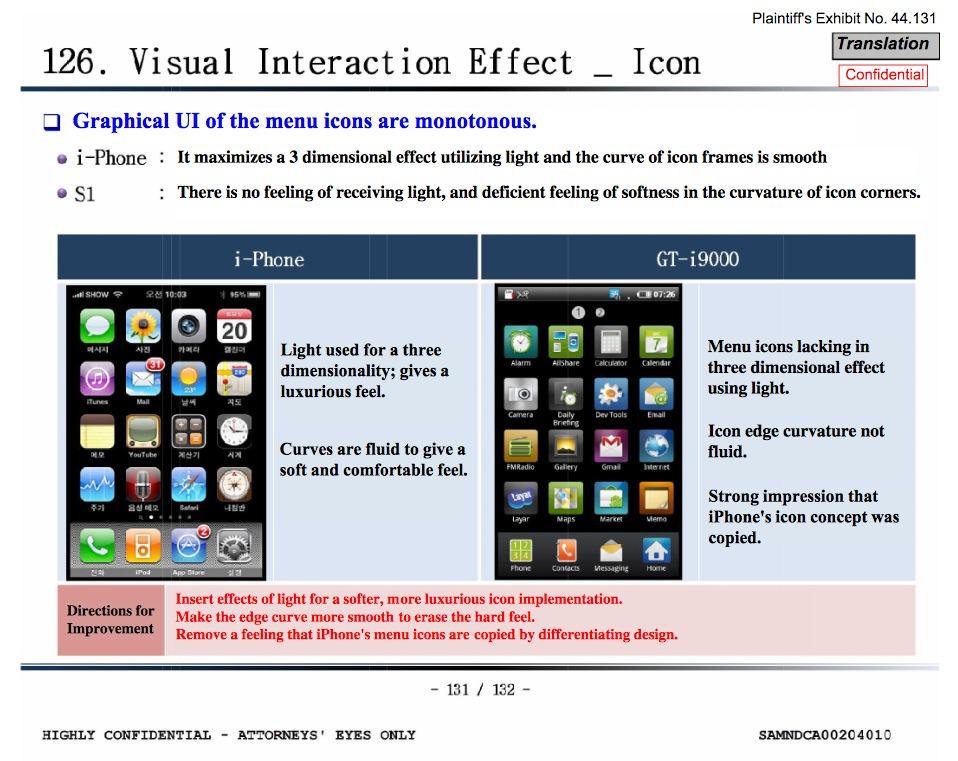
Ironically, it was one of Samsung’s own documents that showed this up—a 126-point slide presentation showing how the iPhone’s design was better than Samsung’s S1, and how Samsung should copy Apple’s design decisions on each of these points. Here’s a representative slide:

Point126

Ironically, two of the points express how Samsung should copy the iPhone’s design, while a third notes that an effort should be made to avoid looking like they were copied. In short, copy the elements which make the iPhone stand out, then change the appearance enough so that it doesn’t look too blatant. Copy but don’t look like you’re copying. Little wonder Samsung lost in the U.S. case, and yet telling that it didn’t lose in Korea, not to mention elsewhere.

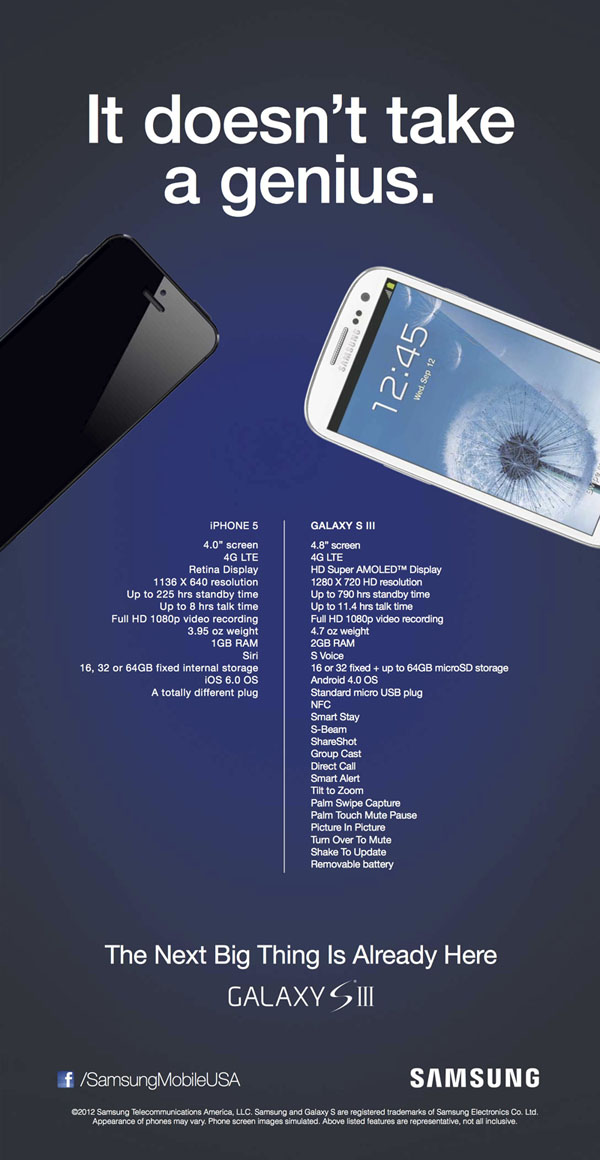
SamsungadAs a result, when one sees someone holding a cell phone nowadays, one often has to look carefully to determine whether it’s an iPhone or something else. Admittedly, the Galaxy S III is visually different to a greater degree, although I was chagrined and amused to discover that in my initial viewing of the ratings list I had mistaken the S III for another iPhone. Seriously.

Samsung also went on the offensive with an ad showing how much better the Galaxy S III is than the iPhone 5, at right (click for the full-size version). One may note that they used differently colored phones, and keep the iPhone off while the S III is on. I confused the two in the ratings list because both were black and shown activated. I don’t think it was a random choice to show them that way in this ad. It would have looked a lot worse for Samsung had they been side-by-side, both the same color, and both turned on.

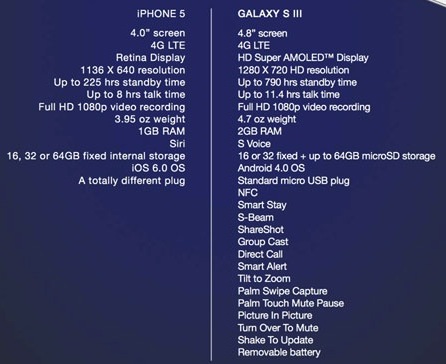
The ad made these comparisons:

Samsungadtext

Samsung actually has some points here, but to a knowledgable observer, it’s clear that they’re not going for actual advantages, but instead are aiming to pad the list.

The screen is one point of difference, but is listed three times. The S III has a 4.8“ AMOLED screen at 1280 x 720, whereas the iPhone 5 has a 4” Retina screen at 1136 x 640. The final point—the resolution—is the only significant difference in most cases. People like big screens, but they also like small profiles. AMOLED gets you better contrasts and deeper blacks with lower power consumption, but Apple’s display has been rated as the best-quality in a broader range of points. And in the end, few will notice the difference in resolution. Advantage goes to the S III in most cases, but not by much.

Another three points are about the battery. The S III has more standby time. However, how many people let their phones remain idle for more than ten days? How many don’t recharge every day or two? Samsung brags about battery life in use; in some tests, the S III’s battery lasted longer, though nowhere near as much as advertised. These running times vary, and the advertised times are based on settings at minimum, which do not reflect real-world use. When the screens are set to maximum brightness and LTE is used, in fact, the iPhone 5 battery actually lasts longer than the S III. In normal use, the battery is more or less a wash. The only significant difference comes with the point Samsung moved to the end of the ad: replaceable batteries. If you find yourself forgetting to charge at night, or are such a heavy user that you run out of battery before you get home, this can be a huge difference (albeit a greater cost), but most people don’t need it. Advantage goes to the S III, but again, not by much.

The Samsung has 2 GB or RAM compared to 1 GB on the iPhone 5. An advantage, but then again, Android uses more RAM, making it more of a wash. Currently, the iPhone 5 runs perfectly well with the 1 GB, making the difference meaningless. However, in a few years, the new OS versions and software will tax that 1 GB. Advantage goes to the S III; by how much depends on the actual RAM requirements of software used. It should be noted that some variants of the S III only have 1 GB, however.

The real advantages of the S III are the removable battery, the ability to use SD storage in a meaningful way, and the larger screen, for those who like that and are willing to put up with the disadvantages involved (increased size and weight, less battery life). NFC is a possible advantage, depending on whether or not you can use it.

Some points are a wash; both do 4G LTE, both record 1080p video. The OS (iOS vs. Android) is a matter of preference.

Other points? Apple wins on weight and dimensions. You might note that Samsung “overlooked” the physical dimensions. The iPhone 5 is notably smaller in all three dimensions: 4.87 x 2.31 x 0.3 inches (123.8 x 58.6 x 7.6mm) for the iPhone 5, and 5.39 x 2.80 x 0.34 inches (137 x 71 x 8.6mm) for the S III. If you give the S III points for screen size, you have to give points to Apple for profile. Advantage goes to Apple, depending on preference.

Samsung’s ad also notes Siri, pitting it against Google’s “S Voice.” According to those who have used both, Siri wins hands-down.

Amusingly, Samsung touts their own “Standard micro-USB plug,” while calling Apple’s connecter “a totally different plug.” After having used it, I must say I love the fact that you can plug it in either way; I used to struggle with directionality a lot, and still do on the iPad. It’s a pain when you’re doing it just as you’re falling asleep, for example; it wakes you up. True, Apple is hogging all the revenue for the new connector, denying cheap copies to be sold for a while. But Samsung’s main charge, that it’s different, is bogus on the fact that Samsung has changed their own connectors more than a dozen times in the past 10 years; this is the first time Apple has change the plug in a decade. I would call this a wash.

After this in their ad, Samsung then proceeds to list 14 different features presumably unmatched by anything Apple has. As noted above, only two are significant: the NFC and the removable battery. Almost all the rest are specific features residing in a category which, if honestly compared with the iPhone, should allow for dozens more Apple features to be mentioned. I mean, really, “Tilt to Zoom”? “Turn Over to Mute”? Many of these are trivial at best.

How about iCloud built in? Shared photo streams? iMessage allowing texting to expand to other devices? Airplay video streaming? Find my iPhone? Apple’s VIP Mail feature, or “Do Not Disturb”? Facetime? These don’t count? Apple’s 700,000 apps don’t count? (OK, maybe 100,000 when you subtract fart apps. Ditto for Android, though.)

Then there’s security. Even with a jailbreak (which cancels out many of Android’s advantages), the iPhone is likely to be more secure.

Then there’s the hardware. Samsung uses plastic; Apple uses metal. I have never liked the cheap plastic feel of so many phones (including when Apple used it), and much prefer the more solid construction. Both use glass, but in drop tests, Apple fared far better than Samsung.

When I have been able to get my hands on an Android phone, I always test the touchscreen. Apple is noted for having the best sensitivity and fine control, and it shows. Relative to using the iPhone, I have trouble using screens of competing phones, and have seen the owners of these phones experiencing the same difficulty.

I have wanted to do a side-by-side with the S III, but ran into another difficulty: I couldn’t find anyone who had one. It made me wonder if it had come out already, but yes—it has been out since May.

And that’s what it really comes down to: preference. And back to: sales. See the ratings list I started this post with. Apple is hands-down the winner in terms of popularity.

One thing that I regularly do when I ride the train is to try to note cell phone use. In Japan, at least half the passengers are using them, or so it seems. When I do a count—how many are using the iPhone versus any other phone—I regularly come out with about the same result: about half the phones I see in use are iPhones. That’s versus every other maker combined.

In a country where the iPhone was supposed to be an abject failure, that’s saying something.

Categories: Gadgets & Toys, iPhone, Technology Tags:

Called It, Again

October 6th, 2012 4 comments

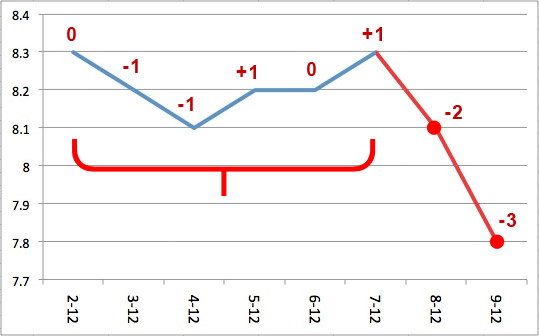
In March, upon seeing February’s numbers, I wrote:

The bad news for Obama is that, for the next 4-6 months, unemployment will not be so hot–it may drop a point or two over the next 4-6 months (numbers might show a drop in June or July more than other months), but may not really start to change again until just before the election–which is the good news for Obama. The rate should start dropping regularly come September, when we see the numbers for August.

Based on nothing but a guess, I would say that the unemployment rate will probably be between 7.6% and 7.8% come November. The last three months, all good gainers, will show up in the unemployment rate in the three months leading up to election day.

Then here’s what happened:

Uechrt

So far: wow. I really did call it, didn’t I? It dropped a few in the 4-6 months following February’s numbers, the started dropping regularly when the numbers for August came out, and fell into the range of 7.6 ~ 7.8%. I’m willing to bet that the figure will be 7.6 or 7.7 % in next month’s report.

Question: will this put a damper on Romney’s fueled charge post-debate? It certainly subtracts from the ammunition he could have fired if the rate hadn’t dropped 0.3%…


I wrote the above last night but fell asleep before finishing up… and awoke to a series of reports I could hardly believe: job truthers.

Really.

A lot of people on the right are now crying foul, forwarding the conspiracy theory that Obama faked the jobs report, in “Chicago style,” whatever that’s supposed to mean.

As it happens, truth beats out truthers:

Betsey Stevenson, the former chief economist in the Labor Department, wrote this morning, “Anyone who thinks that political folks can manipulate the unemployment data are completely ignorant about how BLS works and how data are compiled.” Alan Krueger, the chairman of the White House Council of Economic Advisers and one of the nation’s preeminent labor economists, told Bloomberg today, “No serious person would question the integrity of the Bureau of Labor Statistics. These numbers are put together by career employees. They use the same process every month. So I think comments like that are irresponsible.”

So: the polls show your guy behind? They’re faked! It’s a liberal conspiracy which includes Rasmussen and Fox News! The unemployment rate drops? Fake! A socialist conspiracy from the Bureau of Labor Statistics!

Frankly, I’m surprised they didn’t call Hurricane Isaac, which hampered the GOP convention in Tampa, a liberal conspiracy. It’d be just as realistic a call. Blame it on Al Gore.

Categories: Economics Tags:

And Here’s That False Equivalency Now

October 5th, 2012 1 comment

Liberal blogs are talking quite a bit about Romney’s Blue Streak of Bullshit™ in the debate, but the MSM seems to be largely ignoring it, instead focusing on how well Romney did. And, as I expected, the fact-checkers are going out of their way to create a false equivalency instead of pointing out that Romney was lying his ass off while Obama was staying much closer to the truth. They accomplish this by straining to making Obama’s statements seem less truthful, while ignoring steaming heaps of BS from Romney’s side. Think I exaggerate? Read on.

Here’s an example from PolitiFact, which contorts itself into pretzels to try to make an Obama claim seem like it’s misleading:

Early in the first presidential debate, President Barack Obama attacked Mitt Romney’s tax plan as unbalanced and devastating for the middle class. He charged that Romney’s plan “calls for a $5 trillion tax cut,” and challenged him to defend it. …

The claim is based on a study done by the Tax Policy Center, a nonpartisan group that has analyzed the tax plans of the candidates. The center examined Romney’s proposals for a 20 percent reduction in all federal income tax rates, eliminating the Alternative Minimum Tax, eliminating the estate tax and other tax reductions.

The center estimated that altogether, the lost revenues would total $480 billion by 2015. The Obama campaign adds up the cost over a decade and winds up with $4.8 trillion, which it then rounds up to $5 trillion.

The conclusion is accurate but misleading. Yes, the cuts would total that amount, but as Obama himself noted as he continued speaking, Romney hopes to offset the lost revenues by closing loopholes and deductions. The reductions in tax breaks are as much a part of Romney’s plan as the tax cuts.

In short, PolitiFact is claiming that Obama’s statement that Romney has a $5 trillion tax cut is misleading because it will be somehow paid for? What, that makes it not be a $5 trillion tax cut? I don’t see any misleading info here; it IS a tax cut. Paying for it, or claiming to pay for it, does not make it not a tax cut. Obama stated clearly that Romney claims to pay for it, and PolitiFact even noted that—but called him “misleading” because of the information Obama noted! Apparently, PolitiFact is calling Obama a liar for dividing the information into different sentences instead of telling the whole story in one sentence!

Here’s their summary:

The president made a misleading statement about an incomplete plan, but he did describe what the plan was missing and Romney would not fill in the gaps. We rate the statement Half True.

Gah! They claim Obama was misleading because he made one statement that was incomplete, and then he completed it and told the whole truth!!! How is that not fully true???

PolitiFact also throws in supposedly compounding factors: Obama is counting 10 years of the tax cut—a normal and legitimate measurement—and that Obama is rounding up from $4.8 trillion, adding to the illusion that he’s not being completely factual. Neither really make Obama into a non-truth-teller; both are standard ways of expressing facts within their context.

Contrast that with their Green-Light “True” judgement on Romey’s claim:

Romney reminded Obama during the debate, “you have said before you’d cut the deficit in half.”

The statement is accurate. Obama made the pledge shortly after taking office in 2009. Today, the deficit is smaller, but it’s not half the size it was. We rate Romney’s statement True.

Here, there is no throwing in compunding factors; they do not ding Romney for failing to take into account Republican obstructionism, or the fact that continuing the Bush tax cuts for the wealthy—which Obama tried to stop but the Republicans forced him to concede—is what accounted for most of that failure. Nope, where Obama was called “misleading” just because he claimed one half of the equation—before finishing it and completing the whole truth—Romney is called a truth-teller when he avoids mentioning far more damning mitigating evidence, and never refers to it at all later.

Worse: When you look at their whole report for the debate, PolitiFact completely ignored Romney’s bald-faced lie about Obama doubling the deficit. They give him a true rating for a distortion like you see above, but let Romney get away clean with one of the biggest lies of the night. They also failed to mention that Romney lied about the number of unemployed. I can find neither lie in the PolitiFact page on the debate nor their main page.

The fact is, Romney was clearly lying far more than Obama. However, if the fact checkers start noting this—which is supposedly their job—they seem to fear the same thing the MSM does: being smeared as “in the tank for liberals.” The truth has a liberal bias, indeed.

Who checks the fact-checkers?

Categories: Election 2012, Right-Wing Lies Tags:

The First Debate: Live Comments

October 4th, 2012 8 comments

Not gonna crowd the post with constant comments, but would like to make a few points.

Romney is coming across much better than he has in the past; he is not coming across as very awkward, and does sound passionate, while Obama sounds more level, wonky, and even a little whiny. Side by side, Romney does have a richer voice, and all the stuff he says sounds more appealing than what he’s said before. Obama pauses, Romney doesn’t. Romney is steamrolling through Lehrer and making up his own debate direction, which many may reward. From just watching these guys and not thinking or referencing facts—which most viewers are doing, alas—Romney sounds like he’s scoring as many points as Obama. And this is where the debate may have its impact.

On the other hand, we have a factual assessment… in which case, Romney is coming across the way he has in the past: as a huge liar. He said Obama doubled the deficit: not true, and misleading as the deficit was handed him almost as-is at the same time the economy was cratering. He said he was not going to cut taxes on wealthy people or rack up trillions in new debt, which goes contrary to what he has explicitly stated over time. He dishonestly exaggerated the unemployment numbers. He lied about Obama doing health care before jobs. He lied about public oil production. He lied about government boards and health care. He even dragged out the old “cut Medicare by $716 billion” lie. And that’s just so far.

In short, he’s hoping that all he has to do is lie confidently and convincingly and hope most people won’t look at the fact-checking the next day, will look at partisan “fact-checking” friendly to Romney, or if they do look at the checking, will see false equivalencies and keep some of the initial impressions they got when watching.

And that may very well work. Initial impression: Romney will “win” this debate. Not on facts, but on bull.


Ooohh… Romney just pushed the Religion button.


Romney is probably going to get points for not looking like an idiot or an ass. But a lot of the “not being an ass” element is Romney contradicting much of what he has been pushing for the past year. All of a sudden, he wants no benefits for the upper class and is the champion of the middle class, he loves PBS, he loves all the popular causes he’s been attacking and proposing cuts for. Looks great, sounds great, but is not what he’s been saying all along. He’s definitely trying to reboot himself yet again. All based on lies and BS, but it’s about appearances.


Oooh! A zinger! “Mr. President, you’re entitled to your own airplane, your own house, but not to your own facts.” Make Obama look like an elitists with a private jet while at the same time getting entitlements!


I know Obama can’t spend his time blaming Congress… but Romney’s BS about working with the other side is exactly what Obama said and actually did. It’s something Romney should do, because Democrats would actually cooperate; it’s something that Obama shouldn’t have done, because Republicans were solidly bent on sabotaging the process and had no intention of honest cooperation.


Obama just slipped bin Laden in.


Ha! YouTube cut off their broadcast at exactly 10:30… cutting Romney off just as he started.


Post-debate assessment: Romney won by looking more confident and passionate, but mostly by lying his ass off with conviction. Obama looked beleaguered, stuttering, almost bored. Romney looked far better than when he’s off-the-cuff, his nervous energy serving him here instead of hurting him.

Obama missed at least a couple of huge targets, didn’t even fire at them at all. The 47% as a lead-in to defining Romney, rather than his tax cut program. He could have done a mini-litany of Romneyisms, including “corporations are people,” “I’m not concerned about the poor” and “It’s not my job to care about them.” Second, Republicans in Congress. A tangential target, perhaps, but pointing out that he has pushed jobs plans that Republicans have shot dow, that Republicans have not concentrated on the economy, have put politics above all else—and Romney has done nothing to challenge that, hardly a bipartisan cooperative approach. Finally, Obama should have attacked Romney with as much passion as Romney attacked Obama.

Obama can only come out of this looking good on the facts. Cue the fact-checkers to gloss over some of Romney’s lies and straining to point out every small inaccuracy by Obama in order to achieve yet another false equivalency.


Last word: the jobs numbers for September will be out in a few days. It has the potential to either extend and strengthen Romney’s boost from the debate, or give Obama the ability to stamp it out. I don’t know about jobs numbers, but I have predicted that the unemployment rate will continue to fall, perhaps to 7.9%, which would be a big psychological boost for the economy for crossing the 8% threshold.

Categories: Election 2012 Tags:

Apple Maps, Ctd.

September 27th, 2012 4 comments

I tried Apple Maps a few times for turn-by-turn directions. Didn’t work out too well.

When I tried it in my car, it suggested a route I knew was not the best one. My car’s GPS makes the same suggestion, and I ignore it as well, taking a faster alternate route on a road which is not numbered and therefore is not as “visible” to the GPS. But once I start taking the better route, the car’s GPS comes on board and projects that going all the way down that route is in fact best. Not Apple’s GPS: it kept insisting that I take side roads back to the initially suggested route, even after it was clear that this would significantly extend the travel time.

Next, I tried the GPS while walking. One problem I ran into was not necessarily Apple’s fault: construction blocked a road crucial to the route. It actually cut off the road completely, which was very rare. I also noted that even after I went completely out of the suggested path, the GPS did not re-route. Worse, every time time turned of the phone and turned it back on again, the maps app had reset, completely losing my route, forcing me to re-input the route every time I pulled out my phone; the only other solution was to leave the phone turned on in my pocket. Later, after I had finished, I tried it again and the route had not reset when I closed and opened the phone—apparently, it only loses the route when you actually are using it to get directions…

I also found a driving bias in the GPS tracking: while taking the train home, the GPS locator tried to track my route along adjacent roads. If the road veered off, the GPS location would follow the road, until it was clear I was not going that way, whereupon the location would snap back to the rail line, only to snap to an adjacent road the moment one presented itself. Clearly, Apple does this to avoid the turn-by-turn directions from showing you driving through city blocks, making up for GPS inaccuracies. When you’re not driving, though, it creates inaccuracies because of this feature.

The more I see the maps, the more I see bogus locations, most notably numerous instances of a single train station in multiple locations. Worse, Tokyo’s city geography is largely centered around rail lines and stations, but Apple’s map app doesn’t show train lines until you zoom in a certain amount, and doesn’t show train stations until you zoom in almost all the way.

Also, why am I not getting 3D building renderings in downtown Tokyo? It seems that feature is not active in Japan; instead of a 3D Buildings icon, I just get a button with the characters “3D,” and all that does is tilt the map a little. Hardly “3D” anything.

Apple has to do a lot of work on this. If they don’t hire a couple thousand people to do the grunt work on getting these things fixed, then they’re idiots. This will only work well for Apple if, by next year this time, most of the errors are fixed and the functionality improves. Right now, with the iPhone 5 playing catch-up with Android features and the Maps actually going pretty far in the other direction, Apple is in danger of losing the reputation for best quality that is chiefly responsible for so many people reflexively buying the device.

Categories: iPhone Tags:

We Were Panicking?

September 27th, 2012 1 comment

I don’t think so, but Jamelle Bouie and Bob Moser seem to think that in 2004, we liberals were doing the same thing about polls that conservatives are now:

Around this time in 2004, liberals were panicking. The Democratic nominee for president, Massachusetts Senator John Kerry, was lagging behind George W. Bush, who appeared to be on his way to a second term. This was baffling, and not in a Pauline Kael kind of way. It wasn’t so much that liberals couldn’t imagine the person who would vote Bush—at the time, it wasn’t hard to find a Bush voter—but that conditions were terrible, and it was a stretch to believe that America would re-elect a president who brought the country into two messy wars and the most sluggish economy since WWII.

Obviously, these liberals decided, the problem was the polls. A cottage industry of liberal bloggers and pundits arose to explain how “biased” sampling had skewed the polls. If you weighted Republicans and Democrats correctly, they argued, then John Kerry would be ahead. But that was missing the point. Pollsters don’t weight the partisanship of the electorate in one way or another. They simply survey a large, randomly selected group of people, and report their party identification. If there are more Republicans than Democrats in a collection of samples, it’s because there are more Republicans than Democrats.

Bush won, as you might recall. One lesson that emerged: The party that complains about the polls is one that’s about to have an unhappy election night.

Bouie and Moser, conspicuously, don’t offer any evidence to support their point, nor do they go much into the details. I wondered at the idea that possibly, I could have been guilty of dissing the polls just like conservatives are now. Fortunately, it turns out that I have a blog and can go back and check this stuff out.

So, what was the “liberal cottage industry” in poll-bashing? Were we all panicking because the polls were not favoring us?

Turns out, no. We were suspicious of the polls because the polls showed impossibly varying results:

One really has to wonder if the polls mean anything this year. Ever since the Republican convention, they’ve been going nuts. Just a few days ago Harris had Kerry out in front by one point. But now Gallup comes up and says that Bush leads by fourteen points. No way both are true, or even close to agreeing upon anything. Other polls show similar discrepancies. Kerry is at 41% or at 48%, Bush at 46% or 54%.

This was around the same time that the “cottage industry” supposedly erupted. Ironically, this “liberal” conspiracy theory was suggested by Rasmussen itself!

Concern has been growing over the quick-and-dirty post-convention polls from TIME and Newsweek which show Bush enjoyed a double-digit bounce. Not so fast, though; Rasmussen polls, tracking the numbers day by day, see only a 4 to 5 point lead over Kerry, which is backed up by reports of internal poll numbers from both campaigns. Rasmussen attributes the discrepancy between TIME & Newsweek and the new numbers to the news magazines’ giving more weight to Republicans’ responses in the polling data; the L.A. Times, apparently, made the same mistake by counting too many Democrats when the paper reported a huge Kerry lead earlier in the year.

Rasmussen’s article is behind a paywall, but there’s a reprint of it here.

So, were liberals acting the same as conservatives today? Hell, no. Back in 2004, we saw polls varying wildly, and a professional polling firm, the one conservatives today love best, pointing to inaccurate sampling. We also noted polls leaning too far toward a Democratic bias as well.

Now, in 2012, there is no professional pollster making any such claim, and the polls do not vary nearly as much; conservatives are simply unhappy with the numbers, and are making up complete BS about how it’s all part of a liberal conspiracy, despite the numbers being more or less backed up by similar polls from Fox News and Rasmussen.

In short, Bouie and Moser didn’t look closely enough and got the facts wrong. I suspect that they simply wrote their article based on vague rememberings or secondhand reporting instead of actually checking out the exact genesis of the “panicking.”

Interestingly, they claim that the accuracy of the polls liberals complained about was confirmed by the fact that Bush won. However, the polls liberals complained about had Bush ahead by double digits, and the ones we believed in more had Bush ahead by 4 or 5 points—and Bush wound up winning the popular vote by 2.4%. In other words, the final results were leaning even more toward Kerry than our “conspiracy theories” suggested!

What we seem to have here is yet another case of false equivalency. Liberal questioning of the polls was based upon professional analysis and included balanced views later confirmed by election results. Conservative questioning of the polls is based on nothing but desperation on top of the usual layer of self-serving whacko drivel.

Voter Suppression Continues

September 25th, 2012 3 comments

Republicans, now motivated more than ever to suppress the vote for Obama, are continuing their fight to implement laws which purport to stop a form of voter fraud which has been clearly shown not to exist, asking courts to ignore the obvious intent of the laws to depress voter turnout for partisan political reasons.

How plainly evident this all is only emphasizes how galling it is. This is not “thinly disguised” voter suppression; it is clear-cut and outright. Many of the people directly behind these movements have made public statements clearly noting the intent and purpose. This follows many efforts by the same party (e.g., voter caging, or movements to shut down voter registration, all by conservatives and all against liberal voting blocks) which were clearly illicit, and clearly political attacks against voter’s rights. They have simply taken the dirty-tricks vote suppression tactics to the legislative level.

And yet, somehow, it continues, and is taken seriously by the courts. How obvious does it need to be before courts and the media simply say, “Jesus, you assholes, you can’t just stop the other side from voting!” I’m serious. All Republicans have to do, apparently, is to make a separate appearance in court or in public, baldly claim that they are not being partisan about it, and their claims are accepted as honest.

Imagine that I have a history of fighting with my neighbor. For whatever reason, I hate his guts, so I do all kinds of nasty stuff. I order pizzas and other COD items in his name all the time in order to harass him. I step that up to cancel his water, power, telephone, and gas subscriptions. When that doesn’t get rid of him, I even try to get his name on pedophile and terrorist watch lists. All of this traceable back to me, it is clear what I have been doing to anyone who looks. Then I get myself elected to the city council, and submit a law that would build a street through his house. I even state publicly that “This law should help me get rid of that goddamned neighbor.” When he challenges me in court, can I get my law backed simply by claiming that I have no intent to harm him and the law is really for the public good? Of course not; hearing the history and my public statements, the judge would probably have me thrown in jail on top of throwing out the law. In this situation, reason would prevail—or at least we hope. If the judge were to accept my obvious dissembling and rubber-stamp the law, anyone in sight would be disgusted at the decision. Unless they also hated the neighbor.

How has it come to this, where there can be such a brazen, open attempt to suppress the vote on such plainly partisan grounds, built upon a foundation which is 100% proven to be fictional—and yet it is not being called for what it plainly is? How can any judge see this and not be compelled to call bullshit for bullshit? How can the media report this and not say the blindingly obvious?

The answer: because half the nation is in favor of it, whether actively or passively. Perhaps because they believe that politics is a contact sport, and if you can’t defend yourself, you don’t deserve the power to control. Or perhaps because it’s one of those many things which you accept peripherally because it serves you and so you can easily just ignore it or divorce yourself from it. Either way, half the country is giving it credence—a half of the country which is willing to call “partisan politics” if it is publicly noted. This half of the populace has weight; they buy, they vote, they protest, they boycott. You do not take them lightly. You cannot dismiss them, and you cannot ignore them.

As a result, so long as even the most transparent of pretenses can be invoked, we have to pretend that the other side is not committing a grave crime, else we are somehow “biased.” In other words, the Republicans have worked the system so thoroughly—by, over time, raising the bar bit by bit, legitimizing corruption one small step at a time, using the media to push their point of view further and further—that they can now violate virtually any ethical boundary and hide behind the simple claim that they didn’t mean it in a bad way. It’s the same principle as a member of congress voting for a law that benefits a corporation while receiving huge campaign contributions from that company, and yet remaining pristine simply by claiming that there is no connection between the two.

The fact is, however, that it is simply wrong.

Any politician who forwards and/or fights for such legislation should be ashamed, because they have violated their oath of office and have failed to represent the people.

Any judge who does not dismiss such laws on their clearly groundless merits, or does not at least rule that they are forced to respect it but personally and professionally are repulsed by it and that such laws should all be repealed, should be ashamed, because they have failed to uphold their oath to the Constitution and to uphold the rights of the people.

Any reporter who considers themselves an actual journalist, who reports on this story and does not clearly state this these laws are an obvious attempt to subvert the legislative process so as to subvert the electoral process, should be ashamed, because they have failed to serve the highest, and frankly, the only important principle of journalism, which is to inform the public in a truthful manner, especially concerning issues which are of public import.

Any citizen who allows this kind of law to be passed because they don’t know any better should be ashamed, because they have failed in their highest civic duty, to be an informed voter.

Any citizen who is aware of these laws, sees what they are, and accepts them—especially in cases where it serves their personal interests—should be ashamed, because they have violated and abandoned the core principles of democracy, and thus no longer deserve its benefits or protection, even though democracy is bound to benefit and protect them regardless of whether they deserve it. They should be ashamed because they have selfishly corrupted the system they purport to live by.

All of these people should be deeply ashamed simply because they have done something that is wrong.

Categories: Corruption, Election 2012 Tags:

iPhone 5

September 24th, 2012 4 comments

I got the iPhone 5 yesterday. The deal with SoftBank worked out; they had a plan where Sachi could actually keep her data plan at a bit less than half price. It involved her using my old iPhone 4 and canceling her own phone’s contract—which suited her, as her phone’s home button was glitchy anyway. Mine has the repaired screen, but you can’t tell the difference. My new plan costs 1000 yen a month more for the LTE (which I haven’t seen yet, just 3G so far), and allows free tethering from January 15th n

First impressions: the thing actually does seem considerably thinner. Looking at the specs, it’s about 20% thinner, and you really do see that. I imagine they lost a good deal of it getting rid of the back glass. The new backing does come across as stylish, but it is reported that it is very easy to scuff this and have the coloring scraped away. I have no idea how it happened, but I already have a small ding which shows lighter color on the back edge. This will probably show wear & tear real quick. I’ll have to start looking for cases, I suppose. Kinda defeats the purpose of the thin profile though…

As expected, the slightly larger screen is… well, only slightly larger. You don’t even notice it after a few minutes.

The new connector is very small, and I had to stop myself from check which side was up before plugging it in. Definitely a lot easier to plug in; I never liked the larger connector, to be honest, and don’t have any peripherals that require the old cable—I just have a bunch of the older cables, which are still needed for my iPad.

The phone is noticeably faster. As a test, I ran the “Action Movie” app, the J. J. Abrams special-effects app which adds disaster elements to video you take. It usually involves processing which would take some time on my iPhone 4; the 5 just zipped through it. Definitely better, though this is a jump from the 4 to the 5, skipping the 4S.

The camera panorama seems to work fine, though I have not tested it outside yet. There is definitely the possibility for straight lines getting warped, however; I’ll have to practice to see what gets the best results. I also tried the camera in low light—it did an excellent job, and the flash is also much better.

Maps is a wonky as they say. It didn’t take me long to find errors (Two locations for Higashi-Shinjuku Station, one being in a seemingly random location on a small street nowhere close to the station). The app is artfully done, but lacks details that Google Maps has, and no Street View is a marked loss. I am definitely keeping my iPad on iOS 5, and will be using Google Maps on the web as well… I’ll even get the chance for turn-by-turn directions today in my car! Apple has an embryonic technology and it will definitely improve over time—but Apple does have a history of keeping such software “free” of too much development. We’ll see how it matures over time.

Siri is as I though, a relatively useless little toy. I might find some uses for it, but right now, it just does a mediocre job of understanding me. I could not get it to understand “Shiba Inu,” for example. It also is not able to look up things on maps in Japan, a common lack outside of North America.

The new earphone buds are as I thought: not so great. One of my ears is slightly misshapen (dog attack when I was a kid); ironically, that’s the one the ear bud doesn’t keep slipping out of. I have never had a usable set of ear buds, and these are no different.

More as I use it…

Categories: iPhone Tags:

Why I Got Clobbered by Seibu

September 21st, 2012 11 comments

A few months ago I posted on how the new train schedule had royally screwed me over. Not too long after that, I found out the actual reason, but didn’t get around to posting it until now, having seen a poster just now with the prime reason—they call it the “Convenient Commuter Pass:”

Poster01-1

This is a new sales pitch by Seibu which betrays their real reasons for making the use of merged lines a pain in the ass: they want more money. It’s fairly apparent that under the old system, it was far too convenient for too many people (like me, for instance) to take the trains linking in to the Fukutoshin, which branched off in Nerima, quite a distance out from Ikebukuro.

That’s bad for Seibu because it means that fewer people will ride in along their own line the rest of the way in to Ikebukuro, depriving them of their share of the fares along that section. They seem to have decided that this is unacceptable, and acted to rectify it. They apparently could not just break the connection with the subway lines, so it would seem that they decided to do as much as they could to make things inconvenient within the framework of joint lines.

The plan: cut the number of direct trains going off on the Fukutoshin out of Nerima. Have the ones you retain start closer in, meaning that people farther out on the lines no longer can catch the train without an inconvenient transfer and wait. Have the ones coming in from the Fukutoshin stop closer in, and at inconvenient non-express terminal stations with long waits before a connecting train comes along. In short, make the direct-connect trains fewer and far more inconvenient.

And then start selling the all-new “Convenient Commuter Pass,” in which they advertise the connection with other train lines… but tout how convenient it is to ride the Seibu Line from Ikebukuro, It’s an extra option! You have two ways to get to your destination now! Just look at the poster! See how easy it is? See how close those stations are? See how the commuters all get to sit down with nobody in the adjacent seats? Isn’t that so much better?

Except it’s not. The whole reason why people ride the direct-connect trains is because it’s a pain in the ass to transfer. To switch from the Fukutoshin to the Seibu line means a quarter-mile walk through one of the most crowded rail stations in the metropolis, up and down staircases and then waiting for trains at the tail end of extremely long lines, never getting a seat unless you decide to form a new line for the following train, which means you stand on the platform for 15 minutes or so after a long day at work.

Yeah, that’s much more convenient than staying in my seat on the train all the way.

But with the new pass, Seibu now gets revenue from the Ikebukuro-to-Nerima stretch, regardless of how often you actually use that stretch. Doubtlessly, many will buy the pass, thinking they are getting a deal—and then realize that the Seibu stretch is completely not worth it, even after Seibu totally screwed up their direct route.

I considered registering a complaint, but after consideration, decided it was pointless. This obviously works for Seibu, and since there are no viable alternatives for commuters, they will have no reason to change the system—at least not that I can foresee. I hope I’m wrong, but I don’t think I am.

Categories: Focus on Japan 2012 Tags:

Apple Maps

September 21st, 2012 1 comment

Apple is getting very bad press for its new Maps app, which is understandable due to a transition from an old technology to a new one, and from a mature database to an untested one. It was probably not possible for Apple to transition without glitches like it is now being lambasted for.

The question is, did Apple make a mistake going with its own mapping app? In my opinion: absolutely not. Apple learned that lesson with Microsoft and integral apps like browsers and office suites.

And it showed with maps. When I visited home a year ago, I used Google’s map app on my father’s Android phone, and was frankly startled at how much more advanced it was than the same app in iOS. It instantly became clear: Google was putting all its work into improving the app on their own mobile OS, allowing the iOS version to languish, thus giving iOS and Apple a black eye—and Android a selling point.

Apple would have been stupid to let that continue. And now Google has the gall to release a new, updated maps app to Apple, as if that had not been possible a year ago—upgrading their iOS app only when Apple itself competes. Even if Apple’s map app is a flop, at the very least it will have prompted Google to update their app on iOS (hopefully a decent update this time).

The point is, however, that Google seems to be becoming Microsoft—leveraging their position to screw other people over. So much for “not being evil.”

Categories: iPhone Tags:

SoftBank Slowly Releases Details

September 19th, 2012 2 comments

One detail: they will (finally) allow tethering. Not immediately, but from Jan. 15 of next year. And it’ll cost an extra $6 per month, or thereabouts. And there will be a 7 GB limit. The first two years may be free, but what the “first two years” may mean is open to interpretation—is this only available for new subscribers? It doesn’t look like it, but I would not be very surprised if that was their meaning. In the past, they’ve offered nice stuff only as incentives, like gifts for people coming to SoftBank for the first time, or in exchange for extensions of contracts. You will be able to apply for the two-year fee waiver when the iPhone 5 comes out, so we’ll see.

I’ll also have to figure out what 7GB a month feels like; that’s 233 MB a day on average. That would be something like a couple of Apple Trailer downloads—but if you avoid heavy stuff like that, I imagine you could do just fine with that amount.

Categories: iPhone Tags:

This Is What Romney Shouldn’t Have Said

September 18th, 2012 6 comments

When Romney thinks you’re not listening—from a video taken in the spring:

There are 47 percent of the people who will vote for the president no matter what. There are 47 percent who are with him, who are dependent upon government, who believe that they are victims, who believe that government has a responsibility to care for them, who believe that they are entitled to health care, to food, to housing, to you name it. That’s an entitlement. And the government should give it to them, And they will vote for this president no matter what.

And I mean, the president starts off with 48, 49… he starts off with a huge number. These are people who pay no income tax. Forty-seven percent of Americans pay no income tax. So our message of low taxes doesn’t connect. So he’ll be out there talking about tax cuts for the rich. I mean, that’s what they sell every four years.

And so my job is not to worry about those people. I’ll never convince them they should take personal responsibility and care for their lives. What I have to is convince the five to ten percent in the center that are independents, that are thoughtful, that look at voting one way or the other depending upon in come cases emotion, whether they like the guy or not.
[emphasis Romney’s]

Hmmm. So, I’m dependent upon government checks, am I? Apparently, I don’t take personal responsibility, and I don’t care for my life. Et cetera.

What is significant about this… well, there are several ways that this is significant. The most obvious is that Romney is bashing nearly half the electorate. Way to win over people on the other side, calling 47% of the people irresponsible moochers.

Next, there’s the “47%” number. These are the non-taxpayers, he claims. He makes the remarkable claim that every single one of them is an Obama voter, while every single person in the country who pays taxes is a Republican or undecided. Every single one of them have no sense of personal responsibility; instead, they lay back, take it easy, and live the high life off of welfare checks, food stamps, and free government health care.

So, no Republican is too poor to pay income taxes? Or too rich? No Republican receives welfare, Social Security, Medicare, food stamps, unemployment benefits? And people who do are irresponsible, incapable of caring for themselves?

His statement pretty damning evidence that Romney, like many right-wingers, truly has a skewed view of reality.

The 47% he speaks of includes 17 million senior citizens on social security. These are people who paid into the system all their lives, and now use tax breaks to bring their effective tax rate to zero. Does Romney think they don’t deserve those tax breaks? Does he want to get rid of those breaks for seniors? Way to win Florida.

Another huge chunk of people he mentions are not poor, but middle class families taking standard deductions and getting breaks for the care and education of their children. Does Romney want to get rid of those tax breaks? Way to win middle class families.

Besides which, of course, is the fact that the entire supposition about the 47% is flawed: nobody pays no taxes, most pay their share in social security and medicare taxes, most have property taxes, most face state & local taxes, and everyone pays sales taxes. Add those up and you may have close to the 13% that Romney himself paid.

As for “people who believe that they are victims,” that’s a label much more appropriate for right-wingers. The whole canard about the 47% who pay no taxes is in itself a badge of right-wing victimhood—those poor people are victimizing the decent, hard-working, real Americans who vote Republican! The white males who believe that they never benefit due to their race or gender and that when they fail it’s due to affirmative action, these are people who believe that they are victims. The right-wing Christians who think they are persecuted because they can’t have prayer in every last nook and cranny of public life and because a few department stores print ads saying “Happy Holidays,” these are the people who believe that they are victims.

And entitled? How many conservatives get Social Security and Medicare, and would be enraged if they lost these benefits? How many depend on unemployment checks when they lose their jobs? Remember the right-wing crowds bused in to break up Democratic town halls, screaming “Keep your government hands off my Medicare”? These are people who want all the benefits, but only for themselves, and the people who are not as well off—most of whom paid in to these systems and are just as deserving of the benefits—should be cut off. “I’ve got mine, you go screw yourself” is their motto. That’s not a sense of “entitlement”?

There’s so much more to say about that statement, I can’t put it all down here. But above are the key points. Romney and so many conservatives really think this way, that they are the only ones who work hard and pay taxes, and are being victimized by every single Obama voter, who are lazy, irresponsible moochers who demand to suck at the government teat as if it were their god-given right.

Not just Obama, but all Democratic contenders should use this from now to election day in their campaign ads. Romney thinks that if you get Social Security, Medicare, or unemployment benefits, then you’re a bum who can’t take care of himself, you think you’re entitled. Tell Romney that he’s not entitled to the White House,, that’s he’s not entitled to give himself yet another whopping tax cut, that he’s not entitled to raise taxes on the poor and middle class.