Archive

Author Archive

Yep. This Is What Obama Needs to Say.

September 16th, 2012 4 comments

An Obama Ad which hits the mark:

It has all the elements on the key issue, the economy. It answers the 4-years-ago question just well enough for people to remember without getting too bogged down in details. It mentions the hemorrhage of jobs in 2008 and the growth (though tepid) since; it fails to mention the effect of the stimulus directly, but it is implied. It then paints the differing plans, again hitting the key points. This is a well-planned and -crafted ad. Yes, it glosses over the down points, but that’s what campaign ads do—but even on this point, it does the rare campaign trick: admit you haven’t done as well you you intended while still not sounding like it was a failure. Obama can thank Clinton for planting that seed.

What it does, most importantly, is to win the argument on the economy. That was Romney’s only real hope: blame Obama for the recession. It was, in fact, the Republican Party’s chief goal, as you recall. But here we have Obama beating Romney on that, and it reflects in the polls, which show no advantage for Romney on the issue. Republicans have, amazingly, lost their advantage on security, the military, and foreign affairs as well. The GOP led us in to the recession, into huge debt, and into two massive, costly, and lengthy land wars in Asia while governing over a time of fear and crisis. For all the lingering pain, it’s felt better under Obama, and bringing Clinton out reminds us of the 90’s, now almost a golden age. Obama can say he’s brought back job growth, rescued Detroit, ended the Iraq war, killed bin Laden and brought down Gaddafi. What’s left for Republicans to attack against? Obama can even go on the offensive in these areas, most bitingly against Romney’s tax plans.

Romney would certainly deny that he is planning the tax hike for the middle class, so you could conceivably call Obama’s claim in the ad a “misrepresentation”—but certainly not a “lie,” and I would even argue the term “misrepresentation.” Romney promised deficit-neutral tax breaks for the rich which, mathematically, can only be achieved with the tax hike on the middle class. Romney denies this, claiming that economic growth will magically rocket upwards to a point where all the money falling from the sky will make the break deficit-friendly, but that’s BS. And Romney has failed to take back his pledge about the tax break. Ergo, he may not be directly proposing a tax hike and may utterly deny it, but it is the certain result if he keeps his promises. If I say I will drive my car off a cliff by deny it will crash in the ravine below due to magical flying abilities, it is safe for others to claim that I propose to crash my car in the ravine.

Categories: Economics, Election 2012 Tags:

SoftBank and the iPhone 5

September 16th, 2012 1 comment

So, I reserved an iPhone 5, but I may pull back at the last moment. One issue: they are upping the data plan fees for the LTE network, from about 4500 yen a month to about 5500 yen a month. Another issue: they made very clear that the details of the plan are not yet set. Their basic fees, what speed the LTE network will function at, what coverage is like, whether tethering is allowed, etc. I’ll have to decide when they have the phone ready for me.

Despite what the guy said above area coverage not being set, SoftBank does have an interactive map set up.

SoftBank also plans to throttle if your use is too high, but the rep I spoke to would not specify what the trigger would be or what the lowered data rate could be.

I have to say, though, the panoramic feature is beginning to look a lot better to me; I do use the camera quite a bit, and want to get bigger images like the pano feature can give. And despite not desperately needing the map feature, I look forward a lot to playing with it. Not yet clear yet is whether it, or Siri, will function well here in Japan.


Does anyone know if email and text messaging is data-plan-dependent? Sachi doesn’t use data otherwise, and so for her, the data plan probably is an unnecessary expense. Disturbingly, however, the guy at SoftBank said that she can’t quit the data plan even though her contract has expired—she’d have to leave SoftBank entirely. Which to me, makes no sense—they seem to be saying, go to a competitor—which is what she may do! I’ll call up for an English rep on that though, it doesn’t sound right.


Alas, I got one of those obsequious reps who refused to use simple language for clarity, and had zero ability to clarify beyond rather technical language. He spent 15 minutes trying to explain the two different data plans—one that has a flat rate, and one that starts at a lower rate for minimal use but goes higher than the flat rate if you exceed a certain amount of data per month. That would have been dead simple to explain with minimal language, and yet the guy could not bring himself to simplify his vocabulary.

If, for example, I were an English-speaking rep talking to someone with minimal English ability, I could say, “This plan: use no data, or use a lot of data, price is always the same. This plan: use no data, you get this price; use more data you pay more; use this much data or more, you pay this rate.” Simple as pie. The rep I got, however, never left the level of, “With the flat-rate plan, the data usage doesn’t matter, you always maintain the same level of fees…” and so on, you get the picture. He consistently used a level of vocabulary which made it next to impossible for me to understand. I had to puzzle out the meaning by looking at the literature, after which I would explain it in simple Japanese which he should have used, after which he would sigh in relief and confirm, yes, that’s what I have been unable to express in the last five minutes.

Maybe it’s Japan’s homogenous culture leading to lack of experience in dealing with language differences that makes it impossible for people here to simplify their vocabulary, or perhaps the corporate training forbids exiting teineigo, the polite mode of speech. To me, it’s just hard to understand why these people can’t shift gears.

Categories: iPhone Tags:

The Difference Between K1 and K2

September 14th, 2012 Comments off

The iPhone is being criticized for not being mind-blowing; Timothy Lee of Forbes gives the rundown:

It has a faster processor, a bigger and brighter screen, supports LTE networking, and is thinner than its predecessors. It will doubtless prove to be a capable phone and a worthy competitor to the latest Android gear.

Still, judging from the Twitter chatter and early coverage by tech sites, what’s striking about the phone is what’s missing: a compelling story about what makes this phone better than its predecessor or distinguishes it from its competitors.

He then explains why:

Jobs instinctively understood that most customers don’t care about technical specs, they care about what you can do with a device’s raw hardware. Sometimes, if a new product had a particularly impressive technical improvement—as with the Retina Display—he’d come up with a whimsical brand name for the new feature and make that the focus of the presentation. But more often, his presentations would focus on small number of applications or characteristics, like Siri, that weren’t directly tied to any specific hardware upgrade but made the product dramatically more useful for ordinary consumers.

Had he been around, could Jobs have made the iPhone 5 sound more exciting? Maybe. Perhaps a focus on how much faster LTE is, like the old Mac-to-PC side-by-side presentations Jobs did showing a rendering process or something. Maybe Jobs could have made the new mapping technology a centerpiece.

But frankly, I doubt it. One of Apple’s disadvantages is that it is not competing against one company—Google and Android—it is competing against all other companies that make cell phones. It has to beat all of them out, and that’s an enormous task. Not only that, it has to beat all other phones combined. If one Android phone has features A and B, another has B and C, and yet another has C and D, the iPhone has to have A, B, C, D, and E to beat them. Not exactly a fair fight.

The biggest problem, I believe, is that we’re simply running out of features that knock our socks off. I noted this back in 2010 when the iPhone 4 came out:

One other thing that this makes me think of–there’s so much new stuff on this phone, what’s left to add to the next-gen iPhone a year from now? Seriously. It’ll be hard to make it much slimmer; doubtful they’ll up the screen resolution; no more cameras to add, or video functionality; no more wireless stuff to add that I can foresee. The iPhone 4 didn’t up the flash memory, nor did it add colors, so that could change, but those are relatively mundane “upgrades.” So, what could be added next year that could compare with this year? The iPhone 4 will be pretty damned hard to beat, even for Apple.

The 4S added Siri, but it’s not that easy to create iconic new technologies like that. The “S” upgrades are usually speed bumps anyway; the iPhone 5 was supposed to be one of those every-two-years major upgrades.

And that’s probably its biggest flaw: it didn’t live up to expectations. People have come to expect Apple to hit not just home runs, but grand slams every time. The iPhone is already such a good product, it’s progressively harder and harder to do even better.

This came more to light for me when a student in my class a few days ago asked if I was excited about it, and I gave my “Meh” response. but then they asked about switching from Android, and my response was much different. Students have handed me Androids in the past and I have played with them. They feel plastic and cheap. The touchscreen is less responsive. The interface is less intuitive. I know many people prefer Android, but the phones I have seen it on just feel inferior to Apple hardware and software.

From that perspective, it is my impression that the iPhone 5 is mind-blowing. I think you’re simply getting a much better product. However, coming from the heights of the iPhone 4S, it’s, well, also really good. But from that height, there just isn’t as much difference.

Another factor is Apple’s own popularity and how that has translated into leaks. iPhones in the past had some surprise. This one had zero. Nothing was unknown before the announcement. The taller profile and bigger screen had been known for a year or more, and parts leaks gave us a look at the entire exterior and much of the interior for at least a month in advance. We knew it was LTE from software clues. We knew about all the features in iOS6 already, including the panorama photo feature. The only things we did not know were some minor technical features, like the exact number of megapixels in the camera.

As a result, there was nothing that would surprise anyone who was paying attention.

Alas, a lot of this simply comes back to and down to perception. This was put rather cruelly to the test in this video:

Frankly, I hate videos like this. They play on people’s ignorance—which is the point, yes. But you know they edit out the people who either don’t see a change or who can easily spot that it’s not an iPhone 5. Worse, it plays on people’s desire to be on TV—some of the people in the video look like they’ve been asked to audition for an Apple commercial, and some perhaps think that this is exactly what they are doing.

Despite all that, Kimmel’s video has a point to make: people simply expect every new iPhone to be better, so they see it whether it is there or not. Basic human psychology. It doesn’t mean the new iPhone isn’t faster, thinner, lighter, and better—it just means these poor schlubs aren’t really equipped to tell the difference.


Anyways, I will probably go out and get my iPhone 5 pre-ordered today—SoftBank starts taking pre-orders from 4 p.m. For me, it’s not because I’ve gotta have it, it’s more because, well, frankly, it’s free and there’s no downside. If I thought the 5S or whatever will be out next year would be a quantum leap forward, I might wait, but there’s no special reason to think that. SoftBank subsidizes the entire price of the 16GB model in exchange for extending your contract another 2 years, which I would do with or without a new phone anyway, so I pay nothing extra for the hardware. Is essence, there’s no reason not to get a new phone. It would be turning down a free mini-computer, and while the 5 doesn’t blow me away, it is still a very, very nice product.

Categories: Gadgets & Toys, iPhone Tags:

NFC and the iPhone 5 in General

September 13th, 2012 7 comments

Apple VP Phil Schiller on why the iPhone 5 doesn’t have NFC built in:

It’s not clear that NFC is the solution to any current problem, Schiller said. “Passbook does the kinds of things customers need today.”

Bull.

Number one, since when does Apple wait to fulfill a need until everyone is doing it? With that kind of attitude, the iPhone would never have been created. Apple’s main distinction is that it creates products that do things people want to do but either didn’t know it or they weren’t available.

Second, not every customer is in America. Here in Japan, having NFC would mean I could make payments at most stores and use the iPhone as a train pass. At this time, I am still on the fence as to whether or not to get the new iPhone—an incrementally taller screen, LTE, and a slightly faster processor do not give me anything I need right now, but NFC would completely change the game for me.

Which brings us to the most likely reason Apple did not include NFC and why Schiller gave a BS answer: because Apple was not able to establish an NFC payment system where Apple gets to take a cut of each payment made. Making NFC available in Japan, for instance, would have meant simply making the chip available to be configured to other companies’ setups, which would be fantastic for users, but Apple would see nothing of all that cash flowing through its product.

And I think that is something Apple cannot bear—they have demonstrated in the past that if any transaction goes on within sight of an Apple product, it must either pay Apple or be denied a place in Apple’s domain.

Apple does not want to enable other companies to make money using their product; Apple wants to wait until it can figure out a way to commandeer the profits from NFC payments. Allowing such payments to go without Apple in the loop even for a short time would be a bad precedent.

This is one of the less satisfying aspects of being an Apple user. I am sure that when Apple does NFC, if it does, it’ll be great and either the same price as competitors or better—but Apple won’t allow it to happen at all until it can insinuate itself in the profit chain, and that means people like me have to wait without an obvious and current technology while Apple cuts deals.


Meanwhile, about the phone: As I mentioned above, nothing really knocks my socks off.

4“ screen instead of 3.5” screen? Meh. I use jailbreak apps to space the icons, have had five rows for some time already.

LTE? It’s not like I sit around waiting for downloads on my phone all the time. It works fast enough as-is. Not to mention I have no idea if Softbank will make new charges for LTE use. Now, if they kept the data fees the same but allowed tethering? That might interest me. Otherwise, meh.

The new camera? Sweet, and I would love the panorama feature. But get a new phone just for that? Meh.

Thinner, lighter? So small a change I would probably not even notice. Sexy, sure, but still, meh.

Faster CPU and graphics? Wouldn’t help much of anything I already do, wouldn’t make me do more than I already do. Meh.

Disappointing is Apple’s lockout of new iOS features on older phones—again a maddening move by Apple to push users to buy new products. Siri will still be denied to iPhone 4 users, as will 3D flyovers and turn-by-turn directions in the new Maps app. While that’s frustrating and more than a little annoying, I don’t see myself using Siri much, and can live without the maps features. They would be nice to have, but I don’t like being coerced like that.

I just checked Apple’s iOS page. Turns out they are denying the iPhone 4 with the panorama feature (bastards), as well as FaceTime over 3G (wouldn’t use it anyway).

However, almost all of these will be available on the iPad 3, which I do have.

Bottom line: I will check with SoftBank about my account status. If there are no changes in fees for LTE, and if SoftBank subsidizes the whole cost over two years, making the new iPhone essentially free, then I will probably get it because there is simply no downside to getting it. I don’t see Apple releasing NFC with the iPhone 5S or whatever the next one is called, so I don’t think I’d be shutting myself out of the next phone’s features much.

The only thing that would hold me back: soon after getting the iPhone 3G, I recall SoftBank changed their charge schedule to make the data plans cheaper—but demanded an extra year’s indenture to SoftBank in order to get it. I do not know if that has carried on to this day. If it has, I would avoid the iPhone 5 as a way to unshackle myself from SoftBank, just in case I might want to switch to KDDI. If that year does not apply and I am currently free anyway, then never mind, and iPhone 5 it is.

As for Sachi, we more or less decided that she doesn’t really use the data plan much, so staying with the iPhone 4 would mean we could save about $50 a month, which would be nice, and the iPhone 4 performs well enough.

I guess I’ll have to drop by the SoftBank office today, but don’t look forward to the lines…

Categories: iPhone Tags:

Resentment of Authentic Bipartisan Hugs

September 12th, 2012 1 comment

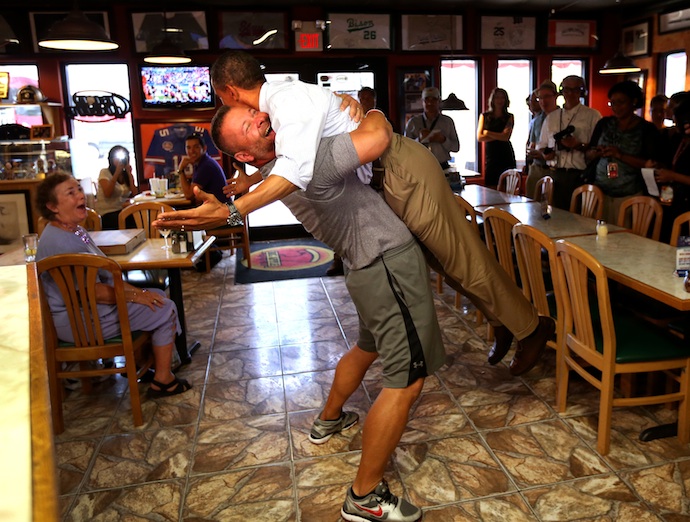
Bearhug-1

Some blowback regarding the Pizza House owner and registered Republican who gave Obama a bear hug:

But once word got out that Van Duzer is a registered Republican who voted for Obama in 2008 and is planning to do so again in November, angry conservatives flooded his restaurant’s Yelp page with negative reviews and began staging a boycott. (Sample gem: “I cringe at the thought even of eating at this Big Crapple Pizza. Knowing O’Hussain was there totally creeps it out for me.”)

This from the same crowd who absolutely adored “Joe the Plumber”? That was a guy who approached Obama with an obviously fabricated premise about wanting to buy his boss’ business, clearly making up a projected income at exactly the level where Obama suggested we start taxing people higher. Joe was making nowhere near that amount, and so constructed a fantasy in order to put him in that range. And still he flubbed the intended “gotcha” moment, conceived to put Obama on the spot for raising taxes on an “ordinary” American like him: even under his artificially inflated income, Obama’s plan still would not have raised taxes on imaginary-Joe, or at least it would have done so very minimally. Even more ironic, under the two candidates’ tax plans, real-life Joe would have gotten a way bigger tax cut under Obama—and as things have turned out, Obama over the past four years has not even raised imaginary-Joe’s income tax level, either.

And yet this posing faker was immediately embraced, adored, and vaulted to celebrity-hero status among the same crowd that now heaps hatred and invective upon a small business owner who simply got a bit giddy at having the president drop by—attacking his business and trying to shut him down just for liking the Democrat in office.

That’s a great way to represent the “Real America” conservatives believe in.

Instead, conservatives should look towards this guy as a role model, not for who to vote for, but rather for attitude and reasoning skills. He makes an excellent point about what “building it yourself” really means:

So you’re not one of the people who feel like he’s let the country down in his first term?

The bottom line is this: I own a small business. I take accountability for my business. I’m not looking to blame the government. And if people had the same mentality of taking care of their own businesses instead of looking to blame somebody when things are a little bad—just tightening things up and doing the best they can—I think we’d be better off that way, too.

Read the interview with him; he comes across as not just reasonable, but smart and compassionate. The guy got his own—and then immediately started working to help others, raising money for families in need and organizing blood donation drives.

I’m not sure what makes him a Republican; I’m sure I would disagree with him on some issues. And even if he had voted for McCain and planned to vote for Romney, I feel like I would still really like this guy. He’s what you wish all, or even most Republicans could be like—and, for that matter, what more Democrats should be like as well.

Categories: Election 2012, Right-Wing Hypocrisy Tags:

Called It. Six Months Ago.

September 9th, 2012 7 comments

The unemployment rate just dropped to 8.1%—and yet virtually every news source is saying this drop is due to more people dropping out of the workforce—not being fired, but quitting looking for work, which is even worse.

Maybe so, I’m not an economist. But then, how was I able to predict this drop back in March? On March 10, six months ago, I wrote:

The bad news for Obama is that, for the next 4-6 months, unemployment will not be so hot–it may drop a point or two over the next 4-6 months (numbers might show a drop in June or July more than other months), but may not really start to change again until just before the election–which is the good news for Obama. The rate should start dropping regularly come September, when we see the numbers for August.

That is more or less exactly what has happened. The rate drifted down by a point a few times, before drifting back up. I was right to be unsure about a pop in June or July, and I was right that for 4-6 months, the rate would stay flat.

But my key prediction was that the rate would start showing a drop come September, one with momentum. That momentum would be marked by a more significant change than a single-point drift like we have been seeing.

Well, the new jobs report is out, and guess what? the rate dropped by .2%. Changes of .2% or more generally indicate more than just a marginal, one-month shift. We’ll see more evidence on October 5 when the next report comes out; if it falls below 8%, then my prediction will be confirmed more surely.

Still, for the moment, I feel confident in saying “I told you so.” An Econ 101 teacher will tell you that unemployment is a lagging indicator, usually by 9 months.

Now, I may be mistaken about what it lags behind—it may lag behind other factors, and may be more in line with job gains or losses. However, I find it at the very least interesting that the unemployment rate so neatly falls in line with jobs reports like it has over the past several years.

The fact that I was able to predict the unemployment rate six months in advance after noting this has to be worth something.

Still, we have yet to see what happens. If my predictions truly bear out, we will likely see an unemployment rate of 7.8 or 7.9 percent (more likely the latter) a month from now, followed by another drop of .1 or .2% in November. Which makes me wonder, will the November numbers come out before or after election day? In any case, I expect to see the rate at 7.6% to 7.8% in November’s report—as I predicted back in March. We’ll see.

What Obama really needs, though, is not just the unemployment rate, but the jobs numbers as well. While it’s good that we got almost 100,000 new jobs last month, I will be much happier to see more robust growth next month, with a re-adjustment of August’s numbers, upwards of course. That, with my expected unemployment number drop from the low eights to high sevens, could give Obama a nice kick upwards, enough to cancel out the bad news this month.

Categories: Economics Tags:

Four Years Ago

September 3rd, 2012 3 comments

Astonishingly, Republicans are asking the question, “Are you better off now than you were four years ago?”

Have they forgotten what the economy was like four years ago? Maybe they meant “five years ago” or something.

Sadly, I think they are depending on people having forgotten about the near-collapse Republicans brought us to; they need Americans to forget that Obama’s stimulus, however underpowered, still halted the horrific plunge that had us losing 800,000 jobs a month and brought us quickly back to positive territory. They instead rely on people simply remembering a vague time in the past when things were better, and that things aren’t so great now—and undoubtedly hope that people won’t think too hard about the specifics. This right-wing blogger, providing an apt example, asks the “four year” question and then shamelessly compares the economy now to the economy three years ago.

The fact that they can ask that question now and not be torn to pieces is hard, cold proof that Americans don’t know as much as they should, don’t remember as sharply as they could, and that the media, far from being “liberal” or “in the tank for Obama,” is in fact criminally derelict in its duty as envisioned by the founders—to ensure an informed electorate.

Otherwise, how could Republicans refer back to a time of economic near-collapse and ask Americans if they want to return to that, and not have the people, much less the press, fall on them in a wave of incredulous contempt?

Categories: Economics, Election 2012 Tags:

Supporting the Troops

September 3rd, 2012 1 comment

Republicans don’t. Democrats do.

I am struck by how Republicans have begun to criticize Obama over Afghanistan. Clint Eastwood seems to think that Obama started the war. As with bin Laden’s capture, Romney and Republicans try to find any way they can to criticize Obama for a war Republicans fumbled and Obama has finally brought to a close. And though Romney has not, like many in his party, promised war in Iran, it is implied if we are to take his statements on the issue seriously—and a war with Iran could turn out to be even longer and bloodier than the last two we have only just now begin to close the door or.

And yet, somehow, still, Republicans have the reputation for being on the side of the soldier, when nothing could be further from the truth.

The public image is reversed, but the public image is wrong. As General Wesley Clark so aptly put it in 2004, “Republicans like weapons systems; Democrats like the soldiers.”

Republicans use soldiers as tools regardless of their safety. Republicans started two massive land wars in Asia, the longest wars in U.S. history, bound to be meat grinders for the soldiery. One was made necessary by a security blunder by a Republican administration and was not only mismanaged by that administration, but was all but forgotten about by them. Bin Laden at Tora Bora. Allowing the Taliban to resurge while Bush started a wholly unnecessary war in Iraq. Soldiers were sent in without body armor or armor for their vehicles. Oil fields were protected while armories full of weapons later used against the troops were left open to looters. Conservatives’ plans for Iran show similar disregard for how many of the military will be struck down as a result. A third land war in Asia within just 15 years? I would agree that a draft would be a bad but perhaps necessary way to bring the real cost into focus for these people, except that these people have always found ways to shelter their own, draft or no; Bush was an excellent example of this.

Republicans love to use the military as backdrops to make them look strong. It seemed that every other public speech given by Bush had a wall of soldiers in the background. Bush made huge PR runs on aircraft carriers (Mission Accomplished!) and on military bases (where soldiers who were not loyal Republicans were pre-screened and locked out of the Thanksgiving dinner Bush used as a PR event; non-Bush-supporters were kept in the barracks and given MREs instead). Meanwhile, military coffins and funerals were banned from sight, out of fear that Americans would care too much for the fallen, and Bush did not even deign to sign letters to families whose loved ones had given the ultimate sacrifice.

But worst, Republicans’ greatest abuse of the soldiery is to use them as a human shield. Reagan used the valor and sacrifice of the troops he sent needlessly and uselessly into Lebanon as a shield when a reporter questioned his reasons for sending them, castigating the reporter for daring to question the honor of the troops, when the reporter was only questioning Reagan’s judgment in putting them in harm’s way. Bush used this coward’s retreat often; any attack on him was morphed into an attack on the troops; a new rule was established that you cannot criticize the president while troops are in the field, a rule conservatives abandoned the moment Obama came into office.

Meanwhile, Republicans cut benefits for the troops, mercilessly extended their tours of duty, and left their families with less and less support, spending money primarily for enticements to get more people to sign up, but then ignoring their needs once recruitment is no longer an issue. While lavish fortunes were spent on mercenaries and fortunes are sunk into often unneeded Defense contracts, relatively trifling amounts that could make big differences for soldiers are struck down by Republicans. The IAVA gives methodologically sound ratings to Congress based upon votes that affect veterans, rating in which Republicans consistently score dead last.

Democrats, on the other hand, have acted with care and caution where it has concerned the troops. Clinton’s war in the Balkans and Obama’s actions in Libya were examples of modern war by Democrats: good causes (stability and human life, not oil) in actions defined by the surgical use of force with minimal or even no loss of life among the soldiery. What funerals there were were not hidden; due homage was paid. Obama has been less than satisfactory in Afghanistan, true; but had he been in charge from the start, do you really think the war would have lasted 11 years? The only bloody military actions Democrats have presided over since Vietnam have been ones left them by presidents named “Bush.”

In the meantime, after the last Bush left, al Qaeda has all but been decimated, with bin Laden at the bottom of the ocean with a bullet in his head. For which, conservatives have only complaint, studiously avoiding any praise for Obama where they would have ordered apotheosis had a Republican been in office.

Democrats do not shy from giving speeches in front of troops, but it is not the common standard that it was for Bush and Republicans that came before. They spend more time actually doing stuff for the troops as opposed to only using them as a convenient backdrop.

Democrats do not use the troops as a human shield. You did not hear Clinton and will not hear Obama saying that an attack on the president is actually an attack on the troops.

But mostly, Democrats care about the soldiers in a contrast with conservatives which could not be deeper or more sharp. Where Republicans cut benefits for the troops, Democrats restore and even shower the troops with help.

Republicans not only disapprove, they despise this.

That’s right. I do not exaggerate. Allow me to give a definitive example.

Less than a year ago, conservatives ripped Obama for praising the troops. They created the false impression that Obama had never said anything good about the soldiers, but then suddenly started praising them for political gain; a false claim, of course.

But the worst part was that they accused Obama of actually abusing the troops, making them into “victims dependent on social-welfare and medical services.” Yep, that’s right. By giving the troops education and job assistance, by giving them good medical care upon their arrival home and paying attention to the emotional scars which have increased the suicide rate, Obama is actually, in the conservative’s view, disrespecting the troops.

Better to do it the conservative way: give them a handshake, salute them, mouth a few cheap platitudes—and then leave them to fend for themselves in a shattered economy in which your are dismantling health care.

That, apparently, is how you “support the troops.” Use them, grind them down, pose with them for a photo shoot, and then abandon them so they can learn self-reliance.

What astonishes me is that the men and women in uniform still trend conservative. Well, maybe not so much, considering the conservative cultural and religious influences built into the military infrastructure; how Fox News and radio shows like Rush Limbaugh and Laura Ingraham are featured in military media.

No doubt the message below will be ruthlessly ripped by the conservatives. The troops are for swiftboating, not for supporting godless liberals.

Lies by the Bushel

August 30th, 2012 4 comments

It has been difficult to watch TV in America recently; I landed here just in time for the buildup and beginning of the Republican Convention. And every time they start showing RNC speeches, I have to change the channel in frustration as I note lie after lie after lie within just a few sentences of each other.

The AP did a fact-check article, pointing out a multitude of lies and misrepresentations in major speeches, but I am not impressed; it’s raining lies in Tampa right now, all you have to do is hold out your hat for a few seconds to get enough material for a book.

Similar checks of PolitiFact show Republicans leading the way in lies, especially Pants-on-Fire ratings. Even more galling when you read the specifics and see that the “Mostly True” or “Half True” ratings usually catch Obama on technical points while most Republicans getting those ratings are actually lying on key points and getting a break on technicalities.

For example, Chris Christie gets a “Mostly true” for saying that Obama added $5 trillion to the deficit over the pas four years, but overlooks the fact that most of that debt was incurred by George W. Bush and not Obama, which was Christie’s intended meaning. Obama bears some of the responsibility, but without crashing the economy, and with Republican obstructionism added in, it would have been literally impossible for Obama to cut much of that budget at all, certainly not without committing political suicide.

Obama, meanwhile, gets a “Half True” for saying that most Americans probably pay more taxes than Romeny—a statement which is only untrue if you make assumptions unfriendly to Obama’s statement.

Overall, however, Republicans are full of it. About a month ago, I did an analysis, but didn’t have time to publish it. IU think the numbers are significant though, as it measures the truth and lies before Republicans got the spotlight. As one could argue that they have more negative showings on PolitiFact just because of greater exposure in the convention (which I think PolitiFact tries to “balance” by paying more attention to Obama), here is a count of truth and lies when the attention was even:


Politifact, which rates politicians’ statements as True, Mostly True, Half True, Mostly False, False, or “Pants on Fire!” has a page dedicated to “Pants on Fire” rulings. These pages have 20 rulings each.

The first page has one “Pants on Fire” ruling about an Obama statement.

The other 19 are all conservative statements, either candidates, pundits, think tanks, other organizations, or right-wing memes in email or elsewhere on the Internet.

Four are by Romney.

Page two again has 19 conservative pants-on-fire rulings, and one chain email from the left. Romney has three pants-on-fire rulings to himself.

You have to go to page three before more than one left-wing whopper appears; there are three (one each by Reid, Obama, and Pelosi). The same page holds five by Romney.

Those three pages take us back a little more than a year. So, let’s see: 60 rulings, 2 against Obama, 3 others against liberals, and 55 outrageous lies by right-wingers, including 12 Romney whoppers.

Obama does less well in the next-worse category, “False” statements. He has four of the latest 20; Michelle Obama, Nancy Pelosi, and Joe Biden each have one.

The other 13 are right-wingers. Romney alone has six.

On the following two pages, Obama shows up 3 times out of 40; Democrats Axelrod and Lew join two left-wing organizations to have “False” judgements, bringing the liberal total to 7 of 40.

The remaining 33 are right-wing people or groups. Romney had six of them.

To sum up: conservatives account for 55 of 60 of the most outrageous lies in the past year; Romney made 12, Obama 2. Conservatives also made 46 of 60 of the outright lies of the past 6 months, with Romney again responsible for 12, and this time Obama having 7.

Not hard to tell who is lying the hardest, even without resources like this.

Categories: Election 2012, Right-Wing Lies Tags:

Skeeters Bin Busy

August 26th, 2012 3 comments

Lots of bugs in the countryside, there are. I have been scratching quite a bit recently. In Japan we get that too, but usually I don’t get anything but bug parts when I slap one. Not so here:

Mosq1

Mosq2

Not one, but two mosquitoes I caught flying in a logy manner in the room. Slapped them, and got a few drops of my blood back.

Categories: Travel Tags:

Try Something Different This Time

August 25th, 2012 3 comments

Upon the eve of the 2012 elections, the economy is not doing well. Why is this the case?

After Obama’s election in 2008, Republicans announce a policy of obstructing progress and reform, saying that it “works for” them. They fight against the Stimulus, eventually watering it down to the point where it is far too ineffective. They fight against health care reform, watering down that as well, costing billions and offering alternatives that would balloon the budget and cost massive numbers of jobs. Instead of focusing on how to fix the economy they broke, they instead focus on sloughing off blame on Obama for doubling unemployment and losing millions of jobs, while fighting to maintain the policies which decimated the economy in the first place. Republicans fight equal pay, fight minimum wage increases, fight unemployment benefits, fight stimulative spending. Republicans announce that their primary goal is not jobs or fixing the economy, but making Obama fail so they can retake the White House. Republicans force the extension of Bush tax cuts, proven to significantly deepen the deficit while being poison to job creation. Upon gaining control of the House, Republicans fail to act on jobs, instead focusing on things like restricting abortions. Republicans instead push for cuts, admitting that it would kill jobs. Republicans repeatedly put “nuclear options” into play, sometimes over severely ideological issues like Planned Parenthood. Republicans pass budgets that promise job losses. Republicans threaten defaulting on the debt, causing the US credit rating to be downgraded for the first time in history. Republicans kill Obama’s jobs bill, even though it offers $250 billion in tax relief. Republicans finally offer their own “jobs” bill which essentially includes deeper tax cuts for corporations and elimination of regulations governing pollution and corruption, none of which would create jobs.

So now, four years later, the economy has not yet recovered from the devastating effects of the Republican policies that led to the effective depression we suffer from today.

Republicans point at Obama and shout, “Look what he did!!

Yes, the president owns the economy, for better or for worse. All the media plays into this, acting as if Republican policy to essentially sabotage the economy somehow does not exist, and only Obama is to answer for it.

That may be a political reality. But it is not reality.

Had Obama been free to do what he wanted, the economy would look far different than it does today. Obama may own the economy, but he was far from alone in creating it.

The key point: Republicans have been far more destructive to the economy, even openly stating goals which work against economic recovery, again openly admitting their goals in this are to gain political power.

The answer to this is not to reward them with more power.

The answer is to give that power, definitively this time, to Democrats, even just for two years, so we can see what Democratic policies would reap without Republicans poisoning everything.

If, after two years, things don’t improve, we can try something else. But the idea that Democrats have tried and failed, or that Obama has tried and failed, are fiction.

But that’s just reality. My apologies.

Isaac and Gustav

August 25th, 2012 Comments off

2008 and 2012. Two Republican National Conventions, four years apart. And both have found themselves threatened by hurricanes. One of them in Minneapolis, the last place you would expect to be threatened by a hurricane.

But now the Republicans are in Tampa Bay, and Isaac is now heading more or less straight for them, again threatening heavy rain.

Just coincidences. But let me ask you: had these hit two Democratic National Conventions, both featuring Barack Obama, would we not be hearing, pretty loudly in fact, about the involvement of the hand of God?

Just saying.

Categories: Election 2012 Tags:

Romney’s Evasions Are Nothing New

August 18th, 2012 6 comments

During some Q&A with reporters, Romney claimed:

I did go back and look at my taxes and over the past 10 years I never paid less than 13 percent. I think the most recent year is 13.6 or something like that. So I paid taxes every single year.

At first, the thought was, hmm, okay, he’s on the record, so he’s probably telling the truth.

But then everyone started to realize that Romney’s statement was not off-the-cuff, but had been very carefully phrased—so much so that it means almost nothing.

Remember, words—especially when talking about money and economics—can be very cleverly phrased to make something sound like the exact opposite of what it is. A case in point is a Limbaugh favorite, to support trickle-down economics: “In the 1980’s, Reagan lowered taxes, and revenues doubled.” The statement is simple, to the point, and each part of it is true—but the whole statement is as bald-faced as lies get. The revenue doubling does not discount inflation, which makes up most of the increase, leaving only a 19% increase during Reagan’s terms, as much as 7% of which was due to simple population increase; and although Reagan lowered some taxes, he raised others more, making the premise of lowered taxes causing increased revenue unsupportable.

So, how about Romney’s statement?

Note that he did not say the magic words “federal income” taxes. He just said “taxes.” Also, note that he did not say what income he paid the 13% on. It is very likely, almost to the point of assuredness, that Romney paid no taxes on his capital gains income in 2009, and since that constitutes much of what he makes, it is likely that he was not including that in his statement.

In short, what Romney said was essentially meaningless; by playing with words, he could be saying that, if you take his non-capital-gains income, and include property taxes, sales taxes, state income taxes, and every other tax he can account for, the taxes he paid could well add up to more than 13% of his non-investment income.

And yet, in terms of federal income tax, which is what the question was actually asking about, he could have paid zero or close to zero for one or more of those years.

It is similar to what his wife is saying, that they have done what is “legally required,” when in fact, no tax returns are “legally” required and no one suggested they were; and that no one is suggesting that they illegally evaded taxes, instead the whole issue being about what is legally possible to evade.

You have to remember, though, that this is nothing new. In 2000, the question came up about Bush and drugs. At first he tried to evade the question, then he made statements about how he could have passed White House background checks when his father was president—which only ruled out a few decades, but left open the possibility that he was a heavy cocaine abuser in his 20’s. The fact that he didn’t just come out and say, “No, I never used hard drugs” essentially meant that he had, and knew that if he made a statement that he had not, it was possible that some witness or evidence could emerge to contradict him.

The same is true here: Romney is playing games, hoping to twist and turn through the slippery use of language until the media tires of the cat-and-mouse game and turns to other issues.

However, his reticence on his taxes has been so damaging that it is obviously clear that there are details in his returns from 2009 at least, and probably in earlier years as well, which are pretty damning in some way. Romney has judged that it is better for people to suspect that he possesses embarrassing wealth and uses his privilege to avoid his civic duty, than to open his records and remove all doubt.

Categories: Economics, Election 2012 Tags:

Overweight States

August 17th, 2012 6 comments

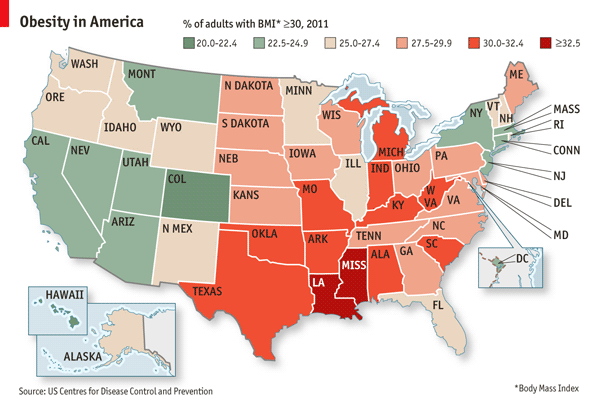
The Economist released this map showing obesity rates by state:

20120818 Wom065 1

I compared this map to ones showing poverty, religious intensity, and many other factors of life, but could not find anything that matched well. One page found a very significant link between diabetes and poverty, but that seemed to indicate a more direct link between poverty and medical care than poverty and obesity.

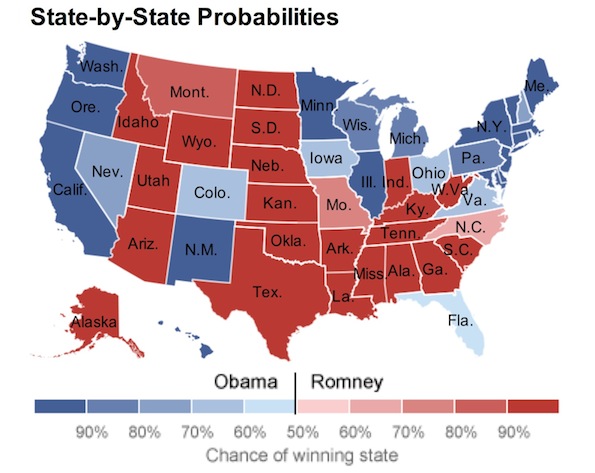
Interestingly, this map from Five-thirty-eight constituted the best, if still imperfect, match:

Polmap

It’s hardly a 100% correspondence, but the similarities are striking, are they not? The question is, does this mean anything? Does conservatism cause obesity? Does obesity cause conservatism? Or—in my opinion, more likely—are both conservatism and obesity symptoms of something else, like poor impulse control? Ask Rush Limbaugh, perhaps.

Categories: The Lighter Side Tags:

Yes, Ryan’s Medicare Plan Would Hurt Seniors Already on Medicare

August 16th, 2012 1 comment

A reader at Sullivan’s blog put it very succinctly:

The Ryan Medicare plan absolutely will effect people currently on Medicare. If you establish that in 10 years the Medicare risk pool will stop growing and start shrinking, you do damage to how the program works. First, you increase the risk in the pool and drive up cost by stopping younger healthier seniors from entering the plan. Second, as the pool shrinks Medicare looses [sic] power to dictate reimbursement rates. Doctors will begin not to accept Medicare patients because not only will the volume of patients no longer justify the low reimbursement rates, but those left in the pool will be older, sicker and more expensive to treat. The program that they say will be in place will not only become much more expensive to maintain then projected, but it will collapse on itself.

Let there be no doubt: that is their ultimate goal. Republicans have made it agonizingly clear over the years: they want to get rid of Social Security and Medicare. Not reform, not preserve, not save. They want to fully eliminate these programs, preferably phasing them out by transitioning to private “programs” which will essentially be equal to people buying private-market pension and health care plans by themselves, with private industry skimming a 10 ~ 30% profit (which currently goes to benefits for the payer) right off the top, whilst being mostly unregulated and therefore much more easily able to raid the remaining investments.

The result will be that in the short run, seniors slowly notice their benefits collapsing, costing more and giving less. In the end, we’ll be back where we were 80 years ago: if you’re not wealthy, you’re going to get inferior health care–and even if you were able somehow to save money your entire life after well-paying jobs got shipped overseas and the conservatives lowered your salary to below-poverty levels by abolishing or neglecting the minimum wage, you are liable to lose whatever retirement savings you do have to financial skullduggery of one form or another by rich bankers.

Welcome to the 19th century, folks. Didn’t you know that conservatism is all about driving us backwards? It is right there on the label, after all.

Republican Judge Affirms Vote Suppression Act

August 16th, 2012 1 comment

Welcome back, Mr. James Crow! You now have a wider audience to block, including the poor, the elderly, and students!

Thanks to a Republican judge, the Republican law in Pennsylvania requiring specific types of photo ID to be presented for voting is now sustained, and due to his careful wording, it may be hard to overturn, despite the clear bias inherent in the ruling itself.

Fact: there is no evidence of any kind whatsoever indicating that vote fraud even exists beyond a few scattered cases, while it is a statistical certainty that at the very least, thousands–possibly tens of thousands–of legal, eligible Democratic voters, some of whom have voted regularly for decades, will be unable to vote because of this law.

Fact: as many as 11% of all voters lack the correct ID, and some will be forced to go to unusual efforts to acquire them, while other will have been misinformed, even by the Republican governor himself, as to whether their current ID is valid or not. As many as 1 million voters in Pennsylvania lack the right ID, and 379,000 do not have the documents required to get that ID. Many in the state would have to travel to state offices in other counties which are only open once a week, and there are only funds for 1/10th of the number of people who need IDs–meaning that hundreds of thousands of Pennsylvanians would be subject to a poll tax. The only solution is absentee voting, which would require a visit to a doctor and a doctor’s note and then an application process, clearly an unusual hurdle just to vote.

Fact: the laws disproportionately affect Democratic voters to a great degree, and were pushed through on a wholly partisan basis by the party that stands to win the vote–a party which has already performed heavy redistricting in that state to tilt the vote further in their favor.

Fact: Republican Mike Turzai, Speaker of the House in Pennsylvania, stated outright, in a checklist of partisan goals, that Pennsylvania’s voter ID law would “allow Governor Romney to win the state of Pennsylvania.” This bolsters the proof that state Republicans had a partisan goal in pushing through the law.

And yet, the Republican judge ruling on the case decided that none of this “clearly showed” that the voter suppression act “denied voters’ rights.”

Right, judge, it doesn’t deny voters’ rights, except for those tens or even hundreds of thousands of young, elderly, poor, and minority voters which your Republican-tinted goggles make invisible to you. And of course, those same goggles make the clear-as-day partisan vote-rigging going on also invisible to your eyes. Because we all know that Republicans are actually concerned about voter fraud and are completely unaware that the problem is in fact non-existent, and just happened to introduce a law which completely coincidentally disenfranchises hordes of voters from the other party, and statements made about how this will help Republicans win elections were completely honest mistakes and misunderstandings.

Really, how fracking blind do you have to be to take even a cursory, much less a detailed, look at this issue and not see the painfully obvious fact that this is election fraud writ large?

Those are quite some goggles, judge. Quite some goggles, indeed.

Hard-Hitting Ad

August 14th, 2012 3 comments

But factual:

With Romney, it was only possible to infer tax hikes for the poor and middle class; he said what he would give the rich, and then said that he’d pay for it but not how. However, there’s only one real way to do that.

Imagine a guy standing next to a vault, with a box of dynamite nearby, and no one has the combination. “I promise I will open the vault,” he says.

“Do you have the combination?” you ask him.

“Nope,” he says.

“Do you have any special tools, a cutting torch or diamond drills?”

“Nope.”

“So, the only way to open it is to blast it with that dynamite right there. Will you use the dynamite?”

“I’m not saying.”

With Ryan, however, the picture is a bit more clear. Ryan has made positive statements about some of the stuff he plans. His math is fake and he still holds back on many details, but he is on the record about a lot of draconian crap he plans to pull.

Romney has tried to distance himself on this, but it’s what Ryan is known for. It’s why Ryan was even in the field in the first place. Choosing Ryan not for his budget and Medicare plans would be like the Yankees saying they got Ichiro not for his batting skills.

Romney is trying to do what he has been doing: veering hard right and then calling foul when people say he veers hard right.

Categories: Economics, Election 2012, Health Issues Tags:

Preserving Beer

August 14th, 2012 2 comments

You go into a bar and order a beer. They serve you a drink, but it has no head of foam, and in fact is clear as water. You taste it. It is water. “Hey!” you object, “I ordered a beer!”

“That is beer,” the bartender asserts. “We overhauled it. That’ll be seven bucks.”

“But beer costs five dollars here!”

“I told you,” the barkeep replies. “We overhauled it.”

“What’s with this ‘overhaul’? It sounds like a stupid idea.”

“Beer sales weren’t making enough money before. We would have had to stop serving beer. In order to preserve your ability to get beer, we made necessary changes. But it’s still beer.”

“No it’s not! It’s water!”

“It’s still a beverage. We just swapped out some of the ingredients. Stop whining.”


This is essentially what Ryan’s “Medicare” plan is: to end Medicare and replace it with something completely different, but still call it “Medicare.”

Ryan was only slightly more opaque; his plan was to give seniors “vouchers,” a set amount of money, so they could buy private insurance. It amounts to the same, however: private insurance costs more and gives lesser service, meaning that Ryan’s new program–one must refuse to call it “Medicare” because it is not “Medicare”–would instantly deliver less service to participants. It would effectively be a government subsidy of private insurance, exactly the opposite direction our system needs to go.

Worse, the vouchers would increase by the overall inflation rate, and not by the inflation rate of health insurance, which is notably higher. Thus, benefits would slowly decrease over time, making the coverage less and less each year. To top it off, Ryan would roll back the age of eligibility to 67.

So, waiting until you’re 67, getting a voucher which would buy you inferior care, which would decrease every year.

But it’s still an insurance plan, so let’s call it “Medicare.” See? We just “preserved” Medicare!

The Devil Is in the Details, And Immigration Doesn’t Say Much about the Devil

August 13th, 2012 5 comments

So I am leaving for a business trip to the U.S. soon, and Japan has just adjusted its immigration laws and procedures. One welcome change: re-entry permits are no longer required.

However, there are other details as well. Rules are different between regular visa holders and those with permanent residency. And there’s a new “Residence” card to replace the “Alien Registration Card.”

I have not had time to get the new card, and after all, I am not required to change until 2015. My last re-entry permit expired, but they say you don’t have to have one any more. Feeling my “Gaijin-ey Sense” tingling, I wanted to make sure: if I travel outside of Japan without a new Residence card and without an old-fashioned re-entry permit, am I still OK?

I called Immigration in Shinagawa to make sure, and they said “yes.” I called the Narita office, and they repeated the same thing. Still paranoid, I called the main immigration office again and spoke with a supervisor. Same answer.

Just to be on the safe side, I spoke with an advisory center for foreigners, who told me the same thing, but added one tiny little detail: on the embarkation-disembarkation card they have you fold inside your passport, a new check box has been added: it reads, “みなし再入国許可” and “Departure with Special Re-entry Permission.”

If you don’t check that box, you lose your visa status, including your permanent residence status.

I called Narita once more after learning that, and they gave me the same vague reassurances they had before. I asked if there was anything else, they said “no.” I then asked about the check box. The guy said, “Oh yes, You have to do that too.”

Well, thanks for giving me the heads-up on that.

Okay, maybe they make sure you check the box at the airport. Or maybe it’s something everyone must do and they did not think of mentioning it in answer to my specific question.

And yet, with the consequences as dire as that for such a tiny little detail, one would think they would mention it in passing. You know, “Just make sure to check the ‘re-entry’ box on you E-D card!” To which most people would reply, “The what on my what?”

I really have to wonder how many people are going to walk into major trouble because that detail is glossed over.

Categories: Focus on Japan 2012, Travel Tags:

Is Government Necessary?

August 12th, 2012 13 comments

Part of an analysis of Obama’s “You Didn’t Build That” false controversy:

Jefferson, whom Democrats claim as the progenitor of their party and whom they celebrate with annual “Jefferson-Jackson Dinners,” was perfectly clear. The people of the United States created the government for one purpose only: to secure their rights. That is, the people, their possessions and their God-given rights existed prior to the state, which the people created to serve them.

With his Roanoke speech, Obama turned Jefferson on his head. In Obama’s formulation, government is not a tool for the people’s use, but the very foundation upon which all of American prosperity is built. Government is not dependent upon the people; the people are dependent upon the government.

Aside from the question of whether the author’s interpretations of the founders’ intentions are correct, the real question here is, can we say that Obama’s analysis is true? Do we depend on the government for being who we are?

The answer is easy: of course we do. I am tempted to add the biting comment, “Duh.”

We would be a completely different nation had we followed limited intentions as to the role of government. The fact is, we have grown, evolved, and become much more than was first established or envisioned. Had we not, we would not be the world power we are today, and we would not have the society we have today.

Historical romanticism is good and all, but you cannot base modern governance upon an ideal of returning to the principles of the role of government which may or may not have been an intended ultimate limit back when we were a fledgling agrarian society in a completely different age where human rights were delegated to a privileged few.

We should also not be fooled by the idea that this is about principles. Those espousing severe cutbacks in government programs are not doing so out of love for historical virtue. It is a more visceral reaction based upon avarice and bias. All the good that government does and has done is either dismissed, taken for granted, or subsumed into accomplishments by agents other than government. The cries for cutbacks come primarily from a desire to funnel money to the sector from which the cries originate while cutting as much as possible the burden of those doing the crying.

As a result, we see not so much reason and support as we do rewriting and obfuscation.

The writer of the article does essentially that. He first dismisses Obama’s idea that the middle class owes much of its existence to the the federal government by throwing up the straw man that Obama’s argument rests upon the supposition that the “middle class” at the time of the revolution would have to have been created, or allowed to form, by King George. Then he dismisses the entire argument about infrastructure by bizarrely arguing that this was the people acting, and not the government acting, defining the difference as being that the American people had tight control over how far the government would go in such endeavors. In short, the key to his argument seems to be based upon redefining things so that he’s right.

This has nothing to do with the argument being made publicly today, including the response to Obama’s statement: that government should not be, nor should ever have been as big as it is or as involved in advancing the general welfare of our nation. Building the nation should be up to private enterprise, as should health care, pensions, schools, security, and most everything else. And if you build a business, it’s all you and the government never did anything to help you–instead it only hindered you. Because we all know that government can never actually create any jobs, and when it tries to help, only horrific disaster ensues.

The question, then, goes back to that fundamental idea which the writer proposed, or more specifically, to the idea being forwarded by conservatives today: that the sole purpose of government is “to secure our rights” and anything beyond that is irrelevant to our achievements, or has actually held us back.

To consider this, you have to ask, exactly how does government secure our rights?

In the minimalist sense, government should do nothing more than is absolutely necessary to see that our rights are preserved. This would require a very small government, defending our borders and doing minimal policing inside them. No foreign wars would be prosecuted; no special services or assistance would be rendered to the people; no involvement in the economy would be performed. The government would make sure we’re not molested from without and do the bare minimum to preserve order within, and otherwise try to be as invisible as possible to the people. No huge projects, no safety nets, no redistribution of wealth. No trying to make the people better, just maintain the status quo and leave the rest up to society without the government sticking its nose in. No forced integration, no affirmative action, no government condoning of things like gay marriage.

Think over our history and how this would have affected our development as a country. Would we be who we are today without that?

Hell, no. We’d be a completely different society, and not a better one. We’d still be capitalist, but with income inequality even more severe than it is now. We would have become a plutocracy far beyond what we see today, with a manufacturing economy spreading from the north based on slave wages, and an agrarian economy from the south based on slave labor. Slavery would have lasted far longer, perhaps even into the present, with civil rights probably still only a dream. Public education would have been for-pay and only for those with wealth, as would be any kind of substantial medical care.

Despite being wealth- and production-centered, American industry and business would not have grown as it did. There would have been no government push for infrastructure. The rail system would have been minimal, interstate highways never built. Electrical systems would not have grown beyond sparse usage. Everything that our government has spent a great deal of money on in terms of infrastructure would have only been built as far as it was economically viable for private business–in short, not nearly as comprehensively as we have today. This would have saved money for businesses in the short run, but stunted their growth terribly in the long run. Computer technology was primarily funded by government spending, even as far back as the 19th century; that industry would have been greatly delayed, and infrastructure like the Internet never built. Ironically, it has not been the people bleeding the rich and the businesses for welfare checks, it has been industry calling for taxpayer money to build infrastructure too expensive for them to build themselves.

The author of the article suggests otherwise, and the argument could be made that building a national infrastructure is vital to preserving the rights of the people. (Ironically, these same conservatives are trying to stop infrastructure spending.) The problem with that argument is that if you take the idea of “preserving the rights of the people” as far as doing things like building infrastructure (acting positively to improve the society the people live in) then you essentially have the government we have today–in fact, you actually have a far more socialist government than we have today. How is providing financial security and good health to the populace not preserving their rights while building an infrastructure is? Really what the author is saying is, “We’ll stick to the absolutist principle except for stuff we like.” Sorry, but no–this is a situation where you cannot be “a little bit pregnant.” Either government works to preserve the rights of the people actively, or it doesn’t. Anything else is not principle, but instead is cherry-picking. Either we stick to the barest principles of the founders or we expand beyond it. You can’t establish a principle and then pick and choose when to violate it and still say the principle is sacrosanct to suit your needs. Sticking to the principle would have meant no government building of infrastructure, instead leaving it to private industry. And the fact is, we have decided as a society to act in the people’s interest.

Minimalists would have furthermore only protected imminent threats to our borders, but would not have participated in conflicts overseas. Even the Monroe Doctrine might not have passed. America would not have expanded its influence overseas, and would have sat out the first two world wars, figuring that we were not threatened because it would be too costly for European and Asian powers to bring war to American shores. America would never have become a world leader, and its ability to extend trade beyond its own shores would be in grave doubt.

I could go on, but you get the idea. All of this and far, far more serves as the foundation for the America we all know and want to have. It is all based on a strong central government which has grown well beyond simply minimally maintaining the rights of citizens–something which, when the Constitution was drafted, was limited mostly to wealthy white male land owners in any case.

What the government became, and what conservatives are trying to deconstruct, is a government which acts as an advocate for the people. If industry pollutes, the government stops them from harming the people. If a group is deprived of its rights by a bigoted majority, the government protects the rights of the people, not the ability of the majority to persecute. If the people are forced through desperate poverty to work for ruinous wages in harmful conditions, the government becomes their advocates. But the government does more than just that; it has tried to create a society where, as in a family, no one gets left behind to die in the street. It intervenes so the elderly are not forced to sleep under bridges in winter because some rich bastard stole their pension funds; so the poor are not made to starve in a land of plenty; so people can expect decent medical care without having to pay a king’s ransom because an industry holds their very lives as hostage.

Conservatives hate this. To them, it means that they are paying money for some freeloading bum to live in the lap of luxury with washing machines and big-screen TVs. They see a stark dichotomy with them doing all the work and making all the progress while half the nation sits on their ass without paying a dime in taxes, smoking dope and buying booze with food stamps, acting as parasites on the teat of big government. Reagan’s mythical welfare queen, now on steroids and writ large across an entire class.

Conservatives hate this straw-man moocher. You heard the crowds at the debates, not cheering, but shouting in outraged triumph at the idea of letting a poor schmuck die cold and alone in the streets instead of making them participate in paying for health care that would save the man’s life. You heard the crowds bused in to disrupt town hall meetings: I’ve got my Medicare, don’t you dare tax me to pay for health care for the poor. This is what they mean when they say they want “their country back.” It is what this all really comes down to: not a return to the founders’ glorious principles, but instead, “I want the benefits of government for me, not for those other bums.” Its just like the vote-suppression movements: “this country is for me; I deserve it and you’re a no-good parasite; you can go to hell!” They see others as being selfish when in fact it is them.

Obama was perfectly correct, and those who think government should never have grown beyond its infancy are indulging in a pipe dream. We are, in fact, not just dependent on each other within our own borders, we are dependent upon the world as a whole. Contrary to the fantasy world some libertarians dream of, you cannot have even a fraction of the wealth and prosperity we have enjoyed without also requiring exactly the things that these people wish never existed. Anyone who thinks they built a business and did it “completely” on their own is sadly and selfishly mistaken. Anyone who believes they would be better off without government is a fool.

The fact is, were the “drownable in a bathtub” government to exist, these people would not have a fraction of the things they presume have appeared because of their own individual efforts or the independent might of free markets. They are prosperous and believe they owe no one else for that prosperity.

Reality is very much distant from that presumption.