Archive

Author Archive

No Occupancy

June 5th, 2012 1 comment

Michael Kazin opines on why the Occupy movement fizzled:

[T]he Occupy movement gave American leftists a chance to appeal to millions of their fellow citizens who care about the same crisis they do and were willing to listen to egalitarian solutions. But the open-ended nature of the movement and, to paraphrase Marx, the incubus of failed ideas and strategies on the left still weighs heavily on its fortunes.

I disagree. I stated last October:

A real problem with the OWS protests seems to be the nature of the political support behind it. When the Tea Party had far less groundswell (especially protests not paid for or otherwise supported by billionaires), they wielded incredible political influence. This was because the conservative establishment immediately picked up on the influence they represented and made the most of it. Fox put their full weight behind them, and the conservative political force responded strongly to it, took full advantage of a popular protest.

In the case of OWS, there is no “liberal media” (outside of a few MSNBC shows) to rally behind it (while Fox has spent all their time vilifying and/or mocking it), and Democrats seem to be unsure of what to do. Obama even seems to be ignoring them for the most part–all in character, of course. As a result, we see this huge movement which seems to be running in place, getting nothing at all accomplished.

If a movement has no political arm and no political party gets behind it, isn’t it kind of obvious that nothing will happen? All Wall Street had to do was walk by them every day and wait them out.

Categories: Economics, The Class War Tags:

Would Romney Have Done Any Better?

June 5th, 2012 9 comments

Ob-Rm-Rmp

From The Washington Post’s “Fact Checker”:

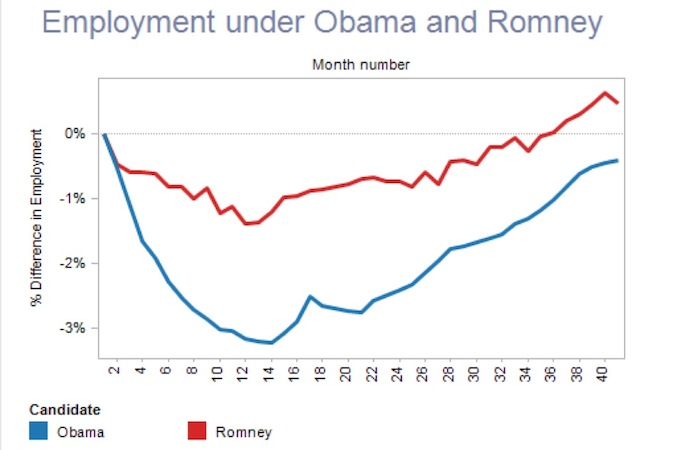
Take a look at the chart above, which uses seasonally adjusted Bureau of Labor Statistics employment data to show the change in the level of employment during the first 40 months of each man’s tenure as governor or president.

The similarities are actually more striking than the differences. Both men took office as the economy was plunging, but the hole (in percentage terms) turned out to be much deeper for Obama. The jobs picture started to turn around for both men at about the same time, but because Romney’s job deficit was comparatively smaller, he moved into positive territory sooner — though it still took him 36 months.

Of course, Kessler forgets one tiny little detail in his analysis: Romney, aside from having to deal with a tiny disaster instead of an unprecedented clusterfrack, did not have a legislative opposition which was dedicated to sabotaging his work, defeating or watering down his proposals to help the economy, and preventing him from concentrating on his job. I do not believe that any Democrat in the Massachusetts state legislature ever said that their #1 task was to make Romney fail.

Considering that the vast majority of actually useful things one can do as chief executive is controlled by the legislature–who typically escape virtually all responsibility even when they overtly work to hurt the state, as Republicans have–this should be counted as a factor. But maybe I’m just being crazy here.

Categories: Economics, Election 2012 Tags:

Peak Baby

June 4th, 2012 1 comment

Hans Rosling on how birth rates are connected not to religion, but to economic status–and that we have achieved “Peak Baby,” and the world’s population will peak at 10 billion people and not more. A fantastic lecture, a great animated chart. Well worth watching.

Also really good: author and creator of the Rhapsody music service Rob Reid shows up the ludicrously insane “copyright math” which media industries dream up to show how they are robbed of far more value than they actually have. I love the part about how, according to the industry’s numbers, minus 58,000 people work in the entertainment industries as a result of piracy. This is alarming indeed.

Categories: Social Issues Tags:

Drop It Enough Times…

June 3rd, 2012 5 comments

I was taking Ponta for a walk, and dropped the phone. I’ve done it dozens of times since I got the phone. The worst that’s happened was a small crack in the lower right corner. Today, my luck ran out:

Iphonebreak01

Iphonebreak02

On the down side, the front glass is shattered. It feels like it could easily get worse; run my finger over the shattered area, it catches more than I like. I sure don’t want to have that loose in my pocket when I reach in for it.

On the up side, the phone still works, even the touch screen, and even in the shattered areas.

Iphonebreak03

Iphonebreak04

I was surprised at how little I was upset by this. It’s a great piece of equipment, and I was looking forward to using it well after I got a replacement–it certainly holds up far better than my old iPhone G3 after I got the 4.

I was figuring, hey, I’ll still keep it; the video camera will be worth it alone, and maybe I can use it for other things not requiring a screen. And then there’s the fact that the new iPhone is coming out soon, which means I won’t have to put up with a shattered screen for too long. Still, I figured I’d get a screen protector film to hold what’s left in place.

But then I thought, hmm, I wonder if they sell replacement kits. I figured it wouldn’t hurt to look, so I went online and was surprised to find out that relatively cheap glass replacement kits are available. In Japan, they go for ¥3880 ($50), but that would be worth it for me. The iPhone 5 (or whatever they end up calling it) may not be out until October. I could survive four months with a broken screen, but looking at it as $12.50 per month to replace it, not to mention keeping it around afterwards as an extra camera or whatever, it’d be worth it.

Alternately, there is ¥3200 ($41) solution with the front panel only. I wonder if the glass will feel better or the parts would be more reliable.

The replacement surgery is pretty damned involved from what I can see, but with the videos on the web, I should be able to do fine.

Anyone here have experience with this? Any advice?

One other idea, though a bit of a long shot: take it to Softbank, see what they do. I figure a good chance they’ll say no can do, but you never know. A G3 I had got video issues, and they just replaced it on the spot–but that was not owner-incurred damage. On the other hand, they may have inventory to clear with a new phone expected soon, and maybe would like to create good customer relations, what with AU now selling the iPhone as well. Probably not. But hey, can’t hurt to try.

Whatever happens, it’s cool. I still have the new iPad for running apps. And, by the end of the year, I’ll have the new iPad, the new iPhone, and the new Macbook Pro. So, there’s something to look forward to.

Now all I gotta do is figure out a way to stop dropping the damned thing.

Categories: iPhone Tags:

Apparently Liberals Approve of Slavery and Oppose Working to Better One’s Self. Sounds Legit.

June 2nd, 2012 7 comments

A conservative chastises liberals for being so off-base on conservatism and history:

Built into this response is an intentional misrepresentation of what conservatism is. In essence, liberals look back at history, identify the social changes of which they approve, and define “conservatism” as opposition to those changes, since conservatism is, in this reading, opposition to social change. Thus the hilarious New York Times reference to those seeking to maintain Communism in post-Soviet Russia as “conservatives.”

This doesn’t hold up to very much scrutiny: The abolitionist movement, for example, was populated largely by people who would be viewed with contempt by modern liberals, because they were crusading Christians who sought to write their own interpretation of morality into the law. (Or, in the case of John Brown, militant anti-government activists pursuing Second Amendment remedies.) One of the things I like most about Frederick Douglass is his economic analysis of slavery. In Douglass’s view, one of the great crimes of slavery is that black Americans were denied the profit of their labor and the ability to invest and engage in enterprise. One of his great sources of bitterness was that even after emancipation, black Americans remained excluded from the economy, and therefore unable to better themselves. Lincoln’s views on the importance of a man’s ability to work to better his condition would be right at home on conservative talk radio today.

So, according to this guy, Kevin D. Williamson, we should ignore the essential foundations of conservatism, the most fundamental characteristics which define it so deeply that its very name is a reflection of that foundation… and instead believe that the heroes of the past are conservative because some of their personal viewpoints are similar to what conservatives are talking about today?

Boy, talk about not seeing the forest for the trees.

Not to mention, this guy has his own misinterpretations of liberalism, and his own misjudgments about the religious mainstream. For example, he thinks that liberals would disapprove of abolitionists because they were dedicated Christians trying to bring their Christian morality to the public square. What a one-dimensional perspective this guy must have. Most liberals are Christians, and we have never objected to people allowing their religious beliefs to guide them in making moral decisions–that’s a conservative conceit. After all, how many liberals ever put down Martin Luther King Jr. for doing exactly that? And at the time, you would not have seen many conservatives accepting Dr. King’s cause based on his deep religious convictions, either.

Not to mention that the abolitionists were not trying to codify religious scripture or beliefs (what conservatives try to do with “religion guiding my actions” as a dodge and disguise to accomplish), they were guided by their religious beliefs into making social progress to equality–the exact same thing that conservatives today vilify. Look at the right wing’s vicious attacks against “social justice” movements in American religion today, and you get an idea of this.

Conservatives love to imply the false view that most Christians were abolitionists, that it was the mainstream Christian movement that freed the slaves–and conveniently ignore that they were a minority in the religious community at the time (PDF). They were the like churches today that fight for acceptance of homosexuality; they were not the megachurches with pastors who fight to further discrimination against the minority. The abolitionists were sneered at by conservatives of their time, as similar liberal Christians are sneered at by conservatives today. The fact that these people act on religious convictions have never meant anything in this regard.

Similarly, liberals would not mind religious affiliations at all if the focus were a moral good–and not an attempt to mandate religious practices. If a religious group tried to enforce prayer in schools, liberals would fight them; if, however, a religious group campaigned for legalizing gay marriage or women’s rights, we would march with them. In any of those cases, we would not examine or care whether their motivations were religious in nature; that would not matter.

The citation of Frederick Douglass is even more ridiculous–does Williamson actually believe that liberals were against black people getting paid a fair wage and being encouraged to invest and profit? Really? So why are conservatives hostile to legislation that would help assure that minorities today get paid fair and equal wages today? Why are attempts at fairness that would fit Douglass’ philosophy like a glove so vehemently opposed by right-wingers, with legislation to codify equal treatment denounced as “special privileges”?

Similarly, Williamson’s note about Lincoln’s views about working to better oneself could only be seen as antithetical to liberal values if you have a bitterly skewed and biased misunderstanding of what liberals represent.

But at the core of it all is a deep desire to gloss over basic truths in order to incorrectly claim as one’s own the more respectable icons of history, and to attempt to heave off their own villains as somehow belonging to others. All in an attempt to justify current socially regressive views as being on the right side of history. Santayana be damned.

Categories: Right-Wing Lies Tags:

Car Doctor

June 2nd, 2012 Comments off

An aging sign outside a lot on a corner near our house. The lot is filled with old and rusting cars–not the best indicator of how good a “car doctor” the proprietor is. But the sign is the real deal-killer:

Cardoctor

Nice aging, wouldn’t you say? The years have given him not only a double chin and some grid-like acne, but two bullet wounds in his right arm.

This sign always freaks me out. Look at the eyes–hell, look at the face:

Cardoctorface-1

I mean, damn. It looks like a clone of Super Mario accidentally hybridized with an albino goat, only this moment realizing in abject horror his monstrous fate. Even were the sign not aged and peeling, I feel as if I would recoil from it with a deep sense of hideous disgust.

Really, not a fantastic indicator of the owner’s good sense or taste–in that he not only paid for the thing, but he also has displayed it, for years.

Suing for Overtime

June 1st, 2012 Comments off

I wrote this a few months ago, and it fell through the cracks. Here it is, though.


Apparently, more and more American workers are suing employers for unpaid overtime pay:

Americans were pushed to their limit in the recession and its aftermath as they worked longer hours, often for the same or less pay, after businesses laid off almost 9 million employees.

Now, many are striking back in court. Since the height of the recession in 2008, more workers across the nation have been suing employers under federal and state wage-and-hour laws. The number of lawsuits filed last year was up 32% vs. 2008, an increase that some experts partly attribute to a post-downturn austerity that pervaded the American workplace and artificially inflated U.S. productivity.

Workers’ main grievance is that they had to put in more than 40 hours a week without overtime pay through various practices:

• They were forced to work off the clock.

I noted this story because my one experience in court was exactly this. It was back in 1984, if I am not mistaken. I worked at a movie theater for a couple of certifiable douchebags, perhaps the two most unpleasant and dishonest people I have personally known.

They came across as convincingly earnest at first, as douchebags often do. When they took over the theater, they told all the people who were already working there about their dreams to make that theater a terrific place. However, they needed to build up capital, and could not afford everything at the start. They said that they could guarantee us a good health care plan later on, for example, if we would be willing to forgo overtime pay for a while at the beginning. We thought that an actual health care package was way more than we could expect, and didn’t think that overtime would matter much, so we agreed.

Of course, the no-overtime policy never disappeared, and the promised health care plan never materialized.

At one point, one of the workers left and sued the theater for unpaid overtime pay. At that point, the owners told everybody that before they would accept our timecards, we would have to re-write them–falsifying the records, spreading the hours around so that they would never go over 8 hours a day or 40 per week.

Soon afterwards, I quit the theater. The overtime issue was not the only reason, of course. These guys made the place a horrible place to work, and really pushed the limits on what you could even stand by and watch. Someday I’ll go into detail perhaps, but right now it’s beside the point. Suffice to say they disgusted me and I wanted nothing to do with them.

Afterwards, I decided to sue for the overtime pay. I had copied all of my timecards, and decided not to try to make a point of the falsified records; I just sued for what was on the books, which came out to a bit more than $500.

I served them by registered mail and showed up in court, armed with all the documents to prove my case. They did not show, and got away with it. These guys were not new to being served (again, stories for another time), and the dominant douchebag of the pair signed the registered mail as “Rob Roy.” While I’m sure signing that way is illegal, there was no way to pin it on him, and without a valid signature, the registered mail was not sufficient to show the guy had been served. The judge told me I’d have to re-file.

This time I had someone I knew serve them (in exchange for a few six-packs of beer). The day for the court case came, and again they did not show. The judge ruled in my favor by default.

At that point, they had, if I recall correctly, thirty days to appeal, which I was sure they would do. They never did. I think they just figured that they didn’t need to; they were already deep in debt, and figured that they could just refuse to claim, maybe use some more tricks to keep from coughing up the judgment (plus fees and costs).

I don’t think they realized that I knew which bank they used.

All I needed to do was to hire a county deputy sheriff to go to the bank and get the money; all he needed was the bank name and the name of the account holder. A few days later, I got every penny.

I did say these guys were scummy; I did not say that they were particularly bright.

Categories: People Can Be Idiots Tags:

Breastfeeding

June 1st, 2012 Comments off

With all the “furor” over breastfeeding, I figured it would be appropriate to re-post this image from 2006:

Frankly, I think people freak out over this way too much. Seriously, we can send troops overseas, have them fight and kill and die, but we can’t handle moms feeding their kids. For crying out loud, get a grip.

Categories: Social Issues Tags:

Smelly Train Guy

June 1st, 2012 Comments off

In the past two weeks, I’ve had the same uncomfortable experience four times: some guy walks through the train car I am in. Immediately in his wake, he leave a foul, pungent odor. Not sulfurous, if that’s what you were thinking. More like, kind of a “I haven’t bathed in six months” aroma. It takes a full minute for the smell to dissipate.

This being Japan, nobody in the crowded car so much as turns their head. But if you have become even a bit attuned to people’s expressions here, you can see they feel the same way I do: disgusted by the smell, and grateful that the guy walked through and out to the next car instead of settling in among us here. I feel badly for the people he does camp out next to, though.

I don’t even know if it’s the same guy, but I would not be surprised.

Such things are not rare on Japanese trains, but they are not common, either. I do recall a passenger who was much worse once. This was back on the Chuo Line, maybe in the late 80’s (possibly the early 90’s). A short, stocky guy, messily dressed. The car was not packed, but all the seats were taken. This fellow came to a bench at the end of the car, where three people can sit. Nobody was standing in front of the bench, and the three occupants were either women or slight men.

He stood in front of one of the three people sitting there, and after a few seconds, started hitting the seated passenger’s knees with his knees. More or less he was saying, “I want to sit here, pal, so get out!” After a few seconds, the accosted passenger got up and fled to another part of the car.

But the brazen ass didn’t sit down. He moved on to the next passenger, and did the same thing. After that person left, he got to the last passenger and went through the exact same act as before.

After he cleared the bench that way, he laid down and went to sleep.

Categories: Focus on Japan 2012 Tags:

Florida Republicans Illegally Purging Voter Rolls, AGAIN

June 1st, 2012 1 comment

Yep. Apparently it is now an official Florida tradition. The Florida GOP’s brazen schemes to strip legitimate Democratic voters of their ability to cast their votes comes back, with a vengeance. Republicans claim they are trying to stop voter fraud, something for which there is extremely little evidence–unless, of course, you count the massive voter fraud inherent in repeated GOP attempts to disenfranchise Democrats over the years. But no, they’re not concerned with that. The purge is–surprise!–heavily biased against Democrats, Independents, and Hispanic voters (everyone except Republicans, how strange!), according to a Miami Herald study.

Back in 2000, state Attorney General Katherine Harris, partisan extremist and Bush loyalist, carried out the first politically-directed purge, one which stripped tens of thousands of legal Democratic voters of their right to vote in Florida on the bogus assertion that they were felons. This, in an election which was decided by only a few hundred votes. We have Harris to thank for eight years of G. W. Bush, and, in his wake, a stacked Supreme Court, a bitter partisan divide, a battered Constitution, two massively costly land wars in Asia, and eight trillion dollars of debt.

In 2002, the purge continued, with the company charged to maintain the list claiming that as many as 91,000 of the 94,000 names on the list were not illegal voters. Florida “promised” to clean up the list.

Jump to 2004. Guess what? The voter purge list was still alive, this time even more flawed than ever, and–like all of its iterations–it “accidentally” purged decisively against Democratic voters. Whoopsie! How could that have possibly happened?

Fast-forward to 2008, and we see the techniques to purge Democratic voters continued, albeit in a milder form: meaningless small typos and variations in how names were written (with a middle initial or full name, for example) purged tens of thousands of voters. While this would not target Democrats with the initial purge, it affected Democrats more in the end because elderly and minority voters–heavily Democratic–would be far less able to repair their status. And while ACORN (which legally registered many poor people to vote) was under a vicious attack which would eventually shut down it down, Florida imposed new laws making new registration harder, a move that would disproportionately disadvantage older and minority voters (again, Democrats).

Well, the mild-mannered days of 2008 are out the window, and we see the brazen and corrupt Republican machine surge back into action, this time with an all-new list of 182,000 voters to purge, with easily tens of thousands of them clearly legitimate–and, according to a study by the Miami Herald, “predominantly made up of Democrats, independents and Latinos.” The last groups was famously spared the purge back in 2004, but that was before the numbers shifted from Republican-friendly Cuban-Americans to a current, far greater majority of Democratic-friendly non-Cuban Latinos in the state.

And that really does highlight how this is blatantly political–every single time this happens in Florida, it just “happens” by “accident” that the majority of voters “mistakenly” stripped of their right to vote are Democrats.

Not that any of this is a surprise; Republicans have become more and more shameless and open in their attempts to disenfranchise Democrats. Expect more of this in the months and years to come.

Categories: Election 2012, Right-Wing Slime Tags:

The Streets, They Are A-Changin’

May 29th, 2012 2 comments

Maybe a year ago, I noticed that a bank on the shopping street from the station did a renovation, but with an odd touch: they shaved off a corner of the building and filled the corner, inexplicably, with concrete planters. Seemed rather odd at the time.

Hibredo01

Then came something even stranger: a small apartment building with a mini-spa on the 1st floor was built, but it came with an empty spot of land, wedge-shaped, that was fenced off. I could not figure what the purpose of the wedge was. It just seemed weird. If it was for access to the back, it was really badly designed.

Hibredo02

Then, across from both of these sites, a building was taken down and the area covered with asphalt. That seemed reasonable–a parking lot.

Hibredo03

But then, right next to the mini-spa, another building went down…

Hibredo04

…and suddenly, the pieces fit together.

Hibarinew00

These were no random redesigns; I had completely forgotten that a new road would be cut through here, as part of the city’s new plans for avenues.

For some time, there has been a big, wide avenue with large sidewalks which rather awkwardly starts about 350m from the station. Closest to the station, it suddenly narrows into a narrow, crooked road with no sidewalks. The city has long planned to fill in the remainder of that avenue, creating a large open space in front of the station exit, and extending the wide avenue to go all the way to the station. The thing is, a lot of buildings stand in the way.

However, plans seem to be in high gear now. In addition to all this reconstruction at the shopping street, a few large buildings near the station are also being torn down. How long it will take before the project is done is anyone’s guess. It seems right now like there’s a lot left to take down, but looking at the map, it appears that maybe already half the work is done already. I noted that a few other buildings, including a pharmacy way out from the station which shut down mysteriously early this year, are already shuttered and ready to go.

Two things I wonder about, though. First, there’s a cemetery plot which will wind up on a major intersection which you would expect to be primo commercial space. Do they relocate cemeteries in Japan? I would guess so, but will be interested to see how that is handled.

Second, when will they get around to the secondary streets adjoining the main one they are building. I ask because one of them cuts through our kitchen. Literally.

Update: Found a document which says that the station road is planned for completion in “fiscal year 2013.”

Categories: Hibarigaoka Tags:

Late Night Quake

May 28th, 2012 Comments off

Sachi and Ponta and I all just felt a strong, up-and-down trembler, one strong enough to make you think it could turn into “The Big One.” This one was centered in Chiba not too far from Tokyo, but it came on really fast and shook us rather noticeably. It appears to have been at least a 5.0 on the Richter.

Update: it was a 5.2.

Categories: Focus on Japan 2012 Tags:

The Next Step in HD TV (Long Post)

May 28th, 2012 2 comments

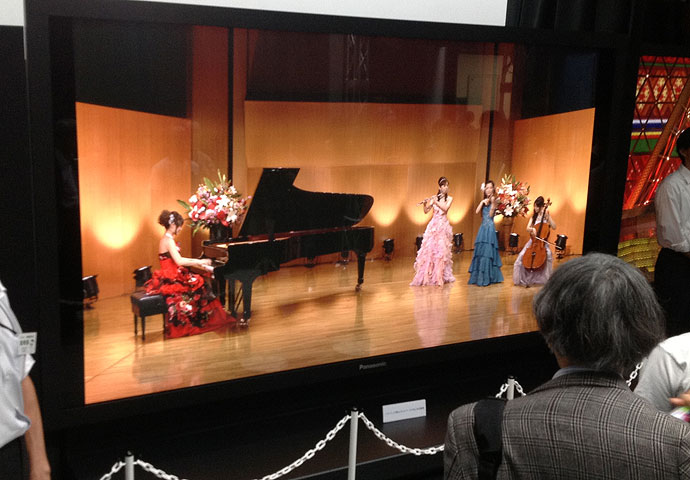
Today I visited the Open House for NHK labs in Setagaya to get a sneak peek at the new “8K” UHDTV (Ultra High Definition TV) standard, known in Japan and Super Hi-Vision. They had their 145“ super-LCD screen going, in full 7680 x 4320-pixel glory.
Screen01

The system is not just 16 times sharper than your latest-model HDTV; aside from having 16 times the pixels, it’s also progressive scan (not interlaced), and it’s got a refresh rate of 120 Hz. In short, it looks great.

Confused by the tech talk? Let me see if I can explain it.

First, let’s begin with some basic display vocabulary: scan, scan lines, interlaced and progressive scan, refresh rate, pixels, resolution, and aspect ratio. Let’s also go back to the earliest standard TV sets as well.

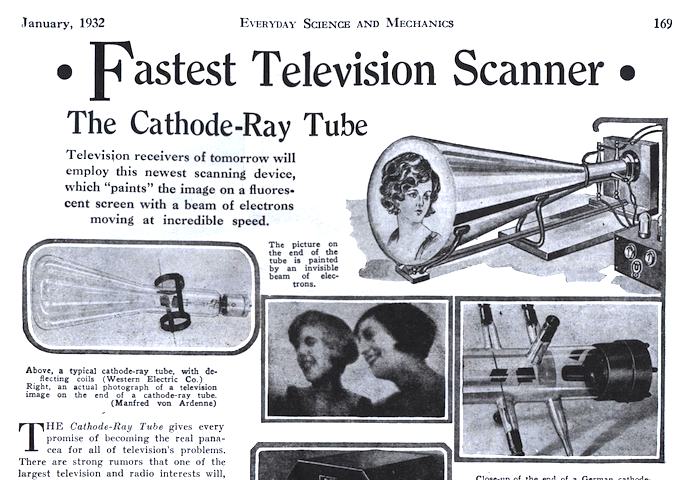
We refer to scanning in a television because of how the century old (!) TV technology works.

Farnsworth

That would be a CRT or Cathode Ray Tube. This was a glass vacuum tube with up to three electron guns (red, green, and blue for color) in the back. These guns would fire electrons at a phosphor (light-emitting) screen, in a rectangular shape called a raster.

If none of that makes any sense to you, then forget it. Just remember that the guns in the back of the tube fire energy at the screen to make it light up. But they do so in a pattern. They start at the top left, and slowly go left to right, painting a single line of the picture across the screen. When the right end of the line is finished, the guns would go back to the left side and start painting the next line. They do this over and over again, through hundreds of lines. All this in a fraction of a second.

This process was called scanning; each line was a scan line. When the guns finished at the lower-right corner of the screen, a single scan was complete. The number of scans per second is measured in hertz (Hz).
Earlytv

With the technology available in the mid-20th century, scanning each line in order didn’t work well; the picture did not show motion well, and there was flicker. As a result, they came up with a display method called interlaced scan. It fixed these problems, though it also had a disadvantage: it is not as sharp as it could be; small text, for example, often appears fuzzy.

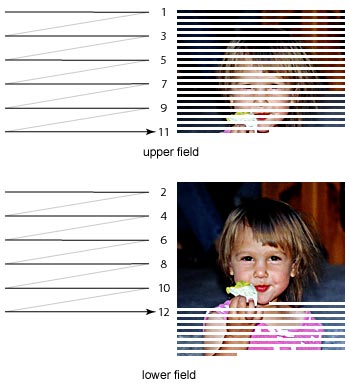
Interlaced scan means that the guns only painted every other line in each scan–that is, on the first scan, it would paint lines 1, 3, 5, 7 and so on; on the following scan, it would fill in the missing even-numbered lines, 2, 4, 6, 8 and so forth. In this way, a single full image took two scans to complete.
Interlaced Fields

The number of scans per second was called the refresh rate. This was set at 60 Hz; because of interlaced scan, this meant that 30 frames per second could be shown.

Interlaced scan was not the only way to show an image; progressive scan paints an entire image, all the scan lines, in one scan. Once the problems with motion and flicker were resolved, progressive scan was used in computer monitors, giving them a much better image.

The number of scan lines–the resolution–also had to be decided. The television most people grew up with originated in the 1940’s and 50’s. In North America, the NTSC (National Television System Committee) settled on a standard of 525 horizontal scan lines for the TV, although only about 480 lines are visible, and the other 45 lines are used for other information, including closed captions.

This picture is equivalent to an image on your computer screen 480 pixels tall, the vertical resolution. The horizontal resolution ranges from 640 to 720 pixels, depending on the type.

The aspect ratio (horizontal-to-vertical ratio) is 4:3, although a 720 x 480 screen would be 3:2.

OK, now that we’re through with all that, what did the old NTSC standard of 480 lines look like? Well, here’s an image with 480 ”lines“ of resolution in the NTSC aspect ratio:

480P

Looks OK, doesn’t it? However, there’s a catch–the image you see above is shown in progressive scan, so it looks sharper than it should. Still, that’s fairly close. This is what we used to think of as a clear, sharp TV image.

However, there’s another hitch: you’re looking at it in a very small space.That image might occupy only as much as 7 inches diagonally. Blow up the same image and paste it on a 40-inch TV, it won’t look so good.

We found this out at around the turn of the century, when the next-generation of TVs, called HDTV (High Definition TV) came out. (Japan calls this ”Hi-Vision.“) These TVs have a vertical line count of 1080. Since we use LCD screens, and they use pixels, we refer to the overall resolution as 1920 x 1080.

So before, we had 480i (480 lines interlaced); with HDTV, we got 1080i. That’s more than double the lines, and (because the screen has a wider aspect ratio) almost 7 times more information.

Now, I can’t show you an HDTV image on this screen, as it likely would be bigger than your display area (here’s such an image you can view separately). So instead let’s scale things down to about 1/3rd the height, or about 1/8th the area. Of the two images below, the one on top is the same 480i NTSC image scaled down, and below it, an HDTV (1080i) version of the same image. Were the two TVs to have the same ”pixel“ size, this is how they would compare. Note also the difference in aspect ratios:


Ntsc-230X172

Hd-690X388

As you can see, you’re getting a lot more image with HDTV, even if your newer TV doesn’t look that much bigger.

Now, look what an old 480 NTSC image would look like on a newer HDTV screen, with the 1080 image next to it for comparison:

Ntsc-In-Hd

Hd-690X388

The old NTSC image looks kind of fuzzy in comparison, doesn’t it? Now, keep in mind that you are looking at it on a progressive-scan screen at a small screen size! On a real HDTV, it would look even worse. That’s what you see on your new HDTV when they broadcast an old-timey teevee show!

So you can see that HDTV was a big improvement. Even more so was Blu-ray; instead of showing images in 1080i, Blu-ray shows them in 1080p. That’s the best quality you’ll see on your current TV. It also might even be better quality than some films shot on 35mm film in the old days, which is why Blu-ray doesn’t always seem to give you the ”best“ quality when you’re watching films from a long time ago.

Interestingly, George Lucas used a 1080p digital camera to shoot Star Wars: Attack of the Clones. While 35mm film can be better quality than 1080p, under some circumstances they are close enough that most people would not notice the difference, especially with processing that films go through.

So, is 1080 the end? Not by a long shot.


In fact, we’re now heading into perhaps as much as two generations beyond HDTV. They are referred to as 4K and 8K, or QFHD and UHD TV.

The 4K, or QFHD (Quad Full High Definition) is 3840 x 2160, which is exactly double the vertical and horizontal resolution of HDTV (also called ”FHD,“ or ”Full High Definition“), which gives it 4 times the pixels, or overall resolution. Thus the ”Quad“ label. Current HDTV has about 2,000,000 pixels (2 megapixels); 4K has more than 8,000,000, or 8 megapixels.

The ”4K“ label, by the way, does not come from the ”quad“ label; 4K comes from the rough number of horizontal pixels. 3840 is close to 4000, therefore we get ”4K.“

4K is just now becoming available; you can actually buy 4K Blu-ray players and 4K TV sets. HDMI cables are now capable of transmitting 4K video. And 4K is actually closer to a cinema standard–a movie shot in 4K video (as many are now) will look just as good as any shot on film.

However, there’s a catch: 4K TV sets (projectors, really) still cost at least $10,000, even if the 4K-ready Blu-ray players can be had for much cheaper. Oh yeah–there’s nothing to watch in 4K anyway. However, 4K might be good for HDTV-quality 3-D viewing, although that’s a limited use for expensive equipment.

Not that 4K won’t become cheaper and more available in the next few years. The problem is, by the time it catches on, it’ll already be obsolete.

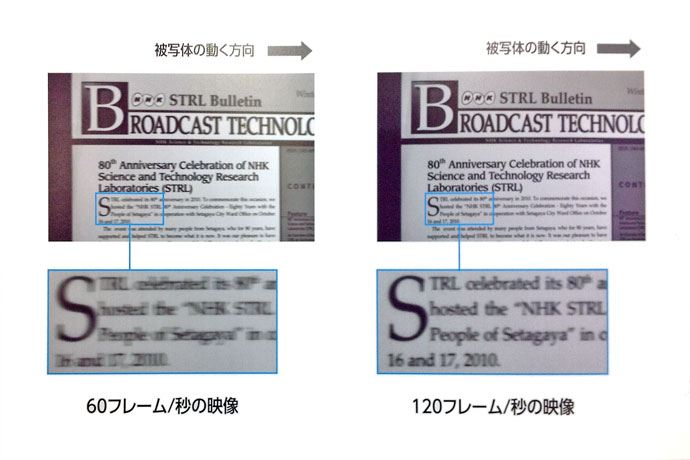
You see, NHK here in Japan is working on 8K: a full 7680 x 4320 pixels, more than 33,000,000, or 33 megapixels. That’s more than 100 times the number of pixels on a pre-HD television set! Not only that, it’s progressive scan. And it scans 120 times a second (120 Hz), so you get sharpness even with motion that would blur on current TVs.
Movingtext

Still not impressed? Let me show you a scale showing all the different resolutions:

8K

See that tiny orange scrap at top left? That’s your old NTSC TV set. The higher-quality version of it, with top DVD quality. The screen two levels down, the darker green one, marked ”HDTV 1080p“? That’s your current flat-screen set. The light green square is 4K, what is coming out right now. The largest light-blue square is Super Hi-Vision.

They say that it will be ready for broadcast from NHK’s satellites from 2020 (give or take a few years). By 2025 they expect to broadcast that over the Internet.

Not only that, the sound will improve. Today’s ”home theater“ systems include 5.1 surround sound, meaning there are five speakers surrounding the viewer, and a subwoofer for bass.

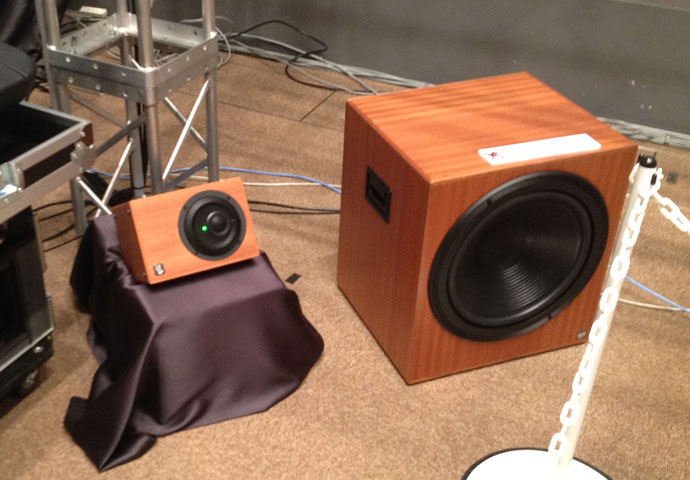
Super Hi-vision has a 22.2 sound system–yep, 24 speakers in all. 9 at the top of the room, 10 around the middle, and 3 normal speakers in front, accompanied by two subwoofers.

Nhkspeakers01

Nhkwoofer01

And still, we’re not finished. After all, you can’t just go and increase resolution by 16 times and expect it’ll still fit on the same media, right?

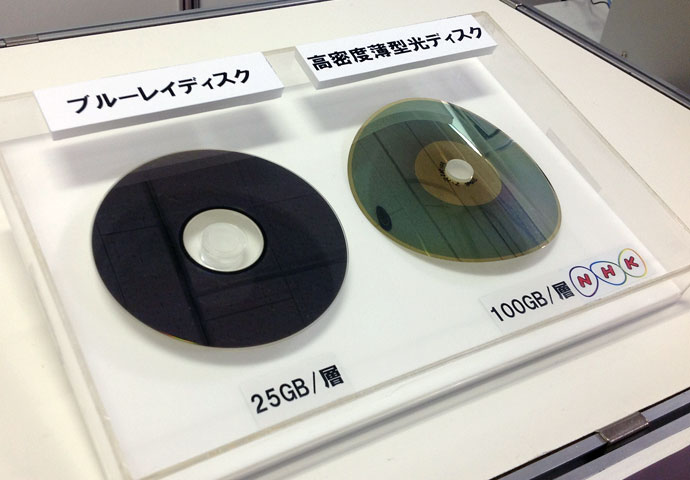
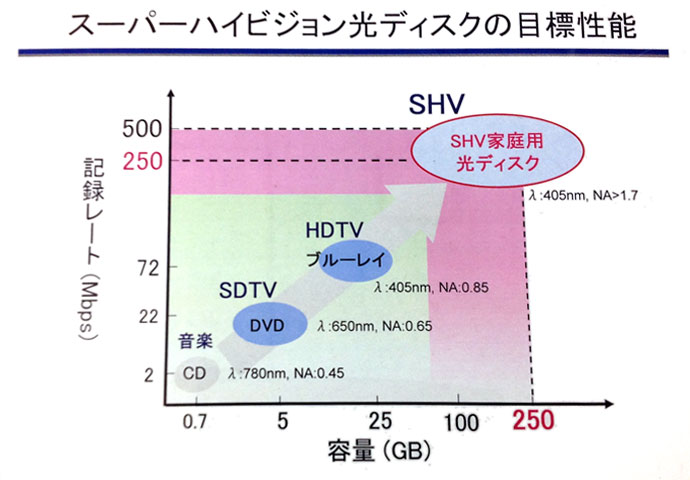
When DVDs were too small for recorded HDTV, we got Blu-ray, going from 4.7 GB for DVDs to 25 ~ 100 GB for Blu-rays. Even with compression, however, Super Hi-vision will require media that’s 250 GB in size, at least.

Now, Blu-ray might get there–it’s 25 GB per layer is already at 100 GB thanks to 4-layer discs, and 10-layer discs are not too far off. However, it’s not just the capacity: it’s the access speed. If the media can’t shoot out the video fast enough, it won’t work. And the guy I spoke to at NHK (several of them spoke pretty good English, not surprisingly) said that even with upgrades, Blu-ray just won’t cut it.

So NHK is looking into alternatives–like this:
Nhkdisc01

Note the NHK disc is floppy, not unlike the opaque black mylar film used in the original floppies decades back. But this disc (which will probably be more firm when released) holds 100 GB per layer due to a lens process with blue lasers which halves the width of the beam, thus producing 4 times the capacity. A 4-layer SHV disc would hold 400 GB, more than enough for a SHV video.
Shvmedia

But that’s not all. They’re also working on holographic media:

Nhkholodisk

See those tiny little dots? Each one is 10 MB of data. Or was it 100 MB? Frankly, I forget–I didn’t write it down. Whatever the case, the guy said that one of those inch-square plastic (glass?) chips would hold as much as a terabyte of data. He also said that it wasn’t reliable enough for data storage yet–but he did say that he expected it to be sold on the market within three years.

He even had a cool laser setup you could look at:

Nhkholodisk02

That disc in the middle is not the media–the square chip on it is.

Now, when I saw this, something immediately came to mind. Data storage media, in the form of thick plastic cards… where had I seen those before…?

Trekmicrotapes

Of course, they seemed to have far less capacity back then.

Categories: Technology Tags:

A Bit Too Much of an Optimist

May 27th, 2012 2 comments

Richard Leakey believes that creationists will vanish within a generation or two:

Richard Leakey predicts skepticism over evolution will soon be history.

Not that the avowed atheist has any doubts himself.

Sometime in the next 15 to 30 years, the Kenyan-born paleoanthropologist expects scientific discoveries will have accelerated to the point that “even the skeptics can accept it.” …

“If you don’t like the word evolution, I don’t care what you call it, but life has changed. You can lay out all the fossils that have been collected and establish lineages that even a fool could work up. So the question is why, how does this happen? It’s not covered by Genesis. There’s no explanation for this change going back 500 million years in any book I’ve read from the lips of any God.”

I think that Leakey doesn’t really understand the Fundamentalist / Creationist mindset. He seems to believe that all you need is overwhelming facts and evidence, and they will accept something contrary to their strong religious convictions. That’s a mistake. These people literally take what they believe as an article of faith. They could be looking directly at a mountain of evidence clearly contradicting them, and still not waver. All they have to do is say it’s a trick, Satan’s behind it, so forth and so on, and then walk away. It’s pretty much what they are doing now.

I recall Arthur C. Clarke making the same error, writing in his stories that once we meet alien species, the superstitions of religious belief would melt away. I’m pretty sure that wouldn’t happen, either.

I think that if these people are to accept things like the age of the universe or the workings of evolution, it will not be until a much longer time than now, due to social workings and not wholly that of evidence.

Categories: Religion, Science Tags:

Manufactured Outrage

May 26th, 2012 Comments off

New York Daily News columnist S.E. Cupp recently took the brunt of another political hit job by the tastelessly liberal Hustler magazine, which criticized her politics and suggested “shutting her up” with male genitalia, and provided photoshopped artwork to that effect.

There is now a big fuss about it, mostly driven by the conservative media, which has been making a larger charge against both the mainstream media and against society at large: why is there only outrage against misogyny when it is directed against liberal women, but not when conservative women are the target?

That’s because incidents like this happen with such frequency and casualness that it’s clear people think there won’t be any pushback if they attack a conservative woman. Back in 2008, when some idiot hecklers shouted “Iron My Shirt” to Hillary Clinton, we talked about sexism for three days. But, like Weigel pointed out, no one at the AFL-CIO even thought twice about not only GETTING a piñata with Nikki Haley’s face on it or hitting said piñata, but similarly had no problem recording the event and UPLOADING IT TO YOUTUBE. If you do something sexist against a liberal, expect a firestorm. If you do something sexist (or pseudo-violent) against a conservative, well, they had it coming.

Right off the bat, this particular argument falls apart: the piñata incident, while tasteless, had nothing to do with gender. The target could just as easily have been a man.

This is either a blind spot with conservatives or it’s a hypocritical oversight: sexism and racism are not when you attack an individual for a reason unrelated to gender or race. Right-wingers seem to think that just opposing a female candidate on her politics is sexist, or blocking a judge on his rulings when he is Hispanic is racist–if said target is conservative, of course.

They apparently do not understand that sexism is when you attack someone because of their gender, or the attack is against the gender itself.

The “Iron My Shirt” incident, for that reason, was sexist: it was a reaction to a woman running for the presidency, and was essentially a symbolic slap in the face against women in general. If the sign had said, “Cut My Taxes,” or even, “Go Home, Idiot” it would not be sexism, as there would be no apparent relation to gender. People have expressed hatred and even symbolic violence against Hillary in the past without it being linked to sexism.


So, why is there no outcry against the Cupp photo?

Well, first of all, there is outcry against the image, especially in the conservative media. Why not from the left? Um… actually, people on the left are decrying the image. Even Rachael Larimore, who wrote the piece quoted above, took note that Planned Parenthood, the Women’s Media Center, and Sandra Fluke have all condemned the photo. So, what do they want? Every last liberal to shout it from the rooftops? They condemn the lack of coverage–but that charge falls short since all the coverage they provide itself ignores the left-wing outcry.

Second, the source is laughable: it’s Hustler magazine. If they published a similar image of a left-wing female politician, there probably wouldn’t be much outcry there, either. Not every act of misogyny creates a national public debate, only ones that come across as significant. Larry Flynt being an ass doesn’t rate that, any more than do countless right-wing imbeciles in the yahoo gallery doing crap which is just as vile and idiotic.

Which leads to point number three: the visibility of the target. After all, who is S.E. Cupp? If I have seen her before on some news show as a commentator, I don’t remember it. It’s not exactly realistic to expect the media to erupt in a furor every time a second-tier talking head gets snarked by a porno rag.


However, none of that is the central point here. In fact, misogyny is the issue, but not misogyny against conservative women. The fact is, conservatives in general don’t give a crap about misogyny. How do we know? Imagine the Hustler thing was about Hillary instead of Cupp. Would they be outraged? Hardly. They would probably chuckle over it, and stand ready to castigate any liberal or feminist group that complained. Which means they don’t care about the misogyny, they are instead complaining about the political outcome of misogyny.

But it goes much further than that: it stark opportunism, pure and simple. The recent stir regarding contraception has given Republicans a black eye and made them look bad to women. Republicans in Congress tried to deny coverage of contraception; they refused to hear from women, and instead held a women’s health hearing with an all-male panel, which appeared condescending and dismissive. After Fluke spoke later, Rush Limbaugh called her a slut and a whore, repeatedly. All kinds of other stuff happened on periphery, like the aspirin-between-the-knees remarks.

So now, right-wingers are smarting from that, and they need a way to fight back. They cannot actually come out for women on any substantial issues, of course. So this is their answer.

The Cupp story works for them well: they get to play the victim. They get false equivalency, creating the impression that sexism is equally bad on the left and the right (as if Larry Flynt were equal to Congressional Republicans, Rush Limbaugh, and many other representatives of conservatism). They get to act like misogyny happens against them even more by suggesting that it is simply dismissed and under-reported. They get to paint liberals as hypocrites.

But mostly, they get to act like the whole contraception thing never happened. Like Dan Rather’s error in reporting on a bogus memo meant that George W. Bush got excused for having gone AWOL.

In truth, most of these people probably don’t give a crap about what happened to Cupp–but it’s too good as a political weapon to pass up.

Nor is it just this case; most right-wing cries about sexism are similarly opportunistic. Remember the furor about Sarah Palin and the jogging-suit photos on Newsweek? That did get a lot of coverage, in part because women’s groups did not jump to Palin’s defense. But then again, they had good reason not to: the charge of sexism was petty and weak. Palin had intentionally posed for the photos ; she had chosen the outfit and the setting herself, but expressed outrage when the photos were used. It made no sense. Had Newsweek done something that was actually sexist regarding Palin, NOW and other groups probably would have come out on her side. As it was, the whole incident was more of an attempt to attack groups like NOW, so no wonder they did not chime in.

However, the Newsweek story shows that the whole claim by the right wing is false: the media does pay attention to sexism when it is levied against conservatives; the Slate piece by Rachael Larimore quoted at the top is poorly reasoned, providing poor support and a lack of objectivity. Outrage over “Iron My Shirt” is not equal to the Haley incident, it is more akin to incidents involving Palin. Neither is the Cupp incident equivalent to Fluke.

And yet, despite the rampant opportunism displayed by conservatives in regard to these kinds of stories, the media and the public at large still does treat misogyny against conservative women with equal regard. It’s just that significant acts of misogyny usually go the other way.

Categories: Election 2012, Social Issues Tags:

Romney’s Education Sham

May 25th, 2012 7 comments

It’s all worded very prettily, but in essence, it comes down to this: move money away from public schools while leaving them burdened with the highest-cost children they will not be funded to handle; place even more emphasis on meaningless assessment tools designed to punish experienced teachers in the public school system; reduce certification requirements so that private schools can save money and increase profits, while removing regulation that would require these schools to meet minimum standards, all in a push to privatize education in a way that will effectively award billions of taxpayer dollars to profit-seekers looking to cash in.

All worded rosily as “choice” for the “best” schools while “ensuring” quality and “rewarding great teachers” and so on. But if you look past the BS language and think carefully about how this will be implemented in the real world, not to mention what is not said in these phony outcome scenarios, it comes out to basically the same answer: reward our donors instead of theirs.

Sadly, this is expected to be an area where he will be seen as stronger than Obama–not that Obama has been superlative in this area himself, but Romney, essentially forwarding the conservative line on education, will be far more destructive.

Categories: Education, Election 2012 Tags:

Doctor Who?

May 23rd, 2012 3 comments

Screen Shot 2012-05-23 At 9.28.01 Pm

I can imagine he used the Tardis to help find bin Laden, but why did they send him to jail? Always getting into trouble, that Doctor…

Categories: The Lighter Side Tags:

Bad Traffic

May 23rd, 2012 20 comments

Last weekend, Sachi and I went on a kind of ‘day trip’ we have done from time to time: driving Ponta to a dog run in Tokorozawa, and then on to Costco for shopping. Now that we have the car, Costco trips are much easier–but because Costco always sets up shop in distant locations (presumably to avoid high land costs), it’s not an easy drive. Not because of distance–in total, it’s a 35 km (22 mile) round trip. Instead, it’s hard because of insufficient roads and horrific traffic control, making what should be no more than an hour in traffic into a four-hour road trip.

In Japan, most people use trains, in part because of cost, but also perhaps because traffic can be a nightmare at times. Tokyo, like most places in Japan, is not exactly traffic-friendly; thoroughfares are not ubiquitous, and often you have to navigate three sides of a square to get where you want to go.

Take our trip to the dog run in Tokorozawa. As the crow flies, it’s just 8 km (5 mi.). However, the most direct route is on small, narrow roads which, in Japan, qualify as streets with two-way traffic–which is to say, one car pulls over onto the curb while the one coming from the other direction slowly creeps past, with inches of clearance on either side. A lot of roads in Japan are like that, streets so narrow they would barely qualify as a one-way street in the U.S.

The same path is also filled with a multitude of turns, some of which are so subtle and confusing that it is easy to go down the wrong way.

However, this is usually the way that the GPS recommends, probably because it chooses the least-distance route and ignores how fast one might go. Google Maps does the same thing, claiming that the 11-km small-road route to the dog run takes 34 minutes–when in fact, it is more than an hour. Sachi and I discovered that a three-sides-of-a-square route, taking bigger roads, is much faster, despite the fact that it is 16 km (10 mi.).

However, what really gets me is the traffic control. In Japan, I really get the impression that when they plan traffic, they don’t. As in, they don’t give a good goddamn about traffic flow, instead they just follow pre-set standards someone set randomly some time in the past.

It’s like that with road designations and speed limits. You can be in the countryside, on a wide two-lane thoroughfare, with no lights or stop signs for a kilometer at a time, no pedestrians in sight and the sidewalk blocked off by large barriers in any case… and the speed limit will be set to 25 mph (40 kph). In the U.S., a similar street would have double the speed limit. In Japan, the limit is set by the road’s official classification–meaning that a narrower, pedestrian-laden one-lane street near the city center may have a higher speed limit.

Traffic control in Japan seems to be planned the same way–mostly arbitrarily. On our trip last weekend, we ran into at least three traffic jams which were obviously endemic; the exact same traffic jam is there every time we go, and I am sure the same is true of the new jams we encountered on our route this time.

The culprit is usually the same: a badly timed right-turn signal. In Japan, we drive on the left, so right turns must cross traffic. The roads are narrow, and right-turn lanes are short. A traffic signal, especially at a 5-way intersection (where these jams usually occur), may take 2-3 minutes to cycle. However, the right-turn light will last only two or three seconds–and no, I am not exaggerating, I timed it. (The turn light is actually 5 seconds, but straight-through drivers run their red light, cutting a few seconds off the turn signal traffic.) So, naturally, the line of people wanting to turn right quickly backs up, and very soon blocks the whole flow of traffic (as most streets are one lane), thus creating a traffic jam that backs up for more than a kilometer.

What is so stupid about it is that the jams could obviously be eliminated, or at least greatly lessened, by simply extending the turn light by five to ten seconds–nothing when you consider the overall cycle duration. And yet, it never happens. Not all right-turn lights are so poorly timed, but enough are, and they tend to be in key spots where you cannot get around them.

This last weekend, we got caught by exactly that type of traffic jam, made even worse by an incredibly idiotic placement of a parking lot exit stream just 100 meters or so from just such a right-turn trap. We were almost at Costco–one turn away–when traffic came to a stop. And I mean, a dead stop. At one point, I realized that traffic had not moved for more than five minutes. People were starting to get out of their cars to see what had happened.

Now, this was already bad enough before: a signal at the intersection had the same short-right-turn-lane combined with the three-second-turn-light syndrome. Add a steady stream of cars exiting the mall parking lot close by. (In previous trips, we noted that these people got impatient real fast, as if they had been the only ones waiting for half an hour, and tended to bull into the line and then go bumper-to-bumper, denying the main street traffic access to the stream again.)

But instead of simply adjusting that right turn signal, what did the morons in traffic control do? They added a signal just before the parking lot traffic flow. The timing was perfect: as soon as the new signal turned red for the main traffic flow, that’s when the line moved forward, essentially giving most of the flow’s movement to the parking lot traffic–but also more or less turning the main road beyond that point into a parking lot.

Stupid, stupid, stupid, stupid, stupid. For no cost, they could have alleviated most of the problem. Instead, they spent all that money to add a traffic light, making the problem even worse.

After 10 minutes and still no forward progress, I decided to do something that seemed counter-intuitive. Instead of trying to complete the last 500 meters of that nightmare, I turned around and took a 4-km “shortcut” around a large country club, essentially covering 3-1/2 sides of a large square. It took about 7 minutes, and saved us anywhere from half an hour to an hour.

Nor is this the only kind of stupidity one sees in Japanese traffic control. I remember when I lived in Inagi, they spent years building a completely new, luxuriously wide (for Japan), two-lane thoroughfare straight through the center of town. What used to require a circuitous, jammed-up ride down narrow roads was replaced by a beautiful, wide avenue where one could leisurely cruise straight across town.

Except, of course, they screwed it up with traffic lights. Lights at virtually every intersection, every few hundred meters. Of course, that would not be so bad… if the lights were not set to be staggered. Yep, you could see it down the straightaway: red green red green red. You just leave a red light, and seconds later, you stop at the next one. Each wait was about thirty seconds, and there was virtually no cross-traffic. You felt like a complete idiot, just waiting there for no reason. Then again. And again. And again and again. Just as stupid: I found that if you took a narrow side street, it had no stops signs or traffic lights, and so you could completely avoid the three-minute delay and zip past in seconds. And yet, I was apparently the only one who had found this–the side street was always empty, even when the traffic on the main street was heavy.

Ironically, the main, traffic-signal-filled street passed right by city hall. I don’t understand why the place has not get been burned to the ground by irate commuters.

Except that, this is Japan. People simply accept this crap–probably because they know that complaining will do no good. I would not be surprised it, six years later now, the traffic lights were still the same.

Categories: Focus on Japan 2012 Tags:

Eclipse

May 21st, 2012 8 comments

Just got finished viewing the eclipse here. People out on the street and all that. Got to see it through a filtered lens, and while the live view is something you should see, it’s still–ironically–way better on TV.

What was neat, though, was the quality of light–something which you can’t really photograph well. It got darker, but not the way it does with coldness. Kind of a muted shade, but still with direct sunlight. Spooky, and cool.

Categories: Focus on Japan 2012 Tags:

Romney’s “Job Creating” Shell Game

May 19th, 2012 12 comments

Robert Reich explains how Romney & friends over at Bain capital got stinking rich. A teaser: they risked not a single dime of their own money and used a bunch of accounting scams, while working Americans paid the price, and footed the bill in the form of taxes and debt to pay for the debris trail they left behind.