Archive

Archive for the ‘Economics’ Category

Blame-Shifting in High Gear: Ludicrous Speed Ahead!

November 15th, 2008 2 comments

I know that I have often pointed out that right-wingers blame the other side for everything all the time, but still, they’re going to extremes with this one.

For years after Bush took office, the wingnuts claimed that everything bad about the economy was Clinton’s fault. The idea was that Clinton dug us so deep into a hole that Bush could not possibly be blamed for anything bad that happened economically (though any progress was immediately awarded to Bush).

So, naturally, since Bush, after eight years in office, is handing off a far worse recession, maybe even a depression, to his successor, Obama will get the same grace period, right?

Ha! Of course not. Obama won’t even take office until two months from now, but the wingnuts aren’t wasting any time–despite Obama not even being the president-elect for a whole two weeks yet, the right-wing talking heads are already blaming our current downturn on him, calling it “The Obama Recession.”

What’s the job description for a wingnut? “No critical thinking skills required”? Oh, I’m sure they’ll have some rationalization as to how it just happened to work out the way they’re claiming. I’m just surprised that they are being so transparent about it. I expected them to wait until a few months after Obama took office to start blaming everything on him. But now, anyone who accepts this has to believe that Obama has been working for years behind the scenes to engineer this recession, or that he immediately inherits the recession and the blame for it a few months before he’s able to do anything.

Like the claims made by the wingnuts during the campaign, this new line of crap will be believed only by the converted, by the Kool-Aid drinkers and the Loyal Bushies. The blatant nature of the lie is so transparent, however, that this stands to only help Obama with the moderates.

So, keep spouting, Limbaugh, Hannity, and all the others–keep spouting this laughable lie. The more you do, the more you highlight the fact that it’s a lie, and the more people will remember that it’s a lie for quite some time. You could have waited a decent amount of time, until after Bush had faded away and people had been hurting for a while, and then started blaming Obama–and a lot more people would have bought into it. But now, whenever you try to do that over the next few years, all anyone has to do is to remind everyone that you’ve been saying the same thing since two months before Obama even took office–and at that, the accusation will fall flat.

Tax the Rich

October 13th, 2008 Comments off

For all of McCain & Palin’s bluster about Obama raising “your” taxes, the proposals are pretty clear: Obama is proposing hefty cuts to the middle class which taper off as you reach $250,000 a year; he then starts raising taxes, those hikes becoming notable at the half-million mark and above. McCain, in contrast, wants cuts for everyone but gives the lion’s share to the wealthiest Americans. His cuts for lower and middle class Americans ($0 to $100,000) are less than Obama’s. Where Obama wants to tax wealthy people, McCain wants to give them yet another tax cut, and reserves the biggest windfalls for the richest people.

In that sense, their plans are diametrically opposed: Obama proposes a 5.3% cut for the poorest Americans which reduces to 0% around a quarter of a million dollars, then rises to an almost 8% rise for multi-millionaires; McCain gives the poorest Americans a paltry 0.2% tax cut which gradually increases with income until you see the wealthiest getting a 3% cut.

So the questions become simply: (a) should we raise taxes for rich people? and (b) should we lower taxes for the middle and lower classes?

Yes, there is a serious economic downturn. But that does not change the fact that if a person is making a million dollars a year, they are making a million dollars a year; if their income is still so high, then obviously the downturn has not made them poor yet. If the bad economy knocks you down into the middle class, then Obama has bigger cuts waiting for you there–this is a self-correcting mechanism. But if you’re still making lots of money, then the downturn only helps you, as your relative purchasing power has become stronger. If you could afford those tax hikes last year, you can afford them this year.

I have always believed in bottom-up economics. Top-down is ludicrously flawed, because the money tends to stay at the top. Money tends to circulate up, not down, as those who have money use it to keep it and to continue taking it from people with less money. Bottom-up makes sense as a system of circulation and economic health because people at the bottom can’t hoard money like people at the top can; people with little money usually have to spend it, else have it work for the local economy while they wait to spend it.

Then there is the cumulative view: over the past 30 years, taxes for wealthy people have been slashed, while the middle class has gotten far, far less–and possibly is paying more for less by this point. Obama’s plan works toward coming closer to a balance.

The plan Obama proposes makes sense on just about every level–it is less of a burden on the deficit and debt than McCain’s plan, stands to jump-start the economy (hopefully along with minimum wage increases and other legislation which corrects past imbalance) by getting money back into circulation, and is far more fair and even-handed than the “fair” tax cuts for the rich that Bush and the GOP used to help wreck the economy in the first place.

Categories: Economics Tags:

McCain & Republicans Further Trash the Economy

September 30th, 2008 1 comment

For the past eight years, George W. Bush and the Republicans have trashed the economy with massive giveaways to corporations and the wealthy, deregulation of critical industries, and encouragement for companies to move production overseas. They also starved the lower and middle classes–weakening unions, refusing to raise the minimum wage, allowing pensions to fail, attempting to sabotage medicare and social security, reducing federal services, and ballooning costs for education, medical care and insurance–an equation which drains the flow of the economy by making it difficult for people to spend money, which is what fuels the economy in the first place. The economy is an engine where money has to flow, but instead the right-wingers have succeeded in hoarding all the fuel into one part of the engine and have refused to allow it to cycle through. (This is one reason the Democrats don’t want to just flood the engine in the part where the fuel is currently amassed.)

Now we have a banking crisis based upon deregulation and predation on the poorest members of our society collapsing into a stinking, heaving mass of greed. All part of the problem, but distressingly, only one fetid corner of it–which may be why the markets are reacting the way they are, because they know full well that McCain’s claim of the economy being “fundamentally sound” is complete and utter horseshit. If the economy were sound, then the markets would have more confidence in the banking crisis being cushioned and contained. They don’t.

So, here we have McCain “suspending” his campaign (while not really stopping very much) for a few days, charging into D.C. to manage the crisis. A petty show of impotent grandstanding, but he made a huge deal out of it. “I’m doing something!” he cried, but when it came to action, he didn’t stand up. And when it came to a vote, he failed to get even his own party–much less Washington D.C. as a bipartisan whole–to toe the line. 60% of Democrats voted for the bill, but only 33% of Republicans did so–the major reason why the bill failed. So if McCain really was the leader here, he failed miserably, and stocks plummeted. I didn’t even want to look at Apple stock, but I did, and regretted it. Thanks a bunch, John.

But at least McCain was not partisan about it, right? Hell, of course he was. Despite saying “Now is not the time to fix the blame, it’s time to fix the problem,” blame from McCain and Republicans was effusive. Immediately before talking about not fixing the blame, McCain said that Obama “and his allies in Congress infused unnecessary partisanship into the process.” Har! McCain’s grandstanding was the partisan pillar of this entire mess, and probably was just as responsible, if not more, for the eventual failure than anything else. Republicans in Congress, meanwhile, are surging to blame Nancy Pelosi for the bill’s failure. McCain blames Obama for just “watching from the sidelines.”

News flash John: Leadership means actually leading, not failing pathetically and then blaming the opposition.

This failure is owned by John McCain; he claimed the mantle, he broke it, he bought it. Now he’s trying to palm it off while boasting that he’s not palming it off.

Disgusting.

Response to the Bailout

September 22nd, 2008 3 comments

Obama has come out with a statement of how the bailout of banks has to be handled. Here’s the rundown:

  • There must be accountability and oversight, no blank check;
  • Taxpayers must be protected and allowed to recoup this investment;
  • Homeowners must be helped in keeping their homes;
  • Many nations should be called upon to help, as they have stakes in this as well;
  • Rescue the American people, not just predatory bankers; and
  • Reform and regulate the industry so this does not happen again.

The Republican response: don’t add extras. (True, the fifth one about rebuilding Main Street, not just Wall Street, seems to be a tack-on; the rest, however, is solid thinking and a good plan.) While there is some talk of protecting taxpayers amongst Republicans, there is wide disagreement among in the GOP about the plan itself, and resistance to doing more than just generally “protecting taxpayers,” which is what they claimed to be doing when they deregulated the industry. Since they should have learned their lesson with the Savings & Loan debacle and yet just went right ahead and did it again, one should have little confidence that they will do the right thing here.

And John McCain? He chimed in on “broad oversight,” but other than that, said that the CEOs of these companies should receive limited salaries. Oooo, harsh. Oh yeah, and he wants to blame Securities and Exchange Commission chairman Chris Cox and fire him. That’ll fix a lot of problems.

Meanwhile, the bill for U.S. taxpayers might be getting bigger, as foreign banks are now added to the protection we’re paying for. One of the biggest beneficiaries: UBS, the Swiss financial services company that top McCain economics advisor Phil “Americans are whiners” Gramm has close ties to. So foreign banks get bailed out by U.S. citizens, and Republicans are calling it an “extra” to have not only the institutions being bailed out but the countries invested in them join in paying the costs? Yeah, that would be a bad idea, adding extras like that. Maybe they just realize that they couldn’t swing it–but I’d bet that Obama could.

Categories: Economics Tags:

It’s All in the Details

September 18th, 2008 5 comments

Via Andrew Sullivan’s site, here are the two candidates’ messages on how to fix the economy:

Quite a difference. Obama’s plan:

1. Reform tax system with $1000 tax break to middle-class families, not the rich;
2. Real regulation that protects your investments and pensions;
3. Fast track “energy made in America plan” to end dependence on Middle East oil;
4. Crack down on lobbyists;
5. Bring a responsible end to war in Iraq so money can be spent on America.

McCain’s Plan:

1. Reform Wall Street
2. Fix Washington

This is better than Obama’s plan because:

1. His “opponent’s” solutions are only “talk and taxes.”

How stark can it get? One lays out a 5-point plan (with a link to a web site with a great many details on how this will be accomplished), and the other says he’ll “fix things” without saying how, while bragging that he’s “taken on tougher guys” than Obama.

I’m sorry, but if you’re voting for John McCain to reform the economy better than Barack Obama, then you’re a complete idiot.

Me, I’ve seen my stock price fall a lot chiefly because of market pressures due to Bush/McCain deregulation. No more, thanks. The economy has gone far better under Democrats than under Republicans for a very long time. Let’s stop the BS and turn the economy around, something possible under Obama but not under McCain.

Categories: Economics, Election 2008, Main Tags:

McCain’s Top Advisor: Americans Are “Whiners,” Should Be Grateful for Bountiful Bush Economy

July 11th, 2008 1 comment

Mccain-GrammAmericans are making less while working harder than ever, when they can find the work, that is. Bush’s tax cuts have gone mostly to the rich, and what scraps the middle and lower classes have been tossed have been wholly eaten up by other costs–just the price of gas alone has eaten up every non-gazillionaire tax cut, many times over. We’re hemorrhaging jobs, suffering from fuel-driven inflation, and Americans are hurting–bad.

So what does John McCain’s chief economic advisor have to say to Americans?

“You’re all whiners!! This isn’t a recession! You’re just imagining it!”

And sadly, that characterization is not an exaggeration:

“You’ve heard of mental depression; this is a mental recession,” Gramm was quoted as saying.

He goes on to say that the United States has “never been more dominant” and has “benefited greatly” from globalization.

“We have sort of become a nation of whiners,” he said. “Misery sells newspapers,” [Former Senator Phil] Gramm added. “Thank God the economy is not as bad as you read in the newspaper every day.”

If Americans were just reading about it in the newspaper, then things wouldn’t be so bad. The trouble is, most Americans are living this horror show of an economy. Perhaps Gramm, living large as he is, simply has no clue as to what actual Americans experience.

Now, the question has already come up: Obama caught hell for a full month or more for saying that some Americans are “bitter.” Now McCain’s top advisor has called all Americans “whiners” who don’t know what their own economic conditions are like.

Is this far enough from McCain that the media might actually give it some air time? Somehow I doubt it. But you can be certain of the fact that if an Obama surrogate had said this, it’s be “Breaking News” 24/7 for the next week or more.

The McCain Campaign reaction?

A McCain official said: “Phil Gramm’s comments are not representative of John McCain’s views.”

Um, then you shouldn’t be hiring this guy to be McCain’s chief economic advisor then, dude.

McCain: Trust Me!

July 8th, 2008 4 comments

Josh Marshall has an excellent rundown on why McCain’s promise to balance the budget is an empty sham. Short version: he has no numbers because there is no way to draw up any plan–even a fuzzy, shoddy one–that could possibly achieve what he’s promising. So instead, he’s just saying that (a) he will cut wasteful spending which he won’t currently identify save for limited examples, (b) he will magically win the war in both Iraq and Afghanistan, apparently using secret plans he will not reveal to us or even to the White House but they will work and save us money, and (c) the economy will have “reasonable growth,” apparently for no reason other than because McCain will magically imbue them with confidence despite all indicators to the contrary.

All this will happen despite the fact that McCain promises another layer of tax cuts mostly for wealthy people which will cost $3.6 trillion over the next ten years, and he promises to increase military spending.

Now, let’s see… cutting taxes significantly and mostly for wealthy people, growing the military, cutting waste, and promising to magically balance the budget… hmmm, where have I heard that before? Oh yeah! Every Republican presidential candidate for the past few generations!

And how has that worked out? Let’s see… Reagan: started massive deficits; Bush: continued massive deficits; Bush Jr.: after Democratic Clinton balanced the budget, Bush Jr. brought us back to massive deficits again. Did any of them cut waste? Not really–they tried to cut Medicare and other programs most Americans approve of and want, but certainly under the last Bush, who had the Congress doing whatever he wanted, waste exploded.

Essentially, we’ve seen exactly what these promises will bring. McCain would cut taxes, mostly for the wealthy (as he has laid out), and I don’t doubt that he’d increase military spending (as Obama probably will as well). He might even try to carry out his promise to veto pork, except that (a) there’s not nearly as much cuttable pork as he suggests (but somehow never fully identifies), and (b) Congress would probably override his vetoes anyway.

But as for balancing the budget? Forget it; the budget will simply explode even more; that’s pretty much a foregone conclusion. Even if he did everything he promised, he could never even come close to balancing. Especially if he did everything he promised, in fact. Even in McCain’s Super-Duper Magic-Pony 2013 Ultra Fantasy World™.

Mac Market Share

July 1st, 2008 1 comment

There’s a story hitting the news wires: the Mac has hit an all-time high of 7.95% market share, more than ever before, with the impression being of an immediate upward trend for Apple. Last year at about this time, some clueless tech writer at Computerworld wrote that the Mac OS was flailing while Vista showed robust growth, using the exact same source of stats that the new story uses (Net Applications’ tracking data). I wrote a blog post explaining in detail why this guy was full of it. Both stories–the one that was negative about Macs last year and the one which is positive about Macs this year–are wrong, and for similar reasons.

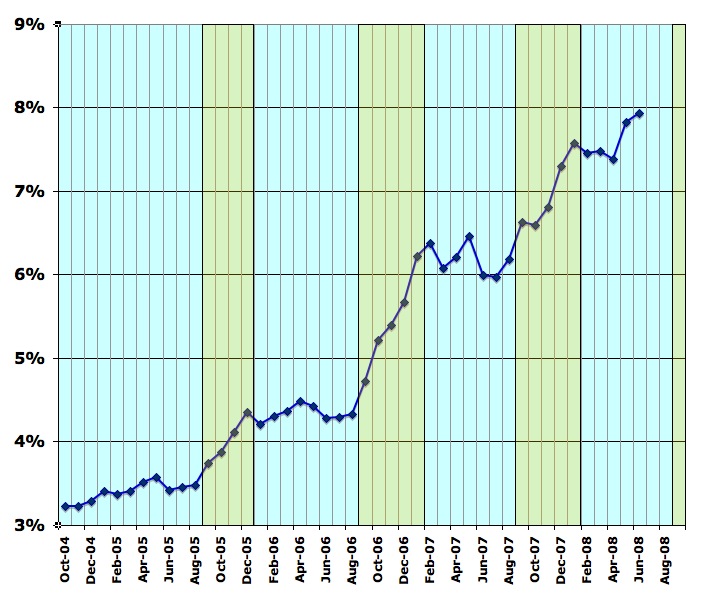
Yes, a new all-time high about Mac use is nice to hear, but not impressive to me right now. The reason: it’s not Mac season yet. I have noticed a pattern over the past three years–here’s the data over that period of time:

Macuse-Na

The areas filled in with green show sustained growth. See a pattern? Every year, starting in September, there is a sustained growth burst that continues until January. Between February and August, there are minor fluctuations, but the market share generally remains static.

The growth spurts are dramatic–less than 1% growth in terms of total market share in late ’05 (but that was bigger in terms of percentage of growth over the existing brand market share), 2% in late ’06, and close to 1.5% in late ’07. But right now we’re in the lull period.

Not to mention that the larger rise took place in May, not June (which was only a slight uptick from May), which was not really reported on. And if you look back, for some reason, there has always been a peak around April or May, so this is not a surprise. The safe bet is that the number will fall again in July and/or August, but then take off again in September, as always–probably representing back-to-school sales which create the growth spurt which lasts into Christmas sales, dying out soon afterwards.

Now, I’ll be surprised if the numbers continue to grow before September; that would be unusual, and could signal a bigger-than-usual surge in the latter third of the year. But right now, it’s not clear how big that surge will be. Yes, the iPhone 3G is making waves, but the original iPhone was making even bigger waves a year ago. While the current spurt trend–only two data points long–shows a slowing increase (2% to 1.5%), that’s less a trend than it is just a couple of data points. The surge this year could be anywhere from a 1% increase up to about 9%, or a 2% increase again up to 10%.

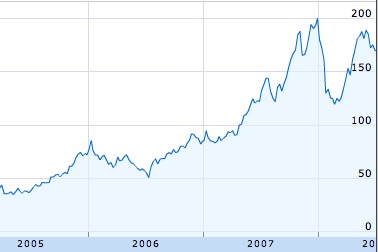
The only thing I’m pretty sure of is that there will be a surge–that’s the safe bet. And if you take a look at Apple stock, you’ll see a similar trend: a general pattern of big increases in the latter half of the year, with slower growth, decreases, and/or volatility in the first half.

Appl05-08

That graph is less clear-cut, but you’ll notice that the biggest increases, especially when you discount the drop-and-recover beginning of 2008, always fall in the second half of the year, peaking over the new year, and then dropping or at least slowing. But since 2003, there’s never been a value drop between June and December.

Those seem pretty clearly to be the golden months for Apple.

Categories: Corporate World, Economics, Mac News Tags:

Apple Stock

June 27th, 2008 2 comments

Great news from all around for Apple: analysts have raised their target share price to more than $50 above the current price and rate it a strong buy; Apple is on the eve of the release of their biggest-hit product ever, the iPhone 3G, which is raising massive interest around the world–in Spain and the UK there are already 300,000 pre-orders, two weeks before the actual release. Apple has increased its orders for production up to 15 million units from ten million units, and plans to hit it’s sales goal which observers once called fantastically optimistic but have now changed to saying Apple will probably sell even more. A new report says that Apple should make more profit from each new iPhone than they have ever made before. And the App Store promises to be just as much a hit, generating billions as a brand-new source of income for Apple. In other news, Apple sells its five billionth music track at the iTunes Store, and its line of personal computers continues to hit record sales marks (dominating the high-end market) and continues it’s skyrocketing trend in market share, while OS rival Microsoft wallows in mediocrity as its creator, Bill Gates, retires. Overall, every bit of news out there is highly positive for Apple.

The market’s reaction: Apple stock plummets $9.13, 5.15% of its total value.

Why? Frakking speculators.

Categories: Economics, Mac News Tags:

McCain: Hurtling Toward the Edge

June 14th, 2008 3 comments

McCain is at it again. His propensity for lying in only thinly veiled disguise is pretty stunning. A week or so ago, he said that our troop levels are at pre-surge levels, then he denied he was wrong, trying to pretend he never said “pre-surge” in a way that was pretty blatant. Today, he’s lying even more outright–listen:

So, essentially, he’s saying that he’s not for privatization, those damned nasty liberul Democrat Party meanies will twist his words and claim he’s for privatization, but he’s not. Instead, all he wants to do is allow for people to put money that would otherwise go to Social Security payments and instead place them in personal accounts. In other words, privatization. (Oh, no! I just twisted John McCain’s words! I’m going to hell for sure now!)

Josh Marshall points out how Republicans, similar to the way they blamed their own “nuclear option” terminology on Democrats, backed off from “privatization, saying the that Democrat Party™ was responsible for it all along. They switched to ”private accounts,“ and when that didn’t work, ”personal accounts,“ the language McCain just used in aggressively denying he was for privatization. It’s kind of like watching an intelligent-design proponent vigorously deny he’s a creationist when all the time he’s thumping on a bible.

Undoubtedly, we are taking him out of context yet again, which is now McCain’s knee-jerk response to any public mention of his numerous lies. So, for context, here is the word from John McCain himself:

So, what do we have just recently? McCain claiming that Obama lacks knowledge and experience about Iraq, while claiming that our troops are at pre-surge levels, and that all violence in Iraq will magically disappear soon after he takes office. (This built upon repeated McCain gaffes and blunders about Iraq, from his famous ”marketplace stroll“ fantasy to his inability to discern Shiite from Sunni.)

McCain claiming that Obama will raise Americans’ taxes by ”thousands of dollars,“ that ”Americans of every background would see their taxes rise,“ claiming that McCain is the middle-class tax-cutter when in fact, Obama would cut middle-class taxes much more than McCain, and would only raise taxes on people in the upper class while giving small businesses and middle-class workers big cuts; McCain, meanwhile, gives the lion’s share of his tax cuts to the rich.

According to McCain, Obama is dirty because one of his Veep Vetters simply worked for Fannie Mae, while McCain’s own Veep Vetter was a paid lobbyist for Fannie Mae.

And that’s just in the past week or so. Keep going back and it’s practically anunending string of stuff like this–reversals, lies, and double-standards.

My question is, how long will it take for the media to recover from the softening effects of the Kool-aid-drinking McCain barbecues and start reporting even half the obvious truth about McCain, showing him up to be a liar, a flip-flopper, and a hypocrite on levels that makes even George W. Bush pale?

Five minutes after that happens–if it ever does–expect the right-wing PR machine to go into high gear, claiming that the (a) Liberal Media™ has (b) gone back on the May-I-Get-You-A-Pillow-Senator-Obama Bandwagon and (c) is unfairly demonizing John McCain for no good reason.

The Tax Plans: Obama Helps the Poor and Middle Class, McCain Favors the Super-Wealthy (Surprise!)

June 13th, 2008 3 comments

An analysis of both candidates’ tax plans has been released (PDF) from the Tax Policy Center, a respected source of analysis on such matters. And guess what: Obama’s plan is far, far better, unless your surname is Hilton or Gates. But if you’re an average working schmoe, then you’re definitely going to want to vote for Obama.

On the plus side for McCain, he cuts taxes for everybody. On McCain’s bad side, he gives the biggest cuts the super-rich, with only a paltry handout to anyone making less that $38,000 a year. Even up to incomes of $66,000, you’re looking at a $320 cut–not very good, considering that recent hikes in gas prices probably have already eaten up much more than just that. But millionaires can look forward to saving more than a quarter million per year–sweet, if you’re rich.

Obama, on the other hand, gives everyone with incomes up to about a quarter million dollars a year a cut of up to almost $3000, with the cuts spread much more liberally at the lower end than McCain’s. While McCain would give low-income earners an insulting $19, Obama makes a huge difference in their lives with a $567 tax cut. All the way up to earners of $112K per year, Obama gives more back to the earner than McCain. And even for the upper middle class, Obama’s plan is not bad–with a tax hike of a mere $12 for those making up to $600,000 a year, I think it’s reasonable to say that you’ll have to really have tons of money before Obama starts taking anything away from you. And while Obama really socks it to Bill Gates, I think that people making eight figures or more can well afford to pay their way after the cash cow days under Bush.

Neither Obama’s nor McCain’s tax plans look hopeful in terms of balancing the budget anytime soon, but the report makes one thing clear: while neither will balance the budget, McCain’s tax cuts will cost about a trillion dollars more over the next ten years. McCain claims that he’ll offset this by spending cuts, but what he means is that he’ll increase spending for the military while slashing stuff like Medicare. McCain may claim that he’ll get it by cutting pork, but there simply isn’t even close to that much pork to be found.

Here’s the total breakdown of the tax plans by income level:


Income Obama’s Plan McCain’s Plan
$0 ~ $19K cut $567 cut $19
$19K ~ $38K cut $892 cut $113
$38K ~ $66K cut $1,042 cut $319
$66K ~ $112K cut $1,290 cut $1,009
$112 ~ $161K cut $2,204 cut $2,614
$161K ~ $227K cut $2,789 cut $4,380
$227K ~ $603K raise $12 cut $7,871
$603K ~ $2.9M raise $115,974 cut $45,361
$2.9M ~ Bill Gates raise $701,885 cut $269,364


What’s more significant here is that Obama’s plan is progressive, while McCain’s is regressive–in other words, Obama gives a higher-percent break to lower-income earners, while McCain gives the biggest percent-of-income breaks to the wealthy.


Income Obama’s Plan McCain’s Plan
$0 ~ $19K -5.3% -0.2%
$19K ~ $38K -3.2% -0.4%
$38K ~ $66K -2.0% -0.6%
$66K ~ $112K -1.5% -1.2%
$112 ~ $161K -1.6% -1.9%
$161K ~ $227K -1.5% -2.3%
$227K ~ $603K 0% -2.3%
$603K ~ $2.9M +6.1% -2.4%
$2.9M ~ Bill Gates +7.9% -3.0%

As you can see, Obama’s plan helps those who need help the most, while McCain continues Bush’s policy of giving the most help to the people who need it the least, and leaving people on the bottom rung with crumbs at best.

And here’s a bonus: McCain has been going around for a while now claiming that Obama is “going to raise your taxes by thousands of dollars per year,” and has even recently raised the Cold-War-era canard of “tax and spend.”

One can only assume that McCain was addressing an audience of millionaires, because that’s the only group which will have their taxes raised by “thousands of dollars” under Obama’s plan.

Categories: Economics, Election 2008 Tags:

Hillary to the People of Indiana: I Think You Are All Morons

May 3rd, 2008 Comments off

This via TPM:

I’ve just obtained a copy of another ad hitting Obama on the gas tax that Hillary just started airing in Indiana.

The last-minute ad, which went up late on the Friday before election day, says Hillary’s gas tax holiday would “save families $8 billion,” and adds: “Barack Obama says that’s just pennies.”

“He’d make you keep paying that tax, instead of big oil,” the ad continues.

Wow.

I mean, really. The gas tax idea has been almost universally exposed as petty pandering to voters, dangling money in their faces which evaporates before it gets to their pockets. Hillary refers to her “improved” version of McCain’s “gas tax holiday,” where she proposes paying for the tax cut by charging the oil companies with it. Therefore the claim that “He’d make you keep paying that tax, instead of big oil.”

Of course, it’s pure BS. Hillary is simply shifting the tax to an earlier point in the pipeline; do you really imagine that the oil companies won’t pass on the tax hike to consumers? It is doubtful that there would even be a hiccup in prices at the pump. The tax would still be there, and you would still be paying for it. Even pro-Clinton Paul Krugman is with Obama on this one.

What’s worse, Hillary is lying about Obama with her numbers. Obama pointed out that in total, Americans would save no more than $30 total, assuming the “gas tax holiday” would work to full effect, which of course it will not. Hillary, who chides Obama for (correctly) pointing out that this comes out to just pennies a day, instead grandly claims that Americans will gain a windfall of eight billions dollars! Wow! That’s a lot! Until you divide that number by the number of Americans, when it comes out to being… $30. She’s calling Obama a liar because he’s claiming her tax cut, if it even worked, would net Americans the exact same amount of money she is claiming it will.

Hillary is testing an idea: are the voters in Indiana complete morons who will vote for anyone who promises a tax cut, no matter how obviously false the promise is? Unfortunately, she could be right in her assumption.

The ball’s in your court, Indiana: lying panderer, or truth teller? You decide.

Categories: Economics, Election 2008 Tags:

Well, Duh

April 29th, 2008 2 comments

You may have heard about how McCain, and now McClinton both support a “gas tax holiday” for this summer, and argue that Obama is “out of touch” with regular Americans because he opposes the “tax cut.” The problem: the tax cut is so limited, in fact nearly worthless, that it works only as an election-year gimmick, not an actual solution to any problem. The tax stands at 18.6 cents per gallon, where gas costs $3.60 on average in the U.S. today. Let’s say that your gas tank holds 15 gallons and you pay the average price; you will save only $2.79 on a $54 refill. Wow! What a savings! That should fix a lot of people’s financial problems!

Truth is, you could probably save more money right now just by going to one of those web sites that finds the lowest gas prices, and save ten to fifteen cents per gallon that way. In my old ZIP code, there is a 23-cent-per-gallon difference between the highest and the lowest gas prices at stations within just a few miles of each other.

In short, the McCain/Clinton proposal is nothing more than hot air; Obama has got to be respected for speaking truth on this one, in contrast with Clinton’s jumping on the McCain publicity-stunt bandwagon:

Mr. Obama derided the McCain-Clinton idea of a federal tax holiday as a “short-term, quick-fix” proposal that would do more harm than good, and said the money, which is earmarked for the federal highway trust fund, is badly needed to maintain the nation’s roads and bridges.

In 2000, Mr. Obama supported a bill in the Illinois legislature to suspend most of the state’s 6.25 percent gasoline sales tax. But he later opposed making the reduction permanent, arguing that the state needed the revenue and that the measure had saved consumers little.

Mrs. Clinton, of New York, has also taken varying stands on the issue of gas taxes. In her 2000 Senate campaign, she spoke against repealing the federal gasoline tax, calling it “one of those few taxes that New York actually gets more money from Washington than we send.”

At a meeting with voters in North Carolina on Monday, Mr. Obama said lifting the gas tax for three months would save the average consumer no more than $30, a figure confirmed by Congressional analysts. Mr. Obama has previously dismissed Mr. McCain’s proposal as a “scheme.”

“Half a tank of gas,” Mr. Obama told his audience. “That’s his big solution.”

Well-put. Naturally, the Liberal Media™ will probably report that Obama is costing you money and how Clinton is successfully pulling for the little guy. Because the media is now far less about reporting facts than it is about branding images for profit.

Update: I was thinking of adding this when I wrote the above post, but couldn’t think of a way to phrase it succinctly and convincingly; Krugman, in a rare moment of not baiting Obama, put it extremely well:

if the supply of a good is more or less unresponsive to the price, the price to consumers will always rise until the quantity demanded falls to match the quantity supplied. Cut taxes, and all that happens is that the pretax price rises by the same amount. The McCain gas tax plan is a giveaway to oil companies, disguised as a gift to consumers.

Forgive me the omission.

Categories: Economics, Election 2008 Tags:

Class War

April 17th, 2008 1 comment

You might want to read this article in The Politico by Joel Kotkin about the emerging class war in the United States, and how it will replace the culture war:

Increasing numbers of Americans find it ever more problematic to maintain a “middle class” lifestyle. The current mortgage crisis, which has eroded the value of the most valuable asset of millions of Americans, only exacerbates these concerns. In such a situation, it’s hard to see how micro fractures among ethnic and gender identities will continue to be the defining issues of our politics as they were during the last half of the 20th century.

… [E]conomic issues seem certain to become more important in the next decade. This is a matter for not only older Americans: As the large millennial generation ages, it could well face an increasingly difficult economic climate. In the past, a college education alone has been the sure ticket to upward mobility; in this century, the newest research shows that it no longer guarantees any such thing. Wages for recent college graduates, particularly males, have been dropping since 2000, even as less-educated workers, at least in some places, have done better.

Categories: Economics, Social Issues Tags:

The Meme That Won’t Rightfully Die

April 16th, 2008 2 comments

This on McCain being reported from a new poll:

McCain was seen as a better steward of the economy than either Democrat despite their repeated criticism of his economic credentials. He led Obama by 3 points and Clinton by 5 points on the question of who would best manage the economy.

This despite McCain showing no reason to believe he would be a good steward of the economy, and in fact demonstrating that he would not be. The only thing he might do differently is to not favor pork as much, but with Democrats in control of Congress, he would do that anyway–and would still likely favor his own party’s pork in any case. But McCain wishes not only to extend Bush’s tax cuts for the rich, but to add his own to the pile, while allowing the middle class to lose their homes while he bailed out those who foreclose on them.

So why is McCain seen as a better steward? For no better reason than he is a Republican, and Republicans–completely contrary to all evidence–are still considered better on the economy. Yet another baseless favor McCain will enjoy, like being seen as stronger on campaign finance reform despite having violated federal laws on campaign finance and surrounded himself with lobbyists, or like he is considered strong on defense and foreign policy despite having authored the failed surge, promised an endless war in Iraq and a new costly war in Iran, and so much more to his detriment. He is seen as a centrist maverick when he is really a strong conservative who readily toadies to the most extreme elements of his party. And so forth and so on.

Kevin Drum put it succinctly and well:

The results are simple: Democratic presidents have consistently higher economic growth and consistently lower unemployment than Republican presidents. If you add in a time lag, you get the same result. If you eliminate the best and worst presidents, you get the same result. If you take a look at other economic indicators, you get the same result. There’s just no way around it: Democratic administrations are better for the economy than Republican administrations.

Democratic presidents generate more jobs–even the worst Democrat in the past century has outperformed the best Republican. Deficits fall under Democrats, and skyrocket under Republicans. The rich get just as rich under both, but while the middle class and the poor suffer under Republicans, they do very well under Democrats. While Democrats keep spending down to a dull roar, Republicans spend like there’s no tomorrow; while Democrats responsibly try to find ways to pay for what they spend, Republicans carelessly pile up massive debts which cripple the economy, costing us $469 billion this year alone just to pay interest [OMB figures, Excel file] on our Republican-generated debt. Without the interest payments on the Reagan-Bush-Bush deficits alone, we would have a balanced budget right now.

The facts are clear for anyone to see: elect a Democrat, and your income will go up, jobs will increase, the deficit will fall, the economy will do better. Elect a Republican, the reverse will happen. And yet, millions of Americans continue to vote against their own financial interests based on nothing more than a fairy tale, a PR sham job.

Categories: Economics, Election 2008 Tags:

Bush: No Use Taxing the Rich

February 12th, 2008 8 comments

This is Bush’s rationale on why taxing the rich won’t work:

Most Americans feel overtaxed and I promise you the Democrat party is going to field a candidate who says I’m going to raise your tax.

If they’re going to say, oh, we’re only going to tax the rich people, but most people in America understand that the rich people hire good accountants and figure out how not to necessarily pay all the taxes and the middle class gets stuck.

We’ve had — we’ve been through this drill before. We’re only going to tax the rich and all you have to do is look at the history of that kind of language and see who gets stuck with the bill.

It is obvious: if you raise taxes on rich people, rich people get stuck with the bill. That’s why they fight tax cuts like crazy.

Bush’s theory is that if you tax only the rich, somehow that tax will only affect people who the tax is not applied to. Huh? So if we make a law that raises the Alternative Minimum Tax for people making over $200,000, exempt everyone below that line, do not allow for special exemptions above that line, and anchor the tax to inflation, somehow rich people will not pay a penny more but people making under $100,000 a year will end up paying these taxes? Wow! Rich people must be magical!

Of course, it’s all a sham. The AMT was created to make sure rich people paid more taxes, and while I’m no expert, it appears to have worked. Not perfectly, of course; it needs to be tagged to inflation, some more loopholes closed, and it needs to be applied more to the super-rich, but overall, it prevented exactly the kind of thing Bush was talking about.

It is also hard to understand why Bush, on multiple occasions, either cut or tried like hell to cut, again and again, in way after way, taxes for rich people. He sees rich people as dishonest deadbeats, elite bastards who hire accountants to evade paying their fair share–so he rewards them by making it easier for them to avoid paying taxes? Interesting.

Really, what Bush is trying to say here is the same simple right-wing message: don’t tax the rich, and Democrats who say they want to tax the rich just want to raise your taxes. Boogah! Boogah boogah!

The tactic is simple. Use lies and scare tactics to get the middle class to vote against their own best interests, and support a massive welfare system for the rich.

Side note: have you noticed how Bush never uses the proper adjectival form “Democratic” to describe the Democratic Party? It’s way beyond an occasional misspeaking–he uses the conservative-created pejorative term “Democrat Party” virtually every time he names the party. He did so three times in the Wallace interview quoted above.

When Bush gave his State of the Union speech in 2007, he used the term–which was seen as the depth of political partisanship, to use that kind of a partisan slam in such a formal occasion. Soon after, he tried to blame it on “poor diction.” (His diction affects written scripts?) However, he only “misspeaks” when referring to the party. He uses the term “Democrat” liberally, and when he uses the word in adjectival form, he uses it correctly to refer to “Democratic leadership,” or “Democratic Senator,” and so on. But when speaking of the party, it is virtually always the “Democrat Party.”

Either this is from him simply being so immersed in a crowd who are so politically biased and entrenched in spiteful partisan politics that he never hears a different term, or it is a conscious decision by Bush to attempt to control the language to malign the opposition party.

Categories: Corruption, Economics Tags:

Pretty Typical

January 14th, 2008 Comments off

Obama released the details (PDF) for a $120 billion stimulus package he is introducing as a bill in the Senate which would give an immediate $250 tax cut for working families, with an additional $250 in the future if the economy worsened.

What does the Republican political machine call it? A “knee-jerk tax-and-spend” proposal.

A tax cut is ”tax-and-spend“? Interesting. I don’t recall them saying that when Dubya cut taxes for rich people. Maybe that’s it–it’s a tax on wealthy people when you give working families a break.

The package demonstrates a big difference between how Democrats and Republicans approach stimulus: Republicans favor top-down (or ”trickle-down“), where you give money to rich people and corporations, and, in theory, the money will make its way down to the lower classes, who will then spend it and the economy gets better. Democrats cut out the middle man and give it directly to the people who can do the actual stimulating. Not to mention the people who are more likely to keep it in the U.S. as opposed to sending it offshore to avoid taxes.

Categories: Economics, Election 2008 Tags:

Would You Like a Market with Your Stock?

November 10th, 2007 Comments off

Ouch. Apple’s stock has has two $10-a-day drops, after an initial $5 drop, going from $191 per share to $165 in just three days–a 13% drop. The good news is, it isn’t a reaction to anything related to Apple, it’s just that tech stocks in general are falling, and when the market drops, Apple usually drops as well.

No problem, though; Apple itself is strong and has a highly promising holiday sales season ahead of it. This drop will simply give Apple a bit more room to grow, for those who might have been worried about too big a market cap. That’s the best reason that I can think of as to why Apple didn’t issue a stock split when its price got pretty high–they don’t want the stock to inflate too fast.

Still, it’s not very fun watching it drop like that!

Categories: Economics, Mac News Tags:

Too Little to Take, Too Much to Pay

October 9th, 2007 1 comment

Since 2000 and George W. Bush’s long-running cut-taxes-for-the-rich campaign got started, the rallying cry has been that wealthy people pay too much in taxes. This has been propped up by distorted stats like the one InstaPundit is pushing today:

SO I GUESS THE TAX CODE IS PRETTY PROGRESSIVE, THEN: Top 1% Pay More Income Tax Than Bottom 90%.

There are problems with this, however, particularly if you have a memory. Now, mine ain’t all that great, but I do recall that back in 1993, when Bill Clinton wanted to raise taxes on the rich (very marginally, at that), the arguments went like this: If you tax the richest 1% of Americans at the rate of 100%, you could only fund the federal government for one day. Or something to that effect; the message was, rich people don’t really have enough money that taxing them more would make any difference.

Funny how the rich don’t have any money when we want to tax them, but are paying virtually everything when talk comes round to cutting their taxes.

But hey, if InstaPundit and those like him want to insist that their message today is the true one, then I say: if the wealthy are such a bonanza of tax revenues and yet they still have such opulent wealth left over, we should tax them a bit more and solve our budget deficit problems!

Of course, it’s all baloney. Kevin Drum debunks.

Categories: Economics Tags:

Tax the Rich?

September 17th, 2007 2 comments

Okay, let me start out by saying that Economics is a subject I know little about. All I have to go off of here is common sense, so this post is more of a question than a statement. But I wanted to bring up and question a conservative principle that I have heard for some time and always thought was fallacious.

I was reminded of all this after reading an article which talked about yet another loophole which allows wealthy people to reduce their tax burden to a point lower than many in the middle class have to pay.

Laffer Curve
Neolaffer

The conservative argument is: taxes on wealthy people should be low because if you raise them, people will have less motivation to make money. This argument is based upon the Laffer Curve, which in basic principle is a respectable argument–if taxes are set at 0% or 100%, then the government collects nothing (at 100% no one has any incentive to work). Somewhere in between is the optimum taxation rate.

The problem is, it is not as simple a curve as it is expressed at right, especially in a progressive tax system. For example, let’s say you tax a $50,000 salary 20% so the earner takes home $40,000, and you tax a $1,000,000 salary 96%, so the earner takes home $40,000, the return on the greater salary is zero, giving one no incentive to earn more. Such effects don’t fit so neatly on the curve. And when you get out of the extremes, other variables creep so strongly into the equation that it collapses into the snarl seen below Laffer’s curve at right, as illustrated by Martin Gardner.

The argument I am referring to never actually applies to extremes as high as 90%+; while such brackets may have existed in the past, current discussion centers on whether such brackets should be in the 15~50% range. And as Gardner points out, within that range, Laffer’s curve fails to serve as an accurate predictor.

First of all, taxes are never as simple as conservatives portray them in public discussion. You often hear about how people “pay” the top tax amount. However, the top earners never pay 35%, the top bracket today. There is a difference between tax brackets and net taxes paid. People talk about the 35% tax rate, but that doesn’t mean that every dollar of your income is taxed at 35%. You get the first chunk tax-free (deductions), then the next chunk is taxed at 10%, then the next chunk gets taxed at 15%, and so on. And then we have other loopholes, shelters, and dodges, like capital gains tax, which tops out at 15%; a lot of wealthy people make huge portions of their income this way.

But let’s ignore all that for now, and simply focus on the principle itself.

Let’s say that I propose raising taxes so that a person earning more than a million dollars would pay half of their whole income in taxes.

According to the conservative argument, many people would throw up their hands, say “what’s the use?” and not work so hard to make more money. As a result, incomes would drop, and therefore tax revenues would drop.

Somehow I just don’t buy this. I don’t think that people give up money so easily just because they’re not making a bit more more money.

Let’s say that you make $2 million a year and you have, say, 30% taken away in taxes, so you come home with $1.4 million. Then I raise your taxes to 50%; at the 50% tax level, if you make $2 million, then you take home $1 million. You don’t like that, but let’s say you can’t avoid it. Your only choice is to work less or to work more. Will you really be tempted to cut your work levels so that you make $1.8 million and take home $900,000 instead?

I strongly doubt that. Or, if you do, then I think the cause is not the 50% tax bracket, but the desire for less work–that cutting a certain portion of the workload would result in less stress, more free time, etc. Under such circumstances, the same person would likely cut their work levels if the tax rate were zero–the motivation to work less is linked to the desire for free time, not because they get a smaller return than in some other imaginary situation.

After all, people get taxed today, and yet they still work their asses off to make a fortune, or make more of a fortune. Why aren’t more people saying, “Hey, I could be making millions more, but the government takes so much–I could get loads more if the tax rate were half what it is now, so why should I work this hard?”

In fact, I would argue that the motivation factor works in the exact opposite direction to what conservatives argue. And this is my central argument: People who make large incomes are usually highly motivated to make more money. They will not be motivated to make less if the tax rates are higher–if anything, they will be motivated to make more money in order to make up for the loss to taxes.

Think about it. Will you really give up on the chance to make an extra million dollars if the take-home is $500,000 instead of $800,000? You would really deny yourself half a million dollars just because taxes ate up $300,000? Or would you say, “damn the government for eating up that $300,000, but I want/need that $800,000,” and try to find a way to get more?

Then there is the fact that people who make that much money–that is to say, more than they need to live comfortably–tend to be motivated by the desire to make as much money as they can, to succeed as much as they can; these people are the ones who will work even harder should tax rates rise.

There is a threshold at work where at some point, higher taxes start to be counter-productive, and to be certain, it starts at a lot lower than 96%. However, I am pretty sure that it also starts at a lot higher than 35%–today’s top bracket, which means actual tax percentages are a lot lower.


Query for information: is there any resource which lists the actual average tax payments as a percent of total income based on income levels? Say, a list which shows what percent of total income an American taxpayer shells out when making $50,000, $100,000, $500,000, $1 million, and so on? Not just straight-out, assuming standard income only and no application of loopholes or other dodges, but a real-world view? As far as I can tell, that doesn’t exist.

I would think that for any informed debate on tax levels, such a chart would be essential, and well worth the effort it would take to research and calculate it. Which makes me wonder why there might not be one.

Categories: Economics Tags: