Archive

Archive for the ‘Economics’ Category

For Example

October 19th, 2009 1 comment

I know that this is old hat, but it bears pointing out.

Conservatives claim that Obama is “bankrupting America” because, in response to an economic crisis, he put forward a stimulus bill in his first month in office which will eventually cost the United States a total of $787 billion.

On the other hand, conservatives to this day say that George W. Bush saved the American economy almost exactly eight years ago because, in response to an economic crisis, he put forward a tax cut plan (primarily benefitting rich people) in his first month of office which was projected to cost the United States a total of $1.6 trillion.

I’m pretty sure that $1.6 trillion is something like double $787, but I didn’t use a calculator to check. Of course, since 2001, inflation has made that $1.6 trillion into $1.9 trillion, but who’s counting? Well, these guys are (PDF), actually, and they say that Bush’s overall tax cuts wound up costing the United States $2.5 trillion. Again, no calculator, but I think that’s triple what Obama spent.

So: Bush spends $2.5 trillion in tax cuts mostly for rich people, and he saved the economy, while Obama spends $787 billion on a stimulus to create jobs, and he’s bankrupting us.

Did I miss the part where conservatives offered a cogent explanation of how these two opinions are reconcilable?

Categories: Economics, Right-Wing Hypocrisy Tags:

Steady As She Goes

August 3rd, 2009 5 comments

A big talking point of the Republicans is that Obama’s stimulus package has failed because the economy has failed to rebound, despite the fact that it’s only been a few months since the stimulus has been in effect. Even though preliminary signs were good–job losses turned around and started decreasing instead of increasing right after the stimulus passed–conservatives held that it had come and gone and, what, no effect. This despite giving Bush a far longer time to claim that his initiatives were successful, taking more than two years for most indicators, and even as late as 2004 Bush was still claiming that a job recovery was “just around the corner.” For Obama, right-wingers claimed that after three or four months, the game was over.

Now, many economists are saying that an economic rebound is in fact coming; indicators like the housing market and consumer spending are looking good.

So, how long until those very same conservatives who said no rebound meant Obama failed will now start claiming that the rebound has absolutely nothing to do with anything Obama has done? Three, two, one…

Don’t be surprised if many of them actually try to credit Bush for the rebound, claiming that Obama just wasted money on a stimulus that was not necessary after all. Now, the stimulus may not in fact turn out to have been the major reason for the rebound, in that there is usually not too much presidents can do to affect the economy positively (negatively is easy). But politically, presidents tend to get blamed for bad economies just by being there when it happens–look at how the right-wingers eagerly started calling it the “Obama Recession” just days after he got elected, months before he even took office–and, conversely, they get credit when economies are good. That’s simply how it works.

Whatever the case, if the economy does in fact rebound and things start clearing up, Obama will step up and take credit, and the Republicans will try to claim that somehow they were responsible (“we stopped him from making things worse with a bigger stimulus package!”). But since presidents historically get credit, and because Obama’s been the consistent one (conservatives not only have claimed that he is trying to destroy the country, but often claim that he has already destroyed it) in saying that things will get better. He has more cachet here.

Categories: Economics Tags:

Truthiness and Search Engines

July 7th, 2009 1 comment

Mike Huckabee on how Bush never blamed the recession on anyone else:

HUCKABEE: There’s one thing though that Biden and President Obama have got to get under control. And that is quit blaming George Bush. George Bush inherited an economy when he became president back in 2001 that was already beginning to show real signs of the stress from the breaking of the technology bubble. George Bush didn’t go out whining and complaining every day, he stood up like the president of the United States and he worked on trying to get it fixed.

Then 2001, 9/11 came, things really went tough, but he worked on the economy and it was in much better shape for most of his presidency. Then the recession started, wasn’t totally his fault for sure and all you hear from Joe Biden and President Obama is how, how terrible it was, what they inherited, how it wasn’t their fault. No, look, you own it now. You got elected, you wanted the job. Stand up and take it and get this thing rolling. But quit spending money.

Not only did Bush whine and complain, he did it every chance he got. When he mentioned the economy, he constantly threw in some mention of how it was already in motion when he took office, making sure people knew that he was not to blame. Not only this, but he did it throughout his entire eight years in office, right up to his last press conference.

In fact, Bush used the economic slowdown in the exact same way Obama is using the current one–which is to say, using it as a reason to push his financial package. Every time the slowdown or recession was mentioned, Bush used it to push his massive tax cut agenda. And as you can see from the quotes below, it was accompanied by repeated comments about when it started, pinning it on the last guy.

So I went and got most of these from Bush’s White House archives site, a few from other places–and by the time I got to 2004, I just got tired and jumped to 2008. Trust me, there’s lots more. You can go check yourself. Below I list only Bush’s direct quotes, though I found endless quotes by Cheney (a few: “To begin with some recent history, President Bush and I came to office facing a recession that had already begun.”, “We inherited a recession. The recession began the first quarter of ’01, when we first arrived.”, “We inherited a recession, a recession that began either shortly before or about the same time that we got into office.”) as well as several Bush administration Press Secretaries and cabinet officials. But Huckabee said “Bush,” so here is a small sample of Bush’s modesty and non-whining:

“Our economy is sputtering. Economic growth has stalled. Consumer confidence is falling. We can’t just stand by and hope for the best. We must act, and act now, to get ahead of this problem, and blunt or reverse this slowdown.”

–George W. Bush, March 10, 2001

“For several months, economic indicators have pointed toward a slowdown, and now many Americans are beginning to feel its impact in your lives.”

–George W. Bush, March 17, 2001

“And one of the problems we inherited was an economy that was sputtering along and slowing down.”

–George W. Bush, August 16, 2001

“I tell you what the numbers are showing. They’re showing that we’ve inherited an economic slowdown and the country is in an economic slowdown.”

–George W. Bush, August 23, 2001

“Many economists warned me when I took office that a recession was beginning.”

–George W. Bush, December 1, 2001

“You know, when I came into office, we were beginning a recession. I remember the Vice President saying that clearly.”

–George W. Bush, August 7, 2002

“You see, you’ve got to remember something about our economy. When we came in there, the economy was just beginning to get into a recession.”

–George W. Bush, August 29, 2002

“When we got up to Washington, D.C., the country was headed into a recession. Markets started correcting in March of 2000, that’s when it peaked. And then the summer the economic growth started to slow. And so by the time the Vice President and I showed up in Washington, D.C., we were in three-quarters of recession.”

–George W. Bush, September 23, 2002

“So with the combination of the loss of revenue as a result of the recession — which was official in January of 2001…”

–George W. Bush, May 2, 2003

“Let me tell you something, the deficit was caused by a recession which we inherited…”

–George W. Bush, August 13, 2003

“First, the stock market began a steady decline in March, 2000, as investors realized that the economy was not healthy. Businesses faced over-capacity during that period of time and cut their budgets for new investment in technology or equipment. And by early 2001, this economy was in recession.”

–George W. Bush, September 4, 2003

“We’ve been through a recession — and, by the way, the stock market started to decline six months before I became President. And then we had a recession.”

–George W. Bush, October 9, 2004

“When I took office, we inherited a recession…”

–George W. Bush, February 8, 2008

“We inherited a recession.”

–George W. Bush, March 14, 2008


“In terms of the economy, look, I inherited a recession, I am ending on a recession.”

–George W. Bush, January 12, 2009

Yep, Good ol’ George. Never willing to pass the buck.

Categories: Economics, Right-Wing Hypocrisy Tags:

Perception

June 19th, 2009 Comments off

While the Republicans may have done a lousy job of convincing the American people that Obama is to blame for the deficit, their long-term efforts to blame Democrats in general seem to have been successful. Witness the results of an NBC/WSJ poll (PDF):

Which ONE of the following groups do you feel is most responsible for the federal budget deficit?

Obama: 6%
Bush: 46%
Republicans in Congress: 7%
Democrats in Congress: 21%
Everybody: 13%

It’s fairly encouraging that only 6% truly believed that Obama could cause “most” of the damage seen in the federal deficit in just a few months in office than Bush could in eight full years; one can discount the 6% as the lunatic conservative fringe. “Everybody” is not a bad answer, either.

But look at the congressional numbers: Republicans 7%, Democrats 21%? When the Democrats have been in charge of the House for just over two years, barely in charge in the Senate for most of that time, the Republicans filibustering everything in sight, and Bush dominating things until just recently? That wins them 21%, while Republicans in Congress–who are in fact just as responsible as Bush, oversaw the majority of the deficit-building, and were guilty of extravagant pork and deregulation, only got 7%?

That has to be a result of either (a) Democratic respondents blaming Bush while Republican respondents blame Democrats, or (b) the successful job conservatives have done of making people believe the fiction that Democrats are to blame for spending no matter what, and that Republicans are fiscally responsible. It’s a given that Democrats in Congress have not distinguished themselves as fantastic budget-cutters, but to assign three times more responsibility for the current deficit to them than to Republicans in Congress is rather ludicrous.

Categories: Economics Tags:

Perspective

June 11th, 2009 Comments off

A chart from the New York Times showing where the current deficit comes from. I have altered the colors so that Bush’s deficit is shown in red, Obama’s in blue. It is worthy to note two things: first, that most of what we see here has taken place over a relatively short period of time, over the last year or so. Second, that the lion’s share of Obama’s deficit consists of actions needed to fight off Bush’s recession. When you subtract continuing costs incurred by Bush policies (like the recession and the Middle East wars), Obama’s contribution is limited to that tiny arrow at the bottom right.

In any case, if you ever encounter a tea-bagging wingnut screaming that he wants to secede from the union because Obama is creating a deficit that’ll cripple us, show him this chart. He’ll ignore it, of course, or otherwise claim it’s irrelevant (or Clinton’s fault), but others in the room will see him for the idjit he is.

Once we get out of the current recession, expect to see us do something that Bush could not do: rise up out of this deficit.

Surpdef-Bushobama

Categories: Economics Tags:

Jobs, Through a Red-tinted Prism

June 6th, 2009 2 comments

A lot happening, a lot to talk about… but various things to take care of have made it a bit difficult to post over the past several days. Sorry about that.
Gr2009060501264
One interesting point: in an encouraging sign, 345,000 people lost their jobs in May.

It is, of course, encouraging only in the context of 345,000 being way below estimates (the prediction was for 520,000 jobs lost), and May’s numbers showing the lowest job loss numbers in more than six months. As you can see from the chart on the right, there seems to be a trend from January that suggests we are quickly heading out of this recession. If you follow the trend line, we could actually be seeing job growth in three or four months–if the trend line holds or improves.

Is Obama responsible? Well, Obama passes a stimulus bill, and within a month or so job losses slow dramatically and the stock market gains 2000-plus points. Not proof positive, but it’s pretty hard to dismiss.

However, ever since Obama got elected, Republicans have been trying to blame him for anything and everything that smacks of bad news. Seriously, even after he was nominated as the Democratic candidate, Republicans have tried to pin stock market drops on him, as if the traders were going into wild panics at even the thought of Obama maybe becoming president.

And when Obama took office, Republicans took no time at all to go into full-blast blame-Obama mode, despite forgiving Bush for years of bad economic news because it was Clinton’s fault. A few weeks after Obama took office, the market dropped, and that was immediately jumped on. For example, in February, Malkin reached back to a November high to contrast the February low, blaming Obama for the stock market tumble. Even counting from January, when Obama took office, there was an apparent plummet that right-wingers wasted no time in laying at Obama’s doorstep.

Sm01

Naturally, when the stock market then immediately regained and actually rose above the level it was when Obama took office (just a few weeks after the “ineffective” stimulus bill passed), the same bloggers’ thundering silence was hard to miss.

Sm02

By the right-wingers’ own standards, Obama should be responsible for the first encouraging upswing since mid-2007. We’re still waiting for their congratulatory praise, their admission that the stimulus bill indeed stimulated the economy. After all, if Bush had gotten such immediate, positive results, the same people would be shouting this from the rooftops–but when Obama pulls off a relative economic miracle, they claim he is an abject failure.

Instead, Bush was supposedly not responsible for the downturn in the market at all–a lie easily proven false when one tracks back to stock market activity before the election. It’s kind of hard to miss the fact that the biggest losses came well into the remains of the Bush administration:

Sm03

Malkin’s blaming of Obama for a 4-month, 2000-point drop kind of loses significance when one sees Bush suffering a 2,400-point drop in just ten days in October. In fact, the very temporary one-month drop looks insignificant when compared to the market’s activity in the last six or nine months of Bush. And I don’t think that Malkin has yet congratulated Obama for the 800-point rise relative to when he took office.

And let’s not forget that the change in payroll job loss numbers is kind of hard to miss–that the moment Obama took office, the numbers immediately switched from accelerating downward to slowing considerably, pointing to a possible end of the recession with such rapidity that Bush’s faux “recovery” will look ridiculously slow in comparison.

At which point, I have no doubt that the right-wing bloggers would yet again do a 180-degree double-flip-flop and again assert that the previous president’s influence is what should be credited with the economic performance a year or two after the next president takes office–completely ignoring their previous claims that anything after November 2008 was completely Obama’s fault.

As for now, the right-wing blogs are mostly ignoring the encouraging job news altogether. The few wingnut blogs that are talking about May’s job numbers are pretending like the payroll numbers don’t exist or don’t matter, and instead focus on the unemployment numbers, which rose more than expected. From Hot Air:

The unemployment numbers for May hit earlier this morning, and it looks like Barack Obama didn’t save many jobs at all. Despite claims from both Obama and VP Joe Biden that the Porkulus package had saved 150,000 jobs, unemployment went up another half-percent to 9.4%, setting a new record for the past quarter century. … Why is this important? It demonstrates that the President and his economic advisers have gotten pretty much everything about this economic collapse wrong.

Outside the Beltway does mention the job numbers, but only at the end of their post about the unemployment numbers, and only to make the claim that they don’t matter:

Going by the Household Survey the number of unemployed increased by 787,000. This makes this recession as bad as 1957 and not quite as bad as 1948 in terms of unemployment. So despite the very mild good news yesterday about new jobless claims this data more than offsets it.

Even this grasp at painting the worst possible picture is hollow and false. As the NYT Economix blog patiently explains, the reasons for the unemployment numbers rising are not so dire–and may even be encouraging. While some of the number hike is due to the fact that 345,000 lost their jobs–still a loss, despite the great improvement in numbers–another part of the rise in unemployment is due to the fact that a much larger number of people than usual are trying to re-enter the job market. These are people who lost their jobs under Bush and had stayed unemployed for so long, they had dropped off the charts altogether–but now have reappeared because they apparently have new hope that jobs can be found. As for jobs Obama has saved, if you use Bush’s last numbers–700,000-plus jobs lost in January–as a baseline, Obama has saved about three-quarters of a million jobs already. Not that I take that claim seriously, but it conservatively follows the logical pretexts that right-wingers laid down.

So, the May payroll job numbers are about 175,000 jobs better than forecast and show a greatly encouraging trend toward rapid exit from recession, and even the higher unemployment numbers signal widespread confidence that jobs can be found, and people are out there looking for them–but all the right-wingers claim to see is bleak prospects–or nothing at all.

Not surprising.

As I recall, back when Bush was in charge and anyone tried to claim things weren’t going so well, they were accused by the right-wingers of trying to talk down the economy, of trying to make things worse so they could criticize Bush.

And now?

The Old Fallback

May 21st, 2009 1 comment

Jonathan Chait of the New Republic:

Quite possibly, four years from now we could still be mired in a worldwide depression and Obama could be facing dismal — who knows, even Bush-like — popularity ratings. The world is unpredictable. But isn’t there a pretty decent chance that the economy will have recovered, and Obama’s policies will look fairly wise in retrospect? Do Republicans want to make any political plans for this contingency?

Sure they have a contingency plan: lie. That’s how they claimed Clinton was not responsible for the booming economy he oversaw. If the economy gets better, claim it was because of actions taken by Republicans in the Bush years which came to fruition later, because of economic conditions completely divorced from Obama, and because of pressures Republicans exerted to shape policies during the Obama administration. Meanwhile, they will blame Obama for every piece of negative news during that time (there is always something bad happening), and will claim he’s the most liberal and worst president ever.

Is Chait new here or something?

Categories: Economics Tags:

A Positive Nation, Despite Hardcore Right-wing Negativism

April 7th, 2009 Comments off

The incessant, frenzied, paranoid, schizophrenic, and often downright vile right-wing campaign to make Obama fail and turn the nation against those nasty, communist liberals is not doing so well. According to the latest NY Times poll, Americans think we’re doing better and are headed in the right direction–and they think that the Republican Party has hit the bottom of the barrel:

…the number of people who said they thought the country was headed in the right direction jumped from 15 percent in mid-January, just before Mr. Obama took office, to 39 percent today, while the number who said it was headed in the wrong direction dropped to 53 percent from 79 percent. That is the highest percentage of Americans who said the country was headed in the right direction since 42 percent said so in February 2005, the second month of President George W. Bush’s second term.

The percentage of people who said the economy was getting worse has declined from 54 percent just before Mr. Obama took office to 34 percent today. And 20 percent now think the economy is getting better, compared with 7 percent in mid-January. …

By contrast, just 31 percent of respondents said they had a favorable view of the Republican Party, the lowest in the 25 years the question has been asked in New York Times/CBS News polls.

Of course, this is perception–but the nation’s economy is largely fueled by perception, as are election results. How this will translate into actual economic improvement over the next year is a different matter, as many elements of the economy are out of the control of mere perception, and could scuttle confidence.

Still, what we see is a measure of faith and trust: Obama and the Democrats are instilling more confidence and approval in the people, while Republicans are driving them away.

So, keep at it, Rush. You’re doing just fine.

Categories: Economics Tags:

“You’re Gonna Hear a Lot About Class Warfare… Because We’re Getting’ Us Some!”

April 3rd, 2009 4 comments

You know that when Republicans start talking about class warfare, it’s because they plan on waging it even more than before.

You know that Republicans in D.C. have lost their moral compass, that happened quite a while back. You know they they will lie and obfuscate to ridiculous extremes, depending on the the media to back them up, enough to sound credible and get it presented raw to the American people and be believed by many.

But this is pretty amazing. I mean, there is lying, and there is lying. I know I keep on acting surprised at the lengths they go to, but they keep on getting more and more outrageous. Representative Paul Ryan, the ranking Republican Budget Committee member, said this when presenting the Republican budget that actually had some numbers, however ridiculous, in it:

“You’re gonna hear a lot of echoes of class warfare. You’re gonna hear allegations of draconian spending cuts. You’re gonna be told that there is no viable choice for America other than to embrace the president’s radical fiscal agenda. Let me respond to that right now.

”Using class-warfare to take advantage of peoples’ legitimate anger and anxiety, it may make good policy but it’s not leadership. Preying on people’s emotions of fear and envy, it doesn’t create jobs. It demoralizes the small businesspeople who are trying to become successful, and it demonizes the small businesses that are successful that create most of our jobs.“

Update: Upon re-reading this, I noticed something I should have caught before. In the quote above, Ryan begins by saying he wants to respond to potential allegations of class warfare. But in the response, he does not give any evidence that his budget is not class warfare; instead he says class warfare is bad and hints that Obama is guilty of it. That he gives no defense of his own bill is rather telling of the fact that he can’t.

Some things he got right: using class warfare is wrong and it’s not leadership. The error: he ignores the fact that class warfare is a two-sided battle, and conservatives have been waging that warfare more vociferously and have been winning it outright for quite some time now. Think not? Then when rich and poor both needed bailouts, who got no-strings-attached billions and who got short-changed? Who got handsome bonuses and who got told to take a wage cut?

Republicans have been playing at class warfare for a long time now, and what Ryan said is, in a way, nothing new–when Republicans want to open up a whole new front in the class warfare battle, they always start by accusing the other side of it first. But who’s waging war here? Obama, who wants to take the best tax environment for the wealthy in a long time and scale it back just a smidge in the direction it had been for decades?

Or is it the GOP, which launches massive tax cut after massive tax cut for the wealthy, then turns around for some more union busting, followed by slashing of services and benefits for the middle and lower class? Almost their whole agenda is class warfare. When the poor needed cheaper drugs and the taxpayer needed a break with Medicare spending, who instead gave all the power, leverage, and profit to big pharma? When the people in dire straits were pitted against the loan industry, who pushed through legislation to put all the advantages in the hands of the big banks? And in this latest crisis, when regular people overstepped their means but banks lured them to do so for predatory reasons, who got the bailout and who got their homes taken away?

The Republicans want to dish out more of the same all over again–even more tax cuts for the rich. Because the economy will collapse if Paris Hilton doesn’t get all the billions her daddy’s gonna leave her. Because the wealthy need their inheritances more than the people need their homes. Because if we don’t give millionaires and billionaires those Bush tax cuts permanently, who’ll have enough money to save us all?

Note, of course, that Ryan dragged out the perpetual poster boy for the right wing and their rich patrons: the small businessperson. Obama’s budget, Ryan claims, both demoralizes and demonizes the small businessman. Um… how? When? What small businessman–the CEOs of the big banks? Those small businessmen?

Oh no, Ryan must be talking about people like Joe the Plumber. Small businessmen like him who own… um, who want to own, uh… well… who brazenly lied about being a small businessman so he could score a political ”gotcha.“ That’s pretty much all they have–because the small businesspeople they are talking about don’t exist, at least not in any form that will get wiped out by Obama’s plans. Despite Obama’s goal of raising the tax bracket on income over $250,000 a year, that’s not gonna take down a single small businessperson. You’d have to make well over that before you started paying significantly more in taxes, and let’s face it, that ain’t being poor, nor is it going to ruin any business. It might sting a little, but then taxes sting people making less than that a lot more.

I mean, really, is someone gonna say, ”I’m only making $300,000 a year in profit off my small business, but the new few thousand bucks in taxes I gotta pay makes it all totally not worth it–I’m shutting my shop down and going back to being a shop clerk at some other sucker’s store!“ Yeah, that happens all the time, I betcha.

The Republicans, on the other hand, want to make permanent tax cuts for the wealthy and even add some more, and they they want to slash Medicare, Medicaid and Social Security. They want to stop the stimulus cold, choking civilian job growth, and then heavily expand military spending, benefitting defense firms but also forcing poorer Americans to instead sign up for military service because there would be no other jobs out there. That’s not class warfare, right?

But the real whopper comes with their projections. Though tax cuts and more tax cuts for the rich have drowned us in deficits and a stagnant economy, despite the fact that Democrats have historically achieved better job growth and lower deficits, this is what the Republicans are claiming will happen if we follow Democratic or Republican budgets:

Gopgraph

This is so out of proportion, so ridiculously, ludicrously fictional, it’s actually hilarious. And this economy is a tough room. Republicans might as well say that Democrats will lead us all to the gates of hell while Republicans will have rainbows and magic ponies for all! Just give up the rest of your social programs and translate it into a few more billions in tax cuts for billionaires, and we’ll be there!

And we can trust the Republicans when they tell us this, right? Because they have been so trustworthy and effective in regards to economics up until now, right?

Categories: Economics, Political Ranting Tags:

20% Sales Tax

March 22nd, 2009 3 comments

I have heard this idea tossed around for some time in Japan–to increase the national sales tax from 5% to 20% and so do away with some other taxes. To me, this sounds like a foolish idea–it is essentially a way to tax the poor and give the rich a relative break, and could be a huge brake on spending in general. As I recall, the last times they raised the sales tax–from nothing to 3%, and then up to 5%–the economy did very poorly. Of course, other things happened at those times that make it uncertain as to how much of a bad effect the sales tax increases alone had, but it seems almost intuitive.

I do recall that before Japan had the sales tax, there were other taxes, like luxury taxes, that were aimed at the rich–and these taxes disappeared, the sales tax taking their place. To me, the sales tax in Japan has always seemed a way to make taxes in Japan less progressive. And it helps to remember that there are no exceptions for the sales tax–you pay the tax for food, for example, unlike in the United States.

However, my understanding of this issue and how it works is spotty at best. So could somebody explain to me how a 20% national sales tax is not a bad idea?

Categories: Economics, Focus on Japan 2009 Tags:

The Bonus Tax

March 20th, 2009 3 comments

Whatever its flaws, I like it. Maybe (probably) I don’t know nearly as much about the details as I should. Maybe I am responding viscerally. I don’t care. These reprehensible asses have been robbing us as customers to line their own pockets, and now they’re robbing us as taxpayers to line their own pockets. If these bonuses were reasonable and as tied purely to performance as they so falsely claim, that would be one thing. But they are not.

Republicans in Congress, predictably, are putting up resistance. Many are caving in and voting with Democrats just like Democrats did with Republicans on the Iraq War. The similarity is due to both being immediate third-rail policies, the difference is that (of course depending on your opinion) one was for the wrong reasons and the other is for the right reasons.

The Republicans’ reasons to protest:

Two Wrongs Don’t Make a Right. … since the bonuses have been distributed, the solution is not to compound the problem with more inappropriate actions by the federal government.

This only makes sense if you agree that taxing obscenely wrong bonuses is a “wrong.” Many beg to differ.

Retroactive Tax Increase. The tax increase in the bill would be applied to bonuses paid after December 31, 2008. Many conservatives believe that retroactive tax increases are unfair and unconstitutional.

This only applies if you see it applied to specific days of the year. This bill is aimed at the current tax year, so I do not think it is retroactive.

Confiscatory Tax Rate. The legislation creates a tax rate of 90%.

Of course it’s confiscatory. That’s the point. I for one have no problems with this. These scumwads are running off with money earned by working Americans that was intended to save the business and benefit the nation, not enrich the same dishonest bastards that lost the firms’ money in the first place. If Republicans think that it’s wrong to confiscate that money, then I think they go too far on principle where it frankly should never apply.

Bill of Attainder. The bill, while not mentioning AIG by name, is clearly meant to punish AIG executives who received high bonuses–a specific group of individuals in response to public outrage over the bonuses.

The idea being that only courts should be able to apply such specific punishments. They believe that we are punishing a very specific group of people, even though it is a group, and no specific people or even corporations are named. And I think that’s where this argument fails; you can’t name all the specific people who will be affected yet, and more people could fall under this classification based upon their actions, not who they are. After all, one could say that the Estate Tax is a bill of attainder if one limited the definition to a “restricted group or class of people.” That this bill is aimed at anyone working for a firm receiving large amounts of taxpayer bailout money emphasizes the fact that there is a public interest. It is aimed at a wrong, not specific people. Furthermore, it does not really “punish” anyone; if the Congress passed a law that said bank robbers had to pay back 90% of the money they stole but don’t have to go to jail, I rather doubt that Republicans would be crying foul over an “unfair punishment.” Not to mention that Republicans are probably crying foul only because it is white-collar executives running off with public money–if it were bank robbers doing the exact same thing, they’d want to hang the bastards. But these guys are too close to their core constituency.

Categories: Economics Tags:

Republicans: Scrambling Out the Back Door, Running Around to the Front, Then Screaming to Throw the Bums Out

March 14th, 2009 4 comments

Obama and Democrats in the Senate propose stimulus spending to spur job growth and economic revitalization. The public approves of it strongly. The bill passes Congress. The states await the funding.

A few opportunistic Republican state governors make noise about refusing token bits of the spending, but one governor–Mark Sanford of South Carolina wants to take that state’s $700 million cut of the money, and instead of spending it on what it was intended for, use it to pay down the state’s debt. Remember the young girl asking for funds to make her school livable again from Obama’s address to Congress? South Carolina. Sanford would be pulling the carpet out from that school, as one small example of those who would suffer from it.

So, why does he want to do that?

What we’ve said is it’s not a good idea to spend money that you don’t have, whether in your personal life, in the world of business, or for that matter, in the world of politics. At the end of the day, all this stimulus money’s about spending money we don’t have. We don’t think that’s a good idea, but that debate was lost.

Ah. After eight years of non-stop Republican borrow and spend, where right-wingers couldn’t spend “money they didn’t have” fast enough, after decades of smearing of the Democrats as “tax and spend” (which would be using money you DO have), after thirty years of Republicans running up ten trillion dollars in debt, we now have Republicans lecturing Obama and the rest of us on “spending money we don’t have,” a practice the Republicans have owned for the past three decades. And their timing could not be worse–we now actually need spending like we never have before.

And Obama’s spending is not the earmarks Republicans have dominated, nor the no-bid contracts to cronies and contributors, or the billions in giveaways to oil companies already flush with profits or billions more for wealthy people flush with profits from the Clinton years. Instead, the spending is mostly for stuff that I guess Republicans see as wasteful–schools, roads, bridges, communications, and other infrastructure stuff.

Remember Al Gore and the lockbox, using some of the money the Clinton surplus would have given us for paying down the debt? Remember how Republicans scoffed at it and instead insisted that it was “your” (the taxpayer’s) money, so you (and by “you,” we mean wealthy people) could get tax cuts? Remember how those tax cuts, along with Bush letting 9/11 happen, and his debacle of a war in Iraq, gutted any chance of surpluses helping, even if Republicans had any intention of paying down any debt?

Yep, the Republican Party is now officially the Party of Dangerously Irresponsible Economics. Not that they weren’t for the past 30 years when they gave in to “Voodoo Economics” so they could win elections. But now they have removed any and all doubt.

Categories: Economics, Political Ranting Tags:

Fomenting for FUD and Profit

March 14th, 2009 Comments off

Jon Stewart finally had Jim Cramer on his show last night, and boy, did Cramer come across as a giant ass. Not to mention, a clip Stewart showed of him in a webcast interview from TheStreet.com from a few years back (before the iPhone was released) shows how and why FUD (Fear, Uncertainty, and Doubt) was “fomented” by hedge fund managers (like he was) to bring stocks like Apple down–because though it was “blatantly illegal,” it was easy to do and the SEC wouldn’t go after you for it. In his words (video here):

Jim Cramer: You can’t create yourself an impression that a stock’s down. But you do it anyway ‘cause the SEC doesn’t understand it. That’s the only sense that I would say this is illegal. But a hedge fund that’s not up a lot really has to do a lot now to save itself. This is different from what I was talking about at the beginning where I would be buying the Qs and stuff.

This is just actually blatantly illegal. But when you have six days and your company may be in doubt because you’re down, I think it’s really important to foment if I were one of these guys. …

Aaron Task: Okay. Another stock that a lot of people are focused on right now seems to be Apple.

Jim Cramer: Yeah. Apple’s very important to spread the rumor that both Verizon and ATT have decided they don’t like the phone. It’s a very easy one to do because it’s also you want to spread the rumor that’s it not gonna be ready for MAC World. This is very easy ‘cause the people who write about Apple want that story, and you can claim that it’s credible because you spoke to someone at Apple, ‘cause Apple doesn’t –

Aaron Task: They’re not gonna comment. They’re not gonna –

Jim Cramer: So it’s really an ideal short. Again, if I were a short Apple, I would be working very hard today to get that. The way you would do that is you pick up the phone and you call six trading desks and say, “Listen, I just got off the phone with my contact at Verizon and he has already said, ‘Listen, we’re a Lucky G house. We’re a Samsung house. We’re a Motorola house. There’s no room for Apple. They want too much. We’re not gonna let them in. We’re not gonna let them do what they did to music.’” I think that’s a very effective way to keep a stock down.

Oh, great. So here’s a stock that I have invested in with money that I worked hard for years to earn and save, and there’s some scumwad hedge fund manager who made some bad choices–so to help himself, he goes out and spreads fake rumors to rob me of money. And here is this self-described “banking class hero” scum virtually bragging / instructing others to do this kind of thing, on national TV. And here we are more than two years later, and the guy still has a TV show on CNBC and other high-profile writing gigs.

Yes, unchecked capitalism works so well.

(Click here for an article from RoughlyDrafted on this, from back in 2007.)

Categories: Economics, Mac News Tags:

How Dare Workers Think They Deserve Better

March 12th, 2009 11 comments

This news is ricocheting about:

Today is Employee Free Choice Act day in the Senate, with Tom Harkin holding a hearing on the Health, Education, Labor, and Pensions Committee that will serve as precursor to the bill getting sent to the floor. …

The more impressive strike came, however, earlier this morning, when Citibank downgraded Wal-Mart’s stock from a “buy” to a “hold” on fears that passage of EFCA could force the company to unionize which would in turn decrease shareholder profits as more of the company’s worth was distributed to employees.

What would the Employee Free Choice Act do, exactly? Its description says, “To amend the National Labor Relations Act to establish an efficient system to enable employees to form, join, or assist labor organizations, to provide for mandatory injunctions for unfair labor practices during organizing efforts, and for other purposes.” In short, if people want to join or form unions, they can. How heinous! While characterized as making it easier for workers to form unions, the act is probably better defined as making it harder for businesses to keep unions from forming or controlling how they work.

What the downgrade seems to mean is that Wal-Mart’s business is essentially based in large part upon abusing employees.

Wall Street has always been unmercifully anti-union, however. Back in mid-2005 I blogged on a NY Times article expressing how Costco treated its workers much better than Wal-Mart does; their pay is almost twice as high, and their insurance burden is about one-third as much. Wall Street’s reaction? Not that Wal-Mart is almost fascist in its abuse of its workers, but that Costco is “too generous.” That Costco should “force employees to pick up a little more of the burden.” As if workers don’t deserve fair pay and benefits, as if businesses don’t depend absolutely on their employees and should treat them that way.

Unions may have their faults (they deserve nowhere near their current reputation), but they are just about the only way that people in the lower and middle class can count on representation; Congress and the government in general is far too likely not to work in their interests, and even with Democrats back in charge, things won’t always be too rosy. We have just been through a 30-year period of anti-union, anti-worker, anti-middle and lower-class government. It has created 10 trillion dollars of debt and has crushed our economy and our viability.

Let’s try maybe doing the opposite and see how that works, shall we? Maybe, just maybe, putting some capital back into the hands of regular people could result in a stronger economy and do some good. Clinton went some distance in that direction before Bush derailed it. Let’s see if we can get back on that track.

Categories: Economics Tags:

Got That Right

March 4th, 2009 Comments off

I’m not a big fan of Joe Klein, but truth is truth, no matter who says it:

In truth, class warfare is what the Reagan Era gave us: thirty years of tax breaks for the wealthy at the expense of the common weal, thirty years of lax regulations which enabled the bankers to strip-mine the savings of average Americans while reaping huge rewards in Ponzi schemes, like the micro-dividing of mortgage assets that were really debits. Once again, I’m not sure Obama’s proposals will work–some will surely be more successful than others, there’s a good chance that rather than being too bold, he isn’t being bold enough–but I am absolutely certain where the continuation, or augmentation, of Reagan-Bush policies would leave us: even worse off than we are now.

Couldn’t have said it better.

Categories: Economics Tags:

We’re from the Government

March 1st, 2009 Comments off

If you haven’t heard the fallout from Bobby Jindal’s story in the Republican response to Obama’s address, then you’re in for a treat. Jindal told a story about how a sheriff in Louisiana was trying to save lives while some bureaucrat told him he couldn’t until he had the right insurance coverage. Jindal told the tale about how the sheriff stood up to the lousy, sniveling bureaucrat, and said “you can come and arrest me” but he’d go and save those lives, insurance or no. With the sheriff now passed away, we may never get a definitive recounting of the actual events, but Jindal went further: he then went on about how he was there, that he backed up the sheriff, and the sheriff said they could come and arrest Jindal as well! Two maverick lifesavers, standing up to the lousy, sniveling bureaucrats!

Except for the tiny detail that Jindal wasn’t there–he made that part up. Nor was it a spur of the moment kind of thing, either–he apparently has been telling the same tale since last year, soon after Sheriff Harry Lee passed away. Despite the fact that the record clearly shows that Jindal was elsewhere at the time.

Add to this the fact that a letter exists from early September, 2005, which tells the story somewhat differently–at least in that the bureaucrat, a Dept. of Wildlife & Fisheries agent, told a flotilla of 500 citizen rescuers to go home, not because they lacked insurance and registration, but because the boats were too large to use because the water level had dropped overnight. The agent ordered the boats home, and all but a few small boats complied. That sounds like the same story Jindal is telling–but even without Jindal’s embellishment about how he was there, the story sounds pretty different.

However, the central theme is still the same: some bureaucrat screwed up and probably cost lives. Jindal used the story to drive home a popular Republican theme: you can’t trust government to do the right thing, you can only trust the people (always eventually extended to corporations) to do what needs to be done. This harkens back to Reagan’s joke about the “nine most terrifying words in the English language” being, “I’m from the government and I’m here to help.” Republicans use this image of government being perpetually incompetent to accompany their cry for “smaller” government, but as we’ve seen so strongly demonstrated from the Reagan and Dubya years is that they in fact have a great love of big government; they only want to make certain parts of government smaller and weaker–parts like social programs that help the poor and lower middle class, taxes and regulations where they apply to corporations and the wealthy, that kind of thing. But when it comes to big spending that puts money into the pockets of corporations and the wealthy, government can never be big enough for the Republicans.

This theme echoes throughout Republican rhetoric; just recently, we heard Republican Party chief Michael Steele insist that the government never created a single job–it just creates “work” (apparently, he himself has been “working” without a job for quite some time now). You can find examples of this everywhere. Republicans want to take anything that they don’t like and leave it up to the “people”; break down public education and put it in the hands of private enterprise; never allow social health insurance to come together; deregulate industries and let the market take care of things.

The thing is, most of the examples of government ineptitude come from the Republicans’ own inept handling of government. FEMA was an unmitigated disaster during Katrina, something Jindal used to suggest that Obama’s plan for more government job projects are doomed for failure. The problem is, FEMA was a disaster because Republicans made it so: Bush made FEMA into a personal checkbook for paying off cronies, so no wonder it did terribly. And despite the fact that sweeping deregulation leads to massive bank failures every generation which require ever-increasing bailouts, Republicans seem completely incapable of recognizing the fact that deregulation is a prime factor in causing these disasters.

But what about the Katrina story, at least as we know it happened? Did not a government bureaucrat turn away a flotilla of citizen rescuers? The fact seems pretty solid that he did, though we have to take the storyteller’s word that the guy was wrong. Assume he was, assume it was just the screw-up it is painted to be. Isn’t that evidence enough of how government bureaucrats, regardless of which party is in power, always screw up?

Well, no. It’s a single incident. Republicans love to do this: come up with isolated stories about how bureaucrats, regulations, entitlement programs, etc. make some massive screw-up, therefore the whole department/program/system should be taken down. We almost never hear overviews, analyses that prove the programs are wasteful; instead we get stories. The stories always get embellished like Jindal’s; Reagan went wild in his exaggerations of the legendary welfare queen scammer, and opponents of Affirmative Action took a case involving the Daniel Lamp case and distorted it heavily out of proportion. In all these cases, there is a kernel of truth about something related to government going wrong, but in all these cases it’s an isolated incident, and does nothing to demonstrate that the program or system as a whole is bad. Whatever faults welfare had, it was not bad because a few scammers were able to cheat here and there. Affirmative Action works quite well on the whole, thank you very much; the abuses most commonly come from people who take literally the right-wing horror stories made up about it and so take wrongful actions. And when systemic faults do appear, the reaction is to demolish the system rather than to address the faults and repair the system.

In the end, what you usually have is a few idiots doing something stupid, and thus the whole system gets blamed and tagged as unacceptable. The thing is, such idiots are everywhere, in every system, public and private. Look at the banks that accepted bailout money–they mismanaged the banks horrendously, took the bailout money and paid themselves big bonuses, and then refused to use the money for what it was intended–to get loans to Americans flowing again. These are exactly the people that Republicans say we should leave things up to, instead of government. When it was the Republicans that enabled them–pouring money into their coffers and not demanding regulation or oversight–while it was the Democrats who called for oversight and eventually put the brakes on the banks’ worst excesses.

On the other hand, look at what government has done right. Does anyone truly believe that building the railroads in the 19th century was a bad thing? (Yes, there was graft, corruption, and abuse especially in that example–but the central idea was rock solid.) Or building the interstate highway system in the 20th century? Both were government programs and both served to dramatically spur the national economy. The space program on the 60’s and 70’s was a marvel of accomplishment, and its technological investment created the seeds of the computer industry that so enriches the United States today. The Internet was a government project, kept alive by people like Al Gore in the 80’s, and served to dramatically elevate the economy and bring America back to the forefront of the worldwide economy. Even the put-people-to-work programs Roosevelt enacted which Republicans now revile worked, the market only acting badly when Roosevelt listened to his opponents and scaled back temporarily. But in all these programs, it was not just the many jobs created by the programs themselves, but all the jobs made possible by the infrastructure built by these programs. The fact is, the U.S. government, for all the idiotic bureaucrats you’ll find here and there, is the single largest creator of well-paying, productive jobs in history. And it has specifically been infrastructure investment in particular that has generated the most jobs, the kind of investment that Obama is trying to get done and that Republicans are trying to derail.

Robust government spending in education, infrastructure and scientific research, free from the kind of corruption Republicans have infested our government with, alongside strong and responsible regulation of industries, will lead to a strong and capable America. The “fiscally responsible” (har!) Republicans want instead to covert the country into a plutocracy complete with serfdom–which, after all, is the American Dream, right?

Categories: Economics Tags:

Blame Obama

February 25th, 2009 Comments off

It started really early: just a week or so after Obama won the election, right-wingers were already calling our current economic crisis the “Obama Recession.” Remember, these are the same people who were still blaming Clinton for the recession for years into Bush’s term. They couldn’t even wait for Obama to actually step into office, they had to start blaming him for the economic woes a full two months before he could even start doing anything about it.

Apparently, right-wingers are applying the Pottery Barn rule, only in reverse: “you bought it, you broke it” seems to be their new motto. Hell, there are right-wing bloggers out there saying that we should measure the “Obama economy” based on the economy’s performance from the time of his nomination in June last year. Give them time, and they’ll find a way to pin the blame for the Great Depression on him.

Now that they have established that every economic downturn since people even heard about Obama is all his fault, the question now becomes, how much can we bash Obama if the economy fails to boom within x number of months or years? Remember, for Bush this was not supposed to be an issue. Remember back in 2004 when Bush was claiming that a recovery was “just around the corner”? That was almost four years after Bush took office, and Bush’s commerce secretary was still saying stuff like, “The president inherited a Clinton recession and turned it into the early stages of Bush prosperity.” That was for a recession that started two months after Bush took office (though they tried real hard to apply revisionist history on that), as opposed to this recession, which started in December 2007–a full thirteen months before Obama took office.

And yet, just a month into his presidency, and the pundits are coming down on Obama every time bad news comes out. Somehow, bad economic news in a recession that began after he left office was Clinton’s fault for years after he was gone, and yet somehow Obama is responsible for a recession in its 14th month despite just barely having unpacked his suitcases.

Of course, I should not be surprised. Goodness knows I have never faulted conservatives for their relentless sense of consistency.

Because the Rich Need All the Help They Can Get in These Hard Times

February 9th, 2009 2 comments

Among the Republican calls for tax cuts (PDF file of the GOP proposal):

Repeal the alternative minimum tax so that wealthy people can avoid paying even that much.

Keep the capital gains and dividends tax rate at 15%, so that wealthy people who make most of their income that way can use it to maintain low tax rates.

Lower corporate tax rate from 35% to 25%, because Exxon and the other oil corporations need to keep as much of their massive eleven-digit profits as they can in order to keep their Cayman Island accounts healthy.

Lower the highest tax rates on regular income for the the wealthy from 35% to 25%.

And here’s the topper: Repeal the estate tax under $5 million, and cut it to 15% for estates above $5 million. Currently, estate taxes apply to estates worth $3.5 million and higher, and are taxed at 45% above that amount. Republicans have been shooting for the $5 million/15% for some time now, meaning it’s not “stimulus,” it’s simply one of their desired goodies.

Fact is, tax cuts to the rich is not stimulus; it didn’t pump up the economy when Bush tried it before, and it won’t work now. These tax cuts are simply yet another giveaway–this time a $3 trillion giveaway over the next 10 years–mostly to people who don’t need them. Just pile it on top of the $700 billion we just fed the super-wealthy, and all the other cuts they’ve gorged on, which only helped feed their greed which led to this crisis in the first place.

That won’t stop Republicans from pressing for even more tax cuts for the rich, on top of all the recent huge tax cuts for the rich, at a time when revenues will be plummeting and the middle class, more and more, will not be helped by tax cuts on income they aren’t making.

Here’s a prediction: if the Republicans got these tax cuts and they didn’t work, what would they would ask for next? Just a wild guess here, but I’d say they’d call for more tax cuts for the rich.

Categories: Economics, Political Ranting Tags:

The Obama Stimulus Plan

January 25th, 2009 2 comments

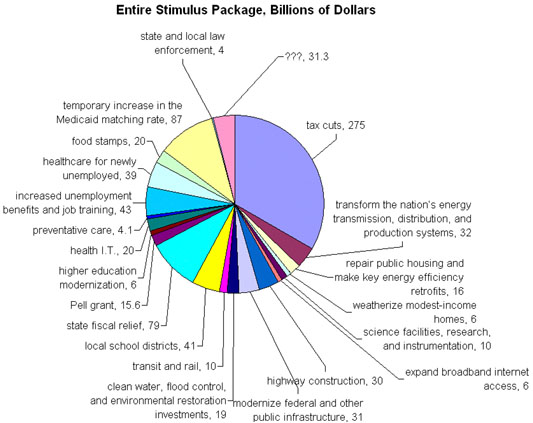
You’ve probably heard a lot about the stimulus plan, but what you have probably not seen is exactly where the money is going. So many reports in the news and on blogs mention major elements of the plan, general categories and notable expenditures–but you probably have not seen a dollar-by-dollar breakdown of everything in the plan as proposed by Obama (before the Congress leaves its mark). After searching, I found a great report in the New York Times that gave the details I was looking for. Below is the NYT’s Catherine Rempel’s pie-chart breakdown. The pink “???” slice represents money that was not listed in the summary she reviewed (presumably a large number of programs not specified in the report?).

Stimpackage

You can also follow this link to a PDF (or better, right-click to download) for the House Committee on Appropriations’ 13-page report detailing each segment of the plan and how much it will cost.

The plan includes $275 billion in tax cuts, maybe Obama’s proposed middle-class tax cuts we heard about earlier (PDF report on Obama’s proposal alongside McCain’s). Possibly not, though–I am not sure if this is the first step towards achieving that, or if it is something completely different–perhaps this is a one-year measure as opposed to a permanent change. Republicans are suddenly proposing a middle-class tax plan which, on the surface, is even bigger than Obama’s. We can confidently read this as hypocritical pre-midterm-election posturing–the GOP never forwarded this kind of a middle-class tax cut before. It is probably nothing more than congressional Republicans forwarding a plan they know will never pass but they can later claim, “we tried to pass bigger tax cuts for you, but the damn Democrats nixed it!”

In any case, the other major elements of Obama’s plan, sorted by cost, are:

  • $87 billion for a temporary increase in the Medicaid matching rate;
  • $79 billion in state fiscal relief to prevent cutbacks to key services, including $39 billion to local school districts and public colleges and universities distributed through existing state and federal formulas, $15 billion to states as bonus grants as a reward for meeting key performance measures, and $25 billion to states for other high priority needs such as public safety and other critical services, which may include education;
  • $43 billion for increased unemployment benefits and job training;
  • $41 billion to local school districts through Title I ($13 billion), IDEA ($13 billion), a new School Modernization and Repair Program ($14 billion), and the Education Technology program ($1 billion);
  • $39 billion to support those who lose their jobs by helping them to pay the cost of keeping their employer provided healthcare under COBRA and providing short-term options to be covered by Medicaid;
  • $32 billion to transform the nation’s energy transmission, distribution, and production systems by allowing for a smarter and better grid and focusing investment in renewable technology;
  • $31 billion to modernize federal and other public infrastructure with investments that lead to long term energy cost savings;
  • $30 billion for highway construction;
  • $20 billion to increase the food stamp benefit by over 13% in order to help defray rising food costs;
  • $20 billion for health information technology to prevent medical mistakes, provide better care to patients and introduce cost-saving efficiencies;
  • $19 billion for clean water, flood control, and environmental restoration investments;
  • $16 billion to repair public housing and make key energy efficiency retrofits;
  • $15.6 billion to increase the Pell grant by $500;
  • $10 billion for transit and rail to reduce traffic congestion and gas consumption;
  • $10 billion for science facilities, research, and instrumentation;
  • $6 billion to weatherize modest-income homes;
  • $6 billion to expand broadband internet access so businesses in rural and other underserved areas can link up to the global economy;
  • $6 billion for higher education modernization;
  • $4.1 billion to provide for preventative care and to evaluate the most effective healthcare treatments;
  • $4 billion for state and local law enforcement funding.

I have hardly done a thorough analysis, but a quick read of that list is pretty hard to argue with. Emphasis on middle-class tax cuts and local-level services are a direct reversal of Bush administration policies, and about time, too–I don’t see anything in there at all that is aimed at the nation’s wealthy, or at corporations specifically (the only corporate tax breaks I found are tied to job creation). You know that if this had come out of the Bush administration, it would have asked to give more upper-income and corporate tax cuts, repeal of the estate tax, and all other kinds of giveaways to the rich which would not benefit the nation one bit. Instead, here we have a plan which leaves us with a dramatically improved infrastructure: better schools, more affordable education, improved roads, bridges, & highways, energy grids, housing, Internet, law enforcement–in short, instead of coming out with richer rich people and corporate coffers overflowing even more than before, we instead come out with a better and more solid national infrastructure which will pay off many times over in the future. Hell, even without an economic crisis, this plan would be a good idea.

With the passing of this plan, Obama would live up to a large number of his campaign promises–about 500 of which are tracked on this web page. Once the plan is launched, you can track its progress and how the money is being spent on this page. Remember how the Bush administration had similar web pages to show how all the money was spent on the Iraq War and the bank bailout? Of course you don’t, because there was never any such accounting. Another sign of change–we will have transparency, a switch from the years where corrupt Republicans could shovel billions of taxpayer dollars into the pockets of huge corporations and then claim “national security” or “we’re just not interested in telling you” as reasons why we never got a straight accounting.

We’re hardly there yet, but we are starting on the way towards a far better, fairer, stronger, and more competitive America.

Categories: Economics, The Obama Administration Tags:

Morality ⊄ Religion

November 23rd, 2008 1 comment

Wow. Reading this editorial from the WSJ had me sitting there for a while trying to figure out if it was clever satire. After the third or fifth paragraph, however, the article leaned more toward technical market stuff, and the possibility of satire eased. Still, had the beginning and end been published in The Onion, word for word, I would have accepted it as rank satire without a second thought. In essence, the editorial blames the recent economic collapse on secularism. Yep, we’re back to the golden oldie: if something bad happens, it’s because we aren’t being religious enough. Let’s begin with a canard that the piece uses as a theme:

And so it will come to pass once again that many people will spend four weeks biting on tongues lest they say “Merry Christmas” and perchance, give offense. Christmas, the holiday that dare not speak its name.

Here we go again. First of all, I know of no one who is reluctant to say “Merry Christmas”–it is repeated endlessly during the holiday season, just like the endless loops of Christmas carols that play on so many radio stations. This is pure fiction. It arose when some businesses, in order to include all of their customers, started giving the generic “Happy Holidays” greeting.

“Happy Holidays” is not anti-Christian, any more than “people” is anti-male. The whole “War on Christmas” attitude is intentionally blind to the distinction between inclusiveness and exclusiveness. “Happy Holidays” includes Christmas, as well as all other religious celebrations. Pressuring people to say “Merry Christmas” instead, on the other hand, is exclusive–it specifically shuts out all other belief systems except for Christianity. When speaking person-to-person, there’s nothing wrong with any specific greeting–but when addressing a large number of people, one must be general. One would not call a crowd of men and women “gentlemen.” Similarly, you say “Happy Holidays” to address everyone during the holiday seasons. Christians who are offended by this are effectively saying that no other belief system deserves recognition.

The very people who whine about the “War on Christmas” are the ones who are shutting people out, waging a war on non-Christians. The rest of us are just sitting here, rolling our eyes at their thinly-veiled bigotry.

While the “War on Christmas” is a theme of the opinion piece, the central thesis is that secularism causes moral and therefore systemic collapse:

What really went missing through the subprime mortgage years were the three Rs: responsibility, restraint and remorse. They are the ballast that stabilizes two better-known Rs from the world of free markets: risk and reward.

Responsibility and restraint are moral sentiments. Remorse is a product of conscience. None of these grow on trees. Each must be learned, taught, passed down. And so we come back to the disappearance of “Merry Christmas.”

It has been my view that the steady secularizing and insistent effort at dereligioning America has been dangerous. That danger flashed red in the fall into subprime personal behavior by borrowers and bankers, who after all are just people. Northerners and atheists who vilify Southern evangelicals are throwing out nurturers of useful virtue with the bathwater of obnoxious political opinions.

The point for a healthy society of commerce and politics is not that religion saves, but that it keeps most of the players inside the chalk lines. We are erasing the chalk lines.

Of course, the author’s primary error here is to assume that the collapse happened because the ones responsible for the collapse had lost god and therefore their morality. They provide no evidence for this aside from the claim that using “Happy Holidays” instead of “Merry Christmas” was somehow related. They apparently assume that at some point in time in the past, a market full of people defined primarily by their lust for money and not at all for their religion was god-fearing and therefore restrained and responsible, and that the subsequent loss of their religious ways (apparently brought on by a few scattered advertisements which said “Happy Holidays!” instead of “Merry Christmas!”) caused them to instead go after risk-and-reward. Um, yeah, right. That’s what caused it all.

All of this comes back to a recurring sermon: religion equals morality, and you can’t even have morality if you’re not religious–you can only pretend to, by mimicking Christians. The solution, as it is often expressed, is simply to make religion present where the problem exists, which is why you get people saying that the answer to moral decay in youth is to introduce classroom prayer and post the ten commandments on the schoolroom walls. This kind of superficial application of morality reminds me of the time I worked for a religion-backed organization which required it’s managers to be Christian. The idea was, theoretically, to assure the moral tenor of the management. My immediate boss, as a result, converted to Christianity–despite the fact that he was not in the least interested in the church–while at the same time maintaining an adulterous affair and doing other immoral stuff I won’t go into here. In other words, it was all about appearance, not actual practice. Oh, sure, the organization’s intent for morality was sincere–they simply failed to recognize what morality was and how it works with people. They made the same error as the writer quoted above, believing that the mere presence of religion induces moral behavior.

While religion can be used to stimulate moral behavior, it does not do so automatically nor exclusively. Religion can just as easily stimulate immoral behavior as it can moral behavior; it depends upon the examples chosen and the themes and applications of the lesson. Similarly, non-religious teaching can have an equal effect: it depends upon the examples you choose and how you teach the lesson. The two are equal–both tools, neither one a magical cloak that bestows morality. The key is in the lesson, not the example. Sounds simple, but the writer quoted misses it completely: you get moral behavior by teaching morality; religion is simply one vehicle for that, and can lead people in the wrong direction just as easily as any other vehicle.

Now, the author, like many religious people, is probably working from a central assumption: that fear of god and damnation sets people on the right track. This is what often what religious people are thinking when they say that introducing god stimulates morality; they may overtly talk about learning lessons and so forth, but what they’re feeling in their gut is related more to punishment; when talking about remorse, it is fear of paying the price down the line. In short, “if I think about god when I’m doing something wrong, I become fearful and change my ways.”

There are several problems with this “moralizing” quality of religion. First, it is a sense born not of compassion for others, but instead of fear for one’s self. It is a morality forced upon the individual from the outside–much weaker intrinsically than a decision to act rightly despite believing that there would be no adverse consequences for acting wrongly. But so long as one believes that god is watching, then what difference does it make? Well, first there is the fact that it is fear-based and not compassion-based; those feelings will spill out into other areas of the person’s behavior. But the larger hazard here is the assumption that everyone will react to this outward pressure in the same way. I can see several ways that ‘god-fearing’ Christians could get around this.

For example, many rationalize their immoral behavior. In economics, one does so by passing the buck–for me alone, this would be wrong, but it is my responsibility to do this for the company. In life in general, people do this all the time in a variety of ways, one very common version being “they deserve this.” As with the death penalty, where we feel we are entitled to take life because of the actions of others. In short, we can do something immoral because someone else did something immoral; this can even be extended through the concept of pre-emptive strike: I can do something immoral because I expect that someone else will do it. Another common rationalization is “I’m not really doing that,” using semantics as moral cover. I’m not stealing, I’m delivering a well-deserved lesson, or I’m getting back what I think I deserve, so forth and so on. There are any number of ways to do immoral things but rationalize that they are somehow all right.

You may notice something: none of the above are specific to religion, anyone can use them to skirt morality. And that’s part of the point: Christians aren’t immune to the same rationalizations used by everyone else.

There are, however, other ways related to religion-as-morality-teacher where the application of the fear-god principle won’t work. There’s the brand of Christian who has learned that they can do something wrong, but make up for it later and be forgiven. And there is the interpretation-of-scripture excuse, where you can take whatever passage you like from the bible and read it any way you like. Or the religious person who believes they cannot be forgiven and are already going to hell, so why not? Then there are people who are not strongly religious, who rely only on religion for morality but don’t really believe that god is watching or will punish them in hell. Reminders of Christianity won’t have an effect on them.

I could go on and on, but you get the idea. Introducing religion is far from a guarantee that people will act morally.

I have written on this kind of things before, but this WSJ author dredged up all of that and a lot more. Prior writings include the source of morality (religion is not the source), the weakness of the ten commandments as a moral guide, The ability to use scripture to justify immoral acts, and the view that there is a war against religion when, if anything, the war is against atheism, fought by the religious.

Believe it or not, secularism is not the root of all evil, or even most of it.

Categories: Economics, Religion Tags: