Archive

Archive for the ‘Election 2008’ Category

Obama Pulls Ahead, McCain Leaves Principles Behind

February 14th, 2008 5 comments

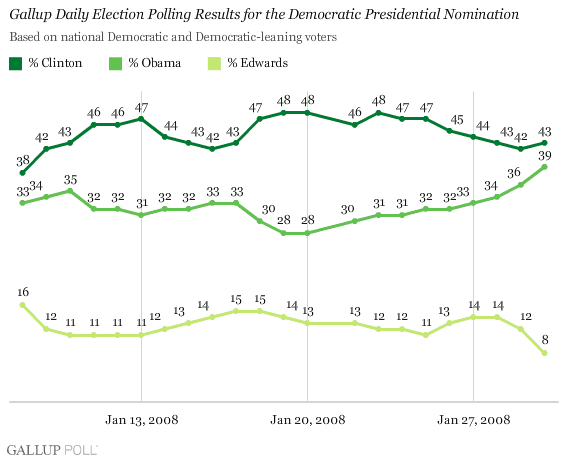
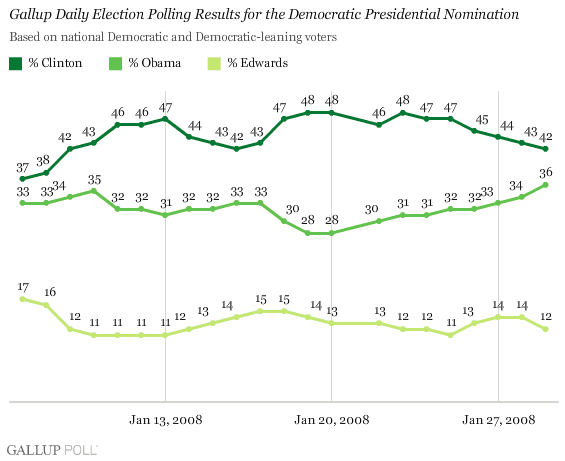
Obama, after his sweeps in D.C., Virginia, and Maryland by high margins (wasn’t Clinton supposed to be fighting hard in one of those states?), now claims another prize: his first lead over Hillary in the Gallup Daily National Tracking poll. It’s just a 1-point lead and so a statistical tie, but it follows a trend where Obama again gains a point a day while Hillary loses one. Just a little more than a week earlier, Hillary had been ahead by 13 points after a strange post-Super-Tuesday bounce. But now, with no good news for Hillary for at least three weeks (she is expected to lose in Wisconsin and Hawaii by similar margins), and possibly not even after that (with so much time and money, Obama is bound to make up some distance in Texas and Ohio), the trend will probably keep going for a bit. For the first time, Obama is considered the front-runner, a freight train with Hillary’s name on the… ouch, on second thought, I don’t think I want to use that metaphor.

What Obama has to watch out for: the expectations game, which has hurt him a few times in the past. Still, it comes down to a numbers game now: many are saying that Hillary’s Giuliani-like big-state-firewall strategy of winning Texas and Ohio is risky–that Hillary will have to not only win the states, but win them by several touchdowns in order to come out ahead in this race. And with Obama coming down the stretch with momentum, a truckload of cash, and seeming inroads into Hillary’s base, he stands a good chance of reducing Hillary’s critical leads in those states.

On the other side of the aisle, Republicans cut McCain a break today: on the anti-torture bill, had they tried (yet, yet, yet again) to filibuster, they would have put McCain in a difficult position of having helped stop the bill. Or he would have been in an equally difficult position of having helped pass a Democratic bill. So they helped him weasel his way out: they did not try to filibuster, but instead let the bill pass, with McCain voting “no.” While that violates his conscience and principles, as well as his past words and actions, it appeases the right wing base–and McCain’s vote is supposedly less meaningful because he did not stop the bill. That’s the key–McCain is kinda screwed on this any way you look at it, so for him, apparently, the least harmful path is simply to say, my vote didn’t matter.

So, all McCain lost today were his principles. But he kind of gave up on those when he started this campaign and started kissing up to the people who smacked him around good in 2000. McCain, a victim of torture himself and a lifelong advocate to ban such practices, today voted to sustain the use of torture so he could win a few more votes. When it comes to the crunch, it seems that “Straight-Talk” McCain will abandon his principles and suck up to anyone who can get him what he wants.

And notably, the “liberal media” is hardly touching this story.

Categories: Election 2008 Tags:

Obama Sweeps

February 11th, 2008 5 comments

Wow–not only did Obama win all the races this weekend, but he pretty much crushed Hillary in most of them. Especially Maine, where Hillary was given a fair chance of taking the state. The closest state this weekend was Maine, where Obama won over Clinton by 18% of the vote. That’s not just a win, it’s a blowout–and it was the closest race over the weekend. Here are the five races this weekend and their results:

State Obama Ciinton + % Win
Louisiana 57% 36% +21%
Nebraska 68% 32% +36%
Washington 68% 31% +37%
U.S. Virgin Islands 90% 8% +82%
Maine 59% 41% +18%

Most people are ignoring the Virgin Islands vote, and probably with just cause–there are only six delegates, and though Obama gets all six, each one only counts as half a vote, so Obama only gets three from them. But that’s OK–Obama won a lot more delegates elsewhere. He also got enough big wins to make even an 82% margin not all that necessary to tout. I mean, look at those results–he won Louisiana and Maine by margins of about 20%, and Washington and Nebraska by margins close to 40%. That’s pretty impressive.

In fact, although Hillary has won most of the big states so far, Obama has won almost every state he’s gotten by 10%+ margins. And while Hillary had a big win in Arkansas, that 43% margin was the only one she got over 25%; Obama, meanwhile, has won ten states by a 25%+ margin:

Clinton (10)

Arkansas +43
Oklahoma +24
New York +17
Massachusetts +15
Tennessee +13
California +10
New Jersey +10
Arizona +9
Nevada +6
New Hampshire +3

Obama (19)

Idaho +62
Alaska +50
Kansas +48
Washington +37
Georgia +36
Nebraska +36
Colorado +35
Minnesota +35
Illinois+32
South Carolina +32
North Dakota +24
Louisiana +21
Maine +18
Utah +18
Alabama +14
Delaware +10
Iowa +9
Connecticut +4
Missouri +1

So far, a strong new start for Obama, and a terrible one for Hillary. She needs some kind of win this month, and though she’s got the expectations game on her side, it’ll be tough slogging. She reportedly has started a do-or-die fight for Maryland, something to break Obama’s February sweeps. But bad news keeps dogging her campaign, making her look more like a loser–lending her campaign $5 million, losing the fundraising war to Obama by a 2-to-1 margin, having her staffers work without pay, and now she’s fired her campaign manager.

It’ll be interesting to see how this affects the polls, especially in Ohio and Texas.

Categories: Election 2008 Tags:

Romney’s Out, McCain the Unpopular Front-Runner?

February 8th, 2008 2 comments

It should be interesting to see what happens to McCain’s and Huckabee’s numbers now that Romney has unexpectedly pulled out of the race. Are Romney people the more religious segment of the party? How many are people who simply won’t accept McCain? How will Romney’s numbers be split between the two remaining candidates? It’ll be three days before the Gallup daily tracking polls have a full sampling on the split, but it should be interesting.

Also interesting is the sheer vehemence of the Republicans who simply cannot accept McCain. Several conservatives have already stated publicly that if it’s McCain vs. Hillary, they’d vote for Hillary. When McCain spoke at the conservative CPAC convention (where Ann Coulter last year called Edwards a “faggot”), the audience booed McCain–even though they were explicitly instructed not to boo him. Just the fact that they felt it necessary to admonish the crowd not too boo their front-runner in the first place is pretty telling of how much open revolt there is to his candidacy.

And that in itself is pretty amazing, considering that McCain is pretty conservative. He’s moderate on the budget and on immigration, but is firmly anti-choice, likes strict constructionists, is anti-union, anti-gay-marriage, anti-civil rights, pro-death penalty, is a hawk on war issues, and is the man on Iraq… so why do conservatives hate him so much? Do they look back to 2000 and think that he’s a liberal in conservative clothing? If so, they’re wrong–he was no more liberal back then than he is now, that was just an image of moderation, without actually being too much of a moderate.

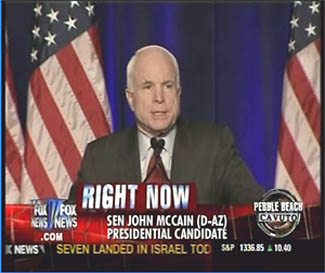
To see just how conservatives see John McCain, see the “accidental” caption that Fox Noise put on McCain’s video clip (look at the party affiliation):

Mccaind-J

That’s the caption they put on Republicans who are exposed as sex offenders. Um, okay.

Categories: Election 2008, GOP & The Election Tags:

Actually,…

February 8th, 2008 2 comments

The more analysis that comes out about the results from Tuesday’s election, the more it becomes clear that this was a fairly clear victory for Barack Obama. The press has treated it pretty much as a tie, which is a bit grating–they were quick to call defeats for Obama when he did not meet exaggerated expectations, but they won’t give Clinton the same scrutiny. The fact is, Obama won Super Tuesday–in more ways than one.

First of all, despite Hillary’s taking the big states like California, New York, and New Jersey, Obama picked up 49% of the popular vote vs. Hillary’s 47%, and–it seems–roughly the same percentage of delegates. In other words, Obama won. Strange that this isn’t the story out there; when Hillary beat Obama in New Hampshire 39 to 36, it was a “stunner” because polls in the day or two before the primary had Obama ahead by a few points. Well, before Super Tuesday, Hillary was ahead in the polls more than Obama was in New Hampshire, and he beat her in a result that was much more stunning–but the media yawned, and called it a “wash,” or even sometimes a Clinton “victory.”

The fact is, Obama was playing catch-up, and down to the last minute, was down in most of the polls, especially in the Super-Tuesday states. See this post by Kos, showing polling data right up to the day before the election, which showed Obama momentum, but also that the polls had Hillary with a clear lead. He should have lost, by all expectations–and needed to stay within a few hundred delegates behind Hillary to stay in the race. Super Tuesday was supposed to be Hillary’s chance to knock Obama out of the race altogether, and yet Obama actually came out ahead. How is that, by any measure or stretch of the imagination, a “victory” for Hillary?

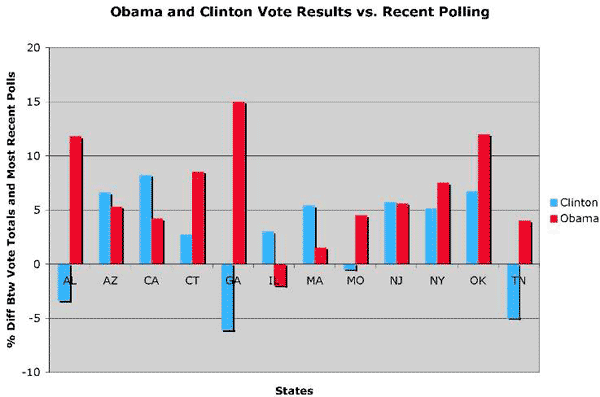
One should note also that Obama actually exceeded expectations more than Hillary did; where the polls called for them to get a certain amount of the vote, Obama gained more than the polls predicted more often and more strongly than Clinton did:

Polls-Vs-Results-Feb5

Some call Hillary the winner because she has more delegates–but only when you count the “super-delegates” into the equation. However, these were not votes “earned” on the day of the election, rather votes granted to her by a few powerful people some time ago, when Hillary was way out in front, and considered to be the shoo-in for the candidacy. One can hardly count that as part of Tuesday’s elections. If you count only the delegates earned, on the actual election day, then Obama comes out ahead.

Add to this the fact that Obama is poised to win 6 out of the next 7 races in February, and rack up a lot more delegates, and Hillary’s “victory” appears even more hollow.

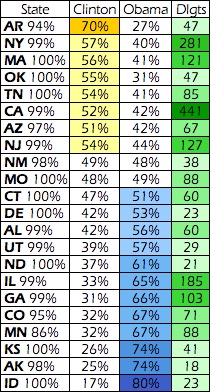
Furthermore, while Hillary won the big states (except for Illinois) on Super Tuesday, she won fewer states than Obama, and the states she won, she won by more shallow margins:

0208-St Delegate Table

Of the 9 states with a Clinton lead, all save for one (Arkansas) were taken with less than 60% of the vote. Of the 13 states Obama won, only 5 were taken with less than 60%; 5 more were won with 60~70% leads, and three were won with a 70~80% majority landslide. This helps explain why Obama got more delegates.

What’s more, Obama is raking in the money, while Clinton is having a hard time scraping together enough to pay the bills. She had to “lend” herself $5 million (money on loan from her senatorial coffers), and on top of that, was forced to ask her top staffers to go without pay. Obama out-raised Hillary in January by a two-to-one margin or more. And despite a big push by the Clinton campaign to get as many donations as possible, she has raised only half of what Obama has generated since the polls closed on Tuesday–Obama has gotten over $7.5 million, while Hillary has raised somewhere between $3 and $4 million in the same time period. Obama raised $5 million of that in less than 24 hours–the same amount that Hillary loaned to herself.

On a side note, there is a Hillary development that is troubling me: Hillary seems to have made a friend out of Rupert Murdock, the ultra-conservative media magnate who founded Fox Noise and has worked to wreck the progressive cause. In 2006, he hosted a fundraiser for Hillary, donating money to her campaign himself–in 2007, she got $40,000 from Fox News executives. And now she’s double-dog daring Obama to a Fox Noise debate.

If you recall, John Edwards spearheaded the boycott of Fox News as a debate host earlier last year, and Obama and Hillary jumped on board. The principle is sound: don’t put yourself in the hands of the propaganda machine of your political opponents.

Except now, Hillary is tossing progressives overboard and hopes to score some points with a political maneuver which smacks of party betrayal.

One can only assume that the dirty campaigning she tried in South Carolina is not exhausted yet (she’s just getting smarter in how to carry it out), as things get tight for her campaign and she faces a month-long stretch in the doghouse.

Categories: Election 2008 Tags:

Close

February 6th, 2008 Comments off

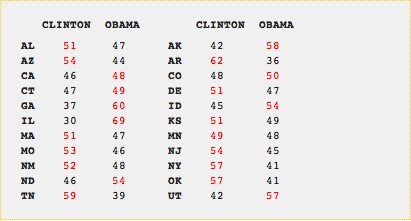
For the Democrats, Super Tuesday was interesting indeed. Obama and Clinton virtually split the popular vote exactly down the middle; some estimates have Hillary winning 49% to 48%, others have the same numbers the other way around. Hillary won more big states, but Obama won more states overall, often by larger margins. Hillary won one state with over 60% of the vote, but Obama won several in that range–and at least three states with wins in the 70’s or 80’s. Hillary will get more delegates, but mostly because of Super-delegate votes, which are not a popular or democratic measure, but rather a political one. Even so, the delegate count remains very close.

And, as noted before, several races remain in February, most of which are leaning in favor of Obama. And momentum is with him. While Super Tuesday was not a decisive win for him, the press at least is not pulling another New Hampshire–they are not claiming that Obama lost because he did not beat the most optimistic polls in his favor. Everyone is calling this an even split, but the unreported story is that this is a big win for Obama. He should have lost by a fair margin today, especially by what the last-day polls were saying. That he held it to a tie is great news for him: it means that he is holding his own, and since the momentum is his, he stands to gain more and more as time goes on.

Still, Hillary has more of those Super-delegates lined up, and she might be able to hold this out until the convention, where the gaming will really start.

One thing in Obama’s favor: more and more people seem to be coming around to the idea that Obama will fare much better against McCain than Hillary could. The more people realize how Obama will perform in a general election, the more people will realize that Obama hold much more hope of a Democrat winning the election this November.

Categories: Election 2008 Tags:

Cautiously Optimistic

February 5th, 2008 3 comments

Gallupdaily2-04

Lastpoll-0208

Obama has momentum. But then again, he did before New Hampshire. Polls show him just now edging out Hillary in California. Again, the same as New Hampshire. And yet, so many signs are good for Obama. He raised $32 million in January, while Clinton probably did a lot worse (they’re not saying, but one report has the number at “at least” $10 million). And despite Krugman’s out-of-balance Obama-bashing (sorry, but Krugman’s over-reaction to Obama goes way beyond logic), Obama is racking up the endorsements, and not just from the Kennedys.

I think the key thing here is to keep perspective, and look at it as Obama catching up. Obama supposedly lost in New Hampshire, right? A big blow to his campaign. Except one thing: he lost by only a few percentage points, in a race where Hillary had a huge lead in the polls up until the last several days. The real story about New Hampshire for Obama was a come-from-way-behind almost-win, not some sort of crushing defeat.

The problem is, a lot of people are now touting Obama as a possible winner on Super Tuesday–so if he gets fewer than 50% of the total votes tomorrow, even if he performs admirably compared to where he was in the polls a week ago, people will call it a “loss.” Despite the fact that (a) Hillary has no chance of tying up the nomination tomorrow, not even close to it, (b) Obama is doing better in states that will vote after Super Tuesday, and (c) momentum is in his favor, which means he’ll do better in a drawn-out race. Even if Obama “loses” tomorrow, so long as it’s not a blow-out in Hillary’s favor, it’s good news for the Obama campaign. These things are not decided in one day–this will be a long, drawn-out affair, and in that context, Obama has the advantage.

And let’s not forget that after Super Tuesday, we have a stack of February primaries (Louisiana, Nebraska, Washington, Maryland, Virginia, and Hawaii) which almost all favor Obama heavily; even if he “loses” his momentum on Super Tuesday, he’s bound to pick it back up with successive wins in the weeks following. (Ironically, in an election year where so many states flooded the early calendar so as to be more relevant, it’s the states at the end of the calendar that may prove most influential of all!)

Obama does have one big disadvantage: the primary race is among Democrats and some Independents, and so we see fewer of Hillary’s flaws and fewer of Obama’s strengths in the context that counts: in a general election where everybody votes. In a general election, Hillary will face far greater obstacles than will Obama. Say all you want about Hillary being a fighter (though that hasn’t helped her much against Obama), say all you want about her being pre-smeared and that things somehow couldn’t get worse for her–the fact remains, she is polarizing. She stands a far worse chance of bringing Independents to her side than Obama does, and she stands virtually no chance of bringing any Republicans over.

But the big story was pointed out to me a few days ago: Hillary will not just lose the Republican vote solidly; she will actually galvanize the right wing and help them bring out the vote. Republicans who will be dissatisfied enough with John McCain and/or accepting enough of Obama will stay home, if those are the choices. But those same voters will turn out in droves to defeat Hillary Clinton. That is a huge negative for Clinton which does not show up in any way in the primaries.

Even further down the road, we have to look at how things will play out after a Hillary or Obama victory. If Obama becomes president, he will likely have much bigger coattails than Hillary, helping him win more congressional seats for the Democrats; Hillary, in bringing out the Republican vote, will lose more seats for the Democrats. Neither will have a Democratic super-majority, so either would have to face a Republican filibuster machine perhaps even more obstinate and obstructionist than the one that has shut down virtually every Democratic initiative for the past year. Obama fixes this by bringing the center to him; Hillary fixes this by running to the center, which means that if you think her proposals are more progressive today, you won’t much like them next year–and Obama will suddenly look a lot better.

This especially counts towards health care: there is no way that any Hillary health care plan will get through a Republican Senate filibuster. The Republicans have too much history, too much invested in that. They vaulted to power in 1994 very much aided by their opposition to Hillary’s health care plan back then; allowing one to pass for President Hillary would be unthinkable for them. Where they could deal with Obama, they will flat-out shut down Hillary. Whatever you think of mandates, Hillary will not bring you anything come 2009. Even if you think that that is no worse than an Obama health care plan winning, it still cancels out any advantage Hillary has over Obama, leaving Obama again with all the advantages.

And then there’s the chance, as I explained earlier, that Obama, in bringing more votes for Democratic Senate and House seats, will not only have a stronger voting bloc in Congress, but will scare more Republicans who won by close margins; if Obama can maintain a strong, positive, and popular image in office, as Reagan did, then he may very well get his “Obama Republicans” which might even give him that filibuster-proof Senate super-majority. The one Hillary has no chance of getting.

That, along with the very real chance that Hillary could lose the election to a Republican–which for Democrats this year is the nightmare scenario–demonstrates more and more reason to support Obama.

Categories: Election 2008 Tags:

The McCain Bipartisan Appeal?

February 4th, 2008 2 comments

There has been quite a lot said recently about how McCain has the power to appeal across party lines. While, surprisingly, fewer seem to talk about Obama Republicans, there has been more than a little talk about McCain Democrats:

His penchant to stray from the GOP herd is legendary, and explains his ability to attract independent voters and Reagan Democrats. McCain’s appeal across party lines emboldens wishful thinkers about a Republican victory in November.

I believe that the primary reason this impression persists is that Democrats haven’t been much exposed to McCain recently. They were, a bit, before his candidacy went under the first time, but that was a while back, and McCain strangely still seems able to draw upon his image as the “straight-talker” from eight years ago.

And eight years ago, McCain did appeal a lot to the left–albeit superficially. Known for his attacks on illicit campaign financing and pork-barrel spending, he spoke out against conservative Christian influence on the party and criticized the Confederate flag. He became a media darling because he allowed nearly unfettered access and answered almost every question put to him, or at least that was the image he maintained. He further gained sympathy from the left when he was mercilessly smeared by the Bush-Rove machine, and after the 2000 elections, there were even rumors that he was in negotiations to join the Democratic party. As late as 2004, there were rumors that Kerry might consider him as a vice-presidential candidate.

So is McCain really someone who would appeal to independents or even liberals? Despite his surface appeal, McCain is actually pretty solidly conservative. If you get past the popular image and see where he stands on the issues, and McCain comes across as more of a right-winger than most people are aware. He would repeal Roe v. Wade; he strongly supports the death penalty and wants to see it used more, with fewer appeals granted; he approves of school vouchers; he’s a military hawk, especially on Iraq, and sees us staying there for a long time; he has strongly supported the “Patriot” Act and save for his reservations on torture, has generally supported the attack on civil rights in the “War on Terror™”; he is not strong on health care; he is anti-union; he wants to privatize social security; the NAACP rates him at 7% for not supporting civil rights; and he supports the flag-burning amendment.

He gets wishy-washy on several issues: he opposes gay marriage, but not to the point of approving of a constitutional ban–he’s for civil unions, but seems comfortable with homosexual discrimination going on in the background. He has a mixed record on gay rights, but ultimately scores a low 33% in his voting record; he also has mixed records on education and the environment. He’s against the Confederate flag–kind of… he doesn’t want it on top of a state building, but in front is OK, and he acknowledges the “cultural heritage” many use to excuse the racist message behind it. He would not mandate prayer in schools, but is fine with “allowing” it. He believes in evolution, but wants school districts to decide on whether to add creationism to the science curriculum; he supports some gun bans, but ultimately supports the Second Amendment and wants to loosen already weak gun control laws; he is anti-abortion, though he supports an exception for rape and approves of stem cell research; he was against Bush’s tax cuts at first, but now approves extending them.

He is fairly liberal on immigration, but most of his “independent” image seems to come from his stances on economic and government reform issues–from budgeting and pork-barrel spending to campaign finance and special-interest influence. That, and his appearances on The Daily Show. But as far as being “moderate” on the issues, that’s about as far as he goes.

In fact, he is about as conservative as Obama is liberal; the are similar in that they are both fairly deep into their respective ideologies, but both also seem to appeal across party lines. The difference comes when you see why: while Obama get his appeal through his elegance and his ability to address people on core principles that can sway them across party lines, McCain seems to depend almost wholly on his “maverick” image from the 2000 campaign, the public perception that he’s a switch-hitter, rather than any solid reason or ability to use rhetoric in any way.

In the end, there’s only so far that campaign finance reform and his now-tarnished image from the “Straight Talk Express” can take him. There is too much awareness of McCain as having caved on his principles from eight years ago and sucked up big-time to the same conservative Christians and hard-right-wingers who trashed him eight years ago. And it won’t be too hard to use Iraq against him; the image of his meltdown where he claimed it was safe to walk the streets of Baghdad is not much helped by his recent statements about being in Iraq for a hundred years. Add to that the fact that he is a short-tempered 72-year-old cancer survivor. Not that the age nor the cancer detract from him personally, but when you’re looking at someone who may inhabit the White House for the next eight years, it does raise some concerns.

Whatever people say about McCain’s ability to cross party lines, when it comes down to it, I’ll bet on Obama’s record and charisma over McCain’s any day.

Categories: Election 2008 Tags:

The Edwards Split

February 1st, 2008 2 comments

Gallupdaily1-30

While on the Republican side, McCain clearly won the Giuliani vote. Edwards’ bowing out of the race brought a far less clear result. While it may seem that Clinton got only one point and Obama three out of the 4 points Edwards’ lost campaign gave up (the polling sample included three days, only one of which where Edwards had announced the end of his campaign), the truth is better seen in light of recent trends.

As I posted yesterday, Clinton has been losing one point per day while Obama gains the same. Presuming the same has held true, then Hillary lost one point again–but gained two points from Edwards. Obama probably gained one point on his own, but Edwards gave him two points as well. So it would seem that while Obama continues to gain on Hillary, they are splitting the Edwards supporters between them. Yesterday, Obama was 6 points behind Hillary, today he is four points behind.

What will happen in two days, when all polling results in this daily poll reflect Edwards’ withdrawal? If the current trend continues, it could be tied in two days–Clinton and Obama both at 45%. The remaining 10% undecideds would make all the difference… unless Obama’s upwards trend continues.

However, from the polls I have been seeing, Obama faces an obstacle: most of the big Super-Tuesday states are Hillary-heavy. If Obama’s support is in post-Super-Tuesday arenas, that support could suffer if Hillary takes most of the victories next week.

Categories: Election 2008 Tags:

Trends and Departures

January 31st, 2008 4 comments

The Republican race for president seems to be firming up while at the same time thinning out: as Giuliani drops out (and the Free World gives a collective sigh of relief), McCain maintains his 10-point lead over Romney and Huckabee, who are still neck-and-neck for second place. The Gallup Daily Tracking Poll (which Josh Marshall talked about but strangely did not link to) shows the GOP landscape:

013008Dailyupdategraph1

It looks like McCain has a pretty good lead, but not a decisive one–even with Giulani’s backing, he won’t go above 40% if even that high. While McCain is the solid frontrunner, the numbers are more or less stuck where they are, and we could be looking at a brokered convention.

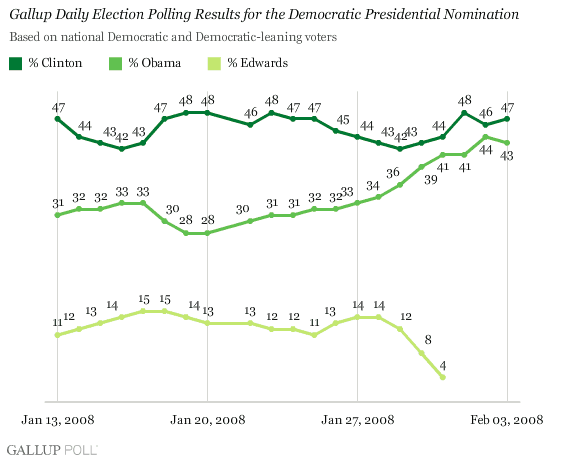
Similarly, on the Democratic side, there is no clear winner. Edward’s departure today could help either candidate or simply split the difference between them both–it’s anybody’s call. And with Gallup’s nationwide poll showing Hillary leading Obama 42% to 36%, you might think she has a comfortable lead–until you realize that exactly one week ago, it was a 46% to 30% lead. And then you see the trend:

 Poll Graphs 013008Dailyupdategraph2

That’s an average one-point gain for Obama every day, and a one-point loss for Hillary every day. Which suggests that just three days after the last reading (that would be February 1), they should be neck-and-neck, and by Super Tuesday, Obama could have a comfortable lead over Hillary.

Not that that’s going to happen, of course. It could, I hope it will, but I doubt that the trend will remain unbroken. The question is, what could break it? Florida was the big bet, but (a) Hillary was expected to win big there anyway (she won 50% to 33%), (b) the delegates aren’t even supposed to be seated, and most importantly, (c) the Florida win for Hillary seems to have barely made the news. The closer Republican race is drawing more attention, and Edwards’ and Giuliani’s departures have stolen even that spotlight. Which means that Hillary will not get nearly as much a boost out of Florida as Obama likely got out of South Carolina.

Then there’s the question of why the trend is happening; it’s clearly not a prolonged South Carolina “bump” for Obama; the trend, after all, started a week before South Carolina–ironically, at about the same time Obama made his Reagan analogy. South Carolina may have accelerated Obama’s rise a bit, but it did not cause it.

So what did? My guess (and admittedly it’s a biased one) is that (a) as more and more people see Obama and Hillary in action, the more the like Obama and don’t like Hillary; (b) Hillary’s negative campaigning may be a big factor; and most of all, (c) voters may be choosing Obama as the more electable candidate as the Super Tuesday ballot grows near and people start firming up on who they’re going to vote for.

One thing for sure, you can’t call this race boring.

Categories: Election 2008 Tags:

Barack’s South Carolina Win

January 28th, 2008 6 comments

We all pretty much expected Obama to win in SC, the question was always “by how much”? And the answer, “by double what Hillary got,” is the unexpected and buoying answer for Obama. The polls, on average, had Clinton’s and Edwards’ numbers about right. Reuters/C-Span/Zogby, SurveyUSA, Mason-Dixon, Clemson, and Rasmussen’s pre-primary results averaged out to put Clinton at 27% and Edwards at 19%; their actual results were 27% and 18%, very close indeed. Obama, however, was predicted to get 38%, but actually got 55%–meaning that in this state, virtually all the undecideds went to him. High voter turnout, especially among young voters, also seems to have helped him, as it did in Iowa.

The question is, what effect will this have? Will this buoy Obama’s campaign in other states? Will it give him the push he so badly needs to get past Hillary’s numbers elsewhere?

One important point here is that we’ve got a candidate who could potentially win many southern states for us; turnout by Democrats was much greater than it was for Republicans in their contest in SC last week. Whatever strength Hillary may deliver in Democratic circles, she will almost certainly lose most if not all of the South. This all highlights another significant strength of the Obama campaign, and a reason to doubt Hillary’s I’ve-got-a-political-machine strength.

The news over the past twelve hours that first, Caroline Kennedy (with an elegant op-ed titled, “A President Like My Father”), and later, Ted Kennedy (the party elder and powerful political broker) have endorsed Obama certainly can’t hurt his campaign, either–almost certainly timed to add to Obama’s momentum after his big win yesterday. There are whispers now from the Obama campaign that Obama would award Edwards the spot of Attorney General should Obama win, a spot Edwards no doubt would covet; some see this as a hint that Edwards might throw in with Obama should his campaign ultimately fail, as it no doubt will.

The SC contest also brings into question the whole “Hillary is a fighter” idea–that she can withstand the barrage of right-wing attacks and come out the better. Here, she was obviously the one running the dirty campaign, and not only did Obama’s high-road strategy win out, but showed that he can survive the smearing just as well.

I have to say, what the Clintons did this week left a definite bad taste in my mouth. Campaigning against someone, okay; even getting negative may have its points; but the Clintons went beyond that, they went over a line: they out-and-out lied, knowingly, about Obama’s words and actions. They went beyond playing rough and clearly strayed into playing dirty. At that point in the debate where Hillary insisted that Obama voiced approval for Republican policies–knowing full well that he did nothing of the sort, with Hillary pushing what was a clear and knowing lie–that brought me to feel strongly that Hillary was not a good candidate. This wasn’t just stretching the truth, or making an error in interpretation; this was purposefully taking a quote out of context and baldly asserting that it meant something that it clearly didn’t. “We can give you the exact quote,” she said, knowing that this would give the impression of an absolutely verifiable truth without having to actually supply a quote that clearly proved her point.

Bill Clinton did no better, acting as the ultimate Hillary surrogate and trying to drag down Obama in a mudfight. His worst tactic: trying to reduce Obama to “the black candidate.” His later dismissal of Obama’s win as being like Jesse Jackson’s was seen as a similar crude condescension–comparing Obama to someone seen as unelectable, who did run as the “black candidate,” more or less. TPM points out that Jackson won in SC partly because it’s his home state, and partly because the SC caucus at that time came after the nomination had been more or less locked up, and so Jackson was not really campaigned against much. A lot of Democrats resented Clinton’s tack even before that snipe, and that likely had a part to play in today’s results.

What a lot of people will probably not see is the fact that Hillary was leading in SC as recently as last November; Obama definitely has had the momentum in this state. The same turn has been happening nationwide since last Fall; even in states like Florida and California, where Hillary has a wide lead, one can see a definite trending to Obama, and a similar trend away from Hillary.

Will South Carolina accelerate this trend? Will Obama receive the same kind of bump he got after Iowa?

Another issue coming up is Hillary playing the fake-out dirty trick with Michigan and Florida–first signing the promise to not be in those races, but then campaigning there anyway–and now she’s insisting that both states’ delegates be counted. In effect, she acted like she’d move out of those races with other other candidates, and then when the others did as they’d promised, she jumped back in and now wants them both to count. It brings to mind an episode of House last season, when the character fondly referred to as “cutthroat bitch” got a half-dozen or so candidates for the job to quit by pretending to quit herself, but then she snuck back and put herself back in the race. Hillary essentially did the same thing. It may work, but it still demonstrates a fundamental unfairness.

In short, Hillary may be proving herself to be an effective fighter, but more and more she is showing herself to be the kind of politician I am not nearly as excited to see take the White House. At the same time, Obama is proving himself to be more electable as well as more worthy of the nomination.

Categories: Election 2008 Tags:

Obama and Reagan

January 19th, 2008 5 comments

Clinton and Edwards are making a big deal over what Obama said about Ronald Reagan. Unsurprisingly, I see their attacks as being specious, unfair, and opportunistic. Here are Obama’s original words:

I don’t want to present myself as some sort of singular figure. I think part of what’s different are the times. I do think that, for example, the 1980 election was different. I think Ronald Reagan changed the trajectory of America in a way that Richard Nixon did not and in a way that Bill Clinton did not. He put us on a fundamentally different path because the country was ready for it. I think they felt like, you know, with all the excesses of the sixties and the seventies, and government had grown and grown but there wasn’t much sense of accountability in terms of how it was operating, and he just tapped into what people were already feeling, which was we want clarity we want optimism, we want a return to that sense of dynamism and entrepreneurship that had been missing, alright? I think Kennedy, twenty years earlier, moved the country in a fundamentally different direction. So I think a lot of it just has to do with the times.

“I think we’re in one of those times right now. Where people feel like things as they are going aren’t working. We’re bogged down in the same arguments that we’ve been having, and they’re not useful. And, you know, the Republican approach, I think, has played itself out. I think it’s fair to say the Republicans were the party of ideas for a pretty long chunk of time there over the last ten, fifteen years, in the sense that they were challenging conventional wisdom. Now, you’ve heard it all before. You look at the economic policies when they’re being debated among the Presidential candidates and it’s all tax cuts. Well, you know, we’ve done that, we tried it. That’s not really going to solve our energy problems, for example. So, some of it’s the times. And some of it’s, I think, there’s maybe a generation element to this, partly. In the sense that there’s a, I didn’t did come of age in the battles of the 60’s. I’m not as invested in them.

”And so I think I talk differently about issues. And I think I talk differently about values. And that’s why, I think we’ve been resonating with the American people.“

What Obama is saying is very objective, analytical, and correct: with Reagan, there was a turning point that he sensed and took advantage of. Neither Nixon nor Clinton changed things the way Reagan did; Reagan, and later his followers, sensed frustration and a desire for a significant turn in the way things worked. (They didn’t call it the ”Reagan Revolution“ for nothing, after all.) Whether or not you like the direction Reagan took us in, you cannot deny that he took us there. As for ”being the party of ideas,“ that again does not mean that the ideas were good, it means that they were forwarding new ideas–like the ”Contract with America,“ for example–that the public responded to, while the Democrats did not forward similarly coherent and revolutionary concepts. It does not matter that the Republicans completely reneged on that deal, which was vague and jingoistic to begin with. The point is that they won hearts and minds with the words and ideas they put forth, and the times were ripe for the public to respond to them in a transformational way. Clinton didn’t do the same thing; as much as I admire what he did as president and see him as the best president since Kennedy, he did not achieve what he did by transforming the political scene–rather, he played to it, rode it to the successes he enjoyed.

What Obama is saying is that he senses that the public has reached the same cusp now that we saw when Reagan came on to the scene; that after seven years of Bush and Cheney, the Republican tax-cuts-will-fix-everything freight train has run out of fuel; that again, the American people are tired of the way things were, and are ready to change in a significant way. The pendulum has risen as far as it can to one side, and it is heavy and primed to swing back, and swing back big. Obama makes a point about how he addresses values and issues in a different manner, with a different voice, and that is what resonates with this hope and expectation of revolution.

But that’s not how Clinton and Edwards are spinning Obama’s comments. They are taking the rather base political approach of appealing to the simplistic; they take the words ”Reagan,“ ”party of ideas,“ and ”changed the trajectory of America,“ they completely ignore the context and overall meaning of Obama’s message, and then they try to paint him as a Reagan-lover who is praising Republicans and betraying Democratic principles. Hillary said:

”I have to say, you know, my leading opponent the other day said that he thought the Republicans had better ideas than Democrats the last ten to fifteen years. That’s not the way I remember the last ten to fifteen years.

“I don’t think it’s a better idea to privatize Social Security. I don’t think it’s a better idea to try to eliminate the minimum wage. I don’t think it’s a better idea to undercut health benefits and to give drug companies the right to make billions of dollars by providing prescription drugs to Medicare recipients. I don’t think it’s a better idea to shut down the government, to drive us into debt.”

See? She’s painting it as if Obama was in favor of all of those stupid policies the Republicans have been chasing, when in fact, Obama was saying the opposite. Edwards was little better:

I would never use Ronald Reagan as an example of change…

He was openly — openly — intolerant of unions and the right to organize. He openly fought against the union and the organized labor movement in this country. He openly did extraordinary damage to the middle class and working people, created a tax structure that favored the very wealthiest Americans and caused the middle class and working people to struggle every single day. The destruction of the environment, you know, eliminating regulation of companies that were polluting and doing extraordinary damage to the environment…

I can promise you this: This president will never use Ronald Reagan as an example for change.

While Edwards did not as directly accuse Obama of approving of conservative principles, he did give that general impression. As for “never using Ronald Reagan as an example for change,” that is more dogmatic than rational. Perhaps, in the context of not wanting the kind of change Reagan brought, that could make sense–but in an objective, intellectual manner, Obama hit the nail on the head. And again, Edwards is suggesting that Obama approved of the type of change, when in fact Obama was not doing anything of the sort.

In short, Edwards was saying that he viewed Reagan’s changes as so toxic that we should purge them from our minds and not acknowledge much of what they were. And I think that’s not smart. Obama has the right idea: see things for what they were, and leave the partisan invective at the door. Obama not only made a good point, but by recognizing what Reagan did and not trashing him (as much as I dearly love to do myself), Obama opened the door to many independent and even Republican voters who would never vote for Edwards or Clinton.

Obama was not compromising his principles or ideals, he was objectively and accurately using a historical example to demonstrate an opportunity to change the nation to recognize and embrace liberal ideals, in a way that even many conservatives could accept.

Remember what I said a month ago about “Obama Republicans,” just like we used to have “Reagan Democrats”? This is what I was talking about. And either Clinton and Edwards just don’t see that, or they do and are hypocritically attacking it in a fit of political opportunism–and in doing so, are passing up a powerful weapon that could be used to assure a big Democratic victory this coming November.

Categories: Election 2008 Tags:

So Help Me

January 17th, 2008 3 comments

The front-runner for the Republican Party race for president:

I have opponents in this race who do not want to change the Constitution. But I believe it’s a lot easier to change the Constitution than it would be to change the word of the living God. And thats what we need to do is amend the Constitution so it’s in God’s standards rather than trying to change God’s standards so it lines up with some contemporary view of how we treat each other and how we treat the family.

But, of course, the United States could never actually become a theocracy.

Right?

Categories: Election 2008, Religion Tags:

Pretty Typical

January 14th, 2008 Comments off

Obama released the details (PDF) for a $120 billion stimulus package he is introducing as a bill in the Senate which would give an immediate $250 tax cut for working families, with an additional $250 in the future if the economy worsened.

What does the Republican political machine call it? A “knee-jerk tax-and-spend” proposal.

A tax cut is ”tax-and-spend“? Interesting. I don’t recall them saying that when Dubya cut taxes for rich people. Maybe that’s it–it’s a tax on wealthy people when you give working families a break.

The package demonstrates a big difference between how Democrats and Republicans approach stimulus: Republicans favor top-down (or ”trickle-down“), where you give money to rich people and corporations, and, in theory, the money will make its way down to the lower classes, who will then spend it and the economy gets better. Democrats cut out the middle man and give it directly to the people who can do the actual stimulating. Not to mention the people who are more likely to keep it in the U.S. as opposed to sending it offshore to avoid taxes.

Categories: Economics, Election 2008 Tags:

A New Horse Race, Again

January 9th, 2008 1 comment

You never know. In this race, front runners always seem to drop behind at the last moment. Hillary wins New Hampshire, albeit by a slim margin–2% at this time, with 81% of districts reporting. This is great for Hillary, who was on the verge of losing big, and not-so-great news for Obama, who will have to come back strong–again. In a very real way, it’s all about expectations. Two weeks ago, Obama getting 37% to Hillary’s 39% would have been a huge win for Obama. Today, with pre-primary polls (three times fast!) averaging about 5-6% for Obama, it comes as a defeat. In neutral terms, it’s almost a tie for the votes of the state, a close race.

But this is all about expectations and momentum, which have now returned to Hillary’s camp. Which makes her the front runner again, and so far in this race, that doesn’t mean very much. Whatever the New Hampshire result means, Obama’s Iowa bounce has made him a serious contender. Neither candidate is out of it now.

One question a lot of people will ask: how much did Hillary’s “emotional moment” have to do with this? If not that, then what was it? Or were the 50% of polls that put Obama ahead simply wrong, and the other half which had Clinton and Obama neck-and-neck simply the right ones?

It will be interesting to see details on New Hampshire turnout and how youth, independents, and even Republicans voted in the Democratic primary.

One good thing: it keeps the media’s eyes even more closely focused on the Democratic race; had Obama blown Hillary out of the water too quickly, the media would have paid more attention to the Republicans, giving them more air time, more exposure, which only would have helped their cause.

Categories: Election 2008 Tags:

The Surge

January 8th, 2008 3 comments

Good news for Obama: a new USA Today/Gallup poll has Obama out in front with a 13-point lead in New Hampshire, 41% to 28%, with Edwards trailing at 19%. Meanwhile, a new CNN/WMUR poll put Obama ahead by 10 points. That makes four polls with Obama ahead by double-digits.

The polls seem to suffer from dual-personality disorder (c’mon, admit it, “schizophrenic” works better there, despite the inaccuracy of the medical term), as just as many recent polls put Clinton and Obama within just a few points. Here’s how TPM lists it:

ARG: Obama +11
Gallup: Obama +13
CNN/UNH: Obama +10
Rasmussen: Obama +12
Suffolk: Clinton +2
Mason-Dixon: Obama +2
Zogby: Clinton +1
Research 2000: Obama +1

Also, one has to remember that these polls take their samples according to historically representative voting groups, which means that Obama’s lead might even be understated, as it was in the Iowa polls. Not to set too high a bar, but this could be turning into a blowout.

A few more recent polls from New Hampshire show a similar range:

CNN: Obama +9
Suffolk: Obama +1
Fox: Obama +4

Not surprisingly, Obama is surging in South Carolina:

SurveyUSA: Obama +20
Rasmussen: Obama +12

But the biggest surprise is nationally:

Gallup: Obama/Clinton even
Rasmussen: Clinton +4

While that might not look impressive for Obama out of context, it’s huge news: Obama is catching up everywhere, not just in the few early-primary states. And given that Clinton had a 15-point-plus lead over Obama nationally just a week ago, these numbers are rather breathtaking. Iowa started a trend, and now it’s exploding. Just a few days ago, people were warning that even if Obama won in New Hampshire and South Carolina, Hillary was still strong elsewhere and Obama would have a tough time beating her. Now that seems to be reversing; one influential web opinionator, Kos, now wonders how Hillary can possibly recover.

Usually I would say that it’s still too early to start making predictions, but with the primaries stacked like they are, this whole thing could be over in a short matter of weeks, and with Obama trending like this, it is indeed hard to see how this could all change. Not that it couldn’t, but it would have to take something pretty dramatic to do it.

Categories: Election 2008 Tags:

Obama: the Democratic Reagan?

January 6th, 2008 17 comments

Obama is now surging in new polls out. While a few (like CNN’s) have him neck-and-neck with Hillary and picking up only marginal gains, two polls–Rasmussen and the American Research Group (ARG)–show Obama surging ahead of Clinton in New Hampshire by 10 to 12 points. Other polls report that Obama’s positives are similarly surging, as are his ratings for electability, now equal to Hillary’s.

Though Clinton has somewhat successfully gone negative (“successful” in that she got negative barbs out), Obama remained aloofly positive, and in the end, I think people will react better to that. Clinton’s overall strategy: paint Obama as a liberal (now, that’s hitting below the belt! And incredibly ironic!), claiming that he’s too far to the left–at the same time that Obama’s message of unity has some lefty bloggers worrying that he might run to the center. I believe their worries are misplaced; Obama shows respect for all views, but he comes out of the reasoning and the negotiation process with solutions still well within liberal bounds.

But I think there’s an angle here that few if any have picked up on: Obama is likely to be the liberal version of Reagan, a great orator who will inspire people to follow him. Obama will not be a Clinton, chasing after the electorate in the hopes they will favor him. Obama’s eloquence, his trustability, his appeal to independents and even Republicans is more likely to allow him to sell his liberal ideas and policies. From 2009, we might start hearing people talk about “Obama Republicans,” like we heard of “Reagan Democrats” in the 80’s. Obama could get these the same way Reagan did, by speaking directly to the nation in a way that would cause a popular upswell, bringing enough Republicans nervous about their electability over to Obama’s side. And he would not need too many Republicans to get the bills he wants passed, as Congress will likely still have a Democratic majority.

In fact, if Obama can translate his ability to bring in huge voter turnout from Iowa to the national stage, we might see more Democrats winning Senate and House seats than expected. A few Obama Republicans might be all that is needed to create a super-majority and remove the Republicans’ massively-overused filibuster weapon from their arsenal. And if Obama can show that he has coattails that will let Democrats beat out Republicans in close races, it might be an easy sell to get those borderline Republicans to vote with him.

In short, instead of running to the center–which Hillary would absolutely do, without any doubt whatsoever–Obama could bring the center to him, and swing the country to the left. No way Hillary could do that, and Edwards doing it would be a stretch.

Categories: Election 2008 Tags:

New Hampshire

January 5th, 2008 1 comment

Obama’s big win in Iowa was invigorating. Not only did he pull way out ahead of where the polls said he’d land, he did it in a powerful and ultimately hopeful way: by bringing out the voters who usually don’t vote. Young people were the big surprise; usually, they don’t vote as much as other groups, but for Obama, they came out more than the traditional groups. Voter turnout for Democrats was almost double of what it was in 2004, and was far higher than it was for Republicans. Here are the Iowa results portrayed not by percentages for each party, but in percentages overall, and it shows something scary for the Republican Party:

Percentage of total vote
24.5% Obama
20.5% Edwards
19.8% Clinton
11.4% Huckabee (R)

I am beginning to think more and more that not only can Obama win, but he could win big.

Of course, I’m getting ahead of myself; there are still a few contests left before a president is chosen. And Obama’s next big challenge is New Hampshire, where Hillary still leads, but the trends show Obama is gaining. And let’s not forget that before Iowa voted, Clinton and Obama were neck and neck; it was the unexpected turnout that vaulted Obama ahead, and the same could happen in New Hampshire. Right now, Hillary has something like a 6-8% lead over Obama. Even a close tie in that state would be a definite win for Obama. If he comes out with more votes than Hillary, Obama would have even more momentum going into South Carolina–he might even by that time be called the front-runner.

Categories: Election 2008 Tags:

Why Obama

January 4th, 2008 3 comments

Taoh-CoverA lot of what I like about Obama goes back to this speech, back in 2004. In many ways, Obama is the Bill Clinton of 2008. Like Clinton giving the keynote speech for a future lost Democratic bid in 1988, Obama came of note in 2004–except that Obama’s speech was far better, far more uprising. Obama is a stirring orator, someone capable of reaching across divided lines, and uniting people who might be surprised to find themselves on common ground. As I noted before, I have seen conservatives with an unabated hatred of Hillary Clinton and of Democrats in general say that they actually like Obama, or at least would be satisfied with him.

Usually, politicians try to offend the least number of people possible. To do so, they state their stands on issues as seldom as possible, swinging instead to generalized, feel-good rhetoric which, in the end, doesn’t really mean very much. They try to ride public trends, even if it means derailing their principles. They come across as shallow. I remember seeing a debate of the Democratic candidates where Clinton, Edwards, and Obama spoke on an issue. Clinton seemed calculating, and both she and Edwards–Edwards especially–spoke broadly but vaguely; in then end, I wasn’t sure what they meant. But Obama spoke specifically, giving examples and citing cases. I teach students how to write, and drill into them the importance of examples. When Obama gave his reasons, I felt that he was not just trying to rouse the crowd with dazzling campaign-style language. It seemed instead that he had studied the issue, fought with himself on deciding why he should see it this way or that, and came to a decision as to what was best, and now he was trying to explain it to me in a way that made sense. Edwards, who had just spoken before, appeared to me as superficial–crowd-pleasing within a liberal context, but essentially not meaningful.

I finally broke down and bought Obama’s book, The Audacity of Hope, so that I could have a clearer picture of the candidate. What it has told me confirms the view I had had, and gives me even greater confidence in this candidate.

I have said before that where Bush claimed to be a united and not a divider, Obama actually is, even though he doesn’t try to claim that mantle like Bush so crassly (and so falsely) did. When I write on political matters, I do what a lot of people do: I write with conviction and anger, with an Us vs. Them paradigm. This is satisfying, but in the end, will not sway the other side so well.

Obama manages to say the exact kind of things that I want to say, but he does so in a way that shows due respect to all sides, taking into account differing perspectives and political points of view. He doesn’t say, “I’m right and you’re wrong,” nor does he try to obfuscate his way out of taking a stand. He points out the facts and the arguments that both sides would acknowledge, points out the core principle which is important to him, shows how these elements guided his decision, and then states clearly what he thinks should be done. In stating his case in this way, he shows you that he considers your point of view, values what is important to you, and that his decision is what he honestly feels best answers the problem at hand. He has not come to his decision through politics and polls, but through logic, understanding, and compassion. One example from his book was when a decision had to be made in Illinois concerning police interrogations; instead of simply laying down a decision, he called together all interested parties and hammered out a solution that everyone could agree to.

In this way, he comes across as trustworthy. If a Republican were to do this like Obama does, I would feel a lot more comfortable with them, and I think that this is very much why many independents and conservatives would accept Obama, where they might reject another candidate from either party.

I believe that Obama also has an intelligent and correct focus on what is important. I myself have always believed that the three best investments that we as a nation could make are in education, infrastructure, and science. In his book, in the chapter titled “Opportunity,” Obama lays out his big three investments: Education, Science, and Energy. He lays out the case for each, and I find myself reading his words as if I were reading my own. And while he placed energy in third place ahead of infrastructure, I find myself having to agree that it is a more pressing matter, and am not discouraged because he highlights the importance of infrastructure elsewhere.

And this is one of the things I like best about Obama: the wonkiness factor. It is the antithesis of Bush in 2000, making the case that he doesn’t need to know anything, he just needs to surround himself with “good people.” Obama appeals to me as the candidate who is actually smart enough to be president, who may not be an expert on everything, but knows enough about everything that he can make intelligent choices, and will not be led about by the nose like Bush has been. Obama has a good command of the issues, knows the facts that need to be known, and can explain it to people in ways that resonate and don’t condescend.

On the issues, Obama stands pretty much where I stand. He is a strong defender of the constitution as a living document, and opposes strict constructionism. He dislikes abortion but is pro-choice. He supports stem-cell research. He believes that deficits are dangerous, supports “pay as you go,” wants to get us out of crippling debt (and means it). He is no homophobe, and is extremely strong on civil rights. He supports free trade, but feels that strong efforts must be made to stop promoting the exportation of jobs; for example, no tax breaks for companies that send jobs overseas. He feels that the death penalty can be justified in extreme cases (we disagree on that a bit), but also understands that it is not a deterrent and is so prone to error and prejudice that it is not tenable. He believes that police interrogation should be videotaped. He rightly questions the way drugs are dealt with, and though he does not come out strongly on the issue, he gives me the clear impression that he knows the “war on drugs” is a sham (am I reading my biases into that?). He believes that good, solid, public education is essential, and is against vouchers or other easy feel-good political answers. He wants real reform and real funding for public education. He wants more teachers, more emphasis on teaching, more grants and support for students, and an end to crippling student debt. He approves of Ethanol, but not as the only alternative energy source. He is open to more nuclear, and supports big research into alternative fuels and renewable energy as well as higher fuel efficiency standards. He is very good on the environment. He is strong on campaign finance reform and reducing the influence of lobbyists, stating that the only lobbies he feels comfortable with are lobbies made up of people, or which work for the interests of the people–not because they are lobbies, but because their goals are already in sync with what he already believes. He is strong on gun control. He is strong on health care reform and well-versed on health issues. He is for corporations and the people cooperating for the benefit of all, but is strongly against corporate corruption and supremacy; the people come first. He believes in trickle-up, not trickle-down. He takes a reasonable middle road to immigration, open to more immigration but not to indiscriminate opening of the floodgates. (I do not agree with his fence-building support, if that was his intent in voting for it, he does seem to support cracking down on illegal employers.) He is pro-worker, pro-union, pro-people (as opposed to believing that if we support organizations, that we can trust them to take care of the people). He is strong on values, but not on ramming them down our throats. He is pro-Social Security, and against privatization. He is for middle-class tax cuts, and feels that the wealthy have been given far too much and should be made to pay their share. And though he has been called weak on foreign policy, he was one of the few voices of reason on Iraq from the very start, and shows the same level-headed promise in other areas–speaking from principle rather than from politics.

I have seen many liberals voice discomfort with Obama, which strikes me as strange because his stand on the issues is solidly liberal. I think what makes them uneasy is the fact that he does not dismiss alternate points of view out of hand. That he values what conservatives think and feel, even if he eventually disagrees with them on specifics. However, this is what makes Obama strong: that he can see both sides of an issue, draw in people from both sides, and come to a decision that many more can feel comfortable with because they feel that their values have been addressed and their leader is a true, honest straight-shooter.

I believe that Obama represents America and Americans better than anyone else out there. I see him as the most honest and informed candidate. I believe that he has the greatest appeal, the greatest likability, and is the greatest orator in the crowd. I believe that he has the best chance of winning, and more importantly, the best chance of being a great leader who takes us exactly where we need to go.

Categories: Election 2008 Tags:

Changing Candidates

January 4th, 2008 Comments off

Two years and four months ago, I made a list of 28 potential Democratic candidates for the ’08 race. The list included all the eventual candidates, except one: Mike Gravel. I think I can be forgiven for overlooking him.

The purpose for making the list was to guess not only who would run, but who you would choose from that list as the best candidate for president. My choice at the time was Hillary Clinton, and I guessed as a dream-team VP candidate, Barack Obama. At the time I was being analytical, trying to figure whose chances were best. I liked Obama, but Hillary seemed much more likely to go the distance.

That opinion changed over time. As I noted in this post, I gradually became disenchanted with Hillary for two core reasons. First, I don’t believe that she’ll do the right thing. She seems to work by triangulation, not by principle. She runs to the center far too often. She may be the skilled political operative, but that doesn’t mean that she’ll do the right thing. I simply don’t like her record, nor what she says and does today.

Then there is the issue of how she would fare in the general election. Despite assurances about how she has survived and has demonstrated that she can fight back, she could far too easily be made into a figure of dislike amongst Americans in general. She seems to me to be the Kerry of 2008–the one who seems to have “winnability” only because she’s the “power” candidate. If you recall, Kerry also was the “winner” choice, and we all believed that he had the best ability to fight back against the Republican slime barrage. We were wrong. I believe that impression is similarly mistaken about Hillary. There’s just too much dirt, too much negativity and polarization to exploit.

Slowly, as I saw more of the candidates, I liked Hillary far less, and Obama far more. As I noted in 2005 when I saw Obama as a potential running mate, I noted this:

This guy can give a speech. This guy has the potential to rally support, and more than coming from a state or balancing a ticket, he could actually motivate people and get them to come to vote. He is inclusive, he is positive, and he is young and energetic. He’s also one of the most popular senators around. …Obama’s positive enthusiasm and inclusiveness will win the day.

In a February, 2006 comment to my candadite-list post, I noted:

Actually, I’m beginning to lose my interest in Clinton, and with Feinstein, for the same reasons–they are too compromising, too clinging to the middle of the road. I’m beginning to think that we need someone who is more willing to stand by their convictions. Feinstein lost my vote of confidence when she shut down the Alito filibuster before it could get started. Don’t get me wrong, [e]ither of them would be a hundred times better than Bush and many times better than any Republican candidate I have seen.

A year ago, I had pretty much swung fully into the Obama camp, noting this:

Barack Obama scares the living crap out of [far-right-wingers]. The reasons are simple: he has no sordid, scandalous past. He has no long track record they can hang him with. But most importantly, he is a liberal who does not come across as a liberal. He comes across as centrist, reasonable, and personable as hell. His books are well-written, intelligent, and thoughtful, but can’t be pigeonholed as liberal-elite. Even more, he can see both sides of an issue; where Bush claimed to be a uniter-not-a-divider but in action was anything but, Obama does not ostentatiously claim this, but he does display it. He does not give the easy answers to people, he doesn’t tell them exactly what they want him to say–but they leave feeling that they’ve been dealt with straight. And as far as straight-talking is concerned, he makes Bush look plastic and cheap by comparison.

In short, Obama is about as liberal as you can get while having the charisma that could appeal across centrists and even fairly deep into conservative territory. There is a couple I know who are very, very conservative; they hate Clinton and love Bush, and tend to be right-wing mostly across the line. And they like Obama.

If Obama can dodge Hillary and stride out in front without getting too sullied in the primary process, then he stands to be a major threat to John McCain or Rudy Giuliani. Early polls show him doing not much better than Hillary against them, but then again, Hillary has huge name recognition and Obama still has relatively little. Give him a national stage and time, and he’ll start steamrolling.

Well, that happened. Right now Obama is neck-and-neck with Hillary in most polls, and has the momentum. It helps that Kucinich told his people to make Obama a second choice; Kucinich is bound to be eliminated, and his people, while few, are enthusiastic, and did very well for Edwards in Iowa in 2004. Obama is doing pretty well in New Hampshire, given Hillary’s front-runner lead in that state–in some polls, Obama is very close to Clinton, and if he wins and she loses in Iowa, Obama could jump ahead very easily. Clinton has a huge lead in Michigan, but only because Obama and Edwards pulled out at the behest of the party; Michigan will be discounted. And in the next big test, South Carolina, Obama and Hillary are neck-and-neck. Again, Iowa could give Obama a boost to make him the early front-runner, and give him momentum he could ride to the candidacy.

Next post: why I am encouraged by Obama specifically.

Categories: Election 2008 Tags: