Chofu Station Platform
June 25th, 2003
Comments off
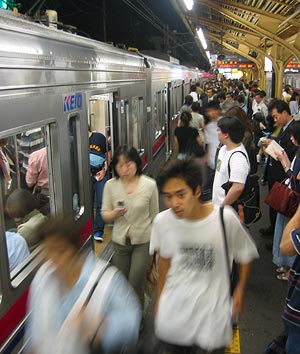
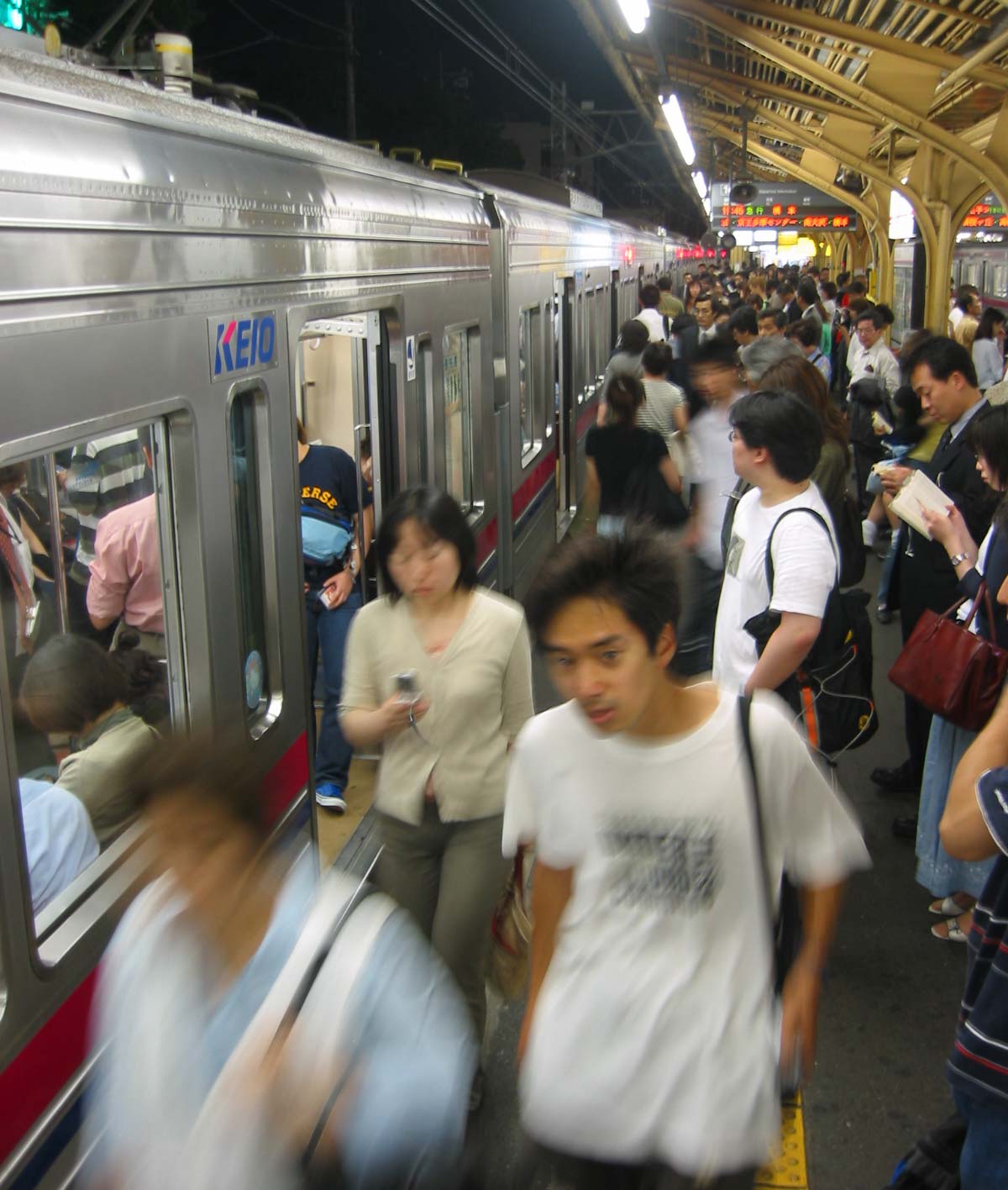
A nice photo of a platform on the Keio line, Chofu Station, a few nights ago. A larger version of the image is here.
Categories: Focus on Japan 2003

A nice photo of a platform on the Keio line, Chofu Station, a few nights ago. A larger version of the image is here.
 OK, I am now officially getting screens for my windows, or else finding some other way to keep cool for the summer. Did I ever mention that large insects completely freak me out? They do. Under a few centimeters in length, I got no problem. But if they’re as big as a medium-sized cockroach, I start to climb the walls. Call it a weakness. I just hate ’em.
So imagine my joy at laying in bed tonight, and seeing movement out of the corner of my eye. On the wall across from my bed, a 12-cm-span spider, I kid you not, is crawling right along near the ceiling. As advertised, I freak out. Not enough to kill my instinct for good blog fare, so I grab my camera and venture as close as I dare to snap the thing’s picture. Between further attacks of the Willies, I run to the kitchen to get a large metal bowl and something thin and hard (a plastic hand fan does the job). I come back, and in a feat of stupendous bravery (or sniveling cowardice, depending on how you define it), I trap the spider underneath the bowl and toss it out the window.
It was either him or me, and I pay the rent here. I mean, really, look at the picture. Look at the FANGS on that thing!
YyyeeeEEEeessshh!
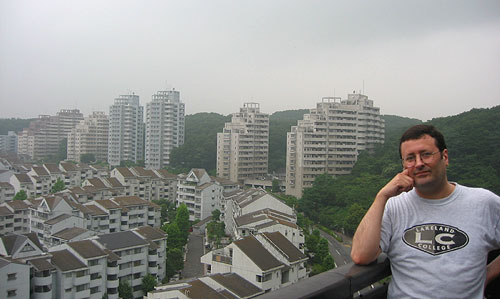
Hiromi and I climbed the local observation tower atop a nearby hill for a view yesterday; that’s me, with my apartment complex in the background.
It’s a really nice location–in front of us, you get a nice view of Tokyo, and to the back, noting but wooded hills for a few kilometers. But it’s not too “inaka”; it’s only a 30-minute train ride into Shinjuku–though it’s a 5 minute bus ride or a 20-minute walk to the train station. But I love the green, the parks, the wide open areas, the feeling of escaping Tokyo without getting too far from it.
And this isolated pocket of apartments up against a hill is priced right, too–I pay about 130,000 yen per month, but I have an 84-square-meter apartment for it. That’s an 8-mat bedroom (all the rooms are hardwood floors despite the tatami size measurement), 8-mat living room, 5-mat dining room, 4-mat kitchen, a 6-mat room off the dining room, and a 4.5-mat guest room–not counting the genkan, bath and toilet rooms and a walk-in closet thrown in for good measure. Try finding that downtown without breaking the bank!

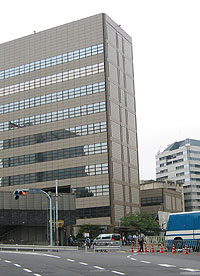
A few street scenes from today.

 For those of you who haven’t heard, you might want to take note of the requirement for U.S. citizens to file your 1040. Most expats assume that since they get deductions and credits that effectively wipe out any tax debt, that they do not need to file. That’s not true. In fact, in order to get the deductions and credits at all, you must file on time. You can do this by mail, or by visiting the IRS office at the embassy or one of the consulates. Expats get an automatic 2-month extension on filing, so our deadline is June 15th. If you want another 2-month extension up to August, there’s a form you can file, and another form if you want another extension after that. But you do have to file sometime.
The forms to file are your 1040 and the 2555. The 2555 is the one to get you the $80,000 deduction (does not cover income from U.S., such as interest income or dividends). After you file the first time, the IRS sends you the book and the forms. You can also get them online; here’s the 2555.
The Tokyo embassy is located in Akasaka. The closest train station is Tameiki-Sanno, on the Namboku and Ginza lines, or you could go to Kokkai Gijido-mae, on the Marunouchi and Chiyoda lines. (Here’s a fairly good English-language subway map, by the way.)
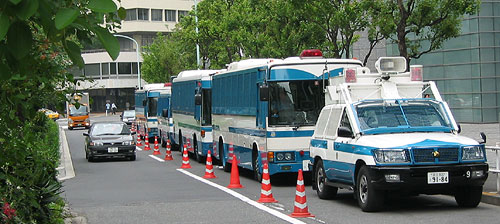
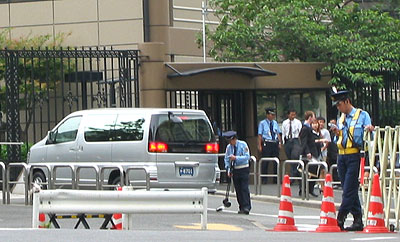 You can expect a pretty sizable security contingent, of course. A good number of police vehicles are always camped out nearby (above), and the entrance has several security personnel for both pedestrians and vehicles. At the main gate, you will be asked for an I.D. and your bag(s) may be checked.
You can then walk into the main compound. The first doors you will come to are for the visa services; pass those by and go up the stairs until you come to the second entrance. A U.S. marine is always on guard there in a bulletproof station; you have to give him I.D., which he holds while you’re inside, and he gives you a visitor pass.
A Japanese security guard then takes your bags and belongings through a scanning device, while you walk through the metal detector. Various items are not allowed inside, like cell phones, cameras, etc.–there’s a list right there. I just lump everything I have into my backpack, except for the forms I’m filing, then have the guard check it at his station, and pick it up when I leave.
Once through the entrance, you have to wait while the IRS staff member comes to take you to the office; no visitors may walk unescorted in the building. You might have to wait until a number of people come through before he leads you all to the office. In the office, the staff will check and then certify your 2 copies, and you’re done. You can also visit them for forms or other materials.
Once finished, you wait until the staff member escorts you back to the door, pick up your stuff, and then you’re done.
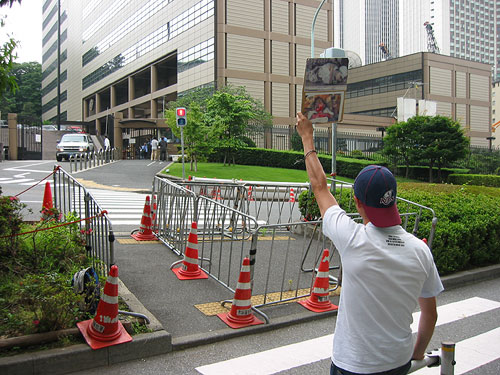
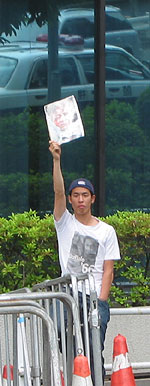
This visit, I was treated to an interesting sight–a sole demonstrator outside the embassy entrance. A fellow in his 20’s, he was holding up a photo placard of injured children (presumably from Iraq), and was shouting stuff like “THERE ARE NO WEAPONS OF MASS DESTRUCTION!” and “YANKEE GO HOME!”
Never seen that before at the embassy, but in light of recent events, I’m kinda surprised it was just one guy.
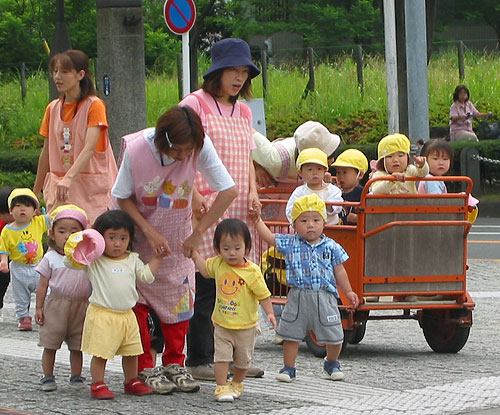
Here’s an example of one of the carts I mentioned the other day. For some reason, only a few are riding in the cart and the rest are walking. Usually it’s just Kids in Carts.
Whatever the transport mode, they’re cute as hell.
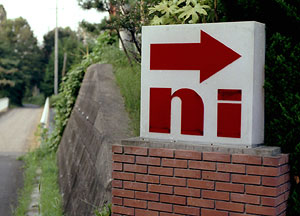
Either that, or they’re huge Monty Python fans.

Here’s a Norman Rockwell, Japanese style. Note the classic yellow hats and the raised hands while crossing. These kids must be one grade up from the younger kids who get corralled five or six to a cart and pushed around town. For some reason, I always see two such carts filled with kids, never one or three.
Anyway, I wonder where these kids are going from and to? Are they going to a school? And from what gathering place? Or are they going home, and if so, why all together?
Probably it’s just a field trip of some sort, or something to do outside so they don’t get too antsy….
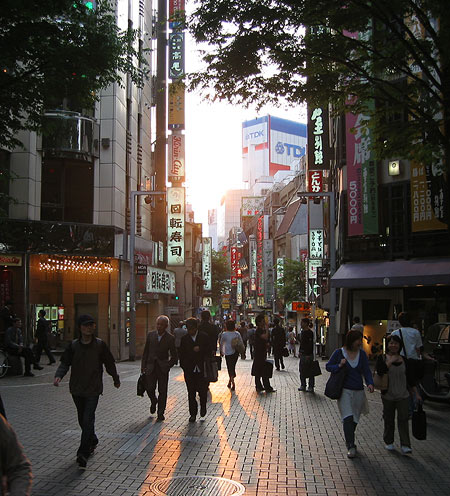
A little lull in blogging, due to a heavy work schedule. Here’s a nice image, though, of a Shinjuku (East side) back street just before sunset.
 Oops.
Oops.
The guy at right is probably not as ashamed as you might think, depending on his particular crime. There’s a very good chance that he was pulled over for something that was safe, reasonable, and yet still illegal.
Japanese traffic police are an interesting breed. If we were to class them as we would a species of bird, we would note that they have a very specific range–in this case, primarily along major thoroughfares, especially at intersections or at the exits of underpasses. Their “diet” is primarily motorcycles or other two wheeled vehicles; they might occasionally snack on cars or vans, but they never, ever go after trucks, no matter what crazy thing one might do. And they are most definitely diurnal; you will never see one out after dark. In fact, they never go out when it rains or snows, either; they apparently have a very delicate constitution.
OK, ornithological analogies aside, Japanese motorcycle cops are not exactly doing the job they are supposed to be doing, which is–and I’m making a big reach by presuming this–protecting public safety on the roads. In fact, their mandate is likely closer to what it is for most police in Japan, which is to make a good show of law enforcement without really getting involved, except for high-profile cases.
As I mentioned, Japanese traffic cops have poor habits for enforcement. First, they only venture out onto the big roads, like Koshu-Kaido, Ome-Kaido, and so on. With the multitude of smaller roads and blind corners where traffic disobedience can present real dangers to the public, you might think they would normally patrol these areas as well, but they don’t. Even on the bigger roads, they hang out at major intersections and at the exits of underpasses only. Why? Because it’s easy to catch people there. Seriously. That’s where people slow down, making it easier to pull them over. Also, you can find people violating technical rules there more often, rules that do not necessarily endanger anyone but make for juicy traffic fine fodder.
One example: I knew a guy who rode a 50cc scooter. At one intersection, he got into the right turn lane (in Japan, you drive on the left, so a right turn at an intersection means crossing the opposite lane of traffic), and he got pulled over. The officer gave him a ticket. Why? Because in Japan, if you are riding a scooter under 51cc and you make a right turn at an intersection with two major lanes of traffic and a third turn lane, it is illegal. Why? No good reason whatsoever. They just made the law that way. If you know how Japanese traffic works, you will know that there is no earthly difference between a 50cc and a 70cc scooter making that same turn. A 50cc bike is allowed to drive in any lane of traffic, no matter how many lanes there are. When you go from the rightmost lane into the right turn lane, you slow down, meaning 50cc vehicles have no problem there. Making the turn itself is no problem. There is no part of that maneuver which is not perfectly safe for a 50cc vehicle. But the police can write lots of lucrative traffic tickets for it.
Another profitable spot is at the exit of two-lane underpasses. Why? Because such underpasses always have lanes separated by a yellow (no-cross) line. Why is it there? I can’t think of a logical reason. But bikes will often cross it, and they’re easy to catch on the straightaway or traffic light right after. Also, the cop can hide easily there, as he can at the intersection.
In addition, they go after motorcycles far more often than any other vehicle, far out of proportion to offenses committed. And I have never seen them pull over a truck. One time I saw a truck make a sudden and extremely dangerous lane change, over a no-cross yellow line, no less. A traffic cop was right there, watching. He did nothing. A minute later, a motorcycle crossed the yellow line, in a completely safe way. He got pulled over.
There is also a season, by the way–traffic campaign seasons, multi-week stretches (usually 2 or 3 times a year) when traffic cops are at intersections and underpasses everywhere, writing tickets like mad. Why the sudden enthusiasm? They get paid extra for every traffic ticket they write.
Traffic cops seem to have a good union, because they are never out at night, nor do they come out in inclement weather. Which are, naturally, the times when traffic violations present greater dangers than usual due to lack of visibility and control. But I concluded long ago that cops in Japan are more about show than safety. One example: I have only seen one speed trap (a guy seated on a folding chair with a radar setup, in radio contact with traffic cops at the other end of the street) set up in my years in Japan. It was along a riverside road. The road itself is ludicrous: half a kilometer long, the river on one side, a huge building on the other; no intersections along that stretch, no houses, no pedestrian traffic, just a nice, long unbroken straightaway. So of course the speed limit is 30. That’s Kph, not Mph. It comes out to just under 20 mph. Someone would have to be insane not to “speed” there. They put up the trap there precisely because of that, and because it’s easy as pie to stop people. Does it help public safety? Not in the least.
On the other hand, there is a small street I sometimes walk on, one of those very narrow two-lane streets you often see in Japan, but this one with lots of blind corners and heavy traffic. A straightaway, no stops signs or lights for a 200-meter stretch. People crossing the street all the time, cars coming out of the blind intersections. The speed limit on that road is 40 kph (25 mph), and people speed quite often. It’s one of the most dangerous streets I know of. Furthermore, there is a large police station right smack at the end of the street. And yet I have never seen a speed trap there, nor any cop watching traffic. Go figure.
This all jibes with what you hear about Japanese police in general. Someone stole your wallet/purse/whatever? Sorry, we can’t help you, in fact don’t even bother us by filling out a report. Bosozoku (hot rodders on scooters and motorcycles) racing up and down your street at 2 a.m., endlessly revving their engines at artificially-enhanced noise levels, breaking traffic laws left and right? Don’t bother us.
But if you see a guy on a 50cc scooter going at safe speeds making an orderly right turn on a 3-lane street, by all means, report it immediately. We don’t want a menace like that going unchecked.
Update: I have encountered two more speed traps like those mentioned here. Both were in almost identical circumstances–not dangerous at all, but well-placed to catch safe drivers in technical illegalities. But I have also seen two instances recently which made my eyes pop: a truck and a taxi (not at the same time–different days) pulled over and ticketed. I have never seen that before, either one. Not because they drive safely, especially not taxis, but, I believe, because cops give them a break, either because they share a common background or simply because taxi and truck drivers depend on driving for their livelihood.
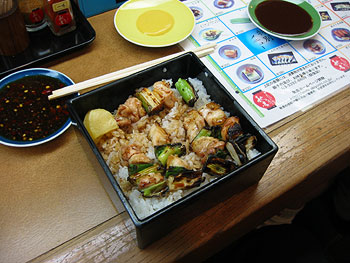
When I first came to live and work in Japan in 1985, I made one of those 24-hour multi-layover flights that was extended even further by a train ride out to Toyama City, in the Hokuriku region, where I would work for the next two years. When I got off the train at the end of that epic journey, I was immediately whisked off by the welcoming committee to have dinner at a place I go to up to this day (literally, I ate there tonight). The name of the place is Akiyoshi, and they specialize in yakitori.
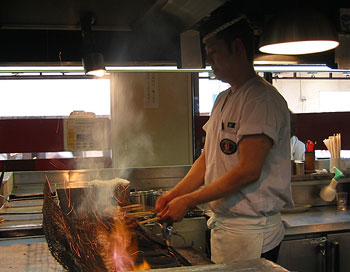 Akiyoshi is a national chain with 127 outlets, but it originated in Hokuriku–Fukui prefecture, to be exact. Toyama, despite being out in the boonies, was close to Fukui so the city had three branches (the prefecture now has 15). It became a familiar haunt, and no less so two years later when I moved to Tokyo. Originally, I lived in Suginami ward, in Asagaya, so the Ogikubo branch was practically next door. Tokyo now has about a dozen, including Ikebukuro, Kanda, Tokiwadai, Gotanda, Nakano, Shibuya, Takadanobaba, Ginza and Ueno.
My personal preference is still for the Ogikubo store, not just for sentimentality or because the staff knows me going on 16 years now, but because the atmosphere and portions are the best there. The Ogikubo store is one of those places where everyone shouts greetings when you walk in; in fact, any order given is another occasion for the staff to shout to each other. Gyuu-hire, itchou! Hai! It’s mostly bar seating, and generally a more convivial atmosphere than most eateries you might go to.
But the food is the best thing about it. More than a dozen varieties of meat-on-a-stick, my personal favorites being negima, gyuu-hire (filet beef), and the standard wakadori. If you want a great meal starter, you can order tori-juu or hire-don, both square lacquer boxes filled with rice and either chicken or beef (cooked on the stick, presented on the rice off the stick), adorned with the house tare sauce. The chicken dish is pictured at the top of this post.
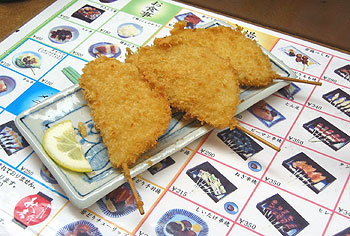
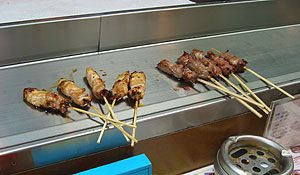 You can also get a variety of other meat and/or vegetable dishes, and beer and chu-drinks are available on tap. The menu for the store can be found here, on their web site. The full on-line menu is in Japanese and has only a few photos; a menu with links to more photos but to more limited dishes can be found here. They also have menu placemats, which you can see under the onion fry dish at the bottom of this post.
That is one of my favorite side dishes: tama-negi furai (pictured at bottom), or onion fry–slices of deep-fried onion in batter. Mmmmmmm, baaaatterrrr…
Even better is the house sauce–a garlic flavored tare sauce, accompanied by a spicy Chinese mustard sauce, and special sauces for additional dishes.
What’s more, it’s cheap, as far as yakitori joints go. The 5-stick wakadori plate is 350 yen. I usually get a tori-juu (5 negima on a bed of rice), two orders of wakadori (5 sticks per order), a tama-negi furai and a couple bottles of Coke, and the damage comes to 1,920 yen.
Do yourself a favor, head on over to one of these next chance you get. The Ogikubo shop is out of the West exit of JR Ogikubo station. Once out of the ticket gate, turn right and go down the stairs. When you reach the shopping street, turn left, and go about 20 meters; Akiyoshi is on the left, past the Yuu-topia bath house.
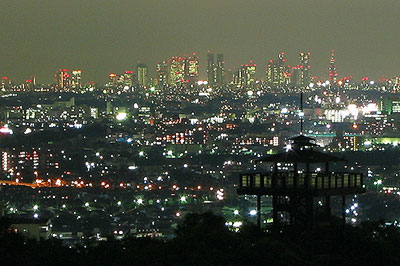
A 15-second time-lapse photo taken from the top of my apartment building (10th floor) at nighttime. The foreground is an observation tower atop a hill nearby my apartment building; the background in downtown Shinjuku.
By the way, I hope to have Day 5 of the Spain trip up this weekend… a visit to El Ermitaño Restaurant, on the way back to Madrid.
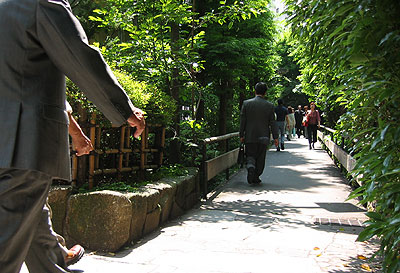
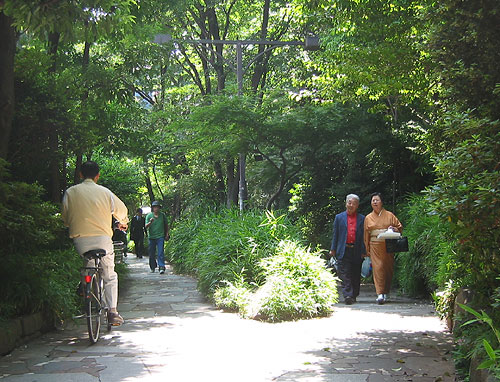
Every once in a while you come across a little corner of Japan, tucked neatly away where you might never have noticed it before. One such pleasant reprieve from the gray maze of central Tokyo is a small road called “Shiki no Michi,” or “Avenue of the Four Seasons.”
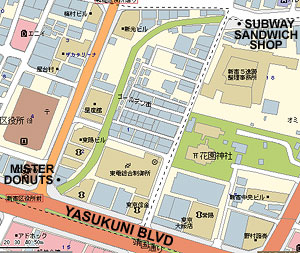 If you work or play in Shinjuku’s east-side “San-chome” neighborhood, you may have come across it. It begins just next to a Mister Donuts shop on Yasukuni Blvd., and cuts across an otherwise not-so-attractive neighborhood to come out just north and east–suitably enough for us expats, right next to a Subway sandwich shop. But the street itself is the attraction, one of those places where you suddenly lose the city and for a short time, you can imagine you’re out in the countryside somewhere. Well, almost. The street is just at the periphery of Shinjuku’s famed red-light district “Kabuki-cho,” and you can spy a few love hotels and other establishments through the few points where the foliage thins out.
It’s great for my co-workers and me, as it lies on the path between JR Shinjuku Station and our college–it even cuts down on our walking time between the two. If you’re ever in the neighborhood, give it a walk.
 When I first came to Japan, I felt like Michael J. Fox in Back to the Future: I saw a car pull into a service station, and a flock of attendants rushed up to the car, cleaning the windows, vacuuming the inside, checking the oil and water and whatnot. Never happened in the U.S. in my lifetime!
Gasoline in Japan costs quite a bit more than in the U.S.; a gallon goes for about $3.25 by today’s prices and exchange rate. For that much money, you would expect to get better service! But in recent years, the quality of service has fallen somewhat–where you used to see teams serving cars, now it’s just a single attendant, though they will do more than just fill ‘er up. And now we seem to be seeing the downfall of even that level of service.
A few months ago, I happened across the first self-service gas station I have ever seen in Japan. I was quite surprised by it. Apparently, instead of the service guy coming out, taking care of you and then taking the payment, you instead pump gas yourself, and then swipe a card to pay for it. A single attendant stands by to help anyone who needs instructions–which I would imagine happens a lot, as few people here have ever pumped their own gas.
Apparently, self-serve stations have been around for as long as a decade, but they have been quite rare until recently. The photo above left shows one station I spied this morning that is in the process of changing from full- to self-serve.
The problem: the gas costs almost exactly the same! Maybe you get 1 yen or so less per liter (maybe 3 cents to the gallon), but that’s hardly worth the trouble. Not only do the gas companies save loads on payroll, but the self-serve paradigm also encourages users to be station card-holders. You use your Mobile or Jomo company gas station cards to pay with the swipe machine–or else you have to go over to the attendant stand for a cash transaction. Since people will prefer the card, and because they will not want to have a wallet full of cards for different companies, they will be maneuvered into being more monogamous with one company.
Sounds self-serving on the part of the gas companies to me….
Part of the reason I am posting this is because I want to test some new blog posting software I’m using, called KungLog. The software can upload photos if you are using Moveable Type, so let’s give it a try.

An unfortunate name, and an even more unfortunate shape, given the name…
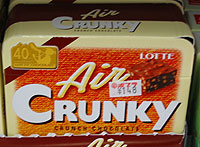
For those who prefer to avoid Air Jordan…
Hey! Not funny! Well, OK. Funny.

View from the 9th floor of my school.
The college where I work is located in Shinjuku, about 15 minute’s walk from the JR station. Our building is situated on a large “block,” and the interior of this block used to house a golf driving range and a model home tract. The land was owned by NTV, the television station.
 About a year ago, NTV decided that the land was going to waste and they needed some serious income, so they sold the land to the Urban Development Corporation, which presumably will build high-rise apartments there.
However, the site turns out to be a rich archaeology deposit. The first excavation, closer to my school, had remains of the foundation of a yashiki, or country home, for a wealthy Edo-period family. The building was owned by Matsudaira Sado-no-kami, or the Daimyo of Sado, now Ishikawa prefecture; I believe this was the site of their residence while living in the capital Edo.
But the current dig, on the other side of the lot (in photos), has a rich find of 9,000-year-old Jomon pottery, with a WWII bomb shelter thrown in. Some of our classes have visited the site, and we may get more chances still–it looks like the construction of the new buildings will be on hold for a while yet before they get all they can from this valuable dig.
Here is a web page detailing the dig.

I just got through pointing out the flawed reasoning in two Yomiuri articles, and now on their web site I find a third. The article caught my attention because of the title: “Tokyo traffic fatalities plunge to 50-year low.” Either that’s a horrid pun, or a very badly considered title.
In the article, the following thesis is presented: The low traffic death toll was attributed “to a crackdown on bag-snatchers riding two-wheeled vehicles.”
Huh?
It gets better: they said that two-wheeled vehicles are responsible for 30% of traffic deaths in Tokyo, which is more than the national average of 20%. However, the article fails to show that any traffic deaths were caused by these snatchers, so we can only assume that bag-snatchers on scooters somehow get into traffic accidents. In turn, we have to believe that if the police crack down on them, the death toll gets lower. (Which goes contrary to the general policy the police have for not stopping noisy bosozoku bike gangs, namely that they flee and cause accidents.)
But the article then states that bag-snatchers “have struck an average of almost 20 times a day this year, much more than the average 15 times a day they attacked last year.”
Huh?
Stopping bag snatchers was supposed to bring down the death toll, but snatchings are up? How does that account for the lower death toll? Further, the article says that part of the crackdown involved “questioning all people riding two-wheeled vehicles within a three-kilometer radius of the scene of a bag-snatching.” This has got to be the most ludicrous thing I have ever heard of. A scooter can go 3 kilometers in 6 minutes even in slow traffic. Are we to believe that the police can stop and question all of the hundreds of two-wheeled vehicle riders in an area 6 kilometers across within six minutes of the crime? That’s quite a feat! Frankly, I would be astounded if the Japanese police could get interested in a crime in six minutes, given their reputation for not jumping into action, rather simply telling victims that nothing can be done about it.
What we have here is an extremely badly written article based on an unbelievably faulty premise. Pretty standard for the Yomiuri.
That’s what one Men’s store call its “Big and Tall” section. But for those of you who want a good selection of oversize clothes, both formal and casual, try Sakazen. The web site does not seem to show the Shinkuku store, but it’s there, on Yasukuni Blvd. just past Meiji Blvd., coming from Shinjuku Station. Five floors of clothes, the 4th and 5th floors dedicated to larger sizes (formal wear on the 4th, casual on the 5th). The phone number for the store is (03) 3354-1641.
Right across the street there’s what looks to be a good oversize shoe shop, carrying sizes over 27cm. Tennies, dress shoes, sandals, the whole lot. The shop is called Hikari Shinjuku, phone number (03) 3351-0192.
Both shops are located much closer to the Shinjuku Sanchome stations for the Shinjuku and Marunouchi subway lines; take exit C7, they’re right around the corner from there.
A couple stories in the Daily Yomiuri caught my eye. All too often these stories are badly written, coming to incorrect conclusions by missing crucial information. One story concerned the “unpopular” 2,000 yen bills.  In my experience, they are not unpopular, it is just that they are very poorly distributed. The story claims that people don’t like them because they can’t use them in vending machines. Well, you can’t use a 10,000 yen bill in vending machines, either. Another stated reason was that bank tellers are afraid they might confuse them with 5,000 yen bills–a possible reason, but it hardly explains why you never see the bills. One time I tried to get a whole bunch of them, because I like the convenience as well as the design of the bills–and was made to wait more than ten minutes at the bank because they apparently had to get the notes out of the vault. I don’t think the public has had the chance to dislike them–I have only been given one once at a store–it is just that they are badly distributed by the banks. Oh, and the lack of enough drawers in most cash registers might be a reason merchants don’t like them….
Another story on the same page deals with high-speed Internet access, where consternation is expressed as to why only 305,000 subscriptions to fiber-optic lines exist, when more than 16 million households have access. It astounds me that the writer of the article did not seem to know that due to the type of cables used, fiber-optic connections can only be made to households with specific construction that allows the cables in–so of course only a few buy the service. Are the people at NTT really scratching their heads, unable to figure this one out? I’d love to get the service–the “high price” the story mentions for subscription is the same as many people in the U.S. pay for 1.5 megabit DSL, yet the Japanese service is 100 megabits. But my apartment building is unable to accept the wiring. NTT, you want to sell more subscriptions? Invest in new wiring technology that doesn’t exclude the vast majority of possible customers!
One can only pray to a merciful God that these clowns stop doing this by tomorrow. I read on a few other Japan blogs that the election is then, and can only hope that loudspeaker trucking is prohibited on election day. At least, it should be over by Monday. But then, sometimes other elections follow soon after. I hope not.

A few images of the latest offenders parading by, stopping up traffic and barraging all of us with endless noise. Note the trucks with four loudspeakers, like one isn’t enough.
Proposal to any Japanese people reading this: start a movement in which you publicly proclaim that if you hear a politician making noise from a truck, you will purposefully not vote for them.