Archive

Archive for the ‘Focus on Japan’ Category

Stupid News from Japan

February 7th, 2007 Comments off

You can’t get anything past the Japanese boys in blue:

A man stole a police car from outside a post office in Maebashi on Monday because he was too tired to walk home….

The policemen who drove the patrol car left it idling in the parking lot. I know Japan is a relatively safe country, but this is still pretty stupid. The man apparently did not even drive the patrol car all the way home. Instead, he stopped 5 km later and told a woman that he was a police officer and needed her car.

Nothing you can tell me will shake my conviction that beer was involved in this somewhere.


From the This-Is-What-You-Get-for-Electing-Right-Wingers Department:
On Jan. 27 Japan’s Health Minister Hakuo Yanagisawa gave a speech on the country’s shrinking population in which he referred to Japanese women of childbearing age as “baby-making machines.” He went onto explain that arresting population decline was difficult “because the number of baby-making machines and devices is fixed [in the population]; all we can do is ask them to do their best per head.” The 71-year-old Yanagisawa did add, however, “that it may not be so appropriate to call them machines.”

Ya think?


And from the irony department:
A former assistant professor of Meiji University’s School of Information and Communication plagiarized 96 percent of a report on copyright submitted to the Institute of Intellectual Property, sources said Monday.

Plagiarizing a report on copyrights. Well, you gotta give the guy an A+ for sheer brass balls.

Categories: Focus on Japan 2007 Tags:

MegaMacs MegaScam?

February 3rd, 2007 2 comments

A few weeks ago I blogged on the MegaFattening MegaMac at Mickey D’s here in Japan. Since then, as reader Jeff pointed out, reports have come out that the MegaMac is so popular that it sells out too quickly–and McDonald’s stores have had to limit sales of the burger at each store to ration the item.

Customers who go away disappointed are given a rain-check coupon to get the MegaMac at another time for a discount–190 yen instead of the regular 350 yen. One such coupon is pictured below; Sachi got one when she tried to order a MegaMac and was told that they were sold out. (Though I have no idea why she would want one–hell, the burger is almost bigger than she is.)

McD’s outlets have limited sales of the special item to “dozens or hundreds” per store per day.

Megamaccoupon

Frankly speaking, I smell a marketing scam. First of all, how could they “run out”? The MegaMac is essentially a Big Mac with two extra patties. Is McDonald’s running out of Big Macs and patties? Nope. So what’s the problem? Do they actual have the materials but their accounting system can’t allow parts for one burger to be used for a different burger? Sounds ludicrous, but I suppose it’s possible.

However, I think that it is more likely that McDonald’s saw an opportunity for a PR device. After all, just introducing a new product will not get them publicity. Even selling a huge number of them might not get printed up. But running out of a specialty product because it’s so popular and then having to give discount coupons… sure enough, that got McDonald’s into the press. That got people’s attention, and has probably generated a lot more sales.

But how can McD’s get more profit by turning away customers? Probably because those customers don’t turn away–they wind up getting something else on the menu. The coupon means they are more likely to return as a repeat customer, and will have the feeling that McDonald’s was generous and that they “won” something.

In the meantime, the franchise gets free press equivalent to free advertising, and their MegaFat specialty item gets the aura of being so popular that only lucky customers get one–kind of like the fast-food equivalent of Louis Vuitton handbags or something.

In the end, they get more money and your arteries get harder. So everybody wins!

Categories: Focus on Japan 2007, Health Issues Tags:

Will This One Make Headlines?

February 2nd, 2007 Comments off

Infractions committed by members of the U.S. military in Japan, sometimes even relatively minor ones, tend to make headline news here. So the question should be: when U.S. soldiers immediately come to the rescue of a Japanese man who fell onto the subway train tracks at Roppongi station (when no other bystanders moved to help), will this also be recognized in the Japanese media? Especially when such rescues are often reported when they do not involve American servicemen?

I’m not holding my breath. So far, only Stars and Stripes has the story of the rescue–which happened almost two weeks ago.

Categories: Focus on Japan 2007 Tags:

Nova High

February 1st, 2007 Comments off

Here come the mandatory drug tests for Nova teachers again, as seven Nova teachers from Saitama are arrested for pot and coke possession.

Categories: Focus on Japan 2007 Tags:

Maeuri-ken

January 30th, 2007 Comments off

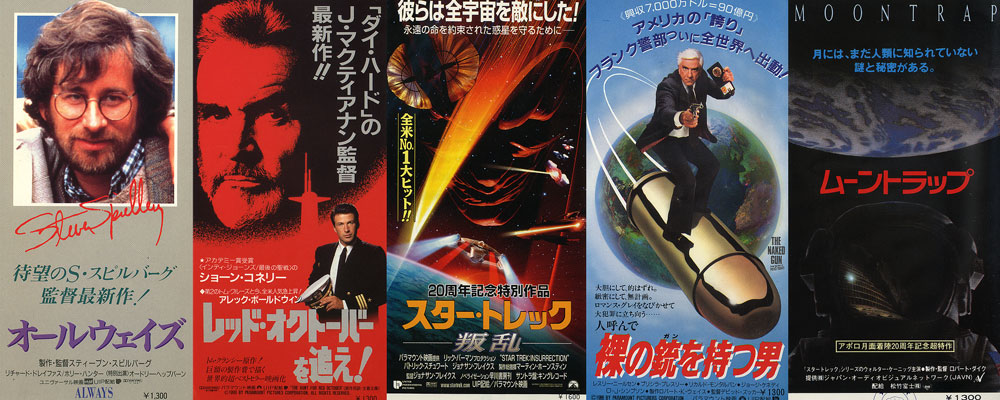
Yesterday, Sachi and I went to see An Inconvenient Truth. Since we did not get advance tickets or go to a late-night show, we paid the full ¥1800 ($15) face price for the tickets. (Somewhat ironically, popcorn and drinks cost less here.) Had we prepared in advance, we could have bought maeuri-ken, or advance tickets, which would have set us back only ¥1300 ($11). While that may not sound like much of a savings, it is still four bucks a head.

0107-5Tix-450
Click to see larger image

Maeuri-ken (literally, “advance-sale tickets”) are just what the name implies: tickets sold in advance of the film’s release, for a reduced price. The tickets are nice because they have a picture stub which you get to keep (see above), and they can be used at virtually any theater showing the film (though sometimes a limited listing of theaters is printed on the back). Technically, once the film starts showing, you’re not supposed to be able to buy the discount tickets–but many places sell them after the release anyway. The same shops can also be found selling special discount tickets specific to one theater or one chain of theaters, presumably sold to the store by people who get them by some private means.

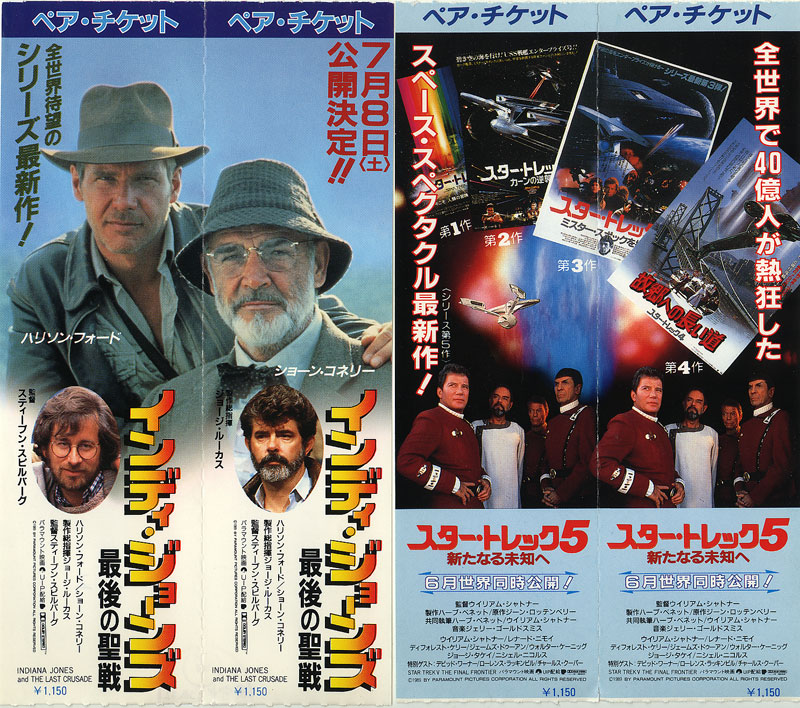
Sometimes, tickets are sold at a slightly greater discount as “pair tickets,” presumably for dates and whatnot. These are (or at least were, last I bought one many years ago) ¥1150 ($9.50) a head, or ¥2300 ($19) for the pair.

0107-Pairtix-450
Click to see larger image

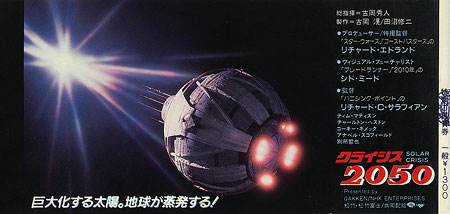
I have a small envelope full of a bunch of tickets I have bought over the years, back to and including Aliens, which was released way back in 1986. One of the stood out, however: Crisis 2050 (aka Solar Crisis).

0107-Crisis2050

This was notable partially because it was a real dog of a movie. But I remember it particularly well for a few other reasons; one was that it was co-produced by Gakken, which was my employer at the time, and another was the reason why the ticket was on sale at ticket shops for dirt cheap. That reason: Gakken, foreseeing how badly the movie would stink, “suggested” to their employees that they buy something like ten tickets apiece. Having no choice, they bought the tickets–and promptly sold all they could to the ticket shops for what little they could get. I would be surprised if anyone aside from Gakken employees paid full admission price. At least, I hope not. The film was dreadful. And I specifically recall seeing the mostly-empty movie theater predominantly populated by middle-aged salarymen, something unheard-of for a sci-fi flick.

Categories: Focus on Japan 2007 Tags:

NHK = RIAA?

January 27th, 2007 Comments off

NHK has always been a pain in the butt. I know that a lot of people like it, but personally, I do not. As for the translated English-language news, I can get far better from the Internet. As for their documentaries, National Geographic, Discovery, and Animal Planet on cable offer far better–and on NHK, all too often, they have all too often actually blacked out the English-language track on English-language programming. And in the past, I have noted a distinct political tilt to their news broadcasting. I got tired of them long ago, and haven’t watched them for a decade or more; were they to vanish, I would not even notice.

Except, of course, for the fee collectors. Like England, the public broadcasting in Japan is partly financed by fees collected from the people–whether they like it or not. Fortunately, while the fees are mandated by law, there is no penalty for not paying them. Foreign residents have traditionally avoided paying them, as have a very large number of Japanese as well–and for Japanese to refuse to pay fees when a government official comes to the door and strongly demands it, well, that’s saying something. As for myself, I last staved off the fee collector by pointing to my satellite dish and making it clear that I did not want NHK by any means or measure–and challenged them to cut off my NHK “service.” Please.

It got worse a few years back when embezzlement scandals within NHK caused public disgust, and more than a million households that had been paying fees stopped doing so.

So, what is NHK’s response? Are they working hard to improve programming or finding other ways to restore public trust?

Of course not. They’re suing the people who stopped paying.

That’s right. Taking a page right out of the RIAA playbook, they randomly chose 33 households that stopped paying fees, and are suing them for amounts ranging from $339 to $885. Now, admittedly that’s not too much like the RIAA in that they are not absurdly exaggerating the amount owed, but in Japan, any kind of lawsuit in court is considered a big thing. Japanese people are not nearly as litigious as Americans, and civil suits are famous for being lowballed.

The greatest similarity with the RIAA lies with the fact that, having lost the trust of the people who no longer pay, instead of leveling out and flying right, they are taking random people to court so as to scare all the others into line.

Good to see that they’re on the right track.

Categories: Focus on Japan 2007 Tags:

Street Signs

January 25th, 2007 2 comments

I thought I’d share a few things I’ve spotted on the streets as I go to work every day.
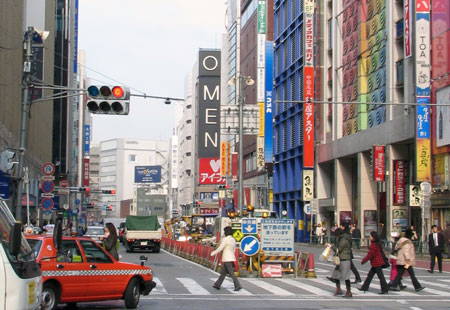
0107-Omen

This first one is a view I get while coming up Meiji Boulevard. That “OMEN” sign stands out a bit ominously. In fact, it’s the Marui Men’s store; the “O” is really an “OI” (pronounced “Maru-i” in Japanese) with the “I” hidden behind other signs on the right side. With the “MEN’ sign below, it produces the creepy effect. I always find myself thinking, “is that a good omen or a bad one?”

Next is a label I started seeing on taxis a few months back:
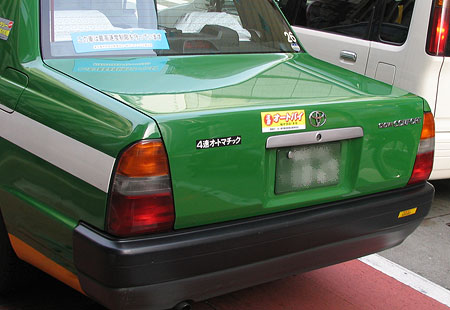
0107-Taxi-Label

And a close-up, from a different taxi:
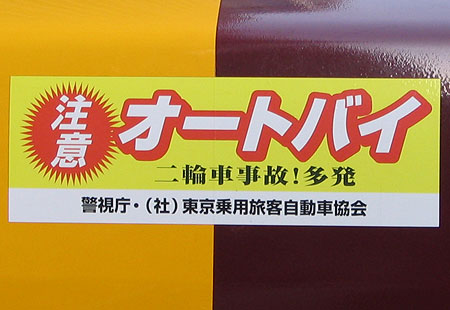
0107-Chui-Bike

Literally, the sticker reads: “CAUTION! MOTORBIKES — Two-wheeled-vehicle Accidents! Repeatedly Occur (Police Headquarters – Tokyo Passenger Vehicle Association)”

Though it’s a bit cryptic, the essence is pretty clear–the sticker warns people on motorbikes that they cause accidents frequently. I say that because it certainly doesn’t seem to be blaming the taxis, as taxis are not even directly mentioned. And if taxis were to blame, the sign would read something like “Caution — this vehicle makes sudden stops” or something like that.

Now, should a regular car bear such a sticker, I could see the justification–many bike riders do get out of hand. But for taxis to be bearing these is like a murderer calling a jaywalker “hard-bitten.” Taxis are dangerous sunzabitches. They constantly weave in and out of traffic–as bikers do–but then they also, often and without signal or warning, merge suddenly and/or hit their brakes and pull over to pick up or drop off passengers.

They also have a tendency to hog the road; on two-lane streets, they will straddle the center line, slowly weaving a bit right and a bit left, so they can command both lanes while driving leisurely, something which probably causes many of the aforementioned bike accidents. Bikers have enough room to pass on either side, and the taxi will often at the same time suddenly decide to choose one lane over the other–of course, without signaling or other warning–thus causing the biker to brake suddenly or veer off dangerously.

For that and other reasons, taxis and motorbikes are often natural enemies on the road. A further frustration for bikers is that taxis get a free pass from traffic police, who will instead over-prosecute bikers. I have seen literally hundreds of bikers pulled over for tickets, but only once in more than a decade have I seen a taxi driver given a citation. Same thing with truckers, who also (though less frequently) pull dangerous crap on the roads. I think the police cut a lot of slack to anyone whose driving is also their livelihood.

So to see so many taxis sport signs more or less accusing the bikers of causing accidents–especially when bikers are the ones who get hurt in the collisions–is a tad galling. Now, maybe I’ve got it wrong and the signs are not meant to be accusatory–but frankly, I doubt that.

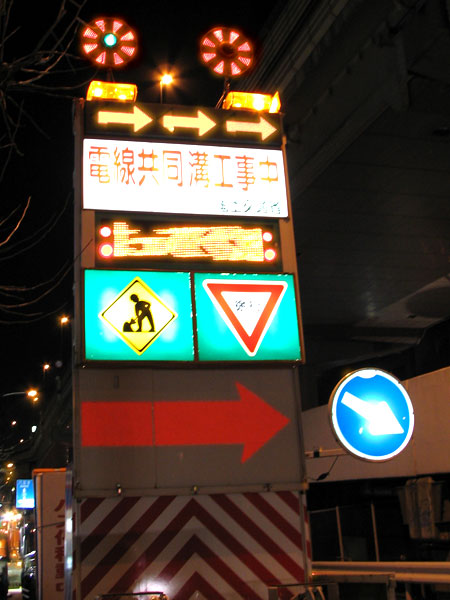
But on to a lighter subject: the Construction Sign of Doom! (Sorry, Sean, I ripped that moniker off from your satchel.) This is the one I mentioned last week, and I got it on film this time.
0107-Sign-Of-Doom

It’s a bit different from what I recalled an hour after having seen it for only ten seconds or so, but my recollection mostly holds true. The big, dull red arrow at bottom was pulsing; the orangish smear above the green-backed construction signs was an electronic scrolling text sign; the three yellow arrows were flashing on and off from left to right; above them, those yellow lights were the flashing roller lights, and above those, the pizza-slice rotaters, with flashing green lights at their centers.

Sadly, the guy with the light baton was absent tonight (I guess they figured out how irrelevant he was), but if you can picture it in your mind, he was only tall enough so that his construction-site helmet only reached the bottom of the big, pulsing arrow near the bottom of the sign.

This has to be the most outrageous warning sign array I’ve seen on Japanese roads. Now that I’m aware of them, I have noticed that other signs use the exact same elements of this one, except they only use half as many parts at most–like the pulsing red arrow and the green-backed warning signs only, or some other combination of bits and pieces that make up the sign. Maybe on this one, someone got too enthusiastic and just threw in everything but the kitchen sink.

Categories: Focus on Japan Miscellaneous Tags:

Mega Mac

January 22nd, 2007 3 comments

McDonald’s Japan has a new product campaign going on now. I don’t know if it’s also being sold in America (their web site doesn’t show it), but it seems strangely un-Japanese. It’s called the Mega Mac, and it is essentially a double Big Mac, or at the very least, a double-Double-Burger. Here’s their graphic for it from their web page:

Megamac

According to their “nutrition” info, it’s got 750 calories and 46 grams of fat in it. In the regular “set” menu, it includes a medium fries (420 cal., 22g/fat) and a medium coke (140 cal.), for a whopping total of 1,310 calories and 68 grams of fat. For lunch. In Japan. This is not going to help Japan’s fight against recent trends to obesity in a country famous for slim, long-lived people. Which is also why it’s surprising that it’s being sold in Japan, and not in the U.S., where there seems to be more of a trend toward chicken and salad-based meals.

And the amount of fat is pretty disgusting. For a 2000-calorie-per-day diet, the Mega Mac set meal delivers just a tad more than the 65 grams of fat you’re supposed to get, and that’s just for one meal. You’re also getting more than lunch’s share of calories, leaving only about 700 for the other two meals of the day.

If I thought I could get a straight, accurate answer, I’d stop by one of their busier shops and ask how well the Mega Mac was selling. But then, if I could get a straight, accurate answer, I’d almost be afraid to ask.

Categories: Focus on Japan 2007 Tags:

Subtle Bias

January 21st, 2007 2 comments

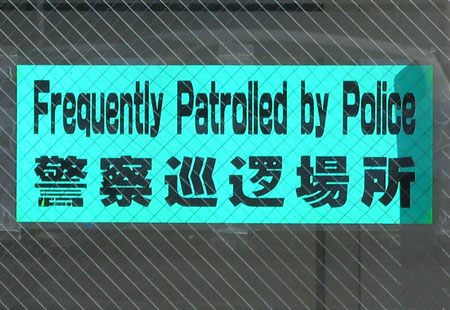
There is a sign on the front door of Mizuho Bank that has caught my attention every time I go to that branch. After seeing the exact same sign on another Mizuho Bank across town, I decided it was worthy of general note. Take a look at the sign and tell me if you can see what problem I have with it:

Policesign

Of course, it is not a problem with the grammar, spelling, or anything else about language; this is not a case of “Engrish.” The problem I have is when you compare this sign to almost all other bilingual signs in Japan. Check out these signs in the Flickr pages here and here (if they have disappeared, copies are here and here), for a quick, general comparison. Note that Japanese is on top and English is below. Also, although English is sometimes the same font size as the Japanese, it is usually smaller.

However, in the sign that graces the entrance to Mizuho, English is prominently on the top of the sign, and the lower half of the sign is in Chinese. Not Japanese.

The sign is aimed at foreigners, a subtle point made by the prominence of English on the sign. Japanese can read the sign easily enough, but the message is that the bank expects English- or Chinese-speakers to be the chief perpetrators of crimes at their establishment. The bank is clearly showing that they expect their foreign visitors to be much more liable to commit a crime.

Not a very welcoming message–though I would not be surprised if the people at the bank had no idea what message the sign was giving to non-Japanese. I have found that when this kind of bias appears in Japan, most Japanese are fairly blind to it.

I am thinking of going to the bank sometime soon and telling them what impression the sign gives, just to see what they would do about it.

Categories: Focus on Japan 2007 Tags:

Do You Think That’s Really Necessary?

January 20th, 2007 Comments off

I saw something on the road last night that made me smack myself for not having my digital camera with me. There was some road construction going on, and so they had a setup to warn people at a distance, so they would merge right and not hit the construction area.

Now, you might not think that would be worthy of taking a photo and blogging on it. But this warning display was different. It consisted of a vertical array of electronic lights that easily reached 25 feet in height, and was at least 10 feet across. This was nighttime, so it all stood out like a sore thumb. There were orange lights arrayed across the bottom. Above that was one of those electronic message boards that scrolls messages across from one side to the other. Above that were giant yellow arrow chevrons, animated to point you to the right. Above that were flashing yellow “rollers,” the kind seen atop police cars in red and blue (and in Japan, often used outside gas stations). And to top it all off, at the zenith of the sign there were two big bright red circles, divided into pie slices, with the slices turning on and off in a rotating fashion–the one on the left going clockwise, the one on the right going counter-clockwise.

I mean, talk about overdoing it.

But that’s not even the funny part. Here we had this gigantic sign, visible from a mile away, flashing and moving and gyrating all to hell, almost blinding you with its brilliant warning. And at the bottom of the sign, invisible until you got fairly close, was the ubiquitous guy whose job it was to wave a little red baton back and forth.

I laughed so hard I almost had to pull over.

Asakusa

January 16th, 2007 1 comment

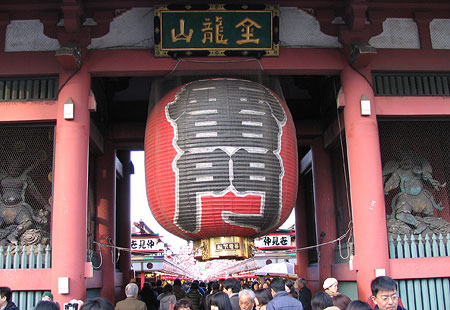
0107-Asakusa1-450

It having been maybe 24 years or so since I last visited, I got away to Asakusa last weekend with Sachi. The main draw of the area is the large temple, Senso-ji (a.k.a. “Asakusa-dera”). The street to get there begins with the landmark Kaminari-mon, or “Thunder Gate,” with the distinctive large red lantern, pictured above. Once inside, you get to brave the long gauntlet of pricey tourist-trap stalls and shops lining the avenue, separated by masses of tourists.

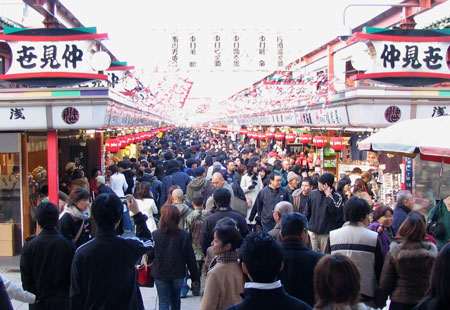
0107-Asakusa2-450

This is about as touristy as it gets in Japan, the kind of shops where kitsch dominates. Shops filled with “Ichi-ban” T-shirts, “Kamikaze” hachimaki headbands, Hi-no-maru folding fans, to bawdy novelty items–like the “Oppai Purin” (“Titty Pudding”) pictured below (miniature brassiere optional–I’m not kidding). The Osaka variety at left was sold out (god knows why that one went first). And no, I didn’t get any.

0107-Paipud-450

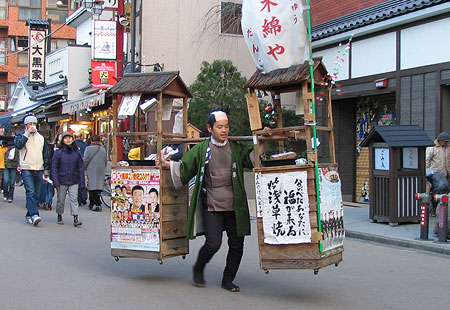
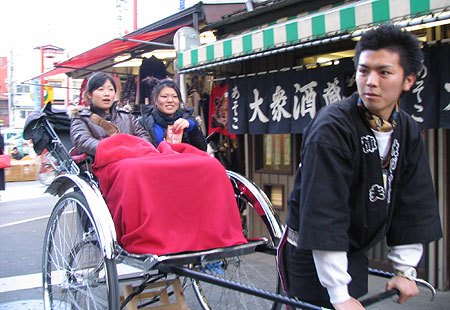
To round off the tourist kitsch, there were dango & manju (dumplings & buns) salesmen dressed up as old-style samurai, and nice rickshaw rides available. Though Japanese don’t call them “rickshaw,” they say “kurumaya” or “jinrikusha.” And to those of you who have never been to Japan, rickshaw are only located in the tourist areas, and not even very often then–though I will admit to having spotted several underpasses with “no rickshaw” signs at their entrances–probably very old signs indeed. Though they may have been simply more generic “no hand-drawn cart” signs instead.

0107-Dangoya-450

0107-Jinriku2-450

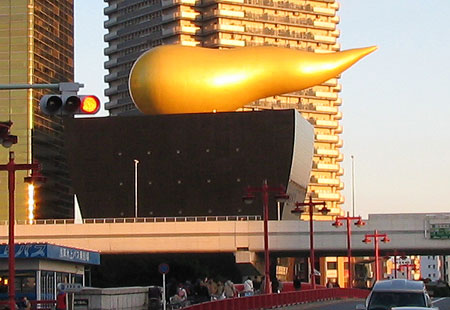
Nearby is the Asahi Beer Building, designed to have a giant flame atop the monolithic base. However, many Japanese see it differently, and call it the “Unko” building–literally, the “Turd Building,” after what they recognized to be a giant, stylized, golden piece of fecal matter (if you’re familiar with Japanese manga, they are kind of drawn like that).

0107-Unkobiru-450

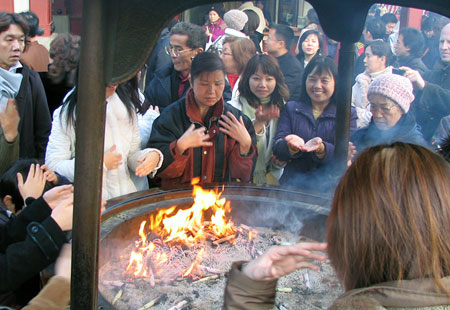
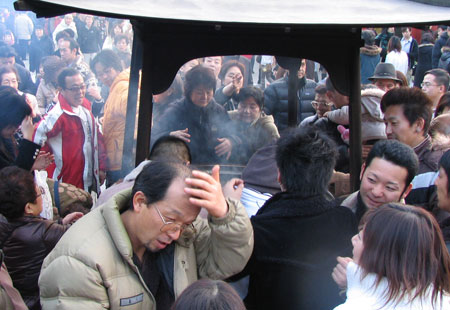
Once you get past all the tacky shops, you get to the Senso Temple proper. At the front there is a rather famous incense pot, where everyone stops and waves the smoke over their heads and at their bodies, as a kind of good-luck thing.

0107-Incense2-450

0107-Incense3-450

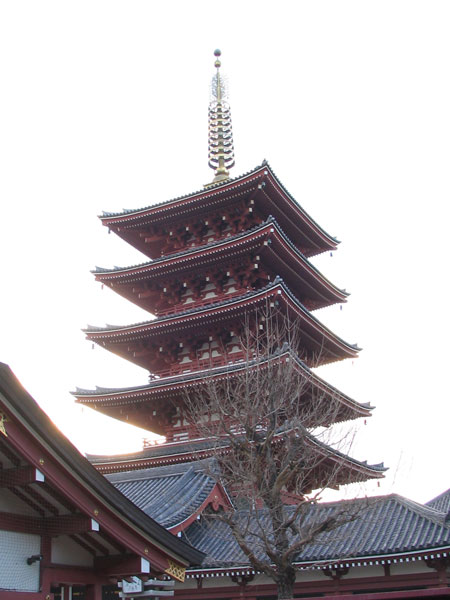
There is also a pagoda there, quite a nice one. This shot below is actually a composite. I took two shots at different exposures; one that was exposed well for the pagoda had the sky too washed out, and the other was good for the sky but the pagoda was too dark. Experimenting in Photoshop, I superimposed the good sky on the good pagoda and got quite a nice effect, I think. Click on the image for a larger version.

0107-Pagoda2-450

One more shot before I go: the pagoda with the washed-out sky. A very nice view regardless.

0107-Pagodatall-450

Categories: Focus on Japan Miscellaneous Tags:

Dog Rental

January 13th, 2007 7 comments

Some time back, I remember hearing of a place (I thought it was in Odaiba, but am not certain) that rented dogs out. At the time, I thought two things: first, how silly and frivolous, and second, I’d like to rent a dog. Well, today, we did.

The place we used is called the “Wanko Rental” in Gotanda, which happened to be close-by. Upon arriving, we saw the staff giving the dogs some outside-time. (The dogs were attended to by two staff people, who moved out of the way for this shot.)

0109-Wanko1

Usually I am not too crazy about pet shops; I don’t like the idea that the poor animals are cooped up in tiny cages, and I get the distinct feeling that they don’t let the poor things out too much. This rental shop does indeed let the dogs get out for exercise, and the girls inside often let the dogs run around inside the fenced areas in the shop. But their great idea is the rental service: they not only get customers to walk their dogs for them, but they get you to pay for it at the same time. Not that I’m complaining.

Sachi is very fond of Shiba Dogs, so we decided to walk one of them. The shop had tons of Dachshunds, some Cavalier Spaniels, some Retrievers, and a wide variety of other dogs. They used to have three Shibas, but there were only two when we went–more on that a little later. Of the two in the shop, the staff advised us as to personality, and though Sachi likes the brown version of Shiba, we decided on a cream-colored one (a variation not approved of by the American Kennel Club for some reason), a female named Yuriya. When Yuriya was taken out and given a leash, there was a hell of a racket, as all the other dogs knew what was going on and wanted to be walked as well. (By the way, the rates are 1000 yen/$8 an hour for walking, or 5000 yen/$42 per day for longer stints, minimum 2 days for the discount rate.)

We were given instructions and a little kit that included poop-scooping materials, a water bowl, and other stuff we might need on the walk–as well as a map to a park that we could take her to (we had already planned on it anyway), and then we were on our way.

Here is Yuriya:

0109-Wanko2

0109-Wanko6

On the way out, she dragged us all over the place, doing usual dog stuff…

0109-Wanko3

0109-Wanko4

0109-Wanko5

Yuriya is an excellent dog. She was well-behaved, not too wild or excited; she never barked, heeled well on the walk, and seemed content (or at least patient) when we pet, scratched, and cuddled her. She just seemed to have a good time.

The rental thing just seems like a good idea to me. So long as you’re going to have a pet shop with mature dogs, why not get them acclimated to people, as well as have them taken out for exercise and care more often? It is also a good alternative for Japanese people who live in no-pet apartments, but love dogs.

But there is an extra point here: while mature dogs are often passed over in favor of puppies at pet shops, this shop deals only in mature dogs, or so it would seem. There were no puppies there when we visited. (Maybe these dogs are given up by pet shops after having aged without getting bought, I don’t know.) Rental customers walk the dogs and take them to the park for some sniffing about and frolicking, but all the dogs are ultimately up for sale. And what happens is that if a dog-walking customer becomes fond of a particular dog, they are more apt to buy them. The walking episodes become a kind of getting-familiar process, better than getting a dog cold and finding out your personalities don’t match. That’s what happened to Hanako, the third Shiba I mentioned before. She was purchased, apparently a short time before, by people who got to know and like her.

So maybe the idea of rental dogs isn’t as silly or frivolous as I had first thought.

0109-Wanko7

Categories: Focus on Japan 2007 Tags:

Akemashite Omedeto Gozaimasu

January 1st, 2007 1 comment

In translation, the title of this post means “Happy New Year” in Japanese. When I first came to Japan in the mid-80’s, I was taken to a shrine for New Year’s, and since then have always preferred this place at this time. Every year, I try to make a point of going to a good local shrine to participate in the goings-on; I simply enjoy the atmosphere very much. Not a crazy party atmosphere, but a quietly festive neighborly get-together of strangers for a unified purpose, everyone friendly and enjoying themselves.

This year was also special because it was the first time in three years that I have been able to make it to the local shrine. As you may recall, two years ago, a severe nosebleed kept me over in the U.S. for an extra week and I missed the proceedings here. Last year, a broken foot saw me back in Japan on time, but unable to go out and do anything–especially to climb the steep stairs of the shrine. So this year was the first time in a long time that I was able to get back into the action.

Visiting a shrine or temple on New Year’s is called “Hatsumode,” literally “first visit to a temple.” It is usually done anytime in the first three days of the year, though right at midnight on New Year’s is Prime Time, so to speak. One visits the shrine, throws coins in the offering box, shakes the rope with the big bell at the top, and then prays to the spirits (I always say a prayer for my mom). Famous shrines are often swamped; Meiji Shrine, for example, has so many visitors that most cannot even get to the batteries of offering boxes arrayed before the shrine. Most visitors wind up tossing the coins over the heads of those in front of them, causing some in the first row to get pelted with coins. Shrines and temples see their biggest revenues of the year at this time.

Activities at the shrines and temples are also a big draw. Temples ring a large bell 108 times, allowing visitors to take one hit each. Shrines offer a variety of attractions. When I first came to this town, I thought that the shrine atop the tallest hill near the central train station would be the Place to Be. However, when I got there just before midnight (this must have been 2001, I suppose), there was no one anywhere around; I was all by myself at this dark, deserted shrine, albeit with a great view. But then I saw fireworks from another location, and followed them to their origin–and found the shrine that I go to to this day. And that shrine has just about every attraction a shrine is bound to have: fireworks, shi-shi-mai dancers, hyottoko, sake and ama-zake, festival-style food, a traditional Japanese band, and a few bonfires. It’s quite a show.

2007Ny-01

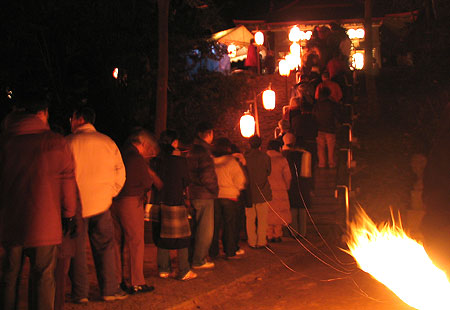
In the image above, people line up to ring the bell and pray; the line winds down the stairs all the way to the bottom. This year, I got there at 11:15 and was surprised to find that I had gotten there before anyone else. Even after waiting for 20 minutes (and getting the very first cup of sake to be served from the barrel), I was still first in line–after the band players, who all got to cut to be first in line.

2007Ny-02

2007Ny-03

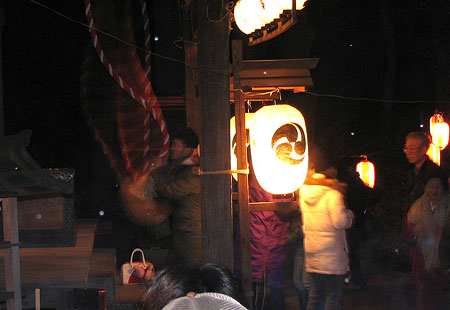
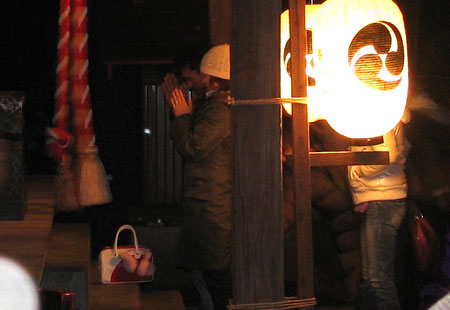
You shake the rope, you clap twice (optional), and you pray. It’s not a big religious thing.

2007Ny-04

I caught one of the fireworks on film, with embers from the bonfires rising to meet the burst.

2007Ny-05

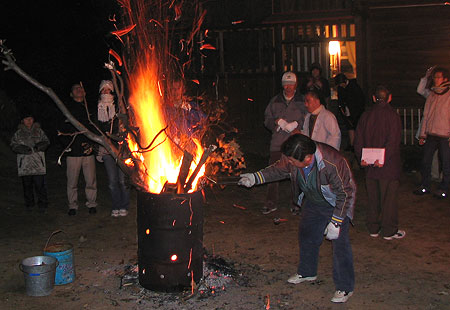
Bonfires are maintained partly to provide warmth (it’s cold!), and to allow you to burn the old stuff you bought the year before, like the wooden arrow I always buy.

2007Ny-06

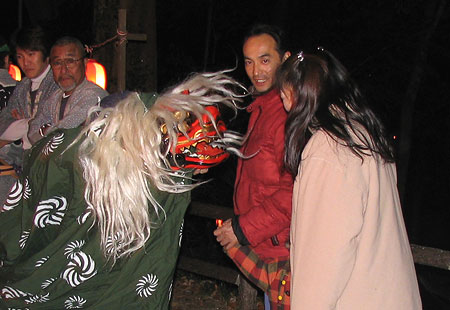
The shi-shi-mai dance; someone inside the big lion’s head goes around to visitors at the shrine. They approach a visitor, who then bows their head. The lion’s head opens, and touches the visitor’s head for a few moments, then the dancer pulls away, bobs up and down and claps the jaws a few times. This is supposed to frighten away the evil spirits about you. It also scares the heck out of half the kids at the shrine, some who go running and screaming.

2007Ny-07

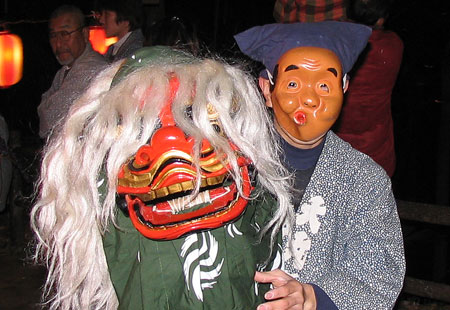
In this case, a hyottoko doubled as the shi-shi-mai dancer. “Hyottoko” is actually “hi otoko,” or “fire man; supposedly, the distorted face comes from blowing through a straw to stoke a flame.

2007Ny-08

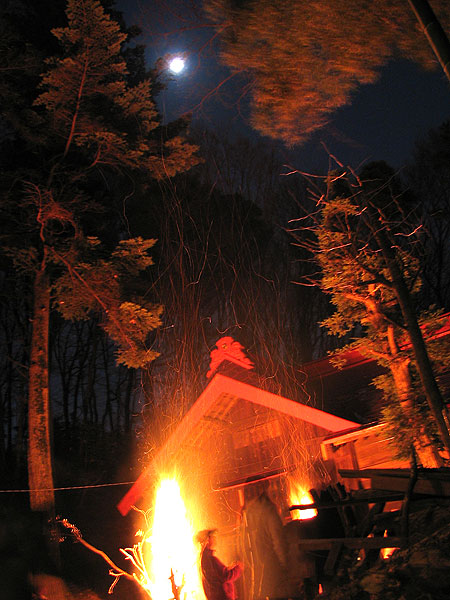
Finally, a nice time-lapse photo showing the scene from the bonfire at bottom to the moon above the shrine and the tall trees.

Happy New Year!

Categories: Focus on Japan 2007 Tags:

Japan and Nukes

December 25th, 2006 Comments off

This story out recently:

The Japanese government recently looked into the possibility of developing nuclear warhead, a news report said Monday, citing an internal government document. …

The Japanese daily Sankei reported that experts affiliated with the government estimated that it will take at least three to five years for Japan to make a prototype nuclear warhead.

The experts also estimated that Japan would need to spend about 200 billion yen ($1.68 billion) to 300 billion yen ($2.52 billion) and mobilize several hundred engineers to produce a prototype nuclear warhead, according to Sankei.

The interesting thing here is that Japan is claiming that it would take three to five years to develop a nuke, after spending tons of money and employing “several hundred engineers.” This when Japan has been pretty much universally recognized as being within one year of producing a nuke; this Federation of American Scientists’ report from 1998 is perhaps a pretty solid source:

Japan’s extensive nuclear industry contains tons of already separated reactor-grade plutonium, which could be used for nuclear weapons. Within a year of deciding to develop a nuclear weapon, Japan could acquire the weapons materials and a workable design by drawing upon available unclassified information and its technical expertise.

So, what does the difference in the report mean? Were international estimates too high, overestimating Japan’s ability to fabricate a nuclear weapon? Or perhaps there is a difference in the type of nuclear weapons capability each estimate was measuring, with the FAS report guessing at the time to produce one nuke and the internal Japanese report estimating how long it would take to build a minimal arsenal? Maybe the Japanese study overestimates the time and effort needed due to bureaucratic or engineering standards that call for such so that actual performance can exceed expectations. Or, perhaps, the report is simply a fake or hoax of some sort.

However, the probable truth is that the report is real; Japan, after all, has been making various noises recently about a nuclear weapons program in response to North Korea’s own program. And, one has to admit, even if Japan is dead against building nukes, it would only be a reasonable, rational move to at least study what is or is not possible, just to have the information on hand in case things change. After all, it is not inconceivable that Japan and America could have a falling-out and North Korea could become much more overtly threatening in any number of ways; in such a case, Japan would have a real reason to consider nukes.

The worry, however, is not just that Japan might develop nukes (which itself would be enough of a worry, if for no other consideration than how other nations in the region would react), but that a nationalistic government of Japan were to have nukes along with a resurgent desire to assert itself militarily–something which also is not inconceivable.

Categories: Focus on Japan 2006 Tags:

Yes, But

December 19th, 2006 2 comments

I tend to challenge statements that I encounter, and that sometimes gets me into trouble. If someone makes a statement and there is a possible alternate view, I have a tendency to blurt out the alternate view, even if I don’t agree with it or have no stance on the issue myself. This sometimes makes people think I disagree with them when I really do not. One example might be the atomic bombing of Hiroshima and Nagasaki; if an American says they were necessary, I challenge that; if a Japanese says they were criminal, I challenge that, too. Probably because both sides deserve challenging, mostly because of who is saying it. If an American said that the bombings were a crime, or a Japanese said that they were necessary, I probably would be less inclined to challenge either one–probably because the statements would sound much less self-serving.

I just came across this news story:

NAGASAKI — The policy chief of Japan’s ruling Liberal Democratic Party, Shoichi Nakagawa, on Sunday called the U.S. atomic bombing of Nagasaki in 1945 a “crime” that was impermissible from a humanitarian viewpoint.

In a speech given in the city of Nagasaki, Nakagawa said, “The U.S. decision to drop such a thing was truly impermissible on humanitarian grounds…Atomic bombings are a crime,” referring to the Aug 9, 1945 bombing of the city three days after an atom bomb was dropped on Hiroshima. [no link due to the site’s ephemeral nature]

My immediate response? I would want to ask this person if he was aware that during WWII, Japan had not one but two atomic weapons programs. And how come that never comes up when a Japanese politician is speaking out against the evils of atomic weapons? Yes, some might think that it would give the politician less moral standing to make a claim of outrage. But in my opinion, stating such a thing would give him much more more standing to make such a claim. However, somehow I don’t think that this is the kind of moral statement that Nakagawa was thinking about, considering that he has recently suggested that perhaps Japan should consider arming itself with nuclear weapons.

And that’s where I start to worry a bit about statements like the one Nakagawa made about the U.S. bombings being a crime. Within the context of his other recent statements, it could be building to something less than encouraging. “It’s a country’s right to protect itself,” Nakagawa said about a month ago. “Of course we need to examine all options, including missile defense.” The “all options” bit is further worrying.

OK, so perhaps Nakagawa is simply raising the nuclear specter in order to put a few bargaining chips on the table for Japan, maybe to rattle the North Koreans a bit. For all I know, Nakagawa might be stridently anti-nuclear. But the things he has said are too close to what I would classify as ‘pulling a reverse-Santayana.’ I opined on the dangers here, but in short, if a nation forgets the bad things it did and focuses on its own victimhood, then starts saying that it has special standing to defend itself in light of that victimhood–it’s time to start watching out for armbands.

Within the context of moral superiority, the claim of Hiroshima and Nagasaki being crimes falls a bit flat due to Japan’s own atomic programs, and the rather inescapable fact that had Japan developed nukes first, there would have been no hesitation or remorse in using them first. Remembering that about yourself and your people is far more a claim to moral standing than is the claim of victimhood.

Categories: Focus on Japan 2006 Tags:

What Is With These Prices?

December 13th, 2006 4 comments

I am currently looking at getting a new camcorder, but was discouraged in Japan as the cheapest acceptable model cost 50,000 yen (about $430). That made a $200~$250 repair of my old camera look like a possible alternative. But then I looked at prices in the U.S.; I had forgotten the usual divide in prices, and sure enough, acceptable camcorders start at around $220.

So, what the heck is with the price differential? Look at this camera: the JVC GR-D350, on sale at Amazon.com for $250, but the exact same model is sold at Yodobashi.com for ¥49,800 ($425), fully 70% more expensive than the same model on sale in America.

I noticed this effect long ago. On my first trip to Japan, I wanted to buy a Nikon SLR camera. Fortunately, I had priced them in San Jose before I went, and so realized that they were a lot cheaper in the U.S. My Canon S1-IS was priced at $320 in the U.S., and $510 in Japan (60% more expensive). Prices for Apple goods in Japan seem to be more moderately jacked up, only about 5~10% higher than U.S. prices. But most consumer electronics have this massive difference in cost between Japan and the U.S.

Anyone know why?

Categories: Focus on Japan 2006 Tags:

It’s the Simple Things

November 22nd, 2006 3 comments

In Japanese homes, centralized heating does not exist. It simply isn’t done. Instead, there are a variety of heating methods that take the place of what we in the West take for granted.

The traditional (in a modern sense) Japanese way to keep everybody warm is the kotatsu, a table with a heating element underneath it. The kotatsu is a low table, maybe only 18 inches off the floor (taller kotatsu are sold, but the low ones are the most common). The top comes off to show the frame with the heating unit; place a comforter over it, and put the tabletop back on–and presto, you have a nice heated table.

Kotatsu-Yodo2

Kotatsu-Yodo

People sit around the table with their legs underneath to keep them warm. Usually, there are seats with no legs–just a chair seat and seat back–which keep everyone sitting comfortably that close to the ground. And not just humans enjoy it:

Catatsu

Now, put a bowl of mikan (mandarin oranges) on the table and you’ve got classic Japonica.

For some reason, I’ve never been too enamored of the kotatsu. I used to have one, twenty years ago, back in Toyama, but I don’t think I’ve had one since. It’s nice and all, but it doesn’t heat your upper body, and I tend to move around the apartment–and the kotatsu is only good for keeping your legs warn when you’re sitting.

One alternative I used back in Toyama was the kerosene stove heater. Every so often, a kerosene seller comes around and you can fill up your red plastic kerosene container; using a special plastic pump, you can siphon the fuel into the heater, and fire it up to warm up the room. Often there’s a space on top to put a tea kettle or anything else you want to warm up. The down side: it’s a pain to fuel, and smells kinda bad, too. And I hate the tunes (wav file) the trucks play when they come around.

Here in Tokyo, a lot of people use their reidanbo–literally, a “cooler-heater,” or an air conditioner with a heating unit installed. They are virtually ubiquitous in Japan; I have two, in fact. Many apartments come with them pre-installed (not my place, though). I’ll sometimes use this, but it uses tons of electricity, and is not an cost-effective way to heat the house.

Reidanbo

The remaining way is, in my opinion, the best: using natural gas piped into the house to fuel gas heaters. I used to use the kind that simply light up heating elements, like four book-sized orange-glowing panels behind a sparse metal grill. This is called a “gas stove”:

Gasstove

The problem with these, however, is that they don’t circulate the heat very effectively. So the ultimate heating unit is called a “gas fan heater,” a heater which uses a nice fan to blow the warm air a good distance so it fans out. I’ve had one for some time, but it’s a huge, old, used unit which tends to cut out the heating part while the fan stays on, just blowing cold air around. So I broke down and went out and bought a new unit–last year’s model, on sale for $200.

Gasfanheater

It’s a nice unit–has a sleep and wake-up feature that shuts down and turns on the fan by a timer, but the feature I like is the thermostat, which automatically turns the unit down to a very low setting once a certain temp has been reached. And when on high, it heats up my big room fast.

And yes, I know that I can wear a sweater. Call me jaded.

Categories: Focus on Japan 2006 Tags:

Ruminations on an Early Morning Mall Walk

November 19th, 2006 Comments off

I walked Sachi to the station this morning before going off to do some birdwatching (next post), and on the way back, snapped some photos of the pre-business mall walk. This is an upscale area just out of Meguro.

Pachinko-Opening

This one I’m not sure I figured out. It’s twenty people lined up to get into a pachinko parlor/game center, at maybe 8:15 am. Was there some special new game that gets 20 forty- and fifty-somethings up before eight a.m. on Sunday morning? Or do they do this every week? Note the mini-chairs many are using.

Bluelagoon

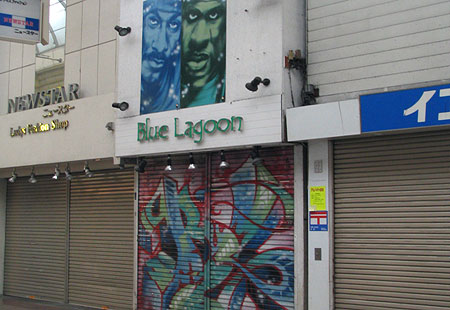
This shop is interesting as it’s not some Japanese faux-American rapster joint or something–it’s a clothing shop and the proprietor is an African-American man, as I’ve observed while passing by during business hours. Not something you’d expect to see on an upscale Japanese walk-and-shop mall. I wonder if he has local shoppers coming in all the time and then seeing him and slooowly backing out…

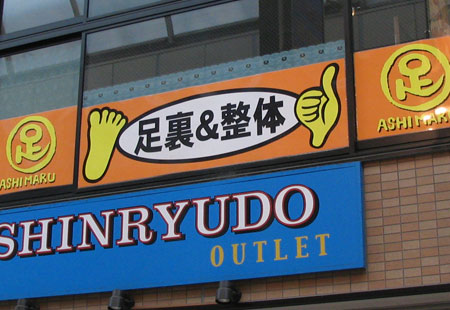
Footcircle

And this is a chiropractor’s sign. They got the foot OK, but what the heck is with the hand? Is that a hand? If not, then what the heck is it?

Categories: Focus on Japan Miscellaneous Tags:

Why Can’t They Just Leave Us Alone?

November 11th, 2006 4 comments

One of the down sides to living in Japan is the loudspeaker trucks–as you know well if you are a long-time reader of this blog. True, we don’t get robo-calls during an election, and I admit that this could be worse than loudspeaker trucks. But only marginally. At least you can avoid the robo-calls by leaving your house.

My location has turned out to be pretty bad, in fact: there is a spot on the road just outside my building which all the loudspeaker trucks favor as a staging area for long rants and raves. They’ll stop there, deploy their banner-toting crew, and do their schtick for ten, twenty, or even thirty minutes at a go. During heavy election season campaigning, we sometimes get one or two of these every day. The are, of course, scheduled for times when the most people are at home trying to relax in peace and quiet.

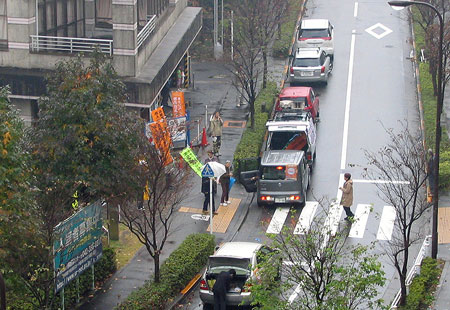
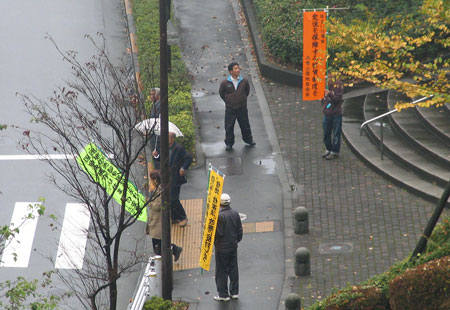
There seems to be an election on right now; I haven’t heard of this in the news, but I sure can hear the loudspeaker trucks. Yesterday, as I tried to teach a lesson, no fewer than three trucks drove past the school, almost drowning out my lecture. As for the people pictured below, I honestly can’t say whether they are a political campaign (I couldn’t see the side of the truck where a candidate’s name would usually be plastered, though the lack of a name on all sides is a hint they may not be campaigning for a particular candidate). All I know is that this is an election season of some sort, and these people blared away for 15 minutes as I tried to do my morning blog-reading.

1106-Caravan1
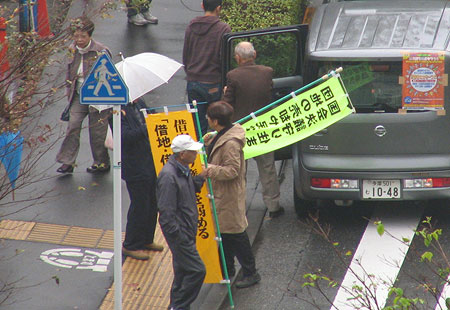
The caravan parks and begins to unpack their wares; the speakers waste no time, shouting their message from the moment they arrive

1106-Caravan3
Getting the banners out

1106-Caravan2
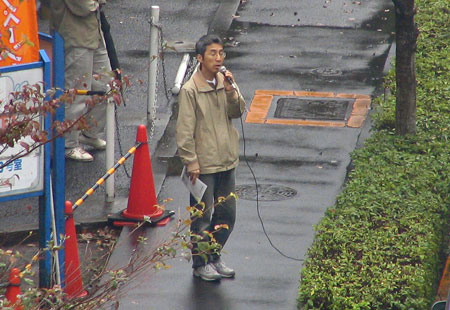
The first of several speakers

1106-Caravan4
The Banner Brigade, fully deployed

Two weeks ago, I caught some audio of a guy with a loudspeaker truck; the audio is here (800KB wav file). This guy was on an anti-American kick, and at one point even shouted, “America dai-kirai!!” (“I despise America!!”) The significant thing about this audio was that I never actually saw the guy or his truck–when he made this speech, he was at the very least a few hundred meters away, maybe more. And yet I could hear him blasting away with my windows closed.

Categories: Focus on Japan Miscellaneous Tags:

Arts Day 2006, Part 2

November 2nd, 2006 Comments off

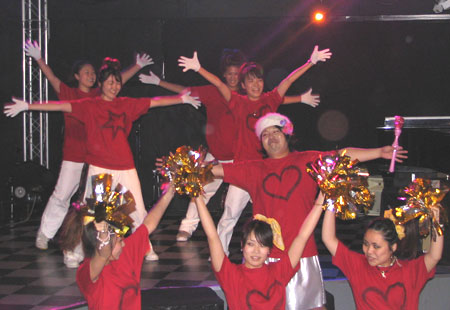
In the second half of the show, we’ve had some dance groups, who have been pretty good–impressive for kids who don’t do this much.

06Ad9
“OK,” a cheerleading-style dance group (with one odd member…)

06Ad10
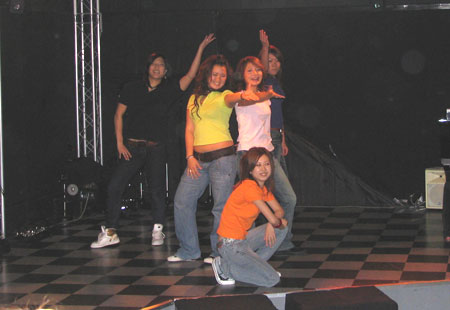
The first set of “Studio B,” a 9-person dance team

06Ad8
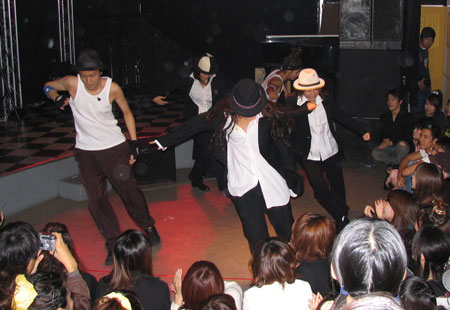
Studio B did several sets, with costume changes for each one

06Ad12
The Drama Club put on a performance

06Ad11
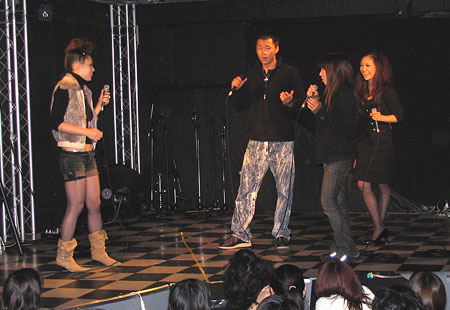
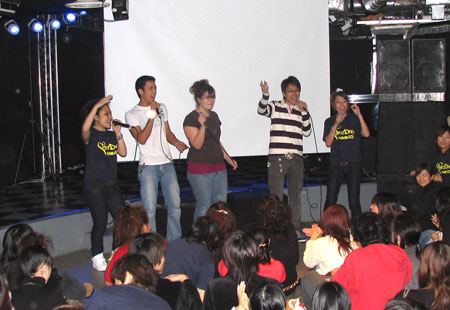
…and finally, “Voices of America / Japan” did some singing for us.

Categories: Focus on Japan Miscellaneous Tags: