Archive

Archive for the ‘Focus on Japan’ Category

Live from Takanoya, It’s Arts Day 2006

November 2nd, 2006 Comments off

Every year, my college has an Arts festival in early November. It’s a 4-day weekend for the school (tomorrow is Culture Day), and so we celebrate by getting many of the students to show off their talents by singing, dancing, and performing in various arts media. My own contribution is to edit together a 15~20-minute video to start off the festival; this was the 4th consecutive year I’ve done this.

I am blogging this live from the (appropriately named) “live house” where we hold the festival; for some reason, they have a high-speed Wi-Fi node here, so I can blog as the festival progresses. I won’t do too much, but perhaps a few times I’ll give an update on what’s going on.

06Ad2
The video featured a parody of the TV show “24” along with some other musical bits

06Ad3
The first group, “Mediterranean”

06Ad4
Roger & Friends–this friend is Miyuki, a very talented student and a great singer

06Ad5
Roger & his other friend, Masa

06Ad6
Masa going solo

06Ad7

06Ad1
My setup for showing the video

More later…

Categories: Focus on Japan 2006 Tags:

Nutritional Information in Japan, or the Lack Thereof

October 29th, 2006 4 comments

One thing that you miss quite a bit if you come from America to live in Japan is the more detailed nutritional information on food packaging. This is where that dreaded “big government” massively interferes with poor American businesses in ways conservatives hate–but which most Americans very much prefer, even if they do take it for granted most of the time.

Here in Japan, nutritional information on food packaging is spotty at best. I still haven’t figured out why some foods have the information and some do not (is it entirely voluntary?). I think there is at least a requirement to list ingredients. Many foods do have limited nutritional information, in a small table on the back or side of the product, which lists:

エネルギー • “energy,” or calories
たんぱく質 • “tampaku-shitsu,” or protein
脂質 • “shishitsu,” or fats
炭水化物 • “tansui kabutsu,” or carbohydrates, and
ナトリウム • “natorium,” or sodium.

And that’s it. No information on the fats (how much is transfat, saturated fat, etc.), no information on fiber, cholesterol, or most vitamins and minerals–unless the producer wants to advertise them. And even then, it’s a matter of simple readings in grams–no “daily recommended allowance.” If you’re not used to thinking about how much of each dietary element you need in grams per day, then you’re outta luck.

That’s why I was so surprised to see this on the back of a bag of lightly salted cashews that I bought recently:

Cashews1

Not only did it give a longer list of nutrients, but it also gave a bar graph of the nutrients as part of a DRA calculation. That startled me, and encouraged me as I thought that this might be a new thing I’d see a lot more of in Japan.

Then I knew those were false hopes when I looked down below and saw the maker:

Cashews2

…Which means that it’s a purely voluntary carry-over from the U.S. which will probably not be followed by anyone else in Japan. Ah well.

Before I leave this topic, there is one pet peeve I’d like to unload, and if you’re an American living in Japan, you’ll probably share it. When American goods are imported to Japan, the Japanese government requires a Japanese-style ingredients sticker be affixed to the package. This is all good and well. What peeves me is where they affix the sticker: almost universally, they put the Japanese sticker right on top of the English-language USRDA label on the package, completely obscuring the far more complete nutritional information. This is done even when there is plenty of blank space elsewhere to put the sticker. And the sticker is almost always impossible to peel off in a way that reveals the original information.

I have this problem at Costco in Japan all the time. I’ve complained about it, and they always agree that I am completely right, but apparently it is done by the shippers, who presumably would rather their customers not be turned off by that damning evidence–why list something you don’t want people to see when it’s so easy to cover up?


Postscript: “Natorium”?

Categories: Focus on Japan 2006 Tags:

Construction Mannequin

October 27th, 2006 8 comments

Perhaps one of the most visible jobs one could have in Japan is the person who works at a construction site, waving traffic along with a flag or a flashlight cone. I’m not talking about the kind where they direct traffic, but rather the kind which simply stand in front of the traffic cones and work crews and gesture traffic to the other lane. That particular job tends to stand out for two reasons: first, you almost automatically imagine how easy and yet mind-numbingly boring and unrewarding such a job must be, and second, because 95% of the time, the position seems utterly unnecessary.

Now, there are some situations in which a person standing there controlling traffic is vital–like when the road construction is right around a sharp bend in the street, and you wouldn’t see it until it were too late. But most of the time, you can see the construction cones and heavy machinery from a mile away, and the person standing there waving you to avoid hitting them seems completely lame. But you gotta figure there’s a law that requires it.

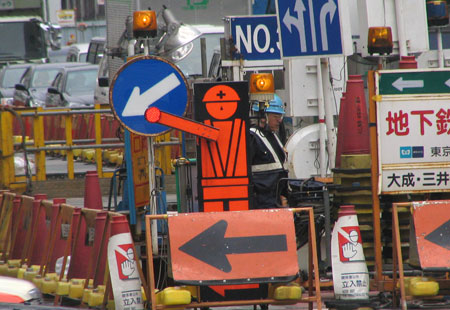
Fairly often, you’ll encounter a site which is using a mechanical signaler–usually a simple stylized-figure cutout with a mechanical waving arm with a light on the end of it, as in the photo below. Nothing to write home about.

Const-Cutout

But once in a rare while you’ll see a rather interesting sight: a mechanical dummy, complete with arms that goes up and down, with a flag in hand. Talk about having your job taken over by a machine… but when your job is so completely simple and mechanical in the first place, one should pretty much expect to have a simple motor take over the position.

Constman-450
Click for larger image

The funny thing about this particular dummy was that the flag he’s waving had to be strapped onto the end of his arm–apparently, it’s not set up to hold one normally.

Constman2-450

Nor are these mannequins unique to construction sites. One sometimes sees fake policemen as well. Back in my touring days, when I drove across Japan on a motorcycle, I would see both cutout photographs of policemen and mannequins dressed up as cops placed in strategic locations on roads to try to fool drivers into slowing down. Sometimes they were very realistic, but sometimes they were laughable, including one mannequin who was clearly strapped to a pole–it looked like he was both frozen absolutely rigid and tied up by a kidnapper or something.

Categories: Focus on Japan Miscellaneous Tags:

Halloween? Probably Not

October 11th, 2006 2 comments

As I went shopping at the local supermarket today, I saw something that I hadn’t seen before in Japan: a substantial Halloween display.

1006-Halloween1

1006-Halloween2

Halloween has never been a holiday of note in Japan. I have never seen trick-or-treaters, and outside of some communities with heavy American populations, I don’t think there has been any in Japan.

Not that this display suggests will will be any costumed kids. Yes, the Kit-Kats on sale are bags of the mini-bite-sized variety one stocks up on for costumed visitors, but note the rest: pre-packaged candy boxes, already full. Likely this is just like many other imported holidays in Japan: a commercial excuse for sales. A gimmick, in short.

As my sister-in-law noted in her blog recently (and I noted three years ago), Christmas is done much the same way in Japan. While a few people have taken to putting up Christmas lights (even the local hilltop tower is lit up), people in Japan generally don’t get a Christmas tree, don’t exchange presents (not for Christmas, anyway), and don’t decide whether to unwrap gifts Christmas Eve or Christmas morning. But a lot of “Christmas cakes” are sold, along with foam-cast stockings/boots filled with candy–very much indeed like some of the candy items shown in the photos above.

At least Christmas in Japan has some odd angles to it–for example, it’s considered “the thing to do” for men to take their girlfriends out to expensive restaurants and them for them to spend the night at a love hotel. And–god knows why–Kentucky Fried Chicken is the dinner of choice for huge numbers of people, to the extent that you have to wait hours to get an order filled. How that got to be a popular pastime is beyond me.

So far, all I’ve seen of Halloween outside of novelty shops in Japan is what you see above–but it was a bit of a shock to see. Kind of like, the confection companies of Japan, wanting another payoff holiday like Valentine’s Day (women give chocolate to men), White Day (a domestically contrived ‘holiday’ acting as kind of a ‘reverse’ Valentine’s day, where men give cookies and other baked goods to women), and Christmas (cakes and candies), have suddenly decided to push Halloween in Japan as well, hoping it’ll take.

I didn’t see many people buying. I’ll have to ask around to see if it’s catching on.

Categories: Focus on Japan 2006 Tags:

Turning Japanese

October 3rd, 2006 4 comments

Have you ever heard the song Turning Japanese? At the beginning, there’s a bit of an “oriental riff,” something that Americans might associate with Japan, as the musicians obviously did.

Interestingly, Japanese people are familiar with the little melody as well–but they associate it with China, not Japan. One of my students tells me that it’s played in a Chinese cooking TV show.

Categories: Focus on Japan 2006 Tags:

Escalated Shrine

October 2nd, 2006 1 comment

We tend to think of shrines and temples in Asian countries as being places that encourage discipline and hard work. It is not atypical to envision a temple or shrine atop a mountain with a ten-thousand-step staircase leading up to it, making it so that only the most dedicated worshipers make it to the sacred ground.

In reality, it’s not like that in Japan, at least not typically. Many shrines in fact are at the top of a few flights of stairs, but it’s usually not quite as challenging as the stereotypes make out.

Nevertheless, when I visited the shrine at Tameike-sanno in central Tokyo yesterday with Sachi, I saw something I did not at all expect: escalators leading up to the shrine! Three of them, no less–two large ones, and then a smaller one at the top (you can just see the second big escalator above the staircase at center). Vehicular access was at the rear.

Tameikesanno-Esc

The traditional-shrine/modern-artifact contrasts didn’t end there, however–once you get into the shrine’s courtyard, you are immediately reminded of the shrine’s location (Akasaka district, neat the US embassy and lots of big businesses), as seen in the photo below, with the Prudential Building looming in the background.

Sanno-Prud

The final surprise came when Sachi and I went to offer prayers at the front of the shrine. I saw something I had never seen before: a wedding in progress, right inside the shrine, clearly visible to anyone and everyone who came up to throw in coins, shake the thick rope with the big bell on top, clap their hands twice, and then pray. On the pretext of taking a photo of Sachi praying, I got this in the photo, cropped to show detail.

Sanno-Wedding

Pretty cool, actually. Just surprising to me.

Categories: Focus on Japan 2006 Tags:

Somebody Noticed

September 28th, 2006 1 comment

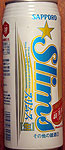
About a year and a half ago, I blogged on a new Sapporo Beer product called “Slims,” which bore the motto, “The new type of tasty draft brew. More flavor, with fewer less calories.”

Well, somebody noticed the error, apparently. The new can now reads:

It is true, the brew is no longer new. Also, it seems, with not as much flavor.

You see this kind of thing all over Japan, of course. Sometimes it’s really good (like the “off sale” signs, or the misspelled “in” sign I saw), but more often it takes the form of very mildly off-kilter English, like with these items:

Noped

Dream-In

Not especially funny, but certainly strange enough to remind you that you’re in a country where English is not the native language.

And then there are some errors that you have to look at carefully to see, like with this bite-sized cheese snack:

Desertcheese

From camels, perhaps?

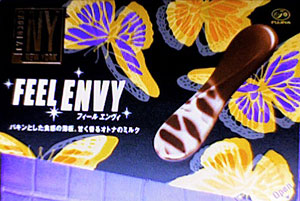
And then, there’s the just plain goofy names they think up, like for this chocolate snack:

Feelenvy

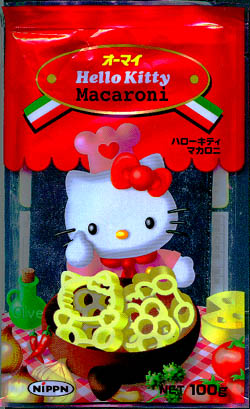
And yes, I know that on this package of Hello Kitty Macaroni, that Kitty is supposed to be giving the thumbs-up. However, from the first time I saw it, it really, really looked to me like she was giving everyone the finger.

Kittybird

Food for thought.

Public Classics

September 14th, 2006 3 comments

DVDs in Japan cost considerably more than in the U.S. New releases of DVDs in America generally cost around $20; in Japan, the same movies go for $30. For example, current releases of V for Vendetta, Poseidon, and The Da Vinci Code all sell for about $30 at Amazon Japan, while the same titles sell for $20 at Amazon U.S.–except for The Da Vinci Code, which sells for $15.

This is one of the main reasons why I buy my DVDs from the U.S., and use a region-free player (or the Region 1 player I lugged here from the U.S.)–because U.S. releases are so much cheaper, in addition to having earlier release dates. Generally, much earlier–the latest X-Men movie is just out in Japanese theaters, while the U.S. DVD is on sale soon. Often, summer Disney titles go on sale by Christmas, just as they are opening in Japan.

This of course, is why they have region encoding in the first place: to keep people from benefitting from different marketing plans.

500Dvd2But there is a strange hole in this: if you want to buy the DVD for Gone with the Wind in the U.S., it costs $20. In Japan, the same movie costs $5–or more precisely, ¥500.

Same with Casablanca–$20 in America, the same movie is $5 in Japan. The same deal applies to movies like King Kong, The African Queen, Arsenic and Old Lace, The Treasure of the Sierra Madre, It’s a Wonderful Life, The Wizard of Oz, and more. The DVDs are “all-region,” and come with English and Japanese subtitles (which can be turned off).

So how did that happen? Well, it has to do with copyright law and a court case. As part of corporations’ quest to become legally immortal super-human beings with endless ownership rights, they have been lobbying to indefinitely extend copyright protections. Previously, copyright protection for films was 50 years; in 2004, it was extended another 20 years. However, a recent court case decided that, in Japan at least, the 20-year extension was not retroactive. So a movie made in 1954 will stay protected until 2024. But a movie made in 1953 is now in the public domain.

500Dvd1I reported on this a few months back when I heard about the case, but it was just last week when I finally saw the DVDs on sale. I picked up Gone with the Wind, Notorious, Roman Holiday, Citizen Kane, The Third Man, and To Kill a Mockingbird for ¥3000, sales tax included–about $26, actually, at today’s rates. Six movies for less than any one of them would cost “legitimately.”

This in part reveals the actual production costs for DVDs–or even more sharply, the recent decision by Warner Home Video to start selling their movie titles in China for just $2.65. Although that is to compete with the widespread $1 pirate DVD market, you know that Warner wouldn’t be selling at that price unless they were making even a small amount of money from them.

Meanwhile, back in Japan, we can enjoy some good classics for a still comfortable price. You can see the on-line catalog here; to see categories of specific movies, click the links after the English words “PICK UP” near the top left. (By the way, you can see they made the web page using Adobe GoLive 6–check out the web page title. Think it was a pirated version?)

They’re only selling 140 titles now, but there should be more than 140 good ones made before ’54. Alas, movies like The Man Who Knew Too Much (the Jimmy Stewart/Doris Day version) won’t go on sale for another two decades.

Categories: Focus on Japan 2006 Tags:

Barriers, Physical and Otherwise

September 10th, 2006 2 comments

I went to a barbecue party with people from work yesterday (great party, lots of fun), and to get there, I took the train and had four transfers–quite a few escalators and staircases along the way. Not to mention a few new train lines. One of them was the Tsukuba Express Line, which had an interesting feature common to most new train lines: a platform guard wall, pictured below.

0909-Tranbarr2

0909-Tranbarr1

When the train stops, the gate doors open with the train doors. Japanese trains have always stopped at exact locations relative to the platforms (locations marked on the floor of the platforms for waiting passengers to line up at), which is necessary anyway for this to work.

Considering the tendency of many Japanese suicides to use jumping off railroad platforms as a tool for demise, this seems a prudent measure–though I suppose someone determined enough, and in good enough shape, could easily vault the fence anyway. However, this being Japan, I wouldn’t be too surprised if even suicides decided that it would be too uncouth to do so.

One other feature of the train line is, from what I could determine without my computer along to test it, is an on-train wireless Internet connection. Most of the articles I read seemed a bit unclear about whether it was free or not, but a few said it was only available to DoCoMo users. Still, it seems a new thing, and if it spreads and is opened up to anyone for free, it’d be a big new reason to take the train–if you can get a seat, of course.

Right now, however, I don’t take the train much for a few different reasons. First, I have never been comfortable with the sanitation of being crammed together in those cars with so many people with god alone knows what viruses and so forth. I’d wear a surgical mask, but they don’t make one here that works effectively with a nose as big as mine, not that I think it’d make that much of a difference. And on cold days, one can see the windows not just fogged, but dripping with precipitation–which, when one considers it, is really saliva exhaled in mist form from all the passengers on the train, dripping down the sides of all the glass surfaces. Ewww.

Second, there’s the footwork involved. I live in a place where I have to walk five minutes to a bus station, then take a seven minute ride to the train station, then walk for about 400 meters up and down several levels to transfer to the subway line to get to my school, and then walk from the station. The wait between the bus and the train is usually long, as the bus arrives at the station just as the every-20-minutes express train leaves; it’s a choice between taking the local and transferring to a crowded express halfway there, or waiting almost 20 minutes for an express I can sit down on. Coming home, I can get a seat–if I am willing to stand in line an extra 10-15 minutes to get on a subsequent train.

Relative to that, taking my scooter has too many advantages to give it up. A guaranteed seat, door-to-door transport, and taking into consideration the walking, buses, and transfers, it’s actually quite a bit faster than taking the train. Disadvantages include inclement weather (though the scooter is lovely in hot weather), and the dangers of driving in Tokyo. But for the time being, at least, I’ll take the bike. At 35 kpl (83 mpg), gas doesn’t cost too much–but then there’s one last disincentive: my school only reimburses travel by train and bus. Despite it being cheaper by about half, even with wear-and-tear costs factored in, they don’t pick up that particular tab. Ah well. Who said life was perfect?

Categories: Focus on Japan 2006 Tags:

“Flange”?

September 9th, 2006 4 comments

This story in the Mainichi Daily is a bit of a curious one, about a film coming to Japan where for a brief moment, female genitalia are visible. The story, titled “Film That Dares to Flash the Flange All in the Name of Art,” describes the offensive film and the fact that Japan’s censors are letting it slip by–as, so the story says, they let male genitalia appear on screen in Kinsey. (And, I observed, they let the same go uncensored in Schindler’s List on cable TV.) This time it’s an Austrian film about artist Gustav Klimt, which otherwise would have passed by unnoticed in small art theaters here.

A lot of people in Western countries assume that Japan and the Japanese are pretty blase about nudity, with the whole “nudity is often seen but never looked at” idea. Japan lacks privacy, as Mariko-san said in Shogun, and so nudity is not something Japanese mind so much.

Ha! Maybe in pre-Meiji Japan, or maybe even pre-WWII, but that is sure as hell not the case today. Modern Japan has kind of strange takes on nudity, probably a mix of Japanese mores and conservative censorship imposed by the US military during the occupation.

I remember the first time I visited Japan, back in 1983, and my tour group was in a countryside inn. The group leader told us that if we felt adventurous, we could all go together to the local bath house. Clearly everyone expected mix bathing, but when we arrived, to our collective disappointment and relief, it was a segregated bath–something which is very much the norm in Japan. Mixed bathing is rarely found in this country, mostly infrequent cases in the deep countryside, and is probably more common in California than it is in Japan. And even in segregated baths, people still carry small cloths which have little other purpose than to act as a fig leaf.

Outside of bath houses, nudity is not seen in public very much at all in Japan. One might see a flash now and again in terms of imagery, like in a manga cartoon book read by an oyaji (old guy) on a train, or in a poster outside a porn theater. Other than that, it tends to be restricted to pornographic materials. You certainly don’t see even a suggestion of private parts in public. Women always wear bras with sufficient padding so that nipples never stand out. On the beach, women almost always wear one-piece bathing suits, and I’ve never heard of a nude beach in Japan (though they might exist). In fact, you never even see shirtless men in Japan outside of beaches and swimming pools–or the odd festival where men might even wear fundoshi. Japan can be very puritanical in regards to clothing.

Pornography tends to strange contrasts here, on the other hand. The subject matter can get wild very easily (I’d rather not get into details), but because of the laws, genitalia cannot be shown. In fact, even pubic hair is usually covered with digital mosaics, though maybe a decade ago censorship laws relaxed enough to make showing “artistic” pubic hair legal, creating a boom of “hair nudes.”

There has also been a more conservative trend in terms of nudity on television. Back in the 80’s and early 90’s, nudity was pretty rampant on TV. Late-night shows featuring nudity were common, and by channel-skipping after 11:00 at night, one could almost always find some T&A going on. Um, so I heard. It was always very careful to restrict the view to boobs and bums, but it was common. One could even see the occasional women’s bath scene on daytime TV. Today, the trend is definitely away from that. Nudity on television is much more scarce, for reasons I do not understand.

So the next time you hear someone sagely explaining about how Japanese are nonchalant about nakedness, bring them up to date.

Categories: Focus on Japan 2006 Tags:

Up to 6 Now

September 6th, 2006 2 comments

A year and a half ago I blogged on how doctors in Japan tend to over-prescribe through reflex, and how they would almost impulsively give you a pill, a capsule, and a powder for almost any ailment. Well, they seem to have graduated from three medicines to six. Just the other day a coworker of mine complained that she had been given six different nostrums by her doctor, which seemed excessive to her. And today I just got hit by the same outcome.

I went to see the doctor about stomach pains and other related ailments, and was diagnosed with gastritis and a cold. The prescription? One capsule, two kinds of pills, and three kinds of powders–one of the powders being a mix of three different medicines, actually. I’m hardly a doctor, but that seems way excessive to me. They include an antibiotic, two medicines for fever and pain (of which I only have slight indications), two stomach medicines, and one for general symptoms apparently. I’m tempted to just leave the whole thing behind and simply live out the illness naturally.

And I hate the powders. Gotta put them in your mouth dry, then wash them down with water, and they almost always leave a residue in your mouth that the water can’t wash away, and it tastes horrible.

Categories: Focus on Japan 2006 Tags:

Snapshot

September 1st, 2006 3 comments

I’m not talking about a photographic snapshot (though I wish I’d had my camera), but the snapshot you see of someone else where you wonder where they came from and what will happen to them. People you just see on the street, passing by, and never see again. You see them for a moment, like a snapshot, and that’s it.

I had one of those moments today as I drove back home from work. It’s a rainy day here, and I was going down Route 20 outside of Shinjuku. And by the side of the road, I see a hitchhiker.

That alone is unusual. In all my years in Japan, I cannot recall having seen one before. And knowing Japan as I do, I know that a Japanese person would almost certainly not be doing this; even before I can make out the person’s face, I know it has to be a foreigner–and so it was. A youngish man with short brown hair. He’s standing under an umbrella with a few traveling bags at his side, and he’s holding up a small piece of cardboard (maybe a foot and a half across). The cardboard has a simple drawing of a mountain, and below that, the single word “FUJI.”

And that kind of makes me wonder what this guy is about. Obviously a tourist, is he just going to visit the Fuji area, or does he intend to climb? Does he have any idea what climbing Fuji entails? Or is he aware that the Fuji-climbing season is July and August, and he’s just missed out on the time when the main trails are open? After August 28, the mountain is climbable, but few buses go up to the starting point at the 5th station halfway up the slope, and above that point, the huts and other support facilities are now closed.

Having climbed Fuji before myself (three times–and I just realized that I never blogged on this), and long ago having been a newbie tourist alone in Japan, I can sympathize with this guy, and keep wondering what will become of him. Is he so adventurous that he’ll climb the mountain anyway? Does he have any clue as to what he’s getting into. Or hell, will he even get a ride from anyone in the first place?

That’s why these snapshots are so intriguing and frustrating–you’re never going to know the answer.

Categories: Focus on Japan 2006 Tags:

Quake

August 31st, 2006 2 comments

5:23 pm: A few minutes ago, there was a fair-sized quake here in Tokyo. No big details, except that it seems to have been centered real close to where I live, in Kanagawa, where it was a 4 on the Japanese scale.

5:26 pm: Now they’re saying that the epicenter was at the north tip of Tokyo Bay, around what looks like just at Yatsu Higata Salt Flats, though the strongest affected areas were in Kanagawa. Magnitude now reported at 4.8 on the Richter scale.

5:30 pm: HiNet is reporting it as a 4.7 (update: the same page now says 4.8). They’re now saying no danger of tsunami. Coordinates of the quake epicenter are 140.1E, 35.6N, just at Chiba Port Park.

5:37 pm: Now HiNet is saying 5.2, on the same page where another panel says 4.7. The epicenter is also given as a bit different, 140.024E by 35.632N, more in line with what I’ve seen on TV. Trains are stopped, at least the bullet train service.

Categories: Focus on Japan 2006 Tags:

Mmmm…. Wasaaabi

August 24th, 2006 Comments off

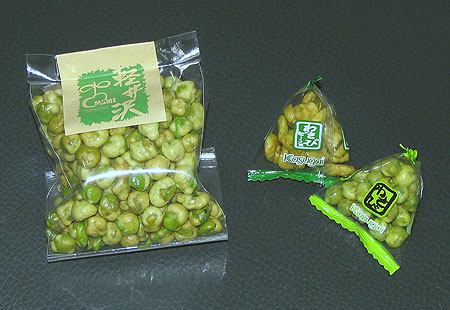
wasabipeas.jpg

I like wasabi. I love wasabi snacks. Wasabi sembei (hard, dry rice crackers in a wide variety of forms), and wasabi-flavored potato chips are great. But wasabi peas are the best. The only problem is, I can’t usually find them. In Karuizawa (where apparently wasabi is produced somewhat more than elsewhere) they had some wasabi stuff, including the peas, so I bought some–the larger package shown above at left.

Now, there is a wasabi peas snack sold more widely–that would be the two smaller triangular packs on the right. The only problem is, half the packages are wasabi peas, which are great, and half are wasabi lima beans, which are okay but less desirable.

If you haven’t had these before, give ’em a try. They’re great. And if you know where to get the peas only in Tokyo, drop a comment and let me know.

Categories: Focus on Japan 2006 Tags:

The Other Side of Nationalism in Japan

August 21st, 2006 3 comments

Nationalism in Japan, like fundamentalism in America, is often over-represented relative to its actual popularity. The black loudspeaker trucks and vans tend to stand out. They are way over-represented in government, with the ruling party tending to go along their lines. Newspapers often tout their agendas (though the Yomiuri is now doing an about-face).

But there is evidence of a different point of view among actual Japanese people. One small point of evidence: a new anti-war film, called The Ants (Ari no Heitai), is drawing large crowds. It is only playing in two small art houses–bigger chains would not dare to bring this out themselves, at least not until it’s wide popularity is proved–but it is getting record attendance. A small piece of evidence, to be sure, but it will be interesting to see if this gets wider attention and a broader release.

It’s always been my observation that most Japanese simply don’t know about what happened in WWII–too many simply never heard of it, not just because they didn’t want to. I recall back in the 80’s when I was tutoring a private student, a high-school girl, and discussion came around to the subject of Japan’s actions in the war. She told me that her high school History teacher only covered material up to the end of the Meiji period (when Japan was modernizing and growing in international stature)–then said that there was “not enough time to cover everything,” so they jumped ahead to the firebombings of Japanese civilians by the U.S. and the atomic bombings of Hiroshima and Nagasaki. A jump which conveniently glossed right over Japanese militarism and aggression at its worst. Since then, I have spoken to several Japanese people from different parts of the country who report the exact same gap in their teachings.

As a result of this and the whitewashing in the media, many Japanese, though aware something is wrong in this area, have very little actual knowledge of what happened outside the revisionist retellings of what went on, usually focusing on how it was the Japanese, and not others, who suffered.

Like the people of any nation, many Japanese will defend their country when challenged with the facts, but it is my impression that most are not like that. When they discover what Japan did during that period, most Japanese I know accept it and are very disapproving. Now, that is certainly colored by the fact that many of those I see in this reaction are young people, and often students who have chosen to study English. But even in light of that, my general impression remains the same, so I would not be too surprised if The Ants were generally well-received if it were to enjoy a wider release. The news would probably be focused more on the predictable reactions of the minority nationalists, protesting such a film.

And although I see a general trend towards nationalism in Japanese politics, I am far from convinced that this is also true of the Japanese people.

Does anyone have experiences or opinions to the contrary?

Categories: Focus on Japan 2006 Tags:

Trapped at the Apple Store

August 19th, 2006 9 comments

So I went in to the Shibuya Apple Store for a Genius Bar consultation about my Powerbook. The screen gets dark around the bottom after it’s been asleep for a while, and sometimes on startups.

Badscreen3

I took it in a few months ago in June, and they told me the same thing they did yesterday: we have no idea what that darkening is, we don’t see it, but let’s replace the screen for you. The warranty ran out in June, but because I told them that I needed the computer for my work until August, they gladly extended the warranty for me (screen only). So now it’s August, but I’m still on the fence.

First, it’s not so bad. The darkness goes away in a few minutes, and after a while, I don’t even notice it. But, and this is a big “but,” the cause is unknown and so this could get worse over time and cost me a few thousand bucks in a year or two, if it goes bad.

Second: this screen is okay as far as dead and stuck pixels go. There’s only one pixel with a dead green element (only shows up when white or greenish images hit the pixel), and it’s way off to one side. A virtually clean screen. If I have the LCD screen replaced, I could be stuck with a screen with dead and/or stuck pixels, up to maybe a half dozen or perhaps more, and maybe in the middle of the screen where they’ll stick out. (Apple will not swap out your screen for stuck or dead pixels unless they exceed a certain number, which they won’t tell you.)

And third: I have to do without the computer for a week. Yeah, I know–I’m an addict. I’ll get by on my PC and an antiquated iBook from work, but it’s surprising how dependent I’ve become on this machine.

So I’m on the fence. I sat at the Genius Bar for twenty minutes, asking questions and getting advice from a very helpful guy (who spoke English). In the end, I decided to be indecisive, and wait it out a little more. But I am now edging, at maybe 55%, to bring it in early tomorrow to be serviced.

Unless anyone out there has any advice… ?

So, why “trapped”? Because when I left the store, a sudden torrential downpour had hit Shibuya. Fortunately, there were banks of computers connected to the Internet right there, so I checked the TBS weather site and saw that the rain could continue for an hour or two. Well, I was riding my scooter, and though I had my rain slick with me, my backpack would get soaked along with everything else in them. What to do?

Well, I asked an Apple store employee for a trash bag. (No problem finding help, they were all around and available to help despite the store being crowded.) Instead of a trash bag, they gave me one of the very nice, very large Apple bags. I asked for a pair of scissors, and was given a box cutter. I put the Apple bag over the backpack, cut two holes for the shoulder straps to poke through, and put the thing on–perfect. Another Apple store employee kindly tied the drawstrings to the bag at the bottom of my backpack, and I was ready to go.

One thing Apple knows, it’s service.

Categories: Focus on Japan 2006 Tags:

Tokyo Tribunal

August 14th, 2006 Comments off

I noticed that one of the channels on my satellite connection was airing a 5-hour film called Tokyo Saiban (“Tokyo Tribunal”), so I recorded it. Turns out it is a Japanese film produced in 1983. And considering the first ten minutes of it that I’ve watched so far, when it was made goes a long way in explaining what I saw.

This is, ostensibly, a film about the Tokyo Tribunals, hence the name. Trials held after the end of WWII where Japanese military officers were held accountable for war crimes.

So what was in the first ten minutes? Extended footage of the atomic bombings of Japan, with grisly images of the victims, including a dead baby charred black, and piles of skulls (which I’m not even sure were actually associated with the bombings). Images of the bombings of the Japanese mainland and attacks by American forces of Japanese-held islands. Japanese civilians jumping off of cliffs, and American soldiers spraying Japanese in caves with flame-throwers. Kamikaze pilots, but not images of them hitting ships and killing people, rather the planes being shot down, one after another, by American ships, showing the broken, flaming wrecks spiral into the ocean.

Now, this film being about the war tribunals, one might imagine that relevant footage of evidence of Japanese war crimes might make an appearance. But of course not. Not a single image of what Japan did in China, nothing of the Nanjing Massacre, nor of the results of the Japanese “Three Alls” scorched earth policy. Not a single image of the Japanese concentration camps where western prisoners were starved and worked to death. Not one reference to the crimes that were, in fact, the subject matter of the film. The introduction did show images from Burma–of Japanese soldiers who somehow were starved and emaciated.

So the whole introduction was of what the film’s producers clearly felt were American war crimes committed against Japanese. Ten minutes of images of Japanese suffering and dying. And then, switch to: Americans cheering, celebrating, dancing in the streets.

I don’t have time to watch the whole thing today, and after the first ten minutes I’m not sure that I want to, but I’m keeping the recording and will watch it over what time I can make soon.

But the introduction certainly made a clear statement about the intent of the film, in an unmistakable way. Perhaps the filmmakers were nationalists, but it is just as likely not; in the Japanese mass media, certain subjects simply must be presented in certain ways. Another film from Japan, in 1998, titled Pride: The Fateful Moment, centered on the same topic–the war tribunals–in a different way, as a docu-drama focusing on Hideki Tojo. Tojo, of course, is presented as a kind, patriotic family man who is used as a scapegoat by scheming Americans.

The first ten minutes of Tokyo Saiban does very much make the point that, although Americans also whitewash and revise, that Japan does it more starkly and blatantly than just about anybody else. While Americans protest when exhibits of the Enola Gay are shown with photos and descriptions which suggest the bombings themselves may have been wrong, never have I seen anything on the American side so starkly biased as this from the get-go.

Update: I would say it was a coincidence that I found this new series from Yomiuri, but this is the anniversary period for end-of-WWII events, so I suppose there’s no coincidence at all here. The new series asks who is responsible for WWII, which the newspaper has apparently unilaterally decided to call “The Showa War.” Surprisingly, Yomiuri blames Japan itself:

Some conservatives claim that the war against the United States was a “war of self-defense” for Japan. They base their arguments on the United States’ oil embargo and the Hull note of Nov. 26, 1941, which was considered a de facto ultimatum delivered to Japan by U.S. Secretary of State Cordell Hull shortly before the start of the war. However, the U.S. pressure on Japan to suspend its military advance in China came about, to a large extent, by Japan’s “misjudgment.” Japan in a sense drove itself over the precipice.

The series of 8 articles goes from the start of the Sino-Japanese war to just before the end of the war in the summer of 1945.

It might not be so surprising to see the Yomiuri, long dedicated to furthering nationalistic agendas, pinning the blame for the war on specific Japanese military and civilian leaders, since the owner of the Yomiuri Corp., Tsuneo Watanabe, six months ago announced a change of heart on such issues. With the help of his hamsters.

Categories: Focus on Japan 2006 Tags:

Power Outages

August 14th, 2006 3 comments

I heard the news on the radio this morning, that power outages had hit parts of central Tokyo. According to updates, about two-thirds of a million buildings were hit, and some people were stuck in elevators in Shinjuku. About 260 traffic lights went dark, and some train lines (notably the Hibiya and Ginza subway lines) were stopped for a while. This all happened around eight o’clock in the morning. However, since this is the O-bon holiday season, a lot of people were out of Tokyo, so traffic was light and disruptions were minimal.

A few points of significance to those unfamiliar with Japan: the O-bon holiday is one of three major annual holiday seasons in Japan (the others are Golden Week from the end of April though the first week of May, and New Year’s, typically the first three days of January). Typically, you don’t want to travel much during those times, because everyone else is. In Japan, people don’t get so much time off, so when the three big holiday seasons hit, everybody makes for the door. The O-bon holidays are a time for Japanese to visit their hometowns, and pay respect to relatives and ancestors who’ve passed away. The peak time is August 13-15, but this holiday break is the least stringently assigned, and can come a little earlier or later for some people.

My other point: the reason why a simple power outage is significant is that it almost never happens in Japan. Back in the U.S., I remember power outages were a fairly common thing–we’d be hit by one every once in a while. In California a few years back, this was magnified by the whole power “shortage” and associated scandals, but even in good years, they’d happen with fair frequency. I never thought too much about them, but in the 90’s, a Japanese classmate at SFSU commented on our having so many, and it caused me to realize that in the seven or eight years I had spent in Japan by that time, I had never been in a power blackout, nor had I heard of one. I’ve commented on this before, but it does seem an interesting question. I thought fewer trees and newer infrastructure were probably causes, and Roy suggested the idea of smaller power grids. I have heard of one grid affecting others and how usage in one part of the country could cause trouble in another part.

For today’s outage, one thing it probably was not was overload. The weather is relatively cool, and a lot of people are simply out of town.

Update: Now we know why. A construction crane being transported on a boat going up the Old Edo River between Tokyo and Chiba apparently hit and took down some power lines there.

Categories: Focus on Japan 2006 Tags:

One of Those People Who Really Should Be Arrested

August 12th, 2006 Comments off

A 44-year-old man in Hiroshima made a complaint call to an Information operator several months ago. According to this guy, “the operator dealt with it very kindly, so I wanted to hear these women’s voices.” He then started making silent phone calls on his cell phone to “104,” Japan’s information number.

37,760 times.

One day, he made a total of 905 calls. Assuming 8 hours of sleep, that means he made silent phone calls every 64 seconds.

He’s been arrested on charges of causing psychological distress to more than 100 telephone operators.

Categories: Focus on Japan 2006 Tags:

Chuicide

July 27th, 2006 5 comments

From Wikipedia:

The Chuo Line, one of Tokyo’s major train lines, is so infamous for people committing suicide that many English editorials in Japan have taken to using the word Chuicide to refer to the means. Its relative popularity is partly due to its practical ease, and to avoid causing a nuisance to one’s family, though families are often charged or sued by the railway companies to compensate for the trouble caused by the accident. A typical suicide may cause delays between one and a few hours on one or more lines and is certainly unpleasant for onlookers who may be present.

Another interesting trend related to train suicide is to wear a brightly colored cap (orange) to help shield your face. This is done out of concern for the train conductors, so that they may not be caused any trauma by seeing the face of the person about to be hit. It is also useful as a sign that the person is indeed intending to commit suicide, and that no one should risk their life in order to save them.

The costs to the surving families by the railway companies’ “delay fee” is often in the 100 million yen (approx. 850 thousand U.S. Dollars) range. [Mainichi Shinbun, August 18, 2002]

Now, that last bit is cold. Your family member commits suicide, and the train company bills you close to a million dollars for their inconvenience as a punitive measure. It brings to mind the Chinese government’s practice of billing the families of executed criminals for the cost of the bullet. I’m not sure if the billing works as a disincentive–probably not, considering that people keep on doing so in such large numbers–but even if it did work, I’d be squeamish about being so cruel to those who have just lost people they love.

This article in Wikipedia reports that of the 1,210 people who have committed train suicide in Japan since 1995, 156 of them, or about 13%, have done so on the Chuo Line. The article claims that the “high speed and frequency of the trains” is what draws people to it. But such things have their quirks. For example, more than a thousand people have committed suicide by jumping off of the Golden Gate Bridge–but only one or two of all those jumpers chose the side of the bridge facing away from the city. It may be a matter of access, but if you’ve seen both sides, you’ll know that the city side is indeed a far more desirable view than the ocean side–although it’s an interesting question as to whether such a thing matters to someone about to leap to their doom.

Categories: Focus on Japan 2006 Tags: