Archive

Archive for the ‘Focus on Japan’ Category

Ikebukuro

May 21st, 2007 8 comments

Right back where I started from.

When I first visited Japan in the summer of 1983, my group took a Limousine Bus from Narita Airport to the Prince Hotel in Ikebukuro, where we stayed for the first three days in Tokyo. The apartment which Sachi and I are probably going to move into is situated on the very next block, right across from that hotel. Had the building existed 24 years ago, the view out my hotel window would have looked right out at our new digs.

It kind of surprises me that before I could even belt out my second post about apartment hunting (it’s still coming), we seem to have settled on a place. Despite early attention to Musashi Kosugi, one rather significant factor intervened: key money. Not that we can’t afford it; my savings would cover such a fee, but still, as we looked at places for rent and the fact that almost all of them would immediately sock us for about $7000 in non-refundable fees (the gift money and the agent’s fee), it was a rather sobering thought.

We also started looking with UR (Urban Renaissance), which is the agency I rent from currently. As I will go over in the upcoming second part of my apartment-hunting post, UR is a government housing agency. Not only do they welcome foreign tenants (still an issue with many landlords in Japan, as I have discovered), but they charge no key money or agent’s fees. You pay 3 month’s rent as a deposit (hefty, but not unheard of in private renting), and the first month’s rent of course, and that’s it. You’re in. And anything that saves you $7000 right off the bat is nothing to sneeze at. UR rents also tend to be a bit lower than usual market value, and are not slow about going down if market value so dictates; my own UR rent in Inagi has dropped considerably, maybe as much as 15%, in six years’ time.

But timing was as important as anything else in finding this new place. Sachi and I visited the UR office in Shibuya on Saturday, and grilled them about possible openings. Unfortunately, it was like pulling teeth sometimes. They would not look to see if any rooms were available unless we told them about a specific building–but there are so many buildings, and so many potential locations on so many lines that we could have accepted. Musashi Kosugi got ruled out early, at least as far as UR was concerned; it was a popular spot. And as Sachi and I soon discovered, that was the case with virtually all UR buildings close in to Tokyo. They go fast, and in most cases, it’s first-come, first serve.

Then the agent we dealt with told us about new buildings being constructed. UR puts up maybe a dozen or more new buildings in the area each year from what I can tell. For example, a new 247-unit building is going up in Ningyocho, just a short walk from the Ginza, which opens for signing up in September. If there are too many applicants, then they’ll do a lottery, but otherwise, UR just gives apartments to the first people who apply. Ningyocho caught our eye, but there are several other buildings opening, including two in Adachi Ward (a less-desirable but cheaper location), one in Setagaya, another in Yokohama, and another in Saitama.

But then the agent mentioned that there was a building which had just opened for people to move into, one which people had applied for a few months back. Probably what had happened was that a lot of the people who had originally applied in advance had found other places in the meantime, or otherwise decided not to go for this one, so they cancelled. That left a lot of rooms open–a situation that would last for only a short time (ergo the good timing). We were given a pamphlet and decided to check it out.

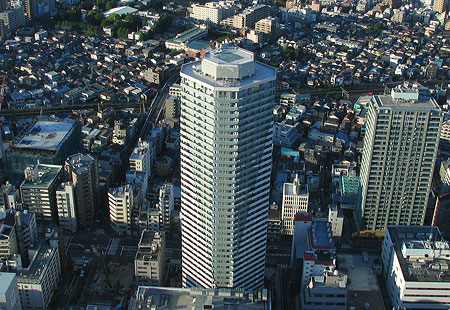
The building is called Vanguard Tower. While the photos on their site are better than what you actually get, it’s still a very nice place. They just finished construction, so all the units are brand-new. It’s a 38-story building in the heart of Ikebukuro, the next block over from Sunshine City. The advertisements say it’s a 10-minute walk from Ikebukuro station, but you know that they always make that figure sound as attractive as possible. We haven’t timed our own speed yet, but it’s probably closer to 12-14 minutes, I’d guess. Still, it’s pretty damned central.

0507-Vanguardtower-500-60
Vanguard Tower as seen from the observation deck of Sunshine 60.
Click to see a larger view. Our unit would be halfway down on the right.
That’s Mt. Tsukuba on the horizon, by the way.

The walk from the station is pretty straightforward. When you come out of the east exit of Ikebukuro Station, you go down the main street for a little then veer left down a big shopping street leading to Sunshine City. Vanguard is visible along that street, and in fact, I could see back down to that street from the apartment.
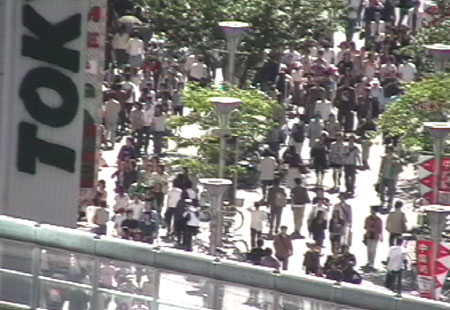
0507-Sunshine60Street-450
A rather extreme zoom of Sunshine 60 Street from the unit.

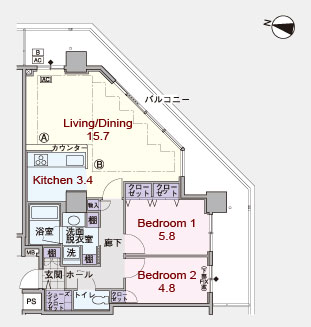
We spoke briefly to the staff on the second floor, in the recruitment office, and were given building passes for looking at the room. We went up to the 21st floor and checked the place out. While not perfect, it is a very nice place. At 72 square meters, it’s very spacious for central Tokyo. Here’s the layout as provided by the building’s web site:
0507-Floorplan

You walk in the door, and there is a small walk-in shoe closet on the right, and a smaller shoe cabinet on the left. The toilet is also immediately on the right, and is of the variety I like to call “the Captain’s Chair,” as the bidet and washlet controls slightly resemble a futuristic starship seat. Immediately down the hall are the two bedrooms. Sachi and I will probably use the smaller one as a storage room–and even at that, we’re both going to have to pare down our belongings considerably. To get out on the balcony, you can use either a door in the larger bedroom or one in the living room. The balcony area outside the bedrooms is wide enough to have a small table and chairs, but we might opt for a smaller table and two chairs in the little inset pocket just around the corner; it’s protected from winds better. The larger area might become a small plant garden/exercise area (I have to put my large elliptical trainer somewhere). The larger bedroom we’ll use ourselves, though we may need a new bed; it’s just small enough that my present bed might not fit the way we want. We looked at new beds last night, and they tend to range from 200,000 yen ($1,650) for a queen size. Ouch. Anyone know a place in Tokyo that sells beds cheaper?

The bath room is nice–two mirror/dresser areas, with plenty of cupboard/shelf space. The bath itself is nice, though Sachi noticed that the rubber fitting at the bottom of the bath room door may not keep water in as well as one would prefer; she noted that it seemed cheap. However, the complaints more or less end there, aside from a few small kvetches.

From there, you come in to the main living area. It measures about 6 x 7 meters (20′ x 23′), with a diagonal cut in one side where the balcony windows dominate. The kitchen is fully electric (no gas in the building, so I’ll have to sell that sweet new heater I bought recently), with three stove “burners” and a small internal grill. There’s a large sink and (for Japan) ample counter space. It might be hard to fit in a fridge and the nice rack of kitchen shelves I have at my place, but they could work. There’s enough cupboard space, and the nice feature is the open counter to the living/dining area–something I like a lot. It opens up the kitchen nicely.

The living/dining area itself a large, though the odd shape may make it hard to utilize as well as we might like. Still, it’s hard to beat the window area–large glass windows/door all around the room. When we were there, brown-paper faux curtains which we could only open partially cut off most of the light. But the room faces southeast, and will be very bright. The floor is heated from beneath, and they give us one air conditioner/heater. The windows are all double-paned, which will insulate the place very nicely, in addition to silencing traffic noise. The view is great–not fantastic, but great. Alas, here’s where the advertising photos cheat: they make it look like you can glance down at the dinner table and see the cityscape past the table settings. But the balcony railing cuts off the view of the cityscape unless you stand up. That’s a good thing, though–were the railing lower, you could fall over it too easily! It’s sphincter-puckering enough to look over the railing on the 21st floor as it is.

The view is a cityscape, and should be beautiful at night. We might even get a distant view of firework displays like the one over the Sumida River. But the view does not, alas, include the beauties of the Tokyo night. The Sunshine 60 and Prince Hotel buildings dominate the southern view. Tokyo Tower is visible, but mostly blocked by a nearby skyscraper. Shinjuku’s skyscrapers are also visible, but just through the gap between the Sunshine 60 and Prince Hotel. Mt. Fuji is blocked by the Toyota building (maybe ten floors higher and we could have had a view of it). So unless the Sunshine complex is going to be more dazzling than I expect at night, the view will have to simply be… north-central Tokyo. Which, hopefully, at night, will be a nice enough view for the city light show. (A small note of amusement: the pamphlet for the building shows a room with a telescope. But due to light pollution, the scope would be useless for skywatching–but great for looking into other people’s windows!)

0507-Eastview-500
The view to the west. Anything to the right is dominated by Sunshine City. Click to enlarge.

From here we get into the small stuff, a lot of which is nice. There’s an auto-lock security system (you buzz people in at the front door), with a video monitor to see who’s coming. The toilet and bath both have emergency call buttons which sound an alarm in the main living area (Honey, I forgot my towel!). There are two places where you can let (sound-buffered) air come in from the outside to create an air flow, aside from what you get by opening windows on opposite sides of the unit. There’s a clothes-drying system above the bath that allows for speedy hang-drying, with laundry poles and changeable rests for them. Rails with hangers adorn the side walls of the living area, allowing us to hang pictures or other ornamentation. And the mailbox system is a special treat: it’s closed off to anyone except you and the post office. No more regiments of part-timers flocking to stuff your mailbox with annoying ads! Yay!! Even better, there’s a system of locked closets for receiving large parcels, so if you get a Fed Ex delivery, you don’t have to be at home. Just give the delivery service the code number for the box, and they can leave it there for you to pick up at your leisure. Cable TV and Internet services are available but not included in the rent; that’s something we’ll still have to work out.

A small difficulty: there’s no garbage disposal chute. You have to carry your trash down to the 2nd-level basement and leave it in one of a few different rooms, depending on its type. However, that’s the same basement level where I’ll park my scooter, so I’ll probably be the one carrying out the trash. For the whole building, there are only 21 spots for motorcycles/scooter above 50cc, but I checked this morning, and they had a space available that I could reserve. It’ll cost ¥4000 ($33) a month, but that’s OK. It’s also very secure–locked behind a gate–so I won’t have to deal with theft like I did with my last scooter.

As for the environs, there is shopping galore. Sunshine City is one block away, with a massive shopping mall. Alas, as is usually the case, 90% of that is clothing shops, almost all of them hideously overpriced and fashion-bound. But the key is finding the dozen or so shops that suit you. For example, Subway sandwiches are good for my diet; a half-sandwich is enough to do me for brunch and is low on calories. I never had access to that in the Tama area. In the meantime, I’ll have to avoid all the other fast food shops which exist in abundance, like the six local McDonald’s stores or five Starbucks locations in the immediate area. I’ll probably spend the first few months just walking around, trying to figure out where everything is, and taking note of the shops I’ll want to frequent.

The shopping element that I worried about was plain-old supermarket shopping; downtown areas are not noted for their grocery stores. But in addition to the Seiyu supermarket just on the other side of Sunshine City, the builders of the Vanguard Tower foresaw the general lack. Half of the ground floor, the part that is not taken up by the semi-luxurious lobby and the mail room, is occupied by a medium-sized supermarket which will be open 24 hours. We’ll have to see about their prices and product quality. I’ve never heard of the market name before (and have forgotten what it was now), so it’s not a known quantity.

There’s good and bad here, but there seems more good than bad. In any case, we have ten more days to mull it over before contract time comes.
Categories: Ikebukuro Tags:

98%

May 21st, 2007 2 comments

It looks like I’ll be moving to Ikebukuro at the start of July.

0507-Vanguard-450

We still have ten days to change our minds, but it doesn’t look like that’ll happen, very likely. We’ll probably be moving in to the apartment a bit more than halfway up on the right side of the tower as seen above, from the observation deck of the Sunshine 60 building just across the way.

More later.

Categories: Ikebukuro Tags:

Apartment Status

May 20th, 2007 1 comment

We’re just getting started, but Sachi and I have two potential choices. One is an apartment near where Sachi lives now, on the third floor of a building atop a convenience store. It’s 72 square meters, a 3LDK with two small carpeted bedrooms, and a sizable hardwood-floor LDK (13 tatami mat size), with a classic 6-mat tatami room which, with sliding doors open, opens up the LDK even more.

Pros: location (one station out from Meguro, 6 minutes’ walk from the station), and there’s a Cherry-blossom-tree-lined street right out the living room window. It’ll only be in bloom once a year for a week or so, the rest of the time it’s just trees–but it’s trees. Another big plus: there’s no key money, just 3 month’s deposit, just like UR’s selections (though we’d still pay a month’s rent for the real estate agent). Also, there’s a big park about 5 minute’s walk away.

Cons: the rent is fairly high, right at our upper limit. There’s a fairly high-traffic street right out front, which we can only hope won’t be too loud–though the bedroom is away from that, in the back of the unit (though its window is barred, and looks out on the hallway). There is a nearby supermarket, close to the station, but almost no other shops close by. And there’s a steady incline from the station to the apartment–though that’s a questionable disadvantage. (Why can’t I ever get a place which is uphill going to work and downhill coming back home?) There’s also virtually no balcony, and might not be any place to park a scooter.

The second place is one we’re going to look at today. It’s a UR property, so it’d be 3 months’ deposit and first month’s rent to get in. But here’s the corker: it’s a brand-spanking-new 38-floor high rise smack in the middle of Ikebukuro, just ten minute’s walk from Ikebukuro Station (almost across the street from the Sunshine City complex). It’s called Vanguard Tower. Apparently, we’ve just caught it at the right time–a lot of people had reserved apartments, but when the building opened, they had already found other places, and so canceled.

An example of one of the openings? A 72-square-meter 2LDK apartment on the corner of the 21st floor, all hardwood floors, with 2 smallish bedrooms (6-mat and 5-mat) and a 16-mat living-dining area–19+ if you include the kitchen. There’s a wide balcony (what will the winds be like so high up? Will traffic smog be an issue?) and the view will be to the south and the east, from Ikebukuro’s skyscrapers to central Tokyo, including the Imperial Palace. There’s even bike parking (bicycle and scooter) in the basement levels. It comes with built-in everything, though you apparently have to contract for your own Internet service.

The location is excellent. Sachi would have a direct train line to work, and I would almost have a direct line (which would change starting June next year, when the new subway opens up from Ikebukuro direct to my work). By scooter, it’d be a short 5-10 minute hop for me. It’s on a major boulevard, but so high up, traffic noise will not be an issue. There are no big parks in the immediate vicinity, and from so high up, trees would not really help much anyway. But the shopping would be unbeatable, not to mention movie theaters and lots of other stuff just a short walk away. (Though a good supermarket might or might not be available closeby; we’ll have to check.) Another benefit: Ikebukuro is a terminus for the Narita Express. No more humping through transfer points with major luggage every time I visit home, and coming back from the airport would be a breeze.

A possible major issue: wait time for elevators. We’re sure as hell not walking 21 flights, up or down. Sachi is worried about this, and when we go to see the unit today, we might see it at its worst: people just started moving in a few days ago, so there’ll probably be much worse traffic than usual. There are five elevators; one large car that stops at every floor, and four smaller ones. Two of the smaller ones are express elevators to the 18th floor and above; the other two service the 18th floor and below. People on the 18th floor have it sweet–they can use all five elevators. On the 21st floor, we could potentially (in a pinch) use the lower-half elevator to the 18th floor and then walk up three flights. Also, the empty elevator shaft above the 18th floor is converted into storage closets for the tenants on those floors.

Earthquake safety would seem to be an issue against, but frankly, I think it’s an advantage here. Nobody’s going to skimp on earthquake safety when it comes to such a high-profile high-rise, while smaller buildings could fly under the radar and not have as good protection.

The square meter-age and the prices of both places are almost exactly the same. Both are close in, though one is a station off the Yamanote, the other is right on it. The differences are obvious: high-rise with city view vs. just-above-tree-lined-street-level view; slightly older small mansion vs. brand-new high-rise. One would be more rustic, neighborhood-oriented with limited shopping, the other would be modern big-city style with downtown right outside the door.

I’m excited about the high-rise myself, but we’ll have to see what it feels like when we’re there.

Categories: Ikebukuro Tags:

Finding an Apartment in Tokyo

May 16th, 2007 12 comments

The apartment I’ve got right now is pretty sweet. It’s a big place for cheap. It even has a nice view. And I’ve stayed here longer than I have stayed in any one apartment in Japan. I just completed my seventh year here, which outdoes the two and a half I spent in a place in Koganei, which was the previous record-holder. In fact, since I moved out of my folks’ house at age 21, this is the longest I’ve stayed in one place.

Nevertheless, time moves on. I’m getting fairly deep into a relationship, but our living places aren’t compatible. Hers is close in to Tokyo, but is way too small. Mine is big enough for two, but is too far out. Only the fact that I have a scooter has made it livable; otherwise the daily bus ride to the train station, plus twenty minutes combined waiting for the bus and train to come, make it an hour-plus trek to my job, with transfers and walks along the way. For Sachi, it would be even more of a trip.

So now we’re looking for a place that’s both large (my condition) and close to central Tokyo (her condition). Of course, we’d both like both qualities. The hard part is finding them. Fortunately for us, we’ll have two rather healthy incomes to put together; for less than we now pay combined in rent, we’ll be able to get the kind of place that we want. So we’ve started the process, both of us understanding that it could be a long way to go. Maybe it’s harder finding a good place in New York City, but it ain’t easy in Tokyo, either.

I also figured that this would be a good opportunity to get into explaining how one finds an apartment in Tokyo. I went into that before in this blog about two and a half years ago (part 1, part 2), but that was told more as a story, with facts about apartment hunting peppered in. Let’s see if we can’t go about it in a slightly more organized fashion this time. And hopefully, I’ll be able to do it fairly well–after all, I’ve been through this process seven times in Japan so far (eight if you count finding my brother’s place). It’s been a while since I last did it (seven years, as I mentioned), but having gotten started again, it’s all coming back.


Location: You know what they say about location, and it’s no different here in Japan. Rule of thumb: the closer you are to central Tokyo (as measured by the Yamanote loop line circling the center of town), the more expensive it’ll be–but also, it gets more expensive the closer you are to the local station you choose.

You start by seeing where it is that you work, and probably discover that it’s too expensive to live close to there. So then you start figuring what the train lines are like from work to various places. Some train lines are more coveted than others; they may have nice, major stations along the line (the Chuo Line, for instance); they may have nice express trains (express stops rate higher rents). Some lines, like the Nambu line, have no express trains and few interesting stops. So you choose a line which looks good for you, and has good connections to work and to other places you’d like to go.

Then you choose the station itself. As I said, express stops are choice–it means a shorter commute into work. Factor that in along with proximity to central Tokyo and other desired locales. Sometimes you can actually find a place which is not yet “discovered,” and has many good qualities without having prices that are too high.

Sachi and I believe we’ve found that station for us: Musashi Kosugi, in Kawasaki City, just across the Tama River from Tokyo’s Ota Ward. Kosugi is an express station, with no fewer than three major lines running through it (Tokyu Toyoko, Tokyu Meguro, and JR Nambu), and through trains to three different subway lines (Hibiya, Mita, and Namboku) through extensions–and a fourth, the Fuku-toshin Line, connecting in 2012 (a line that would take me straight to work). Of the six lines now operating out of Kosugi, three have their terminus there (Meguro, Mita, and Namboku); it is an express stop for all lines that have such stops. There is direct access to Shibuya, Ebisu, and Meguro stations on the Yamanote Line, averaging abut 14 minutes from Kosugi to any one of those stations. From there, you can transfer yourself to anywhere, and many of the through trains go to other major stations.

Despite the choice station location, Kosugi is relatively low-priced. Just a few stations inward, Den’en-chofu is hugely more expensive, as an upscale neighborhood. Although being even more distant and less well-connected by train lines, Futago-Tamagawa and Mizonoguchi, across from each other a little ways up the Tama River, also ask higher prices. Kosugi seems strangely overlooked.

One other element of location is distance from the train station–a key point if you are going to walk to the station every day. That’s where my place lacks–it’s a 20-plus-minute walk, or a 5-minute bus ride followed by a 5-minute walk, with hilly areas for the walking. Having to depend on a bus is also a pain, because they often come at inconvenient times. The bus from my place to the station comes once every twenty minutes–and arrives at the station just two minutes after the once-every-twenty-minutes express train has left. So having a place within 10-15 minutes’ walking distance of the train station is a big plus.

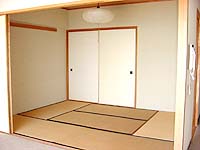
Size: this is the other big deal with apartments. There are two ways to measure the size of a place: the number of rooms and the floor space. In Japan, total floor space is measured in square meters. My current place is big, 84 square meters; Sachi’s is about half that size. Individual rooms, on the other hand, are measured in tatami mats, each one approximately three feet by six feet. Standard is a 6-mat room, nine by twelve feet, as illustrated at right.
The second way to measure is by the number of rooms. In Japan, the letters to remember are L, D, and K. “L” for living room, “D” for dining room, and “K” for kitchen. If two or all of those are combined into a single multi-purpose room, you’ll get an LK, DK, or LDK, for example. If a number is added to the beginning of that, it means that there are that many extra rooms (usually bedrooms) in addition to the central area. (In Japan, bathrooms are not specified; it is assumed that there will almost always be one toilet room and one bath/shower room.)

Sachi and I are looking for a 3LDK–what in the U.S. would be called a three-bedroom apartment. We’re hoping for a room at least 70 square meters in size. I visited Kosugi recently, and finding such a place within our price range seems eminently possible.

Type: In Japan, there are three basic types of places for rent: apartments, “mansions,” and houses. The real distinction to be made is between the apartments and “mansions.” Apartments are relatively cheap and of poorer construction; they are always rented. “Mansions,” on the other hand, are not sprawling estates as are their namesakes, but rather more-sturdily-built apartments. Think condominium. Walls are thicker (often concrete), and soundproofing is better. I live in such a “mansion,” and the folks who lived next door to me had a newborn baby when they moved in. Either that’s the quietest kid in history, or the soundproofing in the walls is excellent (though it is always weakest in the ceiling, from the unit above). Mansions are sometimes rented, but often are bought. At the $2000/mo. level, I have also seen a surprising number of rental houses offered. Sometimes these are attached/semi-attached, but usually not. They are often a square layout with two floors; sometimes they are an elongated rectangle, three floors, with a garage at the ground level.

Cost: Here’s the real kicker. In Japan, moving-in costs can be prohibitive. There can be up to four separate costs for moving into a place in Japan, only two of which are common in the U.S.:

  • First month’s rent: standard.
  • Deposit: in the U.S., it’s usually one month’s rent; in Japan, it ranges from one to three months’ rent, though it is usually two months’.
  • “Gift” Money (also called “key” money): from zero to two months’ rent, this is essentially a bribe, or a surcharge demanded by the owner. Worse, if there is any “gift” money demanded initially, another month’s rent in further “gift” money is demanded every two years when the contract is renewed.
  • Agent’s Commission: one month’s rent. Granted, they work to get you a place, but they don’t work that hard! Sachi and I will likely fork over the equivalent of US $2000 for an agent who will likely spend only a few hour’s work getting us a place. True, they may only score a sale every ten or more attempts, but still, they have an amazingly sweet setup for themselves. Unsurprisingly, any agent will eagerly take down you phone number and address and try to get you to rent a place through them.

The common deposit/gift scheme is 2/2, meaning two months’ rent as a “gift” and two more as a deposit. Which means that moving in will often mean plunking down six months’ worth of rent before you can call it your own, only one month’s rent of which will actually be applied to the rent itself. Sachi and I will pay about $6000 in fees and will have about $4000 locked up in the deposit when we move in, beyond the $2000 for the first month’s rent. That’s $12,000 to get into an apartment. That’s not a down payment on owning the place. In short, it’s a real scam they put you through.

What’s more, I just discovered an extra element that I had never encountered before: end-of-contract conditions. Most of the places Sachi and I have seen so far have conditions that prohibit us from keeping the place for longer than two, four, or five years. Probably a loophole to get the owner out from under rent control, it means that the owner can choose to completely re-negotiate after that amount of time passes. In Kosugi, I am guessing that four-year end-of-contract clauses will be common–that’s when the Fuku-toshin Line connects to Kosugi, meaning a direct line through to Ikebukuro and other new, popular stations. Also, there seems to be a lot of new apartment/mansion development in Kosugi–it won’t remain under-discovered for long. We may start by renting, but buying in the near future may not be a bad idea.

One more important point about cost: the kanri-hi, or maintenance fee. This is added onto the monthly rent (though it is not included in the key money, deposit, or agency commission). It can sometimes be in excess of $100/mo.

Ambience/Shopping: this can also be key. Sachi has a great location for shopping; just across the street is a big, long covered shopping street (it is named “Pearl Road,” which, oddly, most such streets seem to be named). Two stations closer in from Kosugi is a station called Tamagawa; it has virtually no shopping. Kosugi is a happy medium: lots of shops and restaurants, but not a huge number, and the main street is nicely shaded with trees. We’ll have to do more exploring, of course, to get a feel for the area. Key point: how many supermarkets within walking distance, and what are their hours?

These are the major points. Other important points for a place include:

  • Age: when was the place built? More than ten years is pushing it. A place can be “reformed” (renovated), but newly constructed is most sought-after.
  • Exposure: where do the main room windows face? Southern exposure is best for sunlight, but you also have to consider where major roads are. Will there be a ton of traffic noise? Is there a train line nearby? Sachi and I were almost shown a place which appeared on an ad’s map as in a nice spot; it turned out that it was actually on the corner of two major thoroughfares and an elevated expressway.
  • Closet space: naturally. Though it always fills up no matter how much you get.
  • Elevation: what floor is it on? First floor is considered bad in Japan, especially for women. It’s about security as well as the view. Every apartment’s description includes the total number of floors in addition to the floor the unit in question is on.

Then there are a larger number of lesser features:

  • Balcony space: usually very small, but some places can have a nice amount of floor space outdoors.
  • Elevator: important if you live above the 3rd or 4th floor.
  • “Autolock”: a security feature, where you have to buzz in people for them to enter the building. As is true everywhere, it is questionable, as with most places it’s easy to just wait for a tenant to come in or out and catch the door when it’s open. associated feature: Video intercom (may be in color).
  • Cable TV/BS: the “BS” stands for “broadcast satellite,” usually the NHK variety. Though with any place, you’ll want to see if the other satellites are blocked out by buildings or terrain.
  • Internet: newer places may have shared fiber-optic high-speed Internet connections built-in to the building; you could get access without extra charge, and many new rooms have the Ethernet ports built into wall sockets along with TV reception, power, and gas.
  • Air conditioning: Japan’s summers can be brutal. Frankly, I don’t know what I’m going to do–I bought two air conditioners for my present place, and having them uninstalled-reinstalled may cost more than just getting new ones…
  • Flooring vs. Tatami mats: some people prefer tatami (thatched) mats, but wood flooring is pretty popular nowadays. Often, apartments have mostly flooring with one or more rooms done in tatami. Wood flooring may have “TES Yukadambo” (TES 床暖房), which means the floors are heated from underneath. This often applies only to the Living-Dining area. “TES” stands for “Tokyo-Gas Eco-System,” and can be applied to a variety of new-fangled central-heating systems.
  • Other stuff: Are pets allowed? Could be good or bad, depending on whether you want pets, or whether there is good soundproofing. Your place might or might not come equipped with a gas-burning stove in the kitchen. (Japanese places very rarely have full-blown stoves, or dishwashers or trash compacters, for that matter.) The kitchen may or may not have a counter opening to the Living-Dining area. Kitchen layout and cupboard space must be looked at. Various water-heating systems may be employed. There may be a special area where parcels can be delivered without requiring you to be home. Is the toilet separate from the bathing area, and do you even care?

Once you have found a place that meets your requirements well enough, a little more investigation is called for. The real estate agent may show you the place at the optimum time of day, when the warts are the least apparent. You should visit the place at other times and camp out a bit. You may discover that trucks load right next door at 6:00 in the morning with a piercing backing-up beeping. Unexpected sounds or smells could make themselves manifest. And the noisy neighbor is always a frightening specter, hard to detect beforehand.

So, all of this is stuff that you have to keep running in your head as you look for a place. I’ve already taken up way too much space just for getting the basics down. So, I will cover the actual looking-for-a-place part of the hunting process for a subsequent post, coming soon.

Categories: Focus on Japan 2007 Tags:

No Parking

May 14th, 2007 1 comment

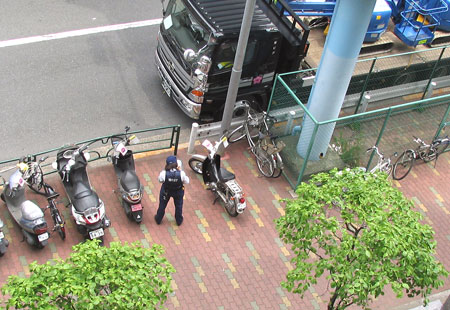
This whole parking thing has gotten out of hand. They have really gone hog-wild. It’s not just in Shinjuku or in the high-traffic areas; I can’t even park my scooter on a normal street anymore without getting ticketed. Before, using a scooter was great; parking anywhere was not a problem. And I’m not talking about cluttering up a street, but parking in a place which still leaves a broad two meters or more of sidewalk open for traffic.

Case in point: I came to visit Sachi and parked in front of her apartment building. There is a space next to a pedestrian overpass, where there is a traffic “shadow,” an area where no one would walk or ride their bike even if it were clear (see photo below). A less offensive parking space is hard to imagine. But the ticketers came along and started writing out their citations… not because it was a nuisance, not because anyone complained, not because anything was being blocked… but simply because they could, because there’s a profit in it. If the bike were parked next to the building where it was blocking foot traffic, they’d have no complaint–I know, because I just asked them, and they told me to park it in a traffic spot because it was not a public traffic spot. So I did that, and now it’s parked next to some little stools on a pathway next to this building, where it could easily bget in the way of someone who wanted to rest there… but I won’t get a ticket for that.

0507-Biketicket1-450
Note the sidewalk, how there is more than two meters open, and how the bikes are parked in the traffic shadow behind the fencing. The tickets won’t clear up the space, either–it’ll just fill up with ordinary bicycles. So what’s the point?

0507-Biketicket3-450

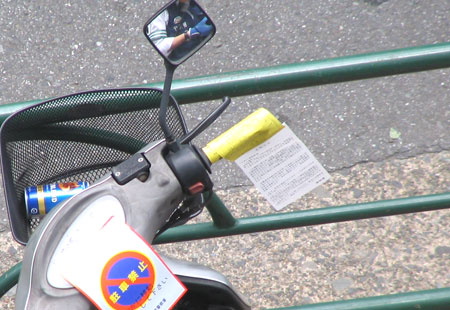
And neither is this going to clear up the sidewalk, even in places where the sidewalk is narrow: they are only ticketing motorized bikes. Scooters and motorcycles. Not bicycles, even though they take up virtually the same amount of space, and are far more numerous. Apparently, you can’t hand out a citation for a bicycle that generates profit. So they get a free pass. At worst, a notice is left on the bike, and if it stays affixed for several weeks, then it gets carted away. My scooter got a notice and was almost ticketed within just a few hours.

0507-Biketicket2-450
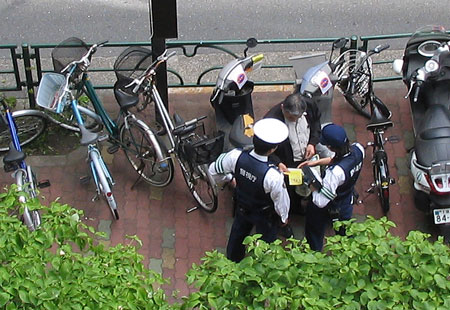
It’s not just me, either. I moved my bike with minutes to spare, but this guy didn’t. He just took the ticket off his bike’s handlebar, the one behind him to our right, and is now he’s futilely complaining to the ticketers about how he was just visiting a nearby building for a few hours, so what’s the deal? Note the bicycles here don’t even get a notice to warn them to move.

If you park a scooter even for one day, it gets ticketed, which means a steep fine and points get taken off your license. Which stays on your record for a full year, or longer if you get other violations before that year is up.

Nor is it a simple matter of finding the right spot. The building superintendent steadfastly refused to allow me to park in any of the many open spots around the building where no one goes. Buildings in Japan have zero accommodations for visitor parking. They have completely closed off all parking places for scooters, except for the pay-parking lots–and that can run $10 a day or more, for parking in a space barely larger than a bicycle takes.

In short, Tokyo has changed from a scooter-friendly place to a scooter-hostile zone. It would be slightly better if there were a reason for it other than sheer profit for the ticketing agencies. I’m just lucky that there’s a sliver of a space next to my workplace where I can park. Otherwise I’d have to park far away and pay for the privilege.

Categories: Focus on Japan 2007 Tags:

Throwback

April 27th, 2007 Comments off

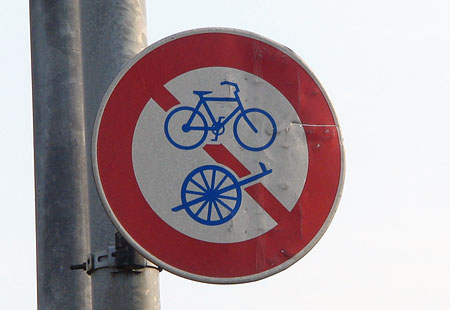
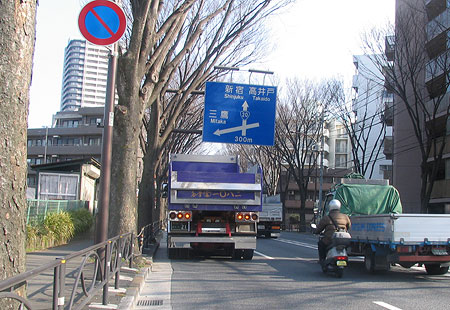
This is an interesting sign you sometimes see on Japanese roads, especially at the entrances of underpasses and overpasses:

0407-Sign-450

The bikes, okay… but the rickshaws? An interesting inclusion there. Now, I will admit that I have seen handcarts of that nature in Japan, but very rarely… and I think only a fool would try to take one onto an overpass. True, there are fools out there, but how many with rickshaws, and even if they do have one, if they’re that foolish, won’t they ignore the warning signs anyway?

Categories: Focus on Japan 2007 Tags:

Parking in Shinjuku

April 23rd, 2007 2 comments

It used to be that you could park just about anywhere in Shinjuku on a scooter. Just go up to the sidewalk and park it alongside bicycles, no problem. And it didn’t really cause any more problems than bicycles alone. It was one of the best things about riding a scooter–the convenience and efficiency should you want to shop here, check out that over there.

Just a little more than a year ago, I posted on the fact that tickets for parking violations would soon shift from police administration to private contractors, and predicted that it would lead to wanton ticketing–not to clear the streets or to benefit the public in any way, but rather purely as a way to make money.

Well, I was right. The new parking police have gone way too far. I noticed this when I found that I could not even park my scooter in front of my own workplace, where the sidewalk is very broad (about 4 meters) and there has always been plenty of space, no problem parking there. No mess, no inconvenience to anyone. It’s not a busy area, not a business district, and there’s no reason why people can’t park.
Then my students started getting ticketed for parking their motorcycles in front of the school. I was lucky to avoid that before I caught on that there was ticketing now in force; one of my students got two tickets (which equals four points off his license and $200~$300 in fines).

I also noticed that if I tried to park in Nishi-Shinjuku, roving bands (four people per group) of the new parking police were going up and down the street, issuing tickets with abandon. And just tonight, on a Monday night after 7:00 pm in a far corner of Kabukicho where my co-workers had come to meet, I wanted to park–and found a gang of ticketers right where I figured I’d saddle up for a few hours. Swell. Worse: no legal parking places for bikes within easy walking distance. Lots of places for cars to park, but not bikes.

What’s worse than that is that the ticketers seem to be focusing on ticketing motorized bikes (scooters and motorcycles); I haven’t seen them molesting cars yet, though there are plenty parked illegally virtually everywhere.

I knew it was a bad idea when I heard of it, and it’s even worse than I thought in execution. I’m just going to have to give up shopping in Shinjuku if I have my scooter.

Categories: Focus on Japan 2007 Tags:

Shinkansen and Restroom Nostalgia

April 22nd, 2007 1 comment

Today, Sachi and I returned from a short stay in Nagano to meet her family. As we did twice before when traveling to that region, we took the bullet train–a nice ride, but pretty expensive. We each paid about $50 for a one-hour ride each way.

I remember the Japanese Bullet Train, or Shinkansen, back in 1983 when I first traveled in Japan. Then, I had a Japan National Railways (JNR) Railpass, which gave me unlimited access to all JNR trains for a single price. So I used the Shinkansen up and down the country, from Hiroshima to Morioka (as far as it went north back then).

I remember that “no smoking” back in those days meant that the forward half of one car was designated as “smoking,” with the back half designated as “no-smoking,” which of course meant that the “no-smoking” part was just as filled with smoke as the other half. Apparently, JNR at the time felt that entropy would not spread the smoke around, and did not see enough demand for non-smoking seats that it could designate a whole car as such.

I remember a little Shinkansen adventure when I returned from my short trip to Hokkaido (cut short by my homestay city’s request that I return to their town early, only to find that there was no specific reason and I wasted three days instead). I remember that for some reason (probably that I couldn’t stash it anywhere else), I carried with me all of my suitcases and all of the junk I had acquired in the three weeks of previous travel; it equalled one large suitcase, a backpack-suitcase (which I still have), and two large shopping bags full of stuff. To say the least, I was bogged down so badly that moving around was a chore.

I remember that when I arrived in Morioka going south and transfered from the regular train to the Shinkansen, I would have to go down four floors–and I only had a precious few minutes to make the transfer. At that time, either there were no elevators (not to mention escalators), or I did not know where they were and had no time to learn. So as we pulled in to Morioka Station, I was at the door, ready to bolt out. But when the doors opened, something unexpected happened: two dozen old ladies barreled through from behind me, literally shoving me aside and not letting me out the door until they had gotten through first. As they disappeared in the distance, I finally got out, and now made even more late, struggled mightily to make it to the Shinkansen tracks.

Somehow, I got to the bullet train platform just as the doors were about to close, but I had to jump onto the first car, closest to the stairs–and found that my seat was at the other end of the train. Already drenched in sweat and exhausted from the race down to the Shinkansen platform, I then struggled to drag my two suitcases and two full shopping bags down the narrow aisle for the length of the train.

About halfway through, I entered a car and had an encounter: there were the two dozen old ladies, all relaxed and stretched out, and when they saw me, they broke out laughing. Apparently, they too knew the transfer to be a tough one–which is why they shoved me aside, without thinking that (a) they would delay me more than I would have them, and (b) I was burdened down with huge amounts of luggage and they were not. I smiled politely as I passed them, thinking less-than-kind thoughts.

I also remember the lavatories, mostly because I lost a pair of glasses in there. In the 1980’s, they used a kind of septic-tank approach, where the toilet just had a circular rubber-leafed membrane between you and the tank of noxious material. I remember going to the bathroom there, then leaning over to flush–and in leaning over, my extra pair of glasses, worth more than $100 as I recall, slipped out of my breast pocket and square into the hole to the septic tank. I left the lavatory as soon as I could, and without thinking about it beforehand, I asked the conductor if the glasses could be recovered. He said no, with a look that I then–upon thinking about it–understood as saying quite rightly that I wouldn’t want to recover the glasses from where they were. Even with rigorous cleaning, would you want to put that onto your face?

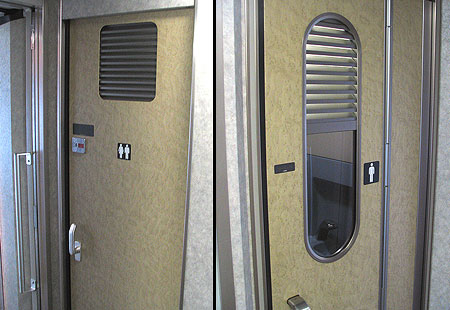
Anyway, what brought the toilet part of this reminiscing back to me was an observation I made today, about something that has not changed on the Shinkansen for all of these years–something that makes no sense to me. Every few cars, there is a set of lavatories on the Shinkansen. One is for women, and is naturally a seat toilet. One is for men and women, and is also a seat toilet. Both are in rooms with a solid door that closes. Natural enough.

What I don’t get is the men’s lavatory: only a urinal, which is fine–but the door has a window in it. See the photo below: the left shows the men’s-and-women’s combo door, the right side shows the men’s-only door.

Shinkansenrestrooms

Here’s my question: why the hell put a window on the men’s room door? There’s no use for it. The other rooms have an indicator showing whether the room is occupied, tied into the door lock. The same could be done with the men’s urinal as well. It would not cost more–in fact, the men’s urinal door with the window must cost more, because it costs more to add a window than to have a plain door. And while many Japanese men probably don’t mind the lack of privacy, certainly some do. So why have the window at all in the first place? It makes no sense to me, though apparently it made sense to someone.

This brings back another memory from that first trip, on the ferry from Aomori to Hakodate, bridging the islands of Honshu and Hokkaido. The bathrooms were located along the outside corridors leading from fore to aft. There were stalls for men and women to do their setting business, but all the men’s urinals were simply lined up out in the open on the other side, where people of both sexes walked past. Not being quite that modern (or old-fashioned, I suppose), I used the stalls.

But in Japan, there is something of a history of men’s rooms being more open to the public. Even today, when I used a store’s restroom, the men’s room door was propped open, while the women’s room door was closed. Often it will be that way, with the men’s room’s urinals sometimes being in plain view of passers-by.

This is in contrast to a feature of Japanese restrooms that I like: the stalls, including the ones in the men’s rooms, are completely sealed from outside view. No gap at the bottom, and more to the point, no gap between the door and the stall wall. When you close the door, there is no way for people to see in unless they climb the wall and peek over. In the U.S., when you’re sitting on a john in a busy public bathroom, you often have to deal with people who want in to a stall, and who apparently don’t believe that a locked and closed door means occupancy–they will often stare right in at you as you sit there, to make sure the stall is indeed occupied. I never liked that, and I can’t imagine that anyone would. That can’t happen in Japan–it’s a fully private little room. Nice.

But one other thing that bothers me sometimes: the cleaning ladies. You can bet that cleaning men are never found in ladies’ rooms. But in Japan, mostly in hotels but also in large buildings like department stores, cleaning ladies are almost always present in the men’s rooms, or so it seems at least. Not that the ladies would necessarily ogle like men might in a ladies’ room, but nevertheless, to bathroom-shy individuals like myself, it is not really a helpful thing. It’s one of those times that you wish they were a bit less gender-discriminatory in hiring the cleaning staff.

Categories: Focus on Japan 2007 Tags:

The Barrage Begins

April 16th, 2007 4 comments

I love a lot of things about Japan. I love the peaceful aspects of the country, the general hands-off character to its religious side, the less confrontational interpersonal habits, and the many differences between its culture and my own which provide fascination as well as entertainment. I love some very specific aspects about Japan, including how there are a lot more people in stores who can help you and how far they’ll go sometimes to help you; how Japanese public restroom stalls are fully closed-off and private; I love Mt. Fuji, and I love the shopping streets with their varied little stores. I love the fact that English is supported so well here (and how it is sometimes mangled). I love to just go out and walk or drive in a random direction and discover new stuff.

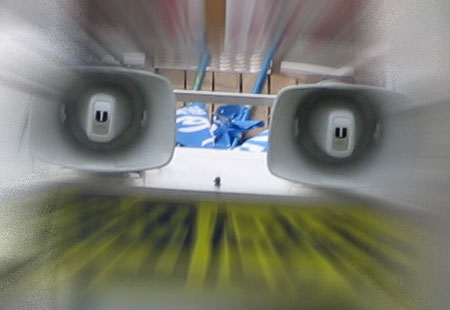
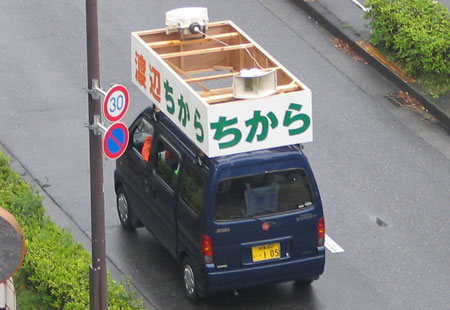
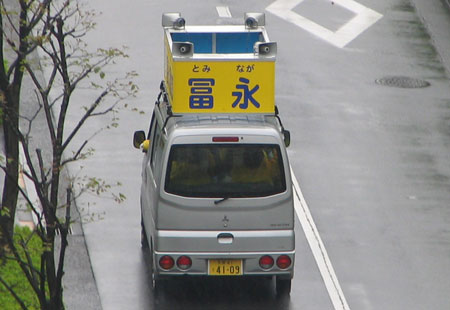
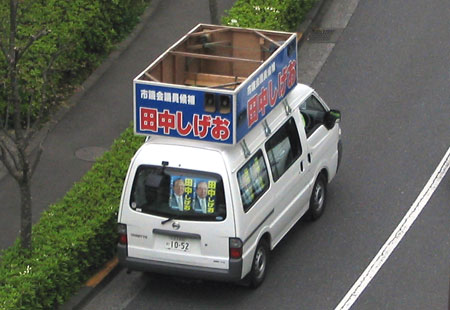
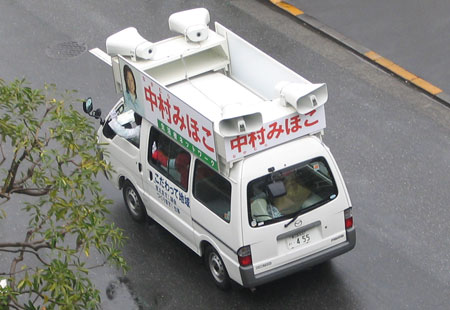
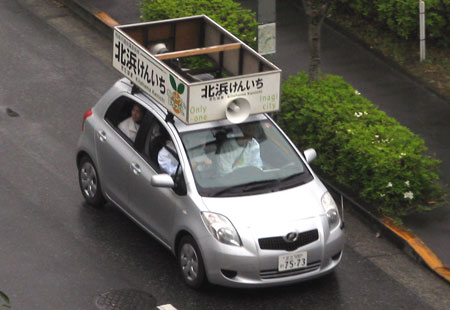
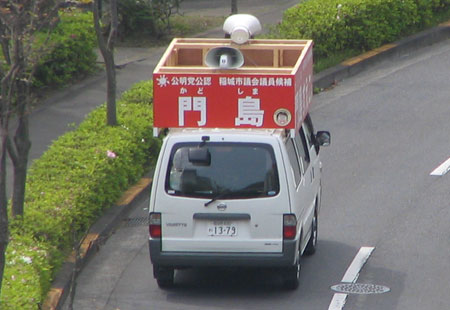
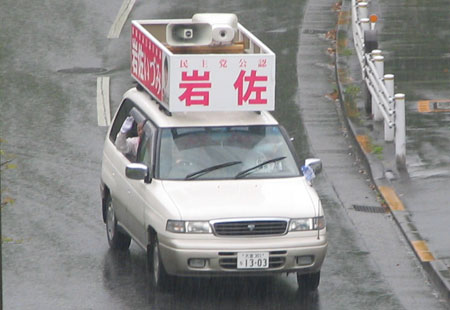
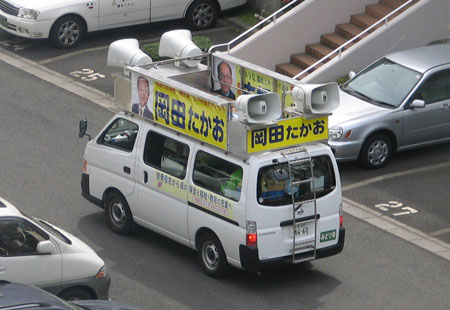
But there are things you hate, too, just like any other country. And at or near the top of my list is those goddamned loudspeaker trucks. I know I’ve blogged on this before, but a little more depth this time. (And sorry for saturating the page with images, between this post and the recipe.)

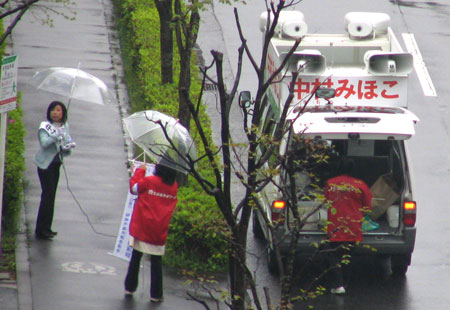
0407-Loudspeakers2

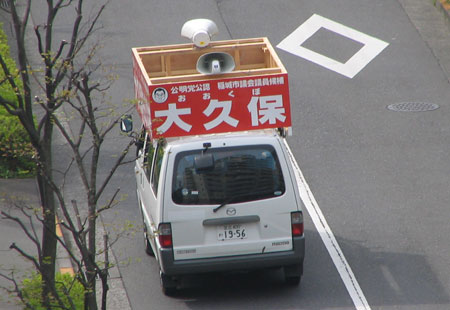
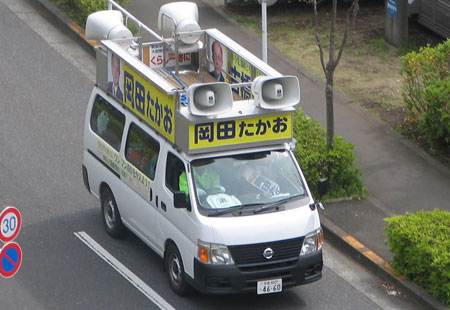
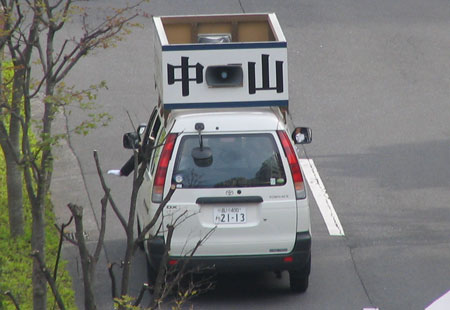
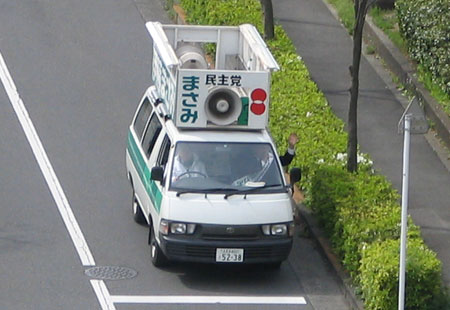
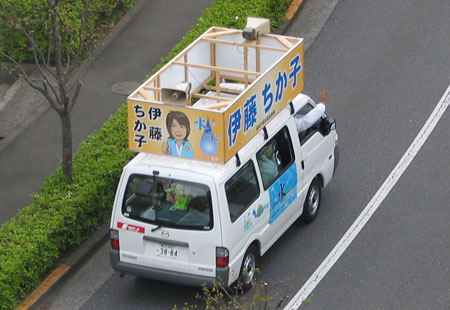
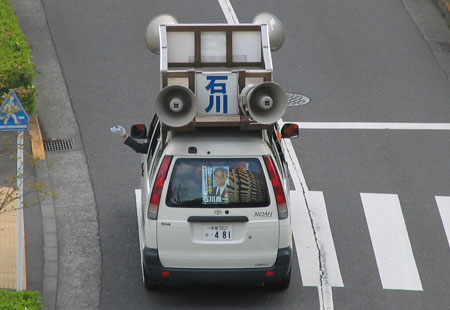
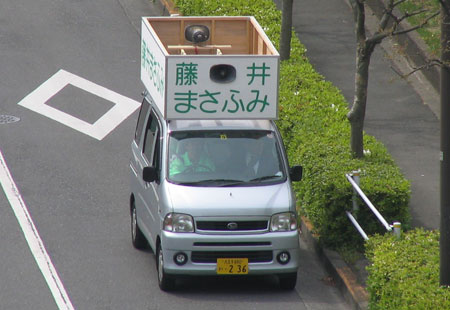
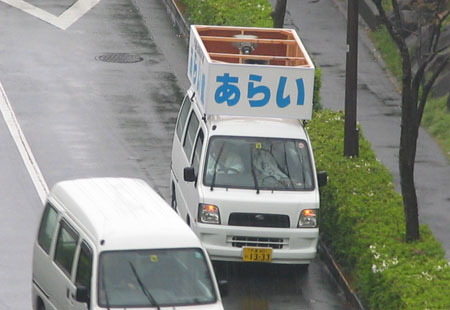
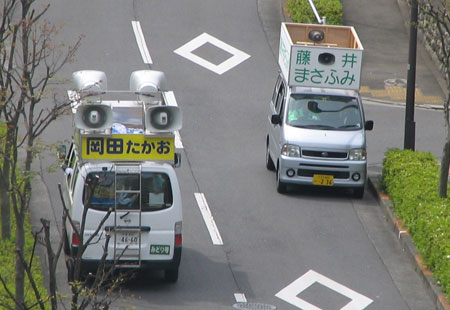
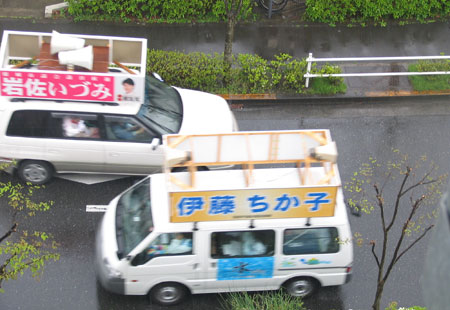
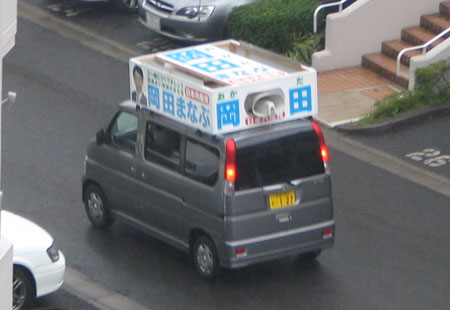
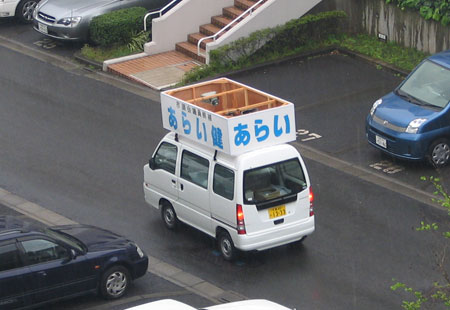
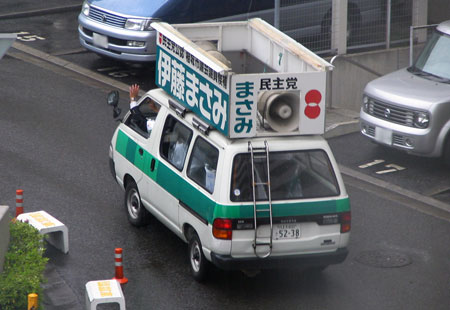
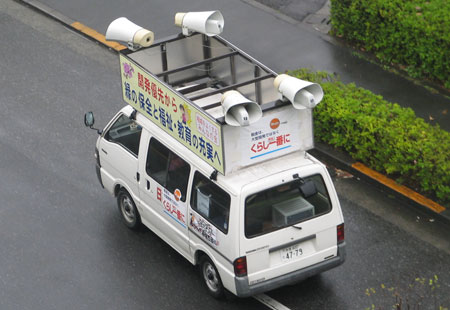
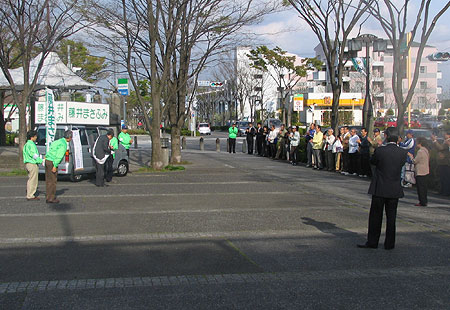
In Japanese elections, politicians have a lot of restrictions which seem good on their surface–such as no television advertising, no plastering their posters everywhere and anywhere, and so on. Not that this really stops corruption. And one other thing it does is limit what the candidates can do to gain recognition: ride around in loudspeaker trucks all day blaring at huge volumes. What makes it worse: I’m paying for the damned things. That’s right–candidates get anywhere from ¥250,000 to ¥450,000 (roughly $2000 to $4000) of taxpayer money to pay for the trucks that wake those same taxpayers (including me) up way earlier than we’d like to–and then to keep blaring away, all day long, without a break.

This whole setup just baffles me. I can understand Japanese people not complaining when this happens–that’s simply part of the cultural landscape (although Sachi tells me that people sometimes do complain, like the two older ladies in the office she temps at). But how do these bastard politicians get away with cruising through crowded neighborhoods at 9:00 am on a Sunday morning (like they did last Sunday), blaring away on their loudspeaker trucks at top volume, and not have the locals get so pissed off that they’d at least withhold their votes? Seriously, do they actually gain votes by waking people up like that?

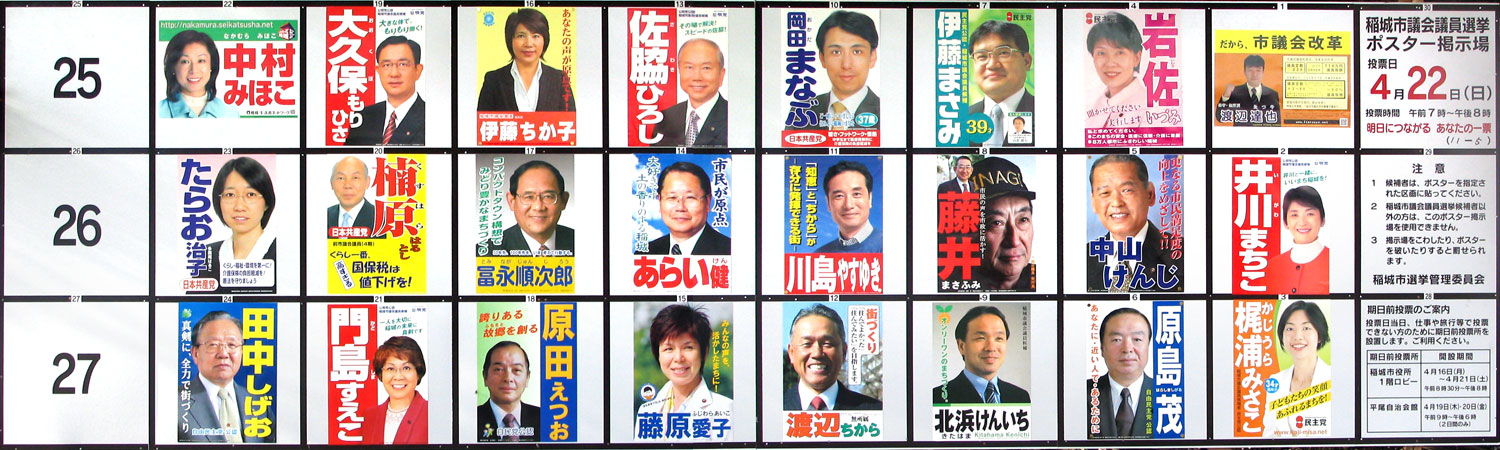
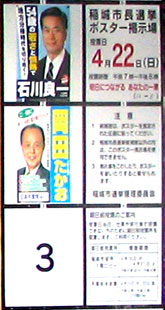
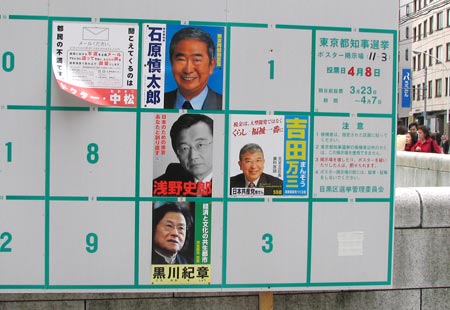
And yet not only is it happening, it is happening in spades. Almost everyone on the ballot is out there. Over the last two days, I’ve been going to the window as often as I can get around to it to snap photos of whoever is being an ass at that moment. In this election, there are two candidates for mayor, and 24 for city council. See the roster below (the main board can be enlarged by clicking on it):

0407-Inagi Councilboard-4500407-Inagi Mayorboard-310

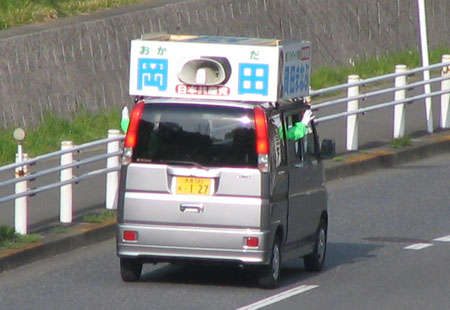
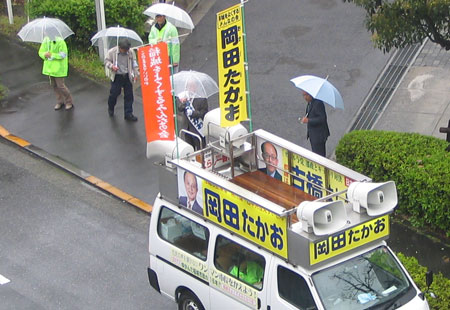
So far, I have caught 16 different candidates rolling up and down the street. In small form (though each pic is in fact 450 x 310 pixels):


In that armada are both mayoral candidates and 14 of the 24 council candidates. As for the other ten, I would bet good money that either I missed them, or they just haven’t gotten around to this neighborhood yet. Almost always, the trucks carry the candidates themselves, and there’s a lot of city to cover. Even so, with 26 candidates running around, they must be very efficient, as there appears to be more than enough time for there to be at least one truck in the area every few minutes–and every so often, two or even three trucks in the same vicinity, as these images of trucks passing each other show:

0407-Pass1

0407-Pass2

Nevertheless, they also somehow find time to make their way into each and every parking lot for every apartment building, and cruise through at a snail’s pace whilst blaring away as loud as ever:


Note that the green truck at the bottom right of the above four photos is the exact same truck used four years ago when I first blogged on this annoyance. A lot of the vehicles are perennials, though some of the candidates who always seem to appear have upgraded their vehicles and their loudspeakers.

Oh, by the way, note that I have not taken the trouble to blank out any of the politician’s license plates (though I have taken care to do so for other vehicles). If someone finds a way to use those numbers to harass the politicians in some way, I ain’t losing any sleep over it. In fact, it is a bit of a fantasy of mine to hire a loudspeaker truck for one week, and immediately following the elections, when the candidate is trying to rest and wind down, to go in front of their house, and for one week, from 8am to 8pm, blare out at maximum volume, “GOOD MORNING!! I AM AN ANGRY RESIDENT!! I JUSTED WANTED TO SHOW YOU HOW FREAKING ANNOYING THIS IS!! GAMBATTE KUDASAI!! ARIGATO GOZAIMASU!!” Over and over and over and over again, for a whole week. See how long it takes them to call the police and complain. Not that the police would do anything if a citizen called, but I betcha they’d move their asses if a city councilperson did. That’s Democracy for ya.

And it’s not even limited to politicians: I even spotted an issue truck, apparently not attached to any party or candidate, just screaming on about what issues they wanted talked about. [Late edit: a closer inspection of the mayoral candidate’s truck shows that on the inside of his truck-top facade, only visible from a height, were similar banners to what is seen on the issue truck. Fair game? Or are they breaking some rules here? — later edit: the issue van is back again the next day, with a different facade; I listened more closely, and found that they are campaigning for both “Okada” candidates, presumably father and son.]

Issue-Truck

And it’s even worse sometimes, when the politicians decide that they like your abode so much, they just can’t resist parking, getting out of the truck, and making a 15-minute long speech, just for you.

Nakamura-Speech

Okada-Takao-Speech

This following photo was interesting–it was Fujii, who parked in a local square and made a speech to a crowd. The thing is, it could not have looked more fake. The audience was lined up along the walkway all nice and neat, nobody left for the duration of the speech, and they all clapped on cue–while actual residents just walked by, completely ignoring the little play. Obviously the supporters were bused in in order to make it look like the candidate could draw a crowd.

Fujii-Speech

Obviously, this system isn’t working. Maybe they should change the laws so as to just let people advertise on TV–but only X minutes per election cycle per candidate, at set rates. Subsidize the damn thing with my taxpayer money if you have to. But just get these damned yammerheads to shut the hell up. At least within the walls of my own residence.

image from Mainichi Shimbun

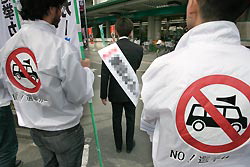
Surprisingly, the politicians actually seem aware that they are annoying the hell out of people: there are at least ten candidates in the region who have joined a coalition of candidates who refuse to use loudspeaker trucks. They still use mics and boom boxes, but otherwise are relatively inoffensive, pedaling around on bicycles to talk to citizens. Much better! I hope to god that all ten candidates run away with victories and it sets off a new trend. Not that I actually expect that to happen. But you can dream, can’t you?

Thank all that is good and holy for one thing: campaign law also says that the candidates can not go around in the loudspeaker trucks before the official election campaign period (usually about 10-14 days) begins. But that one or two weeks can be hell. Forget about sleeping in. I myself have one more full week of this crap to endure before it ends.

Other resources:

Next-day Update: Three more of the politicians so far have added to their names of the obnoxious, making 19 different local politicians out of the 26 running who have no respect for their constituent’s peace of mind. The seven six five four non-offenders so far are Sawaki, Tarao, Harada, Kusuhara, Igawa, Harashima, and one of the Watanabes. [Update: I am removing the people from the list who later show up in their trucks.]

The worst offenders: the Okadas, mayoral challenger Takao and his (apparently) son Manabu, both members of the Japan Communist Party. Their vans are the loudest and most persistent in this area, coming around more than any other candidates, stopping to make speeches and driving through parking lots. They also apparently own the “issue” truck that has made multiple appearances as well.

Categories: Focus on Japan 2007 Tags:

Creepy McSushi

April 14th, 2007 8 comments

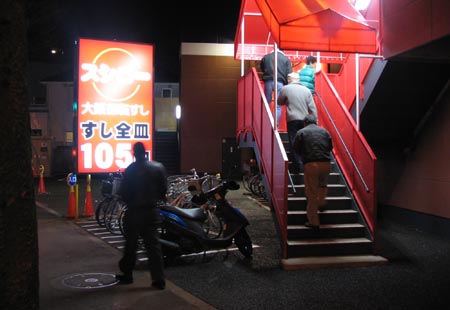
0407-Sushiro1

0407-Sushiro2A little while ago, I noticed that a new conveyor-belt sushi joint (kaiten-sushi in Japanese) had opened up along my route home, and so I decided to check it out. Usually, I go to a place called “Ganso Sushi,” which is a fair place. I’ll order a plate of maguro, and if it’s good, I’ll eat there that night (quality varies dramatically from day to day).

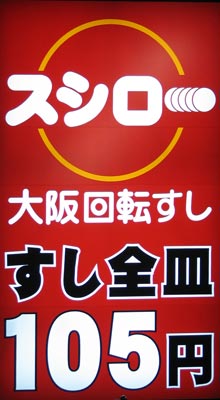
This new chain, called “Sushiro,” makes a big deal of their ¥105-yen plates (roughly a buck a plate, with each plate having two pieces of sushi), which is fairly cheap. This chain has started sprouting up everywhere, with the same building style as many “family restaurants” (Denny’s-style) in Japan–a second-story restaurant with a ground-floor parking lot.

Anyway, I stopped by one evening and went in–and very quickly freaked out. I can’t say exactly why, but something about the place just creeped me out somehow. Unlike most kaiten-sushi joints, this one had no central bay with the sushi chefs. The chefs were hidden behind a wall. There were, instead, three or four rows of booths clustered around conveyor belts that led back behind the wall leading to the kitchen. To order any special kind of sushi, you would talk to the chefs via an intercom, and in a minute or two, the order would come rolling out. How you could be sure that your order would not be snatched up by diners before you on the conveyor belt I don’t know, maybe they have a system for that, an order tag or something.

The thing is, the whole place gave me the willies. It just felt wrong. After figuring out how it worked, I simply felt that I had to get out of there and never come back. It’s one of those unconscious things that you can’t explain. Don’t ask me to be rational about it.

Obviously, I am not in the majority on this: the place was crowded, with people waiting in line to be seated. Every one of these places I’ve seen has people streaming into it, likely because of the low prices.

Still, you won’t catch me in one of those things.

Categories: Focus on Japan 2007 Tags:

Demagoguery in Tokyo

April 10th, 2007 3 comments

Ishiharaboard

Shintaro Ishihara just got re-elected for a third four-year term in Tokyo:

Tokyo Governor Shintaro Ishihara, an outspoken nationalist who is fond of riling Japan’s neighbours, has secured a third term leading the world’s largest metropolis.

Mr Ishihara, who has used racial slurs for Chinese and Korean residents and has described women past child-bearing age as “hags,” had an unassailable lead over his rivals for a four-year term, Japanese media said.

He was first elected chiefly from name recognition, having been the famed author of the nationalist screed The Japan that Can Say “No”, and seems to have gained popularity with his rather overt demagoguery.

Ishihara is not at all loved by the foreign community here, as he has a history of stereotyping and scapegoating on racial grounds, distorting statistics to make it look like foreigners are a criminal menace, and inciting fear among the local population as a means of creating support for his administration. This is in part why you get comments like this:

“I voted for Ishihara as I think Tokyo needs a leader who is convincing and has strong leadership,” said Manabu Koiso, a 24-year-old fish market worker.

In a very real way, it is the same kind of effect that Bush gets when he makes people afraid of terrorism, with the understood linkage to Islam and people of Middle Eastern origin, or that Republicans in general get when they play the race card on immigration (see Bill O’Reilly’s latest meltdown where he tried to connect his immigration scare with a recent drunk-driving tragedy).

For those of you not familiar with Tokyo’s charming governor, here’s a sample of his tasteful commentary:

Roppongi is now virtually a foreign neighborhood. Africans — I don’t mean African-Americans — who don’t speak English are there doing who knows what. This is leading to new forms of crime such as car theft. We should be letting in people who are intelligent.

He has also referred to Koreans, Taiwanese, and Chinese as “sangokunin,” a derogatory term from Japan’s colonial days. In his speech, to Japan’s military forces, he said that these foreigners “are committing heinous crimes over and over” and suggested that such foreigners should be rounded up in case of a natural disaster, otherwise they would “cause civil disorder.” This was evocative of the panic following the Great Kanto Earthquake of 1923, when rumors spread that Koreans were poisoning wells, burning buildings, looting, and even planting bombs; as a result, as many as 2,500 Koreans were killed by Japanese mobs of vigilantes. For Tokyo’s governor to be stirring up the exact same fears even before another quake strikes is reprehensible beyond belief.

But at least he’s a strong leader.

Categories: Focus on Japan 2007 Tags:

Sakura

April 1st, 2007 2 comments

It’s that time of year again. Japanese people love this. It’s the one-week period when the Cherry Blossom trees are in full bloom. All too often, the unstable weather at the beginning of Spring will lessen the impact of the trees; one strong rainfall, especially with heavy winds, can ruin an entire viewing season before revelers get a chance to enjoy them. But this year, in Tokyo at least, everyone got a break: the blossoms came into full bloom on Saturday (though it was a bit chilly), and despite a Saturday night storm that had unusually strong winds, the blossoms stayed put just long enough for the trees to still be beautiful on Sunday, when the temperature shot up 8˚ C (15˚ F) for a 24˚ (75˚) partly sunny day.

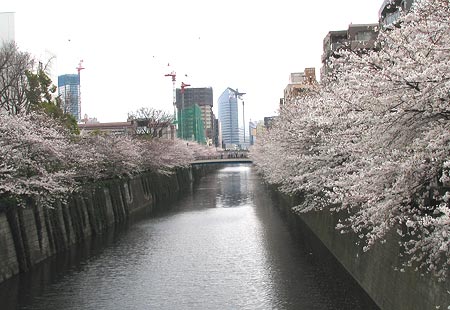
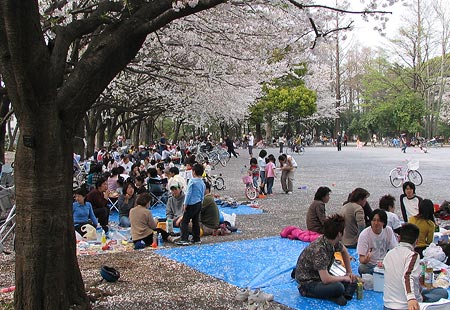
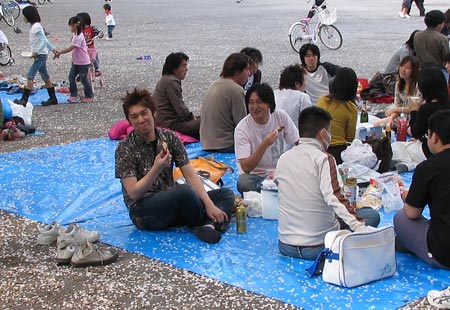
So millions of Japanese people were doing what they always do when this time rolls around: they lay out blue tarps on just about every inch of space under the Cherry Blossom trees, and party as the petals fall. Beer is a favorite (and often times the area smells of it), but people lay out full picnics, including portable gas stoves and everything they can cook, drink, or snack on, while kids run about like crazy. I’ve never been a huge fan of this pastime, but you have to admit, the white-and-pink boughs contrasted against the near-black bark of the trees is quite a pretty sight on a beautiful spring day. Sachi and I went blossom-viewing both weekend days, Saturday along the Meguro River, and Sunday in a local park. Here are some photos from the walks. Enjoy.

0307-Sakurariver-450
Because of their popularity, Sakura trees are everywhere,
lining streets and rivers in abundance.

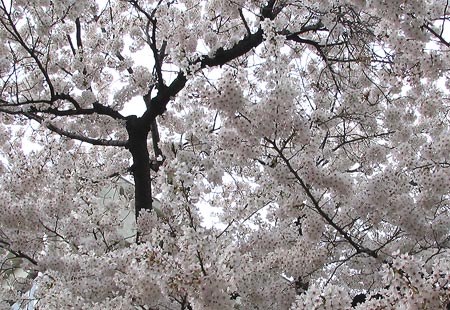
0307-Sakura1-450
This is what you see when you look up.

0307-Sakura2-450

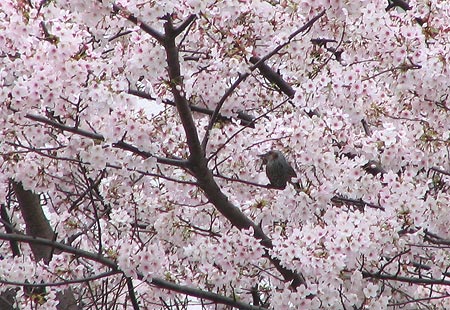
0307-Sakurabird-450-1
The Brown-eared Bulbuls love the blossoms as a snack; they were all over the trees.

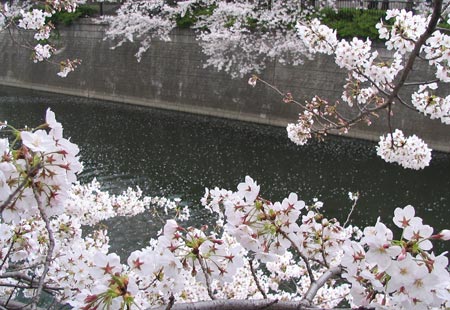
0307-Sakurapetals-450
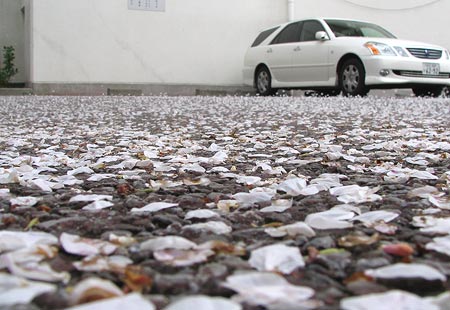
The petals fell in such abundance that they often looked like drifts of snow on the streets and rivers.
Here’s a close-up of one of the covered areas of the Meguro River. (Click for larger view)

0307-Sakurafall3-450
Notice the petals drifting in the breeze just above ground level.
If you walk in such a drift while looking down,
it’s like walking in a river of petals.

0307-Sakurafall-450
And sometimes, when a good gust of wind comes along, it looks like it’s snowing.
Click for larger image.

0307-Hanami1-450
Revelers.

0307-Hanami2-450

And let’s finish today’s post with a nice image of two isolated petals, growing almost directly off the tree trunk’s bark. Sachi spotted this one, and it seemed too poetic to pass up. Click for a larger image.

0307-Sakurabark-450

Categories: Focus on Japan Miscellaneous Tags:

Insane

March 21st, 2007 5 comments

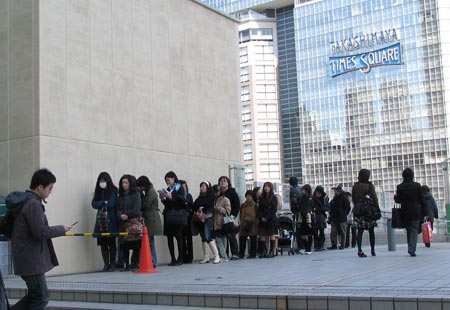
My sister-in-law has been following the madness over at the first Japanese branch of Krispy Kreme. They opened in mid-December last year and immediately there were 200 people in line to get donuts.

Ok, so there’s a hot new shop, and a lot of people want to try it out, so as a special thing, people wait in long, long lines. Nothing weird about that.

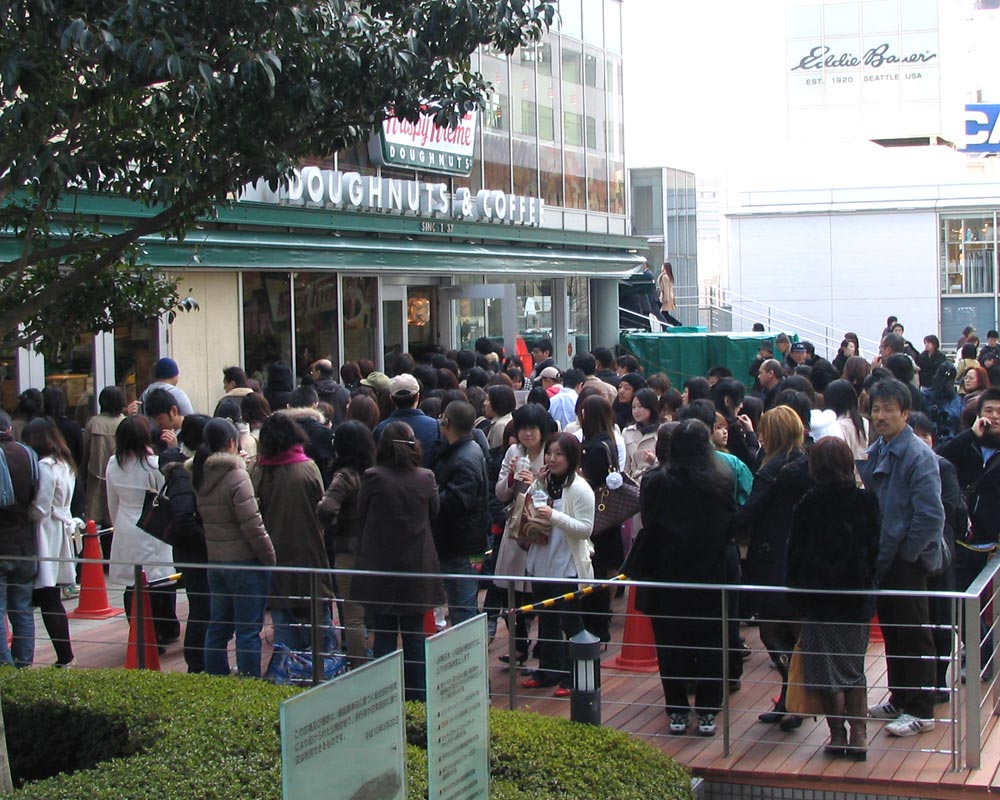
But the lines didn’t stop. Yes, they got shorter, but a few weeks passed, and still the lines were mammoth. Then a month passed. Two months. Three months. And still, my brother and his wife told me that the long lines persist. So I decided to check it out for myself the other day, and indeed, the lines are still there:

0307-Kkd1-450

There’s an amusement-park-style maze-line right in front of the store with what must have been at least a hundred people in it, but it was not big enough; the tail end of the line continued around the corner, with a security guard feeding the store-front line with the people from the auxiliary line whenever enough space opened up.

0307-Kkd2-450

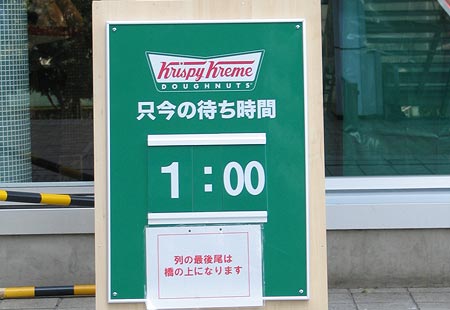
Amazing. Truly amazing. (And yes, those people near the end of the line have a baby in a carriage.) And it’s not like people in line don’t know what they’re getting into; there’s a sign clearly notifying customers:

0307-Kkd3-450

The sign says, “Current Wait Time: 1:00,” with a notice below about the tail end of the line starting around the corner.

Now, Krispy Kremes may be good, but they’re not that good. It’s utterly bizarre. My brother and his wife have asked their students for an explanation, but they’re puzzled as well. Maybe I should try approaching the people in line (“Hi, I’m a reporter from ‘The Blog from Another Dimension’….”) and asking them why they’ve decided to wait for a whole hour just to get donuts. Thousands of Tokyoites, every day, for months on end.

Is it a fad? Mass hysteria? A new cult religion? A huge Homer Simpson fan club?

Categories: Focus on Japan 2007 Tags:

A Good Idea

March 18th, 2007 2 comments

The Japanese train system has always been very good. Anyone who lives here knows that Japan’s copious number of trains run on time (without quite so much fascism), so much so that you can practically set your watch by them. Even more, they stop on a dime, so you know exactly where the doors will be when the trains come.

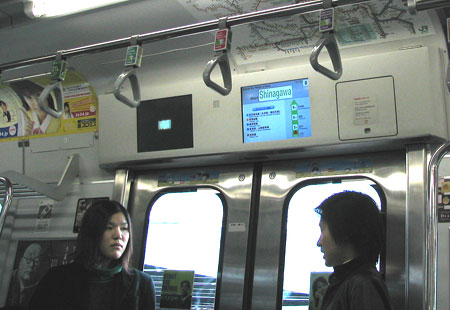
There have been other changes as well, from the welcome (less smoking–for example, JR East’s bullet trains went completely no-smoking just today) to the annoying (as an “anti-terrorism” measure, trash cans–what few there were–were removed from the platforms on many lines). But one change that seems to be taking shape is better information for riders. This from the Yamanote Line, Tokyo’s main loop line:

Jrtv01

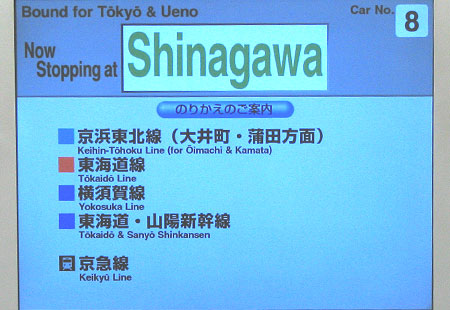
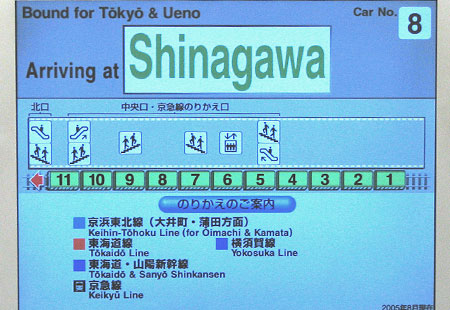
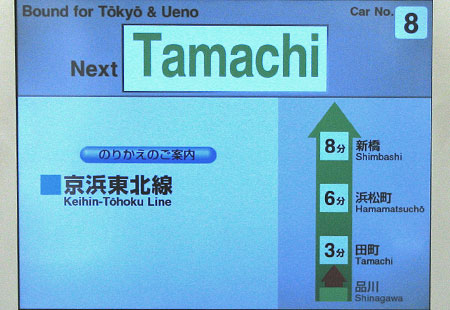
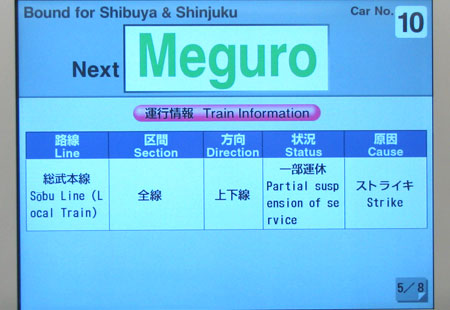
Above these passengers’ heads, you can see a pair of LCD screens. The one on the left is for ads (and the occasional English mini-lesson from Berlitz), but the one on the right displays train information, and it does a good job. Here are some sample screens:

Jrtv02

In addition to what stop you’re coming to, all stations are displayed along with how long it’ll take for you to get there. That’s a nice feature.

Jrtv04

This one tells you what lines you can transfer to from the upcoming stop…

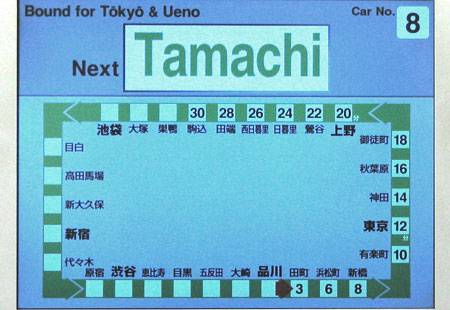
Jrtv03

But here’s a nicer feature: a display of information about where the stairs, escalators, and elevators are located relative to the cars of the train, along with the transfer info. Note the number of your car is displayed at upper right. It even mentions which exits are best for certain transfers.
Jrtv05

There’s also a more detailed display of what’s coming up…

Jrtv06

And info on the status of other lines, should there be trouble.

What should be next is free WiFi on all lines (like they have on the Tsukuba Line now, though I don’t think it’s free), especially with a connection to the train line’s central data center so you can see the status of any and all train lines and get info on how to best get from point A to point B. This feature would bee especially useful as more and more handheld devices are getting WiFi. And if they can afford to install something like 16 LCD screens per car like they did here, why is free WiFi so out of the question?

Categories: Focus on Japan 2007 Tags:

Your Social Window

March 10th, 2007 Comments off

A cool Japanese expression that I learned recently is “Shakai no Mado.” Literally, it means “Social Window.” In English: “your fly is open.”

This brings up all kinds of questions, such as what kind of social interaction are we talking about?

Categories: Focus on Japan 2007 Tags:

Morphing Corporate Baseball Teams

February 25th, 2007 Comments off

In the United States, sports stadiums have started changing names due to corporate sponsorship–note Candlestick Park in San Francisco, which has gone through the names 3Com Park and now Monster Park. But the names of the teams change only when a franchise moves to a new city.

In Japan, however, franchises are not awarded by location; you don’t really hear about a city getting a baseball team, rather a corporation getting one. Baseball teams take on whatever name the owners desire, which means that you’ve got names of the teams themselves morphing from one to another. I just saw a story about the Softbank Hawks, and thought, wha? They used to be the Fukuoka Daiei Hawks (Daiei is a supermarket chain), though when I first came to Japan, they were the Nankai Hawks (Nankai is a railway firm).

Other teams have similar name histories. The Swallows were originally the Kokutetsu Swallows (another railroad firm, this one the now-defunct JNR, the national railway corporation), then they were briefly the Sankei (newspaper) Atoms, then they became the Yakult (beverage) Swallows. The Yokohama Baystars started out as the Taiyo (?) Whales, became the Taiyo-Shochiku (alcoholic beverage) Robins, then the Taiyo Whales again, and then the Yokohama Taiyo Whales.

Then there is the Hankyu (railway) Braves, which became the Orix (financial group) BlueWave, which merged in a businesslike manner with the Kintetsu Buffaloes (formerly the Kintetsu Buffalo before the herd increased I guess, and before that, the Kintetsu Pearls, owned by the hilariously-named Kinki Nippon Railway) and became the Orix Kintetsu Buffaloes, later to be renamed the Orix Buffaloes.

One team name I particularly enjoy is the Nippon Ham (meat-packing company) Fighters, now the Hokkaido Nippon Ham Fighters. Often the name of the team is misinterpreted as the “Ham Fighters,” which I think is much better than just “Fighters,” myself.

One note: for a sport which claims to have acquired its own unique Japanese identity, the names are all English–including even the more-Asian-flavored names, the Carp and the Dragons. The Giants are sometimes called the “Kyojin” (Japanese for “Giants”), but that’s a nickname, not an official one. I have to wonder if that’s a rule or something, because you gotta figure that “Samurai” would be the perfect name for a Japanese team. However, Japanese people would find such names odd. What might appeal to English speakers would sound strange or even comical to Japanese–take the name “Ninjas,” for example. A Japanese person would laugh at any baseball team with that name.

In the meantime, you gotta have a scorecard to keep track of the name changes.

Categories: Focus on Japan 2007 Tags:

Truck Parking Lot

February 15th, 2007 2 comments

In Japan, roads can be pretty narrow, and it’s not uncommon to find a street which is so narrow that you can hardly believe it’s even a one-way street, and then you realize it’s used for two-way traffic. Wide roads exist, but they are few and far between. A three- or four-lane road is fairly hard to find in Japan, with highways (expressways) being no exception to that rule. Commonly, two lanes is a wide thoroughfare in Japan, and most of the major traffic arteries in Tokyo are two lanes almost all the way.

So naturally, truckers make parking lots out of them. I see this pretty much every day on the way to work. I take Route 20, or Koushu Kaido, one of the major east-west routes going through western Tokyo Prefecture. And on the stretches where there are not many businesses, trucks are commonly parked along the side of the road, their drivers taking a nap or break or something. Here’s one I spotted yesterday. In the photo, with time frozen, it’s kind of hard to see that the purple truck on the left is not moving (I should have taken a longer exposure to blur moving traffic), but you can see its parking lights are on. Also note the no-parking sign at top left.

Truckpark

And no, there are no construction sites nearby to explain why they’ve stopped at that location–no unloading is going on, nothing. They’re just parked there. While this happens mostly on the major roads, I’ve seen it on most two-lane streets that I regularly drive on.

This of course forces all traffic for about a hundred meters or more behind the truck to merge into a single lane, and I have often seen three or four trucks parked like this along a few hundred meter’s stretch of road, essentially making a major boulevard into a one-lane street for a considerable length–enough to cause traffic jams.

And, as is usual for this kind of thing in Japan, nobody seems to mind or care or complain. Certainly the police never do anything about it.

Categories: Focus on Japan 2007 Tags:

Fukutoshin Line

February 14th, 2007 4 comments

This is The Line Formerly Known As Line 13, as it were. The new subway line opening between Ikebukuro and Shibuya is now officially the 副都心線, or Fukutoshin Line–literally, the “secondary redevelopment effects on a city center as a result of suburban development” … er, “line,” as defined by EDICT. Though that translation may be a tad stodgy. The three characters are “secondary” (or “vice-“), “metropolitan,” and “heart.” I guess “Secondary City Central Line” might be a better way to put it.

However, the line will not be opening as soon as I had thought. Many sources placed the opening in 2007, but the same article that reveals the name claims the line will open in June 2008.
The line is of particular interest to me because it includes a station less than a block from my work, and would do away with a 10-minute walk now required in my commute. I was hoping it would open in June this year–a nice birthday present for me–but instead I’ll have to wait another year.

Categories: Focus on Japan 2007 Tags:

Japanese Anti-Piracy Movie Trailers Become Even More Ridiculous

February 13th, 2007 8 comments

PircrycomUntil late last year, this was the trailer playing in just about every Japanese movie theater to discourage piracy. (For irony, see the pirate-video-cam version of the trailer on YouTube.) This trailer has been around for a few years, and tells the audience: “Our enjoyment (of movies) is being stolen. Important things will be destroyed. I won’t watch, I won’t buy (pirated movies).” The following text appears during the trailer: I want to protect movies, I want to protect our enjoyment (of movies). … Don’t watch or buy illegal downloads and pirated DVDs. The campaign is called “Save Our Movies.” As if, of course, they are greatly imperiled by movie pirates.

There are several things wrong with the ad. First of all, it is shown pretty much exclusively to people who just plunked down $15 a head to see a movie in the theater, so it’s hard to say what the effect will be of either boring non-downloading patrons with such an ad, or insulting them with the accusation that they do so. Secondly, the ad is pretty strange. Artistic, perhaps, but my own reaction to it was to roll my eyes at the over-dramatization. Maybe some are impressionable enough to be affected by this message, but I have the feeling that most people scoff at it.

But they’ve gotten even worse in their latest trailer which I’ve seen several times now. Instead of the girl crying pirate-black tears, they now have a set of bizarre cartoon frames. I wish I could show them to you, but I cannot find them anywhere on the web. One frame, for example, shows a movie pirate in the back of a theater with a camera up on a tripod, wearing an evil grin, while other patrons stand and shout in anger. One male patron is caught in a ridiculous mid-shout while his girlfriend is crying miserably (while also shouting). Cut to another frame showing the pirate at home insidiously working his home computer with the movie, his hands caught in a villainous rigor.

Now, of course, you would expect this to be ironic, perhaps even self-effacing, intended as comic relief to make light of a situation while still sending the message. The thing is, that’s not the tone of the trailer at all. It comes across as serious, even somber–not like they’re trying to make fun of it at all. It could be tongue-in-cheek, I suppose, but nobody is laughing at it at the screenings I’ve seen. And it is all too similar to similar cartoons shown on Japanese subways to discourage impolite behavior, like talking on your cell phone or spreading your legs out while seated–cartoons with a caricatured offender with bystanders showing ridiculously exaggerated expressions of annoyance or distress.

Maybe I’m just not getting it. Maybe it’s low-key, nobody-laughs comedy like Bunraku. But I have the feeling that it’s not.

Categories: Focus on Japan 2007 Tags:

No Tokyo Snow

February 11th, 2007 Comments off

Ever since they started taking records in 1876, there has always been snow in Tokyo by February 10–the latest recorded snowfall being February 10, 1960.

Not this year. It’s February 11, no snowfall in Tokyo so far, and today’s low was 7 degrees Celsius (45º Fahrenheit), with a high of 14º C (57º F). The forecast for the next week at least shows little change, and no chance of snow foreseen. We might go without snow at all this season, and I’ve heard that the skiing industry up north ain’t having too much of a fun time.

Over the past several years, the first snow has come in December or January. On December 9, 2002, it came just as I was leaving for the U.S., and trains were shut down in much of Tokyo–including the Narita Express–almost preventing me from getting to Narita for my departure.

So, what’s the cause? Everyone is thinking global climate change, and it might just be so. But the better test for that would be in snow not falling in Tokyo for several years. Still, it’s strange not getting at least one snowfall.

Categories: Focus on Japan 2007 Tags: