Archive

Archive for the ‘Focus on Japan’ Category

Moving Day

June 29th, 2007 1 comment

0607-Movingday-Ike

It’s finally here… and now I’ve got a load of stuff to do. I unplugged the fridge last night (lukewarm water in the morning on a hot day… ugh!) so that it’d be ready for transport. I would have been ticked off at the Takkyubin people for calling me at 8 am, except that on this day I had my alarms set for 8:10, so what they heck. Sometime after that, the person comes to remove the A/Cs (hopefully).

Then, at some indeterminate time in the afternoon, the movers arrive, by which time I had better have all the junk cleared up and be ready to go. I pay them cash at the door, apparently, and that’s set up. After they get loaded up, then I lock the door after them and while they drive to the new place, I ride my scooter over to meet them there (stopping by at work for a few minutes along the way). At the new place, they unload everything… and that’s it. For today.

Tomorrow I’m getting a rental van. The movers are limited to a 2-ton truck, so they might not be able to fit everything in. In any case, I have to deliver my air conditioner and gas stove to some people who are buying them from me. So I’ll pick up the rental van from 8 am, may or may not pick up a friend who has volunteered to help, and then will head back here. After packing up the rest of the stuff and before leaving, the recycle shop people are coming around to pick up some stuff; I will probably disappoint them, as they’ll expect a huge haul, but all they’re getting is a computer monitor and maybe a few other small things.

After I’m through with the rental van, it’s back in the apartment to wait for Sachi’s movers to arrive, while I also wait for the KDDI people to hook up the Internet and phone service, and for the cable TV people to come in and do their stuff. Sachi arrives later in the evening, and the unpacking begins in earnest, taking up a lot of Sunday as well. The new bed frame arrives Sunday, and my Apple WiFi base station arrives Saturday or Sunday as well. Monday, it’s back to the old apartment for cleaning… and then the move is complete.

I need more sleep. Life goes on.

Categories: Ikebukuro Tags:

Getting Ready to Lose My Cool

June 28th, 2007 4 comments

Well, tomorrow is the big day. Things are beginning to happen. The piles of boxes are stacking up, the shelves are emptying, stuff is getting tallied. The Kodan inspector was just in a few minutes ago, tallying up the damage–he figures about ¥33,000, less than $300. However, all of my big furniture is still here, and they must know that some damage will not be apparent until the place empties. That puzzled me, why they would send the inspector over before I emptied the place out. I probably saved a lot of money that way. Though I have to wonder, if they find extra damage after all my stuff has moved out (I know he missed a few things, but I kept mum–am I bad?) will they charge that? I don’t know–after all, the guy signed forms and everything, including the paperwork to refund my deposit. And since this is a government operation, maybe they won’t do anything. We’ll see. At least he didn’t charge me as much as they’d warned me for losing my third room key.

0607-Movingboxes
…and I’m not finished yet.

But the big hit for me today will be the loss of my air conditioners. Though I move tomorrow, a person is coming over today to uninstall the air conditioning units. And that’s a big thing for me. You see, I tend to perspire quite a bit; it runs in the family, on the male side. I especially start to sweat a lot when I exert myself, like if I am cleaning my apartment out. So when a lot of the big work gets done tonight and tomorrow morning, I am going to get drenched. Fortunately, the water is still running, so I can shower off OK. But tonight I’ll have to turn off the fridge in preparation for shipping it off (it’s going to the faculty office at my school), which means no cold drinks unless I run down to the convenience store (there’s not even a vending machine closer than the conbini). So no cool air, no cool drinks tomorrow morning. How will I survive? I guess I’ll have to make do with the electric fan and rough it out.

Update: I got a reprieve. They told me that they’d uninstall the A/Cs in the a.m. today–but at 11:30am, there was no call and no show, so I called the moving company. They said that the person would arrive just before noon, and that the uninstall would take an hour. Maybe I’m unreasonable, but an 11:50-12:50 visit is not what I would technically call an “a.m.” visit. I have to go to work, and allowed for a 15-30 minute window after noon, but not a whole hour. They said that the person would come tomorrow instead–which is much nicer for me in any case. One more day of coolness! I won’t have to do my last day’s packing in the heat, thank goodness.

Categories: Ikebukuro Tags:

Lost Summer Light

June 27th, 2007 1 comment

My father asked recently about when it gets dark here in Tokyo, and it got me to thinking. I noticed that while in Madrid, in April, it was light out until very late–well past 8:00 pm. My father noted that it stays light out in the San Francisco Bay Area until almost 9:00 in the evening–though of course he noted this at summer solstice.

In Japan, however, sunset is around 7:00 pm now. Seeing as how Tokyo and San Francisco share almost the same latitude, how is this? The same goes for Madrid.

As it happens, both Madrid and San Francisco are on the western edges of their time zones, while Tokyo is on the eastern edge of its zone; this accounts for a good deal of the difference. In addition, America and Europe enjoy Daylight Savings Time, while Japan has opted out of that plan–one of only three developed nations (including India and China) that don’t change their clocks.

As a result, it starts getting light before 4:00 in the morning, which means that birds start their early-morning chirping at about 3:30, which is how late night owls like me sometimes stay up until.

Seeing as how most of Japan is on the east end of GMT+9, it would seem natural to have DST. DST was implemented by U.S. occupation forces after WWII, but the Japanese government dismissed it immediately upon regaining independence. According to various sources, DST has not been implemented for several reasons: farmers hated it, educators feared it would keep students away from homework in the early evening, and one claim even said it was preferred in the gloomy postwar days, so everyone could get drunk and sleep instead of being depressed in the daylight.

However, it seems that we may be getting a break: this month, there is news that the government is now seriously reconsidering DST for Japan in the face of global warming, and, one would presume, rising energy costs. Hokkaido experimented with DST after a fashion–a non-mandatory shift of working hours. As slipshod as that might sound, it apparently worked, and has fueled interest in DST here. Look here to see a “man on the street” perspective.

Personally, I’d vote for Japan to join GMT+10 and have DST on top of that–then Tokyo could enjoy mid-evening June daylight like Spain gets, and the sun would rise at a civilized 6:00 am during the summer. Even early risers in Tokyo miss an hour or two of daylight, and most people miss two or three hours. I miss four or five, but then I’m weird.

Categories: Focus on Japan 2007 Tags:

Sodai Gomi

June 25th, 2007 8 comments

Today was the first of two “Sodai Gomi,” or “large garbage” days for me. In Japan, when you have trash that exceeds a certain size or is of a certain type, you have to use the sodai-gomi system to get rid of it. Since few people have vehicles suitable for carrying off large junk to the junkyard, this system suffices in its place.

Sodaigomi-Ticket-Inagi

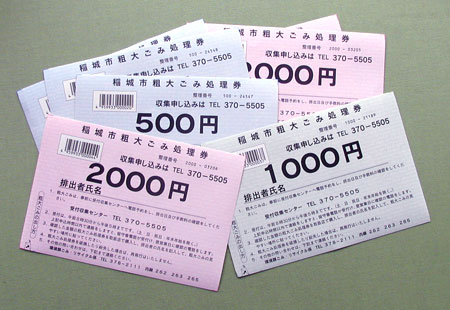
The first step is to visit your city hall, where they can give you a list of prices for all different manner of junk, and a phone number to call for information and reservations. Then you go to your local supermarket or convenience store which sells tickets for sodai-gomi. These are adhesive stickers (not very adhesive, alas) which come in price increments of 250, 500, 1000, and 2000 yen (at least where I live–your city may differ). I bought 25 tickets all told. You’re supposed to put your name on the stickers, which might be a good idea since they can be removed rather easily, and are essentially money, like postage stamps. Then you make a phone call to the sodai-gomi center, and tell them when you’ll be putting out your trash. And finally, you put the trash out in the appropriate place for your street, with the stickers affixed. The haulers will come in and take it away.

So, last night, I hauled all of the junk that one person could carry to the gomi pile, and it was quite a haul. A video deck, three old carpets, two stools, two gas heaters, a gas stove, a suitcase, an old plastic mat, an old scanner, and two old printers. I also had two laser disc players, which involves a little story (as you may wonder why I had even one, much less two). Some years back, my brother and his wife used a laser disc player. They found that LD discs could be bought cheap here, and when I caught on, I bought a cheap player myself and got several discs. Of course, the machines are monstrous and the discs themselves huge, so as soon as they got the chance, my brother and his wife transferred them to DVDs. I figured I would as well, and since my machine was buggy and they no longer needed theirs (they had paid to get it fixed so they could do the transfers), I took theirs to do my transfers. Having finished, I had no use for either machine and so dumped them.

That was late last night, around midnight. This morning, I woke up and looked outside to see the gomi pile disturbed. At first I just thought that someone had knocked over my suitcase while putting out their pink-bag unburnable garbage.

Sdg-Sodaipilepre

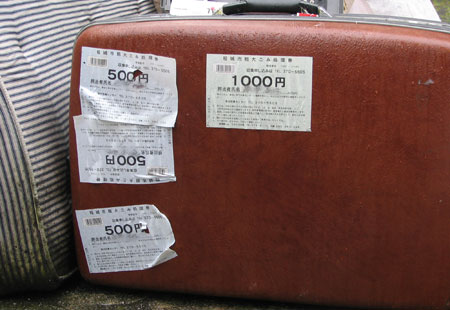
But on a closer look, I found that something else had happened–a few items seemed to be missing: the laser disc players and the scanner. The person who took them had removed the sodai-gomi stickers and had stuck them on my suitcase. The suitcase was askew because the laser disc players had been next to them. Other trash had also been moved aside to get at them.

Sdg-Suitcase

Now, I found this to be very bizarre. First of all, it was raining, not the most opportune time to snatch electronics from the outside junk pile. Second, who the hell wants laser disc players any more? I supposed that this person had a disc collection they couldn’t play anymore or something. And third, the scanner? I did not include the power cable, nor did I include the ancient SCSI cable–not to mention, who has a SCSI-capable computer anymore these days? It occurred to me that maybe this was the work of the junk shop people, but they would probably have passed up on junk like that, instead taking the still-functional gas heaters, or even the less-ancient printer. I also can’t figure out if the pasting of the extra stickers on my suitcase was a courtesy or a rudeness. I also have to wonder if this person will be dumping the machines back out on the gomi pile when they figure out that the machines (or at least two of them) are not functioning. Hopefully, I won’t even be around to have to deal with it.

Now, foreigners have a history of taking this stuff, and I think we usually figured that we were the main ones doing it. But I’m pretty sure no foreigner was involved here, as they’re pretty scarce in this area. I know the only other non-Japanese tenant in this complex, and he didn’t strike me as they type.

This kind of thing is not too uncommon, by the way–Sachi put her sewing machine in the gomi pile a week or so ago, only to find it gone before it could be picked up.

It’s not that it’s a terrible thing–after all, it is junk, and if it can be used, great–but I did spend about twelve bucks on the tickets to haul those items away, which are now wasted. I guess the thing to do is to put your sodai-gomi out a week in advance, and what is not absconded with, then you buy tickets for.

Next week, the movers will put the rest of my sodai-gomi out, the big stuff–two book cabinets, a metal-frame cabinet, a computer desk, a regular desk, my bed frame, and a TV cabinet. Doubt that’ll get hauled off before the city people come, unless the garbage snatchers are very resourceful.

Update: It turns out that the printers are gone as well; I must have missed them before. Maybe it was the garbage guys. That would mean that you should set large junk out a week ahead of time without tickets, on the sodai-gomi pickup day; whatever doesn’t get taken, then you buy a ticket for. I could have saved about twenty bucks had I thought of that….

Categories: Ikebukuro Tags:

More on Noise

June 25th, 2007 2 comments

The more I consider the matter, the more I realize that the new apartment may be less noisy. I think I already mentioned loudspeaker trucks as one issue. In my current place, they are an endemic problem. On a regular basis, we have the junk dealers, the yam and gyoza salespeople, and whatever other vendors or special interest people that decide to harass us on any given day. In the winter, the kerosene seller comes through regularly with a mind-numbingly repetitive melody in dull but piercing electronic tones. And during election times, it’s a wall-to-wall scream-fest from morning till night for two or three weeks at a time. The new apartment building will be a lot less susceptible to that, as it is a single building along a major road, which noise trucks will be less likely to ply; it is not the sprawling residential complex with winding parking lot roads that attract these pests like magnets.

This week has been an example of that. For some reason, the issue loudspeaker trucks are out. I can’t make out what the occasion is, but several different trucks have been rolling by. One is for someone who might be a politician, but seems focused on telling one story having to do with AIDS–over and over again. The van, void of slogan banners, just a van with three loudspeakers mounted on top, passed through my neighborhood half a dozen times yesterday, a few of those times doing to drive-slowly-through-every-parking-lot thing. Another truck had a political party name and one candidate from the last mayoral election, but did not seem to be campaigning. Another truck had a banner for “Seikatsusha Net” (“生活者ネット“), which for all I can figure out, means “Living Net,” “living” in the sense of a person living a certain lifestyle. The noise truck passes are not regular and don’t follow a single theme. What the hell?

But perhaps the one element that is most relevant in terms of the timing of my move is a neighbor across the way. It seems that someone in the building right across from mine has gotten a new bundle of joy–a real screamer. And this tenant has chosen a room in their place to use as a nursery which faces right across from my place, maybe 50 feet distant. And this wonderful mother has decided to leave the windows, and sometimes the door as well, of her apartment open so as to give the child fresh air. Can’t fault her too much on either choice, I suppose, but the end result is that I’m getting treated to full-volume infant screaming on a regular basis now. Lucky me, this started just this week, days before I move out, and not a year or more before now.

Categories: Ikebukuro Tags:

The Price of Convenience

June 22nd, 2007 Comments off

As I’ve mentioned a few times, the new building we’re moving into next week (just one week! Still, time is craaaawling by…) has a small supermarket on the 1st floor, open 24/7. It’s more than just a convenience store (in Japanese: “conbini”) as it has supermarket-style selections, including a full meat and fish section, as well as fruits & veggies, a baked goods section, and so on. But it does resemble a convenience store in the pricing.

When I went to check it previously, they were having a sale, so I couldn’t judge the prices accurately. Now that the store-wide sale is over and they just have the usual odd items on sale, like any supermarket, I figured it might be interesting to check out the differences in pricing between the new store and the supermarket I’ve been using for seven years in Inagi.

Now, you could say that it’s not a fair fight; after all, one store is way out in the boonies and has massive floor space, while the other is downtown with a small footprint. The smaller, new store (“Pororoca”) does not have the facilities to prepare the meat, bake the bread, and so on. So it has to ship it in from some other place where it’s prepared.

And it shows in the pricing. While some items were priced identically (an imported strawberry jam, a liter carton of milk, a packet of spaghetti sauce, a few different kinds of snacks) and fewer still were actually cheaper at Pororoca (carrots, for some reason, and a few other items on sale at the time), most of the items were more expensive. While a few meat products were priced the same at both places, some meats at Pororoca were priced at two or even three times the cost per 100 grams than they were set at my local Sanwa market. Fruits & veggies were more similarly priced (I guess they just get shipped in the same way wherever they go), and many other items ranged from slightly more expensive to about 50% more expensive.

So, Pororoca will be the emergency backup market–kind of like a convenience store (like the dozens of convenience stores within walking distance of the new place), but far better stocked. You can’t get materials for entrees at a convenience store unless you’re really creative. So while our main shopping will probably be at the Seiyu a few minutes away, if we’re in a rush or need something really late at night, we have a place to go get it.

Categories: Ikebukuro Tags:

And Once Again…

June 22nd, 2007 1 comment

When I first asked KDDI to set up an Internet connection at our new apartment, they said it would use the telephone line and I’d need a splitter, a vDSL box, and a router-modem, just like I do now.

Later, they corrected themselves. They would do it through the LAN ports built into the wall; all I would have to do is plug in directly, no problem.

Today, I got another call. Guess what?? Yep, another version of events. Now it seems that they’ll use the fiber-optic cable port (on the left in the image above), and so will need to have some kind of modem box after all.

I can barely wait to hear what their next version of events will be!

Actually, though, I expect that the F/O cable will yield the best results, in terms of speed. But we’ll see….

Categories: Ikebukuro Tags:

Tokyo Back Streets

June 21st, 2007 1 comment

0607-Bs3-450

As I have explained before, street layouts in Japan are somewhat complex, following a different system than is used in the United States. And despite the fact that relatively few people in Japan have cars, the streets tend to be full of them at any given time. Sure, it may not be as bad as you hear New York is at times, and as I ride a scooter, a lot of the frustrating traffic jams are for me more an exercise of finding a way past the stopped cars through the gaps and crevices.

As a result, driving down the main drags can be, well, a drag, if you’ll forgive the piss-poor pun. Streets are not quite so tidy as they are in the U.S. They angle, they turn, they merge, they don’t usually run parallel. So it’s not easy to find a backstreet route in the first place. But it can be even harder because of a phenomenon I like to call “the neighborhoods of no through passage.” I discovered these early on, when I tried to take shortcuts. I would drive down what looked like a promising street to cut through a mass of houses and other buildings to get to an objective that was blocked by traffic on the main roads. (Sometimes there are no gaps to ride through.) A few minutes later, I found myself dumped back out on the road I started from, having found that You Can’t Get There From Here.

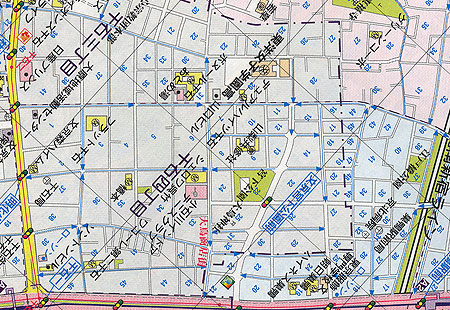
In the U.S., when a neighborhood wants to cut down on traffic cutting through, they usually install speed bumps along the main roads and 4-way stop signs at every intersection. This slows people down enough to discourage those who are trying to find an alternate route. In Japan, however, they have found an alternate method: creatively designated one-way streets. Take a look at the scan below, of an area in central Tokyo:

0607-Tokmap1-450

Note all those blue arrows. They designate one-way streets. Now, starting from the big red street along the bottom, try to take any of the streets heading upwards to the top of the map, without going against any of the arrows, and without going to the yellow street on the left. Go ahead, try it. Similarly, try finding a route from the yellow street at the left all the way to the right side.

Now imagine trying it without the benefit of a map.

Pretty clever, huh? They do an excellent job of blocking you out. Oh, a route can be found, but it’s extraordinarily tricky, especially without a map to guide you. (And even then it’s still hard!) The residents probably come to know the area well enough to be able to get where they want to go easily enough, but strangers quickly become ensnared and no matter how hard they try, they can’t get to where they want to go. As a result, drivers tend to avoid taking the back streets.

And no, the streets aren’t one-way because they’re narrow. In Japan, streets that would be so narrow as to be back-alleys in the U.S. often serve as two-way streets in Japan, as I pointed out in this post. The one-way system has got to be for keeping shortcut-seekers out.

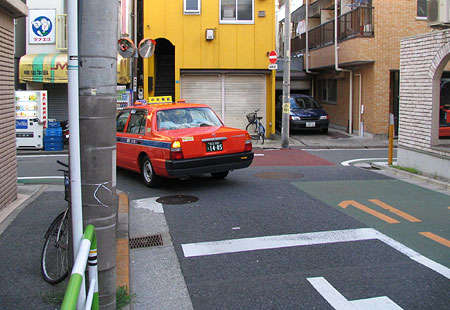
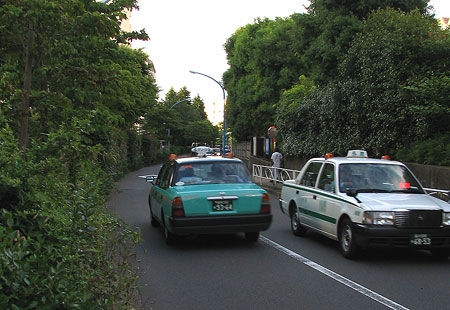
Now, the thing is, there usually is a workable backstreet route–but it’s hard to find. It takes trial and error, and some time studying maps. Or, an easier method: follow the taxis.

0607-Bs4-450

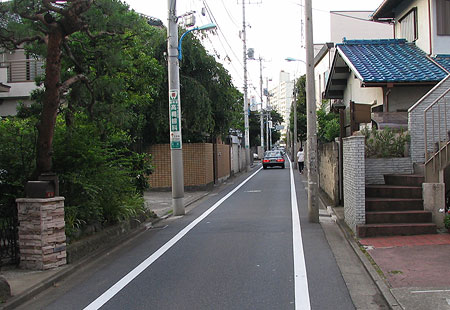
Taxis do this kind of thing for a living. They know all the back streets. Which is why all the photos I took of backstreets here (all are of streets between Shinjuku and Ikebukuro, which will be my route to and from work) have taxis in them. So if you want to go from point A to point B, just follow the cabs, and you’ll get there. The back streets that allow for a path from one place to the other are full of cabs, as well as the other practiced drivers who have found the routes. The back streets may be narrow and tiny, but they’re well-used.

0607-Bs2-450

Some of the back streets are actually quite pleasant; they wind past parks and are sometimes tree-lined. You wonder why more people don’t know about them. But then you look at the map of the area and you can see why. They’re so far buried in convoluted mazes of streets, it sometimes seems a wonder that people can find them at all.

One thing I do know: without a map, you can get lost in Tokyo really easily.

0607-Bs1-450

Categories: Focus on Japan 2007 Tags:

Things to Look Forward To

June 18th, 2007 3 comments

There are a lot of things that I look forward to when we make the move to Ikebukuro. At the top of the list, of course, is being with Sachi–that’s the whole reason for the move, in fact. Second might be the location, being so close to work for a change, and having a major shopping district just a few blocks away. But there are smaller things as well.

1. Living above a 24-hour supermarket. I don’t care if their prices are inflated. It’ll just be really nice to be able to shop at any time I want, and not have to settle for convenience-store food. It’s a small yet full-fledged supermarket; they got everything, pretty much. Now, where you live, this might not be such a big improvement, but where I live, there’s only one supermarket, and it closes at 9 pm (they usually have put the meat away by 8:30). There have been too many times when I come home at 9:30 or later and it comes down to pizza, McDonald’s, or whatever I got in the fridge. Having a fully-stocked market just an elevator ride away will be worth it.

2. No more junk mail. In Japan, junk mail which is actually mailed to you is rare. Unlike the U.S., where only you and the postman are allowed to touch your mailbox, in Japan, mailboxes are free for anyone to dump whatever they like in them. So scores of people are hired to shove endless fliers and crap into mailboxes, especially the ones in large apartment complexes. Which means that every day you come home to find ten ads for each actual piece of mail. When you go on vacation, your mailbox fills to the brim, alerting burglars to the fact that you’re gone. Now, maybe that’s still true for some in the U.S.–worse, as the junk mail is often thicker there–but in the new building, we’ll have the best of both worlds. Since only the postman can get into the mail room at the building, we won’t have the box-stuffers, and because they are Japan’s version of junk mail, we won’t get much junk mail in the box at all. Sweet.

3. No more solicitors. I am sick and tired of newspaper salesmen, religious recruiters, and anyone else who feels like it coming around to my door at whatever hour I’m trying to sleep and wasting my time. The new building has Autolock, a common feature in many apartment buildings. When visitors come, they have to get buzzed in by someone. I can only presume that if a solicitor gets in by following a tenant in through the door, then unhappy tenants who get their spiel will soon call security or whoever handles this kind of thing, and get their asses kicked out. I can only hope that solicitors don’t substitute for this by buzzing everyone’s apartment number in lieu of ringing the doorbell. If they do, they’ll get an earful from me, and I’ll ask the building superintendent to do something about it. But I find it hard to imagine a salesman, no matter how desperate, actually standing there punching in the numbers of three hundred or so apartments.

4. We can put garbage out anytime we want. Actually, Sachi already has this, but I don’t. In Japan, most people put their garbage out on the sidewalk, where cats and crows and other creatures can easily get at it. So in such a situation, you can’t just put garbage out any time you like unless you enjoy seeing it scattered all over the street (at which time, the building’s garbage nazi will scour it for your name so they can have at you); you have to wait until just before it’s collected, twice a week (Tuesdays and Fridays where I am now). If you forget, then you have to keep the smelly bags of trash in your apartment for three or four more days, unless you opt for a largish outside trash can, which most people don’t have the space for–and they’d be unpleasant anyway, as you don’t just haul it to the curb, you instead would have to take the bags out of the can again and walk them downstairs.

When I moved into the place I live in now, they had large metal bins, and you could throw stuff in there any time you wanted. So naturally they took that away a year later, and we were reduced to a net over the bags of garbage. In addition to being a pest magnet and an unholy mess when animals get through the net (which is often), the garbage pile is unsightly and smells. In the new building, though, there’s no net–you throw stuff away any time you want, on the 2nd basement level. Which is where my scooter will be stored, so it’s even right on the way out.

5. Garbage disposal. This is one that I didn’t expect–I didn’t even know this was available in Japan. But the new place apparently has this feature. In Japan, sinks have wide drains which, when you pull off the rubber top, have a small metal mesh-wire drum that you have to put plastic nets over all the time. In Japan, people use these as little trash bags, and constantly shove food cuttings and other bits of garbage into them. But that means you’re constantly changing them, and the drum keeps getting moldy. Yechh. When I first came to Japan, I actually didn’t catch on for several yaers–I thought the net was there for long-term catching of miscellaneous junk, and never used it as a garbage net. That is, until a Japanese visitor to my apartment shoved a wad of vegetable cutoffs into the sink, drawing my rebuke–and then I got a lesson in how it was used. A garbage disposal will be much nicer.

6. Having a balcony you can actually use. Most Japanese apartments have a tiny balcony, if any. Most are just big enough to keep plants on, or fit a washing machine (one of the old, narrow, spin-dry units) or air conditioner outside-boxes. Our new place actually has a balcony we’ll be able to go out and sit on, or maybe even use a barbecue on. Nice.

7. Not having to play tag with deliveries. The new place has a nice flexible locker system for takkyubin or mail deliveries. No more having to find a delivery stub in your door’s mail slot and then having to schedule a stretch of the day where you have to sit around and wait for them.

8. Less noise–hopefully. Even with the very good mansion construction in my current place, some noises still get through. I can always hear when my upstairs neighbor is vacuuming, for example–not from the whine of the motor, but from their rolling it around the floor. That’s the main noise from the neighbors here. The new place touts double-level floor construction, which supposedly will deaden that kind of sound. Let’s hope. Then there’s outside sound. Yes, we are in Ikebukuro, on Kasuga Boulevard, a rather large street. Being on the 21st floor puts us above the sound a little, but not that much. I am told that the bosozoku (noise-loving bikers who roar through neighborhoods at 2 in the morning) don’t run much in central Tokyo any more (they do where I live, just not all the time). But still, buses, trucks, and regular traffic could be noisy. However, all the windows are double-paned glass, which insulates not only heat but sound as well.

I also won’t miss the loudspeaker trucks where I live now, the ones that endlessly weave through the complex parking lots at 5 kph, blaring away at full volume–politicians, junk dealers, food vendors, kerosene sellers, and so on. A constant stream. Also, while living near so much greenery is nice, you also get real loud bugs in the summer, and the crows start getting noisy at 4 am as well. All of these annoyances will likely not be an issue in the new place. Ahhhh….

I am sure there will be disadvantages. Less green. Less clean air, maybe. Waits for the elevator. And I am sure that new annoyances will pop up. But hey, let’s not borrow trouble.

Categories: Ikebukuro Tags:

My New Place, from My Old Place

June 16th, 2007 Comments off

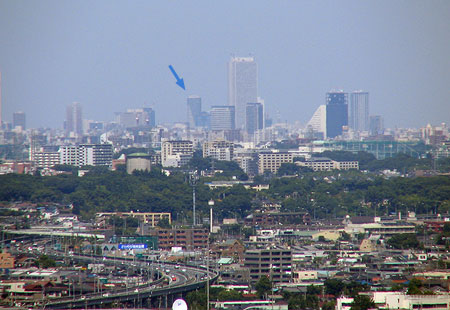
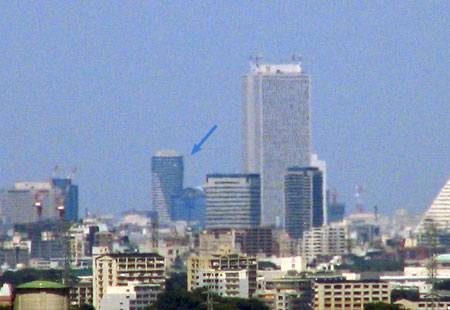
I got to thinking that maybe I could see my new apartment building from the top of my old one, and it turned out that I could. I had to wait for a day that was clear enough, but sure enough, there it was. I could not see it from my current apartment window–a hill blocks the way. I had to go up to the 10th floor and check it out from the landing. So here it is from there:

0607-Newplace0

0607-Newplace1

0607-Newplace3

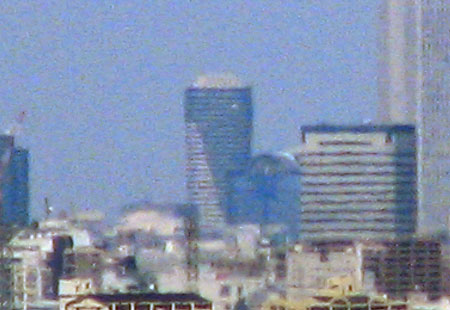
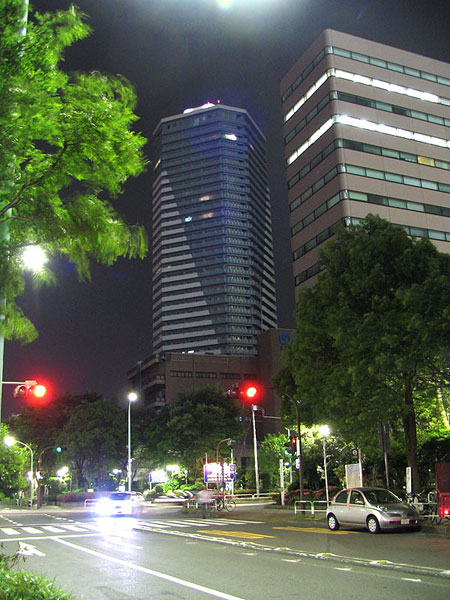
It is, obviously, the building with the arrows pointing at it. You can see the distinctive balcony-style shift that produces that diagonal dark-light boundary across the bottom left. The big building to the right is the Sunshine 60 building.

The shot is not a bad one considering that the building is 23 km (14.3 miles) as the crow flies, or a 30 km drive.

As it turns out, you just can’t see my new apartment. It would be visible on the right lower side of the building. But do you see that low building blocking the lower right? That’s that goddamned Toyota showcase building, the same one that blocks my view of Mt. Fuji. As it would turn out, if you draw a line from Vanguard Tower to Mt. Fuji, my old apartment is directly along that path. (It’s true, I checked it out on Google Maps.) As is the fancy, gaudy, useless roof of the Toyota building. Thanks a lot, Toyota. Well, if I could make friends with the people on the other side of the floor of my new building, we could get a view… either that or just go to the observation deck of the Sunshine 60 and cough up the 600 yen or whatever they charge. Hey, I wonder, is there a place near or on the roof of my building they’d let people go? Probably not….

Categories: Ikebukuro Tags:

It Would’ve Been a Lot Simpler If They Gotten This Straight from the Start

June 12th, 2007 1 comment

KDDI called me back again today, this time with a message that they would be delivering the modem and router to my new address two weeks before I can move in, so I would have to contact them in another department in order to get a new delivery date set up. This annoyed me, as it would seem to make things more difficult–that I would have to wait until a delivery could be arranged after I’d moved in, and I was moving in on a Friday, late Friday at that. Maybe no Internet for the first weekend.

So I called the number they gave and spoke through a translator–but this time everything got a lot simpler. These people said that because of the way my building was constructed, I won’t need any kind of modem or router–that instead, I would only have to plug an Ethernet cable into the LAN port in the wall directly, and that would be it. All the KDDI business would be done by June 14th, and my presence would not be required. All would be ready long before I moved in, and I would have instant 100 Mbps fiber optic Internet the moment I walked in the door.

Which is exactly what I expected from the beginning, and exactly what I told them they should be able to deliver, right from the start. I told them that the mansion was brand-new, that it had FTTH, and that there were LAN ports and even a modular fiber connector right there in the room. But they wouldn’t listen. Instead, I had to wait through a week and about half a dozen different stories about how things were going to work, before finally they told me what I expected to hear from the start.

Now I’m afraid to talk to them again, for fear that they’ll revert to some other story….

Categories: Ikebukuro Tags:

Moving Companies

June 11th, 2007 3 comments

0607-Movers
The rather goofy-looking Hero Shot for one of the moving companies.

When I moved to Inagi from Saginomiya in Nakano Ward, I did it without a moving company. Of course, back then, I had a bit less stuff. Also, my brother and another person helped out with the move. Still, it was not really the most fun experience, especially since my place in Inagi has the most stupid elevator arrangement. For some weird reason, the elevators here only stop at the half-floor, so wherever you stop, you half to climb up or down half a flight of stairs. Why they did this I have no idea; not having the elevator stop level with the apartment doors seems like they wanted to make it hard for disabled people or people moving in and out.

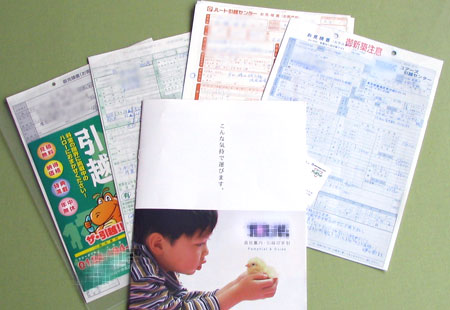
In any case, Sachi was arranging for a moving company herself, and so I got introduced to that whole world. I had never used a moving company before, figuring that I could save a lot of money. But to have people come in and take care of the hairy stuff is really appealing–especially since I have two air conditioners which have to be taken down (one of them has to be installed in Ikebukuro as well). So Sachi and I contacted three different movers and had them come in to do estimates.

That’s how it works: you look through the untold number of moving companies in Tokyo and figure which ones might be the best candidates. Then you have them come in to your place and size things up. Thank god for Sachi: she’s able to talk to the people without the language barrier making things twice as long. I don’t know if I would be able to communicate all the stuff that would have to be communicated if it were just me. Plus she has experience with this.

So the guy comes over and you walk through the place, pointing out what you need to have moved and what not. He takes a tally and then you sit down, and he writes out an estimate, or mitsumori-sho. You discuss all the particulars–the hows, whens, whats, and wheres. How much distance from the elevators to the door so they’ll know how much floor and wall covering to set down, that kind of thing. In the end, he completes the estimate and gives it to you. Then you compare what you get from different places and figure out which one to use.

0607-Movingmitsumori

Of course, the building we’re moving into isn’t making it much easier. They set a limit on the size of the truck–no bigger than 2 tons, which is the smallest truck most moving companies have, a tiny little thing. I would have to get two trucks from the moving company to do it all that way, which would add several hundred dollars to the moving tab. Also, they don’t allow moves on Sundays, or on any day after 7:40 pm. The Sunday thing doesn’t affect me too much, because I have Mondays and Fridays off this semester (and Friday moves are actually cheaper). The 7:40 thing is a bother, though, as moving companies charge a lot less for evening moves. But I may still be able to get the discount if we start from mid-afternoon.

Still, it’s working out pretty well in the end. The movers will move all the hard stuff, take care of the air conditioners, and get all the heavy and delicate stuff taken care of. What’s left over, I’ll cart over myself in a van, with a friend if I am able to get somebody to help. For what the moving company is doing, so far they say it’ll cost a tad over 60,000 yen.

So far, so good. Another three weeks and I’m outta here.

Categories: Ikebukuro Tags:

The Internet Service Phone Call from Hell

June 5th, 2007 6 comments

Jeeezus, I had forgotten about this. Applying for Internet service in Japan can sometimes be an incredibly time-consuming and labyrinthine process. Having just suffered through it again, I now remember having done this a few times before. What should be a simple process of filling out a web form with telephone assistance–choose this, put this info here, etc.–is made into an excruciatingly painful chore. I was on the phone with KDDI, talking to their reps for two hours and fifty minutes. That does not count the half hour I spent talking with their tech people before that or the twenty minutes after. As a result, I am now pretty sure that I have submitted an application, but I have no idea whether they gave me the right service or how it is going to work.

The building I am moving into is supposed to be equipped with the latest Internet capabilities; as you can see in the photo below, there are three LAN ports built into the wall, one modular phone jack, and a special direct fiber optic connector. But from what I gathered talking to the KDDI people, they will bypass all of that cool new techie stuff and give me the exact same old-style telephone-line connection that I presently have in my aging pre-fiber mansion in the sticks.

Jack

None of this makes sense. However, nobody seems to know anything about this. I tried asking the Vanguard Tower sales staff; they said to ask at the orientation. At the orientation, they said to ask the administrative office. At the administrative office, they said to call KDDI. And KDDI seems to know jack. They instead led me through the signup process, by the end of which I had not been told what speed our connection is nor how much we will be paying. I had to ask about those details, and only get the answer for the speed–and later was told that even that wasn’t right. So I am still not sure who was telling me the accurate information and who was not. I have signed up for service and I don’t know anything about it. Swell.

KDDI has to be given credit for one thing: they do try to provide full English-language service. They get it right with the tech support–they speak English pretty well. But in sales, for some reason they can’t hire English speakers and train them in how things work; instead, they hire translators. Bizarre–translators should cost more, and are certainly less efficient than direct communication–but that’s how they do it. And this time (like all the other times, actually), the process was glacial. Probably 80% of the stuff I could have done a lot faster by myself just in Japanese, but the other 20% would have made it all impossible. So we use the translator, and as a result, some issues that should have taken half a minute to resolve suddenly became twenty-minute chores. I sat there looking at what should have been a simple choice, ask a clear question–but then the translator for some reason chooses not to simply translate my question, but instead to repeat five minutes of backstory on my situation, and the sales person then launches into what seems to be a scripted spiel only tangentially connected to my question, which the translator then brings back to me–which does not answer the question I asked. So I ask again, emphasizing the simplicity and asking for the translator to simply ask the question, which half the time would result in a more direct questioning and answer, but not always. At other times, the sales clerk and translator would get tied up with irrelevant details, like would I be getting an NTT land line installed, when it was clearly not required, but they would refuse to move on until I committed to such an answer. This kind of thing happened time and time again, drawing the phone call out far too long. But KDDI can’t be singled out in regards to the difficulties in getting things set up; that seems to be an industry-wide problem.

After getting off from talking with the sales people, I got back on with the technical people and got some things straightened out. The biggest clarification was that we will probably be getting 100 Mbps speeds, despite the sales people saying that only 70 Mbps was available. One operator said that KDDI had not yet installed their equipment in the building, and another said they had. One said I had a choice of plans, another said I did not.

There are likely to be other problems associated with getting a connection, however. As is usually the case with these things, the ISP always insists that it will take three weeks or more between applying for service and getting it. Apparently, it could even be a bit longer in this case because the building is still new. And if that happens, then we might be without Internet service for any amount of time from days to weeks, even longer, in theory at least. During that time, our options are slim: either use dial-up or ADSL, and in either case we’d have to get NTT to activate the land line, which would lose all utility once the fiber optic connection was established. Again, there were conflicting reports; one operator said I could get ADSL on the fiber optic line, though it would be slow and unstable; another said I had to get the land line first. Even worse, they refused to let me sign up for KDDI’s ADSL, instead for some reason insisting that I go to NTT for the service, without clearly explaining why it would be necessary to deal with a second ISP.

But ADSL is not a great option in itself–after all, one has to wait three weeks or more for that to get started as well. Silly me, I just figured that KDDI would have other alternatives available, instead of effectively saying, “We’ll get you connected at some undetermined time, but until then your dark with no options.” I would have an option, though–use outside sources for the Internet. It’ll be just a ten-minute ride in to my school with their network, and there are Internet cafes everywhere in case the school is not open every weekend day.

Maybe someday, using the Internet in Japan will be as simple as choosing options from a menu and having the phone company switch them on more or less immediately. Maybe some places are already like that, though I doubt it. And this is not just a language problem–Sachi had similar travails getting her ADSL line started some months ago, with confused agents and conflicting information, and more. Bottom line is, these people just do not have their act together–and so wasted my entire afternoon on my day off when I could have been getting productive work done.

Categories: Ikebukuro Tags:

Walking Distance

June 3rd, 2007 1 comment

Sachi and I visited Ikebukuro again before going out to dinner with friends. We looked around the Pororoca supermarket on the first floor of the new building, and found it satisfactory. It had a good supply of meat, poultry, fish, fruit, vegetables, and other assorted goods. No Diet Coke, though–I’ll have to ask them to order some. The prices seemed very reasonable, but then again a lot of the prices were marked down as part of their “opening ceremony” sale. We’ll have to go back in a week or two to see if the prices are still reasonable after the sale ends.

We also tested the walking distance between the building and the station. As measured from leaving the front door to the entrance to the station, it was within the ten to eleven minutes advertised; but if you measure it to the ticket gate, you have to add another minute or two. Not really all that bad, except that none of the route is covered; in rainy weather, it could be kind of a pain in the neck. But mostly for Sachi, who will depend on the train; for me, the scooter would be an acceptable alternative. Hell, it would take me slightly less time to go from the apartment to work on my scooter than it would take to go from my apartment to the station on foot. And it’ll be that much harder for her because where she lives now, she’s used to an eight-minute walk, most of that in a roofed shopping arcade. I’m thinking of giving Sachi a present of taxi tickets, to be used when the rain is bad. I know they exist, I used to use them for company classes, but I don’t know if a regular person can get them. I’ll have to call a taxi company and check.

Sachi and I also sat down and got most of the paperwork done–well, actually, Sachi did most of the paperwork while I sat there not understanding what most of the paperwork even was. Not only does she read and write Japanese way better than me–of course!–but she’s got business experience, and has dealt with this kind of paperwork a lot. A fringe benefit for me from the relationship.

And before I forget, Sachi finalized a deal she’s been working on for some time now: she has just signed on to work for a small company that has been absorbed by a larger cosmetics firm, and negotiated a nice salary from it as well. She starts in maybe three weeks or so. Let’s hope that this new place has a better working environment for her than the job she left before.

Four weeks before moving begins…

Categories: Ikebukuro Tags:

Done and Done

May 31st, 2007 Comments off

Sachi and I signed the apartment contract today, and handed over ¥740,000 (roughly $6,100) for the deposit and first few days’ rent (well, we handed it over to the bank by furikomi, but same difference). We got handed the keys (three high-tech keys; the plastic grip also acts as an electronic pass key which opens the front door of the building) and a big load of documents, the bulk of which is pamphlets explaining this and that. Even so, they still could not answers about the LAN outlets and other technical stuff; when Sachi and I first reserved the place, the office people there said to ask at orientation, while the orientation people today said to call up and ask the Kanri Office. Ah well–somebody’s got to know how things work there.

In the meantime, I also got an envelope from JS Systems which gave me another set of keys, these for the cage where my scooter can be parked. So all we have to do is wait about 30 days and then we move in. In the meantime, I have to post ads on Metropolis, maybe Craig’s List, and in the Daily Yomiuri; we have to unload one or two microwave ovens, a fridge, a washer-dryer, a SkyPerfecTV satellite dish and tuner, a desk, a gas heater, and a variety of other stuff. I’ll also have to stop by Yodobashi or somewhere and start asking about getting signed up for Internet service–better start now or we’ll waste the usual three-week “wait while we do nothing for no reason” period.

In other good news, Apple stick rose again, this time by more than $4 in one day to $118.77, continuing a streak over the past 30 days which has driven the stock up about 20%, about 30% over where it was when I bought into it late last year. Just as I write this, it is up again to over $120. My original investment (I bought in at $91, which at the time was a peak and it stalled under that for a few months) has netted about $8000 so far, and now many traders are setting targets as high as $150, seeing as how the stock will likely rise sharply when the iPhone is released, as well as when Jobs unveils the goodies on Leopard at the WWDC on June 11. Apple has just also hit $100 billion in capital and has joined the S&P 100. So far, so good.

Categories: Ikebukuro Tags:

Again to Ikebukuro

May 30th, 2007 Comments off

This time I tried taking the backstreets from Shinjuku. I made it to the Vanguard Tower in about the same time it took to use the main roads, but probably only because I ran into a few dead ends and had to backtrack. Once I have figured out a good backstreet route, it will probably prove to be faster than Meiji Boulevard–but more important then the few minutes it would shave off would be the safer and more pleasant back roads, with less traffic, more trees, and fewer hassles to deal with.

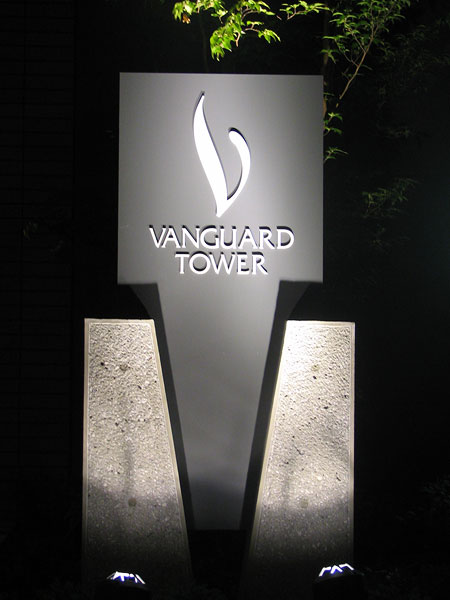
Again (more due to my schedule than to a preference) I visited at night–but this time with my camera. Here are a few views of the building in the evening:

0507-Vt1-450

Note the few lights on in the building.

0507-Vt2-450

0507-Vt0-450

Here is also a wider shot of the entrance; click for a larger image:

0507-Vt3-450

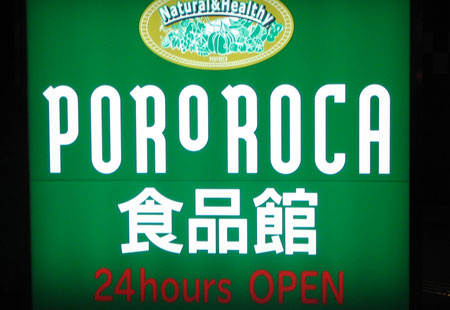
On the left is the 24-hour supermarket which will make life easier. The place is called Pororoca, and seems to be a supermarket owned by the MyCal company; from their web site, they seem to have a lot of stores in central Tokyo. (I have the feeling that it’ll be a tad pricey.) A few are open 24 hours like this one. It’s a bit small, but it’s no convenience store–it’ll have a respectable fish, meat, and vegetable section, as well as a baked goods section. And despite the guy at the store a few nights back telling me that he didn’t know when the branch would open, the web site announces the opening to be at 8 am on June 1st.

0507-Pororoca-450

Go to the right of the supermarket, and you’ll get into the vestibule with the autolock intercom:

0507-Vtv-450

Note the padding to protect the floor while people move in. I think the camera affords a color picture to each unit’s kitchen monitor when the apartment number is punched in, but I have yet to test the color part of that. Once you get buzzed in, you get into the plush lobby (click to enlarge):

0507-Vt4-450

The elevators are in back, with more green anti-movers padding. The doorway at top right is to the mail room.

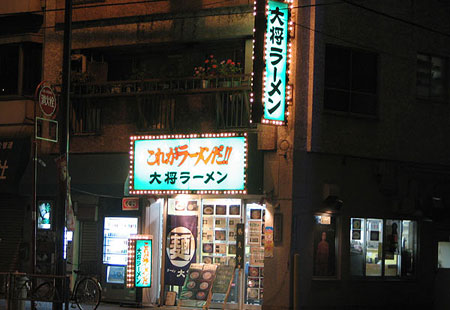
I also spotted Sachi’s Ramen shop across the street. I call it “Sachi’s” because she likes ramen a lot, so we’ll be sure to try this place.

0507-Rm1-450

I also spotted a few of the portable ramen shops–the kind set up on street corners, a makeshift temporary restaurant where you sit down on a stool right out on the street and enjoy your noodles. That just a block away from Vanguard.

I also noted that there’s a bus stop right in front of our building–handy in case the weather makes us want to ride to the station rather than walk. Also interesting is the NTT building (a big one) right next door to Vanguard. If we get DSL, it’s sure to be a strong signal. Also nearby: the Kuyakusho, or City Hall, just a few blocks down the road.

While in town, I also checked out a few other things. For example, I found another supermarket nearby. In addition to the Pororoca and the Seiyu behind Sunshine City, there is a Daimaru Peacock a few blocks further beyond Seiyu. This one is open till 11:00 pm, and is on the basement floor of a new complex called “Rise City Ikebukuro” (which is also an exit for the Yurakucho Subway Line’s Higashi-Ikebukuro Station). I even ran into an old friend at the entrance, and we chatted for a few minutes. She clued me in to a nearby Tsutaya video rental shop with discount days.

0507-Dmpc-450

I also found a Don Quixote store, branded “Picaso,” which is open 24 hours. This is closer to the station but still not far from Vanguard Tower. Don Quixote, for those not familiar with the chain, is a discount store famous for its crowded, narrow, non-linear shopping aisles crammed to overflowing with cheap products. Not my favorite place in the world, but some deals can be had there.

Sachi and I are now pretty much committed to the move. Thursday we sign the contract and pay the deposit.

Categories: Ikebukuro Tags:

Moving Considerations

May 27th, 2007 8 comments

In an attempt to get the most complete understanding of the area that I can before signing the contract to move in, I have been visiting the Ikebukuro area and checking things out. I stopped by in the evening a few nights ago, and noted a few interesting things: first, that the 24-hour supermarket on the 1st floor is now stocked, but a person inside said that they would not be opening until a still-undecided date in June. No problem for us–we move in at the end of June.

The other thing I noticed about the building is that it seems like almost nobody has moved in yet. Only five or six units were lit in the whole building, which has some eight units per floor, on 36 of the 38 floors. While some people may just not have gotten home by 7:30 pm, it is more likely that most people have just not moved in yet. Sachi is worried that way too many people will be moving in at the exact same time, and she has a point. The elevators will be severely taxed, at best, and it could slow things way down. While half the building was taken by people who could move in any time they wanted starting last week, the other half will be spoken for by people like Sachi and me, who may be given the choice of starting rent payments in the same one-week period.

Another thing I’ve been looking at is transportation. Ikebukuro is a hub, and the choices of train lines are considerable. We’re looking at the Yamanote, Saikyo, Shonan Shinjuku, Tobu Tojo, Seibu Ikebukuro, Marunouchi, Yurakucho, and the Takasaki & Utsunomiya Lines. The Narita Express also runs through Ikebukuro, and the new Fuku-toshin Line will start a year from now, if they finish on schedule. There is even a streetcar that runs through, the Toden Arakawa Line, going as far south as Waseda.

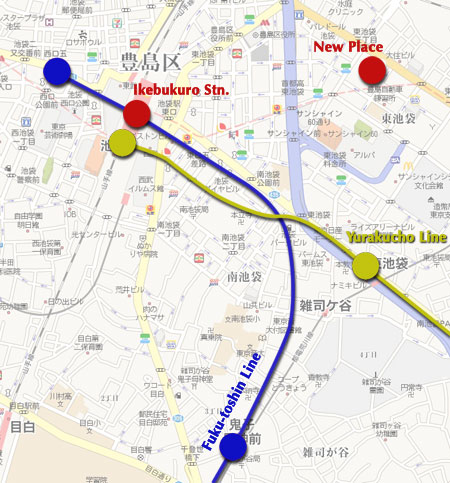
I was looking forward to using the new Fuku-toshin subway line starting next year, but then I realized something: the stations are very inconveniently placed for the new apartment building. It’s as if the planners thought, “how far away from this new apartment building can we place the stations?” and then acted on it. The Ikebukuro station of the new line is on the other side of the main Ikebukuro station, adding maybe 5 minutes to the walk to the station. And while the line passes close to the new building, there is no second station close-by; that’s even farther away than the terminal station. As you can see on the map I ginned up from Google Maps below, the blue line is the Fuku-toshin opening next year, the dots representing stations. The yellow line is the existing Yurakucho Line, for comparison. Note that the Yurakucho stations are more conveniently placed; the Fuku-toshin stations are farther out. Ah well.

0507-Train-Map

The good thing is, my work is a short bicycle ride away. I look forward to using my bicycle to make the trip on good-weather days, and at the same time, exploring all of the back streets between Ikebukuro and Shinjuku.

I also looked more closely at the shopping. As I feared, most of it is stuff I would not be too interested in, but as I also noted, you just need a few good shops to make it worthwhile. And god knows that there’s virtually nothing out here in Inagi, where I live now.

Ikebukuro has more department stores than you can shake a stick at–five, by my current count. Down side: department stores here tend to be expensive, upscale places; the best thing about them is the food center in the basement. Clothing stores abound; maybe good for Sachi, but meaningless to me. Food stores are also plentiful, which is nice, but has the drawback of tempting me to eat badly. Control yourself, Luis! Stay away from those Cheetos! Cost might be an issue; a lot of stores are expensive, but I have already spotted at least a few discount places that I’ll have to check out. There are zillions of restaurants, most of which will be too expensive or not very good quality or service (as Sachi and I discovered when we ate lunch at an Italian place last week). Good news: Akiyoshi has a branch there; it’s a bit far away on the other side of the station, but is close enough. And right next to it is a Spanish Tapas joint which touts authentic Spanish chorizo. We’ll have to see about that.

But the most notable point is the volume of stores and restaurants, and the sheer multitude of back streets. Out of so much, even if only 1% is worth going to, that still represents a large number of good places.

For a while, I thought that the movie theaters might be skimpy–there are eight places, but the closer I looked, the more they seemed to be tiny little places, maybe half of them art houses or something. But the Cinema Sunshine has 6 screens, the largest being 426 seats, and the Humax has four screens, the largest being 483 seats; both of these are within a few blocks of our place. The Tokyu has 300 seats for a single screen. Two more theaters have twin screens and three more are solos, all of which have 100-250 seat screens. Alas, I have grown addicted to the Toho/Warner MyCal theater style, with the reserved seating and western-style popcorn, but these chains are typically outside of central Tokyo, like Costcos are. But there is a Warner MyCal in Itabashi, six stops out on the Tobu Tojo Line. Best for going to movies with crowds and long lines–just drop by the theater and buy a ticket a day or more in advance, then stroll in just before showtime.

Sachi and I are preparing all the documentation we’ll need for the contract signing. One of the documents is a form which states that we are engaged to be married. One of the idiosyncrasies of UR is that most of their better apartments are reserved for couples. The agents tend not to take this too seriously; when I moved in to my current place 7 years ago but was thinking of a unit that is only for couples, the agents actually suggested that I fake the engagement form. Sachi and I are not formally engaged, but we have no trouble putting up the pretense.

We’re also looking at moving companies. One which dropped an ad in my mailbox last week advertises a move for a place my size for about “from $300”–not too shabby, so long as they don’t go too much higher than that. This would include taking down my air conditioners for me, not a small thing. But the big thing is the inconvenience of my building. The people who designed it, for some malicious reason no doubt, made it so that the elevators stop at mid-floor on the stairwell–meaning that even if you take the elevator, you still have to walk up or down a half-flight of stairs. I think I mentioned this when I had the broken foot. It also makes moving a bit of a bear–have you ever tried to carry a large refrigerator up or down a flight of stairs? Not fun.

All we need instead, then, is the deposit money, and first month’s rent. Since we’re starting on June 29th, that’s only two day’s worth. (We’ll have to ask them how the July rent will be handled; as soon as I can, I’ll want everything to be automatically debited from my bank account.) Despite there being no key money or agent’s fee,we’ll still have to plunk down ¥739,940 (about $6,080). Still, that’s far better than double that amount!

In any case, it’s now pretty much solid that we’ll be moving. For a while, I was afraid that Sachi was doing this for me, humoring me with my choice; however, she assures me that she likes the place more than well enough to move in. So here we go!

Categories: Ikebukuro Tags:

296

May 25th, 2007 Comments off

I didn’t know just how many videotapes I had. In part of my pre-moving cleaning, I just bagged and dumped 8 trash bags each with 37 tapes. And I still have another good 50 to 100 tapes left to dump. They’ll have to wait until next week as the garbage guys just came around. The things are mostly full of old American TV shows my dad taped for us, dating back to the early 90’s (I’ve got most on DVD now anyway). I thought about trying to sell them, but hell, it’s enough of a hassle just to move them downstairs, let alone ship them off to someone.

The thing that surprises me: Tokyo considers videotapes to be “burnable” garbage. Umm… really?

Categories: Ikebukuro Tags:

The Price of Pride

May 24th, 2007 4 comments

Sometimes it’s a good thing to have insurance.

A few weeks ago, I was coming back home on my scooter. My apartment building is part of a complex, and each column of apartments has its own bike/motorbike parking area, with a little pathway leading into it from the parking lot. The parking lot has little roads connecting a few different lots.

As I came in on the parking lot road, a takkyubin (delivery) vehicle was parked there, and as they often do, they left their empty cart blocking the entrance to the bike parking area. I asked the delivery guy, who fortunately was there, inside the truck, to move the cart, while I waited. I was almost in the middle of the road, the back of my bike pointing out.

When they guy came to move the cart, he was careless; he got between myself and the cart, his back to me–and then started backing up right into me. Not wanting to get hit and fallen on by this guy, I used my feet to back up a little bit out of his way (scooters don’t have a “reverse”), while uttering some kind of sound to let him know he was going to back into me. That’s when I heard the pop and scrape.

While I was waiting for the cart to get moved out of the way, a guy and his wife were driving out of the lot. There was barely enough space between the back of my bike and the other side of the road for this guy to get through, only a few inches clearance. Worse, since he was going downhill, he coasted, which meant there was no engine noise to warn me he was there. He did not make any signal that he was about to pass within inches, despite the fact that he could clearly see that I could not see him. He saw everything that was going on and had ultimate control of the situation. I did not have to back up much for my tail luggage rack to hit the side of his car as he passed.

Well, you know people and their cars. In Japan, it can be even worse than America, in fact; people have an almost obsessive-compulsive desire to keep their cars spotless. There are exceptions, of course, but one thing even car-loving Americans tend to be surprised by when they first visit Japan, is that so many of the cars look squeaky-clean and new.

So this guy hears the scrape, stops his car, and jumps out, pissed off as hell. Even in Japan, where people tend to avoid fights and conflicts, if someone feels that you’ve scraped his car, he’ll be ready to jump down your throat. A few years back, I passed a van in a close situation. I know exactly what happened: my muffler scraped the curb, but I know for a fact that I did not touch the van. The owner of the van, having heard a scrape, felt differently. I knew nothing of this until several blocks later, when a man jumped out of his van, leaving it in mid-traffic, strode up to my bike as I waited at a red light, and made a grab for my keys. He later came back and parked nearby when I told him I’d wait. He was pissed as hell, saying I’d scratched his van. I asked him to show me where, and in an ironic twist, this was one of the few people in Japan whose car was full of scratches. He turned to his van and started to point, but soon saw it would be hopeless to identify which one was supposedly the one I had caused. In our pursuant discussion, he said that the scratch was not as important to him as the fact that I did not apologize (though I think that the fact that his van was already in bad shape helped to turn that balance). I explained that I did not scratch his car, I was positive I had not–but he said it made no difference. So just to end the situation, I apologized. They guy nodded in a lordly manner, and left.

That is one way to defuse the situation: apologize profusely. In Japan, that does not necessarily mean a legal admission of fault or guilt, it is often just to grease the wheels. It was the same with the guy I was now dealing with in my building’s parking lot. Had I turned over, shown my belly, and allowed him to growl over me, his dominance assured, things would have gone differently. Unfortunately, my American tendency not to instantly apologize but to stand my ground, this was still strong enough–in addition to the fact that it was not such a clear-cut accident. I have no problem admitting that I should not have backed up without looking. However, there were mitigating circumstances. First, I did not move under motor power–I simply backed up with my feet, and did so to avoid collision, under a split-second choice. Second, it’s not as if I switched gears and backed up while having time to be careful and look both ways–it was a sudden, reflexive avoidance reaction, like ducking back if someone puts their hand too close to your face. And third, his car was to my back and silent–and I still hold that if you decide to pass within inches of people with their backs turned to you, you must accept at least some of the blame yourself.

This guy was having none of that. Even more pissed that I did not immediately humbly apologize for being fully at fault, he became even further enraged when I explained that I was not yet sure that I was 100% to blame. His wife was no help to defusing things, she backed him up and was similarly angry.

Well, we called the police to take a report on the accident, and called the insurance companies. In this kind of a case, despite the mitigating circumstances, I was technically at fault–mostly because my bike was moving backwards, no matter how little or for what reason, and hit his car on the side door, leaving an almost invisible blemish. He had the blemish, and all I had was my story.

You may think I understate when I say the words “almost invisible blemish.” However, I use those words because when the police asked the guy to point out the scratch–they could not find it themselves–the guy came to point it out…but couldn’t find it. Not for several seconds, at least. As it happened, I had already found the scratch a few moments before he tried to, and saw that he started by pointing almost at it… but then his finger wandered away from the scratch, and he had to look really hard in order to finally locate it. That was the extent of the damage. It was so light that at one point, I wanted to try to rub it with my finger to see if it would come off, like a soft paint transfer–but before I could touch it, the guy yelled at me threateningly, telling me not to touch it. The way he was looking at me, I swear he would have gotten physical had I gone ahead and actually touched his car. (Who knows, maybe he was afraid I’d wipe the smudge off and he’d have nothing to stand by; it’s not as if I wasn’t going to pay for it anyway if I made it worse, he already had my insurance info by that time.)

It still rankles me a few weeks later to remember it. I could not prove that he passed within inches, nor could I prove that I only moved back a few inches, even if it would matter (which it probably wouldn’t). The delivery guy had his back turned and so saw nothing. I accept responsibility for not looking before backing up, no matter why I did it, but this guy refused to acknowledge that he might even be in the smallest way also responsible for his silently passing within inches of me when I had my back turned. Instead, he acted like I had just delivered the worst possible insult to his manhood by leaving a near-invisible scar on his automobile and did not immediately prostrate myself and beg forgiveness.

Fortunately, I have insurance for this; I paid about ¥40,000 for two years’ worth of insurance to cover damage to other vehicles and property. When I spoke to the insurance office (someone there speaks English well), they at first suggested that I wait until the damage estimate came in to decide whether or not insurance would pay, as my next insurance payment would go up by $100 if I did. The insurance agent seemed to think that the repair could be done for under that amount, and if so, it would be better just to pay out.

A few days later, I called them back. They told me how much Mr. “My Car Is More Precious Than Life Itself” had the vehicle repaired for.

¥181,461. In U.S. dollars, that $1,493.

For a nearly invisible smudge on his left rear door.

Am I nuts, or could you not replace the entire freaking car door for less than that? It wasn’t a Mercedes or any type of luxury car, just a standard domestic sedan. And in Japan, this kind of repair is usually less than it is in the U.S., at least as far as I have seen and heard before now; parts may be a bit more expensive, but labor is usually much cheaper here.

So naturally, the insurance will catch it, and if I want further extended coverage, I’ll cough up the extra hundred. If people can get away with highway robbery like that and the insurance company agrees to pay, it means that I’d better have the extra coverage just in case something like this happens again.

To be perfectly honest, if it were me, I would not even have cared about such a blemish. Cars get scratches. Deal with it. Live with the shame. Better to have a few scars than constantly be wound up about what might happen to your beautiful faux manhood. My brother and I used to share a car in college; it looked like crap, and we didn’t much care. It’s a thing, and the thing worked just fine. In that car my brother and I had, we got rear-ended several times; each time, the insurance companies pointed out that the car wasn’t worth enough to make a full repair of the severely dented back end, so they just paid off the total cost of the car–something like $700. My brother and I just had a basic un-denting done, and didn’t think about it again. We certainly didn’t get mad or angry or excited about it, nor did we go ballistic when the other driver essentially said, “whoops!” and “here’s my insurance info,” even though we knew the insurance wouldn’t pay to set things back to the way they were before. And heck, my scooter has been scratched on several occasions–some by myself, other times by others–and I barely notice or care. Who really gives a damn? I mean, I love my Mac PowerBook like some people love their cars, but if someone scratched it, I’d say, aw, too bad, and go on with life. I wouldn’t fly into a rage and demand his insurance pay $1000 to replace the casing. If it still worked, that’s what matters.

Now, safety, that’s something else. A few years back, on my old scooter, I was driving across a bridge, in the middle of the single lane of traffic going my direction. Some ass in a car wanted to speed past me. He did not even bother to honk at me, flash his brights, or otherwise indicate he wanted to pass. Instead, he just flew past in a confined roadway while I was still in the middle of the street. I was already going about 10 kph faster than the speed limit, about 60 kph, and this guy was easily doing 70 or more–and as he passed me, his car side-swiped my scooter, throwing me off balance and nearly making me crash. I could hear his car scrape against my bike for what seemed like one or two seconds as he passed me. That must have left quite the scrape on his car… but of course, he did not stop. He sped off.

I was soon able to catch up to him, and honked at him to pull over. I know, it was stupid to, probably, but I was pissed. Not because he might have scratched my precious bike. Rather, because the bastard had come this close to frakking killing me. He dodged down side streets, tried to shake me as I pursued him, honking my horn all the way, hoping to attract a police officer. I busied myself memorizing his license plate (Tama 300, な 81-83, and I don’t give a damn who knows), before he finally got away by going up a ramp to an expressway, which my level of scooter was not allowed to enter. Maybe I should have still followed him and caught him at the toll gate… but then again, the prick had a nationalist hi-no-maru sign in his rear window, so maybe I was better off leaving him go as I did.

Instead, I went to the nearest police station, gave them the license plate number and a description of the car, and filed a report. The police assured me that my name would not be released to the guy; they could not file charges, after all, having no eyewitnesses, but they told me they would visit the guy’s house and give him a talking-to. Despite my lack of faith in Japanese police, I have little reason to believe they did not. Maybe I wound up causing the guy some grief after all–maybe it was a stupid kid driving daddy’s car, and the police visit did him no good. I like to think so, anyway. I also was confident it would not come back to me as the guy did not have my license plate number, nor any idea of who I was or where I lived.

My point? If somebody nearly kills you, getting pissed may be stupid, but at least it’s understandable. If someone barely smudges your car, I can even understand you not accepting what responsibility you had and trying to lay it all on the other guy–you’re protecting your own interests and being defensive, and that’s human nature. Maybe I’m doing that here more than I deserve to–I don’t think so, but it’s possible. And understandable.

But don’t expect me to accept your rage as an equally understandable reaction.

Categories: Focus on Japan 2007 Tags:

Measurements

May 22nd, 2007 18 comments

Before I start, I should give you warning that this post delves deeply into minutiae about the new apartment. Unless you’re into checking out other people’s places or are curious for some other reason, this post may be a huge bore for you. So be warned.

Before going to work today, I stopped by the Vanguard Towers to measure the place. In order to figure out which of our things we can fit into the new place and where they will go, I have to get precise measurements of all walls and distances; then I create an accurate-to-scale map on my computer; then I measure and represent each piece of furniture in the map; and then I arrange things to see how they’ll fit.

Already two things have become apparent, even before making the map. The first is that the bedroom will be a tight squeeze. I was hoping to have a bed and cabinets in the room. Now I have to wonder if the bed alone will fit. A 6-mat room (actually, a shade less than 6 mats) does not fit a queen-size bed very well. The problem is that my current bed has a headboard that’s 25 cm (10 inches) long. Without it, the bed would fit sideways into the room; with it, the bed fits, but it prevents a closet door from opening. Argh. But that’s what the computer map will be for–arranging the furniture well before it’s an immediate physical concern.

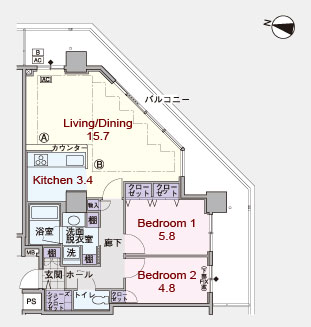
The second issue concerns space. The apartment is 72 square meters, only 12 square meters less than my current place. I’m wondering where the hell all that space is going; cut off a 6-tatami-mat-sized room (roughly 12 square meters) off of my current apartment, and I still seem to have more space here. The space, as it seems, goes to two places: the hallway in the new place (my current apartment has none) and the odd shape the living-dining area has. Angled corners eat up a certain amount of space without allowing for full utility.

These things are kind of disappointing and are leading to second thoughts. But then I just remember that really, almost any place we get will be like that. We’re not getting any bigger-sized a place near central Tokyo, and finding one that would fit the furniture perfectly would be even more rare still. I have to remember what a huge place I enjoy now, and that there are compromises to be made–especially with two people moving in together.

But in the end, these are design and arrangement problems; again, the map will help figure out how best to utilize the space. So we’ll see. Hopefully I can have the mapping done by the end of the week, and Sachi and I can puzzle over it.

In the meantime, I got digital photos of the apartment and the view. The first time I visited, I only took videos. So here are some images of the place:

0507-Newaptldk-450
Click on the image for a larger (1000-pixel wide) view.

This first shot is a combination of three photos showing the kitchen (left) and the living-dining area, or what was visible of it from the other end of the room (my camera’s lens is not wide-angle). The brown-paper “curtains” make it hard to see the cut-in angle of the large windows. I show the apartment layout again below so you can see where I was standing for the shot–I was in the Living-dining (yellow) area, lower right corner, as seen on the diagram below.

Now here’s a shot taken from the other end of the room (top left of the yellow area) again with a larger view on click::

0507-Newaptldk2-550

Now, for the view from the balcony. First, the balcony itself. It’s really hard to show the whole thing, so I won’t try. But for a small taste, the image below shows the really narrow part of the balcony, the central part. Note that the balcony widens out to twice this much at each end–but since those are around corners, they’re danged hard to show.

0507-Balconynarrow-450

I can’t really show the wider end areas enough to do justice to them, there’s no vantage point far enough away to show them in full, so enough gets cropped out to make them look cramped; in addition, the outward view gets cut out as well, which is what makes the spaces refreshing. Ah well. Just imagine them.

Because the balcony goes around two corners of the building, it allows a view that starts (from left) just a shade left of North; East and South are both in full view, and West is just occluded by the building at the other end of the balcony. Here’s a squeezed 580-pixel-wide version; this image is a stitched panorama of eight or nine different photos. The original was 9000 pixels wide. If you click on the small image below, you’ll get a bigger (3000 x 333 pixels) image. The cardinal compass points are marked in light blue text and arrows. Just remember when you’re looking at it that it appears flat, but really represents a 270-degree roundabout view. If you could print it out on a strip of paper and then curve that to make 3/4 of a circle, that’s be the real view.

0507-Vtpanorama1-580

One more shot, a crowd-pleaser, I hope: our new toilet.

0507-Captainschair-450

This is common in Japan: the bidet/washlet toilet. Or as I call it, “The Captain’s Chair.” Now do you see why?

That note, by the way, says that you can’t use this toilet yet.

Inevitably there will be more coming about the apartment. Can you just not wait?

Categories: Ikebukuro Tags: