
Christmas in Japan
 Well, it is exactly a month before Christmas, and I’ve noticed people putting up their Christmas decorations recently; scattered apartments and houses around Tokyo putting up lights, stores with the usual displays, playing Christmas carols for store music. Even though Japan is predominantly Shinto and Buddhist, with Christians forming a minority 1% or so, Christmas is nonetheless a middlin’-to-big thing over here, for much the same reason it is in the U.S.: commercialism. But with a Japanese twist.
The traditions in Japan are different, however; first of all, almost nobody has an actual Christmas tree. Trees in Japan are way too expensive, and there are no Douglas Fir farms in the hills that I know about. If anyone has a Christmas tree in Japan, it will be made of metal and plastic, readily stowed away in a closet from January, waiting for the next holiday season. And, to the best of my knowledge, even if a Japanese family has a tree, presents don’t get put under it; it is simply a decoration. No cranberry-and-popcorn strings, either (I always loved making those with the family), rather just some ordinary store-bought garnishes. I’ve never seen tinsel here.
Presents are exchanged, though Christmas is not exactly the reason: it is bonus season. In Japanese employment, one’s meager salary is usually bolstered by bonuses, traditionally given out twice a year–once in summer, once in winter. The summer bonus 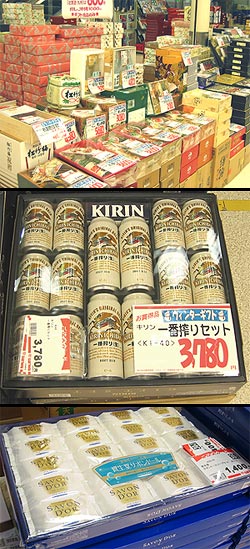 marks the Chugen season, the winter one is called Seibo. Each one is marked by a special gift section created in stores across the country, sometimes taking up as much as half of a floor of a department store. In such gift areas you’ll find a plethora of items, popular ones including small rolled hams, and a wide variety of product packs–a 20-piece soap package, a 15-can beer package, packages with assortments of cookies, coffees, salad oils, fruit juices, canned seafood, and countless other consumer items. One buys gifts here and either gives them or has them delivered to the recipients. The Seibo gift centers are already open for business.
Next is a tradition also made in Japan: Christmas Cake. Don’t ask me why, probably a confectioner thought it up, just like they thought up White Day for bakers (White Day comes a month after Valentine’s Day–Valentine’s is for chocolate, which women give to men; White Day is for men to give cookies or other treats to women, and is supposed to have been created simply as a way to sell sweets). At Christmas time, people who choose to celebrate have a Christmas Cake. It even became a metaphor in the 80’s–women who had not married by age 26 were rather callously called “Christmas Cake,” meaning that nobody wants to buy the old cakes after the 25th of December. That attitude has changed, by the way, and most young people today have never even heard of the expression.
And for some reason, Chicken is the meal of choice. Turkey just isn’t popular here, I suppose, and ham isn’t exactly the same, either. I found out early on that if you want KFC on the 24th of December, you’d better make a reservation (yes, you heard me) if you don’t want to wait two hours for your order to be filled, or better, just go another day. KFC is swamped on Christmas Eve. Good thing I always vacation in the U.S. every Christmas (coming back to Japan before New Year’s–I like that holiday here). Not that I eat at KFC anymore–they usually refuse to let you choose which pieces you’re going to get.
One other Christmas tradition in Japan: romantic evenings at a romantic restaurant, followed by a visit to a love hotel (or perhaps any nice hotel would do). Again, I don’t really know why, but having a date on Christmas Day is considered a must for young couples. This article refers to a love hotel in Kanagawa which has permanent Christmas decorations in order to attract visitors. Some say there is an urban legend that if you confess your love to your special someone on Christmas Eve, your wish will come true.
But to many in Japan, Christmas is simply a secular affair, if an affair at all. Some make something of it, others do not. Here is an interesting sampling of responses in a kind of “man-on-the-street” survey in Tokyo. And here is an interesting article from the Japan Times last year about Christmas in Japan, including some history behind it.