Archive

Archive for October, 2003

News Updates — 10/30/2003

October 31st, 2003 6 comments

Just as Bush has trodden on the very soldiers he sends to Iraq (cutting their pay, their benefits, even money for their kid’s education that was supposed to be supplied, while chintzing on their supplies at the same time they hand out non-competitive billion-dollar contracts to Cheney’s firm, God I could go on and on), he does not discriminate–he snubs the families of soldiers everywhere. This is evidenced by Bush’s visit to Australia last week, where he used a soldier’s death to his political advantage, proclaiming: “…in Afghanistan, the first casualty among America’s allies was Australian: Special Air Service Sergeant Andrew Russell. This afternoon, I will lay a wreath at the Australian War Memorial, in memory of Sergeant Russell and the long line of Australians who have died in service to this nation.”

Of course, in order to make it a clean memorial with no chance of a grieving widow becoming an embarrassment to him… neither he nor Aussie Prime Minister John Howard bothered to invite the soldier’s widow. That’s right–a memorial supposedly for the man and his widow wasn’t even informed that it would be taking place. That’s not an oversight. You don’t hold a memorial to a fallen soldier and just forget to inform their next of kin.

To add insult to injury, Bush didn’t even lay the wreath like he promised; two of his men laid it for him.


Michael Schiavo has gotten an incredibly bad rap in the past month, due to a concerted smear campaign fed by so-called right-to-life advocates. If you recall, Schiavo is the man whose wife fell into a persistent vegetative state fourteen years ago. After many years of attempted rehabilitation, experienced doctors concluded that she was beyond any hope of recovery, with her cerebral cortex atrophied to the point of being completely replaced by spinal fluid.

When Schiavo finally decided that there was no hope six years ago, he followed his wife’s stated wish that she not be kept alive by artificial means in a vegetative state, and tried to have her feeding tubes removed. Her parents, after a long absence from the scene, stepped in and fought the decision in courts, bringing in a specialist who said that enough brain material remained to bring her back–but then, this was the same doctor trying to sell them on a treatment he developed, one that Florida officials charge is fraudulent. The parents are also being influenced and supported by right-to-life groups, with an obvious political agenda on hand.

In order to garner public support, they released a long string of vicious lies and accusations–that he tried to strangle her, that she wanted to divorce him so he tried to kill her, that he was in it for the money, that he denied her rehabilitation, that he denied the parents access–really devastating stuff. Videotape was released which seemed to show Terri as being alert and aware, even trying to communicate. So much public sympathy was generated that Florida politicians were pressured into passing a law specifically to keep Terri alive.

Of course, it all turned out to be fake. Her state was induced by abnormally low potassium levels, there was never any sign of abuse or strangling despite close examination by doctors, the money went into a trust for Terri’s care, and Michael gave Terri years of rehabilitation and even studied to become a nurse himself. The videotape falls apart when you look at it carefully–you can tell it has been edited. Not a continuous stream of images like a regular videotape–rather, a clip here, a clip there, obviously heavily edited to make it appear as though she is responding, with the majority of video showing her not responding left out.

After suffering this assault for weeks, Michael Schiavo finally came out and appeared with his lawyer on Larry King Live, accounting for himself very well. If you are one of the people who feels strongly that Terri is really OK and Michael was virtually a criminal, you should feel obligated to hear his side–you will likely change your mind. The transcript is available here.


Despite a thorough dislike for her political views, one has to admit that Condi Rice, unpleasant as she may be, is highly intelligent. So it makes you wonder how she finds it in herself to put up with working for a doofus like this.


Jeffrey Woodard, a likable and well-performing 18-year-old high school student at the private Jupiter Christian School (motto: “Teaching the Mind … Reaching the Heart … Serving our World”) in Florida (why is so much weird stuff happening down there?) was expelled after a teacher coaxed him into admitting being gay. More “tolerance and acceptance” from an increasingly outspoken minority of Christian authorities who are pushing the envelope of what society will accept.

Personally, I think faith can be a wonderful, life-saving quality, but I believe in the inverse-square law of religious strength: the farther you go from the individual, the more the light of faith diminishes. Churches are fine so long as they support the individual, who is at the center of faith. But organized religion in general, and specifically religious practitioners who deign to judge rather than support, are much more in the dark than in the light in my humble opinion.
Categories: Archived Tags:

Avoiding Responsibility

October 30th, 2003 1 comment

Bush is getting more and more pathetic. He talks big about taking responsibility for things, but he always blames somebody else. Drunk driving? Call it a political dirty trick and blame your opponents. Bad economy? Blame Clinton. 9/11? Clinton. Lies about Iraq’s nuclear program? Blame the CIA. War in Iraq going badly? Blame the liberal media.

Like a 5-year-old child caught with his hand in the cookie jar, Bush is blaming everyone but himself for his inexcusable behavior and policy failures. That’s not taking responsibility, that’s called dodging responsibility. And now Bush has taken this vice to a new low.

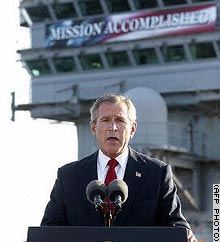
Remember six months ago, when Bush had an aircraft carrier turn around, delaying its entry at port by a day and costing you and me a million dollars so he could be flown in on a jet and be seen wearing his flight suit for PR value? He changed into a suit, then strutted out before the actual military veterans and declared that “major combat operations in Iraq have ended.” Remember the “Mission Accomplished” banner that was hung just right so that the cameras could frame Bush with it in the background? That banner’s message has come under fire, now that far more U.S. servicemen and -women have died since that PR stunt than before.

Bush is trying to avoid blame for that one, too. It’s the Navy’s fault, he says. Their idea.

Well, actually, not really. The White House had the sign made. But, they claim, it was the navy’s idea in the first place, and they were the ones who strung it up. Yeah. Right. I’m sure the White House didn’t have anything to do with suggesting the idea, or with placing it so it could be framed so visibly, right behind the president from the cameras’ POV. Those Navy guys are real sharp at this PR stuff, not the White House.

This is pathetic. The only thing that could be even more sad would be if the American people continued to buy these sorry excuses from this miserable coward who himself shirked duty while admonishing others not to do so, who lied to get us into this war and is lying to avoid responsibility for it.

Categories: Archived Tags:

Ironically, Fox Almost Accidentally Sues Itself

October 29th, 2003 Comments off

Sadly, the headline here is not a joke. Not in the literal sense, anyway. Nor is it even an actionable parody.

After taking a pratfall for suing Al Franken’s Recent Book, Lies and the Lying Liars Who Tell Them, Fox threatened to sue Matt Groening and his animated TV show, The Simpsons, for airing a parody of the Fox News ticker (“Do Democrats cause cancer?”).

Alas, The Simpsons is owned by… Fox. They almost sued their own TV show for parodying their own TV show.

The Simpsons avoided getting sued, but now Fox has a new rule banning such a parody news-ticker. Why? Because, they say, “it might confuse viewers into thinking it’s real news.”

On The Simpsons?

These people need help.

In other Fox News news, Fox has declared itself worthy of the title “Fair and Balanced.” Why? Because they hired Chris Wallace. My first reaction to that was, “Who?” After looking around on the net, I found that people were saying he was a liberal, mostly because of the story about Fox News, though some contended he had conservative leanings. So it’s a bit confusing how the hiring of a single maybe-liberal interviewer now signals that the vastly right-leaning network is now “balanced.” Or maybe they were commenting on how Wallace himself has declared Fox to be “balanced.” Gee whiz, a new hire speaking well of his new bosses? Go figure!

Categories: Archived Tags:

Crime and Foreigners in Japan

October 28th, 2003 3 comments

Life in Japan as a foreign resident is much better today than it was back in the 80’s. The creature comforts, imported goods and so forth are better, as I have commented on before. But more than that, in the 80’s there was a notable racial component to things as well; foreigners were sometimes seen as a source of crime and disease; police often stopped foreigners for no immediate reason other than that they were foreign. That happened to me many times, usually riding my bicycle; the police would accuse you of having stolen it. In those days, with so much antipathy focused on foreigners, the bad news accentuated and the good news muted, you were sensitive to such things. I recall one day I was stopped near Musashi-Sakai Station for “bicycling while foreign,” and was actually surrounded by four or five cops. I remember seeing passers-by shooting glances at me, and guessed what they were thinking, that this scene confirmed the fears stoked by newspaper bias and politicians’ speeches shouted from the tops of loudspeaker trucks.

This happens a lot less today.

There are, however, some remainders from that time, and this week a few of them have popped up. One of them was an editorial from the Japan Times that was very reminiscent of the 80’s; in fact, it could be an exact clone of an editorial from that time. It comments on high crime rates of foreigners in Japan, but like so many similar reports in past years, it exaggerates quite a bit. It mentions high numbers of crimes, but it does not mention crime rates; and if one calculates the crime rates, one finds what has always been true: crime rates of non-Japanese in Japan have always been lower than that of the native population.

Another facet of the problem has been how the Japanese media gives weight to some stories and less so to others. I commented on the story of Yoshi Hattori, the young boy who was shot to death in the U.S., and how this was amazingly over-reported in Japan, the story dragging on for much longer than a year, while a story about an elderly Japanese woman shot in Japan was virtually ignored despite the unusual nature of the shooting.

Yesterday, a similar example of bias appeared in the news when an American sailor was shot on the streets of Hiroshima. Initial reports here in Japan not only failed to identify the assailant as Japanese, but omitted certain details–his basic description, along with the language he spoke, all information available from the start–details that would have suggested that he was Japanese, thus giving the impression (by local standards) that the shooter was probably another American serviceman. The story was given short thrift in the papers yesterday, and today’s Yomiuri has nothing about it at all. Only subsequent on-line articles reveal that the man spoke Japanese, and still fail to identify him as a national. Foreign publications, like this Stars and Stripes issue, give a more detailed accounting. Japanese newspapers, it should be noted, seldom fail to identify a suspect as a foreigner even if it was only a suspicion of such.

One thing that is clear: if the races had been reversed, and it was an American who had shot a Japanese, there would be no other news story for this day or any other for weeks; it would make international headlines, and Japan would be rife with protest and anger.

Categories: Focus on Japan 2003 Tags:

Conservative Lies #2

October 27th, 2003 1 comment

Sorry for the lull. Had quite a few midterm exams to go over, grading, and all that, and then personal stuff came up. But here we are with another common conservative lie.

Lie #2: “Democrats are racist.”

When Miguel Estrada’s nomination to the D.C. Circuit Court was successfully blocked by Democrats in the Senate, Republicans went on a rampage of accusing Democrats of being “racist,” with a few examples here, here, here, here, here, here, here, here, here, and here. Why? Because Democrats slung epithets at him? Because Democrats have a history of blocking any and all Hispanic nominees? Because there’s even the slightest scrap of evidence of racial bigotry? Of course not. It’s simply because they blocked the nomination of a far-right-wing nominee who also happened to be Hispanic. If there is any racism here, it is in the racial exploitation of Estrada by the GOP–part of their campaign to win over the crucial Hispanic vote by putting token Hispanics like Estrada and Alberto Gonzales into prominence, wearing the heck out of their Hispanic origins and rags-to-riches tales, and then admonishing Democrats for assaulting the tokens on any grounds, always claiming race is the only reason Democrats are attacking them.

Naturally, Democrats did not block his nomination because he was Hispanic; they blocked his nomination because he is an “outspoken conservative” (read: “ultraconservative”) and a staunch constructionist. Estrada belongs to the firm that defended Bush in Bush v. Gore. The Bush administration denied the Senate committee access to internal memos written by Estrada when he worked Office of the Solicitor General; his office handled cases that would go before the Supreme Court, and would give a better look into what his legal philosophy is. He flatly refused to discuss his legal philosophy and claimed that he never pondered Roe v. Wade.

Democrats standardly challenge nominees whom they regard as being far too conservative, and conservatives, like Orrin Hatch, try to obfuscate by saying, they don’t want an “African- American on the court who’s conservative,” or a “conservative Hispanic,” suggesting that it is the race, not the political philosophy, which is important.

This is not the first time that Republicans have tried to exploit race as a shield against turning down an ultra-conservative judicial appointment. They did so with Clarence Thomas, who “just happened” to be black, a sorry sop to the African-American community, as if Thomas somehow represented them in any way, not to mention being any kind of replacement, judicially or otherwise, to Thurgood Marshall. But the Estrada nomination is just an example of the acceleration of this exploitation; expect Alberto Gonzales’ name to come up next.

Nor is this the only situation that conservatives use to try to tag Democrats as racist. A long-standing charge against liberals is that Affirmative Action (the conservative code word for quotas) is racist–not just reverse-racism against whites, but also racist against minorities, because it regards them on the basis of race. Well, how else are you going to regard people who have been victims of racial discrimination? Quotas may be a bad solution, but the alternative is far worse: allowing racism to go unchecked. More on that topic in this post.

Bottom line: Democrats, for all their faults, have been the people who have always fought racism in all of its forms; conservatives, when not outwardly racist, have always associated with and defended the institutions that contribute to and benefit from racism.

Categories: Archived Tags:

Fall View

October 26th, 2003 Comments off

Had a busy day today, not much time to blog. Had the chance to visit the tower atop the local hill (the one that blocks my view of Shinjuku!), and found that not only had I picked a very nice day to climb, but that it also happened to be the last day the tower is open this year. The tower is usually closed and locked, open only on Sundays during about 4 hours in the afternoon–and even then, only for a few months. For the first few years I lived here, I didn’t even think it opened at all.

But I got a good view today; below is a panorama (click it to see the larger image, about 1000 x 300 pixels). The fall colors are turning, and they’re just going to get better.

Categories: Focus on Japan 2003 Tags:

Mmmmmmaahhhh…. Suuuuushiiiii…..

October 25th, 2003 Comments off

When I tried to find a decent, cheap sushi place in the U.S., it was very hard to do. Most places charge several dollars per plate, a lot more than the dollar-a-plate I’ve become used to in Japan. The best I could scrape up was a few all-you-can-eat places in San Francisco, and they were still more expensive, in the end, than the Japan dives (even if I starved myself prior), and the quality just didn’t match up.

Before I came to Japan, I thought as many Americans do–that I would really hate it. Raw fish? Come on. And you know what? I still do, much of it. Sorry. Especially the maki-sushi (rolled sushi) or any other kind with seaweed. Never got used to that stuff. But there is one kind that I do like, and I like a lot: tuna. That’s either in the standard form–red tuna, or maguro–or in the high end menu selection, fatty tuna, called toro.

Toro, when you get good stuff, is heavenly. Tastes like butter, almost. I get it whenever it is priced reasonably at the supermarket. It comes in slabs; I chill it while I cook rice, then as the rice cooker indicates that the rice is done, I take it out, slice it (you need a really sharp knife), and eat it as sashimi, the rice on the side. Of course, I can’t afford to get what is called “oo-toro,” the highest-quality toro, but “chu-toro” (literally “medium fatty tuna”) is often available and I get that every few weeks.

Strangely, the toro available at the kaiten (conveyor belt) sushi joints is, almost uniformly, not very good. I’ve never ordered the 6-dollar-a-plate variety, but the 3- or 4-dollar varieties never have the right taste. A friend of mine who lived in Osaka once treated me to toro at a good sushi place near where he lived, and that was great–but the conveyer-belt places can’t seem to get it right.

But they do the regular tuna just great, and so that’s what I usually load up on when I stop by the place, every week or so on the way back from work. They know me there now, just like the folks at Akiyoshi yakitori-ya do. I’ll come in, order two plates right off the bat. They combine the two into one plate, putting the four sushi together, and the two plates one on top of the other. If the first set tastes good, I’ll order another four to six plates. I’ve come to notice, however, that they give me the best sushi first….

When you’re finished, they tally up the plates you’ve left stacked; price per plate is determined by the color and pattern on each plate. Since maguro is the cheapest, the tab usually comes out to a bit more than 6 or 8 dollars. Not bad.

Categories: Focus on Japan 2003 Tags:

iPod: First Impressions

October 24th, 2003 Comments off

Right off, I will admit that I have an interest in finding this to be a nice machine, having just plunked down $450, including tax, for the little thing. That said, I think it goes beyond that bias to say that this is a sweet device.

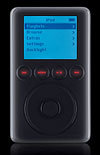
The first thing that strikes you is the size; you always expect it to be bigger. The common measure, that it is about the size of a deck of playing cards, is pretty much right on. But the iPod also has weight–not too much, but enough to make it feel definitely solid–a feeling which is reinforced by the polished metal backing. I’ve had one other MP3 player, the one from Iomega, and have seen a lot more, and it is all to easy to find ones that are too big (the ones with capacities similar to the iPod) or even too small; this machine gives you the impression of being just the right size and having just the right heft to be a solid, and (very subjectively) a deservedly expensive piece of equipment. Remember in the first Jurassic Park movie, the kid finds the infrared goggles in the car? He asks the adult if he can play with them; the adult asks, “Are they heavy?” The kid answers “Yes,” and the adult replies, “Then they’re expensive. Put them back.” That’s what this feels like. Totally subjective, but that’s part of the experience.

One nice extra point was that the battery was about 75% charged, right out of the box. I hate getting a new toy, and then have to just sit and look at it, inactive, for several hours while it charges for the first time. The first thing I did, naturally, was to plug it into the computer. You set the iPod onto its base (also hefty for its size), and the cable from that ends in a FireWire connector. Now I have about 2,500+ songs from my CD collection saved on my PowerBook G4 hard drive. You plug in the iPod and two things happen: first, the iPod starts charging right through the data cable (Firewire cables have six wires, four for data and two for power); and second, iTunes pops up and the iPod starts synching. 10 or 15 minutes later, my entire collection has been transferred over with room to spare. That extra room can be used as external data storage–put anything you like into it. With a Belkin flash card reader, you can download your digital camera photos into it, a feature I could have used while traveling in Spain.

Open up the iSync application, and in a few minutes, my iCal calendar and Address Book have both been copied to the iPod as well. The beautiful thing is, it all just works. Smoothly. No bugs, no hassles, no figuring anything out; in less than 20 minutes, most of which I just spent surfing the web while the computer worked, all was done. It was ready to go.

The one hassle I expected was the expected limited ability, from one jog dial and five buttons, to effectively operate the machine, especially considering the fact that two and a half thousand songs were on the thing. But they did a very good job with this. It’s like a single, extended, hierarchical menu (it even has the menu font Apple uses). The jog dial (works like a trackpad, solid-state) acts as a scroll wheel; dial this way or the other, and you move up and down the list, quickly. Tap the button at its center and you move into the next submenu; tap the “Menu” button to move back. For example, choosing a single piece this way: Browse >> Albums >> Jurassic Park >> Theme From Jurassic Park. Very quickly, you can narrow down your selection. Feedback is given by little clicks, which you can mute if you like. And the menus are customizable; you can choose to have “Albums” in the top menu, for example, or turn off “Extras” (Address Book, Calendar, Games, etc.).

You can also arrange Playlists in iTunes; while on your computer, create a playlist (Command-N); let’s call it “80’s Rock” for the sake of the example. Choose a group of songs you want to play, drop them in, and you’re ready to go. Set the iPod back into the cradle, and it will automatically sync to the changes you made. Remove the iPod, and now just select Playlists >> 80’s Rock, and you’re there. You do surprisingly little looking around–disappointing at first, because playing with the dial and buttons can be fun.

The headphones are fairly good, better than any set of ear-pods I’ve used. And that’s important for me. Those pods never seem to fit my ears right, possibly due in part to the fact that I had one ear half-bit off by a St. Bernard when I was seven; plastic surgery repaired the worst of it, but the ear is still a bit off norm, so the pod can bite. These actually feel OK, however subjective that impression may be. The remote controller is designed well as far as shape, size, and layout, but the clip is disappointingly narrow; it barely holds on to whatever part of my shirt I clip it on to. They should have done better on that one.

The sound is also good, at least to me–I’m no audiophile, so what might be unacceptable to a connoisseur, sounds OK to me. I go by general quality and volume. My former MP3 player never was able to play loud enough; on the iPod, the loudest setting is too loud for me; and that’s OK by my book. And there are still lots of features I haven’t tried yet–using the calendar and address book in practice, trying out the random shuffle feature, or even finding the true extent of the battery life. More on that later.

I’ve only had it a day, but already I feel comfortable with it, and can use it without having to think or figure. So, first impression–a very nice little chunk of machinery here.

Categories: Mac News Tags:

Christmas Came Early

October 23rd, 2003 5 comments

Not much time to blog tonight–I’m grading midterms. But I did have time to stop by the electronics store earlier and get myself an early Christmas present: a 20 GB iPod. I never buy big-ticket items on a whim, I always give myself at least a few weeks to mull it over, especially to avoid those impulse buys where a few weeks later you ask yourself, “why did I buy that thing?”

I’m not going to be saying that about this one. I made a mistake with my first MP3 player, an Iomega HipZip. Dang thing broke after just a few months, and not from rough use or anything. Just shoddy merchandise. The iPod is a solidly built little thing, worth the extra bucks. More about it later. Midterms now.

Categories: Mac News Tags:

Conservative Lies #1

October 22nd, 2003 2 comments

It has gotten to the point that I am hearing outright, bald-faced lies from conservative commentators on such a regular basis, I feel the need to address them in some manner. So here goes a series of small posts, in each a conservative claim and the truth of the matter.

Lie #1: “Clinton Sent Troops into Somalia.”

Heard this one on Crossfire the other day, and found several instances of it on the web as well, a notable one in The Washington Times. The claim is used as a way to criticize Clinton for his foreign policy, and to contrast this with Bush’s purported “success” in Iraq.

The fact: Clinton did not sent the troops. George H. W. Bush did. On December 4, 1992, Bush ordered 25,000 U.S. troops into Somalia. Remember the night-vision video of the beach landing on the news? One thing Republicans know, it’s how to script news coverage. Bush sent the troops in a month after losing the election, and one and a half months before Clinton took office, knowing full well that he would get the initial glory and that Clinton would get stuck with the quagmire. If Clinton had done the same to Bush Jr., conservatives would have been howling like mad, accusing Clinton of every political dirty trick in the book, claiming he was sending our soldiers into harm’s way just to embarrass Bush Jr. But Bush Sr. doing it to Clinton, that was OK. In fact, conservatives quickly erased the fact that Bush sent them in and blame the whole thing on Clinton, showing how he didn’t know how to handle such things.

In fact, Clinton’s handling of Somalia beats Bush Jr.’s actions in Iraq to hell. Clinton was anxious to bring the troops back, he didn’t have to wait until the whole country was screaming at him before he decided to do that. And unlike Bush, Clinton was able to get the U.N. forces into Somalia, cutting U.S. troops down to 4,200. Unfortunately, he could not pull them all out–despite conservative sneers that Democrats like to cut and run, Clinton stood ground with the U.N. forces as long as it seemed that good could be done–and so, naturally, conservatives lashed out at him when a mission went wrong in late 1993, where eighteen U.S. soldiers died in the mission that went so famously wrong. Soon after, Clinton ordered a withdrawal, the mission no longer publicly tenable, but U.S. troops still held ground there, staying until late March, 1994.

It was a fiasco, but it was a Bush fiasco; Clinton simply did the best he could with what he had been given.

Source: The History Channel: George Bush, Forty-First U.S. President.

Categories: Archived Tags:

Around the Blog in 80 Days

October 21st, 2003 1 comment

Hey, I just realized I’ve done 80 days of blogging without missing a single day. It’s been my intention not to miss a day, but usually I am not so good at keeping up with things. Missed only three days since four months ago in mid-June, when I got lazy and missed two full days. But to make up, I often post more than once a day. Quite often–I started posting regularly in May, about 170 days ago, and am up to post #330 now.

Now if only I could do the same with exercising….

Categories: Main Tags:

Crossing the Chuo

October 21st, 2003 2 comments

One of the many places I’ve lived in Tokyo was Koganei, for two and a half years. I lived in Higashi-Koganei, near Asia University. I used to ride my bicycle in the area quite a bit, in particular to a Home Center (a kind of store, like a cross between Home Depot and Walmart; not as big, but big for Japan) on the south side of the tracks. So I know what it’s like to cross the Chuo Line–and yet, from the news I see, it is now even harder than ever before. More on that below; first, a bit of background.

Crossing the Chuo was always a chore. First of all, trains in Japan are much more widely used, so there are a lot more of them. Back home in the Bay Area, a train crosses an intersection every thirty minutes to an hour. Here in Tokyo, it’s once every few minutes on the busier lines. Second, the barriers at railroad crossings in Japan go down long before they would in the U.S., sometimes almost a minute before the train comes. And if the crossing is next to a train station, just forget about it; even though the approaching train will stop at the station before it crosses the intersection, the barriers go down just as soon–so people at the intersection have to wait not only the one minute for the train to get to the station, but also the time it takes for people to get off and on the train, then for the train to start up again–and finally cross the intersection.

To make things even worse, there are times when the trains from either direction are staggered–you wait a few minutes for a train one way to get through, then just as it passes, the lights indicating a train is coming from the other direction light up. Then just as that train passes through, an express train from the first direction lights up that way again. Choose the right intersection close enough to a station, and you can get caught like that for what seems to be an endless time. My own record for that is waiting for five trains to pass, each one on the heels of the other. That’s not counting the one time when there was a slowdown due to an accident, with trains lined up behind each other; the trains were so close and so slow, the barriers stayed down for more than half an hour (in the rain, of course). Finally, everyone at the intersection just got fed up, lifted the barrier and went through when it was clearly safe to do so.

But now, things are worse. JR East, the railway company that runs the line, has begun construction on an elevated line for the Chuo. The plan to get the work done involves laying extra tracks beside the original ones, thus widening the railroad crossing. This requires more warning time before each train comes, which has been causing great traffic jams. The elevated line, ironically, is intended to relieve traffic congestion caused by the difficult crossings. I guess it has to get a lot worse before it can get a lot better.

I first noticed this trouble when flipping through channels, and saw one station at a railroad crossing, showing how ridiculously wide it had become–taking even some young people more than 20 seconds to cross, impossibly long for some elderly people. I didn’t note at the time where it was, but then I started seeing it on the news more and more, and so started paying attention.

The crossing most in question is the one on Koganei Boulevard (Kaido), next to the busy Musashi-Koganei Station. The crossing is usually 56 feet (17 meters) wide, but due to the construction, it has been widened to about 120 feet! that’s 35.7 meters. kind of hard to believe, but you understand when you see it. It’s wide. Vehicles have become trapped in there, causing crossing guards, always on duty, to signal the emergency stop for approaching trains. The same guards are constantly having to hold up the barriers for the later pedestrians to get through. Elderly people, frightened into moving faster than they should, often trip and fall.

It’s worse if you’re waiting to cross. As mentioned before, back-to-back train passes make for long waits, and the widening of the tracks makes them even longer. The TV show I saw tonight clocked one wait at an entire hour before the barriers came up. Drivers just give up and go elsewhere.

Pedestrians don’t have that option, so Musashi-Koganei Station has started issuing special passes to people so they can enter the station, walk to the far end of the platform, use the stairs to cross the tracks, come down the length of the opposing platform, and then depart the station on the other side. At other stations, people are lucky enough to have pedestrian overpasses (still a major pain to bike riders), or even better, elevators up to the overpasses.

I’m just glad I don’t live in Koganei these days… I hope they finish the elevated tracks as soon as possible–but JR East is saying that it will take six months just to install temporary devices, such as approaching train sensors so the gates don’t go down so early. Lord knows when the work on the tracks will be done; years away, no doubt. The entire project, in four parts, is due to be completed in 2011.

Categories: Focus on Japan 2003 Tags:

Where Are You Politically?

October 20th, 2003 3 comments

The Christian Science Monitor has this quiz you can take to see where you land on the political spectrum; an OK test, but the results are a bit disappointing–you are only told if your answers rate, on average, as isolationist, liberal, realist, or neoconservative. No specifics, no spectrums. It wasn’t too surprising, or very interesting, when the quiz told me I was a liberal. Shock!

A much better quiz is the Political Compass, a six-page test with a great number of multiple-choice questions (on the agree-disagree scale). After you take the test, you are not pigeonholed into one of four categories, but you are placed specifically on a 2-dimensional chart, where the ends of the two axes represent liberal, conservative, authoritarian and libertarian extremes. You can then compare your position (see chart, upper right) to the positions of famous political figures (shown on a separate graph, I did some Photoshopping). Not too surprising to see George. W. Bush up there with Thatcher and Sharon, nor that he is closer to Hitler than Gandhi. More surprising is seeing Pope John Paul II in the neighborhood of Stalin, Hussein and Arafat. I guess that makes sense from an ideological point of view, but you don’t think of it that way, usually. And that’s me, right next to the Dalai Lama.

The test is not perfect, as there are some questions which could be interpreted differently by different people, and a few with no choices that exactly represent your views. Still most people report that they get placed pretty accurately, and it is fun to see where you come out. Go ahead, give it a try. If you do, come back here and share the results.

Categories: Archived Tags:

Those Clever Spammers

October 19th, 2003 1 comment

Recently my spam has reached in excess of 30 per day; while my Eudora spam filter is good, once in a while things slip through, or legit mail might get junked. The problem here is that none of the automated spam filters is 100% reliable, and you never know exactly what it is they’re doing. For example, I use email forms on web pages to give my students tests. Once in a while, one of the emailed tests lands in my junk box, and I have no idea why, no understanding of what triggered it. To better my odds, I decided to try strategizing some spam filters of my own.

Available on most web host control panels is the ability to create your own customized spam filters that will block incoming messages before your email program gets a chance to download them. The trick was to find what text strings were unique to spam emails. So I started up Eudora, which houses my 4-year-plus archive of tens of thousands of emails, including a good deal of archived spam, and I started going through the most recent spam, email by email, looking for something that seemed unique. When I found something, I would do a search for the string in Eudora; if the search produced only spam, I had found a silver bullet. If legit email crept through, the filter could backfire on me. After all, since this completely blocked the email, I would not have the option I have with Eudora’s junk filter, that being to quickly scan what got into my junk box.

Pretty soon I started finding gems. “opt-in” was one–from those fake offers to remove you from their list, really a trap to identify people who read their emails. Others included “guaranteed!” “100% money,” “to be removed,” “generic” (drug sales), and “enlargement” (you know what that’s about). These terms produced few enough legit email hits that I felt comfortable using them.

But I also started noticing the tricks that the spammers used to avoid detection. Like “Viagra,” a very common spam topic, was being spelled in various ways, like v1agra, v_iagra, viagara, v.iagra, or v1a-gr@. I found that by filtering “v1a” and “agra ” (with a space at the end of the last one), most of them got filtered out. Some spam included the intra-word period all over the place, like “get doc.tor recom.mended v.iagra!” Thus breaking up the words for a standard filter.

One rather devious word-breakup scheme I found used HTML, the web page scripting language which is now commonly encoded into email to create various tables, backgrounds, text sizes, styles and colors, not to mention images (more on those below). I found one email that clearly read, “Free Tour,” which seemed like a possible filter. I searched for it, but nothing was found–not even the spam I’d seen it in. I couldn’t figure out why it was not showing up, until I turned off the “blah” filter which usually hides the HTML and other coding. Then I found this:

<!– flow –>Cl<!– gutenberg –>ick
he<!– baby –>re for a F<!– predominant –>R<!– reagan –>EE to<!– pint –>ur

See what they did? The <!– * –> is an HTML code for a memo, a note programmers insert into code to mark something; it doesn’t actually do anything, it’s just a tag which doesn’t show up in normal display mode. By using these tags all over the place, the spammers not only break up the words that would normally trigger a spam filter, but they add words that might be what some people really search for. And because the comments do not appear in rendered form, the original message–in this case, “Click here for FREE TOUR”–comes across clearly to the reader.

But many spammers use a more straightforward dodge: they don’t send any text. Instead, their ads arrive in the form of image links–not usually images they send to your email account, mind you–that’s bad enough. No, instead, they use the HTML image link feature to tell your email program to go to their website and retrieve the image, then show it in your email when you view it. This not only blocks the spam filters, but it also lets the spammers know who just opened their email, so they can send even more to you. Most people don’t know that you can and should turn off HTML graphics options in your email client.

Nevertheless, I was able to find an Achilles’ heel to this practice: they use the DIV tag. An HTML feature that allows alignment and other formatting control. Most graphics spammers use the tag to align their images. And when I did an email search for “div align=” in Eudora, I hit the jackpot: half the spam email showed up, and NO regular email. Bingo!

So I entered that and a few other choice terms into the spam filter, and the next day, the spam that Eudora had to filter out was cut by about 60%. Cool. So I’ll do some more searching, and maybe get it fine-tuned. With luck, the number of spam emails I have to glance at in my junk folder will be down to only a few a day, and it will be extremely easy to spot the legit emails. And when spam starts getting through in larger numbers again, I’ll just figure out the trick and add the spam filter to catch it.

I admit, this may very well be more trouble than it’s worth, but then again, it can be fun to try to outsmart the vermin.

Categories: Main Tags:

RIAA Sues Again, A Little More Politely This Time

October 18th, 2003 Comments off

So, who will be on the list this time? Seeing the RIAA’s last attempt, one would expect some nuns and orphans named in the new offensive. Throw in a few infants and a healthy dose of people who don’t even own computers and they’ll come in at about par.

The RIAA (motto: “Do What We Say Or Another 200 Hostages Get It”) is planning to sue a large group of users again, but this time, they are playing nice (relatively speaking). They are being ever so polite as to send letters first. The missives to the 204 people targeted in this round were sent out over the past week, informing the defendants-to-be that the RIAA has “gathered substantial evidence that you have been using a peer-to- peer network such as Kazaa or Gnutella to download and upload music owned by our clients.”

The RIAA is giving the dastardly criminals ten days to negotiate a settlement (i.e., whatever the RIAA demands they pay) or else they get dragged into court. However, considering that the last round included a 12-year-old girl and several senior citizens, including one who didn’t even own any file sharing software, it is likely that this new batch will have similarly misidentified people. Already, two people from the last groups have challenged the RIAA in court (not counting those the RIAA withdrew their suits against because it was so blindingly stupid of them to accuse the people they did). One is a web page designer named Ross Plank, who claims that the RIAA just plain misidentified him. Mr. Plank is being defended in his case by the Electronic Frontier Foundation.

Then there is the possibility that the RIAA doesn’t have the legal standing to do what they are doing. Aside from the sheer viciousness of their campaign (they call it a “fear and awe campaign”–seriously), there is the legal questionability about their right to issue subpoenas and access ISP logs.

In a side note, the RIAA is telling the new batch of scapegoats that if they even so much as try to erase any songs from their hard drives, they could be arrested for tampering with evidence. And how, I wonder, could the RIAA possibly (a) prove that songs were deleted after a certain date or before, and (b) get their hands on the computers in any case? Do they now assume they have sweeping police powers to break down people’s doors and confiscate evidence?

So far, 64 people have settled their suits with the industry, and another 838 people who were not sued have accepted an amnesty deal (which does not even offer to protect them from later lawsuits, and might even open them up to such suits at a later date). Millions of other users are not yet acting–and they may end up justified. This kind of legal scare tactic has been tried before by companies seeking to shake down “pirates.” When HBO was broadcasting by microwave in the late 80’s, a de-scrambling kit with a microwave dish was being sold by a company proudly calling itself a “pirate” outfit . HBO sent people around neighborhoods, and whenever they found dishes at addresses that did not have subscriptions, they sent a letter threatening to sue unless the dish owners paid a settlement. In the end, a large number of people paid up–and then HBO’s case was thrown out of court. (The case was Zimmerman v. HBO Affiliate Group, 1987; see discussion section “e” on this page for a bit more on that. The case was lost on grounds not relevant to the RIAA’s case, but their tactics were very similar.)

This may very well end up the exact same way, in that the abusive acts of the RIAA may end up getting them cash and publicity in the short term, but they are far from winning any case in court, and could very likely be defeated there.

Categories: Main Tags:

Music for the Apple of Your Ear

October 17th, 2003 9 comments

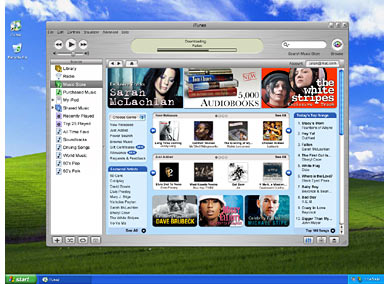
Apple is hitting its stride with its music initiative, and several new announcements today. First is the emergence of iTunes for Windows. I have yet to download this for my PC–I will very soon–but it promises to be a smash hit. It is a very high-quality program, incredibly easy to use, putting any other app for music to shame–and it’s free. Then there’s the Music Store, now available for the other 95%–and the two or three percent have bought 13 million songs up till now, making it the #1 music downloading service already.
And Apple is not wasting time doing its marketing right: together with Pepsi, they are offering 100 million free songs, codes randomly distributed in Pepsi containers. Very good move, IMO. Apple should be able to sell lots more where those came from. At 99 cents per song, the ability to buy singly at that cheap price or buy whole albums for $10–I’m buying my music there.

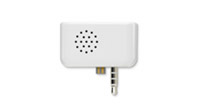
And I’m finally going to break down and get an iPod. Probably the 30 GB model. I’ve been teetering on the line, more on the not-buy side lately, but with the introduction of two new accessories, the microphone to make voice recordings, and the Flash memory adapter to store photos–well, that about did it. That’s my Christmas present for myself this year. Am getting it before I go to the U.S. so I can use the music and games on the flight over and back (watching DVDs on my Powerbook is limited to the battery life, not enough to stretch out for the 8- to 10-hour flight), and to hold all the photos I take on my digital camera without having to haul my laptop everywhere.

Oh, and Microsoft had an announcement today, too. They’ve discovered not one, but four more giant, gaping security holes in their operating system.

Cool.

Categories: Mac News Tags:

Media Filters and the Tools of Perception

October 16th, 2003 Comments off

We’ve seen it before, you know. Back in the Reagan administration, when things were seen as not going well in the nation, Reagan’s people blamed the media back then, just as Bush is blaming them now. They said that the media only reported bad news, and that they should “balance” their reporting with good news. And before him, Nixon also gave it a try–with his vice president Spiro Agnew denouncing the “nattering nabobs of negativity.” The suggestion, of course, was as hollow back then as it is now; the real reason behind the claim was not due to a fault or lack on the part of the media–it was due to falling poll numbers for a conservative presidency, unpopularity caused by factors beyond the control of the presidency. And since the root problem could not be helped, the president tried to make people believe that the root problem was not so bad–it’s just that the media is making it look that way.

Reagan’s attempt to spin the media was perhaps the embryonic beginning of the conservative myth about the liberal media; the reason behind creating that fiction is very much in line with the current administration’s attempt at massive media spin. It all has to do with perception, the kernel of American politics.

It’s like the old haggling ploy of trying to place the perceived center as close to your side as possible. Let’s say that you have to negotiate with someone and come to a settlement. When people start to dicker, the assumption is that they will compromise towards a central point. Let’s say that the fair settlement is 100. You want 200, your counterpart wants zero. Your counterpart, not wanting to insult you with a zero offer, starts at 50. You see an opportunity to move the center closer to you, so you start at 250. That puts the center at 150, much closer to the place you want to be–and your counterpart is now at a disadvantage, because they have to make you give up more than they do.

And that’s more or less what conservatives have been trying to achieve with the entire “liberal media” canard: to place the perceived “center” of fairness closer to their side. By claiming the media is liberal, they create the appearance that the truth is not what the media says it is, but rather the truth is much closer to what they say it is. If media stories show a conservative figure in a negative light, such as Rush Limbaugh, we are supposed to discount it because of the “liberal media,” and believe that he is less culpable than he appears. If a liberal cause is perceived as popular in the media, such as a gun control measure, we are again supposed to discount it and believe that few people really support it, and it is being propped up by those liberals in the media. If you can get people to believe there is a liberal bias in the media, then, you can push public perception to the conclusion that the truth is more on the conservative side of things. That is the motive for the right wing to engender, espouse and sustain the illusion of left-wing bias in the news that we receive.

Joe Conason does an excellent job of upending that cliché in his book, “Big Lies,” where he compares it to “working the ref.” In basketball, if the referee calls a penalty against a team, the coach goes out of his way to protest, calling the decision unfair to as far a degree is possible in the hope that the ref will give the team some slack to make up for it next time. Conason points out that while a majority of reporters vote Democratic, a greater majority of editors and publishers–the real ones that decide bias and direction–are conservative. And he reports on conservatives who have, in candid moments, owned up to the truth; Bill Kristol, for example, in 1995, saying that “the liberal media were never that powerful, and the whole thing was often used by conservatives for conservative failures.” Even Rush Limbaugh has claimed that the media today is more conservative. And that is hard to deny, with Fox News leading a frightened CNN into the conservative realm, and with a seemingly endless line of conservative radio and TV commentators with their own biased shows, with nary a liberal in sight with even a half hour of his or her own.

The grand Republican tradition of swaying perception simply continues with George W. Bush; nothing here is new. With his Iraq policy in shambles, and things looking grim for an election year, there’s not much he can control that would improve things–he can’t stop the guerillas, and he can’t guarantee the capture of Saddam Hussein. He can’t pull the troops out, he won’t be the humble leader he promised in 2000 in order to get the U.N. to sign on, and he can’t avoid spending yet more and more billions of dollars. Without the ability to make any substantive changes, he does the only thing he can do to try to win the day, the tactic that has served the GOP so well over the decades: blame the media for making things look so bad.

It’s a tough sell, with American soldiers dying daily, car bombs blowing up streets every week, with the world largely against us and the patience of the American people wearing thin.

But then, conservatives are very, very good at this game.

Categories: Archived Tags:

More of the Sunset

October 15th, 2003 Comments off

As advertised. [Edit: I have had to delete the larger images because of hotlinkers. Sorry.].

What amazing colors. Again, I stress that none of these are retouched–just resized, some sharpened slightly to compensate for lost detail in the resizing process.

This one is simply cropped detail on one cloud formation.


And finally, below, a panoramic shot, stitched together from three portait-oriented photos.

Categories: Uncategorized Tags:

New Sunset Photos

October 14th, 2003 Comments off

This morning was cloudy, and by early afternoon, rain was just pouring down. But around 3:00 pm or so, the rain stopped and the sun came shining through. The sky really looked spectacular, and so just before sunset, I booked on down to the river to see if good sunset photos might be taken. And it was brilliant, a beautiful sunset. The photos below are only resized in their original aspect ration, and are not retouched in any way.

These photos are best viewed in a larger size, so I have made each one link to an 800 x 600 version. Enjoy.

Before the sun had really set; the clouds were still amazing. The photos don’t do justice, really.

A lot of people were enjoying the view, including this couple on the river grass.

You can barely see it in this small version, but that’s a cloud-capped Mt. Fuji in the lower-left corner there. Click on the image to see it better in the larger version.

This one I call the “Monster” picture–looks like part of a monster’s head peering out from behind some clouds.

I’ll be back with more photos from this shoot in the next day or so.

Categories: Uncategorized Tags:

Using the Troops: How Low Can You Go?

October 13th, 2003 Comments off

A local newspaper in Beckley, West Virginia, got a ‘letter to the editor’ from a soldier in Iraq. “I have been serving in Iraq for over five months as a soldier with Company A, 2nd Battalion of the 503rd Airborne Infantry Regiment, otherwise known as ‘The Rock,'” wrote 19-year-old Pfc. Nick Deaconson, son of Dr. Timothy Deaconson, a Lt. Col. who served in the first Gulf War.

“Things have changed tremendously for our battalion since those first cold, wet weeks spent in the mountain city of Bashur. … The majority of the city has welcomed our presence with open arms.” The letter went on to tell how well things are going in Iraq, contrary to news reports.

When Dr. Deaconson read this letter in the paper, he was so proud. The writing style was excellent, better than he expected from his son. He decided to call Nick to congratulate him on getting published.

When he did so, his son simply asked, “What letter?”

Pfc. Nick Deaconson was recovering from shrapnel wounds in his legs at a hospital. He said he didn’t send any letters to the newspaper.

And soon, newspapers across the country were beginning to notice that the same letter was running in “Letters to the Editor” sections nationwide. Each one was identical.

According to one soldier, the company’s platoon sergeant passed out the form letters, bearing the name of each soldier, and asked everyone for the name of his hometown newspaper. The soldiers were then asked to read the letters, and if they agreed with them, to sign them. The company administration, apparently, then took care of mailing each one to the hometown newspaper. So far, at least a dozen newspapers have been found to run the letter (I found them in New Mexico, Pittsburgh, and Charleston; I have seen reports of the letter in New Jersey, Montana, Washington, and the above-mentioned West Virginia. Two letters so far found were unsigned, and both soldiers whose names were used report that they did not give consent.

Now, there are a few things about this that are pretty despicable. First, some of the letters were sent out unsigned, but bearing the name of soldiers who never consented to have their names used in a propaganda offensive. And second, it should be illegal for any superior officer to “suggest” that any soldier write letters saying anything at all. Each soldier knows that if they decline, it will be noticed and they may be disciplined or looked down upon as disloyal. You don’t want to put a soldier in that position. Every soldier has been trained to be loyal to the military authority, and this action is a crass violation of the trust that said authority will not be abused.

It is bad enough that this administration is taking these young men and women, putting them in harm’s way, getting so many killed and injured… then lowering their pay, cutting their insurance and educational benefits, even making some pay for the food they eat while recovering in hospitals–the list of how badly this administration has been treating our men and women goes on and on…

And now this.

I’m sorry, but this sickens me.

Thanks to Sako for pointing this story out to me.
Categories: Archived Tags: