Archive

Archive for October, 2003

Ashcroft: Special Prosecutor Needed

October 13th, 2003 Comments off

No, of course he didn’t say that about the Bush White House. He would never do that. It’s only when there’s a liberal in office that we have to do that.

On October 4, 1997, when Al Gore was accused of using a White House telephone instead of a private telephone to make fundraising calls, Ashcroft demanded a special prosecutor. Why? A law was violated. Well, a much more important law was violated in the Bush White House. Ashcroft also said a special prosecutor was needed because there’s a conflict of interest–only because Janet Reno and Al Gore were in the same administration. But in the current case, the focus of the investigation is someone who not only worked with Ashcroft, but also is the man who got Ashcroft his job. That’s not a conflict?

Here’s the quote:

ASHCROFT: The truth of the matter is that if the law’s been violated, we should be able to ascertain that. We can, if we have an independent person without a conflict of interest…

ROWLAND EVANS: …The attorney general has shaved down all the allegations that Vice President Gore apparently down to one single allegation — which telephone he used to make these fundraising calls from. Do you really think that alone is worthy of a special prosecutor?

ASHCROFT: …you know, a single allegation can be most worthy of a special prosecutor. If you’re abusing government property, if you’re abusing your status in office, it can be a single fact that makes the difference on that.

So my own view is that there are plenty of things which should have caused [Attorney General Janet Reno], a long time ago, to appoint a special prosecutor, an independent investigator. We asked for that on March the 13th of this year in letters from Republican members on the Judiciary Committee. And she’s in a bad position…

…The man who signs her check is the man that she’s investigating, and she hasn’t been very aggressive about it.

Again, what we have here is outright hypocrisy. Or, as Paul Krugman writes in his latest column, the Republican concept that Democrats should be held to far higher standards than Republicans themselves. We had 8 years of massive partisan attacks by Republicans against Clinton, but now we’re tired of that and Democrats should lay off Bush. Republicans demanded special prosecutors whenever someone in the Clinton administration so much as got football tickets in a way the GOP didn’t like, with Republicans abusing the special prosecutor law and the justice system as well to unbelievable extremes, but now, even with an obvious crime far worse than anything that Clinton was even accused of and with blatant conflicts of interest, Republicans are criticizing Democrats for even suggesting a special prosecutor.

Let’s dispense with the pleasantries, shall we? There is massive hypocrisy in play here on the part of the GOP, even as they try to falsely smear the Democrats with that same charge for having the gall to want a special prosecutor in this one, extreme case.

Categories: Archived Tags:

More Things I Like About Japan

October 12th, 2003 2 comments

I first came to live and work in Japan since 1985. Since then, there have been a slew of improvements for foreigners looking for a touch of home. A few:

International Telephone Calls. KDD used to have the monopoly on that market, and rates used to be ludicrously high, especially calling from Japan to America. I remember that I used to have to call my parents through the international operator, calling collect. I would give the operator our family’s cat’s name, and tell her I was trying to reach someone with our dog’s name at my parents’ number. When my dad got the message that our cat was trying to make a collect call to our dog, he knew it was me saying, “call me now.” He would then refuse the call and give a coded answer as to when he would get back to me, which the operator passed back to me.

Even then, we’d have to keep our conversations short, else dad would get charged $50 a pop or more. Now we use a lot cheaper services, and we may even start using Messenger’s audio linkup (or iChat) soon, making the conversations completely free.

Internet Access. This really wasn’t even on the radar screen in 1985, and it was depressingly poor in Japan up until just a few years ago. But then it took a quantum leap, just as America’s service started to falter. Two or three years ago, I was still forced to use ISDN (max speed, less than 64 Kbps), and had to covet my folks’ 300 Kbps ADSL connection in the San Francisco Bay Area when I visited them at Christmas time. Now, my dad is paying more than before for a crummy half megabit, while in Japan, DSL speed is now up to 26 Mbps for just about $30 a month, and if your building can accept the cable, 100 Mbps fiber optic can be had for about $70 a month–what my dad pays for his now-slower ADSL.

Unfortunately, I live more than 2 km from the telephone station, so my 12 Mbps ADSL is really only about 2 Mbps. But at my college, our LAN has a dedicated fiber optic connection, and man, that thing is blazing fast. The main thing limiting it is that almost no one else has a line that fast. But I have gotten download speeds as fast as a few megabytes per second from big sites, like Apple.com. Sweet.

English-Language Media, for that matter. I remember when it was hard to get any English-language books, magazines or newspapers–you had to get them through Kinokuniya for outrageous prices, else have them shipped from the states (I usually bought them on my trips back home). And on TV, all we got was the Wednesday night bilingual (like the SAP deal in the U.S.) movie, usually something stupid like Death Wish 3, and we were grateful for it. This is not one of those I-used-to-walk-ten-miles-in-the-snow stories, I really mean it, I watched that garbage, and so did most of my foreign friends, because that was about it on TV. There was the video rental place, and you can bet we used it.

Now, we have cable TV with CNN and options like Super Channel. There is Amazon.com, and Amazon.co.jp, and of course, there’s the Internet for all kinds of media. A lot nicer. It does make a difference.

Cheaper and More Available Foreign Foods. First we got the Foreign Buyer’s Club in Kobe, which has, for a long time, been a good place to get imported foods. They still will deliver to your door for a 1000 yen flat fee, even if you order 20 cases of Diet Caffeine-Free Coke. Where else can you get sunflower seeds in the shell? Or a ton of other stuff, for that matter.

And now, Costco is making a big entry, with four stores in Japan now (Fukuoka, Chiba, West Tokyo, and Hyogo) and growing–they say 50 stores in the next decade or so may open. Next: maybe Saitama. It’s a godsend for me, with the West Tokyo store opening a year ago just a few stops away from me on my train line. just went there today, getting some bagels (real ones, not the kind you usually find in Japan) and whipped cream cheese, four-cheese ravioli, microwave butter popcorn, a bag of cheap lemons, a big net of garlic cloves, five rotisserie chicken legs and thighs (fresh baked) and some other nice stuff. There’s a 4,000 yen yearly membership fee, but for what you get at the prices they have, you can’t beat it.

And even local stores have a lot more imported stuff, a lot different from the protectionist 80’s when an imported can of beer–when you could find it–cost almost twice what it does now. A lot of foods, snacks and other groceries you can get which you couldn’t before.

Plane Tickets. I remember the shock of calling a travel agency and being told that my round-trip ticket to California and back would cost about US$2,000. Sure, you could get cheaper tickets, but not by much. Many of you who were here in those days will remember the old “yobiyose” tickets. Essentially, they were three-leg plane tickets bought overseas and then sent to people in Japan. For example, the ticket would go from Hong Kong to Tokyo, then to San Francisco, and then back to Tokyo. The buyer in Tokyo would just toss out the first leg and use the second two. And still the ticket would be a lot cheaper than one bought in Japan. Others would just buy one-year open-ended tickets in their home country, and just make sure they went back every year, buying a new ticket each time.

Somewhere along the line, the pricing system changed, and now it’s a lot cheaper–perhaps even cheaper coming from Japan. I just got a round-trip, non-stop ticket for my Christmas visit home to the S.F. Bay Area for 47,000 yen (plus about 10,000 yen for airport, airline and sales taxes). That’s $430, or $520 with taxes–not too shabby.

All of this makes life quite a bit easier in Japan–a nice place to be, all on its own.

Categories: Focus on Japan 2003 Tags:

News Points, 10-11-2003

October 11th, 2003 Comments off

The music recording industry is just embarrassing itself more and more every day. Recently they’ve gotten bad press, and for good reason. They said that they had the right to release powerful viruses that could spread to innocent computer users; they claimed to have special police powers to subpoena people’s private records; and they have sued a truckload of users, including a 12-year-old girl and an 71-year-old grandparent. They even had to withdraw one suit aimed at an elderly lady when she revealed that she owned a Mac, not a PC, and therefore couldn’t even use KaZaA.

Their technical achievements are not much to crow about, either. Sony tried to release a new multi-million-dollar technology called “Key2Audio” which they thought would prevent copying the CD–until someone discovered that you could defeat it by using a felt-tip pen. And now, SunnComm released its own super-duper foolproof copy protection technology–which a college student found you could disable by holding down the “Shift” key.

How embarrassing. But they’re not making the situation better by making sounds of suing the college student.

It’s a dying industry, and they’re really not dying with much grace at all.


“Cuba will soon be free,” said Bush recently, and he promised to “hasten the arrival of a new, free, democratic Cuba.” How? By restricting Americans from visiting Cuba even more than is done today (how will that help, as it has not done anything but made Cubans suffer and not hurt Castro at all?) and accepting more Cuban immigrants, making it safer by informing them “of the many routes of safe and legal entry into the United States.”

News Flash, George: it’s an island. Without plane flights or boat trips that are not closely watched by Castro’s people, exactly what are those other routes? You don’t think the Cubans have thought of just about any way to get off the island by themselves after 40 years?

And increasing immigration–I don’t object to the concept, but that idea, and the whole Cuba initiative itself is such a blatant election-year sop in a crucial electoral-college state that it is rather sickening to behold.


Tony Jenkins, North American Bureau Chief from Expresso newspaper in Portugal, has just been on Diplomatic License on CNN, making a very good point: that Schwarzenegger never answered any substantive questions during his campaign. He related one incident where Schwarzenegger, according to his supporters, was answering serious questions (ergo, he didn’t need to go to those pesky debates). Well, he didn’t get asked serious questions. He brought on Dana Carvey to do his Schwarzenegger-like impression from SNL. After several minutes of this, Jenkins wanted to ask a serious question, and tried to point out that this was not a political press conference, it was a circus–but his American colleagues shushed him, saying, “It’s Dana Carvey!”

Quite rightly, Jenkins referred to them as “pansies.”

Schwarzenegger, in the meantime, says he will ask Bush for federal funding to help California. The journalist in the articled I just linked to doubts it, and I have to say, if Bush comes through now, it will be such blatant political favoritism using taxpayer dollars as to be practically criminal. California needs the money, but it should not be used as a political weapon in an election year.

Instead, why not try to get the $9 billion back from companies like Enron who stole that much and tens of billions more? Unlikely; during the energy crisis, Schwarzenegger held a closed-door meeting in Beverly Hills with Enron Chairman Ken Lay. I doubt they were discussing a movie deal, or that Arnold was desperately trying to get Lay to stop robbing Californians blind. We can all too likely wave bye-bye to California’s suit to get some of that money back.


Rush Limbaugh, meanwhile, is checking into drug rehab–again–and has made a non-admission admission to his drug abuse problem, doubtlessly to play to future clemency. He has hired high-power criminal defense attorney Roy Black, and is in full gear to engage the usual rich-white-guy defense.

The real question here is, if Limbaugh returns to radio or other commentary, will he now be for treatment over incarceration for drug abuse? Because if he’s not, then he’d either better surrender himself to authorities and do hard time in prison, or else come across as a hundred times the hypocrite he’s already seen as–and in Rush’s case, that’s really saying something.

Odds are this guy doesn’t do a day in jail, and he’ll probably come out ‘born-again’ on the drug issue, in the sense of being stronger and more vehement as ever on incarceration.

In the meantime, here is a choice quote from Limbaugh 8 years ago:

“What this says to me is that too many whites are getting away with drug use. Too many whites are getting away with drug sales. Too many whites are getting away with trafficking in this stuff. The answer to this disparity is not to start letting people out of jail because we’re not putting others in jail who are breaking the law. The answer is to go out and find the ones who are getting away with it, convict them and send them up the river, too.”

— Rush Limbaugh show, Oct. 5, 1995
Categories: Archived Tags:

The Democratic Debate: An Immediate Commentary

October 10th, 2003 1 comment

First of all, as I watch it live here in the late a.m. in Japan, it strikes me as a very good debate, especially for one very early on the process. The candidates are on message when it comes to the basics of the Democratic platform: keep the tax cuts for the middle class, roll them back for the wealthy; yes to keeping order in Iraq, now that we are there (despite differences in how to achieve that); be more honest and contrite with other nations, and rely on their support more; protect the environment, build education, and so on. All of them performed well in opposing Bush, his programs and his record (not too tough a thing to do), and only a few stooped to direct attacks against others (which of course media reports jumped on).

Gephardt scored points for pointing out the Democrats are good stewards of the economy and the Clinton years were the best economic times we have ever seen. His line: if you want to live like a Republican, you’ve got to vote for a Democrat. Kerry scored points with me by mentioning a guest worker visa program; many had strong stands on Medicare, health insurance and prescription drug programs, but Kerry got the one-liner of the evening when he said you could go with his plan, or you could “hire Rush Limbaugh’s housekeeper.” Sharpton, as usual, was a good speaker with good points to make, and did well for praising Edwards and his rise from a blue-collar standing to being a millionaire and a presidential candidate–hope being the focus. That’s the kind of positive message and amicable sentiment which would do the party well in these debates.

There were different ideas about what to do in Iraq, and one thing that stood out was that even the poorest of them (Kucinich’s) was far better than what Bush is doing now. One of the themes running through this debate is the argument of who stood up to Bush against the Iraq situation (and tax cuts for that matter) and who did not. All are saying that they did, but naturally, some have less currency on the issue than others. Clark fell under attack for his past good words about Bush, and had a hard time defending that–but he managed to, at least barely.

Most of the candidates did well; only a few said things that rubbed me the wrong way. Joe Lieberman lost points in my esteem in his rather unabashed attack on Wesley Clark; they may be questions about his past stands, but Lieberman’s comments were too rough for my tastes. These debates should expose differences, but not tolerate internal attacks, especially against specific individuals. Dean skirted the edge of that error as he stated the difference between those on the stage who supported Bush and those who did not, and from what time. He did not quite go over the edge as he tended to frame the criticism in terms of how he did not, rather than just an outright attack against the others. It is, after all, a valid point. Kerry lost a few points in the same manner, and it was in part due to his staff distributing some anti-Dean points backstage, which interestingly made it on stage.

Gephardt did well most of the time–he has a good speaking style and can express his criticism of Bush in a smart and biting way–but when it comes to defending his record on voting in Bush plans, he kind of falls apart, and you can see him struggling to say he was against Bush when he went along with Bush because Democrats saw it as being politically expedient to do so. Additionally, Lieberman lost points for being rather loud and unwilling to give up the floor.

One thing that stood out, and I mention it to point out a conservative fallacy about Democrats and the military, is that when a soldier stood up to ask a question and he was introduced as having served in Tikrit, there was spontaneous, rousing applause–not one person or a few people clapping and everyone else chiming in, but everyone coming in at once. As Wesley Clark put so well, Republicans like weapons systems; Democrats like the soldiers.

In the end, nobody stood out as a clear winner, nobody really emerged as an apparent front-runner, but it is, after all, very early in the process–and while no one stood out, only a few did poorly, and most of them did very well. It was not a squabble, it was not a mud-wrestling competition. THere was good criticism of what Bush is doing, and there were good stands on good ideas. Once the primaries start whittling down the list, it should be very interesting simply because there are so many strong candidates in there, looking better and better each day against George W. Bush.

Categories: Archived Tags:

Panther Update

October 9th, 2003 Comments off

Apple has announced it will release Panther on October 24th (25th in Japan); apparently the reports of it going Golden Master (ready to duplicate, press and ship) after version 7B85 were accurate.

Pricing will be $130 for new buyers (some retailers have that down to $100), but recent purchasers get an “Up To Date” break: If you buy OS X (or, presumably, a Mac with OS X) between now and the 24th, you can get Panther for “free”–a shipping charge of $20 will be levied. G5 buyers get in on the deal no matter when they bought their machines. This is an improvement over what happened with Jaguar.

And the educational version will cost $70.

Categories: Mac News Tags:

Headline News

October 8th, 2003 Comments off

I believe that the election of Arnold Schwarzenegger as governor of California is, to say the least, a travesty. Here are the reasons:

  • Democracy Amok. The success of the recall in California will lead to anarchy in the short-term; I am certain a new recall process is beginning this moment, and I know many people who are eagerly awaiting the chance to sign the petitions. A new recall would be carried out for no better reason than to demonstrate how much of a sham the first one was. A majority of the Californian people do not want another recall, but there will be one. That’s the whole point. And you can be certain that politicians elsewhere in the U.S., especially Republicans (who have shown a recent pattern of trying to grab power in any way possible), will start working on them right away in every state that allows a recall. We will have endless campaigning that will only subvert the Democratic process, as Walter Cronkite warned. This will disrupt the workings of government and be abused relentlessly until people find the good sense to either vote out recalls or rework them so they cannot be exploited as they have in California.
  • Moral Bankruptcy. This was not “the will of the people” or the proper execution of a check or balance, it was a base, partisan political grab for power. There was no intent to do what people wanted–the people’s will was demonstrated last year when Gray Davis was chosen by California in normal elections. The recall is a subversion which those who drafted the recall law did not envision or intend. Furthermore, it is hypocritical in the extreme: the idea proffered by the Republicans was that we have to recall Davis because of the budget deficits–but Bush has far greater deficits, and he is more responsible for creating them. But Republicans love him for it, because it means tax cuts for the wealthy and the advancement of the conservative agenda.

    In short, the recall was not by any means a democratic process, it was, in effect, a gigantic dirty trick. Speaking of which–

  • Dirty Tricks. There were dirty tricks in this campaign, to be certain. But Davis was not behind them–Schwarzenegger was. The first was blaming the deficits on Davis, an untrue charge. Most of the budget is California is mandated and untouchable; much of the rest is unavoidable. And the greatest part of the deficit came from things like the deregulation of energy–something put into effect by a Republican governor, which allowed the energy companies in Texas and elsewhere to overcharge Californians to a ridiculous extreme. Most of that money came out of the state budget. The only agency which could have stopped it was the federal government, but Bush refused to do a thing to stop the shakedown–brought on by his oil buddies, surprise surprise–especially when we’re talking about a blue state here.

    Then Schwarzenegger blamed Davis for not telling the people of California about the deficit until after the election. But that was beyond Davis’ control–even he didn’t know it. The numbers for the budget are a public matter in any case, and cannot be “hidden.” This is in contrast to Schwarzenegger’s economic plans, which he decided to hide until after the election, along with an explanation about how he groped all those women. Talk about hypocrisy!

    Then Davis got slammed for the car tax. However, Davis was not to blame for this–it was an automatic readjustment which was created by–you guessed it–a former Republican governor. The tax had been cut to 1/3 of the original amount, and the law required that the fee rise again in case the state had a shortfall of funds and could not pay for the tax cut. That tax hike kicked in, automatically, when the deficit came along. Again, not Davis’ fault–but Schwarzenegger vilified him for it, the same way he vilified Davis for the loss of jobs (can you say “national recession”? “Tech bubble burst”?).

    Then Schwarzenegger pulled the biggest dirty trick of all: he blamed Davis for his own misdeeds. Schwarzenegger obviously has a problem with groping women; this was not a secret before he entered the election. But Schwarzenegger knew that this would hurt him, so from the outset, he started crying “dirty tricks” and “puke politics” before anyone else even had a chance to say anything. And when the L.A. Times, not Davis, came forth with the story of 6 women, and when 9 more women came forth of their own volition, what was the charge? Davis’ dirty tricks. Even the out-of-context Hitler story was by ABC–does Davis control ABC? No, but that wouldn’t stop Schwarzenegger from blaming Davis.

    In short, Schwarzenegger pulled a laundry list of dirty tricks, while Davis himself behaved in a more exemplary fashion than ever before, and certainly conducted himself in a far better manner than Schwarzenegger.

  • The Success of the Non-Campaign. Schwarzenegger demonstrated how one can win an election, not by discussing the issues, but rather by making carefully controlled appearances, manipulating the debate system, and promising to explain himself only after he is elected. He appeared in only one debate, and the questions were released a week in advance, allowing for scripted answers. Schwarzenegger and his people claimed he was answering questions all over the place, but in fact, every “town meeting” or campaign stop was carefully controlled so that only Republican supporters could attend–and, predictably, he was thrown a continuous stream of nice, easy softballs. Compare this to Davis, who allowed non-scripted questions and stood up to criticism against him. Less glitzy, but ballsy and honest.

    Schwarzenegger also ran as a Hollywood star, with one-liners and movie references galore–but no substance. No realistic plans–he borrowed a page from the Bush campaign book and told us we would find after the election how he would cut taxes, increase spending, balance the budget, and bring in all those nice, juicy jobs. Yeah, right.

And the galling thing is that Schwarzenegger will have an easy time from here–Davis has already done a lot of work to ameliorate the budget crisis (for example, rush-building lots of new power plants, which Schwarzenegger will happily take credit for), and much of the deficit will disappear on its own as the energy crisis abates. Schwarzenegger can get away with doing absolutely nothing and the deficit will fall a great deal all on its own–and again, he will shamelessly take credit for it.

Worse, the liberal social policies credited to Schwarzenegger are most decidedly not held by his political advisors and patrons, who are the people who will wield the real power in Sacramento–do you really think that action movies and after-school programs have prepared him to govern a state? He’ll be mugging for the cameras and super-charging his ego, while the Bushite power players will be doing the real work outside the spotlight. Expect a hard-core conservative agenda at all levels of the executive branch to predominate in this mostly Democratic state.

This is nothing but a complete sham, an utter disgrace to the state of California, partisan politics and dirty tricks at their most damaging. The only thing to hope for: over the next several months, evidence and perhaps charges filed by many of his victims will take the luster out of his image (perhaps before Davis’ remedies take effect to Schwarzenegger’s benefit), and he won’t have Davis to blame for his scandals any more (though he may well try anyway). And by that time, the next recall will have its signatures and may be forced on its way.

Sometimes, one can only fight fire with fire, as repugnant as the recall process has come to be. Best-case scenario: another recall ousts Schwarzenegger, and the recall embarrassment is itself recalled, and we can go back to a system where the guy with the most votes wins.

Categories: Archived Tags:

Amped Up

October 8th, 2003 1 comment

It is nice not to have the lights go out like they used to. No, I’m not talking about living in California or New York, but rather here in Tokyo, where power outages are very rare indeed. Instead, I’m referring to the low amperage allotted to apartments in Tokyo, and how my breakers used to trip all the time.

Used to be that whenever I had an air conditioner and the clothes dryer going at the same time, then SNAP! Out the lights would go. Time to grope my way to the breaker box and switch the power back on, then to reset half the clocks in the place, and fiddle all the other settings around the apartment which got wigged out.

Eventually, I got tired of this. I’m not a big energy hog, but there are times when I want to use more than just a few appliances at a time, thank you. And thirty amps just wasn’t enough. So I called up the energy company, and it turned out they can upgrade–though in my case, only to 40 amps. Good enough; I asked them to come over, and the electrician installed the new breaker in just a few minutes.

It costs a few dollars more a month (my basic energy usage hasn’t gone up in itself), but it is very nice to be able to run the nuke wagon with the TV and cooler going and not find oneself suddenly in a dark room.; I haven’t had a single breaker trip since the upgrade.

Categories: Focus on Japan 2003 Tags:

And a Few More

October 7th, 2003 Comments off

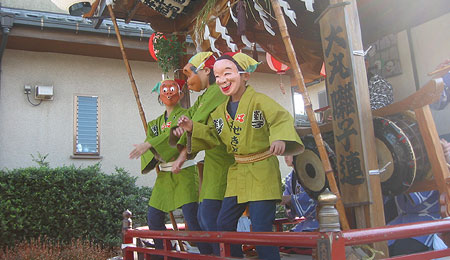
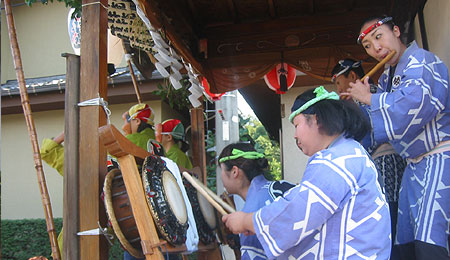
On the way back from Minami-Tama station, a local festival troupe passed by. I still don’t know what it was all about, but it was fun….

My favorite of all the photos was the second one. A bright sky background led to a very nice effect above the mikoshi. If you would like to see a larger rendition of the photos, click here.

Categories: Focus on Japan 2003 Tags:

New Photos from Japan

October 6th, 2003 Comments off

Here are a few more photos I have taken around town lately.

This fellow, photographed outside Minami-Tama station on the Nambu Line, is an excellent example of the transition in telecommunications. When I first came to Japan, many people depended on payphones; I did, from time to time. There was an array of public telephone types, with different colors and abilities for connections (remember trying to hunt down a phone booth that could dial internationally?). And the prepaid telephone telephone cards were a big deal, sometimes used as business cards, and sometimes sold “recycled” by shady characters atop train platform staircases.

Today, most people use their cell phones instead–and in the case of this guy, in exactly the same spot he’d use if speaking on a payphone.

Right after I took the shot of the fellow at the phone, a squad of female Kyudo archers came by. You see students like this from time to time, dressed in their traditional hakata pants and keiko-gi shirts (apparently the tabi shoes are optional). If you’d like to know a bit more about Kyudo, go here.

Categories: Focus on Japan 2003 Tags:

Blaming the Source

October 6th, 2003 1 comment

Schwarzenegger blames Gray Davis for the fact that now fifteen women have come forward with allegations of sexual harassment. The Bush White House is trying to get people to not take the leak of the CIA operative’s name seriously because the man’s wife is a Democrat. Supporters of Rush Limbaugh blamed his current racial slurs of the liberal media. Go back further, and you will find all sorts of claims of this sort, to George W. Bush dismissing his drunk driving arrest as a “dirty trick” played by his political opponents.

The question is, is it reasonable to try to excuse a wrong action by claiming your enemies released the news? The answer, of course, is no, for a few different reasons.

When it comes down to it, how the news was released has no bearing on what you did. If someone stole a car, it would make no difference if that person were turned in by a loved one or a lifelong enemy; the fact would remain that they stole a car. No matter that an avowed opponent released the information, or that it was released the day before the accused was to start a new job critical to their career. The leaker may be an unkind person, but that does not excuse the person who committed the crime in the first place. If you did wrong, you must be held accountable for that action. If the person who released the information had malicious intent in doing so, then that may also be wrong–but it is a separate matter. Any attempt to draw attention from the person who committed the crime and focus it on the person who released the information is nothing less than a dirty trick in itself.

Schwarzenegger claims Davis is behind the 15 women coming out with claims of sexual harassment. His proof? None. That could easily be a dirty trick–to take your own crime and turn it into a smear against an opponent. What about the Bush administration claiming that Ambassador Wilson is a Democrat? Yes, he made campaign contributions to Democrats, but he also did for Republicans; yes, he has appeared for Democratic events, but he has also appeared for Republican ones. Even George Bush Sr. praised him once. The claim that the crime is mitigated by the allegation about Wilson is as reprehensible as the attempts by Novak, Carlson and other right-wing pundits to try to make people believe Wilson’s wife was an analyst or a secretary, in which case no crime was committed–while they knew full well that the nature of her job was still classified, and so their lies would be veiled by the same laws that made the leak illegal in the first place.

In the end, only one thing matters: was there a crime, and if so, how serious was it? The leaking of the CIA operative’s name was a federal felony; that is indeed serious. That a presidential candidate was arrested for drunk driving is also relevant; it speaks volumes to judgment.

Conservatives will say, oh, you weren’t saying that when Clinton was accused of things? What about the “vast right-wing conspiracy”? Aren’t Democrats hypocrites for crying foul about Clinton prosecutions and then demanding the same for Bush?

Many points here.

The things Clinton was accused of were, far more often than not, without veracity. Take the Paula Jones case as an excellent example. First of all, her case was far too weak; it was widely agreed that if she had brought the same case against someone not the president, it would have been dismissed immediately on the basis of merit. The only reason it survived and was investigated was because Democrats were too willing to maintain the appearance of impartiality. If Paul Jones had brought that case against Bush, there would never have been any investigation; Ashcroft would have outright refused to appoint a prosecutor.

Second, there is ample evidence that Jones was indeed prodded to start her case by Clinton’s enemies, and was in fact given legal support and funding from parties avowed to destroy Clinton politically. As I mentioned, an accusation of releasing information for political purposes is a separate matter; and as a matter divorced from the allegations made against Clinton, the fact that Paula Jones’ case was spurred, financed, and abused by Clinton’s political enemies was, in itself, reprehensible.

Most importantly, when Clinton was accused of a serious matter, Democrats took it seriously, and agreed to the investigations. But the GOP so badly abused the special prosecutor statute that, toward the end, prosecutors were being demanded for the vaguest of rumors and the most piddling of offenses. It was never prosecutions for serious crimes that the Democrats opposed, it was rampant abuse of the legal system as a political weapon in cases where there was absolutely no merit or just cause whatsoever.

Categories: Archived Tags:

The Framing of the Question

October 6th, 2003 Comments off

I am beginning to get very tired of the rather biased framing of questions concerning conservative scandals in the press. The idea of unbiased journalism is to not present one bias over another, to state the situation and possible considerations as evenly as possible.

We must be aware of the fact that a journalist’s question on a topic can sway viewers. The question itself provides a sort of grounding of the issue, a statement which the audience often assigns as the common assumption which will be believed until a great enough case is presented to disprove it.

For example, if you were to ask about the allegations concerning Schwarzenegger and women, a balanced question would be: “Are these stories about Schwarzenegger a last-minute attempt to smear him, or are they a legitimate story that should raise concerns in the minds of voters about the candidate?” The question does not assume a side in the question, and presents both possibilities, as any responsible journalist should do. It does not make any assumptions, and keeps the issue open. Perhaps the question could be more evenly stated to include other possibilities, but you see my point here.

However, in the press recently, the question is slanted: “Are these stories about Schwarzenegger a last-minute attempt to smear him?” This version of the question takes a side, and ignores or devalues the other perspective. Yes, the question can be answered to clarify the issue, but the damage has been done: the journalist has given the audience the impression that the smear idea is the one that has the most credence, and will stand until a preponderance of evidence can be brought to show it is untrue. That is biased journalism.

And the conservative scandals have been getting this kind of journalistic bias quite a bit in recent days. Has Rush been the target of the liberal media? Are Democrats taking a minor political blunder and trying to politicize it into a new Watergate? These questions are unacceptable from anyone who presents themselves as an unbiased journalist.

Categories: Archived Tags:

And the Proof of Dirty Tricks Is… ?

October 5th, 2003 Comments off

Well, the media had a hard time not paying attention to six major concurrent Republican scandals, and so for one day, a lot of attention was given–but the day is over, and the media seems to be winding the stories down as quickly as possible.

Schwarzenegger, in fact, is getting a big break from the press, especially on the “dirty tricks” charge against Davis. The media had been lightning-fast in calling out Dean or Clark for making statements not supported by fact, but they’ve been pretty much supporting Arnold on his wholly unsubstantiated charge that Davis is somehow orchestrating all the bad news that is coming out about him.

Were all those women, now eleven of them, somehow created by the Davis campaign? Did Gray Davis tell them all to make up stories and then wait for this day to come out? Hardly. Nor is the timing suspect–the allegations have been around since before the campaign. The fact is, this campaign is so short, any timing could have been called “suspect” by some standards. In fact, if I were heading up a dirty tricks commission, I would consider this bad timing–rather, I would have had three or four women come forth initial maybe 15-20 days before the election, then timed it so that on or two more women would come forward every few days, so that a bad impression could be made early and sustained longer.

But Schwarzenegger is not being asked, or at least is not answering, any questions about what evidence he has that these reports are somehow part of a dirty tricks campaign. Instead, he is being given a free ride and allowed to create a completely false impression, one favored by Republicans in trouble:

Blame everything on the liberals.

Categories: Archived Tags:

Dude, Where’s My Country?

October 4th, 2003 Comments off

By the way, Michael Moore has a new book coming out this week: Dude, Where’s My Country? It looks at the entire debacle that is the Bush administration, from Dubya’s business ties with bin Laden to the Patriot Act; Moore says that the book attempts to demonstrate how the leak of the CIA agent married to Ambassador Wilson for the purpose of political retribution is “just the tip of the iceberg.”

This is all in advance of Moore’s next movie, entitled “Fahrenheit 911,” scheduled to come out before the 2004 election. Moore says that “The primary thrust of the new film is what has happened to the country since September 11 and how the Bush administration used this tragic event to push its agenda. It certainly does deal with the Bush and bin Laden ties. It asks a number of questions that I don’t have the answers to yet, but which I intend to find out.”

Despite attempts to smear Moore in the media, he remains highly popular, and is already #4 on the Amazon bestseller’s list, despite not being released yet.

A good article on the film is here. You can order the book from Amazon U.S.A. here; for those in Japan, Amazon.co.jp also carries it.

UPDATE: In the last hour, Moore’s book has jumped to #2 on Amazon’s list!

UPDATE: And now, predictably, it is #1.

Categories: Media & Reviews Tags:

Not a Good Week for Republicans

October 4th, 2003 Comments off

Wow. A triple double-whammy.

Bush is hit by a leak made by two of his senior officials which turns out to have been a federal felony, in addition to being an underhanded, slimy political attack. The Bush administration blames liberals for the scandal. On top of that, the official report on the search for WMD has come back: we found nothing, please give us another $600 million so we can try to find nothing some more. Less reported on are recent revelations that Colin Powell and Condi Rice made statements prior than 9/11 that Saddam was no threat and did not have serious WMD nor the ability to project them.

Arnold Schwarzenegger has been hit not only by a detailed L. A. Times article on exactly how he groped, grabbed and harassed six women over the past few decades, but also has been again haunted by statements from his past, when the director of a film he appeared in claimed that the now-gubernatorial candidate expressed admiration and respect for Adolf Hitler. This on top of the revelations that he claimed to have gang-banged a black woman with other bodybuilders, and that his father was a member of the Nazi party. Schwarzenegger blames liberals for his troubles. And note that Arnold does not deny the Hitler remarks.

And finally, Rush Limbaugh, trying to get past his disgraceful slur on and resignation from ESPN (which Rush blames liberals for), was named in an investigation of drug rings, in which it was claimed that he illegally bought thousands of painkillers over a long period of time. And note that he does not deny that he bought the drugs.

All in all, not a superlative week for conservatives. Bush’s troubles will likely push his poll numbers further down their predictably falling track, making Americans question his character more, and “The Leak” may very well turn out to have legs (not to mention teeth). Schwarzenegger will likely be least affected by these 11th-hour revelations (despite our hopes), partly because of his star power, and partly because millions of absentee ballots have already been cast. Limbaugh, on the other hand, may be seeing his last days of being in favor with much of anyone; even conservatives will find it hard to excuse him of massive illegal drug abuse, even if he is not subsequently arrested and imprisoned.

Categories: Archived Tags:

Rush, Quotas, and the Discriminatory Double Standard

October 3rd, 2003 4 comments

You undoubtedly have heard of Rush Limbaugh’s recent statement on ESPN that NFL quarterback Donovan McNabb is not talented, but is only considered so because he is black. The statement he made was not just racist, but represents a set of beliefs commonly held by staunch conservatives considering the innate abilities of blacks, and the effects of what they refer to as “affirmative action,” but more accurately should be named as “quotas.” In short, that belief says that any black person’s achievement must be questioned and their esteem diminished if there is even an outside chance that some sort of quota or special consideration may have been given them due to their race. It is this, and not Limbaugh’s own racism, his resignation from ESPN, nor the fact that he has been accused of drug abuse, that I would like to discuss here.

First off, it is necessary to define and explain two concepts which have been massively abused and mangled: “Affirmative Action” and “Quotas.” It is a standard tactic for conservatives to smear a popular, respectable idea or organization by finding something else even distantly related but much more easily attacked, re-defining that secondary item as being representative of the whole issue, and then smearing the hell out of it. That’s what happened with the ERA, when feminism was re-defined in the public eye, somewhat successfully, as being the domain of unattractive, arrogant lesbians seeking to overpower men; it is what is happening now with reproductive rights, with pro-lifers assiduously trying to frame the entire issue as a matter of the rare but far uglier late-term abortions. And that is what has happened with Affirmative Action, being framed as an issue of quotas. Thus the waters have been successfully muddied to the point that even proponents of Affirmative Action have come to use the terms interchangeably.

Affirmative Action is a set of guidelines for employers to follow in order to “overcome the discriminating effect of past or present practices, policies, or other barriers to equal employment opportunity,” according to the Equal Employment Opportunity Commission. For example, let’s say that you are hiring a hundred new workers for your company. Your business is within commuting distance of many towns, each with a different ethnic and socioeconomic makeup. Affirmative Action guidelines will tell you that you should advertise the position to all of these communities, rather than focusing on just one. In many cases, advertising for positions are concentrated in one area by making inquiries at one employment office rather than another, or by placing notices in ethnic- or class-specific journals or venues; this limits the opportunity for fair consideration for those who are not targeted. Affirmative Action explains issues such as this one and recommends how to avoid discriminatory actions–how to choose whom to hire based solely on ability, and thereafter administer that job in a fair and equal manner.

The quota, often identified as “Affirmative Action,” is, in fact, a completely different animal. Mandated either by courts or by executive order, quotas are a remedial resolution to repair proven or prevalent instances of discrimination. Executive orders by Kennedy and Johnson, for example, sought to correct blatantly obvious imbalances in hiring and contracting within the federal government. When a court orders a quota applied to an organization, it is in response to a specific and clearly demonstrable case of discrimination.

There are many misconceptions about quotas. These misconceptions, most often intentionally placed by opponents of quotas and Affirmative Action, are often the cause of the anecdotal evidence used to attack the quota system. For example, the idea that quotas are required where they are not. Many employers, fearing being sued for discrimination, use self-imposed quotas that are, in fact, completely unnecessary. They hear conservatives tell horror stories of businesses punished and forced to accept unreasonable quotas, and believe in them. This leads to the infamous “we’ve got to hire a black woman no matter what” mindset; and that, in turn, serves as anecdotal evidence for conservatives claiming that quotas require businesses to hire unqualified workers–a vicious, self-fulfilling cycle that has nothing to do with actual quotas.

The truth is, a company, as a statistical anomaly, could have a predominantly white, male workforce and yet still be clean; it is not the ethnic makeup of the company workforce that matters, but rather whether or not the hiring practices are fair. A company could employ white males almost exclusively and still be kosher, so long as it can demonstrate that its hiring practices were non-discriminatory. Ethnic composition only matters after racial discrimination has been proven and a quota mandated.

Another misconception is that quotas require an organization to hire people who are under-qualified. This is also patently untrue. Even under the strictest of quotas, if an organization can demonstrate that no qualified minority candidates were found despite a fair and determined recruitment campaign, they are off the hook. No one is forced to hire unqualified workers, though some people may unreasonably feel compelled to do so–again, most often because they hear the far-right rhetoric and believe in it as fact.

One more common misunderstanding is that quotas force employers to hire a similar percentage of minorities as is represented in the local population. This is untrue. Quotas mandate their percentages based upon the population of qualified minorities in the local workforce, “local” defined as living within a certain radius of the organization in question.

In fact, statistically speaking, a quota should never have any impact on hiring at all. If a hiring process is above-board and non-discriminatory, then the racial makeup of those hired will naturally follow the local makeup of the qualified workforce. The fact that a quota should force a hiring one way or another is in itself evidence that the hiring process may not be not functioning properly.

This ties in to yet another misconception, that discrimination is always conscious and intentional; it is not. We make final decisions to hire from a group of qualified applicants often based upon personal considerations (will this person get along with others in the workplace? How comfortable do I feel with this person?) that can easily be swayed by unconscious biases. It is my speculation that a majority of those who discriminate are unaware they are doing so, and most would be shocked and dismayed to know the truth. Instead, confronted with a quota, they resent the judgment because they see it as an accusation of a conscious act of racism, and having no such conscious intent, are insulted and respond with anger and denial.

The final misconception I would like to address is that of “preferential treatment.” A charge also leveled at women and gays, it is the idea that somehow minorities enjoy more advantages than whites and are unfairly benefited by things such as quotas. This misconception is rather easily dismissed by a quick glance at employment figures, which clearly show that white males are still largely over-represented in all areas relative to their numbers in the workforce, especially in higher-paying, higher-ranking positions. Far from demonstrating that quotas give minorities an advantage, it shows that there is a greater and more powerful force tilting the scales in favor of whites: racial discrimination. That is, after all, what Affirmative Action and quotas were intended to offset, and they have not been able to make more than a reasonable dent in that particular societal establishment. If some white males feel they have lost opportunities due to quotas, they probably have never even considered that they have in the past likely benefited from discrimination far more than they have been hit by its remedy. When we gain something, we tend to believe it is earned, not stolen; when we lose something, we do feel that a deserved reward has been taken from us. Similarly, white men are used to a superior position, and believe it is their due; when the scales are made more balanced, it feels to them as if something they have earned is being unfairly stolen and given to someone who does not deserve it.

This brings me to the point about the attitude held by Mr. Limbaugh and other conservatives concerning “preferential treatment.” It is the contention that minorities should resent quotas, and, by association, Affirmative Action, because it puts into question any achievement made by any minority member. In the case of Mr. McNabb, Limbaugh was asserting that he was under-qualified, and only achieved respect and recognition due to a social quota that gave him preferential status. Unfortunately, many minorities buy into this sham, believing that quotas are unfair and that all they have achieved is thereby tainted.

This is patently false, and can be checked by a quick look at how white males assess their own achievements. Racial discrimination clearly gives white males a far greater unfair advantage than even the most stringent of quotas gives to minorities–and yet I have yet to hear any white male seriously question the deservedness of his position or the merit of his achievements because of the likelihood that his path was smoothed by racial discrimination.

It is hypocrisy of the highest order for white men to question or denigrate the standing of minorities because of any possible benefits of Affirmative Action or quotas while not questioning their own standing in light of the far more powerful and widespread influence of racial discrimination.

Categories: Archived Tags:

Arnold Gives the Truth a Try

October 3rd, 2003 Comments off

What the heck, right? Nip it in the bud, act like you’re an honest, up-front guy, and admit to “playfully” groping half a dozen women, at least. Take advantage of the opportunity to claim they weren’t serious incidents, while your aides smear the women and blame the opposition for dirty tricks.

The fact is, the women spoke to others about the incidents long before the campaign. None of them were directed by the Davis team, affirmed by the newspaper that broke the story. And this has just come out, we have yet to hear the gory details, as we likely will in the next few days. Admitting the charges have merit may be a workable strategy, but it’s also risky: if the women’s stories are graphic and sympathetic enough, and if this brings back to the surface the stories of gang-banging a woman, talking about “getting away with” dumping one head-first into a toilet, and making statements often about female anatomy–there might start to be enough of a tarnish to take the energy out of the right-wing get-out-the-vote drive.

The CNN poll that put Schwarzenegger in the lead and the recall at 63% went uncontested for several days, enough to create an impression of winnability, and even help influence the outcome of later polls; but it did not match the private tracking polls of either the Democrats or the GOP. A later poll by the L.A. Times was widely reported to confirm Schwarzenegger’s lock on the race, but in fact, it only showed 56% in favor of the recall, a 3% variance with pre-debate polls, a statistical lack of change when you count the margin of error. The CNN poll was flat-out wrong. The L.A. TImes poll also showed Schwarzenegger and Bustamante within 5 points of each other, close to previous polls; the CNN poll had Schwarzenegger leading by 15%.

Clearly, the media is giving a huge advantage to Schwarzenegger–including a lenient handling of the most recent sex scandal, with few news organizations carrying much of it until the candidate started his spin cycle. And the nonsense with the polls–there is some major media spin going on here, folks. But don’t buy into it; it ain’t over till it’s over.

Categories: Archived Tags:

Shinjuku Skyline Sunset

October 2nd, 2003 Comments off

Got a nice photo of the sunset tonight from the roof of our 9-story school building. This is a composite of three separate photos. For space purposes on this main page, I can’t show the full-size image. However, if you would like, I have available a larger version (1200 pixels by 320 tall, better for computer screens) available.

Categories: Focus on Japan 2003 Tags:

Dinner Out

October 2nd, 2003 Comments off

Once or twice a week I’ll stop by a place on the way home. If I’m willing to go out of my way for a treat, I’ll go to Akiyoshi yakitoriya in Ogikubo. But on my train line home there is a sushi place I drop by, a place I believe is called “Ganso” Sushi (possibly “Genroku”), a “Kaiten-zushi,” or conveyor-belt sushi joint.

This particular place is reasonably priced–about a dollar per plate (two pieces per plate) and up, with my favorite, maguro, being on the cheapest plate. But what I like about this place is that you don’t have to eat the stuff on the conveyor belt, and can instead order new plates to be made for you. This is a big thing for me–I hate having to choose from the hour-old fish that’s starting to turn dark from dryness. Ganso has always let me order fresh–with the singly, highly disappointing visit I made when my father was in town and they shoved the old stuff in front of us (we came during lunch, so the policy may have been different).

I always thought that I was rather stodgy in my selection–I always have maguro, six or eight plates of it. One after the other, maguro maguro maguro. Sometimes people stare.

Tonight I dropped by for, of course, some more maguro. Had to wait a few minutes for a seat to open up, and two did at once. So the other solo guy who’d walked in just after me sat down on the next stool. But this guy made me feel a bit less like the most unusual customer in the shop. He ordered eight plates of the same kind of fish, more than my six for the night–and then ordered ten plates of ika (squid) all at once. The chef had to ask twice to make sure he’d heard right.

I left before he was able to scarf down all the squid, but he was making admirable progress. And for all I know, he ordered another ten plates after I left.

Categories: Focus on Japan 2003 Tags:

Breaking 10,000, and Free Voices

October 2nd, 2003 Comments off

Quite a week for this blog. A startling surprise link in MacSurfer, and later ones in OS News and two French Mac sites, led to more than seven and a half thousand extra visitors for the month than were expected. I had been anticipating about 2,200 visitors, perhaps another one or two hundred, but the massive news-site links blew the month’s stats clear into next year, to say the least. There were more than 3500 visitors per day for the first two days of the link, followed by 900, then averaging out to about 400 per day for the last three days of the month. The monthly total for September was precisely 10,009.

All this is rather overwhelming, considering my modest initial expectations for the blog. When I started out, I thought that I might be lucky to get a few dozen visitors a month, friends and family and the like. The Japan Blogger’s Webring brought in some business, but then Google started kicking in, as well as inbound links from other sites. Even without the links from the Mac sites, I was already averaging more than 150 visitors per day (250 per day at the high end of the scale) and, as noted above, more than two thousand visitors from unique IP addresses per month–well on the way to break three or possibly four thousand by year’s end.

That is, in a rough way, kind of equivalent to having a good circulation for a small-town newspaper, and as such, reinforces my views of the Internet being a breakthrough for the voice of the common citizen. Before the Internet, web pages or blogs, if a person wanted to make their views know, they would have to petition a very small class of people–editors and publishers–for the right to do so. Newspapers, magazines, books, television or radio were pretty much the only way to make one’s opinions widely-known. Being published not only required the usual prerequisite of being a professional writer (save for the small snippets in Letters to the Editor and such), but also depended on one person of that privileged editorial class deciding that your voice could make them money. These obstacles made it very difficult for any but a tiny few to have their voices heard beyond family and friends, or farther than one could shout from atop a soapbox in the park, and the monetary angle presented an unrealistic view of common opinion, often trying to shape it more than representing it.

Then came the Internet. The World Wide Web allowed ordinary people to publish private content for worldwide view, links made it possible for people to direct attention to sites of genuine popular interest, and blogs made this private content more organized, easier to enter, search and view. What we have now is an open market, a place where awards and voodoo Neilsens do not. The narrowcasting standard of the net is a more true representation of what people want to see; however vulgar it may be at times, it is nonetheless more honest. Some corruption is already leaking in–advertisers receiving artificially high ratings on search engines, spammers cheating and stealing to manipulate traffic their way–but the democratic core of the Internet still stands.

Support the blogs you find with your attention; read more than just big media. And whenever you get the chance, let your own views be known as well.

Categories: Main Tags:

Putting on a Show

October 1st, 2003 Comments off

Well, it has been a busy few days in the Wilson-CIA scandal. The White House is trying to muddle the issue and attack both Democrats in Congress and Ambassador Wilson; a White House counsel who has made his career covering up after Bush scandals is acting like he’s interested in finding the culprit, which would make Bush look very bad; the conservative reporter who decided to shill for the administration attack and outed the illegal information is quoting sources that it wasn’t a crime, though his sources are notoriously shady and shaky; the Chief of the Justice Department is investigating a crime that was likely committed by a good friend of his, and Bush & co. are acting enraged that anyone would question his objectivity; and Ambassador Wilson himself pretty much has outed Karl Rove as the perpetrator of the federal crime, whom Bush Sr. indirectly called “the most insidious of traitors.”

First of all, the White House is trying to muddle the issue by not talking about Wilson specifically, but rather the far wider issue of leaks in general, which they have often blamed Congress for. Josh Marshall has good sources and examples of this obfuscation. Conservative spokespeople on the news shows are slipping in the comment whenever they can that the Bush White House doesn’t leak much; does anyone have the facts on that?

But quite frankly, I don’t trust the neo-cons when they cry about leaks coming from the other side. Remember Oliver North? Back in the days of Iran-Contra, North loudly and publicly accused the Congress of leaking information on how a plane with Achille Lauro hijackers bound for Tripoli was intercepted, claiming that the leaks compromised national security and condemning Congress for their disregard for the lives of our agents. Newsweek Magazine, which received the leaked information, later made public the fact that it was none other than Oliver North himself who leaked that information.

The Bush administration is also trying to make a big show with the “no stone unturned” act, by subpoenaing practically every piece of paper since Wilson went to Niger, including conversations with reporters not immediately connected with the story, and any and all documents that have their names (as if a White House staffer would be dumb enough to actually write down that they were leaking classified information). Alberto Gonzales, the White House counsel leading the probe, seems intent on burying the investigation in worthless side-tracking.

Gonzales, by the way, has a history of covering up Bush scandals. In 1996, when Bush got the call for jury duty while governor in Texas, he made a big PR play of it, claiming that he was an ordinary guy and it would be “a feeble excuse” to say he’s too busy. Bush failed to fill out the section on “prior arrests” (a crime, but no one fussed), but was about to be pinned to the wall on his drunk driving rap when he got assigned to a DUI case–a case where lawyers were sure to ask Bush, under oath, if he’d been arrested for drunk driving before.

Alberto Gonzales to the rescue. He orchestrates a hasty exit for Bush, claiming (on rather lame legal grounds) that the governor should not serve on the jury of a defendant who might plead clemency with the governor later. I don’t know how many DUI’s ask for pardons from the governor, but I’d be willing to be the number is somewhere south of “one.”

Meanwhile, conservative pundits and politicians are using any variety of lame excuses–Wilson’s wife hasn’t been killed yet, it’s all a political gambit, what reason would there have been for the leak. None of it is relevant, of course, to the fact that a crime was committed, but the GOP will try their best to take everyone’s eyes off the ball over the next several days. Robert Novak, who was the only journalist who shilled for the Bushies in releasing the illegal information, claimed yet again that he has a reliable source in the CIA that says Mrs. Wilson was only an analyst, and not an operative. But then again, Novak also had it on reliable sources that major news of WMD found in Iraq would be released in mid-September, so there you go.

That already is shown up as political dissembling. A revised story is already making the rounds that Mrs. Wilson used to be an operative, but is now an analyst. Ambassador Wilson, appearing on Ted Koppel’s Nightline, spoke as candidly on the issue as security would allow, telling Ted Koppel to “check his sources” on that–suggesting that his wife was not at all an analyst, pointing to the fact that the CIA would not have made the referral to the Justice department had she been one.

His other revelation, and a much greater one, was that he was called by a reporter who told him that he’d just gotten off the phone with Karl Rove, who had told the reporter that Wilson’s wife was “fair game”–and Wilson said he’s be very willing to give the name of the reporter to investigators. He also pointed out that CIA information and political actions intersected at Rove’s office, and any investigation would naturally start there.

Which leads us to the Justice Department, headed by John Ashcroft, the man who lost an election to a dead man, couldn’t stand a bare-breasted statue of justice, and is campaigning to strip you of your civil rights in the name of security and under the cover of fear. Ashcroft is the head of the department which is poised to investigate Rove, and Rove has political ties to Ashcroft, having worked on his campaigns–and reportedly was instrumental in getting Ashcroft his job as Attorney General. How much more conflicted can you get without being directly related?

Only in the Bush White House could this cronyism and deep conflict of interest be not only withstood, but actively defended–a White House where a former CEO and present stockholder in Halliburton is vice-president, and his firm just “happens” to get awarded billions of taxpayer dollars in non-competitive contracts in Iraq, where Ken Lay, one of the most infamous criminals in recent business history not only was Bush’s financial mentor but was key in directing Bush’s energy policies, just happens to escape charges against him for the vast criminal acts he participated in.

The White House has already positively claimed that Rove did not make the calls, despite the fact that the investigation has hardly even started yet and that the president claims that he “wants to know” who did it. The White House also pooh-poohs claims of conflicts of interest, and says it is “appropriate” for Ashcroft to investigate his friend, client, and possibly the man who got him his job.

One would expect that the White House at least avoid the appearance of impropriety, but they’re not even close to that. Bush makes Clinton look like a boy scout, though a lecherous one; the only difference between the two is that Republicans forced investigations into Clinton’s peccadilloes, while the same Republicans are staunchly refusing to investigate massive fraud and corruption in an administration of their own party.

Categories: Archived Tags: