
IP Telephony
I had planned to go to the opening of the new Apple Store in Ginza today, and post on it in the blog tonight, but weather and work interfered, so it will have to wait for a few days. In the meantime:
I have wanted to get IP over Telephone service for some time. Here in Japan, various ISPs offer it, and it would cut my international calling rates down to only 6 or 7 cents per minute–a considerable reduction, especially compared to the dollars-per-minute charges I experienced when I first came to Japan under the KDD monopoly.
However, I use NTT Flets to get my DSL line, and they do not allow IP Telephony–about the only service that doesn’t, probably. I have wanted to switch, but in Japan the DSL people have a nasty little piece of red tape: if you want to switch DSL providers, you must complete your disconnection from the provider you currently use before you are allowed to sign up for any new service–and after signing up, it will take up to three weeks to get your new DSL service in. So one must go without the Internet for that long if you want to switch. Something tells me that NTT planned it that way–as it was with me, they have the advantage of being the first to offer DSL anywhere, so they have all the early adopters trapped.
So my current plan is to go off of NTT as I leave for my Christmas trip to the U.S., and sign up for another service–likely KDDi, as they have English support–to begin as I come back from the U.S. That might, however, cause me to miss a few days at either end, but I might be able to arrange for dial-up connections for those few days, and certainly it is much better than going three weeks without.
In any case, IP Telephony is catching on in the U.S., it seems, and is at the center of some debate, as it would allow the Telecoms to avoid a hundred years of regulation, not to mention a great amount of taxation. Currently, the Internet is not taxed (you know they’re gonna do it, eventually), nor is email regulated, and that is how telephony works: instead of using a circuit to send an analog signal carrying a voice conversation, the IP phone call is achieved instead by digitizing the call, and, in the same way that any Internet data are transmitted, the audio is divided into small packets. So you say, “Hello,” and that sound is compressed and then cut up into packets, which are then routed over the Internet; when they get to their destination, they are reconstituted into the original file, and the “Hello” you just said is then played from the local station to the recipient of your greeting. By doing this, not only can the quality of the audio be greatly improved over current phone standards, but many phone conversations can be sent via the same wire that used to allow only one. That’s part of how they save money and can offer low rates.
But they also save because there are no taxes or regulations, that is good and bad: good because it means things are cheaper, but bad because governments lose a lot of tax revenues which they must make up for elsewhere, and many of the regulations are intended to protect consumers.
The Seattle Times article covers the issue pretty well. The lowdown: enjoy it while it’s still this cheap, it will likely not last too much longer.

 Well, it is exactly a month before Christmas, and I’ve noticed people putting up their Christmas decorations recently; scattered apartments and houses around Tokyo putting up lights, stores with the usual displays, playing Christmas carols for store music. Even though Japan is predominantly Shinto and Buddhist, with Christians forming a minority 1% or so, Christmas is nonetheless a middlin’-to-big thing over here, for much the same reason it is in the U.S.: commercialism. But with a Japanese twist.
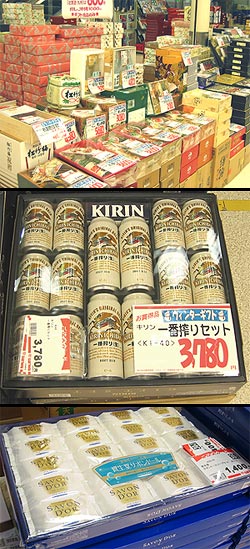 marks the Chugen season, the winter one is called Seibo. Each one is marked by a special gift section created in stores across the country, sometimes taking up as much as half of a floor of a department store. In such gift areas you’ll find a plethora of items, popular ones including small rolled hams, and a wide variety of product packs–a 20-piece soap package, a 15-can beer package, packages with assortments of cookies, coffees, salad oils, fruit juices, canned seafood, and countless other consumer items. One buys gifts here and either gives them or has them delivered to the recipients. The Seibo gift centers are already open for business.

 Well, the school had its Arts Festival yesterday, and it was amazing to see the talent so many of our students have. Not just your usual skits at the talent show–we have some serious composers, musicians, singers… One student, for example, played original piano compositions that were astounding. I was in back when another started singing “The Heart Must Go On,” and I swore that I was listening to a recording of Celine Dion. Paintings by some of the students I honestly mistook for art that the live house had purchased, and there was a fantastic brass section that performed “In the Mood.” Seven students made up a punk rock band, playing a popular Japanese song called “Train, Train” that had many of the students in the audience acting like groupies at a concert. And one of my former students, who I knew was talented, surprised me in showing an array of talents I never expected, from keyboard artist to trumpeter to half a dozen other talents.


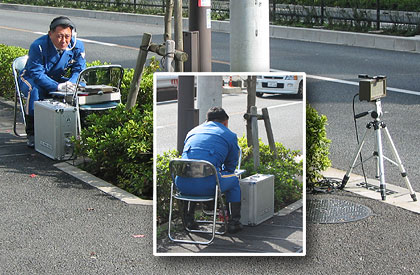
 located strategically so that a speeder cannot turn off somewhere or otherwise get by. A motorcycle cop stands ready to pursue anyone who tries to get away.
 works–and there is never a speed trap or even an officer on patrol. In the places where they could do the most good. Instead, the traps are set up on long, wide straightaways with absurdly low speed limits. The street pictured here is a wide (for Japan) two-lane boulevard with little foot traffic (it’s an industrial area). I walked its length and maybe saw one or two pedestrians in total. Very little cross traffic. In other words, probably the place one would least have to worry about accidents happening.