Caucus #5: And the Wrap-Up
Well, the caucus has been over for a while now–I stopped over at Akiyoshi for dinner after having had no breakfast or lunch, then came straight home and rested for a while.
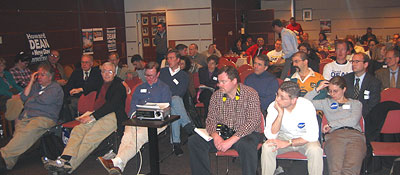
The caucus went a little long, until a bit past 6:30, until the Foreign Correspondents People chased us out. After we finished the delegate assignments and the votes for who would go to Scotland for the main caucus, everyone settled down again to hear out the resolutions.
First came a resolution for Environmental Justice, represented in a 3-page missive stating the necessity of environmental protection that has been so savagely attacked by the Bush administration. Rejoining the Kyoto accord, tax incentives for renewable resources, and other important environmental policies were espoused, to be voted for positively by the remaining caucus members (by this time we had lost about a third of the attendees). After that, two resolutions, affirming gay rights and staking a position against any constitutional amendment outlawing gay marriage were adopted with similar speed and acceptance.
Other resolutions, most drafted on the spot, were met with more questions and quite a few revisions. One forwarded by someone obviously a bit puzzled and overwhelmed by the confusion involved in the caucus process was to suggest the process be changed to 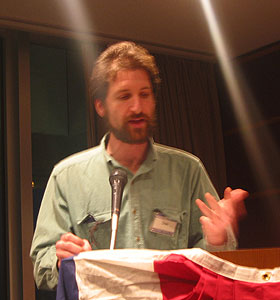 a primary. Apparently it would have to be done so for all Democrats Abroad chapters (more than 30 now), but there were many people who agreed. Still, the the idea had not been well thought out, and there were many questions about how it would be decided and by whom. Eventually, the matter was withdrawn, though the idea will be discussed by the DA and perhaps decided later in a different forum.
Next came a proposal for “Sound Science,” which met with a great deal of questioning, but was nevertheless a very popular issue. It stemmed from the practice of Bush and conservatives in relegating scientific study to the realm of religion and politics, with only studies that supported the political desires of the administration, or agreeing with fundamentalist doctrines, allowed to be heard at the highest levels. The presenter who felt strongly enough to stand up and take on the questions stated that “the past four years have been really depressing for those who believe in things like, you know, facts… reason… research.” Discussion then began over what exactly “sound science” referred to, whether it was supposed to be a partisan or exclusionary term–which is was not, as the proponent pointed out. Eventually, the idea of defining “sound science” as repeatable results, independent verification and peer review was whittled down to “independent peer review,” allowing for uncertainty and difference of opinions resulting from differing interpretations of data. But the heart remained, that being to stop religion or political forces from censoring or steering scientific data and discussion. The proposal passed resoundingly, as did most that passed.
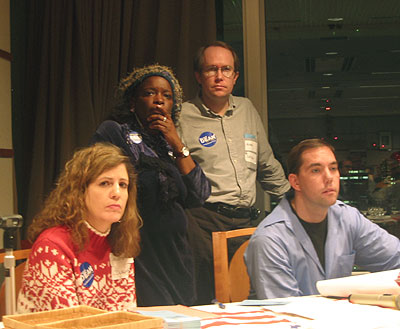 Then there was the suggestion forwarded by Terri MacMillan, who runs the DAJ web site and blog, to explore the possibility of forming a committee to advance outreach programs to minorities and poor communities, particularly via broadband Internet, so that they may become more a part of the political process, more connected to choices and rights available to them, and end a virtual disenfranchisement that many people today suffer from. Again, there were questions and suggestions for revisions, but when the powerful “Yea” vote came through, Terri was delighted, letting out a joyous “Oh, Wow!”
Then came a final proposed resolution, one which was met well in spirit if not well in specific form, that being to increase combat pay for those in Iraq and anyplace else where they face danger by the amount of $500 per month. This was debated on various grounds, such as how it would be paid for and exactly what the details were. Eventually, the suggestion came from Ruth McCreery that we bring back a kind of new version of the G.I. bill, guaranteeing a tuition-free education for every veteran; later, it was pointed out that the main spirit of the bill was to mend the multiple and various acts of violence done to veteran’s benefits by the Bush administration, so a repair of those wrongs was added, all on top of the $500/mo. “hazardous duty kicker” as defined by someone close to military culture. The resolution was passed.
All of these resolutions will eventually be taken to Scotland and proposed there, presumably to be worked into similar proposals and then voted on so they can be brought in to Boston for the convention.
Altogether, a productive meeting and four (really five) hours well-spent. I was very happy to find the live WiFi connection allowing me to post live from the meeting hall, and took quite a few photos, many coming soon, that helped document the activities. When more information–such as the official minutes–become available, I will post on them. Coming next: the photo gallery.
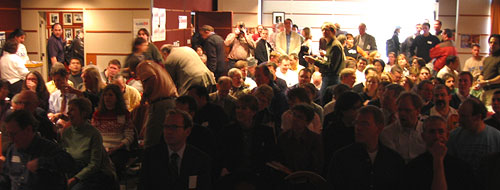
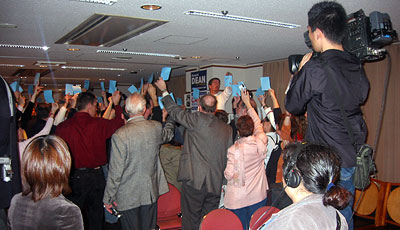
 At the first count, it was Dean, Kerry, Kucinich, Edwards, Uncommitted, and Clark–so the Uncommitted, Clark, Edwards and Kucinich people, with the least votes, had to vote elsewhere or combine to make a larger group. This is where the “horse trading” started. A lot of the smaller-group people joined the uncommitteds, making them a viable group. The Dean group, from some reports (nothing official), had made a deal with the Kucinich people, to give them enough people to make the count in exchange for Kucinich people coming to Dean if Kucinich lost out–and that is what happened. After we lost a few people to time, the final count was: Dean 69, Kerry 51, and the Uncommitted group with 29. That’s the three delegates right there, the people going to Scotland.
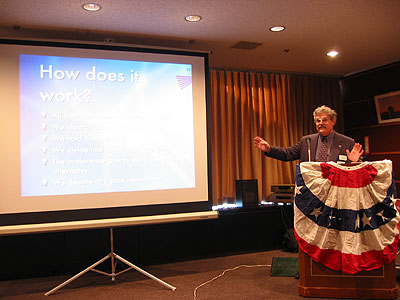
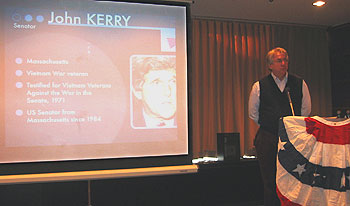 Mr. Skip Orr speaks for John Kerry; a lifelong Democrat, he nonetheless served in the Reagan administration, and tells that the Bush administration, particularly what he calls the “Bush cabal” are strong neo-conservatives, way farther right than Reagan and his people ever were. He spoke of a nightmare–January 2005 and Bush is at the Rotunda, with his trademark smirk, taking the oath. Unfortunately, probably because he was trying to save time, he didn’t say too much, didn’t speak too long.
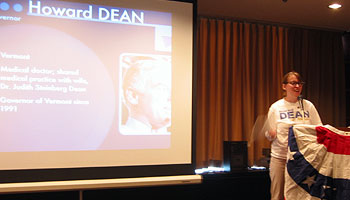 basic Democratic party lines, as with everyone else. But like Clark, behind Kerry in the voting so far, probably a lot of people are wishing he weren’t quite so vocal against taking a vice-presidential spot should he eventually drop out.
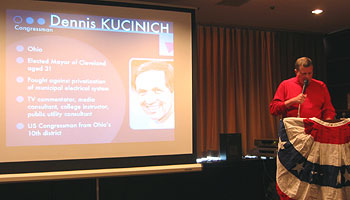 Wayne Parton speaks for Dennis Kucinich, although he was not the official representative–so he read from a script. Told the story of Kucinich, which was impressive enough. Youngest mayor of Cleveland, college instructor, and Congressman from Ohio, replacing the Republican incumbent. Also fought against the “Enron-like” takeover of Cleveland’s power system. He also spoke well on how Kucinich voted against the Patriot Act, against the war in Iraq–and spoke honestly about his chances, but pointed out rightly that Clinton was way down in January, and that getting to the convention and contributing to the party plank is important. This “unofficial” rep spoke on and on, but he said great things–and was eventually shouted off the podium for time.