Well, That’s a Relief
Hey, guess what? According to Tom DeLay, I’m not a bad person, I’m just ignorant. That means a lot, especially coming from a tolerant paragon of virtue like Tom.
So I finally found my way to the Tokyo Wild Bird Park in Ota Ward near Haneda Airport (closest station: Ryutsu Center Station on the Tokyo Monorail, three stops out from Hamamatsu-cho on the Yamanote Line), and had a look around. The park has one central entrance easily enough found on foot, though I’m sure it’d be very hard to locate by car–it is only accessible (or even visible) going one way off the access street, in the direction opposite from the way most people will come, and even then it’s off a secondary street you have to know to take.
Once in the park, you pay ¥300 and are handed a booklet (English version available) with a map of the park and images of the birds usually seen there. The park (see map here) divides into two sections, and seems ideal for birds–there are several lakes, brush, woods, marshes, even mudflats. The bad point is that there’s heavy traffic and trucks loading and unloading all around the periphery of the park, in addition the close-in air traffic, making quite a racket most of the time. Doesn’t seem to bother the birds, but for humans it takes getting used to.

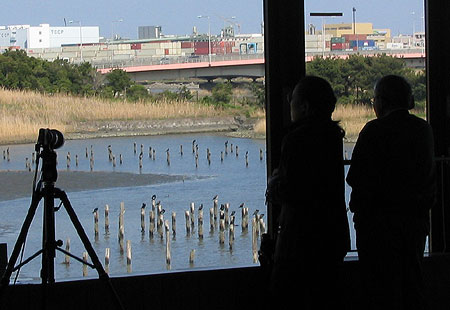
The other problem, though you see its necessity, is that you can’t really go very near the birds at all. The pathways on the map are mostly access paths for staff; visitors are kept to the main paths, and the good viewing spots are not very close-up. They have four huts and one wall set up with viewing blinds, each one equipped with viewing scopes (a nice touch, though many are missing) and seating for the patient birder. There is also a “Nature Center” with large glass windows and more scopes, allowing for a good view of the central park area. But the birds are usually at least 20 meters or so from any viewing spot, and likely much farther; without a good zoom lens, you won’t catch many good shots. Though if you’re just there to view, the scopes they give you do quite nicely.

Because this was a weekday without many people on vacation, the park was nearly deserted. Unfortunately, there weren’t many birds around, either. Well, there were a number of birds, but not as many as one might expect for such a location. A whole flock of Cormorants, and an unusually large number of Eurasian Coots and Northern Shovelers, but nothing I hadn’t seen before, and certainly no truly uncommon birds. Tree Sparrows, Great Tits, Little Grebes, Tufted Ducks, Pygmy Woodpeckers, Dusky Trushes, Brown-eared Bulbuls, and of course, crows and pigeons were all in attendance. A Kingfisher flew by too quickly to see (though we could hear it), but mostly they were species that can be seen in a lot of other places.
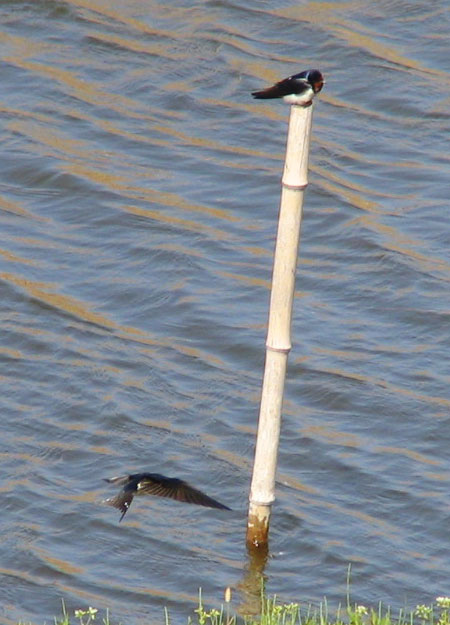
However, I did see a few new species and got photos of one I hadn’t shot before. The first was a bird I have seen often of late, but is always flying fast and erratically: Barn Swallows (Tsubame • ツバメ). They were flying that way here, too, but I was able to catch a few seated on a pole not far from the viewing blinds.


While I was watching the swallows, I noted a big white bird in the distance coming in for a landing in the marsh, and got a lucky shot of it. At first, I thought it might be another of the common egrets, but this one surprised me when I took a look at the image on my computer later–it was a Grey Heron (Aosagi • アオサギ), one I’d never seen before:

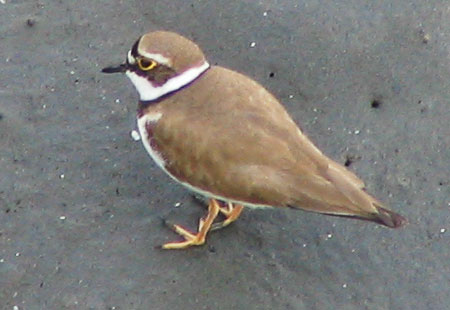
The only other original bird I saw was a very nice-looking one, a Little Ringed Plover (Kochidori • コチドリ):


I also did catch a very brief glimpse of what I am pretty sure was an Azure-winged Magpie (the tail was distinctive), but no chance to photograph it this time.
So not an unproductive day, but not exactly the windfall of new species I’d hoped to see. But I’m told that later this month, around the 20th or so, there will be a lot more birds coming in from migration, so I’ll be back again to see what develops.
UPDATE: I have started translating all of my brother’s novels, in their latest editions, to epub format for easier viewing on ebook readers–perfect for the iPad. Read my current post on the topic (with instructions on how to upload to your iPad), or click the button below to download directly.

I am rewriting this post because all three books are now done. Let me introduce the situation. My brother has begun writing fan fiction, and he’s done so with a vengeance. He prefers not to be identified by name on the web, and goes by the handle “Semprini,” a Monty Python in-joke.
So far he has written three novels based on the Harry Potter series. The books pick up where Rowling’s fifth book (Harry Potter and the Order of the Phoenix) left off. They diverge from the original novels there, so you will note quite a few contradictions between them and Rowling’s sixth book, Harry Potter and the Half-Blood Prince. Essentially, my brother’s books finish the Rowling series and then some: The Veil of Mystery is book six, The Ring of Reduction is book seven–the end of Harry’s time at Hogwarts–and Phoenix Intuition takes place a few years after Harry graduates. So if you begin reading The Veil of Mystery, it is advised that you re-read Rowling’s The Order of the Phoenix so as to remind yourself where things stand.
All three of my brother’s books were completed before Rowling released The Half-Blood Prince. My brother may or may not write another Harry Potter book in the future, but if he does, it will likely be quite different from the novels he has written, and may be in a very different time and setting.
The books tend to be long. Both Veil and Ring would be more than 1000 pages each if published in hardcover form. We’re talking more than 400,000 words each. Phoenix Intuation is about half that length.
You might also be surprised at the quality: they are extremely well-written. I’m not just saying that because it’s my brother, I mean it. Many readers have even said they prefer my brother’s book six to Rowling’s version–and frankly, I agree. A matter of personal preference, of course–both authors take the series in different directions, which will suit different people in different ways. But to be compared favorably to Rowling is no small feat.
It should also be said that the novels are written for an older audience. There is an strong tendency to weave in elements of morality (without getting even near “preachy”), current events, and observations of interpersonal relationships. In contrast to Rowling’s books where characters act in ways that are forced by drama or mystery, my brother’s rendition of the characters is more in line with real life, the way responsible and rational people act–and yet he maintains drama and mystery.
The books are presented here chiefly as PDF files, readable on any computer. For a Mac, just use TextEdit. For Windows, use Abode Reader or any other application with PDF ability. The books are presented in B5 paper size (roughly 7″ x 10″) to be more readble on a computer monitor; if you print out on US Letter-sized paper, there will either be very large margins, or the typeface will appear a bit large. The third book has a US Letter version; in the future I may translate the first two books to this format also. The first two books also come divided into sets of three chapters, and have plain-text formats as well.
![]() |
|
| All of the below files are in PDF format. Chapter group files range from 360 KB to 880 KB in size; the whole book file is 4.2 MB. | |
Download Plain Text version (2.2 MB)
And…
![]() |
|
| The files below are in PDF format. | |

If you read them, please let me know your thoughts and feelings so I can pass them on to my brother.
By the way, is the B5 size working out? Would anyone prefer US Letter or A4 size for printing, or does everyone read it on the computer?
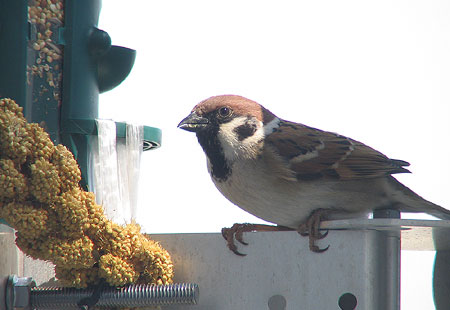
The feeder that I put out my dining room window has mostly attracted just sparrows; I was hoping for more than just them, but so far only pigeons and an Oriental Turtledove (a slightly better-looking pigeon) have shown up aside from them. But the sparrows are now regular visitors to the feeder, sometimes as many as ten of them out there at the same time. Which means that they tend to get a bit aggressive with each other about who gets access to one of the three feeding holes. Which led to this photo:

It’s taken at high speed, 1/1000 of a second (those little buggers flit around real fast), and the action that happened to reveal itself in that split second just looked so similar to a bird martial-arts scene that I had to put it up.
Remember one week ago, when I opined that the “GOP way” is to blame their own faults on the Democrats? More evidence, from the Master of Malfeasance Tom DeLay himself:
House Majority Leader Tom DeLay (R-Tex.) implored Republican senators yesterday to stick with him while he addresses questions about his travel and his dealings with lobbyists, as House Democrats unveiled plans to try to make ethics a defining issue for the year. …Attendees said DeLay, in extremely brief remarks, told the senators that, if asked about his predicament, they should blame Democrats and their lack of an agenda.
‘Nuff said.
Do Republicans believe that any tax cut is a good thing?
In the 1980’s, rich people got substantial tax cuts, only to see them rise moderately in the 90’s; in the past four years, under Bush, it’s been cut after cut after cut, primarily aimed at rich people. And now yet another: House Republicans passed a repeal of the Estate Tax, with Senate Republicans primed to sweep the bill through just as unanimously among their brethren. Of course, they posit the bill as being aimed at small businesses and small farmers, but we all know that this is utter bullshit: only a few hundred such entities are effected by the tax each year. Democrats tried to counter-offer a raising of the ceiling of the tax, which would have changed the current $1.5 million exemption (up from $1 million in 2001 when Bush cut the tax then) to $3.5 million, shielding all but 0.3% of Americans, i.e. the very rich–but Republicans overwhelmingly rejected the alternate offer.
And despite their claimed concern for small businesses and farmers, they did not take the plainly obvious route of exempting just small businesses and farmers. The reason, of course, is obvious: this is not a tax cut for small businesses and farmers. It’s a tax bill for (surprise!) the super-wealthy. The Walton family, for instance, were big Bush and GOP contributors, and they have been pushing relentlessly for the tax cut. By themselves, they will save tens of billions of dollars on top of the many tens of billions they will already get. This is the “small business” that the bill is truly aimed at. The Waltons spent $3.2 million on lobbying and campaign contributions to Republicans, and they weren’t alone; other rich people spent similar amounts on buying off the GOP. And this is where my disgust for politics is often deepest: not just that politicians can be so easily bought, but that they can be bought so cheap. The Walton’s $3.2 million will net them tens of billions of dollars (probably more than half of their $84 billion estate), a payback of 10,000 to 1 or more for each dollar spent on bribes. Halliburton and Microsoft similarly profited massively from relatively small amounts spent on lobbying and contributions. And who gets to pay these super-rich people the billions that Republicans are giving them?
The repeal of the Estate Tax will add $290 billion dollars to the deficit over the next ten years, and will chiefly benefit people like the Waltons. Amy Sullivan put it best:
So, to sum up: Actual prescription drug relief? There’s no money. Armor to protect our troops? There’s no money. The funds to back up the mandated reforms of No Child Left Behind? There’s no money. Doing away with a tax on super rich kids? Plenty o’ cash to spare.
Remember how Bush is such a big supporter of No Child Left Behind, how it makes him the “Education President”? Well, he is unwilling to fully fund the program, or even to reasonably fund it. In the past four years, NCLB has been underfunded by $27 to $29 billion. It might be underfunded by as much as $12 billion in 2006. Even under the most liberal estimates, the Estate Tax cut for the super-rich will cost much more than that; even the Democratic compromise would leave leave enough to fund NCLB and more.
But the GOP apparently feels that the Walton kids trump education. Kids from lower income families can just eat dust, as far as the GOP is concerned–we just don’t have the cash. But they’re willing to spend far, far more on the children of the super-rich. How disgusting is that? How “fair” is that?
And how pathetic will the average American be for supporting the tax cut simply because it’s a tax cut? How completely bereft of intelligence will American voters be if they support the candidates and the party that endlessly pushes for more sops to the wealthy when the budget crisis is still at fever pitch and their own services suffer? When I ask the question, “What the hell are they thinking?” I’m not talking about the GOP. I know what they’re thinking, and they’re doing what seems best for their own power and control. The people who I can’t figure out are the conservative and all to often centrist voters who actually buy into the bullshit and drink the national-debt Kool-aid.
It’s been just more than a year since Air America Radio went on the air. It started with 6 stations and jumped to 11 in a few weeks, and now is broadcasting on 52 stations nationwide. It just signed an exclusive multi-year contract with XM Satellite Radio, which has a listening audience of 3.8 million. According to Arbitron, AAR corrals in excess of 2 million listeners a week. Jerry Springer (switching from circus acts to political issues) has also recently signed on as a new host; whether you see that as good or bad, it will definitely bring in more listeners. And stations who switch to AAR programming find themselves shooting from the bottom of the heap to the top of the list in many markets.
Clear Channel radio is bringing in Air America to pick up listeners to its underperforming stations; in Portland, OR station, AAR brought the Clear Channel station from 26th to 3rd in the ratings. Clear Channel is adding 25 stations to the Air America network, because progressive radio “is the fastest growing format in the country; and that is because Air America has proved it attracts listeners and advertisers,” according to TIME magazine. That’s not just a single opinion, by the way; a web search shows that it is the prevailing opinion: “The future expansion and viability of AM radio is being driven by liberal talk and it is flourishing.” And: “liberal talk is the radio industry’s fastest-growing format.” And:
Progressive Talk helped drive the News/Talk format to an all-time audience high and a bigger quarterly gain than any other radio format…. The record increase in News/Talk listenership is being driven by the explosive growth of Progressive Talk nationwide. These studies are only the latest evidence of an unmistakable trend towards this new format. … In the coming year this format will grow ever larger, as more stations recognize the huge number of Americans longing for this format.
And many more, go look for yourself. When Air America was in its first months on the air, conservatives were certain of its doom. Right-wing visitors to this blog made comments such as, “so much for the whiney liberal network,” and “Arbitron shows that AA’s ratings are in the toilet where they belong. No doubt soon they will be silenced by commercial force majeure.” When AAR hit some financial troubles in the beginning, conservatives were gleefully predicting its imminent demise, despite ratings reports that showed AAR was scoring well in key demographics; they instead pointed to variations of the ratings numbers which masked this success.
Air America can now be heard in most of the top 20 markets, and its base is growing fast. I can still hear the conservatives trying to dismiss it: “it’s not as big as Limbaugh!” All puns aside, Limbaugh took five years after his start to get an even halfway respectable audience. For a radio network that has been on the air for just over a single year, AAR is performing spectacularly, and may eventually do for the Democrats what Limbaugh and the conservative radio phenomenon did for Republicans.
Want to read the next Harry Potter book, now?
On July 16th, about three months from now, the sixth installment of the Harry Potter series is due to hit the bookshelves. It will entail the happenings of Harry Potter’s sixth year at Hogwarts, and is eagerly expected by its fans.
Too eagerly, in one case.
My brother decided that waiting wasn’t good enough, so about a year and a half ago, he started writing his own version of the sixth book in the series. When I learned of it, I was surprised–I hadn’t known that he could write fiction. When I read it, I was even more surprised–it was very well-written.
Now, there are a lot of people out there who write fan fiction (there are even Harry Potter web sites which feature this kind of fiction), but most of what is written is not of very high quality–plot, dialog, and prose can be downright amateurish in most cases–and most of them are in short-story form. Well, not this particular work. Not only is the writing of good quality, but the book is about a thousand pages long, longer than Rowling’s own work. It does not ramble, however–it follows a very specific and intentional storyline, picking up exactly where Rowling left off at the end of book five, Harry Potter and the Order of the Phoenix.
The book has a very well-defined plot, carrying on a logical track stemming from the foundation of Rowling’s five books. There’s a lot of fun, as well as some serious introspection, and a good amount of philosophical thought on morality, relationships, life, and death, without being preachy about it. the book is not written for children, but for a more adult audience while still keeping true to the spirit of the Harry Potter stories.
And my brother didn’t stop at just one book–the seventh novel is also complete (or nearly so), finishing up the seven-year storyline, and again weighs in at about a thousand pages. Needless to say, he went on quite a writing binge over the course of the year or so it took to complete both books. He plans to write another Harry Potter book later on, picking up the story in Harry’s adult life.
You should know that if you have not read books one through five, this may be confusing as there is a lot of background to the story. But then, if you haven’t read the whole series, then you may not be interested in reading this anyway.
I have converted the chapters into PDF form, so if you have a Mac, you can open it with Preview (I recommend viewing in full-screen mode), or on a Windows machine, you can open it with Adobe Reader, which can also install a browser plug-in that allows direct reading in the browser.
I will be presenting the book in chapters, the first one today, and eventually, the whole book in one gigantic file. The first three chapters (“An Owl Gathering,” “A Summer’s Day at Hogwarts,” and “The Wizard and the Boxer”) weigh in at 415 KB for 96 pages. The format is B5-sized paper with 3/4-inch margins to accommodate easier reading on computer monitors; the text is in 12-point Garamond, 1.5-spaced, with chapter titles in the Harry Potter “Lumos” font. Soon I will create a special web page for the book and chapter downloads with a link to it in the right-hand column of this blog.
Any comments, feedback, opinions or suggestions are welcome. Here it is:


post edited 4/12/05
Remember in the 2000 elections when Bush and Cheney claimed that Clinton and Gore had “no energy policy” and that they would be able to bring oil prices down from the ghastly high price of $35 per barrel by pressing OPEC nations to remember US actions during the Gulf War, forcing them to increase oil production, thereby bringing down oil prices? Remember how they scoffed at Clinton’s “driving up” oil prices and not trying to explore “alternative energy sources”?
Well, guess what. Oil prices are sky-high, now at $53 per barrel after hitting a peak of $58, and a Goldman-Sachs report warns of prices as high as $105 in the next few years.
So where’s the Bush/Cheney Oil-men strength? How come OPEC and Mexico haven’t answered their beck and call? And who knew that when Bush talked about drilling in ANWAR and “alternative energy sources” that he was talking about the same thing? Apparently he’s not aware of the fact that “alternative energy sources” does not mean simply drilling for oil in different spots.
Bush has talked big on this topic; in his 2005 State of the Union address, he said:
To keep our economy growing, we also need reliable supplies of affordable, environmentally responsible energy. Nearly four years ago, I submitted a comprehensive energy strategy that encourages conservation, alternative sources, a modernized electricity grid and more production here at home, including safe, clean nuclear energy. … Four years of debate is enough – I urge Congress to pass legislation that makes America more secure and less dependent on foreign energy.
Four years ago, he may have “submitted” a “strategy,” but in real life, he cut the funding for alternate energy by 50% in that very same year.
And what’s he gabbing on about here with “four years of debate is enough,” as if the Democrats have been holding this up? Hasn’t he noticed that his party controls the Congress and Democrats would undoubtedly vote for such an energy platform? He can get practically any bill he wants through; if this one has been held up for four years, it’s because he doesn’t want it to go through, like so many of his other feel-good promises that never get delivered on (while his hurt-the-average-American programs get quickly whisked through Congress).
Proof is in the funding: in his ’06 spending proposal, Bush wants to cut funding for researching alternative energy sources:
The FY06 budget request for the U.S. Department of Energy’s (DOE) energy efficiency and renewable energy (EE/RE) programs envisions reductions totaling nearly $50 million – an overall cut of roughly 4 percent. This includes a 6 percent cut in Distributed Energy programs ($60,416 to $56,629); an 8 percent cut in the Geothermal Energy program ($25,270 to $23,299); an 18 percent cut in the Biomass/Biofuels program ($88,099 to $72,164); and a 90 percent cut in the Hydropower program ($4,862 to $500).
In the meantime, people trying to get to work on Bush’s disastrously low, beneath-the-poverty-line minimum wage are finding that a bigger and bigger chunk of their daily wage is being eaten up at the pump. Maybe Bush and his fatcat cronies don’t feel the effect of the price hike, but everyone else surely does. Bush has failed miserably on this issue.
Even if the world oil supply is not running out or even running low, consumption has increased to the point that we cannot sustain even the hope of lower prices. This is just part of Bush’s stealth tax hike–slash your services, raise state and local taxes, and prices for basics skyrocket. That pittance of a “tax cut” (mostly paid for by raising your taxes later) is more than offset by all the additional expenditures.
And what is planned by Bush for the future? Apparently nothing, aside from drilling in every other national park and crossing his fingers that we’ll hit the mother lode. Just keep that master plan in mind when you find yourself paying more than $3 per gallon of gas in the coming months.
We need an explosion in spending for research for alternate fuel, not drastic cuts. We need real solutions, not Vegas-style gambling on maybe finding an improbable all-you-can-pump oil field somewhere. If we don’t find such a new source free of oil dependence, it will be the Nth nail in America’s coffin pounded in by good ol’ Dubya.
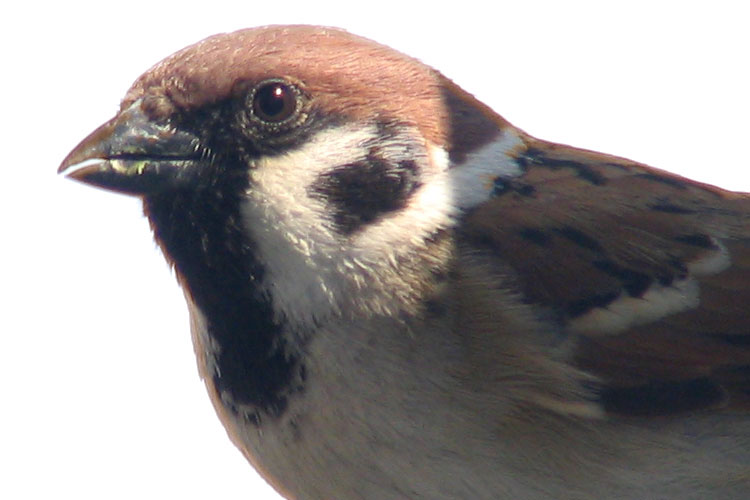
Despite my window areas lacking any kind of hook, latch or other place to attach a feeder, I’ve rigged a bird feeder onto the satellite antenna brace in an attempt to bring some of the local wildlife to my window. The tree sparrows found it the other day and have been feeding fairly frequently–but certainly not all the time. And they tend to be skittish, flying off if I move even a little anywhere in sight. But if I’m patient and sit by the window for long enough, they won’t notice me if I’m still. So I set up the camera on a tripod, and have been using the full 16x zoom on them from a distance of only a bit more than two meters away. Despite the very windy weather today, they’ve still been coming, and I’ve gotten a few nice shots. This one I thought was particularly good:

Of course, that’s the whole photo, reduced but uncropped. If we zoom in on the bird and crop but don’t reduce:
A slightly less-cropped version can be seen by clicking on the above image. The shot has been Photoshopped only to remove the purple and blue zoom fringing.
That’s about as detailed as you’re gonna get with bird shots, I figure. Now if some other birds than sparrows would only visit….
Ah, you love to hear stories like this one: mass spammer gets sentenced to nine years in prison for sending 53,000 junk emails in a manner violating anti-spam laws. Unfortunately, it’s not completely good news. First, the sentence is being delayed on appeal because of questions about the constitutionality of the new law (you can guess where I stand on that issue). It is possible that this particular scumbag will get his conviction thrown out, and if not, the judge has even stated that he may reduce the sentence anyway. And even if he does go to prison, that will not stem the tide of spam sent to your mailbox or mine; the law can only apply within the U.S., even just within some states, and spammers in other countries may spew away with glee. At best, the local spammers will be inconvenienced and will have to move offshore; however, it is not really comforting to us that the slimeballs will being doing their work from the Cayman Islands rather than from North Carolina.
Worse news still: reports say that by sending out as many as 10 million spams a day, this subhuman crud (is my annoyance with these people showing?) was able to make up to $750,000 a month. I knew that there were enough idiots out there who not only read spam but answer it as well to make spamming profitable, but I am dismayed that there are so many that the practice can be so wildly successful–and remember, the spammer got arrested and tried only because he didn’t identify himself correctly on the spam. Had he done so, it would have made no difference to those suffering from his onslaught, and he would still be doing it today, as so many others still are.
So, what is the answer? In my opinion, we should begin charging for email, but only in a way that hits spammers. Here’s how it works. A new email network gets set up alongside the old one. But to use the new one, you have to put $5 down for your account. Whenever you send an email to someone, you are committed to pay them exactly one cent–but this money is only collected if the recipient claims the fee. For most personal and business messages, the recipient will not claim the fee, so your $5 is never touched. Even if you get charged every once in a while, the cost to you would be negligible. Spam, however, can be automatically filtered and marked “charge the recipient,” and even when it isn’t, just zapping a few dozen spam messages by hand could earn you a quarter or two from the spammers in the short time it takes to send them to your junk mail box. At the end of a few months, you could buy yourself a nice dinner with the proceeds. The bastard who was sending 10 million spams a day would suddenly be liable to shell out $100,000 a day or get his email privileges revoked, and fast.
There would be setup and maintenance costs, to be sure–but if it could get rid of spammers, I’d be happy to pay the few bucks a year necessary to do the job–especially if blog comments and trackback pings could be added into the system somehow….
I took advantage of an early bout of drowsiness last night at about 9 pm to get to bed early in order to wake up early for some birding today. Maybe I went to the wrong places, but it seems to me that there are more birds in the afternoon than in the morning. Still, I did get a few good shots, and added two new species of bird to my record.
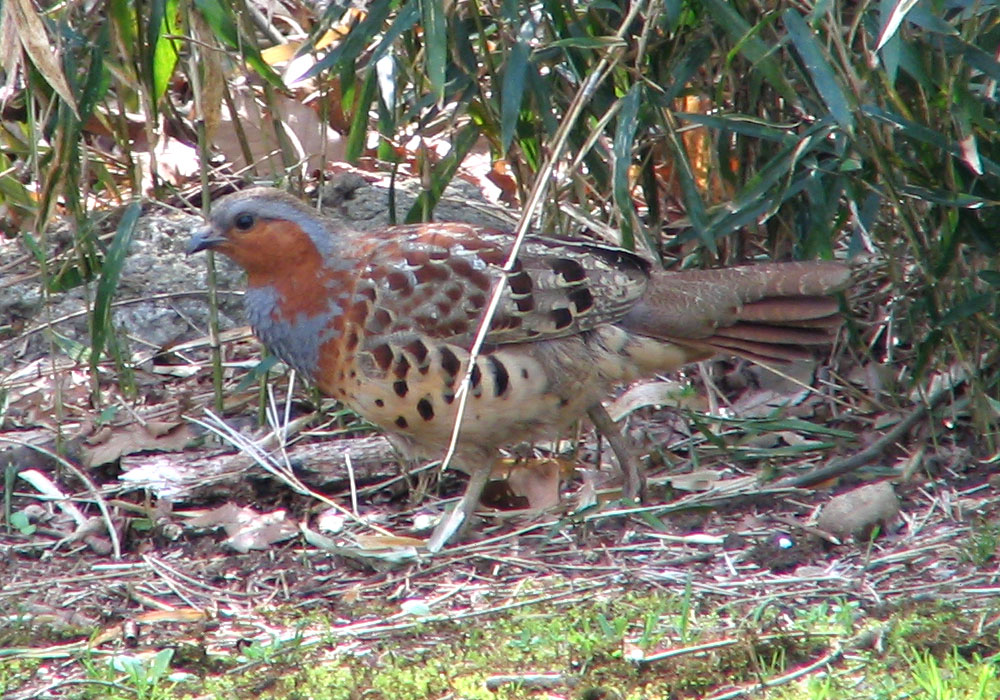
While both new species were quite interesting, the Chinese Bamboo Partridge (Kojukei • コジュケイ) was the more surprising to me. The red and blue coloring around the head and breast gave me a start when I first saw it. I thought it might have been a pigeon at first, because of the general size and the bird’s gait, but those colors made clear that this was a more unusual bird.
By the way, the partridge photos have larger images available when clicked.
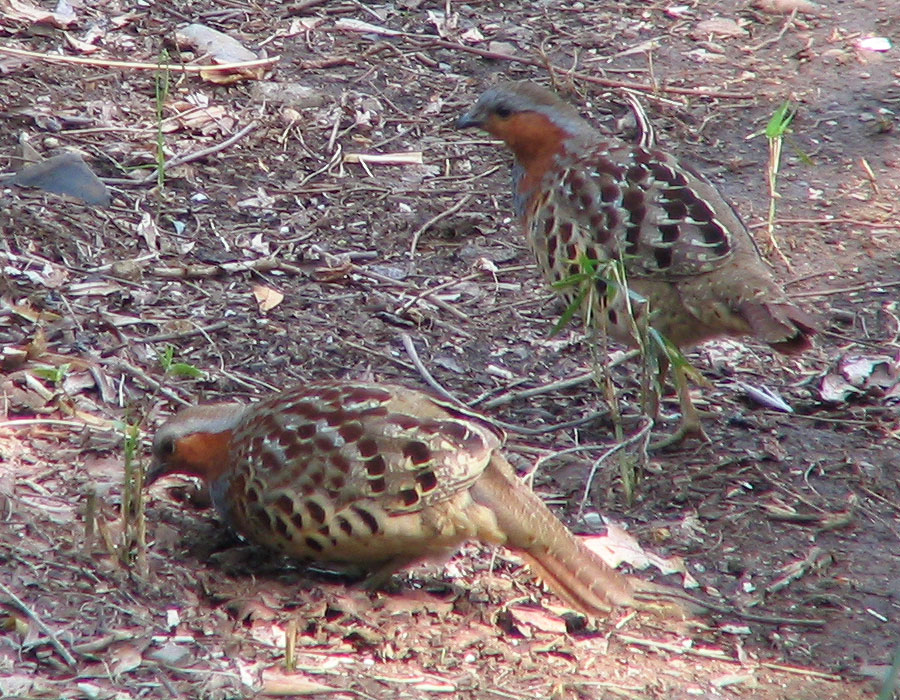
You can certainly see what took me aback–that’s quite an unusual-looking bird! Apparently, it was a bit of a coup–when I later tracked the birds to a more inward location in Sengenyama Park, they started making rather loud calls (sound file here, 330 KB, 11 KHz), which attracted a fellow with a very advanced birdwatching setup–but he wasn’t in nearly the position I was to photograph the birds. But he did tell me that the calls were very distinctive, and that this was the time for the birds to be pairing–which explains the pair:
I’ll have a few more photos of the Partridge in the “Continue Reading” section, linked to at the bottom of this entry.
The other surprise find of the day just jumped right out in front of me on the path: a Varied Tit (Yamagara • ヤマガラ). This is the cousin to the Great Tit, but has more interesting coloring. As with most of the Tits, this one was not a long stayer, so the shots I got off (even more slowed than usual due to a malfunctioning shutter button!) were less than perfect–but you can still clearly make out the red shading on its sides, as well as the extra white above its beak:

That’s the best shot I got; here’s a slightly fuzzier shot, but you can see it more from the side:

Here’s a darker treed view:

And here’s a Great Tit for comparison:

Click on “continued reading” (just below) for a few more photos.
Read more…
This is in a very real way a mirror of one of the worse aspects of American culture, the propensity to blame anyone but yourself or fate for something bad that happens. When children seem badly raised, it’s because of music, TV, movies, schools, video games, their friends, or society in general–but never the parents, it seems, at least according to the parents. If a person gets injured, then somebody usually gets sued–it was the fault of somebody else involved, whether they were there or if they were responsible for manufacturing or managing something involved in the accident–but not the fault of the person who got injured, and not simply an accident of fate that happened somehow.
In politics, the GOP are masters of this mindset. Always blame somebody else: the Democrats, particularly Bill Clinton, are a good target, and if you can’t pin it on them, then some legal aide will do the trick. The poor economy? Blame Clinton. 9/11? Clinton. Record deficits? Due to the economy and 9/11, so blame Clinton. Valerie Plame affair? Hmm, can’t blame Clinton or the Democrats for that one… it was some legal aide!
Bush himself mastered this tactic well during the 2000 election campaign, when his drunk driving arrest became public. Despite having committed such a reprehensible offense and then lied about it for so many years, and despite being a presidential candidate with such a serious offense on his record, he successfully played the revelation as being the fault of the Democrats! Here’s Bush’s take:
The Bush campaign charges that Democratic “dirty tricks” are responsible for the disclosure of information about George W. Bush’s 1976 drunk driving arrest.“I think the American people are tired of this kind of ‘gotcha politics,'” Bush spokeswoman Karen Hughes said Friday. “They’re tired of this kind of last minute dirty tricks and I think the Democrats owe the American people an explanation.”
Arnold Schwarzenegger similarly blamed the fifteen charges of sexual harassment against him on Gray Davis, also calling them “dirty tricks,” intimating they were not his fault but should be blamed on the Democrat.
Well, it would be out of character for the GOP to stop now, wouldn’t it? So that’s what happened in the Terri Schiavo case, when it was revealed that there was a Republican talking-points memo floating about which called for Republicans to take advantage of the issue for political gain. The memo said that Schiavo was “an important moral issue and the pro life base will be excited,” and that it is a “great political issue because Sen. Nelson of Florida has already refused to become a co-sponsor and this is a tough issue for Democrats.”
When this was revealed, Republicans immediately blamed the Democrats. The memo was a fake, they said, and the Democrats were undeniably guilty of having forged the memo as a political dirty trick! Republicans everywhere were discussing the forgery, especially on conservative forums where people were downright pissed off that those bastard Democrats were forging documents again! They were not only upset that the Democrats were up to their old dirty tricks, but where the hell was the press in reporting on this debacle?? It’s the liberal media, at it again!!
But then it came to light that Florida GOP Senator Mel Martinez himself was the source of the memo. He actually handed the memo to Democratic Senator Tom Harkin, calling it the Republican talking points memo! Whoops!
So now, are the same outraged voices in the GOP singing mea culpas? Of course not! It still isn’t a GOP blunder. It was a legal aide who wrote the memo, and Senator Martinez had no idea what was written on it when he handed it to Harkin! Of course he would never approve of such a document! In fact, he stated officially that “Until this afternoon, I had never seen it and had no idea a copy of it had ever been in my possession.” Of course! His legal aide wrote the memo and put it into his pocket without the senator’s knowledge, and then Martinez took the piece of paper out and handed it to Harkin, calling it the GOP “talking points memo”–but he still had “no idea” what the piece of paper was! Happens all the time!
So yet again, blame the Democrats, and when that fails, fall back on the villainous legal aide who single-handedly commits the deed without anyone else in the GOP knowing a thing about it. I gotta tell you, by now the GOP is rife with dastardly legal aides. They should do something about this infestation, ’cause it’s really making them look bad.
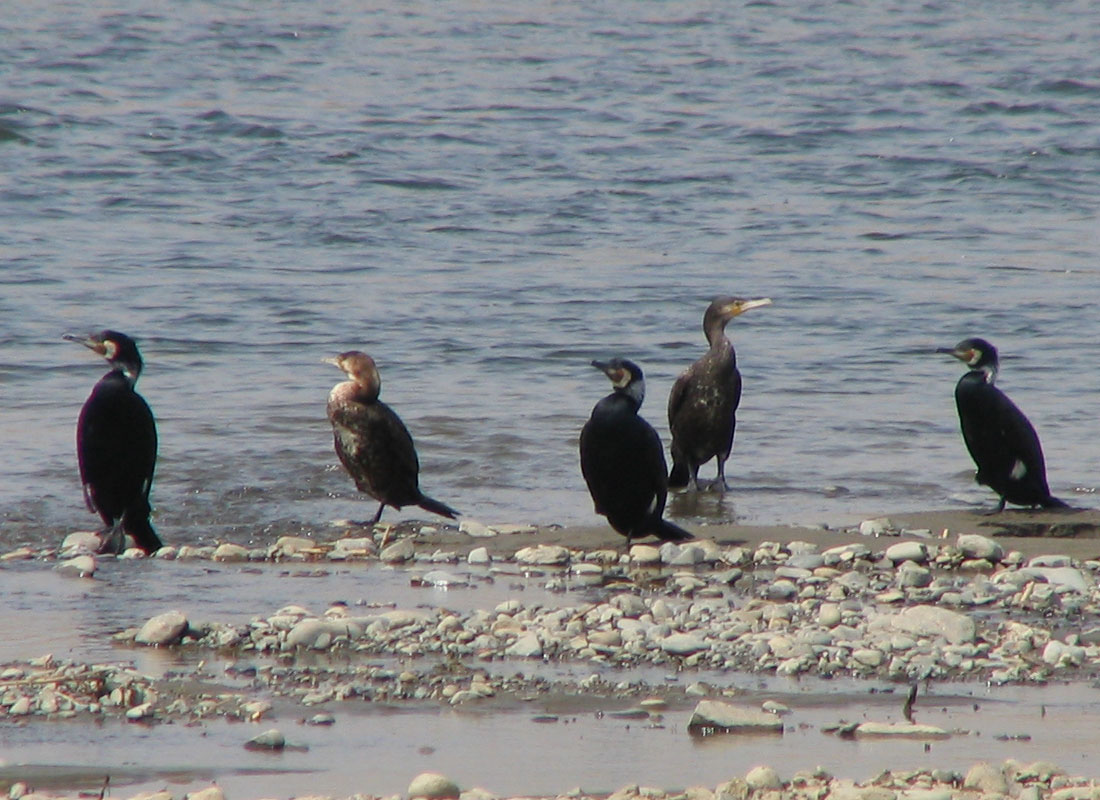
Since this is final exam week, I haven’t had much free time in daylight to take advantage of the zoom tele-converter that I bought, to test it in the field. however, on my way in to work this morning I stopped by the Tama River and found a few subjects to try it out on.
The usual flock of Cormorants was in attendance, and the 16x shot of them turned out pretty well:
Click on the image to see a larger, less-cropped image.
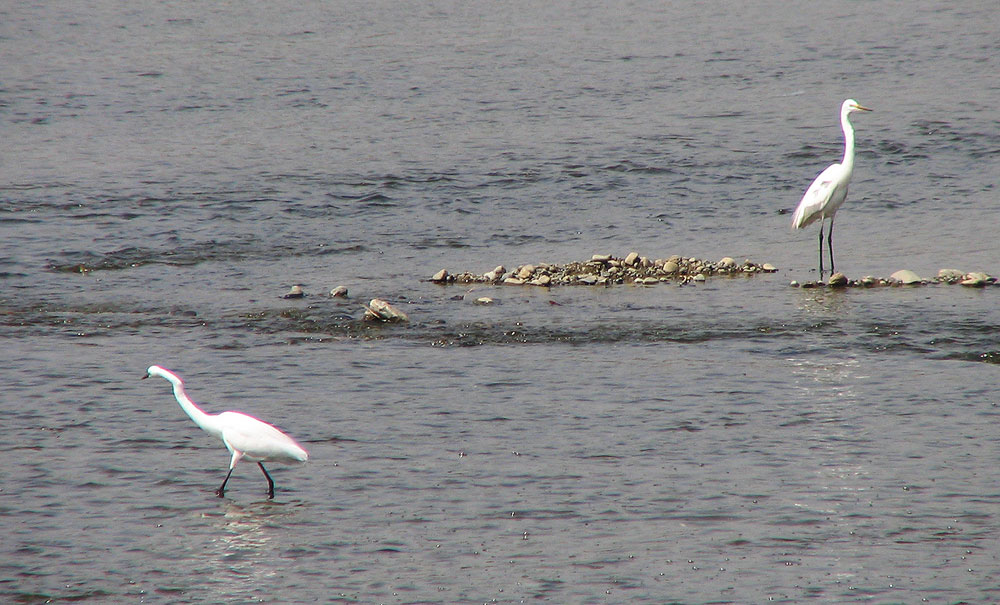
But the better find was a group of four Great Egrets. Now, I think I saw a Great Egret before (an old photo taken at Shinjuku Gyoen, years back), but I was less sure of that than this time. The were pretty big birds, and from their size and the length of their necks, I’d say that they pretty much have to be Greats, not Intermediates.

That image is full-size–that is to say, cropped but not scaled down. The bird was fairly well into the river, so I’d say the zoom is working pretty well. Of course, that’s a pretty big bird. And there were four of them:

And this photo, which can be seen in larger size if you click on it:
I tried to get closer for some slightly better shots, but these birds, even twenty or more meters into the river, don’t like observers on the banks to get too close, and they flew off.
Two years ago today I made my first post in this blog. 1,195 entries later….
So there I was at the shop, mulling over which zoom lens to buy. I have a camera with 10x optical zoom, so the 1.6x and 2.2x telephoto converters would, naturally and respectively, make my optical zoom 16x or 22x. You’d think I’d only naturally go with the 22x. However, there are other considerations.
Size and weight. The Raynox 2.2x lens is light, but it’s also huge. At five inches, it’s twice as long and maybe three times as bulky as the Canon lens. And bulk would be a big down point if I just wanted to hop out the door and jaunt on down to the park. While the Canon is also a bit bulky, at least I can still break it down into small enough pieces to fit into my jacket pockets. And though the Raynox feels lighter (larger items even of greater weight usually feel lighter), it’s almost double the Canon–275 grams to Canon’s 145.
Flexibility. Both lenses have the black outer silhouette when not zoomed in at all, but the Raynox’s silhouette is far more constricting. (See the image in yesterday’s post.) You have to zoom in almost to the full 10x before the black outer silhouette disappears; with the Canon, the smaller silhouette disappears at maybe halfway through the zoom. That allows for me to zoom out to get a wider angle photo without having to change lens assemblies. And, as a small point, the Raynox requires an additional adapter to match the adapter you need to latch on to the Canon S1-IS lens assembly. That means adding three extra pieces instead of two.
Price. This was actually closer than I expected: ¥15,000 for the Canon, ¥21,500 for the Raynox (that’s roughly $140 vs. $200). Less than 50% more money for effectively double the zoom magnification–though, as you can see from the image below, the 2.2x zoom doesn’t really seem as impressive, doesn’t seem like twice the extra magnification, when you look at the end result–though that is largely due to the fact that the extra zoom is seen only after the initial 10x zoom–so from 16 to 22 is not really double.
Effect on performance. This is one I hadn’t really thought through before, and had on of the strongest impacts on me. When I took the comparison shots, it became clear, even through the S1-IS’s tiny LCD display, that the 2.2x lens produced lower-quality images than the 1.6x Canon, and when I thought about it, the reasons made sense. After all, the whole reason Canon’s image stabilization is important is because you’ve got a big zoom lens, and that means that hand jiggle will translate more strongly. So it stands to reason that the more you increase that zoom, the more your hand shaking will overcome the image stabilization–which may be why Canon stopped at a 1.6x tele-converter instead of going for 2.0x or better. Despite the large size of the lens to gather more light, the 2.2x might wind up capturing less light, affecting exposures (though I don’t really know that one way or the other). But the bottom line is, the more zoom you get, the higher a price you pay in performance.
And then, there’s the overall impression:

Look at those two zoom fields. The 2.2x doesn’t really look like like it’s all that much more impressive. Yes, technically, you’re zooming in more. But it really doesn’t seem worth it–more specifically, it doesn’t feel worth the size, weight, extra cost and hit on performance. In the end, I just felt that I’d be too often disappointed and unhappy with the bigger lens–so of course, I wound up buying the Canon TC-DC52B 1.6x converter. And so here it is:

By the way, the black part of the lens assembly is not all the tele-converter. From the camera’s lens assembly to that first major seam in the black assembly is just the conversion adapter for the S1-IS.
Entry for the Dumb Ideas Department: having just bought the Canon lens, I was heading back to Shinjuku station, and in the back of my mind, I was thinking about the lens. My thoughts wandered to blogging about it (as I am now doing), and one consideration was how to get an image of the camera with the lens. Now, you see above that very photo, but at that point, I had not yet considered it, and hadn’t thought it through. I couldn’t take a straight-on photo of the camera in my mirror, I realized, because that would only show the lens head-on, the least interesting view.
So here’s where the dumb idea came in. Now, keep in mind that I was navigating my way through Shinjuku Station, and looking at people and storefronts along the way, so the front of my mind was otherwise occupied; this thought process I’m describing was only going on in the back of my mind. And apparently, the back of my mind isn’t very bright. Because the solution it hit upon was to set the camera’s timer to 2-second mode; I would then focus and click the shutter button while looking straight-on into the mirror–but before the 2 seconds elapsed and the camera took the picture, I would turn the camera so as to get a much better angle!
Once my hindbrain came up with this ingenious plan, it alerted my forebrain. At which time, my forebrain considered it for a split second, and then pointed at my hindbrain and laughed uproariously. It was good for merriment for much of the way home.
Not that my hindbrain stopped there. After a bit, my forebrain realized that the thing to do is to get out the old camera (which I haven’t used since last December) and take a photo of the new camera with that. “Good idea!” answered my hindbrain. “But won’t it be hard to hold both cameras while you’re taking the photo in the mirror?”
Well, it didn’t take long for me to get to want more than 10x zoom on my digital camera. Not that I’m complaining too much; 10x is pretty good, and if you’ve been looking at the Birdwatching in Japan series, then you have a good idea of what good quality shots I’ve been able to get–especially considering that I’m using a digital camera priced just over $300.
But knowing that better lenses are out there, I decided to see what I could find. I went to Yodobashi, and found two candidates: the Canon-specific TC-DC52B 1.6x Tele-converter, and the Raynox DCR-2020PRO 2.2x Tele-converter. Both are priced higher in Japan than in the U.S.; the Japan prices were $140 and $200 respectively. I tried both out on a local target–a shop sign seen out the doorway. Below is the zoom range comparison shot:

The main image was taken with just the regular 10x optical zoom on the Canon. The two interior squares represent the images taken by the camera with the two zoom lenses at maximum optical zoom. I superimposed the 16x and 22x images and then reduced the images until they matched the original image. Each square shows the area covered by each zoomed image; imagine each area expanded to match the original shot, and you get an idea of the magnification. The images are slightly tilted because of the way I held the camera.
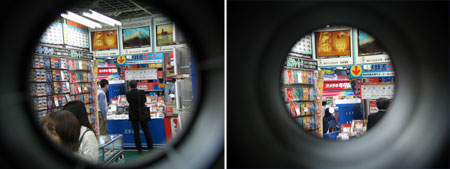
The lenses must be used with the camera at a higher zoom setting, or else you get a telescoping black circle around the image; below are photos taken with the Canon and Raynox, respectively, with the camera fully zoomed out:

As you can see, you have less of a field of view with the Raynox; to get rid of the black frame, you have to zoom the camera nearly to the limit. the Canon lens allows for much more flexibility. Both allow you to start zoomed out in order to find the target before zooming in, however, and that is really all that I was looking for.
I’ve got to go–final exams and all. But I’ll be back with more, including which lens I got, some shots of the lens on the camera, and a real humdinger in the “dumb ideas” department!
You may have noticed more inactivity on my part. Not through lack of effort, of course–I’ve been trying to write about a recent camera accessory purchase. But after having shut down my server for 18 hours without the slightest notification to me, my web host decided, apparently for kicks, to block out my IP address while at the same time displaying a server status page on their site that showed my server as being shut down. So I was shut out of my own site and their indicators lied to me about why. On top of that, their usually quick support people were a lot slower this time–several hours between each reply–so it took a lot longer to get fixed. It’s just now, some ten hours later, that I’m finally back on the air.
If it weren’t for the fact that every web host screws you over for days at a time at some point, I’d be looking for a new web host right now… and to be honest I’m not that far away from beginning a new search.
If you tried to come here in the past 18 hours and were not able to access the page, my apologies–my web host let me down. They changed the IP address for the server, effectively shutting down the site for most of the last day, and gave me no advance notification of the move. This, of course, would just happen to occur as I get linked to by MacSurfer and was getting hundreds of new visitors each hour. Surpass Hosting is very good when it’s working, but downtime seems to be their biggest flaw. And, to be honest, I don’t think I’ve ever had a web host that reliably notifies me in advance of down time….
I always wondered about the naming of some areas of Tokyo, having noted the names of train stations in those spots. For example, Ikebukuro, a major business area of Tokyo (one of its many “downtowns”) seems to translate as “Pond Bag.” Ochanomizu is “Tea Water.” And Mejiro is “White Eye.”
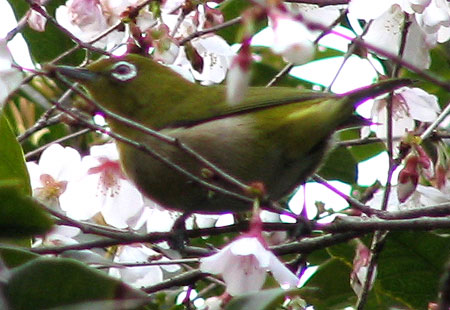
Well, I actually discovered the origin of Mejiro recently when I took up birding: Mejiro is a bird, the Japanese White-Eye, and it is aptly named. A picture is worth a thousand words:
Click on the image to get a full-sized version (1100×700 pixels, 136 KB).
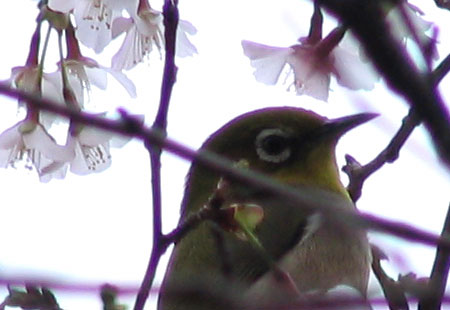
When I visited the park nearby my place today, there were quite a few of the little things flying around the trees. The Mejiro love the blossoming trees, and seemed to be eating the nectar from the flowers:

The blossoms also make for nice decoration around the birds in the photos. The Mejiro were also surprisingly tame; you could walk right up to a tree the buggers are in and be standing just a few meters away, and they would just as happily bounce about from branch to branch. I had my usual focusing trouble with my camera because the Mejiro were always in the midst of a host of twigs, blossoms and branches, but because they were relatively stable in location and not skittish about human company, I was able to get some nice shots of the birds.

I also spotted some Long-Tailed and Great Tits, as well as a Japanese Pygmy Woodpecker, but none stayed still long enough to get any pictures worth sharing.
I also was able to record some Nightingale song just outside my apartment building. The audio clip (332 KB, WAV format) is an amalgam of seven different calls I recorded over about ten minute’s time.
And before I go, one more Mejiro photo.