Archive

Archive for April, 2005

Harassment

April 4th, 2005 2 comments

I’ve observed a new type of blog comment spam: spam apparently designed purely for reasons of harassment. The spam comes in with no functioning URLs, just links to garbage addresses that have no corresponding site. No product name, no forwarded web site, nothing. It has no profit whatsoever for the spammer that I can see, except perhaps if they get their jollies by peeing all over other people’s web sites. Not that I thought that spammers were any less scummy, to be honest. But they went pretty far in making the spam hard to delete: each one has only nonsense words which vary from spam to spam; each gives a unique (and fake) IP address; and each has different URLs.

Fortunately, I did pick up on one point: each fake, junk URL had a common text string–just a few letters–which were unique enough that I could use it in MT-Blacklist. Otherwise it would have been impossible to block, and each one of the possibly hundreds of spam comments left would have to have been deleted one by one. The common string allowed me to zap all that had been laid and block the others coming in.

Nevertheless, this is getting way out of hand.

Categories: BlogTech Tags:

Daylight Saving Time

April 3rd, 2005 Comments off

For those of you who keep in touch with others in the United States, you should be mindful that Daylight Saving Time (DST) has come into effect. As the old saying goes, Spring Forward… so Americans have set their clocks an hour forward, making the time difference between Japan and the U.S. slightly different–one hour more different, or less, depending on how you count it. I don’t like counting back–for the West coast, 16 to 17 hours back is just too much trouble. 7 to 8 hours forward, then subtract a day, is easier, at least for me.

We have been 7 hours behind San Francisco for the winter, so San Francisco will be 8 hours ahead now. 11 pm here is 7 am (the previous day) there. If you’re ever unsure, check this page with a World Clock, and go here if you want more info on DST.

Categories: Main Tags:

Tiger

April 3rd, 2005 4 comments

The new Mac OS is coming out very soon, named “Tiger,” or Mac OS X v. 10.4. While its feature set seems less dramatically improved than past upgrades, one of the biggest benefits appears to be speed–this reviewer reports an almost doubling of speed on her G4 Powerbook. If this is true, then it would be a very nice upgrade for me–my old G4 (which I’m keeping until a big upgrade of the Powerbook line comes from Apple) is getting a bit sluggish, though much of that is probably due to the fact that I haven’t reformatted my hard drive and reinstalled my OS and apps in two years or so–that’ll slow any computer down.

New features in Tiger include Spotlight, a new super-fast file and content search feature (integrated into the Mac Mail app as well), Dashboard (which is a copycat of Konfabulator), which allows you to use mini-apps called “Widgets” for easy access to content and controls. You might also find Safari’s RSS reader or the “Automator” script-builder to be useful as well. But the speed increase and search upgrades are the real improvements made here.

Tiger is due to come out sometime in April, maybe April 15th, and its announcement is supposed to be in the next few days. If Apple acts as it has in the past, then new Mac purchasers can get a free upgrade to Tiger if they buy their computer after the announcement to Tiger is made.

Of course, OS X is already a hell of a lot better than Windows XP, which was released in October 2001 and has had only minor upgrades (mostly patches to numerous security holes) since then. The new Windows OS, code-named “Longhorn,” is scheduled to come out in late 2006, but many doubt that it will be released on schedule. And when it does come out, it will not be a really great upgrade, either–already, just to make it possible to maybe reach the end-of-2006 deadline, Microsoft had to axe Longhorn’s most awaited feature, called “WinFS,” a new storage and file system that would theoretically speed up Window’s file browsing and search features, which still, to this day, use decades-old DOS technology. Not only did Mac OS X rework their system long ago, but the OS release of Tiger is most likely going to be even better in file handling and searching than what WinFS will deliver whenever it comes out.

In short, to get Longhorn will be to get what the Mac has had for years. And most of the other improvements in Longhorn are so technical or business-related that the common user won’t find much that excites them. Primarily the graphic user interface changes (read: eye candy) are what will make the most difference for most people–and that was kind of like what happened with the switch to XP. It was essentially just Windows NT with new colors. And one feature of Longhorn, called “Palladium,” is hyped as a “security” feature, but mostly it is designed to keep big companies secure from you. It is reported to look at what you have on your computer and severely restrict your use of any file or program which is not verified by Microsoft as being fully paid for, and possibly even make it very difficult for competing and open-source software packages to operate on your computer. What’s more, Longhorn, originally planned not to be backwards-compatible, will require users of XP to get upgrades (possibly more kludge-like) to their OS in order to use the software that Longhorn will encourage.

In short, Longhorn promises to be a slick-looking but far-behind-the-Mac OS that essentially serves businesses, not you, and may be more trouble than it’s worth.

The one down side about the Mac is that while you get a lot more great innovations and improvements on a much more regular basis (once every year or year and a half or so, as opposed to once every five years with Windows), you also have to pay $100-130 or so for each upgrade if you want all the improvements immediately. Of course, there’s no guarantee that Longhorn won’t be just as expensive–some are talking about the possibility of a new “subscription” payment method, where you pax X number of dollars every year to use the OS. And presently the Windows upgrade price is about $200. So you can wait to get better features at the same time on the mac for half the price of Windows, or you can get Mac OS X upgrades as they come out and pay maybe 50% more than you would for Windows–but you’d have much more functionality much faster.

Categories: Computers and the Internet Tags:

Nightingale Song

April 3rd, 2005 Comments off

The Nightingales are back! At least in my neighborhood. Haven’t got a photo of one yet–they seem to like hiding–but you can see what one looks like here (found through Google Image Search, by the way). A small sample of the song is here–you can see why they stand out, aurally, at least. I remember that the Nightingale call was used a lot on the Kurosawa movie Tsubaki Sanjuro (a real fun flick).

Categories: Focus on Japan 2005 Tags:

Google Gulp

April 3rd, 2005 Comments off

Google had a bit of fun on April 1st, “introducing” a new line of on-line beverages called “Google Gulp (BETA)™” with technology that might be available in a couple hundred years or so. Be sure to read the disclaimer at the bottom titled “Google Gulp and Your Privacy,” it’s pretty funny.

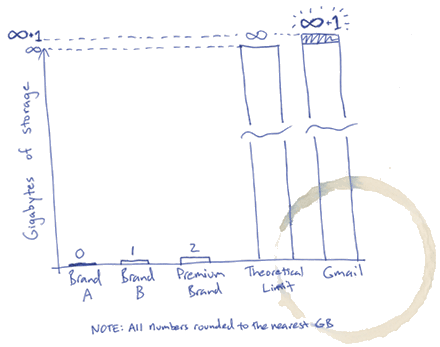
There’s also their not-so-serious sketch of how Google’s storage space will continue to grow after their fully-serious bump up to 2GB (2052 MB, actually) of mail storage space. With that much space, so long as you have a fast enough internet connection, Google is looking more and more like an extra storage location rather than an email service–including software (only for Windows now) for storing photos in an organized way within your account.

And hey, I’ve only got 50 GMail invites left, so if you want one, better act fast!!!

Blackouts

April 2nd, 2005 3 comments

Why are there so few power blackouts in Japan?

In the U.S., they do not happen all the time, but they do occur with some frequency. In my personal memory, it happened maybe once or twice a year on average, though that may vary a great deal from area to area.

But in fifteen years in Japan, I have never experienced a blackout. Not one.

I was first made aware of this back in the 90’s when I was in San Francisco. After a local blackout, a Japanese friend questioned the quality of the power supply, surprising me with the idea that this was not a universal phenomenon.

Now, in my current neighborhood, power lines are underground–which seems like a wise choice, for esthetics, safety, access and protection from the most common cause of electricity failures: falling branches of trees during storms.

But most neighborhoods in Japan have above-the-street power lines. So what’s keeping blackouts away, especially during storms and typhoons? Are there simply that many fewer trees? Are there backup systems? The ability to reroute? Different technologies in play? Newer infrastructure? Stronger power lines? I’d be interested to know the reason why…

Categories: Focus on Japan 2005 Tags:

Time for Another Payoff

April 1st, 2005 Comments off

When the Bush administration was casting about for countries to join the “coalition of the willing,” it was not just asking for volunteers–there was some quid-pro-quo going on. They’ll deny it, of course, but then they denied trying to bribe Turkey (with $28 billion and other considerations) to allow U.S. troops to move through that country in the Iraq invasion, even though the money was yanked back when Turkey refused the offer.

In this case, the bribe is not cash, but status: in return for Japan being one of the most notable nations to join the coalition, the U.S. is, in turn pushing for Japan to be given a permanent seat on the United Nations Security Council, a very powerful and influential spot. No permanent seat has been granted to any nation since the U.N. was founded and the current five nations dominated the council. There are ten non-permanent seats, and Japan has just won one of them (likely through U.S. intervention). But now, we are to believe for no reason except that Japan simply deserves it, the Bush administration has become Japan’s biggest cheerleader in the endeavor:

When reporters voiced concerns about U.S. support for making Japan a permanent member of the U.N. Security Council, Rice responded that Japan’s increasingly global role and its strong financial support for the United Nations need to be recognized. The secretary did not address either bilateral issues between South Korea and Japan or Japanese domestic affairs, but did express her confidence “that democracies like Japan and South Korea … will be more than able” to deal with issues as they arise.

“[I]f we start to think about how the 21st century is going to play out, it is going to be the power of ideas that really matters, and the power of democratic ideals that really matters,” she said.

Translation: “we needed Japan so we could say that we weren’t going in alone in the Iraq War, and this is what we promised in return.” (Oh, and note the remark about Japan’s “strong financial support for the United Nations,” as if Republicans are now impressed with people who pay their dues to the U.N.!)

Not that Japan didn’t want to go into Iraq anyway; sending Japanese troops to Iraq, no matter how non-military their duties, establishes a precedent which will help Koizumi and the other right-wingers to accomplish what they have long been pushing for: the excision of Article 9 from the Japanese constitution, the part in which Japan forever renounces war, the part which prohibits Japan from acquiring an offensive military force or sending troops to fight overseas. Japan may or may not need this in light of possible U.S. troop reductions in the region and with growing tensions between Japan and North Korea, as well as with other countries–but if that is the case, then it should be made clearly and publicly, instead of being done covertly and under the table.

The permanent U.N. Security Council seat would be a further step for Japan to assert itself militarily–which is one of several reasons that Japan’s neighbors are not exactly thrilled at the prospect. China is working to prevent Japan from getting this plum, letting expats do most of the work, getting 1.7 million signatures on a petition to stop the Japanese bid, and publishing ads in prominent publications reporting on Japan’s misdeeds in WWII and its reticence in forwarding apologies over the incidents.

Similarly, South Korea is working, even more straightforwardly, to block Japan’s entry to the council, their U.N. ambassador saying:

We do not think Japan has the qualifications to become a UN Security Council member and we will try to make sure it does not. … There are difficulties for a country that does not have the trust of its neighbouring countries because of its lack of reflection on the past to play the role of a world leader.

Of course, it does not help that Koizumi and others in his government continue to pay official visits to Yasukuni Shrine (where war dead, including class-A war criminals, are interred) despite knowing that this practice infuriates its neighbors.

Note: no foolin’.

Categories: Political Ranting Tags: