Archive

Archive for June, 2006

More Green Pheasant

June 20th, 2006 Comments off

At about 6:00 pm yesterday evening I went down to the empty field where I’d spotted the pheasant before, figuring I might get another shot–and what do you know, but there he was. And this time I got some good shots. The last in this series is the best by far, with a great 1280×854-pixel blow-up when you click it.

06-19-06-Green Pheasant3-450

The one above I got from the overpass, like I did last time. Then I went into the construction site itself, after the bird had hopped away up a hill towards an access road. Along the way, I got muddy feet, one foot submerged in wet mud ankle-deep, when I saw what looked like some sort of plover fly in–but was not able to get a shot in. But I did catch the pheasant, coming toward me this time:

06-19-06-Green Pheasant2-450

As you can see, he’s crouched down. Like with the very first time I saw him, it’s a defense posture. This time, however, he was in plain sight on a hillside, so it allowed for a few nice shots. Eventually, he figured I was not a threat, and so got up again.

06-19-06-Green Pheasant4-45

06-19-06-Green Pheasant5-450

But this one was the best shot, as I was able to catch the bird at the hilltop, with a nice focus contrast of the hills in the background. Again, remember to click to see the full-sized shot.

0606-Green Pheasant6-450

Categories: Birdwatching, Uncategorized Tags:

Stripped

June 19th, 2006 2 comments

Well, that’s quite the strange experience.

I got a phone call not two hours ago from the police. I didn’t know it was them until a bit later, as they didn’t use the word “keisatsu,” the one I know. But I could tell it was someone who worked for city services in some manner. They told me that my scooter was found abandoned in a nearby park, about a quarter of a mile from where I live; someone had found the insurance papers.

That gave me a start. I just bought a new scooter a year ago, and it’s a nice one, too. My immediate fear was that I had left the key in the ignition–something I have been known to do–and that someone had taken it for a joyride. But the guy on the phone told me that the scooter was beyond broken. Not good.

There was, however, a possible alternate explanation. I got the new scooter to replace the old one–and I hadn’t gotten rid of the old one yet. It was six years old, and probably didn’t even run anymore. I couldn’t even get the ignition lock open, it had rusted shut. I had been meaning to call someone to tow it away, but had never gotten around to it. So the missing scooter could be that one.

I had severe doubts, however. Who would want to steal a junker like that, when a nice new bike was right next to it in the parking area? (I did not think about the new bike’s security alarm at the time.) Also, the fact that the insurance papers had been found by the person who discovered the bike suggested that the seat was opened–which suggested that maybe I had been an idiot and had left the key in the ignition when I came back from Costco late Saturday afternoon. In which case I may have been out about $2000 for a new scooter.

As soon as I could, I got the caller’s number and went downstairs to check. Going out the door, I got a nice reassurance: my keys were where I usually leave them at the door, meaning I hadn’t forgotten them. And, when I got downstairs, sure enough, it was the old junker that was gone, its accompanying helmet left on the other side of the parking area.

I called back and discovered I was speaking to the local police officer (I found this out when he told me he was at the koban, the police box). I went down, and he showed me the insurance papers–indeed mine–soaked with water. The officer thought that they had been left in the rain from yesterday. He offered to take me to see the bike, and I wanted to go, to see what had happened to it. The officer had only been told that it had been deposited next to a pond at the local park, and so first took me to the place a quarter of a mile away, where we climbed stairs to go to a pond way away from it all. When the bike was not there, the officer admitted there was another pond–the one right across from the police box where we met–that the finder may have been referring to. We went there, and found the bike.

06-19-06-Stripped3-450

06-19-06-Stripped1-450

06-19-06-Stripped2-450

It was at the edge of an artificial pond, one which I pass every day. One edge of the pond is under an archway, relatively hidden. The bike was stripped bare–tires, wheels, engine, lamps, belts–everything. Even the seat was missing, with the contents of the helmet well left behind, scattered on the ground. Evidently the insurance papers had been tossed into the pond, which is how they’d gotten soaked.

Apparently what had happened was that some local kid had the same model scooter, and it was falling apart. Unable to afford new parts and repair from the shop, the kid stole my bike and stripped it bare. Saturday or Sunday night, he came to my apartment building and somehow spirited the bike off. That would have been no mean feat; as I mentioned, the ignition lock was rusted shut, and when I found the bike, it had not been opened. That means that the steering column was locked in a turn. Either the thief broke the steering column entirely at the parking area (directly four floors beneath my bedroom), or he and some hoodlum pals carried the bike to a truck and carted it off to the pond, where they could strip the bike unobserved.

As you can see from the photos, they did a hell of a thorough job. Fortunate for me that it was the bike I had fully intended to have taken away for parts and scrap anyway. I just prefer to do it on my terms, not some punk thief’s.

When the policeman and I found the bike, I made an effort not to touch anything. But he seemed indifferent about any investigating, and started touching parts on the ground, even asking me to pick up this or that. Afterwards, he apparently changed his mind and started printing the carcass. He found nothing but a partial shoeprint on the broken dash. It would seem that the thief or thieves had worn gloves during the disassembly. The officer allowed me to remove the license plate and take it with me. He told me that he’d see to it that the bike was junked, and kindly waived any fees for doing it. He told me that if they found anyone from the shoeprint, they’d give me a call. I don’t expect anything to come of it, but the officer seemed strangely confident.

Apparently, this kind of petty crime is not too unusual. The officer told me that it’s usually teenage kids with certain popular scooter types (which mine was) who steal other people’s bikes and strip them like this. He recalled one instance in particular where one teenage kid lost his scooter that way–and eventually discovered that one of his own friends had been the thief!

So it has been an adventurous afternoon, and I’m grateful that it was a lot less unfortunate or expensive as I had initially feared.

Categories: Focus on Japan Miscellaneous Tags:

Trackback Cleanup

June 18th, 2006 Comments off

Wow! Turning off the trackbacks really made a difference in clearing out the spammers. I’m still getting about one hundred comment spam a day (MT-Blacklist gets about 75% of them, SpamLookup the other 25%), but the trackbacks seem to have been the real monster here, as I noted before. And it showed up like crazy in the AwStats: immediately after I deactivated the trackback script, the number of “visitors” dropped by a bit more than half. This may represent the clearest picture of visitors I’ve gotten from AwStats in quite some time.

But it also shows how lopsided spam has become. Half of my site’s “visitor” traffic was trackback spam. Maybe 25% of all traffic volume, in megabytes, was spam–the spam, at least, did not download movies or anything. Just made smaller hits–but there were so damned many of them. For a long time, I’d known that about a quarter of my site’s traffic was spam. Recently, I could see that my “visitor” traffic had inexplicably risen by about 30% to 40%. This explains why.

When I look at the “recent visitors” in my domain’s CPanel, I can still see them constantly hitting the site–but now all they’re getting are “500”-type server errors. Maybe in time they’ll even stop trying, once they see there’s no trackback there anymore.

Turning the damned things off was the smartest maintenance move I’ve made so far. If you still use trackbacks, consider shutting them down. They’re not worth it.

Categories: BlogTech Tags:

Flag Burning

June 18th, 2006 3 comments

I think the whole issue is stupid.

If you burn the flag, you are burning the symbol of freedom that allows you to burn the flag.

If you ban flag-burning, then you are limiting the freedom that the flag represents.

American flag burners are stupid because the flag pretty much never represents the people or things they are protesting. If it’s done just to get a rise out of people, it’s still stupid because it rarely if ever gets the kind of attention that helps their cause.

Americans who want to ban flag burning are stupid because they either don’t understand freedom or they are trying to score points politically, which may not be stupid but it is dishonest.

The best solution: ignore flag burners. Which is not too hard, because there are so damned few of them. Problem solved.

Flame away.

Strict Constructionism and the Goals of the Conservative Movement

June 17th, 2006 5 comments

Strict constructionism is a philosophy of judicial interpretation and legal philosophy that limits judicial interpretation to the meanings of the actual words and phrases used in law, and not on other sources or inferences. Adherents look strictly at the text in question rather than relying either on legislative intent (as gleaned from contemporaneous commentaries or legislative debate) or on metaphysical ideas such as natural law. …

The underlying argument behind strict constructionism is that if a legislature truly wants to enact a particular law, they are capable of writing it down in plain English and passing it, and it is not the job of the judiciary to reconstruct what the legislature’s intent could have been. Supporters interpret this position as judging based on what the law is, not what it should be.

— Wikipedia

Strict constructionism has become somewhat of an issue as of late. Most if not all of Bush’s high-level judicial appointees have been constructionists. He likes to solemnly make the claim that he does not apply a litmus test to his candidates, and then, usually in the same breath, states that “I believe in strict constructionists. And those are the kind of judges I will appoint.” As if there is a difference between the two. For conservatives, “strict constructionist” is a code word for all of the litmus tests, on abortion and a broad range of civil rights issues. This was specifically spelled out in 1969 by former Assistant Attorney General, and later Supreme Court Chief Justice William Rehnquist:

A judge who is a “strict constructionist” in constitutional matters will generally not be favorably inclined toward claims of either criminal defendants or civil rights plaintiffs…

But strict constructionism is more than just a litmus test. It is rapidly becoming a way to help disassemble the Constitution of the United States and render meaningless many if not most of the rights and liberties guaranteed under it. Strict constructionism is a tool being used in the current conservative quest to place as much power as possible into the hands of government, and to weaken the power, rights, and capabilities of the American people, so as to make possible the imposition of a specific social and moral structure which, by nature, is unconstitutional. Since revolution and amending the Constitution can be difficult and messy, it is much easier simply to reinterpret the standing law under a new paradigm–ironically, in part by claiming that one should not be allowed to interpret anything.

If you think that’s a radical view, then read on, and I’ll explain.

Strict constructionism is supposed to mean that the law is exactly what is written down, and not one iota more. It specifically precludes interpretation, or the application of changed social standards and meanings into a broader or modernized meaning of the original law. Abortion is the classic case. The founders did not say anything about this, naturally. So the question becomes, can the government ban it? A strict constructionist would say “yes,” because the right to abortion is not clearly written down in the Constitution. They rail against the Roe v. Wade ruling that interprets a right to privacy from the text of the Bill of Rights, and applies that to medical decisions, including abortion.

What amazes me is that strict constructionism can exist at all, considering one rather sticky detail: the Ninth Amendment to the Constitution of the United States. That amendment reads:

The enumeration in the Constitution, of certain rights, shall not be construed to deny or disparage others retained by the people.

There is no question whatsoever that people everywhere consider privacy to be something they desire, even crave, and consider a right. The privacy of one’s own home, the privacy of the bedroom, the privacy of one’s personal life, one’s secrets. Privacy is perhaps one of the most natural of all expected rights. How could that not be covered by the Ninth? And yet, you have Supreme Court justices like Clarence Thomas saying,

“…just like Justice Stewart, I can find neither in the Bill of Rights nor any part of the Constitution a general right of privacy, or as the Court terms it today, the liberty of the person both in its spatial and more transcendent dimensions.”

Thomas was referring to Justice Potter “I know it when I see it” Stewart, who said in 1965, “I could find no general right of privacy in the Bill of Rights, in any other part of the Constitution, or in any case ever before decided by this Court.” Stewart, however, later reversed himself and voted for Roe v. Wade. (It should be noted that in his confirmation hearings in the Senate, Thomas said, “In my view there is a right to privacy in the 14th Amendment.” It is not clear whether he was lying, or like Justice Stewart, simply later changed his views. You can guess what I believe.)

Despite Thomas’ apparent blindness to the Ninth Amendment, it does exist, and it does say that the rights of the people are not limited to strict constructionism. Here’s a good example of how to see this: the Ninth clearly states that there are rights held by the people which are not enumerated in the Constitution, but what are they? The right to have children would be a big one, for example. Get a piece of paper and a pen or pencil, and start writing them down. See how far you can get without putting privacy in there in one form or another.

Actually, it’d be great if readers could record those rights they feel are on the list in the comments below.

My point here is, however, that the Ninth Amendment is antithetical to the core philosophy of the strict constructionists. By its very nature, it contradicts strict constructionism or related philosophies like textualism (which Thomas claims to adhere to). Strict constructionism says that you can only judge on what is written specifically in the law. But the Ninth Amendment says that there exist rights not specifically written in the law.

Well, we can’t have it so that everything is a right. There has to be some mechanism that determines what is a right and what is not. Currently, that role is played by judges, well-trained in legal, historical, and constitutional matters. They occupy a place best suited for judging our rights–determining the validity of the laws passed and the enforcement enacted. They do not bow to special interests, and the important ones do not have to run for re-election. Nothing is perfect, but that’s probably as close as we’ll get in our system.

However, the decisions made by many of these judges, even many of the conservative ones, appall the political and religious standings of many right-wingers, who rail against “legislation from the bench” (which more and more means “any decision I happen to disagree with, no matter how well-supported by law”), and call for constructionists to save the day.

But if judges cannot act as the mechanism to determine what our unwritten rights are, then how do we determine them? According to Antonin Scalia, an “originalist” (another brand of constructionist):

“Don’t think the originalist interpretation constrains you. To the contrary. My Constitution is a very flexible Constitution. You want a right to abortion? Create it the way all rights are created in a democracy, pass a law. The death penalty? Pass a law. That’s flexibility.”

In other words, Congress, the legislature, should be the judge of what rights we have. The problem: the Bill of Rights was specifically designed to deny the Congress the ability to refuse the people these very same unenumerated rights! And here’s Scalia, saying they should be the ones to determine those rights! That’s “flexible,” all right!

Clearly, strict constructionism has deep problems, even assuming it is a completely honest philosophy and not simply a means of applying one’s own personal moral code as predominant over the constitutional rights of the people.

For a moment, let’s move away from the judiciary, and to the conservative movement in general. In recent years, we have seen a broad range of attempts by conservatives to reshape the United States in a conservative political and religious paradigm, and this new social pattern is, by its very nature, unconstitutional. It includes:

Religion: A merging of church and state, making the United States a Christian nation, not just by makeup, but by law. It would impose Christian values upon social systems such as education (indoctrination) and medicine (abortion and pharmacology).

Plutocracy, government by the wealthy. While not a wholly Republican movement, it is an overwhelmingly conservative one. It places the welfare and rights of wealthy people, corporations, and institutions, over and above those of the people in general. We have seen this in the conservative handing over of power and influence in energy, agricultural, telecommunications, pharmaceutical, and credit industries; in each field, over the past several years, sweeping laws have been passed that favor corporate interests over the interests of the people. Tax laws passed in the past five years have overwhelmingly favored the wealthy.

Civil Rights: more and more, we see them violated. National security, now in the form of the unending “War on Terror” is being used as the mechanism to dismantle currently existing rights. The Fourth Amendment is simply the most recent to go, and in the most spectacular flameout. It has now been established that the government can search and seize without warrant in the name of national security, and because of national security, the government can avoid having to explain why. This does not just apply to the fourth amendment, but to practically all of the amendments. The government can abridge your freedom to speak or assemble (“free speech zones”), to petition for redress, to answer for a serious crime without indictment or due process of law, to be informed of charges being made against you, to have a speedy trial, to confront witnesses against you, to have a trial by jury or any trial at all, or to not have cruel or unusual punishments inflicted. All of these enumerated rights have been violated in the past few years.

An important point: on civil rights, I expect to hear what I have heard before: that these are only special cases where these rights are violated, and it won’t apply to most people. Even if such a thing is acceptable to you for any reason (read one of my very first blog posts to see why I disagree), I would still disagree on the grounds that any incursion on our rights, however little you may make of it today, will be used as a wedge to open a further incursion later on.

Don’t believe me? I can prove it. See this blog post, where I stated that the mention of God in the pledge, the oath, and on money should not be tolerated, because:

…these religious incursions, each one violating the principle of church and state, are used to justify the next step, the new religious incursion.

I made that statement because a post I had written the day before on a similar issue, and a commenter had replied that “little things” such as Ten Commandments displays should be allowed to pass. That was on March 3 and 4, 2005.

Well, one year later, almost to the day, Scalia wrote a dissent in McCreary v. ACLU which read, in part:

Presidents continue to conclude the Presidential oath with the words “so help me God.” Our legislatures, state and national, continue to open their sessions with prayer led by official chaplains. The sessions of this Court continue to open with the prayer “God save the United States and this Honorable Court.” Invocation of the Almighty by our public figures, at all levels of government, remains commonplace. Our coinage bears the motto “IN GOD WE TRUST.” And our Pledge of Allegiance contains the acknowledgment that we are a Nation “under God.” As one of our Supreme Court opinions rightly observed, “We are a religious people whose institutions presuppose a Supreme Being.” …

With all of this reality (and much more) staring it in the face, how can the Court possibly assert that “ ‘the First Amendment mandates governmental neutrality between . . . religion and nonreligion,’” … and that “[m]anifesting a purpose to favor . . . adherence to religion generally,” … is unconstitutional?

I hate to say “I told you so,” but I told you so. The scary thing is, Scalia’s dissent was a dissent only because O’Connor was the 5th vote in the majority; had McCreary been decided with today’s court, Scalia’s opinion would have been law. And it undoubtedly soon will be.

Any precedent, no matter how seemingly inconsequential or trifling, can and will be used as precedent, as a future legal justification for a much greater incursion against the rights of the people.

So, to recap, the conservative movement has been attempting, with great success, to reshape the United States into a new mold, incorporating elements of theocracy, plutocracy, and fascism by merging religion and state, empowering the wealthy and the corporations, and by weakening the individual rights of Americans.

Strict constructionism is simply the last building block of this conservative legacy in denial of the constitutional legacy left us since the formation of the country. Strict constructionism adds the element of denying unenumerated rights, in addition to denying the enumerated ones.

This does not paint a pretty picture for the future of the United States if it succeeds. But it is a working blueprint, and it is in the process of being enacted.

The question is, do the American people have the will, or even the desire, to stop it?

Categories: Political Ranting Tags:

Trackback Off

June 16th, 2006 1 comment

So much for that failed blog element. Trackbacks are supposed to be an automated linking system between blogs that refer to each other. Say if Blog A has an interesting post, and the author of Blog B writes his own entry which refers to Blog A, complete with a link. When Blog B publishes this entry, his blog software will send a “trackback ping” to Blog A, informing him of the reference. Blog A will often catch this ping and automatically make a link right back to Blog B within the original entry’s comment section. A nice idea–you link to me, I link back to you, we know we’re talking about each other. Community. Cooperation. Swell.

The problem: spam. What else? Now, maybe once a month, at most, I get a genuine trackback ping. In that same time period, I get tens of thousands of fake trackback pings from spammers (called “spings“). What’s more, these fake pings show up in my referrals (AwStats, not Google Analytics) and make a further hash of the numbers beyond what referral spam does. It got so bad that after my spam logs got so flooded that it caused a server error and I had to purge the database, within a half an hour, 114 more trackback spams had started filling it back up again. It got to the point where comment spam was beginning to look like a minor annoyance.

Mind you, the filters were working–no trackbacks were getting through. But I have no real use for trackbacks anyway, so I got a special utility and closed off all the trackbacks for all the entries in the entire blog, and then I switched off the trackback script. And good riddance.

Categories: BlogTech Tags:

What Sucks About Mac OS X

June 15th, 2006 4 comments

A guy named Thom Holwerda on OS News did a piece on what he feels sucks about Mac OS X. While he has a few good points, most of his rant is either highly subjective and personal, or is relative to what this guy has gotten used to in Windows after using that OS since he got a PC. This is not to say that Mac OS X doesn’t have its sucky points; I feel it does, like pretty much all users (of any OS). And since I have so often harped on what I feel is wrong with Windows, maybe I should put in some equal time for the Mac.

I’ll get to what I think is wrong with it, but first what Holwerda wrote:

The MacOS does not exactly feel fast.

This is one of his better points. There are more delays than there should be, probably because of all the eye candy. Conversely, a Windows PC with maximum eye candy installed can slow down, too. But with the Mac it can be harder to turn it off. This is covered more in my own point #1 below.

MacOS X is an inconsistent mess. Yes, it really is. Graphically, that is. OSX now has, what, 7 or 8 different themes…

It does? There are a few variations of the original OS X eye candy, and a few variations of the brushed-metal theme, but 7 or 8? And does it really jar the eye that much? Frankly, I’ve gotten so used to them that I don’t even notice. But then, I think they’re all classier than the standard Windows theme anyway. But this is my point–it’s highly subjective.

One of my biggest pet peeves: that annoying Google search field in Safari.

Are you kidding me? I hadn’t even noticed it up there, I just never use it. So what if it’s there? Besides, freeware exists to modify it. This guy is just too lazy…

Tiger has some serious issues with… Screen remnants.

I’ve seen these, but only rarely. Again, either he’s oversensitive or something is wrong with his OS. And I’ve noticed just as many redraw issues on my Windows XP machine. Live with it.

Macs need an indicator LED for HDD activity. It is really annoying when your Mac becomes slow or unresponsive and you have to lay your ear on the keyboard to see hear whether it is still doing something or not.

Again, something must be wrong with his Mac for that to happen often enough to matter. Besides, when my Mac becomes unresponsive, I can usually tell by seeing when it becomes unresponsive. Then I do a command-option-escape to see the Force-quit window, which tells me if the app is unresponsive. Then I force-quit and restart the app if I need to. What’s the big deal? Same as Windows, in fact.

Mail.app is a pointless email client, and I am flabbergasted I still use it every day.

Then don’t use it, you idiot. Get Eudora. I wouldn’t use Outlook Express on Windows myself, I’d use Eudora again. I wouldn’t say XP sucks because some of Microsoft’s apps suck. Same goes for this guy’s Safari beefs above.

…MacOS X has an evil dock. Yes, it looks cool and all, but it’s a UI nightmare. Instead of having a separate section for taskbar entries and application launchers, the dock has one section which aims to be both, but obviously sucks at doing so. It’s confusing.

No, the dock is fine. This guy is just too used to Windows. I think that the dock works a hell of a lot better than Windows’ methods, and Exposé beats the living crap out of dealing with Window’s stupid task bar. The dock is perfectly simple, if you’re used to it and know how it works.

OSX needs a decent uninstaller, supplied with the OS… . You see, Mac people will tell you how easy it is to uninstall applications: just drag to the trash and done. That’s wrong. When you drag an application to the trash, it leaves behind a trail of configuration files and the like all over the OS. Obsessive-compulsive as I am… , I want an application to really be gone when I uninstall it.

This guy is blaming OS X because he’s got OCD? What a lamo. Just leave the prefs where they are. They won’t hurt a thing, and will have zero effect on anything. Jeez. In fact, if you decide you want to re-install the same app in the future, your prefs are already there! Besides, this guy seems to be stupid enough to believe that Windows’ uninstall leaves his OS clean! If you’re lucky, uninstalling Windows apps will not break the other apps–if you’re lucky. And he’s got his panties in a bunch because the Mac OS has some harmless leftover scraps he’ll probably never even see? What a loser.

Apple needs to put more effort into backwards compatibility.

Apple has been backwards compatible, right up until this year with the switch to Intel. On my Powerbook G4, I still have a little game app from 1986 I still play. I’d say two decades of backwards compatibility is not bad. True, it sucks that my next Mac won’t be able to play the original Civilization, which I much prefer to later versions, but I can keep using my old G3 tower for that, if need be. My father depends on a Classic app for business which has not been upgraded, and so can’t use a Mactel for that. So if you have that kind of dependency, then Holwerda has a point here. However, there are benefits to Apple’s philosophy on this; Windows suffers from all the woes connected with native backwards compatibility, which makes Windows more buggy and inflexible, less secure, and bloated.


So what do I feel is sucky about OS X? Well, mostly smaller stuff, I’ll admit, but there are some really annoying things. The one that most Apple people agree of is:

1. FTFF, or “Fix the F***ing Finder.” Holwerda touched on one aspect of this, that being the relative unresponsive nature of the Finder (notable mostly on older machines). But there’s a bit more to it. For example, when you go to the View Options, there’s an option to have your preferences apply only to the current window, or to all windows. But this option seems to have no default, and could be set either way any given time you go into View Options. Another problem is how the OS slows down if there is a problem with a network shared volume–though that particular problem has been greatly alleviated in Tiger. Another FTFF issue is icon spacing. You can’t change it, which can be annoying as well. There’s other stuff, mostly more small annoyances. Rumors have it that this will be a big focus in OS X 10.5, Leopard.

2. Language Stickiness. This may be something that only applies to people who type using more than one keyboard layout, and may even be tied to the FTFF issue, but I find it annoying enough to go high on my list. I often switch to Japanese language input. Then I switch back. The problem: Japanese will often pop right back into play when I switch to a different app or window, or even a different text box. And since I hunt-and-peck and must look at my keyboard, I often won’t notice I’m in the wrong language until after I’ve typed a whole sentence. Annoying as hell, and it usually takes a while to go away.

3. Safari. OK, I’ll include the browser too, but in one shot. And I won’t blame Apple for the fact that some web content providers don’t support it (what’s up with that, Google?). Safari has its own problems. One is general responsiveness. Sometimes it seems like half the time I’m using Safari is spent looking at the damned beachball, waiting for things to load. And if a web page anywhere in Safari auto-reloads, it puts Safari on hold for way too long a time, essentially the whole time needed for that one page to reload. I usually have Google News open in a tab somewhere, and every five minutes, Safari goes beachball when GNews does its auto-refresh. And am I the only one to notice, or doesn’t anyone else get fed up with certain web pages being unresponsive in Safari? Every time I go to MSNBC, as a common example, and I double-click on a word, Safari will do the beachball thing for like ten seconds. If I’m stupid enough to click four or five times, I might as well go and take a bathroom break. This is more a problem for me, as scrolling in Safari is often too fast, and so I select a line or a paragraph to mark my place so I don’t lose it when I scroll.

All that said, let’s not forget that Window’s Internet Explorer is still the suckiest browser on the planet. Version 7 is supposed to be better, but if you give Safari the same amount of time to improve as IE has taken (ten years?), it’ll probably be a hell of a lot better by then as well.

4. Full, Native AVI Support. Not too big a deal, since VLC will handle practically any video file. But it’d be nice if Apple finally got off it’s butt and added full support for what’s probably the #1 video format on the Internet, for crying out loud.

5. Search. Granted, Windows sucks way more than Apple on this, and Spotlight is fast and very cool. But not without issues. First of all, there is a lack of ways to sort things once you’ve found them. Spotlight won’t let you sort by size, for example, which is stupid. Hopefully it’ll get fixed soon–it used to be possible, and Spotlight is new. As it is, though, you have to open the “information” button on any given item just to see the size in search mode. Also, you’re supposed to be able to search by filename only and exclude content by adding quote marks to the keyword. That doesn’t work like it should. One more gripe: while it’s nice to be able to hide certain folders from searching (lest content from dictionaries, web page caches, and email archives overwhelm any search), you should be able to override this by doing a direct search within the folder hidden from search. You can’t. You instead must go to the preferences, delete the folder from the hide list, search, and then add the folder to the hide list again.

6. Options and Features. Another app problem, but this is common in almost all of Apple’s home-grown apps. There are way too few features and options. Strangely, the OS itself has no lack in this department, but the apps are quite a different story. Some say that Steve Jobs wants to keep things simple and streamlined. I, for one, don’t like that. Add more options! More features!

7. Displays. This is more a problem if you use external displays, like a TV set, in both mirrored- and non-mirrored modes. Sometimes your Mac will get confused. Sometimes wallpapers will vary unpredictably. Sometimes, only the external monitor will register and my Powerbook’s screen will remain black!

That’s about as much as I can come up with after mulling it over for a day or so. It’ll be interesting to see how much of this gets addressed–if any–in 10.5. One thing remains, however–despite all of the flaws in the Mac OS, it is still heads and shoulders above Windows, which is why more and more people are saying what this guy is.

Categories: Mac News Tags:

Google Earth: Now in Lower Res?

June 14th, 2006 1 comment

What the…? Google Earth 4 was just released, with, they claim, “updated satellite data and much more detail for places in the world that didn’t have close-up information before.”

Not in Tokyo, they don’t. In fact, a lot of Tokyo is now lower resolution than it was before! The images are updated, yes, but strangely so. An entire swath of western Tokyo, including where I live, was replaced not only with lower-resolution images, but the images are from winter, with the ground covered in snow, making the details even harder to make out. Nishi-Shinjuku’s image is from a time when the skyscrapers cast long northerly shadows. My own workplace in Shinjuku, before easily recognizable, is now extremely hard to make out. Where cars on the street in front of my workplace used to be easy to spot, they’re now practically invisible in the more blurry, shadowed mush.

What the hell is up with that?

Until now, I’ve been showing off Google Earth to my students every semester, showing them points they know, starting off with our building. So much for that. They wouldn’t know what they are looking at.

Categories: Computers and the Internet Tags:

Tax Time

June 13th, 2006 1 comment

If you’re an American living and working in Japan, tax time is just about here. Even though you will probably owe no taxes–you get an automatic $80,000 exemption, and a $3,200 deduction for yourself in addition–you must file or lose the exemption! It’s not too late, though–we get an automatic extension until June 15th. You should have gotten your tax forms by now in the mail, if you’ve filed taxes from Japan before. If not, you can get your tax forms here as printable PDF files. Unless you make more than $80,000, you’ll just need forms 1040 and 2555. By the way, the 2005 yen-dollar exchange rate was 110.11 yen to the dollar.

Alas, the U.S. government, after handing out so many hundred-billion-dollar tax breaks to millionaires and billionaires, had to go all penny-and-dime on us expats and closed down the minimally-staffed IRS office at the U.S. Embassy–meaning that if you need any official help, you now have to call the U.S. and wait on hold for an hour for the IRS rep to get to you, and probably even then they won’t know what you have to do. But, lucky for you, I did a blog post two years ago which shows you step-by-step how to make out your tax forms. As always, I do not guarantee their accuracy and you follow them at your own risk. I have to say that–I’m not a professional tax preparer or anything. It’s just how I do mine. And if you’re confused about how to fill these things out, the guide will probably help a lot. Mail it off by June 15th and you’ll be fine.

Categories: Main Tags:

Spam Blogs

June 13th, 2006 1 comment

Well, if this doesn’t beat all. Spammers have a new trick: create fake blogs, then steal blog post text from real blogs, and then load the blogs with ads for ringtones, pharmaceuticals, porn, and others spam commerce sites.

I found out about this by doing a Google blog search on the title of my last blog post, “Japanese Green Pheasant,” to see who else may have blogged on the bird. To my surprise, my own post appeared–three times. One was the original, and two more were spam plagiarists. Only a few lines of text are stolen, but it’s still theft, and still it’s spammers using my work to sell their crap.

Looking up other titles, I’ve found more of my posts stolen as well. So far, all the spam blogs I’ve found (and no, I won’t link to them) are on “yahoo-blogs.com”–but don’t be fooled, it’s not really Yahoo. A spammer apparently got ahold of that domain name, and uses it just for spamming.

Categories: BlogTech Tags:

Japanese Green Pheasant

June 12th, 2006 Comments off

I decided to get a bit of casual birdwatching in today, without expecting much of a return. Mostly I just wanted to explore a bit of town that I hadn’t looked at yet. On my way back, I decided to scan the open, undeveloped fields in town to see if I could catch sight of a pheasant–and I got lucky! These are my best shots so far (as poor as they are) of the lovely male Japanese Green Pheasant that I kind of got a while back–but it was too dark. A beautiful bird, lovely plumage.

0606-Pheasant2-450

0606-Pheasant3-450

0606-Pheasant-450

You can click on that last one for a larger image.

Categories: Birdwatching, Uncategorized Tags:

Now, That’s a Cat!

June 12th, 2006 1 comment

Last Sunday, a New Jersey tabby, and a highly territorial one, spotted an intruder in his yard. So, hissing and spitting, Jack the cat treed the intruder. Usually, you hear about dogs treeing cats. Well, this cat treed a bear. Twice. The cat’s owners had to call the cat inside in order to let the poor bear escape. But not before a neighbor photographed the spectacle.

2003053679

Categories: The Lighter Side Tags:

Net Neutrality: Down But Not Out

June 12th, 2006 3 comments

You may have heard that a few days ago, a provision for Network Neutrality was voted down in the House 269-152. While a few Republicans voted for neutrality and several dozen Democrats voted against it, the vote was mostly along party lines, with Republicans against and Democrats for. Lobbyists won the day, bribing away like madmen; in an expensive election year, bribery is all too welcome in Congress.

While this loss is discouraging, it is not the end of the battle. It only means that the House will not positively vote for Net Neutrality; it does not yet mean that the House and the Senate will decisively vote against it when (and if) the telecom bill gets through Congress.

One more point to add to prior observations: the telecoms are trying to say that the big Internet media companies want to use these fast lanes for free to deliver content to you online. Aside from the untruth I noted before that these companies already pay high fees to the telecoms and get nothing for free, there is another fallacy: the metaphor of the goods being “delivered” to you, as if it’s the Microsofts and Googles which are the ones traversing the information superhighway. The fact is, no one is “on” these highways or “in” these pipes. However, if anyone is using these pathways, it is you. The content providers simply make things available at their end. You are the one who chooses to initiate the contact and receive the content. Much more than the content companies, you are the one who is doing the traversing. Which means that you’re the same greedy bastard that the telecoms are attacking for using their “pipes” for “free.” Are you? Do you get a free Internet connection? Or are the telecoms lying?

What it comes down to is whether you get to choose what comes across the Internet to you at high speed. If the telecoms get their way, you get no choice–they get to choose, and they get to charge money for it, money which you eventually have to pay, whether it is directly to them, or to them through the content providers. If Net Neutrality wins, then you get to decide what goes fast on the Internet, simply by requesting it. And it won’t cost a penny more in the end.

The fight’s not over. It’s not too late. Do something.

Often Enough, One Side Is More Than the Other

June 11th, 2006 Comments off

You’ll note that I do not often mention Ann Coulter on this site, partly because it’d be too easy to criticize her, partly because it would be responding to unrepentant liberal-baiting, partly because it would be giving her even the smallest morsel of legitimacy, and partly because my mom told me never to say bad things about crazy people. Of the ten times I’ve mentioned her name here (out of about 1850 posts), only one post was actually about Coulter, only one other had more than one sentence on her, and the rest were either lists of right-wingers or were indirect references. I honestly consider her, without exaggeration, to be part of the lunatic fringe, not worth paying attention to.

But here’s a thing: people seem intent on granting parity. By that, I mean that there is the odd tendency to equate everyone on one side of the political divide to someone on the other. The presumption is that both sides are equal, and everyone has an equivalent counterpart. Ann Coulter’s is often stated as being Al Franken. Although, with the relatively lower number of high-profile left-wing pundits, Al Franken is usually considered the equivalent to Rush Limbaugh and Bill O’Reilly as well. That alone should begin to demonstrate the inherent unbalanced nature of representation of both sides in the media.

Parity like this does not exist. Just because Franken and Coulter happen to be easily recognizable as firebrands for either side does not make them equivalent. Franken’s speaking is not even on the same scale as Coulter’s when it comes to sheer hatred and invective. And Franken, like him or not, is a hell of a lot more careful of facts than is Coulter, and is far more willing to publicly concede error. In tone, language, and emotional quality, the two could hardly be more different. And yet somehow they’re considered in the media as being equally shrill and objectionable.

But here’s the kicker: Ann Coulter is an out-and-out loon. I have no doubt that there is someone on the liberal side just as hateful, just as insane, just as offensive as she is. But that kind of a person could never become as popular, as well-liked and accepted, or nearly as often defended in the liberal world as Ann Coulter is on the right.

Most recently, Coulter’s new book, Godless: The Church of Liberalism, and her media tour to promote that book, has stirred up all kinds of ill will. In it, she portrays liberalism as the “religion” of America, claims that actual religions like Christianity and Judaism are “prohibited by law,” that evolution is “bogus science,” and starts getting outrageous from there. But what she has been most criticized for lately is her attack on the 9/11 widows, saying of the “self-obsessed women,”

These broads are millionaires, lionized on TV and in articles about them, reveling in their status as celebrities and stalked by grief-arazzis. I’ve never seen people enjoying their husbands’ deaths so much.

Now, I don’t think I’m going too far in saying that Coulter is being a loon. Massively and unacceptably offensive. And think about it: if the 9/11 widows had instead become flag-bearers and cheerleaders of the Bush administration, and those same words were spoken by Al Franken, do you think liberals would defend him?

Not for a freakin’ microsecond. I myself would be horrified to have someone as dependably repugnant as Coulter on my side of the issue, and would not hesitate to attack such a person were they to gain any sort of recognition as a spokesperson for progressives.

But somehow, some conservatives have little trouble either quietly accepting Coulter, or actively coming out in defense of her. True, some conservatives have spoken out against her, but most of those have been equivocal. Even though Bill O’Reilly said that Coulter “bombed,” he couched it in criticism of his own against the 9/11 widows, and compared Coulter favorably to Al Franken, claiming that while Franken’s lies are easy to spot, Coulter “never lies.” Coulter has been defended and even praised by people on the right like David Horowitz, Rush Limbaugh, Mary Matalin, and others. Even Lou Dobbs went easy on her–and he himself attempted to draw a left-right parity in comparing her with Michael Moore (which I’m sure from the conservative side must be a horrific insult, but in real terms is again highly inaccurate in favor of Coulter), to which Coulter responded by comparing herself with Mark Twain and H. L. Mencken.

Sometimes there is no parity. It is wholly possible and very real that one side of the political spectrum can have a far greater number of oafish louts and liars, that one side of the divide can be accepting of far more people guilty of vulgar and repulsive behavior which is massively disproportionate to what the other side will withstand within their own ranks.

And Coulter is an excellent example of this.

Categories: Political Ranting Tags:

Long Time, No Colds

June 10th, 2006 4 comments

I haven’t had a cold in quite a while now. It’s been at least ten months since I caught one, maybe a year. True, I have been dieting and eating well for the past six months, and I’ve been exercising for the past two or three months, and I am sure that’s helping. But that doesn’t explain the four to six months before then. The strongest reason I’m not catching colds is, I believe, something else.

I tended to catch colds a lot. I teach college classes, and so I’m around lots of people with sicknesses all the time. The last time I remember catching a cold, sometime in the middle of last year, there was a student with a bad cough who insisted on sitting right next to the rather small class whiteboard, so as I gave the lesson, here was this guy, coughing like a madman just a foot away from me. A few days later, I was symptomatic.

But it didn’t always take something that dramatic to get me sick; in the computer lab, students often have trouble on their machines and I have to use their mice and keyboards at times. Colds would be inevitable, and I used to get three to six of them every year. And since my job involves a lot of lecturing, colds can be a double curse, tearing up your throat when you need it most.

So why did the colds stop? Well, I happened to stop catching them at the same time I started using an alcohol-based hand wash. It wasn’t even my idea at first–I noticed that my local supermarket started offering it. You see, in Japan, there are no baggers at supermarkets. When you buy your stuff at the checkout stand, it’s taken out of the handbaskets they give you, and into another. They also give you as many bags as you need. Then you go past the checkout stands to a row of tables, where you bag the stuff you just bought. Since you’re handling stuff like chicken meat (even though it’s packaged), the store considerately started supplying pump-spray bottles of alcohol wash at the bagging tables. I had known about the stuff before, but had never thought about using it. Using it at the supermarket made me want to use it at home, and so I found at bought a few bottles at the supermarket pharmacy, and have been using it ever since.

And since I started, I haven’t caught a single cold. Soon after I started noticing this connection, I expanded my supply, and now I have one bottle each handy at home and at work (two at work if I teach at two buildings). I wash my hands with it every time I come home from the outside, and every time I get out of a class. When I see people getting sick around me, I wash more often, especially after coming in contact with anybody, touching their hands or something they held.

In addition, I’ve become more careful about touching my face. They say that you don’t catch much that’s airborne; instead, most illnesses are caught by touching something or someone with the bug, and then by touching your face. So if I feel an itch on my nose during class, I use my sleeve to relieve the itch, and otherwise keep my hands away from my face in public, until I wash.

And as I said, it seems to work. We just went through a wave of illness at school, one which, before, I would almost certainly have fallen victim to. But I got through it fine.

I mentioned this to a student recently, and she commented that when she worked at a hospital, she had to use the stuff (most hospitals in Japan have it, and staff must wash after seeing each patient). She said she didn’t like it because it was sticky. I immediately knew what she meant, as the wash I saw my doc use once was the gel type, which I don’t like myself. The wash I get is not like that, it’s as liquid as water, and looks and smells just like regular home-use alcohol (though the writing on the side of the bottle suggests a lot of other disinfecting agents in there as well). It feels like alcohol, cooling, and dries off really quickly. And it has no deleterious effect on my skin.

So unless this was a huge fluke and I start getting colds all the time again, I am continuing to use this stuff.

Categories: Health Issues Tags:

Two Down, One to Go

June 9th, 2006 Comments off

Congress shot down the gay marriage constitutional amendment (a wholly political, election year wedge non-issue). Then they shot down another Republican chestnut, the repeal of the estate tax (which, despite GOP claims, would not affect a single family farm, and only hits people worth several million dollars–and even then, not by much).

Now they’re stepping up to bat on Net Neutrality. A reminder: if the Telecoms get their way, this will mean only that prices will go up for you. Their claim that it will pay for you getting fiber optic broadband in the future is fictitious; when and if that comes, you’ll still be paying full price for it. And for now, you’ll have to start paying for more content on the web, and/or be more inundated with ads and spam, while the remaining free web sites slow to a crawl.

A danger less reported on: Telecoms will also be able to dictate to you which Internet applications you can and cannot use. Want to use Skype? Not if AT&T wants to sell their version of IP telephony, at a high cost to you.

And if Net Neutrality wins the day? Will the dire warnings of the Telecoms come true? No. This creates no new regulations; Net Neutrality has been the rule of the road since day one–that’s why they’re trying to get it changed. Will this force you to pay for fiber optics? No. In fact, you’ve already been paying, in higher fees allowed the Telecoms in exchange for their promise to use those fees to build fiber networks. They’ve taken in $200 billion in higher fees, and have done nothing. The extra fees they’ll rake in from killing Net Neutrality will not legally obligate them to lay a single F/O line, or when they do, it won’t obligate them to charge you a penny less.

Instead, with Net Neutrality preserved, the Internet will simply continue as it is: most content will be free, all web sites will be equally fast, and you are free to choose to use whatever applications you want, most of them cheap or free. Kill Net Neutrality, and you kill all of that.

Let your congressional reps know that. And act now–time is running out.

Categories: Computers and the Internet Tags:

Finally, Someone in Nigeria–er, Russia–Needs My Help

June 8th, 2006 2 comments

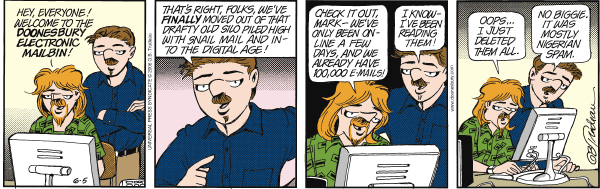
I don’t know what took them this time, but finally, five days after putting a virgin email address up on the main page, spam started coming in. A birthday present for me! Just one message so far–a Nigerian variant–but it’s beginning. I am adding it in the comments of the original post, where I will collect all future spam.

This Nigerian variant pretends to be a Russian barrister representing an oil tycoon who got arrested for bribing politicians, and needs to funnel $18 million through my bank account. I sent him my credit card number right away.

Doonesbury Nigerian Spam

Oh, and the travel agency is still hotlinking to my image. Bless their hearts.

Categories: BlogTech Tags:

God Doesn’t Like to Be Tested

June 8th, 2006 1 comment

From Reuters, the ultimate epistemological test:

A man shouting that God would keep him safe was mauled to death by a lioness in Kiev zoo after he crept into the animal’s enclosure, a zoo official said on Monday.

“The man shouted ‘God will save me, if he exists’, lowered himself by a rope into the enclosure, took his shoes off and went up to the lions,” the official said.

“A lioness went straight for him, knocked him down and severed his carotid artery.”

Either God doesn’t exist, or He loves irony. Kind of like that evangelist preaching at a church in Ohio who asked God for a sign, and lightning promptly struck his church set it on fire.

Categories: People Can Be Idiots, Religion Tags:

Web Host Alert

June 7th, 2006 Comments off

I’m not getting anything for this, but it could be a fairly good deal, so I thought I might put out the word. The web hosting service I use for this blog is Surpass Hosting. I signed on to this host 2 years ago when my old host went into the “too much trouble” mode that all web hosts seem to reach at some point. At the time, Surpass was having a 2-for-1 promotion, where if you signed up during the promotion, you got two accounts for the price of one. If you only have one domain, then it isn’t that great. But if you have several, like me, and especially if you’re hitting high bandwidth, then the deal is very good. I signed up, and have been more or less satisfied with the service. There were two periods where I almost felt like leaving, but it never passed that threshold.

In the second half of June, they’re reviving the promotion for the first time since I signed on. The lowest-cost shared hosting deal is their “Power” plan, which has these specs:

$6 per month ($65 for a one-year contract)
5GB hard disk space
200GB monthly data transfer
10 add-on domains
Unlimited email, subdomain, and FTP accounts, and unlimited SQL databases

You always have to take the “unlimited” claims carefully; there are limits in that you can only use up a certain percentage of the server resources. Too many active scripts on your site could get you into trouble, but you have to do a pretty heavy amount of activity to get there.

“Shared hosting,” by the way, means that your web site is one of a few hundred that inhabit the same server computer at the web host’s facility. It’s usually enough for a regular person’s web site, like a blog or something else casual. However, there are more chances for one or more other users on the same server to behave badly and negatively impact your site’s uptime and performance. The next step up is “Virtual” or “VPS” hosting, which also divides a single server among many accounts (often up to two or three dozen), but each gets a bigger share and each account resembles a private server in some ways. These accounts can be more expensive (starting at around $50/mo.), but allow greater access to site resources. Then you have “Dedicated” hosting, where you get a server machine all to yourself, with the CPU and hard drive dedicated to serving your site, with no one elbowing in on the resources. These are the most expensive, ranging from a hundred to several thousand dollars a month, depending on the package and the bandwidth you get.

As for the other specs: “transfer” means how much data can be uploaded by you/downloaded by visitors each month. My blog is pretty active (around 30,000 unique visitors/mo.), and I have several multi-MB files that get downloaded a hundred times each or so every month; my transfer amounts to about 30GB/mo., and is growing. “Add-on domains” means that in addition to the domain that dominates your account (mine is blogd.com), you can also have other domains run from the same account. Each one inhabits a subdomain, but appears to the world as an independent domain. For example, I have the domain “xpat.org” settled within my “blogd.com” account. Its real address is “xpat.blogd.com,” a subdomain, but if “xpat.org” is directly accessed, it’ll act like its own domain–just not at the moment, though, as I currently have it sleeping, and it redirects to this blog’s main page.

As I mentioned, Surpass is OK as web hosts go, but like all hosts, it has had its rough spots. Soon after I signed on in 2004, a string of hurricanes hitting Florida showed up a lack in their backup facilities, but that got resolved. And late last year/early this year, I had enough site slowdown and script failure problems to almost make me move, but I stayed on and that got resolved. Both are good signs–the bad sign is when the problems don’t get resolved, and your host shows little interest in doing anything about it. But even with Surpass, you gotta keep on their butts about it. Eventually, my latest problems were solved when they moved me onto a new server; the problems arose from another account on the shared server being a CPU hog.

One of the better points about Surpass is the rather quick response time to support ticket requests; they tend to answer in a few minutes, and often the solution is not far behind. But as with any host, different people have different experiences, and there is never any guarantee that any host won’t go south at any given time.

As usual, you can find user experiences and a variety of good advice on Web Hosting Talk forums.

Ah, and the tech support just got back to me: they upgraded my account. When I signed up, ten bucks a month got me 7GB of hard disk space and 75GB traffic; under the present deal, the same amount gets you 10GB and 400GB. So I asked if they’d up me to the present levels, and they did. Fair enough, but apparently you gotta ask in order to get it….

Categories: BlogTech Tags:

Idiots

June 6th, 2006 6 comments

I can’t believe this. A commercial site, a business, a travel agency, is actually hotlinking to one of my China travel photos (the one at the bottom of the page). If they simply ripped off the image and hosted it on their own site, I would never have noticed. But the cheap idiots are hotlinking, actually using the image as it appears on my site. That’s thieving! Will these people never learn? Specifically, will they never learn that a hotlinked image is controlled by the site where it is hosted? And they just happened to hotlink to an image which I just happened to change, purely for the use on my own site. If it happens to blend in with their own page, then that’s their own damn fault for putting it there. Nothing to do with me.

Update: Skaah alerted me to the fact that the hotlinker finally saw the image swap–it took about a week for that to happen. Now the web site is, as Skaah points out, hotlinking to yet another image, this time on a professional photographer’s site. I’m sending the site owner a message warning him of what’s going on.

In the meantime, here’s a link to an image of the page when it was hotlinked to my altered image!

Categories: People Can Be Idiots Tags: