Archive

Archive for October, 2007

Union Probe

October 6th, 2007 Comments off

David Markle over at Japan Probe has a pretty good rundown on how the General Union is not doing much in the Nova crisis, plus an analysis of the union itself. It gets deeper into the nature of the union than I have seen in my two experiences observing the NUGW (once at a workplace in the 90’s, and recently at a school associated with my workplace), but generally confirms what I have seen.

In a previous article on the Nova situation, I left a long comment on the union and its worth, in response to a mention of the union in the article. In short, the NUGW can be an albatross for a workplace, doing far more bad than good. They immediately turn the negotiating situation into an acrimonious one, make ludicrous demands, and grandstand as much if not more for their own high profile than for the good of the teachers. In the end, they leave the workplace more tense, restricted, and distrustful–and usually accomplish little or nothing at all for the teachers. In short, the union is good for little unless you’re really at the end of your rope with your employer.

If you’re interested in getting a better idea of what the union does and what it’s like, read both linked articles and their comments.

Categories: Focus on Japan 2007 Tags:

Probably Not a Breakthrough

October 6th, 2007 2 comments

From the Chosun Ilbo, via Japan Probe:

A Kyoto court ruled partially in favor of a Korean woman who sued a Japanese landlord for refusing to rent a room to her. A Kyoto district court ruled that refusing to rent a room to a person due to her nationality is illegal and ordered the landlord to pay the woman W8.65 million (US$1=W916) in compensation.

Courts have taken a dim view of refusal to let rooms to foreigners since an Osaka court in 1993 ruled this went against the constitutional stipulation of equality before the law. But in reality, Japanese homeowners often reject foreign tenants citing differences in the lifestyle and customs. Counsel for the plaintiff said the ruling was a “head-on attack on discrimination based on nationality” and predicted it would help eradicate unfair discrimination against foreigners.

In case you’re wondering, the award comes out to ¥1.1 million, or about $9,500.

Now, seeing this, I kinda wish that option had been open to me in the past. Maybe it was, and I just never tried, but somehow I don’t believe it would have been so easy or assured; this woman may have simply gotten lucky with her judge, who clearly seems to want to make an example.

Also, the 1993 ruling mentioned may have something to do with things; the first four times I went apartment hunting were before that time, and I recall anti-foreigner sentiment, even in printed form, was rampant. Some fudosan-joho (apartment fliers, or the sheets of paper that each describe an apartment, giving all the info on it) would actually have written on then, “ペット、水商売、外人不可”–“No pets, bargirls, or foreigners allowed.” Rental magazines like “Apaman” would have a notation for which apartments accepted foreigners. I recall in my first few forays into apartment hunting, better than 95% of the apartments I asked about replied, “gaijin wa damé,” or “foreigners are no good.”

In later years, I heard less of this, and have not seen anything written that refuses foreigners–but even just this year, when Sachi and I were looking for a place, we still got refused because of my nationality fairly often–though rental agents would be a bit more circumspect in terms of that kind of thing, calling the landlord out of our hearing, and not saying “foreigners are no good” directly. I thought this was simply because of Sachi’s presence, but perhaps legal decisions since 1993 had some influence on that.

Also, if you read the last paragraph of the Chosun Ilbo story, it shed a bit of light on what may have allowed the woman to sue in the first place:

The woman signed a contract to rent a room through a real estate agency in January 2005. But after she paid the deposit to the landlord and commissions to the realtor, the landlord changed his mind since she was a foreigner.

I am fairly confident that the contract having been signed was a pretty significant element of the decision. I rather doubt that if someone simply refuses to even consider me for the stated reason that I am a foreigner, it would be pretty hard to make any claims; probably the landlord/rental agent filter could be used as an excuse, that there was a “miscommunication” or something.

Which also makes me pretty sure that housing discrimination will continue more or less unabated–they’ll just be sure not to leave any conclusive evidence of it, like they do in the U.S.

Which leads to the question: if they’re going to discriminate anyway, would you rather they be upfront about it, or that they hide it behind excuses? I would think the former manner is at least more honest and less problematic for the victims: one of the biggest problems with masked racism is that you have to wonder if every bad thing that happens to you is because of racism, as you are no longer able to discern between racism and simple bad luck.

Categories: Focus on Japan 2007 Tags:

Short-changing the Troops

October 5th, 2007 3 comments

This administration has a long history of abusing the soldiery while using them as campaign props, fall men, and political human shields.

But the latest news is rather particularly contemptible: after using the Minnesota National Guard in Iraq longer than any other ground combat unit, and as part of Bush’s “surge,” the Bush military is casting them aside–without benefits.

The military wrote the order that 2,600 young American troops be counted as serving 729 days. 730 days is the amount needed to get education benefits under the GI bill. That means it wasn’t an oversight, it was a conscious and considered decision.

In other recent news, Bush vetoed health care for children, and it was learned that the White House officially approved of torture. Later today, he is scheduled to appear in the Rose Garden to kick a small, cute puppy.

Categories: Political Ranting Tags:

Blog Plagiarism

October 5th, 2007 4 comments

What can you do when someone else out-and-out steals your entire posts, tries to hotlink the images straight from your site, and pastes their name on the writing, without any indication it was made by someone else? Here’s my post, and an image from the thief’s page. (Like hell I’m linking to them.)

Very little, from what I can tell. Even though they’re a business, I bet that suing them wouldn’t work. Even if they weren’t lawyers and expert at dodging stuff like that, one can bet that scumwads like this have lots of experience at evading even those determined to bring lawful action or to collect compensation.

Of course, this is probably spamblogging, where spammers start blogs to link to their own sites, and fill the blogs with copied content from wherever they can find it. Yet another way that the smegma of humanity manifest themselves on the Internet.

Categories: BlogTech Tags:

A Giant Step in the Wrong Direction

October 5th, 2007 3 comments

This is pretty amazing, and galling. A jury in Minnesota (Motto: “We’re the New Montana”) decided that a woman they claimed pirated music must the RIAA $9,250 per song, for a total of $222,000.

Among the amazing aspects of this case:

  • The RIAA did not have to prove that the defendant illegally downloaded any music
  • The RIAA did not have to prove that the defendant was the person who pirated the music
  • The RIAA did not have to prove that anyone downloaded the music, only that it was available for download

The RIAA in the past has said that each downloaded song should be penalized with $750, although they graciously accept $3000 quickie settlements from people they send semi-random threats to. Where the jury came up with $9,250 is a mystery. The jury refused to talk to the press as they left.

Either the defense lawyer was incompetent, or the judge was, or the jury was stupid. Or maybe a mix of all three. This is pretty astonishing. Needless to say, it was an easy case for the RIAA to win considering all of its aspects (especially the jury instructions), and the RIAA will doubtlessly try to apply the victory prejudicially over all of its future litigation actions, no matter what the differences.

To give you a picture of what the jury apparently bought into, Sony BMG lawyer Jennifer Pariser claimed that even ripping a music CD to your computer or making a backup copy was stealing, despite the fact that the law says the exact opposite. The RIAA also laid out all of their usual “we’re losing billions of dollars” fiction which has been repudiated by any research not paid for by the RIAA.

The RIAA also played dirty by claiming that the defendant had her hard drive replaced to destroy evidence, despite the fact that the replacement took place before the RIAA first contacted her.

I don’t know. Maybe the defendant was just completely unbelievable in her testimony. Maybe the plaintiffs put their massive legal resources to work and razzle-dazzled the courtroom.

The end result is, thanks to this jury, the RIAA is now completely emboldened, and now has a court-established precedent that works in its favor. The only hope is that this whole case can be appealed and won on appeal, based upon the questionable jury instructions–the judge told the jury that it was not necessary to find that the defendant had actually committed the infringement that she was being sued for.

One could call that a wee bit contentious.

Memory Problems, or When Not to Buy a New Computer

October 4th, 2007 4 comments

Today, I’d like to discuss two little-known computer facts that can help extend the life of your machine.

One thing that a lot of people don’t know about computers: you need extra RAM (memory). RAM is like workspace area for a computer: the more you have, the more you can do at one time.

0907-RamchipsFirst, let’s define terms. Two commonly confused computer terms are “memory” and “storage.” “Memory” is what we call RAM, the temporary data chips that look like long, flat green sticks with thin black rectangles on the sides, and gold teeth along one edge. RAM works alongside the CPU or “brain” of the computer. It is the where data is kept temporarily while the CPU is not using it. RAM memory is “volatile,” meaning that the data is wiped when the power is turned off. It is also very fast, and somewhat expensive.

Compare this with “storage.” “Storage” on a computer is a hard disk, a CD or DVD, a floppy or ZIP disk, a USB flash stick, and so on. It is “permanent” in the sense of not being volatile, which is to say that it does not lose all data when the power is disengaged. Storage is cheaper and can keep a lot more information than RAM, but it is much slower.

Okay, now that we’ve defined the two, let’s move on to what problems can arise. Since RAM is modular and is installed in slots, and because it is expensive, computer makers tend to include only the barest necessary amount, so as to cut the cost of the basic machine. Especially if you buy a cheap computer, you will only get just enough to run the operating system plus one or two programs. Then the RAM fills up.

When your RAM fills up, your computer does not stop. Instead it slows down. Instead of keeping immediate temporary storage in RAM, it spills out to the hard drive–which is much slower. Ergo the slowdown.

If you have a Windows XP or Mac OS X computer with, say, 256 MB of RAM, that will be enough to run the OS and a few programs. Open more and more programs, and you will notice more and more things slow down.

Worse, as software gets upgraded over the years, newer versions require more and more RAM. So what might have been enough to run your computer comfortably three years ago is now too little for the demands your computer has now. That’s one reason why a lot of people with Windows XP machines can’t run Vista: the new OS requires a lot more memory, memory their machines don’t have.

The good news: you can usually upgrade your RAM. You can do it yourself if you know or learn how, or have them do it at the shop (usually for a fee). Every computer has limits, however; the number of slots is limited (usually two, sometimes four, less often more, but always in multiples of two), or the total amount of memory a computer can handle is limited, even if you can stuff massive RAM chips into the slots. My iMac, for example, can handle no more than 3 GB of RAM total.

When you buy a new computer, it is always a good idea to add as much RAM as you can afford at the time. That will allow you to use RAM-intensive software and/or run many programs at the same time. I upgraded my iMac from 1 GB to 2 GB when I bought it.


However, sometimes upgrading the RAM isn’t enough. That happened with Sachi’s laptop. It was running really slowly, and as it turned out, she only had minimal RAM. So we upgraded to a large enough amount… and it didn’t speed up very much.

Which leads me to the other thing most people don’t know about very much: every few years, you have to wipe your hard drive and re-install everything.

Yeah, I know, it’s a huge pain. Maybe you can get by with just re-installing the OS and hoping for the best, but a clean wipe is the best bet. It means having to first back up all of your files on DVDs or removable hard drives, and it means storing and/or writing down all your passwords. It means re-installing and reconfiguring everything. It can easily take all day, and even a few weeks to get everything set up just the way you like it.

But it will rejuvenate your computer, and getting it going quickly again.

You see, a lot of people with older, slower computers simply think that the computer is showing its age and has to be replaced. However, what it is more often, aside from too little RAM, is the operating system showing its age.

Every time you use the computer, there is “wear and tear” on the OS and other software. Little errors creep in. Crashes do damage. Preferences/settings become skewed. Memory management starts screwing up, and memory leaks all over the place.

Take my iMac, for example. I’m now at the stage where I am constantly rebooting (often once every day or two) because if I don’t, my memory gets so filled up that I can’t do anything.

Look at the display below:

0907-Memorystatus1

That’s what my Mac’s “Activity Monitor” app shows me. As you can see, it’s fairly full. The red area is “wired” memory, or data that must remain in RAM and can’t be shuffled around. The yellow area is “active” memory, which is currently being used by the computer. The blue area is “inactive”–that is, data which has been shuffled over to the hard drive, but still remains on RAM just in case it needs to be accessed. That green slice is free memory.

Healthy memory usage, right? Well, it would be, if I were running several memory-intensive apps. However, the display you see is after I quit almost all my apps, leaving only Skype and the Activity Monitor open. If I restarted my computer and opened the same apps, then 75% of that pie chart would be green. So fully half my RAM is considered “in use” by my computer when actually it is not. It gets this way very quickly now after I use some programs–especially Safari and Photoshop, two rather serious memory hogs that also leak like sieves. But it’s not just those apps, it’s also the OS not handling them well.

So now I am running very little software, and yet am already pushing the limits of my RAM, and suffer frequent slowdowns.

I could fix this problem by wiping my hard disk and then re-installing everything. And I would have last month, except for one thing: Leopard is coming out soon. And since I’m going to have to re-install the OS then, I figure I’ll just make a clean sweep and do the overhaul then.

Until then, however, I have to make do with what I have.

You should be aware of the same limitations to your computer. If you have an old computer that’s sluggish as hell, don’t throw it out and buy a new computer, unless you are actually looking for any excuse to get hot new hardware. But if you’d be happy with your old computer running faster, then check the amount of RAM you have, upgrade it if it’s 512MB or less, and then wipe the hard drive and re-install everything.

Unless there’s something else wrong with the machine, that should do the trick.

Categories: Computers and the Internet Tags:

Zune Enters the Year 2005

October 3rd, 2007 11 comments

Zune2-Lineup

The new Zunes are out. And predictably, they are as much of a non-event as the new iPods were an event. They now come in smaller-form flash variety, and sport a somewhat less-dorky control pad, with–get this–touch-sensitive ability. That’s not a touch-sensitive screen. It’s a touch-sensitive pad. Similar to the iPod click-wheel, which has been around for, what, five or six years now? Additionally, Apple has had flash-based iPods for over two and a half years now. So, congrats to the Zune for reaching 2005.

But no touch screen. No Internet browsing. No wireless purchasing of music. No international language support. No 160 GB model. No ultra-mini model (along the lines of the iPod shuffle). Still a smaller screen, and a thicker, clunkier body.

The big Zune now has a screen that is 3.2“ in size, as opposed to their old 3” screen, but is still smaller than the iPod Touch’s 3.5“ screen. No word yet on the screen resolution, though it’s bound to be less than the iPod’s; the question is, is it as bad as Zune 1.0’s? The iPod Touch’s 3.5” screen has twice the resolution of the Zune 1.0; if the Zune 2 has the same pixel size as its predecessor, it will be just as unimpressive.

Even the thickness of the player is still lacking–at 0.5“, it is 1/10th” thinner than the previous Zune, but still almost twice as thick as the 0.31“-thick iPod Touch.

Actually, the only advantage that the Zune has that I can see is the ability to sync wirelessly with a computer; that’s a plus, but not a game-winner, as you have to charge the unit anyway, and WiFi syncing may just drain the battery faster as it is. And, I suppose, the FM radio, if that’s to your liking. Yes, you can share music across Zunes, and they ”opened it up“ so the songs don’t evaporate after three days (they just self-destruct after three plays of more than one minute, like they used to), and recipients can now pass them on to third users and so on. But really, does anyone share music that way? MS is pushing the whole ”Social“ thing, making a new ”Social“ web site, but it smacks of MS trying to egg on an activity that people aren’t really participating in.

Other improvements include dropping features: many songs MS sells in the Zune marketplace will no longer have DRM, and the Zune will no longer come in the color brown. So credit them for at least minimal intelligence.

But a breakthrough? Hardly. But, as I pointed out last November when the Zune was originally released, MS has a record for releasing stuff that’s crappy at first, and progressively becomes less and less crappy until it is just good enough that they can then depend on their OS monopoly to get a feedback loop going.

So despite a continued lackluster presence, the Zune at least is not quite as crappy as it used to be, and that bodes relatively well for MS in the future.

UPDATE: Just as I was about to post this, MS updated the Zune web site to include the new Zunes–a little. Still no specs listed for the screen resolution. Just a zippy blurb, mostly. You’d think that they would have been prepared for this….

UPDATE 2: Still no specs published by MS, but Engadget has the rundown. Apparently, no one is even sure of the screen resolution! And preliminary reports hint at why they’re hiding the number; the reports are saying that it is, or is expected to be, 320 x 240. That’s exactly what is was before. Which means that the Zune 2 80GB (the only one with a big screen) actually loses screen resolution in pixels-per-inch with the new model… and it is still 1/2 the resolution of Apple’s iPod Touch. Hell, the iPod Nano has the same resolution, with only a 2” screen.

What are they thinking?

Categories: Gadgets & Toys Tags:

WasIRightOrWasIRightOrWasIRight?

October 2nd, 2007 Comments off

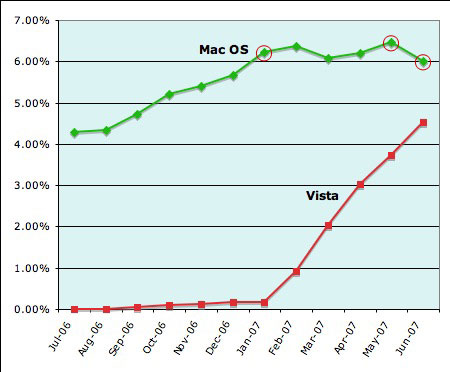
Remember this story from ComputerWorld a few months back? I wrote this blog post on it. The article basically used cherry-picked data to suggest that Vista was booming while the Mac was languishing in flat sales, pretty much the exact opposite of what was true. One quote in particular:

According to Net Applications, in June Windows Vista accounted for 4.52% of all systems that browsed the Web, up from January’s 0.18%. Vista has grown its usage share each month since its release to consumers Jan. 30, hitting 0.93% in February, 2.04% in March, 3.02% in April and 3.74% in May. Apple Inc.’s Mac OS X, meanwhile, accounted for 6.22% in January and hit its high point of 6.46% in May, but it slipped back to 6% in June.

Here’s the chart from which he chose his numbers, with his quoted Mac numbers circled in red:

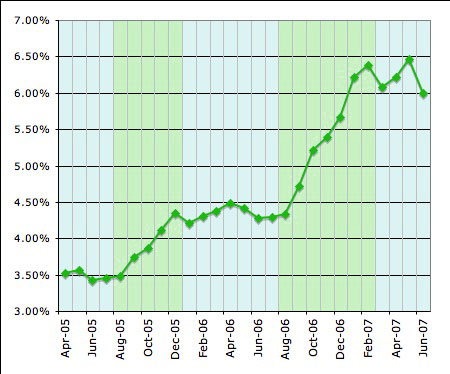
See what he did with the Mac numbers? He chose the January number, which was near the end of a 6-month climb, and then compared it level summer numbers through May, and a small drop in June, citing a 1-month fluctuation as if it were signs of a trend. He did not report that year-over-year, Mac market share has been increasing rapidly: 20% from 2004 to 2005, 26% from 2005 to 2006, and now 40% from 2006 to 2007. Not only is the growth rapid, but it is accelerating. I charted this out:

He used this data to make this conclusion:

Windows Vista’s share of online users has increased every month this year, while rival Mac OS X — to which Vista has often been compared — has shown little, if any, growth, a metrics company reports.

But what about that downswing at the end of the Mac OS chart? Two and a half months ago, I noted:

For example, if you just trouble yourself to get the Net Applications numbers for the Mac OS for the previous year as well, you’ll notice a pattern: Mac OS share rises in the second half of the year, then stays steady in the first half of the next year. The numbers for the Mac have shot up starting in August for the past two years–which means that Mac OS share, as reported by this source, should start to jump again in the next few months….

And guess what? Well, here’s the chart, extended into September of this year:

0907-Macvista3B

And of course, just as predicted, the numbers have shot up. If they continue to follow that same trend, we should see Mac OS X market share reach over 8% by the beginning of next year–and Mac sales seem to indicate that this is pretty much what is happening. If the trend continues, Macs should have between 12% to 15% market share by 2010. If you really want to go far-reaching, the same trendline shows Macs reaching over 30% by 2015. However, considering that there is only 3 years of data from which to extrapolate a future trend, that’s kind of reaching too far; even 2010 is a stretch, and who knows what events can and will affect the trends in the future.

That is, however, the current trend. I was right in predicting the upswing beginning in August; let’s see if I’m right about next January before I start getting excited about anything farther down the road.

Nevertheless, you can probably see why I am definitely holding on to my Apple stock; despite having risen 65% and reached an all-time high since I bought it, Apple has so much more room to expand–not just with computers, but with cell phones and all the other markets they can enter–that it’s not even funny.

It should also be noted that the data comes from Net Applications, and the share is calculated by measuring visits to web sites which are more oriented towards Windows PCs.

Categories: Mac News Tags:

Testing the New Bush Court

October 1st, 2007 Comments off

Now we come down to the home stretch, and find out what Bush’s new stacked Supreme Court is made of. Will Justice Kennedy prove to be the safety valve that Justice O’Connor likely hoped him to be? Or will he vote with Bush 41’s Alito and Roberts, Bush 43’s Thomas, and Reagan’s Scalia to form a conservative block?

Already we have seen that Roberts and Alito are completely content to ride along with Scalia and Thomas in blatantly manipulating the Constitution to claim it says what it clearly does not mean in order to impose their own personal views and ideologies on the nation. But how far will Kennedy go along with that?

One issue facing the court is a Washington D.C. gun ban–a law that bans handguns but allows shotguns and rifles, aimed at stemming street violence. This will be the first time since 1939 that the Second Amendment comes under this close scrutiny–and of course, it’s under a Bush-stacked court. Great.

The Supreme Court is known for being conservative and usually limits its decisions to the specific issue at hand. One way we’ll know if this is an ideological rather than legal decision is if the court, in a 5-4 decision along political lines, rules broadly about the interpretation of the Second Amendment. The only possible thing holding them back may be Kennedy, who the hard-right bloc may have to negotiate with to get him on their side. I fully expect the gun ban to be overturned, but Kennedy’s influence could keep it as restricted as, say, not re-interpreting the Second Amendment and only applying to such matters as whether or not D.C. can be treated like a state. Alternately, the court could easily say that the mention of “militias” has no bearing on the National Guard, and throw open the door to unrestricted access to firearms.

But that by far is not the most important issue to be reviewed this year. The court will decide on the reach of, or possibly existence of, habeas corpus, in regard to U.S. citizens or possibly just to non-citizen detainees in Guantanamo Bay. Free speech, voting rights, capital punishment, racism in crime sentencing, and states’ rights are all on the chopping block.

While this season may not necessarily constitute a bloodbath of civil liberties and well-established legal principles, one can at the very least expect a certain amount of injury to the Constitution and our concept of legal interpretation.

Stay tuned.

Categories: Political Ranting Tags: