Archive

Archive for August, 2010

An Appeal to Bigotry

August 16th, 2010 35 comments

Well, it’s official: now that Obama has spoken out in approval of the Cordoba House project [Clarification: he did not “approve it” or even “approve of it” per se; he only supported their right do so], Republicans are grabbing the issue as an election-year theme. Never mind that this should be an issue of religious liberty. Never mind that this is a clear appeal to lump together all Muslims under the terrorist label and use them as a political scapegoat.

Who cares about any of that when you can get people to vote for you?

Count me as disgusted. Not surprised, just sickened.

Issue Clean-up: Near the Sacred Ground of Zero

August 14th, 2010 13 comments

So, having a mosque community center with an inter-faith chapel built by peaceful, anti-terror Sufi Muslims within a few blocks of Ground Zero is not OK, but having these establishments within a few blocks of the same site is just fine (several are NSFW):

Pussycat Lounge & Hamilton Room
A-1 Metro Parties
Adult New York Escorts
New York Dolls Gentlemen’s Club
Male Strippers
Adult Models Dating and Escorts

I wouldn’t be surprised if at least a few of those places started business after 9/11. I’m pretty certain that if another strip joint or escort service were to go up in the area, no one would object.

Glad we have our respectfulness for the sacred nature of the site in order.

Also, it was found last week that since 9/11, Muslim prayer sessions have been held regularly in an inter-faith chapel within the Pentagon.

Along the same lines of my comments of the repeal-the-Fourteenth-Amendment movement, whether or not you agree with the idea of Muslims of any stripe keeping a respectful distance, the fact remains that such feelings are not what this discussion is about. This is election-year politics. If the demagogues felt that the community center was not a good target and the strip clubs were, then it’d be all about the strip clubs. The public row is fueled not by indignation, but by stark, aggressive, uncaring opportunism.

Addenda: I forgot to mention that the Imam behind the NY project was tapped by Karen Hughes of the Bush administration for overseas tours representing a more moderate Islam. Also, Obama finally threw his hat in, probably now seeing the matter as being resolved enough for his comments to not inflame things and wants to help put the matter to rest.

When Looking for Fire, See Where the Gas Is Coming From

August 14th, 2010 1 comment

I have written about Republican projection before–if you hear right-wingers accusing the left of something, you can be pretty sure that (a) it’s either exaggerated or untrue, and, more to the point, (b) either they or someone else on their side is doing it or wants to do it.

Not too long ago, some distorted conspiracy theory from the Bachmann/fringe/loon camp was being spread about how Obama was using census data to set up “internment camps” built by FEMA (and I’m sure ACORN fit into it somewhere too, I must have missed that meeting), all to put people he didn’t like–that is, Republicans foolish enough to openly admit their party affiliation to a census worker–into them.

Nutty, huh?

Well, in the latest round of “how will we deal will the immigration crisis” paranoia, guess what some right-wingers want to build? Yep: internment camps. Asked if what she wanted was something like the Japanese internment camps of WWII, she said, “Something like that.”

Good thing Obama built those FEMA internment camps–we’re pretty much ready to go now.

Categories: Right-Wing Extremism Tags:

Friday the 13th Curse Not Working

August 13th, 2010 Comments off

Went to the doctor’s office today. Got a great report–blood sugar levels down to almost normal now (they had been creeping up), falling a significant amount since my last check-up 3 months ago, following a yearlong trend. Then I found a folder I thought I’d lost on my desk at work, and cashed in a ¥10,000 check that was in it (cable TV company rebate for joining). Then came home still early in the day, and had a nice & tasty dinner. Also, summer vacation started this week.

Categories: Main Tags:

Microsoft Takes Shots at Macs

August 13th, 2010 9 comments

Microsoft has recently posted a list of supposed advantages over the Mac–revisiting the eternal “Mac vs. PC” comparison debate. So, how do they rate? Some hits, some misses, some rather laughable claims. One way the list tries to pad itself out is by comparing hardware–which Microsoft does not produce–in addition to the OS, and because there are a large number of companies making multiple lines of computers trying to fit all niches, Apple by itself cannot possibly match every single one of them. So naturally there will be many things that Microsoft can claim which will sting… but the fact that they had to pad the list like this is kind of telling. Microsoft starts out the list with the major points, but then quickly devolves.

Under the heading, “Macs might spoil your fun”:

It’s showtime – You can’t get a Mac that ships with a Blu-ray player, TV tuner, Memory Stick reader, or built-in 3G wireless. You can with PCs running Windows 7.

This is a recurring theme in the list: “Many PCs can do things Macs can’t.” True–and many PCs can’t, either. And few, if any PCs can do all of those things–so even with a Windows PC, you still won’t have all the features that are possible.

One odd point in that list: “Memory Stick reader”? Did the Sony Memory Stick suddenly become popular when I wasn’t looking? Macs now ship with SD card readers, which tend to be the most popular type.

But Blu-ray, yes–that’s one that stings. Jobs calls it “a bag of hurt” without being too clear on the why and wherefore. He mentioned the “licensing of the tech,” but that doesn’t necessarily explain why other makers seem to be OK with it. He also mentioned that the format hasn’t “taken off yet,” which shows one Apple weakness–the delay in adopting many new standards. It took way too long to get SD readers, for example, and even the original USB was a bit long in waiting. No doubt USB3 will have a similar lag as well, and probably WiMax too.

Game on – Most of the world’s most popular computer games aren’t available for Macs. And Macs can’t connect to an Xbox 360. PCs are ready to play.

The games claim is mostly true–if you’re a serious gaming aficionado, then a souped-up PC makes more sense. That said, Macs can run Windows and do Windows gaming; Microsoft is playing with the difference between the OS and the hardware here, claiming each one is the main topic whenever it is to their advantage. And connecting to an X-Box? Um, OK. If that’s your thing.

One more point comes up here: stuff that Microsoft can claim now but maybe not for too much longer. Macs are making gains in the gaming world, and as student adoption of Macs continues to skyrocket, so will the Mac ports for popular games. And hey, let’s not even mention the iPad or the iPhone here, right?

These points, however, are the main ones–advanced hardware on some PCs and a bias for the Windows OS when it comes to gaming. One could point to similar advantages for the Mac, primarily the hardware/OS/software symphony, excellent tech support, superior user experience, and ability to run all other OS’s in emulator mode. Microsoft of course does not mention points where it is at a disadvantage, nor should it. But they’re there, nonetheless.

Direct TV connection – Most Macs can’t hook up to your TV unless you buy a converter dongle. Many PCs running Windows 7 are designed to connect directly to TVs, so you can watch movies and see photos on the big screen.

Ooooo… you have to pay five bucks for a converter. Deal killer, that. And as with a point above, not all PCs have this themselves, though a lot do. But that can be counted as an advantage for Windows–you can choose between hundreds of varying systems for exactly the specs you want (though that also has its disadvantages built-in as well).

But this point–HDMI out–has a short shelf life: the Mac Mini has HDMI out. Meaning more Macs will have it soon as well. Oh well, so much for that advantage. Add it to the list of things Microsoft can only claim for the moment.

The claims start to get laughable in the “ease of use” category. The main point: if you’ve only used Windows all your life, it’ll take time to get used to a Mac. But then, if you used MS-DOS, using Windows 3.1 took a long time to get used to also. Are you still using MS-DOS? Yeah.

Under “Macs can take time to learn”:

The computer that’s easiest to use is typically the one you already know how to use. While some may say Macs are easy, the reality is that they can come with a learning curve. PCs running Windows 7 look and work more like the computers you’re familiar with, so you can get up and running quickly.

See? “Stick with Windows: it may be harder to use and more frustrating overall, but we’ve got you hooked because it’s the only thing you know. Don’t bother to take the week or so to discover an OS which is easier to use.”

Their next point: very different!

Working smoothly – Things just don’t work the same way on Macs if you’re used to a PC. For example, the mouse works differently. And many of the shortcuts you’re familiar with don’t work the same way on a Mac.

Oh, wait. Just more specific. Oooh, you’re never gonna get used to the Command key instead of the Control key!

Essentially, Microsoft is saying that Windows has the advantage because it’s different. Not better, just that there are minor differences and you don’t want to have to spend even a few days to get used to different keys. Suckerrrssss!

Use Windows 7 to simplify your life – Windows 7 was designed to make it simpler to do the tasks you do every day, with features that the Mac doesn’t have. For example, the new Snap feature makes it easy to view two documents side by side.

Yes, everything is much simpler than on a Mac! Like installing and deleting softw… um, wait. No, like switching between open windo… ohh. Hmm. Or connecting to a printerrr… well, how about using a USB sti… um…

But hey, you can make two folder windows occupy either half of the screen in Windows like that! Suck it, Apple!

Touch and go – Unlike Macs, many PCs running Windows 7 support Touch, so you can browse online newspapers, flick through photo albums, and shuffle files and folders–using nothing but your fingers. PCs with a fingerprint reader even let you log in with just a swipe of your finger.

Touch screen? On your desktop or laptop? They’re gushing about that? Touch is wasted on those, and on devices where touch is actually useful–phones and tablets–Apple is way ahead. Not to mention Apple’s trackpads put just about any PC’s to shame. Guess which is closer to the keyboard and easier to use?

Stos01
And the fingerprint reader? Hah! Maybe some people like that, but I’ve never met one. I had a student bring in her Windows laptop, and she hated having to swipe her finger every time, and couldn’t figure out how to turn it off. A colleague boasted about the feature, but when I asked him, he admitted that he never used it.

The above points fall into the category of “glitzy features which look cool but you wind up not using.” Not really an advantage to the end user.

Microsoft is clearly aware of the fact that businesses are starting to wake up to Apple gear, and especially that Macs are beginning to dominate the education market (mouse over chart at right to see details). In their section titled “Macs don’t work as well at work or at school”:

If most of the computers in your office or school run Windows you may find it harder to get things done with a Mac.

Not really. If a Windows PC’s network connections are not pre-set by the IT staff, I find it far easier to connect using my Mac.

In any case, the claim here is again based on Windows predominance–not that it’s easier or better, but rather coasting on the fact that there are more PCs around than Macs. When the fact is, if you change all your equipment to Macs, it’s far easier to network, connect, and maintain, with less IT costs. Which is why a lot of IT departments steer away from Macs.

Sharing documents and spreadsheets – If you use Apple’s productivity suite, sharing files with PC users can be tricky. Your documents might not look right and your spreadsheets might not calculate correctly.

Once again, “We’re not better–we’re just what you’re stuck with.” And interesting that Microsoft seems to forget that Office is on the Mac. Is that defective too? Besides which, I’ve seen the same issues pop up between people using different versions of the same software on PCs–like Office 2000 and Office 2007–not to mention what happens when you try to use another computer without the same selection of fonts. Especially different languages–something the Mac handles smoothly, but Windows does very badly.

As for portability of documents from computer to computer, let’s not forget that PowerPoint is an absolute nightmare when it comes to sounds and video–something my students discover every semester when they make a PowerPoint presentation on their home computers and then bring it in to work. Even if they keep their audio and video files all together in one directory, copying that directory onto a new computer will cause PowerPoint to forget many of the paths

Giving presentations – You’ll have to buy a separate hardware dongle to plug your Mac into a standard VGA projector. Most PCs with Windows 7 hook up easily.

Again with the $5 adaptor. Does that really make people turn away from a better system? It’s like saying, “Buy a Hyundai instead of a Porsche, because the door handles are smoother!” And while we’re talking about PowerPoint, here’s a one-word argument for the Mac: Keynote.

Protecting your drives – On a Mac, out of the box, you can only encrypt your home folder. With Windows 7 Ultimate, you can encrypt your entire hard drive and even USB drives. So your stuff can be safer wherever you go.

I don’t know about this feature so I can’t speak to it. Except to say that nobody I know uses the feature on either system. This may be something a few users think about, but most people will just shrug and walk away.

We get to funny stuff again in sharing: “Macs don’t like to share.”

Securely share your movies, music, and photos – With a Mac, it’s harder to set up secure sharing for your photos, music & movies, documents, and even printers with other computers on your home network. With HomeGroup, it’s easy to connect all the computers in your house running Windows 7.

Yeah, but if you have XP or Vista on any computers, tough luck.

As for secure sharing, it’s called WiFi with WPA2–or, in other words, the industry standard. Set it up–easy. Then all the Macs just show in the sidebar. At worst, you have to turn on file sharing in the System Prefs and make a directory shared by clicking a checkbox in the “Get Info” window.

I have not tried “HomeGroup” yet, but from looking at tutorials, HomeGroups seem way, way harder. This tutorial goes over an eleven-step “exercise” (seriously, they call it that) which shows how to create such a network–on one computer. The second page has twenty steps to add another computer.

Simple as pie! Making pie, that is! Very difficult pie!

Is it really more out-of-the-box than that? Because from what Microsoft is claiming, a 31-step process is hardly “automatic.”

After this, it’s just repetition: another section titled “Macs might not like your PC stuff” is a re-hash of “it’s not good because it’s not a PC,” and the “Macs don’t let you choose” is a rehash of the Blu-ray and other media points with “you can’t choose pretty colors” tossed in.

Seriously, if this is all that Microsoft has got to prove it’s better than Macs, they’re in much bigger trouble than even I thought.

What they put up essentially boils down to this:

Macs don’t feature high-end built-in peripherals like some PCs have, and the PC remains a superior gaming platform. PCs also sometimes have cool but useless doo-dads like fingerprint scanners. Macs more often need adaptor cables. The Windows OS has a few nice features which are not found on the Mac.

Otherwise, the main reason to buy a PC is because it’s what you know, and you might have slight problems dealing with cross-platform compatibility.

Seriously, I think even I could have slapped together a better case for PCs than that. The problem is less one of running out of things to talk about and more one of bad writing.

Categories: Computers and the Internet Tags:

Dropping Terror Babies

August 13th, 2010 7 comments

Rep. Gohmert (R-TX) was the main one claiming that “pregnant terrorists” come to America to give birth to babies who will later become terrorists, using their birthright citizenship against America so as to destroy it. About as extreme an anti-immigration, anti-Muslim, paranoid right-wing freakout as you could expect to hear.

Imagine everyone’s surprise when the FBI announced that they theory was, as they put it, “never credible.” Me, I think they should investigate Gohmert under suspicion of giving aid and comfort to the enemy, ’cause I bet that terrorists in all parts of the world sure enough heard this theory and just as sure got some pretty good chuckles from it.

As a side note: my own stand on amending the 14th Amendment to the Constitution to prevent illegal immigrants from having “anchor babies” is ambivalent. On the one hand, the provision is somewhat out of date, having been constructed to grant citizenship to former slaves who were born in the U.S. but were never officially granted citizenship. It was not really intended to allow children of people in the country illegally to obtain citizenship, intentionally or otherwise.

As a result, I am not strongly against repealing that provision of the amendment. However, not now. Why? Because right now the movement to repeal is not based upon reason or intent to clarify the original intent of the law. Rather, it is a highly political and racially charged movement of which I want no part.

Republican Senator Lindsey Graham (R-SC) is simply the most visible right-winger to state it in an only thinly-veiled manner: “People come here to have babies. They come here to drop a child. It’s called ‘drop and leave.’” While Graham attributed the term to immigrants, there is no evidence of such phraseology existing before he said it. What is of specific note here is the term “drop”: the word is used to denote animal birth, as in to “drop a foal” or to “drop a litter.” Using it in reference to people is, in this case, rather blatantly racist, and attributing it to their own terminology is nothing more than an excuse to use such racist terms. And since Graham used that term, it’s all over the place now; many on the far right, taking Limbaugh’s cue, love to use openly racist terms so long as they can point to any pre-existing use as an excuse. Which is one of the reasons I would not agree to repealing the law at this time–not for these reasons, and certainly not with this crowd.

In part, it’s similar to the drive to amend the Constitution so as to allow naturalized citizens to become president–ironically, one that the right wing has abandoned since Obama came to office and they wanted to press the Birther claim. The reason right-wingers were so big on it up until recently was because they were still greatly enamored of Arnold Schwarzenegger, and felt he had a good shot at the presidency, if only it weren’t for that whole Constitution thing. Now, in principle, I think it’d be just fine to allow naturalized citizens that ability; my father is one, for example, and I think he’d have made a better president than some we’ve had, for sure. But I will not stand with the crowd who want to change the Constitution for political reasons.

If we change the Constitution, the intent has to be pure. It should never be a flash-in-the-pan political fad, and it should never have at its roots racist or paranoid delusions. After all, think of cases that are interpreted based on framers’ intent–what would a judge have to conclude when noting that the framers of a constitutional amendment were passing it to win an election by appealing to voters’ racist inclinations?

In the future, when we’ve calmed down a bit, maybe. But not now.

Categories: Law Tags:

More of the Meme

August 13th, 2010 7 comments

Rand Paul on the “You Have to Be a Christian to Be Good” bandwagon:

I’m a Christian. We go to the Presbyterian Church. My wife’s a Deacon there and we’ve gone there ever since we came to town. I see that Christianity and values is the basis of our society. . . . 98% of us won’t murder people, won’t steal, won’t break the law and it helps a society to have that religious underpinning. You still need to have the laws but I think it helps to have a people who believe in law and order and who have a moral compass or a moral basis for their day to day life.

The clear implication is that if you’re not a Christian, then you don’t believe in law and order and you don’t have a moral compass or a moral basis for your day-to-day life.

How charming.

Categories: Religion Tags:

Fun with PHP

August 12th, 2010 8 comments

Okay, all of you actual programmers out there, get ready for amateur hour. I have been working to understand programming better for a while now, and have made a teensy bit of progress. I learned HTML and CSS the natural way–I gleaned it bit by bit off of instructional web sites and peeking at other people’s code (a lot of CSS I learned, in fact, came from editing the themes for this blog). But I wanted to get beyond simple scripting and into some actual programming, something I hadn’t done since I took that BASIC programming class back in 1982.

I figured that my best chance would be to take advantage of the online classes from the college where I teach, free to faculty. Intermediate Algebra was a prerequisite, and though I passed it back in the 80’s (one of my few “B” grades in college), I figured it was time to freshen up, considering that (a) it could help in programming, (b) I have a bit of a phobia about anything more complex than basic math, and (c) I hadn’t used any of it since I took the course and remembered pretty much squat. So I took that class, aced it, and went on to take the next class, “Introduction to Computer Programming.” Which it pretty much was–just an intro course. We never got beyond making little C++ command-line programs. Alas, another Math class–Discrete Math–was required before taking any other programming courses, so I bore down and signed up for that. Problem: the text was horrific, requiring about 30 hours a week to get past the atrocious writing so I could spend another 10 hours learning the material. It was just too much on a full-time schedule, so I reluctantly withdrew.

Not wanting to just give up (our local Math professor has kindly agreed to arrange a private independent-study course that might get me the credit for Discrete Math, but not this year), I started studying PHP. I want to re-write my Introduction to Computers web site from the ground up anyway, and I figured that knowing some PHP would help. Well, now that my August break has started, I started diving into it. The result so far: a crude, basic understanding… and a result. I figured out how to add a much-needed feature to my web site. My students crave feedback at every step, and I wanted to add little exercises after each page or two of study. PHP gave me a way to create very slightly interactive quizzes, very simple–choose the answers from drop down menus and check to see if you got things right.

Pleased with my little success, I figured I’d have a bit of fun and add a quiz you might want to take–not on computers, but on some basic political points. Just click the link below, choose what you think are the best answers, and then click “See Results” to find out how many you got right. Since I like my students to figure out correct answers, I don’t give the answers on the results page; you have to go back and try again. Enjoy!

Quizy01

Categories: Programming, The Lighter Side Tags:

Talking to the Little People

August 11th, 2010 6 comments

These people really are living in a fantasy world. After quitting as governor mid-term, Sarah Palin started cashing in big-time–book deals, speaking tours, and now even a reality show of her own. But filming the show, she came across an Alaskan who was none too happy with Palin leaving her post for profit. Palin approached the woman, who had put up a large sign reading “Worst Governor Ever,” and apparently attempted to talk her down. Excerpts are extremely telling:

Gustafson: You swore on your precious Bible that you would uphold the interest of this state, and then when cash was waved in front of your face, you quit.
Palin: Oh you wanted me to be your governor! I’m honored!

Wow. I know that it’s a standard political technique to dodge a hard question by answering a different question, but that’s quite a stretch there–unless Palin was trying to be snarky and condescending.

Gustafson: I wanted you to honor your responsibilities. That is what I wanted, and to be part of the political process instead of becoming a celebrity.
Palin: That’s what I’m out there fightin’ for America to be able to have a Constitution protectin’ us so we can have free speech…
Gustafson: In what way are you fighting for that? In what way?
Palin: Oh my goodness! To elect candidates who understand the Constitution to protect our military interests so that we can keep on fightin’ for our Constitution that will protect your freedoms…

Here’s where we see a strong element of what we’ve seen before–the self-anointed hero, actually believing that resigning her duties so she can get millions from a book deal, write trash from her social networking sites, and then start her own reality show is “fighting for the Constitution” and “protecting our freedoms.” Here’s someone with, to put it mildly, delusions of grandeur.

Gustafson: By using your celebrity status.
Palin: How am I a celebrity? I’m honored that you think I’m a celebrity.

Again with the snarky condescension. And, hey, I could swear that in the 2008 elections, Palin chimed in with McCain and attacked Obama for being a “celebrity.” Not that consistency is one of her strengths.

Here’s where it gets a bit sad:

Gustafson: You’re certainly not representing the state of Alaska any longer.
Bristol Palin: She’s representing the United States.

Sad that her daughter has apparently bought into the mythos, believing that her mom has somehow been elected to the presidency or some similar office. You represent people when they elect you; so far, America has not elected Palin to anything–she lost, last I heard. And unless she is taking all the millions she is earning and giving them to the people somehow, then resigning from the post she was elected to and cashing in is not in any way “representing America.”

But then it gets even better: Palin discovers what the woman’s profession is…

Gustafson: Yes, I know, you belong to America now, and that suits you just fine.
Palin: What do you do?
Gustafson: I’m a teacher…
Palin: (eye roll)

You have to watch the video: Palin actually does do an eye roll, a rather overt eye roll, with a look to her people, as if to say, “Oh, Jesus, one of those a-holes, great.” And if Palin was thinking it, one of her daughters said it, to the man who was with the protesting local woman–called him an “A-hole” for filming the talk, or perhaps for letting the woman put the sign up on his property.

A sign which the Palin team illegally tore down soon after the little talk. On a public pier where Palin’s private security people were patting down and searching local residents who came too close–as if they had any legal right to do so. As if they were Secret Service agents carrying out law enforcement, or that the public pier belonged to Palin and her entourage. Not to mention the irony of Palin making such big noises about the freedom to carry arms, but not apparently when they’re around her. It is as if Palin and her team did just about every about every little thing possible to aggrandize themselves at the expense of those around them, talking about rights and then stepping on the townsfolk like they were the little people.

And these people call liberals “elitists”? Irony of ironies. It’s a personality cult, built on a rather bizarre personality, based upon lack of desire to serve and all the desire to make as much money as possible and act all superior and self-important. I’d expect this kind of stuff from people even younger than Bristol, and even for them, it would be embarrassing. This, this is just pathetic. And those who adore her… just plain sad.

Categories: People Can Be Idiots Tags:

Hiroshima and Nagasaki at 65

August 10th, 2010 32 comments

I have blogged on this in the past, and simply restate my feelings now: Hiroshima and Nagasaki, if not war crimes, were certainly not necessary to end the war. I hold that it would have been more than adequate had a “warning shot” been detonated over mountains outside Tokyo, in full view of the capital, and then a warning given that a city a week would be obliterated if Japan did not surrender unconditionally. I do not accept any of the excuses about this; it was a clear alternative anyone could have seen, and had more merit than what was done.

The usual side concerns arise: while Hiroshima and Nagasaki were horrific, they paled in comparison to what the rest of Japan suffered in many ways. Carpet bombing of civilian populations killed far more people, and a person dying of third-degree burns likely feels little different if the burns came from conventional or nuclear weapons. The A-bombs were essentially the plane crash equivalents of war: they captured attention because they were unusual and horrifyingly spectacular in nature, even though more people died just as horribly by other means.

An interesting twist on this, the 65th anniversary of the bombings: the U.S. ambassador attended the ceremonies in Hiroshima, the first time an official American representative has been present at the proceedings. This was done with the intention of showing America’s commitment to nuclear disarmament, but some Japanese were “disappointed” that America did not take this opportunity to offer an official apology for the bombings. That is very, very unlikely: many Americans tend to feel completely justified about Hiroshima and Nagasaki, and get their backs up whenever anyone says differently. Were an American official to apologize in such a manner, there would be political hell to pay. But especially for Obama, who the right wing already pillories for “bowing to foreign leaders” and “apologizing for America” to foreign powers, if such an apology were made on his watch, he would pay an especially high price–not to mention that there is no evidence that he would agree that an apology is in order. Indeed, even sending the ambassador was too much for some people.

Then there is the question about the appropriateness of Japan asking for such an apology, considering the fact that Japan itself has never fully apologized to its Asian neighbors for acts just as horrible and extreme. Not that this has any bearing on any actions that might be taken by the U.S., nor does it suggest that people in Hiroshima and Nagasaki are against Japan apologizing to countries such as China. But it does bring such facts to light.

Then there is the idea that America was especially guilty for using such weapons. One would have no doubt whatsoever that had Japan possessed such weapons during the war, that they would have used them without hesitation. Nor can Japan deny that intent, considering that Japan itself had not one, but two different nuclear weapons development programs underway during the war. If Japan was seeking to build nuclear weapons and had the unquestionable will to use them, how pure are Japan’s protestations about the inhumanity turned against themselves? Again, not that this excuses or justifies what America did, but if Japan truly wishes to make a statement against the use of such weapons, to claim victimhood only and ignore its own nuclear intent is more than just a little telling. To admit that the programs existed and those were just as wrong would be a much more powerful statement–and yet I have not heard anyone in Japan make such a statement.

This plays into the larger issue of Japan’s own views of what happened in WWII: its whitewashing of its own aggression and atrocities, its sharp and sometimes extreme focus on how Japan suffered with great emphasis on Japan’s victimhood. I have heard students tell of History teachers in public schools who teach up to the point where Japan started invading other countries, claim there is not enough time to cover all the material, and then jump to the last year of the war where Japan suffered most, without covering the intervening events. Films critical of Japan are regularly blocked or extremely limited, while films lionizing people like Hideki Tojo are well-received. It really does not seem that Japan is itself carrying out the self-introspection and regret that it expects of others.

I remember seeing one of Kurosawa’s final films, Rhapsody in August. It starred Richard Gere as an American nephew of a Japanese woman who comes to visit his family in Japan, learns about the bombings in which the woman’s husband died, and apologizes for what happened. Now, confronted with survivors of the bombings, I myself would offer an apology as an American, so I do not see such a concept as inappropriate. But for a Japanese filmmaker to write such a script is, to say the least, just a bit out of place. Imagine, for example, if an American director like Francis Ford Coppola were to make a movie based in Hawaii where a Japanese visitor learns of Pearl Harbor and decides to apologize to Americans for the attack; I doubt it would be well-received in Japan, nor would they feel it appropriate.

One other note: before this film, despite his status as a legend, Kurosawa had been unable to get funding for his films. George Lucas, Francis Ford Coppola, and Steven Spielberg had to give Kurosawa the funding necessary to make both Kagemusha and Ran, both receiving widespread critical acclaim. For the less-well-received Rhapsody in August, however, Kurosawa had no trouble getting domestic funding. Take from that what you may.

In the end, I hold to Santayana’s advice: we must remember atrocities and injustices our own people have committed lest we commit those crimes again. Remembering the crimes committed against us by other nations and forgetting or forgiving what we ourselves have done is to ensure we will repeat those mistakes in the future. No one is immune from whitewashing their past; America does so quite often. However, despite right-wing anger and disapproval regarding Americans who “apologize” and “hate America” for recognizing the worst of our heritage, such observation is nothing less than the beginning of peace for the future, and necessary for a far more civilized world to live in.

Categories: Focus on Japan 2010 Tags:

NOW They’re All About Conflict of Interest

August 10th, 2010 17 comments

Note: sorry I’ve been away for 3-4 days. End of the semester and the usual intense grading period intervened. Back to the fun:

Another case of astonishingly naked hypocrisy from the right wing: the judge who ruled that California’s Prop 8 (banning gay marriage) was unconstitutional is rumored to be gay, so his ruling is invalid and he should be impeached.

But it didn’t bother them at all that a judge ruling to overturn a moratorium on offshore drilling had investments in the oil industry.

And if the judge ruling on Prop 8 had been a conservative Christian with a history of antipathy toward gays, they would not have had a problem.

Remember the ruling on Intelligent Design in Dover, PA? The judge was a Bush 43 appointee, a Christian, and had a conservative track record; as a result, the right wingers, before the trial, were confident that he would rule for them–they had no problem with his politics or religion beforehand, despite both of those playing a role in the case. It was only after he ruled against ID that they turned on him, viciously–just as they are now howling over Judge Walker.

But are they right in this case? Assuming the judge is in fact gay, was there indeed a conflict of interest?

The answer has to be “no,” just as there was no conflict in the Dover judge’s case. Your identity should not be something that can recuse you, or else judges would be recusing themselves right and left. Male judges should not recuse themselves in rape cases, nor should female judges. Christian judges need not recuse themselves in establishment cases, nor should atheist judges. It could be argued that both white and minority judges ultimately have personal interests in judging discrimination cases–thus no one would be fit to rule on them. In cases such as these, we must trust the judge to be impartial, else no one could judge anything. It is only when a judge has a specific interest–a financial investment or a personal friendship, for example–that they should recuse themselves. But not simply because they belong to a class that could be affected by the law in question.

The whole indignation on the right about this judge’s alleged sexual orientation–despite the fact that he was a Reagan appointee and has been inhospitable to gays in the past–is nothing more than standard right-wing hypocrisy: any decision we don’t like is judicial activism and is wrong, no matter what; any decision we like is OK, no matter how legally twisted. They want the Scalia/Thomas brand of justice: legislate a conservative mindset from the bench, ignoring the actual law whenever it becomes inconvenient.

Categories: Law, Right-Wing Hypocrisy Tags:

Real Patriots Hate the Government
(Especially When a Socialist Fascist Kenyan Dictator has Overthrown Democracy)

August 6th, 2010 15 comments
Senator and Vice-President John C. Calhoun
Jccalhoun

“States’ Rights” has been a buzzword in right-wing circles for a while now. The idea is that the individual states, within their borders, have the right to precedence over the federal government; that if a state doesn’t like a federal law, it can supersede it with a state law. Regardless of whether you agree with this idea–traditionally known as “nullification”–the right wing doesn’t practice it in good faith. To them, it’s a handy marketing tool, but certainly not a principle. When it comes to federal laws they don’t like, like legalized abortion or Obama’s health care plan, they trot it out for show.

However, when states start doing things they don’t like, the idea of states’ rights evaporates with astonishing stealth and speed. For example, under Bush, California instituted medicinal marijuana laws, but the Republican-led government overruled that and made a very overt point of enforcing the federal statutes in that regard. The same went for a right-to-die law in Oregon, which Bush attempted to override with federal drug laws. In short, the right wing doesn’t give a rat’s ass about “states’ rights,” they only care about their agenda, and “states’ rights” is an appealing election-year slogan that sounds good–but means only what they want it to mean, when they want it to mean it.

“Nullification” is beginning to see a revival, as is one of its historical champions, John C. Calhoun, who is not the most fantastic of icons to posit, considering that he also called slavery a “positive good,” and the issue of nullification was related to the South’s rebellion against the North on the basis of the states’ right to maintain the practice even if the federal government were to outlaw it.

Furthermore, they apparently were not aware that Calhoun later emigrated to the planet Beta III and started a idyllo-fascist society of Zombies under the alter-ego brand of “Landru.”

John C. Calhoun, a.k.a. “Landru”
Landru01

Ok, all kidding aside, Calhoun still isn’t the best of role models here. But we are currently in a state where right-wingers are increasingly using terms like “nullification,” “secession,” and “Second Amendment solution” in regards to what are, in fact, very centrist policies of the Obama administration. This is more lynch-mob mentality than civic responsibility, more demagoguery than democracy. It is not about principle, it’s about politics.

I mean, seriously, health care? Who cares if it will save money in the long run–it’s a tax, and we have the constitutional right to pay double to insurance and pharmaceutical corporations in order to avoid paying any sort of fascist tax.

Let’s face it, this is not nullification of any unconstitutional tyranny, this is about right-wingers hating the fact that right-wingers don’t control the government any more, and so are throwing hysterical hissyfits right and left based on whatever flimsily-slapped-together rationalizations they can sell to an eagerly hateful mob.

Categories: Right-Wing Extremism Tags:

The Slow Surge

August 4th, 2010 6 comments

Windows 7 is now “surging forward,” Ars Technica wrote. After just 9 months, it has overtaken Vista, which has been on the market for three and a half years. Sounds impressive, no?

Well, not so much. Windows 7 has so far claimed about 16% of the Windows crowd. And we should remember that Vista started gaining market share well before its official release–at it’s release, it already had about a 4% chunk of the Windows market, meaning that it’s growth is just about 1.3% per month. Better than Vista’s anemic 1% growth, but not by much. And though it has outgrown Vista’s 3.5-year number in 9 months, it did so by decreasing Vista’s share, eating away at Vista as it grew–it did not get there by only outpacing Vista, which is what many might assume from the “overtaking Vista” headlines.

Consider this: Mac OS X v. 10.6, Snow Leopard, got more than 55% of Mac users to switch in the same time period–almost three times the rate. Sure, Snow Leopard was cheap, but this pace of adoption is typical of Mac OS systems.

Another point to consider: where did Win 7’s share come from? Well, it turns out that about 2/3rds comes from XP’s share, and the other 1/3rd is from Vista. Considering that this started with XP having about 78% and Vista about 21% of all Windows users, that means Win 7 is drawing significantly more from the Vista crowd by proportion–Seven stole away about 14% of the XP crowd, but about 24% of the Vista crowd. Not to mention that most of the XP share taken by Seven is simply people buying new computers with Windows 7 pre-installed.

Not to mention that the trend is going to have to change soon: at this rate, it will take Seven a whole 20 months just to equal XP’s share. When official support for XP is finally removed, the trend will likely shift faster, but not by much, as people simply keep using older systems, or continue to re-install XP on new machines.

All this begs the question: why is Windows OS adoption so glacially slow? Mac OS adoption is lightning fast by comparison, even when released at full price. And considering the disaster Vista was, why didn’t most Vista users quickly upgrade to Seven?

SevenworksThere are several reasons. One is that most XP users continue to use machines that simply cannot support Windows 7. XP users who could upgrade may be staying away because of the bad reputation Vista imparted, making XP users wary. Then there’s the comfort factor, with XP working quite nicely enough, many wouldn’t want to change–the “if it ain’t broke, don’t fix it” contingent.

None of these, however, explain why, after a year or so of being available, three-quarters of Vista users have not made the upgrade.

One reason strikes me as perhaps as a likely explanation: upgrading Windows is not the easy task it is on OS X, and the main reason for that is hardware drivers. Even with Win 7’s better driver support, I have talked to people who tried to upgrade and found that stuff on their computer wouldn’t work right, if at all. A case in point: when we made the DIY computer at my school, we bought a Sony Vaio monitor. The monitor has a built-in web cam. It doesn’t work. Why? Because Sony only released drivers with the OS sold with the Sony. The web is filled with people trying to find drivers for Windows machines.

Now, Windows 7 has much better driver support generally, and so it may not be such a big pain–but as I understand it, there are no guarantees for your machine–there is the potential for trouble, which could by itself keep people from upgrading. Some people may be holding back as part of the Vista backlash, unwilling to trust Seven as much as they should. But others may simply be aware that when they upgrade, they might have to spend hours tracking down drivers and dealing with other issues associated with the new OS. At some point, it becomes a matter of not being worth the hassle.

When you get a Windows device, the OS is not built specifically for your machine, and the companies that made the parts for your computer don’t always do a very good job of providing the latest drivers to support everything. To me, this explain a lot when I see the adoption numbers for Windows.

Categories: Computers and the Internet Tags:

Harry Potter and the Ring of Reduction: Now in epub Format for the iPad

August 3rd, 2010 1 comment

Ror-Dl

Sorry for the delay! Here’s book two of my brother’s original series branching off from The Order of the Phoenix, and the sequel to The Veil of Mystery. This novel, The Ring of Reduction, follows Harry in his last year at Hogwarts as a student–and his second as a teacher. With Dumbledore now communing with Harry from the “other side” and helping to fight Voldemort, the long struggle comes to a climax.

Background: as you may or may not know, my brother has written several Harry Potter fan-fiction novels under the pen name “Semprini” (Monty Python in-joke), which are widely considered amongst the best published on the web. The first three novels pick up after the end of Rowlings’ The Order of the Phoenix, and go off on an alternate timeline for the sixth and seventh years (with an additional novel set five years later). Although they have a different tone than Rowling’s books, they are a close match in terms of the inventiveness and “look and feel” of the originals, so much so that I have sometimes become mixed up about what characters and events are from Rowlings’ books and which are from the alternate novels.

Personally, I like my brother’s versions a good deal better than the real deals–they seem much more reasonable in terms of how people act and how events turn out, and are much more satisfying in general. Even better, they recognize and discuss a variety of moral, ethical, and spiritual issues in a manner that is entertaining, making the stories more interesting for adults and more valuable for younger audiences. The greatest flaw with the book was the tendency to draw out some discussions about personal feelings and such, but this is a subsequent edit, in which the author did much to improve the read.

This first novel was titled The Veil of Mystery, and was finished in late 2004. I first published text and pdf versions on this blog in mid-2005, and since then, there have been about 10,000 downloads of the novel from this site. Keeping in mind that that this is not the primary source of publication–that would be fan fiction sites–that number is quite appreciable.

Even more impressive is the fact that the versions published so far are not the easiest to read–one must either print out a large stack of text, or read the book in a less-than-optimal form on a computer. Now that the iPad has come along, it seems the perfect chance to publish the novels in a form which is both attractive and easy to read.

To read the novel using iBooks on the iPad, just download the ebook (click on the cover art below or the download button at top), decompress the ZIP archive (zipped so as to preserve the book title), and add it to iTunes (drag and drop it into your “Books” section of the Library, or in the Library itself if there is no “Books” section yet). When you connect and sync your iPad, iTunes should upload the book automatically; if not, you can select it under the “Books” tab of your iPad’s content area, then Apply/Sync. The book will appear on your bookshelf, as pictured above.

If you have not read the previous novel, then to get the proper context, read or watch Rowling’s The Order of the Phoenix (book / DVD / BluRay) first, then read The Veil of Mystery. This novel picks up where that one leaves off.

Enjoy!

Ror-Cover

click image to download

Categories: Books, iPad Tags:

What Were You Saying About Confirming Judges?

August 3rd, 2010 Comments off

This chart shows what is perhaps one of the most under-reported stories in D.C. today:

Obamanom

Remember when Democrats refused to confirm Bush’s most extreme judges, and right-wingers screamed about how the filibuster was unconstitutional, and all that crap? Yeah, I know, this is old news–the GOP is being hypocritical as hell, yet again. The filibuster was toxic and traitorous and so on, but now Republicans use it virtually all the time, breaking records year after year, so that now a 60-vote majority is virtually required for everything.

Republicans acted like confirming judicial nominees was even a more important matter, the courts were tied up and it’s the president’s right to get anyone he wants approved by the Senate, no matter what their politics, and (again) so on and so on… and now Republicans are blocking nominees like never seen before.

Right now, the Party of No is blocking pretty much anything coming down the pike–even a tax cut for small businesses, which Republicans claim is their forte, they voted against as a bloc. Health care for the heroes who worked at Ground Zero and now suffer? Screw them!

What excuses are given? The goddamned DemocRATs didn’t allow us to attach huge tax cuts to the rich and every other thing we ever wanted tacked on to these bills as amendments, they wanted to force us to vote on these issues up-or-down! After all those years WE were in power and let Democrats add as many amendm… uh, OK, well, we shut them down and treated them like they didn’t exist, but now they’re fascist bastards anyway!!!!

Stuff like this, in addition to the we-love-fat-cat-bankers, the we-love-BP, we want to give Paris Hilton billions but the jobless are lazy and don’t deserve relief, and the fact that the GOP is going even more extreme as time goes on… even with people hating incumbents this year, it is still astonishing that people cannot see who is causing the damage.

You want Congress to do something about jobs? If Republicans get more than 40 in the Senate (they won’t retake the majority, that’s for sure), then you can bet that the near-total filibuster marathon will become an all-out standstill, or worse, Democrats will start to cave and things will start to roll back to the Bush years.

They have made it clear: as long as the Democrats hold the White House and a majority, they are determined to grind D.C. to a halt and make the country fail.

What really astonishes me: the Democrats and left-leaning independents don’t see this as a clarion call to march to the polls in droves. The Stimulus, Health Care, the auto industry revived and profitable, Wall Street reform, credit card reform… all despite near-monolithic opposition from the GOP, the Democrats have managed to get through as much big-ticket legislation in two years and others get through in four or eight. If you’re a liberal, it would be hard to claim that they haven’t accomplished anything, or as much as they could have. But if you fail to get out the vote, you’ll see either nothing or a hard, sharp turn to the right.

The alternative, should the Left fail to do the right thing: Democrats scrap the filibuster. In hindsight, they clearly should have taken the GOP up on this when the “Nuclear Option” was being threatened a few years back–it would have made no difference then, but a huge difference over the past two years. And if the Democrats do toss out the filibuster, and hang on to a majority in the House and a 4- or 5-vote margin in the Senate, with the filibuster gone they could accomplish even more.

And the Republicans could not even criticize the Democrats, because they themselves vilified the procedure and came up with the whole idea of killing it off, so they would have to be silent.

Ha! Gotcha! Of course they’d be hypocritical and blast the Dems. But the Dems should have the guts to ignore them and push ahead.

Adam and Eve Had No DNA

August 2nd, 2010 1 comment

In Australia, primary school students apparently have “Religious Instruction” classes in public schools, and while one gets the feeling that they are usually taught by professionals, it would seem that the churches who send the teachers are giving in to Creationist pressures and are now teaching stuff like about how Noah collected Dinosaur eggs for the ark, and other fun Fundie factoids.

Here’s the end of the article:

A parent of a Year 5 student on the Sunshine Coast said his daughter was ostracised to the library after arguing with her scripture teacher about DNA.

“The scripture teacher told the class that all people were descended from Adam and Eve,” he said.

“My daughter rightly pointed out, as I had been teaching her about DNA and science, that ‘wouldn’t they all be inbred’?

”But the teacher replied that DNA wasn’t invented then.“

In the above exchange, a few things are significant. Firstly, the primary school student seemed better educated than her teacher. And second, the less funny part, is that this young girl became ostracized because she was intelligent and asked sensible questions, and now likely stands out as some kind of pariah in her school.

This is a very real problem in schools where a solid majority is religious: children raised to be freethinking often find themselves outcast, bullied and rejected, because the school itself allows religion in the door and these students don’t subscribe. Without religious instruction, they would blend in and be treated fairly; allow religion to enter, and the students become targets. In Delaware, when religion was allowed to deeply permeate school curriculum and social life, two Jewish students, a brother and sister, were first ostracized and then their whole family literally run out of town because they weren’t Christian. Or this story told by a teen atheist from a religious family in Oklahoma who was harassed and outcast at his high school for his beliefs, to the point where he was labeled psychologically unstable and was forced to drop out of school. Again, something that would not have happened had the school been secular. Especially where religion is strong, this kind of singling out and discrimination is more likely to happen.

This is not just a matter of being offended, this is a serious breach of personal rights and liberties for the sake of forced indoctrination–which is what this is really about. Prayer does not belong in the classroom, as it can be performed countless times during the day otherwise. A child can pray when he wakes up, as he gets dressed, before and after eating breakfast, and any time at home before leaving. He can pray at the bus stop, on the bus, and when he arrives at school. He can pray by himself or with other Christians either out in the yard or in the hallways or in an empty classroom. He can pray during breaks, between classes, during lunch, or other free times. He can pray after school ends, on the way home, with his family, before and after study, before and after watching TV… well, I could go on and on and on, but you get the idea. Not to mention that he can pray silently at any time.

So why does prayer need to be directed by teachers? Simple: because that makes it official. That lends governmental and educational authority to religion. That’s really the major reason for this. To proselytize, to get new people in the church and keep kids in the religion. That’s why it’s so often pushed at schools more than most other places.

The real test is to turn it around and ask if you’d be OK still. If you are a Christian, and you want your kids to be raised Christian, what would you think if the school in your neighborhood pushed Islam and your kids were bullied and outcast for being Christian? Or how about atheism? Not science and scientific findings, which are not atheism, but actual atheism–what would a Christian think if the schools had teachers saying outright that God does not exist, that religion is a sham for the weak-minded? What if they taught the history of religion as war, and that one must discard God to be a good and moral person? I seriously doubt that would not be problem for Christian families; on the contrary, it would be a huge issue. They raise holy hell over a lot less right now. So how come their brand of proselytization is A-OK?

Sorry, I know that I repeat myself a lot on this issue. But every time I see a story like the one above–admittedly on the extreme side, but more ”tame“ stories are nonetheless just as objectionable–I can’t resist getting the soapbox out.

Categories: Religion Tags:

Building Your Own PC, Part 1

August 1st, 2010 22 comments

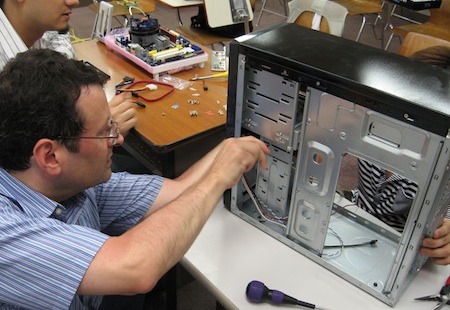
Cmc01At school this semester, we organized a Computer Making Club; the school gives any club a semester (4-month) budget of ¥50,000, enough to buy all the components for a decent-mid-range computer. Before we did this, I had always wanted to do this kind of thing, but never got around to it. In part, I figured there would be technical hurdles that would involve a great deal of study, and so put it off until I had time to dive into it. As it turns out, it was not all that difficult to put together– the process is pretty simple, though getting to understand the minutiae about parts is much more involved. I should say that if you know nothing about computers, and especially if you have a phobia about them, you’ll probably have to overcome a bit of a steep learning curve. It helps to know something about computer hardware in general beforehand.

Not that I’m suddenly an expert or anything, but fresh from having successfully slapped together my first PC, I’m beginning to get hooked. I thought I might describe the process here–though admittedly, one of the reasons is so I can look back in a few years and laugh at how naive and uninformed I was. But we did build a PC without much hassle or intensive study, and it did work, so why not describe it here.

First off, you won’t need to solder anything; it will involve buying perhaps 10 or so different parts that you more or less plug together. They include:

The CPU (the “brain” of the computer)
The Motherboard (the computer’s foundation which everything else connects to)
RAM (the more you have, the more apps you can run)
A Case
A Hard Disk Drive (SSDs are also available, but still expensive)
An Optical Drive (unless you go Blu-ray, these are commonly cheap)
A Video Card (optional)
A Keyboard and Mouse (cheap)
A Monitor (you might want to go used on this unless you can spare it)

Once you have the parts, the process is fairly straightforward: install the CPU (with cooler) and RAM on the motherboard, and install the motherboard into the case. Then put the hard disk and optical drives into the appropriate bays. Add the video card if you have one. Connect all the power and data leads, tie the cables off so they don’t get in the way. Close the case, attach your peripherals (mouse, keyboard, monitor), and start up. If everything works, then restart with the OS disk in the optical drive, and install the OS. That’s pretty much it in a nutshell.

Sounds easy, right? Well, in principle, it can be, but maybe we were lucky: nothing went wrong. If the computer doesn’t work, however, then I imagine it’s time to start studying. And though nothing went wrong, we did hit bumps in the road where we spent an hour or two trying to figure our way through a few things–mostly for the classic shortcoming in the world of computers, namely insufficient documentation. However, we did have the advantage of having people with knowledge and experience enough to figure some stuff out and make the right decisions, though none of us were anywhere near expert at this.

While you likely won’t have to learn the intricacies of the BIOS, and you won’t need to solder or really make anything, there is one thing you should do: familiarize yourself with the parts. Know what they do, and understand the different varieties and categories involved.


Cmc Cpu01The first thing you’ll want to do is decide which CPU you want to use. You could start with the motherboard, and who knows, maybe that’s the smarter choice, but frankly I see the CPU as being a better starting place. It is important to realize that the two must fit: different CPUs have different configurations, and can only fit into certain sockets on motherboards. You cannot just plug any CPU into any motherboard.

There are about half a dozen different common socket configurations, based on how many pins/contacts are on the bottom of the CPU, and how they’re laid out. Intel and AMD are the two big makers, and there are 3 or 4 configurations for each; Intel has the LGA775, LGA1156, and the LGA1366, for instance. The LGA775, as an example, is an older type which supports most currently available Intel CPUs including the later Pentiums and Celerons, and the Core 2 CPU line.

Both Intel and AMD make lots of different CPU models. In this post, I’ll just focus on Intel’s, as they tend to be more popular (and adding AMD’s line to the mix would complicate things). Let me give a quick list of major Intel CPUs, ranked very roughly in terms of speed and age:

Celeron
Pentium 4
Celeron D
Pentium D
Core 2 Duo
Core 2 Extreme
Core 2 Quad
Core i3
Core i5
Core i7
Xeon

If that’s not bad enough, each one can have dozens of different sub-models. The i5, for example, has the 400, 500, 600, and 700 series, with at least half a dozen different CPUs in all. The Core 2 line includes well over a hundred different CPU models released over the past five years.

Each chip has different features, and it can be difficult to figure out which is faster than which–primarily because speed is determined by a variety of features, including the number of processing cores, the amount of cache (on-chip memory storage), the processor speed (in GHz), and the processor architecture in general. You might think that a 6-core AMD Phenom II at 3.2 GHz would outperform a 4-core Intel i5 at 2.66 GHz, but not really. The page I just linked to allows you to see comparative benchmarks, and so get a better idea of what outperforms what.

Fortunately, your choice is simplified by a few factors. First, the Celerons and Pentiums are outdated; fine if you want to buy cheap, used parts and don’t care much about performance, but otherwise forget it. On the other end, chips like the i7 and the Xeon can be costly; unless you’re building a speed demon and price is not an issue, you’ll likely stay away from those as well. For someone with a budget, the Core 2 Duo, Core 2 Quad, i3, or i5 are probably your best bets. After that, look for what’s available in the your price range, and you’ll find you have a much shorter list to choose from. While some chips are much faster than others, CPUs in a similar range will have only minor differences in speed–so you probably shouldn’t fret too much over which is faster unless you’re trying to squeeze every last drop of speed from your system.

If you want to make a computer for less than ¥50,000, for example, the Core 2 Duo might suit best; for less than ¥70,000, the Core i5 would be nice. (I am figuring prices based on mostly new parts and including a video card.) If you want to make a super-cheap computer, then you’re in Celeron and Pentium range, and it starts making more sense to look at used parts.
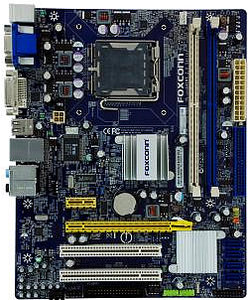
Fcg41Next, the motherboard.

If you go for the Core 2 Duo, like we did (budget concerns), you will need a motherboard with an LGA775 socket. They generally begin at just under ¥5000, and go way up from there. The model we got–a Foxconn G41MX-K–has an OK set of features. It uses the G41 chipset (a chipset is, as it sounds, a set of chips used as a group on a motherboard to control its main functions), not great but respectable; it has a standard PCI slot set (PCI slots allow you to plug in extensions like video cards to improve performance; a PCI Express x16 is something you’ll want to have); and it uses DDR2 RAM (a type of memory; a newer type, DDR3, is newer and better, but not compatible).

Though your CPU will determine the socket type, you should also decide early on which motherboard form factor you want. The main types are based on ATX, the favorite for DIY computer building. The variants include (from largest to smallest) Extended ATX, standard ATX, and MicroATX. Also available is MiniITX, a low-power motherboard form. If you want to have a smaller CPU box, then MicroATX may suit you best. That and the standard ATX seem to be the most prevalent.

The motherboard also has most of the computer’s cable ports built in to its side (in the image above, see the left side near the top); ours had the standard legacy PS2 and Serial ports (for old mice & keyboards), 4 USB-2 ports, a network port, 8-channel sound, and 2 video out ports (one classic analog VGA and one newer digital DVI). More ports can be added in other ways–for example, most cases come with built-in USB ports in the front, which attach directly to the motherboard via interior cables.

We didn’t need HDMI because that would be available on the video card. FireWire is nice, but is being phased out due to USB’s dominance. USB-3 is dandy, but only needed if you have super-fast equipment.

Again, pricing narrows down your options–if you are on a budget, then the dizzying array of choices is made a bit more simple. Our choices were shaved down to maybe a dozen or so as we wanted to stay within ¥5,500.
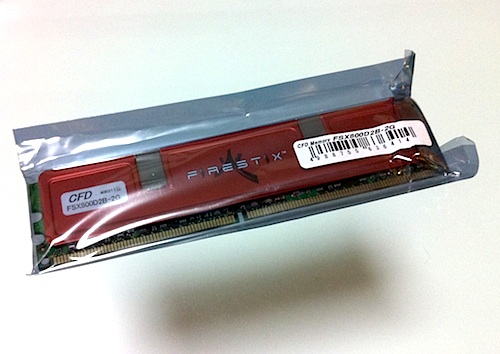
Cmc Ram01After that, you get RAM. 2GB is generally enough for most purposes today, but I prefer maxing out as the budget allows. We went for 4GB of RAM, which will help the machine be viable for a year or two longer. An important point is how many slots there are for RAM on the motherboard; ours had 2 slots (some have 4 or more), and so we had to get 2 RAM chips at 2GB each. Fortunately, the pricing was not any more per GB that way, though 4GB chips start getting pricey. We got two 2GB chips for about ¥8000.


These three elements–CPU, Motherboard, and RAM–make up the heart of the computer, and were the most expensive parts (roughly half of our ¥46,000 hardware budget).

Before working with them, you should have prepared a non-conductive workplace. We used a cheap plastic dish rack lined with bubble wrap, though you might want to prepare something a tad fancier. Be careful handling surfaces and contacts; it’s best to have an antistatic wrist strap to avoid static shocks which could damage the components.

Installing the CPU on the motherboard is relatively easy: open the clamp on the socket, remove the protective shield, drop the CPU into the socket, then clamp down again. Simple.

Sp522S7-1However, most CPUs require cooling units, big ‘ol heat radiators with fans. We bought our CPU used (a Core 2 Duo E7400) for ¥8000, thinking we were saving money–before finding out that new CPUs came with cooling fans, and ours didn’t, so we had to spend another ¥2000 and didn’t save any money.

Installing the CPU cooler was a real bear. First, you must not forget to apply conductive grease to the base of the cooler after making sure the contact surfaces are clean. Without the grease (or “thermal compound”) your CPU will overheat and die. It usually comes supplied with the CPU cooler. Probably a good idea to not let it come into contact with your skin.

There were 4 legs or struts that involved pushing down and twisting so they locked. There’s probably a trick to doing that, but we sure couldn’t figure it out. The first two were easy; the third took a while, and the last one almost killed us. Once the cooler is in place, you have to plug in its power connector; these things are diagrammed out on the motherboard instructions for you.

RAM, on the hand, is a cinch. Make sure it is oriented the right way, then just push down into the slot until it locks. Presto.

There’s the heart of your computer, right there.

In a following post, I’ll talk about choosing a case and power supply, and installing the motherboard into it, then adding the HDD and Optical drive. Fortunately, these are somewhat easier to learn about.

Categories: Computers and the Internet Tags:

It’s Not About Religion, It’s Not About 9/11; It’s About Politics

August 1st, 2010 4 comments

A few days ago, I posted about the “mosque” being built “at” Ground Zero–actually, it’s a community center, and there’s a multi-faith chapel and prayer area, not a mosque, and it’s not on the WTC site, but rather two or three blocks away… but hey, when it’s an election year and you’re trying to make people mad, these things don’t matter. What’s more, as came out in the discussion, the group that wants to put up the center is one that has condemned the 9/11 attack and terrorism in general “in the most unequivocal terms,” and plans a memorial for the 9/11 victims in the center. The Imam heading the initiative, a Sufi Muslim, has worked together with Israelis to promote peace between the nations, and has jointly proclaimed with them for both Palestinians and Jews “to live with freedom, security, dignity, respect, and self-determination.” So this is no radical organization, not a group raising funds for terrorists or smearing Jews, but a progressive, peaceful organization trying to mend relations, build awareness, and bring Muslims and others to a reasonable, respectful, and peaceful place.

And yet, look at what controversy has been brought. Now, this probably would not have been such a big deal were it not for people like Sarah Palin and Newt Gingrich seeing a fantastic red-herring issue intended not to legitimately address grievances or to right wrongs, but instead to inflame (and defame) so as to rally political strength to their campaigns. Without the politicians using this as a prop to get media attention, there would have been a few protests from the families of the 9/11 victims, a few people from the community raising a fuss, but it would have stopped there, the protests drowned out by others pointing out that the group is far from objectionable, the project is positive and constructive by nature, and religious freedoms should be observed and no one group be unfairly maligned or hindered.

But this is a critical election year, and the temptation of making hay by distorting the facts and playing on people’s fears and indignation is just too great.

One interesting perspective is to imagine it having happened a different way: what if Obama himself had announced support for this project? As far as I can tell, he’s stayed a mile away from the issue, and for good reason: the right-wing has made the “Obama is a Muslim who wants to attack Christianity and destroy America” one of its prominent memes; Obama announcing public support for the center near Ground Zero would be like Christmas and Easter wrapped up in an orgasm for these people.

Imagine what the reaction would be if, now that Obama is president, the Pentagon started building Islamic prayer centers just like the one that they’re proposing near Ground Zero? The Pentagon, itself a victim of 9/11! Forced to build mosques!! Whoo boy! That would set off a firestorm of protest! There would be no end to the indignation, the claims that Obama is anti-Christian, the calls for impeachment, cries that anyone who would be insensitive and anti-American enough to build mosques at U.S. military installations must be a traitor of the worst stripe!!! The media would jump right on the bandwagon, “reasonably” asking questions like, “Is it really appropriate for the president to do something like this? Is he not sensitive to the feelings of the families of the victims as well as Americans everywhere? Should we be spreading Islamic fervor within the ranks of our own military?”

What if, on top of that, President Barack Hussein Obama hosted an Iftar, and Muslim celebration of Ramadan, within the White House itself? Everyone would go insane!!!

Well, if you know me, then you can probably see where I’m going with this. In 2006, five years after 9/11, The Pentagon started building Islamic prayer rooms. A few right-wing bloggers got their panties in a bunch, but no one else much minded or even noticed. And Bush hosted Iftars more than once. Bush was not branded a traitor, no brouhaha, the world didn’t end.

What this shows is that this is mostly about politics, mostly about smears and attacks and defamation and using our emotions, our fears and sensitivities against what is reasonable and for what is wrong with politics today.

One last thought: Jonathan Chait at The New Republic makes an interesting point: did you feel that it was proper to allow Salman Rushdie to publish The Satanic Verses, or for a Danish newspaper to publish a cartoon of Muhammad? You see the relation to this–freedoms of religion, action, and speech versus the sensitivities of those who may be offended.

Categories: Political Game-Playing, Religion Tags: