Archive

Archive for June, 2011

Some People Sharing Information = No Right to Privacy

June 30th, 2011 Comments off

In February of this year, Congress introduced new legislation (PDFs here and here) which would allow Internet users to opt out of being tracked by online entities. This usually takes the form of the infamous browser cookies; while you have the ability to view them in your browser, there are typically so many of them that it would be far too cumbersome to sift through the list; deleting them all would mean losing the few which are truly useful, remembering passwords and other key data on sites where you want them to be remembered. What’s more, some cookies are even inaccessible, such as Flash cookies, making it difficult to know who is tracking you and what data they are collecting, even if you could waste the time to track it anyway. The end result is, most people give up and allow themselves, either reluctantly or unknowingly, to be tracked.

The new legislation would prohibit that, requiring an easy online mechanism to opt out of such tracking. The major browsers have included features allowing users to block such tracking, though it falls short of the legislation.

Predictably, business groups hate the legislation; if they can’t track your private information, how can they spam you efficiently enough to offer free crap?

Some Republicans, like Senator Patrick Toomey of Pennsylvania, are predictably taking industry’s side over that of consumers, claiming that such a mechanism would “break the Internet.” But the justification of invading people’s privacy is the real prize-taker:

“In a world where millions of people voluntarily share very personal information on websites like Facebook and Twitter on a daily basis, I’m not sure exactly what consumer expectations are when it comes to privacy, but I am pretty sure different consumers have different expectations.”

So, because some people choose to share personal information on social networking sites, no one has a reasonable expectation of privacy. That smacks of the mindset which justifies rape if a woman dresses provocatively. Even if everyone shared personal information in such forums, it would not justify the invasion of their privacy in forms they do not approve of. Stalkers cannot justify their actions by saying their victims talked about private details in a coffee shop in a voice loud enough for others to overhear.

Not to mention that Toomey’s point about “different expectations of privacy” is exactly why we should have such an opt-out–so we can be sure that consumer expectations are being met. Suggesting that no one should have privacy because some people might not want it is, frankly, idiotic.

Categories: Computers and the Internet Tags:

A Japanese Funeral

June 29th, 2011 8 comments

Last week, my wife’s father, Junzo, passed away after a long illness. We got the call late Thursday, and so headed up to Nagano on the weekend. We decided to rent a car, as there would be driving around to do, and family members would not likely be available often to cart us around. We drove up Saturday morning, hoping to get there by 1:00 pm so Sachi could spend time preparing for what her role would be. However, as soon as we got on the expressway, we discovered that the last three segments of the road to Saku, Sachi’s hometown, were jammed to a standstill because of at least one accident in the tunnels which make up most of the way at that section of the expressway.

As a result, we got off the expressway early, at an interchange called Shimo-Nita (known for its konnyaku and negi), and took the local roads through the mountains and into the Saku valley. We wound up not losing much time after all, arriving at just past 1:30. We even decided to take this way next time as it is somewhat more pleasant.

For funerals and the time leading up to them, everyone dresses according to custom–all in black. Women wear simple black dresses (or, for the ceremony later, black kimono), with basic pearl strands; girls of high school age or younger wear their school uniforms, as Junzo’s youngest granddaughter did. Men wear black suits with white shirts and plain black ties. At the entrance of the home, two large white lanterns are hung on either side; by coincidence, we noted another house just a short way down the street also had these lanterns, indicating that they too had lost someone.

By this time, Junzo’s body was laid out in Sachi’s brother’s living room. (The eldest son is usually the one to take on family responsibilities, and is supposed to stay with the body until it is cremated.) Dressed in a plain kimono, Junzo was laid out on a futon, covered with a white blanket with iridescent white patterning, with a white handkerchief covering his face. A knife in a purple cloth scabbard rested on his chest. Squarish pillows were on either side of his head to keep it straight. As is usual in Japan, the body was not embalmed; the body is preserved with dry ice, though one never sees it or the mist one might expect. To one side, there was a large photo of Junzo in health, with white and black bunting.

Visitors would come to a floor pillow next to the body and pray for a moment. Behind Junzo’s head was a small table with food offerings (including the traditional bowl full of rice with the chopsticks standing straight up), a candle, and a pot of incense. The visitor would take a stick of incense, light it with the candle, and then place the incense stick in the pot. Each visitor could, if they chose, remove the handkerchief and see his face.

The body stayed there throughout that day and into the next, while the family held meals and went about other activities. Family members, neighbors, friends and others would come to pay respects. I found it a little odd at times to be, for example, eating dinner, with everyone chatting away, and–oh yeah, there’s Junzo’s body on the other side of the room.

That evening, a vigil (otsuya) was held. A Buddhist priest came, and with most family members in attendance, sitting behind him, he knelt before the body and chanted–what Sachi referred to as “Namu namu namu,” denoting the specialized speech used, called o-kyou, which many Japanese themselves mostly cannot understand. As this was taking place, a special incense box was passed around; it contained a burning coal and a side tray of incense crumbs; you were to take a pinch of incense, hold it to your forehead, and then drop it on the coals. This is called o-shoukou. After he finished, everyone visited the body again, praying and burning more incense.

Afterwards, we had dinner, with the priest staying to join us. There were no special ceremonies, we just ate and talked. Afterwards, Sachi and I returned to our inn (ryoukan), and slept.

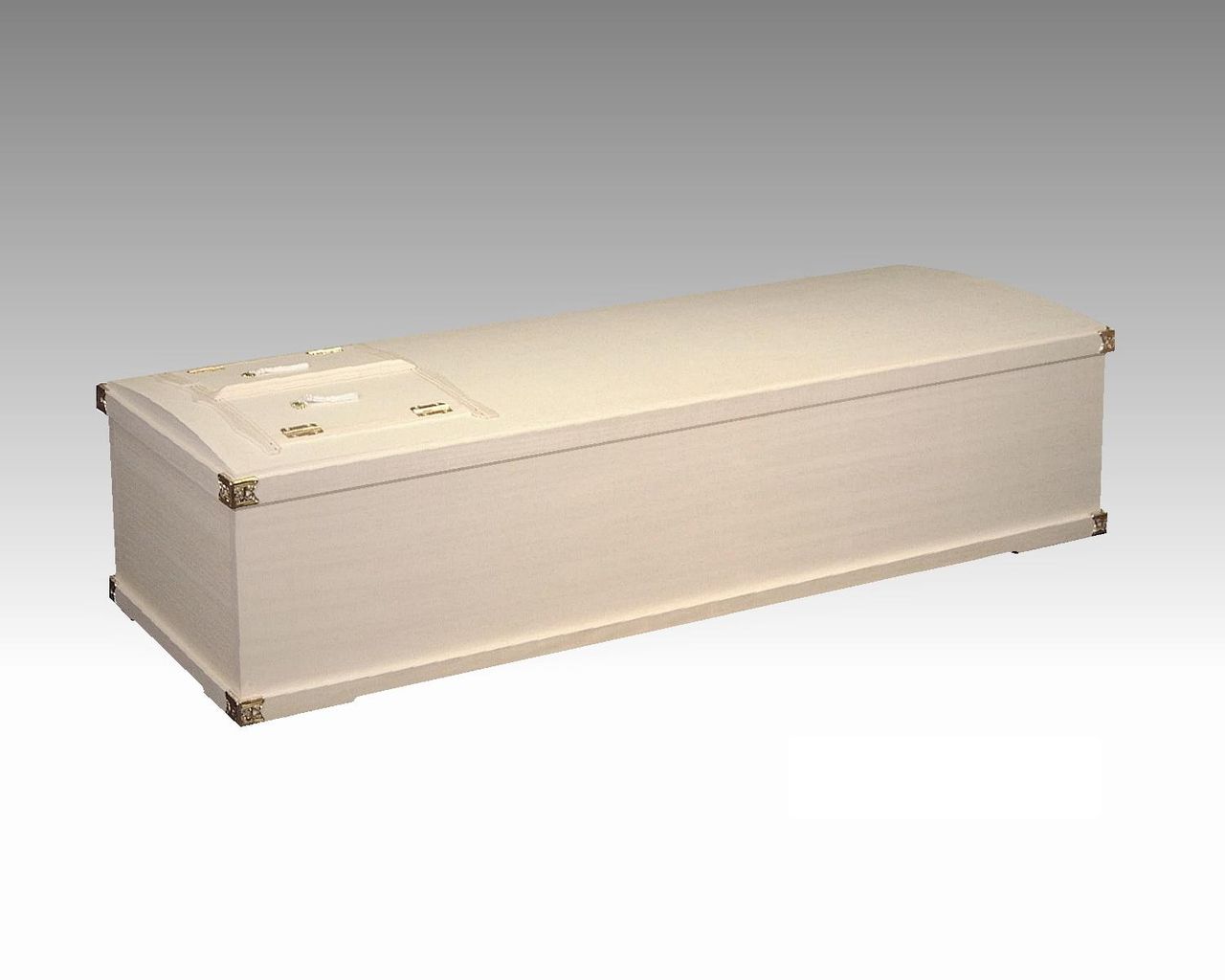
We woke up the next day, and everyone arrived for moving the body to the casket. A man who I figured was the coordinator for the funeral brought a straight (rectangular), narrow wooden casket lined with white silk; it was placed on the floor, sitting on small footstools, beyond Junzo’s now uncovered body. The coordinator waited for everyone to get arranged, and to tie rice-reed ropes (not too dissimilar to what is used at Shinto shrines) around their waists, the stiff strands pointing up and down to indicated heaven and earth.

Then the coordinator brought out a green and purple silk kimono (colors chosen due to Junzo’s preferences), and proceeded to dress Junzo in it. He then placed white cloth coverings over Junzo’s hands and ankles, and slippers on his feet, leaving at least eight cloth strings for family members to then come forward and tie closed. Male family members, myself included, were then asked to come forward and take part of the edge of the top two sheets Junzo rested upon, lift the body up, and place it in the casket. This whole step is called the noukan. The coordinator then covered the body with the blanket used previously, made sure everything was in place, and asked family members to add straw zori sandals and a walking stick to the casket. A box of flowers and petals was then unwrapped, and we were called upon to place these around Junzo’s head until it seemed to float in a pool of color.

The casket was then covered; the top was not on hinges, but was a separate piece, rounded, with small hinged doors above the head. The coordinator hammered four nails almost all the way in at each corner; two rectangular green stones were then given to family members, each of whom used their left hand to tap one of the nails twice. After this, the eldest son was asked to finish hammering in the nails. A white netting was fitted around the casket, and a silk covering around that, both with openings for the doors above Junzo’s head.

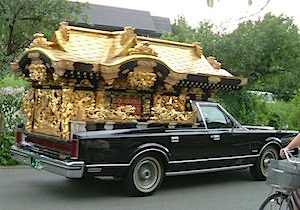
JhearseAt this point, male family members were asked to help move the casket to the hearse. The one used for this funeral was western in style, though often a Japanese hearse will have an ornate golden top (see Wikipedia image at right); I saw one as we returned from the crematorium. We all then removed the rope belts and got into cars for the procession. Family members carried items such as the oversized photo with us. When we were ready, the hearse let out a loud, long blow of its horn (not a standard car horn), and took off for the crematorium, all of us following.

The crematorium was in the hills not too far to the south. A beautiful place, I hope to go back there some day to do birdwatching. We collected in a room with two doors leading to ovens, where a metal cart on hydraulics (still radiating heat from the previous cremation) sat waiting. On the other side of the room, Junzo’s photo was placed, and again, incense was lit by all. We were asked to carry in the casket and place it on the cart. The doors above Junzo’s head were opened, so everyone could pay final respects. The casket’s coverings were removed, and the cart was moved into the cremation furnace. The doors were closed and the furnace lit.

The family was then told to wait in one of the buildings nearby, equipped with kitchens and toilets, but mostly common tatami rooms with low tables to sit around. It would be an hour and a half before things would be ready, we were told. We ate snacks and drank juice (saké for those not driving and who wished it), and some of us took walks. I almost wished I had brought my camera with the zoom lens–I know there were some birds I had never seen before.

After the time was up, we were called back in. The cart had already been pulled out, and most of the matter was gone–but a fair number of bone fragments remained, including ribs, vertebrae, recognizable ends of femurs and other parts. They were burned dry, light, and brittle, fragmented but some as much as six inches long. As the family stood and watched, an attendant used a large metal dustpan to collect the bone fragments with a brush, leaving behind remains of the casket. He deposited what he found on a larger metal tray, with the bones from the head in a special part of the tray.

The tray was moved to a part of the room near the shrine with Junzo’s picture, and several sets of rough, oversized bamboo ‘chopsticks’ were handed out. Each family member was called upon to use these to place pieces of bone (not pieces from the head) into a plain white urn. At first, primary family members were asked to do so left-handed; then we came in pairs, using our right hands, two people working together to move individual pieces into the urn. Then primary family members worked to move most of the remaining pieces in, including the dust, which was sifted out by the attendant. This left the pieces of bone from Junzo’s head, which were saved for last–you don’t want them to be in the urn the wrong way up.

The attendant used a stick to compact the bones already in the urn (making slightly uncomfortable crunching sounds), and then the bone fragments from the skull and jaw were added, and the urn closed. The urn was placed in a decorated box. Sachi’s brother was outfitted with a sling which wrapped around his neck, in which the box with the urn was fitted. It was at this point that I teared up more than any other–not just remembering Junzo, but realizing that, if Sachi gets her wish and passes before I do, then I would be doing this for her someday.

Sachi’s brother then walked to the head car with his mother and his wife, as we took the photograph and other mementos with us in the motorcade back home. The urn was placed in the living room where the body had been kept, and we had a light lunch.

Afterwards, we all got in cars again and went to a temple for the actual funeral ceremony. We arrived at the temple and waited for everything to be arranged. Junzo’s remains, along with his photo, were placed upon a dais with other accoutrements, and eventually, we all sat arrayed to one side on strips of thick, bright-red felt carpet while visitors were received. Up until this point, it was a purely family affair. But now, friends, colleagues, neighbors, and other people related to Junzo and/or the family came to pay respects. Each of them made an offering of incense, of the type in the box with the burning coal.

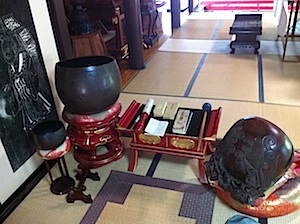
After they had all left, chairs made for tatami rooms were brought out, and we sat through the formal ceremony. The chief priest came out, with his assistant–the same one who had visited the house the night before–sitting on the side at a low desk with metal bowls and a drum along with other devices. The chief priest sat on a low chair atop a floor cushion before the altar with Junzo’s remains, and began chanting. He did so alone at first, but eventually was echoed by or chanted in unison with his assistant. The assistant also made use of the instruments–sometimes the drum, sometimes banging one of two metal pots for a bell sound (one low, the other high), and a hand-held bell on a handle which he would tap slowly and then quickly in three sets of ringing.

Temple01
Templemeal

As the chanting went on, at two different points we were asked by the coordinator to stand, and come forth in line to offer the coal-top incense behind the main priest. Finally, after about a half hour, the chanting ended, as did the ceremony.

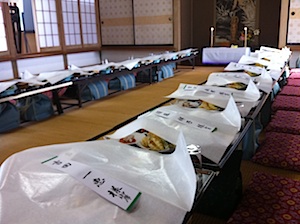
After this, we moved to a dining room with an altar and two rows of low tables. All the meals, previously prepared, lay under white sheets with names written on paper strips atop them. They mixed up my given and family names, so that Sachi’s name was given as “Luis Sachiko.” All but the primary family members were given gift bags, similar to a wedding; the bags, I discovered later, held a small bottle of saké, a rice dish, bean-paste snacks, and a set of towels, along with a card with a small package of tea.

The meals were quite elaborate–grilled fish, meat pâté, sushi and sashimi, tempura, various soups and egg pudding, fruits and so on–maybe as many as two dozen small dishes, common in style but much better quality than fancy inn-style dinners in Japan. There were a few speeches, including one by the head priest, and we all sat down to eat.

After this, I had to get back to Tokyo to catch up on long-delayed work, but after I left, the family took the remains up to the family grave site and placed his remains with all that had gone before him. Before I came home, Sachi called and made sure that, upon entering, I would take a pinch of salt from one of the bowls she had prepared on either side of the door, and throw some on each shoulder and then the top of my head before brushing it off–what you must do before returning to any home after you have attended a funeral.

Thankfully, these two days happened to give a break in the oppressive summer heat; no rain fell during the day, and it was sometimes cloudy, but otherwise relatively cool.

It was quite an experience, and more than most non-Japanese experience unless they are members of Japanese families. While some parts of it were strange to a westerner (like having the body laid out in the living room, or picking out bones of a person I not only knew but to whose body I had shortly before said goodbye), I thought that it was a fairly good way of doing things. In the west, we tend to distance ourselves from death too much, and so fear it perhaps disproportionately. In Japan, from a young age, people are not shielded from this; proximity and contact with the body and its remains seems a sensible thing to expose young people to–though that might just be me.

Categories: Focus on Japan, Focus on Japan 2011 Tags:

It’s Hard to Be Forward-Looking When You’re Always Moving Backwards

June 28th, 2011 2 comments

David Frum, on CNN, explains why conservatives now approve of gay marriage more–but in so doing, also lays out how conservatives, who are almost always wrong on social issues, can slowly migrate to more reasonable positions:

Most conservatives have reacted with calm — if not outright approval — to New York’s dramatic decision.

Why? The short answer is that the case against same-sex marriage has been tested against reality. The case has not passed its test.

Since 1997, same-sex marriage has evolved from talk to fact. If people like me had been right, we should have seen the American family become radically more unstable over the subsequent decade and a half.

Instead — while American family stability has continued to deteriorate — it has deteriorated much more slowly than it did in the 1970s and 1980s before same-sex marriage was ever seriously thought of.

In short, conservatives thought that gay marriage would wreck the tradition of marriage, and when it didn’t, many of them can see that now, so they’re no longer afraid of it. (Ah, if only that were always true of how conservatives see things!) This doesn’t change the fact that conservatives tend to rail against most social progress and have to be dragged, kicking and screaming, into seeing reason. I’d like to hear Frum’s conservative rationale on why they didn’t simply begin from the assumption that gays could have equal rights.

Of course, we liberals could have told them that gay marriage was not a threat from the start–the arguments that gays would destroy marriage were patently ridiculous, and frankly, even a fool could have seen that (see my rant about that from eight years ago). But I suppose that if your church and your entire political fraternity are shouting at you that it’s going to send everything to hell in a handbasket, it might be hard to ignore.

There are still holdouts, people who refuse to join the rest of the crowd. People like Newt Gingrich, for example, still disapprove, but there are signs of change even there–Gingrich, a twice-divorced adulterer, is now saying that gay marriage “muddles” the institution, which I suppose is an improvement over “destroying” or “threatening.”

The thing is, gay marriage is not the only thing that many conservatives have “come around” on. In fact, conservatism, by definition, is about opposing progress and clinging to the past–and that, in social terms, means that if you are conservative, then you are almost always backwards on social issues. Conservatives hold assiduously onto what has been, usually relinquishing their embrace of the past only when it is indeed past.

In the American Revolution, the conservatives were the Loyalists, who wanted to remain subjects of England. Such people were older, wealthy, established land-owners who had sentimental attachments to their British past. It was only after the war was won that conservatives decided that independence was a dandy idea. In the Civil War, the slave-owners were the conservatives, wishing to maintain the traditions of the past, fighting against the newer wave of abolitionism, and resentful of the controlling government that wanted to tell them what was right and wrong, especially that they could not keep their slaves. Only years after the war did conservatives revile slavery. In the battle over women’s suffrage, conservatives opposed; in the battle over civil rights for minorities, conservatives opposed; in the battle over gay rights, conservatives have and many still do oppose. There is a lag there, from the settling of an issue to conservative acceptance of it. If it’s not in the past, it tastes wrong to them.

Now, regarding most of this history, conservatives will tell you otherwise–that conservatives were all for the revolution, because they wanted to preserve traditional rights for the people; while this may have been true for some, it does not change the fact that on the whole, the opposition to the revolution was predominantly conservative in nature. Right-wingers love to point out that Lincoln founded the Republican Party–but ignore the fact that “Republican” and “Democrat” are political, not ideological affiliations, and have shifted over time. Lincoln was not a conservative in his day. But conservatives take credit for freeing the slaves nonetheless–despite the fact that the party affiliation is about as relevant and meaningful to that as is facial hair or top hats.

Again, when it comes to the battle for civil rights, conservatives love to point out that the South was controlled by Democrats at the time, and therefore it was liberals who opposed equal rights for minorities–a patent falsehood, and again a blurring of lines due to politics. The South was deeply conservative, and it was, in fact, the support of civil rights by the Democrats that helped drive these conservatives into the open arms of the Republican Party.

I have little doubt that, in fifty years or so, conservatives will be proudly boasting about how they supported gay rights all along, and it was liberals who somehow opposed them–they’ll probably bring up Log Cabin Republicans and Clinton instituting DADT as examples of proof. They do love to rewrite history with them always being right.

The tide of history, however, shows that almost always, the reverse is true. Conservatives have and probably always will be on the wrong side of history when it comes to social issues, something that comes part and parcel with trying to move backward instead of forward.

Frum simply laid down one cogent theory as to how the evolution sometimes occurs, in the more peaceful of cases, and with the more reasonable of social conservatives. Unfortunately, it does not apply universally and certainly not immediately, else conservatives would be a lot more reasonable on a whole host of other issues. It’s only after they have fought hard and long and have lost, and then after a decade or so of whining and protesting and foretelling doom, that they look around, see how stupid they look, and start claiming that they were with the “in” crowd from the start.

Categories: Right-Wing Hypocrisy Tags:

Pushing the Lie, Again

June 25th, 2011 1 comment

Republicans are revisiting death panels, saying that characterization didn’t go far enough:

Democrats like to picture us as pushing grandmother over the cliff or throwing someone under the bus. In either one of those scenarios, at least the senior has a chance to survive. But under this IPAB [Independent Payment Advisory Board] we described that the Democrats put in “Obamacare,” where a bunch of bureaucrats decide whether you get care, such as continuing on dialysis or cancer chemotherapy, I guarantee you when you withdraw that the patient is going to die. It’s rationing.

— Rep. Phil Gingrey (R-Ga.), June 22, 2011

Number one: Given the false choice, would you rather have your medical funding decided by bureaucrats, who at least might possibly be under the impression that you pay their salary and so they work for you, or by private insurance company lawyers who are paid specifically to deny you any medical treatment they can possibly arrange?

Number two: this kind of “bureaucratic rationing” already occurs under Medicare. I had no idea all of them were doomed to die. Well, eventually–but then, so are we all, no matter what. But I am pretty sure that’s not what people like Gingrey mean. Programs like Medicare demonstrate that when the state controls the system, it is less likely to deny treatments. Private corporations have shown they are more than willing to do so if there’s a buck in it. And if cuts are necessary, plans like the Affordable Care Act will consult doctors, not bureaucrats. Oh, and the ARA allows you to choose between systems, where government-run care would only survive if it did a better job treating you.

Number three: rationing occurs when there is less money to be spent. With private firms skimming as much as 30% off the top, and programs like Medicare being much more efficient than private-sector programs, government-run programs will not have to ration nearly as much as is happening now.

Number four: unless they are sabotaged from within by Republicans, programs like the Affordable Care Act will end up saving us a lot of money. The problem: we’d pay out in taxes more than fees. And Americans hate taxes so much, they’d rather pay a $100 fee than a $50 tax. Just like they fear bureaucrats more than they fear corporate lawyers. I think it’s kind of how people fear terrorist attacks more than traffic accidents, or shark attacks more than crossing the street. We fear what we are told to fear.

We Got This One, At Least

June 24th, 2011 Comments off

Governor Perdue of North Carolina vetoed a Republican bill aimed at disenfranchising Democratic voters:

The right to choose our leaders is among the most precious freedoms we have – both as Americans and North Carolinians. North Carolinians who are eligible to vote have a constitutionally guaranteed right to cast their ballots, and no one should put up obstacles to citizens exercising that right.

We must always be vigilant in protecting the integrity of our elections. But requiring every voter to present a government-issued photo ID is not the way to do it. This bill, as written, will unnecessarily and unfairly disenfranchise many eligible and legitimate voters. The legislature should pass a less extreme bill that allows for other forms of identification, such as those permitted under federal law.

There was a time in North Carolina history when the right to vote was enjoyed only by some citizens rather than by all. That time is past, and we should not revisit it.

Therefore, I veto this bill.

The veto will, thankfully, probably not be overridden. However, it should be noted that Governor Perdue is a Democrat; it would have been much more encouraging had a Republican demonstrated the moral virtue of striking down a bill by his or her own party aimed at illegitimately stripping Americans of the right to vote based on political affiliation.

Sadly, that is not likely, and in many states where the legislature and the governorship are both held by Republicans, it is almost certain that such laws, passed by legislators eager to violate the civil rights of those who would not vote for them, will be happily signed by governors of similar moral depravity.

It should also be noted that for these laws to pass in the first place, almost the entire Republican bloc must vote in unison–demonstrating how very little moral courage exists among the individual members of the right wing of our legislatures.

Getting a Clear Picture

June 24th, 2011 1 comment

It’s pretty difficult to get a completely accurate read on how bad things are after the Fukushima reactor. A great deal of this is due to news stories which focus on sensationalism without actually checking the facts.

Take a recent Al Jazeera story, titled “Fukushima: It’s much worse than you think.” Much of the story may or may not be true, but take this nugget:

In the US, physician Janette Sherman MD and epidemiologist Joseph Mangano published an essay shedding light on a 35 per cent spike in infant mortality in northwest cities that occurred after the Fukushima meltdown, and may well be the result of fallout from the stricken nuclear plant.

The eight cities included in the report are San Jose, Berkeley, San Francisco, Sacramento, Santa Cruz, Portland, Seattle, and Boise, and the time frame of the report included the ten weeks immediately following the disaster.

“There is and should be concern about younger people being exposed, and the Japanese government will be giving out radiation monitors to children,” Dr MV Ramana, a physicist with the Programme on Science and Global Security at Princeton University who specialises in issues of nuclear safety, told Al Jazeera.

Sounds pretty striking. However, when you actually think about it, it also sounds completely bogus. Radiation levels along the west coast of the U.S. barely showed any trace of radioactivity from Japan, and what was found was insignificant in the context of background radiation. For this to result in a 35% spike in infant mortality sounds rather ludicrous, and should not pass anyone’s initial sniff test.

Sure enough, the data was found to be incorrect, if not fraudulent. The essay cherry-picked eight cities which made a writer for Scientific American “pick up a whiff of data fixing,” and the essay used only a four-week period prior to the Fukushima disaster to establish a baseline for infant mortality. Coincidentally, those four weeks showed strikingly low mortality rates, most likely a statistical blip–from the fifth week back, rates were considerably higher on average. When the Scientific American reviewer checked the data, even for just those eight cities, for the entire year, he found that infant mortality rates were actually declining throughout the year, not spiking sharply.

The ten weeks after Fukushima did see a few high numbers, but the four weeks previous were unusually low. The low numbers before Fukushima were not, of course, related to the incident, but were the primary reason a “spike” seemed to appear when only those four weeks were used as a baseline. One could just as easily compare the data for the month before those four weeks and see a similar “spike” occurring two months before Fukushima.

In short, the essay’s claims should never have been published. Sure, the media might not want to wait around for every study to be peer-reviewed, but if you don’t, then you are bound to release, as “news,” completely erroneous data as shown above. This only serves to put all the rest of the claims in the Al Jazeera article in question–what else was not fact-checked? Was the writer going for the sensationalist angle, only choosing to focus on evidence which supported a predetermined conclusion?

This is not to suggest that Fukushima isn’t worse than we think it is–it may well be a lot worse–but it suggests that not all the alarmist information, including that released by “experts,” is as accurate as we believe. That goes for data suggesting that things aren’t so bad as well.

Because the atmosphere regarding nuclear power, even within the halls of science, is so subject to polarized views and infected by bias, added to the fact that there is so much we just don’t know for certain about the subject of radioactivity and health, it is much harder to get a clear picture of how bad things really are.

Rewarding Sabotage

June 23rd, 2011 1 comment

From TPM:

They’ve made it explicit. Democrats are accusing Republicans of trying to sabotage the recovery — or at least stall it — by blocking all short-term measures to boost the economy, even ones they previously supported.

Ya think?

And this is news? It’s been happening since Obama took office. When most economists were saying that we needed boosts in infrastructure and other job- and value-creating spending, and that more tax cuts were the least stimulating, Republicans fought tooth and nail for less stimulus and more tax cuts. While the Dems, and especially Obama, have been far too conciliatory and indulgent with right-wing demands, they have worked in mostly the right direction for recovery (or at least a much better direction), and, were it not for the changes they allowed Republicans to wheedle them into making, we’d be in a lot better shape right now.

Much of it may just be Republicans favoring their more wealthy constituents or following the party line, opposing anything Obama and the Dems propose–but it does, in fact, have the overall effect of sabotaging any economic recovery.

Republicans have demonstrated, repeatedly, that they consider their own hold on power as a far higher priority than the health and welfare of the people and the country. Boehner said it clearly enough: “The single most important thing we want to achieve is for President Obama to be a one-term President.” The Republican leadership knows full well that a wrecked economy will hurt Obama and the Dems while they are in office, and that when Republicans take power back, the absence of them wrecking the economy can be played as them “saving” it. In the meantime, they are quite happy to threaten shutdowns and defaults and everything else that could make the economy tank, knowing that so long as Obama is in the White House, everything they do to trash the economy will be “his” fault.

The real tragic irony is that, in 2010, and probably again in 2012, the people, as a result of this purposeful slowing of the recovery, have rewarded and will likely reward those who harmed them the most.

Misinformed

June 23rd, 2011 Comments off

When Jon Stewart appeared on Chris Wallace’s Fox News show, he made the statement that Fox News viewers are the most consistently misinformed media viewers–which is likely correct–but then added a tag which he probably regretted, saying that this was proved “consistently, every poll.”

Politifact then gave Stewart a “False” rating on their Truth-O-Meter, pointing out that they are not the most consistently misinformed on every poll, pointing to polls which show the statement to be untrue. While Politifact is technically correct, their determination nonetheless gives an impression which is decidedly contrary to actual fact.

In the following video, Stewart both owns up to his own factual misstatement–and proves that, in his more general meaning, he was precisely correct, using Politifact’s ratings on Fox News’ statements as evidence:

I saw the Politifact story before the Stewart piece, and frankly, was disappointed. Yes, they were correct about Stewart being wrong; factually, it is not true that every poll shows Fox News viewers to be the most misinformed. However, the spirit of Stewart’s comment was, as he demonstrated in the bit, very much correct.

In fact, Politifact’s article itself is misleading.

Here’s why: in most of the polls about being informed, the status of “informed” with “high knowledge” is determined with questions like:

  • who is the vice president?
  • who is the president of Russia?
  • is the Chief Justice a conservative?
  • does the U.S. has a trade deficit?
  • which political party has a majority in the U.S. House of Representatives?
  • what is the name of the current U.S. Secretary of State?
  • who is the current prime minister of Great Britain?
  • which company is run by Steve Jobs?
  • which country has an active volcano that has recently disrupted international air travel?

Frankly, in the context of whether Fox News misinforms its viewers, these questions are meaningless. The charge is not that Fox misinforms its viewers about general facts, like who the vice president is, but politically charged facts, like whether the president wants to kill your grandmother.

This 2010 study (PDF), meanwhile, was discounted, because it contained determinations of truth that, while accurate, were challenged–by organizations like Fox News. Questions like:

Is it your impression that most economists who have studied it estimate that the stimulus has (a) saved or created several million jobs, (b) saved or created a few jobs, or (c) caused job losses.

That’s a perfectly legitimate question, but was challenged because, supposedly, it measured whether the respondent is a person “who agrees with the conclusions of experts in government agencies.” That criticism, however, is BS–the questions did not ask if the respondent agreed with the experts, but rather what the experts were saying. Which is a legitimate measurement of knowledge and misinformation.

Nevertheless, this was used to dismiss the results–even though this one survey was the only one that actually measured the political misinformation for which Fox News has become so infamous.

What Stewart should have said was that in a 2010 survey, one designed to measure political misinformation due to bias, Fox News viewers scored worst on almost every single point. The points Fox News viewers were the most misinformed on:

  • most economists estimate the stimulus caused job losses (12 points more likely)
  • most economists have estimated the health care law will worsen the deficit (31 points)
  • the economy is getting worse (26 points)
  • most scientists do not agree that climate change is occurring (30 points)
  • the stimulus legislation did not include any tax cuts (14 points)
  • their own income taxes have gone up (14 points)
  • the auto bailout only occurred under Obama (13 points)
  • when TARP came up for a vote most Republicans opposed it (12 points)
  • and that it is not clear that Obama was born in the United States (31 points)

Many of these points are legitimate for measuring viewer knowledge because they represent knowledge which is necessary to make wise, informed judgments on which policies and politicians are most likely to benefit the country at large; all points measure whether viewers have been swayed by political attacks driven by raw bias.

I think it’s safe to say that, yes, Fox News viewers are, if not the most misinformed, consistently, then they are pretty damned misinformed.

Categories: "Liberal" Media, Right-Wing Lies Tags:

What It Isn’t Good For

June 19th, 2011 1 comment

One thing that has kind of mystified me is why so many, including liberals, seem to be equating the Libyan intervention with the Iraq War. “We’re now at war with five countries,” I hear. Well, if you want to take the greatest liberty in stretching the definition, I suppose so–if being involved in bombing is equal to being at war, then perhaps so. But what we’re doing in Libya is about as far from what we’re doing in Iraq as one can imagine.

This also serves to make a more recent distinction between recent Democratic and Republican wars: Clinton and Obama have limited their wars strategically, intervening where it is both potentially stabilizing as well as humanitarian, but doing so in a relatively risk-free and hands-off manner, using mostly bombing and other forms of support. The last two Republicans, Bush junior and senior, engaged in rather dramatic, major land wars in Asia.

The initial Gulf War was a “good” war, in that it was carried out well and was to good purpose–the flaw was that it was unnecessary, had Bush 41 only paid a bit more attention to whom he was dealing with. The war in Afghanistan again was a “good” war, in that it was something we all agreed was necessary–but again, had Bush 43 only paid a bit more attention, 9/11 would have been foiled and the war would not have been necessary. However, unlike his father, Bush 43 tanked his “good” war, dropping the ball and turning what should have been a conflict of less than a year, maybe two, into a decade-long quagmire. As for Iraq, well, the whole thing was a catastrophic blunder from start to finish.

In contrast, Clinton’s Kosovo intervention was extraordinarily restrained; even when NATO wanted to send ground forces in, Clinton held back, and eventually, the air campaign succeeded. While it is still unclear if Obama’s from-the-air, NATO-led intervention in Libya will also be successful, they share other key similarities, in that they are being carried out more for humanitarian purposes rather than to correct tactical blunders or to serve America’s self-interests.

One other shared feature of these conflicts is their defiance of the War Powers Act. While that act remains controversial, it is law, and it makes me uncomfortable when it is more or less ignored like it is. Clinton dodged it by claiming that funding by Congress implicitly approved it by providing funding; Obama is dodging it by claiming it’s not a direct conflict, but instead we are just playing a support role to NATO.

There are extenuating circumstances, however. In both cases, the wars are “good” wars–carried out not for profit or self-interest, but to prevent oppression. In both cases, the wars are limited, costing relatively little (Libya is costing America no more than $10 million a day, whereas the wars in Iraq and Afghanistan, at their peaks, cost a collective billion dollars per day. In both cases, the wars use only air power, meaning only a minimal risk to our own forces.

One more difference, however, is significant: in both conflicts, while a Democratic president in power tries to use severely restrained, low-cost and low-risk military force to humanitarian ends, a Republican-led force in Congress wants to end the war for purely internal political game-playing reasons stemming from spite and pre-election-year posturing.

This, to me, is the main thing that keeps me from being pissed at Obama–the fact that support from Congress would never be in question were it not for petty game-playing by Republicans. Were it Bush doing this, for example, they would give absolute support for the action. This, to me personally, constitutes effective approval, if not legal approval, and is why I have few problems with what Obama is doing. If Obama is playing games with the War Powers Act, then he is doing it because the Republicans are doing it first–and Obama, at least, is doing it for the right reasons, something which cannot be said about the Republicans.

What bothers me is the precedent–that a future president, for less noble reasons, may start a major land war expensive in both lives and funding, using the same dodge. The problem is, as we saw with Bush 43, even the War Powers Act doesn’t work well when it is enforced, and is only as strong as Congress would be without the act in any case.

Categories: Military, The Obama Administration Tags:

More Republican Election Fraud

June 18th, 2011 4 comments

Conservatives are busily trying to enact laws that will work to rob Americans of their right to vote solely because those Americans tend to vote Democratic, dishonestly claiming it is to stem “voter fraud.” However, conservatives themselves are the ones most often guilty of actual election fraud. From caging college students and victims of foreclosure, to felons lists, other types of purges, and worse, right-wingers’ attempts–all too often successful–to steal votes result in the theft or invalidation of hundreds and even thousands of votes at a time. Their targets: the poor, the elderly, the young, minorities, women–any group more likely to vote Democratic. Because if you vote for Democrats, then obviously there’s something wrong with you, and you don’t deserve to vote. This trend is only strengthening, with Republicans committed to embedding their election fraud into state and federal laws.

The latest revelation: in last year’s gubernatorial election in Maryland, former Republican Governor Robert Ehrlich Jr. was challenging Democratic incumbent Martin O’Malley, and was losing. On election night, more than a hundred thousand voters in heavily black Democratic districts in Maryland received recorded “robocalls” telling them to stay home. Voters heard a woman’s voice tell them, “I’m calling to let everyone know that Governor O’Malley and President Obama have been successful. Our goals have been met. The only thing left is to watch it on TV tonight. Congratulations and thank you.”

Republicans love this kind of deception, because they believe in social Darwinism: if you can be fooled, then you deserve to be fooled. Whenever Democratic voters are confused by ballots or deceived by robocalls, right-wingers cackle at how stupid they are, and feel this justifies the deception.

Indeed, the calls in Maryland last year came from operatives working for Ehrlich, the Republican. Now, two Ehrlich operatives have been indicted on charges that they attempted to illegally suppress votes.

Worse, a document has been discovered, referred to as the “Schurick Doctrine,” which lays out a plan to suppress the votes of African-Americans:

The plan, according to the indictments, “centered on what was termed ‘The Schurick Doctrine,’ which was designed to promote confusion, emotionalism, and frustration among African American Democrats. . . . The plan stated that [t]he first and most desired outcome [of the Schurick Doctrine strategy] is voter suppression.”

The defendants are claiming that the Schurick Doctrine was rejected as “too expensive” and was not carried out–but this does not explain why the robocalls seemed designed exactly along the plans the doctrine dictated, or why Paul Schurick, the Republican behind the doctrine, was in constant telephone contact with the man behind the robocalls throughout election night.

A defense being forwarded for the election fraud: free speech. Really. They are actually trying to use constitutionally protected free speech as a defense for attempting to deceive more than a hundred thousand voters, robbing them of their right to vote.

To these people, “free speech” is a punch line. The party line is that they cherish and protect individual freedoms, but they do more to violate them than anyone else–and want these rights to be effective only when they can be used to protect themselves from prosecution when they are found out.

This is the modern conservative movement: fraud, deception, perversion of civil rights, among many other things just as repellent and obscene. If you vote Republican, that’s a big part of what you are voting for.

Categories: Right-Wing Slime Tags:

Jean Valjean on Massive Steroids

June 17th, 2011 Comments off

To give you an idea of how out of proportion things are: in the state of California, if you go to a music shop and steal, say, three music CDs–let’s say with a total of thirty songs on them–worth about $48, and you are caught, then you will probably be charged with an infraction and fined a maximum of $250. No civil suit would be filed.

If, however, you go online and use filesharing to download the exact same thirty songs, you stand to be sued for $4.5 million, or 18,000 times the penalty for the same theft in physical form. Nor is that a meaningless number–that is the actual amount per song–$150,000–that many people have been sued for.

In theory, the difference is supposed to be due to the fact that file sharers distribute as well as download (ergo “sharing”). However, to reach a proportionate level of penalties to the physical theft, each file sharer would have to distribute a full copy of each song to 18,000 different people–something which is not just unlikely, but absurd. It’s roughly two terabytes of data (assuming less than 4 MB per song), which, with a rather high-speed 10 Mbps upload capacity running non-stop at full speed, would take two and a half weeks to accomplish.

Obviously, no one but the most dedicated file sharer imaginable could come close to uploading enough songs to merit the penalty–even if one assumes that file sharers participate as fully as any given average file sharer would, which means in reality that they would likely send small portions of some of the songs to a relatively small group of people (hundreds, perhaps, but more likely dozens).

This is even ignoring the logical impossibility of each file sharer being personally and fully responsible for the petty theft of 18,000 other people. Supposedly each fine is to cover the loss to all people shared to, but each person shared to also is equally liable–meaning that the penalties may be applied thousands of times over against the same people, amounting to vast multiple-jeopardy. At the very least, we see penalties for theft which are so absurd as to be criminal in and of themselves.

So, what merits the vastly disproportionate penalties?

In the end, one thing: money paid to lobbyists, who contribute to political campaigns, thus buying the ability to write laws saying whatever the hell you please. Laws passed by people whose duty, in theory, is to serve the very people the laws so disproportionately punish. Democracy at work.

Add to this that these penalties could be taken from people who downloaded nothing, but simply did not have the technological prowess to understand that their wireless network, set up by someone else, was not password-protected, in a lawsuit filed clear across the country in a courtroom they could not afford to reach, much less pay for an attorney to defend them.

There is something intrinsically wrong with a system which, even in theory, would allow this to happen.

Categories: RIAA & Piracy Tags:

On “Gotcha Questions”

June 13th, 2011 Comments off

Have you noticed that, in particular when Sarah Palin is concerned, the definition of a “Gotcha Question” seems to be, “Any question a conservative politician answers badly”? In other words, the definition of the question depends not on the question, but on the answer.

Take, for example, the most recent question Palin responded to about her museum visit. The question was, “What have you seen today and what are you going to take away from your visit?”

Sorry, but that’s not a “Gotcha Question.” I could answer that without ever having seen the museum; the stock answer would be that it was a rich cultural and historical experience which all Americans should share, yadda yadda. Palin tried to get specific, and, as a matter of course, came out sounding like an goofus. She “got” herself; the question was not the problem.

Neither was one of the first questions asked to Palin to be so categorized:

And when it comes to establishing your world view, I was curious, what newspapers and magazines did you regularly read before you were tapped for this — to stay informed and to understand the world?

What that boils down to is, “What do you read to stay informed?” Again, not a “Gotcha Question.” Even if you don’t want to be honest, just cite the major papers in Alaska, maybe online sources like The New York Times, stuff like that.

The fact is, these questions are not only far from being “Gotcha Questions,” they are arguably softballs, the kind of questions that politicians love to get because they can be answered quickly, uncontroversially, and can easily be used to segue into their favorite talking point. “What do you read to stay informed?” could be answered by citing one news source as an example, and then highlighting an article which the source published recently that concerned an issue you want to make a point about. Politics 101. Kindergarten stuff. That Palin went all deer-in-the-headlights did not make the question a “Gotcha,” it simply demonstrated how shallow and inept she is.

Conservatives, however, rail against these media questions as if the questions themselves were really objectionable, when, in fact, the media is nothing more than a convenient scapegoat upon which to heap blame and scorn whenever they wish to excuse or disguise their own failures. When you say something stupid, blame the media. Gingrich did this when he was asked about Medicare and gave his opinion. His opinion turned out to be highly unpopular with his party, and so Gingrich blamed the interviewer.

You know that it is dishonest when the judgment rests on political preference, and not on the facts. A similar example would be “legislating from the bench,” which should refer to judges who create laws where none exist (which right-wing judges do most often of all), but conservatives use it to mean “any legal decision we disagree with.”

The fact is, a “Gotcha Question” is one which is specifically designed to be tricky or devious, fully intended to trip up the respondent and make them look bad. If the question is easy and the respondent fouls up anyway, that does not reflect on the question. Now, if an interviewer had asked Palin, “On which continent would you find the nation of Papua New Guinea?” that would have been a “Gotcha Question”–as few Americans, probably even few politicians, would know the answer to that question–but flubbing a geography question could easily make a politician look dumb even when they aren’t.

Another kind of “Gotcha Question,” the worst kind, in fact, is the question designed to force a respondent into a lie which can then be exposed. If you have the goods on someone, but don’t let them know that you do, and them ask them a question about it that you know they will lie to–that’s the ultimate “Gotcha Question.”

Conservatives are entirely political in their judgment of such questions. They would without any doubt whatsoever despise such a question if a conservative were so set up, but there is as little doubt that their favorite question of all time remains, “Have you ever had sexual relations with Monica Lewinsky?” That was a “Gotcha Question” because the prosecutors knew Clinton had, they had evidence on it they could use, they did not inform Clinton of this, and they knew, even hoped, that he would lie under oath about it. That’s the “Gotcha Question” of all “Gotcha Questions.” But ask a right-winger if they think it was unfair, and they will deny it vehemently. They adore that question, will defend it utterly, and have no problems with it.

In contrast, being asked questions like “What do you read?” and “How was the museum visit?” simply don’t even come close to being “Gotcha Questions.”

As Jon Stewart pointed out, “It doesn’t make it a got-cha question just because it got-ya.”

Apparently, Governors Are Not As Answerable As University Professors

June 12th, 2011 Comments off

Despite the fact that Palin’s representatives were allowed to block any specific emails being released if they wished, the right wing is seriously offended by the FOI release of Palin’s emails as governor. Seeing as how she was rather steeped in scandal at the time, it seems like a natural thing to happen. But don’t tell right-wingers that; despite Palin having virtually no hope for becoming president, or that it appears that nothing even approaching salacious will ever be gleamed from the release, they are furious that her privacy is being invaded like this. One reaction:

Greta Van Susteren, a Fox News journalist and one of the few members of the media trusted by Palin, labelled the treatment of Palin “a media colonoscopy” and suggested some news organisations were on “a mission to destroy”.

The Heritage Foundation’s Jason Richwine, on the National Review, suggested this:

Today reams of e-mails sent by Sarah Palin during her time as governor of Alaska will be released to the public. Before the full media circus begins, here’s a proposed rule to guide the discussion: anyone who wants to criticize the content of the Palin e-mails must first make all of his or her own e-mails available for others to read. Sound fair?

Strangely, I don’t recall any such objections being made when a conservative think tank in Michigan demanded the private emails of a large number of college professors in Michigan, despite there being no reason to do so save for union-bashing and intimidation of academics in general. Nor do I see any of them releasing their own private Twitter and Facebook records before jumping onto the right-wing scrum eviscerating Anthony Weiner.

As for being on “missions to destroy,” Andrew Breitbart, virtually a one-man mission-to-destroy machine, gets nothing but praise and air time from these right-wingers. So I don’t think they oppose the idea of being on a mission to destroy, but rather just object when it happens even a little bit in the other direction. That’s unforgivable.

Categories: Right-Wing Hypocrisy Tags:

The App Store and Retailers

June 12th, 2011 1 comment

Computerworld, as usual not seeing the whole picture:

Apple’s decision to sell the Mac OS X Lion upgrade through its own Mac App Store won’t hurt the company’s bottom line but will certainly impact traditional retailers, a market analyst said Friday.

“The Best Buys, the Staples, the PC Connections, they all still have a decent Mac software business,” said Stephen Baker of retail research firm NPD Group. “This will have an impact on all those guys. [The release of an OS upgrade] is always a good opportunity for them to connect to customers, get them into the store and thinking about upgrading their devices.”

That may be, but the real impact of Lion’s upgrade mechanism will be that it forces Apple users to use the App Store at all–something which many are doubtlessly avoiding as they hang on to traditional outlets. Once they are forced to use the App Store to download Lion, they may start looking around, could start finding some good deals, and might recognize that the App Store is a handy one-stop method of buying apps, as well as the later realization that it keeps them up-to-date on upgrades. If they also start seeing lower prices in general, they may start doing what shoppers did when firms like Amazon and Netflix swept them away–rarely if ever going to a brick-and-mortar store to buy media again. Apple started encroaching on the retail market with their own brick-and-mortar stores, now they are simply taking the next logical step–for Apple.

Is this a good thing or a bad thing for consumers? Depends on who you ask. The App Store does tend to be a convenience, and can help you find lower prices (perhaps because of its DRM nature). But what about competition? Well, frankly, there’s less of that in the Mac world. Especially with Apple’s stuff–they tend to control prices pretty firmly. There is probably a lot less comparison-shopping out there for Apple stuff than there is for PC stuff. One rather unfortunate side of the Apple world is that sellers assume that Apple users will pay higher prices for everything. I see this in Japan; stores like Labi, for instance, charge way more for Apple gear, despite it being essentially that same stuff as PCs use.

I think the argument could be made that Apple, despite its reputation for premium price tags, is actually saving consumers more–especially when it comes to stuff Apple doesn’t make. They made it a lot cheaper to buy music, no doubt about that–you usually don’t have to buy an album to get the one or two songs you want anymore, and albums themselves are now a lot cheaper digitally. And they made software cheaper with the App Store, especially on mobile platforms. And while some Apple stuff can be pricey, Apple does have its bargains. The iPad was certainly priced to move. And Apple’s office suite traditionally cost only $99, which may have led Microsoft to price their own suite down to a similar level–except now, in the App Store, the suite can be had for $60. And the OS upgrade for Apple, which previously was $130 and cheaper than Microsoft even then, is now $30, as we discover that Snow Leopard was not just an aberration. Let’s see Microsoft match that. I have a feeling that if they priced Windows Ultimate at $50 and MS Office at $75, they might not have as good a profit margin. Apple gets away with it because their profits are driven by hardware; Microsoft doesn’t have that cushion.

The only thing we can be sure of is that Apple will continue to try to slowly rake more and more business its way. Whether it will gain enough market share to let it charge more, or start charging more when it is able, is anyone’s guess. While certainly an outfit bent on making large profits, Apple is clearly not a consumer advocacy organization–but they do seem better at paying attention to customer needs than Microsoft.

Before and After

June 11th, 2011 2 comments

Some before-and-after images taken during or just after the tsunami, and in the past week or so, showing the extent of progress made in the post-tsunami clean-up.

It Gets Better

June 9th, 2011 Comments off

Hilarious idea from Chris Hayes, via Josh Marshall: David Vitter and Eliot Spitzer should make an “It Gets Better” commercial for Anthony Weiner. Marshall suggested adding Newt Gingrich, John Ensign, and others of similar ill repute in sex scandals. I say throw in John McCain.

Categories: Quick Notes, The Lighter Side Tags:

The Anti-Obama Media Tilt Begins

June 9th, 2011 6 comments

In elections over the past twenty years or so, the media has rather noticeably leaned to the right. It forgives the right-wing candidate egregious faults and fallacies, and focuses disproportionately on those of the left-wing candidate.

In 2000, Gore’s Internet quote (which he never made) and his alleged “lies” (such as precisely which of many forest fires he had visited the scenes of with exactly which people) were hyped up as indicative of Gore’s “problem with the truth,” but far more serious issues and lies on the Bush side, including his drunk driving conviction, his record on education in Texas, his past with drugs, and much more, were given short shrift. Most of the tilt, however, was in smaller things–the kinds of photos the press chose to use, the polls they chose to quote, the specific stories they paid attention to. It added up.

This propensity showed up in 2004 as well (one small example: attention was given to the Swift-boaters, but not to Bush’s clearly faked security alerts), but flared significantly in 2008. McCain was allowed to duck and quickly forget all kinds of lies, flip-flops, and scandals, while Obama was criticized in the media for stuff that was far more tame, or even not true.

Case in point: On offshore drilling, McCain did a complete 180 within days, but the media more or less left him alone for that. Obama, meanwhile, was charged as being a flip-flopper when he did not change his policy or goals, but said he might accept a compromise with Congress on the issue. Earlier, McCain had even violated campaign finance laws but was given a bye from the media–while the press sounded huge alarms when Obama made the completely legal move of foregoing public financing of his campaign.

I laid it out at the time:

Think of it this way: what if Obama were the Republican and McCain were the Democrat? What if the Republicans had a youthful, charismatic, African-American candidate who was a great orator, and the Democrats were running a septuagenarian fuddy-duddy with a weird laugh and a so-so-speaking style? What if the Republican was outspending the Democrat four-to-one in advertising? What if the Republican was the one with consistent policies and the Democrat had flip-flopped on almost every issue? What if the Republican promised bigger tax cuts to the middle class, and the Democrat’s proposals were the ones promising to explode the deficit more? What if the Republican had a solid if not-so-exciting running mate while the Democrat chose a lightweight, far-left whacko? What if the Republican had a solid campaign organization running a competent 50-state policy while the Democrat’s campaign was in disarray? What if the Republican was standing tall while the Democrat was lying left and right and running a pathetic smear campaign?

Take all that, and then add the idea that the election comes after an 8-year Democratic presidency mired in war, corruption, and policy disaster ending with the biggest economic downturn in generations, and the Democrat was running on essentially the same policies as his predecessor?

I mean, seriously: are you freaking kidding me? The Republican would be ahead by huge margins. A landslide would be confidently predicted. There would simply be no question.

As I then pointed out, there were no end to the times you saw McCain do something stupid or repellent, and could say, “if Obama had done that, he’d be toast.” The media didn’t really care. They had their narrative, and were sticking to it. Yes, they do want an election to be more of a horse race than a blow-out–though when put to the test, I have no trouble believing they’d be OK with the Republican having a comfortable lead, and would not bother tilting back the other way to make it closer.

Well, it was bound to start sometime for 2012, and it has now. The Washington Post and ABC released a poll which showed Romney ahead of Obama, 49% to 46%–within the margin of error. Romney ahead, they declare; Obama has “lost his bounce,” the headlines shout. Do a Google News search, and about 500 stories come up.

Quinnipiac releases a poll which shows Obama ahead by six points, 47% to 41%, but only a few dozen sources in Google News carry it. The most prominent is the L.A. Times. Guess how they cover it? The headline: “Mitt Romney more competitive with Obama in poll, but religion remains a sticking point.” That’s the headline. “Mitt Romney More Competitive with Obama,” and the reason he’s not doing better is because of religious bigotry.

Worse, despite being an article about the Quinnipiac poll, it doesn’t mention that Obama leads Romney by 6 points until the tenth paragraph. Almost as an afterthought or something. People reading the article might even come away with the impression that Romney was ahead, especially if they stopped reading about half-way.

Yeah, no tilting here.

This is just the beginning. Be prepared for a long road cluttered with crap like this.

Categories: "Liberal" Media, Election 2012 Tags:

If It Quacks

June 8th, 2011 Comments off

DNC Chairwoman Debbie Wasserman Schultz got into trouble somewhat for comparing Republican attempts to change voting laws to Jim Crow laws of old:

[I]f you go back to the year 2000, when we had an obvious disaster and – and saw that our voting process needed refinement, and we did that in the America Votes Act and made sure that we could iron out those kinks, now you have the Republicans, who want to literally drag us all the way back to Jim Crow laws and literally – and very transparently – block access to the polls to voters who are more likely to vote Democratic candidates than Republican candidates. And it’s nothing short of that blatant.

Andrew Sullivan, for example, puts Wasserman up for a “Moore Prize,” for “divisive, bitter and intemperate left-wing rhetoric.”

Really?

Divisive? Are you divisive for trying to illegitimately suppress voters of the other party, or for calling that out? Bitter? Are you bitter for trying to suppress the opposition just because the opposition wins sometimes, or for getting upset when Democracy is subverted? Intemperate? Is it a sign that you lack control when you overtly attempt to steal elections, or when you make all-too-fitting analogies to richly illustrate the injustice being perpetrated?

I do not see this as inappropriate at all–and am rather surprised that Wasserman took it back. Sure, the Republicans are not trying to suppress only black votes, and when they are, it is not because of the color of their skin. Remember the Michigan Republican back in 2004 who said, outright and repeatedly, that they had to “suppress the Detroit vote”–Detroit being a predominantly black city in a predominantly white state? Remember back in 2000 when Katherine Harris arranged the “felons list” in Florida that just “happened” to illegally disenfranchise thousands of legitimate black voters?

Yes, they are trying to pass laws that would stop blacks from voting–but not for the same reasons as the original Jim Crow laws. Those laws only targeted blacks.

This is worse.

Republicans are trying to suppress the votes of many groups this time–not just blacks, but most minorities, in addition to women, the poor, and college students.

In short, anyone who votes Democratic. I would not suggest that either Pappageorge or Harris were racists–I think they would have been just as happy to disenfranchise white Democrats.

How is that better than Jim Crow laws? It is a bit different, to be sure–Jim Crow laws were more focused on oppressing people than they were on changing the results of election. But is the new Jim Crow really better? In both cases, a specific class of people are being oppressed–blacks with old laws, liberals with the new laws. They just widened their scope.

Is it much better that now the reason behind it is an attempt to corrupt and subvert Democracy and grab power illegitimately rather than just to oppress a group because of racism?

And while the focus of the laws are political rather than racist, the methods are essentially the same–find some indirect way to identify the people you are oppressing as different, and use that as a filter, creating laws which intend to rob people of their votes based on that filter. If you are a college student (which means you’re more likely to vote Democratic) you change your address when moving back and forth in the summer; if you got screwed in the foreclosure game you’re more likely to vote Democratic, but you also had to move–so make laws that penalize people who change their address. If you are poor and have to work long, hard hours and it’s difficult to get around and spend time on non-essential tasks–make laws which require people to get special IDs, and restrict voting hours, making it harder for them to get through. And yes, suppress black votes as well, because they vote Democratic. And take down any organization which is doing the reverse of what you are doing–trying to enable minorities and the poor to vote.

Shame on Andrew Sullivan and all those who think it’s bitterly divisive to call out Republicans for what is essentially Jim Crow II, Jim Crow on a much wider scale, for no less hateful a motive–and certainly an even more corrupt one. This new effort by the right wing deserves to be called “Jim Crow,” and much worse.

Buying a Home in Japan (Very Long Post)

June 7th, 2011 12 comments

Now that we’ve been here almost two months (Has it been that little time? Were we really still in that 21st-floor apartment in Ikebukuro only a little more than a year ago? Jeez…), it’s probably about time to do a wind-up on the whole home-buying process here.

For me, buying a home was a no-brainer. If you pay rent, you get nothing back, assured. You buy a home, and yes, something terrible could happen and you could lose it all–but it’s much less likely that you would come out worse than you would if you instead paid a hundred grand per decade and got nothing back. For about a quarter of a century I paid rent, more than a quarter of a million dollars I won’t ever see again. For the first half of that, I was moving about and buying a house was not a really strong option anyway, and for three quarters of that time, I didn’t really have enough for a down payment anyway. But after getting married and having enough for a fairly healthy down payment, it really didn’t make much sense to keep renting.

When Sachi and I moved in together, we were both working, and could afford a more expensive place; we got our Ikebukuro apartment, on the 21st floor of a big building that was a few minutes away from pretty substantial shopping, about a 15-minute walk from one of the biggest stations in Tokyo. We paid about 250,000 yen a month in rent (roughly $3100, ouch). Some time into that, Sachi stopped working and started studying, and out of inertia we stayed, until it was pretty clear that we simply could not sustain that. By that time, we had already started contacting real estate agents and looking at properties.

Knowing that we would not get a house immediately, though, prompted us to move to a cheaper apartment, so we moved to Hibarigaoka. The apartment was much bigger (about 90m2), and was 60% of the cost, or 150,000 yen ($1870). We were still 15 minutes from an express station, but it was a 15- to 20-minute express train in to Ikebukuro, moving us that much farther out. This was much more in line with our budget, relieving some of the pressure to make a purchase that much sooner.

One thing I looked forward to: the mortgage payments on a house amount to somewhat less than the rent for a place just as big. We could own a nicer place than our apartment and pay less, and much of what we paid would eventually come back to us. In more ways than one, this promised to be a money-saver.


When you first start looking, the first thing to consider is the location. In Tokyo, that means focusing on train lines and stations. Ideally, you want something which has good options for transportation, and that means a train line convenient for where you expect to go to work, but also easy transfers or line conjunctions that allow you to go almost anywhere else with as little difficulty as possible.

We first started looking in a place called Kosugi, just across the Tama River from Tokyo in Kawasaki. It’s on the Tokyu Toyoko Line, which runs between Shibuya and Yokohama, with through connections to the Hibiya Line and, in a few years, the Fukutoshin Line–meaning that you could step on a train in Kosugi and it would be bound directly for the Hibiya or Fukutoshin Line destinations.

We looked at places in Kosugi itself, which has excellent shopping and, being close to the river, nice park areas, but discovered that we were late to the game–Kosugi has been a popular area for some time now, has been expanding, and so is fairly expensive. We found that in stations a bit further out, like Hiyoshi or even Kikuna (both express stations), nicer places could be found.


The next thing you want to decide on, in Japan, at least, is whether to get a house or a mansion, what the Japanese call a condominium. Mansions are very popular in Japan, and do have some attractions: they are usually located closer to the station, you don’t have to worry about maintenance or do any yard work, and often you get a nice view, if you can get a unit high up enough. For me, however, this wasn’t enough. While mansions are often located close to stations, you could get homes close in, too. I also found that mansions really did not provide any price advantage–in fact, for the same price and general location, houses tend to have more floor space. With mansions, neighbor problems are more an issue than with a house; you share walls with them, and more people are closer to you. Also, mansions come with rules that must be obeyed, and you can’t just do anything you want with the property without having to get other people’s consent.

But most of all, it just didn’t make sense as an investment. For me, the house is a possible fallback for retirement; when we’re 65 or 70, we could sell the place and that would help augment our retirement finances. With a mansion, after living there for 20 or 25 years, what you have is an old apartment in an old building–not the most attractive purchase. Even with a home purchase, after that long, the building is worth very little if anything at all–and with a mansion, the building is pretty much all you’ve got. Some mansions have communal agreements to completely renovate the structure every x-number of years, but that not necessarily a deal-saver. In the end, owning a mansion is essentially like owning a small sliver of land that is inextricably locked in with dozens of other land-sliver owners.

Buying a house made much more sense. You own the whole land, which is at least two-thirds, maybe three quarters of the whole cost. The resale price will be at least the value of the land, and establishes a base value that rises or falls no more or less than that of a mansion. In the end, the options for selling are more attractive. In addition, with a house, you make your own rules, for the most part. (For example, we can get any dog we want, while most mansions either forbid any dogs or limit the size you can own.) There are fewer immediate neighbors. There is more floor space. Yes, there is yard work and other maintenance, but it’s your house. That intangible counts for quite a bit.


By this time, you should be thinking about the house loan. When I first applied, I was rejected. Sachi already was engaged in a loan with her family, and could not act as my co-signer. I had a good chunk of change for a down payment, and I had a good, steady, well-paying job I had held for a dozen years. However, they told me that my visa standing was the deal-breaker. Although eligible, I had not applied for permanent residency. Do that, they told me, and they would consider giving me the loan. So I did, and eventually got that loan. I am not sure if having the permanent residency outweighs the co-signer benefit, if I would have been approved on a working visa had Sachi been able to co-sign for me. She couldn’t, so it never came up.

The loan is also important to consider because it helps determine your price range. For such-and-such a down payment, with a loan stretching out so many years, at such-and-such a monthly payment, you could calculate the price range you could afford.

Interest on the loan is very low; we’re paying a shade over 1%–though that could increase over time. Japan’s interest rates are usually a good deal lower than American rates, in any case. Also, property taxes are very affordable here (again, that could potentially change, but does not appear to be about to do so).

When we did the calculation, we got our price range, which was not too bad. We could afford a place not too far from a decent station, with maybe between 80 and 100 square meters of floor space. That was what we felt we wanted, minimum. So far, so good.

Another consideration in getting the loan is the insurance check. If you cannot qualify for life insurance of a certain kind or level, they won’t want to give you the loan. Which means you have to be in at least reasonable health for a person of your age.


So, by now, I knew I wanted a house, and once I got permanent residency, my chances at getting cleared for a loan were good. By this time, we had settled in Hibarigaoka, and found that we liked it as a prospect better than the Kosugi area. We had also checked out many other areas, but were limited by various preferences. One was that I didn’t want to live too close in to central Tokyo, as I value floor space more than proximity to town–but Sachi preferred closeness, and would not accept a place too far out. That gave us only a narrow range, a kind of irregular ring surrounding central Tokyo. I preferred west of central Tokyo, as my work is on this side of the Yamanote, and I have always lived in this general area and I like it.

While we looked at areas on the Keio and other lines, this area stood out better. The Seibu Ikebukuro Line is a good one; aside from going into Ikebukuro, there are direct through connections to the Yurakucho and Fukutoshin subway lines. Between those three lines, you could make connections to go almost anywhere with a minimum of fuss. Compare this with the Seibu Shinjuku Line, for example–that line has no through connections, and the terminus, while in Shinjuku, is a bit of a walk to any other train line. The Seibu Ikebukuro, at least, now gives me a direct train to the station closest to my job. While we looked at properties between Shakuji Koen and Kiyose, Hibarigaoka appealed to us as an express stop with good amenities and reasonable prices. A direct express train takes 30 minutes to get to Shinjuku, while a local train takes 42.

Hibarigaoka is also a fairly nice station area. There are two department stores and many restaurants and other businesses in the area. Parks are not too abundant, but there are enough in the neighborhood, and a whopping big one on the south side of the station. Eventually, we narrowed our search down to this area.


While selecting a real estate agent can be more or less a crap shoot, it can be important. Using more than one is a bit redundant, as they all tend to have the same list to choose from.

A warning, though–and this is where the only major down point came in our experience–no matter how nice, helpful, or resourceful the agent is, never forget that their only concern is to get your money. We let ourselves forget this, and paid for it.

We chose a realtor close to where we lived, Seibu Kaihatsu to be specific. The agent we got was as congenial and helpful as you would expect, especially here in Japan. He showed us a variety of locations, was patient and generous with his time, and had a very friendly and easygoing manner.

But at one point, he screwed us, and good. In net terms, it may not have cost us a penny or changed our final decision at all, but at the very least he royally pissed me off and robbed me of much of the joy of buying my first, and likely only home.

It was, in fact, when we had narrowed our search down to our current house. I was content to search for as long as it took, so I could get the right place. I was ready to spend a few years in the search, if need be. It was hard to do–you would see a place that was almost what you wanted, and had to gamble between getting a good place and waiting for something better which might not ever come.

When we got to this place, we were mostly sold on it. It was the right size, distance, and general location. The floor plan could have been better, or so it certainly seemed, but for the price, it was pretty attractive.

It was at this point that the agent sold us on putting down a deposit with the developer that had built the house. And here’s where he screwed us: he led us to believe that this was just something to hold the property, so no one else would take it, while we looked at it and made the final decision. He knew we were first-timers, and by this time, had a sharp sense of what we knew and didn’t know.

When he put this idea forward, the idea sounded plausible; the property could still be showcased, but putting money down would demonstrate that we were serious enough, and they could get interest off the money in the meantime, something which a corporation making many such transactions might appreciate more than a private seller.

Still, I was suspicious; this was, after all, a million yen (about $12,500), and while that might have been enough to profit the holder in terms of interest income while not costing them much in sales opportunities, it was still an appreciable chunk.

So I asked the agent, to be clear–if we decide not to buy, we get the money back, right? His answer was in the usual floral language in which clarity evades me, but between Sachi translating and my re-asking the question, the answer came through as a clear “yes.” So we got the money and came in to make the deposit.

When we did so, I began by asking again: if we decide not to buy, we get all of the money back, right? We have one month to look and think, and if we say, “we don’t like the house,” the developer returns the whole deposit, yes? The agent assured us, though he pointed out that the 15,000 yen ($187) in revenue stamps would not be returned. No mention of bank loans or any contingent events, just “yes, the money is refundable.”

Then he laid out a lengthy contract, and we went over it line by line. Again, my suspicion was roused–why such a big contract for just holding the property while we thought? In the back and forth, Sachi said that the realtor explained this was to set things up, so if we decided to buy, we would be ready to go. It sounded strange, but I really had no idea how things were done.

When we got to the part about refunding the deposit, the language in the contract was far less than clear. One last time, I asked the question, putting it as clearly as I could. If we decide not to buy, the million yen, though not the revenue stamp fee, gets returned in full, right? I tried my best to establish that it was contingent on our decision to buy or not. Again, he answered in the affirmative. No mention of conditionals. This is not just my memory–I was taking notes, I have them right here. I remember phrasing my question as carefully as I could and asking Sachi to translate. I even remember feeling a bit sheepish about repeating it so much, but I wanted to be sure.

So we signed. By now, you must think we were huge suckers. Maybe we were. But we had built up a relationship with this guy, he seemed to be working a good deal for us (he had talked the developer’s price down by about $50,000), and he had repeatedly assured me on this particular point. I simply hadn’t considered the idea that he would lie to us so baldly.

A few weeks into this “consideration” period, I started finding a few concerns. Nothing that was deal-breaking, but things that I wanted reassurances over, and points which I felt we could negotiate with the seller over. I mentioned these to the agent as we viewed the house one day, and after the viewing, I had to go to work, while Sachi went to the realtor’s office to go over some details.

I got a distressed call from Sachi later that afternoon: the realtor was suddenly claiming that the deposit was non-refundable, and if we backed out of the deal, we would lose not only all of that money, but also a significant sum to cover his commission.

I was livid. I called him up and complained. He came to our apartment, by this time it was 11:00 pm, and we had a confrontation. The guy was as unrepentant as he was dishonest–politely and firmly. He claimed, to our faces, that what he had told us was that we could get the money fully refunded only if the bank refused to give us the loan. Otherwise, we were committed and would lose the money if we decided to back out.

He called it a “misunderstanding.” I call it “bullshit.” The three times I had asked, he never mentioned a bank loan. I know the vocabulary for that, and had he mentioned it, I would have known it and asked about how it played into it. I had asked him three times, and though my Japanese is not perfect, I knew I had expressed, clearly, that I saw this as hinging purely on our decision to buy or not. He simply stuck to his story about the bank loan contingency.

In the end, we had nothing but words which could not be proven–our word against his. He had a signed contract, which, if a lawyer were to read it, said what he said he told us. But the language was not clear–Sachi, for example, read it directly, but did not see the catch–only in hindsight, being told what to look for, did she notice that contingency.

Clearly, the realtor knew this to be a hook he could use, and I have little doubt he has used it often. I am pretty sure that many Japanese would either quietly eat it, or even see themselves to blame. And yes, I was to blame as far as you can be to blame for getting scammed–but in the context of fair dealing, we were right and this guy was wrong. That didn’t help us, though–we were now in a position of either buying the house, or losing tens of thousands of dollars. Of course, as much as we could, we took the mindset of accepting the loss rather than getting a place we didn’t want–but it is impossible to truly know that it had no effect on our final decision. Maybe, free of any penalty, we would have given up on what could have been an acceptable choice, opting instead to keep looking. And maybe we wouldn’t have found anything as good, who knows.

However, this was not just about that. Buying a house is cool. It’s fun. Yes, there is worry, stress, second-guessing–but all of that is ameliorated by the joy of buying a home you can call your own.

That joy was pretty much crushed by what the agent did to us, souring the entire experience. I am pretty sure that we would have bought this house anyway–but now I cannot be absolutely sure. I will always think back on the purchase of this home as possibly being a decision that was coerced.

Furthermore, since we were committed to the tune of tens of thousands of dollars, we suddenly had no negotiation leverage. For example, the house was not supplied with some amenities that houses sometimes come with–screen doors, hanger rods in the closets, little stuff like that. Things that would cost us much more than it would the developer, stuff we could not include in the loan and would have to be paid for up-front. I was mentioning some of these things to the realtor in the context of getting the developer to throw them in as part of the package–and that’s probably what prompted him to let on to what he had done to us.

Maybe it was just this one agent, maybe this kind of thing happens wherever you go. But my advice: steer clear of Seibu Kaihatsu. And whatever agency you do choose, don’t sign a thing and don’t hand over a single yen unless you know you’re ready to buy. Maybe this would have been obvious to you and we were just dumb hicks, but all the same, keep in mind that the agent is not your friend.


That drama aside, let’s get back to the general narrative on home-buying.

So, we decided to buy a house, not a mansion; we settled on the Hibarigaoka area; and we knew what our general price range was.

There are three common options you can go for in buying a house: used, pre-built, and building on land.

Used is difficult, as homes for sale tend to be older and flawed in some ways. Structural damage, musty smells, custom changes by previous owners which may not suit you, etc. We visited some used properties, but didn’t see any used buildings that had been renovated and looked like new. No warranties on the structure. Insurance would likely cost more. Older structures often don’t live up to current building codes, and might not weather things like earthquakes as well. The building might not take more modern accessories, like fiber optic cabling or cable TV connections. Locations were good and prices were low, but the houses were no great deals.

Buying land is a nice option, if you can find the land, get a builder you can trust, and get the design you want. That way, you get to design the house yourself and ask for the little custom changes that you might not get otherwise. A little room under the stairs for the dog. A bath closer to the master bedroom. Exactly the garden space you hoped for. A door from the kitchen to the outside. A dishwashing machine or western-style oven. A better living-dining layout to take the best advantage of space. More closet space. A small loft. The home office in just the right place. Ethernet jacks throughout the house. An electrical socket outside for outdoor tool use or even Christmas lights. And so on. There are firms that will listen to all the things you want and design a place to your specifications. It might end up costing a little more, but might be worth it in the end. We were following this parallel track until the agent derailed us with his “misunderstanding” about the deposit.

The last option is to buy a pre-made home. Developers will buy a property and build homes, based on what I don’t know, but I assume that at least part of it is based on what they can assemble most economically. The big advantages are in terms of overall price and immediate move-in–you don’t have to start monthly mortgage payments to the bank while the structure is planned and built. On the other hand, it will probably never be exactly what you wanted in a house. In our place, for example, I don’t think I would have made the shower in a straight line-of-sight with the front door, so as to cause an accidental flashing if a shower exit, open bathroom door, and unexpected caller all happen at the same time. Smaller details about the pre-built home might not fit exactly–the shade or quality of the flooring, the type of wall coverings, the moldings or railings, the choices for built-in appliances, etc.

You might want to look for any possible deals among those categories, not ruling any one of them out.


After those basic decisions, it’s a matter of looking and getting to understand the details involved. there are a lot of variables, and you have to weigh them all in your final decision. Here’s a basic list:

Distance from the station: a classic Japanese consideration. Unless you plan on having and regularly using a car or cars, this will be something you will have to take into account. You don’t want to be so far away that it is a major trek, especially as shopping tends to be clustered around stations. However, the closer you are to the station, the closer you may be to train noise, including railroad crossing alarms. We wanted something closer in than a 15-minute walk, but preferred closer than 10.

General neighborhood: what shops are close by? What is the general quality of the area? Are there things that could affect resale value? For example, our house is built on land that could, in twenty years, be bought by the city to put in new roads. It’s part of a city plan that may or may not ever come to fruition. Even the address can make a difference–we live a block away from Niiza City in Saitama Prefecture–but our Nishi-Tokyo address, in Tokyo Prefecture, adds value to our home.

Immediate neighborhood: Japan often has irregular zoning. Your house might be next to a small factory, a schoolyard, a cemetery, or a karaoke bar. Is there any business nearby which has trucks coming in at 4:00 a.m., making loud beeping sounds? Do the neighbors have little kids? Are there noisy pets? Our place is right next to the parking lot of a fitness center; the cars don’t make much noise, but the warning buzzer as cars leave is a bit of an annoyance. There’s also a Muay Thai gym a few doors down across the way; you can hear the punching and kicking in the evening if you have the windows open. But we’re OK with these, for the most part. (Mostly we’re waiting for the new home construction next door to stop.) Access is also an issue–we’re rather easy to find, but we earlier turned down a place that would have involved difficult directions and resulted in many a lost house guest.

You have to look at the location in four dimensions, in fact. A private parking lot just to the south could become a construction site at any time, and if it’s big enough, it might be a mansion that will block out the sun or at least ruin the view, if you have one. Our south side has another house under construction, so we know what will be there, for the near future in any case.

Size of the plot of land: We hoped for at least 100 square meters (1076 square feet). One thing to keep in mind is what amount you are allowed to build on. Many properties restrict the footprint of the building to be no more than 50% of the property area. Others allowed 80%. The size of the plot also restricts the total floor space in the building–often restricted to no more than double the maximum footprint. If you get a plot of land too small, you can’t always just build higher; it may determine the floor space available to you.

Shape of the plot of land: Some land plots are not your basic rectangles. Some have arms stretching out to give street access. You might have a larger plot but be unable to utilize a good chunk of it. Also watch out for regulations about certain areas required to be empty on the street side, or leaving clearance to adjacent lots, etc.

Outdoor amenities: Is there a parking space? Most places have one, but often it’s noting more than just concrete to squeeze a car onto it. Is there a garden space, and if so, is it in sunlight enough to plant what you want? Is the balcony space what you need? Where will you park your bikes? Can you put a shed somewhere if you want?

Layout: How is the house interior designed? That living-dining area may look spacious, but when you actually try to place furniture in it, you might find that a good amount of that area is unusable–you can’t put anything there without blocking passage, and it just winds up being wasted space. Look at the living room–where will the TV, sofa, chairs, etc. go? There may not actually be a way to set things up the way you imagined. My solution was to set up the floor plan on InDesign, where I could measure things down to the centimeter, and then try putting furniture in there. That saved me a bad purchase at one point–the floor plan looked nice, but would have been a nightmare to live in. Then there are considerations I mentioned above, like shower-front door placement, and proximity of the bath to the bedroom.

Rooms: What will you use the rooms for? Where will all your stuff go? Will everything really fit? With housing being as cramped as it is in Japan, that’s a real problem sometimes. Will the kitchen be too narrow after those cabinets go in? What space will be left over once you put that double bed where you want it?

I’m sure there are things I am missing here, but these come to me right now as being some of the bigger considerations.


When you are looking, unless there is some pressing deadline you have no say about, take your time. Don’t feel pressure to take the first acceptable place you see. Ignore the realtor when he claims that most people, in retrospect, realize that the first place they saw was actually the best. Don’t worry about somebody else snatching up the place; that may happen, and so be it. Make yourself comfortable with spending a full year or more looking at places, if need be. Consider it a part-time hobby. Sure, maybe a better place than this one your found won’t come along–but time is usually on your side, or at least this is my impression.

Don’t be afraid to ask any and all questions, or to ask to visit the developer’s office, where they’ll explain everything about construction methods, how the house passed inspections, where it rates in terms of those checks, and what features there are–for example, the earthquake-proofing, the insulation methods (our place: styrofoam, apparently), or the techniques to protect against mold or termite damage, and so on.

When you do find a place that you like, then you will do what we were misled into doing too soon: you’ll be asked to put down money as a deposit while the bank considers your loan. The contract is long, and you go over every section with the realtor.

You are going to need a hanko, a “chop,” or seal with your name on it. Usually these are wood or some artificial substitute, about a centimeter in diameter and maybe four or five centimeters long, with a kanji (possibly katakana) impression of your name on the stamp side. It must be registered with the city office–though be careful after that, as the chop will then equal your signature, and if someone dishonest gets it, you could be screwed. In a home purchase, you will be using this chop a lot. I mean, seriously, a lot. Sometimes it seems like every piece of paper needs to be stamped, twice–and there are lots of papers. You will also learn your address pretty darned well, as you will have to write that personally a lot, in this step and most others. And no, no one else can do it for you, it has to be in your hand.

You then hand over the deposit (ours was a million yen, I don’t know if that’s typical but I assume so), and wait for the loan approval. This involves a visit to the bank to make the formal application, with the usual dozens of forms and stamps. You get a lecture on interest rates, and how you can switch between low variable and higher fixed rates for varying periods of time.

After this happens, you’ll also be required to decide on insurance. The cost is pre-paid and is covered by the loan. The main structure of the house comes under a 10-year warranty if you buy new, but you will want insurance to cover various types of damage, including fire, theft, flood, etc. Insurance to pay for damage to other homes if a fire from your home damages them. Optional earthquake insurance, in five-year chunks instead of the twenty for the main insurance. Do you want insurance for the structure only, or for your personal possessions as well? How much coverage?

If the bank approves, then the sale goes forward. If not, then you’re in trouble–because if one bank turns you down for reasons you cannot change (health, financial standing, etc.) then it is considered unlikely that other banks will approve you. Nonetheless, you can try; I was ready to try Citibank, for example, should the Japanese banks say no for some reason. I have no actual idea if they would have been any different, but I would not have given up.

When the loan was approved, we went back to the bank, and, once again, went through an hour or so of writing my name and address a dozen times and applying my chop to each form.


So, now we have our place–or, at least, are beginning to pay off the 33-year loan. Two payments down, 394 to go. Unless we pay off more quickly–you can pay more than is scheduled, along certain rules and plans. I hope that we can do this, otherwise we won’t own the house until we’re 79 years old. I asked the bank, by the way, if they would agree to a base plan where I paid more per month over a shorter time. They said no.

So now, including property tax and other expenses, we’re paying less per month than we were paying in rent at our last apartment–with roughly the same floor space (some of it wasted on stairs, but not too much). On paper, the place looks small, but as it turns out, the rooms are about exactly what we need–less space would cramp us badly, but more space would not be necessary, so we don’t miss it much. The house has an “LDK”–Living room, dining room, kitchen–plus a spare room (Sachi will use for her home business) on the first floor. On the second floor are three rooms–the master bedroom, my home office, and a third room we use as an upstairs living room, with reclining sofa-chairs and the TV and media stuff. There are toilets on both floors, and the shower/bath/dressing room is on the first floor.

Small things have come up. After the earthquake and resulting power crisis (that hit just after we found ourselves semi-committed, further complicating things), the train lines were irregular for some time–and when they came back to full schedules, they had taken the opportunity to change things. One change: they limited the number of through trains to the Fukutoshin. This is a pain, as now my options are less than they were before. But not a travesty or anything.

That buzzer in the parking lot next door is proving to be more of a pain than it seemed when we were looking at the place before we bought it. It’s livable, and I will probably stop noticing it after a while. But for now, it’s a tad grating. I’d consider going to the place and asking them to consider toning it down, replacing it with something else, or even eliminating it–I’m not sure if it is legally required or not–but I have the feeling it won’t be something they’ll change. Maybe a baffle or dish to focus the sound away from us.

Otherwise, we’re happy. The interior soundproofing is pretty good, so we have relative quiet indoors. Too good, in fact, sometimes–Sachi was yelling at me to come down for dinner and I couldn’t hear her, especially if I was wearing headphones, but even without. It was leading to friction until I went to a home center and bought a wireless ringer–when Sachi presses a button in the kitchen now, I get a chime and flashing light.

The doors are nice–they close silently, and have cool little magnetized gizmos set in the floor to hold them fully open. Water pressure is great, and it only takes a few seconds for hot water to come out-mostly because the water heater (in Japan, it’s just that–it immediately heats the water, and has no holding tank) is situated close to the bath and kitchen. However, aside from the toilet and its hand washlet, there is no running water upstairs. The toilet seats, as I feared when we first saw the finished place, are a shade smaller than usual (a problem for me, not for Sachi), and the bowls are shallow at the front (also a problem for me but not Sachi–now if I lean forward too much, there’s a cold shock!). But the flush is well-designed, and the bathrooms, though lacking ventilation fans, somehow don’t hold odors like our old apartment toilets did.

And finally, sometimes you just realize that this is your house, and that’s pretty cool. Everything is working fine–and yes, I know, wait ten years and things will change–but for now, it’s a new house.

So far, so good.

Categories: Hibarigaoka Tags:

WWDC

June 7th, 2011 1 comment

Well, no touch-screen Macs. Could come in the future, though–they tend to limit the keynotes to fill 2 hours, no more, and this one was full.

Lion, a full OS upgrade, for $30, for up to 5 machines. I’d love to see Microsoft match that.

MobileMe now defunct. Um, do I get a prorated refund?

Looks like there are so many smaller features to both OS X and iOS geared towards the general user experience, it’ll take a while to digest it all. Autosave, Versions, and Resume should make using apps a smoother experience. The Cloud for photos could be a nice way to collect and sift/sort through photos–depends on how they set it up and how flexible it is.

Too much for this late….

Categories: Mac News Tags: