Archive

Archive for July, 2012

Petards Indeed

July 27th, 2012 5 comments

There’s one thing I find deliciously ironic about the fact that Romney has royally screwed the pooch and insulted millions of Britons.

He can’t apologize.

Categories: Election 2012, Republican Stupidity Tags:

Wingnut Filter

July 26th, 2012 Comments off

You want to find knee-jerk conservative wingnut web sites fast?

I figured out a quick way: Google “James Holmes” and “Registered Democrat.” Presto.

I won’t link to the site, but Breitbart is running this headline:

Screen Shot 2012-07-26 At 11.22.03 Pm

Now, I had no idea this headline existed before I did the search. But the search was a natural one, since for the past many years, whenever there is some horrible crime, the worst, most pungent, ultra-right lunatic dingbats immediately start posting about “Registered Democrat [insert villain’s name here].”

I expected to get Free Republic posters (they were further down the page of results), but Breitbart is a natural candidate for crap like this, of course.

Categories: Right-Wing Slime Tags:

Republican Politician Goes There

July 23rd, 2012 3 comments

And then some: Republican Arizona state senator Russell Pearce (recalled) blames gun control and the people being shot at directly. Emphasis in the former senator’s Facebook post mine (spelling is his):

This is certainly a time for prayers for the victims and the families of victims in this horrific crime in Colorado. I just had a call from a very good friend of mine in San Diego, California who’s neice Kim, Kim’s best friend Mikayla and Kevin were in the Theater in the front rows. Kim and Kevin got out and as he was trying to get Mikayla out she said she was shot. As the rush of the crowd exiting through the exit door pushed Kevin and Kim out they lost Mikayla.

As of my phone conversation they were not aware of her status. What a heart breaking story. Had someone been prepared and armed they could have stopped this “bad” man from most of this tragedy. He was two and three feet away from folks, I understand he had to stop and reload. Where were the men of flight 93???? Someone should have stopped this man. Someone could have stopped this man. Lives were lost because of a bad man, not because he had a weapon, but because noone was prepared to stop it. Had they been prepared to save their lives or lives of others, lives would have been saved.

All that was needed is one Courages/Brave man prepared mentally or otherwise to stop this it could have been done. When seconds count, police are ony minutes away. My prayers are with all of those suffering from this sensless act, may God be with them in this moment of pain and heartache.

Yep. He thinks that people should attend movie screenings armed, and if there is ever a mass shooting, people in the audience should return fire. If only!

As to where the “men of Flight 93” were, well, I am sure that if the Republican former state senator had been at the theater, he would have rushed the man shooting continuously into the crowd, no question. Right.

What is amazing is that he seems oblivious to the fact that he is, in fact, criticizing his friend, as his friend was not “prepared” and did not sacrifice himself to save others by trying to tackle the gunman.

Later, in response to the media printing his Facebook post verbatim and in full, Pearce complained that he was being “mischaracterized.”

All I did was lament that so many people should be left disarmed and vulnerable by anti-gun rules that try to create a sense of safety by posting a sign that says “No Guns”, when the only real effect is to disarm everyone who could have saved lives.

I think I should have ended my last post with, “And a crazy-ass conservative from Arizona will start spewing fanatical pro-gun rhetoric in three, two, ….”

Categories: Right-Wing Extremism Tags:

You Didn’t Invent the Internet

July 22nd, 2012 3 comments

The conservative world is gleefully playing with Obama’s statement, “If you’ve got a business–you didn’t build that. Somebody else made that happen.” Out of context, just that one bit, is being used endlessly by the right wing to attack Obama, claiming that he denigrates small business owners, as if Obama was saying that no business owner built their own business.

Which, of course, is an outright lie. Obama did not say, “If you’ve got a business–you didn’t build your business. Somebody else made your business happen.” Obama did not even come close to saying that. Every politician and pundit attacking Obama with it knows they’re lying, or are blind and stupidly following the party line without checking. By now, almost certainly the former.

Here is Obama’s complete quote, with relevant parts in bold:

There are a lot of wealthy, successful Americans who agree with me — because they want to give something back. They know they didn’t — look, if you’ve been successful, you didn’t get there on your own. You didn’t get there on your own. I’m always struck by people who think, well, it must be because I was just so smart. There are a lot of smart people out there. It must be because I worked harder than everybody else. Let me tell you something — there are a whole bunch of hardworking people out there.

If you were successful, somebody along the line gave you some help. There was a great teacher somewhere in your life. Somebody helped to create this unbelievable American system that we have that allowed you to thrive. Somebody invested in roads and bridges. If you’ve got a business–you didn’t build that. Somebody else made that happen. The Internet didn’t get invented on its own. Government research created the Internet so that all the companies could make money off the Internet.

Reading the entire statement, in context, it is very clear that Obama is not saying that business owners didn’t build their own businesses; he was saying, without any doubt, that business owners did not build the support structures that helped them build their business. A business owner didn’t educate himself, didn’t build the country himself, didn’t build the roads and bridges. The society built these things, other people pitched in, and it was the community effort which gave the business owner the vital tools without which that business would not thrive. Obama followed the statement by issuing another example, that a business owner didn’t invent the Internet, which helped their business like a hundred other support structures.

His meaning was clear: we all depend on the community, and so we all owe the community. Instead, right-wingers cut off the beginning and end, and falsely claim that Obama was putting down hard-working job creators. There’s no way you could actually look at the whole context and honestly conclude that Obama was saying that small business owners had no hand in building their own businesses.

It’s complete and utter bullshit they’re pushing–but it’s the kind of bullshit that works, and perhaps can win an election.

If you’re wondering why this sounds familiar, it’s because there was another case, about 12 years ago, of a Democratic presidential candidate making a statement about creating the Internet which was taken out of context in the exact same way–and the result of it was that the American people, to this day, still believe the bullshit lie. And the Democratic candidate lost the election by a few hundred votes. (Well, technically he won by thousands, but that’s another story.)

From my 2006 article:

Let’s get one thing straight: Al Gore never said that he “invented the Internet.”

There are a lot of myths out there perpetrated by conservatives. … This one started on March 9th, 1999, when Al Gore appeared on Wolf Blitzer’s “Late Edition” show on CNN. On the program, Gore made the following statement:

During my service in the United States Congress, I took the initiative in creating the Internet. I took the initiative in moving forward a whole range of initiatives that have proven to be important to our country’s economic growth and environmental protection, improvements in our educational system. [the full context of the quote in the interview can be reviewed here.]

… An unkind (and dishonest) interpretation of Gore’s quote makes it seem like Gore was claiming that he single-handedly created the Internet. But that’s not what he said. He said that he took the initiative, that he took an early leadership role–which, by definition, means that he was not alone in the task, nor does it even mean that he was the only leader.

… The irony here is that Gore, in fact, was instrumental to the creation and popularization of the Internet as we know it today. In the 1980s, DARPA had defunded civilian use of the Internet; it could have died right there had it not been for Gore pushing for funding to restart the Internet as a civilian and business network. That took the form of the 1989 National High-Performance Computer Technology Act introduced by Al Gore. The fact is, all along the way, Gore was behind the growth of the Internet, which in itself was largely responsible for the huge economic boom of the 90′s. Ironically, conservatives who enthusiastically credited Reagan with every bit of good economic news in the 80′s, churlishly denied Clinton and Gore any credit for the boom of the 90′s, claiming that it was the Internet that was responsible.

Gore was instrumental in creating a huge economic and industrial miracle worth countless trillions of dollars to the nation. In return for this, the GOP distorted his rightful claim, mocked him as a liar and made a laughingstock out of him. In an election won by only a few hundred votes, the value of the “invented the Internet” lie could easily have been worth that many votes in Florida.

Good to see that the GOP’s priorities are in order.

To back this up, you can read a letter written by Robert Kahn and Vinton Cerf, the two guys most credited with “inventing” the Internet (more specifically, developing the TCP/IP protocol suite central to Internet technology), in which they praise Gore for his work. Or, if you prefer a more mainstream debunking, see Snope’s teardown of the lies told by the right wing.

Despite all of these facts being available before the 2000 election, people believed the lie. In part it was because the right-wing moved in lockstep to repeat the lie ad nauseam; in part because there was a sound bite which sounded similar to what the lie claimed (people still swear they “heard” Gore say he “invented the Internet”); in part because debunking the lie takes longer than and is more complex than perpetuating it; and in part because the “liberal media” played along with the lie.

Guess what’s happening all over again?

FAIR not only debunks the current lie, but points out how the media is implicit in perpetuating it. Some are calling it out as a “distortion,” but usually in the last line of an article; no one in the mainstream media applies the headline, “Romney and Conservatives Distort Obama’s Statement,” which would be fair and accurate. Instead, they simply report on Romney attacking Obama with it, or worse, that it is a “problem” for Obama–which, ironically, is chiefly because the media is not doing its job in debunking the outright lies.

When reporters do get around to mentioning how the attack is completely false, they usually “balance” the piece with a statement about Obama’s use of Romney’s “I’m not concerned about the very poor” line–in effect, excusing Romney’s lie instead of just reporting it. Well, Romney’s remark about not being concerned about the poor was quoted out of context, but it was not distorted in meaning. Romney said that as part of a statement about how he was not concerned about the rich, either, but instead was concerned about the middle class. While that shows he was not favoring the rich over the poor, it does not change the fact that he openly stated that he was not concerned about the very poor, that he believed they were well taken-care of. Obama’s citing that was not a distortion, and did not change the meaning of the words spoken.

In contrast, what Romney and conservatives are doing now is a bald-faced lie; they are distorting what Obama said, they are changing the meaning completely. Obama never did that. So, why are reporters, who already bury the fact that Romney and others are lying, use the story to show “equivalence,” when, in fact, there is none?

Imagine at work, you say something innocent, but another worker, trying to beat you to a promotion, takes it out of context and makes it sound like you were insulting the boss, and then spreads it all around. A coworker who knows all that has happened meets with the boss, and does not tell the boss about the real statement and the lie behind it, and instead tells the boss, “Yeah, it’s a problem for the guy who said it, all right! I can see why you’d be angry about it!” When the boss asks that worker for a detailed report on the topic, the report is titled “Smear Against Boss a Problem for Worker Seeking Promotion,” and only mentions the distortion on the last page, next to an item which points out that a year ago, the person being lied about did something that could, incorrectly, be interpreted as a similar act.

How would you feel about such “fair and impartial” reporting of your actions?

This is money in the bank for the right wing; they will not let up on this. They know, from experience, that lies like this are easy to spread, are very damaging, can have a strong effect, and that the media will let them have it.

The only think to do is to fight the lie. The problem is, that didn’t work before.

If there’s one thing that Republicans excel at, it’s playing dirty.

The Distance Between a Right and a Fetish

July 21st, 2012 5 comments

ThinkProgress has this:

One of the principal weapons used by James Eagan Holmes in the horrific Dark Knight Rises shooting would have been subject to a series of sharp restrictions under the now-expired federal Assault Weapons ban. The AR-15 rife carried by Holmes, a civilian semi-automatic version of the military M-16, would have been defined as a “semiautomatic assault weapon” under the Violent Crime Control and Law Enforcement Act of 1994. If the law was still in force, semiautomatic assault weapons would have been outright banned…

I would like any schmuck who thinks it necessary to have such features as semi-automatic firing along with high-capacity magazines for “home defense” or “hunting” to go to each of the victims’ families and explain exactly why their loved ones had to die to protect the “fundamental right” for features such as those. Not that anyone should go bother those people literally, of course. But just compose, in your head, exactly how you would explain it. Then switch roles and see how you might think it would sound from the other end.

Sorry, but I just believe that reasonable limitations for public safety are not only necessary, but that striking them down or keeping them out of legislation in the first place is criminally irresponsible. I support the individual right to keep and bear arms, but not without the same type of limitations covering other rights: exceptions and requirements to protect the public safety. The old “your right to swing your arm ends where my nose begins” rule is exercised everywhere else, but with guns there is some magical exception. Buying more than one gun a month, or more than two a year, for that matter, is not necessary to exercise your right to be armed. Buying semi-automatic rifles with 100-round magazines is not necessary to exercise your right to protect your home or to go hunting. Training, licensing, and registration would no more limit the right to keep and bear arms than it does the freedom to drive an automobile–and look at how many people drive. Just to name a few.

These and other reasonable restrictions would save lives. They would hamper criminals, and stop more than a few. And they would not stop any law-abiding citizen from arming themselves reasonably for home defense, hunting, or any other legitimate use for a firearm.

You want the right, you take on the responsibilities. This is human lives being taken, not to help protect your home, but to let people who get their jollies from extreme weaponry get their rocks off, and for companies who make and sell these weapons to rake in the profits. Forgive me, but this royally pisses me off. The debate on responsible and reasonable gun control has been all but ceded to the far right. This is simply part of what happens as a result.

In an asinine move, the gun-rights lobbies are even suggesting that we wait several weeks before discussing the gun control question publicly:

“When something like this happens, the anti-gun groups jump on this right away, immediately, and make all sorts of claims and statements,” said Tom King, president of the state Rifle and Pistol Association.

“This is a time for finding out what really happened and healing and dealing with this psychologically. The time for debate can come in two weeks, three weeks.”

Oh, thank you, Mr. King, for so kindly considering my psychological state. Ironic that they approve of a cooling-off period for talking, isn’t it? Not ironic at all, of course–they want people to forget about that reason why responsible gun control should exist. Now, however, is the perfect time to discuss the issue. And if the facts are not fully known regarding the current tragedy, we’ll do just fine reliving the many gun massacres from recent years.

Oh, and for any genius who might suggest that an armed audience would have been the right answer, just consider two things: the specter of dozens of panicking people firing away within a packed crowd in the darkness, and the fact that the killer was wearing a bulletproof vest.

Yeah, that would have turned out real well. Not to mention the fact that, even under normal conditions, I don’t like the idea that the asshole sitting right behind me kicking my seat from behind for two hours is also carrying a firearm.

For those who believe that after-the-fact punitive laws are sufficient enough for public safety, I think you have some funerals to attend. Not just soon, but continuously.

And one more thing: the first imbecile to bring up the “gun ban” straw man, either purposefully or because they didn’t read beyond the first few paragraphs, gets a healthy dose of richly-deserved invective. I promise.

Categories: Social Issues Tags:

Struck by Lightning

July 16th, 2012 2 comments

Wow! Six years ago today, I was struck by lightning. I even recorded it, audio on the link. Of course, it didn’t exactly hit me–the main bolt hit a few feet behind me and to the left, otherwise I might not be here any more. But some part of that lightning bolt split off and struck my foot.

I did not find out until a few days later that a co-worker and friend was hit in the exact same way by lightning on the exact same day, maybe just a few minutes before me.

I get hit indirectly by lightning, happen to be recording it at the time, and someone I know is also being struck on the far side of town at about the same time.

I am still in awe at the odds of that.

Categories: Science Tags:

iPhone 4: Apple’s Vista?

July 16th, 2012 2 comments

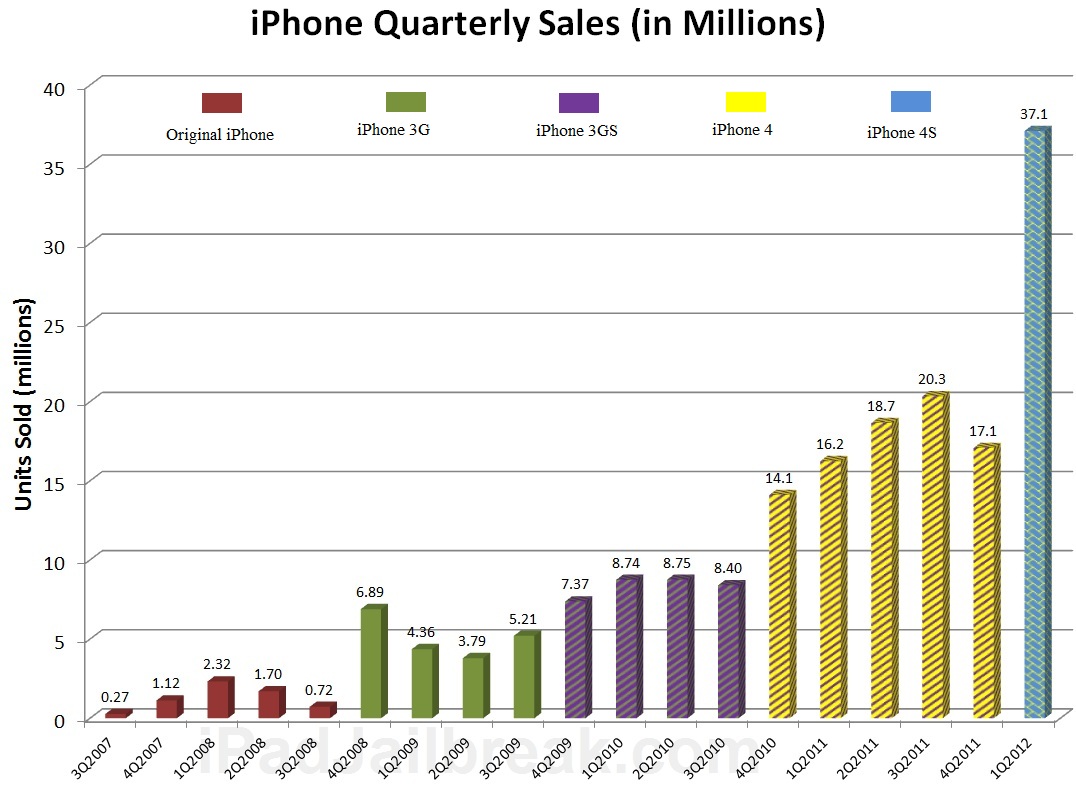
Exactly two years ago, a Microsoft executive claimed that Apple’s problems with the iPhone 4’s antenna issues would sink the iPhone, making it into “Apple’s Vista.”

“It looks like the iPhone 4 might be their Vista, and I’m okay with that,” said Kevin Turner, Microsoft’s chief operating officer, in a keynote speech at Microsoft’s Worldwide Partner Conference (WPC), which runs through Thursday in Washington, D.C.

Earlier in his talk, Turner poked fun at the reception problems that have dogged Apple’s iPhone 4 since its June 24 launch. “One of the things I want to make sure you know today is that you’re going to be able to use a Windows Phone 7 and not have to worry about how you’re holding it to make a phone call,” Turner said, referring to the Microsoft mobile operating system set to debut on smartphones this fall.

So, how did that prediction turn out? Let’s see:

2012Iphonesales

Hmm. I can’t remember, did Vista exceed all sales expectations and take off like a rocket? Ummm…… No, I don’t think so.

And Windows Phone 7? With its rock-solid reception that everybody is talking about? Oh yeah, they’re at 4%. Everybody ran with the story that WP7 would explode to 20% in three years. So far? They dropped a fraction since January. So, not quite so rocket-like quite yet. And the iPhone 5 is bound to dazzle.

Categories: iPhone Tags:

What It’s All About

July 16th, 2012 Comments off
The Christian Science Monitor, inadvertently, I believe, more or less made clear in their headline what Republicans are doing with their voter purges:

A victory for Republicans, Florida wins use of federal database to purge voters

The giveaway: it’s a victory for Republicans. Not for fair elections, not for democracy, not for the nation. It’s a political victory for a strategy to disenfranchise Democratic voters in an effort to illicitly win an election.

Not what the Monitor meant, I am sure, but I think that everybody pretty much knows it to be a fact. The thing is, if you’re a news agency, you can’t say what is obvious–because if you do, then you’re a stinking lame-stream liberal media elitist, and not a “real” journalist who understands that there are always two sides to any argument and you have to give equal credence to both sides, no matter how obviously stupid and corrupt one of them might be. Unless they’re Democrats, because they suck at demonizing journalists for saying bad things about them.

Romney and the NAACP

July 12th, 2012 6 comments

Romney goes to appear before the NAACP. The big story in all the news outlets? He gets booed. But is that the real story? Most news reports talk about the booing mostly, as well as scattered heckling among the crowd; few mention that he received an ovation after he finished speaking. Businessweek mentions the ovation in their article; however, their original headline, “Romney Gets Ovation at NAACP After Boos‎,” was quietly changed later to just “Romney Booed at NAACP During Speech Criticizing Obama.” Andrew Sullivan’s take: “But I think [Romney] gets points for showing up.”

I don’t think Romney should get points for anything but political game-playing. The media, meanwhile, deserves scorn for hyping that very game. Romney and Obama get booed and heckled at various events; why is it such a huge story when it happens to Romney at the NAACP, especially when such a thing is expected? And why go to such lengths to de-emphasize the positive responses, which are, after all, more noteworthy?

Consider when Bill O’Reilly interviewed sitting president Barack Obama in February 2011; O’Reilly was extremely disrespectful, interrupting Obama dozens of times (remember when a reporter interrupted Bush once, and Bush stopped and scolded the reporter?). Were the newspaper stories about O’Reilly’s behavior? Hell, no. The “liberal media” is scared witless at the prospect of reporting truth when it makes conservatives look bad or liberals good; they know they’ll get labeled “liberal” and will suffer for it. Playing into conservative stories, meanwhile, gets them no scorn and loses them no ratings.

Romney understands this; it’s why he was so flummoxed when a Fox reporter actually pitched him a few tough questions. It’s why he knows he can flip-flop like a dying fish and dispense outrageous lies and not have to answer much for it. The media will not call him on stuff like that.

As they will not call him for playing the NAACP as he did. Romney wanted to be booed there; that’s what gets him points. He obviously cannot say much of anything to that audience that will make them want to vote for him, so why appear? The answer is so he can stir up empathy, get people to respect him for his “bravery” in standing up to a hostile crowd, and as a bonus, he can make the people and the organization appear biased, unfriendly, and ungracious.

And he knew the press would lap it up; he even scheduled an interview at (of course) Fox News after the NAACP speech, so he could play up how he was poorly treated by those disrespectful people. His campaign is even openly saying that he expected to be booed, playing up the “telling it straight” courage line, while at the same time punctuating the “biased and disrespectful” NAACP angle.

It was a political play, and the NAACP essentially gave him exactly what he wanted. I think that if they hadn’t reacted badly to his hits against the ACA, he probably had lines ready to deliver which would be more likely to get booed.

Romney: Obama’s Tax Cut for the Middle Class Is an Attack on the Middle Class

July 10th, 2012 2 comments

Yep. That’s essentially what he said:

Previewing the message that he will bring Tuesday to the swing state of Colorado, Mitt Romney told a conservative talk-radio host that President Obama’s tax cut extension proposal would “kill jobs” and harm the middle class.

“What the president is proposing is therefore a massive tax increase on job creators and on small business,” the unofficial Republican presidential nominee told Virginia-based conservative radio host John Fredericks in a taped interview that will air Tuesday. “Small businesses are overwhelmingly being taxed not at a corporate rate but at the individual tax rate. So successful small businesses will see their taxes go up dramatically, and that will kill jobs.”

“That will be another kick in the gut to the middle class in America.”

This is the most laughable whopper since the right-wing claim that Obama hates the troops because he gives them so many benefits–thus making them dependent on the government teat, not respecting their ability to stand on their own two feet.

What Romney is saying is that by giving a tax cut for the middle class and not giving an even bigger one to the rich, Obama will destroy jobs and thus hurt the middle class. Again, a lie along the lines of “give huge amounts of money to the rich and maybe some will trickle down on the heads of the poor and middle class.” When we did that, there was trickling all right, and they had the gall to call it “rain.”

What he doesn’t mention is that (a) there is zero evidence to support his claim, (b) that tax cuts for the rich in the past have shown no propensity to create jobs, and that (c) the tax cuts he is demanding for the rich (excuse me, for “job creators” and “small business owners,” the usual false fronts) will continue to create trillions of dollars more in debt, the same debt he and others in the GOP (1) created, (2) blame Obama for, and (3) claim is killing jobs. There are, as it turns out, multiple dimensions to the GOP’s lies and hypocrisies on this one.

Once again the GOP wants to kick the middle class in the family jewels and tell them it’s for their own good, counting on the American people’s known tendency to vote against their own best interests.

Betcha the media doesn’t call him out on the mass of inconsistencies, dishonest euphemisms, and outright lies packed into this line of BS. They would not want to actually tell the truth and therefore become part of the “liberal media elite,” no sir.


More on Romney’s BS: the median small-business owner makes an income roughly in line with a standard wage-earner. While they are apt to have a broader income distribution–more have higher incomes than do wage earners–the number making over $250,000 is not great–only 3% of them, and many if not most of those are rich people disguising themselves as “small businesses.” As 97% of small business owners would get tax cuts under Obama’s plan, what Romney really means by “small businesses” is those rich people pretending to be small businesses.

As for “job creators,” Romney again means “rich people.” And that BS has been debunked, most notably by Nick Hanauer, an Amazon.com founder, in his TED talk (which TED awkwardly has not posted) where he points out that business owners are, by nature, job eliminators, that they hire only when forced to and cut jobs at every opportunity–and that the actual job creators are the middle class–the very people Obama is trying to give the tax cut to, which Romney is now trying to hold hostage so that the job eliminators can get crushing-debt-creating tax cuts.

Nick Hanauer’s must-see talk:

Categories: Election 2012, Right-Wing Lies Tags:

They Thought I Was a Tourist

July 9th, 2012 Comments off

There’s a small shop in Akihabara called “Akiba Palette Town” which is known for its deals. They are very much the kind of shop that has cardboard boxes out front with cheap merchandise inside. They sell old computers for a few thousand yen a pop, and have all kinds of used CPUs, RAM, and other junk that’s fun to rummage around, and sometimes buy.

A few weeks ago, I went there and saw that they had some nice extras I wanted to pick up for teaching, including a USB3 cable (with the funky new peripheral connector) for ¥200, a few SATA cables for ¥100 each, and a VGA cable for ¥100 also. When I came inside to buy them, I was pleasantly surprised: they gave me half off on everything except the VGA, and the above came ¥300. And they probably still made quite the profit on that.

Today, I was leading a group of students around for our Computer Making Club, showing them the back streets in-between our purchases of parts for the club’s computer this semester. I figured I’d pick up the same collection of cables again, as I could use a few spares and regretted not having bought more the previous time.

So, I put them on the counter and the guy started adding them up. I was wondering what was going on as I saw some strangely high numbers on the tally screen, but figured they had their own odd accounting system. But then the total came up: ¥1380.

¥1380?? At first I thought it was a big mistake, and then I asked the guy how much for the USB3 cable, as an example. He told me it was ¥500. A guy sitting next to him confirmed that.

The box outside was clearly marked ¥200.

I just left the cables there and left, waving them off with an incredulous smile. No sale.

Because I figured out what had happened: when I had come in before, I was wearing different clothes, and looked the part of an otaku who knew what stuff was worth. This time, I had a t-shirt with an American college logo and a cap from our trip to Europe.

They had read me as a tourist and were actually trying to rip me off!!

I was more amused than anything else. Had they charged me full price I would have paid. But more than double? Fifteen bucks for a few pieces of crap they charged me four dollars for before?

Next time I go to that part of town, I intend to try again–the exact same items–and see what they try to charge me then.

I mean, wow. I’ve had shopkeepers try to rip me off before, but never in Japan, never so blatantly. It was a shock, albeit a transparent and amusing rip-off.

Of course, it was nothing to the crap we ran into in Greece; one merchant apparently thought I was unable to count, short-changed me, and when I called her on it, took back my change and then gave me even less back.

However, I did not expect that in Japan. Well, live and learn.

Categories: Focus on Japan 2012 Tags:

The Heckler on Via Dolorosa

July 7th, 2012 7 comments

So, Romney flip-flopped yet again. Initially faced with having to admit that he was the biggest tax hound in Massachusetts history, he coweringly sent out a flunky to say it wasn’t a tax, causing a huge uproar among the right wing who were salivating at the prospect of beating Obama to death with the word “tax.” Sensing that he had to jump on the bandwagon, Romney joined the chorus and called it a “tax.” He knows that he won’t pay much for the hypocrisy; he didn’t “tax” the whole country as governor of Massachusetts, and the media almost never calls out politicians for lies or rank hypocrisy anymore.

Of course, it’s not actually a tax in the usual sense, unless the money you pay when you evade taxes is a “tax,” or the money you pay when you get caught driving without insurance is a “tax.” The most onerous “burden” will actually be the fact that you have to get insurance–which is mostly onerous to those who want to get the best out of the system without paying full price for it.

Not that the penalty-versus-tax meme lasted long; the economic report came out, and it’s a lot less than we need right now.

Yes, Obama’s job numbers are lackluster. But that doesn’t mean that Romney will do better–quite the opposite, in fact.

Romney is, as predicted, having a field day with Obama’s numbers–but hypocritically so.

Never mind that it is the 21st consecutive month of growth following an economic catastrophe which ignited a depression–all caused by Obama’s predecessor.

Never mind that we are now adding more than 800,000 more jobs per month than when Obama came in to office.

Never mind that despite being handed a far less difficult economy, Bush took two and half years to return to stable job growth, while it took Obama only one year.

Never mind that at this point in his term, again despite far better conditions, Bush had only 12 months of growth, only four of those being over gaining 150,000 jobs.

And never mind that Obama has had to deal with the most extreme opposition in living memory, a Congress actually dedicated to sabotaging his attempts to repair the economy in order to make him fail.

That last is a key point. Yes, Obama could have done better–but not because he acted liberally, rather because he did not stand up the the Republicans to do what he should have known was right.

It is a key point for two reasons: first, as Obama was trying to carry the nation back up, Republicans were grabbing his heels and pulling him back down. And second, had we done what Republicans were clamoring for–more tax cuts for the wealthy, higher taxes on the poor, and less spending on infrastructure and other ways to get the economy pumping again–we would be in far deeper shit than we find ourselves today. As is only sometimes observed, Obama’s poor ratings are not just because he’s more liberal than the right is comfortable with, but also because he’s not as liberal as those on the left want him to be.

Romney, unconcerned with facts, likes to wave around “his record” as governor of Massachusetts:

Romney takes credit for vetoing more than 800 spending items passed by the Legislature, saying he wiped out unneeded programs, cut taxes 19 times, built up a $2-billion rainy-day fund and balanced the budget four years in a row. All of that, he says, shows he can stop overspending. “We can balance our budget and live within our means,” he recently told supporters in Ohio.

He leaves out a few tiny details, however:

But Romney’s telling omits key facts that clash with the agenda of his campaign for president:

• The Legislature overrode most of Romney’s spending vetoes.
• State spending rose by 22% on Romney’s watch, nearly double the rate of inflation.
• Romney increased corporate taxes and state fees by $750 million a year, outstripping his tax cuts.

In short, everything had to get past the Democrats, just as Obama has to now get everything pat the Republicans. And while the Democrats shot down a lot of Romney’s ideas, it was not to sabotage the economy–quite the opposite, it was to help the economy, to improve it. Directly the opposite of Republican’s in Congress during Obama’s term. Romney and the Mass. Dems may have been at odds, but it was a constructive rivalry.

In the end, Massachusetts increased spending and it raised taxes on the wealthy–this is what Romney is celebrating, despite his claims to the opposite. Furthermore, it is not what he would do as president.

The primary moves initiated by Romney that helped Massachusetts improve their economy were fee increases and closing corporate tax loopholes. As president, Romney would not be able to raise funds with fee increases, and he wants to slash corporate taxes, not close their national loopholes.

But that was not the main reason Massachusetts’ economy improved–it was because, at the time, the country as a whole was finally coming out of the recession.

So, Romney’s record as governor really reflects a Democratic agenda being pushed over his vetoes, tax and fee hikes he cannot or will not implement as president, and improvements in a more general economic environment which Romney will definitely not have to benefit from as president.

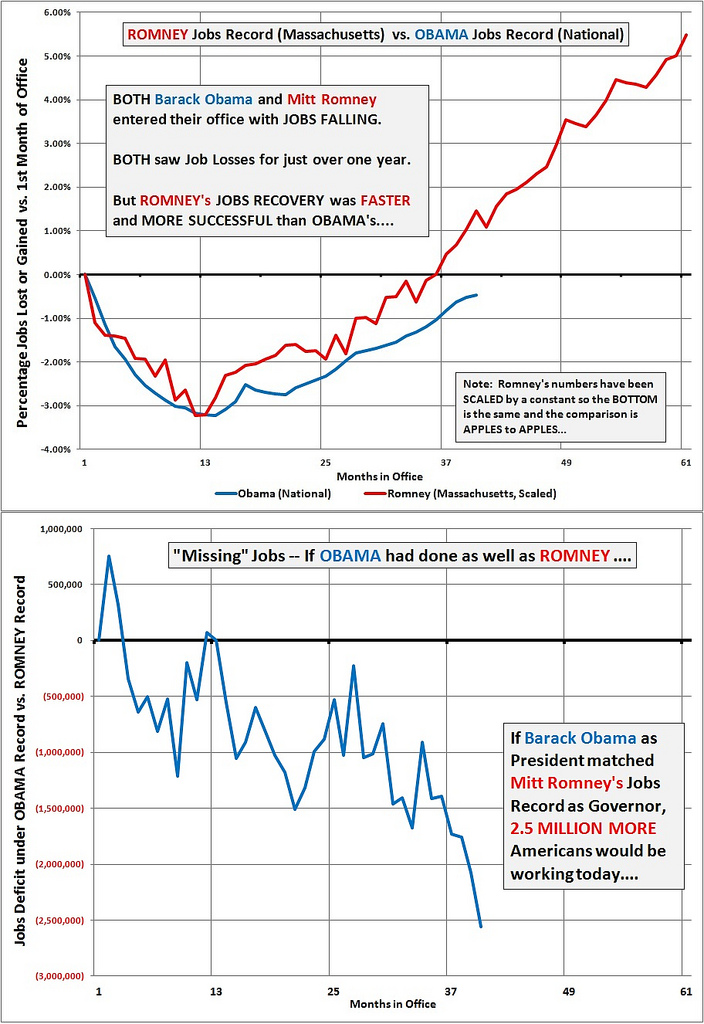
Just the other day, I got a belated comment to a blog post from April 2010. In that blog post, I pointed out that Democrats should run on a chart showing where Bush and the Republicans had been leading us versus where Obama had taken us.

That is very important, yet something that goes virtually unrecognized because it is the proverbial dog that didn’t bark–despite the economy being shitty, instead of focusing on what Obama could have done, imagine what would have happened had McCain won and Republican had control over Congress.

Anyway, the commenter linked to this chart:

7454295280 2E6894D993 B

It appears to be a chart the commenter made himself–and seems to be pretty bogus. The claim of measuring jobs by the “percentage of jobs lost or gained vs. 1st month in office” is misleading; this chart does not compare each successive months’ performance to the first month, thus showing performance against the initial benchmark (which would be a fairer way to judge).

Instead, it simply shows the number of existing jobs with starting number keyed to zero. The author pretends fairness by changing Romney’s numbers somehow so the nadir matches Obama’s, but it is far from accurate, for several reasons. For example, it is easier to recover from a stumble than it is to reverse direction when falling at terminal velocity. Obama was handed an economy in freefall and immediately set upon by an opposition bent on making him fail against the backdrop of a sputtering world economy. Romney was handed a state in mild trouble with a Democratic legislature trying to fix things their own way, against the backdrop of an improving national economy. So, yeah, “Apples to Apples” my ass.

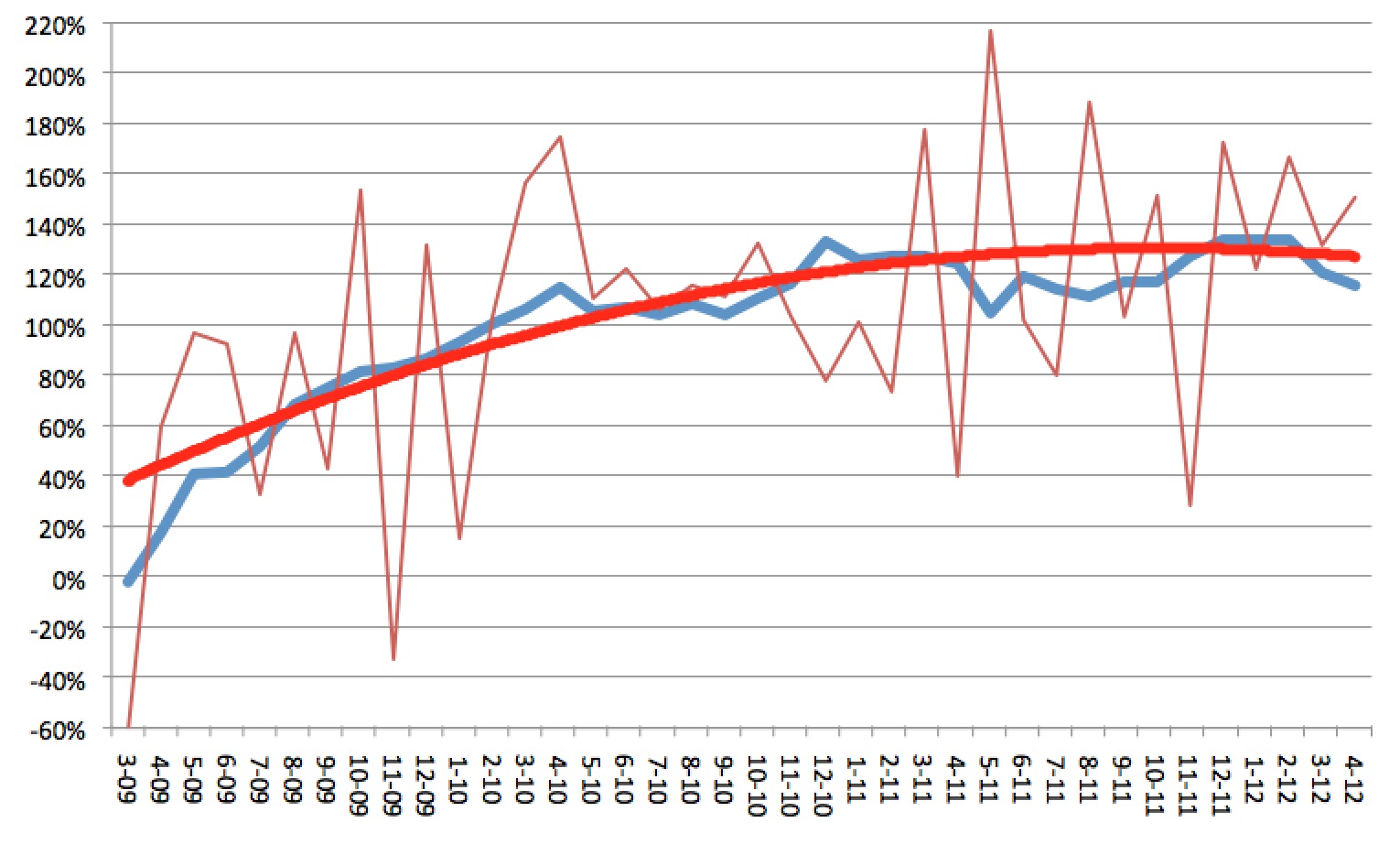
Curious as to what the real picture was, I got the numbers on my own and ran them through a comparison that used the initial state as a benchmark against which you could compare future results, and got this result:

Screen Shot 2012-07-07 At 4.02.20 Pm

The “100%” mark means that you are gaining jobs as opposed to losing; 200% would mean that you are gaining as many jobs as you were losing at the start. Again, a huge advantage for Romney, as gaining 9500 jobs in Massachusetts is a hell of a lot easier than gaining 750,000 jobs at the national level.

As you can see, this shows a pretty different story than the ginned up chart above. As one might expect, Romney’s numbers show greater month-to-month variation due to the fact that he’s presiding over a smaller workforce. Whereas Obama deals with changes in the tens or hundreds of thousands, Romney was dealing in changes of no more than 15,000 in a single month. To smooth that out, I added a trendline–and interestingly, it tracks pretty much exactly with Obama’s performance.

Which means that Romney, in Massachusetts, got just the same level of job growth as Obama despite (1) starting off with a far less catastrophic situation; (2) having a far lower bar in order to claim accomplishment; (3) having a legislature that’s trying to help you instead of hurt you; and (4) getting buoyed by a greater economic environment. In short, he did exactly as well as Obama despite lacking virtually every great disadvantage that Obama had to face.

Imagine what would have happened if Massachusetts were imploding, were Romney pressed to create impossible numbers of jobs, had the Democrats been pitted against him, resolved to sabotage his recovery attempts, and the nation as a whole been in serious decline. Massachusetts would have been crushed under Romney’s governance.

Faced with that challenge at a far greater level, Obama has done passably well instead of impossibly great, for which Romney blasts him for being an abject failure. Kind of like a guy who directed a community theater play, which got good reviews on account of a great cast, heckling Steven Spielberg for not winning the Oscar.

If Romney becomes president and Republicans maintain control of the House, with Republicans blocking or even controlling the Senate, we can expect (a) even more and bigger tax cuts for the wealthy; (b) mild (obligatory) tax cuts for the middle class, offset by (c) tax hikes for the poor and the middle class in various forms, including forcing the poor to pay or pay more; cutting federal aid, thus forcing either tax hikes at state and local levels or reducing local services which essentially forces individuals to pay more, hitting the poor the hardest; and a much more antagonistic environment against the worker–less pay, fewer benefits, less union protection, less regulation against unfair pay and other worker abuses, etc. etc.

This along with spending austerity measures which Krugman points out is poison to an economy like ours right now.


So, yes, Obama’s job numbers are lackluster. But that doesn’t mean that Romney will do better–quite the opposite, in fact. Only in American politics is it the case where the voters are stupid enough to vote for the Penguin just because Batman hasn’t stopped the Penguin’s minions from wreaking havoc.

Clobbered by Seibu

July 7th, 2012 7 comments

When I first moved to Hibarigaoka and up to the time we committed to living there, the train situation was sweet. The line we live on goes only as far as Ikebukuro (short of my work destination), but spurs off at an earlier station, Nerima, to link with the Fukutoshin and Yurakucho subway lines. The Fukutoshin is key for me; it goes directly to Shinjuku-Sanchome, the station where I work. Better yet, there were, I recall, six trains an hour which left my station and stopped in Shinjuku–non-stop locals and express runs. After years of transfers and extremely long walks to and from inconvenient stations, I finally had found a setup that seemed solid.

Just as we bought our new house, the 3/11 quake hit, and train service was disrupted; for a few months, the Seibu Ikebukuro Line stopped serving its connection to the Fukutoshin. During that time, I used my scooter to go to work.

By the time they restored normal service, I was disappointed: they had cut the number of direct trains between my station and Shinjuku down to four per hour–two express and two local runs. Still, there was a direct train every 15 minutes, which was not too bad, and not too different from previous times.

Last week, I came to the station as usual, and saw that the trains were all wrong. I initially assumed that there had been some disruption, and asked at the ticket office. Nope, I was told, the trains were right. The schedule had changed again.

They had cut the direct trains to Shinjuku down to two per hour. Both were express trains, whereas I usually prefer the local (I often use the station before the one at my work, as there’s a sandwich shop close to it, and the walk in to work is only slightly longer).

I was told that there was still a local to Shinjuku, but it left from a station down the line, and I would have to transfer.

Well, great.

I got an even greater shock, however, that evening: the trains coming back home were far worse.

The train lines are a bit complex. As I noted, the Seibu joins with two subway lines; those lines join with two other lines, the nexus more or less being a stop called Kotake-Mukaihara. From there, a small spur reaches out to a station called Nerima on the Seibu Line. This is why the direct trains are a blessing; I can jump on one train, hopefully get a seat, and ride it all the way home. If there are no seats at first, then there are sure to be openings at the transfer points.

When I left for home that night, I found no trains going directly to my line. So I took a train heading to the nexus, and got off to transfer there. It was an 8-minute wait for even a local train to my line, and an additional 12 minutes for the following local. Both stopped short of my station, no express trains within a reasonable time. I took the soonest local, and found myself at Nerima. There, I found that my train had an extra 7-minute wait, while another local to the exact same station would leave in one minute. So I transferred, but lost my seat. When I got to the final stop, one station before mine, it was another 6-minute wait for a train to take me one stop.

Usually it takes 30 minutes to get home. That night, it took more than an hour; four trains, waiting 15 minutes on crowded platforms for three transfers, all trains locals.

One of the reasons we chose our location, why we bought our house here, as I mentioned earlier, was because of the handy access on train lines. Now, a year later, it has been turned into a nightmare. And summer is just beginning. I do not look forward to an extra 15-20 minutes every night of sweating profusely in intense heat and humidity, waiting on a crowded platform for multiple transfers to crowded local trains with no seats.

I discovered my main problem: direct trains from work to home still exist, but there is a baffling 1-hour gap in the schedule with no direct trains in the 7:00 hour–smack in the middle of the times I usually leave work. So I will either have to rush out the door after class, or sit around and wait, and hope I can catch the one train at 7:57, or else wait half an hour for the next one. None of them, by the way, express trains–apparently, no more direct express trains–a few have express stretches on the Fukutoshin, but turn into local pumpkins on the Seibu Line. Kind of defeats the whole purpose of living at an express station.

I am definitely going to issue a complaint with the train company; this is ludicrous.

Not to mention, I am hardly the only one. I see people with physical disorders on the lines quite often; just that one hour-long trip home, a guy with bent legs, in obvious discomfort, was forced to stand and wait and walk and wait and stand some more; if I was annoyed, he was in pain.

Of course, what can you do? Sell the house and move to one on a different train line? No reason for Seibu to give a damn.

What I wonder about is whether this is a permanent change, or will it even get worse in the future? There is a planned extension where the Fukutoshin, at its far end in Shibuya, beyond my stop in Shinjuku, will hitch up with another line leading all the way to Yokohama. If that happens, then you could, conceivably, take one train all the way from Tokorozawa in Saitama to Yokohama in Kanagawa. Maybe when that happens, the schedule will change in my favor again–or maybe, the extension is what’s causing them, for some counter-intuitive reason, to cut the service I depend on.

Categories: Focus on Japan 2012 Tags:

Review: The Retina Macbook Pro

July 2nd, 2012 9 comments

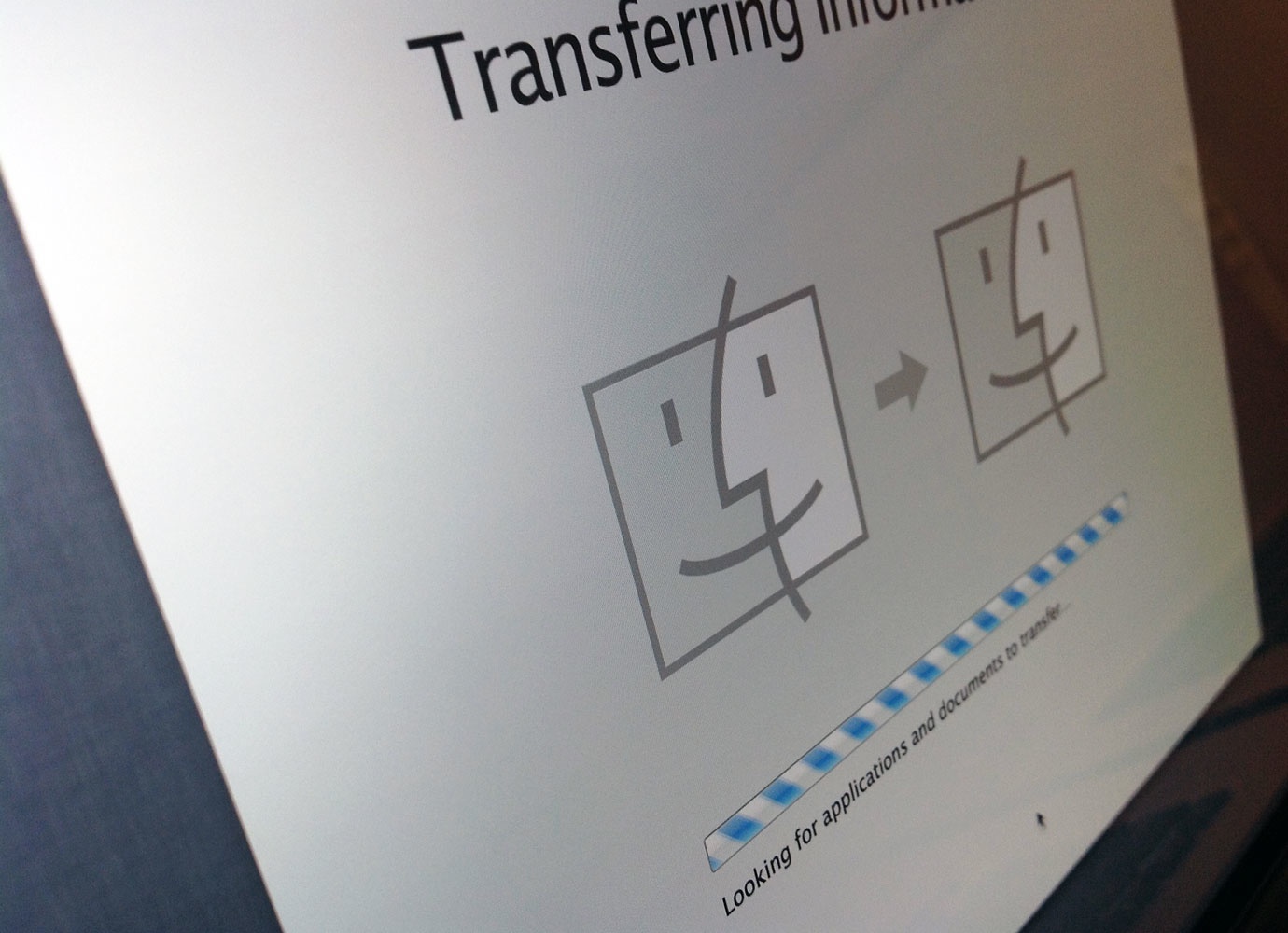
It came a few days ago, and now that I’ve had a bit of time to play around with it, I have some initial reactions.

Unboxing Day

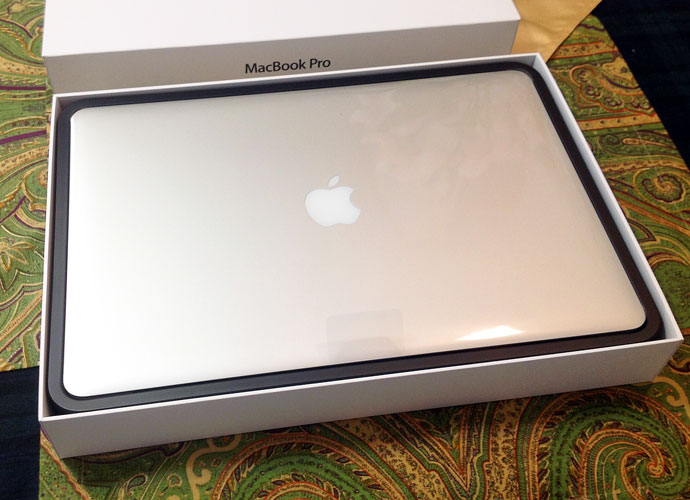
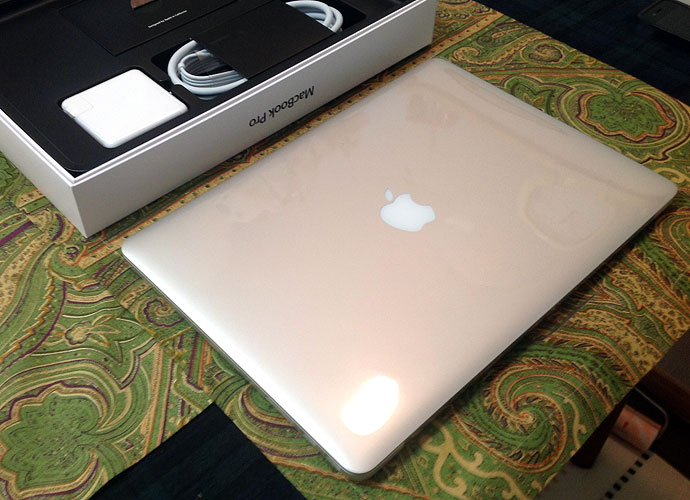
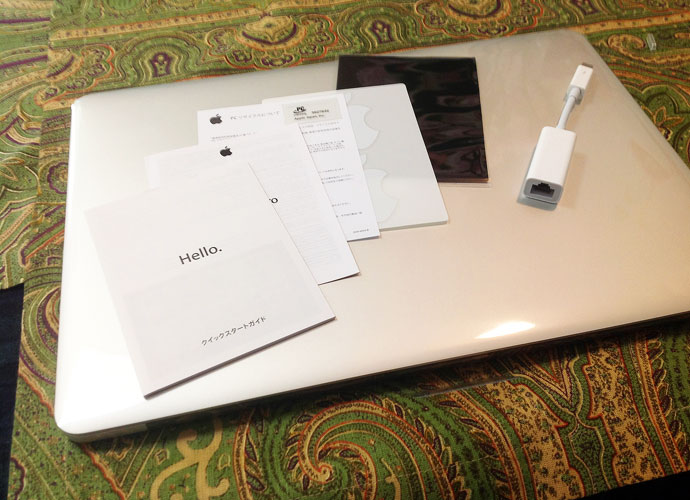
As one would expect, it comes beautifully boxed.

Box01

Box02

Box03

Box04

Sachi had a few chuckles over my photographing the unboxing; she is not that used to Nerd Pr0n.

The first thing I noticed is, the power cable is different. There’s the MagSafe 2, and (at least for units sold in Japan) a more streamlined power cable plug.

Powe01

Apple really sees to the details, down to a piece of tissue paper separating the screen from the keyboard, cut in the precise shape. Insignificant, but they take care of details at that level, and it makes an impression (like using Garamond in a resume).

Paper01

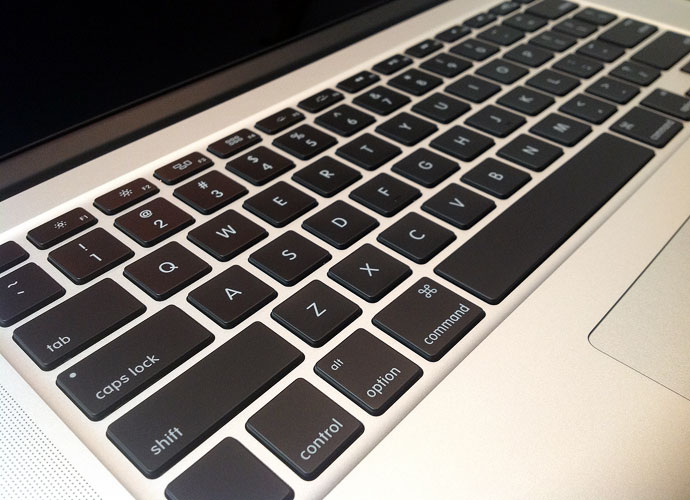
The keyboard is generally the same great-feeling chiclet keyboard, perhaps a bit more subdued than before.
Keyb01

Keyb02

Pixels Painted On

When I got the iPad 3, I was a bit less blown away by the Retina Display than I expected; the screen is great, but not mind-blowingly greater than the previous screens.

The Retina screen on the MBP, however, immediately impressed me. People have talked about things on the screen looking “painted on,” and you do get that impression. Here are a few images at 1380 x 1000 resolution if you click on them:

Screen01-1380

Screen02-1380

It’s not just he pixel density, though; the far-richer contrast hits you pretty quickly, too:

Screencontrast01

As I was setting it up, I took off my glasses and got within a few inches of the screen–and was immediately struck by the fact that you can see the pixels. Yes, I know that the retina display makes the pixels almost invisible at normal viewing distances. However, on my iPad 3, even close-up, it is nearly impossible to see the pixels. Again, I know the density is greater on the iPad (264 ppi for the iPad, 220 for the Retina Pro). Still, I didn’t expect to be able to discern anything visually.

But then I looked back at my late-2008 Pro, and was shocked to see that the pixels were huge. Now, of course, I have been looking at those pixels for four years, and have even noted the pixel grid before–but even after just a few minutes with the new Retina Pro, the older machine’s screen looked much worse than I had recalled.

After using the Retina Pro over the weekend, in fact, I switched back to the old Macbook Pro for a short time–and was even more shocked. Good lord, but those pixels look huge now! I am struck by how strong the screen-door effect is, and have to “get used to” the quality again before it stops bugging me so much.

It really is true–you’re going to have your standards raised so much that older screens will look far worse than you remember them. I heard that would happen, but was rather shocked at how quickly it took place.

Resolutions

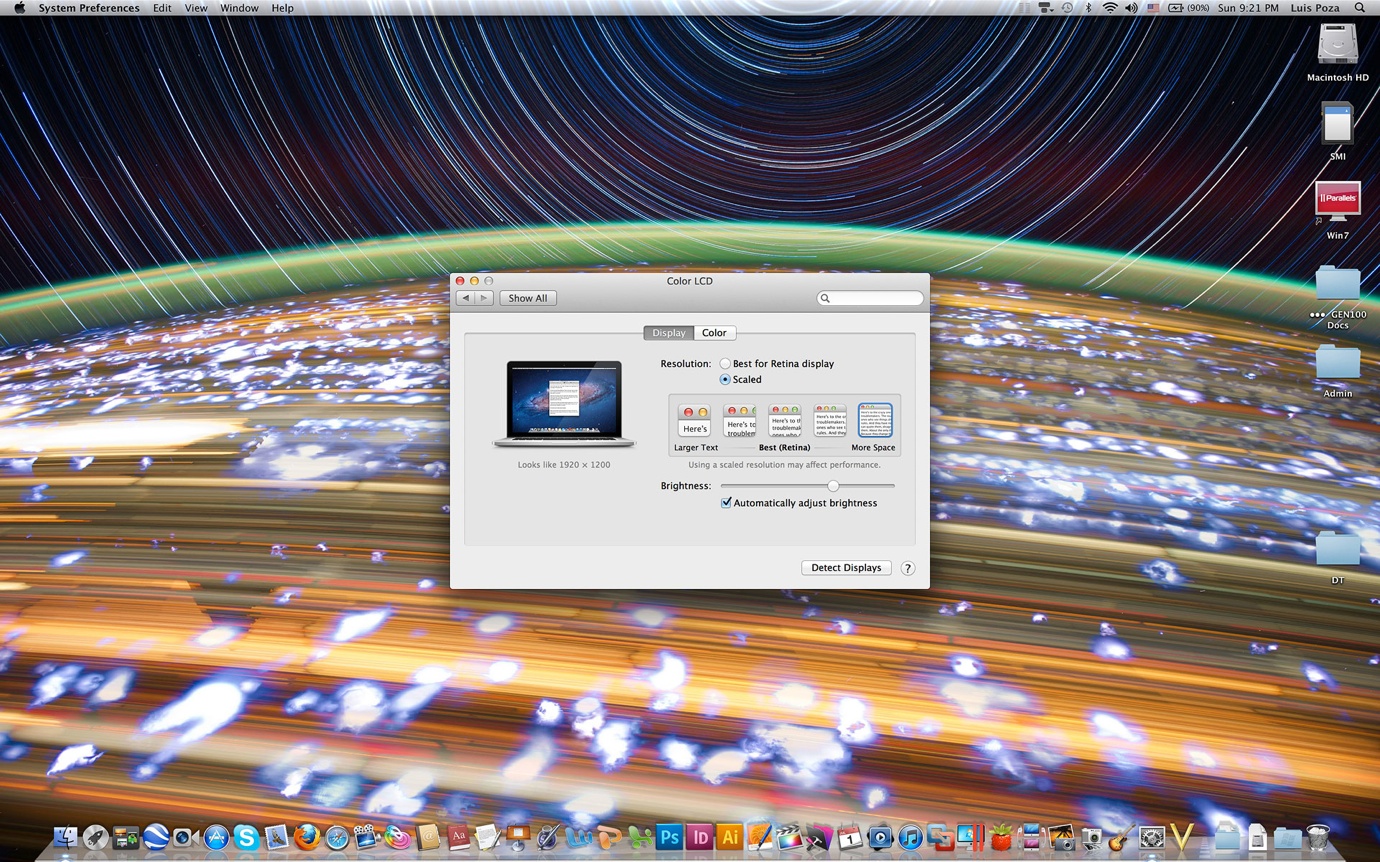
Next comes the screen resolutions. If you have one of these puppies, you’ll want–just for fun, mind you–to download an app called Change Resolution.
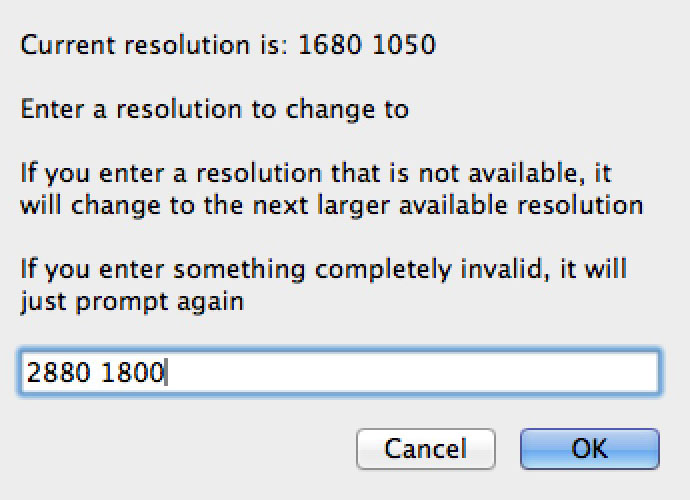
Changeres01

You open up the app, and (in a low-res window!) you can type in the horizontal and vertical resolutions and then click “OK.” Do that at 2880 by 1800, and you get this screen (click for full resolution, file size 1.4MB):

2880X1800Fs

This is the actual size of the screen shot. One thing you will hear is that the Retina Pro creates screen images at double (well, quadruple) the resolution, then down-samples in order to get a more acceptable screen image quality; as a result, screen captures are usually at double the resolution, too. However, this is not the case when you are doing native resolution–the screen shot is at 2880 by 1800. This means that, ironically, at full resolution, the GPU is not working as hard as it is at “lower” resolutions.

As you can see from the image, of course, the elements on the screen become ridiculously small, and while readable, you certainly don’t want to work that way unless you have really unusual needs.

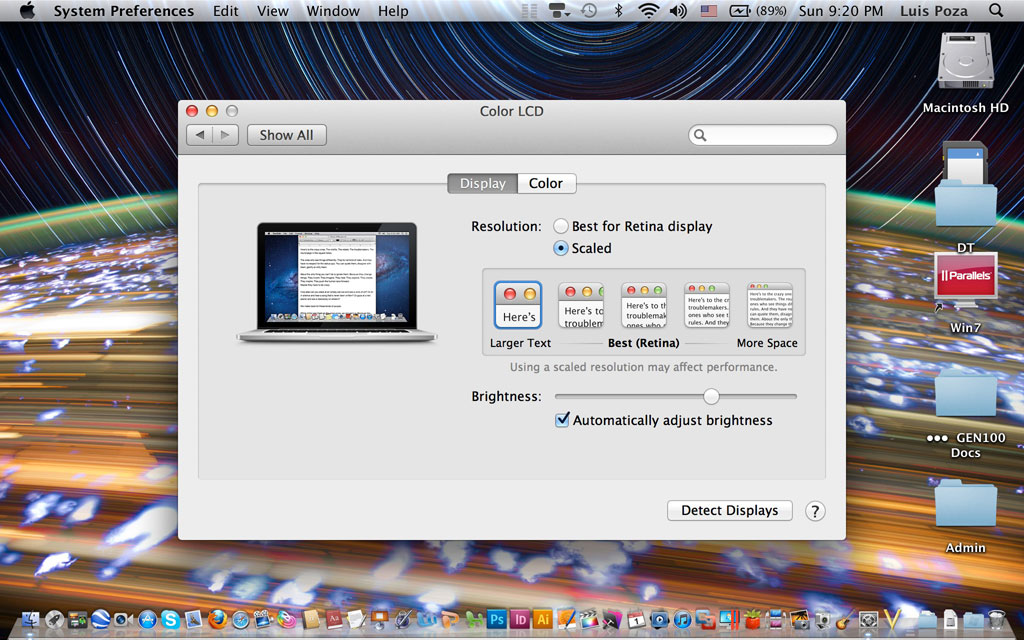
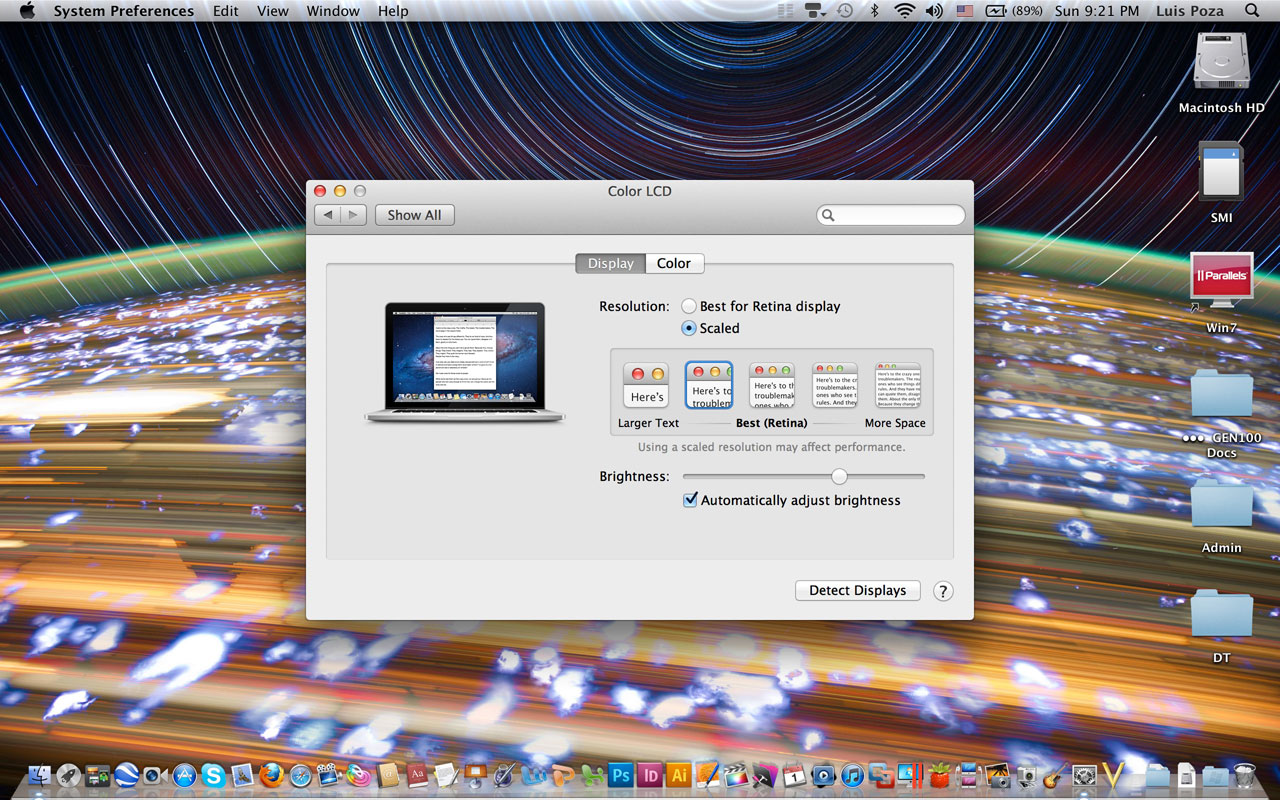
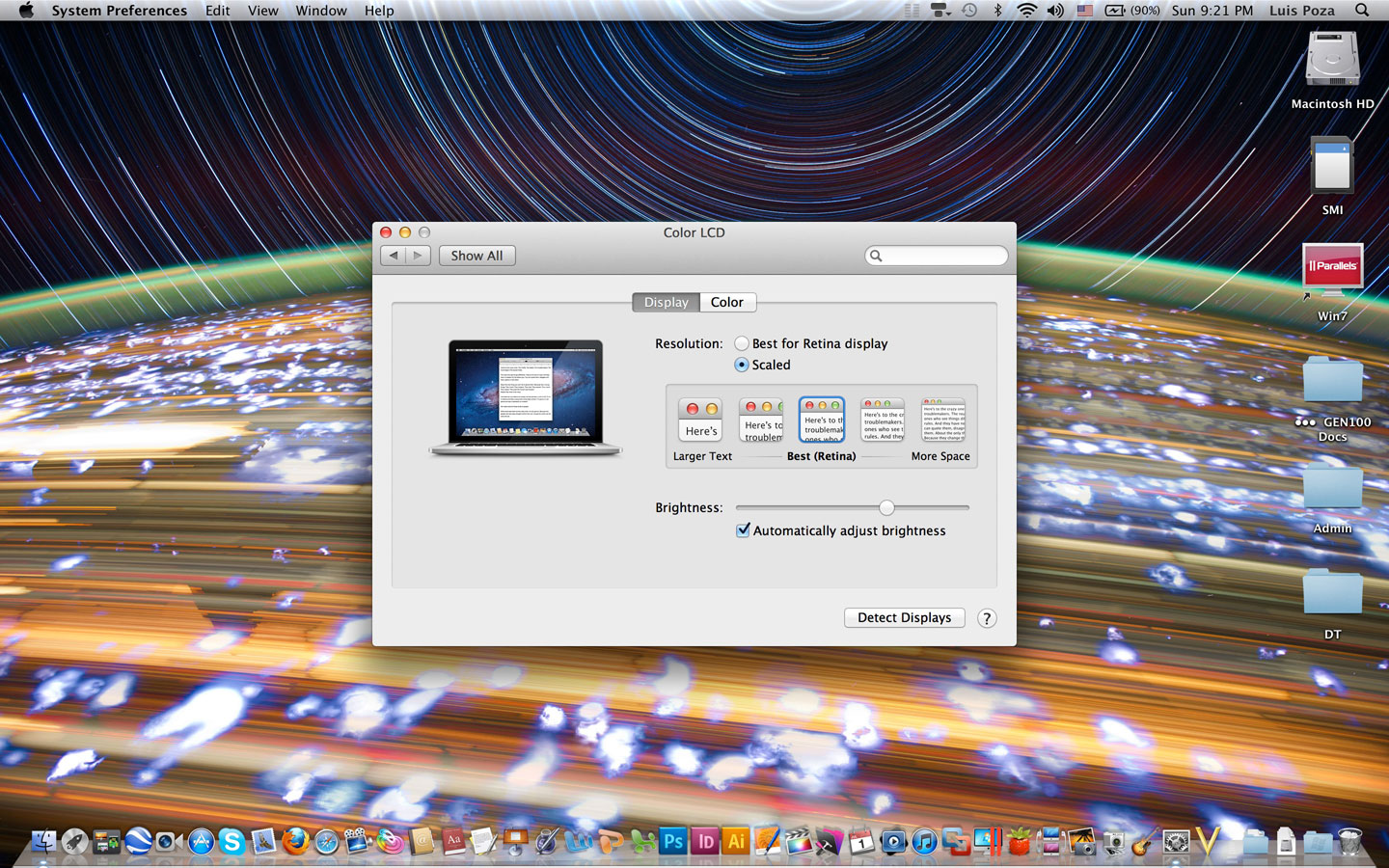
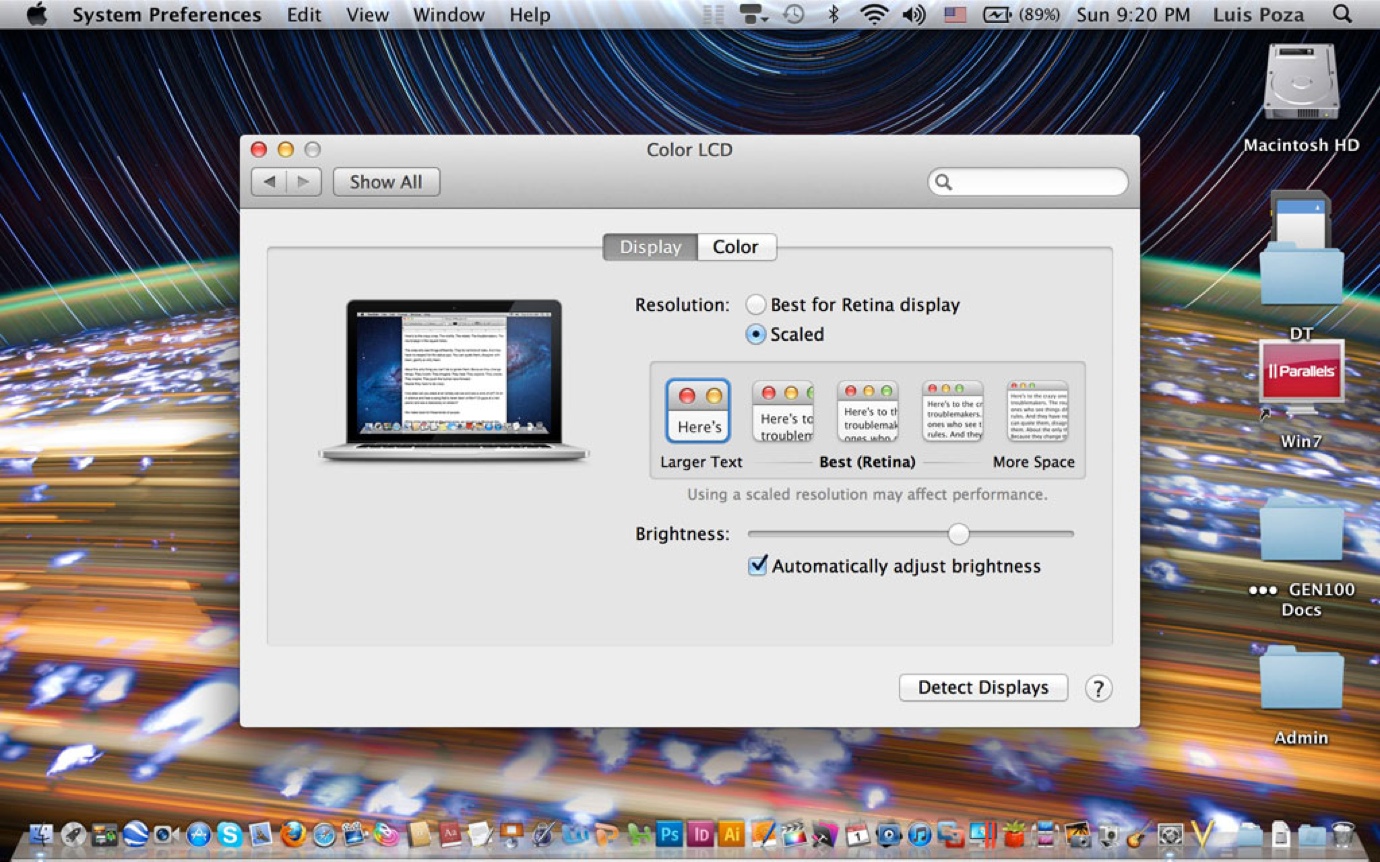
Other resolutions you can work at are, approximated, 1024 x 640, 1280 x 800, 1440 x 900 (the old MBP resolution, exactly half/quarter the new one), 1680 x 1050 (the resolution of the higher-quality screen on the old 15“ models), and 1920 x 1200 (”Full HD“).
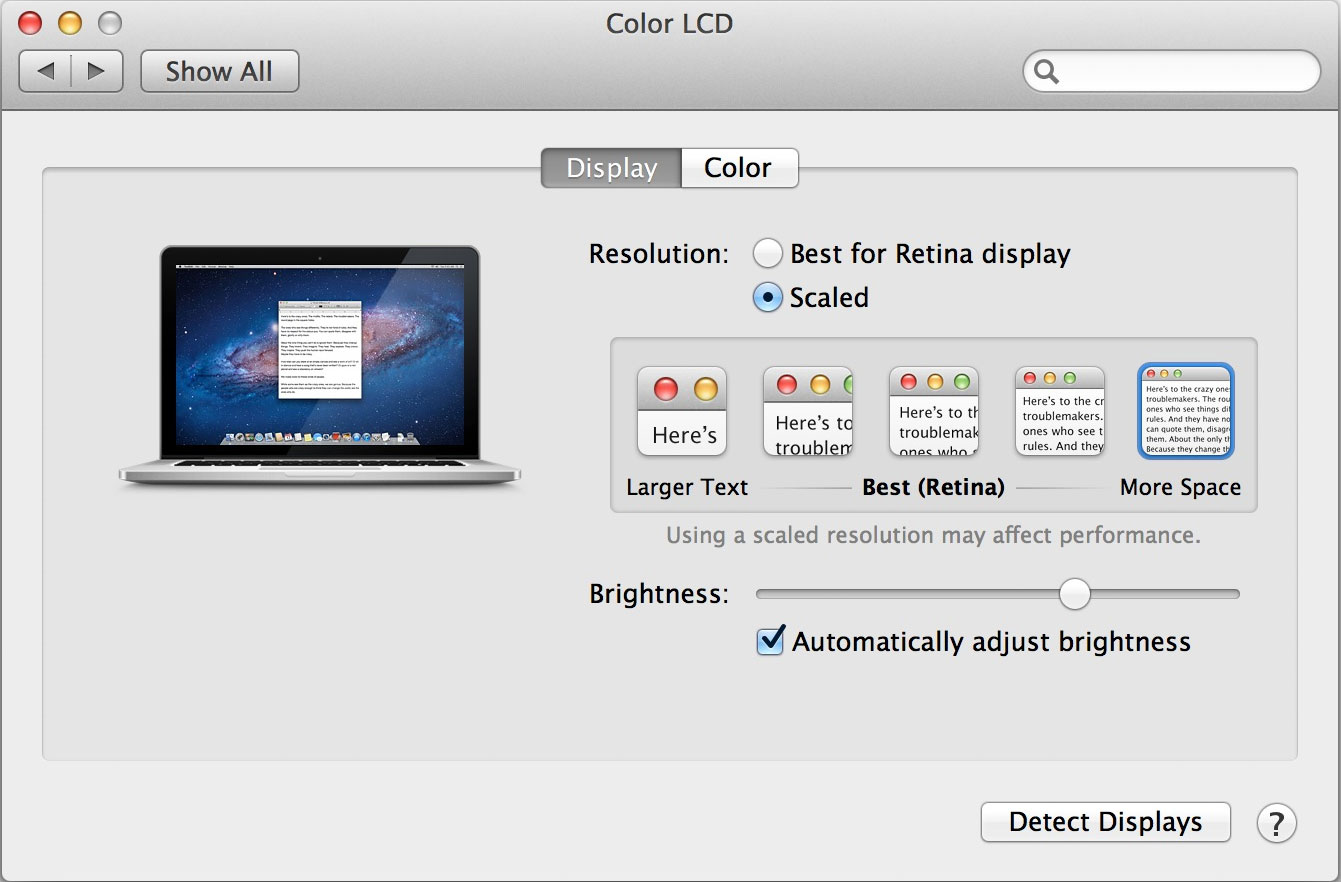
Displaycp-1

Here are screen shots of the five ”normal“ resolutions, scaled to 690 pixels wide (see full-sized on click; I scaled them down from the double/quadruple size of the screenshots to their stated-resolution sizes):

First, 1024 x 640–which I think they included for fun, as who the hell would want this resolution?
1024X640Fs

Next, 1280 x 800–barely reasonable:

1280X800Fs

Their ”best“ setting of 1440 x 900, which is OK, but I want more real estate, myself:
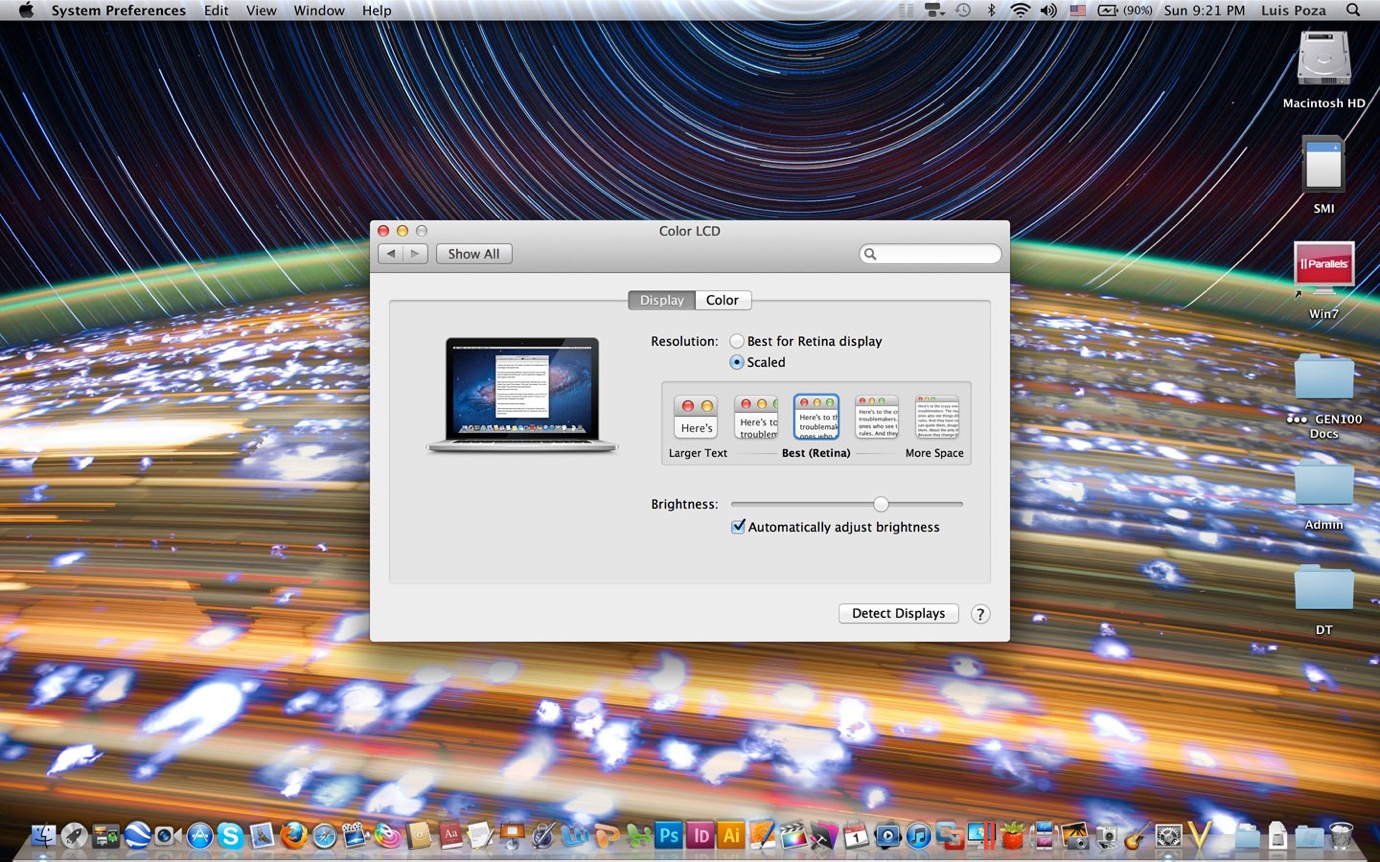
1440X900Fs

Their high-resolution option fitting recent MBP specs, at 1680 x 1050:

1680X1050Fs

And the ”Full HD“ at 1920 x 1200:

1920X1200Fs

I like 1920 x 1200 in terms of how much real estate it gives me, but am still trying to figure out if I can live with how small things get. For example, the images I produced for this post seemed so tiny, I had to check to make sure I didn’t have the image dpi mistakenly set at double. I find myself using the pinch gesture to zoom in on web pages, and often use the zoom feature to see what I am typing better. On the other hand, the zoom feature allows me to zoom in at double size and still looks like almost-native quality, probably due to the double-sampling explained below. It’s so easy to zoom with the Control-Scroll, I am finding it preferable to working with larger-looking elements on less real estate.

When news came out that the 2880 x 1800 setting would be denied to users, there were a lot of shocked reactions. I was disappointed, wanting full control (and subsequently given it by the Change Resolution app). In comment sections on tech sites reviewing the Retina Pro, Mac haters were having a field day, cackling over how we Mac users were getting swindled. That was before it was clear what the deal was really all about.

As stated above, 2880 x 1800 is simply absurd for a 15” display resolution. Apps that can handle it, like games which don’t display text at normal sizes, can claim access to native resolution (i.e., we’re not getting swindled out of pixels), but for normal use, it would be stupid to offer that resolution for your average user.

Additionally, at “lower” resolutions, you are not actually getting “lower” resolutions. It’s always 2880 x 1800. What’s happening is that the approximated lower resolution is produced by the CPU at four times the size (double each dimension), and then downsampled to fit the 2880 x 1800 display. Which means that when you are using the supposed 1920 x 1200 resolution, the quality you see is actually 3840 x 2400 (often referred to as 4K resolution), brought down to 2880 x 1800.

In short, “1920 x 1200” on a Retina Pro is, I believe, a good deal better than 1920 x 1200 on a display with that as the native resolution. Whatever the case, I am still struck by how nice it looks.

In fact, on reflection, I am now certain of it. Take the lowest resolution setting, for example–1024 x 640. If I go down to that resolution on my old MBP (or on any other screen, for that matter), the picture looks fuzzy at best. Not on this display; 1024 x 640 looks as sharp as any other resolution. Meaning that I am not really looking at 1024 x 640 resolution, but simply a 2880 x 1800 resolution which is scaled to look like 1024 x 640. In this case, I guess, 2048 x 1280, which is still better than Full HD, painted onto 2880 x 1800 pixels. However it’s done, it works.

This is a far better improvement (however “apparent” it may be) than I got switching from the old iPad to the new one.

Not Ready for Retina Time?

Many have talked about how bad things look when you are using a non-retina-ready app, but frankly, I don’t see it. Many had posted side-by-side images which don’t show much difference. I thought it was just because you could not see the retina-resolution image at its best, but now I think that it just isn’t nearly the contrast it’s hyped up to be.

Take a look at a small section of a screenshot from a movie at 1080p. The top part of the image is from the movie played in QuickTime Player, which is adjusted to take advantage of the Retina display; the bottom part is the exact same image as shown on MPlayer OSX Extended, an app not so updated:

Clip01

You can see there is a bit more jaggedness to the lower image–but with the pixels being so small on the Retina Pro, the images above are much smaller, and the jaggedness is much harder to see. In full motion, at normal viewing distances, the difference is negligible if not invisible.

You can notice text when it is not displayed right, but so far, using apps like MS Word 2008, I hardly see any quality degradation, and can use such apps perfectly well, without any discomfort. Probably this is due to font smoothing or some other effect that OS X employs.

Zooming Right Along

Next is speed. Now, I may not be the best judge of this, because my old, late-2008 MBP is not only aging, but it’s been dropped several times more than is good for it. More to the point, my normal way to work is to have 10 or more apps running at the same time, some of them memory hogs (Safari, Parallels running Windows 7, Photoshop), and Lion itself is pretty memory-intensive.

As my old MBP has just 4GB of RAM, and runs on an old Core 2 Duo… well, quite frankly, it was driving me insane. Safari took 24 bounces plus a 5-second wait after that to start. I got the spinning beach ball all the time. All to often, just clicking on a menu would elicit a 5- to 10-second pause. It didn’t help that my trackpad button failed more than a year ago, and a few weeks back the file system index blew a gasket, making content-based searches impossible. It is not an exaggeration to say that I am pretty patient when it comes to this stuff, nor that my patience was stretched to the limit.

The new Retina Pro, even the “lower-end” model I have, is so completely different that it’s not even funny. With an Ivy Bridge quad-core i7 CPU, along with a solid-state drive, this thing just rocks. 16GB of RAM doesn’t hurt, either–I have yet to max out the memory, but have come close, and am very glad I went for the upgrade.

Safari, like almost every other app, snaps open in a single bounce of the dock icon. Windows 7 in Parallels opens from a suspended state in just a few seconds. Photoshop is ready to go almost as quickly as I can be ready for it.

In short, it’s fast. Very nice. Expected, yes–but still excellent.

Closet Space

My main concern was not having enough drive space. If you read my posts from before the release, my main fear was not getting more storage. I was tired of a 250GB drive, and was very unhappy at the prospect of the new Pros falling back to my low capacity, after having reached 500 and 750GB previously. Alas, without paying gobs more than it’s worth for the higher-end Retina Pro, you’re stuck with the 256GB SSD.

However, I did have an unexpected revelation: the thing has an SD slot. And it’s SDXC ready, meaning you can stick a 64GB card in there. And Akihabara just happens to have 64GB SDXC cards (albeit off-brand) on sale for ¥2800 ($35). Meaning that, for $140, you could get the equivalent of a 256GB upgrade.

The question was, would it work? People had reported problems with previous SD card use in the Pro line, and I would be using an off-brand type; would it be too slow or wiggy in use? I bought a card (and a cheap portable SDXC reader, for transfer purposes) a few weeks ago so I’d be ready, and have been trying it out.

Card01

Long story short: it works. I slip in the card and an icon immediately pops up on the desktop. Data transfer times are not fantastic–a shade better than 10MB per second, not as good as branded cards, or so I read–but it’s good enough for what I want to use it for.

It’s not as good as having a 512GB drive, but it’s well worth the $500 saved, and then some. When I buy three more SD cards, I’ll use, perhaps, one for photos, one for archived documents, one for video files, and probably one for miscellaneous (or another arrangement if I find one that works better).

I’ll have to find the best way to keep them and to cart them around; in the past, I’ve seen small plastic-sheet holders with tiny sleeves for each card, but now that I need one, I can’t find any–all commercially available holders are hard-cover cases or other inconvenient arrangements. I have a snap-button pocket in my wallet I don’t use, which will probably be my solution, but I’ll have to fish around to get the right card.

Whatever I work out, I am pretty sure it will be sufficient for my needs.

Screendark01

Battery

I have read that the battery lasts 7 hours, 5 hours with heavy use. Seeing how the charge dissipates, I am not entirely confident of that assessment, though I have not tested it objectively. After what sure seems like less than 2 hours’ use, I fall below the 50% mark.

On the other hand, the battery measurement algorithm seems a bit off–it appears to charge beyond 100%, and takes a bit to fall below that. Maybe the lower end of the scale will stretch out more, I don’t know. And one thing I have noticed: the battery charges a lot faster than my old MBP. Probably this is due to the new battery type, similar to iPhone or iPad batteries. My iPad 3 doesn’t charge too fast, but my iPhone does, and so does this laptop.

Addenda: After charging to what I think was full capacity, I unplugged the battery cable–and it took about 22 minutes (browsing, mostly) to fall to 99%. Apple definitely leaves a margin after “100%” beyond which extra charge can be maintained.

Do I Really Need the Two-Tenths of an Inch?

When I first saw the Retina Pro in a shop in Akihabara, I was, honestly, disappointed. It didn’t look much thinner, and when I lifted it up, it had much more heft to it than I had expected. Not a good sign in what is supposed to be a revolutionary design for slimness.

I can only guess that the impression I got was a combination of heightened expectations and the odd height at which I picked up the store unit, along with the inability to close the top and carry it around.

Using the actual machine, the smaller profile makes a great deal of difference. It feels much slimmer and lighter in everyday use, and I am constantly noting the difference. Sometimes, it almost feels half the thickness, to be honest. The screen is thinner as well.

Despite all that, the machine in no way whatsoever feels flimsy. If anything, it seems to feel more solid–though much of that may stem from the fact that I dropped my old MBP a dozen times and the case is warped as a result.

The hinges on the display are a bit stiffer than I would prefer; sometimes I have to hold the bottom down to get the screen up. Hopefully, that will loosen up a bit in time.

Other Stuff

The new MagSafe port is spiffy, but seems even more prone to disconnect at a slight brush than the old model, which was too ‘brush-off-able’ for my tastes. On the other hand, Apple did an admirable job with their $10 adapter, which snaps right onto the old power cables and works beautifully–meaning I don’t have to throw away two perfectly good power cables, and now have up to three I can use.

In other miscellaneous categories, I have yet to use the HDMI port, but am sure it works fine. The USB 3 works as advertised; I have a USB 3 external HDD I have not been able to use at full speed until now, and it works great with the new MBP. The Thunderbolt ports also work fine, allowing me to use the Ethernet adapter I bought (my computer course classroom has no WiFi, requiring the Ethernet use) as well as the external display–I use a DisplayPort to VGA adapter for that. In fact, I need both at the same time for my classes, making me quite happy that Apple included two TB ports on this puppy.

That’s about all for now. To sum up, it is a sweet machine, worth the wait and the price, for my uses at least.

Categories: Mac News Tags: