I tried Apple Maps a few times for turn-by-turn directions. Didn’t work out too well.
When I tried it in my car, it suggested a route I knew was not the best one. My car’s GPS makes the same suggestion, and I ignore it as well, taking a faster alternate route on a road which is not numbered and therefore is not as “visible” to the GPS. But once I start taking the better route, the car’s GPS comes on board and projects that going all the way down that route is in fact best. Not Apple’s GPS: it kept insisting that I take side roads back to the initially suggested route, even after it was clear that this would significantly extend the travel time.
Next, I tried the GPS while walking. One problem I ran into was not necessarily Apple’s fault: construction blocked a road crucial to the route. It actually cut off the road completely, which was very rare. I also noted that even after I went completely out of the suggested path, the GPS did not re-route. Worse, every time time turned of the phone and turned it back on again, the maps app had reset, completely losing my route, forcing me to re-input the route every time I pulled out my phone; the only other solution was to leave the phone turned on in my pocket. Later, after I had finished, I tried it again and the route had not reset when I closed and opened the phone—apparently, it only loses the route when you actually are using it to get directions…
I also found a driving bias in the GPS tracking: while taking the train home, the GPS locator tried to track my route along adjacent roads. If the road veered off, the GPS location would follow the road, until it was clear I was not going that way, whereupon the location would snap back to the rail line, only to snap to an adjacent road the moment one presented itself. Clearly, Apple does this to avoid the turn-by-turn directions from showing you driving through city blocks, making up for GPS inaccuracies. When you’re not driving, though, it creates inaccuracies because of this feature.
The more I see the maps, the more I see bogus locations, most notably numerous instances of a single train station in multiple locations. Worse, Tokyo’s city geography is largely centered around rail lines and stations, but Apple’s map app doesn’t show train lines until you zoom in a certain amount, and doesn’t show train stations until you zoom in almost all the way.
Also, why am I not getting 3D building renderings in downtown Tokyo? It seems that feature is not active in Japan; instead of a 3D Buildings icon, I just get a button with the characters “3D,” and all that does is tilt the map a little. Hardly “3D” anything.
Apple has to do a lot of work on this. If they don’t hire a couple thousand people to do the grunt work on getting these things fixed, then they’re idiots. This will only work well for Apple if, by next year this time, most of the errors are fixed and the functionality improves. Right now, with the iPhone 5 playing catch-up with Android features and the Maps actually going pretty far in the other direction, Apple is in danger of losing the reputation for best quality that is chiefly responsible for so many people reflexively buying the device.
I don’t think so, but Jamelle Bouie and Bob Moser seem to think that in 2004, we liberals were doing the same thing about polls that conservatives are now:
Around this time in 2004, liberals were panicking. The Democratic nominee for president, Massachusetts Senator John Kerry, was lagging behind George W. Bush, who appeared to be on his way to a second term. This was baffling, and not in a Pauline Kael kind of way. It wasn’t so much that liberals couldn’t imagine the person who would vote Bush—at the time, it wasn’t hard to find a Bush voter—but that conditions were terrible, and it was a stretch to believe that America would re-elect a president who brought the country into two messy wars and the most sluggish economy since WWII.
Obviously, these liberals decided, the problem was the polls. A cottage industry of liberal bloggers and pundits arose to explain how “biased” sampling had skewed the polls. If you weighted Republicans and Democrats correctly, they argued, then John Kerry would be ahead. But that was missing the point. Pollsters don’t weight the partisanship of the electorate in one way or another. They simply survey a large, randomly selected group of people, and report their party identification. If there are more Republicans than Democrats in a collection of samples, it’s because there are more Republicans than Democrats.
Bush won, as you might recall. One lesson that emerged: The party that complains about the polls is one that’s about to have an unhappy election night.
Bouie and Moser, conspicuously, don’t offer any evidence to support their point, nor do they go much into the details. I wondered at the idea that possibly, I could have been guilty of dissing the polls just like conservatives are now. Fortunately, it turns out that I have a blog and can go back and check this stuff out.
So, what was the “liberal cottage industry” in poll-bashing? Were we all panicking because the polls were not favoring us?
One really has to wonder if the polls mean anything this year. Ever since the Republican convention, they’ve been going nuts. Just a few days ago Harris had Kerry out in front by one point. But now Gallup comes up and says that Bush leads by fourteen points. No way both are true, or even close to agreeing upon anything. Other polls show similar discrepancies. Kerry is at 41% or at 48%, Bush at 46% or 54%.
This was around the same time that the “cottage industry” supposedly erupted. Ironically, this “liberal” conspiracy theory was suggested by Rasmussen itself!
Concern has been growing over the quick-and-dirty post-convention polls from TIME and Newsweek which show Bush enjoyed a double-digit bounce. Not so fast, though; Rasmussen polls, tracking the numbers day by day, see only a 4 to 5 point lead over Kerry, which is backed up by reports of internal poll numbers from both campaigns. Rasmussen attributes the discrepancy between TIME & Newsweek and the new numbers to the news magazines’ giving more weight to Republicans’ responses in the polling data; the L.A. Times, apparently, made the same mistake by counting too many Democrats when the paper reported a huge Kerry lead earlier in the year.
So, were liberals acting the same as conservatives today? Hell, no. Back in 2004, we saw polls varying wildly, and a professional polling firm, the one conservatives today love best, pointing to inaccurate sampling. We also noted polls leaning too far toward a Democratic bias as well.
Now, in 2012, there is no professional pollster making any such claim, and the polls do not vary nearly as much; conservatives are simply unhappy with the numbers, and are making up complete BS about how it’s all part of a liberal conspiracy, despite the numbers being more or less backed up by similar polls from Fox News and Rasmussen.
In short, Bouie and Moser didn’t look closely enough and got the facts wrong. I suspect that they simply wrote their article based on vague rememberings or secondhand reporting instead of actually checking out the exact genesis of the “panicking.”
Interestingly, they claim that the accuracy of the polls liberals complained about was confirmed by the fact that Bush won. However, the polls liberals complained about had Bush ahead by double digits, and the ones we believed in more had Bush ahead by 4 or 5 points—and Bush wound up winning the popular vote by 2.4%. In other words, the final results were leaning even more toward Kerry than our “conspiracy theories” suggested!
What we seem to have here is yet another case of false equivalency. Liberal questioning of the polls was based upon professional analysis and included balanced views later confirmed by election results. Conservative questioning of the polls is based on nothing but desperation on top of the usual layer of self-serving whacko drivel.
Republicans, now motivated more than ever to suppress the vote for Obama, are continuing their fight to implement laws which purport to stop a form of voter fraud which has been clearly shown not to exist, asking courts to ignore the obvious intent of the laws to depress voter turnout for partisan political reasons.
How plainly evident this all is only emphasizes how galling it is. This is not “thinly disguised” voter suppression; it is clear-cut and outright. Many of the people directly behind these movements have made public statements clearly noting the intent and purpose. This follows many efforts by the same party (e.g., voter caging, or movements to shut down voter registration, all by conservatives and all against liberal voting blocks) which were clearly illicit, and clearly political attacks against voter’s rights. They have simply taken the dirty-tricks vote suppression tactics to the legislative level.
And yet, somehow, it continues, and is taken seriously by the courts. How obvious does it need to be before courts and the media simply say, “Jesus, you assholes, you can’t just stop the other side from voting!” I’m serious. All Republicans have to do, apparently, is to make a separate appearance in court or in public, baldly claim that they are not being partisan about it, and their claims are accepted as honest.
Imagine that I have a history of fighting with my neighbor. For whatever reason, I hate his guts, so I do all kinds of nasty stuff. I order pizzas and other COD items in his name all the time in order to harass him. I step that up to cancel his water, power, telephone, and gas subscriptions. When that doesn’t get rid of him, I even try to get his name on pedophile and terrorist watch lists. All of this traceable back to me, it is clear what I have been doing to anyone who looks. Then I get myself elected to the city council, and submit a law that would build a street through his house. I even state publicly that “This law should help me get rid of that goddamned neighbor.” When he challenges me in court, can I get my law backed simply by claiming that I have no intent to harm him and the law is really for the public good? Of course not; hearing the history and my public statements, the judge would probably have me thrown in jail on top of throwing out the law. In this situation, reason would prevail—or at least we hope. If the judge were to accept my obvious dissembling and rubber-stamp the law, anyone in sight would be disgusted at the decision. Unless they also hated the neighbor.
How has it come to this, where there can be such a brazen, open attempt to suppress the vote on such plainly partisan grounds, built upon a foundation which is 100% proven to be fictional—and yet it is not being called for what it plainly is? How can any judge see this and not be compelled to call bullshit for bullshit? How can the media report this and not say the blindingly obvious?
The answer: because half the nation is in favor of it, whether actively or passively. Perhaps because they believe that politics is a contact sport, and if you can’t defend yourself, you don’t deserve the power to control. Or perhaps because it’s one of those many things which you accept peripherally because it serves you and so you can easily just ignore it or divorce yourself from it. Either way, half the country is giving it credence—a half of the country which is willing to call “partisan politics” if it is publicly noted. This half of the populace has weight; they buy, they vote, they protest, they boycott. You do not take them lightly. You cannot dismiss them, and you cannot ignore them.
As a result, so long as even the most transparent of pretenses can be invoked, we have to pretend that the other side is not committing a grave crime, else we are somehow “biased.” In other words, the Republicans have worked the system so thoroughly—by, over time, raising the bar bit by bit, legitimizing corruption one small step at a time, using the media to push their point of view further and further—that they can now violate virtually any ethical boundary and hide behind the simple claim that they didn’t mean it in a bad way. It’s the same principle as a member of congress voting for a law that benefits a corporation while receiving huge campaign contributions from that company, and yet remaining pristine simply by claiming that there is no connection between the two.
The fact is, however, that it is simply wrong.
Any politician who forwards and/or fights for such legislation should be ashamed, because they have violated their oath of office and have failed to represent the people.
Any judge who does not dismiss such laws on their clearly groundless merits, or does not at least rule that they are forced to respect it but personally and professionally are repulsed by it and that such laws should all be repealed, should be ashamed, because they have failed to uphold their oath to the Constitution and to uphold the rights of the people.
Any reporter who considers themselves an actual journalist, who reports on this story and does not clearly state this these laws are an obvious attempt to subvert the legislative process so as to subvert the electoral process, should be ashamed, because they have failed to serve the highest, and frankly, the only important principle of journalism, which is to inform the public in a truthful manner, especially concerning issues which are of public import.
Any citizen who allows this kind of law to be passed because they don’t know any better should be ashamed, because they have failed in their highest civic duty, to be an informed voter.
Any citizen who is aware of these laws, sees what they are, and accepts them—especially in cases where it serves their personal interests—should be ashamed, because they have violated and abandoned the core principles of democracy, and thus no longer deserve its benefits or protection, even though democracy is bound to benefit and protect them regardless of whether they deserve it. They should be ashamed because they have selfishly corrupted the system they purport to live by.
All of these people should be deeply ashamed simply because they have done something that is wrong.
I got the iPhone 5 yesterday. The deal with SoftBank worked out; they had a plan where Sachi could actually keep her data plan at a bit less than half price. It involved her using my old iPhone 4 and canceling her own phone’s contract—which suited her, as her phone’s home button was glitchy anyway. Mine has the repaired screen, but you can’t tell the difference. My new plan costs 1000 yen a month more for the LTE (which I haven’t seen yet, just 3G so far), and allows free tethering from January 15th n
First impressions: the thing actually does seem considerably thinner. Looking at the specs, it’s about 20% thinner, and you really do see that. I imagine they lost a good deal of it getting rid of the back glass. The new backing does come across as stylish, but it is reported that it is very easy to scuff this and have the coloring scraped away. I have no idea how it happened, but I already have a small ding which shows lighter color on the back edge. This will probably show wear & tear real quick. I’ll have to start looking for cases, I suppose. Kinda defeats the purpose of the thin profile though…
As expected, the slightly larger screen is… well, only slightly larger. You don’t even notice it after a few minutes.
The new connector is very small, and I had to stop myself from check which side was up before plugging it in. Definitely a lot easier to plug in; I never liked the larger connector, to be honest, and don’t have any peripherals that require the old cable—I just have a bunch of the older cables, which are still needed for my iPad.
The phone is noticeably faster. As a test, I ran the “Action Movie” app, the J. J. Abrams special-effects app which adds disaster elements to video you take. It usually involves processing which would take some time on my iPhone 4; the 5 just zipped through it. Definitely better, though this is a jump from the 4 to the 5, skipping the 4S.
The camera panorama seems to work fine, though I have not tested it outside yet. There is definitely the possibility for straight lines getting warped, however; I’ll have to practice to see what gets the best results. I also tried the camera in low light—it did an excellent job, and the flash is also much better.
Maps is a wonky as they say. It didn’t take me long to find errors (Two locations for Higashi-Shinjuku Station, one being in a seemingly random location on a small street nowhere close to the station). The app is artfully done, but lacks details that Google Maps has, and no Street View is a marked loss. I am definitely keeping my iPad on iOS 5, and will be using Google Maps on the web as well… I’ll even get the chance for turn-by-turn directions today in my car! Apple has an embryonic technology and it will definitely improve over time—but Apple does have a history of keeping such software “free” of too much development. We’ll see how it matures over time.
Siri is as I though, a relatively useless little toy. I might find some uses for it, but right now, it just does a mediocre job of understanding me. I could not get it to understand “Shiba Inu,” for example. It also is not able to look up things on maps in Japan, a common lack outside of North America.
The new earphone buds are as I thought: not so great. One of my ears is slightly misshapen (dog attack when I was a kid); ironically, that’s the one the ear bud doesn’t keep slipping out of. I have never had a usable set of ear buds, and these are no different.
A few months ago I posted on how the new train schedule had royally screwed me over. Not too long after that, I found out the actual reason, but didn’t get around to posting it until now, having seen a poster just now with the prime reason—they call it the “Convenient Commuter Pass:”
This is a new sales pitch by Seibu which betrays their real reasons for making the use of merged lines a pain in the ass: they want more money. It’s fairly apparent that under the old system, it was far too convenient for too many people (like me, for instance) to take the trains linking in to the Fukutoshin, which branched off in Nerima, quite a distance out from Ikebukuro.
That’s bad for Seibu because it means that fewer people will ride in along their own line the rest of the way in to Ikebukuro, depriving them of their share of the fares along that section. They seem to have decided that this is unacceptable, and acted to rectify it. They apparently could not just break the connection with the subway lines, so it would seem that they decided to do as much as they could to make things inconvenient within the framework of joint lines.
The plan: cut the number of direct trains going off on the Fukutoshin out of Nerima. Have the ones you retain start closer in, meaning that people farther out on the lines no longer can catch the train without an inconvenient transfer and wait. Have the ones coming in from the Fukutoshin stop closer in, and at inconvenient non-express terminal stations with long waits before a connecting train comes along. In short, make the direct-connect trains fewer and far more inconvenient.
And then start selling the all-new “Convenient Commuter Pass,” in which they advertise the connection with other train lines… but tout how convenient it is to ride the Seibu Line from Ikebukuro, It’s an extra option! You have two ways to get to your destination now! Just look at the poster! See how easy it is? See how close those stations are? See how the commuters all get to sit down with nobody in the adjacent seats? Isn’t that so much better?
Except it’s not. The whole reason why people ride the direct-connect trains is because it’s a pain in the ass to transfer. To switch from the Fukutoshin to the Seibu line means a quarter-mile walk through one of the most crowded rail stations in the metropolis, up and down staircases and then waiting for trains at the tail end of extremely long lines, never getting a seat unless you decide to form a new line for the following train, which means you stand on the platform for 15 minutes or so after a long day at work.
Yeah, that’s much more convenient than staying in my seat on the train all the way.
But with the new pass, Seibu now gets revenue from the Ikebukuro-to-Nerima stretch, regardless of how often you actually use that stretch. Doubtlessly, many will buy the pass, thinking they are getting a deal—and then realize that the Seibu stretch is completely not worth it, even after Seibu totally screwed up their direct route.
I considered registering a complaint, but after consideration, decided it was pointless. This obviously works for Seibu, and since there are no viable alternatives for commuters, they will have no reason to change the system—at least not that I can foresee. I hope I’m wrong, but I don’t think I am.
Apple is getting very bad press for its new Maps app, which is understandable due to a transition from an old technology to a new one, and from a mature database to an untested one. It was probably not possible for Apple to transition without glitches like it is now being lambasted for.
The question is, did Apple make a mistake going with its own mapping app? In my opinion: absolutely not. Apple learned that lesson with Microsoft and integral apps like browsers and office suites.
And it showed with maps. When I visited home a year ago, I used Google’s map app on my father’s Android phone, and was frankly startled at how much more advanced it was than the same app in iOS. It instantly became clear: Google was putting all its work into improving the app on their own mobile OS, allowing the iOS version to languish, thus giving iOS and Apple a black eye—and Android a selling point.
Apple would have been stupid to let that continue. And now Google has the gall to release a new, updated maps app to Apple, as if that had not been possible a year ago—upgrading their iOS app only when Apple itself competes. Even if Apple’s map app is a flop, at the very least it will have prompted Google to update their app on iOS (hopefully a decent update this time).
The point is, however, that Google seems to be becoming Microsoft—leveraging their position to screw other people over. So much for “not being evil.”
One detail: they will (finally) allow tethering. Not immediately, but from Jan. 15 of next year. And it’ll cost an extra $6 per month, or thereabouts. And there will be a 7 GB limit. The first two years may be free, but what the “first two years” may mean is open to interpretation—is this only available for new subscribers? It doesn’t look like it, but I would not be very surprised if that was their meaning. In the past, they’ve offered nice stuff only as incentives, like gifts for people coming to SoftBank for the first time, or in exchange for extensions of contracts. You will be able to apply for the two-year fee waiver when the iPhone 5 comes out, so we’ll see.
I’ll also have to figure out what 7GB a month feels like; that’s 233 MB a day on average. That would be something like a couple of Apple Trailer downloads—but if you avoid heavy stuff like that, I imagine you could do just fine with that amount.
There are 47 percent of the people who will vote for the president no matter what. There are 47 percent who are with him, who are dependent upon government, who believe that they are victims, who believe that government has a responsibility to care for them, who believe that they are entitled to health care, to food, to housing, to you name it. That’s an entitlement. And the government should give it to them, And they will vote for this president no matter what.
And I mean, the president starts off with 48, 49… he starts off with a huge number. These are people who pay no income tax. Forty-seven percent of Americans pay no income tax. So our message of low taxes doesn’t connect. So he’ll be out there talking about tax cuts for the rich. I mean, that’s what they sell every four years.
And so my job is not to worry about those people. I’ll never convince them they should take personal responsibility and care for their lives. What I have to is convince the five to ten percent in the center that are independents, that are thoughtful, that look at voting one way or the other depending upon in come cases emotion, whether they like the guy or not.
[emphasis Romney’s]
Hmmm. So, I’m dependent upon government checks, am I? Apparently, I don’t take personal responsibility, and I don’t care for my life. Et cetera.
What is significant about this… well, there are several ways that this is significant. The most obvious is that Romney is bashing nearly half the electorate. Way to win over people on the other side, calling 47% of the people irresponsible moochers.
Next, there’s the “47%” number. These are the non-taxpayers, he claims. He makes the remarkable claim that every single one of them is an Obama voter, while every single person in the country who pays taxes is a Republican or undecided. Every single one of them have no sense of personal responsibility; instead, they lay back, take it easy, and live the high life off of welfare checks, food stamps, and free government health care.
So, no Republican is too poor to pay income taxes? Or too rich? No Republican receives welfare, Social Security, Medicare, food stamps, unemployment benefits? And people who do are irresponsible, incapable of caring for themselves?
His statement pretty damning evidence that Romney, like many right-wingers, truly has a skewed view of reality.
The 47% he speaks of includes 17 million senior citizens on social security. These are people who paid into the system all their lives, and now use tax breaks to bring their effective tax rate to zero. Does Romney think they don’t deserve those tax breaks? Does he want to get rid of those breaks for seniors? Way to win Florida.
Another huge chunk of people he mentions are not poor, but middle class families taking standard deductions and getting breaks for the care and education of their children. Does Romney want to get rid of those tax breaks? Way to win middle class families.
Besides which, of course, is the fact that the entire supposition about the 47% is flawed: nobody pays no taxes, most pay their share in social security and medicare taxes, most have property taxes, most face state & local taxes, and everyone pays sales taxes. Add those up and you may have close to the 13% that Romney himself paid.
As for “people who believe that they are victims,” that’s a label much more appropriate for right-wingers. The whole canard about the 47% who pay no taxes is in itself a badge of right-wing victimhood—those poor people are victimizing the decent, hard-working, real Americans who vote Republican! The white males who believe that they never benefit due to their race or gender and that when they fail it’s due to affirmative action, these are people who believe that they are victims. The right-wing Christians who think they are persecuted because they can’t have prayer in every last nook and cranny of public life and because a few department stores print ads saying “Happy Holidays,” these are the people who believe that they are victims.
And entitled? How many conservatives get Social Security and Medicare, and would be enraged if they lost these benefits? How many depend on unemployment checks when they lose their jobs? Remember the right-wing crowds bused in to break up Democratic town halls, screaming “Keep your government hands off my Medicare”? These are people who want all the benefits, but only for themselves, and the people who are not as well off—most of whom paid in to these systems and are just as deserving of the benefits—should be cut off. “I’ve got mine, you go screw yourself” is their motto. That’s not a sense of “entitlement”?
There’s so much more to say about that statement, I can’t put it all down here. But above are the key points. Romney and so many conservatives really think this way, that they are the only ones who work hard and pay taxes, and are being victimized by every single Obama voter, who are lazy, irresponsible moochers who demand to suck at the government teat as if it were their god-given right.
Not just Obama, but all Democratic contenders should use this from now to election day in their campaign ads. Romney thinks that if you get Social Security, Medicare, or unemployment benefits, then you’re a bum who can’t take care of himself, you think you’re entitled. Tell Romney that he’s not entitled to the White House,, that’s he’s not entitled to give himself yet another whopping tax cut, that he’s not entitled to raise taxes on the poor and middle class.
It has all the elements on the key issue, the economy. It answers the 4-years-ago question just well enough for people to remember without getting too bogged down in details. It mentions the hemorrhage of jobs in 2008 and the growth (though tepid) since; it fails to mention the effect of the stimulus directly, but it is implied. It then paints the differing plans, again hitting the key points. This is a well-planned and -crafted ad. Yes, it glosses over the down points, but that’s what campaign ads do—but even on this point, it does the rare campaign trick: admit you haven’t done as well you you intended while still not sounding like it was a failure. Obama can thank Clinton for planting that seed.
What it does, most importantly, is to win the argument on the economy. That was Romney’s only real hope: blame Obama for the recession. It was, in fact, the Republican Party’s chief goal, as you recall. But here we have Obama beating Romney on that, and it reflects in the polls, which show no advantage for Romney on the issue. Republicans have, amazingly, lost their advantage on security, the military, and foreign affairs as well. The GOP led us in to the recession, into huge debt, and into two massive, costly, and lengthy land wars in Asia while governing over a time of fear and crisis. For all the lingering pain, it’s felt better under Obama, and bringing Clinton out reminds us of the 90’s, now almost a golden age. Obama can say he’s brought back job growth, rescued Detroit, ended the Iraq war, killed bin Laden and brought down Gaddafi. What’s left for Republicans to attack against? Obama can even go on the offensive in these areas, most bitingly against Romney’s tax plans.
Romney would certainly deny that he is planning the tax hike for the middle class, so you could conceivably call Obama’s claim in the ad a “misrepresentation”—but certainly not a “lie,” and I would even argue the term “misrepresentation.” Romney promised deficit-neutral tax breaks for the rich which, mathematically, can only be achieved with the tax hike on the middle class. Romney denies this, claiming that economic growth will magically rocket upwards to a point where all the money falling from the sky will make the break deficit-friendly, but that’s BS. And Romney has failed to take back his pledge about the tax break. Ergo, he may not be directly proposing a tax hike and may utterly deny it, but it is the certain result if he keeps his promises. If I say I will drive my car off a cliff by deny it will crash in the ravine below due to magical flying abilities, it is safe for others to claim that I propose to crash my car in the ravine.
So, I reserved an iPhone 5, but I may pull back at the last moment. One issue: they are upping the data plan fees for the LTE network, from about 4500 yen a month to about 5500 yen a month. Another issue: they made very clear that the details of the plan are not yet set. Their basic fees, what speed the LTE network will function at, what coverage is like, whether tethering is allowed, etc. I’ll have to decide when they have the phone ready for me.
Despite what the guy said above area coverage not being set, SoftBank does have an interactive map set up.
SoftBank also plans to throttle if your use is too high, but the rep I spoke to would not specify what the trigger would be or what the lowered data rate could be.
I have to say, though, the panoramic feature is beginning to look a lot better to me; I do use the camera quite a bit, and want to get bigger images like the pano feature can give. And despite not desperately needing the map feature, I look forward a lot to playing with it. Not yet clear yet is whether it, or Siri, will function well here in Japan.
Does anyone know if email and text messaging is data-plan-dependent? Sachi doesn’t use data otherwise, and so for her, the data plan probably is an unnecessary expense. Disturbingly, however, the guy at SoftBank said that she can’t quit the data plan even though her contract has expired—she’d have to leave SoftBank entirely. Which to me, makes no sense—they seem to be saying, go to a competitor—which is what she may do! I’ll call up for an English rep on that though, it doesn’t sound right.
Alas, I got one of those obsequious reps who refused to use simple language for clarity, and had zero ability to clarify beyond rather technical language. He spent 15 minutes trying to explain the two different data plans—one that has a flat rate, and one that starts at a lower rate for minimal use but goes higher than the flat rate if you exceed a certain amount of data per month. That would have been dead simple to explain with minimal language, and yet the guy could not bring himself to simplify his vocabulary.
If, for example, I were an English-speaking rep talking to someone with minimal English ability, I could say, “This plan: use no data, or use a lot of data, price is always the same. This plan: use no data, you get this price; use more data you pay more; use this much data or more, you pay this rate.” Simple as pie. The rep I got, however, never left the level of, “With the flat-rate plan, the data usage doesn’t matter, you always maintain the same level of fees…” and so on, you get the picture. He consistently used a level of vocabulary which made it next to impossible for me to understand. I had to puzzle out the meaning by looking at the literature, after which I would explain it in simple Japanese which he should have used, after which he would sigh in relief and confirm, yes, that’s what I have been unable to express in the last five minutes.
Maybe it’s Japan’s homogenous culture leading to lack of experience in dealing with language differences that makes it impossible for people here to simplify their vocabulary, or perhaps the corporate training forbids exiting teineigo, the polite mode of speech. To me, it’s just hard to understand why these people can’t shift gears.
The iPhone is being criticized for not being mind-blowing; Timothy Lee of Forbes gives the rundown:
It has a faster processor, a bigger and brighter screen, supports LTE networking, and is thinner than its predecessors. It will doubtless prove to be a capable phone and a worthy competitor to the latest Android gear.
Still, judging from the Twitter chatter and early coverage by tech sites, what’s striking about the phone is what’s missing: a compelling story about what makes this phone better than its predecessor or distinguishes it from its competitors.
He then explains why:
Jobs instinctively understood that most customers don’t care about technical specs, they care about what you can do with a device’s raw hardware. Sometimes, if a new product had a particularly impressive technical improvement—as with the Retina Display—he’d come up with a whimsical brand name for the new feature and make that the focus of the presentation. But more often, his presentations would focus on small number of applications or characteristics, like Siri, that weren’t directly tied to any specific hardware upgrade but made the product dramatically more useful for ordinary consumers.
Had he been around, could Jobs have made the iPhone 5 sound more exciting? Maybe. Perhaps a focus on how much faster LTE is, like the old Mac-to-PC side-by-side presentations Jobs did showing a rendering process or something. Maybe Jobs could have made the new mapping technology a centerpiece.
But frankly, I doubt it. One of Apple’s disadvantages is that it is not competing against one company—Google and Android—it is competing against all other companies that make cell phones. It has to beat all of them out, and that’s an enormous task. Not only that, it has to beat all other phones combined. If one Android phone has features A and B, another has B and C, and yet another has C and D, the iPhone has to have A, B, C, D, and E to beat them. Not exactly a fair fight.
One other thing that this makes me think of–there’s so much new stuff on this phone, what’s left to add to the next-gen iPhone a year from now? Seriously. It’ll be hard to make it much slimmer; doubtful they’ll up the screen resolution; no more cameras to add, or video functionality; no more wireless stuff to add that I can foresee. The iPhone 4 didn’t up the flash memory, nor did it add colors, so that could change, but those are relatively mundane “upgrades.” So, what could be added next year that could compare with this year? The iPhone 4 will be pretty damned hard to beat, even for Apple.
The 4S added Siri, but it’s not that easy to create iconic new technologies like that. The “S” upgrades are usually speed bumps anyway; the iPhone 5 was supposed to be one of those every-two-years major upgrades.
And that’s probably its biggest flaw: it didn’t live up to expectations. People have come to expect Apple to hit not just home runs, but grand slams every time. The iPhone is already such a good product, it’s progressively harder and harder to do even better.
This came more to light for me when a student in my class a few days ago asked if I was excited about it, and I gave my “Meh” response. but then they asked about switching from Android, and my response was much different. Students have handed me Androids in the past and I have played with them. They feel plastic and cheap. The touchscreen is less responsive. The interface is less intuitive. I know many people prefer Android, but the phones I have seen it on just feel inferior to Apple hardware and software.
From that perspective, it is my impression that the iPhone 5 is mind-blowing. I think you’re simply getting a much better product. However, coming from the heights of the iPhone 4S, it’s, well, also really good. But from that height, there just isn’t as much difference.
Another factor is Apple’s own popularity and how that has translated into leaks. iPhones in the past had some surprise. This one had zero. Nothing was unknown before the announcement. The taller profile and bigger screen had been known for a year or more, and parts leaks gave us a look at the entire exterior and much of the interior for at least a month in advance. We knew it was LTE from software clues. We knew about all the features in iOS6 already, including the panorama photo feature. The only things we did not know were some minor technical features, like the exact number of megapixels in the camera.
As a result, there was nothing that would surprise anyone who was paying attention.
Alas, a lot of this simply comes back to and down to perception. This was put rather cruelly to the test in this video:
Frankly, I hate videos like this. They play on people’s ignorance—which is the point, yes. But you know they edit out the people who either don’t see a change or who can easily spot that it’s not an iPhone 5. Worse, it plays on people’s desire to be on TV—some of the people in the video look like they’ve been asked to audition for an Apple commercial, and some perhaps think that this is exactly what they are doing.
Despite all that, Kimmel’s video has a point to make: people simply expect every new iPhone to be better, so they see it whether it is there or not. Basic human psychology. It doesn’t mean the new iPhone isn’t faster, thinner, lighter, and better—it just means these poor schlubs aren’t really equipped to tell the difference.
Anyways, I will probably go out and get my iPhone 5 pre-ordered today—SoftBank starts taking pre-orders from 4 p.m. For me, it’s not because I’ve gotta have it, it’s more because, well, frankly, it’s free and there’s no downside. If I thought the 5S or whatever will be out next year would be a quantum leap forward, I might wait, but there’s no special reason to think that. SoftBank subsidizes the entire price of the 16GB model in exchange for extending your contract another 2 years, which I would do with or without a new phone anyway, so I pay nothing extra for the hardware. Is essence, there’s no reason not to get a new phone. It would be turning down a free mini-computer, and while the 5 doesn’t blow me away, it is still a very, very nice product.
It’s not clear that NFC is the solution to any current problem, Schiller said. “Passbook does the kinds of things customers need today.”
Bull.
Number one, since when does Apple wait to fulfill a need until everyone is doing it? With that kind of attitude, the iPhone would never have been created. Apple’s main distinction is that it creates products that do things people want to do but either didn’t know it or they weren’t available.
Second, not every customer is in America. Here in Japan, having NFC would mean I could make payments at most stores and use the iPhone as a train pass. At this time, I am still on the fence as to whether or not to get the new iPhone—an incrementally taller screen, LTE, and a slightly faster processor do not give me anything I need right now, but NFC would completely change the game for me.
Which brings us to the most likely reason Apple did not include NFC and why Schiller gave a BS answer: because Apple was not able to establish an NFC payment system where Apple gets to take a cut of each payment made. Making NFC available in Japan, for instance, would have meant simply making the chip available to be configured to other companies’ setups, which would be fantastic for users, but Apple would see nothing of all that cash flowing through its product.
And I think that is something Apple cannot bear—they have demonstrated in the past that if any transaction goes on within sight of an Apple product, it must either pay Apple or be denied a place in Apple’s domain.
Apple does not want to enable other companies to make money using their product; Apple wants to wait until it can figure out a way to commandeer the profits from NFC payments. Allowing such payments to go without Apple in the loop even for a short time would be a bad precedent.
This is one of the less satisfying aspects of being an Apple user. I am sure that when Apple does NFC, if it does, it’ll be great and either the same price as competitors or better—but Apple won’t allow it to happen at all until it can insinuate itself in the profit chain, and that means people like me have to wait without an obvious and current technology while Apple cuts deals.
Meanwhile, about the phone: As I mentioned above, nothing really knocks my socks off.
4“ screen instead of 3.5” screen? Meh. I use jailbreak apps to space the icons, have had five rows for some time already.
LTE? It’s not like I sit around waiting for downloads on my phone all the time. It works fast enough as-is. Not to mention I have no idea if Softbank will make new charges for LTE use. Now, if they kept the data fees the same but allowed tethering? That might interest me. Otherwise, meh.
The new camera? Sweet, and I would love the panorama feature. But get a new phone just for that? Meh.
Thinner, lighter? So small a change I would probably not even notice. Sexy, sure, but still, meh.
Faster CPU and graphics? Wouldn’t help much of anything I already do, wouldn’t make me do more than I already do. Meh.
Disappointing is Apple’s lockout of new iOS features on older phones—again a maddening move by Apple to push users to buy new products. Siri will still be denied to iPhone 4 users, as will 3D flyovers and turn-by-turn directions in the new Maps app. While that’s frustrating and more than a little annoying, I don’t see myself using Siri much, and can live without the maps features. They would be nice to have, but I don’t like being coerced like that.
I just checked Apple’s iOS page. Turns out they are denying the iPhone 4 with the panorama feature (bastards), as well as FaceTime over 3G (wouldn’t use it anyway).
However, almost all of these will be available on the iPad 3, which I do have.
Bottom line: I will check with SoftBank about my account status. If there are no changes in fees for LTE, and if SoftBank subsidizes the whole cost over two years, making the new iPhone essentially free, then I will probably get it because there is simply no downside to getting it. I don’t see Apple releasing NFC with the iPhone 5S or whatever the next one is called, so I don’t think I’d be shutting myself out of the next phone’s features much.
The only thing that would hold me back: soon after getting the iPhone 3G, I recall SoftBank changed their charge schedule to make the data plans cheaper—but demanded an extra year’s indenture to SoftBank in order to get it. I do not know if that has carried on to this day. If it has, I would avoid the iPhone 5 as a way to unshackle myself from SoftBank, just in case I might want to switch to KDDI. If that year does not apply and I am currently free anyway, then never mind, and iPhone 5 it is.
As for Sachi, we more or less decided that she doesn’t really use the data plan much, so staying with the iPhone 4 would mean we could save about $50 a month, which would be nice, and the iPhone 4 performs well enough.
I guess I’ll have to drop by the SoftBank office today, but don’t look forward to the lines…
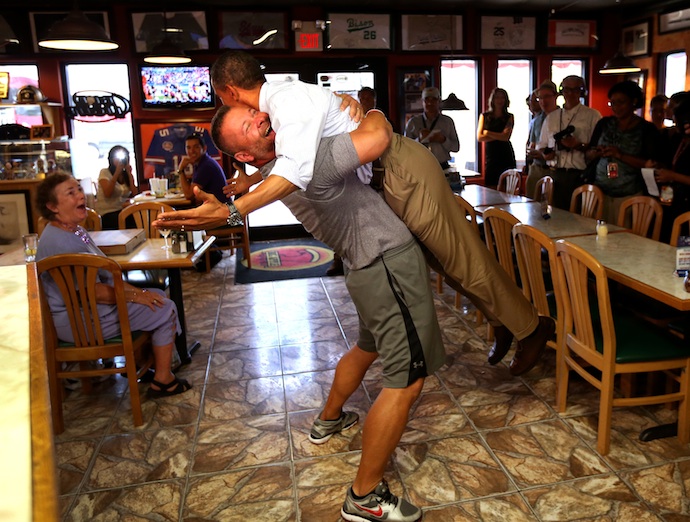
Some blowback regarding the Pizza House owner and registered Republican who gave Obama a bear hug:
But once word got out that Van Duzer is a registered Republican who voted for Obama in 2008 and is planning to do so again in November, angry conservatives flooded his restaurant’s Yelp page with negative reviews and began staging a boycott. (Sample gem: “I cringe at the thought even of eating at this Big Crapple Pizza. Knowing O’Hussain was there totally creeps it out for me.”)
This from the same crowd who absolutely adored “Joe the Plumber”? That was a guy who approached Obama with an obviously fabricated premise about wanting to buy his boss’ business, clearly making up a projected income at exactly the level where Obama suggested we start taxing people higher. Joe was making nowhere near that amount, and so constructed a fantasy in order to put him in that range. And still he flubbed the intended “gotcha” moment, conceived to put Obama on the spot for raising taxes on an “ordinary” American like him: even under his artificially inflated income, Obama’s plan still would not have raised taxes on imaginary-Joe, or at least it would have done so very minimally. Even more ironic, under the two candidates’ tax plans, real-life Joe would have gotten a way bigger tax cut under Obama—and as things have turned out, Obama over the past four years has not even raised imaginary-Joe’s income tax level, either.
And yet this posing faker was immediately embraced, adored, and vaulted to celebrity-hero status among the same crowd that now heaps hatred and invective upon a small business owner who simply got a bit giddy at having the president drop by—attacking his business and trying to shut him down just for liking the Democrat in office.
That’s a great way to represent the “Real America” conservatives believe in.
Instead, conservatives should look towards this guy as a role model, not for who to vote for, but rather for attitude and reasoning skills. He makes an excellent point about what “building it yourself” really means:
So you’re not one of the people who feel like he’s let the country down in his first term?
The bottom line is this: I own a small business. I take accountability for my business. I’m not looking to blame the government. And if people had the same mentality of taking care of their own businesses instead of looking to blame somebody when things are a little bad—just tightening things up and doing the best they can—I think we’d be better off that way, too.
Read the interview with him; he comes across as not just reasonable, but smart and compassionate. The guy got his own—and then immediately started working to help others, raising money for families in need and organizing blood donation drives.
I’m not sure what makes him a Republican; I’m sure I would disagree with him on some issues. And even if he had voted for McCain and planned to vote for Romney, I feel like I would still really like this guy. He’s what you wish all, or even most Republicans could be like—and, for that matter, what more Democrats should be like as well.
The unemployment rate just dropped to 8.1%—and yet virtually every news source is saying this drop is due to more people dropping out of the workforce—not being fired, but quitting looking for work, which is even worse.
Maybe so, I’m not an economist. But then, how was I able to predict this drop back in March? On March 10, six months ago, I wrote:
The bad news for Obama is that, for the next 4-6 months, unemployment will not be so hot–it may drop a point or two over the next 4-6 months (numbers might show a drop in June or July more than other months), but may not really start to change again until just before the election–which is the good news for Obama. The rate should start dropping regularly come September, when we see the numbers for August.
That is more or less exactly what has happened. The rate drifted down by a point a few times, before drifting back up. I was right to be unsure about a pop in June or July, and I was right that for 4-6 months, the rate would stay flat.
But my key prediction was that the rate would start showing a drop come September, one with momentum. That momentum would be marked by a more significant change than a single-point drift like we have been seeing.
Well, the new jobs report is out, and guess what? the rate dropped by .2%. Changes of .2% or more generally indicate more than just a marginal, one-month shift. We’ll see more evidence on October 5 when the next report comes out; if it falls below 8%, then my prediction will be confirmed more surely.
Still, for the moment, I feel confident in saying “I told you so.” An Econ 101 teacher will tell you that unemployment is a lagging indicator, usually by 9 months.
Now, I may be mistaken about what it lags behind—it may lag behind other factors, and may be more in line with job gains or losses. However, I find it at the very least interesting that the unemployment rate so neatly falls in line with jobs reports like it has over the past several years.
The fact that I was able to predict the unemployment rate six months in advance after noting this has to be worth something.
Still, we have yet to see what happens. If my predictions truly bear out, we will likely see an unemployment rate of 7.8 or 7.9 percent (more likely the latter) a month from now, followed by another drop of .1 or .2% in November. Which makes me wonder, will the November numbers come out before or after election day? In any case, I expect to see the rate at 7.6% to 7.8% in November’s report—as I predicted back in March. We’ll see.
What Obama really needs, though, is not just the unemployment rate, but the jobs numbers as well. While it’s good that we got almost 100,000 new jobs last month, I will be much happier to see more robust growth next month, with a re-adjustment of August’s numbers, upwards of course. That, with my expected unemployment number drop from the low eights to high sevens, could give Obama a nice kick upwards, enough to cancel out the bad news this month.
Have they forgotten what the economy was like four years ago? Maybe they meant “five years ago” or something.
Sadly, I think they are depending on people having forgotten about the near-collapse Republicans brought us to; they need Americans to forget that Obama’s stimulus, however underpowered, still halted the horrific plunge that had us losing 800,000 jobs a month and brought us quickly back to positive territory. They instead rely on people simply remembering a vague time in the past when things were better, and that things aren’t so great now—and undoubtedly hope that people won’t think too hard about the specifics. This right-wing blogger, providing an apt example, asks the “four year” question and then shamelessly compares the economy now to the economy three years ago.
The fact that they can ask that question now and not be torn to pieces is hard, cold proof that Americans don’t know as much as they should, don’t remember as sharply as they could, and that the media, far from being “liberal” or “in the tank for Obama,” is in fact criminally derelict in its duty as envisioned by the founders—to ensure an informed electorate.
Otherwise, how could Republicans refer back to a time of economic near-collapse and ask Americans if they want to return to that, and not have the people, much less the press, fall on them in a wave of incredulous contempt?
I am struck by how Republicans have begun to criticize Obama over Afghanistan. Clint Eastwood seems to think that Obama started the war. As with bin Laden’s capture, Romney and Republicans try to find any way they can to criticize Obama for a war Republicans fumbled and Obama has finally brought to a close. And though Romney has not, like many in his party, promised war in Iran, it is implied if we are to take his statements on the issue seriously—and a war with Iran could turn out to be even longer and bloodier than the last two we have only just now begin to close the door or.
And yet, somehow, still, Republicans have the reputation for being on the side of the soldier, when nothing could be further from the truth.
The public image is reversed, but the public image is wrong. As General Wesley Clark so aptly put it in 2004, “Republicans like weapons systems; Democrats like the soldiers.”
Republicans use soldiers as tools regardless of their safety. Republicans started two massive land wars in Asia, the longest wars in U.S. history, bound to be meat grinders for the soldiery. One was made necessary by a security blunder by a Republican administration and was not only mismanaged by that administration, but was all but forgotten about by them. Bin Laden at Tora Bora. Allowing the Taliban to resurge while Bush started a wholly unnecessary war in Iraq. Soldiers were sent in without body armor or armor for their vehicles. Oil fields were protected while armories full of weapons later used against the troops were left open to looters. Conservatives’ plans for Iran show similar disregard for how many of the military will be struck down as a result. A third land war in Asia within just 15 years? I would agree that a draft would be a bad but perhaps necessary way to bring the real cost into focus for these people, except that these people have always found ways to shelter their own, draft or no; Bush was an excellent example of this.
Republicans love to use the military as backdrops to make them look strong. It seemed that every other public speech given by Bush had a wall of soldiers in the background. Bush made huge PR runs on aircraft carriers (Mission Accomplished!) and on military bases (where soldiers who were not loyal Republicans were pre-screened and locked out of the Thanksgiving dinner Bush used as a PR event; non-Bush-supporters were kept in the barracks and given MREs instead). Meanwhile, military coffins and funerals were banned from sight, out of fear that Americans would care too much for the fallen, and Bush did not even deign to sign letters to families whose loved ones had given the ultimate sacrifice.
But worst, Republicans’ greatest abuse of the soldiery is to use them as a human shield. Reagan used the valor and sacrifice of the troops he sent needlessly and uselessly into Lebanon as a shield when a reporter questioned his reasons for sending them, castigating the reporter for daring to question the honor of the troops, when the reporter was only questioning Reagan’s judgment in putting them in harm’s way. Bush used this coward’s retreat often; any attack on him was morphed into an attack on the troops; a new rule was established that you cannot criticize the president while troops are in the field, a rule conservatives abandoned the moment Obama came into office.
Meanwhile, Republicans cut benefits for the troops, mercilessly extended their tours of duty, and left their families with less and less support, spending money primarily for enticements to get more people to sign up, but then ignoring their needs once recruitment is no longer an issue. While lavish fortunes were spent on mercenaries and fortunes are sunk into often unneeded Defense contracts, relatively trifling amounts that could make big differences for soldiers are struck down by Republicans. The IAVA gives methodologically sound ratings to Congress based upon votes that affect veterans, rating in which Republicans consistently score dead last.
Democrats, on the other hand, have acted with care and caution where it has concerned the troops. Clinton’s war in the Balkans and Obama’s actions in Libya were examples of modern war by Democrats: good causes (stability and human life, not oil) in actions defined by the surgical use of force with minimal or even no loss of life among the soldiery. What funerals there were were not hidden; due homage was paid. Obama has been less than satisfactory in Afghanistan, true; but had he been in charge from the start, do you really think the war would have lasted 11 years? The only bloody military actions Democrats have presided over since Vietnam have been ones left them by presidents named “Bush.”
In the meantime, after the last Bush left, al Qaeda has all but been decimated, with bin Laden at the bottom of the ocean with a bullet in his head. For which, conservatives have only complaint, studiously avoiding any praise for Obama where they would have ordered apotheosis had a Republican been in office.
Democrats do not shy from giving speeches in front of troops, but it is not the common standard that it was for Bush and Republicans that came before. They spend more time actually doing stuff for the troops as opposed to only using them as a convenient backdrop.
Democrats do not use the troops as a human shield. You did not hear Clinton and will not hear Obama saying that an attack on the president is actually an attack on the troops.
But mostly, Democrats care about the soldiers in a contrast with conservatives which could not be deeper or more sharp. Where Republicans cut benefits for the troops, Democrats restore and even shower the troops with help.
Republicans not only disapprove, they despise this.
That’s right. I do not exaggerate. Allow me to give a definitive example.
Less than a year ago, conservatives ripped Obama for praising the troops. They created the false impression that Obama had never said anything good about the soldiers, but then suddenly started praising them for political gain; a false claim, of course.
But the worst part was that they accused Obama of actually abusing the troops, making them into “victims dependent on social-welfare and medical services.” Yep, that’s right. By giving the troops education and job assistance, by giving them good medical care upon their arrival home and paying attention to the emotional scars which have increased the suicide rate, Obama is actually, in the conservative’s view, disrespecting the troops.
Better to do it the conservative way: give them a handshake, salute them, mouth a few cheap platitudes—and then leave them to fend for themselves in a shattered economy in which your are dismantling health care.
That, apparently, is how you “support the troops.” Use them, grind them down, pose with them for a photo shoot, and then abandon them so they can learn self-reliance.
What astonishes me is that the men and women in uniform still trend conservative. Well, maybe not so much, considering the conservative cultural and religious influences built into the military infrastructure; how Fox News and radio shows like Rush Limbaugh and Laura Ingraham are featured in military media.
No doubt the message below will be ruthlessly ripped by the conservatives. The troops are for swiftboating, not for supporting godless liberals.
All original content on this site is owned by and copyrighted by the author. If you wish to reproduce beyond Fair Use provisions, you must leave a comment and ask for permission.