Archive

Archive for October, 2012

The Popular Vote

October 30th, 2012 5 comments

The question is coming up: what if Obama wins the electoral vote but loses the popular vote? In particular, how would conservatives react?

It’s easy to predict of course. Remember, they had no problem at all with Bush being elected despite losing the popular vote and winning Florida by just a few hundred votes despite the illicit felon’s list and the botched-ballot voting in Miami-Dade, both of which leave zero doubt that Florida intended to elect Gore, that Gore would have been the winner had actual intention of voting, not the bungled outcome, been respected. Not only were they OK with that, they were adamantly, even aggressively resolved to make sure it stuck, and suggested that anyone who disputed it was a whining partisan crybaby.

So, naturally, they would, if grudgingly, accept Obama, right?

Of course, you know the answer to that.

They would either completely forget about 2000, or else would use it as a reason to claim Obama didn’t win the election—on the basis of liberals protesting Bush’s election legitimacy. They would equate the Florida scandal with imagined widespread voter fraud, having primed right-wing America into believing that there must be millions of stolen Democratic votes, imagining the current “fraud” to be far worse than anything in Florida—thus erasing any doubts about Bush’s election while assuring themselves that Obama cheated and stole the vote.

Despite, of course, the fact that such theft is virtually non-existent. No matter that the fraud went completely the other way, with who knows how many Democrats discouraged, intimidated, suppressed, or outright blocked from voting this year. No matter that Republicans, controlling more state houses in key areas, gerrymandered the crap out of their states. No matter that early voting has been curtailed or shut down wherever possible to depress Democratic turnout, even while attempts were made to expand early voting for Republican counties. No matter than non-English ballots were distributed with the wrong election date. No matter that even states ordered to cease Voter ID suppression tactics still put up billboards using taxpayer money, in particular in Spanish, telling voters that IDs were still required, while other billboards threaten low-income and minority voters with jail should they dare to vote. Even non-partisan evaluations of how Hurricane Sandy depressed votes in the solidly left-leaning Northeast will be explained away or dismissed.

Above and beyond all of that, many will simply cry foul over the simple fact that he didn’t get enough votes. Despite the fact that back in 2000, many claimed Bush even had a mandate (including, most prominently, Bush himself), and the right wing went along with that—none of that will matter, none of it will register.

If Obama gets elected while losing the popular vote, the vast majority on the conservative side will instantly begin railing about illegitimacy and how he’s not the “real” president. The myth of “voter fraud” will become a legend, a rallying cry. I would not be too surprised if calls for impeachment were to arise and be picked up by some sitting Republicans in Congress, or if there were major surges in calls for more “voter fraud prevention” laws, amid a host of conspiracy theories and renewed calls for secession of the South.

The same people who admonished protesters in 2000 on the principle of maintaining the legitimacy of the process and unifying the country would easily tear that process to shreds and the country asunder—if it’s not their guy who gets rallied around.

Owner’s Rights, Copyrights, and Licensing

October 29th, 2012 Comments off

I’ve been on my high horse about licensing for some time, and, from recent events, I think more and more that such a concern is justified. There are cases going before the courts now about reselling textbooks from overseas.

Students at U.S. colleges hurt from outrageous prices and resale-avoidance schemes related to textbooks; any college student knows the frustration of hundred-dollar books, rip-off college bookstores, dodgy buy-back setups, and textbook “editions” obviously designed not to improve the book but to make used book sales impractical.

Now the publishers are fighting back against students who found a loophole: publishers sell identical textbooks cheaper in other countries, so why not import? Well, because publishers don’t like loopholes, so they used licensing to shut it tight.

The problem: licensing is basically a way of saying, “you don’t own what you just bought.” Intended to protect intellectual property, it is now being used to protect physical property in a way that could have serious implications on ownership.

Seven years ago, I expressed it like this:

Think about it. Plug in any other kind of product into that equation. What if a store that sold you oranges tried to sue a company that made juicers on the grounds that they had rights and controlled what you did with an orange after you bought it? That the orange seller deserved a cut of any sales having to do with changing the form or consumption of the oranges after the sale? That you would have to pay extra if you wanted to do anything with the orange except peel it and eat it straight? That turning it into juice would require an extra fee to the orange grower, or that using the rind in baking confectionaries would be prohibited?

Ridiculous, right? But maybe not so much.

Take, for example, a guy who bought several original boxes of software, with install disks and serial numbers; the software was not being used on any computer. He tried to resell the software on eBay, but the software maker shut him down, and won the case. The license agreement said you could not re-sell the product.

The case is important because the sale was not of the intellectual property per se, but of the physical set in which it was obtained. The critical point is that copyright laws were intended to keep people from copying and reproducing intellectual property. For example, I take Microsoft’s latest software, slap a new name on it, and sell it as my own software—that’s a copyright infringement. Copyright law was not intended to keep people who had bought physical originals from reselling them. But that’s where it is right now.

Have you ever bought a used book? You may not be able to in the future. It’s intellectual property, after all. Selling the physical container of that, apparently, is not OK—according to the recent textbook case. It could mean that publishers could slap a license on any book that says you cannot resell it (this already applies to all ebooks, after all), and presto, no used book stores.

It could even mean libraries are under threat. Even if borrowing is allowed, it might carry an extra price. Anything is possible under licensing. I have little doubt that librarians will have to carefully read the license agreement of books they want to add in the future.

But hey, it stops there, right? Well, not really. A few years back, Costco tried to import and resell Omega watches sold for substantially less overseas. Omega sued, and tried a trick: stamp an image on each watch, copyright the image, license it, and use copyright law to keep others from buying and reselling. The case tied in the Supreme Court, allowing Omega victory at a lower court to stand, albeit in a limited way (and Obama appointee Kagan, who recused herself as she had represented Omega in this case, could well have sealed it at the Supreme Court level had she ruled).

Now, apply that to the oranges. Let’s say somebody who makes oranges stamps the peel with their logo, which is copyrighted. Boom. It’s intellectual property, terms can be dictated by license, and suddenly you don’t own the orange you just bought.

I know, you’re still not buying it. Pun intended—you won’t be “buying” much of anything in the future if this comes to pass. You’ll be renting it. And that’s my point. One rule about businesses: if they can find a way to raise prices and exert more control, no matter how ridiculous, they will do it. That is the nature of business: to go to any extent to make money.

And recent court cases are opening doors that fly in the face of what we used to believe was the fundamental basis of property ownership: you bought it, you own it. Business is trying to rewrite that: you didn’t buy that, you only signed a license agreement to temporarily consume it.

Still not a believer? Wait and see. The problem is, by the time you’re convinced, it’ll probably be too late to do much about it.

Categories: Corporate World Tags:

More False Equivalencies Over Debate Fact-Checking

October 24th, 2012 7 comments

FactCheck.org has more to be ashamed of in its “fact-checking” of the final debate. Once again, they go out of their way to create a false equivalency by making it seem like Obama and Romney were equally untruthful. They list ten “incorrect or twisted factual claims” during the debate, five from each candidate.

From Obama (who, strangely, is featured in 4 of the top five items, making him appear more untruthful), they cite distortions of Romney’s statements on Pakistan, Iraq, Russia, and the Detroit bailout, and dinged him for a claim about veteran employment.

From Romney, they cite the Naval weakness, “apology tour,” federal debt claim, taking credit for Massachusetts’ education accomplishments, and a claim about terrorism not being mentioned in the 2000 debates.

Here are Romney errors and lies they missed:

  • Syria is Iran’s route to the sea
  • Obama failed to deal with Syria and begged for help from the U.N. and Russia instead
  • Obama was “silent” on Iran’s Green Revolution
  • Obama said he’d distance ourselves from Israel
  • Obama wasted four years doing nothing about Iran
  • Obama has allowed “jihadists” to strengthen and spread
  • Government investments never make businesses grow and hire people
  • Claims about the nature of Medicaid and how states can run it better
  • Romney was strikingly bipartisan in Massachusetts, when in fact, he exercised the veto 844 times and failed to get his big-ticket items through the legislature
  • Romney will create 12 million new jobs
  • Romney will eliminate Obamacare unilaterally
  • Romney would stop Iranian oil imports that don’t exist
  • Romney will balance the budget (with a $5 trillion tax cut on top of Bush’s plus increased military spending)
  • The debt is Obama’s fault, is like Greece’s, and Romney’s plans will shrink the deficit in comparison

Ironically, FactCheck.org dings Obama for misrepresenting Romney on his Detroit statements, while Romney also misrepresented himself—but that was not mentioned in their analysis. In fact, Obama’s “inaccurate” depiction of Romney’s statements is kind of a weasel: Obama is dinged for saying that Romney did not approve of “government assistance,” when he was referring to direct aid; Romney said he’d approve federal guarantees for post-bankruptcy financing, which involves indirect government support for a private sector bailout—a bailout which would not have occurred. Calling Obama out for splitting hairs while not citing Romney’s lies about what he proposed is completely inappropriate for a fact-check like this. Romney lied more significantly, but Obama is called untruthful for not being specific enough.

How about Obama “lies” left out of the analysis? FactCheck.org has dinged Obama in the past for claiming that Romney’s tax plan would create 800,000 jobs overseas, but it’s an interpretation based on Romney’s vagueness about what the plan would be exactly; so not including it in the fact-check was a good decision.

Other than that? Well, there’s one I heard on CNN, when they were “fact checking” the claim about the Navy. To my disgust, they called Obama the one who was wrong. Why? Because bayonets are standard issue, and so there are probably more in the military now than there were in the past. As if Romney’s vast overstatements about naval weakness are somehow even close to being equivalent to that. It was a throwaway line, a “zinger,” if you will, and part of a larger point which was 100% true: that the number of ships, especially over the span of a century, is not the way you determine naval power.

In short: Every single misstatement by Obama is listed save one or two inconsequential ones, while at least a dozen whoppers made by Romney are edited out of the fact-check. Romney lied his ass off, making bigger and more significant misstatements, and somehow, Obama gets top listing for inaccuracies in a determination that counts the same overall number of untruths?

This is the great shame of the media in this election: ever since the first debate, where Romney made his sudden Etch-a-Sketch move, the media has been willing to eviscerate Obama, while backing off on Romney. Probably as much to create a horserace which will get them bigger ratings than because of their conservative bias, but the motive makes little difference.

The fact is, Romney is getting away with a massive amount of lying, and the media is his immediate accomplice.

There Ought to Be a Law

October 22nd, 2012 Comments off

Marco Rubio is flashing his conservative credentials in the only way possible nowadays: by acting like an idiot.

“Just because they call a piece of legislation an equal pay bill doesn’t make it so,” he said on ABC’s “This Week.” “In fact, much of this legislation is, in many respects, nothing but an effort to help trial lawyers collect their fees and file lawsuits, which may not contribute at all whatsoever to increasing pay equity in the workplace.”

The 2009 law makes it easier for women to sue their employers if they’re being paid less than men for doing equal work. Rubio said he supports the principle but opposes the Ledbetter legislation as a way of achieving it.

“If you’re the most qualified person for the job, you should be able to get paid — you should get paid as much as your male counterpart,” he said. “Everyone agrees with that principle.”

Yes, what we need is a law which actually outlaws unequal pay! That would completely fix the problem, without any need for trivial stuff like a need for a means of redress!

If only there were a law on the books which makes it illegal for an employer to discriminate between employees on the basis of sex by paying women at a rate less than paid to men for equal work on jobs which require equal skill, effort, and responsibility, and which are performed under similar working conditions!

Oh, wait.

The Equal Pay Act of 1963 is a United States federal law amending the Fair Labor Standards Act, aimed at abolishing wage disparity based on sex. …

The law provides (in part) that:

No employer having employees subject to any provisions of this section [section 206 of title 29 of the United States Code] shall discriminate, within any establishment in which such employees are employed, between employees on the basis of sex by paying wages to employees in such establishment at a rate less than the rate at which he pays wages to employees of the opposite sex in such establishment for equal work on jobs[,] the performance of which requires equal skill, effort, and responsibility, and which are performed under similar working conditions, except where such payment is made pursuant to (i) a seniority system; (ii) a merit system; (iii) a system which measures earnings by quantity or quality of production; or (iv) a differential based on any other factor other than sex [ . . . . ]

So… what Rubio is complaining about is that women, who, famously because of Ledbetter, were not able to get any form of redress if an employer cheated them for years or decades, now have the ability to do so.

He is claiming outright that the only effect the Ledbetter Act will have is to line the pockets of trial lawyers.

Hmm, let’s see. Before the Ledbetter Act, it was already illegal to discriminate, but if the employee found out, then there was, according to the Supreme Court, nothing that they could do about it, because, according to them, Congress had not made sufficent provision for redress.

So, what reason would there be for an employer who is already unscrupulous enough to discriminate by gender to not do so? As far as I can tell, none.

With the Ledbetter Act, however, they can now be sued for violating the law.

In short, there is now a reason for them not to discriminate.

Senator Rubio, am I going too fast for you?

Of course, Rubio likely knows this full well. The whole “trial lawyers” attack is now a conservative standard. People hate lawyers. Make them hate trial lawyers even more, because trial lawyers contribute to Democrats. Why? Because Democrats side with ordinary people who, when screwed by wealthy people hiding behind corporate shields, have only one way to get redress, which is to sue them. Which, as a by-product, profits trial lawyers.

So, instead of defending the fact that conservatives are really trying to protect wealthy people from any responsibility or liability for intentionally harming the public in any number of ways, instead pretend that its all about scummy trial lawyers.

Which is why Rubio is acting like an idiot.

Windows 8: Upgrade to Confusion

October 22nd, 2012 Comments off

Windows 8 will be released very soon, and when it comes out, we’ll see if Microsoft is completely stupid or not.

The test: whether or not Microsoft has added a tutorial to Windows 8. One which pops up immediately and tells people how things have changed, and how to get around the OS.

With Windows 8, the Start Menu is gone, cannot be brought back, and has been replaced with the now-infamous start screen. Going from one place to another now requires new actions which are not apparent because they are not visible on the screen. It is anything but intuitive to figure out that moving your cursor to a corner will bring up a screen you are looking for.

When I first downloaded Windows 8 Consumer Preview, I was hopelessly confused. I could not figure out how to get around—and I’m no n00b to Windows, either. There are bound to be lots of people who will be stymied when they see Windows 8, and who will hate the transition. “What?! I can’t bring back the Start menu? Why not?!?”

As I noted previously, Microsoft itself, when making a case for how it was better than the Mac OS, used as one of their key points, repeatedly, that Windows was better because people were familiar with it, and would have to spend time and effort readjusting to the Mac OS.

When I downloaded the Consumer Preview for Windows 8, however, there was no tutorial. Nothing to prepare you for things being different.

That astounded me. You completely change the UI and you leave users completely in the dark about how to operate things? Not even an apparent “Help” icon? Are you kidding me?

When Windows 8 comes up for the first time, it should have a tutorial (which can be dismissed, of course) which points out all the new UI features and the ways users can operate them. Once finished, the tutorial should then shrink to a small question-mark button on the Start screen, and stay there, with a note to users that they can disable the button if they wish.

Anything short of that will be, in my mind, proof positive that Microsoft is being run by morons. Even with it, Microsoft is throwing away one of their key advantages as they themselves define it. Without it, they are virtually begging for another Vista-level migration to the Mac.

Seriously, they have had eight months to realize that people are being stumped and aggravated by the lack of instruction. It should have been obvious before the Consumer Preview; it should be positively glaring by now. And there’s not shame in a tutorial; lots of people do it, it’s considered a feature, not to mention a necessity often times. Without it, people will be lost.

And then there’s the “What For?” effect: Windows 8 is mostly an upgrade for tablets. The new UI is the only notable new feature, aside possibly from the App Store—excuse me, the “Windows Store.” (Really, Microsoft—if you absolutely have to integrate mobile and desktop operating systems into one, why not make the desktop features dominant on desktop machines, and tablet features dominant on tablets, and have both set of features accessible on both? Why force desktop users to use an OS which is not appropriate for a desktop?)

This means that people who “upgrade” to Windows 8 on a laptop or Desktop will be getting a new and confusing user interface designed for something different than their current device, while at the same time, they get to be confused by a new and unexplained interface setup and lose the one tool they have spent most of a lifetime getting accustomed to—the Start Menu.

That’s pretty much it. A few other bells and whistles, like having a USB-based version of the OS, a new backup system (strikingly similar to Apple’s), and a smattering of other changes they won’t notice because they’ll be spending too much time trying to figure out how the hell to do even the most basic things.

So, Microsoft. Tutorial? Or not?

Romney’s Tax Lie

October 18th, 2012 3 comments

People are now coming away with the impression that Romney is vowing not to cut taxes for the wealthy, and instead focus only on middle-class tax cuts. In fact, many people now are convinced that Romney wants to not only leave the base tax levels for rich people unchanged, but to get rid of all or almost all of their deductions and loopholes. The impression is that he’ll actually make wealthy people pay more in taxes!

In reality, this is a very similar con game to the one Bush played in 2000; make it sound like the tax cuts are aimed at the common man, then shovel the lion’s share to the rich. The difference is that Romney is being even more dishonest than Bush was.

The fact is that Romney has not changed his tax plan one bit. He still plans to cut taxes 20%, or one-fifth, across the board, which is a far bigger and better deal for rich people whose income may still fall under the highest marginal tax rate. In addition, he would eliminate capital gains taxes (a major source of income for rich people cut to zero), eliminate the millionaires- and billionaires-only estate tax, and slash corporate tax rates by almost 30%. And, oh yeah, he would scale back tax increases on wealthy people contained in the ACA, and would extend both of the Bush tax cuts which mostly favor the wealthy. More good news for rich people.

In other words, he will not only cut taxes for rich people, he will cut taxes mostly for rich people. The vast majority of savings go to millionaires and billionaires.

For more details on how Romney’s tax plan will be massively slanted to favor rich people, see the analysis below the rule. But for right now, I want to address how it is that Romney is making people think he’ll somehow raise taxes on wealthy people, when the exact opposite is true.

In short, he’s playing with language. Pay close attention to the exact wording, and keep in mind that each statement is made within a context which is almost certainly different than what you think it is.

Here he is at the first debate:

My view is that we ought to provide tax relief to people in the middle class. But I’m not going to reduce the share of taxes paid by high- income people. High-income people are doing just fine in this economy. They’ll do fine whether you’re president or I am. … I will not reduce the share paid by high-income individuals.

And at the second debate:

Now, how about deductions? ‘Cause I’m going to bring rates down across the board for everybody, but I’m going to limit deductions and exemptions and credits, particularly for people at the high end, because I am not going to have people at the high end pay less than they’re paying now.

The top 5 percent of taxpayers will continue to pay 60 percent of the income tax the nation collects. So that’ll stay the same.

Middle-income people are going to get a tax break.

… And I will not — I will not under any circumstances, reduce the share that’s being paid by the highest income taxpayers. And I will not, under any circumstances increase taxes on the middle-class.

Emphasis on the word “share” is mine. And for a reason.

He’s not saying that he will not lower taxes for the rich; he’s saying that he won’t reduce the share of taxes they pay. And in that, he is only referring to the “shares” in the context of the 20% across-the-board cut. That statement does not include the capital gains and estate tax eliminations, nor does it count the tax cuts for wealthy people gained by eliminating the ACA, nor does it count the money they will gain through the corporate tax cuts.

Get it? Everyone gets their share cut by 20%, so no one’s share is cut less than anyone else’s. The 60% thing? A fake measurement which can be jiggered to mean whatever you want it to mean, and even at that, is still probably an outright lie based on assumptions which will absolutely not be true under his tax plan.

But wait—Romney clearly said, “I am not going to have people at the high end pay less than they’re paying now.”

Listen carefully—he said that in the context of deductions. And true enough, he has said he’ll cut deductions, but that won’t matter because the deductions rich people lose will be dwarfed by the other tax cuts Romney is giving them. So they will be paying a lot less than now… but not because of deductions!

What Romney is saying is very carefully phrased, so he can make many statements which sound like he’s only cutting taxes for the middle class and is not cutting anything for the rich—when in fact, the exact opposite is true.

This is what you can call “masterful deception.” People are buying it. And the media, for the most part, is not calling him on it.


Now, how about the details of Romney’s tax plan? How will this be a “fair” cut where no one pays any less a “share” than anyone else?

Income over $388,350 is taxed at 35%; Romney would cut that by one-fifth to 28%, a 7% cut.

However, if you make less than $35,350, your one-fifth reduction brings your 15% margin down to 12%, or a 3% cut.

Worse, the 7% cut applies to all income over $388,350, which, if you make tens of millions of dollars a year, is almost all of that. But if you make less than $35,350, then your first $8700 only gets a 2% cut, and the remaining $26,650 gets a 3% cut.

So, which is bigger: a 7% cut on millions of dollars, or a 3% cut on tens of thousands of dollars? Let me get out my calculator….

Loosely speaking, someone making $10 million in regular income stands to gain close to $700,000, while someone making $40,000 will get less than $1000.

But that’s not all. Romney would cut corporate tax levels from 35% to 25%, a reduction of 29%; most of that money would go to rich people. He would eliminate—cut to zero—the capital gains tax, which is a primary source of income for many rich people. Many who are wealthy are actually capable of designing their income (e.g., choosing stock options instead of salary) so it is more capital gains than not. In addition, he would eliminate the estate tax, which currently only taxes inheritance income beyond $5 million.

All three of these are tax breaks for the wealthy, and all are even bigger than the additional 20% cut on normal income that Romney would also give to rich people. And they keep the Bush tax cuts. And they get the ACA taxes cut.

All of which means that the tax rate for someone making tens of millions of dollars could fall to zero. Making the elimination of deductions meaningless. Remember that Romney paid 14%; he did that in large part due to the 15% capital gains tax, which would drop to zero under his plan. Romney would pay almost nothing in taxes.

In the meantime, if you earn $40,000 a year, Romney’s break could save you $935.

But if your name is Mitt Romney, you could save millions. And if your name is Hilton, or Walton, or Koch, you could save billions.

Now, Romney says he’ll cut deductions and loopholes to pay for it. The problem is, he won’t say which ones. The only thing he has said is that he won’t cut middle class deductions, or at least not anything significant.

The problem is, the math doesn’t work out. That now-famous Tax Policy Center study crunched the numbers, and even assuming the most favorable outcome—that Romney really does intend to get rid of every tax loophole for the rich—he would still have to cut into middle-class deductions to the tune of $2400.

Romney can’t have it both ways. Either his first-year tax plan will increase the deficit by hundreds of billions of dollars a year for the next decade, or he will have to hike taxes on middle class families up to more than double what they save from his tax cuts.

And the poor, by the way, get nothing. Romney is true to his word, he is not paying any attention to the 47% at the bottom. Oh, they’d stop getting food stamps. Because we can afford to cut taxes for billionaires to virtually zero, but we can’t afford to buy milk or bread for starving people.

After all, Romney was quite clear: they are victims. He wasn’t kidding.

Categories: Election 2012, Right-Wing Lies, Taxes Tags:

Debate Notes

October 17th, 2012 8 comments

Neither candidate answered the student’s question about finding a job; they took it as an opportunity to lay down their base arguments.

This is much more like the Obama we should have seen last time. Minimal hemming and hawing, more organized, understandable answers. He sounds a bit too much like someone who is laying down the campaign talking points—but he’s got energy, and, more importantly, he’s answering Romney’s BS.

Obama finally came around to answering both questions: “That’s gonna get Jeremy a job, that’ll lower the price of gas.” I think that’s important; both were going too high about policy and attack points, Obama came down and remembered that the audience had actually asked a couple of questions and wanted more relevant answers.

Romney just lied about oil production—again!

Good, Obama at least mentioned it.


Obama, look at the guy sometimes.

Wow, Romney handed over the mic!

Hah—Obama is owning the stage, rolling over Mitt.


Ooohh. Mitt just used the gas price lie—the price fell because of the recession. Liar.

Good! Obama gives the right answer.


Romney steamrolling the moderator, stealing stage time. I hope they dock him for that—they probably won’t.


His 20% tax cut, and specifics on deductions—the question has come directly. What will Romney answer?

Romney: I want a middle class tax cut—ignore the fact that most of the money goes to the rich. He’s now sailing into the middle class crap. Deductions: I will limit deductions particularly for wealthy people (emphasis mine, a key weasel). Then he uses a bogus “rich will continue to pay 60% figure.”

THAT’s his dodge: he seems to be saying that he won’t lower taxes for the rich, what he’s ACTUALLY saying his he won’t reduce their SHARE. NOT the same thing—and probably a lie.

Then he lies by making it sound like he won’t hurt the middle class, and somehow the deficit won’t explode. Obama should start with: the math won’t work.


OK. Obama is not answering Romney’s tax lie up front, but he is making the point that he DID cut taxes, and contrasting how their approach to the rich will work. However, he should point out Romney’s BS which made him sound like he’s not going to lower taxes on the wealthy by 20%.


“I’m not looking to cut taxes for rich people.” Bull! He wants to cut their taxes by 20% AND keep all their previous cuts under the Bush tax cuts!

Obama HAS to point this out.


Crowley just threw Obama a softball—and he missed the main point! Romney WANTS TO GIVE THE RICH A 20% TAX CUT. He is not saying that directly. Gah, Obama, LEAD with that!


Crowley cut off Romney’s obvious BS line about how “six studies” support him. So, Romney is now evading answering the key questions: how will you pay for it, and how will you pay for it if it doesn’t add up.

Romney simply says “it adds up,” and then launches into an attack—no specifics.

Then he gets to deductions—and more BS. He gets cut off, thank god.


Obama gets the equal pay for women question. He starts with personal stories. I presume he’ll mention Ledbetter. Am interested in how he’ll go beyond that…

OK, there’s Ledbetter. … but it seems that he doesn’t have anyplace to go after Ledbetter, except for generalities—Pell Grants, for example. Well, that won’t equalize pay. His only saving grace here is that Romney has even less than that. Disappointing, I’d expect more.

Romney, as predicted, has less. He put more women on a board. Wow, that’s solved it. After that, platitudes, then using extremes of certain stats to attack Obama and make it sound like he’ll be doing something on the topic. Obama was not strong here, but Ledbetter trumps everything Romney has just said.

Obama brought health care into it, contraceptive coverage. Good move. OK, health care was a point, and child care credits. Small stuff, but at least that’s in there.


New question: Undecided unimpressed with lack of movement, knows however that Bush caused most problems and wants to know how Romney is different.

Romney complains, whines, looks like he doesn’t understand the rules. Weak.

Then he gets in a few words, a quick lie about the health care issue.

His differences with Bush: really, energy and cracking down on China? Seriously? Balanced Budget? Bush said he’d do that too. Romney’s plan will bust the budget from day one.

Then small businesses—how is that different from Bush? Now he has segued not into differences with Bush but differences with Obama. “Small businesses” were just as much a sham used by Bush; this is a place where Romney is identical. Using the mythical small businessman as a false front.


Obama did not address the small business sham. But he did point out that Romney is even more extreme.


Tough question from an African-American voter: things are tough, I’m disappointed.

Obama’s answer is excellent: he’s giving a list of the very real accomplishments he’s done. But he also recognizes that people are hurting and has a plan for helping the rest. Examples: using funds from ending wars to build infrastructure and jobs, gearing up clean power for better efficiency and growing good jobs.

Now he’s contrasting with Romney: he’s going to tear these things down, or just do the same, and help the rich.

Romney: “I think you know better.” Very cutting remark. Brings out the 5.4%. Good attack (even if it lacks specifics about how Republicans blocked that).

“Double the deficit” lie!! Obama better jump on that.

Granted that Romney’s list is very painful and effective—it’s also 80% BS.


Crowley is fairly good on cutting off the candidates; I think both Obama and Romney have been cut down in response time.

Romney on Immigration: have a good system, give green cards… to people with higher ed and top-level skills. I won’t give amnesty, will punish illegals, won’t grant driver licenses. Kids should have a pathway (but also points out that it might require something like military service—if that’s the best path, that’s a fail).

Obama: we need to fix immigration; I’ve done my best, asked Congress for the rest. Border patrol: really? You’re touting stopping illegals more? Next, tagging illegals who are criminals? I don’t think that’ll play well. He’s talking to whites, not Hispanics now. I guess he figures that’s the crowd he has to appease….


Wow: Romney said “no” to the moderator and went off on his own. He can’t bully Obama, so he goes back to bullying the moderator.

Romney is bearing down on the whole “filing papers” line. Don’t know about that. Was that a real thing, something that made a real difference?


I was wrong—Romney just pwned Obama. Spouted a lot of crap about Obama investing in the Caymans. Obama looked like he was squirming. Not good.

And now he’s riffing on high-hope rhetoric? No. He has to answer what was said. He should have come out immediately on how Republicans obstructed.


The Libyan security question.

Obama is taking the tough question—but is answering a different one, the aftermath, not the security request answer. Romney will probably eat this up and spend two minutes bashing Obama on a very weak and sensitive spot.

Sometimes the answer is, this stuff happens. Nobody is prescient, and sometimes the wrong decision is made at lower levels which the president cannot monitor. But Obama can’t say that.

Romney is almost visibly drooling at the prospect of taking Obama to task on this as if this were the biggest crisis in the world, so he can take even more political advantage of the tragedy. Acting like Obama was blasé in the face of it.

His attack is not as savage as I thought it could be, but Romney is scoring points.


“Apology tour,” and “Leading from behind.” Ass.


Crowley throws Obama a softball, noting Hillary’s “Janet Reno” statement. Obama picks it up and hits it hard. Faces Romney directly—

Wow. He’s hitting this hard taking Romney to task.

Romney lied: Crowley supported Obama’s true statement. Romney now looks like a loser.

He saves it a bit, but still does not come across well there. We’ll see what the post-game show says about who was more right on that.


The gun question. Nice. Obama: “I love guns” (paraphrase). But: guns bad. Personal story about gun crime victim. Conclusion: enforce laws we have; “share your belief” that military-grade weapons should not be available. Wants an assault weapons ban (really?), and other vague “interventions” behind the scenes. Nice, but way too soft. This is a weakness of Obama, not moving on real gun control legislation. Trying to straddle the fence.

Romney: I don’t support any new laws OR JACK BOOTED THUGS TAKING AWAY YOUR GUNS! Er, otherwise, I agree with Obama.

Both candidates go soft and run away from the topic. A wash.

Romney turns it into an attack using the “Fast and Furious” thing. Obama killed people! He’s hiding something! He’s arming drug lords!

More sparring on mud, more vague, high-minded rhetoric.


Oh, Romney is going to fix things with China, just by “labeling” them as a currency manipulator. As if nobody knows that now. Empty, vapid. Stupid. Might sound good, but people who know what’s what are laughing derisively now.

Segues into mythical over-regulation, how Obama has destroyed jobs by regulating people trying to hurt people.


Wow. Obama is not going after Romney on the childish naivety on his “I’ll label China” idiocy. He really should point out how weak that would make a president look.

Wait, here comes China: but Obama focuses more on outsourcing.

Currency: has improved because I have pushed. Did not call out Romney’s stpudity.


Apple gets a nod—for being an outsourcer. How do you get Apple to bring jobs back?

Romney: China’s a cheater! I’ll say so and fix everything!

Obama: Some jobs won’t come back. Instead, I want to chase better jobs coming back. Good answer.


Misperceptions about you? Romney attacks Obama for trying to say he doesn’t care, then tells everyone he’s a God-loving, caring man.

Obama: I believe in free enterprise. I believe in self-reliance, risk-takers, in fair shots. I believe in puppy dogs, and—oh, wait, sorry.

Both candidates are painting soft portraits of themselves, attacking the other.

Obama is closing on the 47%. Excellent. Great move. Good closing shot against Romney. I want to fight for true Americans, Romney thinks you’re a victim.


Here’s my final assessment.

Who won this debate? In one sense, I think Obama wins on points; not a clear knockout, or a TKO, but has made his points more clearly and has better answers the crowd wants. Romney fumbled at least twice.

But Obama will win more than just that because it is relative to his bad performance and subsequent free-fall. I suspect that his numbers will now jump.

Categories: Election 2012 Tags:

False Compassion

October 16th, 2012 5 comments

Ryan recently showed up in a photo washing pots at a homeless charity. What a guy, right? Selflessly serving the poor.

But wait—something smells fishy. Ryan is a Rand devotee; serving others like that is an evil to someone like him.

Oh, right. He wasn’t actually helping the homeless, or serving a charity. He was faking it:

The head of a northeast Ohio charity says that the Romney campaign last week “ramrodded their way” into the group’s Youngstown soup kitchen so that GOP vice presidential candidate Paul Ryan could get his picture taken washing dishes in the dining hall.

Brian J. Antal, president of the Mahoning County St. Vincent De Paul Society, said that he was not contacted by the Romney campaign ahead of the Saturday morning visit by Ryan, who stopped by the soup kitchen after a town hall at Youngstown State University.

“We’re a faith-based organization; we are apolitical because the majority of our funding is from private donations,” Antal said in a phone interview Monday afternoon. “It’s strictly in our bylaws not to do it. They showed up there, and they did not have permission. They got one of the volunteers to open up the doors.”

He added: “The photo-op they did wasn’t even accurate. He did nothing. He just came in here to get his picture taken at the dining hall.”

Well, at least he washed a few dishes, right?

Um, no. The dishes he “washed” were already clean.

But at least his boss is actually compassionate, right? After all, he instituted that Romneycare program which provided insurance for a lot of poor people. And he’s proud of it. I think. Maybe. Or was that last week? Hard to tell, it’s like the wind direction changing. We need a RomneyVane.

But Obamacare, that’s an abomination. How dare Obama do for the nation what Romney did for Massachusetts! Nope. Obamacare has got to go, and Romney has vowed to deprive tens of millions of Americans of health care the moment he steps in to the Oval Office.

Sorry, poor people. That money is needed to pay for a fraction of the ginormous tax cut for wealthy people. You need jobs, after all, right? And we all know that a five-trillion-dollars-over-ten-years tax cut will create zillions of jobs, right? An accurate statement, as “zillions” is not a real number, just as jobs created by tax cuts are not real, either.

So, what will poor people do for health care? Not to worry, Mitt has a safety net to catch them:

Sunday on CBS’a 60 Minutes, Romney gave a hint about what he would replace Obamacae with. Scott Pelley asked him: “Does the government have a responsibility to provide health care to the 50 million Americans who don’t have it today?”

Romney replied “Well, we do provide care for people who don’t have insurance, people– we– if someone has a heart attack, they don’t sit in their apartment and die. We pick them up in an ambulance, and take them to the hospital, and give them care. And different states have different ways of providing for that care.”

Pelley was taken aback. He told Romney “That is an expensive way to do it…. in the Emergency Room.”

Romney responded: “Different, again, different states have different ways of doing that. Some provide that care through clinics. Some provide the care through emergency rooms. In my state, we found a solution that worked for my state. But I wouldn’t take what we did in Massachusetts and say to Texas, ”You’ve got to take the Massachusetts model.“

This idea is not new; one could call it ”The Republican Option,“ as Republicans have been suggesting the ER as a health care option for some time now. Essentially, it says, ”we’re not going to provide health care, and the states may or may not leave you to die.“

Paul Krugman has a little bit of data for Romney. Not to suggest that Romney is interested in data or anything. But you might be interested:

Even the idea that everyone gets urgent care when needed from emergency rooms is false. Yes, hospitals are required by law to treat people in dire need, whether or not they can pay. But that care isn’t free — on the contrary, if you go to an emergency room you will be billed, and the size of that bill can be shockingly high. Some people can’t or won’t pay, but fear of huge bills can deter the uninsured from visiting the emergency room even when they should. And sometimes they die as a result.

More important, going to the emergency room when you’re very sick is no substitute for regular care, especially if you have chronic health problems. When such problems are left untreated — as they often are among uninsured Americans — a trip to the emergency room can all too easily come too late to save a life.

A doctor followed up on that:

It’s true that EMTALA [the 1986 law requiring that emergency rooms treat you regardless of insurance status] requires a medical screening exam and stabilization of any emergency medical conditions. It does not, however, mandate admission to the hospital for treatment of conditions that are not currently emergent (e.g. cancer, kidney disease, and other more chronic conditions except related to certain complications). For example, if someone were to present to one of our emergency departments with some mild bloating and be found to have an abdominal mass, they may very well be discharged home for outpatient follow-up and treatment. If that person doesn’t have insurance, they will likely have difficulty obtaining that care.

So, got it, poor people? You no-good, parasitic 47-percenters? You’re covered for a heart attack, so long as you’re willing to dodge the debt collectors, but if you have anything that is not currently bleeding or gushing, you’re on your own. Cancer? Too bad. Tumor? Live with it. Or not. Liver problems? What, do you think this country is made of money or something? Go to your corner and wither, you pathetic loser. If you didn’t make it in the free market system, you don’t deserve help from it—because America is nothing more than the free-market system.

You should be thankful that Paul Ryan took the time to pretend to wash a few pots for you, you ungrateful wretch.

On Handwriting

October 14th, 2012 7 comments

Sullivan quotes Philip Maugham:

[T]here is good reason, argues Philip Hensher, for such a paradoxical evaluation of our handwritten style: “We have surrendered our handwriting for something more mechanical, less distinctively human, less telling about ourselves and less present in our moments of the highest happiness and the deepest emotion,” he writes, while simultaneously recognising that “if someone we knew died, I think most of us would still write our letters of condolences on paper, with a pen.” Hensher’s new book The Missing Ink: The Lost Art of Handwriting (And Why it Still Matters), rests on the argument that “ink runs in our veins, and tells the world what we are like”. Handwriting “registers our individuality, and the mark which our culture has made on us. It has been seen as the unknowing key to our souls and our innermost nature. It has been regarded as a sign of our health as a society, of our intelligence, and as an object of simplicity, grace, fantasy and beauty in its own right.”

I beg to differ. Handwriting is given status primarily because it was used for such a long time, and that was out of necessity, not preference. In that sense, it is like people preferring paper books over electronic media. As the modern alternatives push aside the old, those who prefer what they grew up with have a tendency to create ornate rationales as to why their outdated ways are superior, and bemoan their passing. I recall one person making similar claims about ebooks, saying that they lacked the “permanence” of books, in that electronic media is alterable. As if people often go about altering ebooks they read, or that it is impossible to alter printed material by reprinting it.

The fact is, handwriting is much more a chore than it is an art for most people. It can take years to learn and perfect, and many people never master it. And what art it may possess only exists because human beings have so imbued it. However, this art can be instilled far more effectively by the choice of phrasing than by the fact that it comes a little more directly from your hand.

Handwriting discriminates. It can be brilliant, artistic, illuminating— but only if you are skilled at it. Those who cannot master it as well are severely set back if handwriting is the only means of written communication. Their words, with value by themselves, are muddied by a discriminatory medium. Yes, the mastery of language use can also be discriminating—however, language use is at least necessary to communication. Handwriting is not.

Handwriting can also be a barrier to communication; no doubt you have encountered undecipherable scribbles, and have heard the almost clichéd stories of doctors’ unreadable scrawls. Instead of demanding that doctors learn penmanship, I would rather they spend more time learning how to be doctors, and use a keyboard to enter prescriptions.

Handwriting is the fashion industry of written communication: it is a superfluous and superficial art which can be expressive, but takes itself way too seriously. Just as the person who inhabits the outfit is far more important than the clothes themselves, the words and their meaning are what truly matter, the handwriting in which they are expressed being nothing but a decoration in comparison. And beneath the words, our feelings, choices and intent. Hensher’s conceit about expressing emotion is ill-considered, with the use of language itself towering over a lilt or a flourish of the pen. The worst handwriting in the world could be possessed by the most compassionate heart, articulating the most poignant or noble message. Handwriting can add a flair, but it can also rob us of expressiveness.

What it comes down to is the fact that the words, and the meanings they convey, constitute the soul of writing. Handwriting, in contrast, is almost frivolous. It is, in a sense, skin deep. Handwriting can add beauty, but barely any meaning. The great deal of time learning it can be better spent in other endeavors. Such as learning how to use words to express yourself—something that schools, ironically, have sometimes spent less time teaching kids than they have teaching them penmanship.

And what meaning it does add can be matched by fonts—perhaps even outmatched. Presidents and marketers alike choose fonts with great care to express their messages. Obama chose “Gotham,” a font reminiscent of city buildings, to express a sense of civil service, of community, of utility. Gotham is also sans-serif, a font category that implies a message of importance. His opponent in 2008, John McCain, chose Optima, a font associated with military service via its use in the Vietnam Memorial; this font was coupled with the use of a beveled nautical star, also with military connotations. Ironically—or perhaps not so—Optima is a “centrist” font, a sans-serif typeface which has hints of serifs. Romney, in the meantime, seems to have chosen a muddle of fonts which do not appear to have meaning directly relevant to his campaign—something telling to a designer. (Mitt’s team also seem to have forgotten that many fonts are not public domain.)

Each font has its meanings and associations. For example, I have done a good deal of hiring, and have found, in hindsight, that people who interviewed and later performed very well often had used Garamond as the primary typeface for their resumes. A humble yet elegant font, most people have it but almost never use it, and are unaware of how beautiful it can make a document look when used correctly.

Here’s the thing, though: with fonts, one can express a broad variety of associated meanings. With handwriting, you are more or less stuck with one style. While fonts can be easily learned and applied, handwriting takes great effort and practice, and yet is more limited in its ability to express specific messages.

Fonts are a great equalizer. They allow anyone to express through written language what only some can achieve by hand. Hensher’s implication that typography is “less human” is nothing but self-important hogwash. It’s like suggesting that one’s appearance is mechanistic and inhuman simply because you did not spend years learning how to make your own clothes. It’s like suggesting that it’s more human to make your own home or else you’re a soulless ant in a hive-like artifact, disregarding the fact that what happens within the home and what it represents to the people residing there has far more significance than the personalized shape of the moldings.

And signatures? Hah. I’ll be glad when they disappear. We’ll be far better off with biometric identification. In my job, I sometimes have to sign stacks of documents. I’m lucky if I can get a few signatures that really look the same. As a security measure, it sucks. I was at my bank a week or so ago, and had to sign a form. What followed was so absurd as to be almost comical: they told me the signature didn’t match well enough, so could I please add a little more to my first name? Oh, we need a dot above that “i.” And there should be a little hook at the bottom of that “P.”

Seriously. They spent about 5 minutes telling me how to forge my own signature.

No, handwriting is not some thing of unmatched beauty which is being crushed by robotic printouts robbing us of our humanity. Hensher says it is less mechanical, as if there is some inherent magic with piercingly specific meaning in slight variations in writing the letter “k.” He says typing is “less human”; well, so is driving a car over walking, and yet I bet Hensher thinks nothing of driving to the supermarket—also less “human” than a local family-run grocer. Or maybe I’m wrong, and the guy is Amish.

I will actually agree with him on one point: the use of handwriting in letters of condolence. But even that is more traditional than inherent, the current favor for such personal attention in crafting the letter being appreciated less for its intrinsic value than for its conventional meaning. When you think about it, such letters are actually less human than someone coming to you and delivering such a message in person. For those who desire permanence, electronic messages can be regarded as just as human, just as touching—for, as I stated earlier, the soul of a message is in the words chosen and their expression of human feelings and intent.

The only advantage I can see in handwriting is not from the art itself but from a by-product: the feeling of physical connection to the user. This paper with this message which I am holding right now was written by that person; it is a physical link which we, as humans, tend to appreciate.

But even that can be met almost fully with print—by printing the damned thing out. Sign it if you must, but still the paper comes from that person no less, was held in their hands and traveled to yours. Not as attractive for the traditionalists, perhaps—but this advantage, as far as I am concerned, pales before the advantages of “mechanical” text.

Tell me—were this blog post written by hand and scanned for display, would it be more meaningful? Or would you be just as likely to think, “Jeez, I’d rather not spend the extra effort to read his handwriting. Why didn’t he just type it?”

And if you think that print is less enthralling, then explain to me why literature is not considered some lifeless, inhuman art as a result of the fact that it is printed?

Handwriting, whether art or chore, is departing, and as far as I am concerned, mostly for the better.

Categories: Social Issues, Technology Tags:

Microsoft and Hardware

October 11th, 2012 6 comments

Steve Ballmer:

With the Windows 8 launch on the horizon, Microsoft chief Steve Ballmer today outlined a future in which the company will dabble in software and hardware “to deliver a broad spectrum of Windows PCs, tablets and phones.”

Yes. Because their forays into creating hardware devices have been so successful in the past.

He continues:

Ultimately, Microsoft wants to deliver products that offer a seamless experience. “So right out of the box, a customer will get a stunning device that is connected to unique communications, productivity and entertainment services from Microsoft as well as access to great services, and applications from our partners and developers around the world,” Ballmer wrote.

Sounds nice. And so original, too. Too bad Apple never thought up anything like th—HEY, wait a minute!

Every time Microsoft has tried to copy Apple in making some new device or sales strategy outside of pure software, Microsoft has failed rather miserably. Heard much about Zunes lately? Been to a Microsoft Store? How many people who just can’t wait to get a new Surface tablet do you know? Or even have a Microsoft phone?

Naturally, Ballmer talked up Windows 8 as a way to achieve this goal. “Windows 8 unites the light, thin, and fun aspects of a tablet with the power of a PC,” he said.

All on the assumption that you can cram both into one unit. That people will accept a tablet, designed to be held in one or both hands, as a serious authoring device. Or will accept as a serious computer a device which is essentially a tablet with a bad keyboard, holding this to be superior in some way to a Macbook Air or Ultrabook.

It is, essentially, the exact same strategy they used when they tried to sell “tablets” which were really modded laptops, again and again, and failed each time, before Apple said, “a tablet is something you hold in your hand, and so is much better suited for consumption.” A strategy which worked where Microsoft’s failed, allowing Apple to now dominate the mobile market. So here comes Microsoft again, saying, “Hey, tablets are popular now! People are certain to buy our tablets-and-laptops-are-the-same-thing strategy this time!”

Who knows. I could be wrong. Maybe with powerful enough chips, tablets acting like PCs will be all the rage. However, with Microsoft’s track record, something tells me not to have too much faith in their approach.

Categories: Gadgets & Toys Tags:

Samsung Galaxy S III and the iPhone 5

October 7th, 2012 2 comments

The Samsung Galaxy S III is currently at the #2 spot in smartphone sales in Japan, with the new iPhone 5 in the #1 spot. Admittedly, the iPhone 5 just came out, while the S III has been out since May.

On the other hand, the iPhone is counted as 6 different phones—once for each carrier (SoftBank and Au), and once for each capacity (16, 32, and 64 GB). That’s why, in addition to holding the #1 spot, the iPhone 5 also holds the #3, #5, #7, #8, and #10 spots as well—6 of the top 10 spots on the best-selling list. The reason this unbalanced reporting is done is to prevent the iPhone from always being #1; ironically, it still gets to the #1 spot, and with new model releases, dominates the whole top ten.

The Galaxy S III, despite having two capacities, is listed as a single phone, thus strengthening the relative position in the ratings compared to the iPhone. That is likely the reason why the Galaxy S III is shown as beating out the old iPhone 4S, which still occupies the #4 and #9 spots, in addition to the #16, #22, #48, and #59 spots. Were the iPhone 4S to be counted as one phone as the Galaxy S II is, it would almost certainly take over the #2 spot from Samsung’s model.

The Galaxy S II, similarly, has multiple carriers, also not divided, thus giving it an advantage against the iPhone 4S, which also is listed as six different models. The S II, however, despite being a newer phone than the iPhone 4S, is languishing at #41 on the list.

This gives me the opportunity to also mention the little war that’s been going on between the two manufacturers, a kind of mini Mac-PC war, with users battling it out.

Overall, the fighting is silly. Choose the phone you like, and enjoy it. That’s what I tell my students when we talk about operating systems; they ask which is better, and after listing the advantages and disadvantages of each system, I conclude by asking them simply, “Which do you like better? Which one feels more comfortable to you? Are you satisfied or dissatisfied with the one you are using?” And then I point out that a lot of the determination is subjective, and is simply a matter of preference. The same holds for the cell phones.

What annoys me, however, is when people repeat Samsung’s pithy assertion that “Apple patented the rectangle.” A lot of trolls use it in discussions, and you know you have to ignore these pinheads. Nevertheless, it’s out there and should be addressed. Obviously, phones were already rectangles before the iPhone came out; to suggest that Apple’s innovations were so general and unworthy of note is laughable. Remember what “smartphones” were like before the iPhone? Probably you don’t; it’s easy to forget how hopelessly bad they were. Apple went over virtually every tiny little aspect of their design and function and remade them, most of these changes being significant—or at least significant enough for most cell phone makers to copy or imitate them.

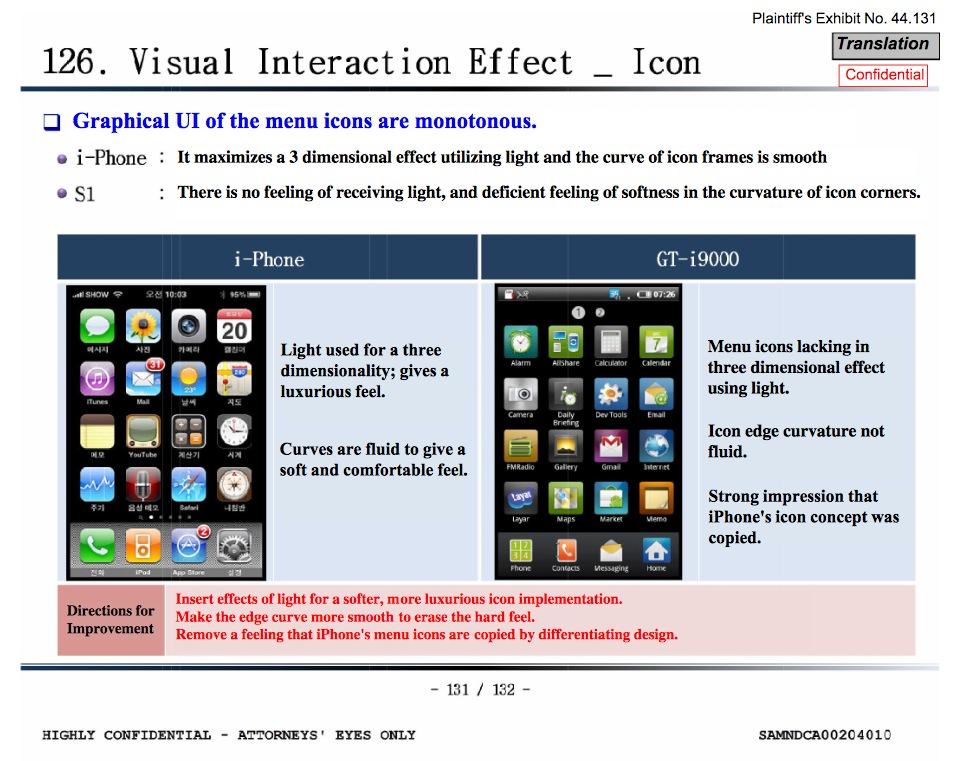
Ironically, it was one of Samsung’s own documents that showed this up—a 126-point slide presentation showing how the iPhone’s design was better than Samsung’s S1, and how Samsung should copy Apple’s design decisions on each of these points. Here’s a representative slide:

Point126

Ironically, two of the points express how Samsung should copy the iPhone’s design, while a third notes that an effort should be made to avoid looking like they were copied. In short, copy the elements which make the iPhone stand out, then change the appearance enough so that it doesn’t look too blatant. Copy but don’t look like you’re copying. Little wonder Samsung lost in the U.S. case, and yet telling that it didn’t lose in Korea, not to mention elsewhere.

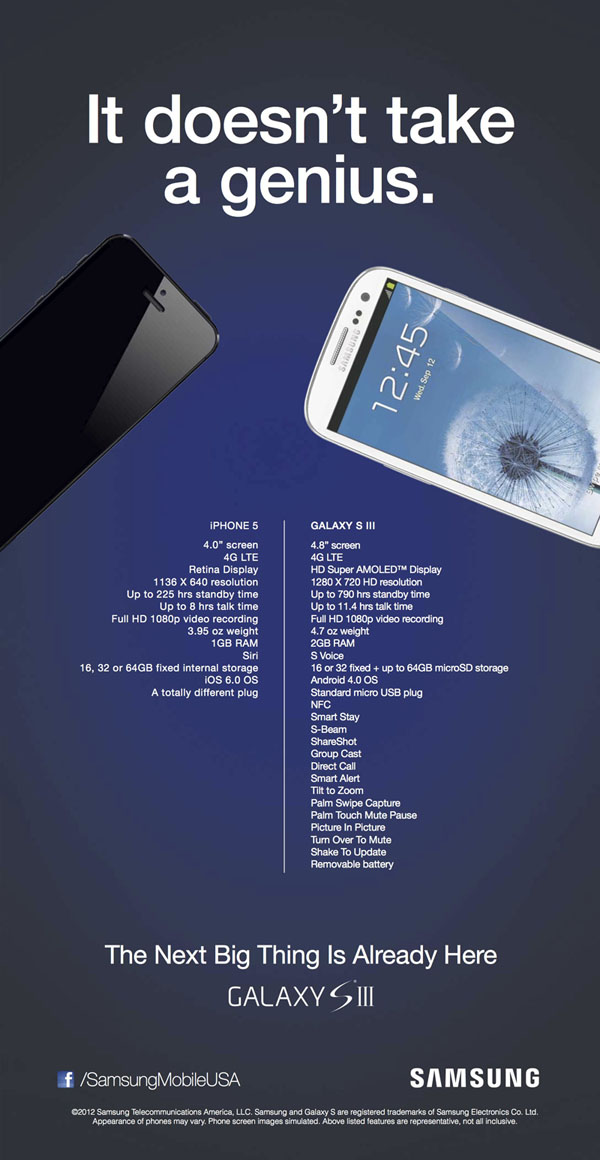
SamsungadAs a result, when one sees someone holding a cell phone nowadays, one often has to look carefully to determine whether it’s an iPhone or something else. Admittedly, the Galaxy S III is visually different to a greater degree, although I was chagrined and amused to discover that in my initial viewing of the ratings list I had mistaken the S III for another iPhone. Seriously.

Samsung also went on the offensive with an ad showing how much better the Galaxy S III is than the iPhone 5, at right (click for the full-size version). One may note that they used differently colored phones, and keep the iPhone off while the S III is on. I confused the two in the ratings list because both were black and shown activated. I don’t think it was a random choice to show them that way in this ad. It would have looked a lot worse for Samsung had they been side-by-side, both the same color, and both turned on.

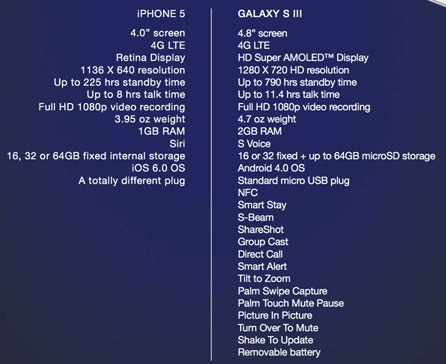
The ad made these comparisons:

Samsungadtext

Samsung actually has some points here, but to a knowledgable observer, it’s clear that they’re not going for actual advantages, but instead are aiming to pad the list.

The screen is one point of difference, but is listed three times. The S III has a 4.8“ AMOLED screen at 1280 x 720, whereas the iPhone 5 has a 4” Retina screen at 1136 x 640. The final point—the resolution—is the only significant difference in most cases. People like big screens, but they also like small profiles. AMOLED gets you better contrasts and deeper blacks with lower power consumption, but Apple’s display has been rated as the best-quality in a broader range of points. And in the end, few will notice the difference in resolution. Advantage goes to the S III in most cases, but not by much.

Another three points are about the battery. The S III has more standby time. However, how many people let their phones remain idle for more than ten days? How many don’t recharge every day or two? Samsung brags about battery life in use; in some tests, the S III’s battery lasted longer, though nowhere near as much as advertised. These running times vary, and the advertised times are based on settings at minimum, which do not reflect real-world use. When the screens are set to maximum brightness and LTE is used, in fact, the iPhone 5 battery actually lasts longer than the S III. In normal use, the battery is more or less a wash. The only significant difference comes with the point Samsung moved to the end of the ad: replaceable batteries. If you find yourself forgetting to charge at night, or are such a heavy user that you run out of battery before you get home, this can be a huge difference (albeit a greater cost), but most people don’t need it. Advantage goes to the S III, but again, not by much.

The Samsung has 2 GB or RAM compared to 1 GB on the iPhone 5. An advantage, but then again, Android uses more RAM, making it more of a wash. Currently, the iPhone 5 runs perfectly well with the 1 GB, making the difference meaningless. However, in a few years, the new OS versions and software will tax that 1 GB. Advantage goes to the S III; by how much depends on the actual RAM requirements of software used. It should be noted that some variants of the S III only have 1 GB, however.

The real advantages of the S III are the removable battery, the ability to use SD storage in a meaningful way, and the larger screen, for those who like that and are willing to put up with the disadvantages involved (increased size and weight, less battery life). NFC is a possible advantage, depending on whether or not you can use it.

Some points are a wash; both do 4G LTE, both record 1080p video. The OS (iOS vs. Android) is a matter of preference.

Other points? Apple wins on weight and dimensions. You might note that Samsung “overlooked” the physical dimensions. The iPhone 5 is notably smaller in all three dimensions: 4.87 x 2.31 x 0.3 inches (123.8 x 58.6 x 7.6mm) for the iPhone 5, and 5.39 x 2.80 x 0.34 inches (137 x 71 x 8.6mm) for the S III. If you give the S III points for screen size, you have to give points to Apple for profile. Advantage goes to Apple, depending on preference.

Samsung’s ad also notes Siri, pitting it against Google’s “S Voice.” According to those who have used both, Siri wins hands-down.

Amusingly, Samsung touts their own “Standard micro-USB plug,” while calling Apple’s connecter “a totally different plug.” After having used it, I must say I love the fact that you can plug it in either way; I used to struggle with directionality a lot, and still do on the iPad. It’s a pain when you’re doing it just as you’re falling asleep, for example; it wakes you up. True, Apple is hogging all the revenue for the new connector, denying cheap copies to be sold for a while. But Samsung’s main charge, that it’s different, is bogus on the fact that Samsung has changed their own connectors more than a dozen times in the past 10 years; this is the first time Apple has change the plug in a decade. I would call this a wash.

After this in their ad, Samsung then proceeds to list 14 different features presumably unmatched by anything Apple has. As noted above, only two are significant: the NFC and the removable battery. Almost all the rest are specific features residing in a category which, if honestly compared with the iPhone, should allow for dozens more Apple features to be mentioned. I mean, really, “Tilt to Zoom”? “Turn Over to Mute”? Many of these are trivial at best.

How about iCloud built in? Shared photo streams? iMessage allowing texting to expand to other devices? Airplay video streaming? Find my iPhone? Apple’s VIP Mail feature, or “Do Not Disturb”? Facetime? These don’t count? Apple’s 700,000 apps don’t count? (OK, maybe 100,000 when you subtract fart apps. Ditto for Android, though.)

Then there’s security. Even with a jailbreak (which cancels out many of Android’s advantages), the iPhone is likely to be more secure.

Then there’s the hardware. Samsung uses plastic; Apple uses metal. I have never liked the cheap plastic feel of so many phones (including when Apple used it), and much prefer the more solid construction. Both use glass, but in drop tests, Apple fared far better than Samsung.

When I have been able to get my hands on an Android phone, I always test the touchscreen. Apple is noted for having the best sensitivity and fine control, and it shows. Relative to using the iPhone, I have trouble using screens of competing phones, and have seen the owners of these phones experiencing the same difficulty.

I have wanted to do a side-by-side with the S III, but ran into another difficulty: I couldn’t find anyone who had one. It made me wonder if it had come out already, but yes—it has been out since May.

And that’s what it really comes down to: preference. And back to: sales. See the ratings list I started this post with. Apple is hands-down the winner in terms of popularity.

One thing that I regularly do when I ride the train is to try to note cell phone use. In Japan, at least half the passengers are using them, or so it seems. When I do a count—how many are using the iPhone versus any other phone—I regularly come out with about the same result: about half the phones I see in use are iPhones. That’s versus every other maker combined.

In a country where the iPhone was supposed to be an abject failure, that’s saying something.

Categories: Gadgets & Toys, iPhone, Technology Tags:

Called It, Again

October 6th, 2012 4 comments

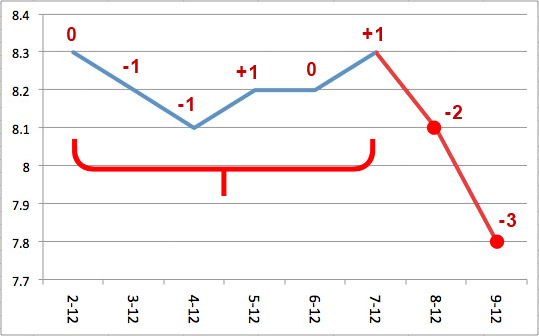
In March, upon seeing February’s numbers, I wrote:

The bad news for Obama is that, for the next 4-6 months, unemployment will not be so hot–it may drop a point or two over the next 4-6 months (numbers might show a drop in June or July more than other months), but may not really start to change again until just before the election–which is the good news for Obama. The rate should start dropping regularly come September, when we see the numbers for August.

Based on nothing but a guess, I would say that the unemployment rate will probably be between 7.6% and 7.8% come November. The last three months, all good gainers, will show up in the unemployment rate in the three months leading up to election day.

Then here’s what happened:

Uechrt

So far: wow. I really did call it, didn’t I? It dropped a few in the 4-6 months following February’s numbers, the started dropping regularly when the numbers for August came out, and fell into the range of 7.6 ~ 7.8%. I’m willing to bet that the figure will be 7.6 or 7.7 % in next month’s report.

Question: will this put a damper on Romney’s fueled charge post-debate? It certainly subtracts from the ammunition he could have fired if the rate hadn’t dropped 0.3%…


I wrote the above last night but fell asleep before finishing up… and awoke to a series of reports I could hardly believe: job truthers.

Really.

A lot of people on the right are now crying foul, forwarding the conspiracy theory that Obama faked the jobs report, in “Chicago style,” whatever that’s supposed to mean.

As it happens, truth beats out truthers:

Betsey Stevenson, the former chief economist in the Labor Department, wrote this morning, “Anyone who thinks that political folks can manipulate the unemployment data are completely ignorant about how BLS works and how data are compiled.” Alan Krueger, the chairman of the White House Council of Economic Advisers and one of the nation’s preeminent labor economists, told Bloomberg today, “No serious person would question the integrity of the Bureau of Labor Statistics. These numbers are put together by career employees. They use the same process every month. So I think comments like that are irresponsible.”

So: the polls show your guy behind? They’re faked! It’s a liberal conspiracy which includes Rasmussen and Fox News! The unemployment rate drops? Fake! A socialist conspiracy from the Bureau of Labor Statistics!

Frankly, I’m surprised they didn’t call Hurricane Isaac, which hampered the GOP convention in Tampa, a liberal conspiracy. It’d be just as realistic a call. Blame it on Al Gore.

Categories: Economics Tags:

And Here’s That False Equivalency Now

October 5th, 2012 1 comment

Liberal blogs are talking quite a bit about Romney’s Blue Streak of Bullshit™ in the debate, but the MSM seems to be largely ignoring it, instead focusing on how well Romney did. And, as I expected, the fact-checkers are going out of their way to create a false equivalency instead of pointing out that Romney was lying his ass off while Obama was staying much closer to the truth. They accomplish this by straining to making Obama’s statements seem less truthful, while ignoring steaming heaps of BS from Romney’s side. Think I exaggerate? Read on.

Here’s an example from PolitiFact, which contorts itself into pretzels to try to make an Obama claim seem like it’s misleading:

Early in the first presidential debate, President Barack Obama attacked Mitt Romney’s tax plan as unbalanced and devastating for the middle class. He charged that Romney’s plan “calls for a $5 trillion tax cut,” and challenged him to defend it. …

The claim is based on a study done by the Tax Policy Center, a nonpartisan group that has analyzed the tax plans of the candidates. The center examined Romney’s proposals for a 20 percent reduction in all federal income tax rates, eliminating the Alternative Minimum Tax, eliminating the estate tax and other tax reductions.

The center estimated that altogether, the lost revenues would total $480 billion by 2015. The Obama campaign adds up the cost over a decade and winds up with $4.8 trillion, which it then rounds up to $5 trillion.

The conclusion is accurate but misleading. Yes, the cuts would total that amount, but as Obama himself noted as he continued speaking, Romney hopes to offset the lost revenues by closing loopholes and deductions. The reductions in tax breaks are as much a part of Romney’s plan as the tax cuts.

In short, PolitiFact is claiming that Obama’s statement that Romney has a $5 trillion tax cut is misleading because it will be somehow paid for? What, that makes it not be a $5 trillion tax cut? I don’t see any misleading info here; it IS a tax cut. Paying for it, or claiming to pay for it, does not make it not a tax cut. Obama stated clearly that Romney claims to pay for it, and PolitiFact even noted that—but called him “misleading” because of the information Obama noted! Apparently, PolitiFact is calling Obama a liar for dividing the information into different sentences instead of telling the whole story in one sentence!

Here’s their summary:

The president made a misleading statement about an incomplete plan, but he did describe what the plan was missing and Romney would not fill in the gaps. We rate the statement Half True.

Gah! They claim Obama was misleading because he made one statement that was incomplete, and then he completed it and told the whole truth!!! How is that not fully true???

PolitiFact also throws in supposedly compounding factors: Obama is counting 10 years of the tax cut—a normal and legitimate measurement—and that Obama is rounding up from $4.8 trillion, adding to the illusion that he’s not being completely factual. Neither really make Obama into a non-truth-teller; both are standard ways of expressing facts within their context.

Contrast that with their Green-Light “True” judgement on Romey’s claim:

Romney reminded Obama during the debate, “you have said before you’d cut the deficit in half.”

The statement is accurate. Obama made the pledge shortly after taking office in 2009. Today, the deficit is smaller, but it’s not half the size it was. We rate Romney’s statement True.

Here, there is no throwing in compunding factors; they do not ding Romney for failing to take into account Republican obstructionism, or the fact that continuing the Bush tax cuts for the wealthy—which Obama tried to stop but the Republicans forced him to concede—is what accounted for most of that failure. Nope, where Obama was called “misleading” just because he claimed one half of the equation—before finishing it and completing the whole truth—Romney is called a truth-teller when he avoids mentioning far more damning mitigating evidence, and never refers to it at all later.

Worse: When you look at their whole report for the debate, PolitiFact completely ignored Romney’s bald-faced lie about Obama doubling the deficit. They give him a true rating for a distortion like you see above, but let Romney get away clean with one of the biggest lies of the night. They also failed to mention that Romney lied about the number of unemployed. I can find neither lie in the PolitiFact page on the debate nor their main page.

The fact is, Romney was clearly lying far more than Obama. However, if the fact checkers start noting this—which is supposedly their job—they seem to fear the same thing the MSM does: being smeared as “in the tank for liberals.” The truth has a liberal bias, indeed.

Who checks the fact-checkers?

Categories: Election 2012, Right-Wing Lies Tags:

The First Debate: Live Comments

October 4th, 2012 8 comments

Not gonna crowd the post with constant comments, but would like to make a few points.

Romney is coming across much better than he has in the past; he is not coming across as very awkward, and does sound passionate, while Obama sounds more level, wonky, and even a little whiny. Side by side, Romney does have a richer voice, and all the stuff he says sounds more appealing than what he’s said before. Obama pauses, Romney doesn’t. Romney is steamrolling through Lehrer and making up his own debate direction, which many may reward. From just watching these guys and not thinking or referencing facts—which most viewers are doing, alas—Romney sounds like he’s scoring as many points as Obama. And this is where the debate may have its impact.

On the other hand, we have a factual assessment… in which case, Romney is coming across the way he has in the past: as a huge liar. He said Obama doubled the deficit: not true, and misleading as the deficit was handed him almost as-is at the same time the economy was cratering. He said he was not going to cut taxes on wealthy people or rack up trillions in new debt, which goes contrary to what he has explicitly stated over time. He dishonestly exaggerated the unemployment numbers. He lied about Obama doing health care before jobs. He lied about public oil production. He lied about government boards and health care. He even dragged out the old “cut Medicare by $716 billion” lie. And that’s just so far.

In short, he’s hoping that all he has to do is lie confidently and convincingly and hope most people won’t look at the fact-checking the next day, will look at partisan “fact-checking” friendly to Romney, or if they do look at the checking, will see false equivalencies and keep some of the initial impressions they got when watching.

And that may very well work. Initial impression: Romney will “win” this debate. Not on facts, but on bull.


Ooohh… Romney just pushed the Religion button.


Romney is probably going to get points for not looking like an idiot or an ass. But a lot of the “not being an ass” element is Romney contradicting much of what he has been pushing for the past year. All of a sudden, he wants no benefits for the upper class and is the champion of the middle class, he loves PBS, he loves all the popular causes he’s been attacking and proposing cuts for. Looks great, sounds great, but is not what he’s been saying all along. He’s definitely trying to reboot himself yet again. All based on lies and BS, but it’s about appearances.


Oooh! A zinger! “Mr. President, you’re entitled to your own airplane, your own house, but not to your own facts.” Make Obama look like an elitists with a private jet while at the same time getting entitlements!


I know Obama can’t spend his time blaming Congress… but Romney’s BS about working with the other side is exactly what Obama said and actually did. It’s something Romney should do, because Democrats would actually cooperate; it’s something that Obama shouldn’t have done, because Republicans were solidly bent on sabotaging the process and had no intention of honest cooperation.


Obama just slipped bin Laden in.


Ha! YouTube cut off their broadcast at exactly 10:30… cutting Romney off just as he started.


Post-debate assessment: Romney won by looking more confident and passionate, but mostly by lying his ass off with conviction. Obama looked beleaguered, stuttering, almost bored. Romney looked far better than when he’s off-the-cuff, his nervous energy serving him here instead of hurting him.

Obama missed at least a couple of huge targets, didn’t even fire at them at all. The 47% as a lead-in to defining Romney, rather than his tax cut program. He could have done a mini-litany of Romneyisms, including “corporations are people,” “I’m not concerned about the poor” and “It’s not my job to care about them.” Second, Republicans in Congress. A tangential target, perhaps, but pointing out that he has pushed jobs plans that Republicans have shot dow, that Republicans have not concentrated on the economy, have put politics above all else—and Romney has done nothing to challenge that, hardly a bipartisan cooperative approach. Finally, Obama should have attacked Romney with as much passion as Romney attacked Obama.

Obama can only come out of this looking good on the facts. Cue the fact-checkers to gloss over some of Romney’s lies and straining to point out every small inaccuracy by Obama in order to achieve yet another false equivalency.


Last word: the jobs numbers for September will be out in a few days. It has the potential to either extend and strengthen Romney’s boost from the debate, or give Obama the ability to stamp it out. I don’t know about jobs numbers, but I have predicted that the unemployment rate will continue to fall, perhaps to 7.9%, which would be a big psychological boost for the economy for crossing the 8% threshold.

Categories: Election 2012 Tags: