Trends and Departures

January 31st, 2008 4 comments

The Republican race for president seems to be firming up while at the same time thinning out: as Giuliani drops out (and the Free World gives a collective sigh of relief), McCain maintains his 10-point lead over Romney and Huckabee, who are still neck-and-neck for second place. The Gallup Daily Tracking Poll (which Josh Marshall talked about but strangely did not link to) shows the GOP landscape:

013008Dailyupdategraph1

It looks like McCain has a pretty good lead, but not a decisive one–even with Giulani’s backing, he won’t go above 40% if even that high. While McCain is the solid frontrunner, the numbers are more or less stuck where they are, and we could be looking at a brokered convention.

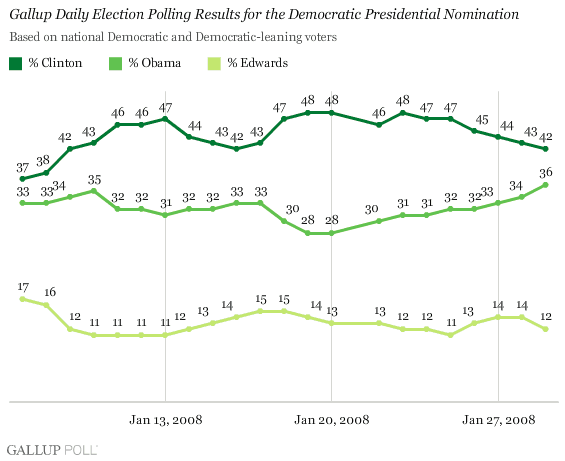
Similarly, on the Democratic side, there is no clear winner. Edward’s departure today could help either candidate or simply split the difference between them both–it’s anybody’s call. And with Gallup’s nationwide poll showing Hillary leading Obama 42% to 36%, you might think she has a comfortable lead–until you realize that exactly one week ago, it was a 46% to 30% lead. And then you see the trend:

 Poll Graphs 013008Dailyupdategraph2

That’s an average one-point gain for Obama every day, and a one-point loss for Hillary every day. Which suggests that just three days after the last reading (that would be February 1), they should be neck-and-neck, and by Super Tuesday, Obama could have a comfortable lead over Hillary.

Not that that’s going to happen, of course. It could, I hope it will, but I doubt that the trend will remain unbroken. The question is, what could break it? Florida was the big bet, but (a) Hillary was expected to win big there anyway (she won 50% to 33%), (b) the delegates aren’t even supposed to be seated, and most importantly, (c) the Florida win for Hillary seems to have barely made the news. The closer Republican race is drawing more attention, and Edwards’ and Giuliani’s departures have stolen even that spotlight. Which means that Hillary will not get nearly as much a boost out of Florida as Obama likely got out of South Carolina.

Then there’s the question of why the trend is happening; it’s clearly not a prolonged South Carolina “bump” for Obama; the trend, after all, started a week before South Carolina–ironically, at about the same time Obama made his Reagan analogy. South Carolina may have accelerated Obama’s rise a bit, but it did not cause it.

So what did? My guess (and admittedly it’s a biased one) is that (a) as more and more people see Obama and Hillary in action, the more the like Obama and don’t like Hillary; (b) Hillary’s negative campaigning may be a big factor; and most of all, (c) voters may be choosing Obama as the more electable candidate as the Super Tuesday ballot grows near and people start firming up on who they’re going to vote for.

One thing for sure, you can’t call this race boring.

Categories: Election 2008 Tags: by

Japanese Variety Shows

January 30th, 2008 5 comments

Since Sachi and I moved in together, I’ve been seeing a lot more Japanese TV, and have noticed certain features and patterns that I had seen before, but had not really thought much about. This applies primarily to the Japanese Variety Shows, the ones that include guests and maybe some special segments. However, a lot of these features seem to apply generally to many TV shows.

Jvar-Subs

1. Subtitles. A lot of what is said on these shows is subtitled, usually in large, bold, and sometimes colored text. We’re talking Japanese subtitles for Japanese speech. The subtitles will appear even when everyone is speaking perfectly clearly. They do not appear for every word spoken, and do not appear to be for better understanding–they simply seem to be a form of punctuation.

Jvar-Panel

2. Lots of guests. There may be a few star guests, but often there’s a whole panel, sometimes more than a dozen guests seated in two tiered rows, with two or three hosts running the show. Panel discussions seem to be the norm for many of these shows.

Jvar-Water

3. Crazy Games. A lot of shows include bizarre games, like dressing up as a giant piece of sushi and walking a tightrope over a vat of oatmeal or something. A lot of these gags, for some reason, involve pools or vats of water, and many involve costumes. Today, Sachi was watching a show where the contestants had to dress up as celebrities (one painted himself gold, put disks over his eyes, and was supposed to be C-3PO), then jump off a platform holding onto a latex-like rope-swing which would snap under too much pressure, and navigate their way to a rolling cylindrical pillow over a pool of water; after rolling the pillow to the end, one would have to jump onto a floating yellow ball and maintain balance. The games are usually made to be virtually impossible. Another segment had a man dressed as a priest surrounded by men dressed as nuns; the priest had to throw himself about five feet forward onto a medium-sized exercise ball, belly-first. And, oh yeah–there are often a lot of men dressed up in drag.

Jvar-Drag

Jvar-Inset

4. Picture-in-Picture Reaction Shots. When they switch to a video of something or another, there is an inset frame in one corner that shows reaction shots of guests, usually switching from one guest to another every 5-10 seconds.

5. Motion Picture Soundtracks. Few if any of these shows seem to have original music. Instead, they just steal stuff from elsewhere. In the course of one hour, you may hear bits from a few dozen different movie soundtracks. If the show’s director finds a music cue they like, be prepared to hear it every few minutes.


This all plays to a conclusion I came to long ago about Japanese entertainment: it is so formulaic as to make the most formulaic of all U.S. entertainment appear stunningly unique. In my experience, with few exceptions, Japanese samurai dramas, detective dramas, romance dramas, variety shows, etc. are all very similar, following very close to a basic set of rules. For example, in Japanese romance dramas, the girl almost always dies in the end, for some reason.

Maybe that’s one reason that U.S. TV series can be so popular in Japan: there’s not much local competition that stands up. Especially in production value–American TV shows often look expensive, with a cinematic feel, excellent special effects, and solid sets and designs. Japanese shows rarely have the same innovation or quality of production that you see coming from the U.S.–and that’s a shame. Because when Japan gets the chance, they can come up with some of the craziest shit imaginable.

My favorite Japanese TV show–not that I watched it more than a few times, but because it made me laugh like hell–was a teen-idol detective drama titled “Sukeban Deka,” which roughly translates to “Delinquent Female High School Student Police Detectives.” They were “delinquent” because they used makeup and accessorized, in addition to their smoldering, resentful, and pouting attitudes. Each girl had a unique weapon; the most famous was the girl with the badass yo-yo.

Near the end of an episode, this small, diminutive Japanese teenage girl in a sailor uniform would be surrounded by a dozen or more big, hulking, hairy, tattooed yakuza gangsters. Then she’d pull out her badass yo-yo. “Stand back!” she’d warn, but the yakuza gangsters would foolishly ignore her. She’d snap back her hand, and then let go the badass yo-yo. We’d get a shot of the badass yo-yo with the background whizzing by (WHISH-WHISH-WHISHHH!!). Then the badass yo-yo would bash one of the yakuza gangsters in the noggin. Half the yakuza would then flee in terror, while the 16-year-old delinquent female high school student police detective would pick off the rest one by one with the badass yo-yo, with all the exaggerated sound effects you’d expect in a kung-fu movie.

It was the funniest damned thing I have ever seen.

The TV show went on to become three if not more major motion pictures in Japan. The posters below show one of the original movies, and a more recent remake.

Sukebandekamovies

Categories: Focus on Japan 2008 Tags: by

Turn Jesus On

January 30th, 2008 4 comments

Via Pharyngula (a reliable source of this kind of thing), comes a completely inappropriate Jesus Light Switch. I mean, really, how could this have been designed and produced and sold by some company with not one person in the chain taking a look at it and saying, “I think not.”

Turn Jesus On

Categories: The Lighter Side Tags: by

Things Better in Iraq?

January 29th, 2008 9 comments

Bush is expected to claim credit for the “Surge™” working in Iraq in his SOTU speech tonight. And it certainly looks like it’s working; The surge started in February 2007, and sure enough, by late summer, casualties began to drop. Wow! The “Surge™” worked! Of course, the real measure of success would be for the Iraqi government to take advantage of the drop in violence and make peace, settle things down–and sure enough, recently, a “re-Baathification” law was signed, signaling peace between the factions. Wow! The “Surge™” is a success!

Of course, it’s all BS. The violence in Iraq did not drop because of the surge; it dropped because, in one of the most under-reported news stories (gee, I wonder why) of 2007, Muqtada al-Sadr, leader of the Mehdi Army which is responsible for most of the violence in Iraq, unilaterally declared a six-month cease fire. The reason: so his militia can be prevented from splitting into factions and fighting amongst themselves. It was only after al Sadr’s cease fire that the violence started to drop significantly, and no wonder. The surge was not a factor here.

Moreover, the “de-Baathification” law, which in theory should allow the Baathist Sunnis to rejoin the Shiite-dominated Iraqi government, is not what it appears. The law was created and pushed by strongly anti-Baathist Shiites, and the Baathists themselves opposed the law. The reason: the law is a wolf in sheep’s clothing, which would actually wind up excluding Baathists, banning them from taking on any real, influential positions.

So Bush is going to step up to the podium tonight and declare that the “Surge™” is a military and political success. However, the drop in violence is due to a temporary cease-fire which ends in about a month, and the political situation in Iraq remains stagnant, if not getting worse.

Update: Case in point: Iraqis can’t even get together on a new flag. Why? It’s de-Baathified.

Categories: Iraq News Tags: by

Barack’s South Carolina Win

January 28th, 2008 6 comments

We all pretty much expected Obama to win in SC, the question was always “by how much”? And the answer, “by double what Hillary got,” is the unexpected and buoying answer for Obama. The polls, on average, had Clinton’s and Edwards’ numbers about right. Reuters/C-Span/Zogby, SurveyUSA, Mason-Dixon, Clemson, and Rasmussen’s pre-primary results averaged out to put Clinton at 27% and Edwards at 19%; their actual results were 27% and 18%, very close indeed. Obama, however, was predicted to get 38%, but actually got 55%–meaning that in this state, virtually all the undecideds went to him. High voter turnout, especially among young voters, also seems to have helped him, as it did in Iowa.

The question is, what effect will this have? Will this buoy Obama’s campaign in other states? Will it give him the push he so badly needs to get past Hillary’s numbers elsewhere?

One important point here is that we’ve got a candidate who could potentially win many southern states for us; turnout by Democrats was much greater than it was for Republicans in their contest in SC last week. Whatever strength Hillary may deliver in Democratic circles, she will almost certainly lose most if not all of the South. This all highlights another significant strength of the Obama campaign, and a reason to doubt Hillary’s I’ve-got-a-political-machine strength.

The news over the past twelve hours that first, Caroline Kennedy (with an elegant op-ed titled, “A President Like My Father”), and later, Ted Kennedy (the party elder and powerful political broker) have endorsed Obama certainly can’t hurt his campaign, either–almost certainly timed to add to Obama’s momentum after his big win yesterday. There are whispers now from the Obama campaign that Obama would award Edwards the spot of Attorney General should Obama win, a spot Edwards no doubt would covet; some see this as a hint that Edwards might throw in with Obama should his campaign ultimately fail, as it no doubt will.

The SC contest also brings into question the whole “Hillary is a fighter” idea–that she can withstand the barrage of right-wing attacks and come out the better. Here, she was obviously the one running the dirty campaign, and not only did Obama’s high-road strategy win out, but showed that he can survive the smearing just as well.

I have to say, what the Clintons did this week left a definite bad taste in my mouth. Campaigning against someone, okay; even getting negative may have its points; but the Clintons went beyond that, they went over a line: they out-and-out lied, knowingly, about Obama’s words and actions. They went beyond playing rough and clearly strayed into playing dirty. At that point in the debate where Hillary insisted that Obama voiced approval for Republican policies–knowing full well that he did nothing of the sort, with Hillary pushing what was a clear and knowing lie–that brought me to feel strongly that Hillary was not a good candidate. This wasn’t just stretching the truth, or making an error in interpretation; this was purposefully taking a quote out of context and baldly asserting that it meant something that it clearly didn’t. “We can give you the exact quote,” she said, knowing that this would give the impression of an absolutely verifiable truth without having to actually supply a quote that clearly proved her point.

Bill Clinton did no better, acting as the ultimate Hillary surrogate and trying to drag down Obama in a mudfight. His worst tactic: trying to reduce Obama to “the black candidate.” His later dismissal of Obama’s win as being like Jesse Jackson’s was seen as a similar crude condescension–comparing Obama to someone seen as unelectable, who did run as the “black candidate,” more or less. TPM points out that Jackson won in SC partly because it’s his home state, and partly because the SC caucus at that time came after the nomination had been more or less locked up, and so Jackson was not really campaigned against much. A lot of Democrats resented Clinton’s tack even before that snipe, and that likely had a part to play in today’s results.

What a lot of people will probably not see is the fact that Hillary was leading in SC as recently as last November; Obama definitely has had the momentum in this state. The same turn has been happening nationwide since last Fall; even in states like Florida and California, where Hillary has a wide lead, one can see a definite trending to Obama, and a similar trend away from Hillary.

Will South Carolina accelerate this trend? Will Obama receive the same kind of bump he got after Iowa?

Another issue coming up is Hillary playing the fake-out dirty trick with Michigan and Florida–first signing the promise to not be in those races, but then campaigning there anyway–and now she’s insisting that both states’ delegates be counted. In effect, she acted like she’d move out of those races with other other candidates, and then when the others did as they’d promised, she jumped back in and now wants them both to count. It brings to mind an episode of House last season, when the character fondly referred to as “cutthroat bitch” got a half-dozen or so candidates for the job to quit by pretending to quit herself, but then she snuck back and put herself back in the race. Hillary essentially did the same thing. It may work, but it still demonstrates a fundamental unfairness.

In short, Hillary may be proving herself to be an effective fighter, but more and more she is showing herself to be the kind of politician I am not nearly as excited to see take the White House. At the same time, Obama is proving himself to be more electable as well as more worthy of the nomination.

Categories: Election 2008 Tags: by

The Ten Commandments: A Moral Guide?

January 27th, 2008 5 comments

On last week’s Bill Maher, the conservative guest on the show made the old “ten commandments” argument: “Who’s gonna argue [against the idea] that the ten commandments are a pretty good way to lead your life, and if more people did do that, the world would be a better place?” Indeed, many Christians talk about the ten commandments like they are morality embodied in ten lines. If children’s morals are lagging, then post the ten commandments in their school room, and it’ll make a difference. Our entire legal and moral codes are based upon the ten commandments, we are told.

However, the ten commandments don’t really live up to their billing–not if you take a closer look at them and think about it a little.

The first five commandments are very simple to summarize: respect and obey authority, especially the church. The first four in particular are all about establishing the church as the ultimate authority, none others, and you better take them seriously:

I am the Lord your God, who brought you out of the land of Egypt, out of the house of slavery; Do not have any other gods before Me

You shall not make for yourself an idol, whether in the form of anything that is in heaven above, or that is on the earth beneath, or that is in the water under the earth

You shall not make wrongful use of the name of the Lord your God

Remember the Sabbath day and keep it holy

Honor your father and your mother

The first four are, in short, “don’t disrespect God (or by extension the church in general) in word or action.” The last is about obeying parents, which in essence says to respect authority–and let’s not forget the form of address required when addressing church authorities.

Still, how do any of these address morality? The first four simply establish the authority of the church; that’s no moral guide. At best, it tells the user to follow the church, and obey it. The fifth commandment says to obey your real parents or the church-as-parents. It is, in essence, suggesting simply to replace your own moral judgment with that of another. This is not morality, it is submission. It does not teach you about right and wrong; on the contrary, it tells you to leave those matters to someone else.

The last five commandments are where the more “morality-based” directives lie:

You shall not murder.

You shall not commit adultery.

You shall not steal.

You shall not bear false witness against your neighbor.

You shall not covet your neighbor’s house; you shall not covet your neighbor’s wife, or male or female slave, or ox, or donkey, or anything that belongs to your neighbor.

So what moral directives are there here? Don’t kill, commit adultery, steal, lie, or covet.

Look at the first four of those: don’t kill, sleep with another’s spouse, steal, or lie. What kind of moral guides are these? Sound ones, most would agree–but general ones, to be sure. Here’s the question, though: do they serve as a special moral guidance, one which you can base an entire moral system upon, as people claim they do?

I would argue not, based upon the fact that these four things would be so obvious to any member of almost any society of any time period that they would go without saying (though many societies would have their usual exceptions). In other words, the ten commandments are wholly unnecessary to establish these moral rules. I mean, think about it: before Moses came down the mountain, did people think these things were moral? Upon seeing Moses come down, did everyone peer at the tablets and exclaim, “Oh, thou shalt not steal! Dang, all these years I thought that stealing was moral!”

So how do these commandments set down a moral code by “establishing” rules that are already apparent and obvious?

The real cutting edge of morality lies not with the obvious rules, it lies in the complex moral situations. If killing one innocent person will save the lives of twenty other innocent persons, is it moral to kill the one? Is it moral to steal food if it is the only way to feed a starving child? May one lie if it saves a life?

These commandments are far too blunt and dull a tool to address the questions with which people truly need moral guidance. Not to mention, people who take these rules literally also build into them exceptions whenever they like. Millions of Christian Americans approved of the invasion of Iraq, in addition to air strikes that had massive civilian casualties. They commonly excuse adultery, lying, and theft by public figures, so long as the person is someone they agree with, and especially if they flaunt their Christianity and give even the most perfunctory of apologies. This hardly feels like a strict moral code.

That leaves the last one: coveting. This is the one which makes the most sense to me–it essentially warns one not to envy others, which is good moral advice, and something which is not so obvious.

Of course, this particular commandment is soiled by the reference to a neighbor’s slaves, which essentially puts god’s seal of approval on the ownership of human beings. Something which, in my opinion, has done as much damage as suppressing envy could alleviate.

In the end, I think the ten commandments are really a lot less valuable as a moral guide than they are cracked up to be. In fact, I would point more to a passage from the Qur’an as a far better moral guide, though it too has its limitations:

Worship only God

Be kind, honorable and humble to one’s parents

Be neither miserly nor wasteful in one’s expenditure

Do not engage in ‘mercy killings’ [of children] for fear of starvation

Do not commit adultery

Do not kill unjustly

Care for orphaned children

Keep one’s promises

Be honest and fair in one’s interactions

Do not be arrogant in one’s claims or beliefs

Here, we get the “worship god” directive, and the mercy killings of children which addresses a different time and culture (well, admittedly, some places on Earth today might still need to address this, but hopefully not many). But the other commandments set rules and principles that are much more far-reaching in terms of what moral situations they cover. Certainly, a lot of fundamentalists could learn from the last one on that list.

One might argue that the ten commandments simply are the standard-bearer for the morality expressed in the entire bible; that, to find one’s moral guidance, read the whole bible and take value from all the lessons enclosed.

The problem with that is that one could extract a lot of very bad moral guidance from reading all the bible. What should one make, for example, of these passages?

Happy shall they be who take your little ones
And dash them against the rock! –Psalms 137:8-9

Their infants also will be dashed in pieces before their eyes.
Their houses will be ransacked, and their wives raped. …
Their bows will dash the young men in pieces;
and they shall have no pity on the fruit of the womb.
Their eyes will not spare children. –Isaiah 13:15-18

And Moses said unto them, Have ye saved all the women alive? […]
Now therefore kill every male among the little ones,
and kill every woman that hath known man by lying with him.
But all the women children, that have not known a man by lying with him,
keep alive for yourselves. –Numbers 31:7-18

The obvious answer to that is to discriminate as you read, to weed out the bad parts. There are several problems with that; the first problem which comes to mind is the parts of the Bible which are bad but not clearly so. Surely one would see Moses’ order to kill male children and take the young girls as slaves and know immediately that one should not adopt this as a moral guide. (Well, most people would, at least.) But what about moral directives in the bible which either are bad but not clearly so, or which play to pre-existing prejudices, like the ones against homosexuality?

Not to mention that, ultimately, when trying to sell the bible as the ultimate moral guide, it does not help when you have to tell people to ignore a great deal of clearly immoral and even barbaric stuff that is liberally mixed into the text.

And then there’s the readability issue. How many people have you heard say they gave up when they got to all the “begats”? Even if you’re able to skip over such parts, that’s an awful lot of reading to do. I wonder if anyone has extracted all the parts they believe contain the useful moral parts? And I wonder how long such an extract would be.

In short, why rely on a moral guide when one must labor so hard to get through it and wind up with so much horrific baggage at the end? Why not simply extract the valuable lessons and leave the bad stuff behind? Would that not be a better road to building morality? In fact, that is pretty much what Thomas Jefferson did–he thought that the ethical teachings of Jesus were beyond compare, but loathed the parts of the bible which he thought contributed to dogma and superstition–so he edited the bible and kept the parts he thought were valuable.

But, returning to the idea of the short-list moral guide, what rules would be far more useful than the ten commandments? It’s not hard to make a list that’s a lot better, but what would be the optimal list of ten moral rules that would truly lead lead one through moral crises and help establish a solid personal moral code?

Here is an impromptu attempt at such a list:

Forgive others their wrongs and focus more on the wrongs you have committed

Show compassion, sympathy, and kindness at every opportunity

Know that others have different views and try to understand them

Help others when they need and will accept help; be willing to sacrifice for others

Do not be arrogant

Use reason: seek knowledge, question information given to you, and think for yourself; always allow for the possibility that you may be wrong

Reign in your fear, anger, envy, greed, and jealousy; recognize them and do not act on them

Take responsibility for your actions, and do not use the actions of others to excuse yourself

Always try to work for the greater good, but first, do no harm

If you must judge others, judge them by their actions alone

See anything wrong with the list above? Have any other ideas? When it comes down to it, there’s no reason to limit it to just ten.

Categories: Religion Tags: by

The Inspiration

January 26th, 2008 5 comments

Yes, this has already been bouncing around the net quite a bit since Slate published the story (based on a book by their writer Jacob Weisberg) and Harper’s picked it up as well, but the punch line is so funny that it bears yet another re-telling on a blog, just in case somebody here hasn’t seen it yet.

Apparently, when Dubya was governor in Texas, he had a painting mounted on the wall of his office. The painting depicted a horseman riding up a hillside, with others not so far behind him. Here’s the image:

0108-Bush-Koerner

Bush was awed, moved, and inspired by the portrait, so much so, that he sent a memo to his “hard-working staff” to come to his office and view the painting. Here’s the memo text:

STATE OF TEXAS
OFFICE OF THE GOVERNOR

GEORGE W. BUSH
GOVERNOR

MEMORANDUM

TO: Hard Working Staff Members
FROM: Governor
DATE: April 3, 1995

I thought I would share with you a recent bit of Texas history which epitomizes our mission.

My very close personal friend from Midland, Joe. J. O’Neill, III, recently loaned me a portrait entitled “A Charge to Keep” by W.H.D. Koerner. This beautiful painting will hang on my wall for the next four years.

The reason I bring this up is that the painting is based upon the Charles Wesley hymn “A Charge to Keep I Have”. I am particularly impressed by the second verse of this hymn. The second verse goes like this:

“To serve the present age, my calling to fulfill;
O may it all my powers engage to do my Master’s will”

This is our mission. This verse captures our spirit.

Joe was inspired to make this generous loan during the church service preceding the inaugural ceremonies. It was in this church service when we sang the hymn “A Charge to Keep I Have”.

When you come into my office, please take a look at the beautiful painting of a horseman determinedly charging up what appears to be a steep and rough trail. This is us. What adds complete life to the painting for me is the message of Charles Wesley that we serve One greater than ourselves.

Thank you for your hard work. Thank you for your service to our State. God Bless Texas!

Weisberg notes, “Bush identified with the lead rider, whom he took to be a kind of Christian cowboy, an embodiment of indomitable vigor, courage, and moral clarity.”

0108-Bush Charge-Oval

When elected president, Bush took the painting with him to the White House, and hung it in the Oval Office, adding to and expanding the tale of the painting; in 2004, Bush said:

There’s a painting on the wall in the Oval Office that shows a horseman charging up a steep cliff, and there are at least two other horsemen following. It’s a Western scene by a guy named W.H.S. Koerner called “A Charge to Keep.” It’s on loan, by the way, from a guy named Joe O’Neill in Midland, Texas. He was the person, he and his wife Jan, introduced — reintroduced me and Laura in his backyard in July of 1977. Four months later, we were married. So he’s got a — I’m a decision-maker and I can make good decisions. (Applause.)

And so we sang this hymn — this is a long story trying to get to your answer. (Laughter.) This is not a filibuster. (Laughter.) That’s a Senate term — particularly on good judges. (Applause.) The hymn was sung at my first inaugural church service as governor. Laura and I are Methodists. One of the Wesley boys wrote the hymn. The painting is based upon the hymn called, “A Charge to Keep.” I have. The hymn talks about serving something greater than yourself in life. I — which I try to do, as best as I possibly can.

Bush continued to keep the painting in the Oval Office, admiring it and drawing inspiration. In 2007, Sidney Blumenthal noted:

Bush takes special pride in pointing out two paintings he has hung that highlight his motives and legacy. He consciously placed these pictures in the Oval Office at the beginning of his tenure to serve as prescient cultural markers. “The Texas paintings are on the wall because that’s where I’m from and where I’m going,” he says.

One of them, by little-known painter and illustrator William Henry Dethlef Koerner, titled “A Charge to Keep,” depicts a hatless cowboy followed by two other riders galloping up a hill. Their faces are intent as they pursue some quarry in the distance that cannot be seen by others. Or are they being chased? “I love it,” Bush said, further explaining his intimate feeling for the painting to reporters and editors of the Washington Times, a conservative newspaper. He offered his interpretation: “He’s a determined horseman, a very difficult trail. And you know at least two people are following him, and maybe a thousand.” Bush added that the painting is “based” on an old hymn. “And the hymn talks about serving the Almighty. So it speaks to me personally.” When he was governor of Texas and the painting hung in his office, Bush wrote a note of explanation to his staff: “This is us.”

So, there’s the set-up. Almost thirteen years ago, Bush receives a painting and is taken in by it, seeing in the brushstrokes a reflection of himself. This, he decides, is what I am. This is my mission. This striking horseman epitomizes my own Texas spirit, my commitment to God and country. I will be that horseman, I will take his mission on to be my own, to become my calling to fulfill.

The punch line: Koerner did not paint a rugged horseman riding to spread the word of god. Koerner painted the man as a horse thief fleeing a lynch mob.

The artist, W.H.D. Koerner, executed it to illustrate a Western short story entitled “The Slipper Tongue,” published in The Saturday Evening Post in 1916. The story is about a smooth-talking horse thief who is caught, and then escapes a lynch mob in the Sand Hills of Nebraska. The illustration depicts the thief fleeing his captors. In the magazine, the illustration bears the caption: “Had His Start Been Fifteen Minutes Longer He Would Not Have Been Caught.”

That explains a lot.

Change Servers, or Change Hosts?

January 25th, 2008 3 comments

Surpass Hosting, the web host I use for this site and most of my others, is beginning to show the same signs of unreliability that I have seen in hosts before I am forced to leave them–primarily, constant site outages, often for several minutes at a time, but increasingly for hours and sometimes even the better part of a day. Twice in the past week, the outages were several hours long, included both of my accounts (which are on separate servers), and even blacked out the host’s own web site.

Maybe it’s just the server (Saprus) that blogd.com is using; my other account with the same host on another server is down far less often. And while Surpass has, every few years, suffered from short bouts of prolonged outages, over the long run they have provided pretty good service for a pretty good price.

Just thinking out loud here. I certainly can’t post this until blogd.com starts responding again. But I gotta figure I am losing significant traffic here over the long run.

Categories: BlogTech Tags: by

Wii 3-D

January 25th, 2008 Comments off

Fake Steve Jobs is right: holy crap. Check this out–seems like a cheap and easy way to change your regular TV set into a cool 3-D set without having funny-colored or even polarized glasses lens. Seems like a company could apply this beyond the Wii and create a relatively cheap piece of hardware that could have all kinds of cool applications in 3-D and VR.

And check out the guy’s web site. He seems like a frickin’ genius.

Categories: Gadgets & Toys Tags: by

Mac Virus Threat Exploding? Oh, No, It’s a Recycled BS Sales Pitch Again

January 24th, 2008 Comments off

You might be seeing articles flying around yet again warning of the ever-increasing threat of Mac malware. Run for the hills! Your Mac could be infected! Buy the anti-virus software made by the company generating the warning!

No need to panic, actually. It’s yet another exaggerated threat ginned up by the same group of folks who always use hyperbole to frighten Mac users into thinking there is a great and ever-expanding threat against them. The “report,” published by anti-virus software maker Sophos, makes the claim that the have “revealed” evidence of “cybercriminals moving beyond Microsoft,” meaning they are advancing on Mac users:

…organised criminal gangs for the first time arrived at Apple’s doorstep…hackers are extending their efforts beyond Windows…until recently, organised criminal gangs have not felt the need to target Mac users…late 2007 saw Mac malware not just being written by researchers demonstrating vulnerabilities or showing off to their peers, but by financially-motivated hackers who have recognised there is a viable and profitable market in infecting Macs alongside Windows PCs. For example, many versions of the malicious OSX/RSPlug Trojan horse, first seen in November 2007, were planted on websites designed to infect surfing Apple Mac computers for the purposes of phishing and identity theft.

Note the deceptive language, pretty much an outright lie: “gangs” (which are organized!) and “hackers” and more “gangs” (criminal ones!) and “hackers” exploiting a “profitable market” of attacking Mac users, with one “example” giving the direct impression that there are other examples.

Wow! It sounds like veritable armies of hackers and criminal organizations are massing like Orcs in The Lord of the Rings and are flooding the market with multitudinous malware aimed at victimizing Mac users!

When in truth, it is one criminal organization (which probably employs one or more hackers) which has released one piece of malware (with variations). The “report” makes the claim that “6000 infected webpages every day” are found, and suggests that all are aimed at the Mac via OS detectors, but does not firmly state whether all have the Mac version of the software. Nor do they provide even one actual discovered real-world instance of a Mac user actually being affected by the trojan, just as they do not report the long string of stupid errors a Mac user must make in order to be affected by the trojan. The “trend” they refer to is a grand total of one malware package, a trojan, with no evidence of actual harm achieved.

In order to download the actual report, you are required to provide an email address and are given the option of have Sophos spam sent to your mailbox. Personally, I declined the generous offer.

Nothing to see here, folks. Move along.

Categories: Mac News Tags: by

Keyboard of the Future Coming Closer

January 23rd, 2008 1 comment

Remember the Optimus Keyboard from Russia? The one with the OLED keys that change appearance? This is the “keyboard of the future” that I’ve said (since two and a half years ago) is bound to be coming into vogue as soon as it gets affordable, and will break us free of QWERTY shackles. The problem up until now is that the only version of this, the Optimus, costs around one and a half thousand bucks, way too steep for anyone but the rich or insane–or the insanely rich.

But watch out–a new contender is now making OLED keyboards, claiming that they can find no Optimus-claimed patents to hold them back. United Keys has even signed a deal to produce OLED keys for gaming keypads for a company called FoxConn, which will presumably be not too expensive. The first version will sport only nine OLED keys in the F-key spots, which will likely let the price be low enough to allow any means-limited fanboy to get their hands on one. Game handsets and controllers will presumably be offered as well.

0108-Uniteddisplaykeys-01

And, of course, there was the Apple patent people sighted a few weeks back which seems to be aiming for a more conservative, black-and-white OLED keyboard which would presumably be cheaper and would accomplish the primary mission of universalizing keyboards. This makes sense not only in languages, but also in switching between Mac and Windows configurations when in Boot Camp or Parallels.

0108-Appleoledkybdpatent

Meanwhile, Optimus is not standing still–they’ve gone all Star Trek: The Next Generation on us, and advanced to a no-button keyboard concept, one which looks so suspiciously like the the Star Trek control panels that Mike Okuda might want to file a patent infringement suit of his own.

0108-Optimustactus-01

0108-Lcars-02

This is along the lines of Apple technology which will allow for tactile feedback from a flat screen–allowing your fingers to feel like they are pressing physical buttons.

The future may be closer than we think.

Categories: Gadgets & Toys Tags: by

Insanely Fickle

January 23rd, 2008 1 comment

Apple Posted record profits and market share gain. Still, the company says, we might see a bit of a slowdown because of the economy next quarter.

Apple shares plummet $20, or about 12%, within five minutes in after-hours trading, for an overall drop of $60 or 30% from a month ago. Why? “Earnings failed to top the most optimistic of analysts’ estimates.” Yes, but they exceeded the average estimates. And the outlook for the next quarter is still for good profits, Apple is just being prudent and conservative–good business sense that should bolster confidence in the company.

I suppose this is no less crazy than Apple’s meteoric stock rise over the past few years, but it’s still crazy.

Categories: Mac News Tags: by

Tokyo Snow

January 23rd, 2008 1 comment

0108-Tokyosnow-01

Finally… the first snow of the season in central Tokyo. Came late this year. Still, it looks like more of a dusting than anything else. To even photograph it, I had to settle for catching snowflakes with my flash; none of the snow is staying frozen on the ground, not yet at least. And though it’s been snowing for about an hour at least, I can still see dry spots on rooftops.

Even so, I betcha some train lines in the city get stopped because of it. Tokyo does not respond well to snow.

Categories: Focus on Japan, Focus on Japan 2008 Tags: by

Original Candy

January 22nd, 2008 5 comments

One of the problems with some of the flavors of Christianity is that, to a thinking person, they include rather clear absurdities that make it difficult to accept the religion as a whole. I remember one of these being pitched to me by a coworker at a job I had while in college (the same fundamentalist coworker who so easily “disproved” evolution). She explained to me that I was in debt to Jesus Christ. How come, I asked; she answered, because he died for my sins. When I asked how he could die for my sins thousands of years before I was born, and more to the point, asked the theoretical question, what if I had no sins, she explained about the concept of original sin.

Original sin has always seemed to me to be a coercive element of Christianity. The idea is that we are born with sin, and that is used to put us in instant debt with the church. No matter who you are, you are born with sin because, according to Christian mythology, Adam and Eve took a bite from an apple from the tree of knowledge in the garden of Eden, and that is added to a ledger of your own sins when you are born. Having sin, you must go to the church for redemption or else burn in hell. The idea here is that you owe the church, the religion; you must ask for forgiveness, you must repent, and receive the blessings of eternal life. Thus there is a built-in debt and feeling of obligation, even ownership by the church, in a sense.

And for what? The tale of Adam and Eve, when looked at critically, is rather absurd. God supposedly creates two innocent beings without the ability to distinguish right from wrong. More than anything else, he wants to deny them knowledge (why?), and keep them in eternal ignorance. But then he puts the source of this forbidden knowledge in the center of their abode, and further stacks the deck by making this knowledge accessible as a sweet and tempting fruit. Then he puts, or allows to exist, a serpent in the garden, in the tree itself, which will wheedle and tempt the innocents to eat the fruit of the tree. Then he goes off and disappears for a while. Talk about stacking the deck!

Translate the situation into something more relative to our experience. A parent doesn’t want a child to read. They command the child never to touch a book. But then they dress up a book in chocolate bars, leave it out in the middle of the child’s playroom. Then the parent brings into the room a stranger who will spend his time trying to get the child to eat the chocolate. The parent then leaves the house, and later returns to find that the child actually ate the chocolate!!! Well, of course the child ate the chocolate.

This is an ultimate sin that places the entire human race in peril from birth? It strikes me as not just a manufactured mechanism of debt, but a rather poorly manufactured one at that. In setting up the situation with the chocolate book, either the parent was stupid to an extreme extent, or they were trying to engineer a situation where the child would disobey and thus deserve punishment. This story makes the parent either an idiot or a sadistic schemer. And then there is a paradox: if the children are innocent and have no knowledge of what is right or wrong, then how can they be blamed for breaking the rules? They were innocent, they didn’t know.

I can understand the story from a point of allegory, a way of explaining human consciousness, our awareness relative to animals in retrospect. Someone must have asked, why are we different from the animals? Why do we have speech, knowledge, certain awarenesses, moral structures, and they do not? OK, someone answered, here’s a story telling why. But in the story are themes of growth and sacrifice. In attaining more knowledge, we pay a price for that awareness; we know moral bounds, and cannot simply do what we like for we know the consequences this may have in harming others. There is even recognition that the increased brain mass that facilitates greater knowledge will cause a mother pain in childbirth. If one does not accept the story as actually having happened, but instead sees it as a vehicle of explaining certain differences and developments in humans relative to other creatures, the story holds more meaning.

But, as a literal story, as many Christians see it, it comes across as nonsense. Even if you accept the idea that god wanted his children to be eternally innocent and free from worries and responsibilities, why would god then set up the situation so that it was virtually certain that his children would disobey him and thus lose their innocence? Not to mention that if god is omniscient as many Christians say, and knows everyone’s fate before they are even born, they how come god was surprised when Adam and Eve did what they did?

I know there are rationalizations. I’m just saying that trying to rationalize all of that stuff in a literalist interpretation is absurd to anyone who bothers to sit down and think critically. Unless I’m missing something, and someone would like to discuss the point in comments.

Categories: Uncategorized Tags: by

Maybe I Should Start Applying for That Permanent Resident Visa NOW

January 21st, 2008 10 comments

Oh, great–rampant xenophobia in Japanese government circles may make life a lot more difficult for me. And not just by taking my fingerprint and photograph at Narita, a relatively quick and painless annoyance. I mean in a big way: they might soon start requiring specific levels of Japanese-language proficiency for residency visas.

And why?

Officials are quoted as saying that adding a language requirement to the visa application process could help to combat illegal immigration or terrorism.

Oh yeah, right. Because a terrorist willing to give up his life for his cause and spend a decade or more planting himself as a sleeper agent would never go to the trouble of learning the language. (Not to mention that every act of terrorism ever committed in Japan was committed by Japanese, never by foreigners.) And let’s not forget those illegal immigrants, who will, what, be taking the test before they officially apply as illegals? This is nonsensical, just more anti-foreigner sentiment from the same crowd that inflate crime rates among foreigners–who, ironically, commit fewer non-immigration crimes than Japanese do. And they could likely stop immigration better by simply locking a door or two (link to story about a Chinese man who simply walked out of Kansai airport, through unlocked doors and right past the guards).

The thing is, they’re not just saying this should be implemented for long-term residents, but anyone wanting to come in on a work visa (some reports say this is the primary target of the new restriction, in fact). Which is monumentally stupid. Can you imagine what would happen to the English-language industry if this passed? Hell, most schools want teachers who don’t speak Japanese, worried that a teacher might resort to using it in class. Certainly, the whole Nova-class of language schools would suddenly find itself out of luck, unless somehow the new restrictions would leave working-holiday visas unaffected. But schools at every level would be hit a s well; right now, it’s hard enough to find adjunct professors to work at my college. I am now subbing for my boss and will be handling the hiring process this semester; if I had to narrow it down to only the ones proficient in Japanese, I wouldn’t be able to put teachers in our classrooms. And the government’s own JET program would probably have to shut down.

But what about other industries? Let’s say you have companies like Siemens, Microsoft, or Morgan Stanley who need to send one of their management staff over to take a position in an English-speaking office; how would these companies fare if every employee they sent over would have to pass a Japanese-language test demonstrating fluency first?

I can only hope that the work-visa element torpedoes the whole concept, or else I’m gonna have to start taking lessons, and soon. It’s not that my Japanese is all that bad–my friends and co-workers say that it’s pretty good, in fact. The thing is, it’s almost purely spoken and non-formal–which is the last thing they’ll test for. And knowing Japanese bureaucrats, they’re gonna go for writing proficiency and technical grammar crap that’ll be more or less useless in my “integration” into Japanese life (I’m doing just fine as I am, thank you very much), but will present a huge obstacle to getting that permanent residency visa.

Don’t get me wrong–I’m not one of those I-have-the-god-given-right-to-live-in-your-country-types, nor do I approve of people living in a country without learning its language. I just disapprove of adding a language test for the wrong reasons, and the likelihood that it’ll be the useless-but-obstacle-raising kind. If it consisted of talking to an immigration agent for ten minutes and testing everyday-language use, then no problem. But I’m pretty sure that that’s the last thing they’ll make it be.

Which means that it would probably be best if I got the visa as soon as I get married this year–which coincidentally will be about the same time that I reach my unbroken ten-year mark living in Japan, which is also usually considered a requirement, or so I have been told by some.

Categories: Focus on Japan 2008 Tags: by

Domain Name Blackmail

January 20th, 2008 23 comments

Whatever you do, never use the domain name registrar Network Solutions, ever. If they are your registrar for any domain names now, then immediately pull your business from them, and get your names registered with another registrar, like GoDaddy. A policy Network Solutions enacted in just the past few weeks showed them up to be predatory, unethical, and downright anti-consumer.

In short: when you do a search for a domain name on Network Solution’s web site, they claim the name for themselves and force you to pay them more than three times what the competition charges, or else risk losing the name to cybersquatters.

Although it’s been in the news over the past few weeks, I had not heard of the controversy. I got wind of it today, when my father told me that he’d fallen into their little trap. A family friend needed help getting a domain name, and together they came up with the perfect name–the only name, in fact, that they felt would be good for the situation. He went to Network Solution’s web site to see if it was available. The web site informed him that it was available for purchase–but prices for other dot-com domains were listed for $15 on the page, so he assumed that was the price (actually, that also is misleading–the domains are “from” $15, and most are $35) and went to GoDaddy to see if he could get a lower price. To his surprise, GoDaddy informed him that the domain name was taken. When he did a “WhoIs” search, he discovered that Network Solutions had reserved the domain name, blocking any purchase from anywhere except Network Solutions. If he went to their site, the domain name was listed as “available.”

It turns out that there is a new twist in cybersquatting, called “frontrunning.” Apparently, cybersquatters have worked out ways to see what domain names people are enquiring about on services like Network Solutions and GoDaddy. When they see that there is interest in a name they deem worthwhile, they will move in and snap it up before the person who originally searched for it can make up their minds.

What Network Solutions claims it is doing is protecting people from the frontrunners: when someone searches for a domain name, they put a 4-day hold on it. The idea is that frontrunners would be foiled from snatching it up. That’s the claim, in any case.

And, as it turns out, the claim is completely bogus. Network Solutions is doing nothing but blackmailing consumers into buying the domain name from them, and nobody else. How can we tell? My father and I did a little experiment: we ginned up a domain name that we didn’t really want, and I searched for it at GoDaddy: name available! For $10/year.

Picture 7

Picture 8

I then searched for the same name at Network Solutions: name available!

Picture 9

Picture 10-1

I went back to search for it again at GoDaddy: Sorry, that name is taken.

Picture 11

We did a WhoIs search: Network Solutions has taken that name.

Picture 12

But the key was to do one final search: while I had done the original search, my father–not only on a different computer, but from a different continent–searched for it on Network Solutions: that domain name is available!

In other words, anyone could get that domain name–but only from Network Solutions, and only for $35–more than three times what GoDaddy charges.

Picture 13

How does this protect you from Frontrunners? Not at all; they could buy the domain name if they wanted, from Network Solutions. In fact, the block on the name helps the Frontrunners–if you decide to wait four days for the domain name to become open again, that give the cybersquatters that much more time to grab it out from under you.

In other words, if you are afraid that someone else might grab the domain name you want, then you are essentially blackmailed into paying steep prices to buy it from Network Solutions.

Network Solutions does not even tell you about the 4-day lock before you do a search. A week ago, they claimed they would add that to their web site–something that would take only minutes to add–and yet no warning appears today when you do a domain name search.

Network Solutions claims that they “hide” the data from frontrunners, but when the WhoIs search actually advertises that the name was searched for and held by Network Solutions, their claim falls apart as an utter crock. In fact, until just a few days ago, Network Solutions would actually go so far as putting a billboard ad for themselves on the domain name someone searched for, calling out for other people to snap up that domain name! Yeah, sure, they’re doing a great job of “hiding” that information. And up until last week, they were putting holds on domain names that people checked out under WhoIs searches–not even asking on their web site.

Now, if they allowed customers the option of a domain name lock for four days so that only they could purchase the domain name, that might be a different story. But that’s not what Network Solutions did. Instead, they decided on a policy that essentially tricks people into divulging their original ideas for names, and them blackmails them to pay usurious prices, fast, or risk losing their idea to cybersquatters.

Scummy. Really scummy. I believe in sending businesses a signal. I will never touch Network Solutions as a registrar (luckily, I never did before), and I urge everyone else to do the same. If you have domains registered with them, then leave. Get out. A company that treats potential customers like that is bound to burn you, sooner or later.

Update: My father says he called Network Solutions and asked them to release the domain name he’d searched for, the one he and the family friend needed–and Network Solutions freed the domain name. Which is great for my dad and our friend, but is another bit of proof that Network Solutions isn’t trying to stop frontrunners. They had no proof whatsoever that my dad was not a frontrunner himself; they just released the domain at his request.

Obama and Reagan

January 19th, 2008 5 comments

Clinton and Edwards are making a big deal over what Obama said about Ronald Reagan. Unsurprisingly, I see their attacks as being specious, unfair, and opportunistic. Here are Obama’s original words:

I don’t want to present myself as some sort of singular figure. I think part of what’s different are the times. I do think that, for example, the 1980 election was different. I think Ronald Reagan changed the trajectory of America in a way that Richard Nixon did not and in a way that Bill Clinton did not. He put us on a fundamentally different path because the country was ready for it. I think they felt like, you know, with all the excesses of the sixties and the seventies, and government had grown and grown but there wasn’t much sense of accountability in terms of how it was operating, and he just tapped into what people were already feeling, which was we want clarity we want optimism, we want a return to that sense of dynamism and entrepreneurship that had been missing, alright? I think Kennedy, twenty years earlier, moved the country in a fundamentally different direction. So I think a lot of it just has to do with the times.

“I think we’re in one of those times right now. Where people feel like things as they are going aren’t working. We’re bogged down in the same arguments that we’ve been having, and they’re not useful. And, you know, the Republican approach, I think, has played itself out. I think it’s fair to say the Republicans were the party of ideas for a pretty long chunk of time there over the last ten, fifteen years, in the sense that they were challenging conventional wisdom. Now, you’ve heard it all before. You look at the economic policies when they’re being debated among the Presidential candidates and it’s all tax cuts. Well, you know, we’ve done that, we tried it. That’s not really going to solve our energy problems, for example. So, some of it’s the times. And some of it’s, I think, there’s maybe a generation element to this, partly. In the sense that there’s a, I didn’t did come of age in the battles of the 60’s. I’m not as invested in them.

”And so I think I talk differently about issues. And I think I talk differently about values. And that’s why, I think we’ve been resonating with the American people.“

What Obama is saying is very objective, analytical, and correct: with Reagan, there was a turning point that he sensed and took advantage of. Neither Nixon nor Clinton changed things the way Reagan did; Reagan, and later his followers, sensed frustration and a desire for a significant turn in the way things worked. (They didn’t call it the ”Reagan Revolution“ for nothing, after all.) Whether or not you like the direction Reagan took us in, you cannot deny that he took us there. As for ”being the party of ideas,“ that again does not mean that the ideas were good, it means that they were forwarding new ideas–like the ”Contract with America,“ for example–that the public responded to, while the Democrats did not forward similarly coherent and revolutionary concepts. It does not matter that the Republicans completely reneged on that deal, which was vague and jingoistic to begin with. The point is that they won hearts and minds with the words and ideas they put forth, and the times were ripe for the public to respond to them in a transformational way. Clinton didn’t do the same thing; as much as I admire what he did as president and see him as the best president since Kennedy, he did not achieve what he did by transforming the political scene–rather, he played to it, rode it to the successes he enjoyed.

What Obama is saying is that he senses that the public has reached the same cusp now that we saw when Reagan came on to the scene; that after seven years of Bush and Cheney, the Republican tax-cuts-will-fix-everything freight train has run out of fuel; that again, the American people are tired of the way things were, and are ready to change in a significant way. The pendulum has risen as far as it can to one side, and it is heavy and primed to swing back, and swing back big. Obama makes a point about how he addresses values and issues in a different manner, with a different voice, and that is what resonates with this hope and expectation of revolution.

But that’s not how Clinton and Edwards are spinning Obama’s comments. They are taking the rather base political approach of appealing to the simplistic; they take the words ”Reagan,“ ”party of ideas,“ and ”changed the trajectory of America,“ they completely ignore the context and overall meaning of Obama’s message, and then they try to paint him as a Reagan-lover who is praising Republicans and betraying Democratic principles. Hillary said:

”I have to say, you know, my leading opponent the other day said that he thought the Republicans had better ideas than Democrats the last ten to fifteen years. That’s not the way I remember the last ten to fifteen years.

“I don’t think it’s a better idea to privatize Social Security. I don’t think it’s a better idea to try to eliminate the minimum wage. I don’t think it’s a better idea to undercut health benefits and to give drug companies the right to make billions of dollars by providing prescription drugs to Medicare recipients. I don’t think it’s a better idea to shut down the government, to drive us into debt.”

See? She’s painting it as if Obama was in favor of all of those stupid policies the Republicans have been chasing, when in fact, Obama was saying the opposite. Edwards was little better:

I would never use Ronald Reagan as an example of change…

He was openly — openly — intolerant of unions and the right to organize. He openly fought against the union and the organized labor movement in this country. He openly did extraordinary damage to the middle class and working people, created a tax structure that favored the very wealthiest Americans and caused the middle class and working people to struggle every single day. The destruction of the environment, you know, eliminating regulation of companies that were polluting and doing extraordinary damage to the environment…

I can promise you this: This president will never use Ronald Reagan as an example for change.

While Edwards did not as directly accuse Obama of approving of conservative principles, he did give that general impression. As for “never using Ronald Reagan as an example for change,” that is more dogmatic than rational. Perhaps, in the context of not wanting the kind of change Reagan brought, that could make sense–but in an objective, intellectual manner, Obama hit the nail on the head. And again, Edwards is suggesting that Obama approved of the type of change, when in fact Obama was not doing anything of the sort.

In short, Edwards was saying that he viewed Reagan’s changes as so toxic that we should purge them from our minds and not acknowledge much of what they were. And I think that’s not smart. Obama has the right idea: see things for what they were, and leave the partisan invective at the door. Obama not only made a good point, but by recognizing what Reagan did and not trashing him (as much as I dearly love to do myself), Obama opened the door to many independent and even Republican voters who would never vote for Edwards or Clinton.

Obama was not compromising his principles or ideals, he was objectively and accurately using a historical example to demonstrate an opportunity to change the nation to recognize and embrace liberal ideals, in a way that even many conservatives could accept.

Remember what I said a month ago about “Obama Republicans,” just like we used to have “Reagan Democrats”? This is what I was talking about. And either Clinton and Edwards just don’t see that, or they do and are hypocritically attacking it in a fit of political opportunism–and in doing so, are passing up a powerful weapon that could be used to assure a big Democratic victory this coming November.

Categories: Election 2008 Tags: by

Mere Words Fail

January 18th, 2008 2 comments

This is pretty galling: evidence continues to flow forth showing unequivocally that not only did the White House violate the law which says official business must go through White House email accounts, not only did they violate the law which says that you must keep records, but now it is turning out that they flagrantly wiped backup storage units containing email from the time when the Bush administration was involved in clearly illegal activities. Their defense boils down to nothing more than “Oopsie!”

And sometimes not even that. After stating repeatedly that the White House lost all those emails and cannot possibly retrieve them, they are now claiming that no emails have been lost, even as they are unable to produce them, and evidence emerges that they not only “lost” the originals and the backups, but they re-uesed the backup tapes so data could not possibly be restored.

So we are supposed to believe that emails they can’t produce haven’t been lost, or that they were lost via a long series of coincidental errors where in (a) millions of emails were “accidentally” erased, (b) their backups were then also “accidentally” erased, and (c) the backup tapes, which could have been probed for recovery of lost data, were “accidentally” re-used, re-writing over the “lost” data. Oopsie! Lots of oopsies!

Are they fucking kidding? How blatantly illegal an act do they have to commit before anything, anything, will be held against them in any meaningful manner at all? This administration has reduced the honor and dignity of the White House to nothing, less than nothing, to a bad joke. They have broken the law dozens of times and simply laughed it off–just because they want to and they can. They blow the cover of a CIA agent and jeopardize national security so they can take political revenge on a man who tried to uncover a lie they told to trick the nation into a horrible quagmire of a war. They then set up a fall guy, and then pardon him. Then they illegally destroy all records and their backups, and claim coincidence and fate were responsible. They piss on the Constitution, declare Habeas Corpus dead, negate the Fourth Amendment, torture people in secret prisons, trash the intelligence community so they can lie and sweep the nation into war, violate international treaties left and right… and much, much more. Then they claim they did nothing wrong, refuse to give up any evidence, destroy evidence under the flimsiest of pretenses….

You know, you write about this stuff enough times, and you begin to realize the futility. The press may report on some of this, but nothing will ever come of it. It’s as if the politicians and the press have simply written off these eight years, giving all the lawbreakers a free pass for as long as they hold office. This administration could do anything, violate any law, render meaningless any ethical principle, and get away with it, because nobody has the balls to do anything about it. Either they’ll claim executive privilege, or stonewall, or simply ignore an investigation until it goes away; and the people of this country, either because they are afraid of terrorism, or because they are so used to illegality coming from the White House that they don’t even pay attention any more, or simply because they just accept it and don’t give a damn, they look the other way. And the Bush people know this, and they take advantage of it.

It’s not even funny any more. Even right-wingers don’t try to defend it much any more, they just ignore it because they know any protest or investigation will come to nothing.

Call it “scandal fatigue.” Call it “Bush gets a pass for anything because of 9/11.” Call it what you will.

One thing cannot be denied: this is a systematically illegal administration that has made a common practice of smugly breaking the least and the greatest of laws, knowing they can get away with it. They started by stealing an election and never looked back.

And the only consolation that we have as a country–after the treasury has been looted, our national defense wrecked, our economy derailed, out justice system politicized and perverted–is that maybe, maybe, history will look back on these eight years and recall them with accuracy for being the farce they have been.

What’s mortifying is that this is the best-case scenario.

Categories: Political Ranting Tags: by

So Help Me

January 17th, 2008 3 comments

The front-runner for the Republican Party race for president:

I have opponents in this race who do not want to change the Constitution. But I believe it’s a lot easier to change the Constitution than it would be to change the word of the living God. And thats what we need to do is amend the Constitution so it’s in God’s standards rather than trying to change God’s standards so it lines up with some contemporary view of how we treat each other and how we treat the family.

But, of course, the United States could never actually become a theocracy.

Right?

Categories: Election 2008, Religion Tags: by

MacBook Air: Too Sexy for Your Party?

January 17th, 2008 6 comments

One thing that concerns me about the MacBook Air (MBA): it might have sexed itself right out of the market. I mean, that is one sexy-looking computer. The question is, who will want it enough to buy it and put up with all of its foibles?

There’s no optical drive, so you’d have to either buy and carry around the external, or carry an install DVD around so you can install software on various machines to “borrow” their optical drive (and I wouldn’t bet on it being a fast connection, nor bug-free).

There’s one USB port, a mini-DVI port, and a headphone jack, and that’s pretty much it. Of course, that’s supposed to be a feature–it’s called “Air” both for it’s slim design and for the fact that you’re supposed to use wireless with it. There’s not even an Ethernet jack–you’d have to use a USB adapter.

You can’t replace the battery by yourself, and it’s possible that you’d have to leave your computer with the store for a while to get it done–though one would hope not. This would not be an issue in the first year or two (unless you like to carry a spare battery around for extended outside use), but when it comes time to replace a battery, a lot of people like to swap the second battery in and out with the first, instead of just tossing the old one. Not a huge deal, but a nit, and the nits build up on this model.

What it really comes down to is that you’re paying a hefty price for sexy. Now, we’re used to paying more and getting less with laptops for their portability, but that’s a contrast with desktop models. With the MBA, you’d be paying that price relative to other laptops.

And you’re paying a lot, too–the price is much closer to the MacBook Pro line, but you’re getting less than is supplied with the MacBook. Compare:

model
price
CPU
screen
MacBook $1100 2.0 GHz 13“
MacBook Air $1800 1.6 GHz 13”
MacBook Pro $2000 2.2 GHz 15“

Add the cost of a portable Superdrive and the special adaptors, and you’re looking at almost the same price as the MacBook Pro. So, you’re paying for a MacBook Pro, but getting less than a MacBook, while dealing with more hassle. Sure, there’s the multi-touch trackpad, but you can expect that to come with future MacBook and MacBook Pro refreshes.

What it comes down to is a thin and sexy computer. To pay twice as much and get less just for that, I believe, is not the best bet in the business. Sure, some people will pay for it, just like many people shelled out a few hundred dollars more for the color black on a MacBook. But while portability is worth that much when choosing between a desktop and a laptop, I don’t think that sexy is worth another sacrifice of equal proportions when choosing between a laptop and an MBA.

It’s as if the Apple people got to thinking that sexy was more important than functional, when all along, sexy has been an important feature but second to functionality. Not the other way around.

I hope I’m wrong; I hope that the MBA’s will sell as fast as the hotcakes they actually look like. I just don’t see it being a big hit.

Maybe that’s what the market was responding to. Apple’s stock, already down to $179 yesterday from a high of $200, dropped to $169 the day of the keynote and has fallen an additional $6 to $163 in after-hours trading. The MacBook Air was the star of the show, and I think that people could see that this was a lofty luxury item, not a mainstream seller. iTunes movie rentals are interesting, but expensive and limited. AppleTV 2.0 is better, but doesn’t look attractive enough to bring it out of its rut. And Time Capsule looks pretty much like a specialty item that not many people will go for.

That, plus there were virtually no surprises in the Expo–everything except Time Capsule was leaked beforehand, save for a few small details. Add that to the usual list of expected announcements that didn’t make the cut, and the keynote this year looks more like a flop.

One could almost forget that the iPhone is selling like gangbusters and is transforming the market, or that Apple’s sales of computers are again hitting new highs. In short, the old news is fantastic, and the new news is that there is no big new news, really.

Categories: Mac News Tags: by