Blog Plagiarism

October 5th, 2007 4 comments

What can you do when someone else out-and-out steals your entire posts, tries to hotlink the images straight from your site, and pastes their name on the writing, without any indication it was made by someone else? Here’s my post, and an image from the thief’s page. (Like hell I’m linking to them.)

Very little, from what I can tell. Even though they’re a business, I bet that suing them wouldn’t work. Even if they weren’t lawyers and expert at dodging stuff like that, one can bet that scumwads like this have lots of experience at evading even those determined to bring lawful action or to collect compensation.

Of course, this is probably spamblogging, where spammers start blogs to link to their own sites, and fill the blogs with copied content from wherever they can find it. Yet another way that the smegma of humanity manifest themselves on the Internet.

Categories: BlogTech Tags: by

A Giant Step in the Wrong Direction

October 5th, 2007 3 comments

This is pretty amazing, and galling. A jury in Minnesota (Motto: “We’re the New Montana”) decided that a woman they claimed pirated music must the RIAA $9,250 per song, for a total of $222,000.

Among the amazing aspects of this case:

  • The RIAA did not have to prove that the defendant illegally downloaded any music
  • The RIAA did not have to prove that the defendant was the person who pirated the music
  • The RIAA did not have to prove that anyone downloaded the music, only that it was available for download

The RIAA in the past has said that each downloaded song should be penalized with $750, although they graciously accept $3000 quickie settlements from people they send semi-random threats to. Where the jury came up with $9,250 is a mystery. The jury refused to talk to the press as they left.

Either the defense lawyer was incompetent, or the judge was, or the jury was stupid. Or maybe a mix of all three. This is pretty astonishing. Needless to say, it was an easy case for the RIAA to win considering all of its aspects (especially the jury instructions), and the RIAA will doubtlessly try to apply the victory prejudicially over all of its future litigation actions, no matter what the differences.

To give you a picture of what the jury apparently bought into, Sony BMG lawyer Jennifer Pariser claimed that even ripping a music CD to your computer or making a backup copy was stealing, despite the fact that the law says the exact opposite. The RIAA also laid out all of their usual “we’re losing billions of dollars” fiction which has been repudiated by any research not paid for by the RIAA.

The RIAA also played dirty by claiming that the defendant had her hard drive replaced to destroy evidence, despite the fact that the replacement took place before the RIAA first contacted her.

I don’t know. Maybe the defendant was just completely unbelievable in her testimony. Maybe the plaintiffs put their massive legal resources to work and razzle-dazzled the courtroom.

The end result is, thanks to this jury, the RIAA is now completely emboldened, and now has a court-established precedent that works in its favor. The only hope is that this whole case can be appealed and won on appeal, based upon the questionable jury instructions–the judge told the jury that it was not necessary to find that the defendant had actually committed the infringement that she was being sued for.

One could call that a wee bit contentious.

Memory Problems, or When Not to Buy a New Computer

October 4th, 2007 4 comments

Today, I’d like to discuss two little-known computer facts that can help extend the life of your machine.

One thing that a lot of people don’t know about computers: you need extra RAM (memory). RAM is like workspace area for a computer: the more you have, the more you can do at one time.

0907-RamchipsFirst, let’s define terms. Two commonly confused computer terms are “memory” and “storage.” “Memory” is what we call RAM, the temporary data chips that look like long, flat green sticks with thin black rectangles on the sides, and gold teeth along one edge. RAM works alongside the CPU or “brain” of the computer. It is the where data is kept temporarily while the CPU is not using it. RAM memory is “volatile,” meaning that the data is wiped when the power is turned off. It is also very fast, and somewhat expensive.

Compare this with “storage.” “Storage” on a computer is a hard disk, a CD or DVD, a floppy or ZIP disk, a USB flash stick, and so on. It is “permanent” in the sense of not being volatile, which is to say that it does not lose all data when the power is disengaged. Storage is cheaper and can keep a lot more information than RAM, but it is much slower.

Okay, now that we’ve defined the two, let’s move on to what problems can arise. Since RAM is modular and is installed in slots, and because it is expensive, computer makers tend to include only the barest necessary amount, so as to cut the cost of the basic machine. Especially if you buy a cheap computer, you will only get just enough to run the operating system plus one or two programs. Then the RAM fills up.

When your RAM fills up, your computer does not stop. Instead it slows down. Instead of keeping immediate temporary storage in RAM, it spills out to the hard drive–which is much slower. Ergo the slowdown.

If you have a Windows XP or Mac OS X computer with, say, 256 MB of RAM, that will be enough to run the OS and a few programs. Open more and more programs, and you will notice more and more things slow down.

Worse, as software gets upgraded over the years, newer versions require more and more RAM. So what might have been enough to run your computer comfortably three years ago is now too little for the demands your computer has now. That’s one reason why a lot of people with Windows XP machines can’t run Vista: the new OS requires a lot more memory, memory their machines don’t have.

The good news: you can usually upgrade your RAM. You can do it yourself if you know or learn how, or have them do it at the shop (usually for a fee). Every computer has limits, however; the number of slots is limited (usually two, sometimes four, less often more, but always in multiples of two), or the total amount of memory a computer can handle is limited, even if you can stuff massive RAM chips into the slots. My iMac, for example, can handle no more than 3 GB of RAM total.

When you buy a new computer, it is always a good idea to add as much RAM as you can afford at the time. That will allow you to use RAM-intensive software and/or run many programs at the same time. I upgraded my iMac from 1 GB to 2 GB when I bought it.


However, sometimes upgrading the RAM isn’t enough. That happened with Sachi’s laptop. It was running really slowly, and as it turned out, she only had minimal RAM. So we upgraded to a large enough amount… and it didn’t speed up very much.

Which leads me to the other thing most people don’t know about very much: every few years, you have to wipe your hard drive and re-install everything.

Yeah, I know, it’s a huge pain. Maybe you can get by with just re-installing the OS and hoping for the best, but a clean wipe is the best bet. It means having to first back up all of your files on DVDs or removable hard drives, and it means storing and/or writing down all your passwords. It means re-installing and reconfiguring everything. It can easily take all day, and even a few weeks to get everything set up just the way you like it.

But it will rejuvenate your computer, and getting it going quickly again.

You see, a lot of people with older, slower computers simply think that the computer is showing its age and has to be replaced. However, what it is more often, aside from too little RAM, is the operating system showing its age.

Every time you use the computer, there is “wear and tear” on the OS and other software. Little errors creep in. Crashes do damage. Preferences/settings become skewed. Memory management starts screwing up, and memory leaks all over the place.

Take my iMac, for example. I’m now at the stage where I am constantly rebooting (often once every day or two) because if I don’t, my memory gets so filled up that I can’t do anything.

Look at the display below:

0907-Memorystatus1

That’s what my Mac’s “Activity Monitor” app shows me. As you can see, it’s fairly full. The red area is “wired” memory, or data that must remain in RAM and can’t be shuffled around. The yellow area is “active” memory, which is currently being used by the computer. The blue area is “inactive”–that is, data which has been shuffled over to the hard drive, but still remains on RAM just in case it needs to be accessed. That green slice is free memory.

Healthy memory usage, right? Well, it would be, if I were running several memory-intensive apps. However, the display you see is after I quit almost all my apps, leaving only Skype and the Activity Monitor open. If I restarted my computer and opened the same apps, then 75% of that pie chart would be green. So fully half my RAM is considered “in use” by my computer when actually it is not. It gets this way very quickly now after I use some programs–especially Safari and Photoshop, two rather serious memory hogs that also leak like sieves. But it’s not just those apps, it’s also the OS not handling them well.

So now I am running very little software, and yet am already pushing the limits of my RAM, and suffer frequent slowdowns.

I could fix this problem by wiping my hard disk and then re-installing everything. And I would have last month, except for one thing: Leopard is coming out soon. And since I’m going to have to re-install the OS then, I figure I’ll just make a clean sweep and do the overhaul then.

Until then, however, I have to make do with what I have.

You should be aware of the same limitations to your computer. If you have an old computer that’s sluggish as hell, don’t throw it out and buy a new computer, unless you are actually looking for any excuse to get hot new hardware. But if you’d be happy with your old computer running faster, then check the amount of RAM you have, upgrade it if it’s 512MB or less, and then wipe the hard drive and re-install everything.

Unless there’s something else wrong with the machine, that should do the trick.

Categories: Computers and the Internet Tags: by

Zune Enters the Year 2005

October 3rd, 2007 11 comments

Zune2-Lineup

The new Zunes are out. And predictably, they are as much of a non-event as the new iPods were an event. They now come in smaller-form flash variety, and sport a somewhat less-dorky control pad, with–get this–touch-sensitive ability. That’s not a touch-sensitive screen. It’s a touch-sensitive pad. Similar to the iPod click-wheel, which has been around for, what, five or six years now? Additionally, Apple has had flash-based iPods for over two and a half years now. So, congrats to the Zune for reaching 2005.

But no touch screen. No Internet browsing. No wireless purchasing of music. No international language support. No 160 GB model. No ultra-mini model (along the lines of the iPod shuffle). Still a smaller screen, and a thicker, clunkier body.

The big Zune now has a screen that is 3.2“ in size, as opposed to their old 3” screen, but is still smaller than the iPod Touch’s 3.5“ screen. No word yet on the screen resolution, though it’s bound to be less than the iPod’s; the question is, is it as bad as Zune 1.0’s? The iPod Touch’s 3.5” screen has twice the resolution of the Zune 1.0; if the Zune 2 has the same pixel size as its predecessor, it will be just as unimpressive.

Even the thickness of the player is still lacking–at 0.5“, it is 1/10th” thinner than the previous Zune, but still almost twice as thick as the 0.31“-thick iPod Touch.

Actually, the only advantage that the Zune has that I can see is the ability to sync wirelessly with a computer; that’s a plus, but not a game-winner, as you have to charge the unit anyway, and WiFi syncing may just drain the battery faster as it is. And, I suppose, the FM radio, if that’s to your liking. Yes, you can share music across Zunes, and they ”opened it up“ so the songs don’t evaporate after three days (they just self-destruct after three plays of more than one minute, like they used to), and recipients can now pass them on to third users and so on. But really, does anyone share music that way? MS is pushing the whole ”Social“ thing, making a new ”Social“ web site, but it smacks of MS trying to egg on an activity that people aren’t really participating in.

Other improvements include dropping features: many songs MS sells in the Zune marketplace will no longer have DRM, and the Zune will no longer come in the color brown. So credit them for at least minimal intelligence.

But a breakthrough? Hardly. But, as I pointed out last November when the Zune was originally released, MS has a record for releasing stuff that’s crappy at first, and progressively becomes less and less crappy until it is just good enough that they can then depend on their OS monopoly to get a feedback loop going.

So despite a continued lackluster presence, the Zune at least is not quite as crappy as it used to be, and that bodes relatively well for MS in the future.

UPDATE: Just as I was about to post this, MS updated the Zune web site to include the new Zunes–a little. Still no specs listed for the screen resolution. Just a zippy blurb, mostly. You’d think that they would have been prepared for this….

UPDATE 2: Still no specs published by MS, but Engadget has the rundown. Apparently, no one is even sure of the screen resolution! And preliminary reports hint at why they’re hiding the number; the reports are saying that it is, or is expected to be, 320 x 240. That’s exactly what is was before. Which means that the Zune 2 80GB (the only one with a big screen) actually loses screen resolution in pixels-per-inch with the new model… and it is still 1/2 the resolution of Apple’s iPod Touch. Hell, the iPod Nano has the same resolution, with only a 2” screen.

What are they thinking?

Categories: Gadgets & Toys Tags: by

WasIRightOrWasIRightOrWasIRight?

October 2nd, 2007 Comments off

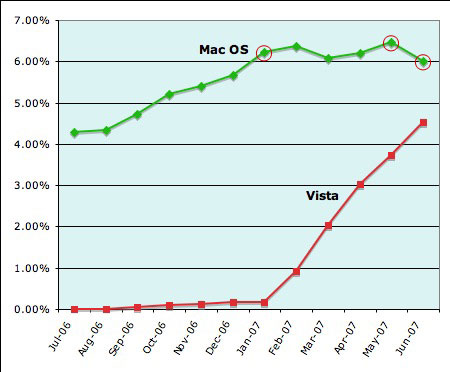
Remember this story from ComputerWorld a few months back? I wrote this blog post on it. The article basically used cherry-picked data to suggest that Vista was booming while the Mac was languishing in flat sales, pretty much the exact opposite of what was true. One quote in particular:

According to Net Applications, in June Windows Vista accounted for 4.52% of all systems that browsed the Web, up from January’s 0.18%. Vista has grown its usage share each month since its release to consumers Jan. 30, hitting 0.93% in February, 2.04% in March, 3.02% in April and 3.74% in May. Apple Inc.’s Mac OS X, meanwhile, accounted for 6.22% in January and hit its high point of 6.46% in May, but it slipped back to 6% in June.

Here’s the chart from which he chose his numbers, with his quoted Mac numbers circled in red:

See what he did with the Mac numbers? He chose the January number, which was near the end of a 6-month climb, and then compared it level summer numbers through May, and a small drop in June, citing a 1-month fluctuation as if it were signs of a trend. He did not report that year-over-year, Mac market share has been increasing rapidly: 20% from 2004 to 2005, 26% from 2005 to 2006, and now 40% from 2006 to 2007. Not only is the growth rapid, but it is accelerating. I charted this out:

He used this data to make this conclusion:

Windows Vista’s share of online users has increased every month this year, while rival Mac OS X — to which Vista has often been compared — has shown little, if any, growth, a metrics company reports.

But what about that downswing at the end of the Mac OS chart? Two and a half months ago, I noted:

For example, if you just trouble yourself to get the Net Applications numbers for the Mac OS for the previous year as well, you’ll notice a pattern: Mac OS share rises in the second half of the year, then stays steady in the first half of the next year. The numbers for the Mac have shot up starting in August for the past two years–which means that Mac OS share, as reported by this source, should start to jump again in the next few months….

And guess what? Well, here’s the chart, extended into September of this year:

0907-Macvista3B

And of course, just as predicted, the numbers have shot up. If they continue to follow that same trend, we should see Mac OS X market share reach over 8% by the beginning of next year–and Mac sales seem to indicate that this is pretty much what is happening. If the trend continues, Macs should have between 12% to 15% market share by 2010. If you really want to go far-reaching, the same trendline shows Macs reaching over 30% by 2015. However, considering that there is only 3 years of data from which to extrapolate a future trend, that’s kind of reaching too far; even 2010 is a stretch, and who knows what events can and will affect the trends in the future.

That is, however, the current trend. I was right in predicting the upswing beginning in August; let’s see if I’m right about next January before I start getting excited about anything farther down the road.

Nevertheless, you can probably see why I am definitely holding on to my Apple stock; despite having risen 65% and reached an all-time high since I bought it, Apple has so much more room to expand–not just with computers, but with cell phones and all the other markets they can enter–that it’s not even funny.

It should also be noted that the data comes from Net Applications, and the share is calculated by measuring visits to web sites which are more oriented towards Windows PCs.

Categories: Mac News Tags: by

Testing the New Bush Court

October 1st, 2007 Comments off

Now we come down to the home stretch, and find out what Bush’s new stacked Supreme Court is made of. Will Justice Kennedy prove to be the safety valve that Justice O’Connor likely hoped him to be? Or will he vote with Bush 41’s Alito and Roberts, Bush 43’s Thomas, and Reagan’s Scalia to form a conservative block?

Already we have seen that Roberts and Alito are completely content to ride along with Scalia and Thomas in blatantly manipulating the Constitution to claim it says what it clearly does not mean in order to impose their own personal views and ideologies on the nation. But how far will Kennedy go along with that?

One issue facing the court is a Washington D.C. gun ban–a law that bans handguns but allows shotguns and rifles, aimed at stemming street violence. This will be the first time since 1939 that the Second Amendment comes under this close scrutiny–and of course, it’s under a Bush-stacked court. Great.

The Supreme Court is known for being conservative and usually limits its decisions to the specific issue at hand. One way we’ll know if this is an ideological rather than legal decision is if the court, in a 5-4 decision along political lines, rules broadly about the interpretation of the Second Amendment. The only possible thing holding them back may be Kennedy, who the hard-right bloc may have to negotiate with to get him on their side. I fully expect the gun ban to be overturned, but Kennedy’s influence could keep it as restricted as, say, not re-interpreting the Second Amendment and only applying to such matters as whether or not D.C. can be treated like a state. Alternately, the court could easily say that the mention of “militias” has no bearing on the National Guard, and throw open the door to unrestricted access to firearms.

But that by far is not the most important issue to be reviewed this year. The court will decide on the reach of, or possibly existence of, habeas corpus, in regard to U.S. citizens or possibly just to non-citizen detainees in Guantanamo Bay. Free speech, voting rights, capital punishment, racism in crime sentencing, and states’ rights are all on the chopping block.

While this season may not necessarily constitute a bloodbath of civil liberties and well-established legal principles, one can at the very least expect a certain amount of injury to the Constitution and our concept of legal interpretation.

Stay tuned.

Categories: Political Ranting Tags: by

Gyoza Update 2007

September 30th, 2007 Comments off

Four years ago, I posted a gyoza (pot-sticker) recipe. Later that year, I posted an update–I had found out that adding Mozzarella cheese to the inside mix helped bind the filling and keep it moist.

Tonight, I made a new batch, and found out a few new improvements to the recipe. First, instead of using regular cabbage, you should use Chinese Cabbage (also called “bok choy,” or in Japanese, “hakusai,” or はくさい), and use more of the leafy parts and not really all of the heavy stem parts. Regular cabbage leaves too much bulk and hardness.

Leeks (nira, or にら) are still an integral part, but scale them down a bit, and fill in with “green onions” or “scallions” (negi, or ねぎ–not too heavy.

Also, drop the regular onions. Makes it too, well, oniony, too sharp. The scallions are enough to add flavor, along with the garlic.

Keep the Mozzarella cheese; as I said, it helps bind and moisten the interior.

I still prefer ground chicken to ground pork; chicken tends to be more moist and tasty a meat. You can even increase the proportion of chicken, unless you like more veggie and less meat.

Next–and this is important–if you can find more than one type of skin (wrapping), choose the thin type. That tastes much better than the thicker type.

And finally, I’ve been experimenting with adding cream cheese to the cooking process; for example, cooking chicken in stir-fry, cream cheese added to the final cooking stretch makes a big difference, and gives the chicken a rich, creamy overtone. Yo don’t need to use much, just a teaspoon or so, to add flavor. And I think it worked tonight with the gyoza. I added it soon after I poured water into the frying pan to cook the prepared gyoza dumplings, just a dab here and a dab there between the pieces, as there was still a good deal of water that had not boiled off. The cream cheese melts and joins with the water, and then slowly coats the gyoza as the water boils off, without becoming crusty or anything. It may even help maintain the moistness of the dumplings.

So follow the original recipe with those modifications. If you do, let me know your impressions!

Categories: Main Tags: by

Condemn the Condemnation

September 30th, 2007 Comments off

Hey! Look! Fox News is attacking the troops now! We should condemn them as well!

Of course, this whole “we should condemn (insert person’s or group’s name here) for attacking the troops” movement is nothing but a sham. The only reason there has been a call from the left to condemn Limbaugh or anyone else is not because liberals think that it’s a good idea to condemn anyone for an opinion, but simply to show up the conservatives for their blatantly political grandstanding and hypocrisy.

The thing is, no one should be condemned like that simply for expressing an opinion. Criticize it, disagree with it, proffer an opposing opinion–but to condemn the act of speech in the halls of Congress begins to set limits on freedom of expression. If we start getting timid about criticizing any element of our government, then a severe blow has been dealt to our freedoms, precisely because politicians will then hide behind it–as the Bush administration has so heavily exemplified over the past several years. Bush ran out of legitimacy some time ago, and has been milking the military for all it’s been worth since then.

The Democrats who voted with the Republicans enough to get the MoveOn.org condemnation passed should be ashamed; the excuse that it would cost them politically to do otherwise simply won’t cut it.

Even the movement to condemn Limbaugh in Congress is a bad move. Yes, there is value in demonstrating to Republicans that they can be met, measure for measure, and in showing up their blatant hypocrisy. But it also means stooping to their level and puts us in danger of having a dangerous precedent set.

And let’s not forget how this started: Giuliani and other conservatives tried to stir up cheap publicity by attacking a left-wing whipping boy in defense of a general with political ambitions lying on behalf of the president whose quagmire is leading us to ruin.

Hardly a bedrock foundation upon which to build upon. Let’s get off this heap of dung before our feet sink too deeply into it, and leave the conservatives to wallow knee-deep all by themselves.

Categories: GOP & The Election Tags: by

Because There Are So Many Fake Soldiers Out There

September 30th, 2007 2 comments

A graf from TPM:

It didn’t take too long for Rush Limbaugh and his allies to come up with a defense for the “phony soldiers” flap. While the transcript makes it rather clear that Limbaugh was referring to troops who oppose the president’s Iraq policy, Limbaugh, the Weekly Standard, and others, have argued that the far-right blowhard was being literal. In other words, when Limbaugh trashed “phony soldiers,” he was referring to actual frauds — those who claimed to serve but didn’t.

Yes, of course. Very believable. And hey, I heard that MoveOn.org has a defense as well: they actually did not know how to spell General Petraeus’ name, and put up the “General Petraeus or General Betray-us” ad in order to get clarification. Just a big misunderstanding.

Apparently Limbaugh is latching on to this bizarre weasel, and has claimed that John Murtha is one of those “phony soldiers.” At the very least, this shows us the difference between Limbaugh and MoveOn.org: only one of them is a gutless wonder who makes lame excuses to try to make it seem that he didn’t say what he obviously meant to say.

Setting a Target

September 29th, 2007 8 comments

I’ve come to a long-term decision about this blog: I’ve decided to set five years as my ultimate goal for non-stop blogging. As of today, I have been blogging every day without a break for 1,519 days, or about four years and two months. And it’s beginning to wear somewhat.

Usually, I do not like to just write down a few words and call it a day, although I have done that a few times–a very few times. Normally, making a blog post consists of a rather lengthy process, and it’s not something that I feel that I can keep up with indefinitely. There are nights when I realize that I have not written a blog for that day, and really don’t feel like it. Call it blogger’s fatigue. And yes, tonight was one of those nights. But this is not an impulse decision; I have been thinking about this for quite some time. And five years seems like a nice, round number.

Certainly, the amount of content that I have built up is enough so that the site can still attract a lot of people via Google, at the very least. Not to mention that I have no plans for stopping–just not blogging every single day. And I am also aware that next year on August 3rd–the first day after the five years is up–the presidential campaign is going to be in full swing. So I might just continue blogging simply because there will be so much to blog about. It’s not as if I’m going to take a day off to mark the occasion; after the 5th anniversary, I’ll just skip the first day that I feel like.

I may certainly be making too big a deal about this–it’s not the end of the world, nor is it a non-stop blogging record (unless I am seriously overestimating all other bloggers), nor is a five-year unbroken stretch anything that’s worth a Pulitzer Prize, or even more than a minute of your time. But personally, it is quite something–it represents my own personal development in terms of being able to continue something for the long term.

I’m the kind of person who tends not to form new habits very easily (unless they are habits of laziness or other forms of non-effort). At the time I started this blog, I felt it necessary to change that. I decided that if I could maintain a daily blog, I could start other habits of effort as well. And it has helped; I was successful, for example, in establishing an exercise routine, which I have maintained for longer than I have ever done before. That was a small part of my ability to lose ten kilos a few years ago as well. This blog is at the very least a landmark in my personal development. And I figure that the mental exercise of writing is certainly not a bad thing for the old noggin, not to mention a good way to keep my writing skills healthy.

If nothing else, however, this blog also has served as a way to record my thoughts and some of my life’s events in a way I never did consistently before. The recent addition of the “On This Day” widget (see the right-hand sidebar) has emphasized this–it’s pretty interesting to look back and see what I was thinking about and doing on any given day “x” number of years ago.

So in addition to counting up (1,519 days), I now have a count-down as well (308 days).

Unless the election provides too much fodder and I find some reason to make 2000 days the target instead of 5 years.

Categories: BlogTech Tags: by

…And It’s Dead

September 28th, 2007 Comments off

Or at least, it is dying. The Republican measure to split California’s electoral votes, that is:

In an exclusive report to appear on this website late tonight and in Friday’s print editions, The Times’ Dan Morain reports that the proposal to change the winner-take-all electoral vote allocation to one by congressional district is virtually dead with the resignation of key supporters, internal disputes and a lack of funds.

The reality is hundreds of thousands of signatures must be gathered by the end of November to get the measure on the June 2008 ballot.

Not that it had all that much a chance of passing anyway, but even the threat was enough to make mobilization against it worthwhile.

Categories: GOP & The Election Tags: by

Giuliani’s Condemnation of Limbaugh Should Be Along Any Minute Now…

September 28th, 2007 3 comments

Well, the right wing has revived MoveOn.org as a whipping boy, a Liberal Satan that they all agree they can pile onto and attempt to destroy. Pretty much all the Republican candidates have taken it upon themselves to completely and utterly vilify MoveOn.org. Why? Because they called General Petraeus “General Betray-Us.”

McCain actually called for MoveOn to be “thrown out of the country” (he later claimed that he spoke in error due to his “outrage”), and Giuliani is daring Hillary Clinton to condemn MoveOn. org or be labeled a hypocrite.

Now, don’t get me wrong. I think such name-calling campaigns are less than mature and respectable for any large public advocacy group, or even any one critic. Sure, it can be fun–there was a satisfying edge to Al Franken’s “Rush Limbaugh Is a Big, Fat Idiot.” It might not be enough to point out that Franken at least wasn’t making fun of Limbaugh’s name with bad puns, but it is rather more excusable that (a) Limbaugh ain’t no soldier (in fact, like so many chickenhawks, he dodged the draft), and so few see it has foul play when he is attacked for his actions, and (b) while being funny and comical, everything that Franken wrote was either fully true or was high satire (for example, Franken’s fictional account of Limbaugh serving in Vietnam). In other words, Limbaugh deserved it in spades, and the worst of it was less name-calling than it was simply pointing out facts.

But such things are not what the Republicans claim to be furious about; they claim that MoveOn.org crossed a line by attacking a man in uniform. That, we are told, is unacceptable and deserves, even demands condemnation.

However, what MoveOn.org did with its recent ad was virtually amateur hour when it comes to right-wing spokespeople and organizations. Take Rush Limbaugh, as a simple example.

One of the few times I ever listened to more than just one minute of Rush Limbaugh was many years ago when he was attacking Senator Inouye, a decorated WWII veteran who won the Medal of Honor, and repeatedly called the Senator “In No Way.” But that’s hardly Limbaugh at his worst. He has recently called Barack Obama “The Magic Negro” and has had racist impersonations of Al Sharpton on for a long time; is it any less objectionable to be a racist? When Clinton was in office, Limbaugh referred to his daughter Chelsea as “the White House dog”; is it OK to viciously attack the president’s 13-year-old child? Limbaugh has called Democrat Tom Harkin (also a war vet) “Dung Heap Harkin.” Other name calling includes “Nikita Dean,” “Ned Lament,” “Dick Turban,” “Nazi Pelosi,” “Bela Pelosi,” “Dingy Harry [Reid],” “Barack O’McNabb,” and many others. He has absolutely no problem with calling decorated war vets names, often far worse than “General Betray-us.”

But wait, you say, Limbaugh is just attacking politicians, and that’s okay–ignoring for the moment that many of these politicians are also former soldiers, and Petraeus himself is a presidential hopeful, in his own mind at least.

Then how about this statement made by Limbaugh just the other day, where he called soldiers who oppose the Iraq War “phony soldiers”?

And in a rather strong show of irony, MoveOn.org was not the first to use the name “Betray-us.” Guess who was? That’s right: Rush Limbaugh. He used it last January to smear Republican Senator Chuck Hagel, who also opposes the war–and is also a Vietnam War veteran:

LIMBAUGH: By the way, we had a caller call, couldn’t stay on the air, got a new name for Senator Hagel in Nebraska, we got General Petraeus and we got Senator Betrayus, new name for Senator Hagel.

So, when will Giuliani condemn Rush Limbaugh? Did Giuliani call for Republicans to condemn Limbaugh back in January?

Of course not. That would violate the long-standing Republican principle of applying double standards to conservatives and liberals. And we can’t have that.

Theft by Fiat

September 27th, 2007 3 comments

I would say that the chutzpah of Republicans in how openly they try to steal elections is galling, but then I have to remember that this is simply par for the course for them.

Under thinly-veiled pretenses of fighting “voter fraud”–something there has been virtually no evidence of despite widespread right-wing claims and a concerted effort to find it–Republicans have been successful in getting laws passed in key electoral states that specifically target Democratic voters, especially minorities and the poor. This story from McClatchy outlines the efforts.

One of two primary tactics in the regard is voter caging: to target tens of thousands of registered letters at heavily poor and minority Democratic voters, especially ones who have the highest chances of not being able to sign for the letters. Any letter that is not signed for is brandished as “proof” that the voter registration is fraudulent, and the voter is challenged at the polls, and forced either not to vote at all, or to cast a “provisional ballot” which is usually not even counted.

One such incident involved letters sent to students at their school addresses–during summer vacation, when they would mostly be away and unable to respond. The letters were even marked “do not forward” so as to guarantee fraudulent challenges.

The other tactic is a modern-day “Jim Crow” law: to require a photo ID in order to vote. Since the people who usually don’t have photo ID are largely minority and Democratic, these laws essentially throw up unfair roadblocks in the hopes of preventing them from voting. Normally, I would not protest the requirement of something like getting an ID if a person feels it necessary to carry out an act–even if it is a right–but the roadblocks are not being put in place on legitimate grounds, nor are they inconveniencing voters indiscriminately–they are specifically targeted at disenfranchising a very specific segment of society. For example, if someone suggested a gun control measure that had no discernible effect on crime but specifically targeted an ethnic group to deny them the same rights as others, then that would be a no-brainer–of course it should be opposed. That’s what we’ve got here.

It should be noted that the same people who are pushing for photo ID requirements at polling places are the exact same people who vehemently fight against “motor-voter” law which make it easier to register to vote when one acquires a photo ID, in the form of a driver’s license. Why? Because it is likely that Democrats would benefit from such a convenience more than Republicans. Not just because more Democrats would register, but because it would make it harder to fraudulently cage Democratic voters.

So we have two laws, both tying photo IDs to voting, and conservatives push for one and fight against the other–not based upon fighting voter fraud or enabling people to vote, but decided purely on the grounds of denying as many Democrats as possible their right to vote.

But the tactics don’t stop at such minor measures; this year, the Republicans are thinking big. They want to steal California. The idea is to change California from a standard winner-takes-all state to a state which divvies up its electoral votes according to which districts voted which way.

Why is this stealing? Because the GOP only wants it to happen in California, a Democratic stronghold. Now, if they proposed a measure that would simultaneously switch California as well as Texas, Mississippi and Alabama–three Republican strongholds with the same number of combined electoral votes as California–that I would approve. A fair and even switch. Or change the whole country that way. But not just Democratic strongholds.

California Governor Schwarzenegger, while not directly opposing the measure, did not approve:

“I feel like, if you’re all of a sudden in the middle of the game start changing the rules, it’s kind of odd,” said Gov. Arnold Schwarzenegger, R-California. “It almost feels like a loser’s mentality, saying, ‘I cannot win with those rules. So let me change the rules.’”

That’s kind of funny, because in 2005, he called special elections in order to try to pass measures to gerrymander California along Republican lines, and to prevent unions from contributing to Democratic campaigns. At the same time, Republicans in California were also attempting to pass the exact same electoral-vote-splitting measure as they are this year.

Schwarzenegger may be less a victim of poor memory than he is of getting his ass kicked in an election; after his pro-GOP measures were soundly trounced, he swung noticeably to the center.


What this all comes down to is fairness. You want to make changes that affect everyone the same, great. Democrats tend to go for that, and even give way against their own advantage–like they did when they passed campaign finance reform laws that actually benefitted Republicans a few years back. Or like when they arranged for Clinton’s special prosecutors to be Republicans; not only would Republicans fight the idea of a Democratic prosecutor investigating Bush, they would fight tooth and nail against any prosecutor investigating Bush.

For the GOP, fairness simply doesn’t figure into politics. They laugh at the idea. They don’t want fairness, they don’t want people to exercise their rights, they don’t want all the votes counted. They just want to win, at any cost. And they don’t care if it is by hook or by crook, and apparently they don’t give a damn about who knows it, from the blatant nature of their theft.

Categories: GOP & The Election Tags: by

Acting White

September 26th, 2007 2 comments

According to the South Carolina newspaper, The State:

Jackson sharply criticized presidential hopeful and Illinois Sen. Barack Obama for “acting like he’s white” in what Jackson said has been a tepid response to six black juveniles’ arrest on attempted-murder charges in Jena, La.

Jackson later tried to claim he hadn’t meant what he said, or said what he said, or meant what he whatever, but even from the words of the backpedal, it sounded pretty certain that he said what he said, though perhaps he regretted it later on.

I have to say that if I were Obama, I’d be pretty offended by such a sentiment; perhaps that’s what Jackson later realized, or figured other people would think.

Race should not matter. And if race should not matter, then Obama should not be held to a higher standard, to be a spokesperson and special representative for the black community (unless he volunteered and the community accepted him). I don’t recall Obama jumping up and down, saying, “Look at me, I’m black!” Everyone else seems to have been paying attention to his race, but Obama, as far as I can tell, has not made it a rallying point or anything. It’s as if a black candidate has to be “black,” noticeably so. He can’t just be a candidate, it seems.

What should matter is ethics and morality and justice–in which case any candidate who fails to speak out about the injustice of what happened in Jena is guilty of not caring; not any one of them should be more or less called upon to care or speak out.

Jackson seemed to realize this:

“If I were a candidate, I’d be all over Jena,” Jackson said after an hour-long speech at Columbia’s historically black Benedict College.

He did not say, “If I were a black candidate, I’d be all over Jena.” In fact, any of the Democratic candidates would do well to pay attention to that issue; it means a lot to quite a few people–aside, of course, from being an important matter unto itself.

But the whole “you’ve got to pay attention to black issues because you’re black,” that’s the kind of thing that conservatives jab Democrats for. And it’s wrong. Not because Obama didn’t go to Jena, but because any of the candidates didn’t go there.

Of course, how many of us could be expected to pay attention to racial injustice in Louisiana when O.J. is catching our attention so? If only there were some kind of organization whose members were tasked to find out relevant goings-on and, oh, I don’t know, “report” on them or something, so the people could know more about what’s actually important and not be so easily distracted. Too bad we don’t have one of those.

Categories: Political Ranting Tags: by

Champ-Magné

September 26th, 2007 2 comments

From here:

In an August 2006 Time magazine article, America is Drawn to Manga, VIZ Media went as far as to say that “true manga” was made only in Japan.

And true champagne is only made in France, and the identical drink made elsewhere must be called “sparkling wine.”

Please. They’re cartoons. Cartoons where the main draw is scantily clad women and giant robots, and usually everyone has monstrously huge eyes which, if real, would scare the crap out of you instead of looking cute. (Yes, I know, manga is more than that, but I never really got into it much and really don’t care.) It’s a style, and style can be copied, often times very effectively.

If you can drink a beverage and really discern which country it was made in, then congratulations, you have far too much free time on your hands. Everything else is marketing and turf, or otakuppoi interest at the level of who-is-better-Kirk-or-Picard.

But then again, on second thought, maybe there are not very many casual readers of manga. In which case, the distinction might very well make a difference to everyone who reads the stuff.

Categories: Media & Reviews Tags: by

Blind to the Power of a Threat

September 25th, 2007 2 comments

Via Think Progress:

In his speech at Columbia University today, Iran President Mahmoud Ahmadinejad was asked about the treatment of gays in Iran. Ahmadinejad responded, “In Iran, we dont have homosexuals like in your country. We don’t have that in our country. In Iran, we do not have this phenomenon. I don’t know who’s told you we have it.” …

“Some international gay rights groups believe that more than 4,000 lesbians and gay men have been executed since the Ayatollahs seized power in 1979,” notes 365gay.com.

Perhaps Ahmadinejad meant, “we dont have homosexuals anymore.”

But in truth, the fact brought up by 365gay.com demonstrates why people in Iran might think that gays do not exist there: quite simply, they know they would face certain death.

This is not a new concept to me; while in college in the early 90’s, I took a course in Human Sexuality (a very popular elective course) in which one of the instructors related a story with a similar theme. Apparently, in a lesson some time before, the teacher had told the class that homosexuals exist in every country, in every society. After the class, a student from a Middle-eastern country came up to her and rather vehemently denied that statement where his country was involved. “There are no gays in my country!” the student declared.

The teacher asked, “If a gay person was found in your country, what would happen?”

“We would kill him,” reported the student matter-of-factly.

Apparently, even after explanations, the student still did not understand how it was possible for gays to be in his country and he could not be aware of it.

Categories: People Can Be Idiots Tags: by

One or the Other

September 25th, 2007 7 comments

Wow. I can’t believe that I never saw this before.

A person just made a comment in the Gun Control post which highlighted a logical inconsistency in the pro-gun argument… one so obvious that I am astounded that I never saw it before.

There are two highly popular, long-standing pro-gun arguments:

  1. If you try to ban guns, criminals will still be able to get them because gun bans are ultimately unsuccessful.
  2. If a dictator comes to power, they will use gun registration to confiscate all our guns and we will not be able to overthrow them.

I have heard these two arguments ever since I started reading debate on the subject, over two decades ago. Like I said, I did not see the glaring contradiction between them, and I am amazed that I never did–and more amazed that I never heard anyone else point this out.

The two statements contradict each other because one assumes that gun bans are not effective, and the other one assumes they are effective.

If a gun ban would never stop criminals from getting guns, then a dictator could never ban guns, either. But if a dictator could effectively ban our guns, then gun bans are effective. You can’t have it both ways–though it is common for right-wingers to want to do so.

Of course, in the context of my gun control post, the whole issue is moot–I never propose a gun ban, but rather effective gun control measures that would have the least restrictions on legal ownership while maximum effectiveness at keeping guns out of the hands of criminals.

Despite this very explicitly-stated opinion, virtually every pro-gun person who leaves a comment slams me for wanting to “ban” guns. It’s a weird phenomenon, a kind of perceptual blindness, where you say “gun control and NOT A GUN BAN,” and people come back saying, “but a gun ban would never work!” Even though I spell out conditions to the point where we would have a new Constitutional amendment saying “no gun bans,” still gun advocates assume that the whole idea is to ban guns and then they vehemently argue against that.

Maybe it’s a perceptual blindness via NRA conditioning wherein they simply presume anyone who wants to control gun sales even the smallest amount also wants to ban guns. Maybe it’s that gun control is too much more difficult for some people to debate against and so they use gun bans as a straw man. Who knows. In the end, I still have yet to hear anyone effectively argue against reasonable gun control.

Categories: Political Ranting Tags: by

Half the Equation

September 24th, 2007 Comments off

0907-Panky-450

Anyone got a hanky?

Categories: The Lighter Side Tags: by

What I Meant Was…

September 24th, 2007 6 comments

Formerly pro-gun-control Giuliani trying to win over the NRA by explaining his support of a gun control lawsuit:

“I also think that there are some major intervening events — September 11, which cast somewhat of a different light on the Second Amendment, doesn’t change it fundamentally but perhaps highlights the necessity of it.”

Um, okay. So, is he saying that the terrorists on 9/11 would have been foiled if everyone on board the planes were allowed to fly armed?

Or is Giuliani simply pandering without respect to reason?

Either way, he’s a hypocritical idiot. With all due respect to “America’s Mayor.”

Categories: GOP & The Election Tags: by

“God Damn America!” So Sings the Right Wing

September 24th, 2007 Comments off

As Josh Marshall points out, any attempt by the left to say America is less than respectable, even if it is by way of pointing out how things have gone wrong and must be set right, is met with contempt, ridicule, and endless harassment and degradation by the right wing. For this, they call us traitors, and insist that we hate America.

And then they turn around and rewrite the song “God Bless America” to say that God should condemn America for not allowing prayer in public schools and for not outlawing abortion.

I would agree with Marshall that this hypocrisy deserves contempt, but for the same reason that I do not regularly condemn Coulter, O’Reilly, and Limbaugh every time they say something contemptible, I cannot expect anything more from moronic fundamentalist prigs like these. It’s their nature to be contemptible, so you can’t really get your panties into a bunch because of stuff like this.

Categories: Political Ranting, Religion Tags: by