Subscribe to Comments Activated

August 24th, 2007 7 comments

I’ve added a plugin that allows you to opt for email notification when someone posts a comment after yours in any one blog entry. The email includes a link which allows you to manage which entries have notification status for you, so you can turn any post’s notifications off if you wish. Seems to work. Let me know if you have any problems.

Categories: BlogTech Tags: by

Bush and His Wacky Analogies

August 23rd, 2007 Comments off

From teh Bush:

President George W Bush has turned the comparison between Iraq and Vietnam on its head in a speech to war veterans, arguing that America’s experience in south-east Asia support the case for keeping US troops in the Middle East.

He said that the rapid US withdrawal from Vietnam and Cambodia in 1975 had led to bloodbaths, persecution of those who worked for the Americans and the boat people refugee crisis.

He argued that a premature US exit from Iraq could have similar consequences.

“Many argued that if we pulled out, there would be no consequences for the Vietnamese people,” he said, addressing the Veterans of Foreign Wars association in Kansas City.

Oh, Lord, so many things wrong, so little time.

First of all, let’s point out that last bit, about “Many argued.” That’s the famous Straw Man appeal. Now, I wasn’t really paying attention to politics much then, mainly because I was, like, under ten years old, but were there really many serious people who argued that a U.S. pullout from Vietnam would not result in any continued violence? Even if there were–and I doubt that–Bush’s statement makes the suggestion that there are a similar “Many” today who argue that a pullout from Iraq will also have “no consequences” for the Iraqi people–which, of course, is utterly false.

Then, as to the basic comparison, one could make so many other analogies between Vietnam and Iraq–the mistake of going in in the first place, the hopelessness of a major guerilla land war in Asia, investing more and more in a quagmire because it would look bad to pull out….

And let’s not forget an oldie but a goodie: the scare theory of what will happen if we leave. In Vietnam, it was the Domino Theory: if we leave, the Communists will start making victories that will topple the other countries until Communists take over Asia and we have a bigger problem and maybe a war taken to our doorstep. In Iraq, the shorthand version is, if we stop fighting them there, they’ll follow us home and make war on our doorstep. Same basic idea: if we end the war, disaster will befall us, and the boogeyman will come get us.

Then there is the whole argument that things will get worse if we leave, as if going in in the first place was not the error that led to the damage. That somehow the decision to invade was a good idea, that staying in is a good idea, and the only course that will do us harm is deciding to leave. The sad fact is, the invasion itself was the error, and withdrawing is the least bad of all resolutions to that error.

Bush claimed that it was the withdrawal from Vietnam that emboldened al Qaeda, suggesting the inference that withdrawing from Iraq would cause similar damage. However, the damage has already been done: it was the invasion of Iraq that emboldened our enemies; the withdrawal is only a painful resolution to a mistake already made, Staying in Iraq indefinitely would embolden our enemies further still, worse than if we were to withdraw. It has already proven to be a huge recruitment and fundraising bonanza for al Qaeda.

“In Vietnam, former American allies, government workers, intellectuals, and businessmen were sent off to prison camps, where tens of thousands perished.”

This shouldn’t be too much of a problem in Iraq: almost all of those people have already left the country. Why? Because they have been targeted by death squads. In short, the horrors Bush warns of have already been taking place.

It also drew on a long-running belief in the military that the US Congress threw away the chance of victory in Vietnam by pulling troops home early.

And here we get into the real fantasy: that this is something we can “win.” Naturally, it is far easier to dream of a victory than to actually achieve one. Right-wingers argue that the “Surge” is working, allegedly because violence is on a downswing (many point to July’s numbers, ignoring the fact that over the past three years, July has always seen a downturn in violence). I would direct you to read what these soldiers have to say about the matter.

Here’s the thing: even if the surge were having the effect that right-wingers claim–and I have seen no persuasive evidence that this is actually the case–but even if it were, then the idea that this means we could win the war is still utterly a pipe dream. As I said before, Iraq is an arterial gash: you can make it look like it is bleeding a bit less by applying pressure to it, but that alone won’t be enough to repair the damage and bring the patient back to health. It is an illusion of repair, not repair in fact.

The theory is that if we can just apply enough pressure to dampen violence in Iraq for a while, then Iraq can heal itself, pull itself together, become a unified whole, pick itself up and banish the insurgents. That’s all, not much.

And that, my friends, is the extent of the pipe dream. The Iraqi government cannot pick its nose without falling apart at the seams; the insurgents, even if suppressed, are still there and are not going anywhere; the Iraqi militia, when they are not giving their weapons to insurgents or actively participating in the insurgency, are incapable of policing Iraq on their own; there is no solution in sight for solving the problems of sectarian division; and so many, many other problems.

So the optimists are saying, “Hey look, all we had to do was pour tens of thousands of extra U.S. troops which we cannot maintain for very long, and the number of violent attacks in Iraq fell by ”x“ percent, so that means all those other problems are not so insurmountable!”

I weep for the poor teen who thinks he’s immortal and gets suckered in by the huge signing bonuses now being offered to join the military. It does not matter if he has patriotism in his heart–in fact, it is worse if he does, for that only intensifies the tragedy of what he will be put through to satisfy the fantasies of those who say we will win this thing, but always find reasons not to serve in the military themselves.

Categories: Iraq News Tags: by

A Fifth of the Nutrition

August 23rd, 2007 2 comments

0807-Gat-Nutr-450In Japan, food and beverage makers have not traditionally done that much in the way of labeling nutritional values. Often times, in fact, when you get an imported item from abroad, the nutritional information is intentionally covered up by a sticker in Japanese with more lax standards on what to report. Don’t count on Japanese people knowing what “trans-fats” are, or how much cholesterol is in stuff, or even to be aware of saturated fats. Generally speaking, you won’t hear about that stuff here.

But they do have to give basics, and one of the basics is calories. At right is from a bottle of Gatorade, but it’s pretty standard. Note the calorie count–26! Pretty low, right? Well, a closer look shows you the little trick they thought up: these are the values for 100 milliliters of the drink, and the bottle is 500 ml. So you have to multiply by five.

Admittedly, it’s a standard trick–how often has a food label’s “serving size” matched the amount you really ate? Still, it is possible that you might nosh on eleven pretzels, two small cookies, or a handful of potato chips. But using such a division on a single-serving drink? Who drinks one-fifth of a bottle of Gatorade, or any other such drink?

This is one of those “lying by telling the truth” techniques, where you jigger the facts enough so that you are technically telling the truth, but at the same time, you are straining as hard as you can to create a more favorable misinterpretation. Kind of like using “Saddam Hussein,” “9/11,” “The Iraq War” and “The War on Terror” so often intermingled and interchangeable that two-thirds of the people believe that Saddam Hussein was involved in 9/11 and that the hijackers came from Iraq, even when such things are obviously untrue. And in the end, you can stand up and say, “Hey, I never claimed that Saddam Hussein and Iraq were involved in 9/11.” But, of course, you did, and that’s the point: if you speak only facts, but you distort them so as to give a false impression, it doesn’t matter if you never came right out and said anything untrue in so many words. The fact that you designed your message to portray a lie makes it a lie.

A Libertarian might say about the drink bottle, let the buyer beware. Me, I favor making it illegal to intentionally lie to people when advertising or giving nutritional information. This is the kind of thing that right-wingers talk about when they say that people like me want “Big Brother,” or government control over our lives. Me, I’ll pass on the warrantless wiretapping, thank you, and opt for the laws against consumer fraud.

Hey, I’m getting back into blogging form again–I squeezed a political statement out of a soft drink label!

Categories: Political Ranting Tags: by

Thematic Difficulties

August 22nd, 2007 6 comments

Ah, it’s all coming back. I remember doing this before, when I first designed my site with Movable Type. Most of the layout is CSS, and since I don’t know CSS, I have to use a template of some sort–some WordPress Theme which has all the fundamentals, all I have to do is insert my own images, change the colors, set widths and heights and fonts and so forth. A work in progress, even still after several days of redesigning.

One unexpected factor: the person who built the theme I am using as a template decided to make an ass out of all the people who used his theme. He inserted text which would only appear of you viewed the blog in Internet Explorer; it takes a prime spot right below your blog banner and right above the first post, and essentially says how IE blows and what are you thinking about using that.

Now, to be honest, I wholeheartedly agree with the sentiment–but at the same time, this guy’s methods are for crap. Inserting a condescending message into the middle of your blog which you won’t see unless you’re using IE on Windows? I had no idea that I was insulting a large block of my own readers, and would not have known at all until (a) I happened to stumble across the code by accident, (b) used IE myself, or (c) someone got offended and told me about it. (a) was not too likely, as the page content section did not really need modification; (b) would eventually have happened, once I got around to testing the theme out on different browsers; but (c) happened first.

Ergo, as soon as I can root out the last of any original design elements this guy put it, I am deleting the link back to him. All I needed the theme for was as a foundation to create my own design, anyway. Or, that is, to transfer the design I had to the new blog.

But since I did wind up unknowingly offending at least one person in that manner, I wound up doing platform/browser tests early, and was reminded of yet another headache of web site design: getting all the browsers to play nice. Like I said, I greatly dislike the theme author’s methods, though I agree with the sentiment: Microsoft makes life harder for web page designers. Sure, they could follow standards, but do they? Of course not. And since Microsoft owns the Desktop and gives IE as the default browser, virtually everybody uses it–which means that you either dance to Microsoft’s tune and blow off people using other software, or you make your blog look bad for everyone else.

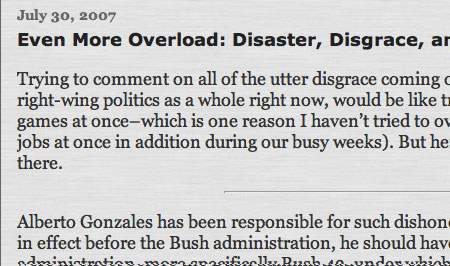
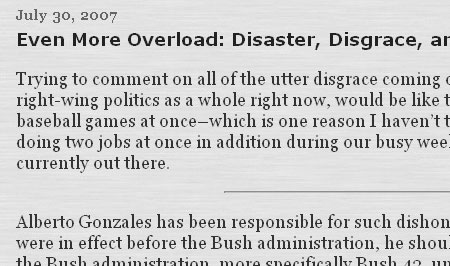
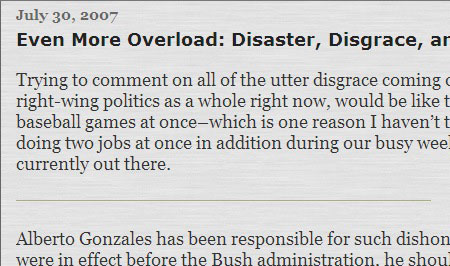
This really stands out when you look at the pages in the different browsers. There really is a good deal of difference in how they render, especially in Windows. Witness three browser views of a part of one of my pages. First, Safari:

Wpblog-Safari

Next, Mozilla/Firefox:

Wpblog-Mozilla

And lastly, Internet Explorer:

Wpblog-Ie

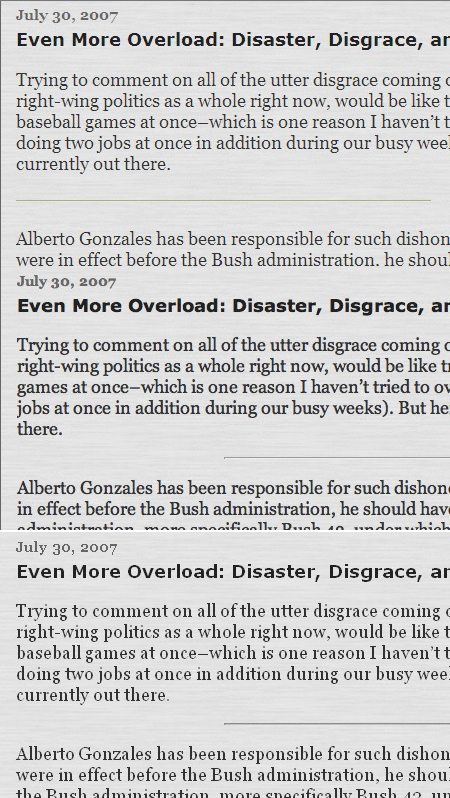
Notice a few things: the text looks smoothest in Safari, probably because Apple does font anti-aliasing. The text looks bolder. Mozilla/Firefox looks horrible–the text is all jaggy and distorted. Maybe I don’t have the text settings done right–but they are as I downloaded them.

IE is in between the two as far as text quality, but notice something else: the half-page-width horizontal rule is left-aligned in IE, and is correctly centered in Safari and Mozilla.

Here’s the interesting thing: on a Mac, Safari and Mozilla/Firefox are virtually indistinguishable–so much so that posting an image of the different screens would be pointless.

Here is an animated GIF file, for those of you who have that turned on in your browsers, switching between the three browsers renders:

Wp-Pages


But that’s not the only place IE differs. You’ll find other small bits and pieces here and there that don’t match up–and IE is always the odd browser out… meaning they’re the ones who don’t play by the rules. Look at the bottom of the comments area on an individual page:

Wp-Pages2
Left is Mozilla, center is Safari, right is IE. Notice how the background color for the last comment extends down to the bottom of the page. Again, not the way it should be.

Such problems are not insurmountable, but they are a major pain. If Microsoft stopped finagling with the code so they could force people to make IE look better to the detriment of other browsers, then web design would be a lot easier. Instead, you have to inspect every nook and cranny on different browsers and different platforms, and fiddle with the commands until you find an array of settings that looks acceptable on all browsers.

This is why so many people keep the simple, basic themes provided, and I can’t blame them for it. It’s a huge amount of effort and self-training. The benefit, however, is learning new code, if you don’t know CSS already.

Categories: BlogTech Tags: by

Getting There

August 21st, 2007 19 comments

Well, the old Movable Type blog is more or less officially closed now, with a note on the door to come over here. I will only be posting new stuff at this location from now on, at least until I decide to put the WordPress blog into the main directory… a decision for later. For now, bookmark this page… or just go to the main page of the old blog and let it redirect you here.

One major hassle will be redirects. Because the old blog did not use blog post numbers for entries that were deleted, and the new blog failed to respect that numbering, the numbering no longer matches. Ergo, the utilities which usually manage redirects will not, in all probability, be of any use to me. Seems foolish–after all, who doesn’t have at least one deleted entry?

Worse, I can’t even redirect the easy way–the redirect utility provided by my web host can’t handle question marks, which WordPress uses. In addition to that, the search engines will continue to send 70% to 80% of my visitors to me… to the old site’s pages. Hell, I don’t even know if the search engines scan and link to WordPress’ php-style pages the same way they do with static pages… they must, right?

Then there is the formatting. As you can see, I have gotten most of the page to look OK, but bits and pieces of the base theme I used are still peeking through. I have to rework stuff like blockquotes, comment background coloring, the footer on the pages, and so on. Please be patient with me while I go through this.

In the meantime, please keep dropping by!

Categories: BlogTech Tags: by

Now, To Change the Layout

August 21st, 2007 2 comments

Okay, so the transfer seems done, more or less. A few strangenesses, like the fact that the number of posts has decreased from 2631 to 2626, but the number of comments has increased from 6593 to 6705. I have no idea where those five extra posts went to, but I have the feeling that the extra emails are ones that I had not formerly approved and yet had not deleted either…

So now I just have to learn all about WordPress-plugins and widgets and themes, oh my!

Categories: BlogTech Tags: by

Whack-a-Mole Spambots and WordPress Migration

August 20th, 2007 6 comments

One of the issues that I have been dealing with is how to defeat the spammers. One way to do this in Movable Type is the change the name of the comment script from time to time. This seems to work, but only very temporarily. Even instantly, a lot of spammers’ software detects the new name (probably once it fails to execute the script once) and just resets with the new script address. Some spammers seem to be set on long-term autopilot, however. I have changed the name of my comments script about 4 or 5 times, and yet I still get attempts to access the previous versions–even though the oldest of those has not been active for more than two weeks.

However, you can see the spammers when they auto-correct: you get two hits from the same IP address; one directed at the old script, and one directed at the new one. Apparently that’s when they tried to old script, it failed, and so they accessed the blog entry page and found the new script. All automated; such hits are usually just minutes apart.

Another issue is how to move the blog from Movable Type to WordPress. A process which should be simplified by this time is still, apparently, labyrinthine. The most frustrating aspect to it is, as I have found out many times before, the documentation. Generally speaking, the people who make the documentation are the people who write the software… and as documentation authors, they suck big-time. Their most common error is to assume that everyone using the software has years of experience in web site administration, so they casually say “do this” and “do that” and give no frakking clue as to how these things can be accomplished.

One example is that since my blog is big, I am having trouble uploading the data file so that WordPress can even get started on processing it. They casually set a limit of 2 MB, while the file I need to import is 14 MB. Yes, I know my blog is a lot bigger than most, but still, they must expect most people to have tiny little blogs; I must have exceeded that much in my first year alone. Anyway, the problem, many report, is that the file is too big–so just divide it into pieces. Well, great–but how? No clue is given to this, they just assume that you know all about this kind of stuff. Nobody takes the trouble of spelling it out so that someone with no technical knowledge can do it. Even the better ones, at some point, have one instruction that depends on knowing some protocol, trick, code, or process–and just one broken link will completely stop you in your tracks.

It does not help that Movable Type apparently re-designed their support site, in such a way that none of the links work. If you search the forums, you always find somebody asking about a problem, and other members say, “You dolt! This has already been discussed, just go here!” and they provide a link. But the link is broken, and a search does not bring up the page they are apparently talking about. Swell.

Frankly, I will be rather surprised if I can get this done this week. I was hoping to have it done today, but tech-support lag has hit me. I needed to ask for a php file-size limit to be raised, and they did… for the main directory only. I did not know I had to ask for a specific directory, so another 2-3 hours must go by before I can get that fixed. And I’m only just beginning. If I succeed in importing the file, then there will be issues about making images work, and potentially much more difficult, making links work (where I linked from one post to another). There are tools and solutions for problems like these… each of which I fully expect to have exactly the same quality of documentation that I have experienced thus far.

Right about now, I am actually asking myself, “how much longer can I keep this blogging thing up?” I figure that I have to at least go five years without a day’s break, and then maybe back off to several-times-weekly, or even whenever-I-feel-like-it.

Read more…

Categories: BlogTech Tags: by

Yes

August 19th, 2007 Comments off

Walking to the station the other day, a brief question-and-answer Sachi and I shared reminded me of an interesting linguistic difference between English and Japanese. Wanting to know which route we should take, I asked, “Do we go straight ahead, or turn left?” Sachi answered, “Yes.” I laughed, but I understood: we turn left.

I have encountered this before in Japan: when asking a binary “A or B” question, the answer “Yes” means the latter is correct. To an English speaker, however, that sounds like a joke answer–as if both were the correct reply. However, I have yet to probe this deeply; for example, I have never heard “No” to mean the former of the two choices as being correct. Nor am I sure of how strong a linguistic certainty this is; I don’t seem to get much agreement from Japanese speakers that this is the way Japanese people answer such a query, though I have witnessed it many, many times.

In contrast, there is a much more established difference between the two languages, concerning the answering of negative yes/no questions. Positive questions (such as “Do you have a problem?”) are answered the same way in English and Japanese; however, negative questions (e.g., “You don’t have a problem?”) are answered differently.

In English, we answer “yes” or “no” based upon the positive or negative status of the answer; for example, if you do have a problem, you answer “Yes,” because the answer is that you do (positive) have a problem. If you don’t (negative), then you answer “No.” The positive or negative sense of the answer always matches the “Yes” or “No” reply.

In Japanese, however, the answer depends on the truth of the question; in other words, if the assumption of the question is true, then the answer is “Yes,” even if the question is negative. Ergo, the question, “You don’t have a problem?” is answered “Yes, I don’t”–“Yes” because the question was true. If the question is not true, the answer is “no,” as if to say, “no, you’re wrong,” even if the answer is stated in the positive–as in, “no, I do have a problem.” Kind of like the old song, “Yes, we have no bananas today.”

The same structure is used in Chinese, and, I suspect, most far-eastern languages. I remember a story told in a movie a few decades back (“Chan Is Missing“), where a Chinese man is stopped by a traffic cop in San Francisco. The cop holds that the Chinese guy ran a stop sign; the Chinese man insists that he did not. Eventually, the cop asks, “You didn’t stop at the sign, did you?” And the Chinese man answers, “No!” Of course, he meant, “No, I did stop!” but the American cop took that to be an admission that he didn’t stop, and so wrote him the ticket with greater confidence.

I always try to teach this difference to my students. When I ask them if they have any questions, they usually answer “no.” So I add, “Ah, so you have no questions? Then they answer “Yes.” So I come back at them with, “So you do have a question!” To which they answer, “No!”…. and that can go on for as many as three or four cycles until they catch on. By the end of a semester, nobody gets caught by that little trick, and they are all aware of the difference. It’s a funny little instructional gag that everybody enjoys. But it effectively demonstrates the trouble you can get into by making assumptions based upon your own language’s patterns when speaking a different language. In this case, I tell my students that it is safer to give a full answer rather than just a simple “yes” or “no”; to answer “Yes, I have no questions” is more clear than the simple “Yes” if you don’t correct for the language pattern difference.

Another slightly different example of language assumptions is with the Japanese phrase “muzukashii.” That word, literally, means “difficult,” but used in certain circumstances, means “no way in hell can we do that.” It is more polite to covey the idea subtly; instead of refusing a customer’s request, a shopkeeper will instead say it is “difficult” to do it. Japanese people instantly recognize this contextual clue and stop asking for the thing. Westerners, however, think that it is simply a matter of effort, and so keep asking how the task can be accomplished, and are confused and frustrated when the Japanese person keeps talking about how difficult it will be. “Yes, yes, I know it’ll be difficult–you’ve told me three times already! But can you do it??”

While this seems entertaining in itself as a quirk of translation, I should at some point do a post about how such mistakes so commonly occur between people speaking the same language, but assume a particular word means something very different. Like “atheist” and “agnostic,” for example–but in situations a lot less clear-cut than even that.

Categories: Focus on Japan 2007 Tags: by

Comments May Go Offline

August 18th, 2007 6 comments

Apparently I am under a full-on massive spam attack, and Movable Type is not helping; my web host continues to press me to switch to WordPress, threatening to shut me down. I have been planning such a switch for a while now, and for the past week have been prepping–despite having a full load of work for my school, plus other plans made long before which cannot be cancelled. Still, the change may not come fast enough–and so my web host may shut down the comments script while I am away over the weekend. I will try to get the blog up and running fully again asap when and if that happens, but it may take a few days. Thanks for your patience.

Postscript: checking my spam logs is an incredible revelation: spammers are hitting my comment script every few seconds. I expect there are as many as ten thousand spam attempts on my site every day.

This is a full-out assault of a kind I thought even spammers would not attempt. Who knows, maybe they figured that I had badmouthed them one too many times and decided to drop on me like a ton of bricks. Has anyone else out there experienced anything like this before?

Categories: BlogTech Tags: by

Makes Ya Dizzy

August 18th, 2007 1 comment

There have been several recent announcements of Republican members of Congress who will not be running this election year, former Republican Speaker Dennis Hastert being the most notable. There are at least 6 GOP no-shows for the House so far, and one for the Senate (possibly two if Pete Dominici’s health falters).

It signals a disastrous turn for the GOP, as it likely means that the GOP will lose several seats to Democratic challengers. They’re in particular trouble in Ohio, where Rep. Pryce won by a razor-thin margin last election and already two desired GOP replacements have turned down the offer to run in her place.

Fox News, of course, is still shamelessly plugging on as the GOP’s propaganda arm. Their headline?

“GOP Making Early Room for New Faces in Congress“

And some of them will be Democratic! How nice of the GOP to make room for them.

The spin over at Fox is such that you can’t really blame them for being perpetually dizzy like that.

Categories: Political Ranting Tags: by

Jingu Gaien Fireworks

August 18th, 2007 1 comment

For what may be the last big fireworks show we’ll see this year, Sachi and I had an excellent view. The Tokyo Bay fireworks were occluded by some building in the way (the “Jama Towers”), and we just plain missed several others. But Thursday, they had one more show over the sports stadiums over in Jingu Gaien. This one did not have any big, high-altitude bursts that grace the ending of many shows, as it was over land, not water. Still, the location was in our direct line of sight, unobstructed, and relatively close. We got a nice show out of it, sitting on our balcony and eating dinner. Here are a few images:

0808-Jgfw1-450

0808-Jgfw2-450

Like I said, they were low-altitude, so they appeared in front of tall buildings behind them. This last image has a bit of an interesting effect: remember the last scene from the first Die Hard movie where the top of Nakatomi Tower blows up?

0808-Jgfw3-450

Yippee-kiyay!

Categories: The Lighter Side Tags: by

Justice Is Blind to Bias, Not to the Law

August 17th, 2007 Comments off

Jose Padilla has been found guilty in a court of law today. To be perfectly frank, I have no real understanding of whether he is guilty of the charges against him or not; he could be innocent, or he could be guilty. I don’t know that aspect of the case well enough to judge. Maybe he was a terrorist in training, for all I know. However, that is not the aspect of the case which I find most important; it is, rather, the way his case was handled and the impact it has on the rights, freedoms and liberties of all American citizens.

Whatever Jose Padilla is or is not, he signifies a disturbing new power the government has granted itself: the power to detain and interrogate any American citizen in violation of their Constitutional rights.

Padilla was arrested on May 8, 2002 as a “material witness” stemming from a warrant issued after the 9/11 attacks. It was at the height of terror-related hysteria, at a time when the government was actively stoking such fears and looking for ways to expand their powers. After a month of imprisonment and two days before the “material witness” warrant was to be challenged in court, Bush ordered that Padilla be detained as an “enemy combatant” under authority theoretically granted to Bush by the Iraq War Resolution. He was moved to a military prison without notifying his family or attorney.

Right here we get into distressing territory: the idea that Bush has the power to invalidate the Constitution because Congress passed the Iraq War Resolution, saying:

That the president is authorized to use all necessary force against those nations, organizations, or persons he determines planned, authorized, committed, or aided the terrorist attacks that occurred on September 11, 2001, or harbored such organizations or persons, in order to prevent any future acts of international terrorism against the United States by such nations, organizations or persons.

This power is clearly limited to people who “planned, authorized, committed, or aided the terrorist attacks that occurred on September 11, 2001” or people who “harbored such organizations or persons.” Even if we accept the original charges that Padilla joined al Qaeda and planned a “dirty bomb” attack on the U.S., he still would not fall into the classification described by the Iraq War Resolution. here is not even any question that the Bush administration went far, far beyond the law, or that the law would be unconstitutional even if it had granted Bush such powers. This was a signal to a new way of doing things at the White House: create new, extra-Constitutional powers out of whole cloth simply by claiming that they exist where they do not, and then maneuver to keep those powers from being challenged. If someone points out that they do not exist, simply keep insisting that they do, then suggest that such powers are necessary for national security, and then accuse the person who brought it up of sabotaging our safety.

The Bush administration declared that it had the power to consider Padilla an “enemy combatant,” thus depriving him of any constitutional protections. The entire idea of “enemy combatants” was a legal fiction created by the Bush administration not out of necessity in dealing with Padilla, but rather out of the desire to ignore the law. They wanted to do whatever they wanted with Padilla, so they simply grabbed the legal definition that suited them best, and under cover of national fear and panic, ran with it. In this case, they wanted a definition that made Padilla an “unperson.”

“Enemy combatant” (also called “unlawful combatant”) status was used to declare Padilla did not have any rights, not even as a prisoner of war under the Geneva Conventions. It was similar to the justification of sending “terrorist” prisoners to Guantanamo Bay: because it was not on U.S. soil, it could evade responsibility under U.S. law, and the administration similarly claimed it was not answerable to the Geneva Conventions. The camp was not located at Gitmo because it was the best location for a prison camp, it was located there because it was the best way to evade U.S. and international law.

Padilla was held without charges for three and a half years, and was subjected to questioning without the right to consult an attorney. These facts are not in question. They clearly violate Padilla’s Fifth Amendment rights (No person shall be held to answer for a capital, or otherwise infamous crime, unless on a presentment or indictment of a Grand Jury, … nor shall be compelled in any criminal case to be a witness against himself, nor be deprived of life, liberty, or property, without due process of law….) and his Sixth Amendment rights (In all criminal prosecutions, the accused shall enjoy the right to a speedy and public trial, by an impartial jury of the State and district wherein the crime shall have been committed, which district shall have been previously ascertained by law, and to be informed of the nature and cause of the accusation; to be confronted with the witnesses against him; to have compulsory process for obtaining witnesses in his favor, and to have the Assistance of Counsel for his defence.)

Padilla:

  • was held without charges filed
  • was interrogated without the right to remain silent
  • was not allowed access to due process of law
  • was not granted a speedy trial
  • was not informed of the nature of the charges against him while being held in detainment
  • was not allowed access to his attorney at multiple key points

Remember, we are talking about a mindset many conservatives have which, though honoring the Second Amendment, sees most of the rest of the Bill of Rights to be an annoying set of trivialities that allow the ACLU to set rapists and murderers loose on the streets. In this mindset, half of the Bill of Rights, specifically the 4th through 8th Amendments, is dead to them. They would probably love to call them “outdated,” but that would only knock down the 2nd, so instead they just obviate and ignore the ones they don’t like.

The Padilla case made its way through the courts, through appeals courts and was rejected initially by the Supreme Court on technical grounds. Eventually, the Bush administration backed down before the case could finally make its way to the Supreme Court. The administration removed Padilla to a civilian court, and completely dropped almost all allegations against Padilla that were issued after his arrest, and did not use any of the information gained by interrogating Padilla during those years in detainment.

However, this is hardly a comfort. The administration did these things not because they had suddenly seen the light, but because they had to in order to avoid being ruled against, to avoid having their illegal actions exposed in further detail. The actions they took similarly protected them from having their powers to do this again taken away.

In the end, the Bush administration violated the Constitution, avoided rulings against them for it, and have maintained their ability to do the same thing again. Padilla’s innocence or guilt is immaterial to this dilemma.

There have been a few steps forward. In June 2006, the U.S. Supreme Court ruled that prisoners at Gitmo did have Geneva Convention rights. However, much of the issue still remains in legal limbo while still practiced by the government.

Just as the administration has evaded accountability and defied Congressional authority to subpoena members of the administration, it evades the law by violating it and then performing quick side-steps and legal maneuvers designed to keep such cases from coming before a court. It is the definitive abuse of power: the administration’s prime duty is to execute the laws of the nation. Instead, it violates them at will and then uses a variety of tactics to make sure there is no accounting–whether it is the outright destruction of evidence (remember all of those “accidentally” lost emails?), pulling a case just before they are going to have a court decide on the matter, or simply not prosecuting themselves as they are bound by law to do. By abusing the supreme power of legal execution, they simply refuse to prosecute themselves for all the crimes they commit, knowing confidence that the “opposition” party will not have the guts to push them on it now or pick up the case after the current administration leaves power.

Some might excuse these abuses in the name of security; we have a “war on terror” to prosecute, after all. Do you want to go be an ACLU-card-carrying terrorist lover, or a patriot defending your country? Padilla is human trash and deserves to be treated that way. We must protect ourselves, and if that means getting tough with the bad guys, then too bad.

The problem with this attitude is that (1) assumes that we must violate our own highest laws to maintain security, and (2) that somehow decimating the legal and civil rights of Americans is going to protect us at all. Neither of these are true. We can maintain the law and fight terrorism; the idea that these are at odds is a fiction created by a segment of our society that prefers a police state. Look at Padilla: he’s going to prison, probably for a long time, and could have been convicted such without the violation of the Constitution. Assuming that he is what the government claims he is, he is no longer a threat. There was no need to violate the laws of our nation in his case nor in any other.

Acceptance of such illegal actions by the government is also based on the false sense of security that “it won’t happen to me.” That we only prosecute bad guys, that innocents don’t get caught up in the system. This is the same sense of rational blindness that allows so many to accept the death penalty, that allows people to ignore the fact that we do kill innocents; while ignorant, at least this view commits a lesser immorality. But there are those who are fully aware that we do kill innocents, but feel that it is an acceptable price to pay… and still, these people simply believe that it will never happen to them.

Even if they are right, and it will never happen to them, that is even worse than the see-no-evil types who believe innocents are never caught up in the system. If they truly believed that it could happen to themselves, that they could be arrested at an airport, declared an “enemy combatant,” and thrown into a prison cell for years without charges being filed–at least then they would be upholding a system with the willingness to pay the ultimate price that system demands. But they don’t. They are perfectly willing to sacrifice nameless and faceless others, but not themselves, just as so many Iraq War supporters vehemently insist the Iraq War is absolutely necessary, but would never volunteer to fight it themselves.

Acceptance of what the government has done also presumes that such powers will not be abused–when in fact, such powers are always abused.

Frankly, I am disgusted by the cowardly, frightened-child attitude which does not protest such actions. America is the Constitution; that is our true foundation, our true identity. Without it, we are no better than any tin-pot dictatorship, and there is little left to defend relative to anywhere else or anyone else.

We can never defend ourselves by destroying what we are.

Categories: Political Ranting Tags: by

Bits & Pieces, 8/16/2007

August 16th, 2007 2 comments

In any large population, there will always be a criminal element; therefore, it is inevitable that crimes, including horrific ones, will always surface where the perpetrator is of whatever group or category that you wish to imagine. So it should come as no surprise that a murder case has come up where one of the suspects is an illegal immigrant. So Newt Gingrich, who is sometimes able to say things reasonable enough that you can momentarily forget that he’s a loon (and a Republican presidential candidate wannabe–interchangeable terms?), is now calling illegal immigrants worse than terrorists, and claims that there is mass slaughter of our children going on. No, I am not kidding:

There is a war here at home, and it is even more deadly than the war in Iraq and Afghanistan. Far more Americans are being killed by violent, evil people here in America than in our official military “combat zones” overseas. …Either the killing of three young Americans is a horrendous event that requires us to act or we will go on with politics as usual while young Americans in our inner cities are massacred by people who should not be here.There is a war here at home that is just as important as the war against terrorism overseas.

Gingrich’s solution: when we catch criminals, we should check their immigration status, and if they are here illegally, then we should deport them. Good idea! Because we know that when we deport someone, they never come back! Problem solved!

I think someone just upped the throttle on their not-yet-announced presidential campaign.


The RIAA demands that people they accuse of downloading music illegally (even though they rarely if ever have any proof that the defendant committed such a crime) pay up, and pronto, or else they will come after you like the devil himself. After all, if the law says you must pay, then you must pay, right?Well, apparently that does not go both ways. The RIAA was ordered, by a court of law, to pay one of their innocent victims’ legal fees.Guess what?


Josh Marshall, as usual, has the goods on a new form of political corruption and unconstitutionality committed by Republicans. The new scheme: change bills to add pork after the bill finished going through Congress.This case was actually pretty sordid, as it involved Alaskan Representative Don Young doing a favor for a Florida real estate developer who raised money for him. The favor Young did was to get public funds to pay for roads connecting the developer’s property to a major roadway under construction. Now, this is about as blatant as you can get where bribery is involved; a representative should be helping people in his state, not real estate developers clear across the country. The situation leaves no doubt whatsoever that there was a bribe and a payoff.That in itself should be a story, but we seem to accept this sort of bribery without even blinking. There’s something very wrong with that.

But in this case, Young went even further in his corruption. After the bill was passed by Congress, Young noticed that his earmark may not have been specific enough to profit the specific developer who bribed him. So he went back in and amended the bill in a process intended only to fix purely mechanical errors–instead changing the wording of the earmark completely.

Surprised? Neither am I. Republicans should simply drop the pretense and hold a Constitution-shredding party. Not that this incident was such a huge deal, but rather that it is representative of the sheer contempt Republicans hold for the Constitution, from Bush’s violation of nearly all of the Bill of Rights, to the unconstitutionality of strict constructionism which Republicans have so strongly embraced, to stuff like this. When Republicans aren’t busy using the Constitution as a punch line (remember the “Constitutional Option”?), they are busy trying to find ways to subvert it (like Bush did when he claimed that he could start a war without Congressional approval) to outright tearing it to pieces (see any one of the recent warrantless wiretapping stories over the past year or two).


Right-wingers have pointed to a July dip in Coalition fatalities in Iraq as a sign that the “Surge™” is working. If only it were so. July has seen a dip in fatalities every year for the past three years, and this year was no different–except in that the July fatality count was much higher this year. It only dipped in relation to higher fatalities overall in the past year or so. Go ahead, grab the numbers from the table in the link above, then paste them into Excel or Numbers and graph them out. It’s pretty hard not to see the upwards trend, or the July dip.In a grim and unhappy reminder that things are still bad in Iraq, the death toll has–predictably–climbed again so far in August. Not to mention overall. The average number of fatalities per day in 2006 was 2.38; this year, so far, it is 3.25.But how about Iraq and the Iraqis? Are the insurgents having a harder time of it? Are Iraqis better off? Is the surge working?

In one sense, we simply can’t judge that easily–there are so many factors involved, and the insurgents aren’t letting us see the transcripts of their meetings with their shrinks so we can gauge their feelings on the matter. But considering stories like this one where 500 Iraqis were killed in a truck bombing, it is rather unlikely that things are cooling down. On the contrary, even air conditioning is not an option, as Baghdad residents only get two hours of electricity a day nowadays. Remember how Republicans used to use that yardstick to measure success? Have you noticed how you don’t hear them using it any more these days?

The political situation is hardly any better. While our brave men and women in uniform slog it out and fight and die, the Iraqi Parliament has taken a full month’s vacation from the summer heat. The Bush administration’s spin? At least it wasn’t a two-month vacation! Believe it or not, that was Cheney’s actual defense.

This story has a lot of rather depressing but relevant facts and numbers on the matter. End impression: not good.


By this time, you gotta figure that right-wingers are just praying for another 9/11 attack, so that everyone will get scared again and run to the GOP, pleading, “Help us! You’re the only ones who can help us! We’ll slavishly support anything you say or do, we’re so frightened! Please, please protect us!” A right-wing wet dream, to be certain.Am I being harsh? Unreasonable? Surely no right-winger would actually want such a thing to happen, right? Oh, sure, Bill O’Reilly wants San Francisco to be attacked by terrorists, but everybody knows that he was just kidding. But how about this guy?

What would sew us back together?Another 9/11 attack.The Golden Gate Bridge. Mount Rushmore. Chicago’s Wrigley Field. The Philadelphia subway system. The U.S. is a target-rich environment for al Qaeda.

Well, heck, there are always nutcases out there who will say anything, right? Certainly no other right-wingers would give this guy the time of day, much less air time or column inches, right? Except for the Drudge Report, but they’re nutcases. Oh, and radio host Mike Gallagher, who boasts of 3.75 million weekly listeners. But hey, he’s just another nutcase with a nationally syndicated radio show. He’s not even as big as Bill O’Reilly. Now, John Gibson of Fox News wouldn’t approve, right? He would certainly never have this guy as a guest on his show, or say anything like “I think it’s going to take a lot of dead people to wake America up.”

Nah. Right-wingers would never actually hope for a terrorist attack just so they could have another political joyride! Shame on me for even thinking that!


And finally, someone at Fox Noise was caught with their hand in the Wikipedia jar. They thoughtlessly made edits to Wikipedia from a computer at Fox News itself, making it possible to see where the edits were coming from. Those hatemongers over at DailyKos have the story, with details and a link to the Fox News Wikipedia edits.What did they edit? A lot of Fox News stuff, cleaning out some embarrassments relating to their own on-air personalities, such as Greta Van Susteren’s plastic surgery, Shepard Smith’s arrest, mug shot, and on-air gaffe, a Media Matters reference on Chris Wallace’s page, controversial quotes by Carl Cameron, and multiple details of Brit Hume’s article. Aside from changing articles about Fox to make themselves look better, the Fox Wikipedia scrubber also changed Keith Olbermann’s page to add biased comments, not to mention similarly changing references to Olbermann on pages about their own anchors.But hey, can you blame them? Those pages were probably written by Democrat Revisionistas! Fox is just setting the record straight!

Oh and hey, I also happen to know that real estate developer in Florida that Rep. Young was helping out; I hear that he’s got some hot properties that you might want to invest in. Send me an email if you’re interested.

Categories: Political Ranting Tags: by

Skype Stuff

August 15th, 2007 Comments off

Skype still works fine, and the latest version has an incredibly useful feature: echo cancellation. In the past, you had to use headphones when using Skype, else your voice emanating from the other person’s speakers would re-enter the microphone and come back as an annoying delayed echo, making it hard to speak. The new echo cancellation works great, making “speaker-phone” conversations comfortable and clear.

My parents have started their annual visit to their cabin on an island north of Seattle, and often Skype in to share a sunset. It’s kind of nice–like a private web cam, in that use of Skype. If my camera weren’t planted in the face of my Mac, I’d be able to give them the same kind of view. I should see if I can attach my video camera and use it that way–I think I can if I want to.

0808-Skype1A-450

My father’s camera is an iSight, the kind detached from the computer, so he can move his around… and we found, to our mutual surprise, that we could use the camera with a spotting scope. See the small red circle in the sunset view below? My father wanted to show me the people he could spot on the spit between the bay and the channel–and was able to, but putting the camera lens up to the eyepiece on the spotting scope. Cool.

0808-Skype1B-450

0808-Skype2-450

Next time he sees an Osprey or other cool bird perched in a nearby tree, he promises to call me and share that with me. Real-time, remote-control trans-Pacific birdwatching!

Categories: Computers and the Internet Tags: by

iWork ’08, Part 2 (Numbers)

August 14th, 2007 3 comments

Iw08-Numbers LogoOkay, I have gone over Keynote and Pages; now on to Apple’s new iWork app: Numbers.

Numbers rounds out iWork as an office/productivity package. Yes, Microsoft Office is more than just Word, Excel, and Powerpoint–but Apple provides alternatives for most other office apps as well. You get Mail, iCal, Address Book and other Office-style apps for free with the Mac OS. While Apple does not include a database app, it owns and sells FileMaker Pro, the definitive database app (both Mac and Windows versions included in a single purchase), for about $300.

But I digress. Remember, we’re not talking about professionals using this suite; iWork is for the majority of computer users, not just those working in cubicles. And for most users, Numbers is not just an acceptable replacement for Excel, it is, I would argue, a preferable one. It provides all the functionality that most people would want from a spreadsheet, but a lot more flexibility and ease-of-use than Excel offers. Here’s a look at a Numbers window (click for larger version):

Iw08-Num Win Pane-450

Note that Apple has planted the spreadsheet within the iWork style, with a great similarity to Keynote in how it shows the organization of sheets and tables in the left sidebar. Let’s take a look at different parts of that window:

Iw08-Num Win Pane

First, the top left of the sidebar:

Iw08-Num Sheets

In Excel, worksheets are managed in small tabs along the lower left of the window; in Numbers, they are displayed here in the left sidebar. But notice that it’s not just the sheets–tables and charts are listed as subsets of each sheet. This is because of a new organization/layout paradigm Apple has introduced. Instead of the spreadsheet (as in Excel) being a grid of rows and columns for data entry, with charts and other objects floating above it, Apple starts instead with a blank sheet. Tables with rows and columns float above the blank sheet alongside the charts and other objects.

Iw08-Num Tables1

Instead of your table occupying a small portion of a massive underlying grid, it exists as a manageable, finite table which you can easily style and place to your specific taste. Each table acquires the A-B-C/1-2-3 column and row control headers whenever you click within a table; otherwise, these headers vanish to give you a true print-layout look. If you resize the table at the right or the bottom, the excess rows and columns simply disappear (though you cannot delete cells with data in them in this manner–the resize simply stops moving at the edge of the data).

One advantage here is that you can define column widths more flexibly. Using Excel, I have often wanted to have one table placed below another, but have wanted the column widths to vary. Without fancy and kludgy footwork in Excel, this is nearly impossible. In Numbers, it comes naturally.

Iw08-Num Cols1

Styles can also be easily assigned. There is a Styles pane at the lower area of the left sidebar which allows you to quickly assign a complete design style to any individual table you are working on.

Iw08-Num Styles1

These styles are easily edited. Just change the colors, borders, headers and so forth to your liking, and then click the arrow to the right of the style you used as a basis; choose “create new style,” give it a name, and it is added to the styles pane for future use.

Iw08-Num Styles2

Iw08-Num Head1Another element in Numbers is the automation of headers within the table. Click on one of the three “Headers and Footer” buttons and your table will acquire a row at the top or bottom or a column at the left, all of which will stay rooted there no matter how you change the table. Names assigned in these areas will automatically be grabbed by any chart you create.

What’s more, you can use these header names in formulas. Let’s say that you are making a table of expenses; months are listed at left, and expense types are along the top. You want to add the food expenses from May and July in a formula. Usually, you would have to track the rows and columns to find the alphanumeric cell addresses–in this case, C6+C8. Numbers allows another option: just type in the header names. In the example below, I typed “May Food” and “July Food.” Note the equation is accepted, and the referenced cells color in:

Iw08-Num Head Form1

However, they don’t have to be in that order; “Food May” and “July Food” works just as well, as do the traditional alphanumeric references. Individual cell references are automatically filled in this way if you simply click on the desired cell when creating a formula (though it does not work that way for ranges of cells).

Iw08-Num Calcs1Another nice touch is the addition of a sample function preview just below the styles. If you select multiple cells with data in them, the answers to various function equations appear in this area. This also happens in Excel, but this is something which most Excel users, including myself, do not notice even after years of use–because the design of Excel makes this feature very hard to see. This is an excellent example of the importance of design; everyone who uses Numbers sees this almost immediately. What’s more, you can use it as a formula shortcut: after selecting the range of cells you want to use a function for, just drag and drop the function from this area onto the cell where you want a formula to appear, and it does (this extra touch is not possible in Excel, by the way–at least not Excel 2003).

Iw08-Num Instform

Once you get used to these shortcuts, making formulas and working with tables becomes dead easy.

Charts are just as simple–none of this four-step “Chart Wizard” nonsense. Just select the data on the table that you want to make a chart out of, select the chart style, and bam, there it is.

Iw08-Num Chart0A

The controls for the appearance of the chart are detailed and allow you to design the chart any way you’d like, making a nice 2-D or 3-D representation of the data. There are too many variables to go over in detail in a review like this, but they include style, fills, rotation, separation of data, so forth and so on–again, the same kind of stuff available in Excel, but more nicely and simply presented, and with a better end effect.

Iw08-Num Chart1A

Let me give an example of one control: fill colors and patterns. If I want to change the appearance of the individual elements of the chart, I just call up the chart colors palette, find a category I like, and then drag and drop it onto the chart element.

Iw08-Num Chart2A

Even better, I can add fills from image files on my computer; just drag and drop an image file from the Desktop or a file window onto the chart element in Numbers, and that becomes the fill pattern. You can do the same thing using the Graphic Inspector, giving the element an Image Fill. Again, dead simple.

There are other touches as well, just as there are several oversights and drawbacks. One example of both a nice touch and an oversight is sorting. Numbers includes automatic sorting options in column headers; hover the cursor over a header and a submenu arrow appears; the submenu allows for sorting without even having to select the data first. Easy.

Iw08-Num Sort1

The oversight/drawback? You can’t sort columns, only rows. Why not? I found myself wanting to when a the chart I showed above had the tallest “wall” element in front, blocking the others; I wanted to sort the columns so that the highest numbers would appear in back. No such luck. Sure, it was easy enough to rearrange the columns by hand, but a sort would have been more natural.

I haven’t used Numbers yet in a real-world situation, but will over the next semester as I use it to calculate grades in my classes. I am sure there’s a lot more good and not-so-good to be found yet–missing features, extra touches, and so forth. But from just playing around with it for a few days, I am more than ready to dump Excel and work exclusively with Numbers. And with Numbers topping off the iWork suite, I find myself considering simply ditching MS Office altogether and switching completely over to iWork (except for when I have to teach Office in my Computer course).

Apple allows you a free 30-day trial to play with Numbers; all features are active during that one-month period. In yet another example of accessibility, I tried the “test drive” for Office 2007 on Windows… and found myself balking when Microsoft demanded that I “activate” my trial software. I’ll do it eventually, but am not fond of the idea of letting Microsoft snoop around my computer every time I want to use their software, even the free stuff. Apple’s iWork trial simply started; the biggest impediment was a nicely-styled start window which showed how many days left you have in the trial.

I swear, if I didn’t have to teach the MS Office suite, it would be gone from my computer….

Categories: Mac News Tags: by

Hotlink Protection

August 14th, 2007 3 comments

To all visitors:

Due to a warning from my web host, I have been forced to enable Hotlink Protection. The last time I did this, a lot of people complained of images not showing up. If you experience such image outages, please let me know in the comments of this post. Thanks!

Update: To those of you building your blogs over time, a little word of warning: avoid piling up too many entries with images in any one category. Why? Well, I just found out.

As I mentioned above, I have been taking heat from my web host. First it was for an “abusive script,” which is to say that spammers were hammering my comment script like there was no tomorrow. Even though no spam ever gets through, they were pounding the damn thing like a sunavabitch, tying up the shared hosting server’s CPU too much. I fixed that at least temporarily, with more fixes to come.

But that’s not what I’m talking about in this note. After the cgi script was called out, and after I fixed it, my web host started complaining about my site getting “too many hits.” They pointed out that my site was getting something like 80,000 hits every day. That seemed strange, as I only get a few thousand visits every day–but after checking, I saw the problem. As I said above, it was in the categories.

You see, I had a few categories that were image-rich, like “Focus on Japan,” “Photo Stories,” and “Birdwatching in Japan.” Each category had several hundred posts, most of which had multiple images. And I noticed that these topics were getting the most number of hits of almost any file on my site–over the past two weeks, “Focus on Japan” got 3230 visits, “Photo Stories” got 1826, and “Birdwatching in Japan” got 694.

So what? Well, each time one of those category archives got hit, every single image had to be displayed–sometimes each loading of a page put five or six hundred images, each image representing a “hit” on my site. And a lot of those visits, probably most of those visits, were coming from the image search engine pages.

Each category archive page had accumulated hundreds of different topics, many hundreds of differently-named images; that variety meant that each such page would get more attention from the search engines. People hunting for one image would get the archive page and see hundreds.

As a result, a few thousand visits started generating nearly a hundred thousand hits, and I got into trouble. To fix it, I simply got rid of the “Photo Stories” and “Birdwatching in Japan” categories, figuring that I don’t need them so much–few people if any ever comment on them, so I figure they’re just drawing image searches. To hell with that! “Focus on Japan,” however, I wanted to keep. To solve the problem with that one, I broke the category up into six categories, one for each year since 2003 and one miscellaneous category (see them now in the category list at right). That got rid of the troublemaking plain-vanilla “Focus on Japan” category, created several new categories not yet indexed by the search engines, and kept the number of hits per page down to a lot fewer than before.

So my advice: if you use images in many of your posts, watch how they pile up in the categories, lest you suffer the same fate I did.

Categories: BlogTech Tags: by

Liberals Hate Everybody

August 13th, 2007 Comments off

This from George Will’s commentary (via TPM):

But because he is a white Mississippian, many liberals consider him fair game for unfairness.

Will is writing about Leslie Southwick, Bush’s new nominee for the 5th Circuit Court of Appeals, claiming that Democrats are resisting his nomination, at least in part, because he’s white.

Now, look at this conservative commentary on why Democrats resisted other Bush nominees:

Despite their inevitable protesting to the contrary, it is clear that Ted Kennedy’s gang of 45 [Democratic senators] discriminated against [Miguel] Estrada because he is Hispanic, like they discriminate against another nominee, William Pryor, for his devout Catholicism. Indeed, if Congress were an ordinary employer and a federal judgeship were treated as a job under federal antidiscrimination law, then Estrada would likely win on a claim of employment discrimination.

Hmm. So, Democrats hate Hispanics and Catholics as well.

When Democrats opposed Janice Rogers Brown, a black woman, because of her outrageous political extremism, this conservative echoed many others, saying “that’s just what the Democrats fear more than anything else – a mature, black woman who loves her country and the Constitution.”

Senator Orrin Hatch claimed Democratic senators reject women nominees because they don’t like women, saying “I’ve heard for 27 years how much greater they are for women. Don’t believe it. If they were, they wouldn’t oppose these wonderful women nominees.”

And that, of course, is just the tip of the iceberg; Republican claims of Democratic racism and sexism are virtually endless, though they especially arise whenever Democrats oppose a conservative nominee to the bench.

But the problem, of course, is that Democrats are painted as being racist and sexist against everybody; in the examples I have listed above, Democrats are supposedly bigoted against men and women, against whites, blacks, and Hispanics, as well as against Southerners and Catholics. Search more and I’m sure you will find claims that Democrats are bigoted concerning every single race, religion, region, and sexual orientation. Apparently, Democrats are prejudiced against all human beings in all their diverse forms.

Some conservatives cushion their argument, noting for the sake of an escape clause that it’s really the conservatism in the candidates that the Democrats object to–but they do this only as a footnote, in between repeated statements that Democrats are opposing blacks, Hispanics, women, etc. etc. Which, of course, is a cop-out: if it’s really about the nominees’ political stances, then why bring up race and gender at all? Because, of course, they want to make the claim that Democrats are racist and sexist even as they protest that they’re not claiming Democrats are racist or sexist, even though they are blocking these minority women from the bench for no good reason, and did I mention that the nominee is a black woman and the Democrats are opposed to her?

This goes right alongside the conservative knee-jerk reaction to opposition of the war, claiming that liberals “hate the troops” because they criticize Bush or other conservatives on their war stance. The same can be said about how conservatives claim that liberals want to tax the average American when they oppose more tax cuts for corporations and the wealthy, or that Democrats want to hurt small businesses when they propose a minimum wage hike or oppose any Republican measure to curry favor with Big Business.

The tactic is very simple: when Democrats oppose something that is conservative, find the closest group of sympathetic innocents and claim that the Democrats are doing what they’re doing because they hate this group (or, sometimes, find an antagonistic group and claim that the Democrats love them). If they oppose a court nominee, it’s really because of the nominee’s race, gender, or religion, no matter which color, sex, or creed that nominee might have. If Democrats oppose any conservative proposal concerning the military, then it’s because the Democrats hate the troops and love al Qaeda. If the Democrats oppose a conservative proposition regarding business, then it’s because Democrats hate the average American worker, or small businesses.

There is always some innocent standing along the wayside that the Democrats supposedly hate. Call it projection, call it a tried-and-true political tactic, call it sheer hypocrisy–whatever it is, it is a common theme in conservative rhetoric.

Categories: Political Ranting Tags: by

iWork ’08, Part 1 (Overview, Keynote, and Pages)

August 12th, 2007 Comments off

Iwork08250With the newest release of their “Office” software suite, Apple has finally fulfilled the potential everyone has been expecting since Apple released their presentation software, Keynote, in early 2003: to replace MS Office on the Mac. Apple’s word processing software, Pages, followed two years later, in early 2005, and–as if on a 2-year schedule–Numbers has now come out in iWork ’08. Now that all three apps are part of the deal, Apple’s iWork suite can now be billed–for some–as a full-out replacement for MS Office. It’s not for everybody–but it is a potential replacement for most Mac users. One of the biggest draws will be the price: $80 for the whole suite, as compared with up to $400 for the same set of apps in MS Office Standard Edition.

Aside from the much lower price, it is also a much simpler choice: MS Office has the usual dizzying array of “versions” that make it hard to understand what exactly you’re getting. For example, why is “Home and Student” $150 when “Standard” is $400 and the big difference is that “Home and Student” has “One Note” and “Standard” has Outlook? Is Outlook worth an extra $250? But even at the dirt-cheap $150 price for the Home and Student version, Apple’s iWork ’08 is almost half of that price–more than half that price for the Student version (at $71).

MS Office is worse if you are in Japan: there is no “Home and Student” version here. There is a “Personal” version with Word, Excel, and Outlook (no PowerPoint) for ¥42,000 ($354); to get PowerPoint, however, you need the “Standard” version, the same as in the U.S., which is priced at ¥48,500 ($410). And they are in Japanese only–you cannot change the language to English, at least not without special tools. In contrast, iWork, like all Apple software, comes “localized” in more than a dozen languages, changing automatically whenever you change the language of the OS (another thing you can’t do in Windows).

But can iWork really replace Office? The answer depends on how much of a power user you are. For example, do you know what a pivot table is, or do you ever use such a thing? How about cross-referencing in a word processing app? If you depend on relatively esoteric power tools in office suite apps, then iWork will not work well for you. For good or for bad, Apple has aimed this suite squarely at non-professional users–“the rest of us,” as it were. But if you don’t use these highly advanced features, then you’ll find iWork can work very, very well for you. It will produce slicker documents more easily, and still have a lot of features you’ll never get around to needing.

One potential drawback: if you’re used to using Microsoft Office, you might run into the same problems many switchers have: running in “Office” mode, expecting iWork to work exactly as you have expected Office to work. Just as Windows users grouse about how the Mac OS doesn’t do things the way they’ve come to expect in Windows, iWork will also take a bit of re-training. But your troubles will not come from switching to a badly-designed app; instead, it will be because you are switching from a poorly-designed app to a better-designed one. Certainly this is true in Keynote; whether it is true in Pages is a bit more debatable.

All right, let’s take a look at what’s new in the iWork suite.

First is Apple’s oldest element of iWork, Keynote. With Keynote ’08, the fourth major revision of the software, Apple’s presentation package feels a lot more mature. Like all of the iWork suite apps, it does not have the minute controls of its MS Office counterpart, nor the myriad little features and effects with as many options. What it does have is pretty much everything you need to use, in a simpler, slicker package, and with effects and presentation features that make your slide show look a lot nicer than Office can make it look. There’s a lot more “Wow” in Keynote than there is in PowerPoint. A lot of it comes from the slick animation and transition effects.
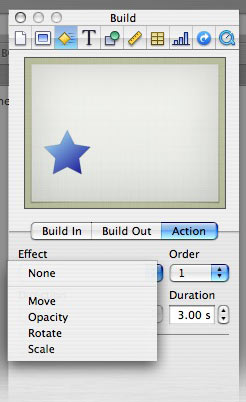
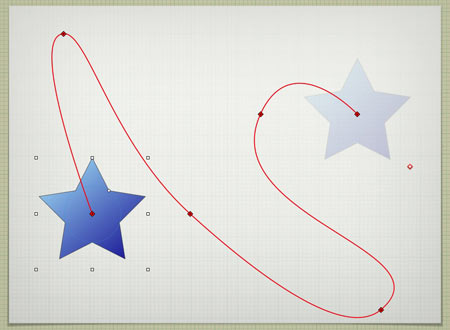
Keynote081-Act1Those effects get a big boost with one major new feature in Keynote ’08: Actions. An action is an advanced form of animation based upon movement, scale, rotation, or opacity. These effects can be used separately or in combination; for example, you could have a photo that starts at point A and moves to point B, and as it does so, it rotates, grows smaller, and fades out all at the same time.

The most fun is the “Move” feature; you can use bezier points to assign a complex path made up of straight lines, corners, and curves. As you can make the object change size, transparency, and angle at any point along the way, you can have some fun making your object dance around as you like.
Keynote081-Act2

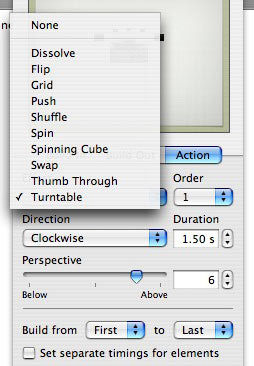
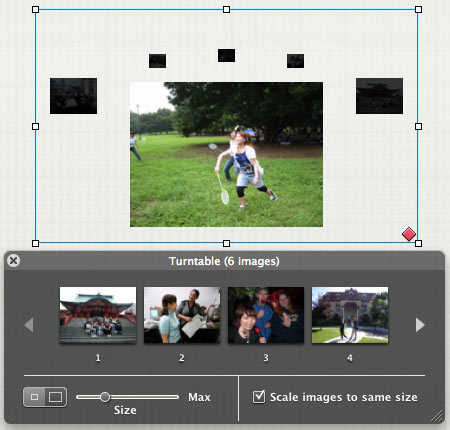
Keynote082-Bld2Apple used this new feature to create more complex bundles of actions, called “Smart Builds.” There are ten such, and they essentially are different ways to view more than one image based upon complex animation techniques.

Included in the “Smart Builds” are a spinning cube with a different image on each side; a turntable (a la Front Row) where images take a turn rotating to the front; a “thumbing” effect which simulates photos being shuffled from front to back as if by hand; and many more.

Each build has a number of options, and, as is usual with iWork apps, it’s dead-easy to generate the effect.
Keynote082-Bld1

Another new feature that has been added to the whole suite is something called “Instant Alpha.” Essentially, it is the ability to make a certain color disappear, but a bit more advanced. If you have an image where a background is mostly one color or range of colors, and the foreground element is a different color/range, then you can (usually) make the whole background disappear. Just drag a circle around the colors you want to make disappear, and they get blanked out.

Iw08-Instantalpha1

You can perform the same technique several times in one image, and the areas to be blocked out are highlighted dynamically, letting you ease off or push forward as is needed. Two problems, however: first, selections are only made contiguously, so if you have lots of small pockets of color to make disappear, then your task becomes a lot harder (see the bird in the image below, and how I missed some of the white sky behind it in certain places); and second, the effect only works well on a small number of photos, such that you have to almost take specific photos designed to work well with the effect. See three different images with varying levels of success below:

Iw08-Instantalpha2


Next is Pages. There are some much-needed new small touches–for example, added shapes no longer appear automatically inline with the text; that glitch caused a lot of confusion for a lot of people. New objects now appear as floating, allowing you to move them outside the margins, with the option to make them appear inline if you wish.

Iw08-Toolbars1-450

A much more significant addition is the formatting toolbar, putting the most important editing tools where you need them, instead of having to hunt them down in the inspector, or conjure up the Font palette. Shown above are the three variations depending on context–text, tables, and objects (click for full view). That makes it not only a lot easier to format, but it also makes it easier for people switching over from MS Word. One remaining complaint: the lack of WYSIWYG font menus. Yes, the Font palette will give you some WYSIWYG, but only in the “Favorites” and “Recent” views… and I never liked the Font palette anyway.

Other changes are a bit less than stellar, but still useful. There are now separate modes for layout: “word processing” and “page layout.” The first works like a standard word processor–type within the margins. The second is more like using a professional layout program like InDesign, in that it relies on text boxes instead of the standard typing paradigm. These different modes were both possible before, but here they have been better defined and separated, with templates made for each mode.

Pages ’08 also allows for change tracking, showing what was changed in a document and when–more useful for collaborative office situations, though I could see it as potentially useful for writing essays as well. Change tracking is one of those very popular high-level features that most people don’t use, but enough have demanded that Apple has included them–like Mail Merge, which was added in Pages 2. There are also new graphic tools, such as picture frames, the above-described Instant Alpha, and other image-handling tools. Most are slight, cosmetic changes that may or may not be useful to different people.

Aside from that, Pages is pretty much as it always has been. It’s now a bit more easy-to-use, and a bit more flexible. I still have not made the complete switch to Pages from MS Word, however, in large part because of the remaining accessibility issues regarding font formatting–namely, the messed-up interface regarding the Font palette. I tried to get around this with keyboard shortcuts, but Apple has not implemented that feature as well as I would have liked. It works well for commands in the main menus, but any command in a pop-up menu will not allow a keyboard shortcut to work unless the pop-up menu has first been activated. Which kind of defeats the purpose of a shortcut.

But that reason is highly specific to me; Pages should work fine as a primary word processing program for most everybody–and despite my foibles about the Fonts palette, I could certainly be happy using it if I really wanted to shove Microsoft out of my life. As it is, I use Pages half the time, and MS Word half the time.


Both Keynote and Pages are nominal upgrades, not complete reworkings of previous versions. Both apps have been inching forward, adding useful new tools and features with each new version–never so much that they become feature-bloated like MS Office apps, and always keeping focus on maintaining the Apple design paradigm of slick-but-simple (for better or for worse, depending on your point of view).

The real new change, however, is Numbers… and I find myself running both long in column space and short of time. So a review of Numbers will come soon. In short, however: Numbers fills out the suite and lets you leave MS Office behind–again, so long as you’re not a power user dependent on Office feature-bloat.

Categories: Mac News Tags: by

Tokyo Bay Fireworks

August 11th, 2007 4 comments

0808-Bay Fireworks1-450

One of the advantages of the view we enjoy from the 21st floor in Ikebukuro is the fireworks displays that can be seen during July and August. Today there were fireworks in Harumi, on Tokyo Bay. We were able to see them, but were hindered by the disadvantage of the 21st floor: it’s not quite high enough to see over some buildings. As you can see in the image above and in some of the ones below, there was some tall building right along the path of the view for today’s display. About 80% of the show was hidden behind the building, which Sachi and I dubbed “Jama Tower” (“Nuisance Tower”). Often we only saw the glow of the display, other times we could make out its edges. But for the bigger fireworks, they cleared the building altogether and we got a very nice view.

0808-Bay Fireworks2-450

0808-Bay Fireworks3-450

0808-Bay Fireworks4-450

Hopefully, the next show will be better: on Thursday, August 16th, there’s one final show, at Jingu Gyoen, which we believe will be just visible beyond the Prince Hotel to the south. It should be closer, and if it’s visible at all, it should be unblocked by any buildings along the way.

Categories: Uncategorized Tags: by

Atheism and Agnosticism

August 11th, 2007 5 comments

I have always understood these terms under their common definitions: atheism is a belief that god does not exist, and agnosticism is the view that we do not have enough evidence to state positively whether a god or gods exist or not. In short, that atheists say there is no god, while agnostics say they cannot accept nor reject any theories about god. These meanings are reflected in the common culture and language; for example, when you say that you are “agnostic” about a certain issue, it means that you have no convictions either way.

However, in listening to various atheists over the past year or so, I was surprised to hear agnosticism defined as “someone who believes that everything is inherently unknowable.” I have always seen myself as an agnostic, and yet I do not agree with that view at all; while one could make an argument for such a worldview, I consider it metaphysical navel-gazing, and irrelevant to practical experience, just like asking yourself “is reality real?” I do not see that mattering either way.

It would seem that many, if not most people who call themselves atheists are people whom I would regard as agnostics. The distinction is blurred because both are correct–depending upon what branch of atheism or agnosticism that you subscribe to. Atheism, for example, has two major branches: strong (positive) atheism, in which there is a positive belief that god does not exist, and weak (negative) atheism, in which uncertainty about theistic truths are emphasized. Agnosticism also has two varieties: the type which closely matches weak atheism, in which uncertainty is key–call this “strong agnosticism”–and the other type, mentioned above, where the validity of knowledge itself is questioned–call that “weak agnosticism.”

I myself reject the navel-gazing version, or weak agnosticism, as the definitive or representative form of agnosticism, because of its practical irrelevancy and (I believe) because it is far less common. At least, it may be recognized as a philosophical truism, but at the same time disregarded as pragmatically meaningless; a person may acknowledge “weak agnosticism” and yet still ascribe to “strong agnosticism” or even “strong atheism.” Because of this, I see what I refer to as “weak agnosticism” as being somewhat irrelevant, a thought-experiment off-shoot that applies less to personal beliefs and more to exercises in academic epistemology.

The problem is, many people seem married to the term they have chosen. Penn Jillette, for example, insists on atheism as including any non-religious people, including strong agnostics; he discarded the word “agnostic” as simply referring to the navel-gazers. I, on the other hand, have always associated the word “atheist” with someone who believes firmly in the non-existence of god, and see my own uncertainty best defined by the word “agnostic.”

I prefer my definition for a reason beyond simply being used to it: my demarkation gives clearly separate terms to describe the most commonly-expressed ideas outside of faith in a specific religious belief. When talking about religious beliefs, we usually refer to those who believe in god, those who believe god does not exist, and those who are not certain. It seems logical to me to reserve one commonly-used term for each of these states. Defining atheism to include the latter two and agnosticism to the navel-gazing seems to me to lend to confusion. If the term “atheist” covered both god-deniers and the uncertain, then one would have to spend a good deal more time explaining what your exact views are.

Nevertheless, I have gathered the impression that religious people tend to blur the terms not because of the finer niceties involved, but rather because they consider any non-belief to be of one general category; to them, there are those who believe, and those who do not–those who believe and have faith, and those who do not. It makes little difference as to why people do not believe.

Once I heard an evangelist (I forget which one) use a definition now common amongst religious people: “an agnostic is an atheist without the faith in his convictions.” This expression uses the definitions of the terms which I prefer. However, not only do I find this sentiment to be inaccurate, I find it insulting: it suggests that I do not believe what I believe, and the reason is because I am weak or lacking somehow.

I cannot understand those who positively believe that there is no god any more than I can understand the religious; in both cases, it seems to me that the belief is based upon “faith.” The (strong/positive) atheist is just as strong in “faith” as the religious person; neither has proof, only belief, but each believes their faith to be equivalent to unquestionable truth. To me, they are indistinguishable. In fact, I have heard strong-atheists express almost exactly that sentiment: they note that most religious people disbelieve in all religions except their own, and as such, are atheists in all but that they still cling to only one of the myriad religions out there. Strong-atheists differ only in that the disbelieve in just one more religion than religious people do. This makes a great deal of sense to me.

The only worldview that makes sense to me is to believe that god is a possibility, but not a certainty. To acknowledge the fallibility of humans and human beliefs is, to me, the most obvious of all conclusions. We have been wrong countless times before, and continue to be wrong about so many things. To think that we could be absolutely and unquestionably correct about the greatest mystery and most fundamental truths about the universe–given that all our knowledge derives from ancient mythology and purely non-empirical evidence–seems both arrogant and comically nonsensical. It strikes me that we should accept what we “know” as simply being the most current theory, and be ready to believe in whatever new facts come to our attention–rather than simply clinging to old, disproved facts, simply because we don’t want to believe that we can be wrong about something so important.

To me, anyone unwilling to accept new information simply because it differs with what was handed down to them is nonsensical and irrational. But that encroaches upon the next topic I would like to discuss: “faith.”

Categories: Religion Tags: by