The New Immigration Deal

May 19th, 2007 3 comments

Here’s the deal that Congress seems to be talking about: 16 million immigrants will be eventually given green cards, including immediate acceptance for 4 million people coming into the U.S., mostly family members of legals, and an estimated 12 million illegal aliens, who would first become legalized through amnesty. Future acceptance through family affiliation would be curtailed. A point system which weighs education and job skills would be used for future immigrants. New border security and interior enforcement would be instituted, and a new employment verification system would be installed. A “huge” temporary worker program would be added.

A lot of the proposal deals with existing immigration pressures, and not with stemming future illegal immigration. The only parts which address that problem would be border security, interior enforcement, the employment verification system, and the temporary worker program.

Border security: don’t make me laugh. Won’t work, even if it could be done in anything more than a half-assed way, which it won’t be. Especially since many if not most illegals don’t cross the border like most people assume. Take the 70,000-plus illegal Polish immigrants in the U.S.; I don’t think it would help much to build a fence along our border with Poland.

Interior enforcement: as long as this focuses on the illegal aliens and not the employers, this will be little more than a futile attempt to sweep back the ocean.

Employment verification system: if this could be done effectively, it might help–but only in the context of holding employers responsible. If they’re not, then they’ll simply ignore the system. As far as it applies to catching illegal immigrants, see the prior point about sweeping back the ocean.

Temporary worker program: this only has a chance in hell of working if it is more attractive to employers than hiring illegals off the street. Otherwise, it’ll be less than useless.

It is obvious that while the deal now being worked out in Congress would relieve some immediate tensions, it would do nothing to stem future illegal immigration.

As I have explained here before, immigration is a symptom, not the illness. The real problem is employers who want to hire illegals because they’re cheaper. (Tim would accurately point out that an equal or greater problem is the economic culture of Central America, but I am addressing purely domestic causes and effects here.) And as long as employers are shielded, nothing–repeat, nothing–will stop the influx of illegal immigrants.

Illegal aliens, by definition, are not dissuaded by laws. Due to sheer numbers, we will not incarcerate, and for the illegal immigrant, being sent back home, even multiple times, is not a deterrent. These are not people who have better choices. We can’t fine them or punish them in any other meaningful way, nothing that will make a difference.

The actual cause and heart of the problem is the employers. The illegals would not come if there were no jobs being offered. It comes down to money: so long as employers have money to gain and are in no danger of fines or imprisonment, there is absolutely no deterrent to make them stop hiring illegals. And so long as they are hiring illegals, illegals will come. Period, end of sentence.

In 2004, a grand total of three–that’s right, three–employers were cited for hiring illegals. And I doubt that they hired four million illegal workers each.

Nothing else will work. We want to stop immigration, the answer is clear: stop spending billions on border control and rounding up workers; instead, spend that money policing employers, using that employment verification system to deny them the excuse of “I didn’t know” (which virtually all of them do anyway). Impose stiff fines and jail time for repeat offenders, and hold the heads of companies liable as well as the immediate hiring staff. At the same time, put that temporary worker program into place, making it as cheap and easy as possible.

Do that, and illegal immigration will slow to a trickle.

This is not even a question of whether the system would work–it would, without question. It’s a matter of us having the will to point the accusing finger at ourselves for this problem, as we should be, and deal with whatever rise in prices comes as a result.

Categories: Political Ranting Tags: by

Blog Stuff Happens

May 18th, 2007 1 comment

There are sometimes perks to having a blog; interesting stuff can happen from time to time. Just a few days ago, a rather well-known site featured a blog post of mine on their front page. Some time ago, one of my posts was mentioned on CNN and linked to (though they chose to link to the cross-post on the now-defunct xpat.org). My post on Arguing on the Internet was selected for a college reader (they still haven’t sent me the copy they promised, though). And unless someone was yanking my chain, author John Varley found a review I wrote on one of his books and left a nice comment.

Nothing ground-shaking or anything, but small and enjoyable brushes with third-class fame. And probably a lot less of this would happen if I weren’t posting like a madman , filling my site with huge gobs of writing on a regular basis (1,383 days of non-stop posting, and counting). That certainly helps with The Google, which is what tends to get you noticed. (It also helps to have the word “blog” in the name of your blog, as it is a common search term, and so gets you ranked higher sometimes.)

Krpdvd

Recently, a new perk popped up: a freebie DVD. A marketing firm found a post I made recently on WKRP in Cincinnati coming out on DVD. They contacted me and asked if I’d like to review the set on the blog, and if so, they’d send me a copy. A good deal for both of us, to be sure–it’s something I would have eventually bought, and since I spoke favorably of the show before, they know my review will probably be a positive one. Can’t promise anything–the way the music is presented (due to the music labels’ greedy demands for huge payments on the song snippets used in the show) could be fine or it could take away from the quality; the special features, like commentary, could be great, or they could suck big-time like the directors’ commentaries on the DVDs for Airplane! and Young Frankenstein. So we’ll see. Trust me when I say that while I like the idea of freebie DVDs of media that I like, I don’t like it so much that I’d stoop to sucking up for it. But given that I’ve seen all the episodes in question already and really liked them, there’s not really much suspense in that aspect of the review. Look for the post on it sometime soon.

Categories: BlogTech Tags: by

Bush: Seven Years in Office = Blame for High Gas Prices

May 17th, 2007 2 comments

Texas Governor George W. Bush, June 23, 2000, blaming the Clinton administration for high gas prices because they were in office for seven years and gas prices were rising:

There seems to be an effort out of Washington to blame me for rising energy prices. And the American people don’t buy that. It’s the — Clinton-Gore administration’s been there for seven years, we’re more dependent now than ever before on energy from foreign sources. And I am amazed that they’re trying to shift the blame away from the people that are holding the office. And I resent that kind of politics, and so will the American people. … And this is typical of an administration that refuses to accept responsibility. This is amazing. They’ve been in office for seven years, the price of gasoline has gone up during their period of time.

The price of gas that very week: $1.68 per gallon.

Now, the Bush administration has been in office for six and a half years. Prices at the pump have almost doubled since Bush blamed Clinton and Gore, reaching $3.10 a gallon (hitting over $4 in some areas). Well, under Bush 2000’s logic, the president is to blame. Think that Bush 2007 would agree to that evaluation now? Think he would be willing to “accept responsibility”?

And it’s not as if he’s really been trying or anything, as if he’s been on the case since day one. Only in the past year or so has Bush even made sounds about acting on high gas prices, and so far virtually nothing has materialized. Bush’s biggest policy proposal, called “20-in-10,” suggests that we cut fuel consumption by 20% over the next ten years. No relief for today or anytime within the remaining year and a half of this administration. Although refinery capacity was identified (PDF) from the start of the Bush administration as one of the biggest culprits of rising fuel prices, Bush has done absolutely nothing to remedy the problem, and today, the refinery shortage is worse than ever.

Bush 2007 says:

Our dependence on oil creates a risk for our economy, because a supply disruption anywhere in the world could drive up American gas prices to even more painful levels.

Boy, it’s too bad that Bush didn’t think about lessening dependency on foreign sources of crude oil back in 2000. Bush 2000, don’t you agree?

I think we ought to make sure that we become less dependent on foreign sources of crude oil. I’ll have an energy policy.

Oopsie! Too bad you let Cheney get the heads of the oil companies to write that policy!

You might expect that conservatives would argue that, after all, being in office for any amount of time does not equal culpability. But then, who expects conservatives to do anything but blame Democrats?

Fox News Headline: “Pain at the Pump: Gas Prices Rise on Democrats’ Watch.” Yes, apparently those damn Democrats have had a 51% majority in Congress for four months and gas prices have shot up during that time! Damn those Democrats! It’s all their fault!

Categories: GOP & The Election, Political Ranting Tags: by

Black is Beautiful; or, $125 for Paint

May 16th, 2007 1 comment

TUAW pointed out something that I’d noticed before, but never tested in detail: that when you buy a high-end MacBook, you pay a premium for color. In the old MacBooks, there was at least a difference in hard drive capacities, though only a small one. But with the new set of MacBooks, you can configure the models so that all technical specifications are exactly the same, and the only difference that remains is color.

The price difference? $125. That’s right, Apple is charging people $125 for black paint instead of white paint. See:

Macbookcompare

Go ahead, try it yourself. All you have to do is upgrade the white MacBook’s hard drive to match the black MacBook. Quite a hefty surcharge for a dead simple, purely ornamental difference.

That said, the black finish on the MacBook is way cool. However, I don’t think that I could ever really bring myself around to paying that much for a color.

Categories: Mac News Tags: by

Finding an Apartment in Tokyo

May 16th, 2007 12 comments

The apartment I’ve got right now is pretty sweet. It’s a big place for cheap. It even has a nice view. And I’ve stayed here longer than I have stayed in any one apartment in Japan. I just completed my seventh year here, which outdoes the two and a half I spent in a place in Koganei, which was the previous record-holder. In fact, since I moved out of my folks’ house at age 21, this is the longest I’ve stayed in one place.

Nevertheless, time moves on. I’m getting fairly deep into a relationship, but our living places aren’t compatible. Hers is close in to Tokyo, but is way too small. Mine is big enough for two, but is too far out. Only the fact that I have a scooter has made it livable; otherwise the daily bus ride to the train station, plus twenty minutes combined waiting for the bus and train to come, make it an hour-plus trek to my job, with transfers and walks along the way. For Sachi, it would be even more of a trip.

So now we’re looking for a place that’s both large (my condition) and close to central Tokyo (her condition). Of course, we’d both like both qualities. The hard part is finding them. Fortunately for us, we’ll have two rather healthy incomes to put together; for less than we now pay combined in rent, we’ll be able to get the kind of place that we want. So we’ve started the process, both of us understanding that it could be a long way to go. Maybe it’s harder finding a good place in New York City, but it ain’t easy in Tokyo, either.

I also figured that this would be a good opportunity to get into explaining how one finds an apartment in Tokyo. I went into that before in this blog about two and a half years ago (part 1, part 2), but that was told more as a story, with facts about apartment hunting peppered in. Let’s see if we can’t go about it in a slightly more organized fashion this time. And hopefully, I’ll be able to do it fairly well–after all, I’ve been through this process seven times in Japan so far (eight if you count finding my brother’s place). It’s been a while since I last did it (seven years, as I mentioned), but having gotten started again, it’s all coming back.


Location: You know what they say about location, and it’s no different here in Japan. Rule of thumb: the closer you are to central Tokyo (as measured by the Yamanote loop line circling the center of town), the more expensive it’ll be–but also, it gets more expensive the closer you are to the local station you choose.

You start by seeing where it is that you work, and probably discover that it’s too expensive to live close to there. So then you start figuring what the train lines are like from work to various places. Some train lines are more coveted than others; they may have nice, major stations along the line (the Chuo Line, for instance); they may have nice express trains (express stops rate higher rents). Some lines, like the Nambu line, have no express trains and few interesting stops. So you choose a line which looks good for you, and has good connections to work and to other places you’d like to go.

Then you choose the station itself. As I said, express stops are choice–it means a shorter commute into work. Factor that in along with proximity to central Tokyo and other desired locales. Sometimes you can actually find a place which is not yet “discovered,” and has many good qualities without having prices that are too high.

Sachi and I believe we’ve found that station for us: Musashi Kosugi, in Kawasaki City, just across the Tama River from Tokyo’s Ota Ward. Kosugi is an express station, with no fewer than three major lines running through it (Tokyu Toyoko, Tokyu Meguro, and JR Nambu), and through trains to three different subway lines (Hibiya, Mita, and Namboku) through extensions–and a fourth, the Fuku-toshin Line, connecting in 2012 (a line that would take me straight to work). Of the six lines now operating out of Kosugi, three have their terminus there (Meguro, Mita, and Namboku); it is an express stop for all lines that have such stops. There is direct access to Shibuya, Ebisu, and Meguro stations on the Yamanote Line, averaging abut 14 minutes from Kosugi to any one of those stations. From there, you can transfer yourself to anywhere, and many of the through trains go to other major stations.

Despite the choice station location, Kosugi is relatively low-priced. Just a few stations inward, Den’en-chofu is hugely more expensive, as an upscale neighborhood. Although being even more distant and less well-connected by train lines, Futago-Tamagawa and Mizonoguchi, across from each other a little ways up the Tama River, also ask higher prices. Kosugi seems strangely overlooked.

One other element of location is distance from the train station–a key point if you are going to walk to the station every day. That’s where my place lacks–it’s a 20-plus-minute walk, or a 5-minute bus ride followed by a 5-minute walk, with hilly areas for the walking. Having to depend on a bus is also a pain, because they often come at inconvenient times. The bus from my place to the station comes once every twenty minutes–and arrives at the station just two minutes after the once-every-twenty-minutes express train has left. So having a place within 10-15 minutes’ walking distance of the train station is a big plus.
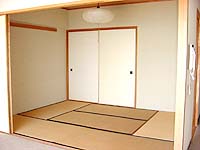
Size: this is the other big deal with apartments. There are two ways to measure the size of a place: the number of rooms and the floor space. In Japan, total floor space is measured in square meters. My current place is big, 84 square meters; Sachi’s is about half that size. Individual rooms, on the other hand, are measured in tatami mats, each one approximately three feet by six feet. Standard is a 6-mat room, nine by twelve feet, as illustrated at right.

The second way to measure is by the number of rooms. In Japan, the letters to remember are L, D, and K. “L” for living room, “D” for dining room, and “K” for kitchen. If two or all of those are combined into a single multi-purpose room, you’ll get an LK, DK, or LDK, for example. If a number is added to the beginning of that, it means that there are that many extra rooms (usually bedrooms) in addition to the central area. (In Japan, bathrooms are not specified; it is assumed that there will almost always be one toilet room and one bath/shower room.)

Sachi and I are looking for a 3LDK–what in the U.S. would be called a three-bedroom apartment. We’re hoping for a room at least 70 square meters in size. I visited Kosugi recently, and finding such a place within our price range seems eminently possible.

Type: In Japan, there are three basic types of places for rent: apartments, “mansions,” and houses. The real distinction to be made is between the apartments and “mansions.” Apartments are relatively cheap and of poorer construction; they are always rented. “Mansions,” on the other hand, are not sprawling estates as are their namesakes, but rather more-sturdily-built apartments. Think condominium. Walls are thicker (often concrete), and soundproofing is better. I live in such a “mansion,” and the folks who lived next door to me had a newborn baby when they moved in. Either that’s the quietest kid in history, or the soundproofing in the walls is excellent (though it is always weakest in the ceiling, from the unit above). Mansions are sometimes rented, but often are bought. At the $2000/mo. level, I have also seen a surprising number of rental houses offered. Sometimes these are attached/semi-attached, but usually not. They are often a square layout with two floors; sometimes they are an elongated rectangle, three floors, with a garage at the ground level.

Cost: Here’s the real kicker. In Japan, moving-in costs can be prohibitive. There can be up to four separate costs for moving into a place in Japan, only two of which are common in the U.S.:

  • First month’s rent: standard.
  • Deposit: in the U.S., it’s usually one month’s rent; in Japan, it ranges from one to three months’ rent, though it is usually two months’.
  • “Gift” Money (also called “key” money): from zero to two months’ rent, this is essentially a bribe, or a surcharge demanded by the owner. Worse, if there is any “gift” money demanded initially, another month’s rent in further “gift” money is demanded every two years when the contract is renewed.
  • Agent’s Commission: one month’s rent. Granted, they work to get you a place, but they don’t work that hard! Sachi and I will likely fork over the equivalent of US $2000 for an agent who will likely spend only a few hour’s work getting us a place. True, they may only score a sale every ten or more attempts, but still, they have an amazingly sweet setup for themselves. Unsurprisingly, any agent will eagerly take down you phone number and address and try to get you to rent a place through them.

The common deposit/gift scheme is 2/2, meaning two months’ rent as a “gift” and two more as a deposit. Which means that moving in will often mean plunking down six months’ worth of rent before you can call it your own, only one month’s rent of which will actually be applied to the rent itself. Sachi and I will pay about $6000 in fees and will have about $4000 locked up in the deposit when we move in, beyond the $2000 for the first month’s rent. That’s $12,000 to get into an apartment. That’s not a down payment on owning the place. In short, it’s a real scam they put you through.

What’s more, I just discovered an extra element that I had never encountered before: end-of-contract conditions. Most of the places Sachi and I have seen so far have conditions that prohibit us from keeping the place for longer than two, four, or five years. Probably a loophole to get the owner out from under rent control, it means that the owner can choose to completely re-negotiate after that amount of time passes. In Kosugi, I am guessing that four-year end-of-contract clauses will be common–that’s when the Fuku-toshin Line connects to Kosugi, meaning a direct line through to Ikebukuro and other new, popular stations. Also, there seems to be a lot of new apartment/mansion development in Kosugi–it won’t remain under-discovered for long. We may start by renting, but buying in the near future may not be a bad idea.

One more important point about cost: the kanri-hi, or maintenance fee. This is added onto the monthly rent (though it is not included in the key money, deposit, or agency commission). It can sometimes be in excess of $100/mo.

Ambience/Shopping: this can also be key. Sachi has a great location for shopping; just across the street is a big, long covered shopping street (it is named “Pearl Road,” which, oddly, most such streets seem to be named). Two stations closer in from Kosugi is a station called Tamagawa; it has virtually no shopping. Kosugi is a happy medium: lots of shops and restaurants, but not a huge number, and the main street is nicely shaded with trees. We’ll have to do more exploring, of course, to get a feel for the area. Key point: how many supermarkets within walking distance, and what are their hours?

These are the major points. Other important points for a place include:

  • Age: when was the place built? More than ten years is pushing it. A place can be “reformed” (renovated), but newly constructed is most sought-after.
  • Exposure: where do the main room windows face? Southern exposure is best for sunlight, but you also have to consider where major roads are. Will there be a ton of traffic noise? Is there a train line nearby? Sachi and I were almost shown a place which appeared on an ad’s map as in a nice spot; it turned out that it was actually on the corner of two major thoroughfares and an elevated expressway.
  • Closet space: naturally. Though it always fills up no matter how much you get.
  • Elevation: what floor is it on? First floor is considered bad in Japan, especially for women. It’s about security as well as the view. Every apartment’s description includes the total number of floors in addition to the floor the unit in question is on.

Then there are a larger number of lesser features:

  • Balcony space: usually very small, but some places can have a nice amount of floor space outdoors.
  • Elevator: important if you live above the 3rd or 4th floor.
  • “Autolock”: a security feature, where you have to buzz in people for them to enter the building. As is true everywhere, it is questionable, as with most places it’s easy to just wait for a tenant to come in or out and catch the door when it’s open. associated feature: Video intercom (may be in color).
  • Cable TV/BS: the “BS” stands for “broadcast satellite,” usually the NHK variety. Though with any place, you’ll want to see if the other satellites are blocked out by buildings or terrain.
  • Internet: newer places may have shared fiber-optic high-speed Internet connections built-in to the building; you could get access without extra charge, and many new rooms have the Ethernet ports built into wall sockets along with TV reception, power, and gas.
  • Air conditioning: Japan’s summers can be brutal. Frankly, I don’t know what I’m going to do–I bought two air conditioners for my present place, and having them uninstalled-reinstalled may cost more than just getting new ones…
  • Flooring vs. Tatami mats: some people prefer tatami (thatched) mats, but wood flooring is pretty popular nowadays. Often, apartments have mostly flooring with one or more rooms done in tatami. Wood flooring may have “TES Yukadambo” (TES 床暖房), which means the floors are heated from underneath. This often applies only to the Living-Dining area. “TES” stands for “Tokyo-Gas Eco-System,” and can be applied to a variety of new-fangled central-heating systems.
  • Other stuff: Are pets allowed? Could be good or bad, depending on whether you want pets, or whether there is good soundproofing. Your place might or might not come equipped with a gas-burning stove in the kitchen. (Japanese places very rarely have full-blown stoves, or dishwashers or trash compacters, for that matter.) The kitchen may or may not have a counter opening to the Living-Dining area. Kitchen layout and cupboard space must be looked at. Various water-heating systems may be employed. There may be a special area where parcels can be delivered without requiring you to be home. Is the toilet separate from the bathing area, and do you even care?

Once you have found a place that meets your requirements well enough, a little more investigation is called for. The real estate agent may show you the place at the optimum time of day, when the warts are the least apparent. You should visit the place at other times and camp out a bit. You may discover that trucks load right next door at 6:00 in the morning with a piercing backing-up beeping. Unexpected sounds or smells could make themselves manifest. And the noisy neighbor is always a frightening specter, hard to detect beforehand.

So, all of this is stuff that you have to keep running in your head as you look for a place. I’ve already taken up way too much space just for getting the basics down. So, I will cover the actual looking-for-a-place part of the hunting process for a subsequent post, coming soon.

Categories: Focus on Japan 2007 Tags: by

New MacBooks?

May 15th, 2007 Comments off

The Apple Store is down, and it’s been heavily rumored that five new MacBook models–including possibly one or more ultra-slim, flash-aided, possibly LED-backlit 13″ models will be among them. Stay tuned.

Title Backsoon1

Categories: Mac News Tags: by

Excuses, We Get Excuses

May 15th, 2007 Comments off

Think Progress has good coverage of the CBS firing of retired General Batiste, which I blogged on recently. CBS originally claimed that they fired him because they don’t hire people who do advocacy–but then it was shown that several long-time CBS commentators have done quite a bit of advocacy for the war and the surge. Then CBS claimed that Batiste was fired because he was raising money for vets against the war–but it was clear that the ad was not intended to raise money. So now comes excuse number three:

Simply stated, it is the policy of CBS that it will not take any part in any partisan political process in any form.

That claim is so outrageous it makes the other two excuses seem halfway honest. It has already been established that CBS hires consultants and others who are involved in the partisan process, on the pro-war side. And then there is the fact that VoteVets, the group Batiste made the statement for, is a non-partisan group–Batiste himself being a strong conservative.

The CBS blog also states:

And the lesson seems to be that conflicts of interest – or merely the appearance of them – aren’t too popular in 21st century journalism.

Are they serious? That statement can be blown to pieces with two words: Fox News. 21st century journalism has become all about partisan politics–which is why CBS fired Batiste in the first place.

But then, can you really blame CBS? Who would want to admit that they fired an honorable man expressing his First Amendment right just because they’re spineless sops to the right wing?

Categories: "Liberal" Media Tags: by

The Dishonorable Quarrel

May 15th, 2007 Comments off

Another must-read Josh Marshall article, on a war veteran who has been criticizing the war in Iraq–and who tragically has just lost his son to it. Marshall quotes Shakespeare to make a point that I have held strongly for some time:

Ay, or more than we should seek after; for we know enough, if we know we are the kings subjects: if his cause be wrong, our obedience to the king wipes the crime of it out of us.

In effect, those who fight and die for the King do not bear the shame or dishonor if the King’s cause proves wrong. How many men will die because the war is prolonged by those who use the honor of the dead to argue that even more should be sacrificed to a dishonorable war?

Categories: Iraq News Tags: by

Another Stellar Vista Review

May 15th, 2007 Comments off

From Transit:

So far, Transit has been using Vista Business full-time for a fortnight. And so far, we’ve found nothing that works better than in Windows XP, dozens of things that are annoyingly different without being a functional improvement, and several things that work at best intermittently and at worst not at all. On the whole, we wish we’d never moved.

That’s just the introduction, but it really says it all. They waited a while for the worst bugs to be sorted out before they upgraded, but that clearly wasn’t enough. They found the new OS to be “hideously” slow, bad at basic network functionality, and gave no gains in productivity.

Categories: Computers and the Internet Tags: by

Shanghaied Syndication

May 15th, 2007 11 comments

Living in the Age of the Internet can be strange sometimes. Today, I found out that I’ve been syndicated, after a fashion. Came as somewhat of a surprise to me.

Usually, I get an average of just one or two comments per post. If I get more, then most tend to come from a group of long-time readers. Less than 24 hours ago, I wrote a blog post on the RIAA and their tactics in dealing with downloaders. Nothing new, I’ve posted much like it in the past.

But then, I started getting comments. Lots of comments. Not major-site-level comments, but more than a dozen in a single day is unusual (even for my infamous eyelid-twitching post), and all from people I never heard from before. Then a little flag went up, and I recalled when this had happened before. So I check my stats, and indeed, there are several hundred hits from The Raw Story web site. It’s a fairly well-known site, having broken several big political stories. I surf to their site, and sure enough, there’s a link to my blog from the morning on their front page.

0507-Rawstorylink

What’s more, it’s not just a plain link to my page–it’s a link that maintains the site’s banner with my own blog post in a frame below it.

Now, there’s nothing really wrong with that, and I do appreciate the nod and the traffic. But it’s kinda weird; I feel like my blog article has been syndicated to their site, and I’m kinda the last one to know about it.

That’s just an illusion, from one perspective. The story never left my web site. But the inclusion of the Raw Story’s banner–with advertising which may have earned money for them–above the blog post creates the impression, especially to the novice reader, that the writing was done under the publication’s wing, so to speak; it gives the impression that it’s all part of their site, a site which generates income from advertising. (To be fair, the banner ad, at least at present, is for a Muscular Dystrophy organization; it’s probably a PSA. But the banner does include links that ask people to advertise, which allow people to sign up to pay by subscriptions, or which ask people to donate money to the site.)

It strikes me as somewhat of a grey area. On the one hand, they are using another person’s published work, without asking, to add content to a site which perhaps makes money from advertising on the same screen on which the borrowed work appears (or at least makes money from ads to the main site, which benefits from added content).

On the other hand, it is a media in which people regularly link to the works of others, and others are glad for the attention; furthermore, the publication did not actually transfer my work to their site, they simply split the screen.

Like I said, I’m not complaining. It just strikes me that the proper procedure would be to at the very least notify someone before going that far, or better, to ask permission. A plain link is not improper at all. But to display a banner and advertisements above the work, on a site that gets paid by advertisers for providing content? I doubt anyone would ever sue or even complain too much–on the contrary. It just seems a little… off.

Categories: BlogTech Tags: by

Why Am I Not Surprised?

May 15th, 2007 Comments off

No, it’s not political this time. But it is a gripe. I sent my mom a bouquet of flowers for Mother’s Day. Used one of the online ordering services because it’s kind of hard to hand-deliver from five thousand miles away. The thing is, on their web site, FTD gives you prices for your gift with no hint of any extra fees. Of course, one would expect such fees–sellers often hide extra charges for as long as they can, to make you believe that the final price will be as low as they can get you to believe. But the “service charges”–revealed only after you’ve finished filling out most of the forms–were nearly half the cost of the bouquet. A little excessive.

0507-Servicecharges

Are there no laws that require up-front reporting on all costs, before the person has gone through most of the process? It’s more than just slightly dirty pool–wait until not only the person has already finalized their decision as to what to buy, but has also gone through so much of the process of filling stuff out that it is less likely they’ll turn back. It also means that it is much harder to comparison-shop, and before you can get to the full-charges page, you have to have given addresses, email, phone numbers, and all sorts of other spamalicious info.

Japan, interestingly, has taken things a step in the other direction: final prices must be revealed at the get-go. In stores prices must be advertised in their post-sales-tax amount–even a charge as obvious as that has to be spelled out. Why can’t the U.S. government require that? (Yes, I know they won’t, and we all know why. Isn’t cynicism swell?)

Happy Mother’s Day!

Categories: Corporate World Tags: by

No Parking

May 14th, 2007 1 comment

This whole parking thing has gotten out of hand. They have really gone hog-wild. It’s not just in Shinjuku or in the high-traffic areas; I can’t even park my scooter on a normal street anymore without getting ticketed. Before, using a scooter was great; parking anywhere was not a problem. And I’m not talking about cluttering up a street, but parking in a place which still leaves a broad two meters or more of sidewalk open for traffic.

Case in point: I came to visit Sachi and parked in front of her apartment building. There is a space next to a pedestrian overpass, where there is a traffic “shadow,” an area where no one would walk or ride their bike even if it were clear (see photo below). A less offensive parking space is hard to imagine. But the ticketers came along and started writing out their citations… not because it was a nuisance, not because anyone complained, not because anything was being blocked… but simply because they could, because there’s a profit in it. If the bike were parked next to the building where it was blocking foot traffic, they’d have no complaint–I know, because I just asked them, and they told me to park it in a traffic spot because it was not a public traffic spot. So I did that, and now it’s parked next to some little stools on a pathway next to this building, where it could easily bget in the way of someone who wanted to rest there… but I won’t get a ticket for that.

0507-Biketicket1-450
Note the sidewalk, how there is more than two meters open, and how the bikes are parked in the traffic shadow behind the fencing. The tickets won’t clear up the space, either–it’ll just fill up with ordinary bicycles. So what’s the point?

0507-Biketicket3-450

And neither is this going to clear up the sidewalk, even in places where the sidewalk is narrow: they are only ticketing motorized bikes. Scooters and motorcycles. Not bicycles, even though they take up virtually the same amount of space, and are far more numerous. Apparently, you can’t hand out a citation for a bicycle that generates profit. So they get a free pass. At worst, a notice is left on the bike, and if it stays affixed for several weeks, then it gets carted away. My scooter got a notice and was almost ticketed within just a few hours.

0507-Biketicket2-450
It’s not just me, either. I moved my bike with minutes to spare, but this guy didn’t. He just took the ticket off his bike’s handlebar, the one behind him to our right, and is now he’s futilely complaining to the ticketers about how he was just visiting a nearby building for a few hours, so what’s the deal? Note the bicycles here don’t even get a notice to warn them to move.

If you park a scooter even for one day, it gets ticketed, which means a steep fine and points get taken off your license. Which stays on your record for a full year, or longer if you get other violations before that year is up.

Nor is it a simple matter of finding the right spot. The building superintendent steadfastly refused to allow me to park in any of the many open spots around the building where no one goes. Buildings in Japan have zero accommodations for visitor parking. They have completely closed off all parking places for scooters, except for the pay-parking lots–and that can run $10 a day or more, for parking in a space barely larger than a bicycle takes.

In short, Tokyo has changed from a scooter-friendly place to a scooter-hostile zone. It would be slightly better if there were a reason for it other than sheer profit for the ticketing agencies. I’m just lucky that there’s a sliver of a space next to my workplace where I can park. Otherwise I’d have to park far away and pay for the privilege.

Categories: Focus on Japan 2007 Tags: by

Uncool

May 14th, 2007 Comments off

The Politico has a pretty good article explaining why the country is shifting left. However, there is one statement in particular that I have contention with:

When conservative Fox News introduced its own satirical program, modeled after Stewart’s, it received a critical beating. The cultural zeitgeist had shifted. Of all people, former Vice President Al Gore is considered kind of cool, while Bush and Vice President Cheney have become not just unpopular, but are objects of ridicule.

That last part about Bush and Cheney is what I disagree with (though I have to wonder–Al Gore is “cool”? Hmm.) The thing is this: Bush and Cheney were objects of ridicule when they came into office, or at least quickly thereafter. Nobody seems to remember that in his first eight months, Bush was going down in the polls as quickly as he has in years since. He started out around 55% and after eight months was at about 50% and declining. He was seen as weak, laughable, and not good for the country. He was violating treaties, bullying his way around Washington, and essentially making an ass of himself.

The Politico’s argument, as with conventional wisdom, would have you believe that Bush and Cheney are now uncool because of the recent shift to the left. But Bush and Cheney were uncool from the start; remember, they lost the 2000 election by half a million votes, and “won” only through election fraud and a right-leaning Supreme Court. A half million more people voted for the “uncool” Al Gore. It was never that Bush and Cheney were more popular.

Remember the political cartoons of the time, how Bush was a kid sitting in Cheney’s lap? How the comedians were going wild making fun of the two? How they were the object of national, and international scorn?

The only thing that changed was 9/11 and fear. That’s what created the artificial upwards zoom in the polls. Bush was never actually popular, never really “cool.” He was simply the guy in office when everybody suddenly got the crap scared out of them.

As I have pointed out many times before, Bush’s poll numbers have shown a striking regularity of pattern: he gets a lift in the polls only from artificial, external events; otherwise, he always progresses in a predictable, downward pattern, until he hits bottom and levels out (which is where he is now). Bush received poll bounces after 9/11, the start of the Iraq War, the capture of Saddam Hussein, and the huge campaign blitz of 2004. That’s it. The pattern can be seen clearly on this graph. It really is unmistakable, and rather remarkable–I don’t know if any other president has shown so clear and true a pattern as this. Had it not been for 9/11, Bush would have reached 40% by sometime in early-to-mid 2003, and never would have recovered, losing the 2004 election handily.

To sum up, Bush and Cheney have not “become” unpopular–they never were in the first place. It is only the wearing off of 9/11 and the resulting fear that is allowing their intrinsic unpopularity to reassert itself.

Categories: Political Ranting Tags: by

Subtle Distinctions

May 14th, 2007 22 comments

From a recent story on how the RIAA is sending out letters to hundreds, possibly thousands of college students, demanding that they cough up $3000 for music they’ve downloaded:

But the students coughing up the cash question why they’re the ones getting in trouble.

“They’re targeting the worst people,” UNL freshman Andrew Johnson, who also settled for $3,000. “Legally, it probably makes sense, because we don’t have the money to fight.”

Bingo. Hit the nail on the head. That’s exactly why they’re being targeted. It would not be surprising to me if the RIAA actually did a financial check on the people it sued, making sure that none of them were capable of a strong legal defense. The $3000 number in itself should be questioned: why that amount? Probably because it is just enough that many people would pay it, but not enough that putting up a legal fight would be worth it.

The perfect definition of a nuisance lawsuit. Though there is a better name for it: extortion.

Johnson got his e-mail in February, with the recording industry group’s first wave of letters targeting college students. He had downloaded 100 songs on a program called LimeWire using the university network.

The money to settle came from the 18-year-old’s college fund. He’ll work three jobs this summer to pay back the money.

Johnson compares what he did to people driving 5 miles per hour over the speed limit.

“It’s not like I downloaded millions of songs and sold them to people,” Johnson said.

There is a point to be made here. I have commented before that when it comes down to it, downloading music for free is illegal–you are getting value for no money. So why is it so common? Why do so many people, perhaps numbering in the millions, join in the activity? The answer was given by Mr. Johnson: because it is seen as equivalent to going 5 miles per hour over the speed limit.

Why that perception? It has to do with how we get our media. So often it is free. We get TV shows broadcast into our homes for free. We can videotape them and keep them. We can even record shows on a DVR which allows you to clip out the commercials and save the pure media to DVDs–essentially getting for free what you pay a lot for from the store. And that’s not illegal. (Edit: Okay, maybe it is illegal. But it is so widely considered as legal and so universally done that the distinction is academic–and it is never prosecuted. It simply proves the lines and perceptions are even more blurred than I thought.) You can do the same with movies. As long as it is broadcast to your home and you record them for your own viewing, there’s nothing wrong at all with that. You can do the same thing with music over the radio. We get free news on TV, radio, and the Internet.

So why is it illegal if I get the exact same media over the Internet? What is the difference between my getting a TV show from my TV, clipping the commercials, and saving it on a DVD, and getting the same show from a download service? The end result is exactly the same, no difference at all, except the type of effort I put into collecting the media.

Legally, the answer is fairly clear: one was obtained through a licensed distributor, packaged with commercials, which in fact paid for the product. That I was able to clip out the commercials was a technical loophole. Downloading from the Internet for free is different: the product is not licensed for distribution, and there is no payment made to the content owner for the distribution.

The thing is, this distinction is virtually invisible to the consumer. We tend to ignore commercials, see them as intangible, abstract things which are to be disregarded for the most part (unless there are talking frogs or whatnot). They are discardable. Take those away, and the distinction vanishes. That’s the “5 miles per hour” that Mr. Johnson was talking about. Because we have grown up disregarding and even looking with scorn on commercial interruptions and intrusions, seeing them as annoyances to be avoided and not integral tools for delivery of content, most normal people do not see them as something that makes or breaks any kind of legality.

If I can legally record a song as easily and identically as I can download it from the Internet, then there is no great moral warning flag telling me that what I am doing is wrong. So people are color-blind to the difference. That’s why so many people see nothing wrong with downloading music.

As I said, legally, technically, it is wrong. But does that change when massive perception says differently?

Now, here’s the interesting part: the same subtle shift also applies to the RIAA. Technically, what the RIAA is doing seems legal–it is suing people for illegally accessing their property. However, just as their legal targets are getting otherwise legal content in an illicit method, so is the RIAA. The methods they are using to get money from people are as illicit as the music their targets are downloading. Blindly suing thousands of people, not really knowing whether they deserve to be sued? Using nuisance-lawsuit methods to essentially extort money from people, designing the “settlement” so that people will give in even if they didn’t do anything illegal? Crafting legal tactics that keep their illicit strategy from being exposed in court?

In a very real way, the RIAA is doing something far worse than any of those college students. Even if the students that the RIAA is targeting know what they are doing is illegal, they know how frivolous an offense it is. The RIAA, on the other hand, knows exactly how dishonest and illicit it is to be doing what they are doing–just as they by now must be aware of the fact that illegal downloading of music has no actual impact on their income.

Edit: I would add one final note–piracy could be ended overnight by using the tools now available on the Internet. How? Targeted commercials. Content providers are now getting addicted to the sale of content that until now has been in that consumer-oriented “free” zone, paid for with commercials. But selling media begs for piracy, which will always win out, as Steve Jobs has noted. The way to defeat it: give away media for free, along with targeted commercials. We hate commercials because they are almost always for stuff we’re not interested in. But that’s so 20th-century–broadcasting commercials blindly to an audience where 97% of the viewers turn away in disinterest. The Internet allows for targeted advertising. Get people to register for all the TV and movies and music they can eat by filling out a survey, which includes the kind of commercials they like to watch, including stuff they plan to buy. If commercials were all movie previews and computer ads, I would more likely watch them, and so would most people. That could easily cover the costs. I outlined it in more detail here, almost three years ago.

Categories: Corporate World Tags: by

Voter Fraud

May 13th, 2007 Comments off

You know how the White House has been all hot and heavy about finding voter fraud over the past few years? Well, it turns out that voter fraud, the kind the White House has been looking for at least, is actually a non-issue, being extremely rare and all. However, there was one clear-cut case of it in Florida, where someone signed up to vote in a district where they did not live, and then voted there. They had the perp dead to rights. But in that case, a high-ranking FBI official with White House ties made a phone call and got the charges dropped.

It helps, apparently, if your name is Ann Coulter.

Categories: Political Ranting Tags: by

Now, That’s Decision-Making

May 13th, 2007 Comments off

WB concludes Wolfowitz broke ethics rules

The World Bank executive board has concluded that bank president Paul Wolfowitz broke ethics rules in arranging a pay rise for his girlfriend and will try to end his tenure next week, a media report said. — Source

Soon after the news broke, the World Bank executive board studied the matter, came to a conclusion, and is now acting on it.

Why can’t we do that when the president clearly violates the 4th Amendment, the Geneva Convention, or a host of other clearly established laws? Nope, we have to sit and listen to insipidly stupid lies about how nobody remembers anything, the records all got conveniently lost, 9/11 makes it OK, and it was some legal assistant’s fault anyway. We know who did it, we know who was responsible, but instead of acting, we just sit around impotently and say that there’s nothing we can do.

Maybe we should get those World Bank guys and hire them to run oversight.

Categories: Political Ranting Tags: by

More Liberal Media

May 13th, 2007 1 comment

Imagine that Hillary Clinton was campaigning in Iowa, and she promised to visit a family farm. The family gets all excited, and starts making preparations. They clear their pasture of cattle and brush for parking, arrange bales of hay for people to sit on, and they arrange for portable toilets that the Clinton campaign assures them will be paid for. They get their hopes up and wait for the big day. But then the campaign asks them how much money they are worth, and when the answer comes back that they’re poor, they get snubbed–the Clinton campaign cancels the event. John McCain’s campaign jumps on it first, offering to campaign there instead.

Drudge would be all over this is a New York minute, Fox News would gleefully spring on the story, with every single reporter and pundit screaming about how elitist, snobby, and downright bad Hillary was, and the mainstream media would be right on their heels, eating the story up like nothing else was news. The story would last longer than the fake news that Pelosi had demanded a huge jet–it would be better, because this story would be real.

And it is real–except that it wasn’t Clinton who snubbed the Iowa farmers–it was Rudy Giuliani.

Media reaction: silence.

Well, not complete silence–the Des Moines Register has a nice story on it, as does the Waterloo Cedar Falls Courier, and precisely two local Iowa TV stations. That’s it. It’s fully contained to Iowa. Despite the blogs being all over it, despite there even being an AP story out about it on the wires. Nobody outside Iowa is picking this up. More newspapers have picked up the story about how a Rush Limbaugh billboard in Baltimore got defaced.

And the reason Giuliani snubbed them? Because he wanted to campaign against the Estate Tax, and because the VonSpreckens were not rich enough to be hit by it. Not surprising, as there are only a handful of such farmers who exist; the idea that the Estate Tax affects family farms is a conservative myth. Something else the “liberal media” doesn’t cover much.

Categories: "Liberal" Media Tags: by

Imbalance

May 13th, 2007 Comments off

I have noted several times before the reason for conservatives to claim that there is a “liberal media” even when it is clear that the media is not liberal, and even leans notably to the right. But there is another benefit they enjoy from perpetuating this myth. For some time now, networks have gone out of their way to demonstrate that they are not liberal; they do so usually by purging liberal views while emphasizing conservative ones–apparently, while it’s bad to for a news organization to be liberal, there’s nothing wrong with leaning as far as you want the other way.

Recently we have seen an example of this, coming from CBS. One has to suppose that CBS has more reasons, from a PR perspective, to shake off an image of being a liberal news source; it is most often attacked as being liberal by the right, primarily because of Dan Rather and the National Guard story. No matter that it was one story by one soon-fired anchor and there was no evidence of liberalism beyond that (or even evidence that it was liberalism that motivated the story in the first place); no matter that such an image is more forged than justified. That’s just the image that has been successfully plastered on the network.

So after retired General John Batiste appeared in a TV ad that advocated an end to the Iraq war and said that President Bush is putting our country in peril, CBS decided to fire him as a consultant to their news organization. A CBS spokesperson commented:

“When we hire someone as a consultant, we want them to share their expertise with our viewers,” she said. “By putting himself front and center in an anti-Bush ad, the viewer might have the feeling everything he says is anti-Bush. And that doesn’t seem like an analytical approach to the issues we want to discuss.”

She said that Batiste’s appearance in the ad marked a violation of CBS News standards, in which “we ask that people not be involved in advocacy.”

The same person added later,

“General Batiste took part in a commercial that’s being shown on television to raise money for veterans against the war,” she said. “It isn’t just that he took an advocacy position.” She also said that the decision would have been the same had Batiste appeared in a similar ad in support of the president.

The irony here is that Batiste isn’t even a liberal–he is, in fact, a hardcore conservative. But just the fact that he spoke out against the president, against what is currently the conservative line, that was enough. No matter that he did so because he felt the military and the country were in danger of great harm, nor that he had the facts behind him, nor that the ad was not a fundraising ad as CBS claimed was the key point.

But that’s not all; TPM found ample evidence that CBS has had other consultants who have quite publicly advocated for President Bush–and CBS did not fire them. Like many other networks, they have no trouble hiring conservative voices in all manner of position, giving them all sorts of platforms. But if someone comes out as being too liberal, it more often means that they will lose their job. Witness Phil Donahue on MSNBC getting canceled in 2003 despite having some of the best ratings on the network. (Despite having lower ratings than Donahue’s show, conservative-leaning shows like Hardball and Scarborough Country were not canceled and remain on the air today.) It is a sign of progress that someone like Keith Olbermann can keep his job, but it is of note that while Olbermann is growing fast and strong in the ratings, neither his network nor others are responding to that trend in audience preferences and opening up to more liberal-oriented talk shows, as they quickly did with conservative ones when they first showed popularity.

Yet again, the Liberal Media at work!

Categories: "Liberal" Media Tags: by

No windows?

May 12th, 2007 Comments off

An interesting idea from a blog called Blackfriar’s Marketing: Leopard’s secret is that it will start doing away with windows. Not Windows, but windows–the interface element itself. In what would have to be the slickest, most ironic blow to Microsoft, Apple could be edging towards a new UI style that would either force Microsoft to rename their OS or stop copying Apple.

The argument is that many of Apple’s products already operate without windows per se. A good example is Apple’s Front Row, which is similar to what is used in Apple TV. Instead of a window, one sees one’s screen fade into an alternate interface. We have already seen that Leopard’s Time Machine software operates in the same way. And the Blackfriar writers point out that most of Apple’s apps already use a single-pane interface, giving iTunes and GarageBand as two examples (actually, virtually all of Apple’s iLife apps are designed that way, as well as some of its high- and low-end apps). The use of new Core animation and resolution independence could assist this new style.

It takes a bit of re-imagining to wrap your head around this idea. It helps to consider what a “window” is. The concept of a window comes from the fact that often times, what you want to look at takes up more space than is visible on your computer monitor. Say you have a ten-page document; clearly, you cannot display the whole thing on your computer while the text remains large enough to read. So instead, the area with the information is imagined as existing as a greater area than visible on your monitor, and the window acts as a frame through which you view the portion that can fit on your screen. This can never be fully done away with, of course. There will always have to be some window-like properties, where you have to scroll this way or that.

However, one can imagine this being done in a different style. For example, do we really need scroll bars? If we enter a word processor, could the entire document be represented in a translucent overlay to one side (similar to what we see in the side “drawer” in Apple’s Preview app when looking at a PDF file, for instance), which could replace the idea of a scroll bar? Maybe it could even pop up and disappear like the Dock so as to save space. Meanwhile, pages in full-size view could float up and down in virtual representation of pieces of paper–this would play right into the Core animation technology Leopard will bring. Things will probably move in the more natural, inertia-based style that we see demonstrated in the iPhone’s interface.

So, could all apps work this way? Potentially, yes, though it would require a thorough redesign for most apps. If this is indeed what is coming, then Leopard certainly would not be able to effect this change overnight. At the very least, it would have to allow the old-style interface to persist and have a place for as long as backwards-compatibility is to last. But that’s not too hard to imagine–a windows-populated screenscape could simply be another environment, something to switch to like one now switches in and out of the Front Row interface. Leopard’s new Spaces feature could even play into it, as the Blackfriar’s bloggers suggest.

One visitor to the Blackfriar blog brought up an excellent point, however: what if you want to view two apps simultaneously? This is a common working style for many people, to split the screen between two apps. The blogger responded to this but did not really answer the question. But I can imagine a solution, one that resolution independence could play into: simply have the apps reshape and share the screen–not overlapping necessarily, but splitting the screen’s real estate. Think about how Expose works, how the windows slide away from each other–but imagine that the parts are sized (or reshaped) so that there’s no dead space between them. Already some apps have toolbars and interface elements that reshape when you resize the window; that could happen if you “pane” two apps to share a screen together. Right now, if I want two apps to appear at the same time and have each one take up optimum space to fill up my screen, I have to carefully resize and place the windows. It would be nice if that could be done automatically, with no part of one app covering up any part of another one, and with no dead, wasted space between them.

Of course, this is all pure speculation. The Blackfriar bloggers point out that they are simply picking up on UI clues that Apple has used in some of its apps that seem to be signaling a sea change. But it is a fascinating idea, and could redefine things in a way that could make Microsoft Windows look like old hat–which could deal a serious blow after MS put five or six years of work into a new version of their OS which merely inched forward, while Apple’s OS takes huge strides. And such a significant UI change would be very hard for MS to copy and yet still claim that they are not completely ripping off Apple’s ideas.

Categories: Mac News Tags: by

Is There Anything?

May 11th, 2007 3 comments

Firedoglake has an excellent question. It’s easy to list all of the things Bush has done wrong (I made a long list, which can by now have quite a bit more stuff added to it), but how about turning the question the other way? What, exactly, has Bush done right? Firedoglake adds the qualifying question, “by whose standards?” That qualifying question is important, because a lot of wingnuts will claim that Iraq was a success, by their standards; that it was necessary to get Saddam out, and that the war could still turn around and be successful. But looking at the polls, that is clearly now a minority view, at best, not to mention that it depends on a potential success in the Iraq situation to make Hussein’s ouster worth it, as opposed to something that has been already achieved.

Then there is the question of partisan goals. Surely, if one is a conservative, there are many successes to list, such as putting a large number of conservatives in high court benches, chipping away at abortion rights, stuff like that. But I would personally only count non-partisan goals–strict government management, and achievements for the country as a whole.

One of FDL’s commenters provides this list of areas where a president can do well or not well, as a way of considering where Bush may have done well (the list seems to have been copied from the White House web site):

Budget Management
Defense
Economy
Education
Energy
Environment
Gulf Coast
Health Care
Homeland Security
Immigration
Iraq
Medicare
National Security
Pandemic Flu
Patriot Act
Veterans

I would add:

Civil Rights
Crime/Justice
Elections
Employment
Infrastructure
Intelligence (e.g., CIA)
Internet/Telecommunications
Regulatory Reform
Small Businesses
Science
Space

There is a little overlap in there, and there are probably more good categories, but that’ll do for now.

Now, one of the problems in FDL asking the question is that few of the commenters seemed to really take a serious stab at the question, and maybe none really were positively disposed towards the president. I can’t claim much better, though reader Cc valiantly hangs on as an opposition voice in my own blog’s comments (I don’t know if I would have that much patience!). Cc, want to take a stab at it? Or, if there are any other conservative voices lurking?

As for my own views, I don’t see much at all that Bush has actually succeeded with. I partly agree with his Immigration policies, but when Bush had six years with a virtual free hand to pass almost anything he wanted, he didn’t do a thing–he talked about it to bring in Hispanic voters, but he took no action. He’s talking about it now only so he can say he’s being cooperative and conciliatory and all that with the Democrats. But he still isn’t pushing it very hard at all. Certainly he hasn’t achieved anything there.

He has brought the deficit down a bit recently, but the only reason it was up in the first place was because of his massive tax cuts for people who were already flush with money, not to mention the completely unnecessary Iraq War. Out-of-control Republican pork-barrel spending helped finish off the rest, and Bush gets at least partial blame for that because he never used to veto, or even the threat of one, to stem it. Did nothing at all on that front. So he gets no credit for partially erasing a deficit of his own manufacture.

I like his space initiative. Too bad it’s virtually unfunded and cuts the legs out from under all sorts of other space programs. Like Immigration, it’s a feel-good PR piece, and little more–so that when eventually someone gets serious about it, Bush gets the Kennedy-esque video clip in the History archives. But he has achieved nothing in that area.

So, help me out here.

Categories: Political Ranting Tags: by