Throwback

April 27th, 2007 Comments off

This is an interesting sign you sometimes see on Japanese roads, especially at the entrances of underpasses and overpasses:

0407-Sign-450

The bikes, okay… but the rickshaws? An interesting inclusion there. Now, I will admit that I have seen handcarts of that nature in Japan, but very rarely… and I think only a fool would try to take one onto an overpass. True, there are fools out there, but how many with rickshaws, and even if they do have one, if they’re that foolish, won’t they ignore the warning signs anyway?

Categories: Focus on Japan 2007 Tags: by

The Hamura Trail

April 26th, 2007 Comments off

Today I went birdwatching up near Yokota Air Base, in a small town called Hamura, along the Tama River. In a birding book I bought a while back, it described the walk as having the potential to see an incredible variety of birds in April and May, so I decided to check it out. And while there was some good birding to be done, it was not nearly as good as advertised–at least not today. Still, the birding trail (really a hiking trail up to Hamura Shrine) was very pretty, and relaxing as well, as evidenced by the photo below.

Forest Wallpaper-450

Actually, they should have called the place “Bulbul Forest,” as the place was teeming with them. Brown-eared Bulbuls, native to Japan, are the bane of birding here. They are ugly birds, your typical “brown” bird with sometimes-spiky head feathers. They also have loud, shrieking calls with enough variety to fool you into thinking that they’re another kind of bird, until you get used to them. And they are everywhere. Especially in this forest, just loads of them; you get tired of them really fast, because when you’re birding, you react to any movement or sound, and when 9 times out of 10 it’s a Bulbul, you start to resent them.

0406-Brown-Eared Bulbul-450

In the forest, I was able to photograph little else. There was this bird, which was either a Black-Faced Bunting, or a Grey Bunting–hard to tell, the lighting was poor:

0407-Unknown-Ji1-450

Then there was this mystery bird, which sang prettily but proved highly elusive visually; I was only able to snap a few images, at extreme zoom. It appears to be a blue-black bird with either a white rump or a white spot on its wing feathers; the closest I can come to identifying it as would be a Blue-and-white Flycatcher:

0407-Unknown1-450

If the two above are the Grey Bunting and the Blue-and-white Flycatcher, then that’s two new Life Birds, but I can;t’ty for sure if they are.

Also in the forest, I encountered a flock of Long-tailed Tits. Unlike before, I was able to center them in my camera view several times, and had ample time to shoot them. But in a frustrating turn of events, every time I had one in frame, the damn camera refused to focus, even when it should have had no problem doing so. Incredibly aggravating, that was.

However, after I got back down to the river, I was able to get some nice shots. Surprisingly, there were tons of Grey Wagtails around; I had only spotted one before in the past few years, but there was no end to them in Hamura. Pretty birds.

0407-Grey Wagtail1-450

Also pleasingly, there were a good number of Bull-headed Shrikes, with interesting calls no less. Once, I found myself by chance just six feet away from one resting in a tree–and again, the damned camera refused to focus despite having loads of time. I am going to have to get a new camera, I think. Still, I had lots of other chances, and got these images:

0407-Bull-Headed Shrike1-450

0407-Bull-Headed Shrike2-450

0407-Bull-Headed Shrike3-450

As I was chasing one of the Shrikes from tree to tree, I started down a slight embankment, and got startled: apparently, a Japanese Green Pheasant was just a few feet away and suddenly took off in a loud flapping rush. They are fairly big birds, and so they make a lot of noise when they do that; quite surprising. The pheasants have a habit of ducking down and holding perfectly still when they see you coming; you won’t know they’re there until you get too close, and then they’re off and flying–quite a sight, considering the size of the bird and those long tail feathers. No pictures, though.

Finally, I’ll close with a relatively pedestrian, but still nice catch: a Meadow Bunting:

0407-Meadow Bunting1-450

0407-Meadow Bunting2-450

0407-Meadow Bunting3-450

To round off the list of birds spotted: Great Egret, Grey Heron, Carrion Crow, Tree Sparrow, Japanese Bush Warbler (Nightingale; heard, not seen), Mallard, Japanese White-eye, Black Kite, and Barn Swallow.

Categories: Uncategorized Tags: by

Surge in the Wrong Direction

April 25th, 2007 1 comment

Example of Conservative Revisionism, Part CCXVII:

Last November, the American people said they were frustrated and wanted a change in our strategy in Iraq. I listened. Today, General David Petraeus is carrying out a strategy that is dramatically different from our previous course.

You gotta give him credit for cajones, telling the American people what they meant, when it is in direct opposition to what they meant. America voted to get us out of Iraq, not deeper in. But this is the government we have to deal with: deaf to anything but their own fantasies and desires.


Meanwhile, some idiot officer speaking out against the Tillman family said that their problem was not that the military lied to them and used their son’s death as a propaganda tool, but rather because they are atheists and the absence of a Christian faith causes them to see their late son as nothing more than “worm dirt.”


And even more Republican Eloquence, this time from candidate Giuliani:
If any Republican is elected president —- and I think obviously I would be the best at this —- we will remain on offense and will anticipate what [the terrorists] will do and try to stop them before they do it.

He added that a Democratic president would put the country on “defense,” and would invite another terrorist attack.

Um… yeah, right. Because 9/11, after all, happened on the watch of a Democr… oh, wait. Well, after all, it isn’t like the Clinton administration successfully beat the Millennium terror attack (remember that one, the one that didn’t happen?) by using their strategy of collecting and successfully interpreting intelligence, or that the Republican president Bush immediately disassembled, allowing 9/11 to happen. It’s not like Bush completely failed in Afghanistan, allowing al Qaeda to survive and then going to war wastefully in Iraq, causing al Qaeda to thrive, right? It’s not like they put off the 9/11 Commission as long as they could, and then largely ignored their recommendations, is it? It’s not like Giuliani himself, after the 1993 bombing of the World Trade Center, put the emergency response headquarters inside the World Trade Center, against the advice and warnings of others, right?

For Giuliani to say such things is the height of hypocrisy, and yet more revisionism.

Categories: Iraq News, Political Ranting Tags: by

Democracy in the Balance

April 25th, 2007 2 comments

They sell us the president the same way
They sell us our clothes and our cars
They sell us every thing from youth to religion
The same time they sell us our wars

–Jackson Browne, Lives in the Balance

There is a story out today about how not only the Tillman family is outraged by how the military lied about the death of their son and used it as a propaganda tool, but Jessica Lynch is also indignant about how the leadership of the armed forces lied about her own experiences, making her out to be a “Rambo GI Jane” and using the incident as a media event. I blogged on the Lynch story back in 2003, and on the Tillman story in 2005, so I don’t need to recount the facts here. But I wanted to comment on the underlying theme behind these fabrications.

It is said that truth is the first casualty of war. I think that some people interpret this to mean that truth gets lost because it is necessary to maintain secrecy and to deceive the enemy. It might be helpful, however, to look at the origin of the phrase, going back to Samuel Johnson in 1758:

Among the calamities of war may be jointly numbered the diminution of the love of truth, by the falsehoods which interest dictates and credulity encourages.

That statement pretty much sums up where we are right now, dovetailing well with Jackson Browne’s lyrics. It seems that truth is less a casualty due to necessary deception of the enemy than it has been destroyed in order to deceive the people of the country waging the war. Just as we saw so often in the cold war, secrets are all to often not kept from an enemy who already knows the truth, as much as they are kept from the dishonest government’s own people, so that they can be kept in line with that government’s wishes. Today, the desire of the government is to wage war in Iraq without interference by the people. And as it has so often in the past, propaganda points inward more than it points outward.

Now, some might say that this is necessary; that war is always ugly, and that if the people knew its truth in full, we would never support the wars that it is necessary to fight. The problem with that stance is that it completely and utterly contravenes the primary principle of Democracy in the most important and vital expression of that principle, the power to wage war and cause mass destruction. If the people cannot decide based upon the clear and true facts in evidence, then Democracy is a sham and we may as well just quit the pretense and admit that we are at least at some level a dictatorship. I am sure that many people would agree that we are already there, to varying degrees.

The founders recognized this when they established the First Amendment and the freedom of the press; if the people cannot be informed of the truth, then Democracy fails. This is one of the reasons why the recent descent of the media is so grave and momentous, why the establishment of propaganda arms like Fox News masquerading as media outlets are as poison to a free and strong Republic. It is because when lies are told to the people in such depth and with such regularity, and when the press is complicit in expressing those lies or even simply does not challenge them, it robs the people of their ability to make free choices.

The free press is supposed to be the bulwark against such deception; instead it has become the method of delivery for these lies. Perhaps this has been true for some time, back to the days of Hearst or earlier. But there is no doubt that there was, for a good deal of time in the 20th century at least, a break from yellow journalism which brought us truth about all manner of government scandal that focused not on irrelevant sexual dalliances but on real malfeasance that harmed the people; truth which helped excoriate corruption; accuracy and fact which enabled Democracy by informing the people and allowing them to decide. But now we have lost so much of that.

We need a free press back. While the right to one has not yet been officially removed, the existence of one most decidedly has.

There is another angle to this problem: national security. Many of the lies told to the people use this as a cover. And the problem is that we do indeed require national security. But it is also clear that a large amount, if not the massive bulk of what becomes classified is not to protect the nation from external enemies, but rather to protect those in power from the indignation and outrage of their own people. But how can we establish the difference between such things?

What is needed is a governmental Ombudsman of record in regards to national security, someone beyond influence and reproach who can decide what truly is necessary to keep secret for the purpose of national security, as opposed to what is kept secret in order to further the political agenda of a government, or protect them from exposure in their corruption. Already Congress is supposed to have this kind of oversight, but there are problems there: first, when Congress attempts to perform oversight, the administration hides much from them; second, when Congress is controlled by the same political party as the president, they become complicit in the cover-up; and third, often it is Congress itself that hides facts that can damage them–we need to know their secrets as well. So one might consider the Ombudsman as a new check-and-balance–not a fourth branch of government, but rather a deeply entrenched and ultimately objective embodiment of the people themselves. Our own warranted wiretap on the government.

Surely such a position would be in full and utter compliance with the wishes of the founders; one might actually feel puzzlement as to why they did not create such an official position in the first place, foreseeing the tendency of all in power to deceive the people. Perhaps they felt that a free press would suffice, and perhaps in their time it did. Perhaps they did not see the potential of the press to become the property of the corrupt themselves, making an ombudsmanship more necessary.

Sadly, it is almost inconceivable that such a position could be created at this stage of the game; it would require positive action by the very powers that wish to avoid such scrutiny. Only a massive surge of outrage by the people could lead to such a change, and only fortune could protect such an office from the corruption that would taint its creation and efficacy.

That, however, does not change the fact that we need one or both such protections if we are to truly be a Democracy and not the cruel facade which now occupies its place.

Categories: Political Ranting Tags: by

Mac Tip

April 25th, 2007 Comments off

If you use a Mac, you might use the Dictionary feature. By this, I don’t mean the Dictionary application, but rather the integrated feature where (available in many programs, but not all) when you hover the cursor over a word and hit the designated keyboard shortcut (preset to Control-Command-D), a little box will appear with the Dictionary entry in it.

This can be very handy in looking up definitions, but I find it most useful as an OS-wide thesaurus. Whenever I write a blog or prepare some other writing, I use it constantly.

The problem: normally, the word’s definition shows up when you hit the keyboard shortcut, and to get the thesaurus listing, you have to move in with the mouse and click the little menu at the bottom of the pop-up box. It takes time, and when you need synonyms as often as I do, it can be a real pain.

Fortunately, there’s a fix in which you can make the thesaurus come up by default instead of the definition. Here’s how to do it: Open the Dictionary app, then go to Preferences. You’ll see the Dictionary and Thesaurus listed (you can turn either or both on and off, by the way). The dictionary will probably be on top. Just click-and-drag the thesaurus to the top, then close Preferences. From then on, the thesaurus listings will always appear first.

Just a little tip. But I find the feature so useful I thought I’d mention it. And if you’re not using the integrated dictionary feature, then start using it: it’s very handy indeed.

Categories: Mac News Tags: by

Getting It Right

April 24th, 2007 Comments off

I still enjoy watching Bill Maher’s “Real Time,” but there is one aspect to it that makes it painful to watch sometimes: Maher’s lack of preparation. Let’s face it, he gets his kudos for being irreverent, not studied on the issues. And because he doesn’t seem to prepare much beyond his own immediate talking points, his conservative guests tend to get away with outrageous statements. And sometimes it’s not even the preparation which seems thin, but Maher’s apparent inability or unwillingness to challenge commonsense contradictions.

For example, on a recent show, one conservative guest discussed the Second Amendment as if it was a fact that it conferred an individual right, in the face of about a century of Supreme Court rulings to the contrary; Maher agreed with the statement instead of challenging it. Yes, Maher is Libertarian, but was arguing for gun controls, and even if he weren’t, at the very least one would want the facts of a case observed.

At another point, a right-wing guest got away with saying we should stay in Iraq because when we pulled out of Vietnam, there was massive bloodshed; Maher did not supply the obvious counter-analogy, which was that Vietnam also was not a war we would have won by staying in. Like Iraq, Vietnam would have just dragged on and festered for however many more years we stayed there, and the same bloodshed would have happened when we eventually left anyway. But Maher let this guy’s rather outrageous analogy just slip by.

A third issue that Maher let slide was “partial birth abortion,” where he was very poorly prepared or just poorly informed, and let the supremely politicized distortions about what “partial birth abortion” is and how it is applied to the issue fly right by–he even said that he had respect for them on the issue of abortion, as if he accepted this extreme wedge issue as representative of the issue as a whole.

Sometimes there will be a liberal guest on the show who will set the record straight instead, but the third guest who would otherwise have balanced the two heavy conservatives was a Democratic governor from a red state–in other words, a conservative Democrat who had something to lose by taking the liberal position on any of the issues mentioned. So he didn’t really act as a counter to them at all.

The thing is, the other guests shouldn’t have to do this. Maher brought up all the issues I listed above, and so he should have at least had a staff flunky do some basic research and give him some crib notes. But almost every time, Maher seems to come to the moderator’s table with little more than what he skimmed from the newspaper. For a person leading what is essentially a debate, Maher does not seem to prepare at all for that debate, and that can be frustrating sometimes. I very much enjoy the show, even when I disagree with Maher and/or his guests, but to have such complete fiction spouted and not challenged when even a half-assed attempt at preparation would have sufficed to stem that sort of thing….

It’s the kind of show where I can get worked up about a thing, and even pause the playback to debate the point as if I were there. Which is not good, really–there’s no point in me doing so, but it helps relieve the frustration. A pity, it’s otherwise a good show, but this flaw often makes me think twice about watching.

Categories: Media & Reviews Tags: by

Parking in Shinjuku

April 23rd, 2007 2 comments

It used to be that you could park just about anywhere in Shinjuku on a scooter. Just go up to the sidewalk and park it alongside bicycles, no problem. And it didn’t really cause any more problems than bicycles alone. It was one of the best things about riding a scooter–the convenience and efficiency should you want to shop here, check out that over there.

Just a little more than a year ago, I posted on the fact that tickets for parking violations would soon shift from police administration to private contractors, and predicted that it would lead to wanton ticketing–not to clear the streets or to benefit the public in any way, but rather purely as a way to make money.

Well, I was right. The new parking police have gone way too far. I noticed this when I found that I could not even park my scooter in front of my own workplace, where the sidewalk is very broad (about 4 meters) and there has always been plenty of space, no problem parking there. No mess, no inconvenience to anyone. It’s not a busy area, not a business district, and there’s no reason why people can’t park.

Then my students started getting ticketed for parking their motorcycles in front of the school. I was lucky to avoid that before I caught on that there was ticketing now in force; one of my students got two tickets (which equals four points off his license and $200~$300 in fines).

I also noticed that if I tried to park in Nishi-Shinjuku, roving bands (four people per group) of the new parking police were going up and down the street, issuing tickets with abandon. And just tonight, on a Monday night after 7:00 pm in a far corner of Kabukicho where my co-workers had come to meet, I wanted to park–and found a gang of ticketers right where I figured I’d saddle up for a few hours. Swell. Worse: no legal parking places for bikes within easy walking distance. Lots of places for cars to park, but not bikes.

What’s worse than that is that the ticketers seem to be focusing on ticketing motorized bikes (scooters and motorcycles); I haven’t seen them molesting cars yet, though there are plenty parked illegally virtually everywhere.

I knew it was a bad idea when I heard of it, and it’s even worse than I thought in execution. I’m just going to have to give up shopping in Shinjuku if I have my scooter.

Categories: Focus on Japan 2007 Tags: by

Shinkansen and Restroom Nostalgia

April 22nd, 2007 1 comment

Today, Sachi and I returned from a short stay in Nagano to meet her family. As we did twice before when traveling to that region, we took the bullet train–a nice ride, but pretty expensive. We each paid about $50 for a one-hour ride each way.

I remember the Japanese Bullet Train, or Shinkansen, back in 1983 when I first traveled in Japan. Then, I had a Japan National Railways (JNR) Railpass, which gave me unlimited access to all JNR trains for a single price. So I used the Shinkansen up and down the country, from Hiroshima to Morioka (as far as it went north back then).

I remember that “no smoking” back in those days meant that the forward half of one car was designated as “smoking,” with the back half designated as “no-smoking,” which of course meant that the “no-smoking” part was just as filled with smoke as the other half. Apparently, JNR at the time felt that entropy would not spread the smoke around, and did not see enough demand for non-smoking seats that it could designate a whole car as such.

I remember a little Shinkansen adventure when I returned from my short trip to Hokkaido (cut short by my homestay city’s request that I return to their town early, only to find that there was no specific reason and I wasted three days instead). I remember that for some reason (probably that I couldn’t stash it anywhere else), I carried with me all of my suitcases and all of the junk I had acquired in the three weeks of previous travel; it equalled one large suitcase, a backpack-suitcase (which I still have), and two large shopping bags full of stuff. To say the least, I was bogged down so badly that moving around was a chore.

I remember that when I arrived in Morioka going south and transfered from the regular train to the Shinkansen, I would have to go down four floors–and I only had a precious few minutes to make the transfer. At that time, either there were no elevators (not to mention escalators), or I did not know where they were and had no time to learn. So as we pulled in to Morioka Station, I was at the door, ready to bolt out. But when the doors opened, something unexpected happened: two dozen old ladies barreled through from behind me, literally shoving me aside and not letting me out the door until they had gotten through first. As they disappeared in the distance, I finally got out, and now made even more late, struggled mightily to make it to the Shinkansen tracks.

Somehow, I got to the bullet train platform just as the doors were about to close, but I had to jump onto the first car, closest to the stairs–and found that my seat was at the other end of the train. Already drenched in sweat and exhausted from the race down to the Shinkansen platform, I then struggled to drag my two suitcases and two full shopping bags down the narrow aisle for the length of the train.

About halfway through, I entered a car and had an encounter: there were the two dozen old ladies, all relaxed and stretched out, and when they saw me, they broke out laughing. Apparently, they too knew the transfer to be a tough one–which is why they shoved me aside, without thinking that (a) they would delay me more than I would have them, and (b) I was burdened down with huge amounts of luggage and they were not. I smiled politely as I passed them, thinking less-than-kind thoughts.

I also remember the lavatories, mostly because I lost a pair of glasses in there. In the 1980’s, they used a kind of septic-tank approach, where the toilet just had a circular rubber-leafed membrane between you and the tank of noxious material. I remember going to the bathroom there, then leaning over to flush–and in leaning over, my extra pair of glasses, worth more than $100 as I recall, slipped out of my breast pocket and square into the hole to the septic tank. I left the lavatory as soon as I could, and without thinking about it beforehand, I asked the conductor if the glasses could be recovered. He said no, with a look that I then–upon thinking about it–understood as saying quite rightly that I wouldn’t want to recover the glasses from where they were. Even with rigorous cleaning, would you want to put that onto your face?

Anyway, what brought the toilet part of this reminiscing back to me was an observation I made today, about something that has not changed on the Shinkansen for all of these years–something that makes no sense to me. Every few cars, there is a set of lavatories on the Shinkansen. One is for women, and is naturally a seat toilet. One is for men and women, and is also a seat toilet. Both are in rooms with a solid door that closes. Natural enough.

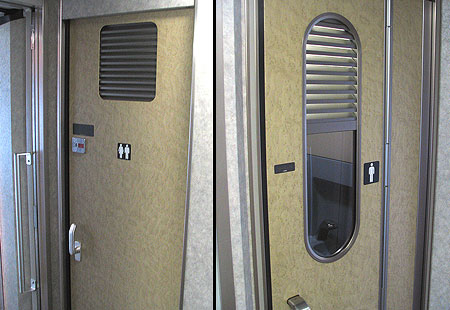
What I don’t get is the men’s lavatory: only a urinal, which is fine–but the door has a window in it. See the photo below: the left shows the men’s-and-women’s combo door, the right side shows the men’s-only door.
Shinkansenrestrooms

Here’s my question: why the hell put a window on the men’s room door? There’s no use for it. The other rooms have an indicator showing whether the room is occupied, tied into the door lock. The same could be done with the men’s urinal as well. It would not cost more–in fact, the men’s urinal door with the window must cost more, because it costs more to add a window than to have a plain door. And while many Japanese men probably don’t mind the lack of privacy, certainly some do. So why have the window at all in the first place? It makes no sense to me, though apparently it made sense to someone.

This brings back another memory from that first trip, on the ferry from Aomori to Hakodate, bridging the islands of Honshu and Hokkaido. The bathrooms were located along the outside corridors leading from fore to aft. There were stalls for men and women to do their setting business, but all the men’s urinals were simply lined up out in the open on the other side, where people of both sexes walked past. Not being quite that modern (or old-fashioned, I suppose), I used the stalls.

But in Japan, there is something of a history of men’s rooms being more open to the public. Even today, when I used a store’s restroom, the men’s room door was propped open, while the women’s room door was closed. Often it will be that way, with the men’s room’s urinals sometimes being in plain view of passers-by.

This is in contrast to a feature of Japanese restrooms that I like: the stalls, including the ones in the men’s rooms, are completely sealed from outside view. No gap at the bottom, and more to the point, no gap between the door and the stall wall. When you close the door, there is no way for people to see in unless they climb the wall and peek over. In the U.S., when you’re sitting on a john in a busy public bathroom, you often have to deal with people who want in to a stall, and who apparently don’t believe that a locked and closed door means occupancy–they will often stare right in at you as you sit there, to make sure the stall is indeed occupied. I never liked that, and I can’t imagine that anyone would. That can’t happen in Japan–it’s a fully private little room. Nice.

But one other thing that bothers me sometimes: the cleaning ladies. You can bet that cleaning men are never found in ladies’ rooms. But in Japan, mostly in hotels but also in large buildings like department stores, cleaning ladies are almost always present in the men’s rooms, or so it seems at least. Not that the ladies would necessarily ogle like men might in a ladies’ room, but nevertheless, to bathroom-shy individuals like myself, it is not really a helpful thing. It’s one of those times that you wish they were a bit less gender-discriminatory in hiring the cleaning staff.


Categories: Focus on Japan 2007 Tags: by

Yacho no Mori, Karuizawa

April 21st, 2007 Comments off

“Yacho no Mori” is Japanese for “Birds’ Forest.” I’ve seen the name applied to various areas in the Japanese countryside where the birding is good in a wooded area. Today, Sachi and I are in Nagano, and as we had a few hours to kill and a rental car to get us around, we went to Karuizawa’s Bird Forest–something which pleased me, because we didn’t get the chance to stop there when we bicycled through the city last August.

The forest was nice, and we spotted some interesting birds, including one I’d never seen before. But we wound up hearing a lot more birds than we saw–normal for birdwatching, of course. At least three or four times today, I got foiled by what I call “psychic birds,” where the birds just sit there nicely until just before you snap the photo, which they seem to sense psychically as they choose that split second to fly away.

Nevertheless, here are some of the birds we got today:

0407-Enaga1-450

0407-Enaga2-450

The above is an Enaga, or Long-tailed Tit. These little guys are as cute as the dickens, but hard as hell to photograph as they flit around so much. There were at least half a dozen flying around in the trees and shooting down to puddles for a bath. These were the best shots I could get–though at one point, one flew within just four or five feet of Sachi and me, settling down for a 2-second bath in the stream right in front of us, before flying off again.

The next bird I’ll show is the last we caught for the day before heading back. It’s a Kakesu, or Eurasian Jay. I got one of these once before in Kasai Rinkai Park, but only then. It’s a pretty bird, with a striking head and pretty blue-barred wings. Sachi and I saw two of them rise up into the trees as we approached, and though one led us on a futile chase, the other happened to be preening just above us, and stayed for long enough to get some nice shots–even if they are from too low an angle. The first of these can be clicked for a larger image:

0407-Eurasian Jay1-450

0407-Eurasian Jay2-450
Taking on a very lion-ish pose…

0407-Eurasian Jay3-450

0407-Eurasian Jay5-450
…from an angle which was too much backlit, but this shows the wing detail very nicely.

The last I’ll introduce is the bird I have never seen before: The Misosazai, or Winter Wren. This was a bird that we heard before we saw. It has a beautiful song (listen to it here as a WAV file, or as an MP3), and did not seem skittish or shy at all: we followed the bird upstream for maybe 100 feet, and it did not seem the least bit disturbed by our presence. The little guy was charming, being a tiny bird with a short, wagging tail and a cheerful song every so often. Though other birder on the trail seemed politely surprised that we got a glimpse of this bird, I have the feeling that it is quite common–after all, we saw the same bird three times along the trail. The first and last of these images have enlargements when clicked on:

0407-Misosazai1-450

0407-Misosazai2-450

0407-Misosazai3-450

Want to listen to the song it’s singing in that last image? Here it is, in WAV or MP3. (In case the sound files don’t open in your browser, try either downloading the link target, or using another browser.)

Categories: Birdwatching, Uncategorized Tags: by

Republicans Filibuster, Nobody Notices

April 20th, 2007 Comments off

Remember how Republicans used to rail against the use of the filibuster? Remember how they used to claim that it was undemocratic and un-American, and that there should be a straight up or down vote? Remember how they used to threaten the nuclear option if the Democrats dared to be so vile as to even consider filibustering?

All of that is interesting when you consider that in the past few months, Republicans have used the filibuster more than Democrats did over a period of years. As The Carpetbagger reports:

…over the last couple of months, Senate Republicans have filibustered a minimum-wage increase, filibustered a debate over a non-binding resolution on the war (twice), threatened to filibuster two appropriations bills, and filibustered a bill that would have led to lower prices on prescription medication.

That last one is the most recent: Republicans have stopped cold an attempt to allow Medicare to negotiate for drug prices. There really is no defense for that; it is a complete and utter sell-out to Big Pharma, and is a betrayal of the American people. That’s almost as bad as stopping the minimum wage hike with a filibuster. And now the Republicans are threatening to filibuster a vote which would give Washington D.C. citizens representation in Congress; I mean, how more democratic and American could you be in wanting to give Americans the right to vote and be represented? But D.C. is mostly Democratic, so…

What’s amazing here is that their filibusters seem targeted at stopping legislation that follows the will of the people–most Americans want a minimum wage hike, and end to the Iraq War, and Medicare negotiations. And even more ironic, the filibusters aren’t even necessary, as Bush has vowed to veto all of this legislation in any case.

So where is the “liberal media” on this story? Well, they’re reporting on the filibuster as a background story, no big emphasis, but virtually no one is noting the extreme hypocrisy practiced by the Republicans in their hyperactive usage of the practice, or that Democrats are not threatening the “nuclear option” every time a filibuster is hinted at. Maybe it would be a bigger story if the Democrats railed against the filibuster like Republicans did, if they threatened the nuclear option constantly, like the Republicans did. Maybe it would even be more effective politically. But it would also be inconsistent.

In short, the Democrats are being fair and honest in accepting the use of the practice, while the Republicans are being unbelievable hypocrites. But because the Democrats are being fair and honest, nobody is picking up on the story. Instead, the media goes hog-wild when Nancy Pelosi wears a scarf. Nice to see their priorities are in order.

To Those Who Thought It Wouldn’t Make a Difference…

April 19th, 2007 1 comment

In the last election, there were many pro-choice people who really didn’t think that putting Bush into office would make that much of a difference. Similarly, when Alito was nominated, many said to let it slide and let him on the bench, because that wouldn’t make much of a difference, either. Well, good morning to those people: you have just woken up in George Bush’s America. Thanks to you, all this is happening.

Now that Sandra Day O’Connor is off the court and Bush successfully replaced her with one of his right-wing strict constructionists, the court has tilted sharply to the right. People who wanted to let Alito slide through said that everything would be OK–Kennedy would naturally step in and assume O’Connor’s role.

That hasn’t happened.

In a 5-4 decision, one which would not have happened had Justice O’Connor remained on the bench for a few more years, the court ruled that a “Partial Birth Abortion” ban was constitutional, even though it had no exception for the health of the woman. Kennedy was the tie-breaking vote, and wrote the opinion for the majority.

The law in question is entirely a political one. The term “Partial Birth Abortion” itself is not a medical term, but one specifically designed by pro-lifers in an attempt to redefine the very meaning of abortion.

There is a page from the classic conservative playbook where in order to fight against a reasonable opposition stance on an issue, you take the most ugly and onerous extreme of the other side’s content, and then try to make everybody believe that this extreme is equal to the whole. Since most abortions take place when the fetus is so small as to be unrecognizable as human, the pro-life crowd needed a “poster child,” in a gruesome take on the expression, to make abortion seem as horrific as they imagined–in essence, a healthy, viable newborn baby torn to bloody pieces.

So they took the procedure of intact dilation and evacuation (IDX)–already an uncomfortable procedure despite the fact that fetuses aborted were non-viable. They gave it a horrific new name, exaggerated the gruesome nature of the procedure and distorted when and how often it was used, and then tried to make it seem like this was the face of abortion. Soon, every legislative move on abortion by right-wingers focused on this procedure. In PR terms, it helped make abortion in general seem immoral and repulsive; in legal terms, it opened a potential back door to disassembling abortion rights as a whole.

One thing that the whole “partial birth abortion” movement is not is medical. It is completely political, from top to bottom, despite the impact it will have on women’s health.

In immediate practical terms concerning IDX procedures, this ruling may not mean much. The procedure is rare, and is becoming more rare as severe deformities and life-threatening problems are detected earlier on with newer technologies, allowing for a first-trimester abortion.

On the other hand, despite assurances that the term “Partial Birth Abortion” is in fact limited to the IDX procedure, there is concern that overzealous anti-abortion law enforcers will stretch the definition to include more common varieties of abortions, and there is a good deal of doubt as to whether that was indeed the original intent of the law’s authors–to assure critics that the definitions were narrowly intended, but to phrase them vaguely enough so that they could be stretched and expanded later on.

Naturally, the law was challenged, and made its way up to the Supreme Court–and the court’s decision may have done even more damage than the law alone ever could have.

In the majority opinion written by Kennedy, the wording is open and permissive enough to allow states to start writing legislation with more and more restrictions on all kinds of abortions. For example, since it is the first post-Roe ruling that allows a restriction that does not have an exception to protect the health of the mother, it opens the door to the repealing of such exceptions on a wide variety of abortion laws. And since the ruling itself denotes a huge shift in the makeup of the Supreme Court itself, it will encourage massive waves of new anti-abortion legislation in the hopes that the new court will be more receptive. And you can be assured that conservatives in states all across the country are in the process of introducing those laws as you read this.

In the end, what we have is essentially a religious law imposed on the population as a whole. Coming up next: the marriage of church and state. Wheee!

Categories: Political Ranting Tags: by

On Gun Control and the Virginia Tech Shootings

April 18th, 2007 10 comments

As I mentioned last night, I am getting a lot of hits from Google for my blog post on gun control in the wake of the Virginia Tech shootings. There has also been some talk about the topic in public.

I am pro-gun control, but I do not feel that incidents like the one at Virginia Tech are germane to the issue. Gun control is mostly about firearm safety and making it more difficult for criminals to arm themselves; gun control also acts as a net to catch wanted criminals or known felons who attempt to purchase firearms.

The Virginia Tech shootings, like most other such rampages, really don’t apply to this issue one way or the other. While they increase our awareness of the issue and perhaps spur people to push for better gun control, they are not the kind of incidents that can really be prevented with better gun control.

According to reports so far, both guns were purchased legally; the shooter did not have a criminal record aside from a single speeding ticket. While he had a record of depression and other psychological difficulties, it was not so severe that any regulation of sales to a mentally ill individual would apply. Virginia even has a relatively strict law about how often you can buy firearms, limiting purchases to one per month; from what I gather, the shooter bought one gun in February, and the other in March. He bought handguns, not assault rifles or semi-automatics, if I understand the description of the weapons correctly. Virginia police destroy records of gun purchases after 30 days, in an apparent sop to the gun lobby. But it would not have made a difference had they kept the record on file for longer. Concealed weapons permits would also not apply, unless the shooter happened to be searched by police or security people between leaving his dorm room and arriving at the scene of the crime.

In short, this is the kind of incident that just doesn’t apply to the argument. Even a complete, nationwide gun ban would not necessarily stop this kind of violence.

That is not to say that gun control would not work; just as it would have yesterday or ten years ago, sensible gun control could stem a good deal of violence and crime.

Just not stuff like this.

Categories: Main Tags: by

Perspective

April 18th, 2007 6 comments

For those who would say that we are making “progress” in Iraq, that there is no civil war going on, and that we are “over-reporting” or exaggerating the violence in Iraq, there is a point in today’s domestic news that should be inescapable to these Iraq War apologists:the shootings at Virginia Tech, for all of their horror and bloodiness, represent a relatively quiet day in Baghdad.

This is not to suggest that the Virginia Tech shootings were not horrific; it is instead to point out that the violence in Iraq is even more horrific, incredibly more horrific. Look at our media coverage: wall-to-wall, and it will probably continue for at least a week or longer. And yet this exact same kind of event in Baghdad would disappear in the daily background of violence and horror that is now commonplace there.

Almost a year ago, Republican Congressman Steve King made a speech before the House in which he claimed that the violence in Iraq was less than what happens in major American cities: “It is getting a little safer in Detroit than it is in Washington, D.C., but still far more dangerous in Detroit than it is in Iraq to be a civilian,” he said. The problem with King’s statement: he played with the numbers, using highball stats from U.S. cities and lowball stats from Iraq, and then compared the death rate in compact, high-density urban areas to the entire country of Iraq, which includes large populations spread out over rural areas. A proper comparison would be city-to-city or country-to-country–but such comparisons would not provide a favorable picture of how things are in Iraq, which is what King wanted.

But that was a year ago; nobody would suggest the same thing today, right? Um, well, actually… “[Returning troops] indicate to me that 80 to 85 percent, in a conservative fashion, of the country is reasonably under control, at least as well as Detroit or Chicago or any of our other big cities.” That’s Tim Walberg, another Republican congressman, this one from Michigan. It was less than a month ago. Walberg is guilty of the same fallacies as King, he just doesn’t use statistics to obfuscate. Walberg is essentially saying that the least violent parts of Iraq are about as violent as the most violent parts of America, comparing the rural stretches of Iraq to the dense pockets of urban violence in America. And yet he stood by his statements, joining many conservatives in trying to downplay violence in Iraq and painting a rosy picture of how things are improving there.

But King and Walberg are not the only ones. Many conservatives have tried to downplay the violence in Iraq, claiming that our media only focuses on the negative news from there, that it’s not so bad. Witness John McCain in a bulletproof vest, ironically surrounded by a hundred troops and covered by five helicopters so he can go shopping in Baghdad; his fellow congressman comparing the visit to a trip to an Indiana marketplace.

But reality intrudes. Estimates vary, but almost all sources put the number of people killed in Baghdad every day at higher than 60–double the number killed in the shooting spree at Virginia Tech. In fact, mass killing at universities are not uncommon in Iraq:

In January, Baghdad’s Mustansiriya University sufferred a double suicide bombing in January that killed at least 70 people, including students, faculty, and staff. A month later, another suicide bomber struck at Mustansiriya, killing 40.
And yet, that one incident in America has spurred massive attention and media coverage, endless hand-wringing and head-shaking. Not that it shouldn’t; rather, what is happening in Iraq should not be downplayed. Imagine the Virginia Tech shootings happening twice, even three times, daily, in one American City, even one like New York, with bullet-riddled bodies dumped with their hands and feet bound, showing signs of torture. Imagine having to become inured to that level of violence in the city where you live.

Iraq is not “improving.” And the sooner we start making decisions not based upon that right-wing fantasy, the better.

Categories: Iraq News Tags: by

Gun Control Blog

April 18th, 2007 4 comments

Interesting. Just in the past few hours, I got two different comments on an old post, my post on Gun Control from May last year. Usually I get comments on old posts very sporadically–to get two in such quick succession is very unusual. I thought maybe it was the same person using different names–but the IP addresses were different. Then I thought that someone was linking to my post from a popular forum or something–but no, my “Latest Visitors” stats page showed them coming from Google. Odd.

Then I figured it out: the Virginia Tech shootings. That has prompted people to search for sites that discuss gun control. And if you Google “gun control blog,” I’m #2 on the returns. And sure enough, when I checked my recent stats, the search terms “gun control blog” which lead people from search engines to my site have spiked in the last 24 hours.

Interesting how stuff like that comes together….

Categories: BlogTech Tags: by

Conservative Assault on the Middle Class, Continued

April 17th, 2007 1 comment

After Bush fired half of the few IRS lawyers who audit the wealthiest Americans, the IRS is now cracking down on the middle class. The excuse:

Chris Edwards, director of tax policy at the Cato Institute, a libertarian research and advocacy group in Washington, said that Congress is driving the need for more audits. Since 1995, he said, “the Republicans greatly complexified the tax code, contributing to tax evasion and making the I.R.S.’s job more difficult.”

The thing is, Republican meddling with the tax code is almost certainly designed to create loopholes and evasions for the wealthy, so why is the IRS focusing more on the middle class?

Kevin Brown, the I.R.S. deputy commissioner for services and enforcement, said the audits “were out of whack” in 2000, with far too little attention paid to the middle class and to the very highest income generators, those making $1 million or more. “We try to run a balanced audit program,” Mr. Brown said. ….

For taxpayers with incomes above $100,000 the odds of being audited in 2006 were 1 in 59; above $1 million, the odds increased to 1 in 16. People in lower income brackets — those reporting incomes below $25,000 — faced a 1 in 94 chance of being audited.

“Out of whack,” huh? “Unbalanced?” Gee whiz, you don’t think that it’s because you’re much less likely to cheat on your taxes if you make $20,000 a year, do you? How many people who make that much have the chance to cheat, anyway? And how much money could be gained by an audit if the person is avoiding $50 in taxes?

Compare that to people making millions or billions, people who have the resources to commit all kinds of tax fraud, where any one case of evasion could net the government millions of dollars in recovered taxes? The over-$1-million bracket has a higher percentage of audits because that’s where most of the tax evasion takes place. It is proportional; if anything, the wealthy should be audited more, not less.

Meanwhile, the IRS had to be faced with a court order to reveal their numbers on auditing of corporations–and the reason became apparent when the results were released: there was zero increase of time spent auditing corporations. None. In fact, the time spent even decreased in terms of efficiency. Gee whiz, imagine that. The IRS also focused more on small businesses–something which demonstrates how clearly the Bush administration actually wants to protect them. Truth is, they don’t want to protect small businesses; they only want to use small businesses when they have yet another tax cut for the wealthy and for corporations, and they need some sympathetic face to put before the cameras to justify it. But in this conservative era, small businesses are nothing but prey, both to tax collection and to the conservative business model which promotes super-sized businesses using overseas labor and vicious monopolistic practices to destroy small businesses.

Consider this as well: the ranks of auditors is cut down to 13,000 from 17,000, a reduction of 24%, while the number of audits doubled, and the tax code became more complex.

Deputy Commissioner Brown and others said the strategy of pursuing more audits, even if each one receives less time and attention, has proved a success.

But we know what that means: since people in the middle and lower classes can’t afford attorneys like wealthy people can, and given the IRS’s coldly extortionate and imperial authority to destroy people’s lives when they feel like it, less time on each case means that it is more likely that an agent of the IRS will not listen to explanations or rationales, and will instead demand payment and not accept “no” as an answer. It’s easier to be “successful” and collect more money when you can virtually rob people blind at a whim and they have no recourse.

It is also interesting to note that while the number of audits nearly doubled, the chances of middle-class earners (between $25,000 and $100,000) being audited nearly tripled, while:

At the very top, those making more than $1 million a year, the data showed that from 2004 to 2006 the number of audits rose 77 percent, from almost 9,600 to 17,000. But more than half of those audits were only letters asking for documentation.

The IRS is so polite to the super-wealthy, aren’t they? But in the IRS’s defense, maybe it actually isn’t more profitable to go after the rich: after all, over the past six years, Republicans have been assiduous in giving the wealthy every possible tax cut and loophole they could humanly accomplish.

Either way, it boils down to the same thing: conservatives are methodically destroying the middle class, while they are just as systematically transferring wealth from the middle class and the poor to a small number of supremely wealthy individuals.

I would simply comment, “business as usual”–but the fact that this is a trend demonstrates that there had been some progress in the opposite direction, progress which is now being rather thoroughly disassembled.

Categories: Political Ranting Tags: by

Quick Notes #6

April 17th, 2007 1 comment

An Insignificant Minimum. That’s what Antonin Scalia calls innocents who are killed by the system of capital punishment. Imagine being the innocent person put to death; how comforting to know you are an “insignificant minimum.” Benjamin Franklin said that it is better a hundred guilty men go free than to let one innocent suffer; the ultimately reprehensible Scalia disagrees, apparently satisfied that few enough innocents are killed; naturally, he conveniently ignores the fact that it is a system virtually designed to hide the fact that innocents are killed. Why else purposefully destroy all evidence in a case when a criminal is executed, like a murderer disposing of his weapon and clothes after his crime?

If you are willing to kill for a belief, I think you should also be willing to die for it. If you approve of the death penalty, and you can honestly say that you would, as an innocent person, go to your execution believing that the death penalty was still just and your life an acceptable sacrifice, then that wins you the prize of not being an utter hypocrite. I have a feeling that most people who support capital punishment would not pass that test.

Even the Dallas Morning News, in the heart of Death Penalty territory, has changed its mind on this issue, as did Republican Illinois Governor George Ryan (though he had to wait just before leaving office to act on his belief).

Categories: Quick Notes Tags: by

The Barrage Begins

April 16th, 2007 4 comments

I love a lot of things about Japan. I love the peaceful aspects of the country, the general hands-off character to its religious side, the less confrontational interpersonal habits, and the many differences between its culture and my own which provide fascination as well as entertainment. I love some very specific aspects about Japan, including how there are a lot more people in stores who can help you and how far they’ll go sometimes to help you; how Japanese public restroom stalls are fully closed-off and private; I love Mt. Fuji, and I love the shopping streets with their varied little stores. I love the fact that English is supported so well here (and how it is sometimes mangled). I love to just go out and walk or drive in a random direction and discover new stuff.
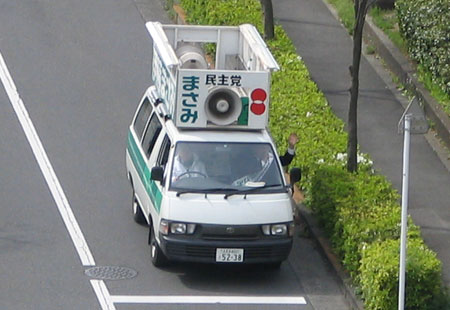
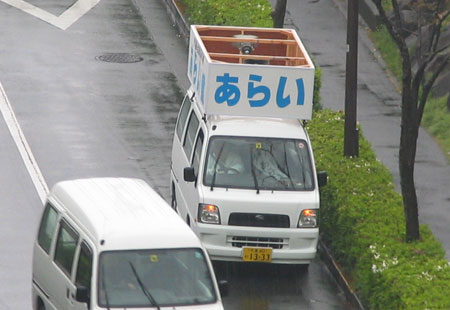
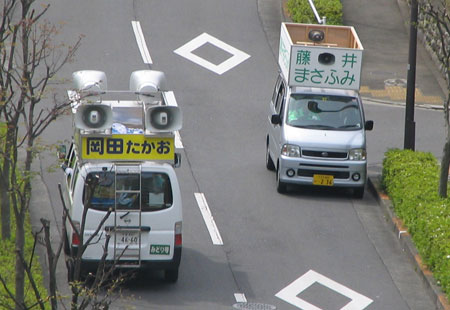
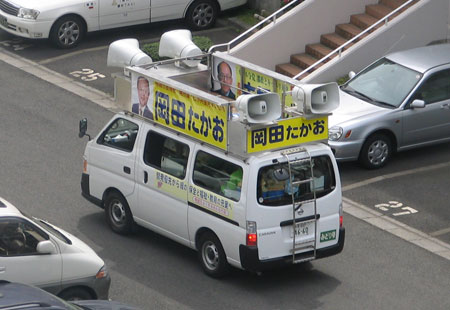
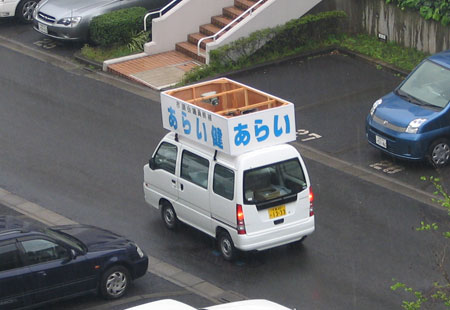
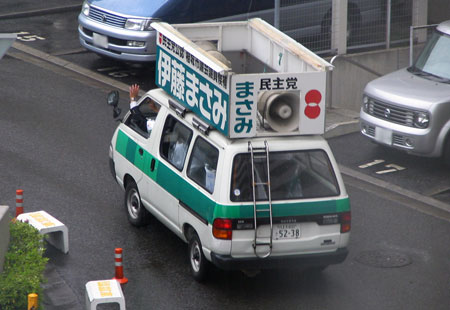
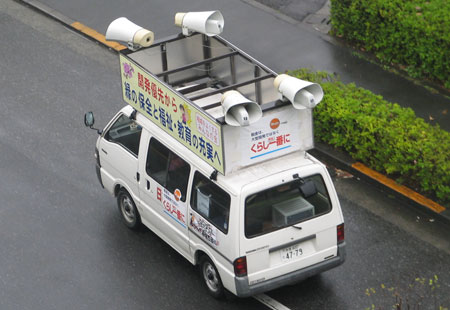
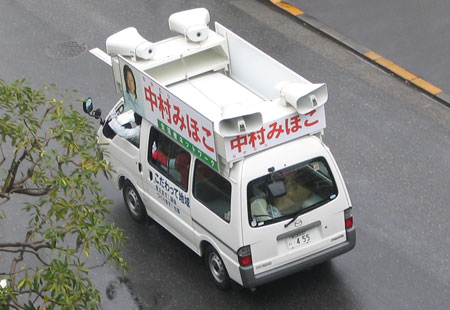
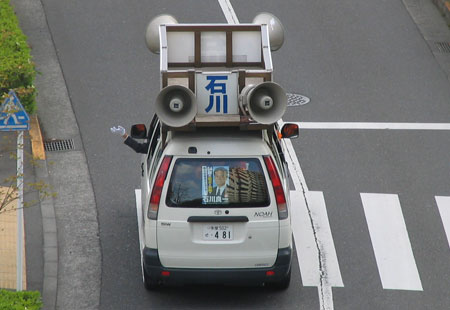
But there are things you hate, too, just like any other country. And at or near the top of my list is those goddamned loudspeaker trucks. I know I’ve blogged on this before, but a little more depth this time. (And sorry for saturating the page with images, between this post and the recipe.)
0407-Loudspeakers2

In Japanese elections, politicians have a lot of restrictions which seem good on their surface–such as no television advertising, no plastering their posters everywhere and anywhere, and so on. Not that this really stops corruption. And one other thing it does is limit what the candidates can do to gain recognition: ride around in loudspeaker trucks all day blaring at huge volumes. What makes it worse: I’m paying for the damned things. That’s right–candidates get anywhere from ¥250,000 to ¥450,000 (roughly $2000 to $4000) of taxpayer money to pay for the trucks that wake those same taxpayers (including me) up way earlier than we’d like to–and then to keep blaring away, all day long, without a break.

This whole setup just baffles me. I can understand Japanese people not complaining when this happens–that’s simply part of the cultural landscape (although Sachi tells me that people sometimes do complain, like the two older ladies in the office she temps at). But how do these bastard politicians get away with cruising through crowded neighborhoods at 9:00 am on a Sunday morning (like they did last Sunday), blaring away on their loudspeaker trucks at top volume, and not have the locals get so pissed off that they’d at least withhold their votes? Seriously, do they actually gain votes by waking people up like that?

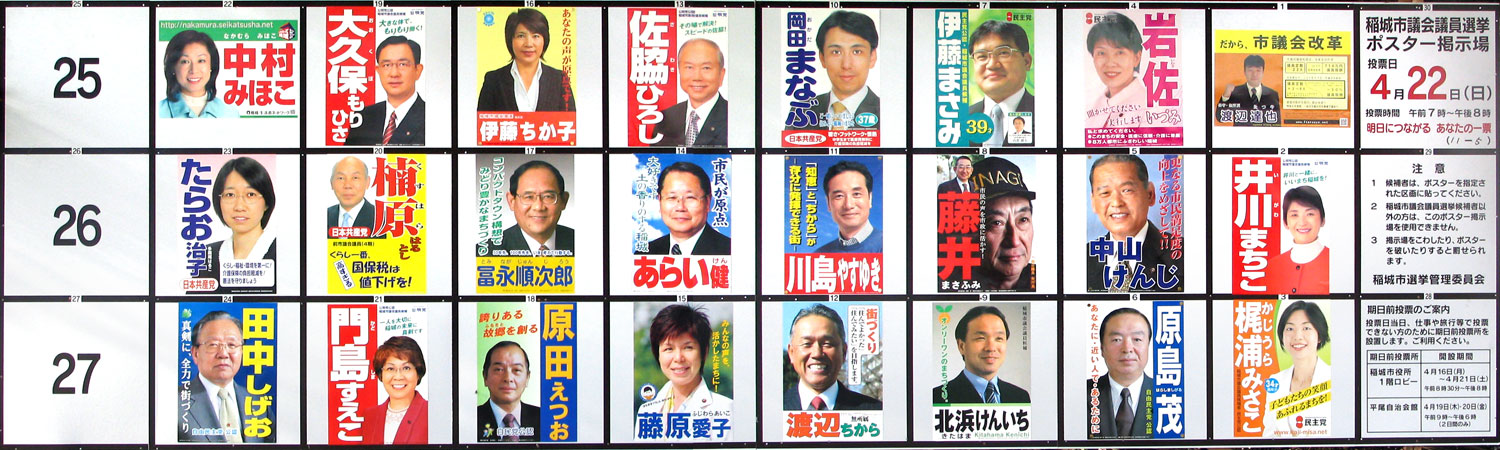
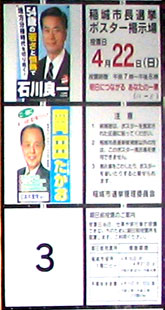
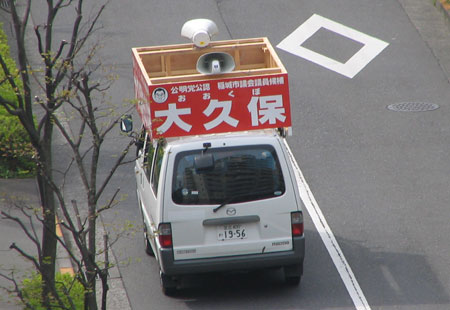
And yet not only is it happening, it is happening in spades. Almost everyone on the ballot is out there. Over the last two days, I’ve been going to the window as often as I can get around to it to snap photos of whoever is being an ass at that moment. In this election, there are two candidates for mayor, and 24 for city council. See the roster below (the main board can be enlarged by clicking on it):

0407-Inagi Councilboard-4500407-Inagi Mayorboard-310

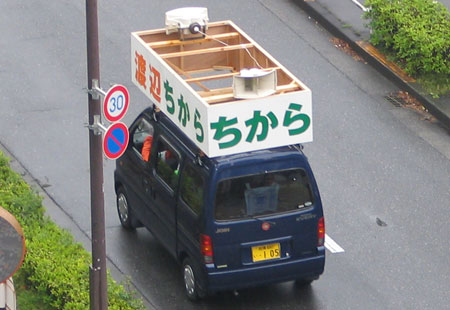
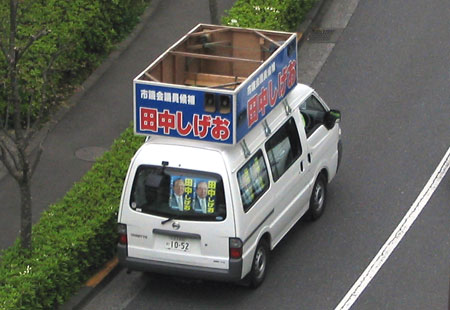
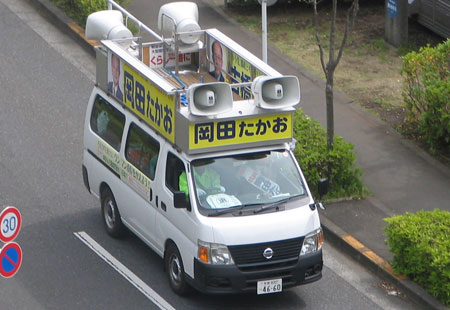
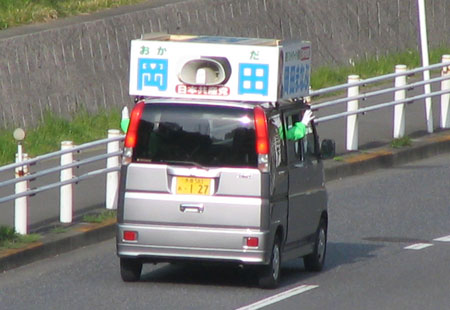
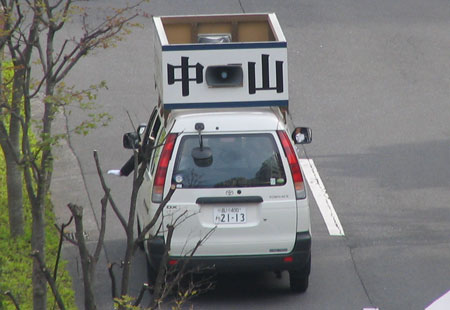
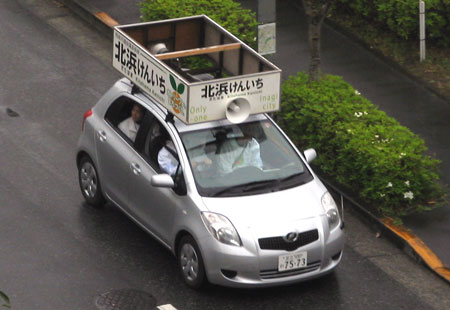
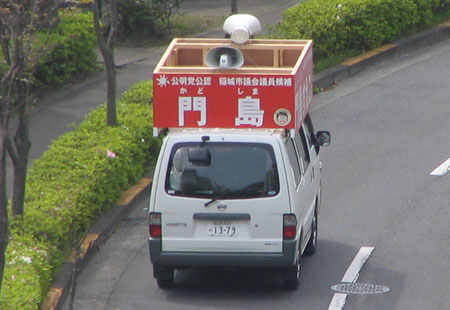
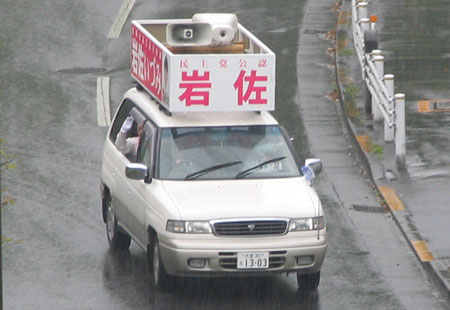
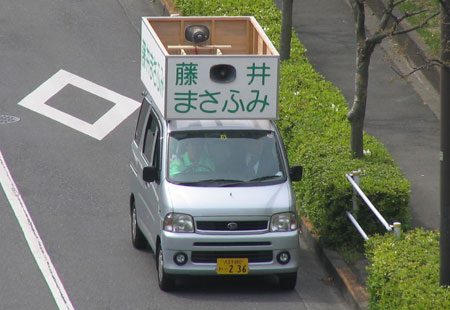
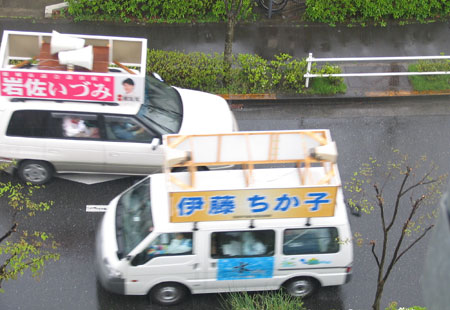
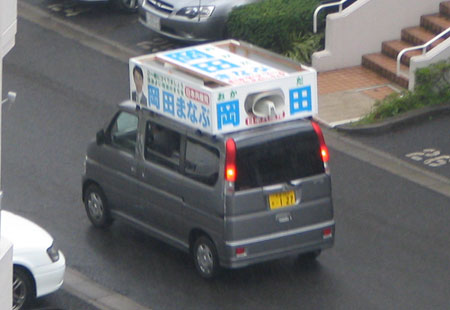
So far, I have caught 16 different candidates rolling up and down the street. In small form (though each pic is in fact 450 x 310 pixels):


In that armada are both mayoral candidates and 14 of the 24 council candidates. As for the other ten, I would bet good money that either I missed them, or they just haven’t gotten around to this neighborhood yet. Almost always, the trucks carry the candidates themselves, and there’s a lot of city to cover. Even so, with 26 candidates running around, they must be very efficient, as there appears to be more than enough time for there to be at least one truck in the area every few minutes–and every so often, two or even three trucks in the same vicinity, as these images of trucks passing each other show:

0407-Pass1

0407-Pass2

Nevertheless, they also somehow find time to make their way into each and every parking lot for every apartment building, and cruise through at a snail’s pace whilst blaring away as loud as ever:


Note that the green truck at the bottom right of the above four photos is the exact same truck used four years ago when I first blogged on this annoyance. A lot of the vehicles are perennials, though some of the candidates who always seem to appear have upgraded their vehicles and their loudspeakers.

Oh, by the way, note that I have not taken the trouble to blank out any of the politician’s license plates (though I have taken care to do so for other vehicles). If someone finds a way to use those numbers to harass the politicians in some way, I ain’t losing any sleep over it. In fact, it is a bit of a fantasy of mine to hire a loudspeaker truck for one week, and immediately following the elections, when the candidate is trying to rest and wind down, to go in front of their house, and for one week, from 8am to 8pm, blare out at maximum volume, “GOOD MORNING!! I AM AN ANGRY RESIDENT!! I JUSTED WANTED TO SHOW YOU HOW FREAKING ANNOYING THIS IS!! GAMBATTE KUDASAI!! ARIGATO GOZAIMASU!!” Over and over and over and over again, for a whole week. See how long it takes them to call the police and complain. Not that the police would do anything if a citizen called, but I betcha they’d move their asses if a city councilperson did. That’s Democracy for ya.

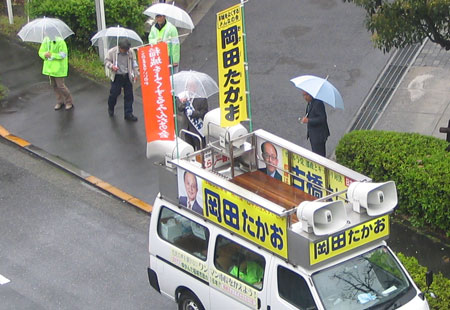
And it’s not even limited to politicians: I even spotted an issue truck, apparently not attached to any party or candidate, just screaming on about what issues they wanted talked about. [Late edit: a closer inspection of the mayoral candidate’s truck shows that on the inside of his truck-top facade, only visible from a height, were similar banners to what is seen on the issue truck. Fair game? Or are they breaking some rules here? — later edit: the issue van is back again the next day, with a different facade; I listened more closely, and found that they are campaigning for both “Okada” candidates, presumably father and son.]

Issue-Truck

And it’s even worse sometimes, when the politicians decide that they like your abode so much, they just can’t resist parking, getting out of the truck, and making a 15-minute long speech, just for you.

Nakamura-Speech

Okada-Takao-Speech

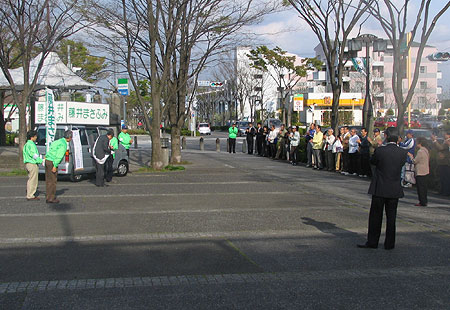
This following photo was interesting–it was Fujii, who parked in a local square and made a speech to a crowd. The thing is, it could not have looked more fake. The audience was lined up along the walkway all nice and neat, nobody left for the duration of the speech, and they all clapped on cue–while actual residents just walked by, completely ignoring the little play. Obviously the supporters were bused in in order to make it look like the candidate could draw a crowd.

Fujii-Speech

Obviously, this system isn’t working. Maybe they should change the laws so as to just let people advertise on TV–but only X minutes per election cycle per candidate, at set rates. Subsidize the damn thing with my taxpayer money if you have to. But just get these damned yammerheads to shut the hell up. At least within the walls of my own residence.

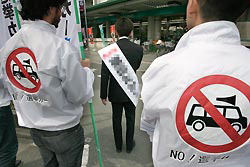
image from Mainichi Shimbun

Surprisingly, the politicians actually seem aware that they are annoying the hell out of people: there are at least ten candidates in the region who have joined a coalition of candidates who refuse to use loudspeaker trucks. They still use mics and boom boxes, but otherwise are relatively inoffensive, pedaling around on bicycles to talk to citizens. Much better! I hope to god that all ten candidates run away with victories and it sets off a new trend. Not that I actually expect that to happen. But you can dream, can’t you?

Thank all that is good and holy for one thing: campaign law also says that the candidates can not go around in the loudspeaker trucks before the official election campaign period (usually about 10-14 days) begins. But that one or two weeks can be hell. Forget about sleeping in. I myself have one more full week of this crap to endure before it ends.

Other resources:

Next-day Update: Three more of the politicians so far have added to their names of the obnoxious, making 19 different local politicians out of the 26 running who have no respect for their constituent’s peace of mind. The seven six five four non-offenders so far are Sawaki, Tarao, Harada, Kusuhara, Igawa, Harashima, and one of the Watanabes. [Update: I am removing the people from the list who later show up in their trucks.]

The worst offenders: the Okadas, mayoral challenger Takao and his (apparently) son Manabu, both members of the Japan Communist Party. Their vans are the loudest and most persistent in this area, coming around more than any other candidates, stopping to make speeches and driving through parking lots. They also apparently own the “issue” truck that has made multiple appearances as well.

Categories: Focus on Japan 2007 Tags: by

Not Fed by The People

April 16th, 2007 Comments off

0407-Yakitori-Engrish

We keep the older fake stuff in the back.

Categories: The Lighter Side Tags: by

Sachi’s Niku-negi Tofu

April 15th, 2007 5 comments

This is the recipe that Sachi invented, the one I mentioned last week. It’s a simple dish that should take no more than 15 minutes to produce; however, a few of the ingredients may not be available to those of you outside Japan, unless you have a good Oriental Foods section at your local supermarket, or have a store specializing in such goods nearby you. If not, then you’ll have to fudge on a few of the ingredients. But if you can do it, this is a fairly cheap, pretty simple, and very delicious dish. I was lucky enough to have Sachi make it for me tonight, and chronicled the process.

The recipe below is proportioned for one person; just multiply for each additional guest. Sachi cooked for two below. Enjoy!

Ingredients (per person served):

  • 1 package / 300g Tofu (soft, white variety)
  • 150-200g ground hamburger (any other ground meats can be substituted, if you want to try)
  • 1 bunch green onions (“negi“)

The following are approximate amounts; you may change to suit taste:

  • pinch of red peppers
  • 1 tsp. Kim-chi sauce or other hot sauce
  • 1 1/2 tsp. Mirin (a Japanese cooking saké), or sweet white wine
  • 5-6g sugar (you can use a sugar packet for coffee, or two depending on the size)
  • 2-3 tsp. Tsuyu sauce (soy sauce which contains “dashi“; you may add soup bouillon to soy sauce instead)

Snnt01

Directions:

Unpack the tofu, drain liquid, and wrap in paper towels to dry; set aside.

Snnt02

Snnt03

Rinse green onions, cut off and dispose of the root ends, and chop into ¼-inch lengths. Rinse again in colander; set aside (this will look like a lot, but will shrink with cooking).

Snnt04

Put ground hamburger into an non-oiled fry pan; cook on medium-to-high flame until it changes color to brown (not dark brown). After that, keep the flame on medium.

Snnt05

If you prefer the mix to be not-so-fatty: Segregate the hamburger to one side of the pan, then tilt the pan to drain some (but not all) of the fat; collect with a paper towel, which you throw out.

Snnt06

Add the green onions;

Snnt07

Add a pinch of red peppers, and then start mixing;

Snnt08

Add 1 or more teaspoons of Kim-chi sauce or other hot sauce of your liking, mix;

Snnt09

Add 2 teaspoons of Mirin or wine, mix;

Snnt10

Add sugar; mix.

Snnt11

Add 2-3 teaspoons of Tsuyu sauce or Soy/bouillon sauce, and mix.

Snnt12

Snnt13

Taste what you have so far to see how it’s going; add whatever of the ingredients you feel needs to be added.

Unwrap the tofu from the paper towels, and hold in your hand. Be careful–it’ll fall apart easily! Using a knife, gently cut the tofu down the center, then across its width five times, so you have 12 slices; place on a plate and stagger them a bit. You may heat the tofu in the microwave if you prefer a completely hot dish; otherwise, it will be a hot/cool dish (which I prefer).

Snnt14

Snnt15

Snnt16

Then just dish the hamburger-negi mix onto the tofu.

Snnt17

Done!

Snnt19

Eat with a spoon, and have it with beer, sake, shochu, or wine. You might want to add a salad. Yummy!

Categories: Main Tags: by

Cause and Effect

April 14th, 2007 4 comments

Just had Anderson Cooper on, covering something called “Post-Abortion Syndrome.” The idea is that women feel something similar to Post-Traumatic Stress Disorder due to the experience of abortion. The existence of such a disorder is denied by both the American Psychological Association and the American Psychiatric Association.

Naturally, I cannot speak towards the existence or non-existence of such a disorder. Many women say they do feel traumatized, and it is difficult to claim that they did not feel trauma. However, here’s an alternate explanation: what is causing the trauma is not the abortion itself, but the barrage of accusation and guilt aimed at them by the religion the believe in.

If I believe in a religion that preaches just as vehemently that drinking Coca-Cola is a horrendous sin, and I drank Coke, I would probably feel traumatized by the experience. That would not mean that drinking Coke itself is traumatic, however.

This is not to trivialize the process of abortion or the effects it may have. But it would be foolish not to explore that side of the issue. After all, it would not be the first time that religion traumatized people as a result of making a “moral” point.

Categories: Religion Tags: by