More Protests

September 9th, 2006 Comments off

Via DKos, more reports of protests against the “Path to 9/11” fictionalization, this time including historians and even right-wingers. Fox News host Chris Wallace calls the movie “slanderous” and “defamatory,” and even Bill Bennett says there’s “no reason to falsify the record” and that Disney/ABC should “correct those inaccuracies.”

In addition, ten high-power historians led by Arthur Schlesinger have published an open letter to Bob Iger protesting the “flagrant falsehoods” in the miniseries.

Media Matters points out that Disney’s defense of “Path to 9/11” is in stark contrast to their abandonment of “Fahrenheit 9/11” two years ago.

TPM Muckraker also has more evidence of the right-wing and even religious bias of the director of the farce. And even Harvey Keitel, star of the movie, says that it is not “factually correct,” and should be.

And finally, Disney is at least considering yanking the movie: “Sources close to the project say the network, which has been in a media maelstrom over the pic, is mulling the idea of yanking the mini altogether.” With just a few days to go, it’ll be interesting to see what happens.

Categories: Political Ranting Tags: by

“Flange”?

September 9th, 2006 4 comments

This story in the Mainichi Daily is a bit of a curious one, about a film coming to Japan where for a brief moment, female genitalia are visible. The story, titled “Film That Dares to Flash the Flange All in the Name of Art,” describes the offensive film and the fact that Japan’s censors are letting it slip by–as, so the story says, they let male genitalia appear on screen in Kinsey. (And, I observed, they let the same go uncensored in Schindler’s List on cable TV.) This time it’s an Austrian film about artist Gustav Klimt, which otherwise would have passed by unnoticed in small art theaters here.

A lot of people in Western countries assume that Japan and the Japanese are pretty blase about nudity, with the whole “nudity is often seen but never looked at” idea. Japan lacks privacy, as Mariko-san said in Shogun, and so nudity is not something Japanese mind so much.

Ha! Maybe in pre-Meiji Japan, or maybe even pre-WWII, but that is sure as hell not the case today. Modern Japan has kind of strange takes on nudity, probably a mix of Japanese mores and conservative censorship imposed by the US military during the occupation.

I remember the first time I visited Japan, back in 1983, and my tour group was in a countryside inn. The group leader told us that if we felt adventurous, we could all go together to the local bath house. Clearly everyone expected mix bathing, but when we arrived, to our collective disappointment and relief, it was a segregated bath–something which is very much the norm in Japan. Mixed bathing is rarely found in this country, mostly infrequent cases in the deep countryside, and is probably more common in California than it is in Japan. And even in segregated baths, people still carry small cloths which have little other purpose than to act as a fig leaf.

Outside of bath houses, nudity is not seen in public very much at all in Japan. One might see a flash now and again in terms of imagery, like in a manga cartoon book read by an oyaji (old guy) on a train, or in a poster outside a porn theater. Other than that, it tends to be restricted to pornographic materials. You certainly don’t see even a suggestion of private parts in public. Women always wear bras with sufficient padding so that nipples never stand out. On the beach, women almost always wear one-piece bathing suits, and I’ve never heard of a nude beach in Japan (though they might exist). In fact, you never even see shirtless men in Japan outside of beaches and swimming pools–or the odd festival where men might even wear fundoshi. Japan can be very puritanical in regards to clothing.

Pornography tends to strange contrasts here, on the other hand. The subject matter can get wild very easily (I’d rather not get into details), but because of the laws, genitalia cannot be shown. In fact, even pubic hair is usually covered with digital mosaics, though maybe a decade ago censorship laws relaxed enough to make showing “artistic” pubic hair legal, creating a boom of “hair nudes.”

There has also been a more conservative trend in terms of nudity on television. Back in the 80’s and early 90’s, nudity was pretty rampant on TV. Late-night shows featuring nudity were common, and by channel-skipping after 11:00 at night, one could almost always find some T&A going on. Um, so I heard. It was always very careful to restrict the view to boobs and bums, but it was common. One could even see the occasional women’s bath scene on daytime TV. Today, the trend is definitely away from that. Nudity on television is much more scarce, for reasons I do not understand.

So the next time you hear someone sagely explaining about how Japanese are nonchalant about nakedness, bring them up to date.

Categories: Focus on Japan 2006 Tags: by

Official Protests

September 8th, 2006 2 comments

The New York Times is reporting that Madeleine Albright, Sandy Berger, and Bruce R. Lindsey have all sent letters to Disney (ABC) head Robert Iger complaining of egregious fabrications in the “Path to 9/11” fictionalization.

…former Secretary of State Madeleine K. Albright, said in her letter … that although she had requested a copy of the film, ABC had not given her one. But, Ms. Albright said, she has been told by people who have seen it that it “depicts scenes that never happened, events that never took place, decisions that were never made and conversations that never occurred.” … “Sept. 11 is not ‘entertainment,’ it is reality,” Ms. Albright wrote Mr. Iger. “Before you air your broadcast, I trust you will ensure you have the facts right.”

Sandy Berger wrote that the movie “flagrantly misrepresents my personal actions” and will serve “only to grossly misinform the American people.”

However, Disney executives probably won’t listen to any of it; a right-wing blogger claims (via Think Progress) that he has been assured by ABC that only extremely minor, barely noticeable changes will be made. ABC “left the door open” to last-minute changes, the Times reported, but I think it’s highly unlikely they’ll do so. The “Reagans” miniseries got dropped by CBS entirely, to be shown only on pay cable; if indeed the right-wing smears and lies in this new miniseries is allowed to be broadcast uncorrected (not to mention nearly commercial free), it’ll be just that much more evidence that the media is decidedly right-wing, not left.

Update: via Tom Tomorrow, from the New York Post:

A furious Bill Clinton is warning ABC that its mini-series “The Path to 9/11″ grossly misrepresents his pursuit of Osama bin Laden – and he is demanding the network “pull the drama” if changes aren’t made.

Clinton pointedly refuted several fictionalized scenes that he claims insinuate he was too distracted by the Monica Lewinsky sex scandal to care about bin Laden and that a top adviser pulled the plug on CIA operatives who were just moments away from bagging the terror master, according to a letter to ABC boss Bob Iger obtained by The Post.

The former president also disputed the portrayal of then-Secretary of State Madeleine Albright as having tipped off Pakistani officials that a strike was coming, giving bin Laden a chance to flee.

“The content of this drama is factually and incontrovertibly inaccurate and ABC has the duty to fully correct all errors or pull the drama entirely,” the four-page letter said.

Additionally, Richard Ben-Veniste, a member of the 9/11 commission upon whose report the ABC miniseries is allegedly based, strongly disputed the accuracy of the movie as well.

Categories: Political Ranting Tags: by

Diebold

September 7th, 2006 3 comments

I am still astonished that any state allows Diebold machines to be used. Wholly apart from the fact that Diebold’s president was a Bush campaigner who promised to deliver Ohio for the president, Diebold’s machines have always been known for (a) a lack of a paper trail, and (b) the ability to be hacked. Now that ability is demonstrated as being very, very easy to do. This post gives step-by-step instructions on how to hack a Diebold machine in four minutes, using only $12 in materials, without leaving a trace of manipulation (link via Engadget).

And with the hotly contested race in San Diego, where “Duke” Cunningham lost his seat due to corruption, the Democratic challenger lost by only 4% of the vote. Diebold machines were among those used in the election, and controversy erupted when it became known that election workers were taking the Diebold machines home for “sleepovers”–though with the machines being open to hacking with only 4 minutes’ work, it is likely that even a sleepover wouldn’t be necessary to throw the Diebold machines’ results into question.

That elections results, however, are now moot, because the GOP leadership in the House illegally usurped San Diego’s right to certify the election by swearing in the presumed Republican winner before local officials approved the election results. So, corruption and election-stealing all around–the Republican Party has this down to an art.

Categories: GOP & The Election, Political Ranting Tags: by

Something Big…

September 7th, 2006 1 comment

Well, the rumors of a 23-inch iMac were wrong. It’s a 24-inch iMac. While the 20″ iMac now goes for $1500 ($200 less than before), for an extra $500, or $300 more than a 20″ iMac cost last week, you get the considerable extra screen real estate in addition to an advanced graphics card (the 20″ has an ATI Radeon X1600, the 24″ an NVIDIA GeForce 7300 GT). The entire iMac line was also furnished with the new Core 2 Duo chips, and the Mac Mini line was made Core Duo across the board. The cheapest iMac, the 17″, now sells for $1000, or $300 less than before.
Apple Showtime
But that’s not what this entry’s title is about. Rather, it’s about September 12th, when Apple has a big media event, which they are touting with the logo at right, proclaiming that “It’s Showtime.” Most everyone figures this means that Apple is going to release their movie download service, a reasonable interpretation.

But the really interesting thing is that the 24″ iMac and CPU upgrades were no small deal; usually, they’d get a show of their own. Instead, just a week before an Apple media event, the iMac and Mac Mini upgrades were quietly announced, with no great fanfare. That suggests that whatever Apple is going to release on the 12th, it’s big enough not to leave room for today’s upgrades… and that’s saying something.

Expectations: aside from the movie download service, people are talking about the long-awaited iPhone, with sources saying that it’s finally ready. Others say a video iPod, but probably just because the video service seems ready to go. However, others say that Apple has a whole new media center solution (maybe hardware) ready to go, and the movie downloads may be of DVD quality, not iPod-sized. It could even be a new kind of video download service altogether, with perhaps the TV downloads also going higher-resolution.

In any case, we’ll know the answers in a week.

Update: Via MacRumors, Variety and AP are already talking about the movie downloads as a certainty, noting that Apple will probably only have Disney on board at first, as the studios are balking at Apple’s low, fixed price structure.

Categories: Mac News Tags: by

More Notes on ABC “Dramatization”

September 6th, 2006 Comments off

An adviser to the producers of “Path to 9/11” tried to explain away a huge fictionalization in the miniseries as a composite. This in reference to the scene where CIA and Northern Afghani Alliance fighters have bin Laden in their cross-hairs, his house surrounded, and the Clinton White House gutlessly calls off the attack. Former Republican New Jersey Gov. Thomas H. Kean, an official adviser on the project, said that the incident, which is not even close to anything that happened in reality, as “representative of a series of events compacted into one.” Which, of course, is complete bull–there is no indication of exactly what “series of events” this is supposed to be compacted from. According to Richard Clarke:

1. Contrary to the movie, no US military or CIA personnel were on the ground in Afghanistan and saw bin Laden.

2. Contrary to the movie, the head of the Northern Alliance, Masood, was no where near the alleged bin Laden camp and did not see UBL.

3. Contrary to the movie, the CIA Director actually said that he could not recommend a strike on the camp because the information was single sourced and we would have no way to know if bin Laden was in the target area by the time a cruise missile hit it.

Since we never had bin Laden in our cross-hairs, and since the Clinton White House never called off a raid on bin Laden, it’s clear that this is more of a “composite” of right-wing pipe-dream truthiness that says Clinton let bin Laden go.

Kean also predicted that the film will “get just as many howls from Republicans,” which chimes in with the producer’s claim that “we are also being accused of being a left wing movie that bashes Bush.” However, these claims belie the fact that the movie was distributed to a great many right-wing pundits and bloggers, and after having watched it, they showered it with high praise. The producer’s claim that they are being accused of making a “left wing movie” is completely unsubstantiated, not to mention contradicted by the evidence on hand.

The claim that right-wingerswill be “offended” as much as left-wingers is likely based upon the fact that the movie shows the Bush administration not doing much in reaction to O’Neill and Clarke’s warnings about al Qaeda in the transition, and it shows Bush getting a PDB on bin Laden. These are not even close to being equally offensive, considering that Clinton is bashed untruthfully with completely fictionalized events making him look bad, while the events regarding Bush are completely factual and not in question.

Categories: Political Ranting Tags: by

Up to 6 Now

September 6th, 2006 2 comments

A year and a half ago I blogged on how doctors in Japan tend to over-prescribe through reflex, and how they would almost impulsively give you a pill, a capsule, and a powder for almost any ailment. Well, they seem to have graduated from three medicines to six. Just the other day a coworker of mine complained that she had been given six different nostrums by her doctor, which seemed excessive to her. And today I just got hit by the same outcome.

I went to see the doctor about stomach pains and other related ailments, and was diagnosed with gastritis and a cold. The prescription? One capsule, two kinds of pills, and three kinds of powders–one of the powders being a mix of three different medicines, actually. I’m hardly a doctor, but that seems way excessive to me. They include an antibiotic, two medicines for fever and pain (of which I only have slight indications), two stomach medicines, and one for general symptoms apparently. I’m tempted to just leave the whole thing behind and simply live out the illness naturally.

And I hate the powders. Gotta put them in your mouth dry, then wash them down with water, and they almost always leave a residue in your mouth that the water can’t wash away, and it tastes horrible.

Categories: Focus on Japan 2006 Tags: by

Building Truthiness, Blaming Clinton

September 5th, 2006 Comments off

As Stephen Colbert put it, truth has a “liberal bias”; Bush conservatives much prefer the imagined revisionism that tells them they are always right. The truthiness that says Iraq was about building Democracy from the start, that there was a link between Hussein and the terrorists, that everything wrong under the Bush administration either doesn’t exist or was Clinton’s fault.

Well, they’re taking that last old chestnut and putting it on the fire again. In a new ABC miniseries, a “dramatization” of the 9/11 Commission report, 9/11 is being recast as a debacle of the Clinton legacy.

Some reports have claimed that the miniseries is more even-handed, that it lays blame on both administrations, but early indicators suggest otherwise. The screenwriter of the 5- to 6-hour miniseries is a buddy of Rush Limbaugh’s, and as pre-publicity for the miniseries (airing on September 10 and 11), DVD screeners and special showings were made available to conservative pundits and bloggers only–who are now raving about the miniseries. (Addenda: while conservatives are cheering a sack of lies, their “family values” cohorts are forcing many CBS stations to drop a 9/11 documentary, because “curse words” were not being censored. Good thing they have their priorities straight: lies posing as history, good; curse words spoken by real people in accurate portrayal, unacceptable.)

Firedoglake has the best run-down of the story, and describes examples of why right-wingers love the documentary so much. The “dramatization,” for example:

  • had the CIA and Northern Afghani Alliance “surrounding bin Laden’s house,” when a phone call was put in to the Clinton White House, which nixed the operation. (In fact, we were never that close to bin Laden, and the operation to find him and take him out was never presented to the Clinton White House.)
  • had the Clinton administration doing “nothing” to al Qaeda in response to the bombing of the USS Cole. (In fact, al Qaeda was not identified as responsible for the USS Cole attack until Bush was in office–and it was Bush who decided to do “nothing.” Firedoglake further points out that if Clinton, in the heat of the 2000 elections, had started a major military offensive against al Qaeda with no evidence they were involved, conservatives would have cried bloody murder.)

These mesh seamlessly with long-term efforts of revisionism within the right wing. The first incident is redolent of the oft-told lie that Sudan and a guy named Mansoor Ijaz practically offered bin Laden to Clinton on a silver platter, and Clinton neglectfully turned down the offer. Ijaz, now a commentator on Fox News, retells the story as if he had bin Laden tied up in a sack and begged Clinton to take him, but Clinton refused. Various stories have him trying to hand over bin Laden once, twice, and even three different times. The whole lie is dissected here. Essentially, Sudan made an offer of questionable validity, but Clinton tried to get bin Laden anyway. His hands were tied, however, by the fact that at the time there was no evidence that bin Laden had done anything illegal within U.S. jurisdiction. Clinton tried to get the Saudis to take bin Laden, but they said no. The deal was simply unworkable, though Clinton did make an effort.

The second mischaracterized incident above also rings of right-wing revisionism, namely the whole “Clinton never tried to get bin Laden” fallacy. In fact, Clinton did try–and was rebuffed by Congressional conservatives. As told by Richard Clarke (portrayed in the miniseries with John O’Neill as frustrated by the Clinton administration):

Because of the intensity of the political opposition that Clinton encountered, he had been heavily criticized for bombing al Qaeda camps in Afghanistan, for engaging in “Wag the Dog” tactics to divert attention from a scandal about his personal life. For similar reasons, he could not fire the recalcitrant FBI director who had failed to fix the Bureau or to uncover terrorists in the United States. …

Clarke, in fact, blamed the Bush administration, not the Clinton administration, for the grievous errors made.

Similarly, in 1996, Clinton approached the Republican-controlled Congress with several anti-terrorism initiatives–including wiretapping, albeit done legally and constitutionally (audio file of Clinton via CNN). The Republicans rebuffed Clinton and turned down the plans, called Clinton’s effort to track explosives “a phony issue,” and said that wiretapping was questionable. Clinton also wanted to attack al Qaeda financially by barring foreign banks and businesses from accessing the American financial market if they associated with terrorist groups; Republican Phil Gramm shot that part down, calling it “totalitarian.” In the end, Republicans severely watered down Clinton’s bill–and today they blame Clinton because enough was not done, and today whine that had Bush’s illegal versions of what Clinton tried legally in the 90’s been in place, 9/11 wouldn’t have happened. Well, Clinton tried, and the GOP trashed it.

Richard Clarke outlined even more when he told of the efforts that he and John O’Neill made to carry over the Clinton administration’s concern over al Qaeda to the Bush administration–where they were effectively blown off. The Clinton administration had a counter-terrorism strategy that worked, and for years had been trying to get bin Laden. When Clarke and O’Neill tried to warn the Bushies about it, they were shown indifference. The Bush administration was far more concerned about Iraq, with heavy players within its ranks planning a second invasion even before the administration took power.

Another consideration which few remember is the Bush administration’s disdain for terrorism as an issue before 9/11. I seldom read or hear of anyone bringing up the fact that Bush not only neglected the terrorism issue, but that they had a strong motive to push it to the back burner. Namely: the missile defense initiative. If you’ll recall, since the very beginning of his administration, Bush was pushing for a missile defense shield, and in May 2001, even started his rant against Saddam Hussein in his push for this expensive white elephant, showing Clarke to be correct in Bush’s determination to get Hussein out even before 9/11; his rhetoric in this speech was almost identical to that he pushed after 9/11–but it was not aimed at terrorists, it was aimed at potential nuclear states.

In fact, the chief argument against Bush’s missile defense initiative was the fact that terrorists and rogue nations were incredibly unlikely to lob nuclear-tipped missiles at us, knowing that the limited damage they would do to us would be answered with complete nuclear annihilation in return. Bush’s critics pointed out that these states would instead work like terrorists, smuggling in nuclear weapons on cargo ships or in suitcases, placing emphasis on fighting terrorism, not building an albatross at great expense with unlikely usability. Clinton’s counter-terrorism was not about missiles, it was about tracking terrorists and beefing up security at ports and airports.

The Bush administration, therefore, had every reason–politically–to downplay real counter-terrorism in favor of the missile shield. Look at Bush’s first address to Congress in February 2001:

Our nation also needs a clear strategy to confront the threats of the 21st century — threats that are more widespread and less certain. They range from terrorists who threaten with bombs to tyrants in rogue nations intent upon developing weapons of mass destruction.  To protect our own people, our allies and friends, we must develop and we must deploy effective missile defenses.

That was Bush’s answer to terrorism: the missile defense shield. And that was his only mention of terrorism in the speech. Bush pushed the missile defense issue for months, and barely mentioned terrorism except in support of the missile shield, despite how Clinton administration officials emphasized it to his administration. Even when Bush gave a speech at the Oklahoma City memorial, he did not mention terrorism once. He did say:

The presence of evil always reminds us of the need for vigilance.  All of us have an obligation to confront evil, wherever and whenever it manifests itself.  We must enforce laws and reject hatred and bigotry.  And we have a duty to watch for warning signs.

Too bad he was asleep at the switch and didn’t see the clear signs of disaster.

Categories: Political Ranting Tags: by

Vista Rush?

September 4th, 2006 1 comment

After The Windows Vista Beta 2 was so buggy and crash-prone that testers virtually demanded a third Beta release, Microsoft instead went ahead and moved on to Release Candidate 1. I haven’t seen much word yet about RAM requirements, but early versions demanded 1 GB, and Beta 2 needed 700 MB. The claim now is that 512 MB of RAM will do, but I doubt that you could run much more than the basic OS with just that.

So far, people are claiming that RC1 is a lot less buggy than the last Beta, but there are still long delays with installing and booting, and other problems (ZDNet called it “unbaked“) which may require a second “Candidate” release. Even so, MS seems to be rushing here, concerned more with the deadline than with possible quality issues. It’s still keeping its options open, though–despite XP’s RC1 being accompanied by a specific release date, Vista’s RC1 is not, so if more time is needed, MS hasn’t painted themselves into too restrictive a corner.

Additionally, not everyone is excited about Vista’s pricing, which is at $200 for the basic Home version and $400 for Pro ($100 and $260 for upgrades, respectively). The upgrade prices are deceptive, though–few people who have been running XP have computers brawny enough to handle Vista, which means that more people will probably be getting it bundled with new computers they’ll have to buy–which, rebates or not, will up the price considerably.

Categories: Computers and the Internet Tags: by

What The…

September 3rd, 2006 2 comments

Great, now I’ve got something new to worry about. It seems that blog spam (comment spam, referral spam, trackback spam) was not enough. Now I’ve seen a Movable Type blog hacked by spammers. True, it was an older version of the MT software–though I’m not even sure that was the weakness the hacker exploited–but it’s now officially got me worried.

It was not my own site, but the site of a family member who needed a web site with certain features, and so I quickly set up an MT blog to fill their needs. I was checking it out today, and suddenly I noticed that on a few entries, a spam link was inserted right smack into the middle of the blog entry page. Worse than that, the browser I was using (Firefox on XP) suddenly bogged down, trying to open up a variety of weird windows and files, to the point where I had to force-quit the application. Later, I tried opening the same pages on my Mac with Safari–and though Safari did not try to open the files, it opened windows filled with junk characters–and it, too, froze and had to be force-quit.

When I looked at the individual pages, it turned out that the link was added directly into the page’s HTML, and there was an indecipherable script added to the bottom of the page. When I checked the entry’s core text on the blog’s control page, it was clean–so the blog’s software and database seem not to have been compromised. But the site’s security apparently was, and that site’s security was standard for the field.

But that wasn’t all. In addition to the 8 pages of the site that were hacked, 3 PHP scripts and an htaccess file were also added to the directory.

Since the original blog database was clean, it was a simple matter to rebuild the site and then erase any files added by the hacker (who apparently did the deed several months ago). So now the site is clean, but whatever scumbag hacked the page might still have access… so I’m going to have to reset the entire site, and then keep an eye out for more stuff like this in the future.

I knew spammers were despicable lowlife criminals, but I’ve never seen or heard of them going this far.

Categories: BlogTech Tags: by

A 23″ iMac?

September 2nd, 2006 Comments off

So the rumor sites seem to be reporting. The rumored release date would be September 12th. This has somewhat of a ring of truth to it, because more than one of the more reliable rumor sites are saying their sources confirm it. If so, a 23-incher would be a huge machine. Have you seen a 20″ iMac? Looks huge. A 23-incher would be giant. And if it does come out, I think I know what machine I’ll be buying when Leopard comes out next year.

There are also hefty rumors of the video iPod being released in mid-September (some say current iPods are being moved out the door to make room), along with the announcement of $10 and $15 movie downloads from the iTMS (though only one studio is known to have signed on).

Categories: Mac News Tags: by

Jesus Camp

September 2nd, 2006 8 comments
Categories: Religion Tags: by

Sidebar Rework–Finished!

September 1st, 2006 4 comments

A small note–I’ve just reworked the sidebar a bit. If you use it at all, you’ll notice a few of the changes. The first change is in the LinkBoard. Remember that episode of Seinfeld about speed-dial rankings? I kind of feel like that when I’m reworking the board, wondering if the people listed will notice the changes and say, “Hey! He moved me from 14 to 16! What’s up with that?” Added to the Linkboard is Sean’s and Justin’s blogs (about time), Blog-Q Taro’s (a lot of actual link referrals come from there, I don’t know why), and a completely new Japan blog, “My So-Called Japanese Life,” authored by Shari.

Next, the “Best of BfAD” is revised. There are now sections to the list. I’ve collected all of my serious-issue entries and collected them at the top; if you want to know where I stand on just about any issue, they’re all there, in gory detail. Included is my post on “Arguing on the Internet,” which, to my rather great surprise, was selected by a professor in Texas as an entry in a college reader, a book used by Academic Writing students as examples of writing to emulate. It’s not published yet, but will be out in the next few months, I’m told–I’ll be sure to go on at length about it when it’s released, as if it were an astonishing accomplishment or something.

The second section is entries that come in series, including four almost-categories where I’ve blogged repeatedly on specific matters (The Republican Blame Game, The “Liberal Media” Lie, Right Wing vs. Judiciary & The Constitution , and Church, State, & Christianity ). Not repetitively, though, I hope. The third section is general posts, followed by a few resources in last place.

Next, I’ve gotten rid of a few sections, including the “Media Reviews” panel which showed “What I’m Reading Now,” which, of course, was always out of date (no, I did not read “Big Lies” for two years straight). I figured I don’t change it enough, and certainly I don’t get people ordering from Amazon through it, so out it went.

Last was a small rework of the end links, adding a number of blogs that have been kind enough to link to me over time. I’m sure I’ve missed a few; if I did, please don’t take it the wrong way.

Categories: BlogTech Tags: by

Snapshot

September 1st, 2006 3 comments

I’m not talking about a photographic snapshot (though I wish I’d had my camera), but the snapshot you see of someone else where you wonder where they came from and what will happen to them. People you just see on the street, passing by, and never see again. You see them for a moment, like a snapshot, and that’s it.

I had one of those moments today as I drove back home from work. It’s a rainy day here, and I was going down Route 20 outside of Shinjuku. And by the side of the road, I see a hitchhiker.

That alone is unusual. In all my years in Japan, I cannot recall having seen one before. And knowing Japan as I do, I know that a Japanese person would almost certainly not be doing this; even before I can make out the person’s face, I know it has to be a foreigner–and so it was. A youngish man with short brown hair. He’s standing under an umbrella with a few traveling bags at his side, and he’s holding up a small piece of cardboard (maybe a foot and a half across). The cardboard has a simple drawing of a mountain, and below that, the single word “FUJI.”

And that kind of makes me wonder what this guy is about. Obviously a tourist, is he just going to visit the Fuji area, or does he intend to climb? Does he have any idea what climbing Fuji entails? Or is he aware that the Fuji-climbing season is July and August, and he’s just missed out on the time when the main trails are open? After August 28, the mountain is climbable, but few buses go up to the starting point at the 5th station halfway up the slope, and above that point, the huts and other support facilities are now closed.

Having climbed Fuji before myself (three times–and I just realized that I never blogged on this), and long ago having been a newbie tourist alone in Japan, I can sympathize with this guy, and keep wondering what will become of him. Is he so adventurous that he’ll climb the mountain anyway? Does he have any clue as to what he’s getting into. Or hell, will he even get a ride from anyone in the first place?

That’s why these snapshots are so intriguing and frustrating–you’re never going to know the answer.

Categories: Focus on Japan 2006 Tags: by

Quake

August 31st, 2006 2 comments

5:23 pm: A few minutes ago, there was a fair-sized quake here in Tokyo. No big details, except that it seems to have been centered real close to where I live, in Kanagawa, where it was a 4 on the Japanese scale.

5:26 pm: Now they’re saying that the epicenter was at the north tip of Tokyo Bay, around what looks like just at Yatsu Higata Salt Flats, though the strongest affected areas were in Kanagawa. Magnitude now reported at 4.8 on the Richter scale.

5:30 pm: HiNet is reporting it as a 4.7 (update: the same page now says 4.8). They’re now saying no danger of tsunami. Coordinates of the quake epicenter are 140.1E, 35.6N, just at Chiba Port Park.

5:37 pm: Now HiNet is saying 5.2, on the same page where another panel says 4.7. The epicenter is also given as a bit different, 140.024E by 35.632N, more in line with what I’ve seen on TV. Trains are stopped, at least the bullet train service.

Categories: Focus on Japan 2006 Tags: by

Language Is Slow

August 31st, 2006 3 comments

Kc-2Sometimes, that it. Some vocabulary charges in on a horse, like “blog” and “blogging” did. But some language persists. After all, you still “dial” a number, even though rotary dials have been gone for a few decades now (“enter a number” would be more accurate). We still get “on” airplanes instead of “in,” a century-old borrowing of seagoing terminology.

And despite the popular use of the word “photoshop” as a verb to describe the digital alteration of a photograph (after the name of the overwhelmingly popular image editing software), a lot of people are still using the old term “airbrush,” after the classic air-powered spray-painting tool used in days of yore to alter photographs printed on paper. I found this to be the case in the Katie Couric scandal, where CBS photoshopped a Couric publicity still to make her look slimmer. Even a magazine dedicated to photography used “airbrushed,” even though it is certain that Photoshop, and not airbrushing, was used. Old habits die hard.

And as an interesting side note, the sites I referenced (all the sites I could find, in fact) only offered a side-by-side comparison. The side-by-side comparison mostly emphasizes the general slimming features, especially in the gaps between her arms and torso. Again, this sort of comparison is a holdback from print photography days, while on the web, a superimposed animated GIF image–which I have prepared at top right–much more vividly shows the alterations done (if it doesn’t animate, turn animations on in your browser). You can see, for example, that part of the trick was to simply thin out the whole photo (or perhaps pinch the photo significantly)–see the background changing. Pay close attention to her neck and bust line as well to see where they put more work into it. Note the shadow added beneath her chin. This comparison shows that it was not just a 2-minute job–they really put some effort into this.

I made the animation cycle at two seconds because anything faster would be too distracting for reading purposes. However, if you click on the image, you’ll see a version which cycles at a half second, making it much easier to see the changes done.

Categories: Media & Reviews Tags: by

Apple Battery Exchange

August 31st, 2006 Comments off

I found myself caught up in the now-infamous battery exchange program when I checked the latest range of serial numbers Apple put out and mine fell into the range. Or at least it appeared to, so I called them up and they asked for the serial number of the battery and the computer. I’m not sure, but I have the feeling that the computer serial number was not needed to identify the problem, but rather they wanted to know who I was before alerting me so they could cover their liabilities. Despite good marks in general for their customer support, Apple’s legal department can be less warm and fuzzy.

You see, despite battery explosions being a relatively rare event, Apple doesn’t want to be liable for any damages that might be caused by a battery eruption to the computer, or more significantly, to surrounding property or persons. So when you identify yourself as having a suspect battery, the support person immediately tells you to remove the battery and not to use it until a replacement arrives. Which will be four to six weeks. And if, in that time, you are forced to use the battery and it explodes, Apple won’t pay for a penny of the damages. They told me that in no uncertain terms. Not that I accept those terms, of course.

Now, a lot of the time I use my computer, it’s plugged in, but a lot of the time, it’s not plugged in. For example, when I move from my office to my classroom every day, I work on my computer in the office and then move it to class where I will use it. If I can’t use the battery, then I have to shut down and restart the OS and all the software for each move–a pain in the ass. And I also use the computer where there aren’t any power outlets. After all, it’s a portable computer, that’s why I got the Powerbook in the first place. It’s got a battery because the users need that battery. Not being able to use the battery for six weeks is effectively taking away a $2500 computer for a certain chunk of the month and a half it will take to get the battery replacement.

To be fair, they did try to offer an alternative, though the alternative was unworkable for me and did not make sense. They said that if I packed up the whole computer and sent it in to their repair people, they could have it sent back to me in two weeks with a new battery. Later, they shaved that time down to one week. But I had to send the whole computer, not just the battery alone.

Now, that was unworkable for me because my school starts next week Tuesday and I have to have the computer for all kinds of preparation for the course I teach. But it did beg the question: why was it necessary to send the whole computer to Apple? Undoubtedly so that it could fit into a repair paradigm. Which means that in reality, Apple does have batteries sitting around the repair center, and they could send one to me within a week, but they won’t do it unless I conform to the repair paradigm which would make me send a perfectly healthy computer in to the repair shop, where absolutely nothing would be done to it, and that would take a week.

Arghh.

Now, I understand that Apple is now deluged with exchange claims. I understand that batteries must be in short supply (the tech support guy said they aren’t even selling batteries at the Apple stores). I understand that the repair route is probably offered specially to those who put up a fuss and they probably keep it difficult so that everyone won’t see that as a shortcut and start demanding it. And I understand that Apple wants to avoid liability for any battery fires which may result. And I would not expect anything more (and probably I’d expect a lot less, in fact) from Dell or any other manufacturer.

But what it amounts to is semi-crippling my computer for the next month and a half, and if anything does happen with the battery, they expect me to pay for every cent of damages–in other words, Apple truly is liable here, but they want the customer to shoulder the liability burden. Like I said, Apple legal can be just as warm and fuzzy as the next pack of lawyers.

Categories: Mac News Tags: by

Spot-on, I Tell You

August 30th, 2006 Comments off

The media just spent about a week in nonstop frenzy over this guy who made a false confession about killing a child ten years ago, in a case where assuming the guilt of anyone should have had “CAUTION” stamped all over it in huge, neon-red letters. And, of course, it turns out he didn’t do it. The media just blew a whole week on a delusional wacko, as I predicted, though they did give brief and nominal coverage to the president violating the Constitution of the United States of America.

In the meantime, the Speaker of the House nullified a congressional election in violation of the Constitution of the United States of America, and pretty much no one covered it in this country.

So, nutball pervert lying about ten-year-old murder case = nonstop week-long media frenzy. Stories about the President and Speaker of the House committing egregious violations of the Constitution, both breaking within a few days = page 17 story.

Yep. Our priorities are spot-on.

Categories: Political Ranting Tags: by

Toenail Clippers and Corkscrews

August 30th, 2006 5 comments

Yes, another entry on a topic of earth-shattering importance! File this one under “Simple Engineering Designs That Have Gone Underutilized.” In the U.S., the only toenail clippers I could ever find were the classic type. You know, the kind where, when you clipped your toenails, the nail shards would go flying randomly around you as you went about the clipping task. Thus forcing me to associate toenail clipping with sitting outside on the porch in inclement weather because neither I nor my mother before me wanted stray toenail shards turning up stuck to the underside of everyone’s feet for weeks to come.

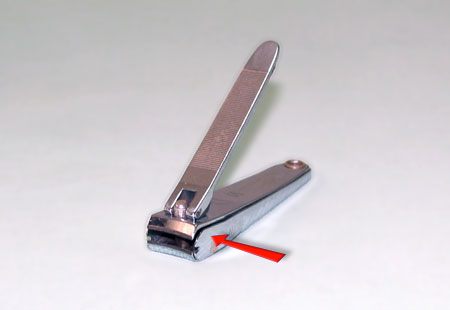
When I came to Japan, I noticed a design that is so simple that I was astonished that it was not used in America. Simply add a side enclosure to the clipper, and the toenail shards get caught inside the mechanism (so long as you don’t hold it the wrong way so they fall out). After clipping, just empty the clipper into the trash–the side-guard even retracts about a half-inch to help with that.

Toenail Clippers

So, my question is, why hasn’t this caught on in America? Last I checked a few years ago, this design was still rather rare in the U.S., even though one look at it and you’d wonder at how stupid the alternative is and why this hasn’t replaced the classic style. Do the American clipper people just not know about this? Or is it some kind of insidious toenail-shard conspiracy? And (nod to Dave Barry) wouldn’t “Toenail Shards” be a great name for a band?

And while I’m critiquing the design of basic household tools, what the hell is the deal with corkscrews? I mean the type with the brace that fits over the mouth of the wine bottle, and the arms that go up as you wind the screw into the cork. In every design I’ve found of this device, no matter how much you try, after using the arms to pull out the cork, there’s still a good half- to three quarters-inch of cork left in the bottle neck which you must still wrestle with to get out, half the time leaving an amputated stump of cork that has to be fished out. I have to think that there’s some reason for this to be done, else it’s one of the most idiotic engineering screw-ups ever.

I mean, why not just re-engineer the gears on the arms of the device so that the cork is pulled all the way out of the bottle? What’s the matter with that idea? Is there some esoteric wine-opening wisdom that shows wine tastes better if human strength is applied directly to finish the corking process? Or is this some idiotic, elitist “you must be talented to open a bottle of wine” crap? I suspect it’s the latter–after all, the whole idea of corking wine in the first place seems faddish to me; I know that screw-caps are associated with cheapo Ripples or whatever, but surely there has to be a better, more workable solution. And if not, then at least design the corkscrews to make it even passably unfrustrating to open a simple beverage container.

Categories: Main, People Can Be Idiots Tags: by

Stewart and Colbert

August 29th, 2006 Comments off

If you didn’t see the Emmys, or you just missed John Stewart and Stephen Colbert presenting the award for Best Reality/Competition Show, then watch it here at Crooks & Liars. It’s excellent.

By the way, via Oxford’s… Pablum: noun (also pabulum): bland or insipid intellectual fare, entertainment, etc.; pap.

I know it was clear in context, but still.

Categories: The Lighter Side Tags: by