MacBooks on May 9?

May 6th, 2006 Comments off

Looks like the 13.3″ widescreen Core Duo MacBook is finally coming out. Apple stores are said to be pushing iBook sales to clear inventory; new boxes are arriving at the stores that say “Do not open until May 9”; and the Apple web site made another error and showed a hierarchical label that read “MacBook.”

The price of the unit will be the important point. If it’s competitive with Windows notebooks, it’ll be a killer package–an affordable laptop that can do Mac and Windows, fast. Four more days…

Categories: Mac News Tags: by

Here We Go Again

May 6th, 2006 4 comments

Seeing an opportunity to jump on the recent “Macs aren’t safe” bandwagon, McAfee Inc. just released a report (pdf file) which claims that Macs aren’t safe. The report is clearly biased, stretching facts and definitions, and presenting the case in as damaging a manner as possible.

This is what gets me: McAfee is a company that sells antivirus software. And yet, in the article, McAfee is identified only as a “security firm,” and no mention or disclaimer is presented to explain that the company issuing the report stands to gain financially from a biased and inaccurate report. How is that not an issue?

One dishonest point jumped out at me right away:

From 2003 to 2005, the number of vulnerabilities discovered on the Mac OS platform has soared 228 percent to 143 from 45, McAfee Inc. said in a report entitled “The New Apple of Malware’s Eye: Is Mac OS X The Next Windows?” Microsoft Corp.’s Windows platform, on the other hand, saw an increase of 73 percent.

Do you see it? That’s right–they note the percentage of increase of vulnerabilities in both operating systems, but not the number for both; while they note the number of Mac vulnerabilities, they neglect to clearly state the number of Windows vulnerabilities. In the original McAfee report, that number is intentionally buried in small print in the footnotes, though there is no honest reason to do so.

Windows vulnerabilities jumped from 92 to 159, as opposed to Mac vulnerabilities going from 45 to 143. So the Mac is made to look worse than Windows because Windows itself was less secure two years ago? Not to mention that it still has more vulnerabilities than the Mac OS today? No wonder they buried that number–it clearly shows they are playing with the truth here, manipulating the numbers to make Macs look far more open to threat than it actually is. Also of note is that the report fails to measure the potential threat of damage via the vulnerabilities or the effectiveness possible for any exploit attempted.

Another example of a clearly intentional omission: the McAfee report mentions the Inqtana worm that operated via a Bluetooth vulnerability:

…OSX/Inqtana.a actually exploited an OS X vulnerability in the Bluetooth directory traversal and file exchange services…. Apple has a patch available on its web site for the vulnerability exploited by OSX/Inqtana.a.

What McAfee fails to mention is that the patch was made available by Apple eight months before the Inqtana worm appeared, and that the patch is not only available on its web site, but that most users have Apple’s Software Update running, and would have received the patch long before the worm appeared. In addition, while McAfee explains technically how the worm is transmitted, they skip any mention of how completely unlikely transmission would be (it requires two Bluetooth-active Macs in the same room, one infected, and then the other user has to authorize a non-existent Bluetooth peripheral). Even if the vulnerability had not been widely patched 8 months before, the chances of the worm spreading farther than a few users was unbelievably small.

One inaccuracy they don’t try to hide is their classification of the Leap trojan or the Inqtana worm as viruses. What’s the difference? A trojan depends on social engineering, and therefore is not a problem with the security of the OS. And while a worm can be more dangerous than a virus, it is not widely recognized as such; if you say something is a “virus” it’s bound to get more of a reaction. McAfee also glosses over the fact that with both “viruses,” user intervention to validate the malware was required, and in both cases was highly unlikely to happen.

All of this leads one to question any of the contentions of the report, including the vulnerability count. I’ll wait until any of this is verified by an independent source, thanks.

Once again, this is not to suggest that the Mac OS is invulnerable, or that the increase in the number of recent vulnerabilities is not cause for concern. It is to suggest, however, that this is nothing more than yet another wildly exaggerated claim of the alleged weakness of OS X security, in this case forwarded by a company that stands to profit from the fear the report inaccurately generates.

Update: ZDNet agrees with me.

Update 2: Just one day after releasing a highly biased report exaggerating the malware dangers of OS X, McAfee showed up their own self-serving motive by releasing a new anti-virus product “for Mactel.” The software being named as though it was designed for “MacTel” plays on irrational fears that somehow working on the Intel CPU will somehow make OS X more vulnerable when nothing of the sort is true. It is further disingenuous since (according to reports) the McAfee software is not even written for use on the MacTel platform, but instead runs under the Rosetta emulator; this means that the inclusion of “MacTel” in the name is for fear-mongering specifically, and does not describe anything about the actual software. McAfee really seems to be crossing lines of truth and propriety badly here.

Categories: Mac News Tags: by

Always the Claim…

May 5th, 2006 1 comment

There’s a Bible-reading marathon going on at the west lawn of the US Capitol, leading up to a national day of prayer (a day inaugurated by Truman), a natural setting for the fundies to press their agenda and try to get religion impressed on our secular government. Here’s the claim:

Critics say that evangelical groups and their allies in Congress are staging events like the Bible Marathon near centers of power as a bid to link secular Washington to Christian ideals. Supporters say they’re simply trying to remind people of the important role that faith played in America’s founding. …

“The Bible had a huge impact on the signers of the Constitution,” says Barton, who says he has led hundreds of members of Congress on his Spiritual Heritage Tour of the Capitol. With the change in House leadership from Tom DeLay to Rep. John Boehner (R) of Ohio, “I’m not sure how many of our ideas will be included,” he adds.

Now, read that article carefully, and see if you can find out where it is detailed exactly how Christianity had a “huge impact” on the founders. Can’t find it? Neither could I.

I’ve heard these claims a lot, but never hear any specific evidence. If you do, it’ll probably be in the form of a weak statement to the effect of, “people were religious in those times,” or “several state constitutions before 1776 included mention of Christianity,” or even “Christianity inspired our laws and the Constitution.” They’ll probably point out how God is mentioned in the Declaration of Independence, and then reiterate the tired old trifecta of “In God We Trust/One Nation, Under God/So Help Me God.”

What they won’t mention is that the Declaration of Independence is not law, but a statement from the people; that the Constitution, the actual high law of the land, mentions religion only once, and only then to state that no religious oath shall be required to take office. They’ll mangle the Establishment Clause of the First Amendment to claim that it means that Congress is restricted from creating a religion on its own and that Congress is prohibited from messing with the church, but the church is fully empowered to mess with government (as if the two are not essentially the same thing). They won’t mention that the trifecta wasn’t originally part of the plan, and that coinage, the pledge, and official oaths didn’t mention God early on, that religious incursions late in the game inserted those mentions of God, against tradition.

It’s funny how these groups claim to be all about history, but they ignore the most glaring and obvious historical fact that completely destroys they legitimacy of their goal to integrate church and state: the religious foundations of this country were established by people fleeing from Europe because their religions were persecuted by states where one religious body merged with the state and controlled or persecuted all other religious factions.

Oh yeah, remember that? Remember how we studied in school about how Pennsylvania was founded by Quakers, who were persecuted by state religions back in England and even the new colonies, with members beaten, imprisoned, or killed? Remember the story of the Puritans and the Mayflower? Remember why they came here? Let’s see, it had something to do with, um, I don’t know, maybe… persecution by the state religion of England?

SusanG over at DKos made the correct observation: the “huge impact” that Christianity had on our founding fathers was that a secular state was the greatest guarantee of religious freedom we could hope for, and the intrusion of religion upon our government would signal the death of religious freedom in this country.

Sometimes I don’t know if the fundies who constantly press for merging religion and state are just ignorant of this fact, or if they are well aware and their intention is simply to become that one controlling religion that gets to persecute all the others.

Categories: Political Ranting, Religion Tags: by

Windows Vista: Delayed Again?

May 4th, 2006 7 comments

Not according to Microsoft. They are standing by their most recent claim that Vista will be introduced in January 2007, a release already pushed back several times. But analysts at Gartner are now claiming that there is an 80% chance that Microsoft won’t even hit that target, and that “broad availability” of Vista could be delayed yet again, perhaps as late as June 2007. They base this prediction on the timing of Microsoft’s announced release date for the second Beta release of Vista, scheduled for this summer; they predict it will take at least 9-12 months to go from Beta 2 to full release. Microsoft counters that they’ll be ready in five months after Beta 2, as they were with XP–except that Vista is far more complex an upgrade than XP was.

One has to take the strong assurances from Microsoft that they are “on track” with a grain of salt; after all, just last November, when the Beta 2 release was pushed back from December to January or February (it’s still not out), Microsoft reps were positive that “the company remains on track for shipping Windows Vista in the second half of 2006.” Now they’re saying, “we remain on track to deliver the final product to volume license customers in November 2006 and to other businesses and consumers in January 2007.” Pretty soon, they might be saying, “we are dedicated to staying on track for a 2Q 2007 release.”

Also, Gartner has a point about the delayed release of the Beta 2 version of Vista, and Vista’s complexity. If Vista does come out on (current) schedule in January, it may be a relatively unfinished release that could need many upgrades before it reaches a stable level of usability.

Of course, it may be that this won’t matter to a lot of people. After all, Vista is reported to be a power and memory hog, and many people won’t be able to use Vista without buying a new computer. More will probably take a wait-and-see attitude before switching from XP. If I recall correctly, XP took a while to get a lot of people switched over.

If one thing is for certain, it is the fact that further delays in Vista will deal even more PR blows against Microsoft–especially if Apple’s OS X Leopard, 10.5, is released well before Vista makes it to the consumer.


In other Mac/Windows news, more and more articles on the web are pointing out that the recent “Macs besieged by viruses” stories are not quite so accurate. Snippets include:
Con Zymaris has been working with Unix systems for nearly three decades and for the past 15 years has been running a consultancy on open source software implementation. Zymaris says that, while it is true that a Mac can get infected with a virus, it is not easy and it is not likely to cause much damage. What’s more, Mac users don’t need to install firewalls and anti-virus software.

And:

OS X is not going to be vulnerability-free, but I do expect it to show significantly fewer vulnerabilities than Windows has. That does not mean OS X users can ignore security – at the very least, enable the built-in personal firewall – but it does mean you should not stay with Windows because you think it will be safer.

So there.


And finally, Apple has come out with its biggest new ad offensive since the “Switcher” ads a few years ago. The six new commercials (viewable here) feature two guys–a cool dude saying “I’m a Mac,” and a slightly nerdy business guy saying, “I’m a PC.” They then act out various conversations which cutely play out several of the advantages of the Mac, in a simple, friendly-joshing yet nevertheless competitive manner. At the least, they’re fun to watch. I love the one title’s “Network” with the Japanese gal playing the digital camera. In case you don’t understand Japanese–and it’s hard to catch exactly as there’s overtalking and it sounds a bit cut up–she asks the cool Mac dude about the PC guy, “Doesn’t that guy seem a bit nerdy?”

Categories: Computers and the Internet, Mac News Tags: by

The Network Neutrality Act of 2006

May 3rd, 2006 Comments off

Well, at least one Democratic congressman recognized a simple, popular issue he could run with. Ed Markey, Democrat from Massachusetts, introduced the Network Neutrality Act. Markey introduced a Network Neutrality amendment to a Republican-backed bill to hand over the Internet to AT&T & co., an amendment that was shot down, mostly by Republicans, but by some Democrats as well. So Markey is firing back:

Mr. Speaker, I rise today to introduce the “Network Neutrality Act of 2006.”  Joining me today as original cosponsors of this important legislation are Rep. Rick Boucher, Rep. Anna Eshoo and Rep. Jay Inslee. …

The Network Neutrality Act of 2006 offers Members a clear choice. It is a choice between favoring the broadband designs of a small handful of very large companies, and safeguarding the dreams of thousands of inventors, entrepreneurs, and small businesses. This legislation is designed to save the Internet and thwart those who seek to fundamentally and detrimentally alter the Internet as we know it. Mr. Speaker, I urge Members to support this bill and urge the House to take a decisive stand in favor of network neutrality.

This one is a winning issue, if it can run the Republican gauntlet; after all, there is literally zero benefit to the consumer, no added functionality nor savings of any sort–just a windfall to big Telecoms, at the cost of other businesses and the consumer. A classic giveaway of American citizens’ money and resources to big businesses. If the majority of Republicans and minority of Democrats that supported the Telecom push in committee recently continue to do so by trashing this bill, they run the risk of being castigated for it; there’s no other issue in the bill to hide behind.

AlterNet has several links to places you can sign petitions, or better yet, contact your congressional representatives and shout at them a bit.

Quake

May 2nd, 2006 Comments off

There was a 5.6 quake (Richter scale) off the coast of Izu a few minutes ago, at 6:24pm. It was pretty strong here where I am (south central Tokyo). Hi-net is calling it a 4.9, but I believe the 5.6 reports from Tenki.jp–that felt pretty darn strong. Rolling more than jolting, here. Apparently it originated very close to Oshima Island. No danger of tsunami, so they say. It was about 80km south of where I am, but it was strong enough to be instantly noticeable, making the curtains sway and so on. Not nearly enough to throw stuff off of shelves, but still it was among the top ten, and maybe the top five earthquakes I’ve felt in the past decade. You might think that’s not much of a distinction, but there are lots of quakes here. I’ve chronicled 21 quakes on this blog, not including aftershocks, the first one being almost exactly 3 years ago. That’s about seven per year, and those are just the ones I’ve felt and could blog on quickly. For example, one hit about a week ago soon after I fell asleep one night, and so I didn’t note that one in this journal. I’m supposing that there may be as many as a dozen quakes a year that you can really feel, should you be awake (or get shaken awake) when they hit.

Categories: Focus on Japan 2006 Tags: by

Open Bar

May 1st, 2006 Comments off

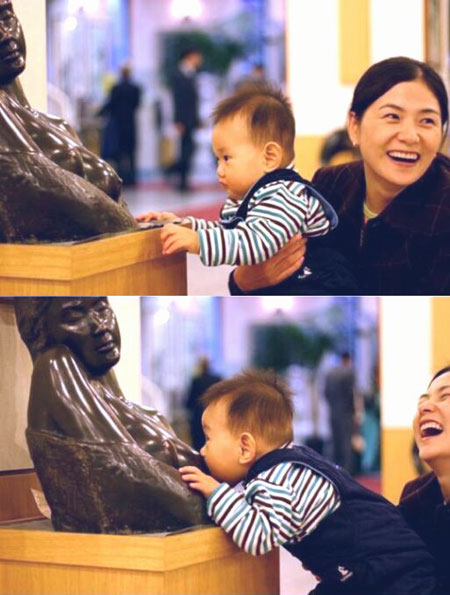
I found this image on the web, and tried to track down its origins, but couldn’t find them. Nevertheless, it’s one of the funniest images I’ve seen for a while. Not to mention, it acts as a great tribute to the sculptor, to be able to fool an expert on such things.

Babyandstatue

Categories: The Lighter Side Tags: by

No Links for the Time Being, Please

May 1st, 2006 1 comment

Just a note: the current spam attack is prolonged enough that I’m getting tired of moderating the few that get through the blog’s usual defenses. So, for the moment, I’m setting the blocking software so that active links cannot be posted in comments–that is, you can’t use the “a href” tag. You can, of course, simply paste URLs in comments without the link tags, so they don’t become a link. I’ll set it back to accepting active HTML links when the spam attack dies off. Thanks for your patience.

Categories: BlogTech Tags: by

Nothing New, So They Recycle

May 1st, 2006 Comments off

You may recall a few months back when the media was sizzling with reports that Mac viruses were on the loose, and that the Mac OS was no longer secure. These reports turned out to be bogus; there were no viruses, and the malware that was found was harmless. As I promised, I have been keeping an eye out for reports of any actual malware, anything that could conceivably be a threat in real life, so I could give the word here that it was time to buy anti-virus software.

Today, reports are surfacing of a Mac virus that can damage your system; lots of media outlets are carrying it. They report that this one user named Benjamin Daines clicked on some links and caught a virus–on his Mac! Gasp! The AP article gives no date for Daines’ perilous encounter, so it sounds like it happened just now, and it sounds like a completely new viral outbreak.

Of course, it’s not. Daines was the same guy who reported the first “virus” back in mid-February, and the tale told in the new AP story is simply the same old story from before, warmed up and made to look like something new. In fact, if you look at the page where the trojan (not virus) was released (don’t worry, the offending link was removed, the thread just shows people reacting to it), you’ll notice that Daines was not even the first to notice it–he was the third.

As I’ve pointed out repeatedly, it’s not a virus–it’s a trojan, which depends on something called “social engineering” to propagate. Essentially, that means that the malware does not penetrate any security holes, but instead tricks the user into allowing the malware in. It’s like the difference between a home intruder breaking in by evading the house’s security system vs. an intruder tricking the occupant to let them in the front door. If you let the intruder in past the security defenses, you can’t put the blame on the defenses. Since no security system can possibly protect against social engineering, it is ridiculous to use such an example–even one as lame and harmless as the one Daines fell for–to claim that the Mac OS security is vulnerable. No computer can protect against the gullibility of the user. If you’re a Mac user and you think that you can do any stupid thing you like and never get harmed, then you’re gonna get burned. But it won’t be the Mac’s fault, it’ll be yours.

The real test will come when a true, self-propogating virus comes about, one that does not require active user intervention to allow access to your computer. Such a thing, as yet, does not exist for the Mac. It is possible, but not as likely or as easy as it would be for the Windows environment. So, despite alarmist stories in the media, you still don’t need anti-virus software for the Mac. You might, someday, so it might not be a bad idea to make a daily check at MacRumors.com, where news of any such outbreak will be reported, with far more reliable commentary and analysis to reveal the true threat to your Mac, if there is any threat.

Categories: Mac News Tags: by

Bush Truths vs. Clinton Myths

May 1st, 2006 Comments off

Just yesterday I mentioned the oft-repeated myth that Osama bin Laden was served up to Clinton on a silver platter, and Clinton intentionally set bin Laden free to wreak havoc upon the world. I reviewed the debunking of this tired lie in this blog entry; go and read it.

The irony here is that while conservatives often dredge up the Clinton/bin Laden fabrication as a way of blaming Clinton for 9/11 so Bush seems without fault, recent revelations regarding Bush’s past actions actually show that Bush in fact did let a major terror suspect go free when it had the ability to nail him.

In the buildup to the invasion of Iraq, one of the key arguments the Bush administration used was that Saddam Hussein was in bed with terrorists, and the evidence of this was that Abu Musab al-Zarqawi, the head of al Qaeda in Iraq, was operating within Iraqi borders. The administration claimed that Zarqawi was wounded and then treated in a hospital run by Uday Hussein. However,

A CIA report in late 2004 concluded that it had no evidence Saddam’s government was involved or aware of this medical treatment, and that “There’s no conclusive evidence the Saddam Hussein regime had harbored Zarqawi.” One U.S. official summarized the report: “The evidence is that Saddam never gave Zarqawi anything.” [Source]

In addition, Zarqawi allegedly operated in an area of Iraq not controlled by Hussein; there is no evidence that Hussein had any control over or connection to the man.

But now, evidence is emerging to support a claim made in 2004 that Bush was given specific intelligence on Zarqawi’s location, and that not once, but several times, he had opportunities to have Zarqawi taken down before the invasion of Iraq–but Bush refused to do so. The only plausible reason Bush would conceivably refuse to remove Zarqawi would be that he was more valuable as a propaganda tool for Bush than he would be dead. In other words, Bush refused to take out Zarqawi so he could maintain a fake reason to invade Iraq.

According to the CIA agent heading up the section in charge of bin Laden and al Qaeda,

“Almost every day we sent a package to the White House that had overhead imagery of the house he was staying in. It was a terrorist training camp . . . experimenting with ricin and anthrax . . . any collateral damage there would have been terrorists.”

According to this agent, the reason Bush declined was because he was “wining and dining” the French, and didn’t want the U.S. to look like “gunslingers.” Naturally, this excuse is not being taken as very credible–but the revelation that Bush knew for a long time where Zarqawi lived and refused to take him out, that is being taken quite seriously, excuse or no.

Categories: Iraq News, Political Ranting Tags: by

Inventing the “Invented” Myth

April 30th, 2006 Comments off

Let’s get one thing straight: Al Gore never said that he “invented the Internet.”

There are a lot of myths out there perpetrated by conservatives. For example, the myth that Bill Clinton passed up an opportunity to bag Osama bin Laden, or the huge myth of the “liberal media.” Conservatives are excellent at starting and perpetuating these myths, which are believed by uncounted millions despite frequent and public debunking. The “invented the Internet” myth is perhaps one of the most pervasive; people still believe that election-campaign lie today.

This one started on March 9th, 1999, when Al Gore appeared on Wolf Blitzer’s “Late Edition” show on CNN. On the program, Gore made the following statement:

During my service in the United States Congress, I took the initiative in creating the Internet. I took the initiative in moving forward a whole range of initiatives that have proven to be important to our country’s economic growth and environmental protection, improvements in our educational system. [the full context of the quote in the interview can be reviewed here.]

I suppose I should say that it didn’t “start” with that quote, as the quote itself was reasonable–if poorly worded–and drew no reaction at all from Blitzer in the interview. Perhaps Blitzer was aware of the fact that Gore, since 1988, had written and championed legislation that helped establish the Internet beyond the government-and-academia DARPANet origins that began back in 1969.

An unkind (and dishonest) interpretation of Gore’s quote makes it seem like Gore was claiming that he single-handedly created the Internet. But that’s not what he said. He said that he took the initiative, that he took an early leadership role–which, by definition, means that he was not alone in the task, nor does it even mean that he was the only leader.

No, the real mythmaking started two days later on March 11. One technology columnist, Declan McCullagh of Wired News, wrote a story–highly inaccurate, at that–in which he spun the distortion, though he did accurately quote Gore’s statement–he just changed the evident meaning of Gore’s statement. He also got the facts wrong, quoting a conservative technology think tank as saying, “Gore played no positive role in the decisions that led to the creation of the Internet as it now exists — that is, in the opening of the Internet to commercial traffic.” However, the Information Infrastructure and Technology Act of 1992 did exactly that, with Gore behind it, along with several other initiatives that indeed helped to create the Internet as we know it today.

The GOP, just a few days after Gore announced his candidacy for president, wasted no time in picking up the ball; then-House Majority Leader Dick Armey (R-Texas) said:

“If the Vice President created the Internet then I created the Interstate highway system. Both were begun during the Eisenhower Administration and I think Ike actually deserves a little credit here.

“It’s common in Washington to steal an idea and claim it was yours all along. This strategy certainly worked for the Administration on welfare reform and tax cuts. But claiming credit for the Internet insults its real creators whose hard work and ingenuity can never be stolen.”

Note that in reporting on Armey’s statement, McCullagh first used the word “invent” to describe Gore’s statement, though he later denied this.

Upon this foundation, everybody in the media picked up on the distortion, to the point where I have even heard people claim that they heard a sound file of Gore himself saying “I invented the Internet.” [For those of you interested, here is a sound clip of the real statement by Gore.]

A good characterization of how Gore’s quote was intentionally skewed comes from Snopes:

If President Eisenhower had said in the mid-1960s that he, while president, “took the initiative in creating the Interstate Highway System,” he would not have been the subject of dozens and dozens of editorials lampooning him for claiming he “invented” the concept of highways or implying that he personally went out and dug ditches across the country to help build the roadway. Everyone would have understood that Ike meant he was a driving force behind the legislation that created the highway system, and this was the very same concept Al Gore was expressing about himself with his Internet statement.

The irony here is that Gore, in fact, was instrumental to the creation and popularization of the Internet as we know it today. Espousing research and funding for high speed networks as early as the 1970’s, Gore was active in putting forth legislation and otherwise popularizing the technology, culminating in the 1991 passage of the National High-Performance Computer Technology Act, otherwise known as the “Gore Act,” which funded, among other things, the first browsers. The fact is, all along the way, Gore was a strong proponent of the growth of the Internet, which in itself was largely responsible for the huge economic boom of the 90’s. Ironically, conservatives who enthusiastically credited Reagan with every bit of good economic news in the 80’s, churlishly denied Clinton and Gore any credit for the boom of the 90’s, claiming that it was the Internet that was responsible.

Gore was instrumental in creating a huge economic and industrial miracle worth countless trillions of dollars to the nation. In return for this, the GOP distorted his rightful claim, mocked him as a liar and made a laughingstock out of him. In an election won by only a few hundred votes, the value of the “invented the Internet” lie could easily have been worth that many votes in Florida.

Good to see that the GOP’s priorities are in order.

For the final word on Gore’s credit for taking a leadership role in the establishment of the Internet, read this letter praising Gore’s work, sent to Declan McCullagh from two guys named Robert Kahn and Vinton Cerf, more commonly known as the founding fathers of the Internet. The letter included the following:

Al Gore was the first political leader to recognize the importance of the Internet and to promote and support its development.

No one person or even small group of persons exclusively “invented” the Internet. It is the result of many years of ongoing collaboration among people in government and the university community. But as the two people who designed the basic architecture and the core protocols that make the Internet work, we would like to acknowledge VP Gore’s contributions as a Congressman, Senator and as Vice President. No other elected official, to our knowledge, has made a greater contribution over a longer period of time.

Last year the Vice President made a straightforward statement on his role. He said: “During my service in the United States Congress I took the initiative in creating the Internet.” We don’t think, as some people have argued, that Gore intended to claim he “invented” the Internet. Moreover, there is no question in our minds that while serving as Senator, Gore’s initiatives had a significant and beneficial effect on the still-evolving Internet. The fact of the matter is that Gore was talking about and promoting the Internet long before most people were listening. We feel it is timely to offer our perspective. …

[There follows a laundry list of Gore’s activities which helped to establish the Internet as we know it today.]

No one in public life has been more intellectually engaged in helping to create the climate for a thriving Internet than the Vice President. Gore has been a clear champion of this effort, both in the councils of government and with the public at large.

The Vice President deserves credit for his early recognition of the value of high speed computing and communication and for his long-term and consistent articulation of the potential value of the Internet to American citizens and industry and, indeed, to the rest of the world.

Spam Weeks

April 29th, 2006 Comments off

Total406Spam-1

So I started to see quite a few comment spam slip through the blacklists and get into moderation. Not too many, between 4 and 6 a day, but much more than usual. I wondered if it was due to some spammer figuring out a way past the blocking software, so I checked the numbers, and found that instead it was simply due to brute force. I quickly punched out the chart above, tracking numbers for the past 18 days (since I last purged my spam lists). On the chart, the black line is the total spam (including trackback spam); the blue line shows the number blocked by MT Blacklist, and the red line shows the ones blocked by SpamLookup. SpamLookup tends to block mostly trackback spam, about 95% of what it gets, whereas MT Blacklist gets the comment spam.

You can see that for the first week, it was going pretty much as it has been since I checked the numbers last August, just depositing a few hundred spam per day. Then there was a sudden spike on the 18th, and a more steady attack pattern after the 23rd. Considering that only 4-6 spam get through to moderation among floods of almost 2000 a day, that’s not bad–a block rate of up to 99.7%. And, of course, not a single one gets through moderation.

This made me think back to the days before mass comment spam. I installed MT Blacklist in December 2003, a little more than two years ago, because one spammer posted 50 comment spams on my site. Back then, 50 in one day was massive, the first time that sort of thing ever happened. And just four months previous to that, I got my first comment spam ever, a single comment, just a month after I started daily blogging. Now, just a few years later, 300 comment spams and 100 trackback spams per day is low traffic. Thank god that the vast majority of it gets filtered out in the background…

Categories: BlogTech Tags: by

Japanese Jury Duty

April 29th, 2006 Comments off

Although this was decided back in May 2004, I hadn’t heard of it until now. Starting in 2009, Japan will change criminal court proceedings to a jury system–or, more accurately, a joint-judge-and-jury system.

I remember having trouble explaining juries to my students, as Japan has not practiced that system much since WWII. In Japan, court cases are usually decided by a panel of three judges–but public trust in that system is marred by police and prosecutorial misconduct, shown up over the past few decades by exoneration of many who were convicted under false confessions.

Back in the 80’s, when Japan was the meteoric star of the world and America was trying to emulate it, a lot of attention was paid to the criminal justice system. Politicians from the U.S. would visit Japan to study how the police and courts worked. Japan, after all, had a superb record of catching criminals and successfully prosecuting them. Japan’s arrest rate used to be as high as 70% (higher for serious crimes), and the conviction rate has been as high as a ridiculous 99.97%.

Part of the arrest rate comes from the fact that the police have been known to select which cases to even report–many foreign residents in Japan tell stories of police refusing to allow victims to file official complaints for crimes ranging from robbery to rape, instead told by police that it’s unlikely the perpetrator could be found, so don’t bother. Another aspect of the high arrest rate comes from rather strong police powers–one can be held by the police for up to 23 days without charges being filed, bail, or even an attorney, and false confessions are said to be numerous.

The high conviction rate stems, so it is said, from both prosecutors being highly selective about which cases to prosecute, and from the fact that judges tend to treat indictments by prosecutors with great respect, treating them almost as the equivalent of an assuredness of guilt. One case of a British national convicted on drug charges pointed out that the judge who presided over the case had not given a single “not guilty” ruling in at least ten years.

Apparently, the new jury system is a reaction to these problems, as well as a reaction to the fact that Japan’s crime rate has risen dramatically since the early 90’s, when the economic bubble burst.

The new system, explained in almost child-accessible terms here (pdf file) by the Ministry of Justice, will not exactly do away with the current 3-judge panel; instead, six layman jurors will be added to the mix, sitting alongside the professional judges. A majority will decide the case, presumably a 5-4 majority of judges and jurors. Defendants will not have a choice between the new and old systems–only the new system will be available, for most crimes that is.

I became aware of this news by reading in Crisscross News (a English-language Japan news-and-discussion site, which I will not link to as these links die very quickly) story that reported the results of a survey on jury duty. Apparently, about 60% of Japanese people are not at all pleased with the idea that they might be pressed into service, with 33% being strongly against the idea. This is actually an improvement–a year ago, 70% said they didn’t want to become jurors. Most said that it would be too difficult to judge, or that they didn’t want to have that responsibility. The new system will allow for people to duck jury duty, though it’s not clear what will be accepted as a reason for doing so. Jurors will also be paid, but it is not decided how much. I can’t find anything any sequestering or other details either.

Another problem Japan faces is the low number of lawyers; passing the bar in Japan is very difficult, with only 3% of applicants successfully doing so. This is in sharp contrast with the U.S., where there are far too many lawyers. Sadly, language difficulties rule out any hope of an export deal…

Categories: Focus on Japan 2006 Tags: by

1000 Days

April 29th, 2006 3 comments

That’s one milestone passed on the blogging road: I just blogged for the 1000th consecutive day. Started on August 2nd, 2003, and haven’t missed a day since. Sometimes it’s very hard to come up with something that feels worth writing about. Sometimes there are several things, and I blog about them all or choose which ones seem best. I try to make each day’s post more than just a quote or a one-line reference. Sometimes, as you may have noticed, I get carried away and write if not a book, then a novella perhaps, or at least it feels like that.

So the question is, how long can I keep this up? I mean, it’s become a real thing, now. I’ll get back to you the next time a significant milestone comes along, I guess.

Categories: BlogTech Tags: by

The Sincerity of Republicans on the Environment

April 28th, 2006 1 comment

Hastertsuv

Republican House Speaker Dennis Hastert held a press conference at a gas station in Washington D.C. today. He drove up in one of two hydrogen fuel cell vehicles. At the conference, he spoke about energy policy and showed off two clean-fuel vehicles, making a big deal about them. Hastert got back into one of the vehicles, and drove off. Suspicious of the direction Hastert drove off in, reporters followed him–and caught him switching vehicles, getting out of the hydrogen car and getting into a gas-guzzling SUV, so he could drive the few blocks back to the Capitol Building.

Categories: Political Ranting, The Lighter Side Tags: by

Internet Explorer 7: Browser Catchup

April 28th, 2006 1 comment

When you go to the web page on Microsoft’s site to download the public beta of IE7, there’s a big title in the middle of the page that reads “We Heard You.” Apparently, they forgot to add the word “Finally.” IE7 is nothing but browser catchup, a dollar short and many years too late. Microsoft has always relied on the fact that since they control the OS for 90%+ of the computers on the planet, and they put their own and only their own browser on the desktop, that a similar number of people will use IE for that reason and that reason only, which is why most people have used a browser so ancient, unsafe, and generally crappy.

But now, with Firefox finally taking a bite out of their market, they’ve gotten off their lazy asses and have begun to upgrade the browser to include many features that have existed on other browsers for several years now. And even with that, they can’t help but be snide about it: when you install the browser, IE demands that you acquiesce to having your copy of the Windows OS “validated.” You feel like you’re going into a movie theater and they want to check your bags for contraband Milk Duds. If you wanna use this browser, you gotta let Microsoft check your pockets first to see if you stole any of their other stuff. Real smooth.

The release is not fully stable–it crashed once soon after I started using it–but it does show that Microsoft paid attention to what the other browsers did well, and pretty much copied them outright. IE7 now has tabbed browsing, better security (so they claim), smaller toolbar/comtrol areas, RSS feeds, and finally–finally–they figured out how to print web pages without chopping off the right side of the content. You’ll recognize a lot of smaller features that you’re familiar with in Firefox or Safari, transplanted into IE7. But aside from a little redesigning, some eye candy, and a few small tweaks, there’s nothing much new here.

Unfortunately, a lot of people will ballyhoo this, and many will remain with IE because it’ll now be “as good as the other browsers.” The thing is, it’s taken 3-4 years for IE to catch up with other browsers, and it is just as likely to fall years behind again. Why reward Microsoft for being lazy and inattentive, and catching up by ripping off the competition years after the fact?

Just get Firefox.

Categories: Computers and the Internet Tags: by

…And Sometimes They Miss

April 28th, 2006 Comments off

This week’s South Park was a fairly big disappointment, save for a few small segments where Cartman eats and craps fake treasure. There has been some talk about the show’s right-wing tilt, but the past few weeks have shown it up pretty starkly. In the recent two-parter about showing Muhammad, the show skewered everyone, from terrorists to people afraid of terrorism, network executives, The Simpsons, Family Guy, reporters, car chases–hell, they criticized Comedy Central for not allowing them to show a cartoon of Muhammad, and even ripped on themselves for being too preachy at times. But in the hour-long episode which made fun of just about anything and everything, only one character with more than a few lines was kept reasonable: George Bush. What the hell? Probably the easiest person to make fun of, and they make him the only sane, stable, and unfunny character in the show. (Were they trying to be ironic?) Well, actually, they also didn’t make fun of manatees, but then, who could?

Now contrast to the show two weeks later, where Al Gore is shown as some lame, bizarre, psycho loser warning everyone of “Man-Bear-Pig,” and acting like some deranged kid who thinks he’s a superhero but is really screwing up. I kept waiting for the whole thing to have a point, a punch line, or a funny line, but it never did. If Man-Bear-Pig showed up when everyone thought it was imaginary and it was a take on global warming, I could see that. Or something, even if it totally trashed Gore, to make there be a reason for it, even if that reason was just to be funny. I can laugh at liberals as much as the next guy, but this was not witty or comical, even in a stupid way; it was just… weird. Like they put that in there not because they had something to laugh at, but instead just because they hated Gore’s guts. It was less like a regular South Park episode, and more like they got drunk and started to rant, thinking they were being funny when everybody just stares uncomfortably.

The show (and Parker and Stone’s movies) take on liberal celebrities often, as well as liberal causes, sometimes with a vicious slant. And usually, it’s done in a funny way. And while they do take on some conservative elements (big businesses, rednecks, right-to-lifers), they have rarely, if ever, skewered a right-wing politician or celebrity. The closest I can think of is Mel Gibson, who’s not so much political as religious (he’s never identified himself politically, and though he does have some conservative views, he also opposed the Iraq War and even praised Michael Moore for Fahrenheit 9/11).

Apparently Trey Parker is a Libertarian, and Stone is the one who steers the show against the left; he has said, “I hate conservatives, but I really fucking hate liberals.” It shows. Strangely, Parker categorizes both of them as centrists, “pretty middle-ground guys,” and Stone claims they take on “both sides.”

Don’t take me wrong–I love the show, no less when they rip on liberals, and you can’t take it seriously politically, or any other way, for that matter. The show where the people with butts where their faces should be turned out to be Ben Affleck’s parents, that was hilarious. But what I presume to be Stone’s utter contempt for liberalism does more than just tilt the show right, it sometimes comes out just bizarrely hateful without much to be funny about.

Categories: Media & Reviews, The Lighter Side Tags: by

Network Neutrality Loses Round

April 27th, 2006 Comments off

The House Energy and Commerce Committee voted on an amendment sponsored by Democratic representatives to a bill on Internet regulation that would have guaranteed equal access to all information on the Internet, The amendment was shot down 34-22, which was in some ways seen as a partial victory, as it was a slimmer margin of defeat than was expected; this means that support for the surrender of the Internet to the Telecom Giants might be slipping as public opposition to the idea, while late in coming, is growing rapidly. While some Democrats have voted for the Telecoms, the voting is split mostly among partisan lines, with the opposition to handing control to Telecoms coming from the Democratic side.

If you want to add your voice to public petitions that support Net Neutrality and oppose handing control to the Telecoms, you can sign petitions at MoveOn, Save The Internet, and Don’t Mess With The Web. Don’t Mess With The Web is a new site joining the fray, with a blog keeping track of current events on the issue.

This is important, people–losing this battle could seriously mess with your ability to access the sites you want to visit, especially sites that offer free access to content you like. It’ll hike your costs without giving you any increase in content or quality, and would give Telecoms the ability to censor or inhibit any voice they don’t favor, on the basis of money, prejudice or self-interest. It’s yet another multibillion-dollar giveaway to giant corporations with absolutely no benefit to the public. Get it stopped, now.

A Fox in the White House

April 27th, 2006 1 comment

It looks like they’re dropping all pretense and hiring Tony Snow, a Fox News host, as the new White House press secretary. Josh Marshall quipped that this was less like a job change and more like an interdepartmental transfer.

Media Matters has been tracking Snow and posting a long list of Snow’s errors, lies, and distortions (and then some more), including whoppers like Valerie Plame wasn’t covert, that Evolution is just as shaky as Intelligent Design, that Kerry blamed troops for errors made in Iraq when he was clearly blaming Bush, as well as many other lies smearing Democrats and trying to cover up for Bush administration malfeasance.

On the other hand, Snow hasn’t exactly been on Bush’s side all the time, and when he’s found himself to be in disagreement with Bush, he can be just as snotty, though predictably right-wing–he criticized Bush when Bush was not sufficiently hardcore enough for Snow’s tastes. He has called Bush “politically correct,” an “embarrassment,” “more eager to please than lead,” and has repeatedly criticized Bush for overspending.

So, this should be fun.

Categories: Political Ranting Tags: by

Neat

April 26th, 2006 Comments off

Here’s a cool story about how a whale apparently “thanked” a group of rescuers by playing with them after they freed her from a dangerous entanglement.

Categories: The Lighter Side Tags: by