On a Slow Network to China

August 24th, 2004 Comments off

I have just successfully logged on to the Internet here in Shanghai. Ken’s personal DSL has been switched off for the vacation season, and I got a scare that maybe blogging would be difficult, as you cannot put USB Flash or a CD-ROM into the computers at the Internet cafe–so I’d have to come to a hot, smoky room full of people playing video games, and uploading photos would be impossible.

But fortunately, the people here are incredibly nice–and they allowed me to hook up my Mac (a platform apparently rare in China) directly to their network, with a tech guy typing in the IP addresses and everything. Got on the network no problem–and now I can upload a blog entry typed offline earlier in the day, as well as upload photos and check on my email accounts using Eudora, again for offline consideration if I want.

The lady in charge, a Ms. Ke (pronounced “Kuh”) just came over, and in her best English, welcomed me to the cafe and expressed a hope that I’d come every night–a definite possibility, especially if the Starbucks WiFi does not work out (and the closest Starbucks that has WiFi is an hour by train and bus each way, so…).

Still, the network here is slow. Ken tells me that any DSL around here can be relatively glacial (definitely much less than a megabit), and this cafe spreads the connection between a few dozen people. Just getting my email took ten minutes (though that was padded out by more than a hundred spam). That means that photo uploads from here may be pretty slow, so for the time being I can only append a precious few each time. I’ll post more when I get back to Tokyo.


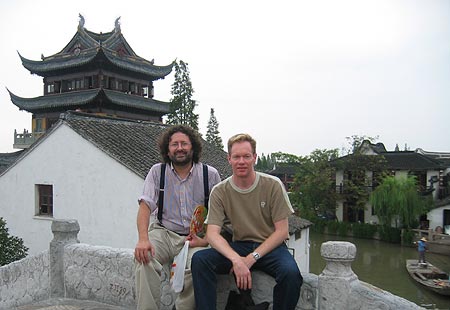
Ken and I in Qingpu Village today.

Categories: BlogTech, Travel Tags: by

First Night in Shanghai

August 23rd, 2004 Comments off

Got into Pu Dong Airport somewhat late last night, partly because it was a late flight, and partly because the flight was delayed. My friend Ken, who’s putting me up in his spare bed and acting as my tour guide for the week, was patiently waiting as I came in at 9:30, and was even more patient as I got in a long line to change money. I had tried changing yen to Yuan in Tachikawa Citibank back in Japan, but they couldn’t do it. No problem, I though, I’ll change it in Narita, plenty of time. But at Narita, they couldn’t change to Yuan either. I’m thinking maybe it’s some political thing, some monetary restriction due to friction somewhere, something like that. Either way, it got me worried–if I didn’t get Yuan at Pu Dong Airport, I was afraid I’d never get it at all.

But my worries were unfounded–the airport bank clerk said I could change yen to yuan in town, but still, it was good to get local money in my pocket. And I really have to get used to the local currency–8 Yuan to the dollar, roughly. And the biggest denomination is 100 Yuan, or about $12. Makes for a big stack if you’re carrying hundreds of dollars.

In addition, many things are dirt cheap here. After getting into town by bus (Y18, $1.50), we had dinner at a small noodle place (beef noodles with a licorice-flavored broth!), and then as it was raining and taking the train/bus/walk would be a hassle, I agreed to spring for the taxi ride–which took more than half an hour. That kind of taxi ride would cost easily ¥5000 in Japan, or about $45, but here it was just 100 Yuan, or about $12, or not too much more than I pay for the 4-minute taxi ride from my apartment to the local train station in Japan.

On the way in, we had the driver stop so I could jump out and get some water, and Ken asked me to get a few “cold ones” for him. I thought he meant beer. He meant water, but I got enough of that too (trying to avoid tap water here as much as I can). But the beers were pretty cheap, 6 Yuan (75 cents?) for a 640 ml bottle which would have cost 4 or 5 times more in Tokyo. I got a few smaller cans which I thought were beer, but wasn’t sure–they were in the same section of the cooler, but with a strange English brand name and the rest in Chinese, I could not identify them as beer. Until later, that is, when Ken pointed out that the brand name “REEB” was “beer” backwards. Ah. Okay.

No photos yet, but you can’t snap many at night (unless you wanted to see Ken slurping noodles). I’m not able to connect to the Internet just yet, and may not be able to today–it’s still tentative–but I’ve decided that if access is limited, then I’ll just blog offline, add the entries when I get a chance, and then backdate them to the right time and day.

In the meantime, I am in the relative lap of luxury in China–Ken’s place is in a dormitory for foreign teachers, and they get special amenities that most people here don’t, like hot water and air conditioning. Cool. Literally. ‘Cause outside it’s rather hot and humid.

Ken has made an arrangement with one of his students out in the countryside so that we can get shown around a small village on the outskirts of the city today–probably a big photo op as well as a nice time. The photos may have to wait, though–if I can’t eventually get to a Starbucks and make the WiFi connection work, then photos will be harder to upload.

Categories: Travel Tags: by

News Bits

August 22nd, 2004 Comments off

A few more tidbits before I fly off for China. I probably won’t be doing too much political commentary for the next week or so, unless I can get a good connection to the web at Starbucks (there are 39 in Shanghai–I shouldn’t be surprised) and can surf the web pretty well there. We’ll see.


Barak Obama is going to walk away with this one. Among all Illinois voters, he has a 40-point lead over Alan Keyes, dominating the polling 65-to-24. Obama has an overwhelming 96-to-3 lead over Keyes among black voters, and he even trumps out Keyes amongst moderate conservatives and those who consider themselves “fairly conservative.” Keyes’ only lead over Obama is among the “very conservative,” no surprise there–but even they only favor Keyes by 19%, or 55-to-36. When 36% of ultraconservatives go for the Democratic challenger, you know that you’re an outright loser.


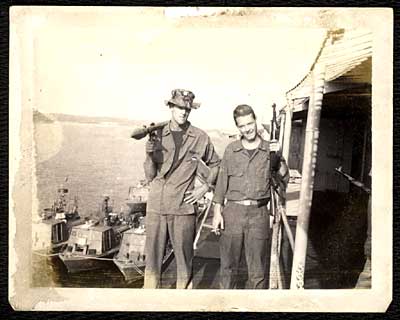
Kerry is getting even more support over the Swift Boat thing: William Rood (now a newspaper editor in Chicago) commanded a swiftboat alongside Kerry on February 28, 1969, when Kerry won the Silver Star. The Swift Boat Vets group attacking Kerry claimed that he exaggerated about what happened, but Rood tells a different story:

Kerry’s critics, armed with stories I know to be untrue, have charged that the accounts of what happened were overblown. The critics have taken pains to say they’re not trying to cast doubts on the merit of what others did, but their version of events has splashed doubt on all of us. It’s gotten harder and harder for those of us who were there to listen to accounts we know to be untrue, especially when they come from people who were not there.

…

Ambushes were a virtual certainty, and that day was no exception.

The difference was that Kerry, who had tactical command of that particular operation, had talked to Droz and me beforehand about not responding the way the boats usually did to an ambush.

We agreed that if we were not crippled by the initial volley and had a clear fix on the location of the ambush, we would turn directly into it, focusing the boats’ twin .50-caliber machine guns on the attackers and beaching the boats. We told our crews about the plan.

The Viet Cong in the area had come to expect that the heavily loaded boats would lumber on past an ambush, firing at the entrenched attackers, beaching upstream and putting troops ashore to sweep back down on the ambush site. Often, they were long gone by the time the troops got there.

The first time we took fire—the usual rockets and automatic weapons—Kerry ordered a “turn 90” and the three boats roared in on the ambush. It worked. We routed the ambush, killing three of the attackers. The troops, led by an Army adviser, jumped off the boats and began a sweep, which killed another half dozen VC, wounded or captured others and found weapons, blast masks and other supplies used to stage ambushes.

Meanwhile, Kerry ordered our boat to head upstream with his, leaving Droz’s boat at the first site.

It happened again, another ambush. And again, Kerry ordered the turn maneuver, and again it worked. As we headed for the riverbank, I remember seeing a loaded B-40 launcher pointed at the boats. It wasn’t fired as two men jumped up from their spider holes.

We called Droz’s boat up to assist us, and Kerry, followed by one member of his crew, jumped ashore and chased a VC behind a hooch—a thatched hut—maybe 15 yards inland from the ambush site. Some who were there that day recall the man being wounded as he ran. Neither I nor Jerry Leeds, our boat’s leading petty officer with whom I’ve checked my recollection of all these events, recalls that, which is no surprise. Recollections of those who go through experiences like that frequently differ.

With our troops involved in the sweep of the first ambush site, Richard Lamberson, a member of my crew, and I also went ashore to search the area. I was checking out the inside of the hooch when I heard gunfire nearby.

Not long after that, Kerry returned, reporting that he had killed the man he chased behind the hooch. He also had picked up a loaded B-40 rocket launcher, which we took back to our base in An Thoi after the operation.

John O’Neill, author of a highly critical account of Kerry’s Vietnam service, describes the man Kerry chased as a “teenager” in a “loincloth.” I have no idea how old the gunner Kerry chased that day was, but both Leeds and I recall that he was a grown man, dressed in the kind of garb the VC usually wore.

The man Kerry chased was not the “lone” attacker at that site, as O’Neill suggests. There were others who fled. There was also firing from the tree line well behind the spider holes and at one point, from the opposite riverbank as well. It was not the work of just one attacker.

Rood backs up Kerry’s story over O’Neil’s, and was in a position to do so. His story comes across as credible, not trying to give an omniscient I-saw-and-know-everything account, but rather a slightly removed view you would expect from someone being where he stood, with caveats and admissions of lack of knowledge. And yet, everything in the article confirms Kerry’s story, and punches yet more holes in O’Neil’s. (The Trib also has posted these photos.)


That’s not stopping the Swift Boat Vets Against Truth from continuing their attacks, however. A second ad is being aired, and this one is even more boldly false, showing video of Kerry on video, apparently accusing all vets of war crimes–when in fact, that video is edited, cutting out the part where Kerry explains that he is reading admissions by other soldiers of what they had done. Kerry is fighting back, not only showing up the lies and deception, but also pointing out the numerous ties between the Swift Boat Vets and the Bush administration, from the money ties to the direct support from the Bush campaign.

Like Bush’s outrageous attacks on John McCain in 2000 (you think John McCain would’ve just sat there for seven minutes?), these attacks on Kerry are having an effect in the polls–but the story is not over. As more and more honorable people come forward to defend Kerry, and as more and more of the SBV claims fall to tattered shreds, one can only hope that this will in some way backfire on Bush–but that is far from certain. Lying smears and nasty attacks all too often work. Had they not, we might have had President McCain, and things would have been a hell of a lot better than they are now.

Categories: Political Ranting Tags: by

The Great Iraqi Giveaway

August 22nd, 2004 Comments off

A month and a half ago, I reported that between one to four billion dollars had apparently been looted from Iraq.

Time for an update.

The figure is $8.8 billion. Maybe up to $13 billion now, I’m not sure if the previous stolen booty is included in the new total or not.

Well, at least now, it is. Far from acting fast and tightening up the cash drawer in Iraq, the Bush administration apparently just decided to allow the scope of the fraud to widen. Now it’s not just oil revenues, it’s billions paid to “Iraqi ministries,” though lord only knows where the money really went to. Read the current telling of the story.

And of course, what will the media focus on next week? Probably the Swift Boat Veterans thing again. Those guys are worth their weight in gold to the Bush administration, smearing Kerry like mad and diverting attention away from Bush’s corruption and scandal.

Categories: Political Ranting Tags: by

The Guy From Kojima Denki

August 21st, 2004 3 comments

So, as I mentioned in my previous writings on getting satellite TV, I had the people at the electronics store come over to check if I could get SkyPerfecTV. It’s in question because there’s a large building next to mine that might or might not be in the way–looking at SPTV’s web page with a map locater, it might be blocking the satellite by just a few feet in one direction. So I went to the electronics store and asked them if they could do a check. It’ll cost ¥2000 ($18), they said. I told them that was OK, better than going through the hassle of buying and only finding out then that I couldn’t do it.

Now, $18 is not a king’s ransom, but since they tell me they guy could figure out if I’m able to get reception, I figure the guy will come over with a little electronic doohickey that could measure the satellite signal strength or something. So I wait the few days for the guy to come. (“Between 2 and 5pm,” they said–and he came just at 5pm. Typical.) The doorbell rings, I open up, and this scrawny little guy walks in. No gizmos. He pulls out a compass. Goes to the window I show him. Climbs outside, holds up the compass, says I won’t be able to get the satellite signal–the next building is in the way. But in saying so, he points in a direction that seems fishy to me. I tell him there’s another window, and he takes that in surprise, like he wouldn’t expect a place to have two windows. He checks from the other window and says, “Oh yeah, sure, you can get it from here! No problem! It’s perfect.” This sounds great to me–except he’s now pointing in an even more westerly direction than before to indicate where the satellite is. He’s pointing in a much different direction that SPTV’s web site indicates–they say it’s more to the south.

So I take him inside and show him the SkyPerfecTV web site, I show him the map page with the arrows showing the direction of the satellite. He looks at it, and something seems to dawn on him. He goes back to the first window, looks at his compass again, and proclaims I can get the signal in that direction, the direction from the web page; reception will be OK, he promises. But the direction he shows me now is way off from the direction he showed me originally. So I question him about how he got that–and he starts talking faster, using words I don’t know.

Here is where I explain to him that he has taken no readings that could possibly be even as accurate as the measurement I made on SPTV’s web page, and so how could he really know if I could get it or not? Unsure how to answer, he leaves, makes a phone call, and comes back. “You can’t get reception,” he explains. “The next building is too tall.” Now it’s time for me to explain to him that I never expected to see over the building, but rather just to the east of it. Again, he’s unsure about it. He goes outside and makes another phone call. He comes back in and proclaims, “it’s too close to call.” Well, hell, I could’ve told him that! I paid ¥2000 to have this joker who knows less than I do to tell me what I already know? I would at least expect him to know the general area of the sky which the satellite is in.

Fortunately, when I called up Kojima and told them about the fiasco, they promised to refund my money. Problem is, I won’t have time to collect on that before I leave on vacation. Hopefully in early September, they’ll still remember me and agree to give the money back. But for now, I’m still just as much in the dark. I just can’t figure out why they think they can do that, charge ¥2000 to have a guy who doesn’t know a satellite from a skyscraper to tell you fairy tales. Hopefully their guy who installs the units will know just a bit more then this guy. What scares me is that he might be the same guy.

Categories: Focus on Japan 2004 Tags: by

The Assault on the Middle Class Continues

August 21st, 2004 1 comment

In their continued attack against the middle class, the GOP and President Bush ponder how they will institute a national sales tax, probably at around 25%. The anti-progressive tax would, in theory, replace the federal income tax, and would represent the greatest tax cut for the wealthy imaginable, a veritable Death Star for tax cuts for the rich. It would shift the tax burden squarely on the middle class and the poor.

Bush and the GOP are already spinning like mad, giving the new plan the name “Fair Tax” and claiming that it would make the middle class “invisible” to taxes. Invisible?? When you pay 25% extra on everything you buy? In addition to whatever state sales taxes you might pay?

The GOP stance is an absolute fraud, pure and simple. Wealthy people would be paying a miniscule proportion of their income for the tax–and would likely be rewarded immediately with big-ticket exemptions (under the guise of aiming those exemptions at the middle class, of course–SOP). The poor would find their tax burden skyrocketing, as just about everything they purchase would become about 25 % more expensive–including food, which for obvious reasons has always been exempt from state sales taxes. Everyone in the middle class would suffer similarly.

The idea has been so unpopular that Bush almost immediately flip-flopped on the issue, saying he didn’t want people to think he was raising taxes. No, we’ve got to get those tax hikes through in stealth mode.

This is a seriously bad idea–not just for the above reasons, but because it will target taxes at purchases, which will hurt sales and be poison to the economy. Japan instituted a 3% federal consumption tax back in 1989, and hiked it to 5% in 1997–and both times, their economy dragged, contributing to a decade-long recession.


On another front, the Bush administration, after losing four congressional votes on the issue, decided to use strict executive authority to enact their overtime overhaul. Republicans are trying to paint it as something that will just take overtime away from a few thousand wealthy people earning over $100,000 a year, and that a lot of other people will get more overtime. Few people getting overtime now believe this, however.

One thing is for certain: it’s not what the Bush administration wants you to think. First of all, how many people who make over $100,000 a year get time-and-a-half? Like the law that says that rich people have the right to sleep under bridges, one can only suspect that this is a false-front way of making it look like a burden only on the wealthy.

Workers earning less than $24,000 will be exempt, but that leaves a huge hole between $24K and $100K, occupied mostly by the middle class. Who in that hole will lose overtime? That’s the problem: the rules are torturously labyrinthine in that area, and even experts say they’re unclear. Some examples of people getting their overtime pay cut include “pharmacists, funeral directors, embalmers, journalists, financial services industry workers, insurance claims adjusters, human resource managers, management consultants, executive and administrative assistants, purchasing agents, registered or certified medical technologists, dental hygienists, physician assistants, accountants, chefs, athletic trainers with degrees or specialized training, computer system analysts, programmers and software engineers.” See the pattern? No? What, are you blind? Obviously the pay cut is aimed at.. er,… uh, whah?

And what if your job is not on that list? Does your pay get cut, or not? You’ll probably find out when your employer cuts your pay–the rules are so unclear that they say employers should determine who gets the cuts on a “case-by-case basis.”

Now, the claim is that this is intended to cut down on lawsuits concerning overtime pay, but this is doubtful: the vague and seemingly random targeting of the pay cuts will, in all likelihood, create countless more disputes and spark a tidal wave of suits. The real aim of the law, it would seem, will be to cut down on the chances of employees actually winning the overtime claims so many businesses despise.

The fact is, the rules confuse a great many people, but many distrust the new regs on the basis of its source–the anti-labor administration–and its backers, the people who pay the wages:

Monday’s change is the culmination of decades of lobbying by business groups representing retailers, restaurants, insurance companies, banks and others that have been hammered by workers’ overtime lawsuits, many of them successful.

I can relate to that. When I worked at a movie theater in college, my own employers withheld overtime pay, claiming they just didn’t have the money for it (businesses never ‘have the money’ to pay employees), and promising future redresses that of course never materialized. I sued them in small claims court, and won.

I would be willing to bet good money that far, far more than the 107,000 workers will lose overtime, and apart from savaging middle-class wage earner’s income, this stands as the first step of many to do away with overtime completely.

Add to this the refusal of conservatives to allow for even a mild increase in the minimum wage, and their incessant drive to give more, more, and even more tax cuts to the wealthy, and it becomes all too evident that the GOP is the friend of the wealthy only, and has nothing but contempt and abusive intent towards the poor and middle class.

Categories: Political Ranting Tags: by

Bits and Pieces, August 20, 2004

August 20th, 2004 Comments off

Iraq continues to be important for some, that is to say, the families of at least 20 people. George W. Bush may want us to forget about it until November, but the death toll is rising. 20 casualties in the past five days, double the death rate for coalition forces throughout the war.

This probably has something to do with the fact that the Iraqi soldiers that Bush wants us to believe are handling things–that’s what happens in sovereign nations, right?–are deserting by the hundreds. We point them to go into Najaf and kill their fellow Iraqis, and go figure, a lot of them are not extremely hip to the idea. And the powers that be don’t really want that known:

At an Iraqi national guard base near the border of Sadr City, the vast Baghdad slum that serves as al-Sadr’s support base and recruiting ground, 1st Sgt. Khalid Ali described the death threats he and other Iraqi troops have received from the Mahdi Army. …

But when Ali was asked about the number of guardsmen who have quit since al-Sadr’s latest uprising, U.S. Army 1st Lt. Vernon Sparkmon cut him off.

“Certain things, you can’t discuss,” Sparkmon told Ali. “If somebody asks that question, that’s, like, classified stuff.”

Oooookay. And by the way, “like”? “Stuff”? Has the military gone Valley Girl?


In the meantime, the Iraqi Olympic team, which Bush & Co. have been using as their poster boys for a happily-invaded Iraq, are not quite so happy about Bush using them for political gain. Apparently, Bush has been airing ads which say, “At this Olympics there will be two more free nations – and two fewer terrorist regimes.” The Iraqi athletes, however, do not feel the same way:

Speaking after winning their group stage at the Games in Greece, one player said he would take up arms against US troops in his country.

And the team attacked Mr Bush for running re-election campaign adverts featuring the Iraqi team.

“Iraq as a team does not want Mr Bush to use us for the presidential campaign,” said midfielder Salih Sadir. “He can find another way to advertise himself.”

Not exactly what Bush wants you to hear, but real nonetheless–and keep in mind, Bush & Co. want you to think that these were the most oppressed people under Saddam, and most grateful for U.S. liberation.


On another front, the Swift Boat Veterans for Smearing Kerry are not having that great a week. The New York Times and Washington Post (admittedly left-leaning publications, but hardly rags) have been tearing them to shreds. In short: the operation was funded by friends of Karl Rove and big-time GOP and Bush donors (most from Texas, wouldn’t ya know), and the claims made by the veterans are falling apart faster than you can say “smear campaign.” In case you need a scorecard, here’s one.

And at least for show, Kerry has condemned an ad run by MoveOn.org criticizing Bush’s record (no lies in them, BTW), but Bush still refuses to disavow the Swiftboat smear campaign. How long that can last, who knows–but when even Bill O’Reilly starts casting doubts, you know the case is weakening.

Another good-news point, Kerry has started hitting back hard against the attack ads. This is what he’s known to do late in his campaigns, not to let the other side get away with crap, and to fight back harder and harder. And it seems the time is ripe: Kerry is doing well in the polls, and has a huge electoral lead (Bush seems tied or slightly in the lead because his support is deep in some states, which is bad for him electorally); many say that the race is his to lose. Considering that Kerry got no post-convention bounce and that in the past two weeks has been outspent massively by Bush, this is a rather surprising, yet welcome, sign.


Other news: Oil is at $49 per barrel, perilously close to the psychologically critical $50 mark (some say $65 is not out of the question)–and a record high, and bad news for the economy. About 60 newspaper editors printed an “astroturf” (fake grass roots) form letter from Bush’s web site. A 55-year-old social studies teacher just wanted to see the president speak, but had her ticket ripped up in front of her face, because of a small Kerry/Edwards sticker on her blouse. See, she was a real security threat. Senator Ted Kennedy was “accidentally” put on a terror-alert list that prohibited him from flying, and despite repeated attempts to get Ridge to take his name off the list, the well-known Massachusetts senator was banned from flying for weeks. Yeah, an “accident.” Lots of al Qaeda terrorists named “Kennedy” are menacing the nation, I bet. Somebody in the Bush White House having fun, no doubt.

Categories: Main, Political Ranting Tags: by

Great Sunrise

August 19th, 2004 3 comments

I just happened to look out the window at the right time this morning and caught a fantastic sunrise. Five of the better shots are displayed below–but the size restrictions of a blog column make the photos too small to really appreciate. Click each one to see a larger (1000-pixel wide) version.


Note the blueish highlights underneath the red clouds.

Categories: Uncategorized Tags: by

Scoring Some Pimenton and Chorizo

August 19th, 2004 2 comments

As I’ve written before, I’ve been looking for a good source of pimenton, that lovely smoked hot paprika from Spain. And though it is very hard to find in Tokyo, I did find an importer who had some and was selling. It was, in fact, almost comically like a drug purchase.

I went to the importer’s office, which was really an apartment in a building in Kami-Meguro. It didn’t feel like a business at all, but like visiting someone’s home. When I was presented with the spice, it was not pre-packaged–it was put into a ziploc. And I almost laughed when they guy opened the baggie and invited me to take a taste. “Mmmm,” I thought. “Some good quality shit here. I’ll take half a kilo.” I swear, that’s how it came down. The illusion shattered when they gave me a printed receipt.

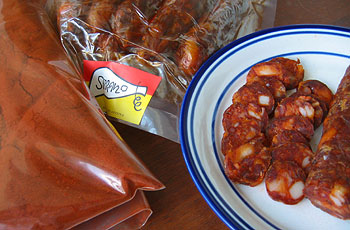
I’m not sure why they had to use the baggie, but it may have been because I wanted the picante, the hot pimenton, rather than the dulce, or “sweet.” Apparently most people in Japan who use the stuff prefer the sweet variety; the importer told me that when he makes chorizo, he uses the hot variety. Thus he probably was selling me his leftover “stash” from making chorizo. If I’d wanted dulce, they could have sold it to me in the bag from the maker, La Dalia.

And when he mentioned that he made chorizo, my ears perked up, and when I asked, he happily showed me the different kinds he made, proudly pointing out that there are no additives used in his product. In Spain, where he lived for five years, he says the chorizo usually is made with chemicals to preserve it. So I wound up buying a kilo of those (which was a lot more expensive than the pimenton). When I got home and tasted it, it was good, but not as good as other chorizo I’ve had. He may have varied the recipe to better suit Japanese tastes (though it is far, far closer to Spanish chorizo than the bland stuff they call “chorizo” in stores here), or the chorizo may have been intended more for cooking than for eating straight, which I prefer. I’ll be trying the chorizo in future cooking attempts, see how it works out.

In any case, if you want some pimenton at a reasonable price in Tokyo, try Mr. Hiroshi Ojima at Serrano–but call first (03-3713-2171) to see if he has what you want. If you want to know how to get there, drop a comment and ask for directions (leave an email address, masking it if you like with a URL; if you do that, the email address is secure. You can also ask me to immediately delete the comment as well).

Categories: Main Tags: by

Japanese TiVo?

August 18th, 2004 6 comments

Right now I’m considering switching from cable to satellite TV, but that’s not the main topic of this article. One piece of technology I’ve been waiting for is a TiVo-like easy-programmable device.

For those of you who don’t know about TiVo or its poor (but superior) cousin ReplayTV, these are hard-disk-based video recorders, belonging to a new category of home electronics, the “DVR” (Digital Video Recorder). Instead of saving recorded shows to VHS or even DVD, they save the video to a hard disk. The advantages are many: you can “pause” (“Time Slip” in Japanese) live TV while the digital recorder saves the ongoing programming into the hard drive; you can save up to a couple hundred hours of programming on the disk, no need to keep them on tapes and wonder what tape is free, what tape has what programming and other hassles; you can access any part of any recorded show very quickly; but best of all, the service usually includes an interactive program guide.

The program guide (called “EPG,” or “Electronic Program Guide” in Japan) is kind of the like the “what’s on” channel on cable TV in the U.S. On a grid displaying time horizontally and channels vertically, it allows you to access any part of the schedule. But with the HDD recorder, you can use that guide to program the recording of a show. For example, go to the program guide and find the “West Wing” slot, hit “program” and tell it how often, and your DVR will handle the recording of that show from then on–often including information such as episode title, summary, and whether or not it’s a repeat. My father uses this in the U.S., and I’ve been more than a little envious.

For me right now, well, I’ve got cable TV and pretty crappy cable at that. Not too many channels, and the channel can only be changed directly via the tuner. Which means that if I want to record a show, I not only have to set the VCR to tape the show, I also have to set the cable tuner to jump to that channel at that time. And aside from the extra work, the cable tuner is hard to program and de-program. Unlike a VCR which will only record from programming if switched off, the cable tuner will always switch to programmed presets, whether the tuner is on or off–which means that unless you de-program the cable box, it will skip to the programmed channel even if you’re watching another show. In short, it’s a huge hassle.

Hopefully, not any more, though. Toshiba now makes a machine (the RD-XS53) which, through a “control cable,” will control the satellite TV tuner as well as its own recorder functions. So like with TiVo or ReplayTV, you just have to go to the channel guide, choose a show, and then forget about it (you can also program the recorder from your PC). But it has some other very nice features as well: it can record two different shows simultaneously (so long as they don’t require the same tuner), and it has a built-in DVD-R/RW/RAM recorder, so you can save anywhere from 1 to 8 hours of programming on a single DVD-R (depending on the recording quality). So just leave the DVR to record a few months’ worth of shows, and for the ones you like, compile them on $3-a-pop DVD-Rs, which now cost about the same as, and record just as much as standard VHS tapes. You can watch these DVDs in your DVD player, or on your PC, if it has a DVD drive. Alas, it is not possible to directly put the video files on your PC, despite the network connection–copyright issues, I’m guessing. No biggie, though.

The major drawback, and possibly a deal-killer for me right now: the Toshiba machine costs ¥148,000 yen (about $1350). There is a lower-end model for ¥104,000 ($950), but it lacks the ability to mesh with SkyPerfecTV. For a while I thought the low-end model could do the satellite TV control, since the guy at Yodobashi and the sales guy at Toshiba both seemed to indicate that was possible when I asked about the two models together. But after my first call to Toshiba, I did more studying, noticed a small asterisk, and called again–and found out, sure enough, only the more expensive machine could do the satellite TV interface. Major difference there. The Toshiba guy was downright sheepish in admitting it to me.

So I might just go with the SkyPerfecTV for now and wait for the Toshiba models to get upgraded and priced down in 6 months or so. But it’s tempting, I have to admit.

One other problem for me, though–to get SkyPerfecTV, which is necessary for the cool programming features (not to mention far better programming than my local cable TV outfit), you need to have a line-of-sight to the satellite, which is relatively low in the southwestern sky–and there’s a building smack in the way from my apartment. However, at the east-most window ledge of my apartment, the SkyPerfecTV satellite map seems to indicate that I juuuuust might be able to peek around the building, just enough to catch the satellite. So, out goes the call to the local electronic shop’s technician, to tell me if I am go or not on the satellite.

And yes, I am a bit much of a couch potato and electronics geek, so no need to tell me so via comments.


Update: I went to Kojima Denki, and they had the high-end model on sale for ¥120,000 ($1090) or thereabouts. The actual standard selling price for the model is ¥135,000, but Yodobashi sells at suggested retail and “gives” you the extra hundred bucks on your point card, so you’ll spend it there. Kojima had it listed for 135, but with a kind of red writing diagonally over the price–which is an old Akihabara thing which means you ask the sales staff, they’ll tell you the real discount price.

120 Puts it back into my ballpark, but only if I feel extravagant… which I might, if I can get SkyPerfecTV.

Categories: Gadgets & Toys Tags: by

The Streets of Tokyo

August 17th, 2004 8 comments

Believe it or not, the street you see at right is a two-way street. Go ahead. Look at it. See if you can figure it out. And for perspective, that white truck parked in the back on the right, it’s a mini-truck, no wider than an American postal jeep. And even two of those would have a hard time passing each other on this street–and yet, I saw a good deal of opposing traffic pass here.

Every twenty or thirty meters, there is an indentation in the street (you can see it at left in this photo, behind the parked scooters; the orange posts mark it). When cars come from opposite directions, the car most conveniently placed to get into the indentation does so, while the car from the other direction squeezes by. I know, but somehow they do it. No wonder you don’t see Winnebagos in this country. Once I rented a truck to move my stuff from one apartment to another–and got stuck on a street wider than this one. When he saw the trouble I was having, the driver of the car going the other way actually got out and volunteered to drive the truck down the street for me while his friend maneuvered his car. Embarrassing, but I couldn’t have made it otherwise–it takes real driving talent.

You might also notice the slight crook in the street in the photo here. Japanese streets are, more often than not, go in all directions; it is less common for them to be laid out in grids. And even those grids are more often than not irregular, with greatly differing block lengths, and tons of T-intersections, one-way streets, and dead-ends. But most streets seem to tilt and angle without any hint of planning or design, like they just grew there. And with no street names (except for large boulevards), no street signs (except for major intersections), and a confusing jumble of block numbers and area names, navigation can be extremely confusing. Take, for example, the sign shown at left. That’s what the intersection looked like, honestly.

Add to that the fact that some neighborhoods are designed with one-way streets and prohibited turns such that it is impossible to exit save by one labyrinthine path; that streets are rarely more than two lanes in one direction, and usually not that; that sidewalks are sparse and properties have six-foot walls along the street, creating blind corners galore; and despite the expenses and difficulties of driving, multitudes seem to have cars, creating traffic jams all over; and top it off with scant parking, some pay parking lots charging a few dollars an hour… I am constantly amazed that people drive cars in Japan.

Oh, and gas runs about $4 per gallon.

Categories: Focus on Japan 2004 Tags: by

The Content of Their Character

August 16th, 2004 8 comments

“I have a dream that my four little children will one day live in a nation where they will not be judged by the color of their skin but by the content of their character.”

–Dr. Martin Luther King, Jr., Aug. 28, 1963

Look up that quote in a search engine and at the top of the list you will not see sites that have a full transcript of the speech, but rather a majority of conservative sites arguing against Affirmative Action.

And quite frankly, I am sick of hearing conservatives use the famous Dr. King quote to attack Affirmative Action. It is a disingenuous and dishonest attack. The right-wing claim is that since it judges people by the color of their skin, it is in itself discriminatory and hypocritical. Here is just one example:

Affirmative action is the 100% polar opposite of King’s dream. Affirmative action judges individuals based only on the color of one’s skin and certainly not by the content of their character, their achievements, qualifications or anything else. Affirmative action is a step backwards by justifying the very racism it was established to thwart.

There is no doubt about it: affirmative action creates discrimination. Those who argue for a color-blind society while supporting affirmative action are presenting a hypocritical belief. It appears that supporters of affirmative action are comfortable with discrimination, provided it is directed towards white men.

The rather glaring flaw in this argument–like in almost all conservative arguments against “Affirmative Action”–is that it completely ignores the constant presence of racial discrimination by whites against minorities. By conveniently disregarding any preexisting racial bias and treating what they call “Affirmative Action” in a vacuum, they make the case that since things such as quotas use ethnicity to decide immediate favor, it is racist and therefore hypocritical coming from those who state that they oppose racial discrimination.

What conservatives ignore, of course, is that quotas (which is what we’re really talking about here, not Affirmative Action; see this post) are a reaction, not an action purely unto themselves. To address a reaction and yet fully ignore the action which prompted it is nonsensical.

Imagine that a conservative Japanese person argued that America was wrong because it attacked Japan during WWII, killing millions of Japanese people and conquering the country. What would an American say in reaction to that? Naturally, the reply would be, “you attacked us.” Taken out of context, an American invasion of Japan seems unjustified. Add the component that the Japanese attacked first, and there’s your justification.

But in the conservative argument against quotas, the initial action is removed from the equation, making it seem unjustified. Additionally, the claim will be made that the liberal ideology precludes the idea of taking action based on ethnicity. This is true only if there is no justification; in the context of quotas, where there is a preexisting discrimination that must be redressed, the conservative claim is utterly false. If that were not the case, then America could have been justifiably criticized for entering WWII.

Dr. King’s statement about his dream of how people should be judged is a hope for the future nature of society free of racism, not for the nature of redress in a society filled with discrimination. King was calling for the end of racial discrimination, not for the end of redress in a discriminatory society. In a society without racial discrimination, quotas would indeed be a wrong thing. Today, they are not.


Recommended reading: Rush, Quotas, and the Discriminatory Double Standard, which explains the nature of Affirmative Action and quotas and their differences, why they are justified, and how they are unfairly attacked.

Categories: Political Ranting Tags: by

Outages

August 16th, 2004 1 comment

My apologies for this site not being available over much of the past day. I am seriously beginning to think about looking for a new web host. First was Surpass Hosting’s major outage of a month or two ago–I got away with only 8 hours off the air, but some were knocked off for days. Just a bit more than a week ago they lost an entire domain of mine (not blogd, but another one), taking up to a day to get it back.

And then yesterday, they were knocked out by the hurricane–but it has become apparent that this was not necessary. They advertise redundant power supply, but claim it malfunctioned. And then, for some reason, that they had to take all the servers off line for three hours to do something else… and now (I am writing this during the blackout, you are seeing this many hours later) the site has been knocked out yet again, for several hours now–and they are still blaming it on the hurricane. Even though other web hosts in Orlando, also hit by the hurricane, managed to stay on line without any problems. I don’t know… I’ll probably give them one more chance, but I’m this close….

In the meantime, anyone know a good web host?

Categories: BlogTech Tags: by

Fahrenheit 9/11 DVD Release Date Set; Pre-Order Available

August 15th, 2004 Comments off

As Moore’s film nears the $150 million mark (domestic and overseas), its position at the box office has fallen enough (making only a few million dollars a week, in only 700+ theaters now) so that the DVD release can be announced. So the release date has been set for October 5th–still giving the film enough time to make several million more at the box office, but coming out on video almost a month before the November 2 elections.

That is clearly in line with Moore’s intentions to get as many people as possible to see the film. And since DVD sales often outpace box office sales, it is likely a lot of people will be getting the DVD.

If you’re one of those people, Amazon.com is your likely shop of choice; Fahrenheit 9/11 is available for pre-order, for $19. The DVD will include: “The Release of Fahrenheit 9/11” featurette, a montage of the people of Iraq on the eve of invasion, Homeland security: Miami style, Outside Abu Ghraib Prison, Eyewitness account from Samara, Iraq, More with Abdul Henderson, Lila Lipscomb at the Washington, D.C. premiere, Arab-American comedians’ acts and experiences after 9/11, Condoleezza Rice’s 9/11 Commission testimony, and the Rose Garden press briefing after 9/11 Commission appearance.

The film, by the way, has been shunned by the supposedly non-partisan military establishment. The film is not showing in theaters on U.S. bases, despite the fact that every other film that makes so much money is quickly snapped up. The claim is that it was “too late” to put it into military theaters, among a host of other phony reasons, but the fact is that Lion’s Gate made the film available from the beginning. It is not surprising, considering that the same people, in a “balanced” way, program Rush Limbaugh, Dr. Laura and Paul Harvey, but no liberal counterweight, on the armed forces network. The claim there is that they only broadcast “the most popular” radio shows. But not the most popular movies, which happen not to be in line with right-wing standards? Please.

I was hoping to write Part II of my review of the film after seeing it again yesterday, but since it was massively sold out, I’ll have to refer to alternate sources to finish it; hopefully I’ll have it ready in the next few days.

Categories: Media & Reviews Tags: by

Fahrenheit 9/11 in Japan: Sold Out

August 14th, 2004 Comments off

The day’s tickets, sold out by noon.

Well, I wanted to see F-9/11 again today, and planned to go with a colleague from school. It was playing today at the Ebisu Garden Cinemas, on both screens. My colleague and I agreed to meet at the theater at 2:30 so we could see the 3:10 show. But when I went, I figured I would be smart: I would get there at 2:00, a half hour early, so I could be sure to get a ticket.

Well, you can guess what happened. I was too late. By about four hours. Apparently, when the tickets went on sale at 9:30 am, there was already a big line, which eventually stretched out to longer than a city block. The whole day’s tickets were already sold out before noon, and the tickets to the 3:10 show were gone well before that. Lauren Shannon, who went very early to get tickets for the 11:30 show, couldn’t get anything before the 3:10 show, and eventually wound up giving her tickets to a couple who came all the way from Chiba and found the day sold out.

It may be the first day, a special showing and all–but the fact that so many people came, so early, and some from so far away, are all suggestions that this film will be a very big hit in Japan. Already this film has grossed $114 million in the U.S. and $32 million overseas as of a week ago–with Japan it will without doubt break the $150 million mark–and it still hasn’t been released in Russia, Italy, Greece, Scandinavia, and a dozen other countries; receipts from Mexico, Egypt, Switzerland and a dozen more have still not been tabulated into that total. And then there will be DVD sales, often matching or exceeding domestic ticket sales. For a documentary, this is beyond extraordinary.

And the audiences are… sometimes interesting, as evidenced below. As many of us sat outside (having arrived early, I was waiting for my colleague, and others were taking care of a get-out-the-vote drive), we noticed two gentlemen in robes–clearly monks–talking to reporters outside the entrance. I would’ve loved to know what they were saying about the film…

Categories: 9/11 News, Media & Reviews Tags: by

Hurricane Outage

August 14th, 2004 Comments off

This site was down for a few hours just until now. The cause was Hurricane Charley hitting Orlando, Florida, where this site’s data center is located. Hopefully, we’ll be up continuously from now.

Categories: BlogTech Tags: by

In Case There Was Any Doubt

August 13th, 2004 3 comments

President Bush’s tax cuts have transferred the federal tax burden from the richest Americans to middle-class families, with one-third of them benefiting people with the top 1 percent of income, according to a government report cited in newspapers on Friday. (from Reuters: Bush Tax Cuts Heavily Favor Rich, CBO Says)

The report says that the top 1% of earners, with an annual income of about $1.2 million, will get a tax cut of $78,460, while the middle 20%, averaging a $57,000 income, will get $1,090.

The tax cuts for the top 1% represents a 6.5% cut, while the cut for the middle 20% is just 1.9%–less than a third of what the rich are getting. This is not just a disparate tax cut, it is an insult, considering the already unfair tax burden between the wealthy and the middle class.

Bush claims that rich people should get a bigger tax cut because “they pay more,” and because it is “fair.” But this claim is, of course, outside the concept of the progressive tax system, under which the idea is that the wealthy should pay more. Why? Because first, they can afford it more, and second–and most importantly–they owe more because it is the American system that allowed them to gain that wealth in the first place.

Instead, the wealthy are paying less than their fair share, even by non-progressive standards, and the gap is even wider than it appears because rising costs in fuel, slashes in federal programs and local government funding, as well as falling wages for middle-class earners–what could be called “Bush’s hidden tax hikes”–all hit the middle class hard while leaving the wealthy relatively unaffected.

And there’s even more bad news: “taxpayers whose incomes range from $51,500 to around $75,600, saw their share of federal tax payments increase” [emphasis mine]. Whereas two-thirds of Bush’s tax cuts went to the wealthiest 20%, or those making over $203,740.

On the “fairness” issue: it is markedly out of context. Wealthy people have been getting the lion’s share of tax breaks, not to mention the biggest tax breaks, for the past quarter century, while the overall tax burden for the middle class has risen. Only income and capital gains taxes have come down–the two tax areas which wealthy people pay most into. State and local taxes, as well as payroll taxes, which hit the poor and middle class most, have risen in past decades.

But wait, Bush will tell you–“the wealthiest 5% of Americans pay 38.4% of federal taxes! That’s not fair!” This is the distortion fed to the American public to make them accept the tax cuts. But is it true?

No, it isn’t: the bottom 60% of earners in the U.S. have less than 5% of the wealth, but pay more than 14% of the taxes. The wealthiest 5% have 59% of the wealth, but pay only 38.4%. Kind of looks different when seen in that perspective, doesn’t it? So don’t cry for people making six- or seven-figure incomes when someone tells you they pay “too much” in taxes. The fact is, they pay less than their fair share, not more. Part of that is because of their massive tax cuts over the past few decades, part is due to the transference of wealth to capital gains as opposed to direct salary, part of it is due to the differing burdens of state/local & payroll vs. federal income & capital gains, and a significant remaining part is due to all of the tax loopholes, shelters, and deductions available to wealthier earners which the middle class and poor cannot take advantage of. The wealthy, claimed to be in the 35% tax bracket, pay nowhere near that in terms of actual percentage of their real income. Nobody pays 35%. Those base numbers are science fiction. After all the special breaks, many wealthy people pay less than the middle class no matter which way you parse it out.

Look, people, the United States is in financial trouble. Bush’s tax cuts are obviously not helping, as the “recovery” after three years of those tax cuts is still anemic. If you’re making over 200 grand a year and you’re not willing to pay your fair share, then you’re not what I would call a patriotic American. Patriotism is not about being gung-ho about sending other people’s kids to war–it’s about sacrifice to make the country a better place.

Categories: Political Ranting Tags: by

Goss: “I Couldn’t Get a Job with the CIA Today. I Am Not Qualified.”

August 12th, 2004 4 comments

Matt Gunn has the details on how Rep. Goss, the controversial Bush candidate for heading the CIA, isn’t qualified–in Goss’ own words. The words were spoken in an interview made for Michael Moore’s Fahrenheit 9/11, but were cut from the final film. Granted, he’s talking about getting a job as an agent, but if a man is unqualified even to be an agent, can he be qualified to lead the entire organization?

Michael Moore has a clipping on the story, and promises video tomorrow.

Categories: Political Ranting Tags: by

Ten Words

August 12th, 2004 2 comments

“There it is. That’s the ten-word answer my staff’s been looking for for two weeks. There it
is. Ten-word answers can kill you in political campaigns. They’re the tip of the sword.
Here’s my question: What are the next ten words of your answer? Your taxes are too high?
So are mine. Give me the next ten words. How are we going to do it? Give me ten after
that, I’ll drop out of the race right now. Every once in a while… every once in a
while, there’s a day with an absolute right and an absolute wrong, but those days almost
always include body counts. Other than that, there aren’t very many unnuanced moments
in leading a country that’s way too big for ten words.”

–President Bartlet, in the West Wing episode “Game On“

In the game of “Ten Words,” Bush has been winning the game.

Last September, after several weeks of claiming that he could invade Iraq without the permission of Congress (his staff even put together a list of legal justifications for doing so), Bush flip-flopped and put before the Senate a request to grant him war powers. Kerry agonized over whether or not to grant those powers; as other Democrats such as Barbara Boxer were saying that we should not trust the president, Kerry finally decided to back the resolution, but not without conditions or reservations:

“Let there be no doubt or confusion,” Kerry said. “I will support a multilateral effort to disarm [Hussein] by force, if we ever exhaust those other options as the president has promised. But I will not support a unilateral U.S. war against Iraq unless that threat is imminent and the multilateral effort has not proven possible.”

There was nothing in the resolution that guaranteed those conditions would be met. Nonetheless, he was one of 29 Democrats to vote for the resolution, which passed 77 to 23.

In his Senate speech, Kerry had said, “I will be among the first to speak out” if Bush failed to seek international support and go to war as a last resort.

It is important to remember that these were words Kerry spoke on the floor of the Senate last October, not this summer; it is important to remember that Bush had promised to exhaust all diplomatic options, to allow the weapons inspectors to finish their work, to build a true coalition and to get the full backing of the U.N. And it is important to remember that Bush broke those promises, and that he appears to have never intended to keep them at all; in this sense, Bush was a flip-flopper at least, and an outright dishonest liar at worst.

But that isn’t stopping Bush from trying to make Kerry look like the flip-flopper instead of himself. The first criticism he laid on Kerry was, if going into Iraq was wrong, then why did you vote for it? That answer was easy enough for Kerry to answer: because you promised to go only as a last resort (ten words exactly!). So now Bush has formulated a different ten-word attack: Knowing what you know now, would you still vote for it?

“Kerry has always had this vulnerability of looking flip-floppy on the issue and Bush is using this very shrewdly,” said Walter Russell Mead, a scholar at the Council on Foreign Relations. He added “Being silent on the question makes him look evasive, and saying something, anything, gets him in trouble with one side of his party or another.” (NYT)

Kerry answered that he would have done so, but again, only if Bush had kept the same promise he had made before–to use force only as a last resort, and only with a true coalition and the backing of the U.N.

Unfortunately, that was not only just a little bit too long for ten words, but it also contained a conditional, which is a seeming contradiction in this context, if one does not examine beyond the ten-word limit. And Bush has been using the tip of that sword to skewer Kerry. And it is true, a lot of Democrats don’t like Kerry’s answer; I myself feel that even with what we knew before we found there were no WMD, that we shouldn’t have gone to war–but I am comfortable with Kerry’s conditions about what should be done first.

The problem is, Bush’s great skill with the ten-word sword and the perception of Kerry unconditionally approving of what Bush did have been wounding Kerry in the media and in public perception recently.

Sometimes it is painful to know that your guy is right and the other guy is not only wrong, but also a lying, deceptive bastard, and yet you can still clearly understand how people can see it the other way around.

Categories: Political Ranting Tags: by

As Then, Is Now–He Just Learned How to Hide it Better

August 11th, 2004 4 comments

The photo at right kind of says it all, doesn’t it? In a way, that is–there’s more to it than just the punch. Bob Harris, over at the This Modern World blog site, explains how:

Incidentally, while rugby is a contact sport, every player knows that tackling above the shoulders is a foul. So is leaving your feet during a tackle. Either of these is serious enough that the other team is immediately awarded a penalty kick, often directly resulting in points for the other team.

So even without throwing a punch, Bush is already well outside fair play.

Grasping an opponent by the back of the head and punching him in the face is beyond the pale — I’ve watched rugby avidly for years, and I’ve never seen it during an open-field tackle like this, honest — and will typically result in a player being immediately sent off.

Of course, this is in line with a lot of other stuff Bush did in college. Arrested twice (once for stealing a holiday wreath from a department store, again for rushing another college’s football field and tearing down the goal posts), interviewed in the national press defending the branding (with a red-hot coat-hanger) fraternity pledges, admonishing classmates for wanting to avoid going to Vietnam and then using family connections to do exactly that–lots of stuff of this nature. Gary Trudeau, writer of Doonesbury, was at Yale with Bush and describes him as being cruel back then: “He could also make you feel extremely uncomfortable. He was very good at all the tools for survival that people developed in prep school — sarcasm, and the giving of nicknames. He was extremely skilled at controlling people and outcomes in that way. Little bits of perfectly placed humiliation.”

Bush apologists say that these were “youthful indiscretions,” but they do show character; people change a great deal, but many fundamental characteristics will last a lifetime, and Bush has carried some of these principles into his later life, as governor of Texas and as president. For example, while governing Texas, he refused to use his power to grant clemency, particularly in the case of Carla Faye Tucker, who was born-again and was doing good works, and pleaded to Bush for her life. Bush’s response? To cruelly mock her in a purse-lipped, falsetto voice, mimicking her saying “Please don’t kill me!” Not a youthful indiscretion–this guy is, in truth, fundamentally cruel. Look at a rundown of Bush’s pre-presidential record, and see the category, “Bush and Character.”

Categories: Bush and Character Tags: by