The GOP Outraged at… What, the Decency of Democrats?

November 6th, 2003 Comments off

Republicans are in outrage against the Democrats because of a memo leaked to the press. The memo, almost certainly stolen by the Republicans then leaked so they could act indignant about it, essentially talks about exposing the lies Bush has told about Iraq. Senator Jay Rockefeller said that it was a draft memo, and not an official one; it “was not approved nor was it shared with any member of the Senate Intelligence Committee or anyone else.”

The GOP, however, will not so easily give up an opportunity to smear their political opponents. Republican Senator John Kyl said, “it is a disgusting possibility that members of the Senate would actually try to politicize intelligence, especially at a time of war, even apparently reaching conclusions before investigations have been performed.”

How’s that for hypocrisy? With the GOP repeatedly politicizing 9/11 and the Iraq war, they’re enraged because the Democrats have a draft memo that suggests they demonstrate how Bush is lying during an election year? How dare they! The fact of the matter is, this memo is about as innocuous as it can possibly be. Among other things, it says that it wants to find “new disclosures regarding improper or questionable conduct by administration officials,” to get “Democratic ‘additional views'” attached to reports, and to reveal “the misleading, if not flagrantly dishonest, methods and motives of senior administration officials who made the case for unilateral preemptive war.” Those bastards.

The memo also states that they will “launch an independent investigation when it becomes clear we have exhausted the opportunity to usefully collaborate with the majority” (emphasis mine). The memo suggests politicization only after all efforts to cooperate have been exhausted! And the Republicans are furious about this? The GOP standardly politicizes issues before even trying to cooperate.

The Republicans have also politicized just about everything under the sun they can for their benefit, especially matters of national tragedy, intelligence, and war. Remember the leak of the CIA operative’s name? Remember when the GOP used a photo of Bush on 9/11 for campaign fundraising? How they held a seminar on how to use the “war on terrorism” to their benefit? There are countless examples of crass politicization by the GOP, any one of which make the current unofficial memo look like a positive thing.

I suppose it should not be surprising; the GOP is, hands down, the reigning master of dirty tricks and mudslinging politics.

Here is the text of the memo:

We have carefully reviewed our options under the rules and believe we have identified the best approach. Our plan is as follows:

1) Pull the majority along as far as we can on issues that may lead to major new disclosures regarding improper or questionable conduct by administration officials. We are having some success in that regard.

For example, in addition to the President’s State of the Union speech, the chairman [Sen. Pat Roberts] has agreed to look at the activities of the office of the Secretary of Defense, Rumsfeld, Wolfowitz, as well as Secretary Bolton’s office at the State Department.

The fact that the chairman supports our investigations into these offices and cosigns our requests for information is helpful and potentially crucial. We don’t know what we will find but our prospects for getting the access we seek is far greater when we have the backing of the majority. [We can verbally mention some of the intriguing leads we are pursuing.]

2) Assiduously prepare Democratic ‘additional views’ to attach to any interim or final reports the committee may release. Committee rules provide this opportunity and we intend to take full advantage of it.

In that regard we may have already compiled all the public statements on Iraq made by senior administration officials. We will identify the most exaggerated claims. We will contrast them with the intelligence estimates that have since been declassified. Our additional views will also, among other things, castigate the majority for seeking to limit the scope of the inquiry.

The Democrats will then be in a strong position to reopen the question of establishing an Independent Commission [i.e., the Corzine Amendment.]

3) Prepare to launch an independent investigation when it becomes clear we have exhausted the opportunity to usefully collaborate with the majority. We can pull the trigger on an independent investigation of the administration’s use of intelligence at any time. But we can only do so once.

The best time to do so will probably be next year, either:

A) After we have already released our additional views on an interim report, thereby providing as many as three opportunities to make our case to the public. Additional views on the interim report (1). The announcement of our independent investigation (2). And (3) additional views on the final investigation. Or:

B) Once we identify solid leads the majority does not want to pursue, we would attract more coverage and have greater credibility in that context than one in which we simply launch an independent investigation based on principled but vague notions regarding the use of intelligence.

In the meantime, even without a specifically authorized independent investigation, we continue to act independently when we encounter footdragging on the part of the majority. For example, the FBI Niger investigation was done solely at the request of the vice chairman. We have independently submitted written requests to the DOD and we are preparing further independent requests for information.

SUMMARY: Intelligence issues are clearly secondary to the public’s concern regarding the insurgency in Iraq. Yet we have an important role to play in revealing the misleading, if not flagrantly dishonest, methods and motives of senior administration officials who made the case for unilateral preemptive war.

The approach outlined above seems to offer the best prospect for exposing the administration’s dubious motives.

Categories: Archived Tags: by

Weather and the Movies (I Ramble)

November 5th, 2003 Comments off

One day to the Matrix… and so of course it starts pouring rain and I start to catch a cold. Ah well. Busy day tomorrow.

If you live in Japan, by the way, and want to keep track of the weather, I suggest you visit the TBS Weather web site. The link just there is to one frame of the page, avoiding the ad links and allowing for reliable re-loads of the page. That particular site is best because (a) it is in English or Japanese (the link is to the English version), and (b) there are many options, including an animated 6-hour forecast of precipitation, as well as typhoon tracking.

I’ve been spending time tonight both working on tests to give students tomorrow, and to break the monotony, watching the new Futurama DVDs I had delivered from Amazon. It is actually not very expensive to have them shipped from the U.S., if you get the boxed sets–three, four, or even ten DVDs count as one for shipping purposes if they’re boxed. So I got the second season of Futurama–not only an excellent series (cancelled, of course), but the commentary (included with every single episode) is fantastic. Matt Groening, David X. Cohen, and John Di Maggio (Bender), Billy West (Fry, the Professor, Zoidberg, etc.), and various directors and writers all join in. They are more than just a little entertaining, explaining unused concepts, story backgrounds, details concerning the animation process, details to watch for, and quite a few amusing anecdotes. Futurama and Friends are the only two series I am buying in their entirety–and with Friends, that’s quite an investment. At least they aren’t vastly overpriced like the Star Trek and X-Files DVD sets.

All that in contrast with, for example, the commentary by the Zuckers and Croft for the “Airplane” and “Naked Gun” series–despite how funny their movies can be, they suck at commentary, some of the worst I’ve heard. I just had to stop listening after a while. Surprisingly, Mel Brooks was the same for Blazing Saddles. Very unfunny commentary. Strange.

Categories: Main Tags: by

Maddening Irony

November 4th, 2003 Comments off

Believe it or not, Linda Tripp is involved in a lawsuit over privacy, and, in an irony of injustice, she’s the one getting an award–$595,000, to be specific. Yes, you heard right. The same woman whose claim to fame was her proud and illegal tape recording of highly private and personal phone conversations with Monica Lewinsky. Her motives were far from honorable–she was being directed by book publisher and veteran GOP dirty tricks master Lucianne Goldberg, undoubtedly with dollar signs in her eyes at a prospective book deal–not to mention the personal and political motivations as well.
So despite the fact that this woman committed what is perhaps the most famous (or infamous) violation of another person’s privacy in the past fifty years or so, she’s the one getting paid–because someone leaked the fact that she was arrested but never charged for a crime she may have committed as a minor. Yeah. I’m sure that leak just ruined her whole life. I am absolutely certain that that leak about her past–which no one in the world remembers and most never even heard of–is the reason why people would not want to hire her in the future. Not because she is known for her felonious betrayal for base purposes. Of course not.

Isn’t the damage this woman did to Lewinsky, the president, and the country as a whole enough? But wait, there’s more–she somehow weaseled out a perk to the deal, in the form of three retroactive glowing reports on her performance at the DoD, where she was employed as she apparently spent a lot of time working sordid details out of Lewinsky. These evaluations will lead to greater retirement benefits. Yes, good work, Linda, for faking friendship, stabbing said friend in the back, and derailing the nation’s politics in one of the most toxic and wasteful dirty tricks campaigns in recent memory.

She cries poverty, saying that her legal bills hit half a million dollars, but gets little sympathy for that–she did, after all, commit far more than the two felonies she was charged with, and was eventually let off scot free. Her fault, no victim she. She was indicted and prosecution began, but she got off on technicalities as the prosecutor finally dropped the case. She also, bizarrely enough, was given, as a gift by an anonymous admirer, $30,000 so she could get extensive plastic surgery and afford a celebrity stylist.

This is one person who most definitely deserves no reward at all.

Categories: Archived Tags: by

Strong Mac Future

November 4th, 2003 1 comment

Here’s where it pays off to be a late adopter. Not that I wouldn’t want to snap up a dual 2GHz PowerMac G5 right this moment; it’s simply not time yet for me to get another desktop. I have that particular goodie slated for next year sometime. But that schedule might help me quite a bit. After languishing in up-to-1.4GHz G4 heck for quite some time, the 2GHz G5 was a big jump–but a bigger jump (in GHz, though maybe not percentages) is just around the corner. Apple has reportedly just acquired 3GHz PPC 980 chips to play with, and the next big processor jump is due within a year–one of the biggest, quickest turnovers in processor speed for some time. That’ll be the one I go for. By then, one might hope the G5 will have the major kinks worked out, though there might be some problems going from the 970 to the 980.

Apple seems to be speeding up in general. People were surprised enough when the iMac went G4, but the iBook? Now people are talking about the iMac going G5 in the near future (that’s a time-sensitive link)–maybe even January, maybe even a 1.8 GHz G5 chip. Yikes. This suggests that Apple is more willing to replace generations of chips more quickly than in the past–meaning faster Macs sooner, but also disappointed users as their recently-purchased marvels getting outdated even faster.

I’ve grown quite used to this myself. Seven years ago, I bought a just-released 120MHz Power Mac 6300, only four months before the 200MHz Power Mac 6400 model was released–for a lower price. And my present 800MHz 15-inch Powerbook G4–which cost me $3,200 last year–is nice and all, but today a 1.33 GHz 17-inch model is available for $200 less. Obsolescence is the norm, you just have to live with it.

As for Macs in general, people are beginning to see more and more reason to buy. While desktop sales have, in the G4 days, been waning, the G5s promise to snatch back much of that market share–like Mac laptops have done, shooting up to a 7% market share recently. People are beginning to see that Macs are cheaper–laptops immediately, and desktops in the long run. Mac speed is also getting favorable press, as several institutions are now choosing G5s to link together in supercomputer clusters, including 1,100 G5 Macs in a supercluster at Virginia Tech which will become the world’s 3rd-fastest supercomputer when finished.

Panther is also contributing to Mac success, getting rave reviews in the press. Even IT developers, notoriously disdainful of Macs, seem to starting to like it as Panther allows for easier interoperability with Windows networks, and developers see more to attract as well. And as Microsoft gets even tighter with its limitations in the name of security while proving porous in actual security itself, and as it hikes licensing fees and threatens to force large buyers to pay even more under new payment schemes, the Mac OS, based on UNIX, and requiring less maintenance and training, is beginning to look better and better.

Time will tell.

Categories: Mac News Tags: by

Ahead of the Game

November 3rd, 2003 Comments off

Nice to know I’m ahead of the curve on some things. Just now, journalists are beginning to call what is happening in Iraq a “guerilla” war; a CNN reporter just said that there is no denying it now, and Josh Marshall on Talking Points Memo has brought it up.

I commented on it just over two months ago.

It’s all part of the War On Language that Republicans have been fighting for the past few decades, trying to alter perception in their favor by promoting some ways of talking about things, and attacking others.

Categories: Archived Tags: by

Taking Responsibility

November 2nd, 2003 Comments off

Today, a Chinook helicopter was transporting as many as three dozen troops from the lines of battle–or perhaps I should say, the lines of “post-mission-accomplished-peacekeeping”–for some much needed R&R. Many of these guys signed up for weekend duty, not for the long haul halfway around the world while their families go without, their bank accounts wither, and God knows if their jobs will be there when they get back. Over the city of Fallujah, west of Baghdad, a missile struck the helicopter, and it went down. Thirteen of the men died. Another twenty were injured. Iraqi citizens rushed in on the flash point, shouting anti-American slogans, some grabbing souvenirs.

Maybe Bush will find some way of telling us how this is a good sign. Frankly, I kind of doubt it. Okay, it’s cool that people up north like us, that schools are opening and that people have electricity. Fine. That doesn’t erase the deaths, the injuries, the cost in blood and money.

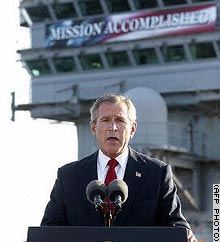
To this day, 374 Americans and 51 British troops have died in Iraq. A total of 258 coalition forces have died since Bush’s “Mission Accomplished” speech on the aircraft carrier with the flight suit photo-op. (This site does a good accounting of the casualties in Iraq.)

Republicans are trying to tell us that we shouldn’t complain, that if we criticize, then we are saying that we want to cut and run. Sorry, but that’s bull. Others say that by disparaging the president we are helping our enemies, so we should tone it down. That’s even more dangerous bull. This president has claimed that this is his responsibility. Well, responsibility doesn’t mean that you just say you’re responsible and then everybody admires you for it. What it means is that when you screw up, you take a hit for it. People remember it. People lose trust in you.

The fact is, this president has to be held to account for what he’s done. Just because we are where we are, that we have no choice but to stay, that we have to support our troops–does not mean that Bush should be allowed to draw a bye on this one. He screwed up. And we’re paying for it. In blood. In escalated terrorist activity. In regional instability. In worldwide scorn. In billions of dollars badly needed at home.

The answer is not to cut and run. The answer is to not have such a dangerously incompetent fool in office. Even if it were necessary to go into Baghdad and take out Hussein, there were better ways of doing it. Getting the facts straight. Garnering support from our allies. Building a real coalition, not the fiction of one despite however many scathing denials come from this failed administration. Having a plan of action and a sound exit strategy. Having sharp vision, not blinded by political gamesmanship. In other words, doing the job right.

Bush never did that. He initially said he would go without the permission of Congress, even laid out legal arguments. Then he said he didn’t need international support. Then he went to the U.N., but as he asked for help he also chided and insulted them. Then as he claimed U.N. authority as a reason to go in, he flushed out the weapons inspectors, who were just starting to make progress–to hell with the facts, he had a war and it was on a schedule and he didn’t want our troops sitting there waiting too long. And even up to the post-war PR celebrations, he still had no post-war plan, no exit strategy.

This war was not even planned as a war. It was planned as a domestic political campaign. And today, 13 Americans who should have been in Des Moines, Iowa, or wherever, barbecuing, watching their kids grow, making love, living their lives, instead died as their helicopter crashed before jubilant Iraqis. And this president says we have to consider this all as part of a good thing. That it was somehow necessary. That he had good reasons to do it to us.

Many of us were against it from the start, and many trusted the president to do what he knew was right. All of us were betrayed as the man used–no, abused the government for unjust means, for unjust reasons. Taking responsibility means you pay the price for your actions. He was responsible for this. And we are responsible for him and what he has done.

So we stay in Iraq and do the best that we can. We support the troops. And next November, we go and we vote, and if we take our responsibilities seriously, we do anything but to re-elect this unfaithful, irresponsible man to the office he never really earned.


Edit: Updated numbers. Make that 15 men dead in the crash. 376 Americans killed to date.

Categories: Archived, Bush and Character Tags: by

The Republican War to Control Perception

November 1st, 2003 Comments off

In trying to make stick the false claim of a “liberal media” (when in fact a majority of editors and publishers, who control the way news is presented, are conservative), those on the right wing are attempting to control the perception of media to their benefit. Similarly, when press reports don’t go their way, presidents try to change perception of the media by mounting efforts to challenge how they are represented (like Bush has with his recent “things are going super in Iraq, really” campaign), again to their political benefit.

But now, the Republican party is not just content to alter perception–this political party wants a direct hand in an artistic representation of history, in the form of the upcoming mini-series, “The Reagans.” Pressure is mounting from the party to represent Reagan the way they want him represented; they have not only asked to view it beforehand, but they say that if it doesn’t meet with their approval, they want the network to run a banner under the picture every 10 minutes claiming the series is not accurate (despite the fact that this is drama, not a documentary, and so that it is not fully accurate is a given)–and the GOP will try to buy air time during the series to run rebuttal ads.

The gist is presented here, but a simple Google News search for “The Reagans” will demonstrate the all-out offensive by the conservative media to do more than just alter perception about this series.

The major advance in this war on perception was set, quite appropriately, in the days of Reagan, and surged more than a decade ago with offensives on the language, such as the senior Bush trying to make “liberal” a dirty word, or Newt Gingrich’s memo to Republicans on how to use language as a weapon.

There is an effort to control the way we see and process information; it is a political effort–and it is most decidedly not liberal.

Categories: Archived Tags: by

News Updates — 10/30/2003

October 31st, 2003 6 comments

Just as Bush has trodden on the very soldiers he sends to Iraq (cutting their pay, their benefits, even money for their kid’s education that was supposed to be supplied, while chintzing on their supplies at the same time they hand out non-competitive billion-dollar contracts to Cheney’s firm, God I could go on and on), he does not discriminate–he snubs the families of soldiers everywhere. This is evidenced by Bush’s visit to Australia last week, where he used a soldier’s death to his political advantage, proclaiming: “…in Afghanistan, the first casualty among America’s allies was Australian: Special Air Service Sergeant Andrew Russell. This afternoon, I will lay a wreath at the Australian War Memorial, in memory of Sergeant Russell and the long line of Australians who have died in service to this nation.”

Of course, in order to make it a clean memorial with no chance of a grieving widow becoming an embarrassment to him… neither he nor Aussie Prime Minister John Howard bothered to invite the soldier’s widow. That’s right–a memorial supposedly for the man and his widow wasn’t even informed that it would be taking place. That’s not an oversight. You don’t hold a memorial to a fallen soldier and just forget to inform their next of kin.

To add insult to injury, Bush didn’t even lay the wreath like he promised; two of his men laid it for him.


Michael Schiavo has gotten an incredibly bad rap in the past month, due to a concerted smear campaign fed by so-called right-to-life advocates. If you recall, Schiavo is the man whose wife fell into a persistent vegetative state fourteen years ago. After many years of attempted rehabilitation, experienced doctors concluded that she was beyond any hope of recovery, with her cerebral cortex atrophied to the point of being completely replaced by spinal fluid.

When Schiavo finally decided that there was no hope six years ago, he followed his wife’s stated wish that she not be kept alive by artificial means in a vegetative state, and tried to have her feeding tubes removed. Her parents, after a long absence from the scene, stepped in and fought the decision in courts, bringing in a specialist who said that enough brain material remained to bring her back–but then, this was the same doctor trying to sell them on a treatment he developed, one that Florida officials charge is fraudulent. The parents are also being influenced and supported by right-to-life groups, with an obvious political agenda on hand.

In order to garner public support, they released a long string of vicious lies and accusations–that he tried to strangle her, that she wanted to divorce him so he tried to kill her, that he was in it for the money, that he denied her rehabilitation, that he denied the parents access–really devastating stuff. Videotape was released which seemed to show Terri as being alert and aware, even trying to communicate. So much public sympathy was generated that Florida politicians were pressured into passing a law specifically to keep Terri alive.

Of course, it all turned out to be fake. Her state was induced by abnormally low potassium levels, there was never any sign of abuse or strangling despite close examination by doctors, the money went into a trust for Terri’s care, and Michael gave Terri years of rehabilitation and even studied to become a nurse himself. The videotape falls apart when you look at it carefully–you can tell it has been edited. Not a continuous stream of images like a regular videotape–rather, a clip here, a clip there, obviously heavily edited to make it appear as though she is responding, with the majority of video showing her not responding left out.

After suffering this assault for weeks, Michael Schiavo finally came out and appeared with his lawyer on Larry King Live, accounting for himself very well. If you are one of the people who feels strongly that Terri is really OK and Michael was virtually a criminal, you should feel obligated to hear his side–you will likely change your mind. The transcript is available here.


Despite a thorough dislike for her political views, one has to admit that Condi Rice, unpleasant as she may be, is highly intelligent. So it makes you wonder how she finds it in herself to put up with working for a doofus like this.


Jeffrey Woodard, a likable and well-performing 18-year-old high school student at the private Jupiter Christian School (motto: “Teaching the Mind … Reaching the Heart … Serving our World”) in Florida (why is so much weird stuff happening down there?) was expelled after a teacher coaxed him into admitting being gay. More “tolerance and acceptance” from an increasingly outspoken minority of Christian authorities who are pushing the envelope of what society will accept.

Personally, I think faith can be a wonderful, life-saving quality, but I believe in the inverse-square law of religious strength: the farther you go from the individual, the more the light of faith diminishes. Churches are fine so long as they support the individual, who is at the center of faith. But organized religion in general, and specifically religious practitioners who deign to judge rather than support, are much more in the dark than in the light in my humble opinion.

Categories: Archived Tags: by

Avoiding Responsibility

October 30th, 2003 1 comment

Bush is getting more and more pathetic. He talks big about taking responsibility for things, but he always blames somebody else. Drunk driving? Call it a political dirty trick and blame your opponents. Bad economy? Blame Clinton. 9/11? Clinton. Lies about Iraq’s nuclear program? Blame the CIA. War in Iraq going badly? Blame the liberal media.

Like a 5-year-old child caught with his hand in the cookie jar, Bush is blaming everyone but himself for his inexcusable behavior and policy failures. That’s not taking responsibility, that’s called dodging responsibility. And now Bush has taken this vice to a new low.

Remember six months ago, when Bush had an aircraft carrier turn around, delaying its entry at port by a day and costing you and me a million dollars so he could be flown in on a jet and be seen wearing his flight suit for PR value? He changed into a suit, then strutted out before the actual military veterans and declared that “major combat operations in Iraq have ended.” Remember the “Mission Accomplished” banner that was hung just right so that the cameras could frame Bush with it in the background? That banner’s message has come under fire, now that far more U.S. servicemen and -women have died since that PR stunt than before.

Bush is trying to avoid blame for that one, too. It’s the Navy’s fault, he says. Their idea.

Well, actually, not really. The White House had the sign made. But, they claim, it was the navy’s idea in the first place, and they were the ones who strung it up. Yeah. Right. I’m sure the White House didn’t have anything to do with suggesting the idea, or with placing it so it could be framed so visibly, right behind the president from the cameras’ POV. Those Navy guys are real sharp at this PR stuff, not the White House.

This is pathetic. The only thing that could be even more sad would be if the American people continued to buy these sorry excuses from this miserable coward who himself shirked duty while admonishing others not to do so, who lied to get us into this war and is lying to avoid responsibility for it.

Categories: Archived Tags: by

Ironically, Fox Almost Accidentally Sues Itself

October 29th, 2003 Comments off

Sadly, the headline here is not a joke. Not in the literal sense, anyway. Nor is it even an actionable parody.

After taking a pratfall for suing Al Franken’s Recent Book, Lies and the Lying Liars Who Tell Them, Fox threatened to sue Matt Groening and his animated TV show, The Simpsons, for airing a parody of the Fox News ticker (“Do Democrats cause cancer?”).

Alas, The Simpsons is owned by… Fox. They almost sued their own TV show for parodying their own TV show.

The Simpsons avoided getting sued, but now Fox has a new rule banning such a parody news-ticker. Why? Because, they say, “it might confuse viewers into thinking it’s real news.”

On The Simpsons?

These people need help.

In other Fox News news, Fox has declared itself worthy of the title “Fair and Balanced.” Why? Because they hired Chris Wallace. My first reaction to that was, “Who?” After looking around on the net, I found that people were saying he was a liberal, mostly because of the story about Fox News, though some contended he had conservative leanings. So it’s a bit confusing how the hiring of a single maybe-liberal interviewer now signals that the vastly right-leaning network is now “balanced.” Or maybe they were commenting on how Wallace himself has declared Fox to be “balanced.” Gee whiz, a new hire speaking well of his new bosses? Go figure!

Categories: Archived Tags: by

Crime and Foreigners in Japan

October 28th, 2003 3 comments

Life in Japan as a foreign resident is much better today than it was back in the 80’s. The creature comforts, imported goods and so forth are better, as I have commented on before. But more than that, in the 80’s there was a notable racial component to things as well; foreigners were sometimes seen as a source of crime and disease; police often stopped foreigners for no immediate reason other than that they were foreign. That happened to me many times, usually riding my bicycle; the police would accuse you of having stolen it. In those days, with so much antipathy focused on foreigners, the bad news accentuated and the good news muted, you were sensitive to such things. I recall one day I was stopped near Musashi-Sakai Station for “bicycling while foreign,” and was actually surrounded by four or five cops. I remember seeing passers-by shooting glances at me, and guessed what they were thinking, that this scene confirmed the fears stoked by newspaper bias and politicians’ speeches shouted from the tops of loudspeaker trucks.

This happens a lot less today.

There are, however, some remainders from that time, and this week a few of them have popped up. One of them was an editorial from the Japan Times that was very reminiscent of the 80’s; in fact, it could be an exact clone of an editorial from that time. It comments on high crime rates of foreigners in Japan, but like so many similar reports in past years, it exaggerates quite a bit. It mentions high numbers of crimes, but it does not mention crime rates; and if one calculates the crime rates, one finds what has always been true: crime rates of non-Japanese in Japan have always been lower than that of the native population.

Another facet of the problem has been how the Japanese media gives weight to some stories and less so to others. I commented on the story of Yoshi Hattori, the young boy who was shot to death in the U.S., and how this was amazingly over-reported in Japan, the story dragging on for much longer than a year, while a story about an elderly Japanese woman shot in Japan was virtually ignored despite the unusual nature of the shooting.

Yesterday, a similar example of bias appeared in the news when an American sailor was shot on the streets of Hiroshima. Initial reports here in Japan not only failed to identify the assailant as Japanese, but omitted certain details–his basic description, along with the language he spoke, all information available from the start–details that would have suggested that he was Japanese, thus giving the impression (by local standards) that the shooter was probably another American serviceman. The story was given short thrift in the papers yesterday, and today’s Yomiuri has nothing about it at all. Only subsequent on-line articles reveal that the man spoke Japanese, and still fail to identify him as a national. Foreign publications, like this Stars and Stripes issue, give a more detailed accounting. Japanese newspapers, it should be noted, seldom fail to identify a suspect as a foreigner even if it was only a suspicion of such.

One thing that is clear: if the races had been reversed, and it was an American who had shot a Japanese, there would be no other news story for this day or any other for weeks; it would make international headlines, and Japan would be rife with protest and anger.

Categories: Focus on Japan 2003 Tags: by

Conservative Lies #2

October 27th, 2003 1 comment

Sorry for the lull. Had quite a few midterm exams to go over, grading, and all that, and then personal stuff came up. But here we are with another common conservative lie.

Lie #2: “Democrats are racist.”

When Miguel Estrada’s nomination to the D.C. Circuit Court was successfully blocked by Democrats in the Senate, Republicans went on a rampage of accusing Democrats of being “racist,” with a few examples here, here, here, here, here, here, here, here, here, and here. Why? Because Democrats slung epithets at him? Because Democrats have a history of blocking any and all Hispanic nominees? Because there’s even the slightest scrap of evidence of racial bigotry? Of course not. It’s simply because they blocked the nomination of a far-right-wing nominee who also happened to be Hispanic. If there is any racism here, it is in the racial exploitation of Estrada by the GOP–part of their campaign to win over the crucial Hispanic vote by putting token Hispanics like Estrada and Alberto Gonzales into prominence, wearing the heck out of their Hispanic origins and rags-to-riches tales, and then admonishing Democrats for assaulting the tokens on any grounds, always claiming race is the only reason Democrats are attacking them.

Naturally, Democrats did not block his nomination because he was Hispanic; they blocked his nomination because he is an “outspoken conservative” (read: “ultraconservative”) and a staunch constructionist. Estrada belongs to the firm that defended Bush in Bush v. Gore. The Bush administration denied the Senate committee access to internal memos written by Estrada when he worked Office of the Solicitor General; his office handled cases that would go before the Supreme Court, and would give a better look into what his legal philosophy is. He flatly refused to discuss his legal philosophy and claimed that he never pondered Roe v. Wade.

Democrats standardly challenge nominees whom they regard as being far too conservative, and conservatives, like Orrin Hatch, try to obfuscate by saying, they don’t want an “African- American on the court who’s conservative,” or a “conservative Hispanic,” suggesting that it is the race, not the political philosophy, which is important.

This is not the first time that Republicans have tried to exploit race as a shield against turning down an ultra-conservative judicial appointment. They did so with Clarence Thomas, who “just happened” to be black, a sorry sop to the African-American community, as if Thomas somehow represented them in any way, not to mention being any kind of replacement, judicially or otherwise, to Thurgood Marshall. But the Estrada nomination is just an example of the acceleration of this exploitation; expect Alberto Gonzales’ name to come up next.

Nor is this the only situation that conservatives use to try to tag Democrats as racist. A long-standing charge against liberals is that Affirmative Action (the conservative code word for quotas) is racist–not just reverse-racism against whites, but also racist against minorities, because it regards them on the basis of race. Well, how else are you going to regard people who have been victims of racial discrimination? Quotas may be a bad solution, but the alternative is far worse: allowing racism to go unchecked. More on that topic in this post.

Bottom line: Democrats, for all their faults, have been the people who have always fought racism in all of its forms; conservatives, when not outwardly racist, have always associated with and defended the institutions that contribute to and benefit from racism.

Categories: Archived Tags: by

Fall View

October 26th, 2003 Comments off

Had a busy day today, not much time to blog. Had the chance to visit the tower atop the local hill (the one that blocks my view of Shinjuku!), and found that not only had I picked a very nice day to climb, but that it also happened to be the last day the tower is open this year. The tower is usually closed and locked, open only on Sundays during about 4 hours in the afternoon–and even then, only for a few months. For the first few years I lived here, I didn’t even think it opened at all.

But I got a good view today; below is a panorama (click it to see the larger image, about 1000 x 300 pixels). The fall colors are turning, and they’re just going to get better.

Categories: Focus on Japan 2003 Tags: by

Mmmmmmaahhhh…. Suuuuushiiiii…..

October 25th, 2003 Comments off

When I tried to find a decent, cheap sushi place in the U.S., it was very hard to do. Most places charge several dollars per plate, a lot more than the dollar-a-plate I’ve become used to in Japan. The best I could scrape up was a few all-you-can-eat places in San Francisco, and they were still more expensive, in the end, than the Japan dives (even if I starved myself prior), and the quality just didn’t match up.

Before I came to Japan, I thought as many Americans do–that I would really hate it. Raw fish? Come on. And you know what? I still do, much of it. Sorry. Especially the maki-sushi (rolled sushi) or any other kind with seaweed. Never got used to that stuff. But there is one kind that I do like, and I like a lot: tuna. That’s either in the standard form–red tuna, or maguro–or in the high end menu selection, fatty tuna, called toro.

Toro, when you get good stuff, is heavenly. Tastes like butter, almost. I get it whenever it is priced reasonably at the supermarket. It comes in slabs; I chill it while I cook rice, then as the rice cooker indicates that the rice is done, I take it out, slice it (you need a really sharp knife), and eat it as sashimi, the rice on the side. Of course, I can’t afford to get what is called “oo-toro,” the highest-quality toro, but “chu-toro” (literally “medium fatty tuna”) is often available and I get that every few weeks.

Strangely, the toro available at the kaiten (conveyor belt) sushi joints is, almost uniformly, not very good. I’ve never ordered the 6-dollar-a-plate variety, but the 3- or 4-dollar varieties never have the right taste. A friend of mine who lived in Osaka once treated me to toro at a good sushi place near where he lived, and that was great–but the conveyer-belt places can’t seem to get it right.

But they do the regular tuna just great, and so that’s what I usually load up on when I stop by the place, every week or so on the way back from work. They know me there now, just like the folks at Akiyoshi yakitori-ya do. I’ll come in, order two plates right off the bat. They combine the two into one plate, putting the four sushi together, and the two plates one on top of the other. If the first set tastes good, I’ll order another four to six plates. I’ve come to notice, however, that they give me the best sushi first….

When you’re finished, they tally up the plates you’ve left stacked; price per plate is determined by the color and pattern on each plate. Since maguro is the cheapest, the tab usually comes out to a bit more than 6 or 8 dollars. Not bad.

Categories: Focus on Japan 2003 Tags: by

iPod: First Impressions

October 24th, 2003 Comments off

Right off, I will admit that I have an interest in finding this to be a nice machine, having just plunked down $450, including tax, for the little thing. That said, I think it goes beyond that bias to say that this is a sweet device.

The first thing that strikes you is the size; you always expect it to be bigger. The common measure, that it is about the size of a deck of playing cards, is pretty much right on. But the iPod also has weight–not too much, but enough to make it feel definitely solid–a feeling which is reinforced by the polished metal backing. I’ve had one other MP3 player, the one from Iomega, and have seen a lot more, and it is all to easy to find ones that are too big (the ones with capacities similar to the iPod) or even too small; this machine gives you the impression of being just the right size and having just the right heft to be a solid, and (very subjectively) a deservedly expensive piece of equipment. Remember in the first Jurassic Park movie, the kid finds the infrared goggles in the car? He asks the adult if he can play with them; the adult asks, “Are they heavy?” The kid answers “Yes,” and the adult replies, “Then they’re expensive. Put them back.” That’s what this feels like. Totally subjective, but that’s part of the experience.

One nice extra point was that the battery was about 75% charged, right out of the box. I hate getting a new toy, and then have to just sit and look at it, inactive, for several hours while it charges for the first time. The first thing I did, naturally, was to plug it into the computer. You set the iPod onto its base (also hefty for its size), and the cable from that ends in a FireWire connector. Now I have about 2,500+ songs from my CD collection saved on my PowerBook G4 hard drive. You plug in the iPod and two things happen: first, the iPod starts charging right through the data cable (Firewire cables have six wires, four for data and two for power); and second, iTunes pops up and the iPod starts synching. 10 or 15 minutes later, my entire collection has been transferred over with room to spare. That extra room can be used as external data storage–put anything you like into it. With a Belkin flash card reader, you can download your digital camera photos into it, a feature I could have used while traveling in Spain.

Open up the iSync application, and in a few minutes, my iCal calendar and Address Book have both been copied to the iPod as well. The beautiful thing is, it all just works. Smoothly. No bugs, no hassles, no figuring anything out; in less than 20 minutes, most of which I just spent surfing the web while the computer worked, all was done. It was ready to go.

The one hassle I expected was the expected limited ability, from one jog dial and five buttons, to effectively operate the machine, especially considering the fact that two and a half thousand songs were on the thing. But they did a very good job with this. It’s like a single, extended, hierarchical menu (it even has the menu font Apple uses). The jog dial (works like a trackpad, solid-state) acts as a scroll wheel; dial this way or the other, and you move up and down the list, quickly. Tap the button at its center and you move into the next submenu; tap the “Menu” button to move back. For example, choosing a single piece this way: Browse >> Albums >> Jurassic Park >> Theme From Jurassic Park. Very quickly, you can narrow down your selection. Feedback is given by little clicks, which you can mute if you like. And the menus are customizable; you can choose to have “Albums” in the top menu, for example, or turn off “Extras” (Address Book, Calendar, Games, etc.).

You can also arrange Playlists in iTunes; while on your computer, create a playlist (Command-N); let’s call it “80’s Rock” for the sake of the example. Choose a group of songs you want to play, drop them in, and you’re ready to go. Set the iPod back into the cradle, and it will automatically sync to the changes you made. Remove the iPod, and now just select Playlists >> 80’s Rock, and you’re there. You do surprisingly little looking around–disappointing at first, because playing with the dial and buttons can be fun.

The headphones are fairly good, better than any set of ear-pods I’ve used. And that’s important for me. Those pods never seem to fit my ears right, possibly due in part to the fact that I had one ear half-bit off by a St. Bernard when I was seven; plastic surgery repaired the worst of it, but the ear is still a bit off norm, so the pod can bite. These actually feel OK, however subjective that impression may be. The remote controller is designed well as far as shape, size, and layout, but the clip is disappointingly narrow; it barely holds on to whatever part of my shirt I clip it on to. They should have done better on that one.

The sound is also good, at least to me–I’m no audiophile, so what might be unacceptable to a connoisseur, sounds OK to me. I go by general quality and volume. My former MP3 player never was able to play loud enough; on the iPod, the loudest setting is too loud for me; and that’s OK by my book. And there are still lots of features I haven’t tried yet–using the calendar and address book in practice, trying out the random shuffle feature, or even finding the true extent of the battery life. More on that later.

I’ve only had it a day, but already I feel comfortable with it, and can use it without having to think or figure. So, first impression–a very nice little chunk of machinery here.

Categories: Mac News Tags: by

Christmas Came Early

October 23rd, 2003 5 comments

Not much time to blog tonight–I’m grading midterms. But I did have time to stop by the electronics store earlier and get myself an early Christmas present: a 20 GB iPod. I never buy big-ticket items on a whim, I always give myself at least a few weeks to mull it over, especially to avoid those impulse buys where a few weeks later you ask yourself, “why did I buy that thing?”

I’m not going to be saying that about this one. I made a mistake with my first MP3 player, an Iomega HipZip. Dang thing broke after just a few months, and not from rough use or anything. Just shoddy merchandise. The iPod is a solidly built little thing, worth the extra bucks. More about it later. Midterms now.

Categories: Mac News Tags: by

Conservative Lies #1

October 22nd, 2003 2 comments

It has gotten to the point that I am hearing outright, bald-faced lies from conservative commentators on such a regular basis, I feel the need to address them in some manner. So here goes a series of small posts, in each a conservative claim and the truth of the matter.

Lie #1: “Clinton Sent Troops into Somalia.”

Heard this one on Crossfire the other day, and found several instances of it on the web as well, a notable one in The Washington Times. The claim is used as a way to criticize Clinton for his foreign policy, and to contrast this with Bush’s purported “success” in Iraq.

The fact: Clinton did not sent the troops. George H. W. Bush did. On December 4, 1992, Bush ordered 25,000 U.S. troops into Somalia. Remember the night-vision video of the beach landing on the news? One thing Republicans know, it’s how to script news coverage. Bush sent the troops in a month after losing the election, and one and a half months before Clinton took office, knowing full well that he would get the initial glory and that Clinton would get stuck with the quagmire. If Clinton had done the same to Bush Jr., conservatives would have been howling like mad, accusing Clinton of every political dirty trick in the book, claiming he was sending our soldiers into harm’s way just to embarrass Bush Jr. But Bush Sr. doing it to Clinton, that was OK. In fact, conservatives quickly erased the fact that Bush sent them in and blame the whole thing on Clinton, showing how he didn’t know how to handle such things.

In fact, Clinton’s handling of Somalia beats Bush Jr.’s actions in Iraq to hell. Clinton was anxious to bring the troops back, he didn’t have to wait until the whole country was screaming at him before he decided to do that. And unlike Bush, Clinton was able to get the U.N. forces into Somalia, cutting U.S. troops down to 4,200. Unfortunately, he could not pull them all out–despite conservative sneers that Democrats like to cut and run, Clinton stood ground with the U.N. forces as long as it seemed that good could be done–and so, naturally, conservatives lashed out at him when a mission went wrong in late 1993, where eighteen U.S. soldiers died in the mission that went so famously wrong. Soon after, Clinton ordered a withdrawal, the mission no longer publicly tenable, but U.S. troops still held ground there, staying until late March, 1994.

It was a fiasco, but it was a Bush fiasco; Clinton simply did the best he could with what he had been given.

Source: The History Channel: George Bush, Forty-First U.S. President.

Categories: Archived Tags: by

Around the Blog in 80 Days

October 21st, 2003 1 comment

Hey, I just realized I’ve done 80 days of blogging without missing a single day. It’s been my intention not to miss a day, but usually I am not so good at keeping up with things. Missed only three days since four months ago in mid-June, when I got lazy and missed two full days. But to make up, I often post more than once a day. Quite often–I started posting regularly in May, about 170 days ago, and am up to post #330 now.

Now if only I could do the same with exercising….

Categories: Main Tags: by

Crossing the Chuo

October 21st, 2003 2 comments

One of the many places I’ve lived in Tokyo was Koganei, for two and a half years. I lived in Higashi-Koganei, near Asia University. I used to ride my bicycle in the area quite a bit, in particular to a Home Center (a kind of store, like a cross between Home Depot and Walmart; not as big, but big for Japan) on the south side of the tracks. So I know what it’s like to cross the Chuo Line–and yet, from the news I see, it is now even harder than ever before. More on that below; first, a bit of background.

Crossing the Chuo was always a chore. First of all, trains in Japan are much more widely used, so there are a lot more of them. Back home in the Bay Area, a train crosses an intersection every thirty minutes to an hour. Here in Tokyo, it’s once every few minutes on the busier lines. Second, the barriers at railroad crossings in Japan go down long before they would in the U.S., sometimes almost a minute before the train comes. And if the crossing is next to a train station, just forget about it; even though the approaching train will stop at the station before it crosses the intersection, the barriers go down just as soon–so people at the intersection have to wait not only the one minute for the train to get to the station, but also the time it takes for people to get off and on the train, then for the train to start up again–and finally cross the intersection.

To make things even worse, there are times when the trains from either direction are staggered–you wait a few minutes for a train one way to get through, then just as it passes, the lights indicating a train is coming from the other direction light up. Then just as that train passes through, an express train from the first direction lights up that way again. Choose the right intersection close enough to a station, and you can get caught like that for what seems to be an endless time. My own record for that is waiting for five trains to pass, each one on the heels of the other. That’s not counting the one time when there was a slowdown due to an accident, with trains lined up behind each other; the trains were so close and so slow, the barriers stayed down for more than half an hour (in the rain, of course). Finally, everyone at the intersection just got fed up, lifted the barrier and went through when it was clearly safe to do so.

But now, things are worse. JR East, the railway company that runs the line, has begun construction on an elevated line for the Chuo. The plan to get the work done involves laying extra tracks beside the original ones, thus widening the railroad crossing. This requires more warning time before each train comes, which has been causing great traffic jams. The elevated line, ironically, is intended to relieve traffic congestion caused by the difficult crossings. I guess it has to get a lot worse before it can get a lot better.

I first noticed this trouble when flipping through channels, and saw one station at a railroad crossing, showing how ridiculously wide it had become–taking even some young people more than 20 seconds to cross, impossibly long for some elderly people. I didn’t note at the time where it was, but then I started seeing it on the news more and more, and so started paying attention.

The crossing most in question is the one on Koganei Boulevard (Kaido), next to the busy Musashi-Koganei Station. The crossing is usually 56 feet (17 meters) wide, but due to the construction, it has been widened to about 120 feet! that’s 35.7 meters. kind of hard to believe, but you understand when you see it. It’s wide. Vehicles have become trapped in there, causing crossing guards, always on duty, to signal the emergency stop for approaching trains. The same guards are constantly having to hold up the barriers for the later pedestrians to get through. Elderly people, frightened into moving faster than they should, often trip and fall.

It’s worse if you’re waiting to cross. As mentioned before, back-to-back train passes make for long waits, and the widening of the tracks makes them even longer. The TV show I saw tonight clocked one wait at an entire hour before the barriers came up. Drivers just give up and go elsewhere.

Pedestrians don’t have that option, so Musashi-Koganei Station has started issuing special passes to people so they can enter the station, walk to the far end of the platform, use the stairs to cross the tracks, come down the length of the opposing platform, and then depart the station on the other side. At other stations, people are lucky enough to have pedestrian overpasses (still a major pain to bike riders), or even better, elevators up to the overpasses.

I’m just glad I don’t live in Koganei these days… I hope they finish the elevated tracks as soon as possible–but JR East is saying that it will take six months just to install temporary devices, such as approaching train sensors so the gates don’t go down so early. Lord knows when the work on the tracks will be done; years away, no doubt. The entire project, in four parts, is due to be completed in 2011.

Categories: Focus on Japan 2003 Tags: by

Where Are You Politically?

October 20th, 2003 3 comments

The Christian Science Monitor has this quiz you can take to see where you land on the political spectrum; an OK test, but the results are a bit disappointing–you are only told if your answers rate, on average, as isolationist, liberal, realist, or neoconservative. No specifics, no spectrums. It wasn’t too surprising, or very interesting, when the quiz told me I was a liberal. Shock!

A much better quiz is the Political Compass, a six-page test with a great number of multiple-choice questions (on the agree-disagree scale). After you take the test, you are not pigeonholed into one of four categories, but you are placed specifically on a 2-dimensional chart, where the ends of the two axes represent liberal, conservative, authoritarian and libertarian extremes. You can then compare your position (see chart, upper right) to the positions of famous political figures (shown on a separate graph, I did some Photoshopping). Not too surprising to see George. W. Bush up there with Thatcher and Sharon, nor that he is closer to Hitler than Gandhi. More surprising is seeing Pope John Paul II in the neighborhood of Stalin, Hussein and Arafat. I guess that makes sense from an ideological point of view, but you don’t think of it that way, usually. And that’s me, right next to the Dalai Lama.

The test is not perfect, as there are some questions which could be interpreted differently by different people, and a few with no choices that exactly represent your views. Still most people report that they get placed pretty accurately, and it is fun to see where you come out. Go ahead, give it a try. If you do, come back here and share the results.

Categories: Archived Tags: by