Those Clever Spammers

October 19th, 2003 1 comment

Recently my spam has reached in excess of 30 per day; while my Eudora spam filter is good, once in a while things slip through, or legit mail might get junked. The problem here is that none of the automated spam filters is 100% reliable, and you never know exactly what it is they’re doing. For example, I use email forms on web pages to give my students tests. Once in a while, one of the emailed tests lands in my junk box, and I have no idea why, no understanding of what triggered it. To better my odds, I decided to try strategizing some spam filters of my own.

Available on most web host control panels is the ability to create your own customized spam filters that will block incoming messages before your email program gets a chance to download them. The trick was to find what text strings were unique to spam emails. So I started up Eudora, which houses my 4-year-plus archive of tens of thousands of emails, including a good deal of archived spam, and I started going through the most recent spam, email by email, looking for something that seemed unique. When I found something, I would do a search for the string in Eudora; if the search produced only spam, I had found a silver bullet. If legit email crept through, the filter could backfire on me. After all, since this completely blocked the email, I would not have the option I have with Eudora’s junk filter, that being to quickly scan what got into my junk box.

Pretty soon I started finding gems. “opt-in” was one–from those fake offers to remove you from their list, really a trap to identify people who read their emails. Others included “guaranteed!” “100% money,” “to be removed,” “generic” (drug sales), and “enlargement” (you know what that’s about). These terms produced few enough legit email hits that I felt comfortable using them.

But I also started noticing the tricks that the spammers used to avoid detection. Like “Viagra,” a very common spam topic, was being spelled in various ways, like v1agra, v_iagra, viagara, v.iagra, or v1a-gr@. I found that by filtering “v1a” and “agra ” (with a space at the end of the last one), most of them got filtered out. Some spam included the intra-word period all over the place, like “get doc.tor recom.mended v.iagra!” Thus breaking up the words for a standard filter.

One rather devious word-breakup scheme I found used HTML, the web page scripting language which is now commonly encoded into email to create various tables, backgrounds, text sizes, styles and colors, not to mention images (more on those below). I found one email that clearly read, “Free Tour,” which seemed like a possible filter. I searched for it, but nothing was found–not even the spam I’d seen it in. I couldn’t figure out why it was not showing up, until I turned off the “blah” filter which usually hides the HTML and other coding. Then I found this:

<!– flow –>Cl<!– gutenberg –>ick
he<!– baby –>re for a F<!– predominant –>R<!– reagan –>EE to<!– pint –>ur

See what they did? The <!– * –> is an HTML code for a memo, a note programmers insert into code to mark something; it doesn’t actually do anything, it’s just a tag which doesn’t show up in normal display mode. By using these tags all over the place, the spammers not only break up the words that would normally trigger a spam filter, but they add words that might be what some people really search for. And because the comments do not appear in rendered form, the original message–in this case, “Click here for FREE TOUR”–comes across clearly to the reader.

But many spammers use a more straightforward dodge: they don’t send any text. Instead, their ads arrive in the form of image links–not usually images they send to your email account, mind you–that’s bad enough. No, instead, they use the HTML image link feature to tell your email program to go to their website and retrieve the image, then show it in your email when you view it. This not only blocks the spam filters, but it also lets the spammers know who just opened their email, so they can send even more to you. Most people don’t know that you can and should turn off HTML graphics options in your email client.

Nevertheless, I was able to find an Achilles’ heel to this practice: they use the DIV tag. An HTML feature that allows alignment and other formatting control. Most graphics spammers use the tag to align their images. And when I did an email search for “div align=” in Eudora, I hit the jackpot: half the spam email showed up, and NO regular email. Bingo!

So I entered that and a few other choice terms into the spam filter, and the next day, the spam that Eudora had to filter out was cut by about 60%. Cool. So I’ll do some more searching, and maybe get it fine-tuned. With luck, the number of spam emails I have to glance at in my junk folder will be down to only a few a day, and it will be extremely easy to spot the legit emails. And when spam starts getting through in larger numbers again, I’ll just figure out the trick and add the spam filter to catch it.

I admit, this may very well be more trouble than it’s worth, but then again, it can be fun to try to outsmart the vermin.
Categories: Main Tags: by

RIAA Sues Again, A Little More Politely This Time

October 18th, 2003 Comments off

So, who will be on the list this time? Seeing the RIAA’s last attempt, one would expect some nuns and orphans named in the new offensive. Throw in a few infants and a healthy dose of people who don’t even own computers and they’ll come in at about par.

The RIAA (motto: “Do What We Say Or Another 200 Hostages Get It”) is planning to sue a large group of users again, but this time, they are playing nice (relatively speaking). They are being ever so polite as to send letters first. The missives to the 204 people targeted in this round were sent out over the past week, informing the defendants-to-be that the RIAA has “gathered substantial evidence that you have been using a peer-to- peer network such as Kazaa or Gnutella to download and upload music owned by our clients.”

The RIAA is giving the dastardly criminals ten days to negotiate a settlement (i.e., whatever the RIAA demands they pay) or else they get dragged into court. However, considering that the last round included a 12-year-old girl and several senior citizens, including one who didn’t even own any file sharing software, it is likely that this new batch will have similarly misidentified people. Already, two people from the last groups have challenged the RIAA in court (not counting those the RIAA withdrew their suits against because it was so blindingly stupid of them to accuse the people they did). One is a web page designer named Ross Plank, who claims that the RIAA just plain misidentified him. Mr. Plank is being defended in his case by the Electronic Frontier Foundation.

Then there is the possibility that the RIAA doesn’t have the legal standing to do what they are doing. Aside from the sheer viciousness of their campaign (they call it a “fear and awe campaign”–seriously), there is the legal questionability about their right to issue subpoenas and access ISP logs.

In a side note, the RIAA is telling the new batch of scapegoats that if they even so much as try to erase any songs from their hard drives, they could be arrested for tampering with evidence. And how, I wonder, could the RIAA possibly (a) prove that songs were deleted after a certain date or before, and (b) get their hands on the computers in any case? Do they now assume they have sweeping police powers to break down people’s doors and confiscate evidence?

So far, 64 people have settled their suits with the industry, and another 838 people who were not sued have accepted an amnesty deal (which does not even offer to protect them from later lawsuits, and might even open them up to such suits at a later date). Millions of other users are not yet acting–and they may end up justified. This kind of legal scare tactic has been tried before by companies seeking to shake down “pirates.” When HBO was broadcasting by microwave in the late 80’s, a de-scrambling kit with a microwave dish was being sold by a company proudly calling itself a “pirate” outfit . HBO sent people around neighborhoods, and whenever they found dishes at addresses that did not have subscriptions, they sent a letter threatening to sue unless the dish owners paid a settlement. In the end, a large number of people paid up–and then HBO’s case was thrown out of court. (The case was Zimmerman v. HBO Affiliate Group, 1987; see discussion section “e” on this page for a bit more on that. The case was lost on grounds not relevant to the RIAA’s case, but their tactics were very similar.)

This may very well end up the exact same way, in that the abusive acts of the RIAA may end up getting them cash and publicity in the short term, but they are far from winning any case in court, and could very likely be defeated there.

Categories: Main Tags: by

Music for the Apple of Your Ear

October 17th, 2003 9 comments

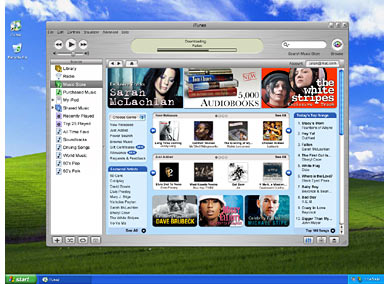
Apple is hitting its stride with its music initiative, and several new announcements today. First is the emergence of iTunes for Windows. I have yet to download this for my PC–I will very soon–but it promises to be a smash hit. It is a very high-quality program, incredibly easy to use, putting any other app for music to shame–and it’s free. Then there’s the Music Store, now available for the other 95%–and the two or three percent have bought 13 million songs up till now, making it the #1 music downloading service already.
And Apple is not wasting time doing its marketing right: together with Pepsi, they are offering 100 million free songs, codes randomly distributed in Pepsi containers. Very good move, IMO. Apple should be able to sell lots more where those came from. At 99 cents per song, the ability to buy singly at that cheap price or buy whole albums for $10–I’m buying my music there.

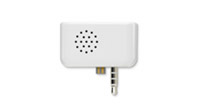
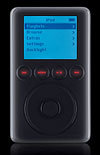
And I’m finally going to break down and get an iPod. Probably the 30 GB model. I’ve been teetering on the line, more on the not-buy side lately, but with the introduction of two new accessories, the microphone to make voice recordings, and the Flash memory adapter to store photos–well, that about did it. That’s my Christmas present for myself this year. Am getting it before I go to the U.S. so I can use the music and games on the flight over and back (watching DVDs on my Powerbook is limited to the battery life, not enough to stretch out for the 8- to 10-hour flight), and to hold all the photos I take on my digital camera without having to haul my laptop everywhere.

Oh, and Microsoft had an announcement today, too. They’ve discovered not one, but four more giant, gaping security holes in their operating system.

Cool.

Categories: Mac News Tags: by

Media Filters and the Tools of Perception

October 16th, 2003 Comments off

We’ve seen it before, you know. Back in the Reagan administration, when things were seen as not going well in the nation, Reagan’s people blamed the media back then, just as Bush is blaming them now. They said that the media only reported bad news, and that they should “balance” their reporting with good news. And before him, Nixon also gave it a try–with his vice president Spiro Agnew denouncing the “nattering nabobs of negativity.” The suggestion, of course, was as hollow back then as it is now; the real reason behind the claim was not due to a fault or lack on the part of the media–it was due to falling poll numbers for a conservative presidency, unpopularity caused by factors beyond the control of the presidency. And since the root problem could not be helped, the president tried to make people believe that the root problem was not so bad–it’s just that the media is making it look that way.

Reagan’s attempt to spin the media was perhaps the embryonic beginning of the conservative myth about the liberal media; the reason behind creating that fiction is very much in line with the current administration’s attempt at massive media spin. It all has to do with perception, the kernel of American politics.

It’s like the old haggling ploy of trying to place the perceived center as close to your side as possible. Let’s say that you have to negotiate with someone and come to a settlement. When people start to dicker, the assumption is that they will compromise towards a central point. Let’s say that the fair settlement is 100. You want 200, your counterpart wants zero. Your counterpart, not wanting to insult you with a zero offer, starts at 50. You see an opportunity to move the center closer to you, so you start at 250. That puts the center at 150, much closer to the place you want to be–and your counterpart is now at a disadvantage, because they have to make you give up more than they do.

And that’s more or less what conservatives have been trying to achieve with the entire “liberal media” canard: to place the perceived “center” of fairness closer to their side. By claiming the media is liberal, they create the appearance that the truth is not what the media says it is, but rather the truth is much closer to what they say it is. If media stories show a conservative figure in a negative light, such as Rush Limbaugh, we are supposed to discount it because of the “liberal media,” and believe that he is less culpable than he appears. If a liberal cause is perceived as popular in the media, such as a gun control measure, we are again supposed to discount it and believe that few people really support it, and it is being propped up by those liberals in the media. If you can get people to believe there is a liberal bias in the media, then, you can push public perception to the conclusion that the truth is more on the conservative side of things. That is the motive for the right wing to engender, espouse and sustain the illusion of left-wing bias in the news that we receive.

Joe Conason does an excellent job of upending that cliché in his book, “Big Lies,” where he compares it to “working the ref.” In basketball, if the referee calls a penalty against a team, the coach goes out of his way to protest, calling the decision unfair to as far a degree is possible in the hope that the ref will give the team some slack to make up for it next time. Conason points out that while a majority of reporters vote Democratic, a greater majority of editors and publishers–the real ones that decide bias and direction–are conservative. And he reports on conservatives who have, in candid moments, owned up to the truth; Bill Kristol, for example, in 1995, saying that “the liberal media were never that powerful, and the whole thing was often used by conservatives for conservative failures.” Even Rush Limbaugh has claimed that the media today is more conservative. And that is hard to deny, with Fox News leading a frightened CNN into the conservative realm, and with a seemingly endless line of conservative radio and TV commentators with their own biased shows, with nary a liberal in sight with even a half hour of his or her own.

The grand Republican tradition of swaying perception simply continues with George W. Bush; nothing here is new. With his Iraq policy in shambles, and things looking grim for an election year, there’s not much he can control that would improve things–he can’t stop the guerillas, and he can’t guarantee the capture of Saddam Hussein. He can’t pull the troops out, he won’t be the humble leader he promised in 2000 in order to get the U.N. to sign on, and he can’t avoid spending yet more and more billions of dollars. Without the ability to make any substantive changes, he does the only thing he can do to try to win the day, the tactic that has served the GOP so well over the decades: blame the media for making things look so bad.

It’s a tough sell, with American soldiers dying daily, car bombs blowing up streets every week, with the world largely against us and the patience of the American people wearing thin.

But then, conservatives are very, very good at this game.

Categories: Archived Tags: by

More of the Sunset

October 15th, 2003 Comments off

As advertised. [Edit: I have had to delete the larger images because of hotlinkers. Sorry.].

What amazing colors. Again, I stress that none of these are retouched–just resized, some sharpened slightly to compensate for lost detail in the resizing process.

This one is simply cropped detail on one cloud formation.


And finally, below, a panoramic shot, stitched together from three portait-oriented photos.

Categories: Uncategorized Tags: by

New Sunset Photos

October 14th, 2003 Comments off

This morning was cloudy, and by early afternoon, rain was just pouring down. But around 3:00 pm or so, the rain stopped and the sun came shining through. The sky really looked spectacular, and so just before sunset, I booked on down to the river to see if good sunset photos might be taken. And it was brilliant, a beautiful sunset. The photos below are only resized in their original aspect ration, and are not retouched in any way.

These photos are best viewed in a larger size, so I have made each one link to an 800 x 600 version. Enjoy.

Before the sun had really set; the clouds were still amazing. The photos don’t do justice, really.

A lot of people were enjoying the view, including this couple on the river grass.

You can barely see it in this small version, but that’s a cloud-capped Mt. Fuji in the lower-left corner there. Click on the image to see it better in the larger version.

This one I call the “Monster” picture–looks like part of a monster’s head peering out from behind some clouds.

I’ll be back with more photos from this shoot in the next day or so.

Categories: Uncategorized Tags: by

Using the Troops: How Low Can You Go?

October 13th, 2003 Comments off

A local newspaper in Beckley, West Virginia, got a ‘letter to the editor’ from a soldier in Iraq. “I have been serving in Iraq for over five months as a soldier with Company A, 2nd Battalion of the 503rd Airborne Infantry Regiment, otherwise known as ‘The Rock,'” wrote 19-year-old Pfc. Nick Deaconson, son of Dr. Timothy Deaconson, a Lt. Col. who served in the first Gulf War.

“Things have changed tremendously for our battalion since those first cold, wet weeks spent in the mountain city of Bashur. … The majority of the city has welcomed our presence with open arms.” The letter went on to tell how well things are going in Iraq, contrary to news reports.

When Dr. Deaconson read this letter in the paper, he was so proud. The writing style was excellent, better than he expected from his son. He decided to call Nick to congratulate him on getting published.

When he did so, his son simply asked, “What letter?”

Pfc. Nick Deaconson was recovering from shrapnel wounds in his legs at a hospital. He said he didn’t send any letters to the newspaper.

And soon, newspapers across the country were beginning to notice that the same letter was running in “Letters to the Editor” sections nationwide. Each one was identical.

According to one soldier, the company’s platoon sergeant passed out the form letters, bearing the name of each soldier, and asked everyone for the name of his hometown newspaper. The soldiers were then asked to read the letters, and if they agreed with them, to sign them. The company administration, apparently, then took care of mailing each one to the hometown newspaper. So far, at least a dozen newspapers have been found to run the letter (I found them in New Mexico, Pittsburgh, and Charleston; I have seen reports of the letter in New Jersey, Montana, Washington, and the above-mentioned West Virginia. Two letters so far found were unsigned, and both soldiers whose names were used report that they did not give consent.

Now, there are a few things about this that are pretty despicable. First, some of the letters were sent out unsigned, but bearing the name of soldiers who never consented to have their names used in a propaganda offensive. And second, it should be illegal for any superior officer to “suggest” that any soldier write letters saying anything at all. Each soldier knows that if they decline, it will be noticed and they may be disciplined or looked down upon as disloyal. You don’t want to put a soldier in that position. Every soldier has been trained to be loyal to the military authority, and this action is a crass violation of the trust that said authority will not be abused.

It is bad enough that this administration is taking these young men and women, putting them in harm’s way, getting so many killed and injured… then lowering their pay, cutting their insurance and educational benefits, even making some pay for the food they eat while recovering in hospitals–the list of how badly this administration has been treating our men and women goes on and on…

And now this.

I’m sorry, but this sickens me.

Thanks to Sako for pointing this story out to me.
Categories: Archived Tags: by

Ashcroft: Special Prosecutor Needed

October 13th, 2003 Comments off

No, of course he didn’t say that about the Bush White House. He would never do that. It’s only when there’s a liberal in office that we have to do that.

On October 4, 1997, when Al Gore was accused of using a White House telephone instead of a private telephone to make fundraising calls, Ashcroft demanded a special prosecutor. Why? A law was violated. Well, a much more important law was violated in the Bush White House. Ashcroft also said a special prosecutor was needed because there’s a conflict of interest–only because Janet Reno and Al Gore were in the same administration. But in the current case, the focus of the investigation is someone who not only worked with Ashcroft, but also is the man who got Ashcroft his job. That’s not a conflict?

Here’s the quote:

ASHCROFT: The truth of the matter is that if the law’s been violated, we should be able to ascertain that. We can, if we have an independent person without a conflict of interest…

ROWLAND EVANS: …The attorney general has shaved down all the allegations that Vice President Gore apparently down to one single allegation — which telephone he used to make these fundraising calls from. Do you really think that alone is worthy of a special prosecutor?

ASHCROFT: …you know, a single allegation can be most worthy of a special prosecutor. If you’re abusing government property, if you’re abusing your status in office, it can be a single fact that makes the difference on that.

So my own view is that there are plenty of things which should have caused [Attorney General Janet Reno], a long time ago, to appoint a special prosecutor, an independent investigator. We asked for that on March the 13th of this year in letters from Republican members on the Judiciary Committee. And she’s in a bad position…

…The man who signs her check is the man that she’s investigating, and she hasn’t been very aggressive about it.

Again, what we have here is outright hypocrisy. Or, as Paul Krugman writes in his latest column, the Republican concept that Democrats should be held to far higher standards than Republicans themselves. We had 8 years of massive partisan attacks by Republicans against Clinton, but now we’re tired of that and Democrats should lay off Bush. Republicans demanded special prosecutors whenever someone in the Clinton administration so much as got football tickets in a way the GOP didn’t like, with Republicans abusing the special prosecutor law and the justice system as well to unbelievable extremes, but now, even with an obvious crime far worse than anything that Clinton was even accused of and with blatant conflicts of interest, Republicans are criticizing Democrats for even suggesting a special prosecutor.

Let’s dispense with the pleasantries, shall we? There is massive hypocrisy in play here on the part of the GOP, even as they try to falsely smear the Democrats with that same charge for having the gall to want a special prosecutor in this one, extreme case.

Categories: Archived Tags: by

More Things I Like About Japan

October 12th, 2003 2 comments

I first came to live and work in Japan since 1985. Since then, there have been a slew of improvements for foreigners looking for a touch of home. A few:

International Telephone Calls. KDD used to have the monopoly on that market, and rates used to be ludicrously high, especially calling from Japan to America. I remember that I used to have to call my parents through the international operator, calling collect. I would give the operator our family’s cat’s name, and tell her I was trying to reach someone with our dog’s name at my parents’ number. When my dad got the message that our cat was trying to make a collect call to our dog, he knew it was me saying, “call me now.” He would then refuse the call and give a coded answer as to when he would get back to me, which the operator passed back to me.

Even then, we’d have to keep our conversations short, else dad would get charged $50 a pop or more. Now we use a lot cheaper services, and we may even start using Messenger’s audio linkup (or iChat) soon, making the conversations completely free.

Internet Access. This really wasn’t even on the radar screen in 1985, and it was depressingly poor in Japan up until just a few years ago. But then it took a quantum leap, just as America’s service started to falter. Two or three years ago, I was still forced to use ISDN (max speed, less than 64 Kbps), and had to covet my folks’ 300 Kbps ADSL connection in the San Francisco Bay Area when I visited them at Christmas time. Now, my dad is paying more than before for a crummy half megabit, while in Japan, DSL speed is now up to 26 Mbps for just about $30 a month, and if your building can accept the cable, 100 Mbps fiber optic can be had for about $70 a month–what my dad pays for his now-slower ADSL.

Unfortunately, I live more than 2 km from the telephone station, so my 12 Mbps ADSL is really only about 2 Mbps. But at my college, our LAN has a dedicated fiber optic connection, and man, that thing is blazing fast. The main thing limiting it is that almost no one else has a line that fast. But I have gotten download speeds as fast as a few megabytes per second from big sites, like Apple.com. Sweet.

English-Language Media, for that matter. I remember when it was hard to get any English-language books, magazines or newspapers–you had to get them through Kinokuniya for outrageous prices, else have them shipped from the states (I usually bought them on my trips back home). And on TV, all we got was the Wednesday night bilingual (like the SAP deal in the U.S.) movie, usually something stupid like Death Wish 3, and we were grateful for it. This is not one of those I-used-to-walk-ten-miles-in-the-snow stories, I really mean it, I watched that garbage, and so did most of my foreign friends, because that was about it on TV. There was the video rental place, and you can bet we used it.

Now, we have cable TV with CNN and options like Super Channel. There is Amazon.com, and Amazon.co.jp, and of course, there’s the Internet for all kinds of media. A lot nicer. It does make a difference.

Cheaper and More Available Foreign Foods. First we got the Foreign Buyer’s Club in Kobe, which has, for a long time, been a good place to get imported foods. They still will deliver to your door for a 1000 yen flat fee, even if you order 20 cases of Diet Caffeine-Free Coke. Where else can you get sunflower seeds in the shell? Or a ton of other stuff, for that matter.

And now, Costco is making a big entry, with four stores in Japan now (Fukuoka, Chiba, West Tokyo, and Hyogo) and growing–they say 50 stores in the next decade or so may open. Next: maybe Saitama. It’s a godsend for me, with the West Tokyo store opening a year ago just a few stops away from me on my train line. just went there today, getting some bagels (real ones, not the kind you usually find in Japan) and whipped cream cheese, four-cheese ravioli, microwave butter popcorn, a bag of cheap lemons, a big net of garlic cloves, five rotisserie chicken legs and thighs (fresh baked) and some other nice stuff. There’s a 4,000 yen yearly membership fee, but for what you get at the prices they have, you can’t beat it.

And even local stores have a lot more imported stuff, a lot different from the protectionist 80’s when an imported can of beer–when you could find it–cost almost twice what it does now. A lot of foods, snacks and other groceries you can get which you couldn’t before.

Plane Tickets. I remember the shock of calling a travel agency and being told that my round-trip ticket to California and back would cost about US$2,000. Sure, you could get cheaper tickets, but not by much. Many of you who were here in those days will remember the old “yobiyose” tickets. Essentially, they were three-leg plane tickets bought overseas and then sent to people in Japan. For example, the ticket would go from Hong Kong to Tokyo, then to San Francisco, and then back to Tokyo. The buyer in Tokyo would just toss out the first leg and use the second two. And still the ticket would be a lot cheaper than one bought in Japan. Others would just buy one-year open-ended tickets in their home country, and just make sure they went back every year, buying a new ticket each time.

Somewhere along the line, the pricing system changed, and now it’s a lot cheaper–perhaps even cheaper coming from Japan. I just got a round-trip, non-stop ticket for my Christmas visit home to the S.F. Bay Area for 47,000 yen (plus about 10,000 yen for airport, airline and sales taxes). That’s $430, or $520 with taxes–not too shabby.

All of this makes life quite a bit easier in Japan–a nice place to be, all on its own.

Categories: Focus on Japan 2003 Tags: by

News Points, 10-11-2003

October 11th, 2003 Comments off

The music recording industry is just embarrassing itself more and more every day. Recently they’ve gotten bad press, and for good reason. They said that they had the right to release powerful viruses that could spread to innocent computer users; they claimed to have special police powers to subpoena people’s private records; and they have sued a truckload of users, including a 12-year-old girl and an 71-year-old grandparent. They even had to withdraw one suit aimed at an elderly lady when she revealed that she owned a Mac, not a PC, and therefore couldn’t even use KaZaA.

Their technical achievements are not much to crow about, either. Sony tried to release a new multi-million-dollar technology called “Key2Audio” which they thought would prevent copying the CD–until someone discovered that you could defeat it by using a felt-tip pen. And now, SunnComm released its own super-duper foolproof copy protection technology–which a college student found you could disable by holding down the “Shift” key.

How embarrassing. But they’re not making the situation better by making sounds of suing the college student.

It’s a dying industry, and they’re really not dying with much grace at all.


“Cuba will soon be free,” said Bush recently, and he promised to “hasten the arrival of a new, free, democratic Cuba.” How? By restricting Americans from visiting Cuba even more than is done today (how will that help, as it has not done anything but made Cubans suffer and not hurt Castro at all?) and accepting more Cuban immigrants, making it safer by informing them “of the many routes of safe and legal entry into the United States.”

News Flash, George: it’s an island. Without plane flights or boat trips that are not closely watched by Castro’s people, exactly what are those other routes? You don’t think the Cubans have thought of just about any way to get off the island by themselves after 40 years?

And increasing immigration–I don’t object to the concept, but that idea, and the whole Cuba initiative itself is such a blatant election-year sop in a crucial electoral-college state that it is rather sickening to behold.


Tony Jenkins, North American Bureau Chief from Expresso newspaper in Portugal, has just been on Diplomatic License on CNN, making a very good point: that Schwarzenegger never answered any substantive questions during his campaign. He related one incident where Schwarzenegger, according to his supporters, was answering serious questions (ergo, he didn’t need to go to those pesky debates). Well, he didn’t get asked serious questions. He brought on Dana Carvey to do his Schwarzenegger-like impression from SNL. After several minutes of this, Jenkins wanted to ask a serious question, and tried to point out that this was not a political press conference, it was a circus–but his American colleagues shushed him, saying, “It’s Dana Carvey!”

Quite rightly, Jenkins referred to them as “pansies.”

Schwarzenegger, in the meantime, says he will ask Bush for federal funding to help California. The journalist in the articled I just linked to doubts it, and I have to say, if Bush comes through now, it will be such blatant political favoritism using taxpayer dollars as to be practically criminal. California needs the money, but it should not be used as a political weapon in an election year.

Instead, why not try to get the $9 billion back from companies like Enron who stole that much and tens of billions more? Unlikely; during the energy crisis, Schwarzenegger held a closed-door meeting in Beverly Hills with Enron Chairman Ken Lay. I doubt they were discussing a movie deal, or that Arnold was desperately trying to get Lay to stop robbing Californians blind. We can all too likely wave bye-bye to California’s suit to get some of that money back.


Rush Limbaugh, meanwhile, is checking into drug rehab–again–and has made a non-admission admission to his drug abuse problem, doubtlessly to play to future clemency. He has hired high-power criminal defense attorney Roy Black, and is in full gear to engage the usual rich-white-guy defense.

The real question here is, if Limbaugh returns to radio or other commentary, will he now be for treatment over incarceration for drug abuse? Because if he’s not, then he’d either better surrender himself to authorities and do hard time in prison, or else come across as a hundred times the hypocrite he’s already seen as–and in Rush’s case, that’s really saying something.

Odds are this guy doesn’t do a day in jail, and he’ll probably come out ‘born-again’ on the drug issue, in the sense of being stronger and more vehement as ever on incarceration.

In the meantime, here is a choice quote from Limbaugh 8 years ago:

“What this says to me is that too many whites are getting away with drug use. Too many whites are getting away with drug sales. Too many whites are getting away with trafficking in this stuff. The answer to this disparity is not to start letting people out of jail because we’re not putting others in jail who are breaking the law. The answer is to go out and find the ones who are getting away with it, convict them and send them up the river, too.”

— Rush Limbaugh show, Oct. 5, 1995
Categories: Archived Tags: by

The Democratic Debate: An Immediate Commentary

October 10th, 2003 1 comment

First of all, as I watch it live here in the late a.m. in Japan, it strikes me as a very good debate, especially for one very early on the process. The candidates are on message when it comes to the basics of the Democratic platform: keep the tax cuts for the middle class, roll them back for the wealthy; yes to keeping order in Iraq, now that we are there (despite differences in how to achieve that); be more honest and contrite with other nations, and rely on their support more; protect the environment, build education, and so on. All of them performed well in opposing Bush, his programs and his record (not too tough a thing to do), and only a few stooped to direct attacks against others (which of course media reports jumped on).

Gephardt scored points for pointing out the Democrats are good stewards of the economy and the Clinton years were the best economic times we have ever seen. His line: if you want to live like a Republican, you’ve got to vote for a Democrat. Kerry scored points with me by mentioning a guest worker visa program; many had strong stands on Medicare, health insurance and prescription drug programs, but Kerry got the one-liner of the evening when he said you could go with his plan, or you could “hire Rush Limbaugh’s housekeeper.” Sharpton, as usual, was a good speaker with good points to make, and did well for praising Edwards and his rise from a blue-collar standing to being a millionaire and a presidential candidate–hope being the focus. That’s the kind of positive message and amicable sentiment which would do the party well in these debates.

There were different ideas about what to do in Iraq, and one thing that stood out was that even the poorest of them (Kucinich’s) was far better than what Bush is doing now. One of the themes running through this debate is the argument of who stood up to Bush against the Iraq situation (and tax cuts for that matter) and who did not. All are saying that they did, but naturally, some have less currency on the issue than others. Clark fell under attack for his past good words about Bush, and had a hard time defending that–but he managed to, at least barely.

Most of the candidates did well; only a few said things that rubbed me the wrong way. Joe Lieberman lost points in my esteem in his rather unabashed attack on Wesley Clark; they may be questions about his past stands, but Lieberman’s comments were too rough for my tastes. These debates should expose differences, but not tolerate internal attacks, especially against specific individuals. Dean skirted the edge of that error as he stated the difference between those on the stage who supported Bush and those who did not, and from what time. He did not quite go over the edge as he tended to frame the criticism in terms of how he did not, rather than just an outright attack against the others. It is, after all, a valid point. Kerry lost a few points in the same manner, and it was in part due to his staff distributing some anti-Dean points backstage, which interestingly made it on stage.

Gephardt did well most of the time–he has a good speaking style and can express his criticism of Bush in a smart and biting way–but when it comes to defending his record on voting in Bush plans, he kind of falls apart, and you can see him struggling to say he was against Bush when he went along with Bush because Democrats saw it as being politically expedient to do so. Additionally, Lieberman lost points for being rather loud and unwilling to give up the floor.

One thing that stood out, and I mention it to point out a conservative fallacy about Democrats and the military, is that when a soldier stood up to ask a question and he was introduced as having served in Tikrit, there was spontaneous, rousing applause–not one person or a few people clapping and everyone else chiming in, but everyone coming in at once. As Wesley Clark put so well, Republicans like weapons systems; Democrats like the soldiers.

In the end, nobody stood out as a clear winner, nobody really emerged as an apparent front-runner, but it is, after all, very early in the process–and while no one stood out, only a few did poorly, and most of them did very well. It was not a squabble, it was not a mud-wrestling competition. THere was good criticism of what Bush is doing, and there were good stands on good ideas. Once the primaries start whittling down the list, it should be very interesting simply because there are so many strong candidates in there, looking better and better each day against George W. Bush.

Categories: Archived Tags: by

Panther Update

October 9th, 2003 Comments off

Apple has announced it will release Panther on October 24th (25th in Japan); apparently the reports of it going Golden Master (ready to duplicate, press and ship) after version 7B85 were accurate.

Pricing will be $130 for new buyers (some retailers have that down to $100), but recent purchasers get an “Up To Date” break: If you buy OS X (or, presumably, a Mac with OS X) between now and the 24th, you can get Panther for “free”–a shipping charge of $20 will be levied. G5 buyers get in on the deal no matter when they bought their machines. This is an improvement over what happened with Jaguar.

And the educational version will cost $70.

Categories: Mac News Tags: by

Headline News

October 8th, 2003 Comments off

I believe that the election of Arnold Schwarzenegger as governor of California is, to say the least, a travesty. Here are the reasons:

  • Democracy Amok. The success of the recall in California will lead to anarchy in the short-term; I am certain a new recall process is beginning this moment, and I know many people who are eagerly awaiting the chance to sign the petitions. A new recall would be carried out for no better reason than to demonstrate how much of a sham the first one was. A majority of the Californian people do not want another recall, but there will be one. That’s the whole point. And you can be certain that politicians elsewhere in the U.S., especially Republicans (who have shown a recent pattern of trying to grab power in any way possible), will start working on them right away in every state that allows a recall. We will have endless campaigning that will only subvert the Democratic process, as Walter Cronkite warned. This will disrupt the workings of government and be abused relentlessly until people find the good sense to either vote out recalls or rework them so they cannot be exploited as they have in California.
  • Moral Bankruptcy. This was not “the will of the people” or the proper execution of a check or balance, it was a base, partisan political grab for power. There was no intent to do what people wanted–the people’s will was demonstrated last year when Gray Davis was chosen by California in normal elections. The recall is a subversion which those who drafted the recall law did not envision or intend. Furthermore, it is hypocritical in the extreme: the idea proffered by the Republicans was that we have to recall Davis because of the budget deficits–but Bush has far greater deficits, and he is more responsible for creating them. But Republicans love him for it, because it means tax cuts for the wealthy and the advancement of the conservative agenda.

    In short, the recall was not by any means a democratic process, it was, in effect, a gigantic dirty trick. Speaking of which–

  • Dirty Tricks. There were dirty tricks in this campaign, to be certain. But Davis was not behind them–Schwarzenegger was. The first was blaming the deficits on Davis, an untrue charge. Most of the budget is California is mandated and untouchable; much of the rest is unavoidable. And the greatest part of the deficit came from things like the deregulation of energy–something put into effect by a Republican governor, which allowed the energy companies in Texas and elsewhere to overcharge Californians to a ridiculous extreme. Most of that money came out of the state budget. The only agency which could have stopped it was the federal government, but Bush refused to do a thing to stop the shakedown–brought on by his oil buddies, surprise surprise–especially when we’re talking about a blue state here.

    Then Schwarzenegger blamed Davis for not telling the people of California about the deficit until after the election. But that was beyond Davis’ control–even he didn’t know it. The numbers for the budget are a public matter in any case, and cannot be “hidden.” This is in contrast to Schwarzenegger’s economic plans, which he decided to hide until after the election, along with an explanation about how he groped all those women. Talk about hypocrisy!

    Then Davis got slammed for the car tax. However, Davis was not to blame for this–it was an automatic readjustment which was created by–you guessed it–a former Republican governor. The tax had been cut to 1/3 of the original amount, and the law required that the fee rise again in case the state had a shortfall of funds and could not pay for the tax cut. That tax hike kicked in, automatically, when the deficit came along. Again, not Davis’ fault–but Schwarzenegger vilified him for it, the same way he vilified Davis for the loss of jobs (can you say “national recession”? “Tech bubble burst”?).

    Then Schwarzenegger pulled the biggest dirty trick of all: he blamed Davis for his own misdeeds. Schwarzenegger obviously has a problem with groping women; this was not a secret before he entered the election. But Schwarzenegger knew that this would hurt him, so from the outset, he started crying “dirty tricks” and “puke politics” before anyone else even had a chance to say anything. And when the L.A. Times, not Davis, came forth with the story of 6 women, and when 9 more women came forth of their own volition, what was the charge? Davis’ dirty tricks. Even the out-of-context Hitler story was by ABC–does Davis control ABC? No, but that wouldn’t stop Schwarzenegger from blaming Davis.

    In short, Schwarzenegger pulled a laundry list of dirty tricks, while Davis himself behaved in a more exemplary fashion than ever before, and certainly conducted himself in a far better manner than Schwarzenegger.

  • The Success of the Non-Campaign. Schwarzenegger demonstrated how one can win an election, not by discussing the issues, but rather by making carefully controlled appearances, manipulating the debate system, and promising to explain himself only after he is elected. He appeared in only one debate, and the questions were released a week in advance, allowing for scripted answers. Schwarzenegger and his people claimed he was answering questions all over the place, but in fact, every “town meeting” or campaign stop was carefully controlled so that only Republican supporters could attend–and, predictably, he was thrown a continuous stream of nice, easy softballs. Compare this to Davis, who allowed non-scripted questions and stood up to criticism against him. Less glitzy, but ballsy and honest.

    Schwarzenegger also ran as a Hollywood star, with one-liners and movie references galore–but no substance. No realistic plans–he borrowed a page from the Bush campaign book and told us we would find after the election how he would cut taxes, increase spending, balance the budget, and bring in all those nice, juicy jobs. Yeah, right.

And the galling thing is that Schwarzenegger will have an easy time from here–Davis has already done a lot of work to ameliorate the budget crisis (for example, rush-building lots of new power plants, which Schwarzenegger will happily take credit for), and much of the deficit will disappear on its own as the energy crisis abates. Schwarzenegger can get away with doing absolutely nothing and the deficit will fall a great deal all on its own–and again, he will shamelessly take credit for it.

Worse, the liberal social policies credited to Schwarzenegger are most decidedly not held by his political advisors and patrons, who are the people who will wield the real power in Sacramento–do you really think that action movies and after-school programs have prepared him to govern a state? He’ll be mugging for the cameras and super-charging his ego, while the Bushite power players will be doing the real work outside the spotlight. Expect a hard-core conservative agenda at all levels of the executive branch to predominate in this mostly Democratic state.

This is nothing but a complete sham, an utter disgrace to the state of California, partisan politics and dirty tricks at their most damaging. The only thing to hope for: over the next several months, evidence and perhaps charges filed by many of his victims will take the luster out of his image (perhaps before Davis’ remedies take effect to Schwarzenegger’s benefit), and he won’t have Davis to blame for his scandals any more (though he may well try anyway). And by that time, the next recall will have its signatures and may be forced on its way.

Sometimes, one can only fight fire with fire, as repugnant as the recall process has come to be. Best-case scenario: another recall ousts Schwarzenegger, and the recall embarrassment is itself recalled, and we can go back to a system where the guy with the most votes wins.

Categories: Archived Tags: by

Amped Up

October 8th, 2003 1 comment

It is nice not to have the lights go out like they used to. No, I’m not talking about living in California or New York, but rather here in Tokyo, where power outages are very rare indeed. Instead, I’m referring to the low amperage allotted to apartments in Tokyo, and how my breakers used to trip all the time.

Used to be that whenever I had an air conditioner and the clothes dryer going at the same time, then SNAP! Out the lights would go. Time to grope my way to the breaker box and switch the power back on, then to reset half the clocks in the place, and fiddle all the other settings around the apartment which got wigged out.

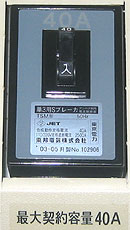
Eventually, I got tired of this. I’m not a big energy hog, but there are times when I want to use more than just a few appliances at a time, thank you. And thirty amps just wasn’t enough. So I called up the energy company, and it turned out they can upgrade–though in my case, only to 40 amps. Good enough; I asked them to come over, and the electrician installed the new breaker in just a few minutes.

It costs a few dollars more a month (my basic energy usage hasn’t gone up in itself), but it is very nice to be able to run the nuke wagon with the TV and cooler going and not find oneself suddenly in a dark room.; I haven’t had a single breaker trip since the upgrade.

Categories: Focus on Japan 2003 Tags: by

And a Few More

October 7th, 2003 Comments off

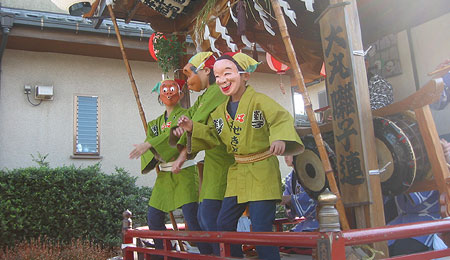
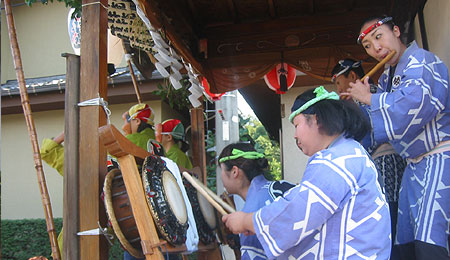
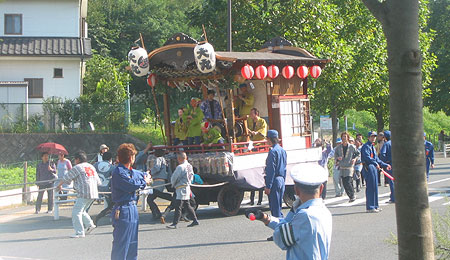
On the way back from Minami-Tama station, a local festival troupe passed by. I still don’t know what it was all about, but it was fun….

My favorite of all the photos was the second one. A bright sky background led to a very nice effect above the mikoshi. If you would like to see a larger rendition of the photos, click here.

Categories: Focus on Japan 2003 Tags: by

New Photos from Japan

October 6th, 2003 Comments off

Here are a few more photos I have taken around town lately.

This fellow, photographed outside Minami-Tama station on the Nambu Line, is an excellent example of the transition in telecommunications. When I first came to Japan, many people depended on payphones; I did, from time to time. There was an array of public telephone types, with different colors and abilities for connections (remember trying to hunt down a phone booth that could dial internationally?). And the prepaid telephone telephone cards were a big deal, sometimes used as business cards, and sometimes sold “recycled” by shady characters atop train platform staircases.

Today, most people use their cell phones instead–and in the case of this guy, in exactly the same spot he’d use if speaking on a payphone.

Right after I took the shot of the fellow at the phone, a squad of female Kyudo archers came by. You see students like this from time to time, dressed in their traditional hakata pants and keiko-gi shirts (apparently the tabi shoes are optional). If you’d like to know a bit more about Kyudo, go here.

Categories: Focus on Japan 2003 Tags: by

Blaming the Source

October 6th, 2003 1 comment

Schwarzenegger blames Gray Davis for the fact that now fifteen women have come forward with allegations of sexual harassment. The Bush White House is trying to get people to not take the leak of the CIA operative’s name seriously because the man’s wife is a Democrat. Supporters of Rush Limbaugh blamed his current racial slurs of the liberal media. Go back further, and you will find all sorts of claims of this sort, to George W. Bush dismissing his drunk driving arrest as a “dirty trick” played by his political opponents.

The question is, is it reasonable to try to excuse a wrong action by claiming your enemies released the news? The answer, of course, is no, for a few different reasons.

When it comes down to it, how the news was released has no bearing on what you did. If someone stole a car, it would make no difference if that person were turned in by a loved one or a lifelong enemy; the fact would remain that they stole a car. No matter that an avowed opponent released the information, or that it was released the day before the accused was to start a new job critical to their career. The leaker may be an unkind person, but that does not excuse the person who committed the crime in the first place. If you did wrong, you must be held accountable for that action. If the person who released the information had malicious intent in doing so, then that may also be wrong–but it is a separate matter. Any attempt to draw attention from the person who committed the crime and focus it on the person who released the information is nothing less than a dirty trick in itself.

Schwarzenegger claims Davis is behind the 15 women coming out with claims of sexual harassment. His proof? None. That could easily be a dirty trick–to take your own crime and turn it into a smear against an opponent. What about the Bush administration claiming that Ambassador Wilson is a Democrat? Yes, he made campaign contributions to Democrats, but he also did for Republicans; yes, he has appeared for Democratic events, but he has also appeared for Republican ones. Even George Bush Sr. praised him once. The claim that the crime is mitigated by the allegation about Wilson is as reprehensible as the attempts by Novak, Carlson and other right-wing pundits to try to make people believe Wilson’s wife was an analyst or a secretary, in which case no crime was committed–while they knew full well that the nature of her job was still classified, and so their lies would be veiled by the same laws that made the leak illegal in the first place.

In the end, only one thing matters: was there a crime, and if so, how serious was it? The leaking of the CIA operative’s name was a federal felony; that is indeed serious. That a presidential candidate was arrested for drunk driving is also relevant; it speaks volumes to judgment.

Conservatives will say, oh, you weren’t saying that when Clinton was accused of things? What about the “vast right-wing conspiracy”? Aren’t Democrats hypocrites for crying foul about Clinton prosecutions and then demanding the same for Bush?

Many points here.

The things Clinton was accused of were, far more often than not, without veracity. Take the Paula Jones case as an excellent example. First of all, her case was far too weak; it was widely agreed that if she had brought the same case against someone not the president, it would have been dismissed immediately on the basis of merit. The only reason it survived and was investigated was because Democrats were too willing to maintain the appearance of impartiality. If Paul Jones had brought that case against Bush, there would never have been any investigation; Ashcroft would have outright refused to appoint a prosecutor.

Second, there is ample evidence that Jones was indeed prodded to start her case by Clinton’s enemies, and was in fact given legal support and funding from parties avowed to destroy Clinton politically. As I mentioned, an accusation of releasing information for political purposes is a separate matter; and as a matter divorced from the allegations made against Clinton, the fact that Paula Jones’ case was spurred, financed, and abused by Clinton’s political enemies was, in itself, reprehensible.

Most importantly, when Clinton was accused of a serious matter, Democrats took it seriously, and agreed to the investigations. But the GOP so badly abused the special prosecutor statute that, toward the end, prosecutors were being demanded for the vaguest of rumors and the most piddling of offenses. It was never prosecutions for serious crimes that the Democrats opposed, it was rampant abuse of the legal system as a political weapon in cases where there was absolutely no merit or just cause whatsoever.

Categories: Archived Tags: by

The Framing of the Question

October 6th, 2003 Comments off

I am beginning to get very tired of the rather biased framing of questions concerning conservative scandals in the press. The idea of unbiased journalism is to not present one bias over another, to state the situation and possible considerations as evenly as possible.

We must be aware of the fact that a journalist’s question on a topic can sway viewers. The question itself provides a sort of grounding of the issue, a statement which the audience often assigns as the common assumption which will be believed until a great enough case is presented to disprove it.

For example, if you were to ask about the allegations concerning Schwarzenegger and women, a balanced question would be: “Are these stories about Schwarzenegger a last-minute attempt to smear him, or are they a legitimate story that should raise concerns in the minds of voters about the candidate?” The question does not assume a side in the question, and presents both possibilities, as any responsible journalist should do. It does not make any assumptions, and keeps the issue open. Perhaps the question could be more evenly stated to include other possibilities, but you see my point here.

However, in the press recently, the question is slanted: “Are these stories about Schwarzenegger a last-minute attempt to smear him?” This version of the question takes a side, and ignores or devalues the other perspective. Yes, the question can be answered to clarify the issue, but the damage has been done: the journalist has given the audience the impression that the smear idea is the one that has the most credence, and will stand until a preponderance of evidence can be brought to show it is untrue. That is biased journalism.

And the conservative scandals have been getting this kind of journalistic bias quite a bit in recent days. Has Rush been the target of the liberal media? Are Democrats taking a minor political blunder and trying to politicize it into a new Watergate? These questions are unacceptable from anyone who presents themselves as an unbiased journalist.

Categories: Archived Tags: by

And the Proof of Dirty Tricks Is… ?

October 5th, 2003 Comments off

Well, the media had a hard time not paying attention to six major concurrent Republican scandals, and so for one day, a lot of attention was given–but the day is over, and the media seems to be winding the stories down as quickly as possible.

Schwarzenegger, in fact, is getting a big break from the press, especially on the “dirty tricks” charge against Davis. The media had been lightning-fast in calling out Dean or Clark for making statements not supported by fact, but they’ve been pretty much supporting Arnold on his wholly unsubstantiated charge that Davis is somehow orchestrating all the bad news that is coming out about him.

Were all those women, now eleven of them, somehow created by the Davis campaign? Did Gray Davis tell them all to make up stories and then wait for this day to come out? Hardly. Nor is the timing suspect–the allegations have been around since before the campaign. The fact is, this campaign is so short, any timing could have been called “suspect” by some standards. In fact, if I were heading up a dirty tricks commission, I would consider this bad timing–rather, I would have had three or four women come forth initial maybe 15-20 days before the election, then timed it so that on or two more women would come forward every few days, so that a bad impression could be made early and sustained longer.

But Schwarzenegger is not being asked, or at least is not answering, any questions about what evidence he has that these reports are somehow part of a dirty tricks campaign. Instead, he is being given a free ride and allowed to create a completely false impression, one favored by Republicans in trouble:

Blame everything on the liberals.

Categories: Archived Tags: by

Dude, Where’s My Country?

October 4th, 2003 Comments off

By the way, Michael Moore has a new book coming out this week: Dude, Where’s My Country? It looks at the entire debacle that is the Bush administration, from Dubya’s business ties with bin Laden to the Patriot Act; Moore says that the book attempts to demonstrate how the leak of the CIA agent married to Ambassador Wilson for the purpose of political retribution is “just the tip of the iceberg.”

This is all in advance of Moore’s next movie, entitled “Fahrenheit 911,” scheduled to come out before the 2004 election. Moore says that “The primary thrust of the new film is what has happened to the country since September 11 and how the Bush administration used this tragic event to push its agenda. It certainly does deal with the Bush and bin Laden ties. It asks a number of questions that I don’t have the answers to yet, but which I intend to find out.”

Despite attempts to smear Moore in the media, he remains highly popular, and is already #4 on the Amazon bestseller’s list, despite not being released yet.

A good article on the film is here. You can order the book from Amazon U.S.A. here; for those in Japan, Amazon.co.jp also carries it.

UPDATE: In the last hour, Moore’s book has jumped to #2 on Amazon’s list!

UPDATE: And now, predictably, it is #1.

Categories: Media & Reviews Tags: by