Not Looking Good for Gates Crowley

July 28th, 2009 5 comments

The Cambridge police released the 911 call and the tapes of the police radio, and things don’t look all that spiffy for the story of Sgt. Crowley. They do not come close to proving Gates was right, but two key elements suggest that Crowley might actually have racially colored the situation and strongly suggest that he was not being accurate in his police report.

The first element is that Crowley strongly mischaracterized the initial report by Gates’ neighbor, Lucia Whalen. Whalen has received a good deal of criticism because everyone accepted Crowley’s report, in which he claims Whalen describes the two men at Gates’ house as “two black males with backpacks.” In fact, in her 9/11 call (mp3, transcript), Whalen did not initially give the race of the two men, and when asked, said that one of them “looked kind of Hispanic but I’m not really sure,” and reported that she did not get a look at the other one at all. Whalen also specifically mentioned seeing luggage.

Now, this was what Whalen said on the 911 tape, and Crowley got his information directly from Whalen on the street, which was not recorded. But to imagine that “two men with suitcases who might live there and one seems Hispanic and I didn’t see the other one at all” would within a minute or so transform into “two black males with backpacks” is not credible. Clearly, either Crowley made up that part or he radically misunderstood what Crowley told him. And that suggests that there actually was racial bias on Crowley’s part, if he contributed both “black” and “backpacks” in place of “unsure” and “suitcases.” Considering Whalen’s 9/11 call, it seems unlikely that she would even mention race at all unless asked by Crowley, in which she would have given the same answer as the 9/11 call. So “black” seems to have been either assumed by Crowley, or else later inserted by him after he saw the men–either way, his police report was false.

The second element comes from Crowley’s transmissions (mp3, transcript), which seem to contradict what he wrote in his police report. In his report, Crowley wrote:

I again told Gates that I would speak with him outside. My reason for wanting to leave the residence was that Gates was yelling very loud and the acoustics of the kitchen and foyer were making it difficult for me to transmit pertinent information to ECC or other responding units.

This is belied by the radio transmission, in which Crowley had no transmissions which were made unclear by Gates’ alleged “yelling.” In the sections of the recordings of the police radio coming from Crowley, you can hear Gates a little in the background, but nothing more than would be expected of a normal conversation. Listen to this file (mp3) with only Crowley’s transmissions:

While Crowley could have been speaking of yelling that happened which prevented him from even trying to make the calls at all, that is certainly not supported; in the transmissions he makes, there is silence for most of the transmissions–not what would be the case if Gates were yelling so loudly and so often that Gates was forced to leave the house. Instead, it now seems far more likely that Crowley actually left the house in an attempt to draw Gates outside so that he could arrest him.

In this case, the media in general has given Crowley the complete benefit of the doubt and Gates almost none on the basis of believing police officers first and arrest subjects last. However, it now seems that this bias was not correct, and Crowley’s report is now seriously in doubt.

Categories: Law, Race, Social Issues Tags: by

The Next Generation of Computers

July 27th, 2009 2 comments

While recently giving a guest lecture in a class at my college, I was asked what computers and computing would be like in 30 years’ time, and I found it hard to respond; although that’s been about how long personal computers have been around, there have been so many developments, both incremental and evolutionary, that it’s hard to predict what the product of so many upcoming separate developments may add up to in that much time–and that’s without considering that advancements in technology tend to be exponential in growth.

But one thing that should not be too hard to see coming is the next generation, what will take us through the next 10 years or so of computing, perhaps longer.

To start with, we have the interface: the OS. Think back to some of the early interfaces maybe half a century ago, which included punching holes in paper tapes and cards and feeding them into scanners that would translate the code into data on the computer. After that, we got the CLI: the Command Line Interface, the quasi-dialect of English which much more resembled human communication, but was still clunky and difficult to learn and use. After that, we got the GUI: the Graphics User Interface, with the mouse, the window, the desktop, the menu–visual metaphors which were much more intuitive, much more related to our human experiences, and so much better suited for human beings to deal with.

That’s where we are now. So, what’s next? It appears to be multi-touch. Yes, the thing that you have on your iPhone or iPod Touch, where you can swipe or pinch or twist and make the phone do stuff. That’s an embryonic form of what you’ll use to control your computer soon. To get a better taste of how that will work, watch the video below, with multi-touch whiz Jeff Han demo’ing his version of the interface. The real action starts at 2:45, so I have (hopefully) queued up the YouTube video to start at that time when you click ‘play.’ (If you want to start from the beginning, manipulate the slider to bring it back to 0).

But at 2:45, Han shows you how you can manipulate images. Some of it will be familiar, similar to what the iPhone does (note that this presentation is from February 2006, before the iPhone came out), but in a much more developed way, involving both hands, and with images moving independently. At 3:45, notice that Han calls up a virtual keyboard, resizes it, and then dismisses it when he’s through with it. At 5:50, see what he does with a program similar to Google Earth. At 7:25, note his use of a program that allows him to create elements which then act like real, dynamic objects instead of static drawings.

As Han notes during the presentation, one of the great things about this is that the interface simply disappears, it’s so natural that you hardly even realize that there’s an OS anymore. He also notes that the OS conforms to you, rather than you conforming to any kind of hardware–his example being the virtual keyboard, which is resizable.

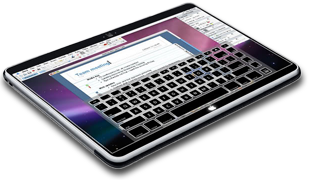
Itablet01So, when will this magical new OS come to a computer store near you? Well, potentially, we could be seeing it late this year or early next: very likely this is what Apple’s rumored multi-touch tablet device will use. It probably won’t be the total break from the current OS that the Mac OS was in 1985, but it should be the start of that evolution to the next interface. As I said, we’ve already seen elements in Apple devices already. Note, for example, not only the multi-touch features in the iPhone and the new Macbook trackpads, but also note the developments in screen technology, most notably the hard-surface screen that Apple snuck into the latest Macbooks–a must-have if you’re going to use a touch screen device–and the new Oleophobic surfaces on the iPhone 3Gs, also necessary to avoid a mess of smears on a tablet screen. New features in Snow Leopard may even facilitate the migration to the new interface. And patents filed by Apple over the past few years have pointed to pretty much exactly this.

But the tablet computer will be more than just a new interface: it may very well be a new composite device, rolling several previous devices into one handy gadget. Think of your current smartphone. (What, don’t you have one? How 2005 of you.) That’s not just one device, it’s 3 or 4. Remember when you used to have an iPod (or Walkman, if you want to go farther back) to keep your music, a PDA to keep calendars, contacts, and notes, and a cell phone to make phone calls? All three of those are now one device, with some functions from your laptop thrown in for good measure. I now kind of chuckle when I see one of my students in the elevator holding both a digital music player and a cell phone.

The tablet could be a similar rolled-up device. We already are moving from desktop computers to laptops; like the move from the big CRT screens to today’s flatscreen LCD monitors, laptops are more expensive and lower quality than desktop computers, but we are starting to buy more laptops than desktops, and they are quickly becoming the default computer to get. The tablet will be that computer, but it will also be an e-book reader, possibly even replacing the Kindle as the e-book device of choice. It could take over much of the netbook market, and could even take over some if not all of the functionality of your smartphone, should you find a way to handily lug the tablet around with you everywhere. Apple’s new tablet is supposed to come with a 3G connection, and with a Bluetooth headset, it could serve as a communications device, eventually doing more than just regular cell phone calls, but adding Skype/iChat communication as well. Phone carriers might see the future is in data plans rather than talk plans.

You may have heard people talk about how the new tablet from Apple will be a “revolutionary” device, and probably discounted that as hype, since we’ve heard that so often in recent years (we’re not all riding around on Segways now, are we?). And the tablet may not be that revolutionary–but it’s not a bad bet that it will signal the start of the next generation of computers. Just like the Lisa was the precursor to the Mac and the popularization of the GUI, the iPhone could be the precursor to the multi-touch tablet.

And yes, I do own Apple stock. But even if I didn’t, I’m pretty sure I would be saying the exact same thing as I am now.

Quantum Weirdness

July 26th, 2009 10 comments

IntOne physics experiment that is fascinating to contemplate is the double-slit experiment. You shine a light through a slit in a wall onto a light-sensitive screen behind it, and you get an exposure of light in the form of a single vertical line behind the slit. But if you open two slits in the wall and shine a light through, you don’t get two vertical lines of exposure–you get several: an interference pattern. The idea here is that light coming from each slit interferes with light coming from the other slit–like waves coming from two stones dropped into water–producing the multiple lines on the screen.

Normally, all this would prove is that light has wave-like properties, the waves from each slit interfering with each other. Now, if you perform the experiment again, except this time you only allow one “particle” of light through at a time, then you get the same result: an interference pattern. If only one “particle” of light is in motion at a time, going through only one slit, then what interferes with it?200Px-Double-Slit Experiment Results Tanamura 2 A wave makes sense–but we usually think of waves as bing made up of numerous parts. If there is only one “bit” or “piece” of light, how can it go through two slits at the same time, and then interfere with itself?

The popular solution to this problem is to assume that the particle did travel through both slits–in fact, the assumption is that the particle traveled every possible path from the light source to the screen. In essence, a vast horde of possible-particles each take slightly different paths, forming a virtual wave–and a wave can go through both slits, forming two wave-like patterns emerging from the other side of the slits, each one interfering with the other, creating the interference pattern. When the particle-wave hits the screen, the paths all “average out,” collapsing the vast number of possible-particles-wave into a single real one that represents the most likely path taken. Because interference was involved on the way to the screen, we get the interference pattern–despite there being only a single particle.

Some take this further, and suggest that instead of all those possible-particles existing in this universe alone, they represent a manifestation of the many-worlds hypothesis, where the light particles from many other universes much like our own interfere with the particle in our universe. In other words, the particle never becomes a wave, it simply interacts with particles from other universes which together resemble the effects of a wave.

But that’s not the end of the weirdness. Place sensors at the slits so we can sense which slit the particle is going through on its way to the screen, and something interesting happens: the interference pattern disappears, and we get two vertical lines.

This is due to what is called the “Copenhagen interpretation” of quantum theory. As stated above, all matter exists as that many-possible state, a “cloud” of possibilities, until it is observed. For example, if you flip a coin and it falls where you cannot see it, it is in a state of flux–it is both heads and tails, and exists in every possible location it could have possibly landed–and it stays that way until you shine a light on it and see it. Once you do that, the cloud of possible outcomes “collapses” into a single outcome, which is then “real.”

So, in the situation described above where the sensors are placed at the slits to see which one the particle passes through, we are observing the particle before it passes through the slits, therefore collapsing the possibilities and making it into a single “real” particle able only to pass through one slit–thus the interference pattern disappears.

In short, by observing the event, we change its outcome. That’s something which we hear about, but it sounds like some abstraction that doesn’t really affect actual events. However, the result of placing the sensor at the slits takes it from the theoretical to the real. It’s not just a thought experiment any more–it actually happens, and we can see it. It’s real.

Upon hearing about this, I had a question: what is causing the results to change? Is it something from the sensors at the slits which changes the nature of the particle? Or is it the fact that a conscious observer sees the data coming from the sensors? This is a key question: if consciousness is necessary, then this implies that consciousness is somehow tied into the laws of physics, so that a human observing something makes it “real” instead of simply possible.

So I thought of a way to test this: put the sensors at the slits, have them record the data–but then, before you see what pattern emerged on the light-sensitive screen, erase the slit-sensor data so no human ever sees it. If it is the sensors which are making the difference, then the waveform should collapse and the interference pattern disappears, no matter what the humans decide to observe.

For a long time, I thought no one actually did this experiment, until I found a lecture on YouTube where a physicist lays out exactly that test (see here and here). It’s called the “Delayed Choice” experiment.

The result: if the sensors are used, and the data is recorded–but then is erased before the screen’s pattern is looked at–the interference pattern reappears, as if the slit sensors had no effect. If the sensor data is not erased and is looked at before looking at the test’s results, then the interference pattern disappears. Meaning that it was the human viewing of the data that determined the outcome of the experiment. It is interesting to remember that the choice to observe or erase the slit sensor data is made after the experiment concludes–and the recorded data changes depending on an action taken after it was recorded.

This seems particularly significant–it would seem to confirm that human consciousness ties into the laws of physics. But a key point to remember is that when the particle hits the screen, that event does not determine the location of the particle hit. The results on the light-sensitive screen are also in flux until they are observed.

The way it was explained in the YouTube lecture:

Despite the fact that machines have registered something at the slits and at the back wall, there is no information at the back wall until we choose to look at it.

When we choose to look at it, the information about where the particles hit at the back wall will be created, and the result will be determined by our knowledge (or lack of knowledge) of the particles at the slits.

In this way, we seem to establish that the machine “observation” does not collapse the wave function of the particle–only human interaction does. So it would seem that human consciousness is tied in to the fabric of reality.

However, the official explanation is that human consciousness is not required–though I have yet to find out how that was determined. (If anyone reading this knows a source, please point it out.)

However, whatever way you look at it, there is one unavoidable conclusion: the sensors at the slits are not what’s responsible for the changes; in this case at least, it is a purely human decision, a matter of human perception. Making a decision and looking at sensor data presently physically unconnected to the light-sensitive screen will make the data on the screen change form one pattern or another.

Any way you look at it, weird stuff is going on here.

If you can get a fair grasp on what is written above, then you will probably get one of my favorite science jokes, from Futurama. The gag is in the first half-minute, with the punch line at 25 seconds:


Postscript (same day):

I have been doing some more research, but as of yet cannot find anything which positively refutes the idea that it is human consciousness that makes the difference in collapsing the waveform. I have found several sources which say that a human consciousness is not necessary, but no explanation of an alternate system which can fully replace the human observer, doing the same thing in the same way.

In terms of theory, what I have found seems to say that the original theory linked the effect to actual human consciousness, and that most scientists were uncomfortable about how this might relate to mysticism, and so started to formulate theories that negated the idea. If this is all–theories and no experimental proof–then I find it highly suspect. A scientific theory should absolutely not be determined by the prejudice of the theorist; if the evidence leads to an answer which seems mystical, then so be it. I get the nagging feeling that I am wrong and there is proof that human consciousness is not truly involved, but if that’s the case, why isn’t proof of this more evident? I would think that such evidence would be put front and center in most discussions on the subject–so why is it so hard to find?

Certainly, the evidence I have seen so far seems to support the human-consciousness model. After all, in the quantum-eraser experiment detailed above, it was established that the sensors recording the passage of the particle through the slit were not sufficient by themselves to collapse the waveform, because even when they functioned and recorded the event, all it took was the lack of a human looking at the data to make the effect of the sensors nil. Similarly, even the particles of energy hitting the light-sensitive screen was not enough, as the pattern left was changeable depending upon a human observer, even if the observation happened after the particles supposedly hit the screen.

If neither highly sensitive sensors recording data on a particle’s position in transit nor a screen recording the location of a particle’s impact are sufficient to collapse the waveform, then what non-human agency is capable of this, and how does it differ from human interaction?

Here are some suggestions for further experiments which I think would be very interesting:

1. Does the observer have to be able to recognize what they are seeing? What if a person sees the slit-sensor data but is not told what they are looking at, and they don’t understand it? Will that change the pattern the particles leave?

2. If the observer does not need to understand what they see, then does the observer have to be human? What if a chimpanzee, or even a dog, sees the data? Does this affect the patterns like it does when a person notices the data?

3. What if two different people observe the data? One person sees the slit-sensor data, but vows never to discuss it with a different person who sees the pattern left? I suppose it would also be necessary to prevent the observer of the slit-sensor data from seeing the pattern left on the screen.

That leads to another question: is it the erasure of the slit-sensor data that affects the pattern on the screen, or is it the decision to erase the data? That suggests another experiment:

4. Have a scientist perform the quantum-eraser delayed choice experiment, but don’t tell him that we’ve disabled the erasing function for the slit-sensor data. Let him think he’s erased the data, and see if the pattern still changes!

If the pattern becomes one of interference as if the data had actually been erased, then one would wonder what would happen if the data were then viewed, especially by that scientist, after the screen’s pattern had been viewed.

If these experiments have already been done and you know about them, please do tell! If not, I wonder why not–they all seem rather significant.

Categories: Science Tags: by

The Spirit of the Party

July 26th, 2009 Comments off

Republicans expressing their opposition to health care sure sound like they’re saying that they want good-quality health care limited only to people who can afford it (which means them), otherwise they’ll be inconvenienced by lines formed by all the peons who’ll get it under Obama’s plan.

Categories: Right-Wing Hypocrisy Tags: by

iPhone Doing Fine in Japan

July 25th, 2009 1 comment

It was pointed out that, in Japan, the iPhone 3GS ranked #1 and #2 (32 GB and 16 GB) almost a month ago because it was the week of the phone’s debut. Even for that, taking the top two spots in a country where the phone was supposed to fail miserably, debut week or not, was a pretty good showing.

Well, now it’s three weeks later. How is the iPhone doing? In week #2, the 32 GB dropped to #2, and the 16GB dropped to #9, seeming to confirm that the iPhone’s popularity was an artifact of the publicized release.

But then, in week #3, the 16GB iPhone stabilized at #9–and the 32 GB iPhone popped back up to #1. In such a competitive marketplace, a debut fad should not act that way. The iPhone is not just #1 as a blip. After 3 weeks, both versions of the phone rate in the top 10. Sharp is the only other maker with more than one handset in the top ten (they have 3, at nos. 2, 5, and 6); the rest of the top ten include single placements from Panasonic, NEC, Sony Ericsson, Casio, and Fujitsu.

Remember, the iPhone was supposed to fail utterly because Japan’s market is saturated with highly advanced smartphones. So, why is the iPhone still #1 after 3 weeks?

Categories: iPhone Tags: by

Microsoft Not Impressing This Week

July 25th, 2009 Comments off

Microsoft isn’t showing its best colors recently. Their sales fell 17%, profits fell 29%, and the stock plummeted by 8% on the news. Compare with Apple, whose sales were strong in another record-breaking quarter which beat market expectations.

One reason is lack of innovation. Microsoft has been making a big deal of its upcoming stores, but most of what they’re doing only plays up how they are losing to Apple. The very fact that they are opening stores at all shows that they recognize Apple’s success in that area, so they are copying the move. The stores will include an “Answers” or “Guru” Bar, copying Apple’s Genius Bar. The only thing they are not copying–or cannot–is a successful style. Where Apple understands the benefit of muted simplicity and elegance, Microsoft is aiming for flashy, gaudy lack of taste, pasting their logo on every available surface. Speaking of “Surface,” they’re loading that “Big Ass Table™” into the store, along with other stuff which is not actually for sale or else is not affordable to the consumer. Apple doesn’t do that–everything you see is for sale, no items are there for flash only, nothing that costs $10,000 like the Surface.

In essence, Apple innovates, usually getting the details right; Microsoft copies, usually getting the details wrong.

Look at the next rumored Apple product, the iTouch Tablet (or Macbook Touch, or whatever it might be named): already people are talking about how it will revolutionize digital media. This is how the iPhone was also developed:

The 10-inch, 3G-enabled tablet, akin to a jumbo iPod touch, is the latest brainchild of chief executive Steve Jobs. That distinction, as insiders will tell you, carries its share of baggage. Under the critical eye of Jobs, contours must be precise, each pixel of the interface has to match a particular vision, and there can be no fault — no matter how slight — or it’s back to the drawing board.

As such, AppleInsider has observed silently as the project was reset at least a half-dozen times over the past 24 months. Each time, development was frozen and key aspects of the device rethought, retooled and repositioned. At times, those close to the Apple co-founder had their doubts that it would ever see the light of day, just like a smaller PDA device he canned a few years after returning to the company.

Microsoft is proud of its Big Ass Table™, as if it were exactly what the public is clamoring for. While it has some cool features, it is completely impractical. Like the Zune, Microsoft was just shoving stuff out there without understanding what is in fact useful, well-designed, or desired. Neither Surface nor the Zune would ever have passed Apple’s standards. Not that everything Apple puts out is perfect; my last post about the Mail app makes this clear. But most of the time, Apple’s standards and sense is spot-on.

As has been pointed out, Apple doesn’t make junk because others are making some money off of it; if it did, they’d be selling cheap netbooks like everyone else, to the dissatisfaction of too many customers. Apple is the kind of company that makes devices its creators want to use, as opposed to most companies which just try to react to what the market seems to be calling for. That means Apple will make stuff that satisfies their own high standards, whereas other companies all too often just make crap which satisfies a shopping list defined by focus groups.

Microsoft falls into the group opposite from Apple: being the type of company that reacts, they don’t innovate, they copy.

Plus, they embarrass themselves all the time. A few weeks ago, Microsoft’s COO Kevin Turner made a huge deal out of the fact that Apple’s lawyers called him and told him that Microsoft would have to pull or else change their ads. The ads hit Apple on pricing, but were made before Apple dropped prices. One commercial still airing showed a Macbook Pro priced at $2000, when the current price was $1700; Microsoft’s ad claimed a price no longer true.

Turner apparently thought the demand was hilarious:

And you know why I know [the ads] working? Because two weeks ago we got a call from the Apple legal department saying, hey — this is a true story — saying, “Hey, you need to stop running those ads, we lowered our prices.” They took like $100 off or something. It was the greatest single phone call in the history that I’ve ever taken in business. (Applause.)

I did cartwheels down the hallway. At first I said, “Is this a joke? Who are you?” Not understanding what an opportunity. And so we’re just going to keep running them and running them and running them.

Of course, Turner now looks like a complete idiot because Apple’s call was completely legit–Microsoft’s ads, as they stand, constitute false advertising–something that MS apparently now agrees with, because they quietly changed the ads in exactly the manner Apple demanded.

All in all, Microsoft is not impressing the hell out of anyone recently.

Categories: Computers and the Internet Tags: by

Things Wrong with Apple’s Mail

July 25th, 2009 9 comments

I am long through with using Eudora as my email client, but I am still not satisfied with Apple’s Mail app. There is too much missing from a program which, by now, should be much better-managed. Like the Mail app on the iPhone, it simply doesn’t do things right–obvious features are left out, and very annoying bugs or badly-run processes are left to continue from version to version. Like making a mouse, Apple fails repeatedly at getting the email app right.

First of all, Apple’s Mail does not allow you to stop a send-mail process. For example, if you click “Send” for an email and then a moment later realize that you used an outgoing server which would not work from your location, then you are screwed, for the next long while at least. Mail will simply sit there are attempt to complete an impossible process, not allowing you to stop the process, recover the email draft, reset the outgoing server, and getting the mail sent right away.

No, instead, you have to wait for an indeterminate amount of time–sometimes longer than 5 or even perhaps 10 minutes–for Mail to figure out that it can’t do it, when it finally releases your message. Your only alternative is to completely re-write the email and send it correctly this time–which you don’t know is necessary, as the original email could pop back at any time. This is incredibly frustrating.

Apple claims that you can kill the process, but I have tried on several occasions, and it never works.

Second: you cannot edit received mail within the app. This is presumably to preserve the original email as a record. Eudora did not limit you that way, but Apple does. I find it frustratingly stupid. If I really wanted to fake an incoming message, I could just access the record directly and do so with a text editor. Keeping me from doing it in Mail doesn’t keep it from happening, it just makes legitimate uses for the act a royal pain in the ass. Why do it at all? Often times I will want to add notes to an incoming email, so that it will remain in my records and will be accessibly by searching for the email. Keeping separate notes makes it harder to keep track of things.

Third, Apple provides no way except for a “flag” to tag a message. Eudora allowed you to use up to 14 different colors to mark email as different types; I used this feature all the time. There is no reason for Apple not to make that highly useful feature available, and yet they never do.

And finally, the Mail app does a crappy job of marking mail as “Replied to.” When I give my students a test using a web page form, for example, I get their results by email; I then correct them and send them back. But when I reply to their original emails, sometime Mail stubbornly refuses to mark the message as “replied to.” Most will, but some will not, leaving me wondering later if I really replied to it at all.

It seems that if, while working on a reply, if you do a “Save” or close and later re-open a draft, the original message will not be marked. Worse, Apple does not give you the option of manually marking the message as having been replied to.

One other annoyance is the mail search. Eudora made theirs easy and powerful; Apple’s version is hard to handle. It took me a few years to realize that you could search for more than one keyword or element by using “Smart Mailboxes”–not an intuitive solution at all, nor an easy one to use. Even then, I am deeply dissatisfied with how Apple made it work.

Apple has had more than enough time to perfect their main Mail app, and the iPhone Mail app seems destined for the same fate, with no-brainer features like being able to batch-mark messages as read being left ignored for years.

It is strange that Apple can be so adept at most things, but in a few, isolated but important areas, to do such a poor job. I can only assume that such tasks are split into teams, and some teams are not nearly as good as others.

Categories: Mac News Tags: by

Why the Republicans Want to Kill Health Care Reform

July 25th, 2009 4 comments

Steve Benen at the Washington Monthly, as always, has a good handle on the issue. The essence: if the bill passes, then as many as 100,000 people per congressional district who now are not covered would get coverage–and if Obama and the Democrats get credit, there will be a lot of grateful people out there.

This puts the Republicans in a risky position: if they defeat the bill, then they gain a victory similar to the one they realized in 1993. But if the bill passes, then not only do Obama and the Dems get credit, but there is the added dimension that the Republicans tried their hardest to kill it–and worse, they were too weak to stop it despite putting their full weight into it.

So the Republicans have a lot on the line, but in the end, the sad thing is that they have pitted themselves against the best interests of the American people. Not a great position to be in, but in some respects, seeing as how for them the greatest issue is power, they didn’t have too much of a choice. Their only hope to avoid disaster here is to sell the American people on the idea that Obama’s health care reform bill is dangerous–which, of course, is their current message. That sales pitch will get harder to make if the bill passes and millions of Americans find they are fully covered where they were not before, and millions of others find themselves with more choices and, if it works, lower costs overall.

The state of health care in the U.S. is so abysmal that it would be hard to believe that almost any well-intentioned plan, even a bad one, would not look good in comparison. The hitch: Republicans have shown that they are fully willing to label any Democratic success a “disaster” and work 24/7 to sabotage it. Note how they have been straining like mad to block stimulus money from getting through.

So Republicans, in addition to fighting Obama’s plan, may also have to work to destroy any chance of it working if it passes. And they’re good at that–destroying effective government agencies and then saying, “See?! Government can’t do anything right!”

Fortunately for them, they have a powerful media machine in place to sell the fictions that serve them–at least 30% of the nation will drink the Kool-aid regardless, and those people will make lots of noise, just like the Birthers now do.

The GOP is no longer just the “Party of No”; they are now the Party of “Destroy America First in Order to Save Our Political Asses.” Sad, sad; you can grant them with being strong-willed and unafraid to fight, but you cannot grant them any measure of love of country. Love of party, absolutely; but their definition of country is their party and nothing else; their definition of patriotism is to gut the country if anyone else is in charge.

Was Crowley Racist? Probably Not. But That’s Not What Obama Was Talking About.

July 24th, 2009 5 comments

A lot of the controversy over the Gates arrest is now focused on racism. And the other day, when asked about the situation, Obama–clearly admitting that he was biased and did not have all the facts–suggested that the arrest was “stupid.” The problem is, conservatives–as well as a good chunk of the mainstream media–have now made this about Obama attacking the police for racism, when that is not even close to what was the case.

Here is Obama’s original statement:

My understanding is, at that point, Professor Gates is already in his house. The police officer comes in. I’m sure there’s some exchange of words. But my understanding is — is that Professor Gates then shows his ID to show that this is his house, and at that point he gets arrested for disorderly conduct, charges which are later dropped.

Now, I’ve — I don’t know, not having been there and not seeing all the facts, what role race played in that. But I think it’s fair to say, number one, any of us would be pretty angry; number two, that the Cambridge police acted stupidly in arresting somebody when there was already proof that they were in their own home.

And number three, what I think we know separate and apart from this incident is that there is a long history in this country of African-Americans and Latinos being stopped by law enforcing disproportionately. That’s just a fact.

Note that while race is mentioned here, Obama (1) does not refer to the arrest as stupid in any way related to race, and (2) makes no claim that actual racism was involved–he actually says “separate and apart from this incident” there is a history of racism, referring to either why Gates reacted as he did, or that sensitivity must be practiced by all parties when race even might be an issue, or both.

The result? The narrative now is that Obama’s remark was somehow an accusation of racism, and an attack on an honest, hard-working cop. One example of how the story is being reported:

Crowley’s account came on a day of dizzying debate over his actions, a furor that was touched off by President Barack Obama’s remarks at a news conference Wednesday night, when he said the police had “acted stupidly” and linked Gates’ arrest to the nation’s long history of racial profiling.

“Linked” being the key word. In a very loose sense, it’s true, but the use of that word implies that Obama accused the officer in some sense of racism–when Obama went to great lengths to avoid saying exactly that. Can you honestly say that Obama “linked Gates’ arrest to … racial profiling” when Obama said “separate and apart from this incident” there is a history of racial profiling? And he was right in that there is a history of racial profiling.

It’s a shame, because the real issue of importance here is not Obama, and not even racial profiling, but rather “contempt of cop” arrests–the “stupid” act that Obama referred to. And Obama was 100% right–it was a stupid arrest, almost certainly a case of a cop getting annoyed at someone and abusing his power to slap that person down.

But what about racism? Was is in fact involved?

While I strongly disagree with the arrest, I don’t think that the facts much support the idea that Crowley himself was racist. It’s possible that he made racially biased assumptions, but far from certain, and Crowley deserves the benefit of the doubt on this.

The initial situation that Crowley was put into was unavoidable: he received a call reporting a break-in, so naturally he had to investigate. He could not just say to himself, “Hmm, there’s an older gentleman inside, he’s probably the owner, I’ll just go away.” He had to check and find out who Gates was. Nothing wrong there.

What Gates identifies as racism is less of a clear-cut situation: that Crowley asked Gates to step out onto the front porch. Apparently, it is much more difficult for an officer to make an arrest if the individual is indoors rather than out; a policeman asking someone to step outside could be a prelude to an arrest. And if Crowley was intending to arrest Gates with no questions asked, then that would have been far more likely a case of racism–it is perhaps not as likely that a police officer would arrest a 58-year-old white person using a cane, in that situation, in such a fashion.

But this is where benefit of the doubt comes in: perhaps Crowley was simply asking Gates to step outside just to be on the safe side, allowing himself more options should the situation take a bad turn. We can’t know what Crowley’s actual intent there was, and so cannot make the assumption that Crowley was being racist–especially since it appears that he did not do anything after that which appeared significantly out of order–until the actual arrest, that is.

Gates, however, made that assumption right off the bat, but there was a contributing factor: that the call had been made at all. This was not Crowley’s fault, of course; the neighbor may have over-reacted. She saw a man forcing open a door–but she also noticed two men. This is critical. To see two men, she had to either see Gates before he entered the house, in which case she would have seen him go around and enter the house easily before the forced front-door entry occurred, or she had to see Gates inside the house when the door was forced open. Neither make sense in the context of an unlawful break-in.

The fact that the neighbor reported men with “backpacks” casts further suspicion: neither man was wearing a backpack–instead, they were dressed in suits, carrying luggage. Where did she get backpacks from, and how did she miss the suitcases? Seeing two men dressed in suits with luggage is a far cry from two men with backpacks; one suggests a returning resident, the other suggests young thugs. It is easy to question whether the neighbor would have reported things differently had she seen two white men in suits, one with greying hair and a cane, in the same situation.

So Gates had returned home in a context that did not match any reasonable expectation of a break-in, and yet moments later police come and act like he may be an intruder. The real turning point was Crowley’s request that Gates step outside, which Gates recognized as a possible prelude to an arrest. With these two facts–an accusation of a black man in an upscale white neighborhood breaking into his own home, and the likelihood that the police officer would simply arrest him right off the bat–Gates forms a new context, and from that point on, everything he sees is colored by it.

Race may very well have played a part in setting up the situation–but it is less than perfectly clear. The neighbor could have just seen things wrong and maybe race had nothing to do with it; the officer could have just been following procedure and might not have treated Gates differently than anyone else. But in the overall context, Gates did have reason to believe that race was involved–though he certainly over-reacted, even if you don’t take the officer’s account at full face value.

What is likely the case is that the neighbor saw the forced entry, and as witnesses are wont to do, painted in details that weren’t there–not an act of overt racism, but more than likely unconscious bias, giving us backpacks instead of suits and luggage, and ignoring the overall context where Gates was already indoors. The policeman came and made what he considered a by-the-book encounter; though he may have intended to act inappropriately and would have arrested Gates right off, we have to assume that he just wanted Gates outside to make the situation easier to deal with. But by that point, Gates had received one too many signals that he was being treated in a racist manner, did not give benefit of the doubt, and started making accusations–accusations that Crowley probably was strongly offended by. The main business of identifying the owner done, Crowley then makes the next big mistake: by wildly overreacting to an angry man who believed he had good reason to be upset, and arresting Gates on trumped-up charges.

That’s the main issue in the end. While actual racism may have played a small, contributory role in setting this up, it was the early taking of offense by both gates and Crowley which escalated things, and eventually Crowley was most at fault, using his authority to satisfy his personal grievance.

And that was the only part of this which was way over the line: the contempt-of-cop arrest.

Obama’s comment did not accuse the cop of racism, but because the media is playing it that way, it’s now about the stuck-up Harvard elitist and his reverse-racist pal in the Oval Office dumping on an honest, hard working cop by labeling him as a racist. Right-wing sites are already ginning up conspiracy theories, like the Boston Globe removing the police report from their web site because it was too embarrassing for Gates, or because it contradicted the paper’s liberal-media agenda to make Gates look like a victim–as if the police report is gospel or something.

So much for any attention on the abusive practice of “contempt of cop” arrests.

By the way, a comment just filed in the previous post sheds new light on why Crowley worded his police report so oddly. From Massachusetts state law, two of the four identifying qualities of what constitutes “disorderly conduct”:

“with purpose to cause public inconvenience, annoyance or alarm”

“engages in fighting or threatening, violent or tumultuous behavior”

Then, from Crowley’s report:

Due to the tumultuous manner Gates had exhibited in his residence as well as his continued tumultuous behavior outside the residence, in view of the public, I warned Gates that he was becoming disorderly. Gates ignored my warning and continued to yell, which drew the attention of both the police officers and citizens, who appeared surprised and alarmed by Gates’s outburst.

It seems pretty clear that Gates was very intentionally cribbing language from the state code so as to justify the arrest. These terms raised flags–note that my post pays special attention to these terms, as they stood out as rather unusual and unlikely. Now we know why: Crowley had to justify the arrest. Whether this is regular practice or not, it seems to cast doubt on the accuracy of what he claimed, as if it were tailor-made to fit the law, as opposed to being a true and objective account of what actually happened.

Categories: "Liberal" Media, Law, Race, Social Issues Tags: by

The Gates Arrest

July 23rd, 2009 9 comments

Henry Louis Gates Jr., a Harvard professor and director of the W.E.B. Du Bois Institute for African and African American Research, was arrested at his home last Thursday. The facts which are not in contention: Gates and his driver, both black, arrived at his home and had trouble entering; the door was jammed, and Gates’ driver had to shove at it to get it to open. A neighbor called the police to report two black men with backpacks breaking into the house; a policeman arrived and asked Gates for identification. Gates showed an ID, and after some discussion in which Gates asked for the officer’s ID, the police officer left the house. Gates followed him outside, and the officer arrested him on charges of disorderly conduct.

Outside of those facts, the stories are–not to use too ironic a phrase–as different as black and white.


According to the arresting officer in the police report (PDF), Sgt. James Crowley, Gates yelled at the officer, alarming the neighbors, and thus warranting the arrest. He claimed that when he first met Gates, upon being asked, he immediately identified himself, stating that he was there to investigate a reported break-in. He claimed that Gates responded, “Why, because I’m a black man in America?” Crowley wrote that after asking if anyone else was inside, Gates told him it was “none of his business” and accused him of being racist. He says he “assured” Gates he was responding to a legitimate crime report, but Gates made a phone call to someone, asking for the “chief,” and told someone over the phone that he was dealing with a “racist police officer.” He than asserted that Gates turned to him and said that Crowley “had no idea who I was ‘messing’ with and that I had not heard the last of it.”

Crowley then said that he was surprised that the legitimate owner of the home would act in such a fashion. He said that he asked Gates for ID, and that Gates refused, but later produced a Harvard I.D. card, which Crowley called in to verify. He claims that Gates asked his name again and that he started to reply, but Gates yelled another racist accusation at him before he could complete an answer. Crowley claimed that Gates again threatened that he was not to be “messed with,” and asked again for identification; Crowley claimed that he stated that he had identified himself twice and would now leave, and Gates could talk to him outside if he wanted. Crowley wrote in his report that Gates was yelling so loudly that he could not report anything using his radio, which is why he left the house. He then claims that Gates responded, “ya, I’ll speak with your mama outside!” Gates, he said, followed him outside and “continued tumultuous behavior .. in view of the public.” He held that outside, he warned Gates twice that he was becoming “disorderly,” and claims that bystanders “appeared surprised and alarmed by Gates’s outburst.” After ignoring repeated warnings, he then arrested Gates.


Gates tells the story differently. In an interview the other day, he claims that he was returning from China to his Cambridge residence provided by Harvard University. He said that his driver, dressed in a suit, helped him with several bags–no backpacks–up to the front door, but it was jammed, with a footprint on the door suggesting that someone may have tried to break in. He went around to the kitchen door, unlocked it, and came to the front door from the inside, but still could not open the door. To get the door open, his driver shouldered the door open, damaging the lock. He said he then called someone at Harvard to get the damage repaired.

At that time, Sgt. Crowley arrived. Gates says that he began by asking, “Officer, can I help you?” and that Crowley asked him to step out on the porch. Gates says that he got a bad feeling then–that the officer would not ask him out on to the porch just to talk to him. He claims that the officer informed him that he was responding to a 911 call about a break-in, to which Gates replied, “That’s ridiculous because this happens to be my house. And I’m a Harvard professor.” When asked to prove it, Gates says he provided both a Harvard ID and a drivers license. At this point, Gates says that Crowley asked another (undefined) question, but Gates instead started insisting that the officer provide his name and badge number, because he wanted to file a complaint–Gates explained that the officer did not act like a policeman usually would, asking if it was his house, but instead started by trying to draw Gates outside, and Gates felt that this is not how a white person would be treated.

Gates said that he asked the officer to identify himself three times, but the officer refused; Gates claims he said, “You’re not responding because I’m a black man, and you’re a white officer,” at which time Crowley turned to leave. Gates followed him out to the porch, where he said that at least a half dozen policemen had gathered, and demanded the ID of another officer there–at which point the officer turned around, said “Thank you for accommodating our request. You are under arrest,” and handcuffed him.

As for the yelling, Gates claims that the officer’s charge is ridiculous, in that Gates had contracted a “severe bronchial infection” in China and had not yet fully recovered, thus rendering him incapable of shouting as Crowley claimed.


You can see how greatly the account clash. Each presents himself as calm, reasonable, and measured, and the other as unreasonable. In such cases, it is safe to presume that the truth lies somewhere in between. The question is, where in between? Crowley paints Gates as being far more unreasonable than Gates paints Crowley. Crowley asserts that Gates, a professor of African and African-American Studies at Harvard University, shouted, “ya, I’ll speak with your mama outside”; while that is not impossible, it does come across as incredibly unlikely, even if Gates were truly pissed off.

It would interesting to see what neighbors who witnessed the event would say about how Gates and the officer were acting outside–for example, was Gates in fact yelling loudly, and were the neighbors truly so “surprised and alarmed” that it warranted an arrest?

Short of that, one should ask if the officer’s reaction was warranted even if we take his word 100% and completely disregard Gates’ version of events. And I think that the answer to that is, clearly, the officer was out of line. Gates was, after all, the one being accused of breaking into his own home; while some people would be happy that police are on the job and assuring the security of one’s home from intruders, some people would not take it in that light. There’s no law saying you have to be grateful. And with the history in America of police and black people, one could at the very least understand how a black man might not be thrilled at being accused of breaking in to his own house.

But the deciding factor was not whether or not Gates was too ungrateful, but rather, was there cause to arrest him at all. Even if you had a severely pissed-off individual here, was he creating so difficult a situation that an arrest was necessary? Let’s face it–we’re talking about a 58-year-old man using a cane, and the worst that even Crowley claims that he’s doing is yelling. Is yelling on your front porch a crime, especially if there is a reason–whether you agree with it or not–for him to be so aggrieved?

What did Crowley feel would happen without the arrest? Did he think it would spiral into violence? While that might sound ridiculous, that is the prima facia reason that Crowley made–he made the arrest only after Gates’ “tumultuous” (dictionary definition: making a loud, confused noise; uproarious) yelling, which “surprised and alarmed” his neighbors. Crowley justifies the arrest by making it seem that Gates was acting in a way that was disruptive to some damaging degree.

I wasn’t there, of course, but from reading the accounts, I cannot possibly see this as being the case.

Instead, what appears to have happened is that Crowley arrested Gates for what is commonly referred to as “Contempt of Cop.” This is when a police officer, in his opinion, finds a citizen to be sufficiently disrespectful, and so arrests the citizen on a trumped-up charge–usually disorderly conduct or obstructing a police officer. The idea is to arrest the person, humiliate them in public, have them go through the process of being booked, and jail them overnight, fully intending all along to drop the charges and release them. Kind of an instant punishment that avoids any oversight or regulation. We can cause you severe humiliation, discomfort, and inconvenience, and jail you for a day, just because we want to.

This practice has some rather obvious problems, the greatest being potential abuse. Since the offense is completely dependent on the officer’s subjective, emotional judgment, it essentially becomes a license to put innocent people through an ordeal for not being respectful to a police officer. There are situations where you can easily imagine this to be justified, but Gates’ case does not even come close–as one would expect that any justified use of this practice should involve more than just offending the police officer.

One problem is that, in Seattle at least, it was found that blacks were eight times as likely to be arrested in this way than whites. This aspect is very likely to have an impact on how we see the Gates arrest–and since “contempt of cop” depends on a trumped-up charge, it follows that the police report will be prejudiced to justify the arrest, explaining Crowley’s implausible “neighbors were alarmed” rationale.

If police are to use “contempt of cop” at all–if police hold that they have to arrest people sometimes for bad behavior–then there should be an actual law drawn up for such circumstances. Otherwise, it is an unconstitutional assault on the citizen. That the police do this with full intent to drop the charges is simply an end-run around the Constitution. The fact that courts dismiss charges that are not dropped hint that such contempt-of-cop laws are not passed because they would not be constitutional.

So what we have is an abuse of police power. No one should be arrested for simply offending a police officer’s feelings.

Categories: Law, Race, Social Issues Tags: by

Apple Thrives

July 22nd, 2009 1 comment

Some months back, there were questions about how Apple would weather the recession–after all, belts were getting tight, doom and gloom were predicted, netbooks were offering great deals, and Apple was this company selling expensive toys at ridiculous profit margins. Surprisingly, not as many people predicted Apple’s downfall–a break from the historical norm, in which Apple’s demise was foretold every other Tuesday. While some predicted that Apple would have to slash prices to get by, most were fairly confident that it would survive.

And survive it has. The Street predicted Apple would report a $1.17 earnings per share this quarter, with the more radical fringe predicting up to $1.27 or even $1.35. The report is out–Apple earned $1.35 per share, with revenue of $8.2 billion. Its shares, already up $15 over the past two weeks, jumped almost $7 in after-market trading.

In short, Apple is doing just fine, thank you. Impressively, in fact, as if there were not a recession. iPod sales are down slightly, but that is compensated for by strong iPhone sales, so much that Apple is having difficulty meeting supply. Apple alone is reported to be raking in as much as 20% of the cell phone industry’s operating profits, with the iPhone quickly becoming the standard everyone else wants to emulate.

When Apple hit $80 in January, people were wary of buying in–but now, in hindsight, it seems like it was a golden opportunity to buy. Already its share price has doubled since then. And Apple is fully expected to announce a breakthrough product in the next few months–a 9-10“ touch-screen tablet which could break new ground like the iPhone did. Apple is very likely on the path to the $200 mark it reached before the financial crisis dragged it down–and just as likely beyond.

[Note in the interest of full disclosure: I own Apple stock. Surprise!]

Categories: Mac News Tags: by

… If He Can’t Take a Joke

July 21st, 2009 Comments off

United States Senator Jon Kyl, (R-AZ) on Obama yesterday:

“In the earliest days, he reached out in a bipartisan way to secure passage of administration priorities … [b]ut the administration has become increasingly partisan in the months since then.”

Yeah, imagine that. The president started out by bending over backwards to be bipartisan. How silly of him to stop doing that only because Republicans slapped away his extended hand of cooperation and then tried repeatedly to punch him in the gut. What’s wrong with Obama, anyway?

Benen points out that Obama is still reaching out. My guess is that Kyl just wants him to be reaching out in the naive way he did at first so that Republicans can slap him down harder.

Categories: Right-Wing Hypocrisy Tags: by

Priorities

July 21st, 2009 Comments off

United States Senator Jim DeMint, (R-S.C.) on the Health Care bill yesterday:

“If we’re to stop Obama on this, it will be his Waterloo. It will break him.”

Isn’t it lovely that the Republicans are so clearly focused on helping the American people?

While Obama is trying hard to fix what’s wrong with the country, the all the Republicans can think of is, how can we use this to help us win elections by destroying our political enemies? All they can do is live in the past–they think that this is 1993. They remember that when Bill Clinton tried to fix health care, they successfully used it to break his momentum. Screw the American people and their need for affordable health care, what self-respecting right-winger gives a crap about that? Economic stimulus? Fight it tooth and nail–Americans should be happy to suffer from economic depression if it means better polling for the GOP!

I noted the same thing back in March: right-wingers are naively fantasizing that everything is the same as it was 16 years ago, and all they have to do is run the same playbook and the voters will sweep them back into power. Be massively obstructionist, block everything, attack the president mercilessly, destroy his attempts at reform. What morons. This is, in all seriousness, their version of “Country First”–the distinction being that their version of “country” is “whatever is good for Republicans.”

If the economy fails to get better, then the one thing that can perhaps save Obama is the fact that the Republicans have been such asses that people will accept the idea that it was at least as much their fault as it was the president’s.

Republicans have made it clear: the well-being of the American people takes a back seat to GOP’s political fortunes.

Right-Wing Tough Love for America

July 21st, 2009 2 comments

This is Fox News Patriotism: defame and kill American soldiers, and get bin Laden to massacre American citizens.

“… if he walked away from his post and his buddies in wartime, I don’t care how hard it sounds, as far as I’m concerned the Taliban can save us a lot of legal hassles and a lot of legal bills.”

“… The only chance we have as a country right now is for Osama bin Laden to deploy and detonate a major weapon in the United States.”

Support the Troops. Country First. But only if we’re in power. Otherwise, let it burn.

Categories: Right-Wing Extremism Tags: by

Hate Crimes

July 20th, 2009 Comments off

Recently, Congress passed legislation that would expand hate crime laws to include not just crimes motivated by hatred for race, ethnicity or religion, but also those motivated by hatred for gender, sexual orientation, gender identity or a disability. This is not legislation against hate speech, but rather against violent acts committed because the attacker targets the person for the quality they represent.

There’s a lot of criticism for this kind of law, including from liberal quarters, the most-argued being that hate crime laws are laws against thought–on the grounds that the only thing different from a hate crime and a random mugging is a belief held by the attacker.

This argument tends to be over-simplistic, explaining only that one is punished for ones thoughts or beliefs, as if the thought alone is enough to convict. This is what religious organizations are claiming, that these laws will prevent them from even just speaking out about homosexuality. But that is not even close to being the case: thoughts or beliefs alone could not be punished.

Instead, there must be a violent crime, and not just that, but the beliefs of the attacker must be demonstrably responsible for the crime. If a Christian violently attacked a gay person for reasons not related to homosexuality and was convicted of a hate crime because his religious beliefs tended against gays, that would be unjustifiable–but that’s not what the laws are about.

The attacker cannot be punished under hate crime laws just because they attack someone who offends their beliefs; there has to be clear evidence that the attack was motivated by the belief, that the person was not targeted because of some other reason. For example, if a Christian were goaded into violence by a gay person with insults, and the Christian did not indicate anything about homosexuality in his attack, then hate crime legislation would not kick in. But if the Christian person attacked a gay person and had no reason to attack that person other than their sexuality, and shouted out insults at the person’s sexual orientation during the attack, that would suggest that the attack was based on hate.

For me, there are two solid reasons why hate crime legislation is justified. Both relate to the same reasoning which applies greater punishment if a person attacks a police officer. First, if a violent act is committed against a person primarily because they belong to a certain group, then it is an attack not just against that person but an attack against that entire segment of society. Just as a person attacking a police officer is considered to be committing a crime against society as a whole and is therefore held more accountable, a person committing a hate crime is not just attacking the individual. In some ways, this is not unlike a terrorist act–striking fear in all of those who belong to the community.

Second, a person who commits a hate crime is a greater danger to society on the whole. When one person attacks or kills another, it tends to be for a specific reason, and is targeted against that specific individual; they are not a danger to society as a whole. But a person who attacks or kills for their hatred of an entire group is far more likely to commit such an act again, and therefore poses a much greater threat. Again, this is the same reasoning for greater punishment for assault on a police officer.

These are not “special privileges” or “special protection” for minorities; Christians, Heterosexuals, or Caucasians are covered too. The laws protect all groups. If minorities tend to be the ones who are violently attacked far more often, then this legislation is not necessarily a protection the majority would want to deserve.

If the legislation does not demand high standards of proof for the intent to be colored by the specific hatred, then it is wrong; if the legislation outlaws only criticism against groups, banning anything short of clear incitement to violence, then it is wrong. But it is my understanding (please correct me if I am wrong here, citing the evidence please) that most hate crime legislation does not go that far.

Categories: Law, Social Issues Tags: by

Walter Is Already Spinning

July 19th, 2009 Comments off

As if on cue, an excellent example of what right-wing “news” is today:

Of course, Coulter and Beck being in the same room is, by the laws of physics, bound to result in the kind of exchange you see above. Add Limbaugh and the television would melt. (Note: when Glenn Beck thinks you’re spinning out of control, that’s saying something.)

Even for commentary, this is sickening. Cronkite went to Vietnam, studied the situation, and gave a grave and thoughtful commentary on the war. Today we get people who–in all seriousness–are candidates for institutionalization, spouting this vomit.

This is a national “news” network, and what they believe deserves a daily, hour-long platform before millions of people.

The state of journalism today.

Cronkite

July 19th, 2009 3 comments

Walter Cronkite died today. He was one of the greats, and perhaps one of the last greats. The “most trusted man in America,” known for his signature sign-out, “And that’s the way it is.” But he also was an excellent example of what was right about avoiding bias in reporting, and a contrast to what has become so wrong with reporting today.

It was no secret that Cronkite was a liberal, proud and unreserved. He famously chided Kerry for shying away from his liberalism, and castigated Bush for Iraq. The staunchly conservative “Media Research Center” has a page documenting Cronkite’s liberal bias, but that page attacking Cronkite and holding him up as a prime example of the “Liberal Media” is notable in that (a) Cronkite (unsurprisingly) comes across as rationally and thoughtfully biased—this is the worst they can find?—and (b) it’s all stuff from after he retired—not one shred of evidence for any liberal bias in his actual reporting. In fact, they quote him in explaining why liberal journalists don’t allow it to taint their reporting:

I believe that most of us reporters are liberal, but not because we consciously have chosen that particular color in the political spectrum. More likely it is because most of us served our journalistic apprenticeships as reporters covering the seamier side of our cities – the crimes, the tenement fires, the homeless and the hungry, the underclothed and undereducated.

We reached our intellectual adulthood with daily close-ups of the inequality in a nation that was founded on the commitment to equality for all. So we are inclined to side with the powerless rather than the powerful. If that is what makes us liberals, so be it, just as long as in reporting the news we adhere to the first ideals of good journalism – that news reports must be fair, accurate and unbiased.

At least, that’s the way it was—I doubt that most “journalists” today do the same kind of early-career reporting by and large.

What Cronkite notes can be said of many similar professions, and is quite significant: educators, scientists, artists, serious journalists—in other words, people who make their livings looking hard at the world in an intelligent way—tend to be liberal. That’s no coincidence, as it is no coincidence that most people in the field of making money—looking at the world through a lens of competition and greed—tend to be conservative.

But what is most important in his statement is that the personal politics of journalists do not bleed through into the reporting. This is key—the key—to the whole “liberal media” canard: it matters not one bit what the personal politics of journalists is, it matters only what bias comes through in reporting. That’s where the whole myth falls apart. If 90% of journalists are liberal but none let it color their reporting, and 10% are conservatives but they do let it color their reporting, then you have a conservative bias overall.

Conservatives see it a different way. Their general response toward almost everything is projection. They assume that everyone else will act the same way that they want to, only without the restraint they feel themselves best capable of—but then use that imagined lack of restraint on the part of others as permission for themselves to let go. Conservatives do not rein in their personal politics in journalism, they let it bleed all over what they report—and so they simply assume that this is what the liberals do, and use that as justification for what they themselves do. I could spend all day detailing hundreds of cases of conservative “journalists”—anchors or reporters, not commentators—doing just that. In contrast, ask yourself when you’ve seen the same coming from a liberal journalist, and only one example will come up—Dan Rather and the National Guard story, and mostly because it’s just about the only example out there. And for it to be from a reporter who jumped on Clinton like all the others in the Lewinsky scandal, and who jumped onto the Bush Patriotic War bandwagon like all the others, is a poor example of excessive liberal bias.

Cronkite was the most trusted man in America not because he was a liberal, but because he gave it to the people straight. It used to be that’s what reporters did. But then Fox came along and made tons of money spewing political propaganda, and now it’s the norm.

It’s a damn shame that a principled, honest journalist like Cronkite, the man who along with Murrow defined excellence in broadcasting, had to watch while petty, small-minded political whores claimed the mantle of journalism and vilely desecrated the sacred temple of objective reporting. There should be no O’Reilly, no Olbermann, no Hannity, no Maddow. There should be people like Aaron Brown, a fantastic journalist whose broadcast came closest among the contemporaries in doing the kind of reporting that Cronkite did, the kind of reporter who should have inherited the anchor’s chair—and so naturally, CNN fired him. (Worse, they forced him completely out of the business for two years.)

There should be hourlong news shows that report the news, like Jim Lehrer became well-known for. There should be focus on issues—not celebrities and little blonde white girls who are kidnapped. There should be deep background, in-depth reporting, continuing coverage, measured delivery, tough questions, relevant points. Instead we get soft porn set to rock music, the new standard pioneered by Fox “News.”

To think that it was a big deal when Cronkite led the charge to expanding the evening news to half an hour from the previous fifteen minutes they were allotted, to think of Cronkite’s humanity during the Kennedy assassination and the moon launch, to think of the legacy the man left—and then to realize that today, Glenn Beck gets a whole hour to himself, makes you cry for the death of journalism.

Categories: "Liberal" Media, Journalism Tags: by

Patriot? No, Just Another Birther

July 17th, 2009 1 comment

The right wing is going gaga over a new schmuck who’s trying to attack Obama, making an ass of himself–just their type of hero.

Major Stefan Frederick Cook, a reservist slated to go to Afghanistan, filed a restraining order as a conscientious objector to keep him from going to Afghanistan, on the grounds that Obama is not actually president. He claimed that he “would be acting in violation of international law by engaging in military actions outside the United States under this President’s command” because Obama is not a citizen and therefore not eligible to lead. The military withdrew his assignment to Afghanistan, and Cook’s lawyer, Orly Taitz, gleefully claimed victory, stating that there was “no explanation” given for the revoking of the soldier’s orders. The right wing is now squealing joyfully that this is proof that Obama is not a citizen, since the military caved in.

Now, as it turns out, the soldier lost his job; the military, they claim, demanded that he be fired from his job–proof that if you dare question Obama’s authority, he’ll use his powers to crush you!

Of course, the truth is far more interesting. First, Cook volunteered for service in Afghanistan. He was not “compelled” to do anything. Stupid, when you think about it: how can you object to being deployed when you volunteered?

As for the military revoking his orders without explanation? A lie; the military gave a full explanation, that being the fact that Cook volunteered and so he was could quit any time he wanted.

It now appears that he may have volunteered for the express purpose of later bringing a lawsuit to challenge Obama’s authority. His lawyer is a big name in the conspiracy-theorist “Birther” moonbat brigade, and this was probably a fraud from the start, designed so the guy–a poster on Free Republic–could use the military system and the courts as a means for grandstanding his paranoid delusions.

As for him being fired, that’s because he works for a military contractor, he chose to sue the military, and now is not allowed on military property. Unless, of course, the firing was actually because his employers decided that he was an ass who would give their firm a bad name. Unless they are in on his “Birther” gig, it is likely that they want nothing to do with the guy.

In the end, the entire story is nothing but a wingnut fraud–and should be treated as such.

Image Over Everything

July 17th, 2009 1 comment

One of the advertising blurbs from Joe the Plumber’s new book:

Joe’s story is the iconic American tale. He’s a patriot who became instantly famous for simply asking a question that millions of us wanted asked. As my friend Sean Hannity would say, Joe is a great American! — Mike Gallagher, Syndicated Talk Radio

Really? An iconic American Tale? I thought that was when a scrappy young immigrant worked hard to graduate from college, start a new business, have a nice family and own their own home. How is it iconic to become an instant demagogue in a presidential election?

As for the question Joe asked, let’s not forget that it was an unabashed, bald-faced lie: Joe lied about his intent to buy the business–he had no real chance of doing so in fact–and he completely made up the amount of income it would represent so as to falsely put Obama on the spot, making it seem like he was talking to an American whose taxes he would raise (Joe’s taxes would actually go down under Obama’s proposals).

So that’s the new “American Tale”: opportunistically fabricate a false set of circumstances in an attempt to set up a bogus attack on a politician from the opposing party, then rise to instant fame when the other candidate insipidly and impulsively makes you a poster boy for his own false set of political imagery, and you strike it rich by cashing in on that fame, signing music contracts and book deals, and going around making speeches that show up how stupid and clueless you are.

Hmm. Actually, come to think of it, in the Fox News universe, that is the new American Tale, isn’t it?

Categories: Republican Stupidity Tags: by

Anatomy of a Bizarre Claim

July 14th, 2009 1 comment

Even though many Republicans are now distancing themselves from Palin, she is still a force to be reckoned with on the right wing of American politics. Not that I necessarily disapprove–I think she’s done wonders for the country, in terms of alienating so many people from Republican politics and highlighting what’s wrong with the party and the conservative movement in general. The primary danger is that, under some bizarre set of events, she might actually be elected to some form of national office. That would be scary, and perhaps make the other benefits not worth it.

Let’s take a look at one particular claim made about Palin, and then by her: that she has foreign policy experience because Alaska is close to Russia. There is no possible way of parsing this statement so that it makes sense. First, as I have pointed out a week ago, the basic claim itself is absurd. Proximity does not equal experience. Even if Palin lived in Russia for some time, it doesn’t mean that she actually learned anything. But Palin’s “proximity” to Russia itself is a joke: Wasilla is more than 600 miles from the closest Russian territory. I’m closer than that to Korea; trust me, it gives me no insight. Moreover, it’s not as if the far reaches of Siberia represent the heart of Russian politics; realistically, Palin was more than 4000 miles away from the Russian capital–about the same distance as Maine from Moscow. Does that make Olympia Snowe a Russian expert?

No one should be taken seriously if they make the claim that their foreign policy credentials are in order because they live in a state which, at its farthest reaches, is within eyesight of the farthest reaches of another country.

Really. It should not be allowed. Think about it. What if you are hiring for a job and someone gave an answer like that in the interview? Say you’re hiring a person to be a vice president of an electronics company. You ask, what is your experience in handling import and export business, and the candidate replies, “Well, I lived in a place where I could see cargo container vessels pass by, every day!”

Trust me, you would smile and then find a way to end the interview as quickly as possible; just that one answer would amply demonstrate that not only is this person unqualified, but they are probably delusional for believing they have a shot at the position in the first place. They are wasting your time. Just as Palin has been wasting ours.

To fully understand the context of Palin and the “Proximity” claim, let’s see how it developed. Looking up the history of that claim was rather interesting, in that Sarah Palin was not even the first to make it. In fact, Steve Doocy of Fox News was first, on August 29, the same day McCain nominated Palin. Watch it:

Kilmeade: He’s going to capitalize, she has no international relations experience, she’s not the chairman of the Foreign Relations Committee. …

Doocy: But the other thing about her, she does know about international relations because she is right up there in Alaska right next door to Russia!

At that point, everybody just thought, Oh, it’s another Fox News idiot blathering away. Stewart was succinct and on the nose; jump to 1:40 in this video:Then, Cindy McCain made the claim:

… And also remember, Alaska is the closest part of our continent to Russia, so it’s not as if she doesn’t understand what’s at stake here.

But still, people thought, “well, she’s just the wife of the candidate. We can’t expect her to be an expert herself.”

Them U.S. News and World Report writer Michael Barone opined, “Foreign policy experience? Well, Alaska is the only state with a border with Russia.” But still, people thought, “Who the hell is Michael Barone?” and probably thought nothing more of it.

But then we had John McCain himself making the exact same argument:

McCain: “Alaska is right next to Russia. She understands that. Look, Sen. Obama’s never visited south of our border. I mean, please.”

“Please” indeed.

Here’s where some serious alarm bells should have started going off. And with many of us, they did. But not on the right wing. Oh, I suppose they had little choice–they could not exactly ditch McCain at this point. But at the very least people could have laughed this off as a little jest, that McCain was kidding, and perhaps McCain himself could have taken that tack.

And perhaps the problem was, they really didn’t have anything else to push in terms of her foreign policy credentials. But even then, it should have been clear that the best move would be to simply talk about being an executive, that you get general skills in working with groups of diverse people, finding common ground, and coming to a solution, that she would be able to apply these skills to foreign policy which she would of course expand upon from this time. It might not be a perfect answer, but it is at least a halfway reasonable one. And at least, it would probably have been enough to answer the interview questions. That’s Political Interview-Giving 101: when asked something you don’t have a good answer for, just give the best possible BS answer for long enough and the interviewer will move along. If that failed, then point out Obama’s lack of executive experience and how he’s at the top of the ticket. There are a variety of ways to competently deflect the question.

But neither McCain nor Palin did that–for some bizarre reason, they kept going with the “you can see Russia from Alaska” angle–as you can see from this interview with Charlie Gibson more than a week later, when Palin had finally come out of her cocoon. She knew she would get the question and had a good, long time to practice one of those competent deflections. Here’s what she said:

GIBSON: What insight into Russian actions, particularly in the last couple of weeks, does the proximity of the state give you?

PALIN: They’re our next door neighbors and you can actually see Russia from land here in Alaska, from an island in Alaska.

Oy. Unbelievable. She doesn’t even try any of the usual techniques, she just barrels right ahead. She doesn’t make light of the “jest,” she doesn’t give a long-winded explanation about general skills, she doesn’t deflect to Obama, she doesn’t segue into a practiced speech about a considered foreign policy opinion regarding Russia, or any of the other many ways one could intelligently answer Gibson’s question.

“They’re our next door neighbors and you can actually see Russia from land here in Alaska!” Therefore I am qualified to be president!

At this very point, federal agents, sworn to protect our country from harm, should have whisked Palin away and prevented her from taking national office or operating heavy machinery.

Seriously, anyone who gives such an idiotic answer after having so long to prepare, knowing exactly the question that would be asked, should automatically be made ineligible for office, for the good of the country.

Many on the right cited conspiracy theories about ABC sabotaging Palin because her extended answer was edited. Here’s what she said right after “from an island in Alaska”:

GIBSON: What insight does that give you into what they’re doing in Georgia?

PALIN: Well, I’m giving you that perspective of how small our world is and how important it is that we work with our allies to keep good relation with all of these countries, especially Russia. We will not repeat a Cold War. We must have good relationship with our allies, pressuring, also, helping us to remind Russia that it’s in their benefit, also, a mutually beneficial relationship for us all to be getting along.

We cannot repeat the Cold War. We are thankful that, under Reagan, we won the Cold War, without a shot fired, also. We’ve learned lessons from that in our relationship with Russia, previously the Soviet Union.

Boiled down, what she said was: being physically close to Russia shows you how important it is to deal with those countries. Everything else is filler, unrelated to the question.

So, does that competently answer the question? Even ignoring Gibson’s focus on Georgia–which Palin did not address at all–it’s still not even close to making sense. You have foreign policy experience because you live close to another country which makes you realize how important foreign policy is.

No. It’s still a stupid answer.

Any competent person should have then realized what was happening and finally picked up on how to deal with the question competently. And let’s remember, Palin was not exactly giving interviews like this every day. She had more than a week before she met with Katie Couric. How did she evolve the answer?

COURIC: You’ve cited Alaska’s proximity to Russia as part of your foreign policy experience. What did you mean by that?

PALIN: That Alaska has a very narrow maritime border between a foreign country, Russia, and on our other side, the land– boundary that we have with– Canada. It– it’s funny that a comment like that was– kind of made to– cari– I don’t know, you know? Reporters–

COURIC: Mock?

PALIN: Yeah, mocked, I guess that’s the word, yeah. Um.

COURIC: Explain to me why that enhances your foreign policy credentials.

PALIN: Well, it certainly does because our– our next door neighbors are foreign countries. They’re in the state that I am the executive of. And there in Russia–

COURIC: Have you ever been involved with any negotiations, for example, with the Russians?

PALIN: We have trade missions back and forth. We– we do– it’s very important when you consider even national security issues with Russia as Putin rears his head and comes into the air space of the United States of America, where– where do they go? It’s Alaska. It’s just right over the border. It is– from Alaska that we send those out to make sure that an eye is being kept on this very powerful nation, Russia, because they are right there. They are right next to– to our state.

That’s after two weeks of hard, long practice in answering a question she knew with 100% certainty would be asked. “Putin rears his head when he flies over Alaska”? First, it was established that Putin doesn’t fly over Alaska when he travels to DC, not unless he travels via Siberia, and second, even if he did, Palin is now claiming that having a foreign leader fly over her head qualifies her in terms of foreign policy.

So come back to that job interview where the candidate says she knows international business because she can see freighters from her window, and you can clearly see why Sarah Palin shouldn’t even be governor of Alaska, let along a political leader of any office greater than that. Maybe I’m just being elitist or something, but I happen to believe in leaders knowing what the frack they’re talking about and doing.

For Sarah Palin to still be taken seriously in American politics, just from this set of events alone, is mind-boggling. It demonstrates how thoroughly the right-wing has become divorced from reality, and it now completely about pleasing the base.

But this is what conservatism in the U.S. has devolved to.

Categories: Republican Stupidity Tags: by