Must-See TV
January 11th, 2009
1 comment

President-elect Barack Obama has requested that the words “so help me God” be added to the end of the oath of office to be administered by Chief Justice John Roberts on Inauguration Day.
As much as I would have liked Obama, a Constitutional scholar, to break with this tradition (though perhaps not quite as traditional as has been thought), one has to recognize that he has to do it. If not, then the right wing would erupt in a frenzy of “SEE?!? HE IS A MUSLIM!!!” that would make their flag-lapel-pin frothing look like a love-fest. He would be hobbled right out of the gate. Even with the society-mandated Christian oath, many on the right are still not giving him any credit, still either believing he’s a secret Muslim or, knowing he’s not, but figuring on how they can benefit by making the others think he is.
Lest one needs reminding:
The Senators and Representatives before mentioned, and the Members of the several State Legislatures, and all executive and judicial Officers, both of the United States and of the several States, shall be bound by Oath or Affirmation, to support this Constitution; but no religious Test shall ever be required as a Qualification to any Office or public Trust under the United States.
–United States Constitution, Article Six
At present, it is a de facto religious test–no president could survive the religious outrage in this country if they opted not to utter those words in their oath. The “tolerant” Christians would not allow it. Neither would the legal system–including the vociferously pro-religion right wing of the Supreme Court–give even the time of day to a lawsuit which, by all legal rights, should be an obvious winner.
Right wingers point out that, according to a Supreme Court decision, such public oaths to god “are ceremonial, not theological.” But if a president were not to utter the words “so help me god” in the oath, religious voices everywhere would claim that this president is either not religious or anti-religious, neither one being acceptable. The omission would result in nationwide religious outrage. That’s religious, not ceremonial. If it were ceremonial, then the omission would simply be a matter of style to which one could only take offense in a trivial fashion, soon forgotten and dismissed.
In a country of “religious” freedom, the non-religious are not free to believe as they wish–not openly, at least–without widespread public derision, scorn, and sometimes even persecution. They are reminded at every turn that their beliefs are not welcome, and they’d better just shut up and take it.
Great. After eight years of caving in to almost everything Bush and the Republicans wanted, now the Democrats in Congress start developing an opposition mentality. To their own party’s president. And, it seems, they are doing it as much to show their own dominance than for any other reason; if it were a principled stand against something important, that’s great, but it almost seems as if they now feel it is safer to be uncooperative and so are doing it just so they can get some political leverage.
There are a few hopeful points: first, they postured with Bush a lot before caving in to him, so maybe they’ll do that with Obama. And second, we don’t want a rubber-stamp, runaway government like the Republicans presided over. The problem is, Democrats in Congress should provide a check against their own party’s president where it is important to do so, not for the purpose of playing politics to the detriment of party unity.
One of the nice features on the Mac which Windows has always lacked is a decent zoom function. Mac OS X’s implementation is beautiful, allowing full control over zoom depth and function, and even smoothens pixels so the result doesn’t look too jagged. This ability is fantastic for giving presentations on the use of computer software, as such displays usually wind up being too small to see fine detail such as small text or the specific appearance of buttons.
Windows, on the other hand, does a horrific job of this. The native zoom feature in Windows cuts the screen in half, one half being zoomed and the other not; this appearance, and how the moving cursor is tracked, is very confusing to the viewer and is no help at all in the end.
A new adjunct at our school found a software solution, however: ZoomIt, by Mark Russinovich. This freeware app essentially mimicks the zoom feature in Mac OS X and then does one better: it provides a red pen which you can use to draw on the screen, circling buttons or drawing arrows, whatever you like. The drawn portions can then be erased with a keyboard shortcut.
If you ever give Windows presentations and need to zoom in to show detail, give this software a try.
After a very long time, Microsoft is finally catching up with Apple on a key technology: simple network setup.
Microsoft’s forthcoming Windows 7 OS will allow users to link their PCs to their other devices, as well as to computers owned by family and friends, in just three steps using a feature called Home Group, a company rep said Wednesday at the CES 2009 show in Las Vegas.“For most consumers, setting up a home network is way too complicated,” said product manager Charlotte Jones, during Microsoft’s CES keynote presentation. “But, in Windows 7, there’s a feature called Home Group, and it sets up a home network very easily.”
We’ll have to see if the new system is actually simple to use, or if it’s just hype. I’ve had to add Windows computers to Windows networks many times before, and it has often been very difficult to do. Any networking using a Windows computer, in fact, tends to be fraught with roadblocks. Just recently, I was reconfiguring a friend’s WinXP computer and wanted to hook it up to my apartment’s WiFi network. No can do: I only found options for WEP passwords, not the (more secure) WPA password my home network uses. Just one example, and maybe the ability was there, but I couldn’t find it after a concerted effort. At my school, there are several networks and I always have trouble setting up connections. The network setup wizard is confusing and difficult to navigate.
Macs, on the other hand, have been about as simple as you can get–you don’t even need to try very hard. I am able to join new computers to WiFi and Ethernet networks with extreme ease. Setting up networks is almost as simple; with Apple’s AirPort, you just plug it in and it works; setup is required only if you want password protection, and the software to do this is easy to use. Same goes for sharing devices–it was a snap to make my non-network printer available to all computers on the network, even for our iPhones. With Mobile Me, I found it ridiculously easy to access my iMac from my work office using my MacBook Pro; it just showed up in the window’s sidebar, and presto–I could access files from across town. As for media sharing, Apple has had music sharing working simply in iTunes for years, and video sharing and syncing is similarly supported. In fact, I have found it much easier to set up Macs on Windows networks than it is to set up Windows machines! All of this has been true since as long as I can remember with OS X.
So if Windows is finally, a decade later, able to catch up, then huzzah for them. But this is yet another example of Windows lagging behind Apple in OS functionality.
You’ve probably heard about this already: how the Obamas wanted to move into Blair House early so their two daughters would be able to start going to school. Blair House is the ideal choice because it is a secure venue and would be fair easier and cheaper to manage. The Bush White House said: “No.” In fact, they said more than that–they said that they were “appalled” by the request. Yes, how dare the president-elect and his family ask to live for a few weeks in Blair House, which they are scheduled to move into anyway come January 15th, so as to (a) avoid having to move house twice, (b) making it easier for their two little girls to attend school, and (c) save a lot of taxpayer dollars.
Why did the White House turn them down? Because, they claimed, Blair House was “booked” until the 15th. They did not specify, and it seems clear now: they were lying. The only dignitary reportedly scheduled to stay at Blair House is former Australian Prime Minister John Howard. On January 13, Bush will award Howard, Tony Blair, and Alvaro Uribe the Presidential Medal of Freedom; Howard receives it primarily for his backing and loyalty to Bush during the Iraq War. In other words, a last-minute payoff to political allies for their backing in a bloody, unnecessary, and illegal war. Which is so deserving of the Presidential Medal of Freedom. Blair and Uribe decided to stay at hotels despite the offer of Blair House.
Still, what’s wrong with booking the house for someone else? Well, first of all, Blair House is huge. It’s a complex of four townhouses with 119 rooms and 35 bathrooms covering 70,000 square feet. You could house four large families there, complete with entourages, in luxurious, roomy splendor, and they would never have to cross paths or even see each other. Every member of each family could even have their own private bathroom. The fact that Bush offered Blair House to Blair and Uribe in addition to Howard clearly demonstrates that the guest mansion is big enough for more than just one guest with entourage. Second, there are reports that Howard was not booked to stay there until after the Obamas made the request, meaning that the White House would not have had to cancel anyone’s stay even if Blair House wasn’t big enough to accommodate a large number of people.
In short, Blair House was not “booked,” it was completely available for the Obamas to move in. Essentially, the Bushes simply and pettily decided to lie and snub the Obama family at the cost of both security and taxpayer expense. Very big of them. Yet another high note upon which to end this administration.
I have seen right–wingers many times over the past few years point to low Congressional approval ratings as proof that Democrats are failing to lead. The trick is that they refer to the Congressional approval ratings as a whole, call it the “Democrat-Controlled Congress,” and so lay all the blame at the Democrats’ feet.
A Gallup poll out last month (referenced in C&L today) shows the reason why Congressional approval ratings are getting dragged down:

Yep: the Republicans are the ones with the bad ratings. Congressional Democrats are getting the best ratings of anyone in Washington at present. Whaddaya know. Surprisingly, more Republicans approve of the job Democrats are doing than the other way around; Republicans also have a more negative view of their own party than Democrats do of theirs:

So, the Democratic Congress unpopular? Not so much. Republicans obstructing everything in sight in a multi-year filibuster-thon? Not a big hit. Add that to the list of reasons Democrats made such surprising gains in the election this time around.
A lot of people were disappointed with the Apple keynote, and the stock fell in value. Some even reported this as the death knell of Apple:
At the annual Macworld trade show in San Francisco today, Apple put on an excruciating 90-minute keynote that may go down in history as the worst Apple event of all time. In brief: for the first time in recent memory, Apple has nothing interesting to sell. And the company’s remarkable decadelong run as the hottest company in consumer electronics may be drawing to a close.
You see, this is why Apple is being smart in shutting down the whole January MacWorld keynote: rumors and expectations build up, and when they don’t arrive, everybody blames Apple. If there had been no expectation of miracles every January, no pre-keynote buildup of rumors, there would not be this kind of letdown when all Apple had was some nice software upgrades and some new developments with the iTunes Store. The bad news was not in what they released–there was some cool and even some important stuff there–the letdown was in that everybody expects regular fireworks every January, which is much less than realistic.
Instead, Apple is now free to release products on their own timetable and not have these unrealistic expectations shoot them down when Apple doesn’t release stuff on an arbitrary schedule. There’s no reason to believe that a new Mac Mini won’t be released in the next month, or that an iPhone Nano won’t have a big, surprise rollout at any given time. Apple has been doing that more and more often, in fact, sending out press invitations to special Apple Events. Apple did that when it released the new MacBook line in October, for example. The fact that industry pundits started proclaiming Apple “out of ideas” because Apple didn’t release these or other items on somebody else’s schedule makes an excellent case for independently-timed Apple Events rather than an annual buildup to MacWorld.
When you think about it, the announcements were not that bad–roughly equivalent to Microsoft releasing a new version of Office, which would normally be a fairly big event. Expectations were so high for Apple that something which should have been important news–Apple building a software suite that can seriously challenge Microsoft’s office dominance–got trashed as “boring.” Seriously, Apple is making huge moves into the Enterprise arena, with Mac OS X but especially with the iPhone–and now iWork is being upgraded as a serious competitor. Mail Merge may not sound like an exciting thing, but it’s a key component in making iWork viable for many workplaces. But instead of popular realization that Apple is eating away at Microsoft’s core market, that it is capturing more and more market share, especially in smart phone and laptop sales–instead of looking forward to potential upcoming non-MacWorld product releases, we get this whole “Apple is out of good ideas” garbage.
I think that Apple has a few product announcements that it is holding back and will make soon: the iPhone Nano and the new Mac Mini line. Now, in the past, I have quickly accepted resignation to the “that is all” mentality after products fail to materialize after a keynote, but this time, a few things are different. First, this was the last MacWorld keynote, and Apple had to know that there would be a bad reaction to that. But if Apple releases a few big products in the weeks or months right after MacWorld, as a way of saying, “Ha! You never know just when we’ll release good stuff!” that could have a big impact on how people see Apple’s creative force continuing, and help re-establish expectations of quality.
But there’s another reason to expect that: the iPhone Nano and new Mac Mini were leaked by accessory and software developers who made products for the new Apple gear. Now, maybe I’m wrong, but usually when an accessory maker leaks a product, it turns out to be true–a lot more so than most rumors. Few companies make products specifically designed for vaporware.
I could be wrong, but I have a feeling about this one. Let’s wait and see.
So, what’s in the goodie bag for one last extravaganza?
iWork ’09, for $79, including:
iPhoto ’09: “Faces” uses facial feature recognition technology to sort your photos by the people in them. Also, “Places” uses GPS geotagging to sort your photos by where they were taken. Good for my iPhone, but not for my Canon Digital Rebel (unless there’s an accessory I don’t know about). Still, you can manually add English-language geotags and iPhoto will sort them right along with the GPS tags that it converts to place names. Not bad. Slideshows have themes and can center on faces automatically. These can be saved to iTunes as a movie file and be played back on an iPod or iPhone. Also, photo books have been updated (Sachi and I plan to make a wedding album using the service; a nicer setup just in time for one of the only times we’d use it. But do we need to buy iLife ’09 for that?)
iMovie ’09: The big question: will it suck less? They dumbed down iMovie ’08, one can suppose so as to get people to pay for Final Cut Express. In iMovie ’09, they seemed to listen to these complaints, making the editing easier and adding so many of the special effects that were cut from the last version. The proof will come from using the product. I still don’t like the interface in general–but we’ll see. Two-track video editing, laying one track over another. Easier application of effects. Drag-and-drop audio (presumably replacing lengthy “extract audio” processes) for voice-overs. Indy Jones-style maps showing where you went. Interesting, but I want more details…
GarageBand ’09: “Learn to Play” teaches you guitar or keyboard. That could be interesting–if it’s effective. The catch: 9 lessons are bundled, but extra lessons cost five bucks a pop.
Keynote ’09: Something called “Magic Move,” which apparently must be seen to be understood. New transitions for objects and text. New themes. And new chart animations. Plus: built-in support for using your iPhone to control the presentation. The iPhone will either show two slides at a time so you can preview the next slide and intro it properly, or it will display notes beneath a single slide.
Pages ’09: 40 new templates. Full-screen view. Dynamic outline mode to help you organize your ideas before writing. Mail merge with Numbers. Connectivity with MathType and EndNote.
Numbers ’09: Copy & Paste charts into Pages and maintain links. More table categories and functions. Advanced chart options, etc….
The main idea here seems to be to beef up Pages and Numbers so they have more of the features that MS Word and Excel have. WHich might sound pathetic, except for one thing: Pages and Numbers are much more nicely designed, and their main drawback has been limited functionality. Adding that functionality could be enough to make people leave Office behind. A key point will be whether Apple did a better job improving Office cross-compatibilty, which could be a critical point.
New twist: iLife and iWork will ship bundled for $169–you save ten dollars. Would be less impressive if it weren’t for the fact that the software was already so cheap.
Next up: iWork.com. This was widely rumored, but the rumors seem to have been off. Less than a full-blown web app, this service seems more oriented toward collaboration and saving docs on the web. You edit docs offline and share them online. Initially it’ll be a free beta, but then you pay for it. Yawn. Comes across like the Apple TV–could have been better, but certainly not yet.
Pricing: Apple finally caved to the music labels and accepted three-tier pricing: $0.69, $0.99, $1.29. Or, at least I think the $0.99 pricing tier will be continued; some reports suggest not.
DRM: It’s going away. 80% now, the last 20% in a few months.
iTunes Store over 3G on iPhone. Um, OK.
More details tomorrow (it’s almost 4 am here), after Apple has posted more on its site. Summary: iLife looks much improved, iWork solidified, 17“ MacBook still for the indulgent, iTunes Store slightly upgraded/changed.
An interesting side note: somebody hacked into MacRumors’ live feed and kept inserting obnoxious comments (e.g., ”STEVE JOBS JUST DIED“), completely disrupting what was one of the best and most-watched live blogs on the Expo. The intrusions got more and more numerous and obnoxious until the site simply went off the air. Some people are such complete losers.
Sachi was watching a program recently which involved some celebrities and athletes (including some U.S. Olympians). There was a big buildup to one part of the competition, with dramatic music and jazzy graphics, ending with the title of the competition in big letters spread across the screen:


Is it a typo or an example of strange usage, of borrowed English distorted beyond the original meaning? Maybe it doesn’t matter, and one should simply sit back and enjoy the absurdity.
I posted earlier about how everything, including trash collection, shut down for a whole week, and in Japan, it’s hard to find a place to store it for that long. Sachi and I risked keeping it on the balcony, and the crows never found it (they probably were feasting enough from the stuff on the ground), but a lot of people in the building apparently had no patience for such inconveniences.

While I understand the frustration, this is not the answer–you don’t pile up stinking bags of garbage in the corridor outside the locked garbage disposal room. That’s just wrong. The sign says no trash disposal, you don’t just dump in the nearest building hallway. I mean, really, who does that? And the building people were stuck: they couldn’t clear out the bags and clean up the mess without encouraging others to do the same. So, thanks to some less-than-neighborly neighbors, we had a very stinky basement for a week, which left a bad smell afterwards.
There’s always a few in buildings this big, aren’t there?
Let’s see. She has only a few year’s experience as governor of a state with a small population, and before that, a few more years as a small-town mayor. Her career is tainted with wrongdoing and scandal, her achievements blown way out of proportion. Her husband belongs to a secessionist party. While she herself pushes an abstinence-only policy for sex education, her teenage daughter got knocked up out of wedlock with a guy whose mother just got arrested for selling drugs. When she herself gave birth to a premature Down’s baby, she refused medical treatment, flew across the continent and then made a long car trip, all while in labor, so she could give birth at a small-town hospital. Her performance handling interviews with the press were painfully, embarrassingly abysmal. She lied constantly on the campaign trail in ways that were astonishingly easy to see through. She stirred up crowds to the point where they were shouting death threats to the opposition candidate. And, oh yeah, she gave a Thanksgiving PR photo op in front of a guy slaughtering turkeys.
And she is the new Great White Hope for the Republican Party. They are jazzed, they love her and then some.
Amazing. I mean, they made up some pretty lurid and insulting stuff about Obama during the campaign, complete fiction, and tried to say this is why we shouldn’t elect him–yet Palin’s true story is even worse, and right-wingers don’t even seem to notice.
I’m sorry, but could somebody explain to me what is wrong with right-wingers? I mean, there’s only so much one can explain away with blind party loyalty and rank hypocrisy. This goes way beyond any of that.
Remember when the Republicans despised the filibuster, even used intermittently, so much so that they seriously threatened the “nuclear option” of doing away with the rule altogether? It was such an un-Democratic thing, they claimed, to prevent a straight up-or-down vote. Forget that Democrats were not using the filibuster much more than Republicans had themselves in the past.
Now? Well, now they’re not in charge any more, they can’t ramrod through their own agenda any more. So, naturally, they love the filibuster. Can’t get enough of it. See:

Those red areas were when Republicans controlled Congress. The last bar on the right was the last two years.
This is one reason they are fighting like mad to prevent Al Franken from being seated as the new Senator from Minnesota: he’d represent the 59th Democratic-caucus vote, meaning that Republicans would have to force such unity within their ranks that even one lost vote could take away their excessive use of the filibuster. And we can’t have that!
Irony: when Democrats attempt to seat Franken, how will the Republicans try to stop them? Yep, you guessed it: with a filibuster!
Remember Trent Lott’s famous words: “The strategy of being obstructionist can work or fail … so far it’s working for us.”
It remains to be seen how obstructionist the Republicans will be able to be this time around.
The official portion of the Minnesota recount has finished, and now Franken is ahead by 225 votes. Sucks for Republicans when all the votes are counted. Coleman is still trying to fight it, however; on the counting side, he’s asking for more rejected absentee ballots to be counted, but that looks like a Hail Mary play as it’s doubtful that any such ballots would favor him enough to matter. On the legal side, he’s going forward with a full frontal assault in the courts, calling the vote count in favor of Franken an “artificial lead” which must be remedied by whatever legal action they can dream up. And since Minnesota state law precludes an official assignment until all legal battles have been cleared up, and since the Senate Republicans have vowed to fight a battle to the death to prevent Franken from being seated before then, we’re just going to have to wait a while, it seems.
One possible outcome is for Coleman to demand another recount. Not that there’s any reason to doubt the results of the last recount, other than that Coleman didn’t win it. While this would fly in the face of almost a decade of Republican derision of “counting and recounting the votes until you win,” Republicans have never been known for their keen sense of consistency where winning matters. This article does a good job of outlining Coleman’s own twists and turns.
Good thing that Republicans aren’t sore losers.
Good news, everyone! Microsoft Internet Explorer continues to lose browser market share, while Firefox and Safari gain points. IE fell below 70%, in fact, while Firefox broke 20% and Safari approaches 8%.
Better news: those who use IE have mostly moved to version 7 (47% of all users), although still too many people are using version 6 (now 20%, dropped from 30% a year ago). Seriously people, if you have to use IE, lose version 6 already–it is literally the worst browser you could be using. It fails to recognize too much of the current coding standards, has very few modern features, and is a security nightmare. But mostly, it makes coding web pages incredibly frustrating, and more and more web authors are simply leaving IE6 users in the cold.
Happy New Year: Microsoft Fixes Zune BugAfter its New Years Eve power outage, it seems that Microsoft has fixed the bug that caused the owners of its 30GB Zune portable music player to unexpectedly lose functionality.
Zune Leap Year Bug Fixed, Microsoft SaysMicrosoft says it has resolved a glitch that caused the 30-GB model of its Zune MP3 player to freeze up over the past week.
In case you don’t see the problem, it has to do with the fact that Microsoft didn’t “fix” anything; the bug is still present. It was a bit of programming that sends the Zune into an endless loop when the last day of a leap year comes around; all Microsoft did was to tell people to wait until the extra day passed (and then some), then told them how to restart the players (which involves a strange process of draining the battery, recharging fully, then booting). That’s it. No “fix,” no resolution. The bug applied to a time period, they simply told people to wait it out. If nothing were changed after today, the bug would happen again on December 31, 2012.
I also like the wording about how the bug caused Zunes to “unexpectedly lose functionality.” In a way, they “lost functionality,” all right. However, if you tried to start your car and nothing happened, I don’t think that you’d say that it “lost functionality.” If you turned on your TV and it just sat there, blank, I don’t think you’d use those words. “Lose functionality” usually means that the device works but a few of its features have been lost. The Zunes did not so much “lose functionality” as much as they “completely froze up” (note that the second article got it more accurately). As for “unexpectedly,” I suppose that depends on how accurately you judge Zunes.
Other headlines include “Microsoft sorts out Zune bug” and “Microsoft offers solution for Zune,” and there are more like those. It’s as if much of these stories were written by Microsoft itself, and knowing how news agencies often work, that probably what happened. All too often “reporters” just copy or paraphrase text from their sources, doing very little original writing.
Would you buy discount goods from a kind-of-anatomically-correct naked pig wearing a necktie?

The “DS” is not Nintendo, is stands for “Discount Store.” And don’t ask me what the deal with the pig is. (Photo of a shop awning on Yamanote Blvd. west of Ikebukuro.)
Starbucks is a very nice place. Okay, go ahead and make jokes about latte-sipping liberals, or about a $5 cup of coffee. It’s still a great place to indulge. The pastries and sandwiches are excellent, and the cheesecake can’t be beat. The coffee is great as well, of course. But two things that strike me, things which are not usually mentioned: the comfy chairs, if you happen to find them empty, are not to be snubbed;

And the bathrooms are the cleanest, nicest public restrooms you’ll find outside of fancy hotels. Roomy, clean, well-equipped, and private. Here in Japan, they even have the electrically-warmed seats.


Strange points to make? Maybe. But true. And don’t tell me that a really nice public toilet doesn’t make a huge difference sometimes. Yeah, it’s expensive, but it’s indulgence, and done well.
I’m glad I don’t have a 1st-gen Zune. Not only did you have to put up with it being bricked for a day and a half, not only did you have to fully drain the battery and restart and risk losing your data, but even that was not a guarantee: many are still reporting that their Zunes are bricks. Wow.
OS market share figures were released again today, and though it is a rough indicator, it nonetheless is a consistent one that mirrors trends in the market. Back in July 2007, I noticed that Mac market share seemed to jump from August to January. After predicting that, it jumped from August 2007 to January 2008. Last July, I again predicted that Apple’s market share would jump again in the same period, this time guessing that it would reach up to 10%.
Guess what? Mac market share jumped from less than 8% to almost 10% between August and December 2008. Right on target. Click on the chart to enlarge it; the green areas denote growth periods:
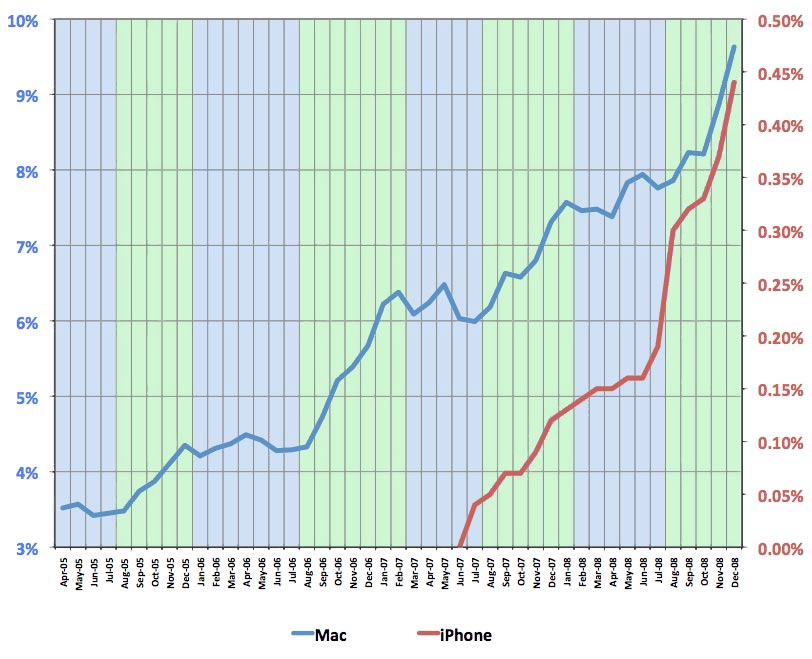
Note also the new trend line in red (scale on right): the iPhone. Starting in June 2007 (with its release), it has been gaining market share rather significantly, very quickly–at this rate, in fact, it should overtake Linux in terms of browser market share (Linux currently has 0.85% of the market, the iPhone has jumped to 0.44% in 18 months).
If you combine the Mac OS and iPhone numbers, then Apple already has more than 10% market share.
What we’re seeing here in the general OS market is exactly what I predicted–the Mac share increases a few percent in the latter half of each year–and it’s not over. If the past is any indicator, then the rise should continue into January and perhaps February. In December, it was 9.63%; it still has one or two months of growth to reach the 10% mark.
Meanwhile, Windows continues its decline with 88.68%, and Vista continues it anemic climb, gaining slightly less than only 1% of market share per month (currently it’s at 21%, some 24 months after its release). Not good news for Microsoft.
But what’s really something is to extend a trendline for the Mac OS over time:

At this rate, the Mac OS could have a 25% market share by 2015, and about 45% by 2020.
Granted, that’s a pretty long-term extension of just a few year’s data. But keep in mind that I first mentioned this 14 months ago, and the new data falls only slightly short of the original trendline seen back then. Once again, hardly an iron-clad guarantee, but certainly a strong indicator that Apple has a great deal of growth potential. Certainly if you had said in 2002 that the Mac OS would have 10% market share by 2009, no one would have believed you. So, let’s wait and see.