Something which has long been suspected among some vendors on the Internet is faked good reviews of an item. When something is sold on a site which allows customer reviews, what is to keep the seller from using varying IP addresses and user accounts to create a herd of sock puppets to give glowing, rave reviews of a product? The answer is, nothing. And the problem is that it is very difficult to find out if this has happened, as tracks can be covered pretty well and most people would not deem such an offense worthy of a detailed, difficult investigation. Even so, fake reviews are sometimes caught.
Right now, I am wondering if I wasn’t the victim of fake reviews for an iPhone app. After downloading only free apps for several weeks, I started buying a few cheap paid apps. The first was a good purchase–something called “Mileage Tracker,” an app which allows you to track what mileage your vehicle is getting by inputting odometer readings and information about each gas purchase.
 But the second app I bought was a Japanese language study aid, a kanji flash card program called “Kanji Flip.” Priced at what I believed was a reasonable $3, it promised to drill me on kanji based on JLPT levels, keeping track of wrong answers and working me out on those more than other cards. As usual, I checked out the reviews, and they were all glowing–and maybe that should have tipped me off, as almost no app gets purely good reviews. Anyway, I bought it, and quickly discovered that I had bought a dog of an app.
First, let me spell out what’s wrong with the app; if you don’t need to know this, then skip the next five paragraphs.
The problem that immediately stands out is that the data is incomplete. Several flash cards have missing or incomplete Japanese readings (pronunciations) of the kanji. There are only 2230 cards in the set, it would have taken the author only short time to check for blanks, maybe an hour or two to check for missed data. See below just a half dozen examples of botched cards out of more than a dozen I found after reviewing only a few hundred cards–which means well over a hundred cards are seriously flawed, about 5%.
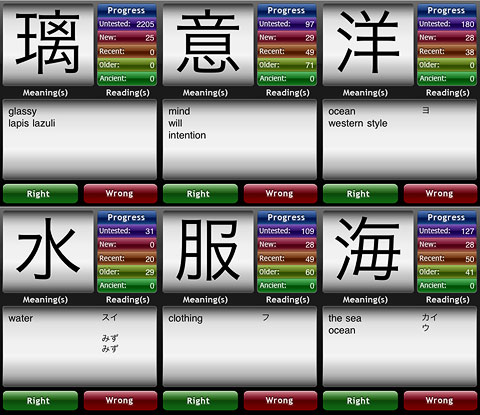
Furthermore, the app is totally non-configurable–in any flash card set, you want to have some control, some manner of setting aside unwanted cards or being tested in some way; this app has none of that. In fact, the only “feature”–marking your guesses right or wrong–is user-driven, not part of the app itself. It doesn’t test you, it asks you to test yourself.
Then there’s the mixing of the levels. You would think that the author, having categorized the kanji by their JLPT levels, would have kept them separate–but no, when you choose a higher level, it includes flash cards from all the lower levels–there is no way to keep out the easy cards.
But what is worst about the app is the repeats: as you continue using the app, it starts sending you more and more repeats of the same cards. I just tested this by trying out level 3, which has 986 cards. The first seventeen cards were unique–but then it tossed me three repeats from the first seventeen. Then, after three new cards, it gave me eleven repeats in a row. Then I got six new cards and eight repeats. Out of the fifty or so cards I tried, nearly half were repeats, and a couple were given three times. With nearly a thousand cards in the level, it would have taken far longer than it should have to get through the entire set.
Even worse, many of the cards which were repeated were ones I had tagged as having scored correctly on–in fact, the last four I tried were all previous “correct” cards. The author says that he gives you some “easy” cards to “encourage” you, but swamping you with cards you have already mastered is aggravating, not encouraging. But the only useful feature of this app is the claimed ability to track wrong guesses and give them back to you later. These two features cancel each other out; the author could easily have included no wrong answer tagging and disguised it with the “easy” card “encouragement”–there was no way to distinguish these two features at work from simply random card repeats.
Okay, so the app is a dog–so why all the rave reviews? It’s rare for an app to get more than four stars on the App Store, especially one with so many problems and limitations. Then I noticed that a lot of the reviewers gave simple, one- or two-sentence reviews, and had no history of other reviews–and a few actually gave only one or two other reviews, those being negative reviews of competing apps. Wanting to warn off people who might be getting the wrong idea, I wrote my own review.
Then I noticed something else happening: you can also rate reviews as being helpful or not helpful. Suddenly, most of the rave reviews, including some of the simplistic ones, started getting only “helpful” ratings–and my review suddenly got a whole bunch of “not helpful” reviews. And one five-star commenter actually edited their review to include a criticism of my review.
Like I said, there’s no way to check, but it all comes across as being very fishy. Still, all I lost was $3, and it re-taught me a good lesson: don’t always believe the customer reviews for a product, especially if they’re unusually glowing.