Capsule Apartments
This story is really depressing: a capsule hotel converted into an apartment building. I thought it was bad to stay overnight in a capsule hotel; imagine living in one. I suppose that it is an alternative for those who really, really need to live in Shinjuku, have few or no possessions, and are on an incredibly tight budget. The ¥59,000 rent includes utilities (it would have to, when you think about it), and there’s no shiki-kin (deposit) or reikin (gift money) which some people may not be able to put up all at one time. And it is better than being homeless (depending on your tastes, I suppose).
For Atsushi Nakanishi, jobless since Christmas, home is a cubicle barely bigger than a coffin — one of dozens of berths stacked two units high in one of central Tokyo’s decrepit “capsule” hotels.
“It’s just a place to crawl into and sleep,” he said, rolling his neck and stroking his black suit — one of just two he owns after discarding the rest of his wardrobe for lack of space. “You get used to it.” …
Still, it is a bleak world where deep sleep is rare. The capsules do not have doors, only screens that pull down. Every bump of the shoulder on the plastic walls, every muffled cough, echoes loudly through the rows. …
Most possessions, from shirts to shaving cream, must be kept in lockers. There is a common room with old couches, a dining area and rows of sinks. Cigarette smoke is everywhere, as are security cameras. But the hotel staff does its best to put guests at ease: “Welcome home,” employees say at the entrance.
First Freeters, then stays at Internet Cafes, now this. Yikes.


 And the thing I missed most: a built-in bidet. Many Japanese toilets have them, with electronic controls on the side. Push a button, and a retractable arm comes out and then washes your backside with warm water. I resisted using these for year, being wary of anything that did something like that, but Sachi got me using it–and I came to depend on it so much that I very much noticed the lack of this feature while in the U.S. Not only does it keep you cleaner, but it saves a considerable amount of toilet paper. Why this has not caught on more, I don’t know. But it’s fairly common in Japan, and has been in use for decades.
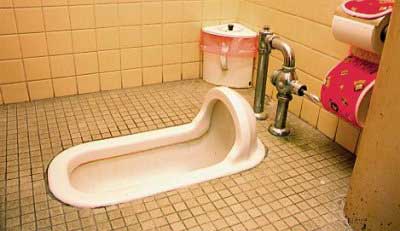 That said, one still finds, all too often, “Japanese style” toilets in public stalls–that is, the weird, old-fashioned, hooded trenches which require one to squat down. Disgusting for several reasons, which I will not go into here. Why these are still used is beyond me–people who hate sharing a seat, or a concession to older people, perhaps. However, you rarely find a public bathroom which does not give you an option–though often times, if there are both types, the Japanese-style stall will be the only one unoccupied.