Archive

Archive for the ‘Mac News’ Category

The Microsoft Store

January 14th, 2009 1 comment

What did you expect?

Msstore-03

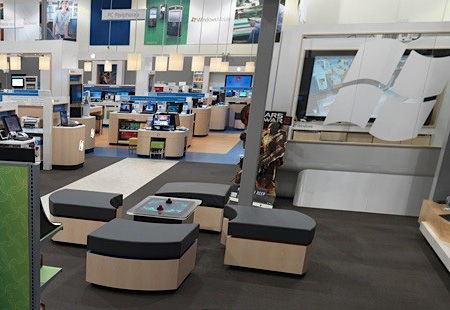
Yes, because we all enjoy the experience of pushing a giant plastic shopping cart around, looking at little else except for rows of shelved merchandise! One thing they seem to have anticipated: no crowds. Have you ever been to an Apple Store? Imagine that store with everyone pushing around giant shopping carts. Isn’t that a nice image? You need lots of empty space to be able to push around those carts, space not filled with customers.

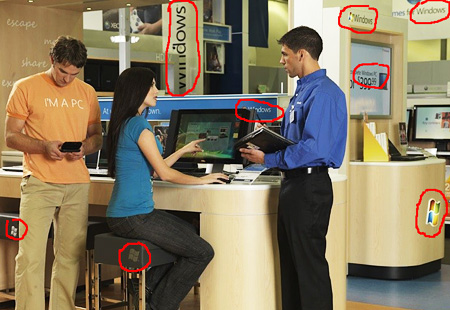
Even better yet, note how the Microsoft logo and Windows labels are applied profusely–they could not even resist making the cushioned seats into a Windows logo.

Msstore-02

Msstore-01

Now compare with an Apple Store:

Acstore-04

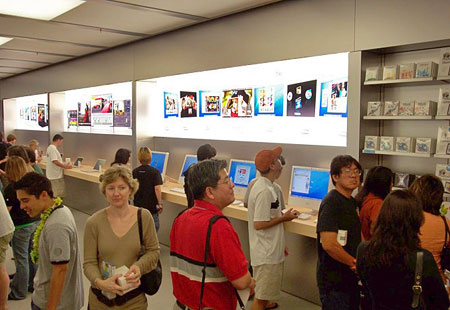
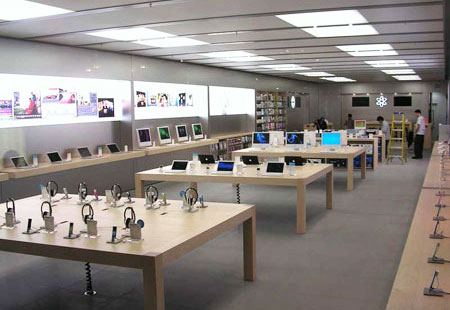
Even with a lot of people, it works; lots of open space, sparse and simple designs, merchandise racks mostly relegated to the walls–and most of the store is tables and tables full of demo products so you can get a hands-on experience. The poster space is mostly showing what the products do, as opposed to being filled with slogans, trademarks, and logos. A few Apple logos are prominently displayed at the entrance to the store, but everything else simple–no seats or tables shaped like Apple logos. It’s called “tasteful.”

Acstore-01

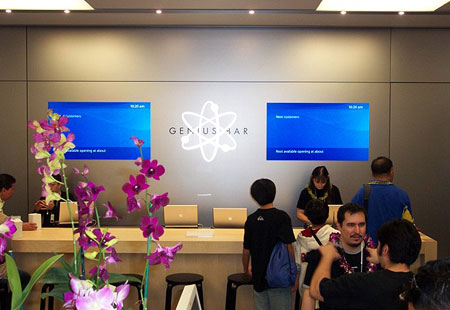
Not to mention service people everywhere, so it’s not hard at all to find someone to help you even in a crowded store. And, of course, the Genius Bar, always tastefully laid out and organized.

Acstore-03

In short, Microsoft did what they always do: took an idea from Apple and executed it poorly, without class or imagination. To give you another example, I leave you with a humorous take-off on how Microsoft would have designed the packaging for the iPod:

Mike Huckabee Seriously Praises Apple Computer

January 13th, 2009 Comments off

And not just the hardware–he specifically notes Apple’s customer service as being a big deal for him. He starts in on Apple at 1:25 in the clip below:

I have to admit to serious qualms about people I am in polar disagreement with on a most political topics having such similar opinions to me on Apple–Limbaugh is another example–but I guess even the worst of the right-wing nutjobs out there can recognize good hardware and service when they see it. Even despite, it would seem, Apple’s public stand against Prop 8 in California.

Categories: Mac News Tags:

The Over-reaction

January 7th, 2009 Comments off

A lot of people were disappointed with the Apple keynote, and the stock fell in value. Some even reported this as the death knell of Apple:

At the annual Macworld trade show in San Francisco today, Apple put on an excruciating 90-minute keynote that may go down in history as the worst Apple event of all time. In brief: for the first time in recent memory, Apple has nothing interesting to sell. And the company’s remarkable decadelong run as the hottest company in consumer electronics may be drawing to a close.

You see, this is why Apple is being smart in shutting down the whole January MacWorld keynote: rumors and expectations build up, and when they don’t arrive, everybody blames Apple. If there had been no expectation of miracles every January, no pre-keynote buildup of rumors, there would not be this kind of letdown when all Apple had was some nice software upgrades and some new developments with the iTunes Store. The bad news was not in what they released–there was some cool and even some important stuff there–the letdown was in that everybody expects regular fireworks every January, which is much less than realistic.

Instead, Apple is now free to release products on their own timetable and not have these unrealistic expectations shoot them down when Apple doesn’t release stuff on an arbitrary schedule. There’s no reason to believe that a new Mac Mini won’t be released in the next month, or that an iPhone Nano won’t have a big, surprise rollout at any given time. Apple has been doing that more and more often, in fact, sending out press invitations to special Apple Events. Apple did that when it released the new MacBook line in October, for example. The fact that industry pundits started proclaiming Apple “out of ideas” because Apple didn’t release these or other items on somebody else’s schedule makes an excellent case for independently-timed Apple Events rather than an annual buildup to MacWorld.

When you think about it, the announcements were not that bad–roughly equivalent to Microsoft releasing a new version of Office, which would normally be a fairly big event. Expectations were so high for Apple that something which should have been important news–Apple building a software suite that can seriously challenge Microsoft’s office dominance–got trashed as “boring.” Seriously, Apple is making huge moves into the Enterprise arena, with Mac OS X but especially with the iPhone–and now iWork is being upgraded as a serious competitor. Mail Merge may not sound like an exciting thing, but it’s a key component in making iWork viable for many workplaces. But instead of popular realization that Apple is eating away at Microsoft’s core market, that it is capturing more and more market share, especially in smart phone and laptop sales–instead of looking forward to potential upcoming non-MacWorld product releases, we get this whole “Apple is out of good ideas” garbage.

I think that Apple has a few product announcements that it is holding back and will make soon: the iPhone Nano and the new Mac Mini line. Now, in the past, I have quickly accepted resignation to the “that is all” mentality after products fail to materialize after a keynote, but this time, a few things are different. First, this was the last MacWorld keynote, and Apple had to know that there would be a bad reaction to that. But if Apple releases a few big products in the weeks or months right after MacWorld, as a way of saying, “Ha! You never know just when we’ll release good stuff!” that could have a big impact on how people see Apple’s creative force continuing, and help re-establish expectations of quality.

But there’s another reason to expect that: the iPhone Nano and new Mac Mini were leaked by accessory and software developers who made products for the new Apple gear. Now, maybe I’m wrong, but usually when an accessory maker leaks a product, it turns out to be true–a lot more so than most rumors. Few companies make products specifically designed for vaporware.

I could be wrong, but I have a feeling about this one. Let’s wait and see.

Categories: Mac News Tags:

The Last MacWorld Expo

January 7th, 2009 Comments off

So, what’s in the goodie bag for one last extravaganza?

iWork ’09, for $79, including:

iPhoto ’09: “Faces” uses facial feature recognition technology to sort your photos by the people in them. Also, “Places” uses GPS geotagging to sort your photos by where they were taken. Good for my iPhone, but not for my Canon Digital Rebel (unless there’s an accessory I don’t know about). Still, you can manually add English-language geotags and iPhoto will sort them right along with the GPS tags that it converts to place names. Not bad. Slideshows have themes and can center on faces automatically. These can be saved to iTunes as a movie file and be played back on an iPod or iPhone. Also, photo books have been updated (Sachi and I plan to make a wedding album using the service; a nicer setup just in time for one of the only times we’d use it. But do we need to buy iLife ’09 for that?)

iMovie ’09: The big question: will it suck less? They dumbed down iMovie ’08, one can suppose so as to get people to pay for Final Cut Express. In iMovie ’09, they seemed to listen to these complaints, making the editing easier and adding so many of the special effects that were cut from the last version. The proof will come from using the product. I still don’t like the interface in general–but we’ll see. Two-track video editing, laying one track over another. Easier application of effects. Drag-and-drop audio (presumably replacing lengthy “extract audio” processes) for voice-overs. Indy Jones-style maps showing where you went. Interesting, but I want more details…

GarageBand ’09: “Learn to Play” teaches you guitar or keyboard. That could be interesting–if it’s effective. The catch: 9 lessons are bundled, but extra lessons cost five bucks a pop.


Next up: iWork ’09, also for $79, with:

Keynote ’09: Something called “Magic Move,” which apparently must be seen to be understood. New transitions for objects and text. New themes. And new chart animations. Plus: built-in support for using your iPhone to control the presentation. The iPhone will either show two slides at a time so you can preview the next slide and intro it properly, or it will display notes beneath a single slide.

Pages ’09: 40 new templates. Full-screen view. Dynamic outline mode to help you organize your ideas before writing. Mail merge with Numbers. Connectivity with MathType and EndNote.

Numbers ’09: Copy & Paste charts into Pages and maintain links. More table categories and functions. Advanced chart options, etc….

The main idea here seems to be to beef up Pages and Numbers so they have more of the features that MS Word and Excel have. WHich might sound pathetic, except for one thing: Pages and Numbers are much more nicely designed, and their main drawback has been limited functionality. Adding that functionality could be enough to make people leave Office behind. A key point will be whether Apple did a better job improving Office cross-compatibilty, which could be a critical point.

New twist: iLife and iWork will ship bundled for $169–you save ten dollars. Would be less impressive if it weren’t for the fact that the software was already so cheap.

Next up: iWork.com. This was widely rumored, but the rumors seem to have been off. Less than a full-blown web app, this service seems more oriented toward collaboration and saving docs on the web. You edit docs offline and share them online. Initially it’ll be a free beta, but then you pay for it. Yawn. Comes across like the Apple TV–could have been better, but certainly not yet.


Finally: A new, slimmer, 17-inch Macbook Pro. Essentially they brought the 17“ in line with the 15” MacBook Pro, with a few new bells and whistles. Matte screen option, full hi-def resolution, better color handling, etc.–lots of small stuff. The one big thing, as predicted by rumors: new battery, not removable except by Apple, but should last for 5 years and support much longer battery life.


And then, One More Thing: iTunes.

Pricing: Apple finally caved to the music labels and accepted three-tier pricing: $0.69, $0.99, $1.29. Or, at least I think the $0.99 pricing tier will be continued; some reports suggest not.

DRM: It’s going away. 80% now, the last 20% in a few months.

iTunes Store over 3G on iPhone. Um, OK.


And… that appears to be it. Surprise: no iPhone Nano, no new Mac Mini, despite copious rumors, leaks, and confirmed sources. Will they be announced later, separately? Doubt it.

More details tomorrow (it’s almost 4 am here), after Apple has posted more on its site. Summary: iLife looks much improved, iWork solidified, 17“ MacBook still for the indulgent, iTunes Store slightly upgraded/changed.

An interesting side note: somebody hacked into MacRumors’ live feed and kept inserting obnoxious comments (e.g., ”STEVE JOBS JUST DIED“), completely disrupting what was one of the best and most-watched live blogs on the Expo. The intrusions got more and more numerous and obnoxious until the site simply went off the air. Some people are such complete losers.

Categories: Mac News Tags:

The Trend Continues

January 1st, 2009 Comments off

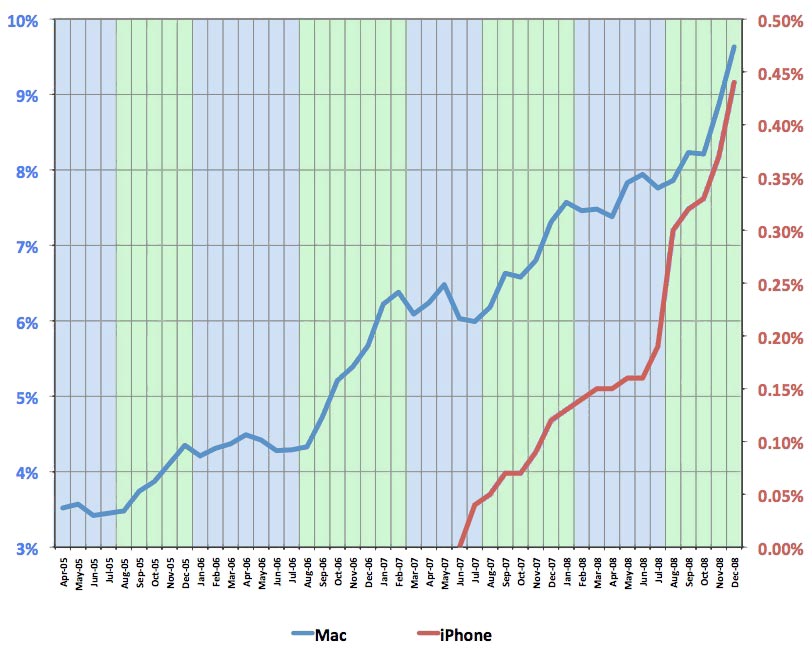
OS market share figures were released again today, and though it is a rough indicator, it nonetheless is a consistent one that mirrors trends in the market. Back in July 2007, I noticed that Mac market share seemed to jump from August to January. After predicting that, it jumped from August 2007 to January 2008. Last July, I again predicted that Apple’s market share would jump again in the same period, this time guessing that it would reach up to 10%.

Guess what? Mac market share jumped from less than 8% to almost 10% between August and December 2008. Right on target. Click on the chart to enlarge it; the green areas denote growth periods:

Mac-Market-0109H

Note also the new trend line in red (scale on right): the iPhone. Starting in June 2007 (with its release), it has been gaining market share rather significantly, very quickly–at this rate, in fact, it should overtake Linux in terms of browser market share (Linux currently has 0.85% of the market, the iPhone has jumped to 0.44% in 18 months).

If you combine the Mac OS and iPhone numbers, then Apple already has more than 10% market share.

What we’re seeing here in the general OS market is exactly what I predicted–the Mac share increases a few percent in the latter half of each year–and it’s not over. If the past is any indicator, then the rise should continue into January and perhaps February. In December, it was 9.63%; it still has one or two months of growth to reach the 10% mark.

Meanwhile, Windows continues its decline with 88.68%, and Vista continues it anemic climb, gaining slightly less than only 1% of market share per month (currently it’s at 21%, some 24 months after its release). Not good news for Microsoft.

But what’s really something is to extend a trendline for the Mac OS over time:

Mac-Market-Future

At this rate, the Mac OS could have a 25% market share by 2015, and about 45% by 2020.

Granted, that’s a pretty long-term extension of just a few year’s data. But keep in mind that I first mentioned this 14 months ago, and the new data falls only slightly short of the original trendline seen back then. Once again, hardly an iron-clad guarantee, but certainly a strong indicator that Apple has a great deal of growth potential. Certainly if you had said in 2002 that the Mac OS would have 10% market share by 2009, no one would have believed you. So, let’s wait and see.

Does MacWorld Make Sense?

December 19th, 2008 3 comments

Apple stock fell on the news that not only would Steve Jobs not be giving the January MacWorld San Francisco keynote speech, but that Apple will not participate in MacWorld after 2009. Probably the reaction was worry that Jobs’ health is the reason behind it all, and that if he goes, the company will disintegrate. Well, all history with Apple of the 1980’s and 1990’s aside, there’s little reason to believe this. Jobs is a visionary, but he’s not the only guy with ideas at Apple.

Some good points have been made that actually suggest that Apple’s new move makes more sense. First, that the MacWorld Expo in San Francisco is poorly timed–in January, people have spent their money already and will wait for a while to spend more. That makes sense–I’ve been in that situation more than once, visiting the U.S. where things are priced cheaper and returning to Japan before a nice new product is introduced. By avoiding the badly-timed MacWorld Expo, Apple can do a better job of utilizing the holiday sales season. It just makes sense.

It means that Apple will feel more free to announce product releases more freely. It means that Apple won’t fall prey to the frenzy of too-optimistic rumors that always precede these shows, raising expectations so ridiculously high that everyone is disappointed when the news is only great, and not miraculous. This is probably why there have commonly been massive stock selloffs after the Expos, and Apple probably got tired of being beaten half to death every time they showed people cool new gadgets and reported great performance.

When you think about it, doing away with the keynotes might be the best thing for Apple. Its success has always been with its products, not scheduled conventions. While the keynotes have been entertaining, they were never necessary.

Categories: Mac News Tags:

Zune vs. iPod

December 13th, 2008 5 comments

While the Mac vs. PC rivalry is well-known and widely waged, there is another Apple-Microsoft war which is far less know: Zune vs. iPod. Most people with iPods just ignore the Zune, but Zune owners tend to hate the iPod, Apple, and Apple enthusiasts with a passion. And there is the inevitable “which is better” debate, though again, it’s usually just the Zune fans talking amongst themselves.

One of the most common ways that Zune users claim superiority is to use selective comparisons. When comparing the products of the two companies, Zune users invariably compare the top Zune model with Apple’s bottom-of-the-line iPod Classic model, which, naturally, gives the greatest advantage to the Zune. The iPod Touch and iPhone are considered “different” enough that a comparison cannot even be attempted.

The justification is usually based upon an imagined alignment–that the Zune and the iPod Classic just naturally align with each other, and the iPod Touch and iPhone are completely different machines that can be discounted and ignored. The most common argument to support this is that the iPod Classic has hard disk storage like the Zune, so there.

The problem is, that doesn’t quite work, for at least a few different reasons. The first is the fact that all Zunes and iPods/iPhones compete directly with each other. Whatever features any of them have, almost nobody is going to buy more than one for personal use. That is, you’re not going to see someone buy a Zune and and an iPhone. In this sense, all of these players compete with each other, in that the purchase of one of the units generally precludes the purchase of another.

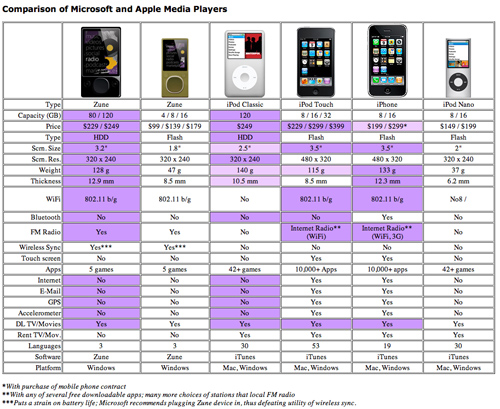
Another reason that argument doesn’t compute is that they’re all different. The Zune no more lines up with the iPod Classic than it does with the iPod Touch or the iPhone. Sure, the Zune and iPod classic both have hard disk storage and a 320 x 240 screen; however, the Zune and iPod Touch share roughly the same screen size and WiFi. There are features all share, and features unique to each player. Consider the chart below (click on it to see the full size), and you’ll see that the Zune doesn’t really line up with any Apple product. (Although the Flash Zune and iPod Nano line up pretty well.)

Zunepod

Then there’s the idea of alignment by media type, which falls flat when you realize that the Flash Zune then gets lumped together with the iPod Touch. Doesn’t work anymore, does it?

So comparisons between the Zune 120 and iPod Classic 120 are very comforting to the Zune crowd, but they really don’t constitute an equal match. Just as Microsoft decided on a certain feature set with both of their Zune player categories, so did Apple with their five categories–but because each company had different objectives and different ranges of models, none lined up perfectly. Everything is a matter of choice. You could just as easily have a Zune 80 and iPod Touch 8 shoot-out. The problem is, with the exception of storage capacity, the iPod Touch would completely blow the Zune 80 out of the water. But that’s a lot less comforting to Zune fans, so let’s not go there.

You could even compare the Zune with the iPhone. Zune fans would shoot that down instantly because of the iPhone’s added cost for a cell contract. However, there’s no reason to do so, as most people have cell phones and would pay for the contract anyway; in fact, the iPhone is a better savings in that respect as you don’t have to buy a separate cell phone, and is more convenient as you have only one device to carry around. Zune users might argue that the iPhone looks cheaper because of the cell carrier subsidizing the costs–except that PC users have no problem discounting such subsidies when they crow about $400 PCs which require a subscription to an Internet service.

The bottom line is, we’re comparing Apples and, well, Zunes. In order to make any comparison, you have to weigh each machine as a complete package. Is a touch screen a big deal? Would you prefer an FM radio or streaming Internet radio over WiFi and/or a 3G network? How do the interfaces work for you? How much memory do you really need? (Surprisingly, I find my iPhone’s 16GB perfectly satisfying; you may not.) Are a handful of games sufficient, or would you like a cornucopia of thousands of apps? Do GPS and an accelerometer sound good to you? Do you like to have access to email and the Internet wherever you are? How often do you actually use wireless syncing or social sharing? Does having a camera built in matter? How about avoiding carrying a two separate devices? How much do you like the styles of each?

Then work out how much each is worth to you, and look at the prices. Then buy. Just keep in mind that the whole Zune-iPod Classic paradigm is a crock. It’s pretty much a subjective comparison any way you look at it.

Categories: Gadgets & Toys, iPhone, Mac News Tags:

Just Bad Reporting… Yet Again

November 25th, 2008 Comments off

Here we go again: another spate of news stories about new Mac “viruses” with prognostications of an oncoming wave of Mac malware, where the real threat is far from what is suggested.

The Telegraph got snookered on the story, where its headline “Apple Mac computers targeted by virus” was subtitled with, “Security experts claim that two new viruses targeting Apple’s OS X operating system have been identified in the last week.” For the Nth time: the report concerns trojans, not viruses. To this day, there have been zero–count them: zero–viruses or worms for the Mac. This is significant because, as I have pointed out before, no OS can protect against trojans. Trojans prey on users being foolish enough to execute them, using promises of free goodies to trick them. The Mac OS is no more immune from trojans than is Windows or Linux. In fact, I am somewhat surprised that there have not been a much larger number of trojans for the Mac than the 4 or 5 that I have ever heard of (including the current ones); there is no reason why there should not be thousands, and the fewer number of Macs out there would not seem to explain the very limited number of trojans out there for the platform.

An article for Computer World was only slightly more accurate: “Mac OS X: Vulnerable to new Trojans.” It is more accurate only in that it used the term “trojans” instead of viruses, but even in that, the article is highly misleading at the very least. For one thing, only one item was a trojan, the other was software that enabled trojans. Next, the article headline using the plural “trojans,” while technically semi-accurate, gives the impression that there are more than two pieces of malware. Third, to say that the Mac is “vulnerable” to these is questionable. In one case, we have a standard trojan, which, as I explained earlier, is equally a threat to all computers. Calling the Mac “vulnerable” to this is like pointing out that Spanish people specifically are “vulnerable” to being killed if they fall off a ten-story building onto concrete. In the other case, the Mac is only “vulnerable” if a hacker gets physical access to a Mac and knows the password; this is not “vulnerable” in the common sense.

And that leads me to the bottom line: neither of these trojans is likely to infect many Macs at all. One of them, as I said, requires direct access to the computer, making it all but useless as malware. The other one is a trojan which lures users to install it by offering it as a “free codec” to watch online porn. This makes it the second trojan to do this–and those two trojans stand, at this point in time, as the only malware that stand to have any real-world impact. All the rest are either harmless proof-of-concept works or require direct access.

Edit: Actually, the facts are even more revealing when you realize that the “second” porn-codec trojan is nothing more than the first one recoded a bit. In short, there is actually only one trojan for the Mac in the wild–this “new” one, being used as evidence for “growing numbers of Mac malware,” is just a new version of the sole existing trojan.

Which means that, to this day, in order to be “vulnerable” to any malware on a Mac, you have to be a porn viewer who believes that downloading a special Mac codec from a porn site is a spiffy idea. Or you have to hand your Mac over to a hacker and tell them your password. And if anyone is infected, these are trojans, not viruses or worms, which means that the damage is limited to that one computer only. So far, despite the first porn-related trojan being ‘in the wild’ for some time, I have not heard of any Macs being found infected with it–though admittedly, that may be because the users would be too embarrassed to admit it, as it would mean they would have to admit to being (a) porn viewers, and (b) stupid enough to fall for it. Still, if a large number of Mac users had fallen prey to it, I would think that word would have gotten out about it by now.

The real tell in these articles is that the warnings come from “security experts” who work for “security vendors.” In other words, companies which want to sell you antivirus software you don’t need, so they issue alarmist press releases which news outlets and naive tech bloggers regularly fall for, trying to scare you into thinking you need security software for your Mac.

So I reiterate what is now a familiar litany: although Macs are not “invulnerable” to malware (that myth is not propagated by Mac users, but by Mac naysayers who exaggerate what Mac users say), there is at this time no self-propagating malware for the Mac, only a pair of porn trojans a single porn trojan that requires your permission to attack your computer. Unless you ever download software from porn sites, you have no need for security software at this time. Which is not to say you never will; eventually, there will be viruses and/or worms for the Mac, there just haven’t been any yet. There have not been any real threats so far because (a) the Mac OS does have better security in general than does Windows, and (b) the Mac user base is small enough to attract less attention from the hackers. When malware which poses an actual threat does come out, it will likely be spotty enough that freeware protection will quickly be available–if not a direct fix by Apple itself via software update.

We are probably a long ways away from Mac malware being serious and common enough to warrant the purchase of commercial security software.

Update: Just to punctuate the above, Microsoft itself–not just the antivirus vendors–has highlighted yet another “critical” worm which can attack Windows computers running XP, Vista, and even Windows 7, the OS that MS won’t even release for a few years yet. Not just a “vulnerability,” not just a trojan, but full-blown worm with a strong presence in the real world.

Categories: Mac News Tags:

A New MacBook Pro

October 28th, 2008 Comments off

When I wake up early several mornings in a row, my body clock becomes used to it and I wake up at the same time for a while thereafter, until something (like my usual tendency to stay up way late) interrupts it. So I woke up early enough this morning that the hyper-early takkubin (Japan’s FedEx) didn’t wake me up. I knew the MBP was coming sometime soon as Apple sent an email to that effect last night, but didn’t expect it quite so fast after notification. But Japanese express mail is like that–almost always next-day delivery.

Setting up the computer just seems to be getting easier and easier. No problem getting on the WiFi network. The printer was recognized and driver auto-installed in seconds. My iTunes account gave the computer basic registration info, and logging into my Mobile Me account got most of my important data; my calendar, address book, browser bookmarks, and other stuff got synced, and all my email accounts are subscribed to. All that in just the first fifteen minutes or so. Apple knows how to make it painless. Most of the rest of my data I transferred almost as easily, hooking up my new MBP to my old Powerbook via an 800-to-400 Firewire cable. And it’s nice to have 250 GB (well, 230 GB in fact) available on a laptop.

Now, the screen. It is a mirror. Not a full-blown one, but a mirror nonetheless. If I want to check my appearance before a Skype call, all I have to do is turn the brightness on the monitor down all the way, and I can see myself perfectly, albeit a bit darkly.

So, is it a deal-killer? Not quite, but it is worse than I had gathered from looking at display units. The reflection is muted by two factors: first, there is a different focal point for the screen and what is reflected in it; if the reflection is far enough away, just focusing on the screen contents helps filter the reflections out (closer reflections can be more distracting). And second, the full brightness of the LCD screen washes out most non-bright reflections. Additionally, I think that your mind will, over time, learn to disregard the reflections–I found myself not noticing them after a while.

Macbook-Powerbook-02
Facing away from the windows; the new MBP’s screen is quite notably brighter.

Macbook-Powerbook-01
Facing toward the windows; the MBP actually seems brighter still, but more washed-out–and note the reflections.

In the right place, and at full power, and with practice, the reflections won’t bug you at all. That said, there are situations where those conditions can be nullified. For example, when you unplug the MBP from the power cable, the screen immediately darkens, and the reflections pop out at you. For this reason, you should probably switch the dimming feature off in your Energy Saver preference pane, and just take the hit on battery life.

Outside, the screen is barely usable–but it does outperform my old Powerbook’s screen. Let’s face it, laptops rarely have screens that are usable in direct sunlight; even in the shade, you stand to suffer from some setback with any screen, and you just have to work around it. As it happens, I almost never use my laptop outdoors, so it makes little difference to me in any case.

As for performance, this thing rocks. Maybe it’s just because it’s a brand-new Mac, but everything ran incredibly fast–especially web pages, which seemed to load lightning-fast. It could be the faster CPU (the 2.4 GHz Core 2 Duo is faster than my iMac’s 2.16 GHz chip), the 1 GHz+ Frontside Bus, or the 4 GB of DDR3 RAM; the 7200 rpm HDD probably doesn’t hurt, either. We’ll see how performance does over time.

The trackpad: I love it. It’s huge. I was already addicted to the 2-finger swipe for scrolling–I find myself trying to use the gesture on every other computer I encounter and realizing with annoyance that it doesn’t work. I never scroll using the scroll bar anymore. The new gestures are at least as useful, if not more so. The three-fingered swipe for “next” and “previous” is more universal than I thought–it works with browser windows and Finder windows, not just your photo albums. It essentially is a way to active the history arrows in any app that recognizes the gesture. The four-fingered up- and down-swipes for Exposé I know I will use a lot–but I have to re-train myself, as I am too used to using the F-keys I assigned for the task. I still don’t use the trackpad for zooming in and out as much as I should be. And I had forgotten that swiping four fingers left or right activates application switching.

In fact, I have gone a step further and have activated, after a long time avoiding it, the trackpad touch-click. Not because I don’t like the click-anywhere trackpad feature–I found myself using it without even thinking–but I have come to really like not having to apply as much pressure. And a two-fingered tap for a pop-up menu is just too hard for me to pass on, now that I am aware of it again. I tried this out before and didn’t like it, but I think that Apple has improved the software over time, and it’s now a lot better at interpreting your intentions.

The keyboard is as good as I recall from trying out the display model at stores last week. I find myself making a lot fewer errors, primarily, I think, because the keys are spaced; most other keyboards have the keys adjacent, which leads to all kinds of mis-strikes. There is also a nice, soft, responsive feel to the keys. If you’re thinking of buying a laptop, try out this keyboard.

I have yet to try out a lot of stuff–for instance, connecting to television sets (Apple says it won’t work, but I at least want to try) and external monitors, using the Superdrive, trying out the higher-performance graphics chip, testing WiFi vs. the old Powerbook, and so on. Heck, I’ve only had my hands on the thing for a few hours now, and most of that has been transferring files.

More later.

Categories: Mac News Tags:

Campus Cool

October 23rd, 2008 Comments off

Just reported:

Apple Inc. is hiring the dean of Yale University’s business school to start a project that it calls Apple University.

No details on what it is yet, but I’d like to know when they start hiring faculty….

Categories: Mac News Tags:

Deciding on a Laptop

October 18th, 2008 1 comment

So I went to Akihabara today, after visiting some electronic stores in Ikebukuro, to see what I could find out about my alternatives for buying a new Macbook Pro. This was the first time I saw the units in person, and, as expected, the monitors were glossier than ever. I never really liked the glossy displays used up until now, but this one was even more reflective. The upside was that it protects the LCD screen better–the glass used makes it hard to disturb the picture by poking it–and the new LED backlighting makes the display a lot brighter than even the previous bright monitors, partially canceling out the glare issue. It’s not good, but not quite as bad as I’d feared.

Newmbp01The trackpad, on the other hand, is great. Very sensitive, very smooth, very large. I never liked having it in touch-tap mode before, but on all the units I played with it was active–and it worked a lot better than I remembered. I could get pop-up menus just by laying two fingers on the trackpad, very natural. And the click-anywhere feature is very nice, meaning you don’t have to aim and reach for the button location. Finally, the new gestures–three-fingered swipes to go to the next image/page, four-fingered brushes up and down to activate Exposé–felt easy to remember and execute. I would definitely miss having this new trackpad.

In fact, I also was pleasantly surprised by the keyboard; when I tried it out, it was smooth and effortless; I have problems with some keyboards, but I loved this one.

The Firewire port issue is not so bad; I even bought an 800-400 FW cable from a cable shop in Akihabara whether or not I wound up buying the new Macbook, figuring it could be used in my old Powerbook anyway.

The TV-out thing still burns, but there is a solution for me. I use my computer at work mostly in a lab, and can hook up via a VGA splitter box that’s in the lab under the teacher’s computer station. I’ll need to lug around a VGA cable, a long one in case I need to set my computer at a distance, but I found a fairly lightweight 5m cable at the same shop I got the FW cable from. For other situations, I can use the new LCD projector the school got if I really need to use a display in any other room. I won’t like not being able to plug into any TV I like, but I should be able to live with it.

All that, plus Apple claims that battery life is better–five hours, they say, but we all know that computer makers always pad that spec quite a bit. Still, the battery looks pretty easy to swap out, and now the HDD can be swapped out as well.

Nevertheless, I was still attracted by the thought of saving a bunch of money on a previous-model Macbook Pro priced down. However, that didn’t work out like I’d hoped. Despite being out of date and in clearance-sale mode, the old MacBook Pro still has a set price–everyone sells it for ¥184,800 ($1819), which is not all that great a savings off the Apple Store education price of ¥218,800 ($2153). Yeah, it’s lower, but not by as much as I’d hoped. Plus, swapping out the 2GB of RAM for my desired 4GB was more expensive than the Apple Store charges for the built-to-order model.

Oldmbpprice02

But here’s the kicker, which I didn’t think about earlier: the previous-version Macbook Pros on sale in stores now only come with the Japanese keyboard. And I really dislike that keyboard, a lot. I’d much rather deal with a reflective screen than a Japanese keyboard.

I played around with the idea of buying a refurbished 17-inch Macbook Pro with a U.S. keyboard currently selling on the Apple Store Japan site; it sells for the same base price as the new 15“ Macbook Pros at education prices. But they won’t swap out the RAM for the usual prices, and that would hike the cost higher–pus, although I’d love the huge screen, I don’t think I would be able to fit it in my backpack, and it might be heavier than I would like to schlep everywhere.

So it came back to the new Macbook Pros, with the screen problems. I was mollified by seeing it in person, the glare not being entirely as bad as I’d expected–but still bad–and the brightness overcoming that some. Using it as-is, I would definitely have to position it right to avoid having parts of the screen blocked out. In my current office situation, there’s a large window behind me, and that would be a deal-killer; however, in a week, we redesign the office layout, and I’ll have a wall behind me. Classrooms are similarly not a problem, as I’ll always have my back to a whiteboard and a wall. At home, it won’t be a problem, and I don’t use my laptop outdoors much.

One more possible solution: matte screen films. Just like the ones that take the glare off the iPhone, there are films for monitors as well. Having seen some displayed a stores, I can see it’s a bit of a risk: on some monitors, the film produces a gritty, grimy appearance in bright areas that are otherwise perfectly smooth and bright without the film; on other monitors, it’s perfectly acceptable. Finding a store where they could show me different brands was a chore, and at the best one, the floor guy seemed not to have a clue as to which films on display were which. So I might have to buy one or two before I find one that works–not too cheap, at about ¥1500 a pop or so. I’ll also have to buy a 17” film and cut it down to match the Macbook Pro’s screen size. I’m still not even sure I’ll wind up keeping it–I’ll use the Macbook for a week or two and see if I can live with the reflectiveness as-is.

So, in a few minutes I’ll put in my order–with options for 4GB of RAM and a 7200 RPM HDD, not to mention the U.S. keyboard. I’ll also get a video adaptor, probably Mini DisplayPort-to-VGA; Apple claims that you can’t add on other adaptors to that one, such as a VGA-to-DVI. They even claimed that a Mini DisplayPort-to-DVI cannot accept a DVI-to-HDMI adaptor hooked on.

But I have a sneaking suspicion that Apple just says all of this stuff to avoid being responsible for wiggy connectors. No one on the Apple discussions site claims to have tried this. I’m buying, of course, on the presumption that the adaptors won’t work… but I will still try all of them anyway.

Update: OK, the order is placed. They say 1-2 weeks shipping time (grouse), but it often comes on the early end of the estimate, if past experience is a guide here. I got the 4 GB of RAM, 7200 rpm hard drive, the Mini DisplayPort-to-VGA adaptor–and the U.S. keyboard as well. I even went in for the Mobile Me subscription, priced down to $60 with the Macbook Pro purchase. Naturally, you can bet that I’ll blog on it when it comes.

Categories: Mac News Tags:

Pretty Glaring Oversight

October 16th, 2008 5 comments

While the prospect of the new Macbook Pro is overall very positive, there are a few significant down points. One of those is the glass screen–I see no real advantage here, and the reflectivity is a major down point. I never liked the glossy screens before, and these computers seem to be more reflective than ever. Had it been made glass so one could get touch-screen functionality, that I could understand. But without that, it’s a drag on the computer’s appeal.

Another down point is the lack of a 400 Mbps Firewire port. I mean, really? I have to buy pricey adaptors and new cables to use a bunch of equipment I own? Now, Apple does mercilessly phase out stuff which is no longer hip–they were among the first, if not the first, to ditch the floppy disc, for example–and I do understand that USB is winning the game. But it’s still a pain.

But one legacy ditch Apple executed with this model is one that makes zero sense to me: no more out-to-TV. Seriously. You can still use VGA and DVI, but if you have an old-fashioned TV set and need to go out to it, you are out of luck with the new Macbook line. No more cables going to composite RCA or S-Video. Kaput.

That’s a huge deal for me, as this is going to have to be a work computer, and we have no HDTVs at my work–all are old NTSC boxes. The new Mac would not be able to use those, at all. I would be limited to a single VGA input box I have set up in the lab, and our LCD projector, which can take VGA in. But that also means I am on a short leash, as long VGA cables are not an easy schlep.

What the hell, Apple?

Categories: Mac News Tags:

The New Macs

October 15th, 2008 6 comments

My reaction: meh.

Yeah, “meh.” I was really expecting something better. The new form factor looks nice. Not incredibly cool, but nice. The black border around the screen is maybe the nicest touch, for me at least. The glass trackpad? I’ll have to try it and see. Probably it’ll be pretty good. But this is not the innovative upgrade I was expecting. No Blu-Ray. More Multi-touch, but no LCD trackpad or touch screen. Nothing that knocks my socks off, to be sure. Nice, but not great.

I will buy it, however. I have an aging 3.5-year-old G4 PowerBook, which has long been outclassed–even though it still stands up surprisingly well. I’ll even keep it, for its pre-Intel functionality, as kind of a bridge unit, a backup, something that can run a lot of the software I still would like to access once in a while (I might even downgrade the OS to something more Classic-friendly).

The new MacBook Pro (gotta have a 15-incher) will be a major upgrade for me. The ability to run Windows will be useful for my job. The 2.4 GHz dual-core low-end model will be quite sufficient, many times faster than what I’m used to, and the NVIDIA chipset will not be bad either. I’ll enjoy having a webcam on my portable, and the WiFi may even not suck like my current PowerBook’s does. I also like the fact that Apple is shaking me down a lot less than before on RAM–a 2GB upgrade to 4GB for $150 is not bad, and is even reasonable. I’ll take that, along with the 7200 RPM 250 GB drive that far outclasses the 80 GB drive I now suffer with.

Sure, it’s a big upgrade from my early-2005 model. Just not the barn-burner of a new release I was hoping for. So I’ll take it, but, you know, meh.

Update: While the “Apple tax” is imaginary, the “Living in Japan tax” is not. Even at the Education store, I will still have to pay about $300 more for the Macbook Pro here in Japan than it costs in America. True, half of that difference comes from sales tax which you can avoid in the U.S. by buying out-of-state, but it’s still a difference. And $300 is not quite worth it to put my family in the U.S. to the trouble of re-shipping a U.S.-bought machine here. Between the shipping costs and the import duty they’d slap me with the price difference would kind of disappear anyway. But it still sucks that you pay a premium for living closer to where the machines are actually produced. And ordering in Japan won’t save me time, either–getting the U.S. keyboard is a special order and usually adds a week to delivery time.

Categories: Mac News Tags:

The “Apple Tax”

October 14th, 2008 Comments off

A Microsoft executive expounds:

…we’re also looking at the different things that you can get with Windows, and understanding what is really involved with what we call the “Apple tax.”

There really is a tax around there for people that are evaluating their choices going into this holiday season and going forward. There’s a choice tax that we talked about, which is, hey, you want to buy a machine that’s other than black, white, or silver, and if you want to get it in multiple different configurations or price points, you’re going to be paying a tax if you go the Apple way.

There’s going to be an application tax, which is if you want choice around applications, or if you want the same type of application experience on your Mac versus Windows, you’re going to be purchasing a lot of software. And even at that you’re not going to get the same experience. You’re not going to get things like Microsoft Outlook, you’re not going to get the games that you’re used to playing. There’s a technology tax–Apple still doesn’t have HDMI, doesn’t have Blu-ray offerings, doesn’t have e-SATA external disk drives that work at twice the speed of FireWire. And so you’ve got all of these things that are truly taxes.

You’ve also got an upgrade tax. The only machine, as far as I know, within the Apple lineup that’s actually upgradeable is the Mac Pro, the $2,800 version, which is (more expensive than) just about any PC configuration that you get from any one of our manufacturers.

Ah, where to start.

The primary fallacy in this entire rant is to take two platforms, list the faults of one and not the other, and call those faults a “tax,” as if there are no faults on the other side. The faults listed are lack of variety, limited number of applications, limited technologies, and limited expandability. All valid points to a degree, though several if not all have just as valid counterpoints, all of which you could have read here previously. With Windows systems–and the exec is talking about Windows plus PCs built for Windows, so we can take that as a group–there are just as many if not more faults. Lack of originality and style, being behind a few years in many of the more key capabilities, a horrendous resource-hogging OS, compatibility problems due to mismatched hardware and software, vulnerability to massive onslaughts of malware… I could go on and on (that’s not an impotent boast, if you read this blog then you know I can because I have). What we are left with is the question of which set of “taxes” are more onerous. You can guess which answer I would suggest.

Then there’s the fallacy of presuming customer desire. The exec talks about people wanting choices like a myriad of colors–as if color were the only element of style (that explains quite a bit)–and volumes of configurations. Apple tried to have a multitude of configurations once, and it almost killed them. They discovered that you should concentrate on a smaller number of configurations, but make sure that you get them right. There are a multitude of digital music players out there, but Apple has the lion’s share of the market, something it won because it made its product right (not the way Microsoft clawed to the top). People like cool gear, not just more colors. Apple has the cooler gear.

Similarly, the exec talks about expandability. But honestly, how many PC owners actually do that kind of thing? I would guess that more than 90% of computer owners don’t expand anything, not even RAM (which most people should). At best, this is one of those things people buy a product for and then don’t use, like most of the features on a cell phone. More often than Windows boxes, Apple tends to identify what most people will really use. A fingerprint scanner looks cool at first, but honestly, do you really need it? After a while, it just becomes this useless thing on your machine that you never use. Most of this appeal is to the geekier high-end users, not the majority of users.

Then there are the plain false claims, like the Mac Pro for $2800 being more expensive than “just about any PC configuration that you get from any one of our manufacturers.” A former student just asked me a question about this the other day so I looked into it. On the PC Connection site, I looked for dual-quad-core Xeon processor desktops at 2.8 GHz or better–what the Mac Pro has–and you have to go to the 8th lowest-priced system before you find something that’s not a Mac Pro (and it has slower CPUs and smaller hard drives, for $240 more than the lowest-priced Mac Pro). Whenever I hear of these special deals for PCs, they usually require multiple mail-in rebates and tie-on deals, and are the exception rather than the rule.

I’ve said it before and I’ll say it again: the Mac is not by any means perfect. It has its faults and weaknesses. There are many people for whom a Windows or Linux system is far more ideal.

But please, claims like this from Microsoft are just pathetically wrong.

MacBooks Coming

October 9th, 2008 2 comments

The rumors have been out for some time now. They started a month ago with reports of something called a “brick,” which everyone thought was a small box, maybe a replacement for the Apple TV. But recently, the general rumor community started to coalesce around the idea that “brick” referred to carving a laptop case out of a brick of metal, describing a new manufacturing process for Apple’s new line of MacBooks and MacBook Pros.

The rumors seemed to solidify when photos were leaked showing images of the purported MacBook cases, indeed carved from a single piece, with no seams.

Apmbpic1

Just this afternoon, I warned a student not to buy a Mac laptop too soon, as Apple is scheduled to release new ones in the next month or two–reportedly very soon, but potentially as late as January. I speculated that in part due to this new manufacturing process that could save money, and perhaps in part because the recent economic crisis and stock drop, laptops costing significantly less were a good possibility.

Just tonight, the rumor was released that 12 separate Apple laptop models (there are currently 8 models) are to be released soon, with prices ranging from $800 to $3100–significant since the current low price is $1100.

Still, there were doubts, as the rumors all said that the new laptops would be released October 14th, and here it is October 9 and no announcement of an Apple event. Obligingly, Apple released this announcement just an hour or so ago:

Appleeventann01

Notably: the date and time for the event is October 14th in San Francisco at 10AM PST.

So, the rumors seem true. If so, then by this time next week we’ll be seeing a whole new line of Apple laptops. The question is, what will there be beyond the cases? Just that? A slightly different form factor but otherwise just a speed bump? Unlikely–Apple releases speed bumps casually, not with big events. Could the casing alone be worth an event? Possibly. More likely the price drop will be the prominent focus.

Some rumors, however, tell of an LCD trackpad. From there, your imagination can run wild.

My current laptop is now about three and a half years old One of the oldest pre-Intel laptops. Already time to buy a new one. No matter what the news, I am almost certainly going to buy one. If it has more than just a new case and a low price, that will be a spiffy bonus. The only question will be, which one?

Categories: Mac News Tags:

Yet Another Phony PC-Is-Better-Than-Mac Comparison

August 10th, 2008 5 comments

The headline blares from Electronista: “Average Mac Price Now 2X Windows PCs.”

According to data collected by the NPD group, the average Windows notebook goes for $700, while the average Apple laptop costs above $1,500, dropping a mere $59 in the last two years. And that’s nothing compared to desktop computers.

The average Mac desktop sells for about $1,000 more than the average PC desktop, which sells for a mere $550.

Oy. Here we go again. First, I was unable to find the “NPD” study data (everybody quotes them, nobody links to them, and the study is not up on their site), so I was unable to find out how the study was weighted–did they weight prices by each single available model, or by the number of each model sold, or what?

That aside, the study is horribly flawed based on one basic point: Apple does not sell dirt-cheap, bare-bones systems. They just don’t make a computer which sports a Celeron or Sempron CPU and cut corners in a lot of places. They start at the mid-range level. As I tell my students, if you want a really cheap computer, go with a Windows PC. But that does not mean that Macs and PCs of the same quality have a 2-to-1 price ratio. They’re averaging prices of cheapo units to mid-level units–not very honest or accurate. That does not take value into consideration at all.

The second flaw is the lack of attention to details, if not outright fabrications:

…a Dell Inspiron 518 tower nearing the $700 mark features two more processor cores, three times as much memory, and twice the hard drive space of an $1,199 entry-level iMac despite both coming with near-equivalent LCDs.

If you check out Dell’s web site, the Inspiron mentioned starts at $724, for the bare-bones version. No monitor, no WiFi, no antivirus, no webcam. Add these little details and the price jumps to $1173, slightly more than the $700 suggested. Then there’s the issue of “two more processor cores, three times as much memory, and twice the hard drive space.” They’re right about the cores (more on that below), but the basic Inspiron 518 has a 320 GB HDD and 2 GB of memory; the iMac has a 250 GB HDD and 1 GB of memory. So, not quite. Upgrade the Mac to match the HDD and RAM, and it’s $1349, less than %15 more expensive, not 50%. Wait for the next iMac release and all of those discrepancies will likely disappear–or the Mac might actually wind up being cheaper.

In fact, that brings up another dishonesty in the comparison: the article uses a brand-new, just-released Windows PC taking advantage of the latest CPU releases and component price decreases, and compares it to a Mac which has not been upgraded in a while. The next iMac will very likely have quad-core CPUs, and will follow the trend in other Mac lines to have 2GB RAM minimum, not to mention a 320 GB or better HDD.

Also not to mention that with a Mac, your machine will likely break down less, and tech support will be far better. Installs and maintenance will take far less of your time (what is that worth?), and you won’t have to fret about keeping malware away or keeping your antivirus up to date. Plus, the Inspiron is a big, fat box, while the iMac has an attractively slim footprint. Not to mention that the Mac runs a far superior OS. In the end, even at the current price differences, the Mac is still probably a better value. Especially in notebooks, which is why Macs are selling like hotcakes in that category.

So if you see one of the stories saying how Macs are prohibitively expensive, remind them that these overblown, biased hit pieces are a common occurrence and should just be ignored.

Here We Go Again

July 22nd, 2008 1 comment

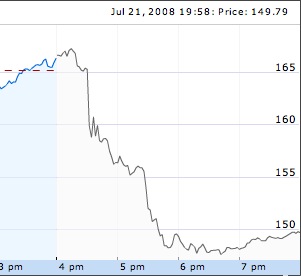
Apple has a huge hit in the iPhone 3G, which is selling out worldwide. The App Store is just as big a hit. iPod sales are still up, so no cannibalization by the iPhone. And Macs are selling like hotcakes, with Apple market share shooting up, sales and profits bigger than ever before, beating expectations. And Apple has “several new products” that will be released in the next few months, including some ultra-cool new gadget that’s still hush-hush.Appstck072208

So how does the market react? Apple’s stock tumbles 11%, down $17 per share after hours.

Why? Because Apple said it’s current quarter might not be as good as expected. Which is what Apple says pretty much every quarter, and every time they do better than expected.

Maybe it’s just the shaky market in general making speculators nervous, but I swear that these guys are economic hypochondriacs–if they got news that their heart is in great condition, their blood pressure excellent, their respiratory and digestive systems A-OK, and the doc gives them a life expectancy of 110… but the doc mentions that they should cut down on fatty foods, just to be safe, they’d burst a blood vessel panicking.

Categories: Mac News Tags:

The Call

July 9th, 2008 2 comments

This afternoon, I got the call I’d been waiting for: SoftBank called to arrange an appointment to pick up our phones. After some procedural stuff, we arranged for a meeting time of 4:00 pm on Friday, just four hours after the release time for the store. I would have made it earlier, but earlier this semester, before the iPhone for Japan had been announced, I had happened to schedule a special workshop class for the 11th at 1:00 pm. So 4:00 it is.

Getting the appointment is a nice relief: it means I won’t have to wait in the long lines at the store. Officially, you’re not supposed to get appointments; Apple and/or SoftBank demand that you come to the store and wait in lines, probably as a marketing display to show off the item’s popularity. But a few SoftBank stores, apparently fully independently, made promises on the first day or two to take reservations–that’s when I dropped by, and got on the list. Although I heard one report of a store canceling its reservations, I heard of at least one other that did not, and when I asked a few weeks ago, the store I signed up at said that although they stopped taking reservations, they would not cancel the one’s they’d made. True to their word, they are honoring the arrangements they promised a month ago. That puts me at a great advantage over the people who have been spending days in line–but I think those people would wait in line like that just to be able to (a) get the iPhone a few hours earlier, and (b) claim to their friends that they were among the first to get the devices.

One catch: they said they didn’t have black 16 GB iPhones. I’ll ask again the day we get them, but they seemed to be saying that the black ones were either immediately unavailable or were already spoken for–but they had white ones. Frankly, the color isn’t quite that important to me, and does have the distinguishing characteristic of denoting a less common model/color, but if I had a choice, I’d go for the black one. Still, there is one other advantage: Sachi will have the black 8 GB model, and this will make it easier to tell the phones apart.

Sachi, by the way, is claiming no great interest in the iPhone, but will get one just to stay on the same plan. Still, when I showed her the Apple video in Japanese demoing the phone, she was very interested in some features, especially the map feature. Nevertheless, I’m pretty certain that if I were not getting one, even knowing the features, she would probably stick with what she’s got.

Categories: Mac News Tags:

iPhone Fever

July 9th, 2008 1 comment

I guess I should have expected it, seeing as how so many Japanese people line up for days waiting for the next iteration of the latest gaming system, but I was still a bit surprised when I heard that lines have started to form in front of the Omote-Sando and Shibuya branches of SoftBank four days in advance of the release of the iPhone. I mean, in New York, people started lining up a week before, and it’s just a version upgrade to them, so I guess this is not a big thing. Still, it’s nice to see if not popular interest yet, then at least intense fanboy interest.

Some of the people near the front of the line are doing a streaming video live blog from their position in line. They do stuff like interview people and generally gab. For the first hour or so of broadcast this morning, all they did was show this guy’s crotch, so I didn’t really hang around for long.

Lbc0709

But since then, whenever I checked back, they were doing something or other a bit more interesting to say the least. It looks like they’re showing the interviews with all the media people who are doing stories about them.

Sorry, but even for a strident Mac fan like me, these people are nuts.

Categories: Mac News Tags:

Mac Market Share

July 1st, 2008 1 comment

There’s a story hitting the news wires: the Mac has hit an all-time high of 7.95% market share, more than ever before, with the impression being of an immediate upward trend for Apple. Last year at about this time, some clueless tech writer at Computerworld wrote that the Mac OS was flailing while Vista showed robust growth, using the exact same source of stats that the new story uses (Net Applications’ tracking data). I wrote a blog post explaining in detail why this guy was full of it. Both stories–the one that was negative about Macs last year and the one which is positive about Macs this year–are wrong, and for similar reasons.

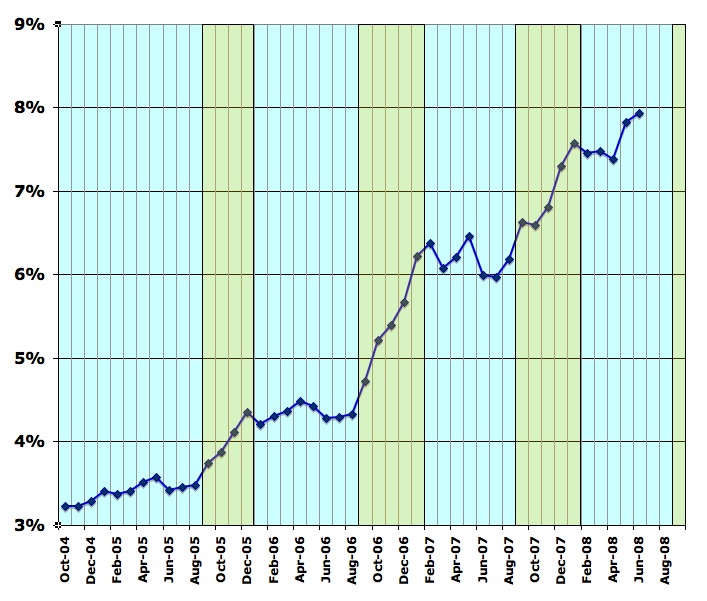
Yes, a new all-time high about Mac use is nice to hear, but not impressive to me right now. The reason: it’s not Mac season yet. I have noticed a pattern over the past three years–here’s the data over that period of time:

Macuse-Na

The areas filled in with green show sustained growth. See a pattern? Every year, starting in September, there is a sustained growth burst that continues until January. Between February and August, there are minor fluctuations, but the market share generally remains static.

The growth spurts are dramatic–less than 1% growth in terms of total market share in late ’05 (but that was bigger in terms of percentage of growth over the existing brand market share), 2% in late ’06, and close to 1.5% in late ’07. But right now we’re in the lull period.

Not to mention that the larger rise took place in May, not June (which was only a slight uptick from May), which was not really reported on. And if you look back, for some reason, there has always been a peak around April or May, so this is not a surprise. The safe bet is that the number will fall again in July and/or August, but then take off again in September, as always–probably representing back-to-school sales which create the growth spurt which lasts into Christmas sales, dying out soon afterwards.

Now, I’ll be surprised if the numbers continue to grow before September; that would be unusual, and could signal a bigger-than-usual surge in the latter third of the year. But right now, it’s not clear how big that surge will be. Yes, the iPhone 3G is making waves, but the original iPhone was making even bigger waves a year ago. While the current spurt trend–only two data points long–shows a slowing increase (2% to 1.5%), that’s less a trend than it is just a couple of data points. The surge this year could be anywhere from a 1% increase up to about 9%, or a 2% increase again up to 10%.

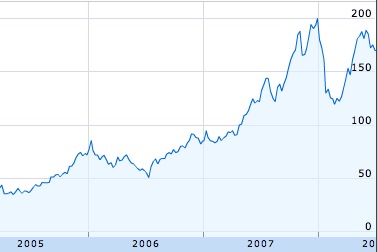
The only thing I’m pretty sure of is that there will be a surge–that’s the safe bet. And if you take a look at Apple stock, you’ll see a similar trend: a general pattern of big increases in the latter half of the year, with slower growth, decreases, and/or volatility in the first half.

Appl05-08

That graph is less clear-cut, but you’ll notice that the biggest increases, especially when you discount the drop-and-recover beginning of 2008, always fall in the second half of the year, peaking over the new year, and then dropping or at least slowing. But since 2003, there’s never been a value drop between June and December.

Those seem pretty clearly to be the golden months for Apple.

Categories: Corporate World, Economics, Mac News Tags: