Archive

Archive for August 16th, 2003

Coming Soon . . . Honest!

August 16th, 2003 Comments off

Robert Novak, the lovable curmudgeon and conservative pundit, reported recently that we have found evidence of WMD in Iraq, and that the information will be released in mid-September. He claims that the administration is waiting for more discoveries to be made before revealing what they have. The information purportedly includes “substantial evidence of biological weapons in Iraq, plus considerable missile development.”

If such information will in fact be released in September, this raises natural suspicions about what is being done to the information and whatever evidence there may be in the meantime; it is unlikely that anyone outside Bush supporters will feel that evidence tampering could be ruled out, not to mention the unethical move of withholding vital evidence for political reasons.

The fact is that the Bush administration has botched the job. By lying so often to the people and the world, by pushing trumped-up evidence and claiming validation, by selling off Iraq profits not just to American industries but especially to those with ties to Bush and Cheney, and by refusing to allow any non-American weapons inspectors into Iraq, the administration would have to be fantasizing if they thought they will be believed by the world when they show up with anything of substance, even if it is real.

Of course, this is all assuming Novak has something here.

But personally, I have the strong feeling that there is nothing to this story at all. Why?

It’s been claimed before. Senators returning from a junket to Iraq claimed on July 3 that “there’s going to be breaking, positive news on that front in a very near term,” and urged Bush to release the information. Of course, nothing came out.

And then there are the news stories: parts for an atomic bomb program were dug up in an Iraqi scientist’s backyard (but were found to be older then the Gulf War and, instead, proof that the program was not reconstituted); two truck trailers were found which the administration told us were mobile labs for creating bioweapons (but it turns out no trace of bioweapons were found, though they would have been if the trucks had been used for that purpose).

We keep hearing these stories, that evidence is on the way or has been found, each time the story being reported wide, far and loud, and each time the fact that it is a bust being reported in a much smaller voice. And I don’t think that these are random errors.

I bet that if you performed a survey of all Americans and asked if we’ve found evidence of WMD in Iraq, that a sizable percent–not over 50%, probably, but still sizable–would say that we have. You spread rumors enough and people start to believe something is there.

Categories: Archived Tags:

Thou Shalt Not Proselytize

August 16th, 2003 2 comments

I thoroughly agree with the idea that church and state should be as separate as humanly possible. Whatever negative experiences some people may have had, religion has had an overwhelmingly positive effect on countless people in their personal lives. However, whenever religion has mixed with politics, government, and the military, the results have been almost universally and completely disastrous. One can think of many examples of religion and state combining to result in injustices and atrocities, but it is difficult, if not downright impossible, to come up with a single example of the marriage of church and state resulting in a positive outcome.

And yet, there are still a great many people, all over the world, who wish to see such marriages multiply (where only their religion is concerned, of course, and not others). This is particularly so in the United States, where the president himself is trying his best to blur the lines with faith-based and other Christian-friendly programs being funded by the state. This is not to say that these programs are not good, I am certain they are great programs. The problem is that they are the camel’s nose under the tent. We have a principle of keeping religion and state separate, and, as any Christian should understand, once you start compromising “a little” on principles, you might as well be “a little” pregnant.

So we come to situations like we have in Alabama, where Chief Justice Roy Moore, supported by a great many religious groups, is defying a federal court order to remove a monument depicting the ten commandments from the state’s judicial building.

The reason given by Moore is that the commandments “represent the moral foundation of American law.” This reasoning is a bit flawed; first of all, the first four commandments regard religious observance, the fifth requires devotion to a hierarchical system, and the tenth is less a legal foundation than a behavioral one. Really only the remaining commandments, concerning killing, adultery, theft and lying, have any connection with our current legal system. But to say that the ten commandments is the foundation of these four laws laws is to say that these rules did not exist before, which is not exactly correct. These are basic foundations in any and all cultures, no doubt dating back way farther than Moses.

And if the claim is that the ten commandments were an influence to the system in general rather than the direct cause of a few laws central to our legal system, it must be pointed out that our system “is also deeply rooted in the pantheistic cultures of Greece, Egypt and Mesopotamia” (Interfaith
Alliance, “Hang Ten Campaign” PDF file), as well as other cultural influences worldwide.

All the excuses seem to me to be a false front–that our legal system is based on the commandments, that they are a historical document and so on. People who give such reasons are, in my opinion, covering for the real reason: it is their religion, they feel it is the most important thing in the world, and they want to proselytize the word of God, and putting up the ten commandments in public places will help to do that. But it is not usually admitted as the rationale for the same reason why people who oppose abortion because of their religion find other secular grounds (which usually make little sense), or why those who oppose cloning for religious reasons turn to the “army of robots” fallacy to make their point. It is because they know that in a society with the principle of separation of church and state, religious arguments are not acceptable. That is the core of what they are trying to change.

I do not see this as some evil conspiracy or the like; to these people, it is right, reasonable and just, and if those who oppose it only saw the light, we’d be thankful. Many people believe that their religion is The Answer to all problems, just as it was The Answer for them in their personal lives. They believe that the laws of God outweigh the laws of man. I can understand this and sympathize with this. However, the problem with this situation is that when one tries to put into effect these beliefs in the form of laws furthering the Christian or any other religion, one violates one of the most important tenets of American society, one that has made us successful as a nation, one that has held this country together. In a multi-belief society, one cannot have a theistic government without disenfranchising members of all other faiths and agnosticism (I count atheism as a belief–but that’s just me).

You can’t have a school with prayers without opening children of agnostics, atheists, or even faiths that forbid public prayer up to taunting, abuse and ostracism (and you can’t ignore the fact that such things are the result). You can’t claim that the system of justice will be a Christian system and provide justice for all others. By definition, a system which includes one religion excludes all others, and that is contrary to the foundations upon which our country was built.

That’s the big picture, and it drives the necessity to do all the small things. Some people feel outrage that Moore is being ordered to take down the ten commandments. Many criticized the judges who forbade the “under God” part of the pledge of allegiance. People who do so fail to see the big picture–or they see it, and disagree with it.

Finally, my own personal opposition to many of the drives to put up the ten commandments is for the one reason stated in public that is not overly religious and yet is an honest one: people believe that putting the commandments up in yards, schools and state houses will curb the loss of morals and the rise of crime, and will teach the youth of our nation morality so they will be good people. Of course, the problem with that is the unspoken assumption that morals cannot be taught without religion, and therefore people who do not have religion cannot be moral.

If you think that I am going overboard with this claim, read this. Also, I have known several people who come from the evangelical camp, some who actually have to check themselves when they realize they are applying religious viewpoints to others in secular situations (such as a friend who accused me, an agnostic, of “backsliding”), and some who don’t check themselves at all. I personally am insulted by this, as I am an agnostic, was not raised on the ten commandments, and yet–I believe–am a moral person. It is more than possible to instill morality and rightness without having to resort to biblical references.

We need an eleventh commandment, specially built for our society, if we wish to retain religious freedom: thou shalt not proselytize on the public’s dime.

Categories: Religion Tags:

You’ve Got to be Kidding

August 16th, 2003 Comments off

The Pentagon and the president, already in hot water for cutting veteran’s benefits and education for their kids after sending scores of them to fight and die for Halliburton, are now digging themselves an even deeper hole: they want to directly cut the already measly pay given to soldiers in Iraq.

Why? Because it would cost another $300 million if they don’t.

Now, I never supported the whole Iraq invasion thing, but our men and women who are there deserve all of our respect and support, and that includes paying at least minimum wage, for crying out loud.

Somehow Bush feels it is a travesty to not give a trillion dollars back to the rich, and that it is acceptable to run up a deficit of $450 billion every year, which this country will soon gag on, just so he can have his political agenda played out–but when it comes to paying a tiny fraction of that to the Americans who are dying for his botched policies, suddenly this is just too much and we have to cut back somewhere.

I’m sorry. You know that I criticize Bush for all sorts of horrible stuff that he does. But this is just plain, stinking obscene.

Categories: Archived Tags:

Making Gyoza

August 16th, 2003 32 comments

Okay, settle down here, because this will be a long post–not necessarily in words, but in inches (or centimeters, as the case may be. A friend recently taught me how to make gyoza (sometimes spelled ‘gyouza’), often called ‘potstickers’ in English. They are essentially a vegetable mix, with meat optional, encased in a small dough wrapping and steamed or fried before serving. I like gyoza, but the ones I get at stores tend to be far less than satisfying–but I found that I really like the homemade ones. The ones I’m showing today are made with chicken. Please note that the amounts of ingredients are approximate–they can easily be increased or decreased to suit your taste. Keep in mind I am no cook, nor a cookbook writer, so this could be a bit messy! Here is the basic setup for cooking:

1/2 head of cabbage or less (you won’t use it all by a long shot, but usually you can’t buy less)
1/2 onion
part of a clove of garlic (use however much you prefer)
one bunch “nira” (leeks)
one bunch “negi” (umm… also leeks, but a different kind. I like the thin type, shown above)
1 to 3 packages large gyoza wrappings (depends how many you plan to cook now)
Sesame oil (“gomayu”)
Seasonings (I use salt and pimenton)
Ground chicken meat (around 250 grams, or half a pound, roughly)

You’ll also need a little flour with water, a largish mixing bowl, a long, sharp knife, a regular spoon, and a frying pan with a cover. Keep in mind that these are just the suggested portions. You can change the amount of any ingredient to your taste, and even add or subtract filling ingredients.
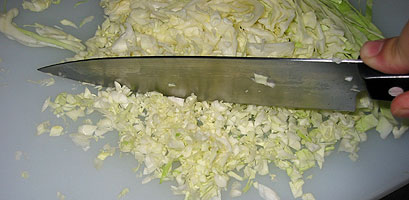
First, slice some cabbage, perhaps three or so quarter-inch thick slices from the middle of the head. Discard any bulky pieces too close to the stem, then start chopping, until you’ve reduced it to tiny pieces. The amount you’ve chopped should amount to about a cup, slightly packed. When finished, throw them into the mixing bowl.
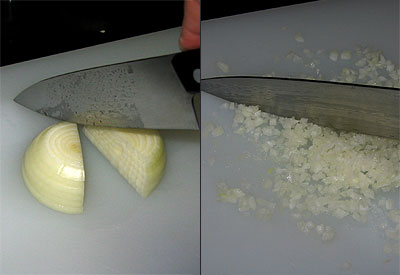
Next, take half an onion (just a regular white onion), and chop it into similarly small pieces. Then throw those into the bowl, too.

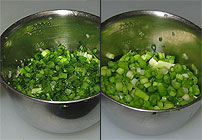
   
Then chop the leeks, not just slicing the bits off, but chopping those into finer bits as well. Each type should produce about a quarter of a cup. Into the mixing bowl they go.

Take whatever amount of garlic, if any, that you prefer–I took three lobes, or whatever you call them–and grate/crush them. Add this to the mixing bowl as well.


This is what you should have by now.

Now, for the meat, I like to use ground chicken. Ground beef was way too dry; ground pork was OK, but chicken makes the gyoza much juicier, in my humble gourmet opinion. I use the fattier ground chicken, in fact.

Update: At this point, you may want to add cheese. I have found that shredded cheese, added to taste, can make the gyoza even more tasty. I use mozzarella, grated, about half a cup.
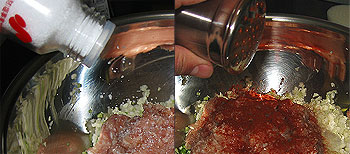
After the chicken is added, top it off with the seasonings you prefer. Salt and pepper are safe bets. I use pimenton (smoked Spanish pepper spice) because, well, I use it on everything. So on it goes.

   
Finally, pour on some sesame oil. Don’t be stingy, but don’t create a flood, either. Maybe 1/4 cup or so will do, though I’m just estimating here. And then–eeewwwwwww!!–go in with both hands and squish, squash, and knead all of it together until it is well-mixed. Then go wash your hands, for god’s sake!

OK, here are the shells to use. They come in different sizes and thicknesses. I always go for the large ones, partially because I like big gyoza, but also because the smaller ones create a lot more work–you have to make more, and as you’ll see, the shell crimping can be time-consuming. I have no preference between the thick and thin types. Here I am using the thin ones. You can usually find them in your (Japanese) supermarket near the ground meats; if not, ask. The ones I use come in packages of 20.

Have the gyoza filling mix in the mixing bowl handy, as well as an empty plate to put the finished gyoza. Get a small dish or saucer, and put a small amount of flour (a teaspoon, perhaps, no more) onto it, then add a little water; mix some flour into the water until it becomes milky, but not very thick. Open the gyoza shell package, and take out some of the round shells; we’re gonna wrap some potstickers!

Here comes the difficult part of the recipe; it may take you several attempts to get decent at it, so be patient. First, take a shell into the palm of one hand, and then spoon out some gyoza filling into its center; see the photo above for the amount. Less than a spoonful to be certain–for the first few, less is better than more (when you close the shell, a few steps later, there should be maybe a third or half an inch of border around the filled center). There’s lots of filling here, so go ahead and waste a few if needed.
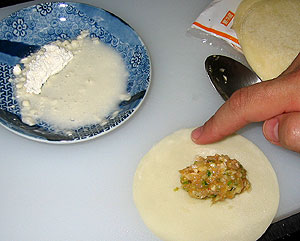
Next, dip the tip of your finger into the flour-water, and apply this to the border of half the gyoza shell (the same side the filling is on), so as to mark out a semi-circle. Only spread enough with your finger to cover the surface of the edge and make it sticky; it should not run wet. This acts like a glue, and is to get the shell to stay closed. In the photo above, I have set the shell on the cutting board only because I needed a hand free to snap the photo; usually, I wet the edges while holding the shell in my other hand.

Next can be the trickiest part:

You’re going to have to close the shell, but not just in a smooth, straightforward manner. You will have to crimp one side of the border, making creases along the way. Different people have different techniques for this. My way is to bring the two halves of the shell together and close them just at the center point, leaving the sides temporarily open. Then, working from the top/center, I take some slack from the far side of the shell (as you see in the above illustration, I start on the right side), creating the crease–then pressing down hard to seal them together. I do this twice on the right, and twice on the left, for four creases; you do what suits you.

The finished product should look something like this:


Note the creases in the shell are only on the one side (call it the “top” now), and the other side should be flat. Note also that the filling should not come close to the edge, with a 1/3 or 1/2 of an inch border.

Continue dalloping, gluing, folding, crimping and pressing, until you have the desired number of gyoza. Usually 12 or so are enough for someone with a good appetite; Hiromi, my friend Ken and I found that 40 gyoza serve three people quite nicely, along with a salad and drinks. The amount of filling that this recipe generates is enough for 40 gyoza, possibly 45 (or even 50 if you use less filling in each). If there is filling left over after you finish (as I had tonight), then drop it into a ziploc and refrigerate it; more gyoza for tomorrow!

In the end, your plate might look like this:


I made 14 here, just for myself (me, hungry).

Now, prepare the frying pan by pouring a small amount of oil (olive oil would be great here) into the pan, then spread it around with a square of paper towel; there should be enough to slightly ‘wet’ all the gyoza as you place them down. Do not pour so much that the whole pan bottom is covered; to the contrary, keep it very light, so that all the oil can be absorbed easily into the gyoza.

Next, place the gyoza into the pan; up to twenty should fit at a time. Don’t worry if they touch. Fry the gyoza at low heat without a cover, until the bottom of the gyoza are brown; then raise the heat a touch for a moment. Then, with the pan cover in one hand, take a cup of water in the other and pour it into the frying pan, then quickly cover the top as the water turns to steam.
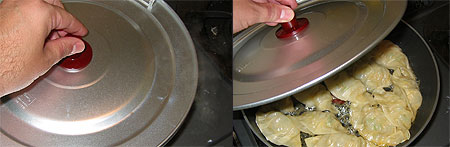

Keep the top on for five minutes at least, perhaps more, checking periodically; when the water has all but steamed off and there is just a bit of water and oil left in the pan, the gyoza may be done. If the water has gone but you think more cooking may be in order, add a bit more water and cover again.

When the gyoza are done, take the pan to your kitchen sink. Drain any excess water (there shouldn’t be any if you did it right), then uncover the pan, and put a dinner plate, upside-down, over the gyoza. Holding the plate with one hand, turn the pan over with the other, then remove the pan from atop; the gyoza should now be nicely placed on the plate.

Congratulations–you’ve got gyoza! Gyoza need a dipping sauce, so in a small saucer, pour some soy sauce, and then some sesame oil. I top that with (of course) a little pimenton. Serve the gyoza from the central plate, allowing everyone to take from it and dip in their saucer.

Enjoy!

Categories: Focus on Japan 2003 Tags: