Archive

Archive for February, 2005

Japan Fun Fact #10: Where the Streets Have No Names

February 9th, 2005 4 comments

Well, not all the streets have no name. The larger ones do. But most don’t.

Japan’s streets are usually not laid out in a rectangular grid like American streets more often are. The blocks seem to be divided in a much more haphazard fashion, like people just claimed this bit of land or that, and the streets just flowed around them. This by itself is enough to confuse any non-native person navigating Japan’s streets, but the fact that most streets have no name, no street signs to guide your way makes it even more difficult. Because streets tend to jig this way and jag that way, it is very easy to lose your sense of direction–I’ve done that more than once, and I’ve got a fairly good sense of direction.

Here’s how it’s laid out. You start with a city block (called a “banchi“), which has a certain number of lots on it. Each lot has a number. The numbering begins at some point on the block, then runs around that block ascending, until you reach the starting point again. Not all numbers are used, and the pattern–if there is one–is hard to see. Certainly not like the U.S. system where even and odd numbers are used on either side of the street. And the block is not usually going to be a rectangle, and the lots are often uneven Rarely are they organized, and usually very different kinds of buildings share the same block–you can have an apartment building next to a factory next to a wealthy person’s home next to a convenience store next to a few regular houses and then a trucking company, and so on. Okay, usually it’s not that diverse, but after seeing so many neighborhoods in Japan, you get the clear sense that zoning is not a big thing here.

Next, the blocks are grouped together into divisions of the “neighborhood,” as you might call it. Each division is called a “chome” and is made up of some dozens of blocks. Each block has its own number, and while they usually are sequential, that sequence may wander and meander somewhat. You could be walking down a street, and come to an intersection, and even though all four visible blocks are in the same division, they might have numbers like 7, 8, 21 and 34. The sequence of numbering is usually most apparent on a map, not from the ground. There seems to be no universal logic to how the block numbers are assigned.

Each “neighborhood” (called a “cho” or “machi“) is divided up into anywhere from one to perhaps even a dozen “chome.” Usually the number of chome is four or five, but there are all kinds of variations, again seeming to follow rather non-standard rules, if there are any rules to this.

Finally, put all the neighborhoods together and you get a ward/borough (“ku“), or some sort of village, town or city (“mura,” “machi” or “shi,” respectively). These then collect to form a prefecture, kind of like a state or a province.

In the U.S., our addresses are initially linear–using streets–but then go to a radial zooming-out system. In Japan, addresses are purely radial. First there is the building number, then the block number, then the neighborhood division number, then the neighborhood, city/ward, prefecture and country.

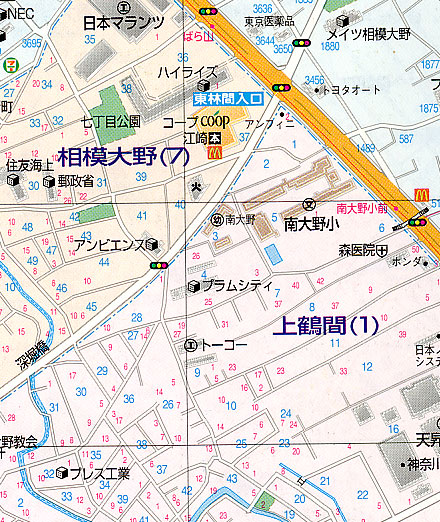
Take the map fragment, from Machida City, shown below:
205Map1

This focuses on the area shared by two neighborhood divisions: the orange 7th chome of Sagami Ohno Neighborhood at top, and below, the pinkish 1st chome of Kami Tsuruma Neighborhood. The big bright orange line is a major boulevard, so it’ll have a name (Tokyo Kanjou, or the Tokyo Ring Road). You can see that it is intersected by a semi-largish white road; sometimes a road that size has a name, but not this time–the Tokyo Ring Road is the only named street on this part of the map. The blue numbers are block numbers, and the smaller red ones are lot numbers. Note the “block” numbers for the uppermost neighborhood above the orange road: the numbers are in the thousands, indicating that it is a neighborhood (machi) with no divisions (chome); in this case, there are no division numbers and even no block numbers–each number is a lot number. So instead of having an address like 7-31-22, the number is just something like 1880.

You might think that the block numbers and lot numbers could help, but these are not always easy to spot on the ground. The closest thing to street signs in most places in Japan are small placards on telephone poles which, along with local advertising, show the address down to the block number. But these are too small to note while driving, and even when walking, they are sometimes absent; people rarely use them for directions. Some residences will have the address on a small plate on the outside wall of the lot, but that is the exception, not the rule.

Now, there are some landmarks to assist you. Note the blue box with the white letters; that’s the name of the intersection. Intersection names can be a help as they do not depend on street names, but as you can see, there are not many of them. So what we are left with are landmarks. You can see two McDonald’s, a 7-11, and a supermarket (“Coop,” right at the named intersection). After that, you have to depend on traffic lights, pedestrian overpasses, schools (the brown buildings just above left of center are an elementary school), hospitals (the cross-in-a-shield mark at center right is one, the Mori Clinic), car dealerships (trust me, there’s a Toyota and a Honda dealership in there), and so on. So directions from point A to point B are heavy on landmarks. “Go two traffic lights down, take a left and when you see the fire station, take the next right. The place you’re looking for is about 30 meters down the road, just after the small park on your left.”

Needless to say, a lot of people get lost. Especially when maps provided by businesses are heavily distorted in terms of distances and relative positions.

You can also see on this map the haphazard layout of blocks and streets. And you can see the variety of buildings in a small area. Take the Coop supermarket: above it is an apartment block, and above that is a factory (marked by the circle with what looks like a Roman numeral “I” in it). Just below it on the map is a fire station, across from which is a kindergarten. Kitty-corner from the Coop across the intersection is the Toyota dealership, and across from that is a pharmaceutical company. In all the vacant spaces are houses and any number of small shops, warehouses, apartments, and so on. In short, it’s a mess. But people get by somehow.

Categories: Japan Fun Facts Tags:

Time to Punish the Poor and Lie Even More

February 8th, 2005 3 comments

After Bush gave huge windfall tax breaks to wealthy Americans flush after the Clinton boom, the deficit is as high as ever. Although Clinton turned the prior Bush’s deficit into a surplus in just eight years, the new Bush says that in nine years he can only achieve cutting his newly-created deficit in half. And how is he going to do it?

Tax the poor, of course. Not in the form of an actual tax hike, but instead by slashing their services. He wants to gouge education, welfare, health care, veteran’s benefits and housing by so much that even some Republicans are gagging. In just education alone, Bush wants to wring dry “school dropout prevention, state grants for vocational and technical preparation and Even Start, a family literacy program.” Cut food stamps, Medicaid benefits, veteran’s drug subsidies–a laundry list of items that Bush naturally neglected to inform Americans of before the election. Nothing on the list will take away anything from wealthy people.

And even after slashing all of those services, Bush still only takes away $15 or $20 billion a year in a projected $400 billion deficit–which conveniently does not include $80 billion for Bush’s Middle East wars, nor does it factor in costs for Bush’s desired social security privatization nor for the tax cuts for the rich that he wants to extend even further–an obscenity when you consider that he is trying to give billions to the rich while at the same time trying to strip away programs that help the poor just to scrape by. A tax cut for Bill Gates right along with taking food stamps and Medicaid from the poor. How inhuman is that? Is he going to give us more BS about how “it’s only fair”?

Fact is, Bush isn’t cutting the deficit at all, not if he gets what he wants this year–in fact, he’s on his way to expand the deficit greatly–but he has no trouble stopping along the way to bash the working poor and tear the heart out of primarily Democratic programs, while the Republicans in control of Congress continue their pork-barrel spending spree.

Yep, it’s a Bush budget, all right.

Categories: Political Ranting Tags:

A Mac Site You Should Not Visit

February 8th, 2005 Comments off

If you want to get the latest information and rumors about Macintosh products, there are a few good places to visit. Macsurfer.com has an excellent daily listing of Mac-related articles and even blog entries (this blog has been listed there several times), updated every day. If you’re looking for a story on anything related to the Mac, that’s the place to go.

For concentrated rumors, Think Secret may be the most often quoted, but MacRumors has the most comprehensive information around, with discussion areas that have a lot of good feedback.

But the place not to go to: MacOSRumors (not to be confused with the excellent MacRumors). You may have seen the link I had to their site on my linkboard at right, but no longer. For some time, they’re been unreliable in both their information and how often they update their site (too many “coming soon” claims that are never followed up), but most annoyingly, they’re more of an ad site than a Mac rumors site. Want to see a story? Click through ads to get there. Ads all over the place. And something that surprised me: they have pop-under ads that actually get through Mozilla’s pop-up ad blocker, something I did not think was even possible. It’s the only site I have been to where this happens.

I wrote them about it when it first happened, telling them I would not return as long as they had such ads. They sent back an email assuring me that it was a fluke, and when they caught an advertiser doing that, they would cut them off immediately. Just that alone sounded like BS–the pop-under ads were not coming from advertisers’ pages, they were coming straight from MacOSRumor’s code. And sure enough, subsequent visits have brought more pop-unders. So I have switched their link with one for Think Secret; I will not return to the site and I advise you to avoid it as well.

Categories: Mac News Tags:

Gotta Love It

February 7th, 2005 7 comments

I typically do not comment on anything that Ann Coulter says, for the reason that she is a pitiful wretch of a person who just says outrageous stuff to enrage people. But this one was too hard to pass up. Commenting on anti-Bush demonstrations in Canada, she noted, in her typical obnoxious manner, that Canada “needs us. They’d better hope the United States doesn’t roll over one night and crush them.” Explaining this, she noted that Canada used to be our good ally because they did everything we wanted them to do, specifically sending their people to fight our wars. “Canada sent troops to Vietnam,” she claimed to CBC’s Bob McKeown for Canadian TV. Because they sent troops to Vietnam, she reasoned, they should be willing to send troops to Iraq.

Turns out they didn’t.

MCKEOWN: “Canada didn’t send troops to Vietnam.”

COULTER: “I don’t think that’s right.”

MCKEOWN: “Canada did not send troops to Vietnam.”

COULTER: “Indochina?”

MCKEOWN: “Uh no. Canada …second World War of course. Korea. Yes. Vietnam No.”

COULTER: “I think you’re wrong.”

MCKEOWN: “No, took a pass on Vietnam.”

COULTER: “I think you’re wrong.”

MCKEOWN: “No, Australia was there, not Canada.”

COULTER: “I think Canada sent troops.”

MCKEOWN: “No.”

COULTER: “Well. I’ll get back to you on that.”

MCKEOWN (voiceover): “Coulter never got back to us — but for the record, like Iraq, Canada sent no troops to Vietnam.”

Of course, if Coulter had just thought about it for a minute, she would have realized that many of those kids during Vietnam who left the U.S. to avoid fighting went to Canada. Duh.

You can read about it here, but even better, Michael Moore has it available on QuickTime on this page. It’s a real hoot, watching her squirm like that–knowing she’s got a big point completely wrong, and yet her titanic ego won’t let her admit to it.

Categories: Political Ranting Tags:

Trekked Out?

February 7th, 2005 6 comments

Since Gene Roddenberry came back in 1987 to resuscitate Star Trek on television, it has been on the air in one form or another for the entire eighteen years up to today. In 1993, when The Next Generation had one year left, Deep Space Nine went on the air. A year later, Voyager joined in and the two Trek shows ran concurrently. When Voyager went off the air in the Spring of 2001, Enterprise picked up the ball that autumn and has been running since. TNG, DS9 and Voyager each ran for seven years before they were retired–but it looks like Enterprise will not be so lucky. After the end of this, its fourth year, Star Trek: Enterprise will face cancellation–and it looks like no fan uprising will keep it on the air.

The reasons for cancellation are pretty clear-cut: it’s doing badly in the ratings, so much so that its rich demographics can’t save it. Part of the ratings problems have to do with the fact that it is on UPN, which is not exactly a powerhouse of a network; part has to do with the fact that it has not been the most appealing show on the air; and part of it has to do with the fact that it was tossed into the Friday-night trash bin (like the original series was in the 60’s) where it has languished this year. Paramount has its 100 episodes which will keep the show alive in syndication, and for them, that’s all that is necessary. And hopes that the show might be picked up by the SciFi channel, like the popular, long-running Stargate SG-1 series (now in season eight) after Showtime axed it, have been dashed by Exec Producer Rick Berman, who says the show won’t be shopped around.

Which is too bad for Enterprise, which was just getting its footing. Each Trek series got off and running at different times, and Enterprise, which got a good push last year with the season-long “Xindi” arc, has been doing much better this year, winding plotlines and Trek “history” from the original series into the Enterprise storylines. But probably the most important improvement has been that Rick Berman and Brannon Braga finally let go of their control to the show and gave it to Manny Coto, who improved the show tremendously. But it came too late–Berman and Braga let go only because they knew the show was doomed.

So now they’re talking about giving the franchise a rest, which might not be such a bad idea. But what it really needs is new blood. Berman and Braga had been with Trek ever since it began its current run in 1987. Eighteen years is too long for two people to be in control of the franchise, and their stagnant direction has been one of the biggest reasons Trek has not been doing well. Hopefully, when Paramount decides to revive the franchise again in four or five years, they will be wise enough to seek out someone talented and fresh, with a respect for the show and the fans.

Categories: Main, Media & Reviews Tags:

The Bush Social Security Plan: So Dumb Even He Can’t Sell It

February 6th, 2005 1 comment

The end game for Bush’s disastrous social security privatization plan is drawing near. This time Bush’s Reality Distortion Field™ is wavering, and the general public is getting the idea that it’s nothing more than an ultra-conservative attempt to destroy one of the most successful government programs ever. (Bush has already mucked things up at NASA, another brilliant success story–what’s next, is he going to try to dismantle the interstate highway system after this?) Even the Wall Street Journal (subscription only; here is an article about it) is now questioning the whole idea–and the answer is not positive.

It boils down to this: Bush claims that social security is headed for bankruptcy. And he’s dead wrong. Like with Apple Computer, people have been proclaiming doom since the start, and it hasn’t come true yet. Under the status quo, in another 40 or 50 years, social security will have enough money to make only 80% or so of its payments, unless, of course, we find another way to fund it. And there is a solution that won’t destroy social security or cripple the economy–but Bush claims there’s no feasible way to do that, so instead let’s privatize.

Unfortunately, privatization is not an answer, it’s a wrecking ball. It will take as much as 1/3 of all contributions into social security and divert them to private accounts. That will not help social security, it will devastate it, by sucking up so much of its funding that it will go truly bankrupt decades sooner! It will incur up to $15 trillion in debt before it starts paying off, which would be literally crippling to the American economy. Furthermore, the WSJ article shows how social security privatization has failed so miserably in other countries that many look at our system as an ideal they wish they could get back.

And, as it turns out, there is a real solution. Right now, the social security tax rate is 12.4%–meaning that, unless you are self-employed, you pay 6.2% from your own paycheck, and your employer handles the other half. But there is a built-in tax cut for the rich here: the tax cuts off at $90,000. So someone making $90 thou a year pays exactly the same amount of payroll tax as someone making $90 million a year. In other words, we have a regressive tax, where the rich pay less than the poor.

The Wall Street Journal (free article) points out the obvious solution: repeal the cap of $90,000, and the problem is solved. Social security will be solvent for at least the next 75 years, and there will be no need for privatization–not that there is any need for it now!

Categories: Political Ranting Tags:

Is Referral Spam Doomed? Not Quite Yet…

February 5th, 2005 1 comment

I’ve been writing for a while on how referrer spam is making the blog visitor stats semi-useless. Spammers, hoping that bloggers will list the top several sites which send visitors to them (with links to the referrers included), barrage blogs with massive amounts of fake referrals. That is, they “look at” your blog, and in so doing, fool your site into believing that the “visit” originated from a link on their site leading to yours. The “visit” will be recorded in your logs and their site gets credit as having sent the “visitor” your way via a link on their page, even though the link doesn’t really exist. The more they barrage your site, the higher they will rise in your rankings.

Now, I don’t post such rankings. Most bloggers don’t. And my stats files are in protected directories which others can’t access. So it is for most bloggers. But that doesn’t stop the spammers. Of my top 100 referrers in AwStats, only two are legitimate. The vast majority of the spam referrals are about poker, and probably most if not all are generated by the “Texas Holdem” cockroach that so many bemoan.

Now the good people who write code are finally starting to react–Tony at juju.org has created a script that accesses the MT-Blacklist file to actively clean out log files. Ron at Groovy Mother has created a hack for AwStats that will filter out referral spam from its logs.

So you’d think I’d be a happy camper, right? Except that so far, the hacks introduced are at the same level of many hacks: designed for people who know a lot more about computers than I do, including use of the command line interface. The instructions are greek to me, no for-beginners kind of stuff that says step-by-step what to do. They assume I know exactly where to put the code and how to integrate it, stuff like that. Heck, I have no idea of where AwStats resides on my site or if I can even access it for a hack. Movable Type and MT-Blacklist are the next step up, scripted code but with documentation so you get taken by the hand through the process–well enough, anyway, so that it only takes a limited amount of time scratching your head to figure out how to get it to work. I will, of course, ask on the pages of the scripters if they’ll provide such instructions, but in the past I haven’t had too much luck when I do that.

Still, it’s a great first step to getting the spamming bastards’ maelstrom down to a dull roar.

Categories: BlogTech Tags:

Denial Is a River in Japan

February 4th, 2005 2 comments

Japan’s treatment of the Mad Cow Disease phenomenon is becoming increasingly similar to how the media in this country reacted to the AIDS outbreak in the 80’s: it’s a foreign problem. I recall a case in the 80’s where a Japanese callgirl (from Kobe, I believe) died of AIDS. The stories were all over the press: she got it from her foreign boyfriend. Despite the fact that she slept with a great many men over many years, and despite the fact that she met her boyfriend not too many years before dying of the disease (not enough to make it likely he was the source), there was almost universal agreement in the domestic media that it must have been that European guy. AIDS was a foreign disease, and this was proven by how few Japanese got it–though since it was a shameful disease, whenever someone died of it, the doctor protected the family from stigma and shame by certifying the death as caused by the opportunistic disease that finished the patient off and not the syndrome itself, thus skewing the numbers to prove an “AIDS-free” country.

Well, here we go again, this time with Mad Cow Disease. I’ve already pointed out how Japan’s ban on American beef is rather irrational, since America has had only one case and that cow came from Canada, while Japan has had fifteen purely domestic cases (the most recent just a few months ago), and on the first one in 2001, they even sent the carcass to be turned into cattle feed after the diseased cow had been diagnosed–but Japanese beef remains as freely sold as ever.

But now comes the story that the first case of the disease variant in humans has taken its toll: this week a Japanese man died from Creutzfeldt-Jacob Disease, and although there is no evidence to show where he got it, Japanese doctors are now all but certain that he must have contracted the disease in Britain because he stayed there for one month three years ago. No matter that the disease has been rampant in Japan the past four years, where he likely ate 98% of all the beef he consumed during that period. It must have been the 2% of beef from England that killed him. Well, when pressed, the Japanese doctors admitted that it is possible he got the disease from eating Japanese beef, and ministry “experts” will continue to “investigate.” Meanwhile, this death, while having nothing to do with U.S. beef, reportedly may hold up Japan’s decision to start importing U.S. beef again. Talk about using any excuse!

In the meantime, I continue to avoid Japanese beef….

Categories: Focus on Japan 2005 Tags:

Can’t Get Enough Fuji

February 3rd, 2005 4 comments

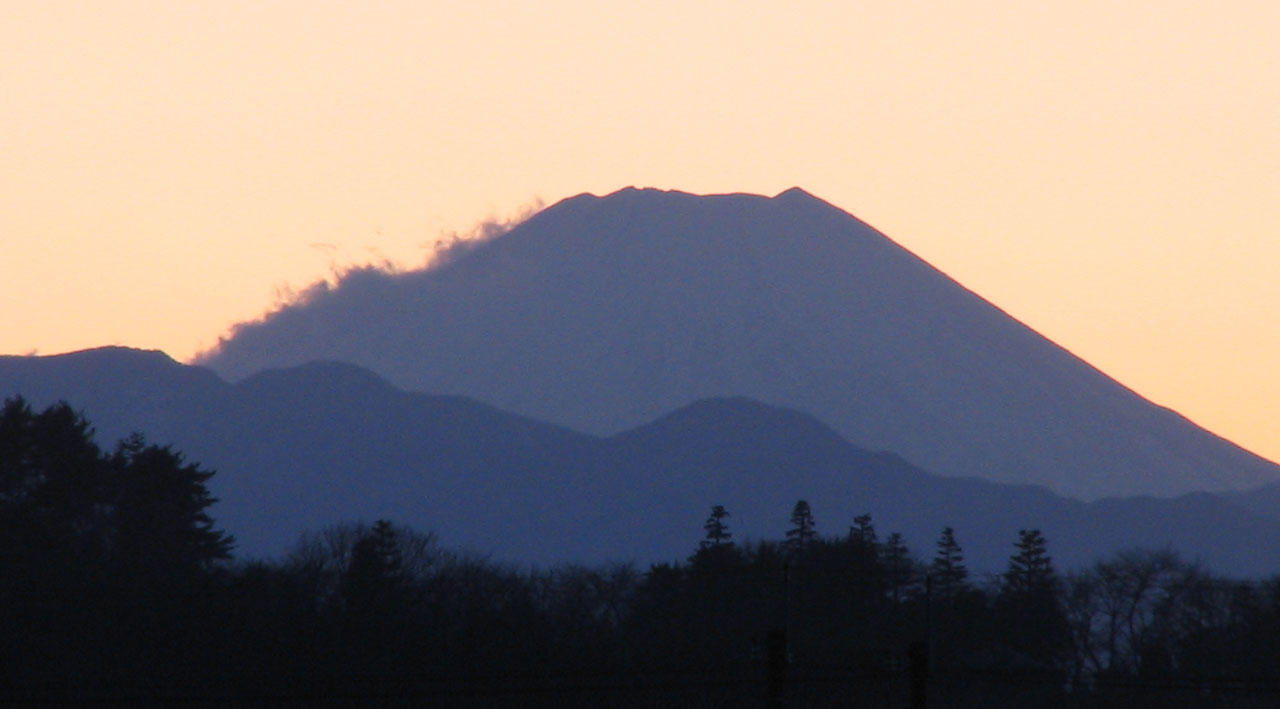
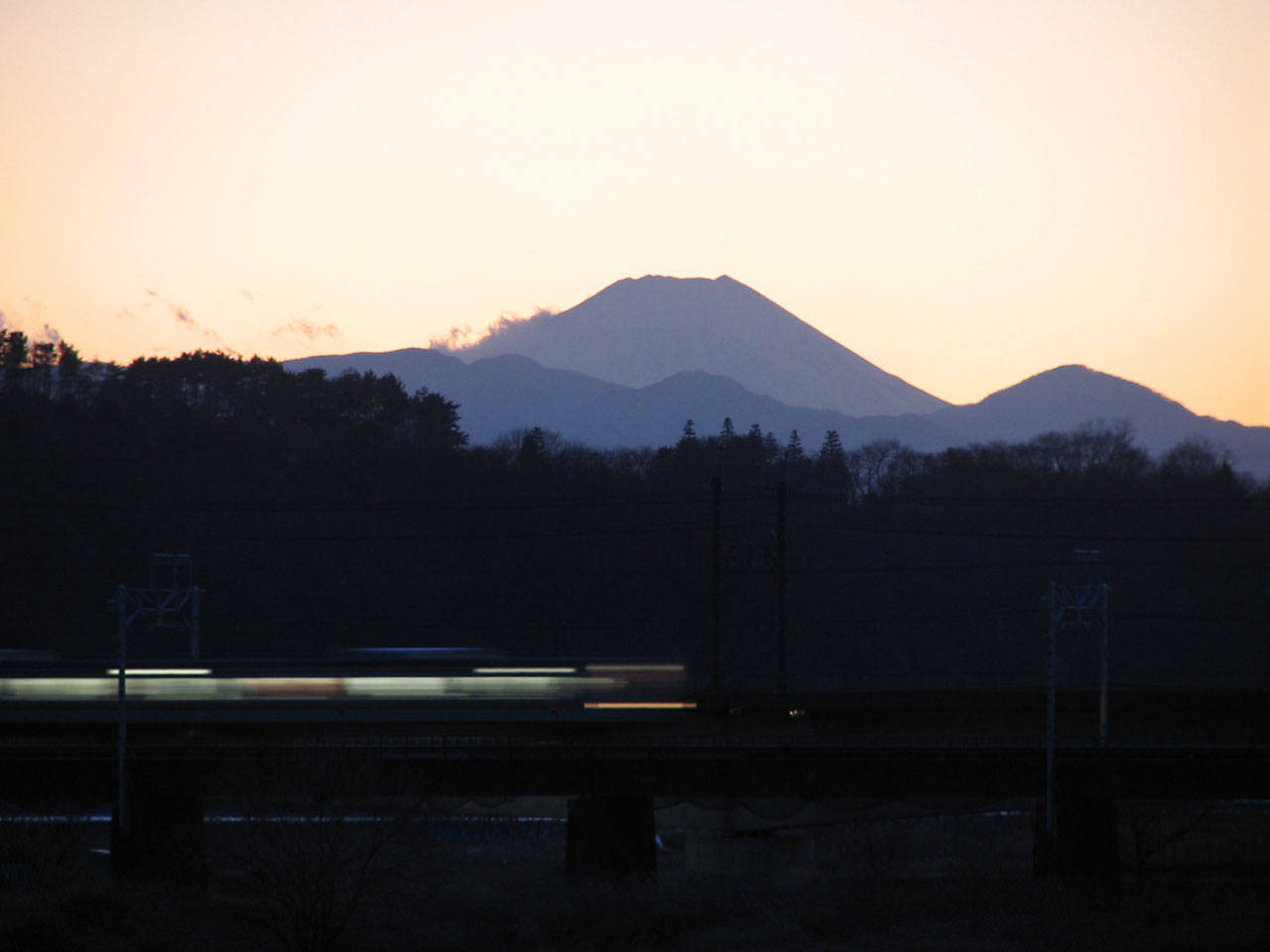
Some more nice sunset photos of Mt. Fuji from the banks of the Tama River. Click on any of the photos for a 1280×960 full-sized image (about 60KB each).

205Fujiss1A

205Fujiss2A

205Fujiss3A

Categories: Focus on Japan Miscellaneous Tags:

Laying in Wait

February 2nd, 2005 1 comment

Every once in a while you come across the sight below: a traffic cop laying in wait. They love to do that at major intersections, expecting people to violate traffic laws there. Not that they really do their job well–if I had the slightest feeling that they were really trying to maintain traffic safety, I’d have some respect for them. But the tend instead to avoid danger spots, instead hiding in spots where there’s very little danger from vehicles crossing yellow lines and such, but where it’s easy to catch and ticket people. A lot more on that in this past post.

205Cop2

205Cop1

205Cop3

I watched him for a few minutes while waiting for my order at McDonald’s to get made. He never went after anybody, and apparently gave up, as he left just as I was heading back. A little video of that–nothing really interesting, just a bit of video for fun. (Quicktime movie, 1.4MB.)

Trafcop

Categories: Focus on Japan 2005 Tags:

New Powerbooks Are Out: No Big Whoop

February 1st, 2005 3 comments

The new Powerbook line was announced today. Not only did the G5 Powerbook fail to materialize (as most expected but hoped otherwise), but even the second-best Freescale dual-core–or even single-core–G4 chip didn’t show up. Instead, the new Powerbooks out are relatively unremarkable upgrades, up to barely 1.67 GHz over the prior 1.5 GHz. A minor speed bump, at best. One can easily understand now why they didn’t want to mention these at the MacWorld Expo.

There are some other upgrades, as if Apple knew the CPU bump would be disappointing and so wanted to cram in as many small improvements as they could: a larger hard drive (up to 100 GB, over the prior 80 GB, but still spinning at 5400 RPM), an 8x Superdrive (I presume the prior model was 4x), more RAM (though 512 MB should have been standard for a long time now), faster Bluetooth, optical audio I/O, a faster graphics chip, and a hard disk drive drop-protection system which will protect the hard drive from a head crash in case of a sudden jolt or impact. There is also a new trackpad scrolling feature and a brighter keyboard backlight. None of these is exactly enough to blow your socks off, even with the $100 to $200 price drop over before, though all of them combined might be enough to impress some buyers just enough. In fact, the low-end Powerbook is just barely better than the high-end iBook, which is priced $100 lower; if the Powerbook doesn’t surge forward sometime soon, Apple will have to slow down the iBooks just so they don’t start to outshine their older brothers.

The Powerbook is still an excellent machine, but it’s just not all that more spectacular than it was a few days ago. A better deal, but not close to being enough to make me drop at least two and a half grand to replace my current Titanium 800 MHz DVI model–especially when it is apparent that a much faster model, a significant upgrade, is just around the corner. Just how far around that corner is another question: will we have to wait another 8-9 months for the next line to come out, and will it be a G5, a dual-core G4, or yet another minor speed bump. Some model turnarounds have come as early as 6 months after the prior release; others have taken almost a year.

This is the hard part about deciding when to upgrade–you never know when the right time is. I got lucky when I bought my own machine almost three years ago; it is still quite serviceable, and will do very well until the next big jump.

But, dammit, you just want to buy a new one!

Categories: Mac News Tags: