Archive

Archive for March, 2006

Morons on Parade

March 10th, 2006 Comments off

For more in the “people can be idiots” vein:

It was pointed out recently that the men who decided to ban abortion in South Dakota had overlooked something: the last time abortion was illegal they didn’t have DNA testing. Which means that preventing abortions, if it works, will create a lot more court orders for child support. Oops. So to compensate, the same self-righteous dicks who want to control women’s reproductive choices are now whining they they don’t have as many choices or as many rights as women do–so men should have the choice to “opt out” of paying child support. But it’s not so bad for the mother, they say–after all, if she can’t afford the baby, she can always give it up for adoption. What generous and fair-minded sweethearts those guys are.


On a different front: fully half of Americans reject evolution, even as a tool used by God to develop life. They say it happened just like it says in the Bible. Which also means that pi equals three and if you eat shellfish then you’re going straight to hell. Not to mention that the universe, which is constructed to appear as if it has existed for billions of years, and the Earth, complete with billions of years of physical evidence of increasingly-complex life forms including dinosaurs and so forth–it’s all a big hoax perpetrated by God to test our faith. That’s right, the known universe of countless trillions of trillions of stars and planets is nothing more than a massive lie for the benefit of us on Earth, a trick invented by our Creator to see whether you will believe in (a) the infinite, magnificent grandeur of God’s own creation, or (b) a bunch of religious fanatics’ narrow interpretation of a book of legends and parable. Easy choice for the person lacking the reason God gave cement, but who has gobs of blind faith.


Three college “pranksters” have been arrested for burning nine (possibly ten) churches in Alabama. Apparently, the first few church burnings were “just a joke,” and the others were the joke “getting out of hand.” After the first arsons, the three men lit the other churches on fire to throw investigators off the track. Good thinking.


What report on morons would be complete without the ones populating our nation’s capital? The House just passed a bill that would strip warning labels off of food. Labels that tell consumers about minor, unimportant stuff, like “this water contains dangerous levels of arsenic,” “the candy you’re about to feed your kid is laden with lead,” or “if you eat this food you could die from an allergic reaction.” That’s right, the tired old bureaucratic minutiae that no one needs, and just breaks up the nice, smooth brand-name art that is packaging design.

The rationale? These warnings are required in some states and not others, which means that corporations which produce toxic products have to go to extra expense to make two versions–one that warns consumers of the dangers, and one that hides these facts from the people who live in states that don’t protect their citizens. Oh, the hardships the corporations must endure!

So to relieve the poor megacorps from such bothersome burdens, your Representatives want to just do away with state-by-state warning labels altogether. Of course, the products in question are, by definition, sold in many states and often nationwide–but your politicians apparently feel that protections some states have had the brains to put into place are not required at the national level. Yet another case of the Congress showing who they serve: no, not you, you idiot. They serve the people who pay them, not the ones who vote for them. Just like when they passed a bankruptcy bill that favored the credit and banking industry and shafted you. Or when they passed legislation that prevented the government from negotiating down prices of medicine, favoring big pharmaceuticals and costing you billions.

But they’re not the dumb ones. The people who vote for them are. The people who have plain evidence of a corrupt government right in front of them, evidence as plain as day that Bush, Cheney, and the GOP are screwing them blind, and yet still vote for them. But then again, this is the age of a faith-based America, an America that believes evolution is a myth, an America that believes the word instead of the world.

I hate to say that Americans who voted for Bush or didn’t vote at all deserve what they’re getting, because all the ones who voted against Bush don’t deserve this, and it’s painful to see any American suffer because too many are just too dumb to pound sand. But taken collectively, the American people are reaping what they have sown.

Categories: People Can Be Idiots Tags:

Al Franken = Al Qaeda?

March 10th, 2006 Comments off

And the right wingers say that left-wingers are controlling social fascists. Read this story of a woman who worked for a sales and marketing firm in California. She had been working at the company for just three weeks, and had come to meet her boss on a Saturday to do some extra work. They met in a parking lot. Her boss saw a bumper sticker on her car for Air America Radio–and fired her on the spot.

Categories: People Can Be Idiots Tags:

Pretty Much Every Time

March 10th, 2006 Comments off

So I turned on CNN today, wondering if it might have any content worth watching. Maybe starting again with Wolf Blitzer was a mistake. I watched the first several minutes of “The Situation Room.” This supposedly “liberal” network in the “liberal” media has a funny way of showing it. In the short time I watched, Blitzer referenced the Democrats twice–and both times he represented them as opportunists, while his reference to Congressional Republicans was respectful and positive.

Blitzer spoke of Congressional Republicans as standing up to Bush on the Dubai ports deal, and only laterally mentioned the election year. But when he spoke of Democrats, Blitzer acted like they were just posturing, and directly stated that they were “trying to take credit” for the failure of the ports deal, as if they deserved none.

Then Blitzer promoed a segment with Hillary Clinton teaming up with Trent Lott to deliver a message. While he said nothing of Lott, he characterized Clinton as doing this to position herself politically–again, making clear the inference that if it’s a Democrat doing something, the motives are purely to gain political advantage.

Darn that liberal media. Will they ever stop?

UPDATE: Here’s the transcript of that show. Here’s what Blitzer said on Clinton and Lott:

Plus, Democrat Hillary Clinton, a liberal, and Republican Trent Lott, a conservative — unlikely allies teaming up for a cause. We’re going to tell you what they want and why Senator Clinton is positioning herself — at least trying to position herself — as a centrist, new Democrat again.

See? If you read down the transcript, you’ll see that the “Clinton is positioning herself for a run for president” aspect to the story is only tangential–Blitzer only refers to it quickly before they go to the actual story, which is what Clinton and Lott wanted to talk about. But Blitzer kept selling the “Clinton is being political” angle as if it were the main focus of the story.

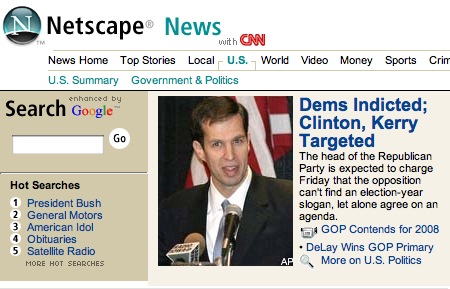
UPDATE #2: Via TPM, yet another example of the “left-leaning” CNN using language outrageously tilted to the right; see the graphic below:

Picture 2

I’m not including a link because this page, as is, will be gone in a matter of hours. But get a load of the headline: “Dems Indicted”? The word “indicted” refers to criminal charges being filed. To use it in the context of a Republican political smear being made is outrageous. This is a perfect example of what I’ve commented on many times before–headlines and other references on CNN and other news outlets commonly refer to actions made by Democrats as being politically motivated, while similar or even more outrageously political actions by Republicans are commonly reported in a far more favorable fashion. Had this been Howard Dean attacking Frist and Lott, the headline would have been something more like “Dems Make Attack on Republicans; Striving for Political Advantage.” But since it’s a Republican attacking Dems, the headline is preposterously favorable and cooperative to the GOP attack, making it sound like the Democrats are guilty of a crime–which is exactly what Mehlman was shooting for. Even though the subtitle to the headline above is somewhat less deceptive, it is still heavily slanted towards the GOP message.

Not to mention the rather strong attention being paid to what is, after all, just an early campaign publicity stunt. When was the last time any major media outlet put, as its banner headline, anything along the lines of: “McCain, Frist Indicted: Democrats charge that likely Republican candidates for president are unfit and incompetent.” Can’t recall? Hell, CNN didn’t give Howard Dean this kind of favorable spin when Dean was taking about actual criminal indictments of Republicans. I rest my case.

I’ve said it before, and I’ll say it again: liberal media, my ass. The media bias is clearly to the right.

Categories: Media & Reviews, Political Ranting Tags:

…And Again

March 9th, 2006 1 comment

If you recall, I recently posted on how shallow and uninformed most reporting is when it comes to Mac technical issues, and recent articles have borne out this view. A Swedish Mac enthusiast issued a challenge to see if anyone could hack in to the system from the outside and cause any damage. One user did so within 30 minutes, leading to articles like this one which decried the Mac a security sieve that could be easily attacked. There was a huge flurry of stories and again, the Mac’s reputation as a secure system appeared to be shot down.

But like with the “virus” outbreak, the reports turned out to be a load of bull, with the description “overblown” being an understatement. The articles made it sound like anyone could hack into your Mac via the Internet with ease. It turns out that the Swedish tester allowed people joining the challenge to access via a local access account–essentially, he granted everyone internal access, just as if they were sitting at the computer itself. This is like opening all the doors to your house and then expressing amazement at how easily burglars you invite in can carry off your TV set. What’s more, the challenge was to access a server, which is more vulnerable than a common consumer machine.

So the University of Wisconsin, which originally questioned the veracity of the initial contest, set up their own challenge. They hooked up the same computer, also as a server, to a high-speed Internet connection, and left it there for 38 hours with an open call for people to try to hack it. This time, they did not allow local access, representing a much more realistic environment. There were a huge number of attempts, but no one was successful.

So much for the “Mac is not secure” twaddle. If you think the Mac is an insecure platform because of malware or hacking, please take note that both flurries of reports to that effect were bogus. There are no Mac viruses, malware has been shown possible but does not yet exist (and the proofs of concept were lame to boot), and your Mac is not open to hacking from the outside–unless you work actively to allow people access.

Got that?

Categories: Mac News Tags:

America Like Japan Like America?

March 8th, 2006 15 comments

I have, in the past, joked wryly about how America’s new anti-terror laws are becoming as draconian as the Japanese system can be. But it seems like Japan might be changing in turn to become as oppressive in some ways as America is–as if the two countries are in a race to see who can blunt freedoms and become more of a police state faster.

In the U.S., new laws allow for people to be arrested without charges, held for an indefinite period of time, questioned without access to an attorney, and even tortured (though they’re usually sent overseas for the last). These somewhat resemble Japanese conditions that have existed for some time; in Japan, you can be arrested and held without charges and no access to an attorney for 48 or 72 hours, and then held for another 20 days without formal charges against you. During that time, you can be questioned incessantly, sometimes even denied food or restroom privileges, and stories of people being beaten are widespread. If the police want to keep you for longer, they can “release” and then re-arrest you and then keep you for another 22-23 days. This period is the cause of many of Japan’s famed forced confessions, which sent many innocent Japanese to prison for decades. So when the U.S. started allowing stuff like this, I thought that it was catching up with Japan.

But Japan, it seems, is not to be outdone; it is now taking on some American anti-democratic techniques. For example, in the U.S., many have been arrested for being critical of Bush, Cheney, or the administration in general, often times for something as innocuous as a t-shirt. People have been arrested on parade routes for nothing more than carrying signs that even might be anti-Bush. Cindy Sheehan was dragged out of the State of the Union address recently and arrested for her t-shirt. The charges? Usually something bogus, like disturbing the peace or trespassing. In the U.S., these charges are usually dropped after the evil t-shirt wearer has been deprived of their ability to speak freely, after the damage is done. And these laws are always enforced selectively, only arresting and detaining those who disagree with Bush, while supporters with approving t-shirts and signs occupying the same public space are never “disturbing the peace” or “trespassing.”

So how is this manifesting itself in Japan? Anti-military-deployment protests. Prime Minister Koizumi has sent Japanese soldiers to a war zone for the first time since WWII, a move opposed by 71% of Japanese people, though not protested so much–but what protests there have been have been reacted to aggressively. Koizumi and the conservatives have been extremely sensitive about this, as it represents a tentative new step in violation of article 9 of the Japanese constitution. So when three Japanese civilians were kidnaped in Iraq while doing humanitarian work, they were not hailed as heroes or praised for their sacrifice. Instead, Koizumi and his people viciously attacked them, made them pariahs in Japan for causing the country “shame.” The politicians vilified them, spread rumors about crimes they committed as youths, even sicced the ultra-nationalists on the poor trio as they returned to Japan after their harrowing ordeal–then billed them for air fare and medical expenses.

So it shouldn’t surprise anyone that the Japanese government acts with open hostility to those who protest the Iraq deployment. A group called Tento Mura (named after tent villages that sprang up in anti-military protests in the early 70’s) distributed fliers in early 2004 to a housing complex in Tachikawa where families of Japan SDF (Self-Defense Forces, the Japanese military) personnel live. The fliers urged the SDF members and their families to oppose the SDF deployment to Iraq.

Technically, the protesters were trespassing; while the complex is open and unguarded, there is a sign prohibiting unauthorized access. However, no one pays attention to it. Like all other apartment buildings in Japan, the complex is visited daily by many part-time workers paid to stuff mailboxes with ads for pizza, real estate, and escort services, amongst other things (in Japan, it’s legal for anyone to put things in your mailbox). The protesters as well had visited the complex many times over the years. But when they tried to oppose the Iraq deployment, they were arrested for trespassing. The difference was not the crime committed compared to that committed by others, but in the message they were delivering. People are always annoyed by the pollution of their mailboxes with ads–but the people who deliver the ads at the SDF complex are never arrested for trespassing. (I wish they were in my building!)

But it gets worse: after being arrested, they were then detained for 75 days on the ground that the police “needed more information,” despite the fact that the protesters had confessed to all charges and all information was fully understood. The detention was purely for harassment, driven home by grueling 5-hour interrogation sessions. The police also confiscated the defendants’ computer, searched their homes, and notified their workplaces, where the protesters were suspended and docked pay beyond the time lost while incarcerated. The state aggressively prosecuted the case, demanding six months imprisonment, and when a lower court dismissed the case on the grounds that it was politically motivated, the state spent a great deal of money appealing the case. The Tokyo High Court later reversed the lower court, completely dismissing any consideration of freedom of speech.

Priests have also been arrested for the heinous crime of distributing fliers. One priest was distributing anti-war fliers outside an air base in Okinawa, completely legally. The police stopped him and handcuffed him to their patrol car–and then started to drive off with the priest still handcuffed to the vehicle. When the priest objected, he was arrested for police obstruction and held for 21 days.

And if arresting protesters on bogus charges isn’t Bush-like enough, Japan is going to start photographing and fingerprinting all non-Japanese who visit or live in the country. Want to come over for a visit? Better ink up your index finger first. But the real impact of this is that Koreans living in Japan, Koreans who were born and raised here and are Japanese all except for the ancestry and citizenship (refused on principle, usually as their grandparents were brought here as forced labor), they will be fingerprinted yet again. They used to be fingerprinted before, but fought for decades to have that stopped, and finally, just a few years ago, were successful. The fingerprinting stopped–but not for long, as it seems that Japan’s “anti-terror” movement is now a convenient excuse for the conservatives here to reinstate the fingerprinting, which brands generational Koreans in Japan as outsiders and makes them feel like criminals.

In short, the War on Terror™ is used as a political tool for social regression and oppression not just in the U.S., but in Japan as well.

Categories: Political Ranting Tags:

And Some More TV

March 7th, 2006 Comments off

In the past, I’ve blogged on many of the shows I’ve been watching; I wrote about The Simpsons, The West Wing, Boston Legal, the Stargate series, and 24; then about Galactica, then Commander in Chief and Boston Legal again, then on The 4400 and Lost, and finally on Invasion and Threshold. Two of those series, Commander in Chief and Threshold, have been cancelled; CinC not regrettably (it had devolved into a fluffy she-always-wins/family-melodrama), and Threshold more regrettably (though it was becoming a more dull adventure-of-the-week show, it had good characters and some promise). The West Wing is also going off the air, though maybe it’s time to. When Sorkin left, things sagged; though the show regained some of its bounce, it was turning into something it had not started out to be, and by necessity would have had to get a mostly-new cast anyway. At least in its final season, it did what I wished it did three years ago but glossed over: gone into the mechanics of a presidential election, in detail. And in its final season, it has done that admirably.

At a time when a lot of the shows I had liked went off the air, I thought I wouldn’t have as much to watch–but more and more good shows seem to be popping up all over the place. More recently, I’ve picked up House M.D., Surface, and My Name Is Earl.

House, M.D. is a new medical-detective show, in a way similar to CSI in that it searches for scientific evidence where people are trying to hide things. You get the same zoom-into-the-body-organ close-up gross-out effects, but instead of suspects, they have symptoms, and instead of solving a murder, they cure a disease or other illness. And of course, the characters are different, and in this series, there is no questioning that Hugh Laurie is the star. His character is critically flawed but highly entertaining to watch. Brilliant, cruel, bitingly sarcastic and caustic, but with a chewy chocolate center. The character, Dr. Gregory House, is a diagnostician who takes the cases that baffle other doctors. He is a tortured, miserable man who in a way covets his misery. Some years earlier, he suffered a clot in his leg that killed his muscle tissue, leaving him limping on a cane and in constant, severe pain. He treats the pain with Vicodin, which kills his pain but leaves him an addict (one of his trademarks is popping a pill almost constantly). His pain, misery, and anger resulted in the woman he (still) loves leaving him, adding to his grief. He will cut down anyone he sees as deserving (almost everyone) without mercy, slashing with insults and mocking irony, including his patients, whom he often calls “idiots” to their faces, when he’s not avoiding them like the plague. His credo is “everyone lies,” referring to the fact that patients always, through embarrassment, fear, or some other base reason, hide critical information which is key to solving the medical mystery.

House is assisted by three physicians, neurologist Foreman, immunologist Cameron, and intensevist (??) Chase, whom he regularly bullies and orders around, but allows them to have their best at him when they can. The show begins with some illness hitting someone in the teaser (there is always a red herring to keep you guessing, but that schtick gets old fast), and then House and his staff write the symptoms on the whiteboard, throw around possible causes, decide the initial testing, and the game is afoot. From there, they typically make several wrong diagnoses, but eventually, when some critical clue falls into place, they solve the dilemma. Usually the patient is cured, but sometimes at a price (Cuddy’s gardener lost a hand), and sometimes they lose the patient (as with the woman who lost her family then got rabies from a bat). House himself will inevitably violate one or two ethics rules, royally piss off half the people around him, and then deal with inane patients in the teaching hospital’s free clinic, when he can’t hide somewhere watching his soaps.

Along the way, we usually get input from Cuddy, the hospital administrator who fights to protect House from himself, despite his representing a monetary loss for the hospital, while keeping on his back about doing all his duties, especially clinic work. Then there’s Wilson, House’s only real friend, an oncologist who seems warm and innocent, but has his own skeletons in his closet and is inured to House’s abrasive ways.

You might wonder how one could like the main character, but Laurie pulls it off magnificently, knowing exactly how far to take the character, yet still maintain humanity and the hint of compassion behind his callous and uncaring exterior. And, in a twist that surprised me, Laurie is very much British; he does a perfect American accent on the show, enough to fool the producer when he first saw Laurie’s audition tape.

On the other hand, like CSI, this show takes artistic license with reality, causing real doctors some grief about how it will change the perception of doctors and medicine. Nevertheless, House, M.D. is a promising new show; let’s hope it can maintain and even grow on what it has established.

Surface caught me by surprise. I’d thought I was watching all the new alien-invasion series (the other two being Threshold and Invasion), but there it was. It just ended its 15-episode first season (yeah, I wondered at that number as well), and it promises some pretty interesting stuff in the future.

Lake Bell plays Laura Daughtery, an oceanographer who while investigating a volcanic vent on the ocean floor, stumbles upon a new, large vertebrate, a new ocean species no one has ever seen before–or so she thought. Soon, she finds herself under attack from what seems to be a shadowy branch of the government, with agent Davis Lee (Ian Anthony Dale) trying to keep her quiet about her discovery. She soon meets up with the character Richard Connelly, whose brother was dragged to the sea bottom and presumably killed by one of the giant creatures. He begins to have visions, leaves his wife and two daughters, and winds up chasing the mystery around the country with Daughtery. Meanwhile, dorky young teen outcast Miles Bennett finds a cache of mysterious eggs in the sea and takes one home to hatch. When it does, he and his friend name the “lizard” Nimrod and raise the little tyke–only slowly realizing that it is not a known sea creature, as it shows the ability to create electric shocks to kill its prey. Eventually, Nim and his gigantic cousins stop being a secret; Miles starts seeing a quirky and cool girl named Savannah, whose father runs the local aquarium where Miles and Nim take up temporary residence.

Throughout the first season, we slowly see a mystery begin to unravel [moderate spoiler warning!] as we discover that the species is not the natural lost-species we thought, and that the organization hunting down Daughtery is not working for the government, but is completely independent–and possessed of some highly advanced technology it developed secretly over many decades. Now, that organization seems to have almost James-Bondian aspirations, with the new Nim-species acting as its agents. We last see the secret organization heading off on a subterranean railway to the Mariana Trench (from the Carolinas?) as a giant tidal wave crashes into the east coast of the United States.

The series does a good job of making fairly credible what should be a rather incredible plot line–giant sea monsters, a boy and his pet alien, a secret conspiracy to destroy the world, and more. You get caught up enough in the story and the mystery that you allow disbelief to be suspended sufficiently to accept it all. But one of the things I like about the series is that by the end of the first season, the world is very much changed–something that few TV shows are willing to do. Most shows that have incredible plots make it so that no one but the core cast know about it, the rest of the world remaining blissfully ignorant, either to serve the conspiracy or to ‘protect’ them from panic. I like the idea of a show that changes everything, and then runs with it–kind of like The 4400 also does. But there are times when you start to gag at the silliness–like when Miles visits the corpse of Nim, on ice, and Nim comes back to life–a scene stolen straight from E.T., complete with the boy and the alien having a sympathetic psychic link.

And yet, I really like the show, and can’t wait for season two to begin–probably next September, possibly in the summer–though the decision about picking up the show for a second season won’t be made until May. In an interesting (but not really spoiler-ish) twist, the two character groups of the show–Laura and Richard, Miles and Savannah–meet by chance in the last few minutes of the season finale, leaving a lot to be explored between the new character dynamic, made up of four strangers thrown together like a nuclear family, complete with pet lizard. Not to mention a whole new world, and a still mostly-unexplained mystery. But the nice thing about this show is that you don’t feel like the writers are holding back information and doling it out with an eyedropper (like Lost or The X-Files)–things develop faster on this show, often in a more satisfying manner. Should be interesting.

And then there’s My Name Is Earl, a half-hour comedy about a bad guy gone good. Earl, played by Jason Lee, is a dumb, low-life criminal who discovers karma. He steals, hurts people, commits crimes at will–and his life sucks. One day, he buys a scratch-off lottery ticket and wins a $100,000 prize–and then is promptly hit by a car, losing the ticket and landing him in the hospital. While recovering, he sees Carson Daly on TV talking about karma (he assumes Daly discovered the concept) and realizes that karma explains why his life is so bad. He figures that if he keeps on going this way, karma is gonna kill him, so he writes a list of every bad thing he’s done in his life. The idea is that if he can right all his wrongs, things will go well for him.

In the show, karma is practically a character in its own right, having a strong and immediate effect, guiding Earl down the right path. It starts (when Earl vows to set things right) by depositing the wind-blown $100,000 lottery ticket at Earl’s feet, Forrest Gump-style. Armed with the cash, Earl and his (even more) dim-witted brother Randy begin to work through Earl’s list, one at a time, righting wrongs such as “stole car from one-legged woman,” “cost dad the election,” “stole beer from a golfer,” and “didn’t pay taxes.” Other recurring characters include Earl’s gold-digging slut ex-wife Joy whom Earl married while on a drunken binge, and Joy’s new husband, the ever-cool-with-life Darnell, a.k.a. “Crab Man.” Also along for the ride is the sexy Catalina, housekeeper at the motel where Earl and Randy now live.

It’s a great set-up, and should keep the show in concepts for the next many years (there are more than 300 items on the list, and Earl sometimes has to add new ones). The show is hilarious, often spilling out into the absurd, and while the characters are often nasty, selfish and mean, Earl’s new-found moral center keeps them all in check. It doesn’t hurt the comedic effect that they’re all dumb as cement.

One final show of note, though not a new one: Real Time with Bill Maher is back on, repeating its new-since-last-year double-set of a dozen shows each. This set is February to May, the second coming in August to November. The show, kind of like the deluxe cable version of Maher’s Politically Incorrect (now with swear words!), is still usually entertaining. Unfortunately, it suffers all too much from a descent into base punditry, especially when some talking-head guest has a loud mouth and a rehearsed set of talking points. Maher never does much research and often combats the pundit with nothing more than “that just sounds wrong.” Another sand-trap is when the comic-relief guest takes over the show with an irrelevant routine; maybe a little funny at first, it soon derails the rest of the show. And Maher himself will, once in a while, depart from his Libertarian core and run off on some strange tangent that will run for weeks until Maher quietly gives up on it, like giving Bush credit for bravely investing on Democracy in Iraq, or believing that it’s a good thing that the NSA is spying on Americans without warrants because he lives close to the L.A. ports and is worried about being attacked.

That said, when the show works, it works well. If the guests balance right, the show can be funny, entertaining, and sometimes educational (though not often for the latter). Maher often has good guests, though he has a strange caustic-attack combined with I’ll-let-you-get-away-with-selling-your-line-of-BS approach with some of the more radical guests. And Maher’s “New Rules” segment is more often entertaining as not, proportionally in contrast with his middle-of-the-show funny-photo mock-up schtick which bombs more than it hits. So the show is hit-and-miss, but hits enough to keep me watching.

Categories: Media & Reviews Tags:

Here We Go Again

March 6th, 2006 2 comments

For what must be the third or fourth time, this site is being barraged by tons of spam, about 30-50 a day all this week, in the form of fake glowing reviews of the site with three or more links to generic news, movie, and educational web sites that are of course unconnected to the spammer. These weird spam messages are of no use to the spammer, as they don’t link back to the spammer’s site–they just link to news sites like The Dallas News, The Globe and Mail, the BBC, to web sites for major movie releases, or for universities. So you’ve got to wonder what the spammer is up to. They get nothing from it–with the possible exception of massively annoying the blogger. I suppose it could be a form of test to see what kind of spam will get through the filters–generate huge amounts of spam and then check to see if any of it sticks. Stupid, but then it’s an automated program and likely costs the spammer next to nothing.

The spam is also hard on unprotected bloggers, because it can’t be easily filtered. Each email has a different (faked) IP address, a different (fake) email address, a differently-worded message, and different links to different legitimate sites. Nothing for some filters to grab onto. But not a problem here–I use SpamLookup, which has a great deal of flexibility in blocking blog comments that fit a number of different profiles. In this case, I adjusted the number of allowable links down to two per comment (it had been set at 3, which is why I noticed the spam attack in the first place). Presto, all the spam is blocked and I don’t even see it. In a week, I’ll check the spam logs to see if it’s still coming in, and if it has stopped, I’ll reset the filters to the higher limit in consideration of my guests.

If you use a Moveable Type blog, use SpamLookup. A very nice tool. I still use MT-Blacklist–but will probably upgrade to MT 3.2 soon, which Jay Allen claims will do a far better job of eliminating comment and trackback spam.

Categories: BlogTech Tags:

Want to Buy a Used Laserdisc Player? Better Act Fast

March 5th, 2006 3 comments

Because after April 1st–no foolin’ this time–the sale of second-hand electronic goods made before 2001 will become illegal. That’s right, against the law. If you have a shop and sell a laserdisc player, you’ll be subject to a prison sentence and stiff fines. The ban is not total–it does not include personal computers, and only applies to businesses that sell used electronics–but that’s quite a ban, if you ask me.

The ban applies to 450 types of items, including “TVs, audiovisual equipment, video-game machines, refrigerators and electric musical instruments.” Ostensibly, the law is supposed to be for safety purposes, but that’s a crock. The standards for checking the safety of products was changed in 2001; before then, the government required strict testing for safety, but changed it so that manufacturers could test items on a voluntary system. Which means that the new testing won’t be as rigorous as the old one. But the new law is based upon the assumption that the old equipment should not be sold because somehow it won’t be as safe as the new stuff. Makes sense, right?

Of course it doesn’t. It makes no sense at all. Until you factor in the way the Japanese government works with its industries. The automobile industry is the best example. In Japan, if you own a car, you have to take it in for expensive “safety” checks every few years, called “shaken” (pronounced “shaw-ken”). When the car is new, you get three years free; then a safety check every two years. It used to become mandatory each year after the car became ten years old, but that was changed and now the two-year check continues indefinitely. But that doesn’t change much–it’s still hideously expensive. Shaken can cost up to $1,750, not including a weight tax (up to $500) and mandatory insurance (up to $250), which is skimpy and usually must be enhanced with additional insurance (also up to $500). So you might wind up paying an additional $3000 every two years–which is why a lot of people sell their cars before a shaken check comes along–which is the whole idea. Shaken is not really for safety, it’s a gift for the automobile industry, intended to boost their sales. The discarded used cars, often in perfect running condition, are then scrapped or sold overseas, another big industry, as they aren’t worth much–if anything at all–in Japan, due to shaken.

Knowing that, you can now understand the whole new “safety” law about reselling used electronics in Japan. It’s more a gift to the Japanese electronics industry than anything else. So head off to Akihabara in March, and maybe you can find some good fire sales for pre-2001 electronics! Courtesy of the Japanese government.

Categories: Focus on Japan 2006 Tags:

A Christian State?

March 4th, 2006 2 comments

It’s almost certain that it won’t get passed, but the Missouri legislature is considering a bill that would make Christianity as the state’s “official ‘majority’ religion“:

The resolution would recognize “a Christian god,” and it would not protect minority religions, but “protect the majority’s right to express their religious beliefs.

The resolution also recognizes that, “a greater power exists,” and only Christianity receives what the resolution calls, “justified recognition.” [link to main story (which is just a few lines longer) requires registration]

Of course, it is immediately being challenged, and some even think that it’s not serious, but just a ploy to make out liberals as being anti-Christian.

Of course, it’s not the first time that this kind of thing has happened. There was a widespread outbreak of Christian fanaticism nearly a century and a half ago in the 1860’s, when a band of Protestant denominations submitted an amendment to the U.S. constitution that would change the preamble to read as thus (proposed additions marked in bold text):

We, the people of the United States, humbly acknowledging almighty God as the source of all authority and power in civil government, the Lord Jesus Christ as the ruler among nations, his revealed will as the supreme law of the land, in order to constitute a Christian government, and in order to form a more perfect union, establish justice, insure domestic tranquility, provide for the common defense, promote the general welfare, and secure the inalienable rights and the blessings of life, liberty, and the pursuit of happiness to ourselves, our posterity, and all the people, do ordain and establish this Constitution for the United States of America.

This amendment was again forwarded in the 1870’s. It failed both times, which is what I expect the Missouri legislation to do. But the movement of the 19th century eventually resulted in several incursions of religion into government, one of note being the use of the motto “In God We Trust” on our money–which is now being pushed as a precedent to tear down the wall between church and state (see page 5 of Scalia’s dissent in McCreary v. ACLU, noted here). This one piece of legislation will probably not pass, being far more radical than the recent South Dakota ban on abortion, but it does show an unleashing of unabashed right-wing religious glee at a Supreme Court majority being on their side, and a growing confidence, a willingness to try out the kind of theocratic fascism that they would love to establish.

Categories: Political Ranting, Religion Tags:

Very Bad Sportsmanship

March 3rd, 2006 3 comments

I know it’s bad sportsmanship, but kind deserves kind: I hope the Japanese baseball team does not win the upcoming World Baseball Classic. That’s not out of any antipathy for Japan, nor for the players, but strictly out of contempt for the team’s manager: Sadaharu Oh. I’ve mentioned this before, but it bears repeating.

When I first heard of Oh, I had respect for his record, if not for the claims that his higher number of home runs than Hank Aaron actually meant he was a better slugger; Japan’s ballparks are smaller than American counterparts, and if Aaron had been batting in them, he’d most likely have gotten far more home runs than Oh did. But since there is no way to strictly determine that, it’s enough to simply say that Oh holds the record for Japan, Aaron holds the record for America, and neither “wins” over the other.

But the respect I had for the man died when Oh showed unforgivably poor sportsmanship, not to mention racism (ironic for Oh, a half-Chinese man who initially faced racism himself in Japan) when he denied foreign ballplayers the chance to break his batting record–because they were not Japanese. This happened not once, not twice, but three times. First in 1985, when Oh managed the Yomiuri Giants and faced Randy Bass, who challenged Oh’s record of 55 home runs in one season. Next was in 2001, when Oh managed the Daiei Hawks, and faced Tuffy Rhodes, who had tied Oh’s record. Most recently, he denied the chance to Alex Cabrera, who had also tied Oh at 55 in 2002. In all three cases, the foreign players challenging Oh’s record faced the teams managed by Oh in the final games of the seasons. In all three cases, orders were given to the pitchers for Oh’s teams that these players were not to be given the chance to break the “King’s” record. While some other teams gave the batters chances, Oh’s teams have consistently blocked challengers on racial grounds. Oh tried to blame this on the coaches, saying he was “out of the loop,” but the fact that he never disciplined a coach belies this weak excuse. It was also commonly understood that if the players had been Japanese, they would have been given good pitches and not walked:

“The pitchers are always under the direction of the manager. So it is not up to them,” explains 25-year old Tigers fan Yasuhisa Tadera, seated in the left field stands, of the practice of intentionally not throwing strikes.

Sitting behind Tadera is Eiji Matsumoto. “The Japanese just don’t want the record broken by a foreigner,” he says.

So then if a Japanese player approached the record, would he see strikes?

“If [Hideki] Matsui of the Giants, for example, were close, they’d give him a chance,” admits Matsumoto, a 52-year old Giants fan, “The Japanese don’t play fair.”

Any person who acts with such a depraved sense of foul sportsmanship not just once but three times does not deserve any titles or respect. This is, after all, baseball: what happened to “three strikes and you’re out”? For Oh to lead this present team to a victory would be a crowning achievement for a man who has disgraced a sport which still idolizes him–for in Japan, unfortunately, such acts as Oh has taken part in are quietly dismissed. In America or almost any other country, the manager would have been ostracized and banned from the sport for such offenses. Japanese baseball is improving–when Oh shut out Rhodes in 2001, Japanese baseball commissioner Hiromori Kawashima criticized Oh, saying his decision was “completely divorced from the essence of baseball, which values the supremacy of fair play.” But Oh has not been penalized in any way, nor has he taken much of a hit in his popularity in Japan. After all, he was chosen to manage the Japan team this year in the World Baseball Classic. What does that tell you?

Categories: Focus on Japan 2006 Tags:

What The…

March 2nd, 2006 8 comments

In just one day, I’ve gotten about 1500 hits via Google from one source which seems to be carrying out robotic searches. This is not just starting now, I’ve noticed it for the past few days, but it really stands out in my stats, in the search engine details, since the clean slate of March 1st has zeroed all the figures.

The searches seem to be carried out using Google as a vehicle and seem to target Movable Type blogs. The copious searches all have the same structure, looking for web pages which include a Movable Type archive address structure like this:

inurl:”archives/001026.html”

Just change the number before the “.html” extension to include any possible number between 000100 and 001700, and you’ve got an idea of the massive barrage of auto-generated searches that get carried out (the 1700 limit is due to my blog having roughly that number of posts–the searches must certainly exceed that number elsewhere). The robot software then apparently follows each of the links given by Google which results in a referral hit on my site–and, I suspect, many, many others. Moreover, each search results in up to 20 hits for any one archive page. It’s as if someone is using Google as a tool in a bizarre cataloging of Movable Type blogs.

Anyone else out there notice this?

The searches and hits, by the way, are all coming from the same base IP address within an eleven-number range, specifically 85.255.113.179 ~ 85.255.113.189.

Update: I’m not the only one, as I expected. Here’s a guy who linked to this post and is having the identical problem. He’s done better than I have, though, and identified the IP address block as being from the Ukraine.

Categories: BlogTech Tags:

When Spin Is Not Nearly Enough

March 2nd, 2006 1 comment

Faux-Cavuto

I don’t know who this clown Cavuto is, but one thing is for sure, he’s spinning the Iraq civil war faster than the Tasmanian Devil. First, the civil war could be a “good thing,” then soon after that, the media has made the whole thing up. So I guess Cavuto thinks the press is doing a great job, since it is “making up” a “good thing” about Iraq!

In the meantime, reality in Iraq seems to be paying no attention to Fox News, with violence escalating and sectarian tensions becoming critical. Not to mention that it could be easily argued that the shrine bombing was not the real start of a civil war, but that one has been brewing since a long time before that.


Meanwhile, Bush takes hits galore now that the videos have come out showing that he not only received massive warnings about the seriousness of Katrina and the danger to the levees, but that he himself asked no questions about the storm or the relief preparations, and confidently stated that he was “fully prepared.” Obviously he was not.

It is already well-established (though not as often reported) that Bush was responsible for the late deployment of relief, his cronyism resulted in massive mismanagement, and his photo op forays into devastated areas put actual relief efforts on hold while people were dying. That this story brings light to these issues and that the government is still screwing up, still not delivering badly needed supplies, and is still short-changing the victims of the storm, is nothing less than a very just reward for an administration that still pretends that it did the best it could.

Is it possible that these news stories will bring Bush down below the low levels he’s already at? One could only hope. Bush is already looking like midterm-election poison, and Republicans in Congress are edging away from him, and even openly rebelling.

Categories: Iraq News, Political Ranting Tags:

Microsoft Redesigns iPod Packaging

March 1st, 2006 4 comments

Not really, thank goodness. But someone did a great job of illustrating the differences in style between Apple and Microsoft, in this 2 1/2-minute animation of what the iPod’s packaging would look like if the marketing people at Microsoft were in charge of the project. A great little video, and perfectly chosen music to boot.

Categories: The Lighter Side Tags:

Poll of U.S. Military in Iraq

March 1st, 2006 Comments off

Zogby has just come out with a survey taken of 944 military personnel currently serving in Iraq. The results are fascinating: 72% think that the U.S. should pull out in the next year. The tough ones are the marines–only 58% agree with that contention, while 89% in the reserves and 82% of the Guardsmen are saying to bug out within twelve months. One can only assume that Bush and the GOP will now start calling the troops traitors and cowards who just want to cut and run–unless they don’t care about being consistent.

What’s more interesting is data that seems to belie what the government is telling the troops: 85% believe the U.S. attacked to retaliate for “Saddam’s role in the 9-11 attacks,” and 77% feel that a major reason was “to stop Saddam from protecting al Qaeda in Iraq.” Now, the poll was not clear on whether the troops believed that Saddam was involved in 9/11 and was protecting al Qaeda, or whether they thought the administration believed that–but it’s likely the former is true. Which tells you something about the propaganda these kids must be getting fed to them. Even at its most gullible, no more than 70% of the American public believed Saddam was involved in 9/11. And it’s a pretty well-established fact that Saddam did not get along with al Qaeda, and vice-versa; Saddam was clearly not “protecting” them. For these personnel to believe these things means that they’ve been lied to even more than we have.

Zogby explains the survey in more detail in his blog.

Categories: Iraq News, Political Ranting Tags: