Archive

Archive for December, 2006

But We’ll Sue Everyone Else

December 9th, 2006 1 comment

The RIAA and the music labels have gained a reputation for playing hardball in their war against piracy and illegal song downloads. Among the most famous examples are how they sued a 71-year-old grandfather who rarely used his computer, and a 12-year-old girl who was an honor student and sincerely believed that she had paid for the music. The RIAA did not care who was actually responsible for the downloads, and even sometimes not bothering to verify whether downloads had occurred at all. They wanted to scare people by playing hardball, and the message was crystal clear: no one is exempt. You download our music, we sue you.

Well, there are exceptions, apparently. Specifically, if you’re rich and your daddy runs one of the record labels. Edgar Bronfman, head of the Warner Music Group, said that “I’m fairly certain that [my children] have [illegally downloaded music], and I’m fairly certain that they’ve suffered the consequences.”

“Fairly certain”? Clearly, the guy doesn’t want to fess up with any certainty in public, but it’s clear his kids did pirate music. As for the consequences? Were they sued for up to $150,000 for each song they downloaded? Well, no suit has been filed in court against them, so the “consequences” they “suffered” apparently did not involve what the rest of us seem to be liable to suffer should we break the same rules. Apparently it involved Bronfman explaining what he feels is “right and wrong” to his kids. “I explained to them what I believe is right, that the principle is that stealing music is stealing music.” Did he explain that stealing is a crime, and that his kids should cough up huge wads of cash or maybe go to jail? It is a serious crime, you know. But I guess Bronfman never got to that part. It was enough to explain to them that they were embarrassing daddy, so stop it or else he’ll be real disappointed in them.

Tell that to 12-year-old Brianna LaHara (now 15), one of the first to be sued by the RIAA and the labels; her mother paid $29.99 a month to KaZaA and misguidedly believed that because they were paying for the service, that they were not stealing. They didn’t even keep the music on their computers–they listened to it and then threw it out. But they were sued, and eventually settled for $2000. Most of the people sued are given this “offer,” which demands payment of thousands of dollars, knowing that the people will cough up the cash even if they are innocent, as lawyer’s fees alone will cost them more than that. (In some circles, that’s called “extortion.”)

The Bronfman children should have known better than any other kids in the world that downloading from P2P sites is illegal. And yet all they got was a talking-to.

Poverty is not an excuse here. College students who could not afford to pay the extortion settlement fees were told by the RIAA to drop out of college or instead go to a cheap community college so they could afford to pay the mega-billion dollar record labels a few thousand bucks.

OK, so you would not expect the head of a music label to sue his own family or relegate them to cut-rate go-nowhere schools–but it smacks of a cop letting his own kids of the hook when he catches them driving drunk or stealing something. A double standard. If anything, it plays up the fact that the RIAA’s campaign is not one of justice, but one of terror. Naturally, they are not going to sue each and every one of the millions who have downloaded from filesharing services. They just want to scare people into believing that it can happen, and that it might happen to them. And the RIAA has the clout to ram this kind of thing through–although satellite TV businesses who tried the same technique–mass-litigate suspected pirates of content then try to get them to cough up settlements–was ruled against, the technique found to be illicit.

Which lessens the hypocrisy not one iota.

RIAA: We’re Not Leeching Enough

December 8th, 2006 Comments off

Remember how the RIAA and the music labels are always whining about how the artists are the ones you’re hurting when you steal music? Despite, of course, the fact that the labels gouge the artists by forcing them to sign horribly unbalanced, labyrinthine, long-term contracts (how does 25 years strike you?) when the artists are starting out, and most artists have to earn their money through concerts because the labels rob them of nearly all the income from recordings.

Well, apparently the RIAA and the labels really do believe that their mammoth share for simply marketing what others create is not enough: now they are petitioning the courts to give them an even bigger share of the profits:

“Mechanical royalties currently are out of whack with historical and international rates,” RIAA executive VP and General Counsel Steven Marks said. “We hope the judges will restore the proper balance by reducing the rate and moving to a more flexible percentage rate structure so that record companies can continue to create the sound recordings that drive revenues for music publishers.”

In other words, they want to stop pirates from stealing from the musicians, so they can steal from the musicians instead. As if they’re not doing it enough already.

Categories: Uncategorized Tags:

Internet Cafes

December 8th, 2006 1 comment

As I am away from home for more than a day, I am using an Internet cafe to make this post. I was hoping for a cafe that would allow me to use my own computer (with my blogging software and browser bookmarks), but this place, at least, does not allow for that. No WiFi, and the Ethernet cable for the computer is too short and cannot reach my laptop.

This cafe also has a fair amount of privacy; all the computer areas are walled off, and though the doors do not completely block the doorways, you could easily imagine salarymen coming in at any time of day or night and doing… er, questionable things. You can ever rent a “pair seat” with a nice, cushy couch where two people could, er, well, you know.

But for those not lecherously-minded, there comes with the 400-yen-per-hour usage charge free drinks and bite-sized candies, not to mention free usage of manga comics, PS2 video games, or movies on DVD. Or, if you’re willing to pay, meals (including beef bowls, pasta, curry and so forth). Printing will also cost extra, 20 yen for a B&W printout, 50 yen for color.

Not all cafes have such private booths; it ranges from open counters with rows of computers to a variety of openness in booths. Most train stations (hubs of commerce in Japanese communities) have Internet cafes, which offer a variety of services and styles to attract customers. Want to sit in a massage chair while you surf? This random choice of cafes might give you an idea of a small neighborhood cafe. Some cafes will go so far as to offer almost spa-like treatment, with relaxation booths for ladies that include skin treatments and manual massages. In other words, more than just your basic computer-on-a-counter.

Categories: Computers and the Internet Tags:

2008 Celebrity Freshmen?

December 7th, 2006 Comments off

Kos has mentioned in the past that in 2008, the Democrats will only increase their majority in the Senate, because few or none of the Senate seats coming up for renewal in ’08 are weak Dem seats–instead, there are several Republican seats that will be vulnerable. One way Democratic candidates could win a few of those seats is by using the same tactic Republicans used to win the California governorship: name recognition.

One of those seats is in Minnesota, the seat that opened up when Paul Wellstone died in a plane crash. Republicans won the seat with Norm Coleman when they opportunistically trashed Democrats for bringing politics into Wellstone’s memorial. Coleman won the race mostly because of that opportunism, and because his opponent died in the middle of the race; his hold on the seat is soft, and celebrity Democrat Al Franken is poised to take over when he most likely will run in ’08. Those who have not listened to Franken directly might buy into the inevitable Republican hype about his rabid ultra-liberalism, but if you have listened to him, you’ll know he’s a very reasonable, knowledgeable, sympathetic guy. Maybe not the funniest comedian in the world, but he’s smart. OK, there was the time he used his wrestling skills to tackle that guy, but in the same situation, I think anyone would have. Despite his nebbish appearance, he has a killer instinct. Franken will announce his intentions in January.

But much more interesting is the less likely possibility of the Democratic Party stealing the Senate seat in Kentucky away from Senate Minority Leader Mitch McConnell–with superstar candidate George Clooney. Aside from all the “sexiest man alive” nonsense, this is a very smart, soft-spoken guy who is razor-sharp on politics and could easily bring massive numbers of voters to the polls in his native southern state. And, as Kos pointed out, it would be sweet retribution for the Republicans having taken out Ton Daschle in 2004. Read the story on Clooney. He may not run, but it would be very, very cool to see this guy in the Senate two years from now.

Categories: Political Ranting Tags:

Now That Takes Patience

December 7th, 2006 Comments off

Not to mention talent. Via Cosmic Buddha, here’s a YouTube posting of a video made by two guys who went crazy with stop-motion animation of themselves. Some of the stuff in this video is pretty mind-blowing, making you wonder how the hell they achieved all of that.

My guess: they used a standard video camera, and simply pulled individual frames out of the sequence, and made a “stop-motion” animation from those selected frames.

Categories: The Lighter Side Tags:

Tama Reien in December

December 6th, 2006 1 comment

The park was a little uneven today. In a few places, birds were all over the place, practically flying right into view. Everywhere else, only crows and bulbuls, and a dearth of bird life. But I’ll take what I can get. And there were a few nice birds today.

Of the birds I did see, I saw a lot. Japanese Pygmy Woodpeckers (Kogera • コゲラ) were visible in many areas.

1206-Jpygmy Woodpecker1-450

1206-Jpygmy Woodpecker2-450

1206-Jpygmy Woodpecker3-450

I also spotted two Daurian Redstarts (Joubitaki • ジョウビタキ), or the same one in two different areas. This one is a female (I have yet to spot a gaudy male), but has stronger colors than the two I have spotted in the past. I saw the first bird in a gravestone plot as I rode by, and though it flew off, it paused on a few sticks so that I could get some nice shots. The bottom shot I got later on another street, and could have gotten some great shots as well, except for a common event at Tama Reien–some car or pedestrian with a dog would come by and make noise or movement, as they tend to do just as you’ve spotted a good bird.

1206-Daurian Redstart1-450

1206-Daurian Redstart2-450

1206-Daurian Redstart3-450

1206-Daurian Redstart4-450

In-between birds, I spotted a small cat colony–six cats (only three of which are shown below), resting lazily on a corner. You usually spot cats in birding areas. A few of them were a bit skittish, but one was of the variety that demands you pet it and give it a good, long scratching around the neck and ears. So was the one in the third picture below. As I squatted down to give the kitties a quick pet, this one jumped up on my knee and presented his neck for a good going-over. By holding the camera out at arm’s length, I got a great shot with the little guy’s tongue hanging out–in extreme pleasure, I presume. Kind of looks a little like Bill the Cat, though, doesn’t he?

1206-Cats1

1206-Cats2
Ack!

1206-Cats3

At the end of my stay at the park, just as I was getting ready to pack it in, I happened upon some nice, autumn-colored trees that were just bursting with birds–a few woodpeckers, a ton of tits, and some Japanese White-eyes (Mejiro • メジロ). I started getting some shots while balancing my bike between my legs, and then noticed that the flock actually started migrating to trees just a short distance away from me! Very rare for birds to get closer like that. And so I got some very, very nice shots.

Click on some for a larger view:

1206-Mejiro1-450

1206-Mejiro2-450

1206-Mejiro3-450

1206-Mejiro4-450

1206-Mejiro5-450

That’s all for today. But I hope that in the next two to three months, I’ll have some more nice pictures. December through February is supposed to be one of the best times for birding here, and last year, a broken foot kept me indoors. The year before, I had only started birding in mid-February. So we’ll see about this year.

Categories: Birdwatching, Uncategorized Tags:

New Bike

December 5th, 2006 2 comments

1206-Newbike

Partly from a desire for more exercise combined with a need for a good mode of transportation for local birdwatching, I bought a new bike a few days ago, and took it out for the first big spin today. I went birdwatching in Tama Reien (for those who haven’t read this blog and/or don’t know, Tama Reien is a huge cemetery smack in the middle of Tokyo Prefecture, a large, quiet area with lots of small streets and lanes and foliage, great for birdwatching). On the map, Tama Reien looked almost too far for biking, but apparently Tokyo is smaller than it looks like on maps; it took only about 30-40 minutes and was a nice little trip.

I started looking for a bike a week or two ago, and started at the little shop within the large supermarket/home center just down the block from my place (and practically the only real store for a mile in any direction). They had a few bikes that were close to what I wanted. Most of the bikes were too simple–cheap little 1- or 3-speed bikes, not great for this very hilly area–or were too much–expensive 16-speed bikes with narrow seats. A few were mid-priced 6-speed bikes, and one looked especially good: for about $140 it included a kind of lamp that didn’t drag on your front wheel (I hate those things). Instead the engine for the lamp is made of magnets within the front wheel axle, a “no touch” light. Cool.

The problem was, the bike’s frame was low, made that way for people who are short even by Japanese standards. I could fit on it, but only with the seat and handlebar extended fully. But by “trying it on” in the narrow store area for bikes, I found that if I were on the bike and made a turn while my leg in the direction of the turn was at its highest point, the handlebar would collide with my knee and the turn would be limited. So I went to a few other bike shops within biking distance–only to find that no one had anything close to what I wanted, or at nearly the price my local shop had. So on Saturday evening, I went in to reserve it–and it was gone. A new one would take 2 weeks to order, and I wanted to get this out of the way.

After much gnashing of teeth and consideration, I decided to buy the $120 version of the bike with the drag-lamp I really don’t like–and only then noticed that they had put a few bikes out in the aisle that I hadn’t seen before. Usually $190, they were on sale for that day only for $150, and had the features I wanted–6 speeds, the no-touch lamp–and these were regular frames, not to mention they simply looked more well-built (and it had a extra device to lock the front wheel in place). There were three, and a man and his two kids were all over them, with the attitude of “we’re buying these!” Hoping against hope, I asked their intentions, and they said they only wanted two of the three–and the one left over was the one I had been eyeing. So without any further delay, I put the money down and bought the thing.

After midnight, I’ll blog on the birdwatching I got done with the bike today.

Categories: Main Tags:

Thud

December 5th, 2006 Comments off

Despite the Zune’s slow takeoff, the media hailed it as getting off to a flying start when the player was given the No. 2 slot among MP3 players, coming in second to Apple’s iPod. Of course, you had to read down a bit to see that the Zune took 9% while Apple held the No. 1 spot at 63%. Still, it looked impressive to say it was “No. 2” (no pun intended), and less impressive to say that it was not even in the top 50 or so on Amazon.com’s consumer electronics top seller list.

The thing is, that was in the first week of sales, with all the huge buzz and hype, when it was bound to sell more than a usual amount. Predictably, the Zune’s sales dropped in it’s second week–quite a large amount. It fell from a 9% market share to a 2.1% share, and fell from second to fifth among digital media players.

Currently, on Amazon.com’s consumer electronics best-seller list, the Zune occupies the #73 spot, just beating out a universal remote control by Logitech. Among other items selling better than the Zune: an iPod travel charger (#58), four digital picture frames (#56, 32, 29, & 28), a 5-pack spindle of CD-Rs (#50), an iPod power adapter (#49), two digital turntables (#44 & 36)–and twelve iPods (7 of which are in the top 15).

Oh, it’s only the black Zune which is #73. No other Zune colors made the top 100.

Among MP3 players alone, the Zune came in at #21, with iPods occupying 12 of the top 15. Week #3 should be a blast. It’s only uphill from there…

Categories: Gadgets & Toys Tags:

The Beam in Thine Own Eye

December 4th, 2006 3 comments

Either how canst thou say to thy brother, Brother, let me pull out the mote that is in thine eye, when thou thyself beholdest not the beam that is in thine own eye? Thou hypocrite, cast out first the beam out of thine own eye, and then shalt thou see clearly to pull out the mote that is in thy brother’s eye. –Luke 6:42

You’d think that in Kenya, a country now world-famous as being the cradle of mankind due to the fossils found by Dr. Richard Leakey there, would be proud of that distinction and would overcome quite some obstacles to claim international pride in the fact. Apparently, however, a bunch of fundamentalists have cowed the nation’s museums enough to seriously consider hiding the fossils so as not to upset the people who believe that the Earth is 6000 years old and that evolution is “just one theory.”

Leaders of Kenya’s 6-million-strong Pentecostal church want the fossils “de-emphasized”:

“The Christian community here is very uncomfortable that Leakey and his group want their theories presented as fact,” said Bishop Bonifes Adoyo, head of the largest Pentecostal church in Kenya, the Christ is the Answer Ministries.

“Our doctrine is not that we evolved from apes, and we have grave concerns that the museum wants to enhance the prominence of something presented as fact which is just one theory,” the bishop said.

The criticism that it is a “theory,” of course, is a common creationist fallacy; Evolution is a “theory” just like gravity is a “theory.” The theory is not about whether it exists, the theory is about how it works. Evolution clearly exists, and in that respect, it is not “just one theory,” it is fact. The only thing that can overcome that is a faith in a belief that says you should ignore facts before your eyes in favor of the unsupported belief–which is exactly what these people are asking be done.

Now, even if one is to bend way over backwards and allow them their “theory” argument, consider what they have said: Evolution is “just one theory.” Well, another “theory” is creationism. And that “theory” has vastly less evidence to back it up than Evolution has. So it should be “de-emphasized” more, yes? Even they themselves admit that Evolution goes against their doctrine–not their research, not their evidence, not their proofs, but their doctrines, which are lesser than research, evidence, or proof (unless you have the all-important fact-defying faith).

But then consider the irony: the fossils they are seeking to suppress are evidence to back up Evolution (hence their eagerness to suppress them). First, they dismiss Evolution is “theory,” and say that because of this, evidence to back up that theory should be “de-emphasized.” Imagine you come up to someone in the early morning and say, “Look, the ground as far as we can see is wet, therefore it must have rained last night.” To which the other person says, “That’s just a theory, so we should ignore your evidence for it and only look up at the sky. See, it is clear and sunny now, therefore there was no rain last night. Ha, what a jolly fool you are!”

If the religious folks were to have their own “theories” held up to the same rigorous tests that they castigate science for not passing (even when it does), their “doctrines” would shatter into tiny little pieces. Ergo, my quote about the mote and the beam from Luke. That’s one thing religion is sometimes good for: maxims about principles and common sense. So why is it that the most holier-than-thou bible-thumpers violate these principles more than anyone else?

Thank goodness that the people running the museums have good sense and–

“We have a responsibility to present all our artifacts in the best way that we can so that everyone who sees them can gain a full understanding of their significance,” said Ali Chege, public relations manager for the National Museums of Kenya. “But things can get tricky when you have religious beliefs on one side, and intellectuals, scientists, or researchers on the other, saying the opposite.”

[sound of me smacking my palm against my forehead]

Yes, it is tricky when one side wants to present evidence and the other side wants to suppress it. Whatever are we to do? After all, we are just simple museum folk.

[smack!]

Categories: Religion, Science Tags:

January iPhone?

December 3rd, 2006 5 comments

MacRumors is reporting that a usually reliable source says the iPhone will be released in January. As previously reported, it will be “unlocked,” meaning that it is not married to a specific service provider–you can use it with any service you like. Also as reported, the iPhone would double as a portable music device, roughly equivalent to an iPod Nano.

The source, Kevin Rose, did come out with new info, aside from the January release date: the form factor is extremely small, the device will have two batteries (one for the phone, one for the music player), it will be priced at $250 for the 4GB version and $450 for the 8GB version, there will be a slide-out keyboard (not number pad?–it might be a full alphanumeric, but that’s unclear), and it will do some “unique things.” If you listen to the podcast (they start talking about it at 38:30), either Rose is BS’ing all of us and putting on a big act, or he has seen the phone in an inactive state, and has heard quite a bit about it–but is very reluctant to say much for fear of burning his source. He did not mention anything about a built-in camera or possible wireless (Bluetooth again assumed) syncing abilities, though one would assume both are in the phone.

Rose did mention that it might have touch-screen “on the outside,” which sounds like the touch-activated technology reported a short time ago.

I’d almost say that it would be a possibility that the touch-screen video iPod and the iPhone are going to be one and the same, but 4GB doesn’t seem like enough for holding any amount of video–unless the big price break for the 8GB model is because that is the video iPod combo.., but that’s still a bit impractical. A pity, as I want both devices. More likely they are indeed separate, but perhaps they are timed so closely because Apple needed to get the touch-screen technology to work just right…

I would normally rule this as an outlier rumor (coming out with a major gift item right after Christmas?), but MacRumors–a pretty good site for this kind of intel–gives some credence to this guy, who reportedly predicted the iPod Nano initial release perfectly, when no one else was. That’s no guarantee about this guy, but certainly gives one reason to pay attention. Also, Apple did release some pretty big items last January, the Intel iMac and the Macbook Pro–not exactly gift items, but still pretty big stuff nonetheless.

The report also seems a bit more authentic due to the strangeness within: two batteries? And why the huge difference in the price break? One would assume that the higher-end model delivers more than just double the flash memory, that it has most of the “unique things” relative to the cheaper model. Frankly, I don’t know about paying $450 for a cell phone; it’d have to be pretty goddamned spectacular. Will Apple really sell 12-20 million units next year at those prices?

Categories: Mac News Tags:

Parallels Getting Better

December 2nd, 2006 Comments off

For running Windows on a Mac, Parallels has been a great app, already surpassing Virtual PC beyond the obvious speed capabilities inherent in running Windows on an Intel machine. But now Parallels has gone and outdone itself, having released a new free upgrade, the Beta Build 3036.

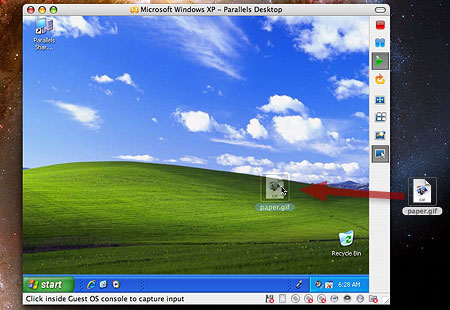
The upgrade is chock full of new features, and though there are only a few that are cool to me, they’re big ones. The first is drag-and-drop copying. I never got the hang of the shared folder in that I kept forgetting where it was on my Mac, and had trouble making it the same between different versions of Windows in Parallels (okay, I didn’t try very hard). But I never liked the whole shared-folder idea anyway, whether it was in Parallels or between different users on a Mac. So now that Parallels allows you to simply drag and drop files between the OS’s, I’m a happy camper.

Para2

Para2A

The other improvement I like is the window resizing. One thing Virtual PC always sucked at was getting the size of the window right, especially since I used it on a Mac that connected to a TV; whenever I changed resolutions to match the TV, the Virtual PC window got screwed up. Similarly, with Parallels, to change the actual resolution of the Windows screen, you’d have to effect the change within the Display Properties dialog box, and resizing the window containing the virtual OS would result in a mismatch. But not any more. With Build 3036, you can resize your Windows window to any size you want, and the OS will automatically resize the virtual resolution along with it. Very nifty.

There is one other big change, though not a big one for me: the ability to work with Boot Camp. A bit late for me, as I never installed Boot Camp, so now it would require a complete wipe of my hard drive and reinstalling everything. But if you haven’t done either yet, or better are just about to buy a new Mac, you can now install WIndows in Boot Camp and use Parallels, without worrying about having to install Windows twice. As I said, I won’t use it (yet), but it’s a good option to have.

Among the other changes: redesigned windows/controls, one-click startup via an OS alias (you no longer have to open the interface window and then start Windows), and enhanced networking, graphics and lots of other little stuff. The details are laid out here. There’s also a new feature called “Coherency,” which is supposed to “show Windows applications as if they were Mac ones,” but all I get when I try it is the Windows area going full-screen except for the Mac menu bar, with bad pixelation of the Windows graphics.

Still, for a free upgrade, this version has some big new features.

Update: OK, I see now. What “Coherency” does it to take away the Windows background except for the active app windows and the Task Bar, making the Mac environment appear behind it. If you have the resolution in Parallels set to maximum, then there is no pixelation. Instead, the Task Bar appears at the bottom of the screen, and all active Windows programs appear to be windows open within the Mac OS. However, you cannot hide them with Command-H like other Mac apps; if you do a “hide,” then they all disappear, along with the Task bar. Instead, you would have to minimize them. I guess that though it’s not quite as good as making Windows apps act like Mac apps, it’s probably the next best thing.

Categories: Mac News Tags:

Jumping the Shark

December 1st, 2006 7 comments

There are some authors who, quite frankly, should leave their politics at the door. It seems to me that when an author of popular fiction whose work I tended to enjoy starts injecting their politics in their writing, it usually also happens to be the case that their writing has fallen below a certain level of quality that makes them no longer readable in any case.

Now, don’t get me wrong–I am not necessarily suggesting a cause-and-effect relationship. I just happen to notice the two things tend to happen at about the same time. It certainly happened to Tom Clancy. I greatly enjoyed his early books, including The Hunt for Red October, The Cardinal and the Kremlin, The Sum of All Fears, and Without Remorse (which I am re-reading right now). Guy books, certainly, but that describes all of Clancy’s books. Debt of Honor is a special case–part of my problem with the book is that I am familiar with Japan, and so most times when Clancy writes about things in Japan, I wince at how horribly wrong he gets so much of the stuff. I could write a long blog post just on that, and maybe I will, if I re-read that book again as well.

But you could see that Clancy was getting stilted with Executive Orders, and by the time he did The Bear and the Dragon, his writing was horrible. And it was with those last two books that Clancy also started preaching politics. Like I said, the two are not connected–Bear was unreadable for so many reasons having nothing to do with the politics, but the politics came right when Clancy was so markedly going downhill. One passage stood out to me from that book, where Ryan was discussing abortion with van Damm. Ryan predicated his argument on this concept:

“Arnie, it’s like this. The pro-abortion crowd says that whether or not a fetus is human is beside the point because it’s inside a woman’s body, and therefore her property to do with as she pleases.”

The whole line of reasoning started with that presumption, that abortion rights were based upon the idea of a fetus as property even if the fetus were considered a human life, a predication so absurd as to be laughable; and yet, Ryan’s supposedly left-leaning and pro-choice counselor, van Damm, accepts this without challenge.

It’s passages like these that can usually turn a book sour for me; for example, my brother gave me a crime novel once called No Lesser Plea. I was already having trouble with the premise, that the state could have a brutal killer dead to rights, and he gets off by throwing a fit in court and then the liberal pansies put him in psychological rehabilitation for a short time and then set him loose on the streets again. I stopped reading altogether when the author described a court-appointed psychologist thusly: “He considered himself a liberal, in that he believed that when black people were violent and committed crimes it was not really their fault.” The abortion passage in Bear did not turn me off from the whole book like that line in Plea, but it sure didn’t help.

I tried reading Rainbow Six, the next Clancy book after Bear, thinking Clancy may have come back into form, but it was just as bad if not worse. The contrived opening had members of an elite squad of counter-terrorism agents taking a commercial flight–which then just happens to get hijacked! Sure!

Now I’m seeing the same kind of thing happening again, this time with a different author. Orson Scott Card has been highly controversial outside his writing, but as long as that kind of thing stays separate, I am able to enjoy the fiction without the person’s politics interfering–else I would never be able to enjoy a movie featuring Arnold Schwarzenegger, Bruce Willis, or Mel Gibson. And three of Card’s works remain my favorites: Ender’s Game, Speaker for the Dead, and Pastwatch. In his public persona, Card has been something of an asswipe. Despite claiming to be a Democrat and saying he has nothing against gays, he nevertheless has advocated that “laws against homosexual behavior should remain on the books” and that gays “cannot be permitted to remain as acceptable, equal citizens” within a society with certain sexual mores. He has also been a rather vociferous and outspoken advocate of George W. Bush, the war in Iraq, and the whole “War on Terror” paradigm; just a few weeks ago, before the midterm elections, he wrote this:

There is only one issue in this election that will matter five or ten years from now, and that’s the War on Terror….I say this as a Democrat, for whom the Republican domination of government threatens many values that I hold to be important to America’s role as a light among nations. But there are no values that matter to me that will not be gravely endangered if we lose this war.

Card is also pro-life, believes a right to privacy does not legally exist, and believes that the Democratic Party is “self-destructive,” “extremist-dominated,” and “insane.” He lauds Fox News and urges everyone to vote Republican. But he says he’s a Democrat because he is pro-gun-control and is critical of free-market capitalism and southern racism.

It goes without saying that venturing into Card’s politics is, to say the least, an ugly, sticky affair. But in the past, much of his fiction has been superlative (not all of it, to be sure). A lot of people didn’t like Speaker for the Dead as much as I did, but Ender and Pastwatch tend to be greatly popular, and I certainly can read them again and again–but only in the way that I can still read the early Clancy novels. For some time, however, Card’s writing has been sliding (his Bean-centered Ender books marked this slide), and now it seems that Card is officially jumping his own literary shark with his new book, Empire.

The plot: a terrorist attack which kills the president and vice-president touches off a new American civil war when blue-state liberals declare New York the capital and claim control of the country. You can read the first five chapters on Card’s site (a usual preview he does for his new books). The politics surge in with Chapter Two, in which we meet a conceited, snotty, East-coast Ivy-League liberal who preaches the virtues of Empire over a Republic and acts all condescending to the reasonable, intelligent veteran whom he calls “Soldier Boy.” The conservative hero sees the liberal student body as:

…ignorant of any real-world data that didn’t fit their preconceived notions. And even those who tried to remain genuinely open-minded simply did not realize the magnitude of the lies they had been told about history, about values, about religion, about everything. So they took the facts of history and averaged them with the dogmas of the leftist university professors and thought that the truth lay somewhere in the middle.

Card does something even more manipulative, which is to make the right-wing protagonist appear to be questioning his own worldview, and, of course, concluding logically and objectively that he is in fact correct to be conservative. The presence of such soul-searching simply marks Card’s realization that the reader will question Card’s bias, so Card inserts the language to try to make it seem like it has been reasoned out–but it comes across as just as self-serving as Clancy’s taking both “sides” of the abortion debate, with a right-wing author using a falsely “objective” device to validate a biased view.

Card’s adulation of Bush is clear:

Truth to tell, this President had changed things. Without ever getting a bit of credit for it, he had transformed the military from the cripple it had been when he took office into the robust force with new doctrines that had the enemies of the United States on the run.

I could go into detail in knocking over this fantasy, but I think you know the fallacies here as well as I do. (Trust me, I could go into a long rant here about how Bush has decimated our military capability in a war completely divorced from terrorism, but to go into more detail would detour too long from the present topic.) In any case, that passage begins Chapter Four, which describes the terrorist attack–in detail which is as bizarre as it is beyond one’s ability to suspend disbelief. From there:

…a radical leftist army calling itself the Progressive Restoration takes over New York City and declares itself the rightful government of the United States. Other blue states officially recognize the legitimacy of the group, thus starting a second civil war.

Interestingly, the Publisher’s Weekly review on the Amazon.com page for the novel (the source of the above synopsis) rather flatly pans the book, saying that “right-wing rhetoric trumps the logic of story and character,” and “the action is overshadowed by the novel’s polemical message.” But I guess that Amazon prints their reviews automatically, good or bad (some of the other reviews are good, which is surprising, as the first chapters–not to mention the plot–are so abysmally bad.

Maybe Clancy and Card are exceptions, and the seepage of personal politics into writing is not a sign of an author going downhill. But within the miniature statistical universe of these two writers, it’s certainly no question that the two events coincided.

Update: I just remembered that Michael Crichton might be a member of the club, though I think his drop-off in writing quality came somewhat before his anti-environmentalist polemic.

Categories: Media & Reviews Tags: