Archive

Archive for August, 2007

Back Streets of Akihabara

August 31st, 2007 6 comments

Akihabara is not what it used to be. It used to be the Mecca of electronics, the place where you could bargain and haggle. Well, you might be able to haggle in some places, but not like before.

I remember, years back, wanting to buy a Japanese word processor–back before PCs were commonplace in Japan, when everyone used these electronic type-writer like machines just for typing and printing. A “Wapuro.” I went to several stores in Akihabara, and asked prices. These prices were always listed for an item, but were almost always marked out in red–you had to ask for the price, and could usually talk it down somewhat. Each time I got the price for a store, I wrote down the store’s name and the price in a notepad, so I could remember who had what for how much. After going to four or five places, I noticed something: the prices I was given were lower for each successive store I visited–the first shop had the highest price, the last had the lowest.

I finally figured it out: each time I visited a new store, the salesman was getting a peek at the notepad I was carrying, checking out the lowest price, and then beating it by a little. I had been haggling down the price without ever realizing it. But that’s what Akihabara used to be–not just the little stores, but the big chain stores as well.

That no longer holds true. Akihabara is different today. Maybe you could haggle, but I don’t think you’d get nearly as far as you could have twenty years ago. Instead, you usually don’t even have to go to Akihabara; you can get good and sometimes even better prices by visiting the electronics chains like Yodobashi, Bic, or others like them in Shinjuku, Ikebukuro, or elsewhere. There’s even a new chain, Labi, which just opened up a big store in Ikebukuro. For a straight-out electronics purchase, I would usually go to places like these.

Akihabara has also transformed from an electronics heaven to mostly an anime and gaming heaven. On the main drag, at least, most of the stores seem dedicated to video gaming or some form of anime-related electronics/media. A shop bearing the name “DVD” in big letters likely won’t be selling any DVD players, but instead game DVDs.

But if you want to buy something unusual, Akihabara is the best place for it. For example, I wanted a region-free DVD player, one that could handle Divx files. For that combo, Akihabara was probably the best place; I found a good machine for it. That could be found in the bigger shops, ones that had duty-free sales for non-Japanese.

Similarly, I needed to get a USB keyboard–with an English, not Japanese, layout. I found a shop in Akihabara that specialized in keyboards, and had a few dozen English ones. For that, you have to go to the back streets.

0807-Akibs1-450

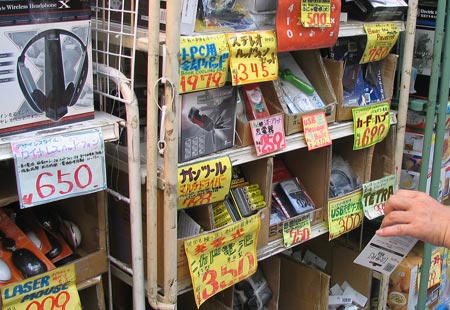
Instead of shopping on the main drag, take a cross street to the streets behind the main drag, on the other side from the Yamanote Line. Here, you’ll find the real electronics heaven. Lots of little stores selling all manner of stuff in all manner of ways. A lot of shops will have these dirty plastic or cardboard bins chock full of cheap stuff, from knock-off products to cheap imports. I bought a 4-button mouse that was identical to a nice one I bought made by Logitech; everything was the exact same, except for the maker’s logo. The Logitech I had bought on sale at Yodobashi for ¥2000; this knock-off was for about ¥600.

0807-Akibs2-450

It seems that almost anything can be found in those bins, from cables to removable drives to gadgets and toys to, well, whatever.

0807-Akibs3-450

There was a ¥1000 3-megapixel digital camera with USB port that I was sorely tempted to try out, just for fun. A ¥650 set of wireless headphones. Any number of mice from ¥500 yen up, but the most expensive ones were still cheaper than the cheapest ones at the major retail outlets.
0807-Akibs4-450

A lot of the shops get way too techy for the ordinary buyer, though–for example, there are lots of shops which sell stuff for people to make their own PCs.

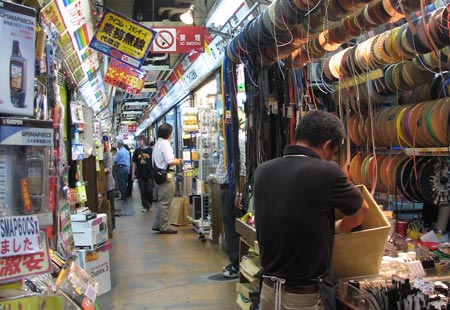
But if you really want elemental electronics, try visiting the place I refer to as The Maze. Very close to JR Akihabara station, it’s a building on a fair-sized plot of land that long ago was converted to stalls in narrow aisles open to the outside.

0807-Akibs5-450

0807-Akibs6-450

In here, you can buy loads of just about anything and everything electronic–not computer-related, necessarily, but electronics-related. There are shops which sell nothing but wiring, or nothing but LED lamps and other lighting bits and pieces. One shop sells nothing but old but functioning radio tubes, some priced in the hundreds of dollars. For the home electronics-engineer hobbyist, this place is a treasure trove. You can also find larger components and systems, especially surveillance cameras/closed-circuit TVs, GPS systems for cars, and stuff like that.

These places are the main reason to go to Akihabara these days… unless some big new anime-based video game is going to be released. But I like the back streets better.

Categories: Focus on Japan 2007 Tags:

It’s a Wonder She Didn’t Die

August 30th, 2007 2 comments

This in the news today:

[A] 38-year-old woman, who was in the sixth month of her pregnancy, was being driven to a hospital near the western city of Osaka after she suffered from stomach cramps and bleeding, according to Kyodo News agency and other local media.

Nine hospitals closer to her home in Nara prefecture (state), over 40 kilometers (25 miles) away, had earlier refused to admit her, saying they were full, the reports said.

Her water broke two hours into the journey. Ten minutes later, the ambulance collided with a minivan.

There is just so much wrong with this story, but it reinforces my apprehension about ever needing an ambulance in Japan. Honestly, unless I feel it’s necessary, I will seriously consider hailing a taxi instead, especially if there is nothing that can be fixed before getting to the hospital in any case. At least taxis drive aggressively. Ambulances here tend to be rather slow and over-cautious.

So, why did the ambulance in question get into the accident? It’s possible that the driver was panicked by the patient being in such dire straits, with so many hospitals refusing service and the only accepting one so far away. But there’s even money on the bet that it wasn’t the ambulance driver’s fault.

Here in Japan, I have noticed an alarming disregard for emergency vehicles by drivers. Every time I see a fire truck or ambulance approach an intersection with sirens blaring and lights blazing, I stop immediately–and am always shocked by how many people don’t stop. Just a few weeks ago, I was at an intersection near Tokyo Dome, and an ambulance was clearly, audibly and visibly, approaching from the cross street. I had stopped early, but most traffic continued until the ambulance came to a stop at the intersection, shouting pleas over their loudspeaker for traffic to clear. Despite this, a car simply ran through the intersection, making the ambulance wait… and then, to my shock, a city bus drove through after the car as if nothing unusual was going on. No way the bus driver did not see the ambulance. This was egregious, even for Tokyo. And yet, I shouldn’t be shocked, as I see this kind of thing all too often.

That’s why I have the feeling that the minivan driver was at least partly at fault: I can so easily imagine the driver simply deciding that where he was going at 5:10 am was more important than some ambulance.

So what happened to the poor woman then?

After the accident occurred, the hospital in Takatsuki refused to admit the woman, with one official telling ambulance workers, “Treatment is difficult as the woman has already had a miscarriage. We also have an emergency operation.”

Another two hospitals refused admission and after another request the initial hospital in Takatsuki decided to admit her.

Categories: Focus on Japan 2007 Tags:

Pitching Values

August 29th, 2007 Comments off

When Bush effectively made the Fourth Amendment to the Constitution null and void, the media barely blinked. When Alberto Gonzales claimed that the right to Habeas Corpus did not exist, the press wasn’t all that stirred up. Just the administration shredding the Constitution here, folks, nothing to get excited about.

But, boy, do they love a sex scandal! Even such that when a Republican senator is caught soliciting sex in an airport men’s room, it becomes a week-long media frenzy like no other–even though the actual impact on the country is about zero. Idaho has a Republican governor, so if Craig resigns or is otherwise forced out, he’ll just be replaced by another Republican, not that Idahoans are really going to elect a Democratic senator anyway. And this scandal takes place far enough away from any election that it won’t make a difference in terms of sullying the party in general and hurting its chances. So really, this story has “back page” written all over it… but it remains top news in the media and will stay there for a few days.

Interestingly, Republicans are pretty much turning on Craig, wishing privately and sometimes publicly that he’d just have the decency to resign, to leave town. This in contrast to their attitude concerning Louisiana Senator David Vitter, who was also caught soliciting sex illegally; with Vitter, they defended him strongly and pooh-poohed calls for his resignation. And it’s not just because Craig solicited man-on-man sex and Vitter solicited hetero sex. Rather, it’s because Craig’s governor is a Republican, so the seat is safe, while Vitter’s was a Democrat, and they would lose a seat. That’s the overriding principle here, and not one of perceived “morality.”

Now, Craig–aside from being a knee-jerk Republican and therefore blaming everyone in sight, including, of course, the media–is practically pleading with the public to believe that he’s not gay. Almost as if that’s more important than anything else here, that nobody thinks he’s queer.

Now, I may get into trouble for this, but I have a sneaking suspicion that he’s telling the truth there–as may be several other conservative figures in power who have been similarly caught standing behind another man with their pants down. What we’re talking about here is not something that is automatically homosexual in nature, at least as far as orientation is concerned. Remember, sex, for many people, is almost inextricably intertwined with power and control, especially anal sex. For heterosexual men in particular, receiving anal sex is the ultimate signal of submission.

And that may be what a lot of this is about: thirst for power and control intermixed with a twisted sense of sex as perverse, sinful, and shameful–you know, core conservative values.

(Yes, yes, I am fully aware that I am tremendously oversimplifying and perhaps mischaracterizing an incredibly complex and involved psychological landscape. Hell, I have no idea if it was anal or oral sex he intended to solicit, or if anal, whether he was to be the pitcher or the catcher. Still.)

Categories: Political Ranting Tags:

Net Cafe Refugees

August 29th, 2007 4 comments

Well, this is interesting. Hadn’t heard of this before. Apparently, there is a growing number of people who are homeless, but still making just enough money to get by–but not enough to get an apartment, apparently, or at least they prefer not to have one. So instead, they spend their nights at Internet cafes, which provide shower facilities and even sell clean underwear. Honest–unless this is a huge hoax that someone put over on the news services. Supposedly, the Japanese government has found 5,400 people who do this, regularly.

The story I found claims that the “refugees” spend ¥3000 for a 5-hour stay (with a meal provided) and get a shower for ¥200 extra. However, I find that pricing to be suspect; 30 days in a month, ¥3000 yen/day, that’s ¥90,000 per month. While an Internet cafe might be nice, one can rent an apartment for much cheaper than that, if you’re willing to settle for less-than-luxurious conditions.

Either the prices most of these people pay are much cheaper (and I’m guessing that you can find much better than ¥3000 for 5 hours if you look hard enough–I found a cafe that was ¥400/hour for a two-person booth, and I am sure that many drop their prices for the late night customers), or the people in question simply prefer things to be taken care of for them, not to mention having a nice space provided–some of the Internet cafes offer good surroundings.

It is also a good alternative to a hotel. I remember staying in a capsule hotel once, and it was horrible; it was essentially a watering hole for drunk businessmen who were either snoring loudly, watching TV loudly, or were congregating in the corridors and chatting all night. Nor was it really that cheap; an Internet cafe would be cheaper, and likely a lot less noisy.

Categories: Focus on Japan 2007 Tags:

Getting Better

August 28th, 2007 1 comment

I’m getting better at cooking, I think. Or at least in presentation. As I am at home most of the day during my August vacation, and Sachi has to work most days, I am cooking most of the dinners. My repertoire is still limited, but I’m getting more of a feel for things. Tonight’s dinner, shown in the image below: stir-fry chicken with onions and green peppers, with garlic, onion, and pimenton spices, served on a bed of lettuce, shaved onions and carrots, with sliced spring onions (“negi”) on top. The side dish is fried potatoes: dice the potatoes and boil for 6-10 minutes, then fry in a pan with a little extra virgin olive oil and apply spices to taste. With beer and toasted bread rolls, delicious. And a relatively simple meal.

0807-Dinner1-450

As we sat down to eat, we were treated to constant lightning flashes. Though a thunderstorm seemed to rage nearby, we heard little thunder; instead, there were repeated flashes every five or ten seconds, many bright, but none with an accompanying boom. Reminiscent of my mother commenting that when they heard thunderstorms when she was a kid, they said “God’s bowling tonight,” Sachi tonight commented, “God is taking a lot of pictures now.”

Categories: Ikebukuro Tags:

Bedtime for Gonzo

August 28th, 2007 1 comment

How much do you want to bet that as Gonzales retires, the White House will try to dismis all investigations in regards to the Justice department, effectively saying, “Hey, Gonzales is gone now, the matter is closed”?

I’ve had enough of the post-resignation testimonials about Gonzales to make me seriously ill, particularly from the president himself. A lot of right-wingers seem to be sighing with relief, glad to see him gone, but at the same time chiming in on the whole he-was-an-honest-guy-smeared-by-the-Democrats meme. As if illegally, brazenly corrupting the Justice Department with partisan politics was not bad enough. As if the USA firings and the subsequent, multiple lies under oath weren’t a problem (do I even need to mention the Clinton impeachment here?). As if Gonzales’ shameless advocacy for torture wasn’t enough of a brand of illegitimacy.

Gonzales fought to hide Dick Cheney’s allowing energy industry leaders to write government energy policy. He has been a force behind the more abusive elements of the “PATRIOT” Act and other violations of Constitution rights since 9/11, including warrantless wiretapping–which in order to push through, Gonzales went to the hospital bed of John Ashcroft to pressure him to sign his approval for it. Yeah, a real saint. And let’s not forget that this is the guy who tried to argue that Americans don’t have the right to Habeas Corpus.

It is ironic that right-wingers are all teary-eyed about how badly those goddamned vicious liberals are mistreating this great man, when Gonzales himself claimed that the Geneva Convention’s use of the words “outrages upon personal dignity” and “inhuman treatment” were so vague that we should be allowed to torture people.

And how did this great legal mind get his start? By doing dirty work for his boss, Texas Governor George W. Bush. Bush, you see, had been arrested for drunk driving years before, and wanted to cover it up. But he ran into trouble when he pulled a PR stunt. Bush had received a call to jury duty, and decided to make PR hay out of it. Saying that it was “a feeble excuse” to claim he was too busy or too important for the task, he went to court. He failed to fill out the legally required part of the juror’s form that required a listing of his criminal record, but that wasn’t the scandal. No, it was when Dubya, by chance, was assigned to a drunk-driving case, and realized that he would be asked, under oath, if the had ever been arrested for drunk driving.

Alberto Gonzales to the rescue!

…before the case began, Gonzales asked to have an off-the-record conference in the judge’s chambers. Gonzales then asked Crain to “consider” striking Bush from the jury, making the novel “conflict of interest” argument that the Texas governor might one day be asked to pardon the defendant (who worked at an Austin nightclub called Sugar’s), the judge said. “He [Gonzales] raised the issue,” Crain said. Crain said he found Gonzales’ argument surprising, since it was “extremely unlikely” that a drunken-driving conviction would ever lead to a pardon petition to Bush. But “out of deference” to the governor, Crain said, the other lawyers went along. Wahlberg said he agreed to make the motion striking Bush because he didn’t want the hard-line governor on his jury anyway. But there was little doubt among the participants as to what was going on. “In public, they were making a big show of how he was prepared to serve,” said Crain. “In the back room, they were trying to get him off.”

Gonzales lied about this episode when he was being reviewed by the Senate for confirmation. An auspicious start to his stint as AG, just as was his start in politics in Texas.

While working for Bush in Texas, Gonzales was also hip-deep in another Bush scandal, again involving perjury. In this case, Gonzales helped Bush get excused from testifying in a corruption case. Bush was heavily involved in Texas political corruption. In 1996, Eliza May was appointed as director of the Texas Funeral Service Commission, and started doing her job all too well. She started investigating a funeral home business that had given sizable donations to Bush and his father. The business’ representative went to Bush’s chief of staff, and May was soon fired from her job. She filed a whistleblower lawsuit, and Bush was subpoenaed in it; Gonzales help get Bush out of having to testify, in a way that Bush literally perjured himself (but, like so many other times Bush broke the law, was never prosecuted for). In that case, Gonzales also received a memo which noted that two Texas funeral commissioners had ties to the funeral home–illegal, but Gonzales did nothing. His defense? Even back then, Gonzales was using the “I forgot” excuse, and claimed he didn’t recall such a memo.

This is the great man that the president is memorializing tonight. A criminal, a liar, a corrupt political crony.

In other words, his kind of guy.

Categories: Political Ranting Tags:

Mac News for the Week: iPods, iPhones, Scares, and Shopping

August 28th, 2007 8 comments

The new iPods are coming! The new iPods are coming! Maybe! Probably!

Well, almost certainly, now. Finally, after so long waiting for the whole iPhone wave to subside, Apple is, it seems, ready to release the next generation of iPods. Already spy images (possibly faked) of the new iPod Nano design (wide-bodied with muted colors) have been flying over the Internet. The images, which could easily have fallen into the “that’s so fake” trash pile, were given a stamp of approval by Apple Legal, which demanded their removal from the originating site (which, of course, prompted far greater coverage on so many other sites).

Rumors have been going around about a new iPod release for some time; almost every month this summer has been the rumored release date. A few days ago, it became known that Apple was holding a special event on September 5th, and the rumors started to fly that this was the iPod announcement. And now there seems to be hard evidence that this is true, beyond what Apple Legal does: iPod supply is drying up at retailers. This is about as close to a sure-fire indicator that you can hope for that a new model is coming out.

At least some of the models, probably the full-sized ones, will run on OS X. The widely-held belief is that the full-size models will also be full-screen and touch-screen; if they’re not, expect a lot of anger from expectant fans. Essentially, everybody expects the big iPods to be just like iPhones, but without the phone part. Expect WiFi to be absent; if Apple provided WiFi and the ability to use Safari, the product would probably bee too much like an iPhone. It would be cool if they had it, but unrealistic. Not to mention that with WiFi, you might even be able to get a Skype hack and turn it into a virtual iPhone.

Then there are the Nanos, apparently getting a bigger screen, and maybe running OS X themselves–though that’s lower on the probability scale, unless each machine will have a lot more flash memory than in the past.

Some even expect the iPhone Nano to be released–a cheaper, smaller, less-featured iPhone. I doubt that, as Apple seems to want to keep the two lines distinct from each other.

We’ll see in a week’s time. Until then, expect the rumors to fly wild.


In other Mac News: If you saw this story from Symantec, then you can safely disregard it.

“Apple has been demonstrated to suffer a number of vulnerabilities over the years,” he said. “Suffice to say that Symantec and other software security vendors do produce anti-virus software for the Mac because we believe there is the potential of a problem.”

And the fact that they sell software to “protect” your computer has nothing at all to do with the fact that they constantly release reports telling people how open to attack the Mac OS is. Of course, because there has never been an actual functioning piece of malware for OS X in the wild, they have to keep talking about those “vulnerabilities,” which are nothing but potential weak spots where hackers could attack… but somehow never do. A lot of these vulnerabilities require rather intricately unlikely environments and sets of circumstances, like two Bluetooth-active Macs which have not had their software updated for a year, in the same room, where one is infected and the other has a user who blindly accepts and approves of a mysterious, unknown Bluetooth device that does not exist.

So let’s lay it out once again: Macs are not invulnerable. They can be attacked. However, they never have been, and it is likely that they will not be for some time. And when they do start falling prey to viral attacks, they will still be far less susceptible to attack than Windows PCs. You don’t need anti-viral software today, but you might at some time in the future. So don’t pay attention to the companies making the software trying to scare you into buying what you don’t need.


Elsewhere, a company claims that it has developed a way to unlock the iPhone so that it can be used with any service provider. Apparently, they’re for real, because AT&T is taking legal action to stop them. From the best I can understand of what people have been saying, it is not illegal (or at least not something anyone will sue you personally for) to unlock your iPhone, but it is probably illegal to unlock iPhones as a paid service.

Under the law as it stands, you are allowed to unlock your cell phone, at least under the criteria listed here (pdf):

Computer programs in the form of firmware that enable wireless telephone handsets to connect to a wireless telephone communication network, when circumvention is accomplished for the sole purpose of lawfully connecting to a wireless telephone communication network.

That means that it is probably legal to unlock your iPhone in order to subscribe to a different provider–but it is not legal to unlock other people’s iPhones for a fee. However, if I read the exception correctly, then it would not be illegal to sell software to the consumer which allows them to unlock their iPhones–so long as they are the ones doing the unlocking. However, there’s a lot in there which goes over my head, so I could be reading it wrong. Check out the pdf linked to above, and see pages 48-52 for relevant material.

The process itself is apparently software-based, takes only a few minutes, and is simple to use. The only feature which is fully disabled is Visual Voicemail, because that’s an AT&T service; however, if other carriers start using it, it should work on an iPhone. The unlocking company claims that the unlock is “restore and upgrade resistant,” which suggests that Apple can’t “switch you off” or otherwise disable the unlock via a software upgrade.

What is more interesting: the unlock seems to be able to free up the iPhone for users outside the U.S. Hmm… I think I’ll wait on that for a little while myself. First, it’ll probably cut you off from upgrades and stuff from Apple (not to mention most likely voiding the warranty), and second, by the time it comes out officially in Japan, it’ll probably be 3G, and with more flash memory. I’m guessing.

At least one consumer is fighting back against the locking in general, filing a class-action lawsuit (pdf) demanding that iPhones be unlocked for use with any carrier. I can sympathize, and I believe that locking a product like that, while it may be necessary in business sense, is unfair to the consumer. Nevertheless, this guy’s case is, to put it bluntly, stupid. The basis of the suit is that Apple did not adequately inform buyers that they were locked into using AT&T with the iPhone. Sorry, but to not have been aware of the AT&T lock-in is a lame excuse at best. Maybe, in its direct ads, Apple didn’t add a huge you’ve-got-to-use-AT&T disclaimer or anything, but the knowledge of this fact was so widespread, and the practice of locking phones so common, that you’d have to be an idiot not to realize it. Kind of like suing Toyota to make them install an ethanol engine in your car for free because, when they sold it to you, they did not go out of their way to inform you that it required gasoline.


And finally, I spent a few hours in Akihabara yesterday, trying to find a monitor solution for the new Mac Mini my school has bought. I wanted to be able to use both a monitor and a TV output for the machine, so I could face the class, see a monitor, and have the same image put on a TV behind me. Alas, it seems that this is unlikely, at least without a few hundred dollars’ worth of equipment and add-ons. I can display on a monitor, or I can display on a TV… but not both.

The trip also brought forth a few things I don’t particularly like about Macs, the biggest being the lack of microphone support. This seems so obvious, especially in the age of Skype, but Apple continues to flub this one. The “sound in” port on the Mac cannot support 99% (not a hard statistic) of the mics out there. If you want a headphone-mic setup for the Mac, you have to go with a USB solution. Not very smart. Apple has also been non-standard in the types of monitor ports it uses, as if a standard port would kill them. VGA ports don’t exist on Macs, despite being the dominant type. Even S-Video ports on the Mac differ from standard ones, or at least the ones used on PCs. And from what I can tell, there are different types of DVI ports, and the ones used on Macs are, again, dissimilar from a lot of ones used elsewhere.

Apple has been ahead of the game in several ways, like wisely dropping the floppy disk before anyone else, and having a high-speed hot-swappable cable interface (Firewire) long before USB caught up, but in terms of ports and interfaces in general, and A/V interfaces in particular, their history has been spotty. Not as bad as their history with making a decent mouse, of course.

Categories: Mac News Tags:

Getting the Site Straight

August 27th, 2007 1 comment

Man, I have been spending way too much time primping the WordPress stuff on this blog. I am probably going to have to take a break from this for a few weeks while I get other business out of the way. In this post, I just wanted to make a few notes about how a few problems were fixed.

First of all, Japanese in the posts. Apparently, if you install WordPress version 2.2 using “Fantastico” (web hosting CPanel software) or in some other fashions as well, there is a bug in the wp-config.php file, specifically two lines:

define(‘DB_CHARSET’, ‘utf8’);
define(‘DB_COLLATE’, ”);

By deleting these two lines (or putting two slashes at the start of each line to “turn them off”), Japanese will appear fine. I thought I had a deal-breaker when pre-existing smart quotes in other posts suddenly turned to gibberish, only to discover that this new bug only happened in blog posts made after the switch. I simply re-uploaded the stories, and now everything is kosher.

As you might also have noticed, I was finally able to center the calendar. In the stylesheet, under the #wp-calendar heading, I added these two lines:

margin-left: auto;
margin-right: auto;

Apparently, they cause free-sized margins to be created to the left and right of the table, effectively centering it. Frankly, a command like “align: center;” would be a lot easier to figure out….

I have also added a new plug-in, called “On This Day.” It shows blog posts from the same day over past years. It’s smart enough to match the day on individual entry pages as well. One problem I had initially was that the widget showed the day’s posts from the current year as well, something which bugged me to the point of distraction, and I tool it down. But I mentioned this to the widget’s developer… and a few days later he posted a new version with the requested feature of excluding this year’s posts. How’s that for customer service?

I added a “robots.txt” file to ask Google Image to stop scanning my images folder, but that doesn’t erase the thousands of files they’ve cached already, and probably will have there for years to come. Still, you gotta start somewhere.

So far, spam has not been that big a problem. Only one spam has gotten past Askimet, not counting a few that needed Askimet moderation (but did not get to the main moderation area). But the spammers have not yet quite figured out where my main site went yet.

For a long time I have had trouble blocking sites using the .htaccess file. Turns out that I was (for the Nth time) the victim of bad documentation. The best I had been able to get was one site blocked (I used that to block MySpace), but after that, none of the blocks would work. Just today I stumbled upon a web page that actually went to the trouble to explain that if you want to block more than one site, you have to add “,OR” tot he deny rule. I had been writing:

RewriteCond %{HTTP_REFERER} myspace\.com [NC]

…but what I should have been writing was:

RewriteCond %{HTTP_REFERER} myspace\.com [NC,OR]

The “NC” being a command to ignore case, and the “OR” being a note to add another text string to block. Without the “,OR” added, only the first block in the list works. Would it have really killed the authors of the hundred other pages I had depended on previously to make such an obvious and vital note? Sheesh. I also finally figured out that to block access to an image, you had to place the .htaccess file in the directory which has the images to be blocked.

Now I just have to figure out the specific syntax to block any site that has the word “forum” in the URL, and my life will be ten times easier….

Categories: BlogTech Tags:

Arienai

August 26th, 2007 1 comment

Sometimes, living with Sachi, I pick up a good expression in Japanese, here and there. One that I got a while back was when we were watching the movie Mr. and Mrs. Smith. As they went through that long battle scene through their house, Sachi kept saying, “arienai!” (“有り得ない!”)* Sachi asked me how to say that in English; at the time, the best I could come up with was “That’s impossible!”

Tonight, we watched The Princess Bride, a very nice movie, one of Rob Reiner’s earlier directing jobs (Reiner is a very dependably good director). As we were watching it, I was explaining a lot of the vocabulary to Sachi (the DVD I have didn’t have subtitles, neither Japanese nor English). And one of the oft-repeated words in the film appealed to me as the perfect translation for “arienai”: “inconceivable!”

*I tried to write the Japanese for this, but have just discovered that Japanese won’t print here… bug #17 that I have to try to fix…. Fixed it. Configuration file problem.

Search Me

August 26th, 2007 5 comments

Well, I’ve just found a major flaw in WordPress: the lack of a halfway-decent search engine. I don’t know, maybe it’s just the stupid theme that I based my design on, but as far as I can see, the “Search” function in the sidebar is limited to presenting the results of a search in full, unabridged form, printing whole posts in groups of ten instead of giving a succinct, easy-to-read list of titles with short excerpts. I have found and tried a dozen or so widgets, and not a single one works. Either they break with the most recent version of WordPress, or their documentation is so bad that it’s impossible to figure out what the hell you’re supposed to do.

Does anyone out there with WordPress savvy have a suggestion? I would rather avoid Google searching; I would like to control the appearance and not have the search leave my domain. I know that I am essentially asking for what Movable Type had, but it’s more out of functionality than simple dedication to what I am used to.

Thanks to everyone who helps out, in advance.

Categories: BlogTech Tags:

Locked In a Closet Without Vanna White

August 25th, 2007 2 comments

About a month and a half ago, I wrote an entry about the garbage handling in the new building we live in, and noted that the recycled garbage room’s door was strangely locked. Not only do you have to wave your room key over a sensor to get into the room, you have to wave a key over another sensor to get out of the room. This struck me as strange, but I accepted it as okay because before you could get into the room, you had to have a key anyway; I also figured that you could get out of the room via the garage entrance. I figured the double-lock system was to keep people from getting into the building from the garage area via the recycled garbage room.

Well, it turns out that this system is pretty dumb. First of all, the building’s security is kind of a joke. People are constantly entering the building without a key, simply by following in people who open the doors legitimately. When Sachi and I held a housewarming party last month, more than half the guests got past the “locked” front entrance. If someone wants to get in, all they have to do is stand outside pretending to fiddle with their cell phone; when they see someone approach the entrance (from the inside or out), they just pretend to finish text messaging or whatever and then walk to the front door as the other person is passing through. No one questions this. So really, there is no reason to have extra protection elsewhere. The whole “autolock” security thing is weak as tissue paper. Not that I am worried about security; there are cameras and stuff that help prevent crime, each apartment’s door is securely locked, and it’s not like crime is rampant in Japan, anyway.

But the garbage room double-lock is dumb for another reason as well: people can and do get locked into the garbage room. Last week, as I was taking out the trash, I heard a banging on the door to the recycled garbage room. I opened it up, and there was a poor cleaning lady. Somehow she had gotten in, probably as a tenant entered with their key–but when she was finished, she realized that she didn’t have her key! She said that she had been locked in there for fully twenty minutes! Apparently, I was the first person to come along. Sure enough, when I checked, the doors to the garage were locked from the inside, in addition to the door leading to the interior hallway. All the doors were locked from the inside, and there is no intercom in the room.

Categories: Ikebukuro Tags:

More Numbers

August 24th, 2007 4 comments

Recently, I posted about the Iraq War and noted that right wingers have touted a “drop” in Coalition troop fatalities as evidence that the Surge™ is working and things are getting better in Iraq. I pointed out that a July dip in casualty numbers has been a pattern that has held true over three years and so it does not have anything to do at all with the “Surge.”

A frequent visitor who gamely carries water for the Bush administration pointed me to an article in USA Today which seemed to support the idea that the “Surge” is working: that “major attacks” have declined since the “Surge” began. That, plus a claim that tips from local Iraqis about insurgents have quadrupled, were the only “hard” evidence that things were getting better in Iraq. My visitor challenged me to read that and answer to it.

My reply: it was cherry-picking data, choosing just two figures from two dates each, out of a virtual galaxy of statistics, and claiming that they represented the whole of the image:

If your source showed *all* the data, I would take it more seriously. Instead, it is an example of the administration releasing a story through indirect agents (in this case, military officials including a retired general friendly to Petraeus) who uses cherry-picked numbers to make his case. For all we know, the trend could be increasing–and the reporter, like so many these days, simply reports what he’s fed. Did he investigate the whole dataset, get all the numbers and facts and figures, so as to confirm or deny the numbers he was given as accurately portraying a trend? Apparently not–he most likely just accepted what was set before him and wrote it up like a good little puppy.

Show me the level of said violence each month over the past one or two years. Add the number of people killed as opposed to simply the number of attacks–were the 130 in March killing just a dozen on average and the 70 in July killing 50 on average? Then add the *total* number of attacks of all types, and the total number of Iraqis killed–also month-by-month over the last year or two.

Well, ask and ye shall receive. Kevin Drum just happened, a few days after those comments, to post an entry that had far better data–not all that I asked for, but a lot further along those lines than the USA Today article provided. Here is the data as provided by Drum (from The Brooking Institute [pdf file]):

Violence Metrics

June/July
2006
June/July
2007

Change
Iraqi Military and Police Killed 349 429 Up 23%
Multiple Fatality Bombings 110 82 Down 25%
# Killed in Mult. Fatality Bombings 885 1,053 Up 19%
Iraqi Civilians Killed
(All violent causes)
6,739 5,300 Hard to say1
U.S. Troop Fatalities 104 187 Up 80%
U.S. Troops Wounded 983 1,423 Up 45%
Size of Insurgency 20,000+ ~70,0002 Up ~250%
Attacks on Oil and Gas Pipelines 8 143 Up 75%

1Methodology changed dramatically between 2006 and 2007, so numbers are highly suspect.
2Number is for March 2007.
3Numbers are for June only. No July numbers are available.

Infrastructure Metrics

June/July
2006
June/July
2007

Change
Diesel Fuel Available 26.7 Ml 20.7 Ml Down 22%
Kerosene Available 7.08 Ml 6.3 Ml Down 11%
Gasoline Available 29.4 Ml 22.2 Ml Down 24%
LPG Available 4,936 tons 4,932 tons Down 0.1%
Electricity Generated 8,800 Mwatts 8,420 Mwatts Down 4%
Hours Electricity Per Day 11.7 10.14 Down ~14%

4No numbers available for June/July. Figure is extrapolated from May and August numbers.

As you can see, the numbers support the USA Today claim that there has been a decline in the number of multiple-killing attacks… but confirms my suspicions that the number of people killed in those attacks has increased. And almost every other figure presented shows things getting worse, not better.

Is this absolute proof? No, of course not. There’s a lot more data in the Brookings report, not all of it bad–but only if you ignore general trends and believe that all immediate downward ticks (just one or two months’ turn as opposed to four+ years of numbers) will continue that way, when they never have in the past. As I have pointed out, there has always been a July dip in those numbers, and the real picture cannot be well-understood until perhaps the end of the year or further beyond. Looking at the whole of the situation in terms of long-term trends, it seems impossible that laying a few tens of thousands of troops on the problem for a few months is really going to turn the war around and put us in a position where we could “win,” where it would be at all worthwhile to stick it out for another three or ten years. As I said yesterday:

The theory is that if we can just apply enough pressure to dampen violence in Iraq for a while, then Iraq can heal itself, pull itself together, become a unified whole, pick itself up and banish the insurgents. That’s all, not much.

And that, my friends, is the extent of the pipe dream. The Iraqi government cannot pick its nose without falling apart at the seams; the insurgents, even if suppressed, are still there and are not going anywhere; the Iraqi militia, when they are not giving their weapons to insurgents or actively participating in the insurgency, are incapable of policing Iraq on their own; there is no solution in sight for solving the problems of sectarian division; and so many, many other problems.

I stand by that. If the data says anything, it says that there is a short-term dip in bad news that coincides with July patterns over time, and that the long-term prospects are dim at best, with violence up significantly over last year even after the short-term dip.

But that’s not what we’ll hear in the report about the “Surge.” The White House, always claiming that “the generals” tell them what to do and they just follow those brilliant men in uniform, is actually writing the script for General “Sock Puppet” Petraeus, and the USA Today article is almost certainly just a pre-report softening-up PR campaign to try to get the impression out there that, het, maybe the “Surge” is working.

If only it were true. If only there was hope in this situation. If only there were something we could do at this point. I wish it too, folks–but wishing don’t make it so, and I for one am not willing to sacrifice another thousand of our young soldiers on a self-serving, Bush-perpetrated pipe dream.

Categories: Iraq News Tags:

Subscribe to Comments Activated

August 24th, 2007 7 comments

I’ve added a plugin that allows you to opt for email notification when someone posts a comment after yours in any one blog entry. The email includes a link which allows you to manage which entries have notification status for you, so you can turn any post’s notifications off if you wish. Seems to work. Let me know if you have any problems.

Categories: BlogTech Tags:

Bush and His Wacky Analogies

August 23rd, 2007 Comments off

From teh Bush:

President George W Bush has turned the comparison between Iraq and Vietnam on its head in a speech to war veterans, arguing that America’s experience in south-east Asia support the case for keeping US troops in the Middle East.

He said that the rapid US withdrawal from Vietnam and Cambodia in 1975 had led to bloodbaths, persecution of those who worked for the Americans and the boat people refugee crisis.

He argued that a premature US exit from Iraq could have similar consequences.

“Many argued that if we pulled out, there would be no consequences for the Vietnamese people,” he said, addressing the Veterans of Foreign Wars association in Kansas City.

Oh, Lord, so many things wrong, so little time.

First of all, let’s point out that last bit, about “Many argued.” That’s the famous Straw Man appeal. Now, I wasn’t really paying attention to politics much then, mainly because I was, like, under ten years old, but were there really many serious people who argued that a U.S. pullout from Vietnam would not result in any continued violence? Even if there were–and I doubt that–Bush’s statement makes the suggestion that there are a similar “Many” today who argue that a pullout from Iraq will also have “no consequences” for the Iraqi people–which, of course, is utterly false.

Then, as to the basic comparison, one could make so many other analogies between Vietnam and Iraq–the mistake of going in in the first place, the hopelessness of a major guerilla land war in Asia, investing more and more in a quagmire because it would look bad to pull out….

And let’s not forget an oldie but a goodie: the scare theory of what will happen if we leave. In Vietnam, it was the Domino Theory: if we leave, the Communists will start making victories that will topple the other countries until Communists take over Asia and we have a bigger problem and maybe a war taken to our doorstep. In Iraq, the shorthand version is, if we stop fighting them there, they’ll follow us home and make war on our doorstep. Same basic idea: if we end the war, disaster will befall us, and the boogeyman will come get us.

Then there is the whole argument that things will get worse if we leave, as if going in in the first place was not the error that led to the damage. That somehow the decision to invade was a good idea, that staying in is a good idea, and the only course that will do us harm is deciding to leave. The sad fact is, the invasion itself was the error, and withdrawing is the least bad of all resolutions to that error.

Bush claimed that it was the withdrawal from Vietnam that emboldened al Qaeda, suggesting the inference that withdrawing from Iraq would cause similar damage. However, the damage has already been done: it was the invasion of Iraq that emboldened our enemies; the withdrawal is only a painful resolution to a mistake already made, Staying in Iraq indefinitely would embolden our enemies further still, worse than if we were to withdraw. It has already proven to be a huge recruitment and fundraising bonanza for al Qaeda.

“In Vietnam, former American allies, government workers, intellectuals, and businessmen were sent off to prison camps, where tens of thousands perished.”

This shouldn’t be too much of a problem in Iraq: almost all of those people have already left the country. Why? Because they have been targeted by death squads. In short, the horrors Bush warns of have already been taking place.

It also drew on a long-running belief in the military that the US Congress threw away the chance of victory in Vietnam by pulling troops home early.

And here we get into the real fantasy: that this is something we can “win.” Naturally, it is far easier to dream of a victory than to actually achieve one. Right-wingers argue that the “Surge” is working, allegedly because violence is on a downswing (many point to July’s numbers, ignoring the fact that over the past three years, July has always seen a downturn in violence). I would direct you to read what these soldiers have to say about the matter.

Here’s the thing: even if the surge were having the effect that right-wingers claim–and I have seen no persuasive evidence that this is actually the case–but even if it were, then the idea that this means we could win the war is still utterly a pipe dream. As I said before, Iraq is an arterial gash: you can make it look like it is bleeding a bit less by applying pressure to it, but that alone won’t be enough to repair the damage and bring the patient back to health. It is an illusion of repair, not repair in fact.

The theory is that if we can just apply enough pressure to dampen violence in Iraq for a while, then Iraq can heal itself, pull itself together, become a unified whole, pick itself up and banish the insurgents. That’s all, not much.

And that, my friends, is the extent of the pipe dream. The Iraqi government cannot pick its nose without falling apart at the seams; the insurgents, even if suppressed, are still there and are not going anywhere; the Iraqi militia, when they are not giving their weapons to insurgents or actively participating in the insurgency, are incapable of policing Iraq on their own; there is no solution in sight for solving the problems of sectarian division; and so many, many other problems.

So the optimists are saying, “Hey look, all we had to do was pour tens of thousands of extra U.S. troops which we cannot maintain for very long, and the number of violent attacks in Iraq fell by ”x“ percent, so that means all those other problems are not so insurmountable!”

I weep for the poor teen who thinks he’s immortal and gets suckered in by the huge signing bonuses now being offered to join the military. It does not matter if he has patriotism in his heart–in fact, it is worse if he does, for that only intensifies the tragedy of what he will be put through to satisfy the fantasies of those who say we will win this thing, but always find reasons not to serve in the military themselves.

Categories: Iraq News Tags:

A Fifth of the Nutrition

August 23rd, 2007 2 comments

0807-Gat-Nutr-450In Japan, food and beverage makers have not traditionally done that much in the way of labeling nutritional values. Often times, in fact, when you get an imported item from abroad, the nutritional information is intentionally covered up by a sticker in Japanese with more lax standards on what to report. Don’t count on Japanese people knowing what “trans-fats” are, or how much cholesterol is in stuff, or even to be aware of saturated fats. Generally speaking, you won’t hear about that stuff here.
But they do have to give basics, and one of the basics is calories. At right is from a bottle of Gatorade, but it’s pretty standard. Note the calorie count–26! Pretty low, right? Well, a closer look shows you the little trick they thought up: these are the values for 100 milliliters of the drink, and the bottle is 500 ml. So you have to multiply by five.

Admittedly, it’s a standard trick–how often has a food label’s “serving size” matched the amount you really ate? Still, it is possible that you might nosh on eleven pretzels, two small cookies, or a handful of potato chips. But using such a division on a single-serving drink? Who drinks one-fifth of a bottle of Gatorade, or any other such drink?

This is one of those “lying by telling the truth” techniques, where you jigger the facts enough so that you are technically telling the truth, but at the same time, you are straining as hard as you can to create a more favorable misinterpretation. Kind of like using “Saddam Hussein,” “9/11,” “The Iraq War” and “The War on Terror” so often intermingled and interchangeable that two-thirds of the people believe that Saddam Hussein was involved in 9/11 and that the hijackers came from Iraq, even when such things are obviously untrue. And in the end, you can stand up and say, “Hey, I never claimed that Saddam Hussein and Iraq were involved in 9/11.” But, of course, you did, and that’s the point: if you speak only facts, but you distort them so as to give a false impression, it doesn’t matter if you never came right out and said anything untrue in so many words. The fact that you designed your message to portray a lie makes it a lie.

A Libertarian might say about the drink bottle, let the buyer beware. Me, I favor making it illegal to intentionally lie to people when advertising or giving nutritional information. This is the kind of thing that right-wingers talk about when they say that people like me want “Big Brother,” or government control over our lives. Me, I’ll pass on the warrantless wiretapping, thank you, and opt for the laws against consumer fraud.

Hey, I’m getting back into blogging form again–I squeezed a political statement out of a soft drink label!

Categories: Political Ranting Tags:

Thematic Difficulties

August 22nd, 2007 6 comments

Ah, it’s all coming back. I remember doing this before, when I first designed my site with Movable Type. Most of the layout is CSS, and since I don’t know CSS, I have to use a template of some sort–some WordPress Theme which has all the fundamentals, all I have to do is insert my own images, change the colors, set widths and heights and fonts and so forth. A work in progress, even still after several days of redesigning.

One unexpected factor: the person who built the theme I am using as a template decided to make an ass out of all the people who used his theme. He inserted text which would only appear of you viewed the blog in Internet Explorer; it takes a prime spot right below your blog banner and right above the first post, and essentially says how IE blows and what are you thinking about using that.

Now, to be honest, I wholeheartedly agree with the sentiment–but at the same time, this guy’s methods are for crap. Inserting a condescending message into the middle of your blog which you won’t see unless you’re using IE on Windows? I had no idea that I was insulting a large block of my own readers, and would not have known at all until (a) I happened to stumble across the code by accident, (b) used IE myself, or (c) someone got offended and told me about it. (a) was not too likely, as the page content section did not really need modification; (b) would eventually have happened, once I got around to testing the theme out on different browsers; but (c) happened first.

Ergo, as soon as I can root out the last of any original design elements this guy put it, I am deleting the link back to him. All I needed the theme for was as a foundation to create my own design, anyway. Or, that is, to transfer the design I had to the new blog.

But since I did wind up unknowingly offending at least one person in that manner, I wound up doing platform/browser tests early, and was reminded of yet another headache of web site design: getting all the browsers to play nice. Like I said, I greatly dislike the theme author’s methods, though I agree with the sentiment: Microsoft makes life harder for web page designers. Sure, they could follow standards, but do they? Of course not. And since Microsoft owns the Desktop and gives IE as the default browser, virtually everybody uses it–which means that you either dance to Microsoft’s tune and blow off people using other software, or you make your blog look bad for everyone else.

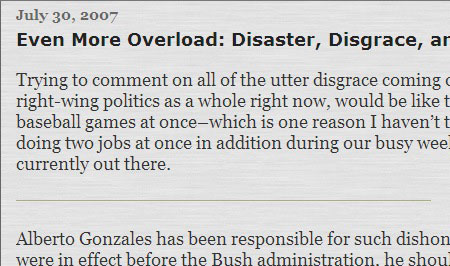
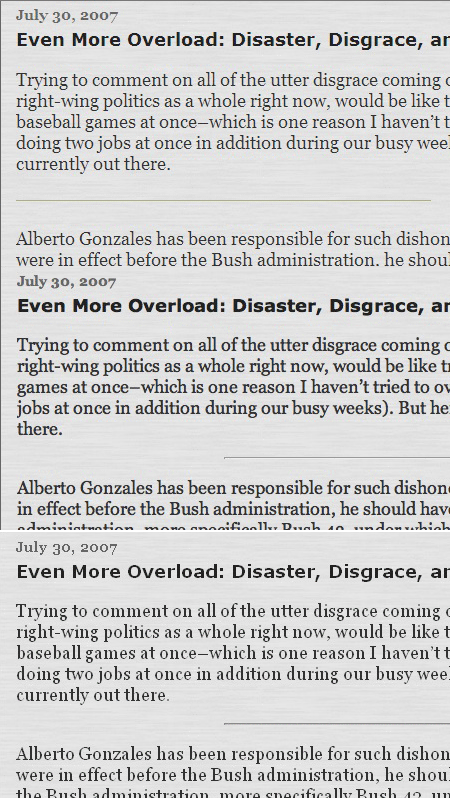
This really stands out when you look at the pages in the different browsers. There really is a good deal of difference in how they render, especially in Windows. Witness three browser views of a part of one of my pages. First, Safari:

Wpblog-Safari

Next, Mozilla/Firefox:

Wpblog-Mozilla

And lastly, Internet Explorer:

Wpblog-Ie

Notice a few things: the text looks smoothest in Safari, probably because Apple does font anti-aliasing. The text looks bolder. Mozilla/Firefox looks horrible–the text is all jaggy and distorted. Maybe I don’t have the text settings done right–but they are as I downloaded them.

IE is in between the two as far as text quality, but notice something else: the half-page-width horizontal rule is left-aligned in IE, and is correctly centered in Safari and Mozilla.

Here’s the interesting thing: on a Mac, Safari and Mozilla/Firefox are virtually indistinguishable–so much so that posting an image of the different screens would be pointless.

Here is an animated GIF file, for those of you who have that turned on in your browsers, switching between the three browsers renders:

Wp-Pages


But that’s not the only place IE differs. You’ll find other small bits and pieces here and there that don’t match up–and IE is always the odd browser out… meaning they’re the ones who don’t play by the rules. Look at the bottom of the comments area on an individual page:

Wp-Pages2
Left is Mozilla, center is Safari, right is IE. Notice how the background color for the last comment extends down to the bottom of the page. Again, not the way it should be.

Such problems are not insurmountable, but they are a major pain. If Microsoft stopped finagling with the code so they could force people to make IE look better to the detriment of other browsers, then web design would be a lot easier. Instead, you have to inspect every nook and cranny on different browsers and different platforms, and fiddle with the commands until you find an array of settings that looks acceptable on all browsers.

This is why so many people keep the simple, basic themes provided, and I can’t blame them for it. It’s a huge amount of effort and self-training. The benefit, however, is learning new code, if you don’t know CSS already.

Categories: BlogTech Tags:

Getting There

August 21st, 2007 19 comments

Well, the old Movable Type blog is more or less officially closed now, with a note on the door to come over here. I will only be posting new stuff at this location from now on, at least until I decide to put the WordPress blog into the main directory… a decision for later. For now, bookmark this page… or just go to the main page of the old blog and let it redirect you here.

One major hassle will be redirects. Because the old blog did not use blog post numbers for entries that were deleted, and the new blog failed to respect that numbering, the numbering no longer matches. Ergo, the utilities which usually manage redirects will not, in all probability, be of any use to me. Seems foolish–after all, who doesn’t have at least one deleted entry?

Worse, I can’t even redirect the easy way–the redirect utility provided by my web host can’t handle question marks, which WordPress uses. In addition to that, the search engines will continue to send 70% to 80% of my visitors to me… to the old site’s pages. Hell, I don’t even know if the search engines scan and link to WordPress’ php-style pages the same way they do with static pages… they must, right?

Then there is the formatting. As you can see, I have gotten most of the page to look OK, but bits and pieces of the base theme I used are still peeking through. I have to rework stuff like blockquotes, comment background coloring, the footer on the pages, and so on. Please be patient with me while I go through this.

In the meantime, please keep dropping by!

Categories: BlogTech Tags:

Now, To Change the Layout

August 21st, 2007 2 comments

Okay, so the transfer seems done, more or less. A few strangenesses, like the fact that the number of posts has decreased from 2631 to 2626, but the number of comments has increased from 6593 to 6705. I have no idea where those five extra posts went to, but I have the feeling that the extra emails are ones that I had not formerly approved and yet had not deleted either…

So now I just have to learn all about WordPress-plugins and widgets and themes, oh my!

Categories: BlogTech Tags:

Whack-a-Mole Spambots and WordPress Migration

August 20th, 2007 6 comments

One of the issues that I have been dealing with is how to defeat the spammers. One way to do this in Movable Type is the change the name of the comment script from time to time. This seems to work, but only very temporarily. Even instantly, a lot of spammers’ software detects the new name (probably once it fails to execute the script once) and just resets with the new script address. Some spammers seem to be set on long-term autopilot, however. I have changed the name of my comments script about 4 or 5 times, and yet I still get attempts to access the previous versions–even though the oldest of those has not been active for more than two weeks.

However, you can see the spammers when they auto-correct: you get two hits from the same IP address; one directed at the old script, and one directed at the new one. Apparently that’s when they tried to old script, it failed, and so they accessed the blog entry page and found the new script. All automated; such hits are usually just minutes apart.

Another issue is how to move the blog from Movable Type to WordPress. A process which should be simplified by this time is still, apparently, labyrinthine. The most frustrating aspect to it is, as I have found out many times before, the documentation. Generally speaking, the people who make the documentation are the people who write the software… and as documentation authors, they suck big-time. Their most common error is to assume that everyone using the software has years of experience in web site administration, so they casually say “do this” and “do that” and give no frakking clue as to how these things can be accomplished.

One example is that since my blog is big, I am having trouble uploading the data file so that WordPress can even get started on processing it. They casually set a limit of 2 MB, while the file I need to import is 14 MB. Yes, I know my blog is a lot bigger than most, but still, they must expect most people to have tiny little blogs; I must have exceeded that much in my first year alone. Anyway, the problem, many report, is that the file is too big–so just divide it into pieces. Well, great–but how? No clue is given to this, they just assume that you know all about this kind of stuff. Nobody takes the trouble of spelling it out so that someone with no technical knowledge can do it. Even the better ones, at some point, have one instruction that depends on knowing some protocol, trick, code, or process–and just one broken link will completely stop you in your tracks.

It does not help that Movable Type apparently re-designed their support site, in such a way that none of the links work. If you search the forums, you always find somebody asking about a problem, and other members say, “You dolt! This has already been discussed, just go here!” and they provide a link. But the link is broken, and a search does not bring up the page they are apparently talking about. Swell.

Frankly, I will be rather surprised if I can get this done this week. I was hoping to have it done today, but tech-support lag has hit me. I needed to ask for a php file-size limit to be raised, and they did… for the main directory only. I did not know I had to ask for a specific directory, so another 2-3 hours must go by before I can get that fixed. And I’m only just beginning. If I succeed in importing the file, then there will be issues about making images work, and potentially much more difficult, making links work (where I linked from one post to another). There are tools and solutions for problems like these… each of which I fully expect to have exactly the same quality of documentation that I have experienced thus far.

Right about now, I am actually asking myself, “how much longer can I keep this blogging thing up?” I figure that I have to at least go five years without a day’s break, and then maybe back off to several-times-weekly, or even whenever-I-feel-like-it.

Read more…

Categories: BlogTech Tags:

Yes

August 19th, 2007 Comments off

Walking to the station the other day, a brief question-and-answer Sachi and I shared reminded me of an interesting linguistic difference between English and Japanese. Wanting to know which route we should take, I asked, “Do we go straight ahead, or turn left?” Sachi answered, “Yes.” I laughed, but I understood: we turn left.

I have encountered this before in Japan: when asking a binary “A or B” question, the answer “Yes” means the latter is correct. To an English speaker, however, that sounds like a joke answer–as if both were the correct reply. However, I have yet to probe this deeply; for example, I have never heard “No” to mean the former of the two choices as being correct. Nor am I sure of how strong a linguistic certainty this is; I don’t seem to get much agreement from Japanese speakers that this is the way Japanese people answer such a query, though I have witnessed it many, many times.

In contrast, there is a much more established difference between the two languages, concerning the answering of negative yes/no questions. Positive questions (such as “Do you have a problem?”) are answered the same way in English and Japanese; however, negative questions (e.g., “You don’t have a problem?”) are answered differently.

In English, we answer “yes” or “no” based upon the positive or negative status of the answer; for example, if you do have a problem, you answer “Yes,” because the answer is that you do (positive) have a problem. If you don’t (negative), then you answer “No.” The positive or negative sense of the answer always matches the “Yes” or “No” reply.

In Japanese, however, the answer depends on the truth of the question; in other words, if the assumption of the question is true, then the answer is “Yes,” even if the question is negative. Ergo, the question, “You don’t have a problem?” is answered “Yes, I don’t”–“Yes” because the question was true. If the question is not true, the answer is “no,” as if to say, “no, you’re wrong,” even if the answer is stated in the positive–as in, “no, I do have a problem.” Kind of like the old song, “Yes, we have no bananas today.”

The same structure is used in Chinese, and, I suspect, most far-eastern languages. I remember a story told in a movie a few decades back (“Chan Is Missing“), where a Chinese man is stopped by a traffic cop in San Francisco. The cop holds that the Chinese guy ran a stop sign; the Chinese man insists that he did not. Eventually, the cop asks, “You didn’t stop at the sign, did you?” And the Chinese man answers, “No!” Of course, he meant, “No, I did stop!” but the American cop took that to be an admission that he didn’t stop, and so wrote him the ticket with greater confidence.

I always try to teach this difference to my students. When I ask them if they have any questions, they usually answer “no.” So I add, “Ah, so you have no questions? Then they answer “Yes.” So I come back at them with, “So you do have a question!” To which they answer, “No!”…. and that can go on for as many as three or four cycles until they catch on. By the end of a semester, nobody gets caught by that little trick, and they are all aware of the difference. It’s a funny little instructional gag that everybody enjoys. But it effectively demonstrates the trouble you can get into by making assumptions based upon your own language’s patterns when speaking a different language. In this case, I tell my students that it is safer to give a full answer rather than just a simple “yes” or “no”; to answer “Yes, I have no questions” is more clear than the simple “Yes” if you don’t correct for the language pattern difference.

Another slightly different example of language assumptions is with the Japanese phrase “muzukashii.” That word, literally, means “difficult,” but used in certain circumstances, means “no way in hell can we do that.” It is more polite to covey the idea subtly; instead of refusing a customer’s request, a shopkeeper will instead say it is “difficult” to do it. Japanese people instantly recognize this contextual clue and stop asking for the thing. Westerners, however, think that it is simply a matter of effort, and so keep asking how the task can be accomplished, and are confused and frustrated when the Japanese person keeps talking about how difficult it will be. “Yes, yes, I know it’ll be difficult–you’ve told me three times already! But can you do it??”

While this seems entertaining in itself as a quirk of translation, I should at some point do a post about how such mistakes so commonly occur between people speaking the same language, but assume a particular word means something very different. Like “atheist” and “agnostic,” for example–but in situations a lot less clear-cut than even that.

Categories: Focus on Japan 2007 Tags: