
Archive

Archive for August, 2007

Comments May Go Offline

August 18th, 2007 6 comments

Apparently I am under a full-on massive spam attack, and Movable Type is not helping; my web host continues to press me to switch to WordPress, threatening to shut me down. I have been planning such a switch for a while now, and for the past week have been prepping–despite having a full load of work for my school, plus other plans made long before which cannot be cancelled. Still, the change may not come fast enough–and so my web host may shut down the comments script while I am away over the weekend. I will try to get the blog up and running fully again asap when and if that happens, but it may take a few days. Thanks for your patience.

Postscript: checking my spam logs is an incredible revelation: spammers are hitting my comment script every few seconds. I expect there are as many as ten thousand spam attempts on my site every day.

This is a full-out assault of a kind I thought even spammers would not attempt. Who knows, maybe they figured that I had badmouthed them one too many times and decided to drop on me like a ton of bricks. Has anyone else out there experienced anything like this before?

Categories: BlogTech Tags:

Makes Ya Dizzy

August 18th, 2007 1 comment

There have been several recent announcements of Republican members of Congress who will not be running this election year, former Republican Speaker Dennis Hastert being the most notable. There are at least 6 GOP no-shows for the House so far, and one for the Senate (possibly two if Pete Dominici’s health falters).

It signals a disastrous turn for the GOP, as it likely means that the GOP will lose several seats to Democratic challengers. They’re in particular trouble in Ohio, where Rep. Pryce won by a razor-thin margin last election and already two desired GOP replacements have turned down the offer to run in her place.

Fox News, of course, is still shamelessly plugging on as the GOP’s propaganda arm. Their headline?

“GOP Making Early Room for New Faces in Congress“

And some of them will be Democratic! How nice of the GOP to make room for them.

The spin over at Fox is such that you can’t really blame them for being perpetually dizzy like that.

Categories: Political Ranting Tags:

Jingu Gaien Fireworks

August 18th, 2007 1 comment

For what may be the last big fireworks show we’ll see this year, Sachi and I had an excellent view. The Tokyo Bay fireworks were occluded by some building in the way (the “Jama Towers”), and we just plain missed several others. But Thursday, they had one more show over the sports stadiums over in Jingu Gaien. This one did not have any big, high-altitude bursts that grace the ending of many shows, as it was over land, not water. Still, the location was in our direct line of sight, unobstructed, and relatively close. We got a nice show out of it, sitting on our balcony and eating dinner. Here are a few images:

0808-Jgfw1-450

0808-Jgfw2-450

Like I said, they were low-altitude, so they appeared in front of tall buildings behind them. This last image has a bit of an interesting effect: remember the last scene from the first Die Hard movie where the top of Nakatomi Tower blows up?

0808-Jgfw3-450

Yippee-kiyay!

Categories: The Lighter Side Tags:

Justice Is Blind to Bias, Not to the Law

August 17th, 2007 Comments off

Jose Padilla has been found guilty in a court of law today. To be perfectly frank, I have no real understanding of whether he is guilty of the charges against him or not; he could be innocent, or he could be guilty. I don’t know that aspect of the case well enough to judge. Maybe he was a terrorist in training, for all I know. However, that is not the aspect of the case which I find most important; it is, rather, the way his case was handled and the impact it has on the rights, freedoms and liberties of all American citizens.

Whatever Jose Padilla is or is not, he signifies a disturbing new power the government has granted itself: the power to detain and interrogate any American citizen in violation of their Constitutional rights.

Padilla was arrested on May 8, 2002 as a “material witness” stemming from a warrant issued after the 9/11 attacks. It was at the height of terror-related hysteria, at a time when the government was actively stoking such fears and looking for ways to expand their powers. After a month of imprisonment and two days before the “material witness” warrant was to be challenged in court, Bush ordered that Padilla be detained as an “enemy combatant” under authority theoretically granted to Bush by the Iraq War Resolution. He was moved to a military prison without notifying his family or attorney.

Right here we get into distressing territory: the idea that Bush has the power to invalidate the Constitution because Congress passed the Iraq War Resolution, saying:

That the president is authorized to use all necessary force against those nations, organizations, or persons he determines planned, authorized, committed, or aided the terrorist attacks that occurred on September 11, 2001, or harbored such organizations or persons, in order to prevent any future acts of international terrorism against the United States by such nations, organizations or persons.

This power is clearly limited to people who “planned, authorized, committed, or aided the terrorist attacks that occurred on September 11, 2001” or people who “harbored such organizations or persons.” Even if we accept the original charges that Padilla joined al Qaeda and planned a “dirty bomb” attack on the U.S., he still would not fall into the classification described by the Iraq War Resolution. here is not even any question that the Bush administration went far, far beyond the law, or that the law would be unconstitutional even if it had granted Bush such powers. This was a signal to a new way of doing things at the White House: create new, extra-Constitutional powers out of whole cloth simply by claiming that they exist where they do not, and then maneuver to keep those powers from being challenged. If someone points out that they do not exist, simply keep insisting that they do, then suggest that such powers are necessary for national security, and then accuse the person who brought it up of sabotaging our safety.

The Bush administration declared that it had the power to consider Padilla an “enemy combatant,” thus depriving him of any constitutional protections. The entire idea of “enemy combatants” was a legal fiction created by the Bush administration not out of necessity in dealing with Padilla, but rather out of the desire to ignore the law. They wanted to do whatever they wanted with Padilla, so they simply grabbed the legal definition that suited them best, and under cover of national fear and panic, ran with it. In this case, they wanted a definition that made Padilla an “unperson.”

“Enemy combatant” (also called “unlawful combatant”) status was used to declare Padilla did not have any rights, not even as a prisoner of war under the Geneva Conventions. It was similar to the justification of sending “terrorist” prisoners to Guantanamo Bay: because it was not on U.S. soil, it could evade responsibility under U.S. law, and the administration similarly claimed it was not answerable to the Geneva Conventions. The camp was not located at Gitmo because it was the best location for a prison camp, it was located there because it was the best way to evade U.S. and international law.

Padilla was held without charges for three and a half years, and was subjected to questioning without the right to consult an attorney. These facts are not in question. They clearly violate Padilla’s Fifth Amendment rights (No person shall be held to answer for a capital, or otherwise infamous crime, unless on a presentment or indictment of a Grand Jury, … nor shall be compelled in any criminal case to be a witness against himself, nor be deprived of life, liberty, or property, without due process of law….) and his Sixth Amendment rights (In all criminal prosecutions, the accused shall enjoy the right to a speedy and public trial, by an impartial jury of the State and district wherein the crime shall have been committed, which district shall have been previously ascertained by law, and to be informed of the nature and cause of the accusation; to be confronted with the witnesses against him; to have compulsory process for obtaining witnesses in his favor, and to have the Assistance of Counsel for his defence.)

Padilla:

  • was held without charges filed
  • was interrogated without the right to remain silent
  • was not allowed access to due process of law
  • was not granted a speedy trial
  • was not informed of the nature of the charges against him while being held in detainment
  • was not allowed access to his attorney at multiple key points

Remember, we are talking about a mindset many conservatives have which, though honoring the Second Amendment, sees most of the rest of the Bill of Rights to be an annoying set of trivialities that allow the ACLU to set rapists and murderers loose on the streets. In this mindset, half of the Bill of Rights, specifically the 4th through 8th Amendments, is dead to them. They would probably love to call them “outdated,” but that would only knock down the 2nd, so instead they just obviate and ignore the ones they don’t like.

The Padilla case made its way through the courts, through appeals courts and was rejected initially by the Supreme Court on technical grounds. Eventually, the Bush administration backed down before the case could finally make its way to the Supreme Court. The administration removed Padilla to a civilian court, and completely dropped almost all allegations against Padilla that were issued after his arrest, and did not use any of the information gained by interrogating Padilla during those years in detainment.

However, this is hardly a comfort. The administration did these things not because they had suddenly seen the light, but because they had to in order to avoid being ruled against, to avoid having their illegal actions exposed in further detail. The actions they took similarly protected them from having their powers to do this again taken away.

In the end, the Bush administration violated the Constitution, avoided rulings against them for it, and have maintained their ability to do the same thing again. Padilla’s innocence or guilt is immaterial to this dilemma.

There have been a few steps forward. In June 2006, the U.S. Supreme Court ruled that prisoners at Gitmo did have Geneva Convention rights. However, much of the issue still remains in legal limbo while still practiced by the government.

Just as the administration has evaded accountability and defied Congressional authority to subpoena members of the administration, it evades the law by violating it and then performing quick side-steps and legal maneuvers designed to keep such cases from coming before a court. It is the definitive abuse of power: the administration’s prime duty is to execute the laws of the nation. Instead, it violates them at will and then uses a variety of tactics to make sure there is no accounting–whether it is the outright destruction of evidence (remember all of those “accidentally” lost emails?), pulling a case just before they are going to have a court decide on the matter, or simply not prosecuting themselves as they are bound by law to do. By abusing the supreme power of legal execution, they simply refuse to prosecute themselves for all the crimes they commit, knowing confidence that the “opposition” party will not have the guts to push them on it now or pick up the case after the current administration leaves power.

Some might excuse these abuses in the name of security; we have a “war on terror” to prosecute, after all. Do you want to go be an ACLU-card-carrying terrorist lover, or a patriot defending your country? Padilla is human trash and deserves to be treated that way. We must protect ourselves, and if that means getting tough with the bad guys, then too bad.

The problem with this attitude is that (1) assumes that we must violate our own highest laws to maintain security, and (2) that somehow decimating the legal and civil rights of Americans is going to protect us at all. Neither of these are true. We can maintain the law and fight terrorism; the idea that these are at odds is a fiction created by a segment of our society that prefers a police state. Look at Padilla: he’s going to prison, probably for a long time, and could have been convicted such without the violation of the Constitution. Assuming that he is what the government claims he is, he is no longer a threat. There was no need to violate the laws of our nation in his case nor in any other.

Acceptance of such illegal actions by the government is also based on the false sense of security that “it won’t happen to me.” That we only prosecute bad guys, that innocents don’t get caught up in the system. This is the same sense of rational blindness that allows so many to accept the death penalty, that allows people to ignore the fact that we do kill innocents; while ignorant, at least this view commits a lesser immorality. But there are those who are fully aware that we do kill innocents, but feel that it is an acceptable price to pay… and still, these people simply believe that it will never happen to them.

Even if they are right, and it will never happen to them, that is even worse than the see-no-evil types who believe innocents are never caught up in the system. If they truly believed that it could happen to themselves, that they could be arrested at an airport, declared an “enemy combatant,” and thrown into a prison cell for years without charges being filed–at least then they would be upholding a system with the willingness to pay the ultimate price that system demands. But they don’t. They are perfectly willing to sacrifice nameless and faceless others, but not themselves, just as so many Iraq War supporters vehemently insist the Iraq War is absolutely necessary, but would never volunteer to fight it themselves.

Acceptance of what the government has done also presumes that such powers will not be abused–when in fact, such powers are always abused.

Frankly, I am disgusted by the cowardly, frightened-child attitude which does not protest such actions. America is the Constitution; that is our true foundation, our true identity. Without it, we are no better than any tin-pot dictatorship, and there is little left to defend relative to anywhere else or anyone else.

We can never defend ourselves by destroying what we are.

Categories: Political Ranting Tags:

Bits & Pieces, 8/16/2007

August 16th, 2007 2 comments

In any large population, there will always be a criminal element; therefore, it is inevitable that crimes, including horrific ones, will always surface where the perpetrator is of whatever group or category that you wish to imagine. So it should come as no surprise that a murder case has come up where one of the suspects is an illegal immigrant. So Newt Gingrich, who is sometimes able to say things reasonable enough that you can momentarily forget that he’s a loon (and a Republican presidential candidate wannabe–interchangeable terms?), is now calling illegal immigrants worse than terrorists, and claims that there is mass slaughter of our children going on. No, I am not kidding:

There is a war here at home, and it is even more deadly than the war in Iraq and Afghanistan. Far more Americans are being killed by violent, evil people here in America than in our official military “combat zones” overseas. …Either the killing of three young Americans is a horrendous event that requires us to act or we will go on with politics as usual while young Americans in our inner cities are massacred by people who should not be here.There is a war here at home that is just as important as the war against terrorism overseas.

Gingrich’s solution: when we catch criminals, we should check their immigration status, and if they are here illegally, then we should deport them. Good idea! Because we know that when we deport someone, they never come back! Problem solved!

I think someone just upped the throttle on their not-yet-announced presidential campaign.


The RIAA demands that people they accuse of downloading music illegally (even though they rarely if ever have any proof that the defendant committed such a crime) pay up, and pronto, or else they will come after you like the devil himself. After all, if the law says you must pay, then you must pay, right?Well, apparently that does not go both ways. The RIAA was ordered, by a court of law, to pay one of their innocent victims’ legal fees.Guess what?


Josh Marshall, as usual, has the goods on a new form of political corruption and unconstitutionality committed by Republicans. The new scheme: change bills to add pork after the bill finished going through Congress.This case was actually pretty sordid, as it involved Alaskan Representative Don Young doing a favor for a Florida real estate developer who raised money for him. The favor Young did was to get public funds to pay for roads connecting the developer’s property to a major roadway under construction. Now, this is about as blatant as you can get where bribery is involved; a representative should be helping people in his state, not real estate developers clear across the country. The situation leaves no doubt whatsoever that there was a bribe and a payoff.That in itself should be a story, but we seem to accept this sort of bribery without even blinking. There’s something very wrong with that.

But in this case, Young went even further in his corruption. After the bill was passed by Congress, Young noticed that his earmark may not have been specific enough to profit the specific developer who bribed him. So he went back in and amended the bill in a process intended only to fix purely mechanical errors–instead changing the wording of the earmark completely.

Surprised? Neither am I. Republicans should simply drop the pretense and hold a Constitution-shredding party. Not that this incident was such a huge deal, but rather that it is representative of the sheer contempt Republicans hold for the Constitution, from Bush’s violation of nearly all of the Bill of Rights, to the unconstitutionality of strict constructionism which Republicans have so strongly embraced, to stuff like this. When Republicans aren’t busy using the Constitution as a punch line (remember the “Constitutional Option”?), they are busy trying to find ways to subvert it (like Bush did when he claimed that he could start a war without Congressional approval) to outright tearing it to pieces (see any one of the recent warrantless wiretapping stories over the past year or two).


Right-wingers have pointed to a July dip in Coalition fatalities in Iraq as a sign that the “Surge™” is working. If only it were so. July has seen a dip in fatalities every year for the past three years, and this year was no different–except in that the July fatality count was much higher this year. It only dipped in relation to higher fatalities overall in the past year or so. Go ahead, grab the numbers from the table in the link above, then paste them into Excel or Numbers and graph them out. It’s pretty hard not to see the upwards trend, or the July dip.In a grim and unhappy reminder that things are still bad in Iraq, the death toll has–predictably–climbed again so far in August. Not to mention overall. The average number of fatalities per day in 2006 was 2.38; this year, so far, it is 3.25.But how about Iraq and the Iraqis? Are the insurgents having a harder time of it? Are Iraqis better off? Is the surge working?

In one sense, we simply can’t judge that easily–there are so many factors involved, and the insurgents aren’t letting us see the transcripts of their meetings with their shrinks so we can gauge their feelings on the matter. But considering stories like this one where 500 Iraqis were killed in a truck bombing, it is rather unlikely that things are cooling down. On the contrary, even air conditioning is not an option, as Baghdad residents only get two hours of electricity a day nowadays. Remember how Republicans used to use that yardstick to measure success? Have you noticed how you don’t hear them using it any more these days?

The political situation is hardly any better. While our brave men and women in uniform slog it out and fight and die, the Iraqi Parliament has taken a full month’s vacation from the summer heat. The Bush administration’s spin? At least it wasn’t a two-month vacation! Believe it or not, that was Cheney’s actual defense.

This story has a lot of rather depressing but relevant facts and numbers on the matter. End impression: not good.


By this time, you gotta figure that right-wingers are just praying for another 9/11 attack, so that everyone will get scared again and run to the GOP, pleading, “Help us! You’re the only ones who can help us! We’ll slavishly support anything you say or do, we’re so frightened! Please, please protect us!” A right-wing wet dream, to be certain.Am I being harsh? Unreasonable? Surely no right-winger would actually want such a thing to happen, right? Oh, sure, Bill O’Reilly wants San Francisco to be attacked by terrorists, but everybody knows that he was just kidding. But how about this guy?

What would sew us back together?Another 9/11 attack.The Golden Gate Bridge. Mount Rushmore. Chicago’s Wrigley Field. The Philadelphia subway system. The U.S. is a target-rich environment for al Qaeda.

Well, heck, there are always nutcases out there who will say anything, right? Certainly no other right-wingers would give this guy the time of day, much less air time or column inches, right? Except for the Drudge Report, but they’re nutcases. Oh, and radio host Mike Gallagher, who boasts of 3.75 million weekly listeners. But hey, he’s just another nutcase with a nationally syndicated radio show. He’s not even as big as Bill O’Reilly. Now, John Gibson of Fox News wouldn’t approve, right? He would certainly never have this guy as a guest on his show, or say anything like “I think it’s going to take a lot of dead people to wake America up.”

Nah. Right-wingers would never actually hope for a terrorist attack just so they could have another political joyride! Shame on me for even thinking that!


And finally, someone at Fox Noise was caught with their hand in the Wikipedia jar. They thoughtlessly made edits to Wikipedia from a computer at Fox News itself, making it possible to see where the edits were coming from. Those hatemongers over at DailyKos have the story, with details and a link to the Fox News Wikipedia edits.What did they edit? A lot of Fox News stuff, cleaning out some embarrassments relating to their own on-air personalities, such as Greta Van Susteren’s plastic surgery, Shepard Smith’s arrest, mug shot, and on-air gaffe, a Media Matters reference on Chris Wallace’s page, controversial quotes by Carl Cameron, and multiple details of Brit Hume’s article. Aside from changing articles about Fox to make themselves look better, the Fox Wikipedia scrubber also changed Keith Olbermann’s page to add biased comments, not to mention similarly changing references to Olbermann on pages about their own anchors.But hey, can you blame them? Those pages were probably written by Democrat Revisionistas! Fox is just setting the record straight!

Oh and hey, I also happen to know that real estate developer in Florida that Rep. Young was helping out; I hear that he’s got some hot properties that you might want to invest in. Send me an email if you’re interested.

Categories: Political Ranting Tags:

Skype Stuff

August 15th, 2007 Comments off

Skype still works fine, and the latest version has an incredibly useful feature: echo cancellation. In the past, you had to use headphones when using Skype, else your voice emanating from the other person’s speakers would re-enter the microphone and come back as an annoying delayed echo, making it hard to speak. The new echo cancellation works great, making “speaker-phone” conversations comfortable and clear.

My parents have started their annual visit to their cabin on an island north of Seattle, and often Skype in to share a sunset. It’s kind of nice–like a private web cam, in that use of Skype. If my camera weren’t planted in the face of my Mac, I’d be able to give them the same kind of view. I should see if I can attach my video camera and use it that way–I think I can if I want to.

0808-Skype1A-450

My father’s camera is an iSight, the kind detached from the computer, so he can move his around… and we found, to our mutual surprise, that we could use the camera with a spotting scope. See the small red circle in the sunset view below? My father wanted to show me the people he could spot on the spit between the bay and the channel–and was able to, but putting the camera lens up to the eyepiece on the spotting scope. Cool.

0808-Skype1B-450

0808-Skype2-450

Next time he sees an Osprey or other cool bird perched in a nearby tree, he promises to call me and share that with me. Real-time, remote-control trans-Pacific birdwatching!

Categories: Computers and the Internet Tags:

iWork ’08, Part 2 (Numbers)

August 14th, 2007 3 comments

Iw08-Numbers LogoOkay, I have gone over Keynote and Pages; now on to Apple’s new iWork app: Numbers.

Numbers rounds out iWork as an office/productivity package. Yes, Microsoft Office is more than just Word, Excel, and Powerpoint–but Apple provides alternatives for most other office apps as well. You get Mail, iCal, Address Book and other Office-style apps for free with the Mac OS. While Apple does not include a database app, it owns and sells FileMaker Pro, the definitive database app (both Mac and Windows versions included in a single purchase), for about $300.

But I digress. Remember, we’re not talking about professionals using this suite; iWork is for the majority of computer users, not just those working in cubicles. And for most users, Numbers is not just an acceptable replacement for Excel, it is, I would argue, a preferable one. It provides all the functionality that most people would want from a spreadsheet, but a lot more flexibility and ease-of-use than Excel offers. Here’s a look at a Numbers window (click for larger version):

Iw08-Num Win Pane-450

Note that Apple has planted the spreadsheet within the iWork style, with a great similarity to Keynote in how it shows the organization of sheets and tables in the left sidebar. Let’s take a look at different parts of that window:

Iw08-Num Win Pane

First, the top left of the sidebar:

Iw08-Num Sheets

In Excel, worksheets are managed in small tabs along the lower left of the window; in Numbers, they are displayed here in the left sidebar. But notice that it’s not just the sheets–tables and charts are listed as subsets of each sheet. This is because of a new organization/layout paradigm Apple has introduced. Instead of the spreadsheet (as in Excel) being a grid of rows and columns for data entry, with charts and other objects floating above it, Apple starts instead with a blank sheet. Tables with rows and columns float above the blank sheet alongside the charts and other objects.

Iw08-Num Tables1

Instead of your table occupying a small portion of a massive underlying grid, it exists as a manageable, finite table which you can easily style and place to your specific taste. Each table acquires the A-B-C/1-2-3 column and row control headers whenever you click within a table; otherwise, these headers vanish to give you a true print-layout look. If you resize the table at the right or the bottom, the excess rows and columns simply disappear (though you cannot delete cells with data in them in this manner–the resize simply stops moving at the edge of the data).

One advantage here is that you can define column widths more flexibly. Using Excel, I have often wanted to have one table placed below another, but have wanted the column widths to vary. Without fancy and kludgy footwork in Excel, this is nearly impossible. In Numbers, it comes naturally.

Iw08-Num Cols1

Styles can also be easily assigned. There is a Styles pane at the lower area of the left sidebar which allows you to quickly assign a complete design style to any individual table you are working on.

Iw08-Num Styles1

These styles are easily edited. Just change the colors, borders, headers and so forth to your liking, and then click the arrow to the right of the style you used as a basis; choose “create new style,” give it a name, and it is added to the styles pane for future use.

Iw08-Num Styles2

Iw08-Num Head1Another element in Numbers is the automation of headers within the table. Click on one of the three “Headers and Footer” buttons and your table will acquire a row at the top or bottom or a column at the left, all of which will stay rooted there no matter how you change the table. Names assigned in these areas will automatically be grabbed by any chart you create.

What’s more, you can use these header names in formulas. Let’s say that you are making a table of expenses; months are listed at left, and expense types are along the top. You want to add the food expenses from May and July in a formula. Usually, you would have to track the rows and columns to find the alphanumeric cell addresses–in this case, C6+C8. Numbers allows another option: just type in the header names. In the example below, I typed “May Food” and “July Food.” Note the equation is accepted, and the referenced cells color in:

Iw08-Num Head Form1

However, they don’t have to be in that order; “Food May” and “July Food” works just as well, as do the traditional alphanumeric references. Individual cell references are automatically filled in this way if you simply click on the desired cell when creating a formula (though it does not work that way for ranges of cells).

Iw08-Num Calcs1Another nice touch is the addition of a sample function preview just below the styles. If you select multiple cells with data in them, the answers to various function equations appear in this area. This also happens in Excel, but this is something which most Excel users, including myself, do not notice even after years of use–because the design of Excel makes this feature very hard to see. This is an excellent example of the importance of design; everyone who uses Numbers sees this almost immediately. What’s more, you can use it as a formula shortcut: after selecting the range of cells you want to use a function for, just drag and drop the function from this area onto the cell where you want a formula to appear, and it does (this extra touch is not possible in Excel, by the way–at least not Excel 2003).

Iw08-Num Instform

Once you get used to these shortcuts, making formulas and working with tables becomes dead easy.

Charts are just as simple–none of this four-step “Chart Wizard” nonsense. Just select the data on the table that you want to make a chart out of, select the chart style, and bam, there it is.

Iw08-Num Chart0A

The controls for the appearance of the chart are detailed and allow you to design the chart any way you’d like, making a nice 2-D or 3-D representation of the data. There are too many variables to go over in detail in a review like this, but they include style, fills, rotation, separation of data, so forth and so on–again, the same kind of stuff available in Excel, but more nicely and simply presented, and with a better end effect.

Iw08-Num Chart1A

Let me give an example of one control: fill colors and patterns. If I want to change the appearance of the individual elements of the chart, I just call up the chart colors palette, find a category I like, and then drag and drop it onto the chart element.

Iw08-Num Chart2A

Even better, I can add fills from image files on my computer; just drag and drop an image file from the Desktop or a file window onto the chart element in Numbers, and that becomes the fill pattern. You can do the same thing using the Graphic Inspector, giving the element an Image Fill. Again, dead simple.

There are other touches as well, just as there are several oversights and drawbacks. One example of both a nice touch and an oversight is sorting. Numbers includes automatic sorting options in column headers; hover the cursor over a header and a submenu arrow appears; the submenu allows for sorting without even having to select the data first. Easy.

Iw08-Num Sort1

The oversight/drawback? You can’t sort columns, only rows. Why not? I found myself wanting to when a the chart I showed above had the tallest “wall” element in front, blocking the others; I wanted to sort the columns so that the highest numbers would appear in back. No such luck. Sure, it was easy enough to rearrange the columns by hand, but a sort would have been more natural.

I haven’t used Numbers yet in a real-world situation, but will over the next semester as I use it to calculate grades in my classes. I am sure there’s a lot more good and not-so-good to be found yet–missing features, extra touches, and so forth. But from just playing around with it for a few days, I am more than ready to dump Excel and work exclusively with Numbers. And with Numbers topping off the iWork suite, I find myself considering simply ditching MS Office altogether and switching completely over to iWork (except for when I have to teach Office in my Computer course).

Apple allows you a free 30-day trial to play with Numbers; all features are active during that one-month period. In yet another example of accessibility, I tried the “test drive” for Office 2007 on Windows… and found myself balking when Microsoft demanded that I “activate” my trial software. I’ll do it eventually, but am not fond of the idea of letting Microsoft snoop around my computer every time I want to use their software, even the free stuff. Apple’s iWork trial simply started; the biggest impediment was a nicely-styled start window which showed how many days left you have in the trial.

I swear, if I didn’t have to teach the MS Office suite, it would be gone from my computer….

Categories: Mac News Tags:

Hotlink Protection

August 14th, 2007 3 comments

To all visitors:

Due to a warning from my web host, I have been forced to enable Hotlink Protection. The last time I did this, a lot of people complained of images not showing up. If you experience such image outages, please let me know in the comments of this post. Thanks!

Update: To those of you building your blogs over time, a little word of warning: avoid piling up too many entries with images in any one category. Why? Well, I just found out.

As I mentioned above, I have been taking heat from my web host. First it was for an “abusive script,” which is to say that spammers were hammering my comment script like there was no tomorrow. Even though no spam ever gets through, they were pounding the damn thing like a sunavabitch, tying up the shared hosting server’s CPU too much. I fixed that at least temporarily, with more fixes to come.

But that’s not what I’m talking about in this note. After the cgi script was called out, and after I fixed it, my web host started complaining about my site getting “too many hits.” They pointed out that my site was getting something like 80,000 hits every day. That seemed strange, as I only get a few thousand visits every day–but after checking, I saw the problem. As I said above, it was in the categories.

You see, I had a few categories that were image-rich, like “Focus on Japan,” “Photo Stories,” and “Birdwatching in Japan.” Each category had several hundred posts, most of which had multiple images. And I noticed that these topics were getting the most number of hits of almost any file on my site–over the past two weeks, “Focus on Japan” got 3230 visits, “Photo Stories” got 1826, and “Birdwatching in Japan” got 694.

So what? Well, each time one of those category archives got hit, every single image had to be displayed–sometimes each loading of a page put five or six hundred images, each image representing a “hit” on my site. And a lot of those visits, probably most of those visits, were coming from the image search engine pages.

Each category archive page had accumulated hundreds of different topics, many hundreds of differently-named images; that variety meant that each such page would get more attention from the search engines. People hunting for one image would get the archive page and see hundreds.

As a result, a few thousand visits started generating nearly a hundred thousand hits, and I got into trouble. To fix it, I simply got rid of the “Photo Stories” and “Birdwatching in Japan” categories, figuring that I don’t need them so much–few people if any ever comment on them, so I figure they’re just drawing image searches. To hell with that! “Focus on Japan,” however, I wanted to keep. To solve the problem with that one, I broke the category up into six categories, one for each year since 2003 and one miscellaneous category (see them now in the category list at right). That got rid of the troublemaking plain-vanilla “Focus on Japan” category, created several new categories not yet indexed by the search engines, and kept the number of hits per page down to a lot fewer than before.

So my advice: if you use images in many of your posts, watch how they pile up in the categories, lest you suffer the same fate I did.

Categories: BlogTech Tags:

Liberals Hate Everybody

August 13th, 2007 Comments off

This from George Will’s commentary (via TPM):

But because he is a white Mississippian, many liberals consider him fair game for unfairness.

Will is writing about Leslie Southwick, Bush’s new nominee for the 5th Circuit Court of Appeals, claiming that Democrats are resisting his nomination, at least in part, because he’s white.

Now, look at this conservative commentary on why Democrats resisted other Bush nominees:

Despite their inevitable protesting to the contrary, it is clear that Ted Kennedy’s gang of 45 [Democratic senators] discriminated against [Miguel] Estrada because he is Hispanic, like they discriminate against another nominee, William Pryor, for his devout Catholicism. Indeed, if Congress were an ordinary employer and a federal judgeship were treated as a job under federal antidiscrimination law, then Estrada would likely win on a claim of employment discrimination.

Hmm. So, Democrats hate Hispanics and Catholics as well.

When Democrats opposed Janice Rogers Brown, a black woman, because of her outrageous political extremism, this conservative echoed many others, saying “that’s just what the Democrats fear more than anything else – a mature, black woman who loves her country and the Constitution.”

Senator Orrin Hatch claimed Democratic senators reject women nominees because they don’t like women, saying “I’ve heard for 27 years how much greater they are for women. Don’t believe it. If they were, they wouldn’t oppose these wonderful women nominees.”

And that, of course, is just the tip of the iceberg; Republican claims of Democratic racism and sexism are virtually endless, though they especially arise whenever Democrats oppose a conservative nominee to the bench.

But the problem, of course, is that Democrats are painted as being racist and sexist against everybody; in the examples I have listed above, Democrats are supposedly bigoted against men and women, against whites, blacks, and Hispanics, as well as against Southerners and Catholics. Search more and I’m sure you will find claims that Democrats are bigoted concerning every single race, religion, region, and sexual orientation. Apparently, Democrats are prejudiced against all human beings in all their diverse forms.

Some conservatives cushion their argument, noting for the sake of an escape clause that it’s really the conservatism in the candidates that the Democrats object to–but they do this only as a footnote, in between repeated statements that Democrats are opposing blacks, Hispanics, women, etc. etc. Which, of course, is a cop-out: if it’s really about the nominees’ political stances, then why bring up race and gender at all? Because, of course, they want to make the claim that Democrats are racist and sexist even as they protest that they’re not claiming Democrats are racist or sexist, even though they are blocking these minority women from the bench for no good reason, and did I mention that the nominee is a black woman and the Democrats are opposed to her?

This goes right alongside the conservative knee-jerk reaction to opposition of the war, claiming that liberals “hate the troops” because they criticize Bush or other conservatives on their war stance. The same can be said about how conservatives claim that liberals want to tax the average American when they oppose more tax cuts for corporations and the wealthy, or that Democrats want to hurt small businesses when they propose a minimum wage hike or oppose any Republican measure to curry favor with Big Business.

The tactic is very simple: when Democrats oppose something that is conservative, find the closest group of sympathetic innocents and claim that the Democrats are doing what they’re doing because they hate this group (or, sometimes, find an antagonistic group and claim that the Democrats love them). If they oppose a court nominee, it’s really because of the nominee’s race, gender, or religion, no matter which color, sex, or creed that nominee might have. If Democrats oppose any conservative proposal concerning the military, then it’s because the Democrats hate the troops and love al Qaeda. If the Democrats oppose a conservative proposition regarding business, then it’s because Democrats hate the average American worker, or small businesses.

There is always some innocent standing along the wayside that the Democrats supposedly hate. Call it projection, call it a tried-and-true political tactic, call it sheer hypocrisy–whatever it is, it is a common theme in conservative rhetoric.

Categories: Political Ranting Tags:

iWork ’08, Part 1 (Overview, Keynote, and Pages)

August 12th, 2007 Comments off

Iwork08250With the newest release of their “Office” software suite, Apple has finally fulfilled the potential everyone has been expecting since Apple released their presentation software, Keynote, in early 2003: to replace MS Office on the Mac. Apple’s word processing software, Pages, followed two years later, in early 2005, and–as if on a 2-year schedule–Numbers has now come out in iWork ’08. Now that all three apps are part of the deal, Apple’s iWork suite can now be billed–for some–as a full-out replacement for MS Office. It’s not for everybody–but it is a potential replacement for most Mac users. One of the biggest draws will be the price: $80 for the whole suite, as compared with up to $400 for the same set of apps in MS Office Standard Edition.

Aside from the much lower price, it is also a much simpler choice: MS Office has the usual dizzying array of “versions” that make it hard to understand what exactly you’re getting. For example, why is “Home and Student” $150 when “Standard” is $400 and the big difference is that “Home and Student” has “One Note” and “Standard” has Outlook? Is Outlook worth an extra $250? But even at the dirt-cheap $150 price for the Home and Student version, Apple’s iWork ’08 is almost half of that price–more than half that price for the Student version (at $71).

MS Office is worse if you are in Japan: there is no “Home and Student” version here. There is a “Personal” version with Word, Excel, and Outlook (no PowerPoint) for ¥42,000 ($354); to get PowerPoint, however, you need the “Standard” version, the same as in the U.S., which is priced at ¥48,500 ($410). And they are in Japanese only–you cannot change the language to English, at least not without special tools. In contrast, iWork, like all Apple software, comes “localized” in more than a dozen languages, changing automatically whenever you change the language of the OS (another thing you can’t do in Windows).

But can iWork really replace Office? The answer depends on how much of a power user you are. For example, do you know what a pivot table is, or do you ever use such a thing? How about cross-referencing in a word processing app? If you depend on relatively esoteric power tools in office suite apps, then iWork will not work well for you. For good or for bad, Apple has aimed this suite squarely at non-professional users–“the rest of us,” as it were. But if you don’t use these highly advanced features, then you’ll find iWork can work very, very well for you. It will produce slicker documents more easily, and still have a lot of features you’ll never get around to needing.

One potential drawback: if you’re used to using Microsoft Office, you might run into the same problems many switchers have: running in “Office” mode, expecting iWork to work exactly as you have expected Office to work. Just as Windows users grouse about how the Mac OS doesn’t do things the way they’ve come to expect in Windows, iWork will also take a bit of re-training. But your troubles will not come from switching to a badly-designed app; instead, it will be because you are switching from a poorly-designed app to a better-designed one. Certainly this is true in Keynote; whether it is true in Pages is a bit more debatable.

All right, let’s take a look at what’s new in the iWork suite.

First is Apple’s oldest element of iWork, Keynote. With Keynote ’08, the fourth major revision of the software, Apple’s presentation package feels a lot more mature. Like all of the iWork suite apps, it does not have the minute controls of its MS Office counterpart, nor the myriad little features and effects with as many options. What it does have is pretty much everything you need to use, in a simpler, slicker package, and with effects and presentation features that make your slide show look a lot nicer than Office can make it look. There’s a lot more “Wow” in Keynote than there is in PowerPoint. A lot of it comes from the slick animation and transition effects.

Keynote081-Act1Those effects get a big boost with one major new feature in Keynote ’08: Actions. An action is an advanced form of animation based upon movement, scale, rotation, or opacity. These effects can be used separately or in combination; for example, you could have a photo that starts at point A and moves to point B, and as it does so, it rotates, grows smaller, and fades out all at the same time.

The most fun is the “Move” feature; you can use bezier points to assign a complex path made up of straight lines, corners, and curves. As you can make the object change size, transparency, and angle at any point along the way, you can have some fun making your object dance around as you like.

Keynote081-Act2

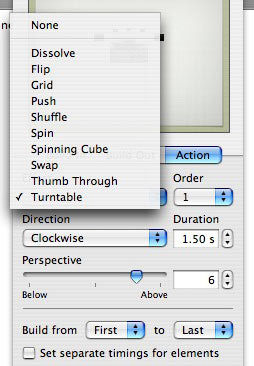
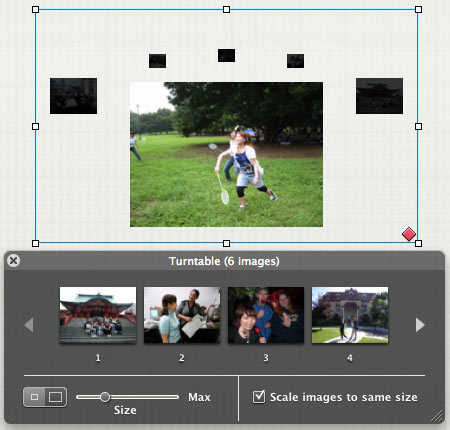
Keynote082-Bld2Apple used this new feature to create more complex bundles of actions, called “Smart Builds.” There are ten such, and they essentially are different ways to view more than one image based upon complex animation techniques.

Included in the “Smart Builds” are a spinning cube with a different image on each side; a turntable (a la Front Row) where images take a turn rotating to the front; a “thumbing” effect which simulates photos being shuffled from front to back as if by hand; and many more.

Each build has a number of options, and, as is usual with iWork apps, it’s dead-easy to generate the effect.
Keynote082-Bld1

Another new feature that has been added to the whole suite is something called “Instant Alpha.” Essentially, it is the ability to make a certain color disappear, but a bit more advanced. If you have an image where a background is mostly one color or range of colors, and the foreground element is a different color/range, then you can (usually) make the whole background disappear. Just drag a circle around the colors you want to make disappear, and they get blanked out.

Iw08-Instantalpha1

You can perform the same technique several times in one image, and the areas to be blocked out are highlighted dynamically, letting you ease off or push forward as is needed. Two problems, however: first, selections are only made contiguously, so if you have lots of small pockets of color to make disappear, then your task becomes a lot harder (see the bird in the image below, and how I missed some of the white sky behind it in certain places); and second, the effect only works well on a small number of photos, such that you have to almost take specific photos designed to work well with the effect. See three different images with varying levels of success below:

Iw08-Instantalpha2


Next is Pages. There are some much-needed new small touches–for example, added shapes no longer appear automatically inline with the text; that glitch caused a lot of confusion for a lot of people. New objects now appear as floating, allowing you to move them outside the margins, with the option to make them appear inline if you wish.

Iw08-Toolbars1-450

A much more significant addition is the formatting toolbar, putting the most important editing tools where you need them, instead of having to hunt them down in the inspector, or conjure up the Font palette. Shown above are the three variations depending on context–text, tables, and objects (click for full view). That makes it not only a lot easier to format, but it also makes it easier for people switching over from MS Word. One remaining complaint: the lack of WYSIWYG font menus. Yes, the Font palette will give you some WYSIWYG, but only in the “Favorites” and “Recent” views… and I never liked the Font palette anyway.

Other changes are a bit less than stellar, but still useful. There are now separate modes for layout: “word processing” and “page layout.” The first works like a standard word processor–type within the margins. The second is more like using a professional layout program like InDesign, in that it relies on text boxes instead of the standard typing paradigm. These different modes were both possible before, but here they have been better defined and separated, with templates made for each mode.

Pages ’08 also allows for change tracking, showing what was changed in a document and when–more useful for collaborative office situations, though I could see it as potentially useful for writing essays as well. Change tracking is one of those very popular high-level features that most people don’t use, but enough have demanded that Apple has included them–like Mail Merge, which was added in Pages 2. There are also new graphic tools, such as picture frames, the above-described Instant Alpha, and other image-handling tools. Most are slight, cosmetic changes that may or may not be useful to different people.

Aside from that, Pages is pretty much as it always has been. It’s now a bit more easy-to-use, and a bit more flexible. I still have not made the complete switch to Pages from MS Word, however, in large part because of the remaining accessibility issues regarding font formatting–namely, the messed-up interface regarding the Font palette. I tried to get around this with keyboard shortcuts, but Apple has not implemented that feature as well as I would have liked. It works well for commands in the main menus, but any command in a pop-up menu will not allow a keyboard shortcut to work unless the pop-up menu has first been activated. Which kind of defeats the purpose of a shortcut.

But that reason is highly specific to me; Pages should work fine as a primary word processing program for most everybody–and despite my foibles about the Fonts palette, I could certainly be happy using it if I really wanted to shove Microsoft out of my life. As it is, I use Pages half the time, and MS Word half the time.


Both Keynote and Pages are nominal upgrades, not complete reworkings of previous versions. Both apps have been inching forward, adding useful new tools and features with each new version–never so much that they become feature-bloated like MS Office apps, and always keeping focus on maintaining the Apple design paradigm of slick-but-simple (for better or for worse, depending on your point of view).

The real new change, however, is Numbers… and I find myself running both long in column space and short of time. So a review of Numbers will come soon. In short, however: Numbers fills out the suite and lets you leave MS Office behind–again, so long as you’re not a power user dependent on Office feature-bloat.


Categories: Mac News Tags:

Tokyo Bay Fireworks

August 11th, 2007 4 comments

0808-Bay Fireworks1-450

One of the advantages of the view we enjoy from the 21st floor in Ikebukuro is the fireworks displays that can be seen during July and August. Today there were fireworks in Harumi, on Tokyo Bay. We were able to see them, but were hindered by the disadvantage of the 21st floor: it’s not quite high enough to see over some buildings. As you can see in the image above and in some of the ones below, there was some tall building right along the path of the view for today’s display. About 80% of the show was hidden behind the building, which Sachi and I dubbed “Jama Tower” (“Nuisance Tower”). Often we only saw the glow of the display, other times we could make out its edges. But for the bigger fireworks, they cleared the building altogether and we got a very nice view.

0808-Bay Fireworks2-450

0808-Bay Fireworks3-450

0808-Bay Fireworks4-450

Hopefully, the next show will be better: on Thursday, August 16th, there’s one final show, at Jingu Gyoen, which we believe will be just visible beyond the Prince Hotel to the south. It should be closer, and if it’s visible at all, it should be unblocked by any buildings along the way.

Categories: Uncategorized Tags:

Atheism and Agnosticism

August 11th, 2007 5 comments

I have always understood these terms under their common definitions: atheism is a belief that god does not exist, and agnosticism is the view that we do not have enough evidence to state positively whether a god or gods exist or not. In short, that atheists say there is no god, while agnostics say they cannot accept nor reject any theories about god. These meanings are reflected in the common culture and language; for example, when you say that you are “agnostic” about a certain issue, it means that you have no convictions either way.

However, in listening to various atheists over the past year or so, I was surprised to hear agnosticism defined as “someone who believes that everything is inherently unknowable.” I have always seen myself as an agnostic, and yet I do not agree with that view at all; while one could make an argument for such a worldview, I consider it metaphysical navel-gazing, and irrelevant to practical experience, just like asking yourself “is reality real?” I do not see that mattering either way.

It would seem that many, if not most people who call themselves atheists are people whom I would regard as agnostics. The distinction is blurred because both are correct–depending upon what branch of atheism or agnosticism that you subscribe to. Atheism, for example, has two major branches: strong (positive) atheism, in which there is a positive belief that god does not exist, and weak (negative) atheism, in which uncertainty about theistic truths are emphasized. Agnosticism also has two varieties: the type which closely matches weak atheism, in which uncertainty is key–call this “strong agnosticism”–and the other type, mentioned above, where the validity of knowledge itself is questioned–call that “weak agnosticism.”

I myself reject the navel-gazing version, or weak agnosticism, as the definitive or representative form of agnosticism, because of its practical irrelevancy and (I believe) because it is far less common. At least, it may be recognized as a philosophical truism, but at the same time disregarded as pragmatically meaningless; a person may acknowledge “weak agnosticism” and yet still ascribe to “strong agnosticism” or even “strong atheism.” Because of this, I see what I refer to as “weak agnosticism” as being somewhat irrelevant, a thought-experiment off-shoot that applies less to personal beliefs and more to exercises in academic epistemology.

The problem is, many people seem married to the term they have chosen. Penn Jillette, for example, insists on atheism as including any non-religious people, including strong agnostics; he discarded the word “agnostic” as simply referring to the navel-gazers. I, on the other hand, have always associated the word “atheist” with someone who believes firmly in the non-existence of god, and see my own uncertainty best defined by the word “agnostic.”

I prefer my definition for a reason beyond simply being used to it: my demarkation gives clearly separate terms to describe the most commonly-expressed ideas outside of faith in a specific religious belief. When talking about religious beliefs, we usually refer to those who believe in god, those who believe god does not exist, and those who are not certain. It seems logical to me to reserve one commonly-used term for each of these states. Defining atheism to include the latter two and agnosticism to the navel-gazing seems to me to lend to confusion. If the term “atheist” covered both god-deniers and the uncertain, then one would have to spend a good deal more time explaining what your exact views are.

Nevertheless, I have gathered the impression that religious people tend to blur the terms not because of the finer niceties involved, but rather because they consider any non-belief to be of one general category; to them, there are those who believe, and those who do not–those who believe and have faith, and those who do not. It makes little difference as to why people do not believe.

Once I heard an evangelist (I forget which one) use a definition now common amongst religious people: “an agnostic is an atheist without the faith in his convictions.” This expression uses the definitions of the terms which I prefer. However, not only do I find this sentiment to be inaccurate, I find it insulting: it suggests that I do not believe what I believe, and the reason is because I am weak or lacking somehow.

I cannot understand those who positively believe that there is no god any more than I can understand the religious; in both cases, it seems to me that the belief is based upon “faith.” The (strong/positive) atheist is just as strong in “faith” as the religious person; neither has proof, only belief, but each believes their faith to be equivalent to unquestionable truth. To me, they are indistinguishable. In fact, I have heard strong-atheists express almost exactly that sentiment: they note that most religious people disbelieve in all religions except their own, and as such, are atheists in all but that they still cling to only one of the myriad religions out there. Strong-atheists differ only in that the disbelieve in just one more religion than religious people do. This makes a great deal of sense to me.

The only worldview that makes sense to me is to believe that god is a possibility, but not a certainty. To acknowledge the fallibility of humans and human beliefs is, to me, the most obvious of all conclusions. We have been wrong countless times before, and continue to be wrong about so many things. To think that we could be absolutely and unquestionably correct about the greatest mystery and most fundamental truths about the universe–given that all our knowledge derives from ancient mythology and purely non-empirical evidence–seems both arrogant and comically nonsensical. It strikes me that we should accept what we “know” as simply being the most current theory, and be ready to believe in whatever new facts come to our attention–rather than simply clinging to old, disproved facts, simply because we don’t want to believe that we can be wrong about something so important.

To me, anyone unwilling to accept new information simply because it differs with what was handed down to them is nonsensical and irrational. But that encroaches upon the next topic I would like to discuss: “faith.”

Categories: Religion Tags:

Anniversary

August 10th, 2007 Comments off

Last Sunday was the first anniversary of Sachi and I meeting. We took the morning off, and then celebrated in the evening.

I had been preparing for this for a while. Every three months since we met, I would get Sachi another three small stuffed dogs, from a line put out by a company that had a large variety of breeds, nicely crafted. So before this anniversary, she had nine little dogs. For this anniversary–a yearly thing instead of quarterly–I decided to go whole hog. I found stuffed dogs at several different places, finally having to go down to the Ginza to find one that I wanted to top things off.

Here’s how I arranged it: when Sachi and I left for dinner, I made an excuse to run back in to the apartment (I intentionally left a fan running so I could go back and turn it off). That gave me the chance to leave the first present out on the dining room table: a small basket with two tiny stuffed dogs in it. Each of these came with a card with a note inside. When we came back from dinner, Sachi found the first dogs, and the note told her that the dogs “bigger brothers and sisters” were hiding under the bed because they were afraid of the fireworks.

0808-Puppy1-450

This worked out really well, in fact: we unexpectedly got treated to two fireworks shows at dinner. We ate at a restaurant on the 58th floor of the Sunshine 60 Building, the view out the window looking down on our own building. It’s a nice place, with multi-course dinners; reasonably priced, but food and service equivalent to a more expensive restaurant. We arrived at 6:30 and left at 8:30, which happens to be the time frame for fireworks in Japan during the summer. One show started to the northeast, relatively distant–but it was pretty big, and was nice to watch. But then another show started up a lot closer, and that was even nicer. Almost all the way through dinner we watched the shows. So when we came back, that first note “from” the two tiny puppies made sense in a way I had not intended.

In any case, the note with the first two puppies led Sachi to the drawer under the bed, where I had placed six stuffed dogs, of the same kind I had given her before (she now has 15 in total).

0808-Puppy2-450

Their note gave clues as to where the next dog was “hiding,” a floppily-stuffed yellow lab about a foot long. His note led to the back of the top shelf where we keep the towels, where I’d stashed his “bigger brother,” a two-foot-long version of the same dog.

0808-Puppy4-450

The note on that one led to their “even bigger brother,” who was “hanging out in the closet.” I had that rather large 3-foot stuffed dog–the biggest version of the same dog–suspended from the coat rack in a closet Sachi uses for winter-wear storage. That dog directed her to ask me for the final dog.

0808-Puppy5-450

Sachi loves Shiba Inu dogs. They’re kind of like small versions of huskies, the most common type being light brown with white underneath and some spots of white on the face. But finding stuffed Shibas is very hard. In Japan, Shibas are popular, but for some reason they don’t make stuffed Shibas much–and when they do, they do them rather poorly. But at the Ginza store, I found a very nice stuffed Shiba puppy doll, which was perfect as the final gift.

0808-Puppy6-450

The notes on each had more than just directions to the next dog, but that will remain private. Needless to say, Sachi enjoyed them thoroughly–but later, she mentioned that I had better stop getting her dogs, as we were quickly running out of places to put them.

The exercise also proved difficult in terms of setting it all up. The anniversary was Sunday evening, but after Friday afternoon I knew that Sachi and I would be together all the time–so I had to set them all up before then. The problem: we have a small apartment–not too many good hiding places–and they all had to be in places where Sachi would not find them by accident. I could not even steer her away from the hiding places all the time, because Saturday afternoon I was out for six hours at the graduation ceremony for my school, while Sachi relaxed at home. And even though I did find good places, it was almost undone when Sachi text-messaged me at the ceremony, asking where I had stored the ironing machine. I knew exactly where it was: right next to the medium-sized dog on the back of the top towel shelf. I had to tell her that she couldn’t iron anything that afternoon.

Not that she was surprised; she figured that there would be stuffed dogs involved, and I’ve done the treasure-hunt game before. She just didn’t know the extent I had gone to. As we went shopping before dinner, she speculated on how many dogs, what sizes, and so forth while I kept mum. She only guessed as high as three dogs, though–not twelve. I kept the secret pretty well.

Sachi, on the other hand, is not nearly as good at keeping secrets. Two of the three times she has gotten me gifts, she has accidentally blurted out what she got me. This time it was at Eddie Bauer, just before dinner, when we were looking at clothes I could buy. I mentioned that I should get some new short pants. Now, Sachi could have said something like, “the shirts you’re getting today are enough for now,” or “I know a better shop to go to for that,” or something else which would not have roused my suspicions. Instead, she blurted, “I got you a pair already!”–and then was instantly annoyed that I had “made her” tell me what (part of) her present was. She couldn’t be mad, of course, but for a while we had fun while I teased her about not being able to keep a secret well, while she just as kiddingly blamed me for tearing the secret out of her. (She told me lightheartedly that I was “ijiwaru,” or being mean.)

It was a fun evening.

Categories: Main Tags:

Okay, That’s It

August 9th, 2007 12 comments

That’s it indeed. First free moment I get, I am putting in a block script in my image directory to keep Google’s image bot out. I’ve had it up to here.

When you have a blog with images, you stand the risk of being swamped by hotlinkers. Sometimes I take some nice shots, and I want to share them. But what happens is that some rather impolite person will find that image via Google, and without permission, without a link back to my site, without even visiting my site at all, they simply grab the address of the image and hotlink.

I have described before what hotlinking is. In short, instead of using an image that they store on their own site, they “link” to the image residing on my site; despite being an image on my site, it appears seamlessly to be a part of theirs. The problem: I get charged for the bandwidth it eats up.

Normally, it’s not a huge issue; usually, it’s a small image and is only accessed a few dozen times. That’s a pinprick; I would hardly notice it. A lot of times, people hotlink the images for use on forums or MySpace accounts; those are the worst offenders. But once in a while, someone with a high-bandwidth site decides to take a large image from yours and hotlink to it. That’s what happened here.

Someone in Ohio who runs a web site that talks a lot about “how to increase your site traffic” and boasts of their AdSense revenue took a 1280-pixel-wide image from my site, a photo of lightning I took a while back. They then used that image–badly, at that–as the background for the title header on their blog, so that it appeared on every single last page of their own blog.

In just the past 9 days, the image was hotlinked at least 17,792 times… meaning that in just over a week, this one person ate up almost four gigabytes of my bandwidth, or about 20% of the total bandwidth of my site for that period of time.

I would not have been quite as ticked off had this person innocently hotlinked without understanding… but the content of their site, one comment in particular, told me that they knew exactly what hotlinking was. Worse, this person quotes scripture on their main page.

So I substituted the image with a smaller version that contained a text message detailing my annoyance (no obscenities), and left an acerbic comment… but really, this is the last straw.

As I mentioned above, the first chance I get, I am cleaning house. I will leave a robots.txt file to steer Google Images (and whatever other image bots I can identify) away from my images directory. I am then going to clear out every file more than 100 KB–even smaller ones, if there are not too many. I might replace them with smaller/more compressed images, but that could mean too much work. In the future, I will post larger images, but I will yank them within a few weeks or months.

This is disappointing to me. I like sharing the photos I take, I want people to enjoy them. But when even a few bad apples take advantage of that and run hog-wild over my site resources…

It is just too much frakking trouble.

Categories: BlogTech Tags:

Comments Temporarily Down: Frakking Spammers

August 9th, 2007 Comments off

I woke up to receive this message in my mailbox:

Your account blogd.com has been suspended or a file disabled in it for the following reason:

CGI/PHP Overload
————–
Your account is causing high load on the server due to an abusive cgi script: …

That, my friends, is what spammers can do to you. Partly my fault, I guess; it has been years since I upgraded my blog software, and just as long since I have taken any evasive maneuvers in regards to my comments script. Fortunately, the web host only shut down the comment script file and has not suspended my account or shut down my scripting abilities altogether. So among other things on my “to do” list today, I’ll have to reshuffle my blog software to get comments working again, and then get to work this month on upgrading the blog software–either to the newest Movable Type, or (my long-term intention) switching to WordPress.

Pardon any inconveniences while this is taking place. Comments should be up again in a few hours.

Update: Comments are back up. More on other changes as I get around to them…

Categories: BlogTech Tags:

Rearranging Deck Chairs

August 8th, 2007 Comments off

This just out:

In a new effort to crack down on illegal immigrants, federal authorities are expected to announce tough rules this week that would require employers to fire workers who use false Social Security numbers.

In a related story, in a new effort to crack down on illegal drug use, federal authorities are introducing tough new laws that require drug dealers to stop selling drugs to anyone who does not pay sales tax on a specific purchase.

I mean, seriously, the employers are the ones who entice the immigrants to come here in the first place; it’s not as if no one is offering jobs specifically to immigrants, who are coming over and passing themselves off as citizens. Forcing an employer to fire an illegal using a forged SS# truly is like having a dealer stop selling to a user: one is enticing the other to commit an illegal act, and forcing them to stop will simply cause both to seek the same activity elsewhere.

I’ve said it before, and I’ll say it again: illegal immigration will stop when, and only when, we crack down on the employers, the people who are creating the problem in the first place. But Bush has made it clear that he is absolutely unwilling to do this. Ergo the Bush administration will do nothing but harm–costly harm, in more than one way–with their various plans and schemes.

Unfortunately, as with the “War on Drugs,” the “War on Illegal Immigration” has a blindingly obvious solution, but one so politically unworkable that it will never be implemented, so instead we get treated to repeated garbage like we see today.

Categories: Political Ranting Tags:

Cool!

August 8th, 2007 2 comments

And I mean “Cool!” in two respects: first, that something great has happened; and second, in regards to the temperature of the apartment. The air conditioner repair guy came back this morning and fixed not just the machine he was supposed to, but also the one the moving company installed.

As mentioned before, the main machine leaked its freon and nitrogen gas reserves–as it turns out, a fitting had been left loose, and the gases had all escaped long before we moved in. He sealed the fitting and charged up the gases, and for the first time, the air conditioner actually works. And now that it does, I can note that it works really well. Sachi and I thought that the building makers had simply skimped and bought a really bad air conditioner. Had we thought to complain earlier, we could have avoided a lot of hot days in the living/dining/kitchen area.

While he was running some sort of vacuum test on the main unit, he took a look at Sachi’s air conditioner, the one that had been installed tilted to the right. He was not in any way responsible for that one, but just as a courtesy, he spent about twenty minutes working on it. It turns out that not only was the wall unit installed at an angle, but the tubing was done extremely poorly–the tubes inside the wrapped bundle leading outside were arranged such that the drainage tube had a notable upward slant, even though the whole bundle was level. Water was pooling inside the unit, and as a result, led to the entire inside of the machine being “sweaty.” Eventually it all dripped out onto the floor. So he unwrapped the bundle, reset the tubes.. and after five or six hours of running at full power, not a single drop has come out. Seems like that unit is fixed as well.

One of these days, the apartment will be perfect. We’ve still got the bath/laundry stink to deal with (likely due to evaporation in the pipes caused by the 24-hour bath-drying utility, which we can’t shut off), and those little flying insects are still massively infesting the apartment–likely breeding in the soil in Sachi’s potted plants. We have to re-pot the plants and then make sure that the bugs left flying around don’t get a chance to re-lay their eggs.

Categories: Ikebukuro Tags:

New DVD Player

August 7th, 2007 6 comments

I had two DVD players, until recently. One was a Region-1 unit I bought in the U.S. maybe six or seven years back, and the other was a region-free unit I bought at Costco four years ago. Both units had been acting flaky, but after the move, neither one would recognize anything I put into them. So, time to get another player. After advising a friend to look for region-free players in Akihabara, and they reported success, I decided to try it myself.

I was also looking for a feature I’d heard about but not seen: a DivX-playing DVD player. DivX is a “codec,” or a method of compressing audio/video data to save space. What it means is that you can download audio and video files from the Internet, and the DVD player will recognize them and play them, just like your computer does.

I found the kind of machine I was looking for, and settled on the Pioneer DV-400VS.

0807-Divx Dvdplayer-500

Even better, the player I got has a USB port, so it will recognize files on USB Flash drives, or potentially on USB external hard disk drives. Since I got a 1 GB flash stick just last week, I can now use it to show up to 2.5 hours of video on the player, if I transfer it from my computer–without burning a DVD disk. Cool.

0807-Divx Dvdplayer2-450

The player can handle DVDs made for any country (they were pretty outspoken about it at the electronics store, after Costco made a deal about how “it’s not legal”), and can handle just about any type of CD (Audio CD, CD-R/RW, VCD) or DVD (DVD±R/RW, Video DVD, Audio DVD)–audio, video, or data–so long as it’s got some sort of visual or audio media on it. JPEG photos will play as slideshows, audio CDs or mp3/wma/aac files play as music, and lots of data-stored video files (mpg/avi/wmv) will play just fine (but not all, of course).

Better yet, it has an HDMI port and progressive/1080p compatibility (upscaling), so it will work fine with the HDTV I plan on getting in not too long a time.

In short, it’ll handle pretty much everything I’ll need to throw at it… until it too breaks down in four or five years. Inevitably.

Categories: Gadgets & Toys Tags:

Bad Luck with Air Conditioners

August 7th, 2007 Comments off

Sachi and I finally told the building’s office people that our main room’s air conditioner not working. Can’t say they don’t respond fast–before the day was out, they had a couple of guys come in and check out the unit.

While one of the guys was outside checking the troubled unit, I asked the other guy to come and take a look at our bedroom’s A/C unit, which has been steadily dripping water. That’s Sachi’s old unit, which the moving company (remember those great guys?) installed in the new place. As he walked in the room, he immediately saw the problem–the unit was tilted, ever so slightly, to the right, and away from the drainage tube, which is also tilted to as to bring the draining water, or some of it, back into the room. One of the guys tried to tilt it back the other way, but the thing keeps dripping; we’ll probably have to call the original installers back in to do the job properly.

Meanwhile, the two repair guys are looking at the main unit, the one in the living room, which comes with the apartment. That hasn’t worked since day one, and once spilled huge amounts of water out when we had our housewarming party. As it turns out, they guys found that there was no gas in the conditioning units. No freon, no N2.

Now wonder it didn’t work. The guys said they were puzzled as to how the gas could have escaped. They claimed that all units are tested to see if they have the 1 kg or so of gases installed… but if a leak is so rare, then there was probably just an oversight to put the gases into the units, at least just in our place. One of 400 or so apartments in the building, you gotta figure at least a few will have problems like this.

I figure another month or two, and the shakedown might be over, and we might have a fully-functioning apartment.

Categories: Ikebukuro Tags:

How Much More Disgusting Can This Get?

August 7th, 2007 1 comment

Do I really need to point out how full of crap Republicans are about national security? They went into Ultra-Shrill mode for the past couple of days, pressuring spineless Democrats into handing Bush broad new warrantless wiretapping powers that allow him to even further violate the 4th amendment to the constitution; the law is so vaguely worded that virtually any communication could be eavesdropped on, so long as the administration can say that it is “directed at a person reasonably believed to be located outside the United States” [italics mine]. In other words, they can eavesdrop on any call, and then claim they had “reason” to believe it involved some foreign person. It no longer has to even be someone suspected of terrorism or any other crime.

Four or five months after a FISA judge made this change “necessary,” Bush and the Republicans in Congress ambushed the Democrats with a tried-and-true formula: drop it in at the last minute, block every attempt to attenuate the most radical and dangerous aspects of the bill, and then scream at the top of their lungs that Democrats were al Qaeda agents for even thinking of not giving the president the “necessary” powers, while not giving even the slightest hard evidence that such powers are in the least bit necessary. Of course, it worked, and Democrats are reduced to flaccidly saying that they will get right onto watering down that bill, after they get back from a month’s vacation. Yeah, right.

So, how serious is Bush, how serious are the Republicans, about keeping America and Americans secure? So much so, that they let 190,000 weapons bought with U.S. taxpayer money “accidentally” fall into the hands of insurgents and possibly terrorists in Iraq.

So rest assured: Bush and the GOP are hard at work making sure that you are safe. Really. They’re listening right now. Doesn’t that make you feel all secure and everything?

Categories: Political Ranting Tags: