Archive

Archive for March, 2008

Notes from the Campaign Trail

March 11th, 2008 1 comment

Big news: Democrats won a special election in Illinois’ 14th District, gaining a seat in the House. Why is that big news? Because the seat was Dennis Hastert’s, the former Republican Speaker of the House, a district that should have been an “easy seat” for the Republicans. Democratic candidate Bill Foster won 52% to 48%.

The fact is, Democrats could win big in 2008. We made huge gains in 2006; expecting only to win the House, we won it by a safe margin and won control of the Senate as well. This time, however, the wins could be even bigger–and not just because so many House Republicans are retiring this year and Democrats are winning special elections which are seen as bellwethers.

The numbers tell the story: in the Senate, there are 35 seats up for grabs–and 23 are Republican seats, with only 12 Democrats having to fight for their incumbency. Even better: a lot of those Republican seats are seriously threatened. Republican John Warner’s Virginia seat could be taken by Democrat and former governor Mark Warner. Al Franken has a good chance to take back the seat that Norm Coleman ungraciously grabbed from deceased Senator Paul Wellstone, capitalizing on smears that Democrats “hijacked” Wellstone’s memorial. John Sununu might lose his New Hampshire seat to Governor Jeanne Shaheen. Boulder Congressman Mark Udall might win the now-open seat vacated by a Republican in blue-shifting Colorado, where the Democratic convention will be held (expect him to make an appearance or two there). Oregon, Maine, and Nebraska could see a switch from right to left as well. And even powerful Alaskan Senator Ted Stevens, in a decidedly red state, could lose his seat to popular Anchorage Mayor Mark Begich, in part due to Steven’s recent scandals.

We thought it was highly unlikely that Democrats could take the Senate in 2006. It seems just as unlikely that Democrats could win a filibuster-proof majority this year. Let’s hope those odds hold true.
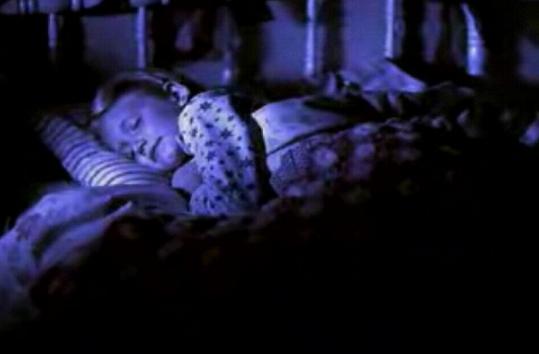

3AmadRemember Hillary’s “3:00 am” girl? The cute little child sleeping in her bed while nasty threats lurked somewhere out there, and could only be dealt with by Hillary? Well, irony has its day: the video was 8-year-old stock footage; the actress will be old enough to vote this year, and is a “big” Obama fan:
Knowles, a senior at Bonney Lake High School who turns 18 next month, has been campaigning for Obama. She attended his rally at Seattle’s KeyArena on Feb. 8. Her mother, Pam, told The News Tribune of Tacoma that Casey cried and trembled after shaking the candidate’s hand.3Amgirl
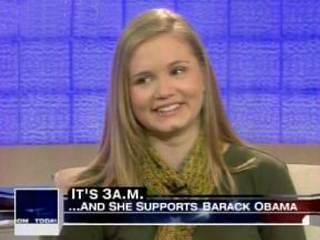
The next day, she was a Democratic precinct captain for the state’s caucuses. If she plays her cards right, she could go to the national convention.

She thinks the Obama campaign should use her in a counter-ad. Think of the possibilities!

In other good news for Obama on the Hillary front: the New York scandal with governor Eliot Spitzer could help shoot down Hillary’s attacks against Obama by putting her on the defensive, in perception if not in action. The troubled governor is a Clinton superdelegate from her home state.

Recent late-night talk-show quips:

Jay Leno joked last night that Spitzer’s scandal “means Hillary Clinton is now only the second angriest woman in the state of New York.” David Letterman offered a Top 10 List of excuses Spitzer might cite, including the number one excuse: “I thought Bill Clinton legalized this years ago.”


Marshall brings up the perfect example of “Liberal Media” bias: a CNN piece slamming Obama. The piece references a fellow legislator felt that Obama was not a “bold” legislator. The problem? The “fellow legislator” was a Republican; this CNN mentioned. Worse: He works for John McCain in Illinois; this CNN did not mention. Whether they mention it or not, or even disregarding that the guy works for McCain, the question arises as to why CNN thinks it’s newsworthy that a Republican criticizes the Democratic front-runner for president. I am absolutely certain that they could find any number of Democrats who worked in Congress with John McCain who would be willing to testify that McCain is not as squeaky-clean on campaign finance as people think he is, and they wouldn’t even have to limit themselves to someone who works for Obama to find such a person–and yet I see no equivalent stories of that nature out there.

Why not?


I find myself in the bizarre position of agreeing with Bill Kristol:
Perhaps the most obvious way McCain could upend the normal dynamics of this year’s election would be a bold vice presidential choice. … He could persuade the most impressive conservative in American public life, Clarence Thomas, to join the ticket.

Wow! That would be great! Of course, it would never happen, but it would be fantastic! Thomas has a long string of bad decisions that would be easily made sport of on the campaign trail; his age and demeanor would complement McCain’s in the worst way; but best of all, Thomas would have to resign from the Supreme Court before it convened in October, and Democrats would probably be able to stall the nomination of another justice until after a Democrat takes office, relieving the court of one of its most ardently destructive right-wingers. All of which, of course, are reasons why it’ll never happen.

Categories: Election 2008 Tags:

Slightly Presumptuous

March 10th, 2008 6 comments

Let it not be said that Hillary Clinton doesn’t make as much hay as possible out of every bump she gets. After winning in Ohio and kind-of winning in Texas, her campaign is painting itself as the eventual winner–to the point of pushing for the possibility of a Clinton/Obama ticket. Rather presumptuous, considering that her “victory” netted her very few delegates, and at this point she still trails Obama by 100 delegates, even counting the Supers. And after Obama’s landslide win in Wyoming, it’s just a wee bit too soon to be counting him out quite yet.

After Mississippi (which Obama is probably going to win by several touchdowns), the delegate count will be back to the same levels they were before Ohio, more or less erasing whatever advantage Hillary got last week save for the perception of her campaign not dying quite yet.

Pennsylvania will probably give Hillary a boost, but again, not enough to make a critical difference. She’d have to win by 10% in order to get a net gain of 25 delegates, and Obama would still be ahead by about 110 pledged delegates. Next up are North Carolina and Indiana. Obama should win the former and Clinton the latter–but North Carolina has a lot more delegates and Obama is known for winning by bigger margins. (There is a chance that Obama will do at least fairly well in Indiana, neutralizing any big win by Hillary.) Obama will probably make up some or even a lot of what he will have lost in Pennsylvania on this day. After that we get West Virginia and Oregon. Hillary is set to take West Virginia, but Obama is very strong in Oregon–and again, Obama’s state has more delegates. Obama is likely to make up even more of the Pennsylvania delegate damage, maybe even erasing it by this time.

After that, Clinton may clean up the remainders–Kentucky, Puerto Rico, Montana, and South Dakota, though Obama could very possibly win one or more of those, nothing is sure. But assume that Clinton does win; she probably won’t do it by huge margins, and those four states are worth a total of 137 delegates–which is probably about how many delegates Obama will be in the lead by then. Hillary would have to win 100% to 0% to get ahead in pledged delegates, and of course nothing like that will happen. If she’s lucky, she might pick up dozen or two delegates, but no more, and probably less.

Even if there are re-do primaries/caucuses in Florida and Michigan, Hillary will gain quite a bit (maybe explaining why Obama is lukewarm to the idea of do-overs), but she still won’t be able to jump ahead. She and Obama are tied in Michigan, so she’ll have to settle for what Florida will give her. Florida has 210 delegates, and right now Clinton enjoys a 55%-39% lead. Say she wins by 59% to 41%; it will get her a net gain of almost 40 delegates, sure enough a big win–but still not nearly enough to overcome Obama’s lead. (Also consider the mitigating factor that Obama would probably go balls-to-the-wall in Florida, and for good reason; he could cut into that Clinton lead significantly, as he has done before elsewhere.) Worst case, Obama will still be ahead by maybe 80 or 90 pledged delegates, and assuming the Supers that commit between now and then don’t tilt more to one candidate or the other, he’ll still have a lead overall. Hillary would have even worse luck if the do-overs are caucuses and not primaries.

It will, inevitably, come down to the superdelegates. If Florida’s votes are counted, Hillary could be ahead in the popular vote. So it would be another split: will superdelegates give their votes to the winning of the popular vote or the winner of the delegate count?

Again, it would have to come down to getting the numerical advantage. I would have to say that this could be close and will almost certainly come down to the convention–but even under rosy circumstances for Clinton, she’s the less likely to win this in the end. Virtually everything would have to go her way in order to win this, and then she’d have to sway Obama, after all that, to take the pitcher-of-warm-spit side of the ticket. Conceivable, but not likely.

But she can make it a hell of a lot harder for Obama to win in November–and considering the scorched-earth tactics she’s already demonstrating, it’s likely that she will do just that.

Categories: Election 2008 Tags:

Out and About This Weekend

March 9th, 2008 5 comments

Sachi and I have been around in the past few days. Yesterday was Sachi’s birthday, so we celebrated. I stopped by Mitsukoshi to pick up a few snacks; usually called “baby castella,” a kind of specially shaped pound-cake mini-snack, except these are filled with maple or caramel-flake flavors, very nice. Plus a bouquet of flowers from a nice florist, not the usual market florist. Then we went to a local “spa.”

It’s not that it isn’t a real “spa,” but more that it is a combination of spa and local bathhouse. These are relatively common, in that you might find one around even medium-sized train station shopping areas. We’re talking about a place that occupies at least three floors of a local building; one floor is set aside for the lobby and men’s baths; another floor exclusively for a more expansive women’s bath; and a third floor for a general-service area, with massage rooms and lounges.

0308-Spa-Jacuzziroom

This one is called the “Resta Spa,” though Sachi and I visited a similar spa in Fuchu that was nearly identical. You pay a nominal “introduction” fee (around $20), and another nominal fee for being in the spa for up to 5 hours.

0308-Spa-Massageroom

Then you can opt for various services, like massages or aromatherapy. Sachi chose for a varied package of services lasting more than an hour, and I just got a 20-minute back massage (you have to be specific about what kind of massage, and it can be great).

0308-Spa-Rlxroom

There is a relaxation room with powered first-class chairs with TV units built in, but I could leave that behind easily–unless you enjoy listening to old guys snore heavily, I am more relaxed in bed at home.

We went home, and I gave Sachi the earrings I got for her main present, then we went off to a very nice restaurant downtown–the Oregon Bar & Grill in Shiodome (unfortunate motto: “Do Me”) City Center in Shinbashi.

0308-Oregon-Bag

A bit expensive, but very good food–one of those multi-course dinners. The view was from the 42nd floor over all of Tokyo, though had I made the reservations well in advance we might have gotten the choice seats looking over Tokyo tower and Roppongi–not that the view over Ginza we had was bad one.

Today, we had a lazy sleep-in day, followed by a visit to Sunshine 60 Cruise-Cruise restaurant, one of the first in a series of visits to places to find a good location for our wedding party this September (though the official stuff gets done next week). A lot of restaurants have special setups for wedding parties, and we’re looking into what the best ones are for our needs and budget. We had a talk with the coordinator there, about costs for various rooms with meals and packages (rental outfits, ceremonies, cakes, dinners, photos, etc.) We’ll visit a few more in the coming weeks to see which one can give us the best deal.

After that, we went to a new favorite Izakaya–a popular Japanese dining format, a restaurant that serves lots of smaller dishes to large numbers of customers in big and/or partitioned common rooms. We’ve tried a few in this area, and found bad ones and good ones. A bad one was a place called “Tapa Sunshine Street”; we went there for a nice meal once, and instead got shafted. Went in the door, got seated in a corner among noisy, smoking groups, and were given our introductory snack. You think that it’s a complimentary snack, but it’s really a cover charge. We ordered beers and those were served promptly–they want you to drink as much as possible as the beer is where they make most of their money. But when we waited more than 40 minutes and none of the ordered food arrived, we got fed up and left–to have to pay about twenty bucks for a glass of beer and a bad snack each. Horrible service.

But we found a much nicer place: Nijyu Maru–though it might be ironically run by the same corporation that owns that “Tapa” dump, it’s a much better-run izakaya. You get seated at your table and use an LCD touchscreen tablet to order food. When Sachi and I ordered, the food came almost too quickly; expecting a wait, we ordered everything we could eat at once the first time we were there, and suddenly found ourselves swimming in an abundance of dishes. Tonight, we ordered more leisurely, and got everything in good time. The touchscreen tablets are easy to use (and becoming the rage in Japan, it seems–more and more places we visit use them), and the food they serve is delicious (especially the Negima yakitori, salted). What I like is the fact that the cigarette smoke is less offensive than most places. Most izakayas are smoking dungeons; after leaving this place, we could still smell the cigarette stink on us, but not nearly as badly as most izakayas, and we didn’t notice it much at all while there. Somehow, the seating and/or the ventilation keep it from becoming too offensive. The prices are reasonable, too–$30 per person for two beers and a more-than-satisfying set of dishes we ordered.

So, a nice birthday weekend for Sachi, and, for that matter, for both of us.

Categories: Focus on Japan 2008 Tags:

Getting Glasses

March 9th, 2008 2 comments

0208-Glasses

I have always gotten my glasses made in the U.S. One of the reasons is that I was scared off of buying glasses in Japan because they were too expensive. I remember, many years ago, checking out prices for glasses in Japan and getting really high numbers quoted back to me. Maybe I was asking in the wrong places, but it was impression that this was a normal thing. So I have always gotten them when I go to the U.S. for visits.

This time around, however, I lost the prescription I had had made for me before I went to the U.S., and so I was not able to get glasses made when I went back. In the S.F. Bay Area at least, the glasses shops refuse to make a new pair for you without a prescription that is less than a few years old; you cannot simply bring in your existing pair and have them make a new pair based on that.

In Japan, however, there is no such restriction. Sachi and I were at Tokyu Hands and we passed by the “Coolens” outlet. We looked around and found a nice frame (at lower left in the image above; I still like my old pair better, but couldn’t find a similar frame here or in the U.S.), and then asked about getting the lenses made. To my surprise, the arrangement was pretty cheap; their cheapest set, including lenses and everything, is about $50 US. The price on each frame was the price including lenses (with UV and scratch-resistant coatings); you pay more for extras, like getting thinner lenses. But the main thing for me was that they would gladly measure the lenses right there and make a new pair for you, no prescription required. So we ordered the new pair–$92 for the basic pair, with an additional $76 for making them a lot thinner than basic. Not the cheapest in the world, but comparable to the prices I checked out in the U.S., and a lot cheaper than they used to be in Japan.

Can anyone out there confirm my impression that glasses used to be a lot more expensive here, and fill me in on when they got cheaper?

Categories: Focus on Japan 2008 Tags:

Down into the Sewer, Just Like the Republicans

March 8th, 2008 2 comments

Hillary’s campaign is beginning to become way too Republican-esque for my comfort. First we had the negative campaigning when Obama fought a relatively clean and positive race; when that backfired, Hillary started lying about Obama’s record, often right to his face, claiming she had iron-clad evidence when she clearly did not. Then there was the double-dealing “I respect Obama and am honored to be with him” on TV followed by “Shame on you Barack Obama!” on the campaign trail. Then came the ultra-negative attacks leading up to Texas and Ohio, which finally successfully dragged Obama down into the mud that Hillary had been wallowing in for a while. Then there was the opportunistic grab at what was clearly a conservative dirty-tricks tactic with the Canadian NAFTA scam. And then there were the campaign claims (that she and McCain had “crossed that threshold” for being CinC, but Obama had not) that actually benefit McCain and can help him win, especially against Obama–kind of a scorched-earth tactic.

But a recurring theme in the Clinton campaign is to delve into hypocrisy, especially when attacking the Obama campaign for things her campaign has done, often times to a greater degree. She attacked Obama for criticizing her on health care, which she did against Obama far more often. She attacked him on exaggerated claims on mailers, which she often did. She blasted him for plagiarism, but was guilty of far worse passage-lifting than Obama–and then made the straight-faced claim that it was OK for her to do it. She criticized him for the Harry-and-Louise image, but now has published a far, far more questionable image of Obama which desaturates, darkens, and broadens his face, along the lines of the anti-Harold-Ford ads Republicans stewed up. She attacked him on the Canadian NAFTA thing to great effect, when all along the Canadians said Hillary was there first, doing the same thing.

And now, Hillary is bashing Obama, this time for an aide calling Hillary a “monster.” Forget that it was off the record, forget that it was an offhand comment by an aide. Forget that the aide apologized and was fired. Hillary is making huge hay of this, dragging it to the bank again and again. The hypocrisy? Clinton aides make those kinds of comments about Obama all the time. And nothing ever comes of it.

I am OK with the idea of Hillary being a “fighter,” but not a complete and utter disgrace–in other words, a Republican-style fighter. I’ll still vote for her over McCain of she wins the nomination, but it will be with more than a little disdain and disgust. Clinton took what was a grand and glorious Democratic run, and has dragged it into the sewer. In a clean race, Obama wins. I don’t know if I want to pay this high a price for a Democratic win. I’ll pay it, if I am forced to–but I will not like it.

Categories: Election 2008 Tags:

Haldane Knew What He Was Talking About

March 7th, 2008 7 comments

Tonight I feel like indulging in a little Quantum physics 101. There’s something in quantum physics which is always fascinating: the double-slit experiment.

Take a light source, like a light bulb. Across the room is photosensitive paper which will get dark if exposed to light. Between them is an opaque wall. In the wall there is a tall, thin slit that can be opened and closed.

You open the slit. As expected, it will expose a section of the photosensitive paper behind it and you’ll get a tall, thin exposure there.

Now, imagine there’s a second slit. Do the experiment again, but this time open both slits at the same time. You might expect that you will expose two slits on the photosensitive paper, one for each opening in the wall. But in reality, you get a series of exposures on the photosensitive paper, as if there were many slits.

This is because when energy travels, it does so as a wave, like waves in a pond. If you drop two stones into a pond, waves go forth, and when the two sets of waves meet, they form an interference pattern. Same thing with the light through the two slits; the light pouring through each slit comes through in a wave form, like the waves from the stones in the pond; the waves interfere with each other, and so form the extra exposures.

Okay, so far we’ve only determined that energy travels as a wave. You’ve heard about “radio waves” your whole life, so this is not too impressive. But when further experiments are done, weird things begin to happen.

The idea of the interference pattern is that large numbers of energy packets are flowing through both slits, so obviously (or so one would think) the interference pattern comes from different light waves coming through each slit. Light wave A travels through one slit, and light wave B travels through the other slit; A and B meet on the other side and interfere with each other.

So someone decided to carry out this experiment with a variation: instead of using a light bulb, a different energy source was used: one that would emit just one packet of energy at a time, a packet of energy that could not be divided. Each packet would have to travel through one slit or the other, with no other packets to interfere along the way. After letting this experiment run its course and enough of packets of energy to pass through both slits, one would expect to see only two exposures, one for each slit, on the photosensitive paper on the far side of the wall with slits.

Except that’s not what happens. Instead, you get the same multiple-exposure interference pattern. And that’s where the weirdness comes in: if only one packet of energy, only one “wave” of light, is issued at one time, what could be interfering with it?

The answer: the energy is interfering with itself.

According to the theory, when you issue a packet of energy and let it go flying across the room, it does not simply follow a single straight path across the room. It takes every path across the room, simultaneously. In the case of the double-slit experiment, the energy packet does not just pass through slit A or slit B, it passes through both slit A and slit B.

But how can one piece of energy go through two slits? Here’s where it gets hairy: every possible path the light could possibly take is taken by a ghost-like probability of the energy packet, each probability nonetheless being “real” enough to interfere with other probabilities. It is as if a near-infinite number of probable versions of that energy packet take off across the room, interfering with each other all along the way. When the packet reaches the photosensitive paper and is forced to make an observable record of its location, the multitudinous probabilities collapse into the one most likely probability, and the impact of the energy packet on the photosensitive paper is recorded.

What’s more weird is what makes the probabilities collapse: observation. Place a detector at each slit that can observe the energy packet going through the slit–before it has a chance to interfere with itself on the other side–and the multiple exposures disappear, leaving only two exposures on the photosensitive paper. Even a detector over just one slit is enough to collapse the probabilities into single, definite paths–somehow the energy packets going through the unobserved slit “know” that observation is going on at the other slit, and behave accordingly.

You’ve probably heard of Schrödinger’s Cat; this thought experiment expresses what is explained above. I prefer to simplify it as a coin-in-a-box. Flip a coin in the air so it will land in an opaque, soundproofed box. When it drops below the upper rim of the box, slap a cover onto the box. You cannot hear where the coin went, how long it bounced around, and being human, you can’t predict which side will come up, heads or tails, just from watching the trajectory and the rate of spin of the coin going into the box. To make absolutely sure, flip the coin in the dark, so you can’t possibly predict how it landed.

The common-sense expectation is that the coin has landed in the box, and is either heads-up or tails-up, and it has a specific location in the box. We assume these things are decided just as if we were watching them, except in this case, we simply haven’t seen the results yet.

But the quantum theory expectation is far different. Once we stop observing the coin, it no longer exists as an object with a specific location. Instead, it exists as a cloud of probable-coins. Half of those are heads-up, and half are tails-up, aside from a small number of probable-coins that rest on their sides along the edges of the box. Probable-coins exist in all possible locations within the box. It’s really just one coin, expressed as a cloud of probable outcomes. And it stays that way until we open the box and observe it–at which time the probable-coins collapse into the most likely probability, which we observe.

That idea really messes with your head. It gives a whole new interpretation to the question, “if a tree falls in the forest and no one is there to hear it, does it make a sound?” According to this theory, if no one is there to hear it, the tree doesn’t even fall. Just probable-versions of the tree fall, and what sound they do or do not make, I won’t venture to guess.

Einstein didn’t like this–probably for many different reasons, but at least because the theory implies that different probable-versions of a particle somehow instantaneously communicate with each other. That is, when the probable-versions collapse, they don’t all shout “Olly Olly Oxen-Free!” to each other. When an observation is made, they simply all collapse, regardless of distance, and that violates classical expectations of how things work.

Einstein tried to disprove this “spooky action at a distance,” but in fact, an experiment performed in Switzerland has shown it to be real, where two “twinned” photons shared information instantaneously at a distance of ten kilometers. We now know that two intertwined particles can share information without paying attention to the speed of light. However, because of the way things work, we cannot use this as a means of faster-than-light communication.

This one effect aside, the whole situation raises bigger questions: is a conscious observer required, and if so, then is consciousness tied in with the fabric of the universe? Is nothing real until it is observed by life forms capable of being observers?

Those into New-Age spiritualism will often might conclude that this is proof of the soul. Scientists will tell you that these are abstractions created by mathematical attempts to explain observable phenomena and do not necessarily translate into real-world conclusions that New-Agers might subscribe to. Science fiction writers use this as a launching point to travel to all sorts of possible explanations, fiction made more fascinating because of its “grounding” in real physics.

In the end, we don’t know what the hell is going on. But it is fun as hell to speculate, to travel to those possible realities, and to know that–to paraphrase J. B. S. Haldane–the universe is not only stranger than we imagine, but it is stranger than we can imagine.

Categories: Science Tags:

Media Silence on McCain Violating Federal Law

March 6th, 2008 2 comments

Do a Google News search on “McCain FEC” and look at the results. In the past two days, there has not been even one story from a non-biased U.S. media source about McCain and the fact that he is now in clear violation of federal election laws. Not one. You have to go back to March 3rd to find one, and that’s an LA Times piece that calls the story “a debate that only law students could enjoy.” Excuse me? The Republican nominee for president violating a law that could net him five years in federal prison?

McCain is Mr. Campaign Finance Reform, Mr. I’m Squeaky Clean, Mr. Anti-Corruption; and yet here he sits, surrounded by lobbyists, with a string of hard evidence showing that he has interceded on their behalf in governmental affairs on multiple occasions, and now he’s flipping off the FEC and saying that he can do whatever the hell he wants. McCain doesn’t like the restrictions imposed by the FEC, and the FEC chairman says he can’t withdraw? No problem: I’ll wave my magic wand–poof! I’m no longer bound by FEC rules!

Meanwhile, Obama gets steamrolled by the press on the NAFTA thing because–supposedly–it shows that his actions don’t live up to his words. Come again?

Instead, all we get is feel-good stories about McCain. The Liberal Media™ rides again!

Cross-border Dirty Tricks

March 5th, 2008 1 comment

Be honest. Considering that (a) Canada’s ruling party is staunchly conservative and favors the Republicans, (b) an Obama win today would have knocked Hillary out of the race and avoided a prolonged battle which will hurt the Democrats, and (c) the Canadian government just happened to leak a NAFTA-related memo damaging to Obama one day before the Ohio primaries, a state where NAFTA means more than in any other state… can you really brush off the whole “NAFTA-gate” affair to pure coincidence?

Not that the American media weren’t happy stooges to a smear job. If you read the whole memo, you’ll find that it was not even close to what the press made it out to be. It did not quote Obama, it didn’t even quote the advisor–it was notes taken by a Canadian official detailing his impressions of the meeting–and the whole memo shows much more than just what’s being reported. Some parts express the official’s belief that he’s being assured that it’s all just “political maneuvering” and “political positioning”–those are the only parts really quoted in the media, the ones that give the impression that Obama is lying to voters.

However, other parts of the memo contradict that impression:

On NAFTA, Goolsbee suggested that Obama is less about fundamentally changing the agreement and more in favour of strengthening/clarifying language on labour mobility and environment and trying to establish these as more ‘core’ principles of the agreement.

Which is exactly what Obama has been telling voters:

Obama said he supports the foreign trade deal, which is especially important to labor and U.S. manufacturers. He said active trading is a key way to keep the United States competitive.

“We’re not going to draw a moat around the United States’ economy. If we do that, then China is still trading, India is still going to be trading,” said Obama, who voted against the recent Central American Free Trade Agreement and opposes the pending trade deal with South Korea.

“I think that NAFTA and CAFTA did not reflect the interests of American workers but reflected the interests of the stock owners on Wall Street, because they did not contain the sorts of labor provisions and environmental provisions that should have been embedded and should have been enforceable in those agreements,” he said.

So, this other part of the memo–not reported widely in the media–contradicts the idea that Obama is lying to voters. But try telling that to the Liberal Media™.

What this proves is that there is no “NAFTA-gate,” Obama is not lying to the voters. Instead, you have a very poor Canadian note-taker, a right-wing Canadian administration interfering in U.S. politics at a key juncture that could swing the election, and a media which is more interested in creating a scandal than reporting the truth. (Which doesn’t take into account why they glossed over the McCain lobbyist scandal by acting like the weak sex angle was the only relevant part–unless you remember that we’re dealing with a Liberal Media™ here, out to eviscerate the Republicans!)

I don’t blame Hillary too much for taking advantage of it–it was a slick political move, if dishonest. Obama should have handled it better, though. Of course, he could not just point out what I just pointed out–it would take too long to do so, and therefore would never play in the media even if the media hadn’t decided it was suddenly Obama Season.

Instead, he should have done what (gulp) Republicans do: call it a “smear,” a “dirty trick,” maybe even some synonym for “gutter politics.” It worked for McCain a week ago. It also worked for Bush when it was revealed that he’d been arrested for drunk driving. Even though Bush had been arrested for drunk driving and his campaign didn’t challenge that, they got through it by calling the release of the information a “dirty trick,” based solely on its timing. Well, that would apply to this situation in spades–and it would have the advantage of being true, while the charges and the impressions created were patently false. Had Obama pressed that angle, it might have actually brought him some sympathy and support. But he didn’t; as far as I can tell, he just denied it was true in a plain-vanilla fashion, and that just wouldn’t fly.

No one is sure that this is what torpedoed his campaign this week, but it certainly seems to be the strongest element to that. There are reports that a lot of people in Ohio turned to Hillary because they suddenly doubted Obama. Had Obama not lost big in Ohio, Hillary’s boost would have been significantly reduced; additionally, the NAFTA faux-scandal may have even tipped the balance in Texas. Had both those states been closer, Hillary might still be celebrating, but she would not have the aura of a comeback like she got tonight.

And to be frank, tonight’s results makes little difference in real terms: Hillary won only a few delegates, and is still about a hundred behind Obama; Obama may even diminish her gains further if the Texas caucus goes his way. Hillary’s only hope is for this win to give her a boost and break Obama’s momentum.

But the real story tonight is how the Democratic race will now continue for at least a few more months, and maybe even right up until August, in a way that could potentially split the party and lose an election that should have been a cake walk.

Tonight may have been a good night for Hillary, but it was a great night for Republicans–with a little help from their friends north of the border.

Categories: "Liberal" Media, Election 2008 Tags:

Entendres

March 5th, 2008 4 comments

Sometimes the nuances of another language can be hard to figure out. They’ve tripped me up on quite a few occasions.

Let me explain. One example I stumbled upon a while ago was the expression “hard to see” in Japanese. In Japanese, one can use the root form of a verb followed by -nikui (difficult) to express the meaning, “difficult to (do something).” For example, wakarimasu means “to understand”; wakari-nikui means “difficult to understand.”

Well, I figured that the root of “to see” is mi (from mimasu), so I tried to say, mi-nikui. Problem is, minikui means “ugly.” That makes sense, when you realize that mimasu is not “to see,” but “to look at”; saying that something is “hard to look at” could be interpreted as saying that it’s ugly. Miemasu is “to see,” and so mienikui means “hard to see.”

However, “hard to look at” does not necessarily mean “ugly,” at least in English; it could mean something that is difficult to focus on, or something that causes eye discomfort. “My computer screen was hard to look at after spending all day in front of computers” would have a very different feeling than just “ugly.” What I haven’t figured out yet is whether or not minikui really means “ugly” or if it is simply translated that way; maybe in Japanese, ugly things are referred to as “hard to look at” as a way of “softening” or euphemizing the language. In Japanese, muzukashii (“difficult”) is used to mean “impossible” in the same way.

A slightly different problem has popped up for me in the past week or so. Twice, I’ve made a mistake when talking with Sachi in Japanese. It comes when I use another verb-root suffix, this one being -gai ga aru (or possibly -gai no aru), which means that something is “worthwhile doing.” For example, yarimasu means “to try,” and so yari-gai ga aru means “worth trying.”

Well, I wanted to say, “it’s worth waiting for.” Tonight, I made a nice dinner for Sachi–sauteed chicken (with cream cheese and spices for flavoring) and stir-fried vegetables, and some salmon with a sauce I cooked up (cream, lemon juice, wasabi, and pimenton spice), along with a salad and rice. It took a long time to make and Sachi was hungry waiting for it, but it turned out really well. So I wanted to say, “it was worth waiting for, right?”

The problem is, the root of “wait” is machi-, and when put together with -gai ga aru, it comes out as machi-gai ga aru, ne? –which means, “there’s a mistake, isn’t there?” You see, in Japanese, machigai is homonymous with the word for “error” or “mistake.” Sachi thought I was saying that something went wrong with the meal, so she disagreed. We then had to figure out where the miscommunication took place.

At least I’m learning.

Categories: Focus on Japan 2008 Tags:

Interference?

March 4th, 2008 Comments off

It is more than just a little coincidental, that in the few days leading up to the critically important Ohio primary, the Canadian government just “happens” to leak an explosive document which could severely damage the Obama campaign in that state. The “coincidence” starts to become more dramatic when one reflects on the fact that the memo is a subjective account from a politically biased administration: Stephen Harper, the Canadian prime minister, is a “George W. Bush Republican.” And his “statement of regret” over the leaking of this story at just the right time to undermine the Obama campaign, and even sounds like it is confirming the accusation; Harper said, “The Canadian embasy in Washington has issued a statement indicating its regret at the fact that information has come out that would imply Sen. Obama has been saying different things in public than in private.” Already, opposition politicians in Canada have accused Harper of trying to sabotage the Obama campaign at a critical moment.

The memo, at worst, is not really that damaging. It is notes taken by a second party, not quotes, putting to paper their interpretation of something said by an Obama advisor, not Obama himself. Furthermore, if you read past the explosive sentence which seems to suggest that Obama is lying to the American public about his NAFTA stand, the rest of the memo makes pretty clear that Obama’s public statements were in sync with the representation understood by the Canadian memo-taker.

Instead of saying that Obama actually supported NAFTA as it stands, the rest of the memo goes on about how Obama wishes to renegotiate the treaty, “clarifying” language in the treaty that would keep jobs from being exported to other countries so easily (confirming Obama’s public statements about renegotiating labor provisions), and restricting the expansion of the treaty to new countries. None of this contradicts Obama’s campaign language concerning NAFTA. It is just that early excerpt saying Obama’s message is “more about political positioning than a clear articulation of policy plans” that sounds pretty bad; though the rest of the memo contradicts this, the press coverage and attacks from the Clinton campaign make it difficult to point this out.

What seems to be most damaging is the initial denial by Obama that the meeting even took place; Clinton is using that as an opening with which to give other accusations more credence.

In an otherwise near-perfectly-run campaign, this is a less-than-perfect day for Obama. Obama has slipped back to a dead heat with Clinton in Texas after being ahead, and Clinton seems to have regained some ground in Ohio, even before the memo leak. Despite impressions that the media is in love with Obama, they love nothing more than a timely scandal and will lustily jump all over this one (and you can bet they won’t play it like they played the McCain lobbying scandal, where they went whole-hog in trying to clear him of any suspicion). Despite impressions that Obama is still carrying momentum and is expected to win fairly big, Obama could in fact be slipping and might not win either state; even a narrow win for Hillary in both states could be played up to put her back in the race. Tomorrow will be very interesting indeed, especially with terrible weather brewing over Ohio.

Categories: Election 2008 Tags:

Marc Andreessen on Barack Obama

March 3rd, 2008 Comments off

If you don’t know who Marc Andreessen is, then look at the program you’re reading this with. If it’s an RSS reader, then never mind. But if it’s a browser, then Marc Andreessen is its granddaddy–he invented the modern web browser, which made the World Wide Web really possible. As a college student, he co-authored the browser Mosaic, seen as the turning-point app that made the web accessible to everyone. After leaving college, he formed the Netscape company, which became the #1 browser–until Microsoft used its OS dominance to kill them off. Still, Netscape was sold to AOL for $4.2 billion. His second venture, Opsware, was sold for $1.6 billion.

Still, he’s a multi-millionaire (or billionaire?) Internet “whiz kid” who is still active in the industry, right now with the social network Ning. And currently, he maintains a blog. Today’s topic: about a year ago, Andreessen had the chance to sit down and speak with Barack Obama, privately, for about an hour an a half–probably one of the last times the candidate was able to sit down with anyone for that amount of time. His conclusions: he was markedly impressed. I’ll let you read the whole post yourself, but at least part of the last point is worth reprinting:

Before I close, let me share two specific things he said at the time — early 2007 — on the topic of whether he’s ready.

We asked him directly, how concerned should we be that you haven’t had meaningful experience as an executive — as a manager and leader of people?

He said, watch how I run my campaign — you’ll see my leadership skills in action.

At the time, I wasn’t sure what to make of his answer — political campaigns are often very messy and chaotic, with a lot of turnover and flux; what conclusions could we possibly draw from one of those?

Well, as any political expert will tell you, it turns out that the Obama campaign has been one of the best organized and executed presidential campaigns in memory. Even Obama’s opponents concede that his campaign has been disciplined, methodical, and effective across the full spectrum of activities required to win — and with a minimum of the negative campaigning and attack ads that normally characterize a race like this, and with almost no staff turnover. By almost any measure, the Obama campaign has simply out-executed both the Clinton and McCain campaigns.

This speaks well to the Senator’s ability to run a campaign, but speaks even more to his ability to recruit and manage a top-notch group of campaign professionals and volunteers — another key leadership characteristic. When you compare this to the awe-inspiring discord, infighting, and staff turnover within both the Clinton and McCain campaigns up to this point — well, let’s just say it’s a very interesting data point.

Read the second part of the experience answer on his blog.

Categories: Election 2008 Tags:

Enough with the “Surge Worked” Meme

March 3rd, 2008 Comments off

This guy (who Kevin Drum often references) is arguing that the Surge worked because of these numbers:

Civ+Cas+I

His case: if those wimps Hillary or Obama had their way and we’d pulled out just before the surge, none of this would have happened.

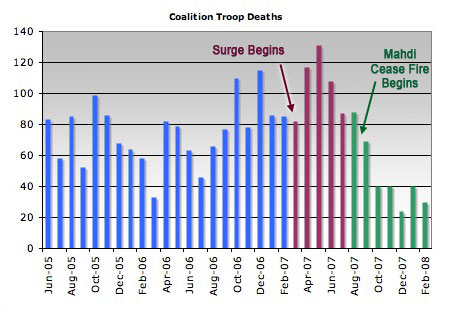
The problem: like so many others, he completely ignores the Mahdi Army cease-fire. Look at Civilian, Iraq Police/Military, and Coalition deaths where the Mahdi Army cease fire is taken into account:

0208-Iraq-Civl-Deaths

0208-Iraq-Plml-Deaths

0208-Iraq-Coal-Deaths

Statistically speaking, the surge had little or no effect in the time it was working–the drops in casualties came after the Mahdi Army called a cease fire. There were peaks and valleys during the surge, but the lasting decrease in violence came only after the cease fire had begun. And seriously, that explanation makes a hell of a lot more sense. Adding a fractional number of soldiers to the battlefield is far less likely to have made the difference than the insurgents most responsible for violence calling a stop to their attacks. It doesn’t take a genius to figure that one out.

And Muqtada al-Sadr did not call a cease fire because of the surge, he called it because his army was beginning to factionalize, and he needed the down-time to keep them together under his control. This does not mean that the underlying problem in Iraq has been curbed or is under control, it means that the same groups that caused most of the bloodshed before are marshaling their forces in preparation for a longer, bloodier fight. So you cannot credit the surge for lighting a fire under al-Sadr.

While it is good news that al-Sadr called the cease-fire, it is completely unreasonable to think that it will last forever, or even long enough for the Iraqi government to stabilize.

The unfortunate thing I see is that Iraq-war cheerleaders now have their talking points: the surge worked, and when the Democrats pull out the troops then (a) if there is peace, it’s only because of the surge and George Bush, and (b) if there is war, it’s only because the damn Democrats pulled out like cowards. Never mind that al-Sadr is the one who can make or break this thing and he is not going to be controlled by whatever number of forces we are able to put on the ground.

Long story short: Republicans created this unholy mess and are perfectly poised to claim credit for any victory and blame Democrats for any problems.

In other words, business as usual.

Categories: Iraq News Tags:

They Just Don’t Get It

March 2nd, 2008 Comments off

Here’s the latest genius masterstroke from the networks:

Looking to strike a blow against the proliferation of digital video recorders, the ABC network, its affiliated broadcast stations, and Cox Communications’ cable systems are establishing an on-demand video service that would allow viewers to watch ABC shows like “Lost” and “Desperate Housewives” any time they choose.

The catch: It uses a new technology that disables the viewers’ ability to fast-forward through commercials. …

ABC and Cox executives said that consumer response to the test had been positive. Several executives involved in the project, which ABC plans to offer to other cable systems around the country, said the move was an overt attempt to staunch the use of DVRs like TiVo, which viewers often use to avoid commercials. That activity is increasingly seen as threat to broadcast television, which depends on ad revenue to pay for programs.

“This does counter the DVR,” said Anne Sweeney, the president of the Disney-ABC television group. “You don’t need TiVo if you have fast-forward-disabled video on demand. It gives you the same opportunity to catch up to your favorite shows.”

So, to quote Maxwell Smart’s various and sundry opponents, exactly what kind of idiots do they think we are? “Hmm, I have this DVR sitting right here and can record the TV show in high-def and can blow through all the commercials… or I can wait a few days, and then slowly download a lower-res, DRM-studded version of the show that I have to watch on my PC with the fast-forward disabled, forcing me to watch commercials.”

Easy choice! Since I’m a complete and utter moron, I’ll watch the downloadable version!

They just don’t get it, do they? The networks, I mean. They seem to think that these various schemes they keep on coming up with will somehow just destroy people’s ability to think rationally and decide to do what is in their best interests. Now, if they were Republicans, maybe they’d be a lot more skilled at it. Unfortunately, studio and network executives aren’t running the GOP, otherwise Bush would have certainly lost four years ago. Instead, their stupidity is wasted on these Quixotic, worthless attempts to bypass the far more appealing alternatives that average viewers can clearly see are better for them.

I have said it before: there is only one way this can work out to the content providers’ benefit: narrowcasting.

What they have to do is give up the old-school thinking of doing things in broadcast mode and switch to delivering personalized content. The pay-as-you-go method of making people pay $2 to watch a TV show they’re used to getting for free just ain’t gonna cut it with 95% of the audience. And people are now too used to being able to cut through commercials or otherwise getting past the dreck that is advertising. 97% of the audience isn’t expected to watch or be interested in commercials anyway–it’s just getting that 3% who happen to be interested in the commercial being shown at the moment which is key. And there is only one solution that is really going to work in a big way.

Here’s the condensed version: make all video content available online–all old movies and TV shows, as well as new television series episodes as they are produced. Make it so people can browse an iTunes-like interface and easily choose which programming they’d like. Then stream it to them, or download in higher definition, whatever works best.

But here’s the key: personalize the commercials. Don’t broadcast, narrowcast. You’ll have to find out what people want to see, so instead of charging money, you have people answer some questions once a month. They have to say what kind of commercials they like to see, want to see. What will they be buying in the next month? What subjects are they interested in?

One thing we all have in common is that there are commercials we like to see. For me, if all my commercials were movie previews, computer commercials, and commercials for stuff I plan to buy in the near future (local wedding chapels is one, in my case, or ideas for what to buy Sachi for her birthday)–then I would want to watch the commercial breaks.

Knowing that I would have to watch commercials, I would be OK so long as the commercials were ones I wanted to see. And I would be glad to give up that info to get access to all the programming I’d like to watch. Privacy, schmivacy–most people give up that data in exchange for a member’s card at their local supermarket and a two-dollar discount on three refrigerator packs of Diet Coke.

This would be golden for the advertisers: instead of reaching only 3% of the audience, they’d be reaching over 90% in all likelihood–30 times the value. The studios could even eliminate the middleman in the form of local stations, and make off like bandits. The advertisers would be happy, the viewers would be happy, and the studios would get rich.

It’ll take bigger investment in broadband, which is overdue anyway, and details would have to be worked out to salvage DVD sales. Maybe offer the downloadable stuff in 480i old-fashioned TV quality, and then sell DVDs of the shows in Blu-ray with the extra features and commentary–they’ve probably already mined out most of the 480i DVD sales anyway.

However they figure that out, the narrowcasting option is the only viable option that I can see. Frankly, whenever I see one of these stupid, lame attempts by the networks to “do away with” DVRs or pirate downloads or whatever, I just laugh. They are all pathetic and doomed, and clearly so.

When are they going to learn?

Categories: Corporate World, Media & Reviews Tags:

Vista Prices “Slashed”

March 1st, 2008 1 comment

That’s right, Microsoft is taking the rather surprising course of reducing the price of their Chrome-Plated Turd™ by 15 to 20%. That brings Vista Home Premium down to $130, coincidentally the same price as Leopard.

So, why are they doing this? The quote:

We have observed market behavior … that suggests an opportunity to expand Windows standalone sales to other segments of the consumer market.

In short, they think they will sell more if they lower the price. Genius!

I have a different explanation: Vista sales suck big hairy donkey balls. Just take a look: after 13 months on the market, Vista has all of a 13% share of the market. That’s a 1% market share increase per month. They plan to release the next version of Windows in late 2009; presuming a December release, Vista should have just over a third of the market by that time. Which is rather pathetic, as I observed before–especially since most people who buy computers simply accept Vista by default. If people were offered a choice at every purchase, then we’d probably see Vista sales at half of what they are now.

All this explains a bit better why Microsoft is reducing their prices–but I really don’t think it’ll help. If Vista market share explodes after this, or even grows somewhat more rapidly, I will be surprised (unless it happens because MS stops selling XP at all). People are not shunning Vista because it costs $30 more than they wanted to pay. They are shunning it because it’s bloated, buggy, does not add all that much functionality, is loaded with DRM and other anti-consumer “features,” and requires too many people to buy all-new computers (or spend money on pricey upgrades) in order to run it halfway decently. Call me crazy, but I don’t think people will overlook all of those negatives for a thirty-dollar discount. Vista will most likely continue to increase only as fast as Microsoft can force people to buy it with new computer purchases.

Categories: Computers and the Internet Tags:

A Reason to Withhold Judgment

March 1st, 2008 1 comment

As it turns out, the alleged case of rape in Okinawa that I reported on two weeks ago, may not have been a rape. It’s pretty clear that something illicit had happened–an American serviceman took a 14-year-old girl home on his motorcycle and forcibly tried to kiss her; when she started crying, he offered to take her home in her car. She then went to the police and made the charge of full rape, and that’s when everyone went nuts. The local population exploded in protest, and local politicians jumped on this as a reason to force U.S. bases and the 40,000 U.S. troops in Okinawa to pack up and leave. The U.S. troops were all put under a sweeping curfew.

But now, it seems that there may not have been a rape after all. This point is not clear–the police are not clearing the soldier publicly, or at least not yet–but the soldier in question has been released and the family is dropping charges. This is not proof that rape did not take place; it is possible that the young girl was so traumatized that the family decided that a trial would not help her. Or it is possible that the girl made a bad decision and made a charge that could not be upheld.

That we still don’t know is just more evidence, to me, that taking such cases and blowing them up into international incidents is very poor judgment. Allow the system of justice to take its course, wait to see what truth filters through, and act on that if it is relevant.

Categories: Focus on Japan 2008 Tags: