While the prospect of the new Macbook Pro is overall very positive, there are a few significant down points. One of those is the glass screen–I see no real advantage here, and the reflectivity is a major down point. I never liked the glossy screens before, and these computers seem to be more reflective than ever. Had it been made glass so one could get touch-screen functionality, that I could understand. But without that, it’s a drag on the computer’s appeal.
Another down point is the lack of a 400 Mbps Firewire port. I mean, really? I have to buy pricey adaptors and new cables to use a bunch of equipment I own? Now, Apple does mercilessly phase out stuff which is no longer hip–they were among the first, if not the first, to ditch the floppy disc, for example–and I do understand that USB is winning the game. But it’s still a pain.
But one legacy ditch Apple executed with this model is one that makes zero sense to me: no more out-to-TV. Seriously. You can still use VGA and DVI, but if you have an old-fashioned TV set and need to go out to it, you are out of luck with the new Macbook line. No more cables going to composite RCA or S-Video. Kaput.
That’s a huge deal for me, as this is going to have to be a work computer, and we have no HDTVs at my work–all are old NTSC boxes. The new Mac would not be able to use those, at all. I would be limited to a single VGA input box I have set up in the lab, and our LCD projector, which can take VGA in. But that also means I am on a short leash, as long VGA cables are not an easy schlep.
Yeah, “meh.” I was really expecting something better. The new form factor looks nice. Not incredibly cool, but nice. The black border around the screen is maybe the nicest touch, for me at least. The glass trackpad? I’ll have to try it and see. Probably it’ll be pretty good. But this is not the innovative upgrade I was expecting. No Blu-Ray. More Multi-touch, but no LCD trackpad or touch screen. Nothing that knocks my socks off, to be sure. Nice, but not great.
I will buy it, however. I have an aging 3.5-year-old G4 PowerBook, which has long been outclassed–even though it still stands up surprisingly well. I’ll even keep it, for its pre-Intel functionality, as kind of a bridge unit, a backup, something that can run a lot of the software I still would like to access once in a while (I might even downgrade the OS to something more Classic-friendly).
The new MacBook Pro (gotta have a 15-incher) will be a major upgrade for me. The ability to run Windows will be useful for my job. The 2.4 GHz dual-core low-end model will be quite sufficient, many times faster than what I’m used to, and the NVIDIA chipset will not be bad either. I’ll enjoy having a webcam on my portable, and the WiFi may even not suck like my current PowerBook’s does. I also like the fact that Apple is shaking me down a lot less than before on RAM–a 2GB upgrade to 4GB for $150 is not bad, and is even reasonable. I’ll take that, along with the 7200 RPM 250 GB drive that far outclasses the 80 GB drive I now suffer with.
Sure, it’s a big upgrade from my early-2005 model. Just not the barn-burner of a new release I was hoping for. So I’ll take it, but, you know, meh.
Update: While the “Apple tax” is imaginary, the “Living in Japan tax” is not. Even at the Education store, I will still have to pay about $300 more for the Macbook Pro here in Japan than it costs in America. True, half of that difference comes from sales tax which you can avoid in the U.S. by buying out-of-state, but it’s still a difference. And $300 is not quite worth it to put my family in the U.S. to the trouble of re-shipping a U.S.-bought machine here. Between the shipping costs and the import duty they’d slap me with the price difference would kind of disappear anyway. But it still sucks that you pay a premium for living closer to where the machines are actually produced. And ordering in Japan won’t save me time, either–getting the U.S. keyboard is a special order and usually adds a week to delivery time.
…we’re also looking at the different things that you can get with Windows, and understanding what is really involved with what we call the “Apple tax.”
There really is a tax around there for people that are evaluating their choices going into this holiday season and going forward. There’s a choice tax that we talked about, which is, hey, you want to buy a machine that’s other than black, white, or silver, and if you want to get it in multiple different configurations or price points, you’re going to be paying a tax if you go the Apple way.
There’s going to be an application tax, which is if you want choice around applications, or if you want the same type of application experience on your Mac versus Windows, you’re going to be purchasing a lot of software. And even at that you’re not going to get the same experience. You’re not going to get things like Microsoft Outlook, you’re not going to get the games that you’re used to playing. There’s a technology tax–Apple still doesn’t have HDMI, doesn’t have Blu-ray offerings, doesn’t have e-SATA external disk drives that work at twice the speed of FireWire. And so you’ve got all of these things that are truly taxes.
You’ve also got an upgrade tax. The only machine, as far as I know, within the Apple lineup that’s actually upgradeable is the Mac Pro, the $2,800 version, which is (more expensive than) just about any PC configuration that you get from any one of our manufacturers.
Ah, where to start.
The primary fallacy in this entire rant is to take two platforms, list the faults of one and not the other, and call those faults a “tax,” as if there are no faults on the other side. The faults listed are lack of variety, limited number of applications, limited technologies, and limited expandability. All valid points to a degree, though several if not all have just as valid counterpoints, all of which you could have read here previously. With Windows systems–and the exec is talking about Windows plus PCs built for Windows, so we can take that as a group–there are just as many if not more faults. Lack of originality and style, being behind a few years in many of the more key capabilities, a horrendous resource-hogging OS, compatibility problems due to mismatched hardware and software, vulnerability to massive onslaughts of malware… I could go on and on (that’s not an impotent boast, if you read this blog then you know I can because I have). What we are left with is the question of which set of “taxes” are more onerous. You can guess which answer I would suggest.
Then there’s the fallacy of presuming customer desire. The exec talks about people wanting choices like a myriad of colors–as if color were the only element of style (that explains quite a bit)–and volumes of configurations. Apple tried to have a multitude of configurations once, and it almost killed them. They discovered that you should concentrate on a smaller number of configurations, but make sure that you get them right. There are a multitude of digital music players out there, but Apple has the lion’s share of the market, something it won because it made its product right (not the way Microsoft clawed to the top). People like cool gear, not just more colors. Apple has the cooler gear.
Similarly, the exec talks about expandability. But honestly, how many PC owners actually do that kind of thing? I would guess that more than 90% of computer owners don’t expand anything, not even RAM (which most people should). At best, this is one of those things people buy a product for and then don’t use, like most of the features on a cell phone. More often than Windows boxes, Apple tends to identify what most people will really use. A fingerprint scanner looks cool at first, but honestly, do you really need it? After a while, it just becomes this useless thing on your machine that you never use. Most of this appeal is to the geekier high-end users, not the majority of users.
Then there are the plain false claims, like the Mac Pro for $2800 being more expensive than “just about any PC configuration that you get from any one of our manufacturers.” A former student just asked me a question about this the other day so I looked into it. On the PC Connection site, I looked for dual-quad-core Xeon processor desktops at 2.8 GHz or better–what the Mac Pro has–and you have to go to the 8th lowest-priced system before you find something that’s not a Mac Pro (and it has slower CPUs and smaller hard drives, for $240 more than the lowest-priced Mac Pro). Whenever I hear of these special deals for PCs, they usually require multiple mail-in rebates and tie-on deals, and are the exception rather than the rule.
I’ve said it before and I’ll say it again: the Mac is not by any means perfect. It has its faults and weaknesses. There are many people for whom a Windows or Linux system is far more ideal.
But please, claims like this from Microsoft are just pathetically wrong.
For all of McCain & Palin’s bluster about Obama raising “your” taxes, the proposals are pretty clear: Obama is proposing hefty cuts to the middle class which taper off as you reach $250,000 a year; he then starts raising taxes, those hikes becoming notable at the half-million mark and above. McCain, in contrast, wants cuts for everyone but gives the lion’s share to the wealthiest Americans. His cuts for lower and middle class Americans ($0 to $100,000) are less than Obama’s. Where Obama wants to tax wealthy people, McCain wants to give them yet another tax cut, and reserves the biggest windfalls for the richest people.
In that sense, their plans are diametrically opposed: Obama proposes a 5.3% cut for the poorest Americans which reduces to 0% around a quarter of a million dollars, then rises to an almost 8% rise for multi-millionaires; McCain gives the poorest Americans a paltry 0.2% tax cut which gradually increases with income until you see the wealthiest getting a 3% cut.
So the questions become simply: (a) should we raise taxes for rich people? and (b) should we lower taxes for the middle and lower classes?
Yes, there is a serious economic downturn. But that does not change the fact that if a person is making a million dollars a year, they are making a million dollars a year; if their income is still so high, then obviously the downturn has not made them poor yet. If the bad economy knocks you down into the middle class, then Obama has bigger cuts waiting for you there–this is a self-correcting mechanism. But if you’re still making lots of money, then the downturn only helps you, as your relative purchasing power has become stronger. If you could afford those tax hikes last year, you can afford them this year.
I have always believed in bottom-up economics. Top-down is ludicrously flawed, because the money tends to stay at the top. Money tends to circulate up, not down, as those who have money use it to keep it and to continue taking it from people with less money. Bottom-up makes sense as a system of circulation and economic health because people at the bottom can’t hoard money like people at the top can; people with little money usually have to spend it, else have it work for the local economy while they wait to spend it.
Then there is the cumulative view: over the past 30 years, taxes for wealthy people have been slashed, while the middle class has gotten far, far less–and possibly is paying more for less by this point. Obama’s plan works toward coming closer to a balance.
The plan Obama proposes makes sense on just about every level–it is less of a burden on the deficit and debt than McCain’s plan, stands to jump-start the economy (hopefully along with minimum wage increases and other legislation which corrects past imbalance) by getting money back into circulation, and is far more fair and even-handed than the “fair” tax cuts for the rich that Bush and the GOP used to help wreck the economy in the first place.
An etymologist criticizes the use of the third person plural as an indefinite singular pronoun.
I’ve always been of the opinion that while rules are a necessary part of language, it is speakers who drive the rules, and not the other way around. Many who speak dialects which are associated with low education may be remonstrated by their teachers at school for speaking “ungrammatically” or using “wrong” language. The thing is, if the language a person speaks follows a set of rules, then there’s nothing wrong with it. “Ain’t,” for example, is perfectly appropriate so long as it is used consistently according to linguistic rules recognized by the group of people who use it. The double-negative is not intrinsically incorrect–it used to be acceptable in mainstream English, in fact–it just happens to be out of vogue.
Language changes. New structures are introduced and played with, sometimes at the fringe of society, and sometimes driven from its core. But it is people who decide what makes sense to them, what feels right, what they prefer to use. Complaining that the new structure does not follow what we have decided previously is not good enough.
Language is not grammatically or otherwise “correct” because it resembles language spoken in the past, it is “correct” because the majority of speakers agree on a rule and apply it consistently. That’s why I have less objection to the “new-cue-ler” pronunciation for “nuclear”–so many people use that pronunciation that it is now becoming part of the living language.
I use “they” or “their” regularly to refer to the indefinite singular chiefly because it makes sense to me, and sounds better. The context makes clear that I am speaking of a single person, so there is no danger of being misunderstood, and it neatly corrects an imbalance in the language which, for all of the whining about “political correctness,” nevertheless is much more accurate and far less grating gender-wise than the traditional form.
But the truth is, you don’t need these reasons to change the language; changes can be made on whim, and need neither rationale nor even internal consistency–as seems evident from much of the language now deemed “correct.”
You can rail against the use of new structures because you don’t like them, but you cannot say that they do not belong in a language because they don’t follow past example, or because you don’t like the logic or lack of same that the new structures represent. If people use them, that’s all that’s necessary.
With McCain and Palin whipping their crowds into frenzies, getting them so worked up that they are now regularly shouting stuff like, “traitor!” “terrorist!” and “kill him!!” one conservative commentator suggests that Obama represents a potential “thugocracy.”
A few days previous, Hans Von Spakovsky–the Bush administration’s vote-suppression pit bull whose nomination held the Federal Election Commission hostage for many months–bemoaned “how partisan and politically-biased the Justice Department and other federal agencies would be under an Obama administration.” This after years of the Bush administration blatantly saturating the bureaucracy with die-hard loyalists, going further than any administration in history to politicize what had been considered completely off-hands to partisanship–with Spakovsky himself being a poster-boy for that very movement.
Hypocrisy? Projection? Working the refs? Blindness? Uber-partisanship? All of the above, and then some?
In this case, Sarah Palin is the party head, and a fully bipartisan council made up of 10 Republicans and 4 Democrats judged that Sarah Palin abused her power while governor. While some of her actions were excusable, many were not. And while the council made no recommendations for action–and there may well be none forthcoming–it did state rather definitively that Palin broke ethics laws. The problem is, Republicans have been doing so rather blatantly for years, and as we have witnessed, no one ever gets sent to jail for it, and few ever even get indicted. If they do, then they just fail to respond to the indictment, and Republicans in executive authority don’t act on it.
As usual, there is a double-standard at work. Republicans have promised investigations and perse prosecutions of Democrats if they maintain power–McCain, for example, promised to take legal action against Barney Frank and Chris Dodd, and maybe even Obama as well. But if Democrats are elected into power, then they had better not even dare think of taking any legal action against any Republican, no matter how solid the evidence that they broke scores of laws–because such investigations would just be political payback. A beautiful system–we won’t prosecute our own crimes, and if anyone else does, it’s playing politics.
Perhaps this focus on the fictional Democratic “responsibility” for the banking crisis is McCain’s way of distracting attention away from the fact that his VP candidate broke the law (joining McCain in doing so, after he broke FEC laws earlier this year). Or maybe he’s just flailing about–goodness knows that there’s little else he can do at this point.
Or maybe McCain was comfortable with Palin for just this reason, that she had scandals lurking–after all, Palin is simply keeping the faith here, doing what Republicans do. It’s not as if Troopergate was unknown before McCain chose her–even with the most cursory of vetting, McCain still had to know about this. Maybe having the goods on her was considered a good point for them from the start–a handle of control, but something they felt they could get settled quietly if they needed to.
Hard to say. But like I said, Palin is simply echoing Republican tradition here. This is what they do. Which is why the GOP faithful won’t even blink at this. They don’t care if their leaders break the law; they believe in the Colbert-like fashion that the narrative is what is “real,” and the narrative says that Obama is a terrorist traitor, whereas McCain is a 100% honorable war hero and Palin is a pure-as-snow Alaskan hockey mom with impeccable morality and credentials. So the faithful won’t even notice this, except possible to dismiss it as an “attack.”
But the moderates are less bound to the narrative, and will probably notice this quite a bit more. So the margins of victory for Obama stand to be pretty big unless something rather astonishing happens. Even if the GOP does control the voting machines, they might not be able to do anything anyway–no narrative about getting the base out in numbers could make the numbers change that much.
At the beginning of this campaign, John McCain solemnly and repeatedly vowed to run a “respectful” and “honorable” campaign, taking the high road and refusing to go negative on his opponent, instead leading with the issues.
John McCain pledged a “respectful campaign” Tuesday against either Barack Obama or Hillary Rodham Clinton, but said he is less confident about the influence of outside political groups.
I think we can safely call that promise broken. It’s gone way beyond being able to blame it on 527’s.
The thing is, McCain broke that promise long ago, maybe even before he started making up stuff like saying that Obama refused to visit wounded troops if no cameras were allowed, or that Obama would intentionally lose the Iraq War just to win an election.
Now, Obama is ahead in just about all of the polls. Fivethirtyeight.com has Obama so far ahead it’s not even funny–McCain now has less than a 10% chance of winning. A lot can happen in a month, but you’d be asking for a hell of a lot for McCain to turn things around.
Of course, that’s not the scary part. Nor is the idea that the polls may not be taking into account Obama’s full power in the upcoming election–that high turnouts by minority voters and vast numbers of new Democrats registering are not being fully factored into the numbers we’re seeing. More and more, it’s beginning to look like Obama is going to win this one.
Nor is the scary part the economy, though that’s plenty scary; Obama is not a miracle worker, and what he will be able to do may be limited, especially if when Republicans go into full-out obstructionist mode, blocking every scrap of legislation in sight and then calling Democrats “do-nothing” losers, the exact technique they have used to good effect (for them, not the country) for the past two years. It’s not quite so scary that Obama won’t be able to do much there because (a) presidents usually can’t do much good, but (b) they can do a lot of harm and McCain looks to do that harm and more.
No. None of that is so scary. So, what is they scary part?
The scary part is that the McCain campaign is starting to look less and less like a campaign and more and more like a lynch mob.
Think I exaggerate? Think again. The McCain campaign has gone almost 100% negative, doing nothing but attack, attack, and attack some more, and the attacks are not subtle; they are playing the “terrorist” angle to the hilt, running ads linking Obama to Ayers as if Ayers bombed D.C. and Obama was right there with him burning a flag. They echo this on the campaign trail. Mentions of Obama’s middle name have re-emerged, and crowds are shouting “Obama, Osama!”
This is made more significant not just by the disrespect, but the utter, complete lack of any respect whatsoever; referring to Obama as “that one,” making thinly veiled racial references, and painting Obama as “dangerous.” McCain and his people know who they are talking to. They know they have the fundie base energized, that they are more and more appealing to the extremist crowd. And they are playing it up.
The question is, how far will they play it up? The answer is, apparently, almost all the way. Maybe not to 11, but damned close. Now it is not uncommon for McCain to ask his crowds, “What kind of man is Obama?” and the audience members shout back, “terrorist!!” Recently, Sarah Palin was stoking the terrorism fire when an audience member shouted out, “Kill him!” In another Palin crowd, someone yelled, “Off with his head!”
In no instance did McCain or Palin rebuke such a response; they just kept on going.
These are not just wackos in the crowd that can be ignored; after all, how often have you ever heard of people in controlled political events shouting death threats against the opposing candidate? And if they did, would you not expect the campaign to go out of its way to disavow and condemn such things?
That’s the scary thing: that McCain and Palin are unabashedly whipping their supporters into angry mobs lacking only pitchforks and torches, though maybe not ropes to hang from trees. They know what they are doing and yet they keep on pressing forward with the attack.
This has gotten so bad that even people inside the McCain campaign are starting to publicly question the wisdom of stirring up such hostility.
In response, a McCain advisor simply said that they were “happy” with how the campaign is going.
I certainly hope that Obama’s secret service detail is beefed up and hypersensitive to all threats, because John McCain seems to be just one short step away from losing it and shouting to his supporters, “Go lynch him!”
Update: Saner opinions in the McCain campaign seem to have prevailed, as McCain has just suddenly hit the brakes on the “Obama is a terrorist” car. At a rally in Minnesota where the audience booed Obama, McCain called for “respect,” apparently thinking this would do the trick and erase the last several months of McCain issuing severe disrespect for Obama, repeatedly calling him in all but name a terrorist and a traitor.
But as is often true after one lathers up an angry mob, the mob has a momentum of its own and is not easy to slow down. Even after McCain’s appeals for respect, audience members “pushed back,” asking McCain to tell the “truth” about Obama (“you know, tell us all about his Muslim terrorist ways!”), and telling McCain that they feared an America led by Obama. McCain tried to reapply the “respectful” brakes, but again to little effect–a subsequent speaker from the audience started by announcing that she is scared of Obama because he is an “Arab terrorist.” McCain actually had to grab the microphone away from her and state that Obama is a “decent family man.”
McCain is suddenly discovering that lynch mobs are not quite as easy to reign in as he may have thought.
Later Update: Here’s a video of the aforementioned rally, which shows that TIME slightly misreported, but that clarification just makes it stranger:
The woman did not say that Obama was an “Arab terrorist”; she said he was an “Arab,” and then stopped–maybe she wanted to go on to say terrorist, but she didn’t. She just said “Arab.”
What is strange is that McCain took the mic back and said, “No ma’am. He’s a decent family man citizen that I just happen to have disagreements with on fundamental issues, and that’s what this campaign is all about. He’s not.”
Umm… “He’s not an Arab, he’s a decent family man citizen”? So, Arabs are not decent?
One can understand why the TIME blogger thought she said “terrorist”: because McCain answered as if she had. At least he’s in tune with his crowd that much.
The rumors have been out for some time now. They started a month ago with reports of something called a “brick,” which everyone thought was a small box, maybe a replacement for the Apple TV. But recently, the general rumor community started to coalesce around the idea that “brick” referred to carving a laptop case out of a brick of metal, describing a new manufacturing process for Apple’s new line of MacBooks and MacBook Pros.
The rumors seemed to solidify when photos were leaked showing images of the purported MacBook cases, indeed carved from a single piece, with no seams.
Just this afternoon, I warned a student not to buy a Mac laptop too soon, as Apple is scheduled to release new ones in the next month or two–reportedly very soon, but potentially as late as January. I speculated that in part due to this new manufacturing process that could save money, and perhaps in part because the recent economic crisis and stock drop, laptops costing significantly less were a good possibility.
Just tonight, the rumor was released that 12 separate Apple laptop models (there are currently 8 models) are to be released soon, with prices ranging from $800 to $3100–significant since the current low price is $1100.
Still, there were doubts, as the rumors all said that the new laptops would be released October 14th, and here it is October 9 and no announcement of an Apple event. Obligingly, Apple released this announcement just an hour or so ago:
Notably: the date and time for the event is October 14th in San Francisco at 10AM PST.
So, the rumors seem true. If so, then by this time next week we’ll be seeing a whole new line of Apple laptops. The question is, what will there be beyond the cases? Just that? A slightly different form factor but otherwise just a speed bump? Unlikely–Apple releases speed bumps casually, not with big events. Could the casing alone be worth an event? Possibly. More likely the price drop will be the prominent focus.
Some rumors, however, tell of an LCD trackpad. From there, your imagination can run wild.
My current laptop is now about three and a half years old One of the oldest pre-Intel laptops. Already time to buy a new one. No matter what the news, I am almost certainly going to buy one. If it has more than just a new case and a low price, that will be a spiffy bonus. The only question will be, which one?
If you use your iPhone in Japan and have used the Ekitan app, you may have noticed that they have pulled out the rug from under you: they are no longer a free service. If you try to use your free version, they let you input stations and times like before, but when you attempt a search, you get a message telling you that “the service has terminated” (サービス終了しました。). When you dismiss the message, you are taken to a web page explaining that the app is now being charged for and you must re-download it from the App Store. The free version seems to still be available and can even be updated–but it won’t work. You gotta pay ¥350 for the working version.
Well, that might have been unfortunately necessary, except that now there’s an alternative: Yahoo Transit, available from the Japanese iTunes Store, for free. What’s more is that the Yahoo app is a lot better–I would have switched anyway, had I known about it. All the more mysterious that Ekitan should suddenly start charging for their app (unless they added new features themselves, but I don’t feel like going to the trouble of translating the whole description just to find out).
The Yahoo app has everything that Ekitan had, but includes some nice new extra features. One is the ability to use GPS to scan for nearby stations instead of typing them in, an excellent time-saver (and even a good way to locate nearby stations you may not have been aware of). The top field (greyed out) is where you tap to enter a station name; the second field is where you tap to get a list of local stations. (The third multi-line field is the list of stations you searched previously.)
Unlike Ekitan, where you have to navigate a Hiragana menu to find your station name, you can just type in your station name directly–a much easier way, most times. Another nice point is the ability to type in names in English and have them resolve into Japanese, just like on the Yahoo Transit web site.
Of course, if there are several stations with the same name or partial name, you can choose from the list:
Like Ekitan, Yahoo Transit remembers stations that you searched for before, so as to maintain a handy quick-find list of often-used stations. Unlike Ekitan, Yahoo’s app allows you to erase station names you don’t want to keep–a very nice addition.
And finally, the app allows you to search additional transportation services, including domestic airline and expressway bus lines–good for long-distance travel. Also, you can turn any one of these off.
And then, of course, you get the results, with all the needed info.
Like I said, a very nice app. I’m kind glad Ekitan shut me out, now I have a much nicer alternative.
Right now, my college is undergoing an accreditation review. For those who don’t know what that is, it is essentially the licensing for the school. You can’t offer a degree worth more than the paper it’s printed on if you don’t continuously win and re-win accreditation from one of the major agencies.
Today we met with the consultant evaluators, and they asked some pointed questions. These are professionals, they’ve been in the business a long time, they’ve done this before and they know their stuff. And of course, it’s their job to know what you should be able to show them, namely that your institution is doing what it is supposed to be doing, that the students you teach are getting what they should be getting.
And it occurred to me in this process that if we did something like ignore a question and address something else we wanted to point out instead, it wouldn’t fly. We might get a long stare that asks us to change our minds and answer the question asked. That if they asked us what the institution could offer students, and we replied that we were real close to a city library, so we had access to lots of information we could give the students, we would probably have to sit there in silence while the evaluators worried about what fate our students would suffer at our inexperienced hands. Or that if we hired someone for a vital position who had no qualifications worth mentioning for the job, they would rightly question our ability to staff the school. And if we knew in advance that our answers would be inadequate and simply denied the evaluators access, it would be even worse.
In short, we could lose our accreditation, our jobs, our school.
Now, we’re just a small school which runs a basic general education program, small potatoes in the bigger world of higher education. It’s not like we want to become leaders of the most powerful nation on Earth.
And yet, it occurred to me in this process, that we are being held to a far higher level of accountability than is the McCain campaign. And it’s not like McCain and Palin are being evaluated by chimps; it’s not as if the entire field of journalists don’t know their jobs, their responsibilities, their duties. It’s not as if they don’t know how to ask the tough questions, how to report on what’s really happening. It’s not like they can’t tell that proximity to Russia has zero value, that McCain and Palin are lying through their teeth, that Sarah Palin is not qualified or appropriate for her position, or that denial of access is equal to an admission of fear and incompetence.
But if you want accountability, head down to your local community college. I can speak from experience that in order to stay in business, they have to answer to a far higher level of scrutiny, and live up to their promises, with no lies, evasions, or bull.
Don’t try to get that from the McCain campaign, though; they don’t even come close to living up to those lofty standards. In fact, they don’t even try.
They could not succeed in running a small junior college; how can they claim to be qualified to run the entire country?
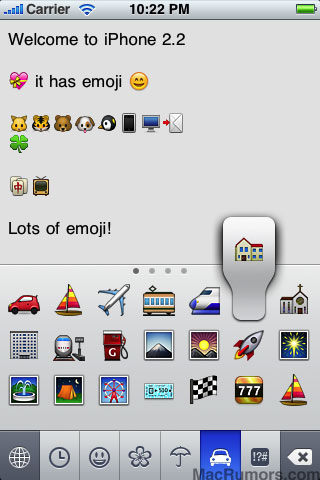
According to MacRumors, emoji support is coming to the iPhone in v. 2.2:
Hard to believe that some people would look at the iPhone and say, “yeah, it’s got massive expandability with cheap and free software in addition to being an all-in-one cell phone, iPod, email, (best portable) web browser, calendar & contacts, GPS with Google-maps integration, etc. device…. but I don’t want to get it because I can’t insert cute cartoon images of puppies in my text messages!”
Still, the iPhone has a big “Wow!” factor here; even months after its release, whenever students in my school see me using it, they “ohh” and “ahh” and are delighted when I let them play with it-and are still blown away when I show them the search feature on the maps app.
As usual, SNL did a great job showing a lot of truth via comedy in the latest debate:
On that note, here’s a quote from the real debate by Sarah Palin:
And I may not answer the questions that either the moderator or you want to hear, but I’m going to talk straight to the American people and let them know my track record also.
News flash, Sarah: if no American people asked you a question and you don’t respond to any question asked to you, then you’re not talking to the American people, you’re talking to yourself–and by ignoring the moderator, who represents the people (as you agreed to when you decided to join the debate), you’re ignoring the American people.
Yeah, I know, this is very late commentary. But it’s been on my mind and I just wanted to get it out.
It’s probably the other things going on in my life, but I have not been strongly into birding recently. Still, from time to time, I drop by a birding spot and give things a whirl… but to be honest, now that I’ve gotten most of the species you’re bound to see without a big surprise, it’s a bit less exciting. All the same, the birds are nice to see, even when they’re nothing new. Here are some from today:
A Grebe (kaitsuburi):
A Cormorant (kawau) preening while drying its wings:
A pretty stilt (seitaka-shigi):
Various sandpipers (I’ve given up trying to differentiate them, to be honest):
This one is of a large Piper chasing a smaller one that caught a morsel it fancies:
Wagtails are always pretty, however common:
The return of the Tufted Ducks signals the beginning of the massive flocks soon to come:
And there were a few Kingfishers (kawasemi) also in attendance:
Flying off, the Kingfisher is such a pretty flash of red and blue-green:
A bull-headed Shrike made an elegant farewell from the park:
Spiders were everywhere, mostly of this variety–this one snacking an a slightly less-colorful bug:
And what bird park would be complete without a wishful cat?
And the crabs, of course:
I’m just throwing this last one in–you get to see Tokyo Tower down the street on the way back, on Route 1:
One of the down points about having a nice view is that sometimes you see stuff that you can’t explain, and it would take too much effort to investigate. This morning was one of those times. We heard a loudspeaker voice from outside, and when I looked over at the World Import Mart at the Sunshine City complex, I saw this:
Now, you often see lines outside Pachinko parlors, movie theaters, and comic book stores, presumably when they have some hot new game/movie/comic. This kind of thing, you never know. Some convention/trade show? Most in line seemed to be young men, many carried bags with green “SC”s written on the sides.
Ah, a mystery for the sake of not caring enough to go outside to check it out. Seriously, though, it would take like twenty minutes or more and I probably still wouldn’t care. But it still bugs you not to know.
Movie critic Roger Ebert gives an apolitical review of the debates which has a lot of interesting stuff. He analyzes, among other things, a point that many have brought up: that Palin, after Biden’s genuine emotion when speaking about his family, spoke with a jarring lack of sympathy or emotion herself. I hadn’t seen that bit.
My apologies to those who were hoping for links to streams, transcripts, or other resources from here; I’m afraid that that I have not been able to do very much blogging because of demands of my job. The college where I work is undergoing an accreditation review, and yesterday was crazy busy for us; from just before 11am to about midnight last night was back-to-back nonstop business.
I was able to catch the first half of the debate myself before I ran off to work, and have seen a variety of reports since then. One of my thoughts even before the debate began was a realization that there would most likely not be any Katie-Couric moments. The reason for this that occurred to me was that a debate format is way different from an interview format; debates tend to question the major issues of the campaign and the major events of the day, something easy enough to predict in advance and make sure Palin knows well. We’ve seen her Alaskan governor race debate clips, and she can be very cutting and precise when she is well-enough prepared. Even more to the point, the McCain campaign had made sure as much as possible that Ifill was warned away from trying to manufacture any “gotcha” questions (you know, the ones which might show that you don’t know something vital that you didn’t think you’d be asked about). They pre-accused her of bias and all that, so if she asked anything too specific or unpredictable, they were all set to fall on her for being “in the tank for Obama.”
But it turns out that Palin had another technique to help her even further: ignore the questions asked her. And not only did she ignore some of the questions, she didn’t even pretend that she wasn’t ignoring them–in fact, she declared that she wasn’t as a badge of honor, saying that she preferred to talk “straight to the American people.” How charmingly dishonest. Whenever she didn’t like a question or thought that she might flub the answer, she would just say, “you know, instead I’d like to talk about energy!”
Very hard to go deer-in-the-headlights when you are effectively asking yourself your own questions.
Not that this was too surprising considering the source, but it is even more telling.
No, what really surprised me about this debate is that Palin does not seem to have won the expectations game. Surely, a lot of people did expect her to get all kerfuffled (surprisingly, that’s not Yiddish) at some point or maybe several times during the debate, and that Biden would just stand a mile above her. But for some reason, the McCain campaign did not play up the expectations (again!) and perhaps that’s why there are so few people today saying that Palin won by not losing. There was no narrative set, no spin campaign to dominate the news cycle. People noted that she did not do as badly as many might have expected, and that she saved her career by not self-destructing, but she was not credited for boosting the McCain campaign last night or for turning the campaign around.
In fact, the verdict seems to be that Biden won, by swaying uncommitted voters more than Palin, and that Palin’s major accomplishment was convincing people that she’s not quite as dumb as they thought she was.
VP debates rarely do much anyway, so perhaps this debate was overblown. Right now, Obama is killing McCain in the polls, and McCain needs some kind of game-changer to turn things around. While this debate may not have been a disaster averted for McCain, neither was it anything close to what he needs to save his faltering bid for the presidency.
All original content on this site is owned by and copyrighted by the author. If you wish to reproduce beyond Fair Use provisions, you must leave a comment and ask for permission.