Well, Finally

December 19th, 2007 2 comments

They took their sweet time about it. Apple is now said to be in active talks with NTT DoCoMo about selling the iPhone in Japan. This could suggest a summer rollout, and might further indicate that Apple has successfully developed a 3G version of the iPhone (perhaps to be unveiled at the MacWorld Expo?).

The Wall Street Journal Article goes on to say that while Apple is negotiating with NTT because it always tries to pair with the top market provider, it would turn to SoftBank, a recent upstart rival with a reputation for good deals but not-so-good customer service. SoftBank has been fairly well-known as an Apple groupie, selling iPods alongside their phones; its president even attended the last MacWorld Expo in San Francisco, the one where the iPhone was announced.

The report goes on to say that while NTT might blanch at Apple’s demand for a cut of the contract revenues, Apple won’t have trouble sealing a deal in Japan–suggesting that SoftBank would probably be happy to give Apple what it wants, thus putting more pressure on NTT DoCoMo.

Me, I don’t know from telecoms in Japan. I’m just getting the iPhone when it comes out. Which hopefully won’t be too much longer now.

Categories: Mac News Tags: by

The Rebel

December 18th, 2007 6 comments

1207-Canonxti-01

I probably shouldn’t have, but I did. And today it got here. Well, part of it, anyway. It cost a lot more than I had figured on, and frankly, I don’t really think that I need it that much. No, I don’t have buyer’s remorse. It is such a nice toy, and I know that I will enjoy it and use it for quite a while. It’s just that I have a bit of sticker shock.

Here are the elements that I’m getting:

The 28-105 lens is lower-end, but has a better range and better quality than the much-maligned 18-55mm kit lens. The 70-300mm IS Zoom lens is the centerpiece of the set, in a way–it’s the lens I’ll be using outdoors most. One down point I discovered: the image stabilization kind of eats up battery life. Therefore, the two extra batteries. Not Canon OEMs, which are pretty expensive, at least $40 apiece or so, but cheap under-$10 alternatives which people on Canon photography boards say work as well or sometimes even better. The Flash card is not as big as they get–that would be 8 GB nowadays–but the Ultimate IV is supposed to be the speediest, which could make more of a difference.

1207-Canonxti-02

Like I said, such a nice toy. It takes pictures so easily. Point and shoot, much more so than the actual point-and-shoots. The autofocus is very nice, the zoom lens is great to use… it’s like graduating from a beat-up chevy wagon clunker to a nice mid-range BMW.

Not that there haven’t been a few kinks along the way. The biggest one had me in a bit of a panic, made me think that I had gotten a lemon and faced a vacation that would consist of waiting to see if the camera could be returned from the repair center before I had to leave for Japan. It turned out all right (I’m pretty sure, at least), but had me scared for an hour or so.

When I got the camera, the first thing I checked was whether it would be necessary to charge the battery first. I hate it when you have to do that–toys should, after all, work right out of the box. But the instructions said nothing about it. I slid the battery into place, and the camera worked. Swell! I ran out and started testing it. Unfortunately, it was delivered late in the afternoon on an overcast day, so there wasn’t much chance to get anything blogworthy on film. Furthermore, I had not run through the instructions yet, so could still not figure out how to make it work best. But I practiced some, took dozens of shots, and then took it back inside to see the results. Pretty good.

Throughout the evening I experimented further, and eventually sat down to go through the manual, trying each new thing I learned by snapping a few more photos. I got to the part about manual control and depth-of-field, and figured that I’d try some comparative shots. After one shot that I took, the camera shut down.

Now, had it simply lost all power, I’d have concluded that the battery had died and I hadn’t noticed the indicator. But the power lamp, the “on” light, remained lit. That suggested that the camera was still powered. But the LCD screen wouldn’t light, none of the buttons worked, and even if you switched the power toggle off, the power lamp remained lit. It had all the earmarks of the camera’s computer crashing, freezing, hanging. The only thing that would bring it back was to remove the battery and then slide it back in. Then it would start up again, I could review pictures, and could see the battery indicator showed half-full. But when I took another picture… it froze again. Removing the battery would always fix it, but the next photo taken–no matter what setting, no matter how I did it–would always freeze the camera in the same way. I tried erasing the flash card, pushing all the buttons, but whatever I tried, it froze and crashed and hung again.

At this point, I was pretty upset. I figured it was a lemon of a camera, broken almost right out of the box, and envisioned spending the rest of my vacation on hold with Canon customer support, shipping my toy away for weeks and maybe even suffering problems after that. An alternative of returning it to the seller and getting a new one in exchange still meant that I’d miss at least a week of photography, the time I had set aside for birdwatching.

Just to be sure, I started recharging the battery, and as I did so, I started Googling possible keywords that might lead me to discussions where people spoke of the same problem, perhaps with a cure. Eventually, I found the answer: this discussion thread, describing more or less exactly my problem. The cause: the battery ran out.

Sure enough, after my battery recharged (it takes a little under 2 hours), I found that the camera worked just fine again. Of course, that struck me as a rather glaring oversight in Canon’s otherwise very nice design–to allow a battery to run out and present symptoms that mimic a terrible mechanical failure… not good. Of course, there were extenuating circumstances. As it turned out, I was using a battery that was not fully-charged to begin with, and at the time the camera seemed to freeze, I was eating up power enormously: I was using the built-in flash, image-stabilization was on, and the camera was in continuous autofocus-and-metering mode. So perhaps that egregious power usage sent the camera over some limit or threshold, and caused the seeming malfunction. Still, that’s a bit of a bug that Canon should have looked at.

So, why had my battery indicator shown half-full? In my experience, when a battery runs out of juice, turing the device off and then on again usually results in a slight burst of life, and the battery reads higher for a moment. It happens in my cell phone that way, for example. Must have happened here. Also, it seems that SLR’s don’t give the blinking-red-empty-battery warning, nor the “You have to change the batteries now” sign-off message, something that also caught me off-guard, being a newbie.

Soon after, I ordered the two backup batteries. Natch.

Categories: Gadgets & Toys Tags: by

Lines at the DMV

December 17th, 2007 Comments off

Even though I live overseas, I keep my U.S. driver license up-to-date. Usually, this is pretty easy–the DMV allows you to renew your license via mail, at least for a certain number of times. But this year, my license expired without the ability to renew by mail, and I had no chance to renew in person as it happened in June, and I would not return to the U.S. until December. So I fully expected to have to go in and take a written test–18 or 36 questions or whatever.

Well, I was prepared. I downloaded the driver’s handbook, and studied it pretty well, filling my head with rules like the California Basic Speed Law and the Three Second Rule, and numbers like 100 feet before turning you have to start signaling, except when there’s a bike lane and you’re making a right turn, then it’s 200 feet, and so on. I took the five online sample tests the DMV puts on its web site, and missed something like 3 of the 50 questions. I even made a page and a half of written notes, something I always tell my students to do.

So I go to the DMV and wait my turn in line, and go up to the counter when they call me… and all they do is give me a vision test, then fingerprint and photograph me. Presto, my license is good again for five years. I still don’t know if I’ll have to take an exam the next time, but this time it was dead simple. Next time, at least, I’ll probably get this out of the way the December before it expires instead of the one after.

Still, this resonated when I read this blog, via Seeing the Forest:

…according to the Governor’s Budget Document, “Over the past two years, the DMV has reduced field office wait times in the largest offices from nearly one hour to 20 minutes and reduced customer telephone wait times by more than 50 percent.” These lines were decreased because the Governor committed to additional funding (demonstrating the direct relationship between funding and good service to the public.)

I’ll betcha there are other ways they do it–they just relate to worse or more risky service, so they’re not mentioned. You can reduce telephone wait time by having fewer human interactions and depending more or machines to answer the phones–which people like a lot less. You can also reduce wait times by requiring fewer tests (like they did with me), allowing longer mail-in renewals, and extending the period a license is valid for (five years nowadays–used to be four years). More funding is good, but it doesn’t mean that all the apparent improvements came from the funding. Administrators always ask for something before giving something.

Some improvements can also be made without funding, just better efficiency: go to the DMV web page for California and find the right office, and it’ll show you how long the line is. That can only help, by steering people to visit when lines are shorter. I checked several times and it was always less than 10 minutes… except, of course, for the time I had to go there, at which time it was about 25 minutes. Still, even at that, it was a shorter wait. I was just really surprised that the visit itself was shortened by there being no written test.

Not that I’m complaining about what it means to me personally… but I’d like to see the figures on traffic violations and fatalities relative to lessening of testing and other lightened regulations, if any correlation can reasonably be made. But let’s just not pretend that budget increases are all that’s doing the job.

Categories: Political Ranting, Travel Tags: by

Murdoch’s WSJ Hates Christmas

December 17th, 2007 Comments off

The Wall Street Journal Report is on the TV right now. The hosts just said, “Happy Holidays”! They hate Christmas! Alert Bill O’Reilly!

Categories: People Can Be Idiots, Religion Tags: by

The War Against Non-Christians

December 16th, 2007 1 comment

News from the front lines: Primarily in order to tick off atheists, the Green Bay City Council President personally paid for a nativity scene to be erected in the city park in front of city hall. Apparently, he and the other council members who voted to approve the display thought they were cleverly dodging First Amendment church-and-state violations by paying for the nativity with personal funds, thus avoiding using taxpayer money. Apparently they did not understand that the land it occupies is paid for with taxpayer dollars, as is the upkeep and lighting–not to mention that the council’s approval of a Christian only-display is in itself an endorsement of a specific religious faith.

Under the category of “Our Religious Icons Are Bigger Than Your Religious Icons,” Christians in Long Beach, NY were furious when they learned that in a public religious display with a Christmas tree and a menorah, the menorah was much larger. The tree was only seven feet tall; the menorah 20 feet tall. For a Christian symbol to be displayed less prominently than a symbol of another belief system was, quote, “an insult to Christians.” The city’s lame response: we searched far an wide, even as far as Canada, and couldn’t find a bigger tree. Um, yeah. Christians will be happy to know that the seven-footer has been taken down in shame and a new tree, exactly 20 feet tall, is being erected in its place. My only wonder is that they somehow restrained themselves from getting a bigger tree. However, the entire brouhaha is yet another example of childish Icon Envy.

WalMart attempts to greet customers universally as equals. Christians respond in fury that they are not given special, exclusive treatment, and that people of other religions are not shunned. WalMart, naturally, caves.

Meanwhile, the War Against Non Christians spreads to England, where Christians angrily insist that Christianity get special treatment, lamenting the “politically correct” trend of treating everyone as equals. Their claims as to why Christianity deserves to be highlighted? Here’s the money quote: “Christian campaigners had worked hard in the past to secure freedom of speech and religion.” Did he mean to say “Christian Crusaders”? Such an attitude ignores the fact that Christians have been and still are responsible for far more effort to curtail such freedoms, despite the number of those who work in the opposite direction. In fact, most western religions have been responsible for almost all of the religious oppression in history, and for a good part of repression of free speech as well. Maybe Britons should celebrate that fact as well. The ironic twist? The Christian defender was a Sikh. That left Keith Porteous Wood, executive director of the National Secular Society, to be the only voice of reason, stating the obvious: “Christians are not being pushed out of public life. If anything they are over-represented.”

And finally, the best for last. Of course you know about how Papa Bear Bill O’Reilly and his minions consider any statement of holiday cheer that does not include the word “Christmas” as being an outright attack against Christianity. Never mind that such a viewpoint is bigoted as it means people of all other faiths are not only excluded, but tagged as the enemy. Think I’m exaggerating? The get a load of this story, where four young Jewish subway passengers were physically assaulted for saying “Happy Chanukah.” Their attackers? A gang of ten Christians, likely Bill-O fans, who had taken upon themselves the mission of yelling “Merry Christmas!” to everyone on the train. The four Jewish kids decided to return the holiday cheer, and got attacked for their blatant non-Christian-ness. The ironic twist? The person who came to their aid was a Muslim kid, who interposed himself between the Jewish kids and the Christian attackers, and got punched and beaten for his troubles. The Jews and Muslims are now forming an interfaith alliance as a result. This, by the way, was not in Jerusalem (does Jerusalem even have a subway?). It was in lower Manhattan.

Of course, the whole idea that Christians being under attack because the holidays are becoming more generic is kind of like saying that American art is under attack because Japanese anime are not being respected as they should be. Christmas has less to do with Christ than it has to do with compromises to pagans to get them to convert. From the pagan rites and seasonal holidays being magically transformed into “Christian” events, right up to the color of Santa’s costume being decided upon by the Coca-Cola company, Christmas is Christian in name only, codified more by repetition over the years than by relevance to anything actually Christian in nature. The “12 Days of Christmas” began as the celebration of Saturnalia; “Yule” is in honor of Thor. Christmas trees are decidedly pagan. For these reasons, even Christians have sometimes rejected Christmas, from Puritans to Protestants, and even today, sects like Jehovah’s Witnesses.

But to today’s religious revisionists, anything that is associated with Christianity is sacred no matter what its origins, and lack of worship of any of that is equated to an attack against Christianity. This demonstrates all too well why there should be a high and strong wall of separation: as has happened so often in the past, if Christianity gains control, it will persecute those not belonging to its controlling sect. This is quite ably demonstrated already by the scorn and aggression being heaped on people by Christians for failing to pay obeisance to a religion not their own. And yet Christians show outrage when Islamic countries persecute people for Christian activities. They’re simply more outright about their bigotry.

Categories: Religion Tags: by

Coming to America

December 15th, 2007 3 comments

So here we go, yet another trip across the lake. As usual, there was the usual forgetting-of-random-items (the zoom mag lens for my S1-IS, and my glasses prescription) and last-minutes delays and rushes.

One included an insufferable UA phone “assistance” operator, whom I called to ask about wither or not I could carry on board a small (44ml) bottle of saline nasal spray to irrigate my nasal passages on the long, dry flight over. A few years ago, I had a cold, then flew, and then suffered from a massive nosebleed which lasted a few weeks and destroyed most of my vacation. Since then I’ve been paranoid of any bleeding or possible factors leading up to nosebleeds.

So I called the UA number, and got some guy who either was incompetent, or his English was far worse than it sounded like. I asked him, “The dry air on the airplane is very bad for my nose; I had a bad nose bleed a few years ago because of the dry airplane air. I have a small plastic bottle with water, a saline solution, to spray in my nose. Is that OK to bring on the airplane?” The operator then asked, “Is it an inhaler?” I said, “No, just a small plastic bottle with water, I squeeze it into my nose to keep it wet.” Then he put me on hold for five minutes. He came back and asked about inhalers again, so I explained again. On hold for another five minutes. He then said that since we were talking about inhalers… I corrected him; he put me on hold again. He came back, asking if my medicine had an electric motor. Quickly becoming frustrated, I corrected him yet again. Again, I was put on hold.

This continued until he had wasted half an hour of my time, and he eventually pronounced that I could bring it on the flight… only if I had a “medical certificate.” For a small plastic bottle of saline solution? I had asked him several times if there were a simple maximum limit, like 50 ml or 100 ml, but he completely ignored that question. I ended the call having no idea what I could or could not do, and had lost a half hour when I planned to use that time to do stuff, like leave some nice flowers and a note for Sachi, fill up the fridge with her favorite drink, clean up the house a bit, and so on. I was able to do it anyway, but had to rush a bit. There always seems to be someone in a “service” position ready to give you a hard time in one way or another. That call should have taken one minute (“You can take this or that but not that, up to x ml of this but not that.” “Thanks!”). As it turns out, I was allowed to take the bottle on board; the agent at the check-in counter recognized that immediately and told me so.

Apart from that, everything went smoothly. I guess after a few dozen international flights you get into the swing of things. Left on time with the apartment fully locked up and shut down, took a $6 taxi ride to the station, had ample time to wait for the Narita Express, smooth train ride, almost no line at the check-in counter, the E-Ticket system worked this time, smooth sailing all the way.

Here’s a question: when they let the passengers on a plane, why do they have passengers board from front to back? I know they don’t do that every time, but it’s been that way on almost every flight I’ve taken. Today’s patter was typical: First-class and Business passengers first, then people in the rows behind them, then the rows behind them, etc. Sometimes it’s rows 1-10, 11-20, 21-30, and so on. Okay, so I understand loading the higher-fare passengers first. But once you get to Economy, it seems stupid to load front to back: the people in the forward rows just clog up the aisles as they load their baggage and mill around their seats. It always creates traffic jams and slows things down. It would make much more sense to load the back rows first, and then move forward.

At least, on international flights, they treat you well. No chickenshit stuff like charging you for headphones or drinks. You get all you want to drink, for free, and headphones are in your seat when you board. You can tell the people new to trans-Pacific flights, asking how much for another beer.

One weakness I have: no matter what I try, I cannot sleep on a plane. I can close my eyes and partially doze, perhaps, but the passenger in the next seat moving his/her arm, someone banging my elbow as they walk down the aisle, or even slight patches of turbulence always wake me up. Frustrating, especially when I see so many other passengers dozing. I’ve got a protruding-arm neighbor on this flight, and half the ride so far has been turbulence, so no rest for me. Another gripe: I know it’s subjective, but I cannot remember the last flight I took, or any flight I ever took, where the person in front of me did not take the first opportunity to recline back fully and stay that way the whole flight. I see other passengers not doing that, but am never the lucky beneficiary. Although I have flown on sparsely-populated flights where no one was in front of me.

I must say, it is so much nicer to travel from the center of the city. In Inagi, I would have to order a taxi to come to my apartment–none drove by reliably enough to flag one down–take a longer ride to the station, then travel 30 minutes into Shinjuku, where I would have to walk my luggage up and down stairs and through narrow passages to get to the Narita Express platform. From Ikebukuro, it’s just a quick ride to the station and up a short flight of stairs and that’s it. Coming back will be even easier–the Limousine Bus from the airport direct to the Prince Hotel, which is a one-minute stroll from our front door. Cool.

Post-flight edit: Too bad the United flights have no WiFi yet. I don’t know when they will–I have noticed no additions to the airplanes I’ve flown in the past ten years–no backseat LCD screens, nothing. Actually, I’ve been home more than a day now. Gotten a lot of ordering done (the Canon Digital Rebel XTi with 70-300mm IS lens and the 28-105mm non-kit standard lens are on their way, along with some other items). Getting an early start, but still fighting jet lag. 6pm on my body clock, past bedtime here. G’nite.

Categories: Uncategorized Tags: by

Free Information Society?

December 14th, 2007 Comments off

NomoreidiocyIn America, you hear of lawsuits by the RIAA to sue for “damages” by 70-year-old grannies downloading gangsta rap at 2:00 am, so as to recover the “lost revenues” due to piracy. You don’t really hear that in Japan so much. Yes, movie theaters always play the “Save Our Movies” anti-piracy movies, but they’re a joke. The image at right is from the latest campaign. The first had a girl crying black tears which became a pirate’s skull; the second had a comically stupid series of images of a dastardly movie pirate stealing films to the terror of those around him. You’d think that the RIAA was making inroads into Japan.

The fact is, in Japan, you’d have a hard time suing anyone. The court system here is very different from the U.S. People who are clearly the victims of wrongdoing might spend decades in court, and if they win, instead of getting millions of dollars, they might–if they’re lucky–walk away with a few thousand. So the idea of mass lawsuits here is rather unlikely.

Now, Japan is no pirate’s haven like China. When I was in Shanghai, I saw pirates selling $1 movie DVDs on every other street corner. Were the police to care, they could easily catch these guys, but obviously, government policy is to turn a blind eye.

Japan is not nearly so brazen. I have never seen pirate software or DVDs on sale here. Private piracy, however, is almost condoned. Unlike the U.S., music CD rentals are allowed. And when you go to the music/movie rental store, you will see blank CDs and DVDs on sale right at the register, like an impulse buy. The message is clear: you wanna copy that disc? Go ahead. Nobody’s stopping you. Often, when my students have music they want to include in a presentation, they use a blank CD-R that has something from the rental store on it.

Which leaves me wondering about Japan’s future as a “free information society.” In truth, Japan seems quite ready to adopt all the DRM technology that’s becoming ubiquitous in the U.S. Already, I am having trouble buying video games available only in Japan for my nephews, because the games are increasingly region-encoded. Which makes no sense, as these are games that never make it to the U.S.–region encoding just denies the content maker more sales.

But in Japan, that’s how it sometimes is: you follow the stream and flow, whether it makes sense to you or not. It seems that in Japan, there’s no big bugaboo or hullabaloo about private, individual piracy in the home–but they are just fine with adopting DRM that makes it very difficult.

It’s kind of like the laws against explicit pornography; while they now allow for pubic hair, genitalia are still strictly forbidden, carefully pixelated out–despite the fact that explicit images are easily found via the Internet, with not any thought given to censoring them.

Like so many things in Japan, it’s all about form, and little to do with substance.

Categories: Focus on Japan 2007 Tags: by

Dog of a Movie

December 13th, 2007 4 comments

The other night, Sachi and I went to see a film she’s been waiting for: “Mari to Koinu no Monogatari” (“The Tale of Mari and the Puppies”). The reason Sachi wanted to see it was that Mari and the puppies are Shiba Inus, and Sachi loves Shibas. Through Sachi’s influence, I have grown to like them a lot too, and the puppies, you’ll have to admit, are basically just little furry teddy bears that are cute as hell.

The story is based on a real family that was caught in the 2004 Niigata earthquake. The basic plot involves a family consisting of a father, grandfather, and a son and daughter; the mother died some years before. They live in a rural town. On their way home one day, the kids stumble upon an abandoned puppy, and the little girl falls in love with it. At first, they avoid taking care of it and keep it far from home because their father hates dogs. Eventually, things work out and the dog is accepted into their home. Some time later, the pup, Mari, has grown into an adult and has three puppies of her own.

The the quake hits; the son is safe at school, the father survives the quake in town, but the daughter and grandfather are trapped under their collapsed home. Mari eventually runs off and finds some Jietai (Self-Defense Force, or Japanese military) rescue workers, who rescue the girl and her grandfather, but the dogs have to stay behind in the abandoned village.

The rest of the movie is the little girl trying to get back so she can rescue the dogs. If this were a romance film, someone would die at the end, but this instead being a heartwarming kids’ story, you can guess what the conclusion is.

The main reason we went to see the movie was to enjoy a few hours of cute dogs, and we got enough of that. The rest of the movie was pretty lackluster. Quite frankly, there should have been more dog stuff; despite the title suggesting that it’s a story about Mari and her three puppies, probably 90% of the movie was centered on the family; there wasn’t as much cute dog pron as there should have been.

Also, according to this account, most of the story was fabricated; there is no mention of two kids, just the old man and his son (he’s called “grandfather,” but in Japan, that’s often a name people will attach to an old man). Apparently, the puppies were born on the day of the quake, and were not bigger and fluffy when it happened. Nor was the old man dug out by Jietai; rather, he was inspired by the dog to dig himself out. And since there were no cute kids involved, about 60% of the rest of the movie is pure fabrication, in addition to what else was fudged. But I guess that’s not too unusual for “true story” movies.

The cast was so-so, except for one outstandingly bad actor–Yasuda (Masanobu Takashima), the Jietai soldier who comes to care deeply about the little girl getting her dog back. When he rescues the girl and her grandfather, they are flying back on a helicopter full of injured and desperate people who have seen their village destroyed–but when he sees the little girl crying because she sees her dog chasing the helicopter, he dramatically punches the wall of the helicopter in outrageous frustration. The rest of his acting was similarly hammish and forced.

Even the dog playing Mari was pretty unexpressive, or more likely, the filmmakers did a bad job of getting any expression from the dog.

In any case, here is the trailer for the movie on YouTube:

After the movie, Sachi and I went out for yakitori. By chance a piece of chicken on the grill looked like this:

1207-Yakishiba

That looks suspiciously like a Shiba Inu head! And it was tasty, too.

Categories: Focus on Japan 2007, Media & Reviews Tags: by

See’s in Japan

December 12th, 2007 4 comments

As Sachi and I get ready for the trip to the United States, something we’re planning to buy in the U.S. is See’s candies. If you don’t know about See’s, then I pity you–they sell, in my opinion, the best chocolates in the Universe. I taste a Godiva’s or any other chocolate, and it pales in comparison. See’s is the ultimate chocolate, bar none.

Which is probably why I am so fortunate that they are not readily available in Japan, or I might be tempted more often. Even in my trips back to the U.S., I have to control myself. I have it down to a ritual: bring back a few pounds of candies, and ration them out to one piece a week, enjoyed slowly and thoroughly. Back in my skinny I-can-eat-anything days, I would easily down a whole pound of the stuff in a week, maybe three different purchases in the week on my way back from working at Green Library at Stanford. A bag full of a dozen or more pieces, and I would chomp through them in minutes, and then get ready for dinner.

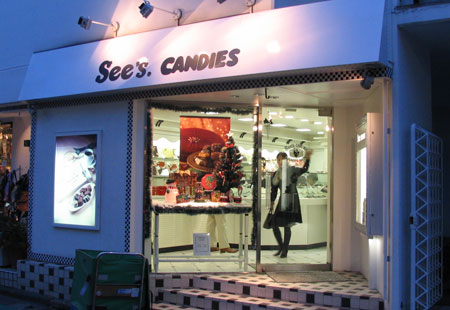
As I said, they are not readily available in Japan–but they can be gotten. If you are completely insane, or desperate. Or obscenely wealthy. They have a See’s Candy shop in Harajuku, on a side road on the north side of Omote-Sando Boulevard, nearer to the Omote-Sando Station end of the street.

1207-Sees1

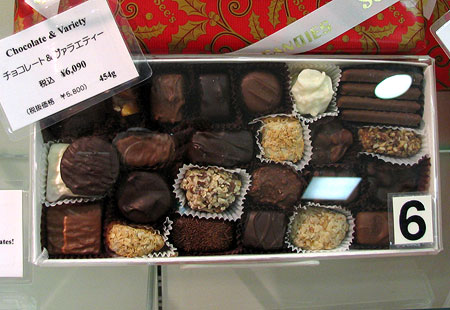
It’s not just the location that makes it less accessible: it’s the price. See’s in the U.S. is currently $14.50 (¥1620) per pound. In Japan:

1207-Sees2

Yes, you’re reading that correctly: ¥6090 per pound, or nearly $55 per pound in U.S. dollars. Nearly four times the price in the U.S. Sachi and I had, between us, a Butterscotch Square, a Scotch Kiss, and a Vanilla Caramel Nut square. Each candy averages less than a cubic inch. Theoretically bite-sized, we made them last a bit longer. And for good reason–we paid about ¥930, or almost eight and a half dollars, for those three little pieces. Nearly three bucks for one candy.

One last comparison: in the U.S., See’s traditionally gives out a free sample to each customer. You can even request a specific candy to try. Here in Japan, for their exorbitant prices, you’d think they could afford to give you at least that much. But not really. They give out samples, but each is a piece cut into quarters–every customer gets a quarter of a piece of candy.

1207-Sees3

In reflection, one can understand the logic. For example, in Sachi’s and my case, we bought three pieces; were they to give us each a full candy as a sample, that would have equalled two-thirds of our purchase, or supposedly $6 worth of candy.

Not that they can’t afford it; my brother and his wife had some See’s air mailed to them recently, and it cost less than half of what it would have from the Harajuku store; surely See’s can cut that cost even further. They are profiting from the position as a luxury product.

Just as well; I would likely lose more than a few years of my life were I to buy the stuff and eat it more often.

Categories: Focus on Japan 2007 Tags: by

Getting a New DSLR

December 11th, 2007 9 comments

So, I finally broke down and decided to get my very first digital SLR camera. The timing seems about right; the cameras I’m looking at have come down in price well enough for me to afford. The last time I looked at these with an interest in buying, the body-only prices were about a thousand dollars. Today, they hover just above $400, with simple “kit lens” sets around $500.1207-Nicanon

By this time I have it shaved down to two possibilities: the Nikon D40x or the Canon Digital Rebel XTi (also called the 400D, or in Japan, the “Kiss X.” Yeah, I know). And between those two, I am leaning heavily toward the Canon XTi.

One of the reasons is that when I checked them out at the camera shop, the Canon felt better, and more familiar. One feature that could have tilted the choice either way–the ability to compose shots live using the LCD screen–seems absent in both models, available only in DSLR cameras above a thousand dollars, or so the camera shop guy claimed.

The Nikon D40x starts at $610; the Canon XTi at $601. The Nikon got a 7.7 rating at CNet, the XTi an 8.0 (though user reviews were less enthusiastic than for the Nikon). More in-depth reviews at dpreviews.com gave the Nikon a very slight edge over the Canon, though the side-by-side feature roundup (another one here) seems fairly on par when it comes to features that matter more to me. Dpreviews did give the Nikon better marks for speed, but when I handled both in the camera store, the Canon had notably better speed in taking consecutive shots. Maybe the settings on the Nikon were wrong, or the conditions unusual?

The Nikon lacks the sensor-cleaning feature that the XTi has–something I’d be worried about–and is said to focus more slowly. Also, it looks like the Nikon’s ability to use auto-focus with attached lenses is limited. Nikon’s USB connection is quite a bit faster; though I do dislike sitting there waiting for images to download, it’s something I can live with.

I am also looking to get a good zoom lens to go with the standard 18-55mm lens that comes with the camera in “kit” form. Hopefully one that won’t break the bank; some of those higher-end lenses look lovely, but I’d rather not pay triple the price of the camera for a lens. The Sigma 70-300mm f/4-5.6 DG APO Macro Telephoto Zoom Lens; people say mostly very good things about it, and the price (around $200) looks good as well. The wireless remote for the camera also looks cheap and useful.

Anybody with experience here want to give me some advice? I’ll probably buy within the next couple of days.

Categories: Gadgets & Toys Tags: by

Seeing the Forest

December 10th, 2007 1 comment

I am soon adding a new blog to my Linkboard: Seeing the Forest, by Dave Johnson. More and more, I see posts he makes which are ones that either I intended to make myself, wish I had made myself, and/or would have made had I taken the time to do all the research. Today’s post resonated so strongly, it triggered my decision to add it to the Linkboard:

As I write this, the US national debt is about $9.17 TRILLION dollars. This debt is the amount we have borrowed to pay for our government since the Reagan tax cuts – compounded by the Bush tax cuts. This is because of a choice we made – yes I say WE, because this government is US – to borrow and pay later instead of pay now.

Don’t for a minute think that you do not owe that money. It comes to about $30,000 for each American, including infants. If you are a family of four you now owe about $120,000 thanks to those tax cuts. YOU owe this money, even though the tax cuts have primarily gone to the very rich. You WILL be paying it, one way or another. Don’t think that debt like that just goes away.

PLUS now each year we pay about $433 billion for interest on that debt. That amount, of course, rises every year. So in addition to owing all that money we have to service the debt by paying $433 billion every year. That amount is larger than the current federal deficit – which means if we had not cut those taxes and borrowed all that money in the past we would have $433 billion more each year to spend or save AND we would not owe $9 trillion.

I do not understand how we tolerate this situation. Yes, it happened because we listened to lies, but how many of our candidates are seriously talking about the changes that need to be made to fix this?

Go ahead and read through, as well as all his posts.

Categories: Blogroll Tags: by

On the Dangers of Trusting Translation Software

December 10th, 2007 Comments off

About a month ago I posted on something called “Juice Bao,” which showed how the literal translation of Chinese characters could lead to linguistic disaster. Today, the Language Log has a great “Chinglish” post which highlights a problem with Chinese-to-English translation software which led to unintentionally obscene–and hilarious–signage. I will shamelessly repost many of the photos (edited for size) from the original post. But please do go and read the original post to get the skinny on how this, erm, “error” cropped up.

Fgan10

Fgan9

Fgan11

Fgan12

Fgan13

Fgan14

Hat tip to F*cked Gaijin.

Categories: The Lighter Side Tags: by

Romney: Atheism Destroys Freedom

December 9th, 2007 1 comment

Boy, talk about hypocrisy, spin, and sucking up all rolled up into one orgasmic heave. Romney’s speech on religion was not a testament to principle, rather it was an unabashed sop to the religious right, a plea to elect a religious candidate who belonged to a different sect, but promised to fight for Christian dominance. The text of his speech can be found here.

Romney certainly begins like a Republican: invoking WWII, fascism, winning the Cold War, and radical violent Islam in the first three paragraphs, couched in vocabulary like honor, inspiring, challenge, defend, and freedom, as well as scare words like peril, risk, troubled, and breakdown, topped off with homilies to a free and strong America and the greatest generation. You can practically measure the political intensity of the speech in quantifiable precision right from the start. All he left out were direct references to Reagan and Lincoln.

Romney wastes no time in getting to the heart of the matter, namely hypocrisy. Despite protestations about separation of church and state, he immediately paints the country as a religious state, claiming religion is literally necessary for the country to function:

Freedom requires religion just as religion requires freedom. Freedom opens the windows of the soul so that man can discover his most profound beliefs and commune with God. Freedom and religion endure together, or perish alone.

Translation: atheists, go to hell; this is a Christian country and you are poison to us, representing the means of our downfall. If that’s not what he meant, it is certainly what he said. Perhaps he was just trying to suck up to the religious right, but the actual meaning of his statement is a punch in the gut to secularists. Right here, he completely contradicts himself on the whole “separation of church and state.”

But it gets better. He goes Dan Quayle on the crowd:

Almost 50 years ago another candidate from Massachusetts explained that he was an American running for president, not a Catholic running for president. Like him, I am an American running for president. I do not define my candidacy by my religion. A person should not be elected because of his faith nor should he be rejected because of his faith.

Again, his language specifically excludes atheists: a candidate should not be judged because of his faith. The correct statement is that a candidate should not be judged because of his beliefs. Huge difference. The correct statement means that there should be no religious test, that a person of any belief system should have an equal chance. What Romney said is contained purely to those who are religious, and that a candidate should not be judged by which god they bow to.

Add to that the fact that Romney is trying to equate himself to John F. Kennedy. In this, Romney fails miserably. While Kennedy, a Catholic trying to be elected in a Protestant society, also couched his speech in religious terms, he slipped in language clearly intended to include those of non-belief, and used more bold language mandating a secular government. Kennedy’s words from 1960:

I believe in an America where the separation of church and state is absolute–where no Catholic prelate would tell the President (should he be Catholic) how to act, and no Protestant minister would tell his parishioners for whom to vote–where no church or church school is granted any public funds or political preference–and where no man is denied public office merely because his religion differs from the President who might appoint him or the people who might elect him.

I believe in an America that is officially neither Catholic, Protestant nor Jewish–where no public official either requests or accepts instructions on public policy from the Pope, the National Council of Churches or any other ecclesiastical source–where no religious body seeks to impose its will directly or indirectly upon the general populace or the public acts of its officials–and where religious liberty is so indivisible that an act against one church is treated as an act against all.

For while this year it may be a Catholic against whom the finger of suspicion is pointed, in other years it has been, and may someday be again, a Jew–or a Quaker–or a Unitarian–or a Baptist. It was Virginia’s harassment of Baptist preachers, for example, that helped lead to Jefferson’s statute of religious freedom. Today I may be the victim–but tomorrow it may be you–until the whole fabric of our harmonious society is ripped at a time of great national peril.

Finally, I believe in an America where religious intolerance will someday end–where all men and all churches are treated as equal–where every man has the same right to attend or not attend the church of his choice–where there is no Catholic vote, no anti-Catholic vote, no bloc voting of any kind–and where Catholics, Protestants and Jews, at both the lay and pastoral level, will refrain from those attitudes of disdain and division which have so often marred their works in the past, and promote instead the American ideal of brotherhood.

Note the key passages: “where no church or church school is granted any public funds or political preference,” and “where every man has the same right to attend or not attend the church of his choice.” Kennedy is clearly stating that the government needs to be divorced from religion, completely the opposite of what Romney is arguing. Kennedy argued for a secular government; Romney is arguing for religious bigots to not hold him Mormonism against him. Further down in his speech, you’ll note that Romney directly contradicts Kennedy’s sentiments about separation of church and state and what form it takes. Romney will gladly claim the mantle of a popular president–just not the principle upon which that mantle is based.

Not to mention that Romney engaged in a direct political dodge in his invocation of Kennedy: Romney said that Kennedy “was an American running for president, not a Catholic running for president.” However, what Kennedy said precisely was, “I am not the Catholic candidate for President. I am the Democratic Party’s candidate for President who happens also to be a Catholic.” Interesting edit by Romney.

Romney continues:

As a young man, Lincoln described what he called America’s “political religion” — the commitment to defend the rule of law and the Constitution.

Well, there’s Lincoln. I spoke too soon above. But the key to that statement is “the rule of law and the Constitution.” This from the man who approves of warrantless wiretapping, pledges to “Double Guantanamo,” and says we should not question the government’s torture policies. Romney promises to be the same kind of Republican as Bush is: loyal to the party over the Constitution–and more loyal to the religious right as well.

But then, Romney treads into territory that many religious people do on this issue, trying to have it both ways in terms of separating but not separating religion and government:

There are some for whom these commitments are not enough. They would prefer it if I would simply distance myself from my religion, say that it’s more a tradition than my personal conviction, or disavow one or another of its precepts. That I will not do. I believe in my Mormon faith and I endeavor to live by it. My faith is the faith of my fathers. I will be true to them and to my beliefs.

I’ve heard that many times before: church and state should be separated, but my faith will direct my actions in ruling the state. I know how many religious people see this–my religion equals my morality, and my morality drives my decisions. But what about when that faith confronts matters of church and state? Surely the faith of a religious Christian informs that person that lack of religion will put people’s souls in peril of eternal damnation; this is likely one reason why so many Christian politicians favor prayer in schools, and the Ten Commandments posted everywhere.

Religious politicians try to dance on a razor-thin line here: no religious leaders will direct my actions, but my religious faith will direct my actions. That is, or almost is, a distinction without a difference, and is one of the reasons why we have such dangerous incursions by religion into the matters of state.

But Romney clearly crosses the line with this statement:

We separate church and state affairs in this country, and for good reason. No religion should dictate to the state nor should the state interfere with the free practice of religion. But in recent years, the notion of the separation of church and state has been taken by some well beyond its original meaning. They seek to remove from the public domain any acknowledgment of God. Religion is seen as merely a private affair with no place in public life. It’s as if they are intent on establishing a new religion in America — the religion of secularism. They are wrong.

This is a direct sop to the religious right wing. It’s practically the mantra of many of them, and essentially says, “we should have separation of church and state, except that we shouldn’t, really.” Like those he is parroting, Romney is trying to have it both ways–being for separation and against it at the same time.

Romney explains that “The founders … did not countenance the elimination of religion from the public square.” This is a direct reference to the abolishment of religion wherever public funds are used for funding. It is based on the principle that a single belief system must not be favored by the government over other belief systems. If one has a display of Christianity only in the public square, that is not acceptable; if one has a multi-religious display, even one not acknowledging non-belief, that is acceptable. So displaying the cross, the star of David, and the star and the crescent together on public land are legal.

Since this is not banned from the public square, then what is Romney talking about? Romney’s complaint, that religion is being “eliminated” from the “public square,” is really just religious code, which means, “Christianity is being demoted from being the sole, dominant religion, and we cannot have that; we want Christian-only displays allowed, the Ten Commandments posted in classrooms,” etc. etc. Just like the so-called “War on Christmas™,” it’s a red herring claiming that religion is being persecuted where there is no persecution; instead, the claim of persecution is used to promote the persecution of everyone else.

Romney further displays this propensity by citing the religious-right standard, “We are a nation ‘under God’ and in God, we do indeed trust.” Romney speaks of references to god in the pledge of allegiance and on currency–both of them incursions of religion in government that happened recently, in the last 50 to 100 years, in contradiction to established secular tradition. The same religious incursions that ultra-right-wing Antonin Scalia tried to invoke so as to completely demolish the wall separating church and state.

Unlike Kennedy, who, speaking to a Christian majority, slipped in language covering the non-religious, and encouraged secularism, Romney specifically excludes the non-religious, and makes repeated mention that he refers only to people of religion, that they are the only true Americans, the only free Americans.

Something else interesting from the beginning of his speech:

In John Adams’ words: “We have no government armed with power capable of contending with human passions unbridled by morality and religion. … Our Constitution,” he said, “was made for a moral and religious people.”

On this, Romney was confronted by reporters, specifically on his leaving out non-religious people. From a Newsweek blog:

“I’m wondering why you didn’t mention non-religious people in your speech yesterday, number one, and also what you meant by ‘freedom requires religion’?” asked a reporter.

An important point–but Romney deflected. “I’m paraphrasing something that’s been said both by John Adams and George Washington,” he said. “Which is that, in their view, for a nation like ours to be great and to thrive… that our Constitution was written for a people of faith and religion. It’s a very extraordinary element and foundation for our nation. I believe that’s the case.”

Unsatisfied, another reporter pounced. “Do you think an atheist or non-believer or non-spiritual person can’t therefore be a free person?” he asked.

“Of course not,” Romney responded. “That’s not what I said.”

“But you said ‘freedom requires religion’?”

“I’m talking about the nation,” Romney snapped. Next question.

Note that Romney dodged the heart of the question about non-religious people.

Pay attention, however, to Romney’s switch of language: that the “Constitution was written for a people of faith and religion.” In his speech, he said it was made for “a moral and religious people.” Does Romney see no difference between the two? It may well be that Romney is one of those people who also believes that there can be no morality without religious faith.

The conclusion that we can come away with after this speech? That Romney is owned by the religious right, desires to tear down the separation of church and state, and will not consider at all the rights of the non-religious.

After all, Romney was speaking at the George (H. W.) Bush Presidential Library; that particular Bush is known to have said, “I don’t know that atheists should be considered as citizens, nor should they be considered patriots. This is one nation under God.”

That sentiment perhaps sheds new light on Romney’s choice of venues for that statement.

Categories: GOP & The Election, Religion Tags: by

Yet More New FUD Bamboozlement Re: Mac Security

December 8th, 2007 Comments off

The International Business Times sports the headline, “Apple Mac, iPhone, No Longer Immune to Hacks.” The problem with that: Macs were never “immune” from malware, no computer is. And though Mac fans are usually tagged as the source of such claims, it’s usually the crowd that is antagonistic to Macs and Mac users who set that statement up as a straw man to take down.

So the question is, is the Mac really “increasingly vulnerable?” How accurate is this new report? Is the amount of Mac malware increasing? Are the number of security holes spiking? Is the Mac less secure than it used to be?

The answers: not really, not at all, no, no, and no. The “new” report bases its warning completely on a single trojan. Admittedly, it’s the first trojan that even shows promise of getting installed on more than one machine, but it’s a trojan nonetheless.

Trojans are a type of malware that requires the user to be fooled into sweeping aside the OS’s defenses. Trojans are the one piece of malware that no OS could possibly protect against without severely hobbling the user; they represent not a vulnerability in the security of the OS, but rather a vulnerability in the intelligence or awareness of the computer user.

For example, let’s say you get a high-end security system for your house. All the doors and windows are wired in a way that would be virtually impossible for a burglar to circumvent. If any are tripped, a security firm races to your house to apprehend the intruders. None of this, however, is of any use if you simply open the door and let in anyone who asks. This is what a trojan does, and the success of any one trojan is not the fault of the security system.

The “alert” from F-secure, a company that wants to sell its security software for the Mac, is a trumped up re-hash of similar chicken-little warnings they have issued and re-issued over the years. I suppose you can’t blame them, from a business perspective; they have a hard job. Selling security software for the Mac is kind of like selling raincoats in the desert.

The fact is that Mac malware is still so rare that the chances you’ll encounter it is close to nil. There are still no viruses and no worms that affect Macs. There have been two Trojans in the past few years that actually made it on to a few people’s computers. One was a fake image that was reported on only one computer in the wild.

The other came out more recently, and it is the focus of the new “warning.” It was a fake codec for watching porn movies. To fall victim to it, you have to surf porn sites until you find one that offers free porn movies–but they tell you that you need their special codec to play them. You must download the codec, ignore the message about installing software you found on the Internet, and enter your admin password for the installation to complete. That last part is the kicker: the password is needed only when an application needs to screw around with system resources. Only when a user passes through all these hoops–similar to a porn huckster showing up at your door and you decide to let him into your living room–will the trojan affect your computer.

And when it does, it will not spread to other computers or infect other users. Each computer must be infected one at a time.

Many of the other “threats” against Mac security are just that: threats. Not actual malware, but rather the potential for malware to be made. These took the forms of “vulnerabilities” or “proof of concept” hacks. And many of those tend to be unlikely, sometimes outlandishly so. Take, for example, a Bluetooth “proof of concept” hack in Macs reported a few years back. In order for an exploit to work, it would have to already be present on one Mac while another Mac was in the same room. Both computers would have to have outdated versions of the Mac OS, and both would need to have Bluetooth activated and discoverable. Then the infected computer would send out a signal to the clean one, telling it that a Bluetooth device was available. The user of the clean Mac would then be presented with a message by the computer, informing the user that a Bluetooth device was available, and do you want to accept it? The user would then have to agree to the incursion, despite there being no new Bluetooth device within sight.

Short story: Macs are still more than secure enough. You have to learn not to be an idiot, but that’s pretty much it, for now. Sometime in the future some actual virus or worm may materialize for the Mac, but it doesn’t look like it’s going to happen anytime soon.

The thing you have to look out for most is the scammers in the “security business” for Macs, and the media outlets that buy their FUD (Fear, Uncertainty, and Doubt) scare tactics wholesale. Take these closing paragraphs from the Times article:

News of Apple’s growing attacks comes as the number of viruses and other malware has doubled over the past year.

F-Secure had detected 500,000 viruses, trojans and worms in 2007, compared with 250,000 last year.

Doesn’t that sound like there are 500,000 viruses, trojans, and worms for the Mac? Oi vey.

Categories: Computers and the Internet, Mac News Tags: by

Another Republican Savior Going Down in Flames

December 7th, 2007 1 comment

Just when you though Mike Huckabee was looking like yet another Republican savior (first it was McCain, then Thompson, now Huckabee–their saviors have a habit of quickly self-destructing), we find out that he has some serious slime to gloss over: he argued for the release of a serial rapist and may have been instrumental in the rapist being released many years before he should have been (he was sentenced to life plus twenty years). That rapist then went on to rape and kill at least two more women.

The reason he wanted the rapist released? Because he was convicted by a jury for raping a woman who was a distant relative of Bill Clinton. For some conservatives, in their furious anti-Clinton frenzy, that amounted to an innocent man being set up by Clinton, who was clearly a mass murderer who had nearly omnipotent outreach to destroy anyone and everyone who came even within miles of anyone even remotely connected to him. I’m not kidding; some conservatives even today still believe that Clinton had dozens of people, including prominent politicians and journalists, as well as Secret Service agents, whacked. (Don’t believe me? Check out “The List,” as it’s referred to–apparently, the Clintons not only had Vince Foster killed, but John F. Kennedy Jr., Ron Brown, Admiral Jeremy Boorda, CIA Director William Colby, and many others. It’s not satire–these people are serious.)

Here’s the key part of the story, as told in the Chicago Tribune:

A jury sent DuMond to prison in 1985 for the rape of Ashley Stevens, 17, a distant relative of then-Gov. Bill Clinton.

His imprisonment became a rallying point for Clinton critics in Arkansas, who said they believed DuMond was in prison because of the Clinton connection.

In 1996, then-Gov. Huckabee joined the discussion, saying he planned to commute DuMond’s sentence in part because evidence in the case was “questionable.” Huckabee’s commutation announcement set off bitter complaints. On Jan. 16, 1997, he reversed the decision and denied clemency, although he told DuMond in a letter “my desire is that you be released from prison.”

That day, the Arkansas Post Prison Transfer Board agreed to release DuMond.

Sheer coincidence, naturally, according to Huckabee. And he claims that he had never been alerted the any evidence that the rapist was dangerous–which is now being refuted by several women who say they warned Huckabee about the man.

Of course, he denies having had any part in the rapist’s release. But even if that’s the truth–and the circumstances cast grave doubt on that claim–then Huckabee still had a strong personal desire to release a man who, when released, raped and killed at least two women.

That’s not going to look too good next November.

Categories: GOP & The Election Tags: by

Religious Hypocrisy

December 7th, 2007 1 comment

A film is coming out this week which has a pro-Christian tone. The film is being condemned by a large number of people in high positions, with large organizations calling for the film to be banned or boycotted, and the books that inspired it be removed from school and public libraries.

Ha ha, just kidding. If that happened, Christians would explode in a frenzied orgasm of persecution fulfilment, and there would be hell to pay.

The film being released, instead, is an atheist tome very similar to The Narnia Chronicles in its subtext of support for a specific belief system. The film, The Golden Compass, is recognized as having an atheist subtext.

Now, what would Christians have said if so The Narnia Chronicles had been so heavily attacked for its religious message? How would they have responded to massive boycotts and calls for the film to be banned? They would have been apoplectic, of course. And yet now, they are smugly happy to be condemning a film which does the exact same thing, except in a direction not to their liking.

So apparently it’s perfectly fine to sell Christianity to kids, but inexcusable to sell atheism. It’s OK to engage in an all-out attack against atheism, but it is an outrage to even begin to criticize Christianity.

Hypocrites.

Categories: Religion Tags: by

Been Told You’re a Spammer?

December 6th, 2007 2 comments

I just ran into the same problem that, apparently, countless bloggers have just run into: my blog stopped working. I couldn’t post, moderate comments, or do anything to change my blog. Every time I tried, I got an error, giving me this message:

We’re sorry, but we could not fulfill your request ….

Your Internet Protocol address is listed on a blacklist of addresses involved in malicious or illegal activity. See the listing below for more details on specific blacklists and removal procedures.

Your technical support key is: (deleted)

You can use this key to fix this problem yourself.

A link is then given to “fix the problem,” but it’s just a page which tells you that you’re a spammer or have been taken over by them:

Your computer’s IP address was determined to have recently sent spam or engaged in malicious activity as reported by a third-party monitoring service. This means your computer is most likely infected with viruses or other malicious software. See below for more information and removal instructions.

This I knew was BS–I use a Mac, and there’s nothing bad coming out of this system.

A quick search revealed the real cause: anti-spam software used by WordPress, specifically Bad Behavior, has screwed up in a major fashion and has blacklisted a lot of people who should not be blacklisted. Thanks a ton there.

So I went in and deactivated Bad Behavior, and the site works again.

But I also realized that this was probably also the reason why no one left a comment on the blog in the past 24 hours. If you tried to comment in the past day and got denied or told you were a spammer, my apologies; the problem is fixed now.

Bad Behavior, however, seems to be living up to their name; despite inconveniencing huge numbers of people, there was not so much as an apology on the site, just this explanation:

Update: Some people have asked for more details on what exactly happened. In brief, yesterday I moved all of my sites to a new dedicated server. In the process, I decommissioned an old blacklist I was running which I thought wasn’t being used, not realizing that Bad Behavior was still set to use it. Shortly afterward, I found myself locked out of my own blog, just as you all did. So therefore, this release.

Apology accepted. Man, what an ass–he takes on the tone of, “hey, I was inconvenienced too, so siooma.”

To make it worse, Bad Behavior did not give any clue in the process that it was responsible for blocking your site. Neither the initial error nor the less-than-useless “fix the problem” page gave any clear indication that it was Bad Behavior that was causing the problem. If I had not found references to the same error message in other people’s blogs via a Google search, I would never have guessed that Bad Behavior was the problem, and would have had to spend several frustrating hours trying to figure out what was wrong.

To the author of Bad Behavior: that is not just bad design, that is stupid design. What kind of software shuts down a site and then gives no clue as to what’s doing it? I may still use the software if spam increases while it’s off, but if I do reactivate it, I will take this idiotic design flaw into account and suspect Bad Behavior as the culprit whenever anything goes wrong.

Categories: BlogTech Tags: by

Prominent Republican Believes In Separation of Church and State

December 6th, 2007 7 comments

But only when it serves him, of course. The Republican, in this case, is Mitt Romney, and he’d rather not people pay attention to how different his religion is. So he’s getting religious about the First Amendment, sounding like a liberal Democrat on the issue:

“We separate church and state affairs in this country, and for good reason. No religion should dictate to the state nor should the state interfere with the free practice of religion,” he will say, according to excerpts of a speech he is to deliver at the presidential library of former President George H.W. Bush in College Station.

Figures that you’d have to wait for a Republican who would be hurt by the massive religious bigotry in play with every presidential election, to hear a conservative talk like that. And it’ll hurt Romney, partly because of his Mormonism, and partly because so many Republicans want the opposite of separation of church and state.

Of course, one can bet that he believes in separation of church and state only so far as his differences with mainstream Christians. But see what happens if someone asks him if it would be equally good to have a staunch atheist in the White House, and then watch him squirm out of it.

Reportedly, Romney will also say, “If I am fortunate to become your president, I will serve no one religion, no one group, no one cause, and no one interest.” Funny–it brings me back to a scene from “Contact,” when Ellie is being shot down from being the person to travel as a representative of the human race, seeing as how she is an atheist and that “95%” of the people on Earth believe in a god. It always occurred to me that an agnostic (called an “atheist” by some) would be the ideal choice: someone who has not decided on any one belief system, someone unwilling to reject the many possibilities.

You can bet that what Romney means by “separation of church and state” in this context is, essentially, don’t apply your religious bigotry against me.

But I am sure that there are many conservative Christians who will apply the same logic to this as they do to gay marriage: let gays marry, and next a man will be marrying sheep. In this context, let a Mormon be president, and sooner or later a filthy atheist could win an election. And of course we all know that the collapse of civilization would soon follow.

Categories: GOP & The Election, Religion Tags: by

Microsoft: Vista Being Pirated Less

December 5th, 2007 Comments off

Here’s the money quote:

In the last year alone, we have pursued legal action against more than 1,000 dealers of counterfeit Microsoft products, taken down more than 50,000 illegal and improper online software auctions and reached out with our “How to Tell” and anti-piracy focused educational Web sites to millions of customers. While piracy rates are hard to measure precisely, we’re seeing indications from internal metrics, like WGA validation failures, that the Windows Vista piracy rate is less than half that of Windows XP today.

The intended message? Vista’s anti-piracy measures are much more successful than XP’s. Of course, it’s bull, like most statements that come out of Redmond. First, all you need is one successful Vista counterfeiting exploit, and then any number of people can use that. So unless MS is peering into every computer in the world, there’s no way they can truly judge how much any piece of software is being pirated.

As for validation attempts, successful pirating attempts circumvent the validation process entirely, they don’t try to connect to Microsoft and fake them out. People with pirated systems usually know that they have to wait for pirated updates; only stupid people agree to validation on pirated systems. On the other hand, only stupid people would pirate Vista in the first place, so maybe they do have something there.

But a cut in the amount of Vista piracy has a rather obvious cause other than better copy-protection. The best anti-piracy measure you could possibly enact is to create a piece of software so crappy that a lot fewer people would want to pirate the thing.

Which is most likely what we’re looking at here.

Categories: Computers and the Internet Tags: by

Rescue the Constitution

December 5th, 2007 2 comments

The above ad is being rejected by Fox News. The reason? Expressed in this letter from Fox News account executive Erin Kelly to the advertiser’s communications manager:

We cannot approve the spot with it being Danny Glover’s opinion that the Bush Administration is destroying the Constitution. If you have documentation that it is indeed being destroyed, we can look at that.

Sorry about that.

Yes, there is no evidence whatsoever that the Bush administration is destroying the Constitution.

None at all.

Categories: Political Ranting Tags: by