Ghosts of 9/11 Past

September 11th, 2007 4 comments

I am taking this opportunity to look back at my 9/11 comments from years past in this blog. It is not surprising that the same ideas still apply, more than ever before. It is depressing that things have only gotten worse, that we have not learned, that we have embraced the authoritarian rule that has brought us only poverty and self-ruin. Had we simply been brave, bold, and determined after 9/11, had we scoffed at the terrorists instead of accepting the official instigation to cower in fear, then we could still be strong today, still be standing tall, the stoic and admired leader of the world, not the bully who would be pariah if his power ebbed.

Terrorists are not the threat we are told they are; they have no new powers they did not have in the past; we are in no more danger from terrorism than we were before, in fact we are probably safer than before. You are in greater danger from traffic than from terrorists. Fear is the enemy, and fear is now used by the politicians to make us cowed and pliable. Our Constitution, the very core of America, is being whittled down to make way for a new order, a perfect world by the lights of conservative and neo-conservative dreamers, who in the past could never have made these dreams real because the Constitution prevented them.

The threat is not from without, it is from within. Fight against fear, fight for your rights and freedoms. Be an American: fear not, accept risk, and hold liberty as more dear than life itself.

Over the past six years, we have done the exact opposite. We have trembled in fear, bought wholesale the lies of those who want us to fear, and applaud when they remove more and more liberties, foolishly believing that we are “safer,” meekly believing that such imagined safety is worth losing our liberty over. We have been addled cowards, undeserving of the proud name “Americans.” We have let manipulative fascists control us.

Yes, fascists, and do not dare suggest that the use of that word is ridiculous or makes the one who points to it a conspiracy nut, as if fascism could not possibly exist today.

Do you really believe that Americans are not living in a fascist state today? Consider the dictionary definition of fascism: “an authoritarian and nationalistic right-wing system of government and social organization.” How could that possibly not apply to the past six years?

Fascism is when individual and societal interests are considered less important than the needs of the state. How could that possibly not apply to the past six years?

“The Anatomy of Fascism” describes what we are experiencing to a T; fascism flourishes with and is marked by:

  1. a sense of overwhelming crisis beyond reach of traditional solutions;
  2. belief one’s group is the victim, justifying any action without legal or moral limits;
  3. need for authority by a natural leader above the law, relying on the superiority of his instincts;
  4. right of the chosen people to dominate others without legal or moral restraint;
  5. fear of foreign “contamination.”

Look at that list. Every one of these is true today in the U.S. We feel a sense of crisis (terrorism) beyond traditional solutions, hence the policy of pre-emptive war and the abrogation of civil rights and liberties.

We believe we are victims of 9/11, victims of terrorism; this on top of the long-held and long-cherished right-wing tradition of being the ultimate victim despite having the greatest privilege and power. White males are victims. Christians are victims. Right-wingers are victims of the “liberal media” and vicious left-wing conspiracists attacking from dark corners and even coffee cups.

Bush has been considered by the fearful as a natural leader, allowed to lead by instinct instead of fact or reason.

We consider ourselves a chosen people, above all others in the world: note our insistence that other countries join our military ventures under our command, but that it would be unthinkable that any of our forces fall under the command of anyone else; note the dismissal of the Geneva Convention and the easy acceptance of torturing and imprisoning people of other countries without a thought; note our willingness to kill hundreds of thousands in other lands, and then either pretend they love us for it, or wonder incredulously why they do not.

And finally, we fear foreign contamination: we “suffer” from a “crisis” of illegal immigrants, we have to accept the idea of English-first and English-only or be labeled un-American; and many right wingers dread the fact that within the next half-century, Hispanics will form the majority, and whites will lose their privileged status.

It is hard to not see fascism, not creeping in, but flowing in freely through the gaps in our core principles that have been gouged out by our fear.


The following are excerpts from my comments on 9/11 from 2003, from the now-defunct expat.org:


Two important truths after 9/11 are still not widely accepted by Americans: first, we are no more likely to be the targets of terrorism today than we were before 9/11, and second, the “War on Terror” has been abused to rework the political landscape and take actions that Americans would never have approved of in times of peace and calm.

The terrorists have not magically acquired new powers, and now that we are aware of the possible threat, our security is tighter than before (although far too much has been spent in foreign ventures which could much more productively have been spent on security at home). The likelihood of something as spectacular or widely devastating as 9/11 happening again is less than it was two years ago. Instead of feeling less secure, we should feel more secure.

Bush did not squander the reflexive, fear-based popularity 9/11 gave him, and immediately found it reason, as well as a smokescreen, to launch every conservative motion that could be rammed through Congress. What is telling is that almost all of what has been accomplished is pretty much identical to what conservatives have wanted all along: greater police powers and diminishment of civil rights in criminal investigations, growing the military, taking on foreign ventures in oil-rich countries, and pronouncing the protection of America and the safety of its people a Republican domain. All of these have been installed under the guise of “national security,” and Democrats have felt enormous pressure to go along: the Bush administration has made it very clear that dissenters will be labeled enemies of the homeland; Anyone who dissents is depriving us of security and giving aid and comfort to our enemies. Hermann Goering would have been proud:

“Why of course the people don’t want war … But after all it is the leaders of the country who determine the policy, and it is always a simple matter to drag the people along, whether it is a democracy, or a fascist dictatorship, or a parliament, or a communist dictatorship … Voice or no voice, the people can always be brought to the bidding of the leaders. That is easy. All you have to do is to tell them they are being attacked, and denounce the pacifists for lack of patriotism and exposing the country to danger.”

Our liberties were among the first to suffer. “Homeland” security (a name eerily evocative of mid-twentieth century European fascism), with provisions to violate personal freedoms to an extent never dreamed of a few years ago, was passed almost without question. All Bush had to do was to proclaim, “An Evil exists that threatens every man, woman and child of this great nation. We must take steps to ensure our domestic security and protect our homeland.” Sounds reasonable, right? The only problem is, those words were spoken by Adolf Hitler. Bush simply paraphrases.

This is not to say that Bush is Hitler. It is, however, to point out that the formula for using fear to control a populace and lead them into war has not changed.


Three years later I wrote the following, in 2006:


The damage done to our country over the past five years has been immeasurable. Our economy has been gutted where it once stood on the edge of hope, and now may never recover as it could have only a few years ago. We are now mired in a meaningless war that has so drained and torn apart our military that it is questionable as to whether we could sustain ourselves in a serious conflict. Our freedoms and civil liberties are endangered as never before. What once was a news media that worked to a degree has now been subverted and dragged down into a mud that makes anything that comes from it suspect. The arena of politics, in even worse shape when this started, is now so degenerate that it is hard to see anything constructive coming from it again.

It is easy to lose hope. But there is a way out. And one prerequisite of finding the way out is that we recognize the source of the problem. And the source is not the terrorists.

The terrorists were a spark. They are still a danger, but not the greater danger, to be certain. The majority of plagues that we now suffer were created by those who hijacked the power created by the fear the terrorists instilled in us. So let me suggest some tools that could be used to fight the real danger:

  1. Resolve not to fear. Our present leader tells us to be afraid, where past leaders taught us to avoid fear. We have terror alerts, terror arrests, we are told that enemies abound in the world and unless we do as we are told by the government, they will slaughter us. Criticize the government, we are told, and you embolden the enemy.

    Do not be afraid of terrorists. They are not that great of a threat, not enough to allow what has been done to us in the name of fear. There will always be attacks. We simply have to live with that, just as we live with the possibility of traffic accidents, natural disasters, and crime. 50 times more people have died in traffic accidents in American since 9/11 than died in terror attacks. Be vigilant, have good investigative police work, have good international cohesion and support, and we can deal with terrorism as well as it can be dealt with. Terrorists were here before, and they will always be here. We must protect against terrorism just like the other threats, but it should not control us or allow others to control us.

  2. Fight for liberty. By “liberty” I do not mean “against terrorists”; such a mindset empowers those who truly threaten us now. By “liberty” I mean the principles that our country was founded upon, the principles so threatened at this time. The principles that so many conservatives hate so fiercely and would wish to destroy. The principle of separation of church and state. The principle of individual rights. The principle of limited governmental power. It is not our personal safety which is at stake here, it is our liberty. And it is not terrorists who threaten us, it is our own current government and those who support it.

  3. Appeal to reason and fact. Do not allow others to think for you, and truly study and understand what is happening. Almost all the conservatives I have observed visit this site have come armed with nothing more than arguments they heard others make, their arguments as shallow as the punditry they absorbed. It is usually easy to shatter the arguments simply by digging just a little bit past the copied-and-pasted propaganda; what is harder is to shatter the presumption of righteousness that goes beyond facts, information, and truth. These are the extreme examples of people who have surrendered their ability to rationally observe a set of facts in order to instead appease their desired perception of reality. If you surrender your reason to sate your desire, you are terribly easy to control, like a cigarette smoker instantly believing a study that says smoking is not harmful, disregarding the fact that the study is a fraud paid for by the tobacco companies.

    Most people are not yet too deep in that abyss yet. To keep from being dragged in, you must never allow your desire for a thing allow you to believe it. I believed in the Killian National Guard memos too easily and for far too long, only because I wanted to; that caused a weakness in my ability to argue and debate, and probably caused those who read what I wrote to believe my words less. Don’t be afraid to question what you want to hear. Study the information. Reason for yourself instead of simply following the crowd you have chosen. Don’t be afraid to come to a conclusion, but allow the facts, and not your fears or desires, to inform that conclusion.

    A tangent to this is the need to keep the media honest. Do not accept the words of those whose bias overrides their dedication to the facts and honest appraisals of a situation; do not accept the idea that opinion rates as strongly as fact. The truth does not compromise; if a contention or representation is not supported by fact, then it is not acceptable. The truth, the whole truth, and nothing but the truth should be the standard, and if a media entity giving the impression that it relays facts does not live up to this standard, it should be duly and strongly scorned and disrespected. Somehow, along the way, too much opinion crept into factual reporting. There is a place for reporting, but the core of a healthy news media is stark, bare fact.

  4. Be willing to sacrifice. Desire can be all too compelling a weakness for others to control you with. You want money too much, and so others use that desire to rob you. You want safety too much, so others use that to steal your freedom. We are far too easily manipulated because we crave more than we think. We crave tax cuts and so vote for them, only to find we’ve been shaken down and tossed aside. We think we can get things without paying for them, so we end up with education and health care in a shambles, and still believe the impostors who tell us that “throwing money at the problem won’t fix anything,” even as they throw trillions of dollars at rich people because that will “fix” the economy.

    As Robert Heinlein said, TANSTAAFL: There Ain’t No Such Thing As A Free Lunch. Don’t vote for a tax cut because you’d like an extra few bills in your pocket; be willing to sacrifice for better schools and hospitals. And instead of whining about how politicians can’t be trusted to spend, try to actually monitor how your representatives vote and control their actions like you should be doing. In a democracy, the citizen is supposed to be the boss. So act like one. Be informed, responsible, and manage. Surrender that control, and expect to be cleaned out by con men.

    And one more thing: if you think a war is necessary, be prepared to enlist and fight. If even half the conservatives of fighting age who spend their days vehemently arguing the ‘rightness’ of the war in Iraq were to actually enlist and serve, there would be no problems with the shortage of troops.


And then there is this, from September 1, 2002, almost one year after 9/11, and before I started the blog in earnest:


Perhaps the reason why [we accept the erosion of liberties] has to do with that confidence that it “won’t happen to me.” After all, I’m not a terrorist. I will never even be accused of being so much as a suspect (or, more insidiously, a “person of interest”). And the people they take away, they will certainly be bad people; we don’t arrest and detain innocent people, after all. And it will make me safer.

Will either error or corruption ever reach you? Does it matter? Should you allow this even if you are guaranteed that you, personally, will never fall to such a fate? Are you willing to sacrifice the freedom, liberty, and even lives of innocent people so long as your hide is a bit safer?

There’s a word for people who act in that manner: cowards.


This is George W. Bush’s legacy: he turned the United States into a nation of cowards, trembling fearfully at shadows, so that we could become more pliable and easily manipulated.

America as a set of core principles still exists; it cannot, in fact, be destroyed. But more and more each day, the United States ceases to be that country.

I await the day when America returns.

Categories: 9/11 News, Political Ranting Tags: by

Well… That’s Not Very Impressive…

September 11th, 2007 Comments off

The iPhone unlock is going on sale today… for a cool hundred bucks. If that’s not enough to make you think twice, then read the disclaimer which says that if Apple happens to re-lock your iPhone via a software upgrade or something, they will charge you again to re-unlock it.

A hundred bucks and no guarantee that you won’t have to shell out another unspecified sum more times in the future? The one-time high price one could get past, but after that, you’re kind of at the mercy of the winds of fate to pay open-ended amounts of money to keep what you might think is already yours.

I kind of expected this to go for fifty bucks with a promise to do their best to re-unlock for free if Apple re-locked it. But then again, we’re talking about getting away from a 2-year commitment to AT&T. When you think about it, why should AT&T be able to lock you in for that long when they aren’t even subsidizing the phone’s cost? If you can get into a cheaper plan without the long-term commitment and possibly better service, then the $100-plus-who-knows-what might be a deal… especially if AT&T doesn’t even serve your area.

Categories: Mac News Tags: by

Site Down

September 11th, 2007 2 comments

Sorry, the site was down for somewhere between 5 to 10 hours. Don’t know why, and if the web host acts like all web hosts do, I will probably never know. One of those glitches, and life goes on. Apologies to those who tried to access the site and could not.

Categories: BlogTech Tags: by

1500 Days

September 10th, 2007 1 comment

Just another meaningless milestone. But like so many others, I do like to see the odometer click over to at least a few zeroes. 1500 days of nonstop blogging.

Categories: BlogTech Tags: by

Yes, Let’s Trust These People

September 10th, 2007 3 comments

Last month, I discovered how a web host could come close to shutting you down because your site uses more server resources than it is supposed to. In fact, that wasn’t my doing–it was a combination of hotlinkers, image search engines, and spammers all hitting my site at once. But at least the web host contacted me with specific guidelines about what was going on, what levels of use were acceptable, and general guidelines as to how to achieve those goals.

It seems that in the U.S., the Telecoms are starting to crack down on users for using their Internet connections “too much.” The punch line: they won’t tell customers how much “too much” is.

Comcast has punished some transgressors by cutting off their Internet service, arguing that excessive downloaders hog Internet capacity and slow down the network for other customers. The company declines to reveal its download limits.

“You have no way of knowing how much is too much,” said Sandra Spalletta of Rockville, whose Internet service was suspended in March after Comcast sent her a letter warning that she and her teenage son were using too much bandwidth. They cut back on downloads but were still disconnected. She said the company would not tell her how to monitor their bandwidth use in order to comply with the limits.

“You want to think you can rely on your home Internet service and not wake up one morning to find it turned off,” said Spalletta, who filed a complaint with the Montgomery County Office of Cable and Communication Services. “I thought it was unlimited service.”

It looks like we’re talking about Internet over cable TV lines, where bandwidth is shared between many homes in a neighborhood. A few users could potentially be using huge amounts of bandwidth and spoiling things for their neighbors.

However, the real crock here is that Comcast is refusing to specify what the bandwidth limits are. The article does not state what Comcast advertises when it sells the product, or what is specified in contracts about bandwidth use. But they do note:

Companies have argued that if strict limits were disclosed, customers would use as much capacity as possible without tipping the scale, causing networks to slow to a crawl.

Frankly, I find that hard to believe. Companies almost always advertise a certain speed for their service, and cable companies are well-known for advertising limits far beyond what can reasonably be accessed–you sign up for a service touted to be 10 Mbps, but find you’re not able to get better than 1 Mbps.

But not specifying the cutoff point, where you could lose your service entirely? Imagine that the electric company calls you and tells you, “you’re using too much electricity; stop that or we’ll shut your power off.” And when you ask how much you should cut or how to do it, they say they can’t tell you. What are you supposed to do? The only way to be safe is to almost stop using power except for the bare essentials.

I am not a computer engineer, but I imagine that it would not be very difficult or expensive to install a bandwidth choker in homes that abused bandwidth limits. After all, there are Ethernet hubs which cut off at 10 Mbps, and they can probably be produced for very cheap–less than $10, I imagine. There must be even simpler ways of restricting bandwidth–the 10BASE-T Ethernet hub is simply an example that it can be done. So why doesn’t Comcast do this instead of cutting people off?

Probably because it’s easier, and because they can.

Not to mention that some years back, Comcast and the others promised everyone high-speed, fiber-optic networks in exchange for raising their rates. We said yes, they raised their rates… and now they not only don’t have those promised networks, but they are actually cutting off customers’ service for using more than an unspecified amount of bandwidth.

These are the people we’re supposed to “trust” by abolishing Net Neutrality and giving them complete control over our Internet experience. Yeah, good idea.

“Adventurers” and “Thrill Seekers” Should Pay in Advance

September 10th, 2007 2 comments

I don’t want to sound cold, but I have issues with the search for Steve Fossett.

First, this guy’s rich. Second, he failed to submit a flight plan–apparently he couldn’t be bothered.

As a result, the search for him is extremely hard–and the public is picking up the tab for a lot of it, as much as $110,000 so far, probably more. The question is, why? If Fossett had filed a flight plan–this being one of the main reasons we do that sort of thing–I’d have a bit more sympathy. But when some rich old fart who thinks the rules don’t apply to him goes off and gets himself killed, I’m not so sure that the taxpayers should pick up that particular bill. If I were a Nevada taxpayer, I’d want the estate to pay for every cent spent on the search.

This also brings up how much public money should be used rescuing “adventurers” and “thrill seekers” when they get into trouble. Some rescue efforts there are no questions about–people who went camping and got lost in the forest, someone who got lost driving in the countryside and got caught in a blizzard–in other words, people in situations we would consider relatively ordinary and reasonable.

The threshold might come when you cross that “ordinary and reasonable” line. People climbing mountains in national parks under reasonable conditions would be on the safe side of that threshold, for example. But we don’t classify them as “thrill seekers.” No, it’s the people who do crazy sh*t under radical circumstances. Like these old-fart millionaires and billionaires who do stuff fly fly around the world in hot-air balloons, though they’re the extreme examples. People who throw themselves off of cliffs, climb high mountains, or try to kayak across the Pacific solo or whatever–these people are doing what they do solely for self-gratification, for the adrenaline rush or for personal vanity.

Mind you, I have no problem with them going off and killing themselves if that’s the risk they want to take; it’s their life, they should be able to do with it what they wish. What I object to is the idea that we’ve got to then go out of our way to care for them, and to pay for the inevitable search and rescue, and probably, in the cases of those without a lot of money, their hospital bills.

Like I said, I don’t want to sound cold, but if these people want to risk breaking their necks just so they can get an adrenaline rush, and come back saying “Am I a badass or what??” then they should pay for their own search-and-rescue, or else be satisfied with knowing that there won’t be one.

Categories: People Can Be Idiots Tags: by

When in Doubt, Blame Clinton

September 9th, 2007 Comments off

Josh Marshall has a spot-on review of the resurgence of Clinton-bashing (Bill Clinton, that is) among Republican candidates recently. The short story is that, like Bush did in 2000, Giuliani and Thompson are now blaming all the woes of our military on the Clinton administration. And it is just as bogus a charge now as it was in 2000.

Apparently nobody remembers that Bush Sr. was the one to institute the “Peace Dividend” and established the policy of a smaller military:

The peace dividend is a political slogan popularized by US President George H.W. Bush and UK Prime Minister Margaret Thatcher in the early 1990s, purporting to describe the economic benefit of a decrease in defense spending. … The term was frequently used at the end of the Cold War, when many Western nations significantly cut military spending.

Clinton merely followed in Bush 41’s footsteps–but Bush 41 was the one who truly “gutted” the military, if that’s what one calls it. Back in July, Mitt Romney also blamed Clinton for cutting the military, and FactCheck.org took him to task for it:

It is not correct to say that the Clinton administration began to cut U.S. military forces. No matter how you measure defense spending, President George H.W. Bush had significantly trimmed it by the time Clinton was sworn in. And it was Bush’s administration, not Clinton’s, that first boasted of a “peace dividend.”

In fact, Bush cut military spending more than Clinton did. Check out this chart:

0907-Defense-Constant

In constant dollars, Bush 41 cut defense spending by $59 billion per year; Clinton cut defense spending by $43 billion per year. And guess which Bush 41 administration official said this:

[O]verall, since I’ve been secretary, we will have taken the five-year defense program down by well over $300 billion. That’s the peace dividend.… And now we’re adding to that another $50 billion … of so-called peace dividend.

If you guessed “Dick Cheney,” you’d be right.

Now, you might argue that Bush 41 cut the defense budget all that it should have and Clinton went overboard and cut more than he should have. Except that it’s not true. When Bush 41 left office, he left behind guidelines for defense spending through 1997, which called for a further 19% cut in defense spending. Spending under Clinton was cut less than Bush 41 dictated, and then was raised again after 1997. A post-Cold-War report explains:

Not only was the drawdown of the 1990s clearly a bipartisan affair, the best available evidence suggests that Democrats and Republicans are still [in the year 2000] remarkably close in terms of their support for defense spending.

The fact of the matter is, Clinton left George W. Bush a far stronger military than Bush has produced today, despite Bush Jr.’s stratospheric defense spending. Besides which, if the best efforts of Republicans to rebuild the military in a wartime footing have failed miserably, despite having seven years to do the job, isn’t it a bit late to be blaming someone from the previous century?

After all, as you’ll note in the chart above, Bush 43 has ballooned defense spending by $118 billion (in constant 2000 dollars), or by 40%, to levels higher even than the peak of the Reagan years. After pouring all that money into the military, why is it far less healthy today than it was in 2000? Maybe conservatives are right when they say that “simply throwing money at the problem won’t fix it.” Too bad they only say that when it comes to education, and not when it comes to defense.

Despite Dubya’s rantings in 2000, the military was just fine when Clinton gave it to Bush. Clinton did, after all, use it to fight and win two wars, and Clinton’s military performed brilliantly when Bush needed them to go into Afghanistan and later into Iraq. It was Bush’s mismanagement that later wrecked these two missions, and left the military in the mess it suffers today.

Our military is overtaxed today, with soldiers forced to go into combat without sufficient training or equipment, and to serve unreasonably long and numerous tours of duty–which explains why military recruitment is suffering a crisis, and why returning soldiers are suffering from post-traumatic stress, leading to higher suicide rates.

Romney, Giuliani, Thompson and other conservatives can try to blame Clinton as much as they want, it won’t make it true. Unfortunately, conservative politicians today are less about building truth than they are about building myths–and they’re damned good at it.

Categories: GOP & The Election Tags: by

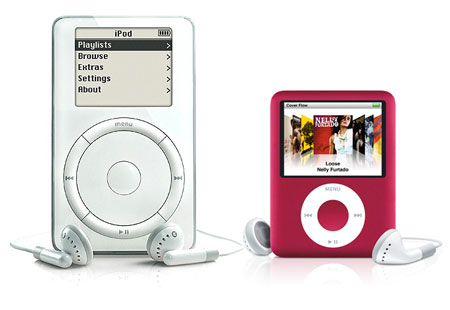
iPod Evolution

September 9th, 2007 6 comments

0907-Ipod2001-2007

How things change.

If you bought the first iPod back in 2001, you would have had the choice of the 5GB and 10 GB models (“1000 or 2000 songs”), with a 2“ black-and-white screen at 160 x 128 pixels, for $400 and $500, respectively.

Today, if you buy the 3rd-generation iPod Nano, you will have the choice of the 4GB and 8GB models (”1000 or 2000 songs“), with a 2” color screen at 320 x 240 pixels, for $150 and $200 respectively.

So we have essentially the same screen size and storage capacity, but today, six years later, you get twice the screen resolution, with color, movies, etc., at 40% of the cost.

Things have a tendency to change pretty quickly in technology. I remember, in the 90’s, getting a 105MB (that’s “MB”) hard drive for $300. I look at my AGFA digital camera from ten years ago and laugh; I look at the images it took and cry. Ten years ago, a 100 MB Zip disk cost $15, where a 1GB flash USB stick can be had for the same price today.

Yes, I know this is kind of a given, we all know about it… but still, it kind of surprises you to look back and see the differences.

Categories: Mac News Tags: by

Unlocking the iPhone

September 8th, 2007 Comments off

Engadget has an image gallery of what it looks like to unlock the iPhone so you can get away from AT&T and (presumably) use the iPhone with any carrier you like. Looks like a very simple process. They say it’ll be available on Monday.

Categories: Mac News Tags: by

The Squeaky Wheel and All That

September 8th, 2007 2 comments

Something I just realized about my cell phone: those ninnies over at Willcom seem to have slipped me a new battery. The old one was rated at 60% efficiency–it wouldn’t hold a charge for too long, but was enough to last the day on stand-by, which was good enough for me. I only asked that they repair the contacts to the charger, and when I originally went in, they claimed that a battery replacement would cost more than the “point” credits I had built up could pay for.

I’m also pretty sure that they did this in response to my getting upset at having been jerked around. I had never looked at it and noticed, but the battery is incorporated into the back panel of the phone. My phone previously had a lot of scoring and wear on the back before. Now when I look at it, it’s clean and new–on the battery part only.

0907-Batton-450

The thing is, I happened by chance to see that the old battery was still in place after the main repairs had been completed. When I came in to pick up the phone, I checked out the repairs (you can see in the image above that the battery contacts–the gold insets at the bottom–were changed), and happened to note that there was all that wear and tear on the back. Later, when I got upset and let them know it because they made me come back again and again and again, they must have said, “This gaijin is pretty pissed off–let’s give him a new battery for free.”

The weird thing is, they didn’t tell me. Not a word. They didn’t point it out, though they had every chance to. When I picked it up for the last time, I did notice it looked nice on the back, but figured that this was just a change in the casing only. It was only later, when I noticed that the phone held more of a charge than usual, that I figured out what they had done.

Usually, I would expect them to announce such a thing, by way of reiterating an apology and saying, “look, we gave you a new battery.” Maybe they just figured that I’d notice it and appreciate it anyway. Not that I don’t–but I would have just as soon kept the old battery and not dealt with all that hassle. It’s not like I’m keeping this phone for one minute longer than the new iPhone is released in Japan.

One extra note here: did I get the new battery because I’m a foreigner? I hear this a lot from Japanese people I know who are familiar with foreigners in Japan. I hear it a lot: “Oh, you got that service because you’re a gaijin. They would never do that for a Japanese.”

Is this really true? Somehow I have the feeling that it’s not true as often as I hear–that instead, foreigners get these things more often because we ask for them, or complain more loudly. Anyone out there have more experience with this, and an opinion?

Categories: Focus on Japan 2007 Tags: by

Free iPhone Ringtones

September 8th, 2007 Comments off

Not that I can use this–yet–but someone has figured out a dead-easy way to make any audio file into a ringtone. Just use an AAC file (convert it to AAC using iTunes if it’s not AAC originally), change the extension to “.m4r” and add it to the iTunes library (if the file was there before, you have to remove it at least temporarily). ITunes will see it as a ringtone.

Seems rather too easy, as if this were an oversight by Apple. Probably they’ll have closed this loophole up by the time I get an iPhone… but I’m pretty sure that there will always be a way to add ringtones for free; it’s too popular a hack not to happen.

Apparently the file cannot be bigger than 3.1 MB. Of course, before you convert the file to an AAC, you can use an audio editing program like Audacity (version 1.3 can import AAC files directly) to edit it down to whatever you like.

NOTE: Apple moved fast. 48 hours after the trick was discovered, Apple closed the loophole. But other hacks still work.

ANOTHER NOTE: That didn’t take long either–someone found another easy workaround to Apple’s block for the original workaround. Just do the process as described above, but after importing the file into iTunes, change the file extension again from “m4r” to “m4a.” That’s it. At least, that’s it until Apple applies yet another block.

Update: Engadget has an article discussing the legality of making your own ringtones. In essence: iTS downloads are a no-no, but CD tracks or original audio is OK; but whatever the legalities, nobody’s going to bother you about it unless you start selling or distributing copyrighted material.

An interesting piece of info from the article: the RIAA fought to win a decision from the copyright office that allowed them to sell ringtones separately as if they were derivative works, but that they didn’t have to pay the artists as if they were derivative works. In essence–they get to sell the songs in a new market without giving a penny to the artists.

Because, as the RIAA keeps on saying, they care so much about the artists getting cheated out of their income.

Categories: Mac News Tags: by

Bush Impresses Australians

September 8th, 2007 3 comments

Bush is attending the APEC summit in Australia. From the Australian press:

US President George W. Bush today thanked “Austrian” Prime Minister John Howard, in front of a summit of business leaders, for being a kind OPEC host.

Gosh, we are so proud of our president.

Bush Administration Accepts Bribes, Attacks Net Neutrality

September 8th, 2007 Comments off

Net Neutrality is an utter necessity for the Internet. It essentially says, “everyone on the web is free and equal,” and keeps Telecoms from becoming despotic tyrants who can tell you what to do, when to do it, how to do it, and how much you can pay them for the privilege.

So naturally, the Telecoms want to control the INternet. There are two major dangers: first, creating classes of Internet speeds; and second, the Telecoms will be able to dictate what programs you use for accessing the Internet.

The former would mean that you will pay more and get nothing in return. Anyone who refuses to pay Telecom tolls will get tossed into the slow lane; everyone else will have to pay for the privilege of not being slowed down. You, the consumer, will have to pay more for stuff you do on the ‘Net, or pay something that you get for free today. Telecoms say “we should get paid for what we give,” but they already do. Everyone pays for bandwidth, including Amazon, Google, YouTube, and Apple. And you. The Telecoms simply want to charge you more.

The latter would mean that you won’t have perfect freedom to use the apps you want to use. It means that if you want to use Skype, but your Telecom has latched onto the idea that they can ban Skype and force you to use their app instead, they can do that. And they will charge you money for it.

Essentially, the Telecoms are saying, “Trust us! We would never do any of those things!” When, of course, those things are the only reasons to kill off Net Neutrality. Of course they’re going to do those things.

The Telecoms insist that they would never censor free speech, which might also be possible if Net Neutrality were killed off. A red herring–while some complain that this might happen, it is the least of the complaints. Few believe that the Telecoms would shut off free speech when they can make money off of it instead.

Anyway, the Democrats generally support Net Neutrality, and were instrumental in keeping Republicans from killing it off last year.

Not having the GOP in Congress to do their bidding, the Telecoms have turned to the last bastion of Republican power: the White House. And as the loyally-bought politicians that they are, they have delivered: the Bush Department of Justice has delivered an Ex Parte Finding which could have been written by the Telecoms themselves–and probably was. It makes all of their lame arguments, chief among them that Net Neutrality prevents Telecoms from charging for services, and using that money to improve services and provide new high-bandwidth connections.

Which is BS, of course–they will have absolutely no obligation at all to deliver squat in exchange for killing off Net Neutrality and essentially making the Internet their private money farm. And they won’t. Just like when they promised several years ago to improve services and provide high-bandwidth connections in exchange for raising their rates. We allowed them to raise their rates, and they blew us off when it came to improving services.

The DoJ “finding” is nothing more than pure Telecom warmed-over lies, and will result in nothing but the loss of what makes the Internet valuable.

Freedom and equality is what built the Internet and made it strong. Private Enterprise with rules and control is what we had with the “Online Services” of the early 90’s, like Prodigy and CompuServe–remember when you had to pay 25 cents per email? If that had remained the rule, do you think there would have been an Internet boom? Hell, no.

But apparently the Telecoms feel that now, people are addicted to the Internet, and they can charge anything they like and people will pay.

And the Bush administration is happy to whore for them.

Here’s a fact: we already pay full price for what we get. The Telecoms will not give us anything in exchange for Net Neutrality except price hikes. And killing off Net Neutrality is nothing short of taking a public resource and giftwrapping it for giant corporations to exploit–like those public lands we all own which are given to energy companies to mine and drill and then not even pay the miniscule pittance the politicians pretend to charge them for it.

So go to this site, find out where your representatives in Congress stand, and tell them, again, exactly where they should stand.

The $70 Million Giveaway

September 7th, 2007 5 comments

I am assuming on that $70 million figure, going on the idea that Apple will have sold a million iPhones by the end of September. The number may be higher.

And what I am referring to is this open letter by Steve Jobs, in which he announces the gift of $100 in store credit to anyone who purchased an iPhone so far.

True, store credit means that people may be buying stuff that carries a profit margin potentially as high as the iPhone did at $600; Apple is not actually giving away the full C-note. And it does seem fairly smart–this should relieve most complaints, as a $100 difference is easier to swallow, and Apple will move more goods and generate more good will. They will lose out on all the money those people would have spent themselves anyway, but in the end, Apple will do just fine. They do, after all, have gajllions of dollars socked away, and this much should be made up by the stock price rising another fifty cents or something.

Meanwhile, market analysts call this one an even trade-off: the lower price will entice a whole lot of new buyers in a competitive market, but that will be offset by the lower profit margin–which, if you recall, was one reason Apple stock went so high before.

There are those who are suggesting that the price drop is evidence that the iPhone is not selling as well as it should, but this flies in the face of a recent report which says that the iPhone is outselling all other cell phones on the market–a historic entrance by a new cell phone maker–and is firmly on course to sell the expected number of phones, 4.5 million in 2007 and 30 million by 2011.

It’s hard to imagine the 4.5 million figure–after all, they expect 1 million sales in the first three months; that means 3.5 million sales in the following three months? I know the holiday seasons are big sellers, but still. Since these forecasts (1 million by September, 4.5 million by December) have been around for a while, one wonders if the iPhone price drop were long-planned–that Apple expected to drop the price and so encourage a surge in sales for the end of the year. Or maybe they’re just counting on sales in Europe to be pretty big.

Another element to the equation: the price of making an iPhone dropped by about $54 since Apple started making them. iSuppli calculates that it costs $226.61 to make an iPhone, as of July; that still leaves a very healthy profit margin for Apple, even taking marketing and other costs into account.

That, plus a very strong new line-up of iPods, should do very well for Apple coming into the holiday season.

Categories: Mac News Tags: by

Dang

September 7th, 2007 1 comment

We slept right through it, but that must have been one heck of a typhoon. I had tied down the cover on the exercise machines, and I mean tight. Polyethylene twine, tied off in multiple knots, up and down the machine in four or five different places. I did not imagine that it was possible for it to come off; the wind itself tended to flatten the cover against the side of the machine.

But when we woke up just now, the cover was completely off, hanging on to the machines by just a string.

I hope those things don’t rust….

Categories: Focus on Japan 2007, Ikebukuro Tags: by

Typhoon #9

September 6th, 2007 3 comments

We’re really getting pummeled by this typhoon. Not disastrously, not right here, but sure as hell noticeably hit. The wind is something else out there, crashing and breaking over the north side of our building, spraying rain horizontally over our balcony windows. Sometimes we feel the walls shake and shudder under the pressure of the wind. The region is reportedly getting 400 ml of rain tonight, as the eye of the storm passes just west of our location, or it will over the next eight hours.

And this is just the edge of the storm.

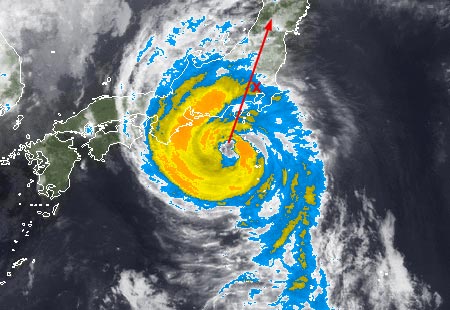
They’re saying that this is the strongest storm to hit Japan in three years, and it’s heading pretty much straight for Tokyo. To give you an idea:

Typhoon9Path

We’re the red “X” here in Tokyo. The red arrow shows the predicted path of the typhoon.

Yikes.

EDIT: I just got back in from tying down a few things on the balcony. My exercise machines are out there, and I had covered them–securely, I thought–with a tarp cover made for motorcycles, fits the elliptical trainer just about right. When I came out to look at it an hour later, I saw that the cover was half blown off, when I thought that would be impossible. So I went out again, with gales of wind billowing the cover tarp almost ridiculously, and tied the cover onto the machines with polyethylene twine. That stopped the billowing and should hold.

But standing out there was pretty impressive–sheets and sheets of rain moving horizontally at high speed in the wind.

I have to wonder what the heart of the storm is going to look like.

Categories: Focus on Japan 2007, Ikebukuro Tags: by

iPhone “Preview” in Japan

September 6th, 2007 Comments off

Here’s one thing the new iPod line means for us in Japan: we get to see what the iPhone will be like. The iPhone is not out in Japan, and won’t be until early 2008, at the soonest. They didn’t even have demo models at the Apple stores in Japan to allow people to get a glimpse of what’s available.

But now the “iPod Touch” is being sold in Japan, and effectively, it’s an iPhone, without the phone or camera–but everything else is pretty much the same. So I won’t have to wait until my trip back in December to see what one is like.

Categories: Mac News Tags: by

All the Rumors Are True, and Then Some

September 6th, 2007 12 comments

As they say, Mac shares rise on rumors and fall on news. Apple is down about $3 so far, but not because people are disappointed. Maybe it’s true this time because the news is virtually identical to the rumors that have been going on for the past several weeks. There are few surprises here. Ringtones, Red Shuffle, Phat Nano, iPod Touch. There were, however, a couple of news bits that nobody expected, especially in regard to the iPhone.

First, Ringtones. This is actually kind of disappointing. Apple has the absolute technological ability to let you assign any sound you could possibly want to assign as a ringtone… but instead they’re gonna charge you. In fact, they will charge you for the same song twice… once for downloading the song, and you pay another dollar to use that song as a ringtone. I don’t think anyone is excited about this. Rather, I think everyone is wondering when the next ringtone hack will allow people to set any audio file as a ringtone.

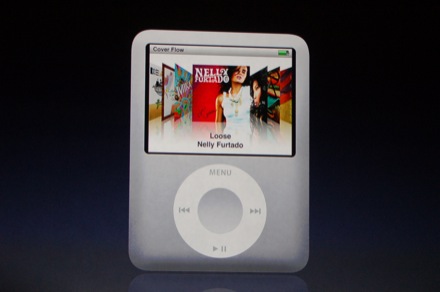
0907-Phatnano
Image borrowed (ahem) from Engadget

The Phat Nano is exactly as the spy/rumor photos had it; wide, squat, with a 2“ screen at QVGA (320 x 240) resolution–in other words, the exact same resolution as the full-sized 5G iPods, except with a 2” screen instead of a 2.5“ screen. (The previous Nano had a 176 x 132 pixel screen at 1.5”, by the way.) What’s more, the new Nanos can play video, and can do games now, like Sudoku. They’re not touch-screen, but they do have a new interface and they do have Cover Flow (slow and choppy, they say), in case you like that sort of thing. Essentially, it’s a 5G iPod scaled down to Nano proportions.

The 4GB Nano sells for $150, the 8GB for $200. On sale in stores from next weekend.

There is one surprise in here, actually: the iPod Classic. It’s essentially a retained 5G iPod, but with the new UI, a bigger hard disk (up to 160 GB!), and a new form factor, though close to the old one. The 80GB version is now $100 cheaper, priced at $250; the 160 GB version is at the old top price of $350.

But the big deal at the event is obviously the full-screen, touch-screen 6G iPod. It is, essentially, an iPhone… without the phone or the camera. And pretty much those seem to be the only things that are missing.

0907-Ipodtouch
Image borrowed from Engadget

Same sized screen as the iPhone, same resolution–but thinner in form. Otherwise, it looks just like the iPhone. It has the motion sensor for tilting and Cover Flow.

And it has WiFi. And Safari. Web browsing on your iPod. The touch-screen keyboard and everything. The iPhone YouTube app is there as well. And, of course, you can sync your address book and calendar.

22 hours audio, 5 hours video on the new battery (your milage will vary, downwards, of course).

But more news: you can buy tunes from the iTS using WiFi, directly on the iPod. Eat that, Zune! The iPhone gets the same feature in a firmware upgrade later in September.

Surprise: no hard drive. They’re making the transition to flash memory, it seems. Probably with the next big release, they’ll phase out the iPod “Classic” and start upping the GB of flash memory, I suppose.

Pricing: $300 for the 8GB, $400 for the 16GB.

On the lighter side, Apple is partnering with Starbucks, giving free WiFi access to iPod users–but apparently only access to the iTunes Store, so you can buy the songs they’re playing at Starbucks. Looks like no free Internet browsing, sorry. Just a sales angle.

One more thing… actually, pretty big news: the 8GB iPhone gets cut in price by 33%–from $600 to $400! That’s a pretty hefty price cut. I guess they figured that they made as much as they reasonably could by charging high prices while the hype was sky-high, and now can rake in even more by cutting the prices down to “sale” levels for the back-to-school and holiday seasons.

So, what about the second iPhone model?… looks like there ain’t gonna be one. Just 8GB for now.

EDIT: Hey, I just realized one more thing the iPod Touch won’t have that the iPhone does–Bluetooth. No wireless headphones. Hmm.

Categories: Mac News Tags: by

Ways to Study Better

September 5th, 2007 2 comments

It’s pretty interesting that while we teach students a lot of things, one thing we tend not to teach is how to study. One would think that this would be a natural topic to cover, but as far as I can tell, it is not widely taught.

Just yesterday, we had the first day of classes in the new semester, and I went over this topic with my students. By chance, LifeHacker linked to a web site that touched on the same topic–how to raise your GPA. Now, such a list could relate tricks that are not necessarily related to study habits, but this list sticks to advice for actually learning. The problem is, I don’t think it’s a very well-put-together list.

A few points are rather obvious, so obvious that they don’t warrant mentioning: “Go to class,” “Sit in the front row,” “Don’t do group work with slackers,” and “Don’t slack off and then pull all-nighters.” These go along with a whole list of other obvious pieces of advice not on the list, such as “Pay attention in class,” “Get enough sleep,” and “Study hard.”

One point on the list is not stated clearly: “Take notes by hand.” By reading the details, one understands the author to mean that many teachers now supply PowerPoint summaries of their lectures which the students use in lieu of notes. The author says to take your own notes instead, but “by hand” is not clear; it seems to suggest writing with a pencil and paper instead of typing into a laptop. Taking notes is good advice in general, but does not go far enough; I will elaborate more below.

The two remaining suggestions are solid enough: “Do a weekly review” is not a bad idea, and “Go to office hours” is one that few people seem to take advantage of. Most times, as a college professor, I have office hours to myself; my students rarely come and take advantage, even though I remind them that they are getting free one-to-one tutoring from an experienced college professor; the equivalent at a language school is not cheap, and they have all this access just for the asking. Many schools also provide free tutoring, which is good to take advantage of.

But there are study techniques which are even better which I share with my students, and figure that it might not make a bad blog topic for the day. So here are my own tips for studying.

1. Read the assignment before the class. A surprising number of students prefer to do the reading for a chapter after they attend the lecture, not before.

The idea here is to maximize comprehension. If you go to a lecture first and read later, you will be ill-prepared. You won’t be ready to ask questions in the right places, or you might assume that things you don’t understand from the lecture will be made clear in the reading. But later, when you go through the reading, if there are things you don’t understand, you cannot ask the textbook questions, or request that it clarify.

If you read the assignment before going to the lecture, you can go at your own pace, take the time necessary for comprehension, get to know the terminology, and understand the subject matter fairly well. Anything you don’t understand, you add to a list of questions. Later, when you attend the lecture, the teacher will probably explain the subject matter you have questions about, and so you can cross those off your list. Whatever the teacher doesn’t cover, you can then ask about in class–just read the questions off your list, already prepared. If you need clarification, the teacher can provide it readily.

Furthermore, this allows you to ask questions intelligently and economically; if you don’t read beforehand, you could wind up asking a lot of questions that are made clear in the reading, thus wasting class time and annoying classmates.

Not to mention that you’ll be prepared for any pop quizzes the teacher springs on you!

One more benefit to reading ahead: it helps you cut down on lecture note-taking. If you know the information is in the textbook, you don’t have to include it in your lecture notes when the teacher covers it in the class.

2. Summarize your pre-class reading. This one may be hard to get used to; it may seem like a lot of extra work, but the payoff can be huge. In the reading assignment, every paragraph or set of paragraphs which encapsulate a concept or chunk of information should be written in your notes with a single sentence, more than one sentence if necessary. Do not simply copy down the topic sentences; re-express the information in your own words. In the end, you’ll wind up with a one-page summary of the entire assignment, written in a style native to yourself.

The first benefit is comprehension. Have you ever read ten pages of a textbook, and then realized that you do not recall or understand a single thing? Sometimes we can go through the mechanical process of reading, but somehow our retention just switches off. Summarizing forces you to focus on the meaning; you have to understand what is being expressed in order to re-word it coherently. It will also force you to learn better how to decode and comprehend the sometimes atrocious writing styles of many textbook authors, and better see the structure and substance of textbook writing.

Summarizing also benefits retention; you are far more likely to remember something you have thought about and written than something you just read as part of as large reading. And finally, at the end of the process, you have a great, concise summary of the reading which will help enormously when you need to study for the test.

3. Take lecture notes. An obvious point, granted, but it is surprising how many people don’t do this, or don’t do it well. You should always take lecture notes.

First, write down everything the teacher writes on the board, unless you observe that your teacher writes meaningless stuff all the time. Usually, teachers write information on the board which they feel is significant, that you should pay attention to–so pay attention to it.

Second, learn how to filter information in the lecture, and distinguish between note-worthy information and non-essential filler. If you try to write down everything the teacher says, you will fall so far behind that you won’t catch most of what the teacher is saying.

Third, develop a shorthand. Writing even just the high points out fully will again set you far back and make you miss subsequent information. Work out abbreviations, and decide on graphic representations of ideas and actions. An obvious example of the latter would be to use an arrow to represent cause and effect.

4. Type out your lecture notes after class. Here’s another thing most people don’t do, but should. When we take lecture notes, we often use shorthand devices that we make up on the spot; it’s hard to have a shorthand squiggle prepared for every eventuality. We can read our own lecture notes and understand them if we review them quickly, on the same day they were written. But come back to your lecture notes after a whole week, and you will find that a big chunk of what you wrote now appears as nonsense to you.

So as part of your daily ritual, sit down and type out in longhand everything you took notes on in class. In the end, you’ll have another set of clean, concise notes that will nicely complement your reading summary. Furthermore, re-typing (and having to translate from shorthand to longhand) again aids comprehension and retention.

You might think that all of this note-taking will be time-consuming. It may be so, but you will get a better payoff in terms of improved grades, and in the end, you might even wind up saving time otherwise spent re-reading the textbook or otherwise trying to understand something you missed because you didn’t take such notes. And with experience, the time needed to take notes will decrease as you become more efficient at both note-taking and at comprehension.

5. Join a study group. Again, it may seem obvious, but a lot of people don’t do this. You should have a study group for each class that requires you to acquire information. If possible, form a study group with people who share several common classes, so you can condense the sessions. Study groups should ideally be between three and six people. You should meet at least once a week, with perhaps special sessions before exams.

First, everyone in the study group should have enough copies of their reading and lecture notes to pass around to everyone. That way, you wind up with three to six sets of notes. Studying other people’s notes (if they are well-prepared) can reveal information you may have missed, and otherwise will offer a fresh perspective and style that may make reviewing more pleasant and informative.

Second, everyone should ask questions on points they still don’t understand, or which they don’t understand as well as they would like to. There will likely be someone in the group who knows the information and can explain it to you. Questions asked by others may highlight information you should know but had missed or neglected.

And third, everyone should close their notes and have one member of the group quiz everyone else, everyone taking turns. Each question should be targeted at a specific member of the group, else one or a few members will answer most of the questions and defeat the purpose for the slower members. When another person is asked a question, see if you can answer it in your head. If someone gets an answer wrong or doesn’t answer it fully, don’t put them down or blurt out the answer yourself. Instead, try to supportively prod them for the correct or full answer–but don’t push.

6. Don’t insist on studying with people who are smarter than you are. This is advice on study groups, but I feel it’s important enough to have its own header. When choosing your study group, you may feel like joining one that is populated entirely with people who are ahead of you in the class, thinking that their smarts will rub off on you. This is not necessarily true, and may backfire.

First, you may lose confidence; if everyone is way ahead of you , you might start to feel that there’s something wrong with you when nothing is wrong with you.

Second, you may miss information you need to know, if others in the group feel it is obvious or assumed as known by everyone else.

And third, you may find that it is far more beneficial and enlightening to answer questions than it is to ask them and have things explained to you. I found this out in my post-graduate studies at San Francisco State, where I formed study groups primarily with Japanese students, due to my background in Japan. Since they were non-native speakers, they naturally caught a lot less than I did, and during study group sessions, they peppered me with questions. I gradually discovered that explaining the information to the others led to much greater comprehension on my part. This is because explaining something forces you to organize and process the information in your own mind first–something you don’t usually do when it is simply explained to you. Being in the role of tutor also gives you motivation to study harder, knowing that others are depending on you. And finally, taking on the role of tutor to classmates gives you greater confidence and a sense of pride; your classmates will likely see you in a better light as well.

7. Set up a study schedule. I will freely admit that I was the kind of student who waited until Sunday evening at 11:00 pm to start working on assignments. Needless to say, this is not a good study technique, unless you perform exceptionally well only when under time pressure. The thing is, just saying “I have to start studying earlier” usually doesn’t do the trick; you have to have a method.

You should set aside times which are dedicated to study, and treat that schedule as seriously as you would a job or an assigned class. Work out a schedule which works best for you, depending on your personal habits and quirks. General scheduling advice might include points such as studying before meals rather than after them, when you are sated and more inclined to doze off. You might want to break up your study schedule into two-hour pieces, giving yourself intervals to rest, relax, and enjoy yourself so you can return to your study refreshed.

But the core idea here is to respect the schedule and stick to it religiously. Feel free to study longer than the schedule dictates, but never shorter, unless you are assured that all your work has been completed, and effectively so.

8. Finish assignments early so you can wait and then review. One of the biggest problems with completed assignments that I see as a teacher is the lack of proofreading and review. When you finish an essay or other assignment, you tend to be tired of it and eager to set it aside, without proofreading it. Even if you do take the time to proofread, you are probably “too close” to the work and will have difficulty seeing its flaws.

Make sure that you finish an assignment at least a day before it’s due, preferably two. Then set the assignment aside at least overnight, and then proofread it the next day. You will find that you have distanced yourself enough from the work that you can look at it more objectively, and note the errors in it.

Proofreading might seem like a pain sometimes, but it is probably one of the easiest ways to hike up the grades you receive.


I hope that this list has helped you out some, if you’re a student. Even if you’re not a student, a lot of the principles here may help in other endeavors. Cheers.

Categories: Main Tags: by

We’re So Successful We Just Can’t Stand It

September 4th, 2007 2 comments

This just out:

President George Bush used a surprise visit to Iraq yesterday to raise the prospect of withdrawing some US forces if “current successes” continue, but insisted that he would not be influenced by political considerations or opinion polls. …

“General Petraeus and Ambassador Crocker tell me if the kind of success we are now seeing continues, it will be possible to maintain the same level of security with fewer American forces,” Mr Bush said.

In other words, to help out Republicans in next year’s election, we’ll be withdrawing at least some troops… not because Iraq is a complete disaster, but because it is such a stunning success.

Of course, I never said these guys didn’t write fiction for a living….

Categories: Iraq News Tags: by